Show notes

You don’t have a bad memory.
I know that statement can be hard to swallow if experience has taught you otherwise.
The real problem is that your memory was never trained. And that’s because no one was ever required to teach you how to train it.
This fact doesn’t get you off the hook in terms of responsibility for fixing the problem.
But it’s one of the most freeing realizations I can share with you when it comes to learning and memory.
And it’s an answer I share often when I answer one of the most common questions I receive here at the Magnetic Memory Method Headquarters:
“Why aren’t memory techniques taught in schools?”
Now, as I’m updating this article in 2026, the question lands with a new feeling of urgency.
As AI continues to fill our minds with a mixture of hope and concern, more people than ever before are starting to feel the cost of an untrained memory in ways they never did before.
I’ve never seen so many pictures of physical books shared on social media, for example.
And when people talk about the “school system,” often the answers they give reeks of conspiracy. They conjure up images of entire nations keeping children ignorant so they’ll grow into obedient workers for the state.
As I’ve reported in my post on rote learning, it might be the case that brute force repetition harms critical thinking.
And what on earth is more repetitive than the Internet itself?
But when it comes to why mnemonics aren’t taught in schools, the truth is simple.
And as usual, the truth is far more useful than conspiratorial thinking.
https://www.youtube.com/watch?v=IoAIkkZCROg
The Real Reason Advanced Memory Techniques Aren’t Taught In Schools
First, a fact most people miss: some memory techniques are taught in schools.
The alphabet song is a memory technique, for example.
And an acrostic like “Every Good Boy Deserves Fudge” is a memory technique from the world of music mnemonics. We hand children simple mnemonic devices for math, astronomy (like memorizing the planets) and biology all the time.
But the powerful techniques like the Memory Palace, the Major System, and 00-99 PAO System?
These almost never make it into a classroom. If ever.
Why?
Here’s the real answer:
No teacher is ever required to learn them.
Think about that sad reality for a moment.
To earn a teaching certificate, a candidate has to demonstrate all sorts of competencies.
But not one certification board on earth of which I’m aware asks prospective teachers to sit down and memorize 30 names in 3 minutes. Not one regulator asks future teachers to encode a chapter of information into a Memory Palace and recite it back.
As a result, teachers can’t model what they were never asked to master. You simply cannot pass on a skill no legislative body has ever required you to develop.
The Gap Must Be Closed
That’s it.
As far as I can tell, there’s no conspiracy to be found. Just a persistent gap in the requirements placed on teachers, one with enormous consequences.
But just imagine if that single requirement to be able to remember thirty names existed. Imagine what tremendous retention skills students would carry with them for the rest of their lives.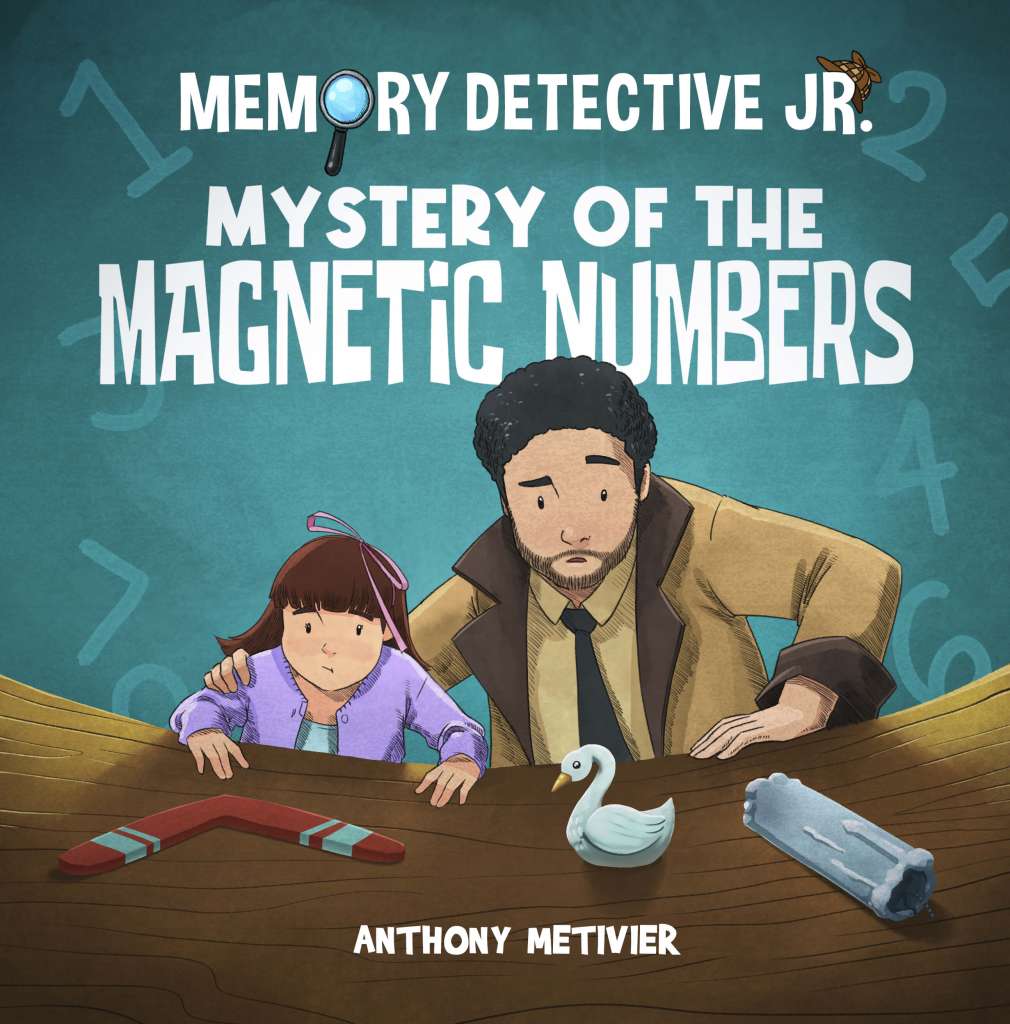
It’s one of the reasons I wrote the Memory Detective Jr. series I will be launching in the near future. It’s to put memory techniques directly into kids’ hands precisely because we don’t have a system prepared to make teachers train their memory.
At least not yet.
For now, we get major news media stories about elite colleges struggling to stamp out AI-assisted cheating.
The Interim Solution
Let me tell you about Adolfo and his son. That’s Adolfo pictured above.
He’s a veteran who went back to school as an adult. When he found his memory lacking, Adolfo signed up for the Magnetic Memory Method Masterclass.
Soon, he was acing all of his exams.
Meanwhile, Adolfo’s son was struggling to get through high school. So badly that going to university looked unlikely. In fact, even finishing high school was under threat.
So Adolfo did something most parents don’t even know they can do to help their kids.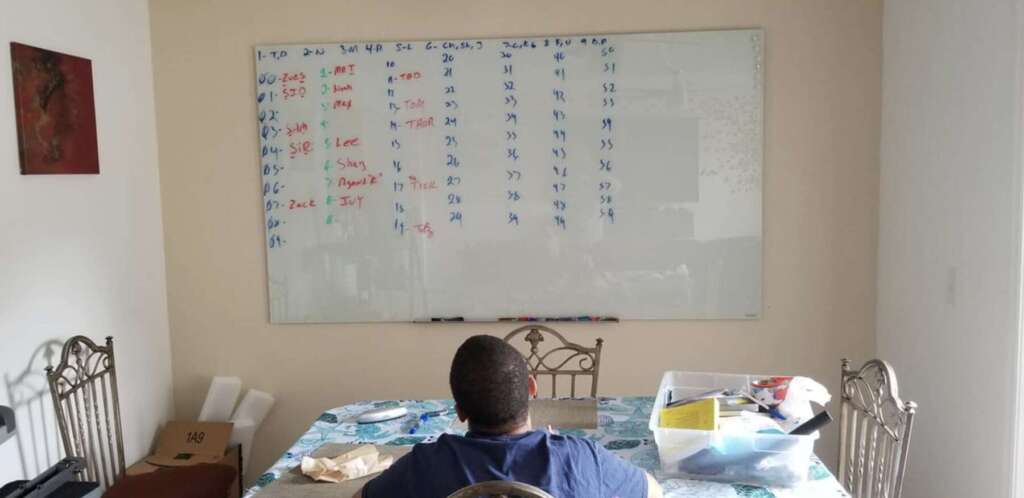
He bought a giant whiteboard, placed it on the dining room wall and sat down with his son to learn the full 00–99 PAO system.
And Adolfo did this despite the fact that it’s one of the most advanced techniques I teach. In fact, you have to learn the Major System first in order to properly use it.
Predictably, Adolfo’s son went on to ace high school. Then he earned a full scholarship to a good university in Florida. As I write this update in 2026, he’s working on his thesis.
Before his father sat down to teach his kid memory techniques? That boy was at serious risk.
Whiteboard Optional
You don’t need Adolfo’s level of dedication to change a child’s whole relationship with learning.
Mohammad Kolia taught the technique to his 9-year-old niece and nephew. As he shared in his testimonial after completing the Magnetic Memory Method Masterclass, in just a few minutes, they’d successfully memorized the first 10 elements of the periodic table using this approach.
His niece, who didn’t even know what an element was when they started, recited them to her teacher the next day and earned a gold star. Now she wants to learn the whole table.

And that’s the point. Any adult who knows these techniques can hand them to a child and successfully guide them.
It doesn’t have to be a teacher working for a school. It can be a parent, an aunt, an uncle, a mentor.
And in a world where AI is quietly doing our remembering for us, being that adult who is capable of passing on these techniques may be one of the most important gifts you can give.
Why I’m So Passionate About Enabling Parents To Take Responsibility
I don’t make this argument as someone who breezed through school.
Far from it. I once dropped out of high school. Although that experience helped me learn a lot about how to live an interesting life, I can’t say I recommend it.
At least not under the circumstances I went through.
Part of the reason why I dropped out was depression.
Part of it was in response to an English teacher who liked to give me a hard time about my grammar. He once told me, probably without a shred of honesty, that he’d give me fifty dollars and an A+ if I ever managed to publish anything.
After dropping out and going back to graduate in a different town, I actually did publish my first piece and went back to show it to him. Ironically, the magazine paid me exactly fifty dollars.
But the teacher was no longer there. He had since died.
Although I never got to see the look in his eyes when I handed him the publication or insist he correct my grade, here’s what I’ve come to understand:
Dropping out ultimately wasn’t the failure all my friends assumed it was. I spent that time reading what I actually wanted to read. I nourished a mind that school had left starving. And when I went back to finish, I was ready for the heavy memory work that would come later in graduate school.
The Need For More Authenticity
A subset of my thinking as a generally AI-positive person is that the only way we can make ourselves bulletproof for the unknown future is to pursue the same options we’ve always had:
Go to the real place and do the real thing.
And be real about it.
For years, I have shared the harder parts of my story openly, especially in my book The Victorious Mind.
Just this morning, I was on a call with a long-time supporter of the Magnetic Memory Method and he shared how he had lost his son. He talked about how much my willingness to talk about the dark stretches in my own life meant to him.
Make no mistake. Writing The Victorious Mind was not easy. But it’s precisely because authenticity helps us all improve that I decided to share my most raw experiences in that book.
And because memory training exercises like these have helped my state of mind so much, on top of learning, being open has been worth it.
So if you’re struggling right now, please don’t carry it alone. Reach out to someone you trust or a local support line. It matters. And so do you.
But Are Simple Mnemonics Enough?
To bring this back to requiring teachers to learn and be able to use memory techniques, I think the problem we face is a lack of authenticity.
I make mistakes publicly all the time when accessing my memory. Of course, my success rate is more than sufficiently high, but many people don’t have the willingness to mess up.
Their egos rule the roost.
And if they engage with mnemonics at all, they stick with the simplistic “list of mnemonics” found on Wikipedia.
Most of them are useless. Worse than useless, frankly because acrostics and acronyms pile on overwhelm because they lack context and the associative power of well-formed mnemonic images.
They have no method, and are generally nothing like the techniques included in my free online mnemonics dictionary.
Ultimately, it’s to encourage people to put their egos aside and dive into the deep end of advanced mnemonics that the Magnetic Memory Method exists.
Not to hand you gimmicks, or some magic fix-all fantasy that improves your memory for all things forever and ever, amen. That’s not reality, and I won’t pretend otherwise.
Instead, my books and programs break the techniques down to the how, the why and the what. And I don’t stop until using memory techniques starts feeling fun.
Of course, serious memory training isn’t for everyone. Plenty of people just want formulas and shortcuts. If that’s what you’re after, I’m not your guy.
But if you want to actually master your memory and treat it as the precious asset that makes every other kind of learning possible, then you’re in the right place. And I’ve got your back.
So Here’s the Real Question…
It was never all that helpful to ask, “why don’t they teach these techniques in school?”
The real question is the one only you can answer:
Now that you know your memory was never broken, what are you going to do about it?
If taking action right now appeals to you, start here with my free memory improvement course:

And then help someone else improve their memory based on your own level of skill.
Soon, you’ll enjoy the benefits of knowing what really improves your memory, leading to the ability to think faster and improve your concentration.
So what do you say?
Do you share my philosophy about learning and memory?
It basically boils down to the old line about teaching people how to fish instead of doing the fishing for them.
Except in this case, it’s also about fishing, hunting, farming, gathering berries and filling your memory with many other skills too. The way only authentic effort to develop your mind can.

 Our TOPPODCAST Picks
  Stay Connected