TopPodcast.com
Menu
  • Home
  • Top Charts
  • Top Networks
  • Top Apps
  • Top Independents
  • Top Podfluencers
  • Top Picks
    • Top Business Podcasts
    • Top True Crime Podcasts
    • Top Finance Podcasts
    • Top Comedy Podcasts
    • Top Music Podcasts
    • Top Womens Podcasts
    • Top Kids Podcasts
    • Top Sports Podcasts
    • Top News Podcasts
    • Top Tech Podcasts
    • Top Crypto Podcasts
    • Top Entrepreneurial Podcasts
    • Top Fantasy Sports Podcasts
    • Top Political Podcasts
    • Top Science Podcasts
    • Top Self Help Podcasts
    • Top Sports Betting Podcasts
    • Top Stocks Podcasts
  • Podcast News
  • About Us
  • Podcast Advertising
  • Contact
Not in our directory?
Add Show Here
Podcast Equipment
Center

toppodcastlogoOur TOPPODCAST Picks

  • Comedy
  • Crypto
  • Sports
  • News
  • Politics
  • True Crime
  • Business
  • Finance

Follow Us

toppodcastlogoStay Connected

    View Top 200 Chart
    Back to Rankings Page
    History

    Walter Edgar’s Journal

    From books to barbecue, and current events to Colonial history, historian and author Walter Edgar delves into the arts, culture, and history of South Carolina and the American South. Produced by South Carolina Public Radio.

    Advertise

    Copyright: © 2023 South Carolina Public Radio

    • Apple Podcasts
    • Google Play
    • Spotify

    Latest Episodes:
    "Never greater slaughter" - the battle of Brunanburh and the birth of England Jan 10, 2022
    Show notes
    A scan of John Speed's 1611 map of the Wirral Peninsula, showing 'Brunburgh' on the eastern shore.
    A scan of John Speed's 1611 map of the Wirral Peninsula, showing 'Brunburgh' on the eastern shore. ( Courtesy of Michael Livingston)

    Late in AD 937, four armies met in a place called Brunanburh. On one side stood the shield-wall of the expanding kingdom of the Anglo-Saxons. On the other side stood a remarkable alliance of rival kings - at least two from across the sea - who'd come together to destroy them once and for all. The stakes were no less than the survival of the dream that would become England. The armies were massive. The violence, when it began, was enough to shock a violent age. Brunanburh may not today have the fame of Hastings, Crécy or Agincourt, but those later battles, were fought for an England that would not exist were it not for the blood spilled this day. Generations later it was still called, quite simply, the ‘great battle'. But for centuries, its location has been lost.

    In his book, Never Greater Slaughter: Brunanburh and the Birth of England (Osprey, 2021) Dr. Michael Livingston, tells the story of the battle and of an extraordinary effort, uniting enthusiasts, historians, archaeologists, linguists, and other researchers – amateurs and professionals, experienced and inexperienced alike – which may well have found the site of the long-lost battle of Brunanburh, over a thousand years after its bloodied fields witnessed history

    Michael Livingston holds degrees in History, Medieval Studies, and English, and teaches the military and cultural history of the Middle Ages at The Citadel.


    100 years of the Poetry Society of South Carolina Jan 05, 2022
    Show notes
    (Sponchia / Pixabay)

    James Lundy's book, The History of the Poetry Society of South Carolina: 1920 to 2021, is a chronicle of the first 100 years of the oldest state poetry society in America, the Poetry Society of South Carolina. Founded in Charleston in 1920 by DuBose Heyward, John Bennett, Josephine Pinckney, Hervey Allen, and Laura Bragg, the Society's first 101 seasons run from the Jazz Age to the COVID era, where everyone from Carl Sandburg, Edna St. Vincent Millay, Robert Frost, Robert Penn Warren, Allen Tate, Ogden Nash, Billy Collins, Sherwood Anderson, Jericho Brown, Thornton Wilder, Robert Pinsky, and hundreds of others appeared before the membership.

    Talking with Walter Edgar, Lundy, also currently the Society's president, gives us an insider's view, with insights into the inner workings and disfunctions of the organization and its slow progress from a Whites-only organization of the segregated South founded in the aftermath of World War I and the Spanish Flu Pandemic, through the Roaring Twenties, into the darkness of the Great Depression, World War II, a resurgence during the Atomic Age, the turbulent Sixties, the decline of Charleston, its rebound into a tourist mecca, and into the present day.


    Why Southern Identity Still Matters Dec 27, 2021
    Show notes
    Okra for sale at the North Charleston Farmers' Market.
    Okra for sale at the North Charleston Farmers' Market.(Ryan Johnson / Flickr)

    The American South has experienced remarkable change over the past half century. Black voter registration has increased, the region’s politics have shifted, and in-migration has increased its population many fold. At the same time, many outward signs of regional distinctiveness have faded. But two professors of political science write that these changes have allowed for new types of Southern identity to emerge.

    In their new book, The Resilience of Southern Identity: Why the South Still Matters in the Minds of Its People (2017, UNC Press), Western Carolina University's Chris Cooper and the College of Charleston's Gibbs Knotts argue that, for some, identification with the South has become more about a connection to the region’s folkways or to place than about policy or ideology. For others, the contemporary South is all of those things at once—a place where many modern-day southerners navigate the region’s confusing and omnipresent history.

    - Originally broadcast 11/23/19 -

    News and Music Stations: Fri, Dec 31, at 12 pm; Sat, Jan 01, at 7 am
    News & Talk Stations: Friday, Dec 31, at 12 pm; Sun, Jan 02, at 4 pm


    Walter Edgar's Journal: A history professor on the radio? Dec 20, 2021
    Show notes
    Tom Fowler and Walter Edgar broadcasting a live episode of Walter Edgar's Journal in 2002 from Columbia's Woodhill Mall at part of the observance of SC Public Radio's 30th anniversary.
    Tom Fowler and Walter Edgar broadcasting a live episode of Walter Edgar's Journal in 2002 from Columbia's Woodhill Mall at part of the observance of SC Public Radio's 30th anniversary.( SC Public Radio)

    This fall Walter Edgar's Journal has been celebrating 21 years on the air by offering encore episodes from our vault. This week we bring you a special episode of The Journal with Walter and long-time Journal producer Alfred Turner as guests, and with SC Public Radio reporter Victoria Hansen guiding a discussion of the history of the program.

    In 2000 a special program aired on South Carolina Public Radio (then South Carolina Educational Radio). It featured a veteran broadcaster and a university professor as hosts and doing live news coverage of the removal of the Confederate battle flag from the state house dome. The program featured called-in comments from listeners.

    From that one-time broadcast came an idea for a live, weekly talk program with broadcaster Tom Fowler and historian Dr. Walter Edgar who would interview guests and take calls from listeners about topics of the day. The program, unnamed for its first few months, became Walter Edgar's Journal, and would evolve into weekly conversation with guests - authors, artists, politicians, and everyday folks - talking about everything from politics to barbeque, topics centered in the American South with a focus on our state's history and culture.

    - Originally posted 11/05/21 -


    U.S. Army Corps of Engineers – 150 years Dec 13, 2021
    Show notes
    Aerial photo of a portion of Charleston Harbor and the Port of Charleston.
    Aerial photo of a portion of Charleston Harbor and the Port of Charleston.(Dennis Franklin) / US Army)

    In 2021, the U.S. Army Corps of Engineers celebrates the 150th anniversary of its founding. The Corps' Charleston District has a unique and varied program that grows larger every year. The Civil Works, Navigation, Regulatory, Emergency Management, Military, and Interagency and International Services programs serve a diverse group of customers that span not only South Carolina, but also globally, which keeps the staff of more than 240 quite busy.

    Lt Colonel Andrew Johannes, Charleston District Commander; and Brian Williams, the District’s Civil Works Chief, join Walter Edgar for a conversation on the Corps’ history, its missions, and the many ways its work impacts South Carolina, including the deepening of Charleston Harbor.

    News and Music Stations: Fri, Dec 17, at 12 pm; Sat, Dec 18, at 7 am
    News & Talk Stations: Friday, Dec 17, at 12 pm; Sun, Dec 19, at 4 pm


    WEJ at 21: What was the most influential Southern novel of the 20th century? Dec 09, 2021
    Show notes
    The late Noel Polk and Tudier Harris, with Walter Edgar, taping "Take on the South."
    The late Noel Polk and Tudier Harris, with Walter Edgar, taping "Take on the South."(SCETV/SC Public Radio)

    As part of our continuing celebration of Walter Edgar’s Journal at 21 we present an encore broadcast from May of 2009.

    Internationally renowned Southern literature scholars Trudier Harris, University Distinguished Research Professor at the University of Alabama, and the late Noel Polk, formerly of Mississippi State University join Dr. Edgar to debate the question “What was the most influential Southern novel of the 20th century?” This episode is a companion of the SCETV’s Take on the South: What was the most influential Southern novel of the 20th century? That was originally broadcast on Wednesday, May 13, 2009. Take on the South is a series of eight, one-hour, live-to-tape debates produced by SCETV for the University of South Carolina's Institute for Southern Studies (ISS) under a grant provided by Watson-Brown Foundation, Inc. You can watch this program, on demand, at knowitall.org.

    News and Music Stations: Fri, Dec 10, at 12 pm; Sat, Dec 11, at 7 am
    News & Talk Stations: Friday, Dec 10, at 12 pm; Sun, Dec 12, at 4 pm


    Justice deferred - race and the Supreme Court Nov 29, 2021
    Show notes
    FILE
    FILE(TexasGOPVote.com / Flickr)

    The Supreme Court is usually seen as protector of our liberties: it ended segregation, was a guarantor of fair trials, and safeguarded free speech and the vote. But this narrative derives mostly from a short period, from the 1930s to the early 1970s. Before then, the Court spent a century largely ignoring or suppressing basic rights, while the fifty years since 1970 have witnessed a mostly accelerating retreat from racial justice.

    In their book, Justice Deferred - Race and the Supreme Court (2021, Belknap Press), historian Orville Vernon Burton and civil rights lawyer Armand Derfner shine a powerful light on the Court’s race record—a legacy at times uplifting, but more often distressing and sometimes disgraceful. Justice Deferred is the first book that comprehensively charts the Court’s race jurisprudence.

    In this episode of Walter Edgar’s Journal, Burton and Derfner tell us many of the sometimes-surprising stories behind the Supreme Court’s rulings.


    WEJ at 21: The weight of mercy - a novice pastor on the city streets Nov 22, 2021
    Show notes
    Deb Richardson-Moore, former pastor of Triune Mercy Center, Greenville, SC
    Deb Richardson-Moore, former pastor of Triune Mercy Center, Greenville, SC( Courtesy of Deb Richardson-Moore)

    Deb Richardson-Moore, a middle-aged suburban mom and journalist was inspired to become a pastor after writing a story exploring God’s call in our lives. Then, in 1996, a recent graduate of Erskine Theological Seminary, she took a position as pastor of the non-denominational Triune Mercy Center, an inner-city mission to the homeless in Greenville, S.C.

    “What I found there absolutely flattened me,” she says. It also inspired her. Today, she and a dedicated staff continue to build a worshiping community that focuses on drug rehab, jobs, and housing for the homeless.

    Walter Edgar visits Pastor Richardson-Moore in her study at the Center to talk about the growth of its ministry and her journey, as well as her recent memoir, The Weight of Mercy: A Novice Pastor on the City Streets (Monarch Books, 2012)

    - Originally broadcast 12/13/13 -

    News and Music Stations: Fri, Nov 26, at 12 pm; Sat, Nov 27, at 7 am
    News & Talk Stations: Friday, Nov 26, at 12 pm; Sun, Nov 28, at 4 pm


    WEJ at 21: Death and the Civil War Nov 15, 2021
    Show notes

    In celebration of Walter Edgar’s Journal at 21, this week's episode is an encore from 2012. In Ric Burns’ American Experience documentary, Death and the Civil War, he explores the 19th century idealization of a “good death,” and how that concept was brutally changed by battles like that at Gettysburg.

    With the coming of the Civil War, and the staggering casualties it ushered in, death entered the experience of the American people as it never had before -- permanently altering the character of the republic and the psyche of the American people.

    Burns joins Dr. Edgar to talk about the film, and the ways in which the Civil War forever changed the way Americans deal with death. Also taking part in the discussion are David W. Blight, Professor of American History at Yale University, and the Director of the Gilder Lehrman Center for the Study of Slavery, Resistance, and Abolition at Yale; and Dr. Drew Gilpin Faust, the Lincoln Professor of History in Harvard’s Faculty of Arts and Sciences. Her Pulitzer-Prize-winning book, This Republic of Suffering: Death and the American Civil War (Alfred A. Knopf, 2008) forms the basis for Burn’s documentary.

    - Originally broadcast 09/14/12 -


    Liberty is Sweet: The Hidden History of the American Revolution Nov 08, 2021
    Show notes
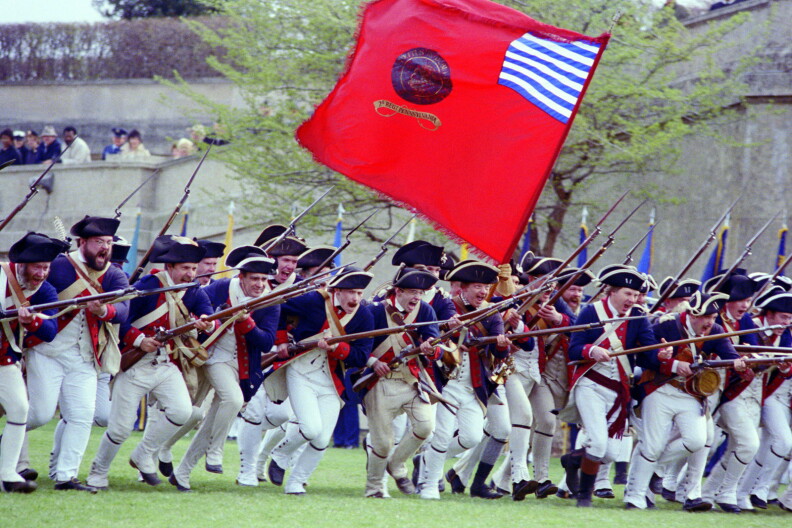
    Troops wearing the Revolutionary War uniforms of the 9th Virginia Regiment, Corps of the Continental Line, participate in a drill and firing demonstration during the Cessation of Hostilities Bicentennial Celebration at the Pentagon River Plaza. The flag of the ceremonial 2nd Pennsylvania Regiment, Corps of the Continental Line, is carried in the background.
    Troops wearing the Revolutionary War uniforms of the 9th Virginia Regiment, Corps of the Continental Line, participate in a drill and firing demonstration during the Cessation of Hostilities Bicentennial Celebration at the Pentagon River Plaza. The flag of the ceremonial 2nd Pennsylvania Regiment, Corps of the Continental Line, is carried in the background.(Sanborn / U. S. National Archive)

    In his new book, Liberty is Sweet: The Hidden History of the American Revolution (2021, Simon and Schuster), Dr. Woody Holton gives a sweeping reassessment of the American Revolution, showing how the Founders were influenced by overlooked Americans—women, Native Americans, African Americans, and religious dissenters.

    Using more than a thousand eyewitness accounts, Holton explores countless connections between the Patriots of 1776 and other Americans whose passion for freedom often brought them into conflict with the Founding Fathers.

    Woody Holton joins Walter Edgar to talk about this “hidden history.”


    Previous 1 14 15 16 17 18 37 Next

    Related Podcasts

    Dan Carlin’s Hardcore History

    1

    Dan Carlin’s Hardcore History History
    More Perfect

    2

    More Perfect Government
    Casefile True Crime

    3

    Casefile True Crime Games & Hobbies
    The Way I Heard It with Mike Rowe

    4

    The Way I Heard It with Mike Rowe History
    BackStory

    5

    BackStory History
    The Black Dahlia Serial Killers

    6

    The Black Dahlia Serial Killers History
    footer-logo

    Contact Us

    Toll Free: 844-670-7747

    Links

    • Home
    • Top Charts
    • Networks
    • Apps
    • Independents Podcasts
    • Podcast Advertising
    • Podcast News
    • Contact Us
    • About Us
    • Analytics & Insights

    Stay Connected

      Privacy, Terms of Use & Our Code of Ethics Protecting Content Creators Copyrights