Join Dr Rad and Dr G as we discuss, spar, and laugh our way through different aspects of the ancient Roman world! Our main series ‘From the Foundation of the City’ follows Roman history year by year from the traditional foundation date of 753 BCE. We also interview academics and specialists from around the globe for their insights into history and the representation of Rome and the ancient Mediterranean in popular culture. Dr Fiona Radford is an expert on Rome on film and wrote her thesis on Kubrick’s Spartacus. Dr Radford is exponent of not only Ancient History, but also Reception Studies. Dr Peta Greenfield is an expert on the Vestal Virgins. Dr Greenfield’s research interests include: religion and politics in Rome, the late republic and Augustan period, and the role of women.
Special Episode – The Year of the Four Emperors with Dr Rob Cromarty
Dec 17, 2020
Show notes
We are thrilled to be joined by Dr Rob Cromarty, better known as Doc Crom, for this special episode on the Year of the Four Emperors. Doc Crom, is a teacher, author, and fellow fan of #PhallusThursdays and #FannyFriday over on twitter and we recommend you follow him for his excellent tweets about Latin literature and ancient artefacts.
In this very special episode we talk about his journey into Classics and his take on the personalities and power struggles involved in the aftermath of the death of the Emperor Nero.
Special Episode – The Year of the Four Emperors with Dr Rob Cromarty
What is ‘The Year of the Four Emperors’?
The Emperor Nero made several mistakes in the last few years of his reign. Following the brutal suppression of a serious conspiracy against him, Nero left Rome in the hands of his freedmen so that he could compete in the Olympic Games.
Back in Rome, the people were dealing with low grain supplies. The aristocracy had been alienated for years, and the increasing use of delatores (informers) only made matters worse. The army was also on edge after the execution of talented generals like Corbulo. The situation in early 68 CE was tense.
The extent of Roman power in the crucial years of 68 and 69 CE. Image courtesy of Wikimedia Commons.
That’s Revolting
The Year of the Four Emperors really kicks off with rebellion. In March, Caius Julius Vindex, then stationed in Gaul, revolted in protest against Nero’s tax policy. Some problems never change. Servius Sulpicius Galba, an old associate of some of the Julio-Claudians, was stationed in Spain and decided to throw his lot in with Vindex.
Vindex’s rebellion was put down by Lucius Verginius Rufus, and Galba was declared a public enemy. But that did not last long. The Praetorian Prefect, Nymphidius Sabinus, promised the guard a hefty donative to transfer their allegiance from Nero to Galba, and before long the Senate had made Nero himself a public enemy.
The First of the Four
Galba became emperor in June 68 CE after the suicide of Nero. As a stern, experienced candidate, he must have seemed like a promising choice. However, he soon acquired something of a reputation. According to sources, his assumption of power involved the death of many, and he was stingy with money. Most importantly, he did not provide soldiers with the bonuses they had been promised in exchange for their support. As Tacitus (Hist. 1.49.6) remarked, “…no one would have doubted his ability to reign had he never been emperor.”
Galba was also 73 years old and had no children. This didn’t bode well for stability, and so he decided to focus on improving his position in this area by adopting Lucius Calpurnius Piso in January of 69 CE, a deliberate snub to one of his most prominent supporters – Otho.
A portrait bust of the Roman emperor Galba. This piece is held in the Antiquities Museum in the Royal Palace, Stockholm. Photo credit to Wolfgang Sauber via Wikimedia Commons.
The Year of the Four Emperors, Take Two
To say that Otho was displeased is an understatement. He bribed the Praetorians to back his cause; after all, they weren’t getting bonuses from Galba! On the 15th of January 69 CE, Piso and Galba were assassinated in the forum. Otho thus became the first emperor to unequivocally acquire power by killing the previous emperor. Otho was well known as he had been a prominent member of Nero’s court; indeed, Nero’s most beloved wife, Poppaea Sabina, had once been married to Otho. Unlike Galba, who sought to distance himself from Nero and condemn his reputation, Otho played on the connection.
However, he faced challenges from the outset. Otho became emperor on 15th January 69 CE and took control of the city of Rome, but another would-be emperor had already taken initiative. The soldiers in Germania Inferior refused to swear loyalty to Galba on the 1st January 69 CE, soon to be followed by the troops of Germania Superior. Vitellius had been stationed in Germania Inferior by Galba, and he began to organise his bid for power. Otho had a lot of support, but his forces were not close by, and he was defeated by Vitellius’ forces at the First Battle of Cremona and driven back to Bedriacum. Rather than prolong the civil war, Otho committed suicide on 16th April 69 CE. But his death would not bring the conflict to an end.
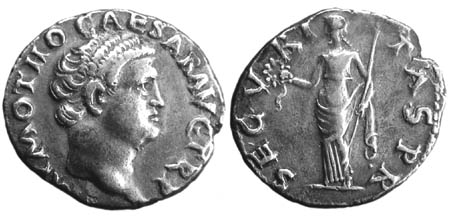
Silver Denarius of Otho, Rome mint. His bare head right, IMP M OTHO CAESAR AVG TR P around / Securitas standing left holding wreath and scepter, SECURITAS P R. RIC 8. BMCRE 17. Sear RCV 2162. Source: accla.org
Of all the emperors to reign in this period, Vitellius probably has the worst reputation (thank you, Flavians?). He had a good relationship with parts of the army and was a well-known figure from the Julio-Claudian period, but the sources record that he was also a glutton, and associated with actors, chariot-drivers and freedmen.
As Vitellius’ popularity started to decline, another emperor was proclaimed in the east on 1st July 69 CE. A man from a modest background, Titus Flavius Vespasianus, had become a trusted military commander. He was supported by the Prefect of Egypt, Tiberius Julius Alexander, and gradually others joined his cause, including the governor of Upper Pannonia (Primus) and the governor of Syria (Mucianus).
A second Battle of Cremona ensued in September 69 CE between the Vitellians and some of Vespasian’s supporters. By December, Vespasian’s men were in Rome itself, and Vitellius was located and slaughtered in the Forum.
This portrait of Vitellius is based on the bust held by the Capitoline Museums in Rome. This particular example is held by the Royal Academy of Fine Arts of San Fernando in Madrid. Photo credit: Luis García (Zaqarbal) via Wikimedia Commons
What’s going on with Otho and Vitellius? Tune into our classic episode for more details.
A New Dynasty Begins!
The year of the four emperors draws to a close with Vespasian. He managed to hold on to power for the next ten years, and was succeeded by his two sons, establishing the second dynasty of imperial Rome.
But how much did his victory influence the historical accounts of this time?
Join us as we discuss the ins and outs of this complicated period, which actually lasted for longer than just one year.
Portrait of Titus Flavius Vespasian, who emerges as a stable ruler from the chaotic years of 68 and 69 CE. Photo credit: Heribert Pohl via Wikimedia Commons
Major Primary Sources
Suetonius, The Twelve Caesars, the lives of Nero, Otho, Galba, Vitellius, and Vespasian
Additional sound effects: Fesliyan Studios, the BBC, Sound Bible, and Pond5
Episode 108 – Plague and Politics
Nov 19, 2020
Show notes
It’s 453 BCE and just as Rome seems to be heading towards a legal milestone disaster strikes: it’s a plague!
Now plagues are terrible, of that there is no doubt, but how does this influence the path to codification? We’re here to find out.
Episode 108 – Plague and Politics
The Character of the Plague
It is hard to identify the plague with certainty. What is clear from our later written sources is that the collective memory recalls this plague as highly contagious with the capacity to leap between species. People caught it but so too did some of the animals that people worked closely with.
The origin of the plague and how it eventually came to an end are lost to us. In lieu of strong osteoarchaeological evidence, it is possible to interpret this plague as a shared idea of opposition to the codification of the laws, which the elites likely saw as infringing upon their power.
Both Livy and Dionysius of Halicarnassus focus on the devastating consequences of the plague. Things to listen out for:
The horrific death toll
The Aequians!
The issue with the harvest
With 453 BCE wholly occupied with pestilence and its effects, everyone still standing is hoping for a better time in 452 BCE…
The Athenian Junket Returns!
Lucky for Rome, the plague does not go so far as Athens. The delegates sent out to find out about the law codes that others have produced return with some new ideas. There are some odd things about our narrative accounts though which Dr Rad delves into. Some pertinent questions:
Why would the Romans go all the way to Athens?
What are the law codes of the Greeks like? Do the Twelve Tables really suggest a Greek influence?
What might our narrative accounts gain by suggesting a connection with Greece at this point?
Rome’s Heading into Uncertain Territory
It’s fair to say that our narrative sources leave us somewhat dissatisfied. Our sources inspire less confidence the further we move into the Struggle of the Orders.
Who are the patricians?
Who are the plebeians?
How were these demarcations understood by the Romans?
Do our writers from the late Republican period really have a clear handle on what happened in the past?
Will the Twelve Tables live up to the suspense?
Only time will tell…
Thomas Cole The Course of Empire. Desolation 1836. Courtesy of Wikimedia Commons
Our Players in 453BCE
Consuls
Publius Curiatus — f. — n. Fistus Trigeminus (Pat)
Sextus Quinctilius Sex f. P. n. ‘Varus’ (Pat)
Suffect Consul
Spurius Furius Medullinus Fusus (cos. 464 BCE) (Pat)
Flamen Quirinalus
Servius Cornelius
Augur
C. Horatius Pulvillus
Our Players in 452 BCE
Consuls
Gaius/Lucius/Titus (?) Menenius Agripp. f. Agripp. n. Lanatus (Pat)
Publius Sestius Q. f. Vibi. n. Capito(linus?) Vaticanus (Pat)
Consular Nominations
Appius Claudius Ap. f. M. n. Crassus Inrigillenssis Sabinus (Pat)
Titus Genucius L. f. L. n. Augurinus (Pat)
Our Sources
Dr Rad reads Livy ab urbe condita 3.32
Dr G reads Dionysius of Halicarnassus Roman Antiquities 10.53-54
Episode 107 – Let the Codification Begin!
Oct 15, 2020
Show notes
We jump into 454 BCE where we start to see the consequences of the events of the previous year play out. It’s hard to get away from our “Roman Achilles” who, in his position as plebeian tribune, levels a charge of “injuring the state” against the former consul Romilius. This sets up a cascade of interesting incidents.
Episode 107 – Let the Codification Begin
There’s little agreement between our major written sources for this year. Livy and Dionysius of Halicarnassus diverge in much of the details even though they hit upon some shared touchstones.
But this is partly about what we don’t know…
Dr Rad explores some of the complexities of who is who during this period. While our sources use categories like ‘patrician’ and ‘plebeian’, these terms offer a binary model for thinking about the structure of Roman society. Often this is a simplification of what was really happening. By the time we get to the first century BCE when these histories were written, the composition of these groups is more clear cut than they were in the fifth century.
Speeches as didactic tools
Dr G delves into Dionysius of Halicarnassus’ use of speeches as a means of teasing out a Roman perspective. Speeches are a significant feature in his writing and sets his work apart from Livy during this period. Dionysius’ penchant for rhetoric offers a means of appreciating how the Romans thought. They also offer a framework for Greek readers to appreciate the reasoning of the Romans.
Listen in for…
Consuls with attitude!
A story of a father, a son, and filial duty
The Lex Aternia Tarpeia
The law about the laws!
A surprising consular return
The laws of Solon
Our Players for 454 BCE
The Consuls
Spurius Tarpeius M. f. M.n. Montanus Capitolinus (Pat.)
Aulus Terminius/Aternius – f. – n. Varus Fontinalis (Pat.)
Special Episode – Medusa with Let’s Talk About Myths Baby
Sep 17, 2020
Show notes
Medusa fills the imagination with a very particular kind of fascination. Pity for her situation and dread of what she is capable of make her one of the most recognisable figures from Greek myth. She has transcended that context with her story reimagined by the Romans, the artists of the Renaissance, and she continues to excite wonder today.
We sat down to talk about Medusa and her representation with the fabulous Liv, host of Let’s Talk about Myths Baby.
Special Episode – Medusa with Let’s Talk About Myths Baby
In this far-reaching conversation, we’ll be considering some of the key stories that make up the mythological world of Medusa including:
How she came to have snakes for hair
The challenges she faced as the mortal Gorgon
And how her representation often reflects the values of the context of the artwork.
Who is Medusa?
When you start to look, Medusa is everywhere (but also, don’t look!). She is an extremely ancient figure best known for the Greek myths associated with the hero Perseus.
Medusa is famous for her snaky hair and ability to turn living things to stone with her gaze. This ability has been immortalised in movies such as Clash of the Titans (1981) and its 2010 remake, and Percy Jackson and the Lightning Thief (2010).
Her decapitated head—the Gorgoneoin—can be found on the breastplate of the goddess Athena, the logo for Versace and the Sicilian flag, as well as decorating many ancient buildings, floors and pottery.
Medusa endures today as a polyvalent symbol of danger and empowerment. She recently featured in Assassin’s CreedOdyssey (2018) and her name is given to the crime network in The Hustle (2019), the gender-swapped reboot of Dirty Rotten Scoundrels (1988).
Join us as we discuss Medusa’s journey to becoming a symbol that can seemingly serve many masters.
Ancient Accounts of Medusa
This is not an exhaustive list, but a guide to those we mention in this discussion and a great place to start reading!
Homer Iliad5.741 – The Gorgon’s head is described as a “ghastly monster” and a “potent symbol of Zeus”. Also see 8.349, where Hector’s gaze is likened to that of Gorgo and 11.36f for a description of a Gorgon’s head on the face of Agamemnon’s shield.
A great deal of Medusa’s complexity has developed through her reception over time. This is particularly apparent in art. We explore a few key examples that draw attention to a range of interpretations
The Rondanini Medusa
Dating to the late Hellenistic or Augustan periods, the Rondanini Medusa is iconic. It captured the imagination of Goethe during his travels in Italy and it shares many visual elements with the Versace logo as well.
“So-called “Rondanini Medusa”. Marble, Roman copy after a 5th-century BC Greek original by Phidias, which was set on the shield of Athena Parthenos.” Source: Wikimedia Commons, photograph by MatthiasKabel, 2005-10-26.
Perseus by Cellini, 1545-1554
This exceptional bronze can be found in Florence where it offers interpretation of the ancient myth and comment on Medici politics…
Bronze and marble (base), 1545–1554. Under the Loggia dei Lanzi, Florence, since 1554. Image Source: Wikimedia Commons, photograph by Jastrow, 13-9-2005
Medusa by Caravaggio 1595-98
Florence is home not only to the Cellini bronze, but also the famous Caravaggio portrait, where the face of Medusa is interchangeable with that of the artist himself.
You can also explore Caravaggio’s Testa di Medusa in detail here.
Bust of the Medusa by Bernini 1644/8
Liv cites Bernini’s Medusa as a piece that encourages empathy for the subject. This perspective will come to the fore again in the twentieth and twenty-first centuries.
Held by the Musei Capitolini, Rome. Source: Wikimedia Commons, photograph by Miguel Hermoso Cuesta, 17-4-2014.
You can explore Bernini’s sensitive artistry in detail here.
Medusa in King’s Quest 3, 1986
Check out this quality graphic!
For Dr G, this was a definitely encounter with Medusa. For many children of the 80s, encountering myths through computer games was a window into the ancient world and its amazing stories.
Garbati’s Medusa flipped the heroic narrative of Perseus and cast our snake-haired heroine as a woman of her own destiny. This reimagining of Medusa’s story demonstrates how cultural perspective can shift representation.
You can explore high quality images of Garbati’s work here.
The complexities of Medusa’s story allow for a variety of interpretations. Garbati’s sculpture positions her as a figure of female empowerment, gaining power by taking the head of Perseus. The image of her head severed from her body has also been repurposed as political imagery by pro-Trump, anti-Hillary campaigners. In such cases, the myth of Medusa is designed to keep women from power. Why are we drawn back to her story time and again?
Good Greeks!
Since we recorded this episode, we’re excited to say that Liv has a book coming out soon! It’s all about Greek myth and is gorgeously illustrated. If you’re looking for a little more Greek myth in your life, this might be just the ticket 🙂
Looking to delve further into the world of Medusa? We’ve got you covered. Below are the works we refer to in this episode as well as readings that will build your appreciation for this incredibly engaging figure from Greek myth.
Bremmer, J. N. & Welwei, K. 2006. ‘Gorgo’, in Brill’s New Pauly. Consulted online on 11 January 2020.
Hirst’s article is a great place to start. This is an accessible overview of who Medusa was and the main myths associated with her in the ancient world.
Keith focuses on Ovid, Lucan and Statius and analyses how these Roman authors reconciled themselves with the power of Medusa’s image. Ovid and Lucan’s work has been very influential in shaping the Medusa myth!
Lewis, S. 2011. ‘Women and Myth’, in A Companion to Greek Mythology, eds K. Dowden & N. Livingstone (Wiley), 443-458.
Mergenthaler, V. 2008. ‘Gorgon’, in Brill’s New Pauly Supplements I – Volume 4: The Reception of Myth and Mythology. Consulted online on 11 January 2020.
Topper’s article is extremely useful for anyone interested in the artistic representations of Perseus and Medusa. Topper explains that earlier attempts to categorise representations of the Gorgon were too “neat” and linear, suggesting that Medusa and her sister moved from more monstrous or grotesque to a beautified image in the Hellenistic and Roman periods.
This introduction provides a succinct overview of the work of French feminist Hélène Cixous’, namely her ‘Laugh of the Medusa’. Keener readers may wish to consult the full essay on Cixous contained in this volume by Zajko.
Sound Credit
With gratitude we offer thanks to Bettina Joy de Guzman for the evocative music that accompanies this episode. She’s an incredibly talented musician and scholar as well as a fantastic supporter of our podcast.
Episode 106 – Spoiler Alert
Aug 13, 2020
Show notes
We continue to follow the cause of our Roman Achilles–more formally known as Lucius Siccius Dentatus–in 455 BCE. Dentatus is truly the star of the this period of history from the perspective of Dionysius of Halicarnassus and Dr G has a lot to say about that!
Episode 106 – Spoiler Alert
What can we glean from a history written long after the fact?
Dr Rad takes us through some of the key concerns we face when approaching the written sources for the early republic.
Part of the trouble steams simply from the time of the events when people like Livy and Dionysius of Halicarnassus lived centuries later. But we also run into the challenge of stock figures, whose names and existence are open to question. Such figures serve an important role in bringing a historical narrative to life.
The complications of public discourse
The traditionalist streak runs deeply through the patricians. This comes as no surprise as they are the beneficiaries of the structures already in place in Rome, but it does lead to some questionable behaviour.
Things to listen out for:
The patricians position in the forum
The challenges raised by the pons or ‘voting bridge’
Patrician power called into question through trials
Some intriguing exchanges through the goddess Ceres…
Trouble in Tusculum!
A real set to between Romilius and Siccius
The discrepancy between Livy and Dionysius of Halicarnassus about the treasury
Our Players
The Consuls
Titus Romilius T. f. T. n. Rocus Vaticanus (Pat)
Gaius Veturius P. f. – n. Cicurinus (Pat)
Tribunes of the Plebs
L. Icilius
L. Alienus
+ 8 others!
Notable Plebeians
Lucius Siccius Dentatus
Some Family Appearances
the Postumii
the Sempronii
the Cloelii
Our Sources
Dr G reads Dionysius of Halicarnassus Roman Antiquities 10.40-47
Dr Rad reads Livy ab urbe condita 3.31
Further Reading
Interested in knowing more about this period in Rome’s history. Take a leaf from Dr Rad and jump into some scholarly reading:
Cornell, T. J. 1995. The Beginnings of Rome
Forsythe, G. 2005. A Critical History of Early Rome
Momigliano, A. 2005. ‘The Rise of the Plebs in the Archaic Age of Rome’ in Rafflaub, K. (ed) Social Struggles in Archaic Rome: New Perspectives on the Conflict of the Orders
Rafflaub, K. 2005. ‘From Protection and Defense to Offense and Participation: Stages in the Conflict of the Orders’ in Rafflaub, K. (ed) Social Struggles in Archaic Rome: New Perspectives on the Conflict of the Orders
Roman warrior charging – Alex Broeckel. Source: Pinterest.
Sound Credits
Sound Effects courtesy of BBC Sound Effects (Beta) Final credits: Excerpt from ‘Ancient Arcadian Harp’ by Cormi
Episode 105 – The Roman Achilles
Jul 16, 2020
Show notes
There’s nothing quite like learning that there’s a Roman Achilles! In this episode we get to meet the man behind the legend.
Episode 105 – The Roman Achilles
Before we jump in, let’s find out where things stand. It’s 455 BCE and our narrative sources have put forward the case that the opening up of the Aventine was an important step under the new collective of ten tribunes.
But all is not well on the homefront of Rome. Things get off to a bad start when the consuls try to forcibly raise the levy. The tribunes step up to the plate in defence of the plebeians and we delve into what privileges and powers go along with the position.
What we begin to see is the some of the complex workings of contested public space and the challenges of fighting for your rights with only a small crowd of citizens. As the crowd of disaffected plebeians swells in significance, the new consuls are faced with a dilemma – met with the crowd or remain in the safety of the senate…
How does the tribunicianship operate?
This seems to be a big looming question in our sources. There’s a range of possible activities that an expanded collective can work towards. The capacity to be decisive, to operate on multiple fronts for common goals, to get passionate about taking strong action. It’s intriguing to see how this potential is redirected under the influence of the patricians.
Events to anticipate:
The tribunes enter a meeting of the senate
A big push for the law about the laws
A consular venture to Tusculum to save them from the Aequians
A controversial decision about what to do with some of the spoils of war
Some clear deviation between the narrative focus of Livy and Dionysius of Halicarnassus
A speech from the ‘Roman Achilles’ including mention of the corona aurea
Our Players
The Consuls
Titus Romilius T. f. T. n. Rocus Vaticanus (Pat)
Gaius Veturius P. f. – n. Cicurinus (Pat)
Tribunes of the Plebs
L. Icilius
L. Alienus
+ 8 others!
Notable Plebeians
Lucius Siccius Dentatus “born with teeth”
Our Sources
Dr G reads Dionysius of Halicarnassus Rom. Ant. 10.33-39. Dr Rad reads Livy Ab Urbe Condita 3.31
Joseph-Désiré Court 1820 Achilles Introduced to Nestor. Courtesy of Wikimedia Commons
Sound Credits
Sound Effects courtesy of BBC Sound Effects (Beta) Final credits: Excerpt from ‘Ancient Arcadian Harp’ by Cormi
Special Episode – Agrippina the Younger with Dr Emma Southon
Jun 12, 2020
Show notes
As far as incredible women in history go, it’s hard to top Agrippina the Younger. Political, ambitious, and a savvy operator are all ways we might interpret the evidence that remains for her life. But its fair to say that our ancient sources are a little less than kind.
Special Episode – Agrippina the Younger with Dr Emma Southon
Quite the Pedigree…
As the Julio-Claudian family developed into a fully formed imperial dynasty, Agrippina the Younger emerged as an important figure in the rule of three emperors: her brother Caligula, her uncle (and later husband) Claudius, and her son Nero.
She could trace her connections back to Augustus through her mother’s line. She was also the daughter of the wildly popular Germanicus, who died too soon and under circumstances palled with suspicion. Her family connections through her father were Claudian and ultimately this meant she embodied the Julio-Claudians.
After the demise of her siblings, we can think of Agrippina as the distilled essence of the family.
But having an illustrious ancestry is not necessarily indicative of how one’s life will turn out, and in this special episode, we have the great pleasure of sitting down with Dr Emma Southon, who has written an accessible academic history of Agrippina the Younger to delve further into the life of this amazing woman.
A recent reconstruction of Agrippina the Younger as potentially the lead singer of an 80s band… Source: Royalty_Now on pinterest
What does it take to write a historical biography?
Dr Emma Southon’s book Agrippina: Empress, Exile, Hustler, Whore was published by Unbound in 2018. This biography of Agrippina the Younger combines historical detail, engagement with the ancient sources and a colloquial tone to make for a roaring read.
We consider the path to publication for this biography and how academics are finding ways to bring detailed critical history to a broader readership.
Looking to delve further in the life and times of Agrippina?
Here’s some sources to get you started:
Primary Sources
Tacitus Annals, esp Books 12-14; Agrippina the Elder’s tears as read in Agrippina the Younger’s memoirs by Tacitus Annals 4.53
One of the most famous depictions of Agrippina on coinage is her representation with her sisters on the reverse of one of Gaius ‘Caligula’ Augustus’ issues. c. 37-41 CE. The depiction of living women on coinage was rare and Agrippina’s appearance here is an exceptional moment in Julio-Claudian iconography.
Before things went wrong… Nero and his mother, Agrippina the Younger depicted together on the obverse side. c. 54 CE. Source: Wikimedia Commons and Classical Numismatic Group, Inc.
Episode 104 – Aventine, Aventine
May 14, 2020
Show notes
We return to the City of Rome in 456 BCE and follow the ongoing domestic struggles that Rome faces in defining herself in terms of transparency at law.
Episode 104 – Aventine, Aventine
With a new crop of tribunes come some important consequences. While in previous years the tribunes have focused on the goal of ensuring that there is a clear and public way for any Roman citizen to access the laws in order to understand them, with new tribunes comes a shift in thinking.
A Return to Redistribution of Public Land
After a long hiatus, the issue of public land returns to the tribunician agenda. It’s safe to say that things are about to get messy in Rome.
If there’s one thing the patricians never seem to want to budge on, it’s negotiating the fair use of public land.
Ten Tribunes Means Twice the Representation!
Not only are there new tribunes but there are now plenty more of them representing the plebeians. We’ll get a taste of what can happen with a larger group of tribunes. That’s a lot of bodies to protect the interests of citizens and we’ll see how that magisterial privilege can be deployed.
The Lex Icilia de Aventino Publicando
We delve into the nitty gritty of the law passed in this year which is unusual for a number of reasons.
The Players
Consuls
Marcus Valerius M’. f. Volusi n. Maxumus Lactuca (pat)
Spurius Verginius A. f. A. n. Tricostus Caeliomontanus (pat)
Tribunes
Lucius Icilius
Lucius Alienus
Sources
Dr Rad read Livy Ab Urbe Condita 3.31 Dr G reads Dionysius of Halicarnassus Roman Antiquities 10.31-32
J. M. W. Turner c.1820s-1836. Rome, from Mount Aventine. Finding a painting that could do justice to the early Republican Aventine was tough, so we opted for this gorgeous, though much later view back onto nineteenth century Rome instead.
Sound Credits
Sound Effects courtesy of BBC Sound Effects (Beta), Pond5, and Lewi Pilgrim
Final credits: Excerpt from ‘Ancient Arcadian Harp’ by Cormi
Episode 103 – Ten Terrific Tribunes
Apr 10, 2020
Show notes
It’s c. 457 BCE in Rome and in this episode we explore the state of affairs in the wake of Cincinnatus’ dictatorship.
Rome’s affairs with her neighbours are not off to a good start. As the City lifts her gaze outward after recent troubles, nearby peoples have taken matters into their own hands. The Sabines and the Aequians are both making bold moves stretching Rome’s attention both to the north and the south.
Episode 103 – Ten Terrific Tribunes
The Law About the Laws
As Rome faces threats from a range of peoples, the usual patrician policy of fielding a citizen army through the levy comes about. We’re in pretty familiar territory here as the levy has been a sore point for years according to our narrative tradition and we can reliably expect the tribunes of the people to request greater transparency in relation to the laws. The desire for a law code that is public and accessible is increasing.
As tensions rise, the differing political aims of the Senate, the consuls, and the tribunes clash.
Things to Look Forward to
Roman masculinity – how to define it and what it means from the perspective of a Greek writer
Cincinnatus makes a fantastically interesting speech!
Horatius tries to rally the people together for war while preserving the patrician position of privilege
A discussion of some of the intersections and conflicts that arise from gender and class narratives
A rhetorical exploration of age versus youth
A proposal to increase the number of plebeian tribunes to ten!
The senatorial back-and-forth regarding the pros and cons of increasing the number of the plebeian tribunes
Hints of when we recorded this piece – during the long Australian bushfire season, but prior to concerns about COVID-19
Who’s Who
Consuls
Quintus Minucius P.f. M. n. Esquilinus (pat.)
Marcus (Gaius?) Horatius M. f. M. n. Pulvillus (pat.) COS II
Tribunes
Aulus Verginius
Volscius Fictor (?)
Two or three other tribunes unnamed in our sources
Sources
Dr G reads Dionysius of Halicarnassus Roman Antiquities 10.26-30
Dr Rad reads Livy Ab Urbe Condita 3.29-30
Jean Lemaire c. 1645-55 Roman Senators and Legates
Sound Credits
Sound Effects courtesy of BBC Sound Effects (Beta), and John Stracke via Sound Bible
Final credits: Excerpt from ‘Ancient Arcadian Harp’ by Cormi
Special Episode – An Interview with Emeritus Professor Edwin Judge
Mar 12, 2020
Show notes
We had the very great pleasure to sit down with Emeritus Professor Edwin Judge to discuss his latest publication The Failure of Augustus: Essays on the Interpretation of a Paradox (2019).
Special Episode – An Interview with Emeritus Professor Edwin Judge
Judge has a long-reaching career, accepting his first junior lectureship in the 1950s and going on accept the inaugural History Chair at Macquarie University in Sydney. Dr G and Dr Rad met as undergraduate students at Macquarie so it is our extraordinary pleasure to sit down with Judge and have the chance to chat.
Dr G (left) holding Cooley’s Res Gestae, Emeritus Professor Edwin Judge (centre), and Dr Rad (right) holding Judge’s The Failure of Augustus
In this far reaching conversation we learn about Judge’s evolving thoughts on Augustus over the course of his academic career, some of the salient connections between Augustus and Tiberius that emerge from considering Augustus’ aims, the content of the Res Gestae Divi Augusti, and consideration of Augustus in terms of failure.
Things to look forward to:
A consideration of the importance of understanding time as a means of approaching historical interpretation
The challenges that Tiberius faces in the wake of Augustus’ death
The importance of the Res Gestae as a lens to Augustus’ life and career
Key materials for approaching the subject of Augustus’ failure.
The cursus honorem of Augustus, as visualised by Edwin Judge. Used with permission of the author. This table appears on the cover of The Failure of Augustus and page 8 of the collection.

 Our TOPPODCAST Picks
 Stay Connected