Join Dr Rad and Dr G as we discuss, spar, and laugh our way through different aspects of the ancient Roman world! Our main series ‘From the Foundation of the City’ follows Roman history year by year from the traditional foundation date of 753 BCE. We also interview academics and specialists from around the globe for their insights into history and the representation of Rome and the ancient Mediterranean in popular culture. Dr Fiona Radford is an expert on Rome on film and wrote her thesis on Kubrick’s Spartacus. Dr Radford is exponent of not only Ancient History, but also Reception Studies. Dr Peta Greenfield is an expert on the Vestal Virgins. Dr Greenfield’s research interests include: religion and politics in Rome, the late republic and Augustan period, and the role of women.
Episode 102 – Cincinnatus, Dictator
Feb 20, 2020
Show notes
It’s c. 458 BCE and Rome’s troubles culminate in the appointment of a dictator. In this episode we explore the context which leads to the appointment of this emergency position and trace Rome’s progress as she attempts to face enemies on multiple fronts.
Episode 102 – Cincinnatus, Dictator
Not only are Roman forces squaring off against the Sabines and the Aequians, but there are ongoing issues on the home front. According to the narrative histories of Livy and Dionysius of Halicarnassus, the tribunes of the plebs continue to lobby for transparency regarding the laws. The struggle to pin down a public law code seems elusive. In this year it is also overshadowed by the troubles that Minucius’ consular forces face in the south-east.
The Aequians are currently led by Cloelius Gracchus and the Roman forces led by the consul Minucius have been trapped in a valley, while the other consul Nautius is campaigning against the Sabines.
The Dictator
Our sources are at pains to let us know that Cincinnatus was both unprepared for his appointment as dictator and not particularly pleased to have the role foist upon him. This is part of a larger trope established in Latin literature of the good leader whose fitness for the role is encapsulated by his lack of ambition for it.
In this way, both Livy and Dionysius offer us a chance to see Cincinnatus—and indeed this era of patrician history—as one populated with brave, proud characters who understood the hierarchy and were staunchly traditional in their outlook.
What does a dictator do?
As the most significant magistrate in Roman society, the dictator has a superior legal capacity to make commands and can hold the position for up to six months. Despite his generally dissatisfaction with the situation, Cincinnatus jumps straight in. We’ll be looking at how he goes about:
Raising an army
Organising troops
And getting on the march
We explore what Cincinnatus gets up to in the role and how he contributes to supporting Minucius against the Aequians at Mount Algidus. Tune in to hear all about:
The military tactics Cincinnatus deploys
How Cincinnatus deals with requests for peace
Some rather unusual divisions of booty
Just what happens to the Aequian city of Corbio
A triumph!
The incredible virtus of Cincinnatus!
Alexander Cabanel 1843. Cincinnatus receives the ambassadors of Rome
Our players
458 BCE
Dictator
L. Quinctius L. f. L. n. Cincinnatus
Master of the Horse
L. Tarquitius L. f. Flaccus
Consuls
C. Nautius Sp. f. Sp. n. Rutilus – cos II
L. Minucius P. f. M. n Esquilinus Augurinus
Prefect of the City
Q. Fabius Vibulanus
Tribunes
Aulus Verginius
Marcus Volscius Fictor (it’s not certain whether Volscius holds the tribunianship in 459 BCE)
Aequian Leader
Cloelius Gracchus
Dictator’s wife
Racilia
‘Freedom of the City’
L. Mamilius the Tusculan
Sources
Dr Rad explores Livy 3.26-29
Dr G is considering Dionysius of Halicarnassus Roman Antiquities 10.23-25
Sound Credits
Sound Effects courtesy of BBC Sound Effects (Beta) and Free SFX Final credits: Excerpt from ‘Ancient Arcadian Harp’ by Cormi
A Tribute to Kirk Douglas
Feb 06, 2020
Show notes
Join Dr Rad as she reminiscences about one of her film favourites and pays tribute to the man that has unwittingly dominated her life for over a decade.
Special Episode – A Tribute to Kirk Douglas
2020 has been on my radar for a while, listeners, as it marks sixty years since the iconic movie Spartacus was released. However, just a few days before the Oscars, the star of this film has passed away at the age of 103. Given the helicopter crash, the strokes, it is amazing that he lived this long, but I still feel very melancholy that a film star of his stature is no more.
I have a strong affinity for Issur Danielovitch (Kirk Douglas) and not just because I grew up watching his movies (which I did). Loyal listeners will be aware that I ended up studying the production of Spartacus (1960), the historical film based on the famous slave revolt against Rome. As the titular hero, but more importantly as the producer of this film, Douglas played a key role in shaping the representation of the rebellious gladiator.
Indeed, it was quite an accomplishment that this movie made it to the screen at all, as film star/producer Yul Brynner was also championing a Spartacus project at the same time. On top of this rivalry, Douglas’ project was plagued with personality clashes and squabbles about the overall vision for the film. This led to constant changes to the script, and Douglas did little to contain this, earning the nickname ‘General Mixmaster’ on set.
Douglas in costume on set talking to his young, and not particularly well-known, director Stanley Kubrick. The men had worked together previously on Paths of Glory, but the tensions over Spartacus would cause a rift to open between them. Image courtesy of https://www.rapportoconfidenziale.org/?p=36320
However, it is undeniable that Douglas’ drive is one of the most important factors that led to the completion and success of this film in 1960.
The movie is largely remembered these days for the iconic ‘I’m Spartacus’ scene and its’ status as the film that finally broke the blacklist (in America at least). The real story about the breaking of the blacklist is a little more complicated, which you can read about here.
During this dark time in America, screenwriters were some of the only professionals in this environment who could potentially evade the restrictions placed on their employment. One such blacklistee, Dalton Trumbo, had been hired by Bryna (Douglas’ production company). Trumbo had been working tirelessly to see his name restored to the credits by the time he started writing the Spartacus script. Douglas probably did not intend to grant this desire during the early days, but he had changed his mind by the time of the premiere.
Kirk Douglas spent hours trying to get his scene on the cross just right. Whilst he may have been one of the causes of confusion on set, no one could question his dedication to Spartacus. Image courtesy of https://www.nieuwsblad.be/cnt/dmf20161208_02615140
There were a variety of external pressures that went into this decision (cough cough Otto Preminger), and we shouldn’t imagine that after Spartacus, the blacklist vanished. Really, this was a sign that change was ahead. The blacklist lingered painfully into the 1960s, but the rebel gladiator had once again struck a blow for freedom.
Although there’s a lot more to the end of the blacklist than this one film, Douglas does indeed deserve a large share of the credit for making what was a bold decision for the time, and one that could have had unfortunate consequences for himself, Bryna Productions or Universal-International.
Farewell, Kirk Douglas, you charismatic egomaniac. Like Spartacus, you will not be soon forgotten.
Episode 101 – Talk to the Tree
Jan 16, 2020
Show notes
It can be quite insulting to be told to ‘talk to the hand’ and, for the Romans, it would seem that being told to ‘talk to the tree’ is just as problematic. In this episode, we explore the tail end of 459 BCE and enter 458 BCE. It’s fair to say that some mud is being flung between Rome and her neighbours…
Episode 101 – Talk to the Tree
The Trouble with Murder…
Livy and Dr Rad have some excellent details to offer about the ongoing and troubling ambiguity surrounding the plebeian push for the ‘the law about the laws’. This ongoing issues between patrician interests and the tribunes fighting for greater transparency is soon waylaid, however, by concerns pertaining to the recent accusation of murder! Dr Rad delves into the murky narrative and Livy’s account of the affair.
New Year, Same Tribunes
Intrigues and law cases regarding potentially spurious accusations of murder give way to new elections and we find ourselves in c. 458 BCE. Both Verginius and Volscius make it back it into the tribuneship!
Listen out for Dr G forgetting Volscius (awkward for everyone) and temporarily being unable to read a map (to clarify, the Sabines and the Aequians are both East of Rome, North and South respectively).
Trouble in the South
It isn’t long before Rome learns of Aequian incursions into Tusculum, which is a huge surprise given the peace treaty concluded between Rome and the Aequians just the year before. Listen in to find out how:
Rome reacts to threats from the south
the fetiales get involved
and oak trees take on an important cameo role
While Dionysius of Halicarnassus gets swept up in the military narrative, Livy seeks to balance the challenges the Rome faces externally and internally…
Our Players
459 BCE
Consuls
Q. Fabius M. f. K. Vibulanus
L. Cornelius Ser. f. P. n. Maluginensis Uritinus
Prefect of the City
Lucius Lucretius (Tricipitinus)
Tribunes
Aulus Verginius
Marcus Volscius Fictor (maybe a tribune)
Quaestors
Aulus Cornelius
Quintus Servilius (Structus Priscus?)
Patrician
Kaeso Quinctius
458 BCE
Consuls
C. Nautius Sp. f. Sp. n. Rutilus – cos II
L. Minucius P. f. M. n Esquilinus Augurinus
Prefect of the City
Q. Fabius Vibulanus
Tribunes
Aulus Verginius
Marcus Volscius Fictor
Quaestor
M. Valerius M’. f. Volusi Maximus
T. Quintius Capitolinus Barbatus
Roman Embassy
Q. Fabius Vibulanus (also Prefect of the City)
P. Volumnius Amintinus Gallus
A. Postumius Albus Regillensis
Aequian Leader
Cloelius Gracchus
Claude Lorrain 1682 Ascanius Shooting the Stag of Sylvia, chosen for its artful arrangement of trees, which are quite pertinent to this episode. The story of Ascanius we’ll save for another time.
Additional sounds in this episode: BBC and WolframTones
Episode 100 – The Consulship
Dec 19, 2019
Show notes
We’ve reached a huge milestone! One hundred episodes is quite something and we’re super chuffed to have made it this far. To celebrate we’ve put together a very special episode for you on the consulship.
Episode 100 – The Consulship
While our narrative history of Rome is still very much in the early republic, the consul is a position that many aficionados of ancient Rome are familiar with. But how much do we know about the consul especially in the early years of the republic? We’re here to sift through the evidence!
After the Kings
After the expulsion of the Tarquins, Rome is left facing a crisis of governance. How best to restructure the state in the wake of the collapse of monarchy?
The Romans innovative solution was to divide the powers of the rex between two men, thereby saving the populace from the tyranny of a sole ruler. But to claim that the Romans came to this decision cleanly, and with a clarity of what this would really look like, is to miss the fascinating complexities of the way the role developed over time.
What Makes a Consul?
In this special episode we’ll trace the some of the key features of the consulship and explore what the position entailed in the early republic, the late republic, and the early empire. There’s plenty to enjoy here including:
a return to the relationship between magistracies and assemblies;
the role of consuls in war;
and the consuls’ relationship with the gods.
Alexandre Jacovleff ‘Ancient Roman Senators’ illustration for The General History Edited by Satyricon (1911)
Sources
Interested in learning more about the consulship? These are the major sources we consulted in preparation for this episode and we definitely recommend them for getting a handle on the subject!
Beck, H., Duplá, A., Jehne, M., & Pino Polo, F. 2011. ‘The republic and its highest office: some introductory remarks on the Roman consulate’ in Beck, H., Duplá, A., Jehne, M., Pina Polo, F. (eds) Consuls and Res Publica: Holding High Office in the Roman Republic (Cambridge University Press), 1-15.
‘Consul’ in Pauly’s Realencyclopadie der classischen Altumsumswissenschaft Band IV, 1, col. 1112-1138 (1900).
Eck, W. 2019. ‘Suffect consul‘ in Cancik, H., Schneider, H., Salazar, C. F. (eds) Brill’s New Pauly (Last accessed 29/9/2019)
Drogula, F. K. 2015. Commanders and Command in the Roman Republic and Early Empire (University of North Carolina Press)
Gizewski, C. 2019. ‘Consul(es)’ in Cancik, H., Schneider, H., Salazar, C. F. (eds) Brill’s New Pauly (Last accessed 29/9/2019)
Hölkeskamp, K. 2011. ‘The Roman republic as theatre of power: the consuls as leading actors’ in Beck, H., Duplá, A., Jehne, M., Pina Polo, F. (eds) Consuls and Res Publica: Holding High Office in the Roman Republic (Cambridge University Press), 161-181.
Hurlet, F. 2011. ‘Consulship and consuls under Augustus’ in Beck, H., Duplá, A., Jehne, M., Pina Polo, F. (eds) Consuls and Res Publica: Holding High Office in the Roman Republic (Cambridge University Press), 319-35.
Scullard, H. H. 1982. From the Gracchi to Nero (Routledge, London)
Smith, C. 2011. ‘The magistrates of the early Republic’, in Beck, H., Duplá, A., Jehne, M., Pina Polo, F. (eds) Consuls and Res Publica: Holding High Office in the Roman Republic (Cambridge University Press), 19-40.
Episode 99 – Tusculum and Antium
Nov 28, 2019
Show notes
It is c. 459 BCE and Rome faces the consequences of the Capitol having been seized and a consul killed in the previous year. The challenges come on two fronts: Tusculum and Antium.
Episode 99 – Tusculum and Antium
Consuls
Quintus Fabius M. f. K. n. Vibulanus cos. III
Lucius Cornelius Ser. f. P. n. Maluginensus Uritnus
Trouble at the Margins
The Latins and Hernicians (Rome’s allies) come to Rome to report that the Volscians and the Aequians are still causing trouble at the edges of allied territory. Rome sends some troops to Antium.
The Aequians surprise attack Rome’s friend Tusculum. According to Dionysius this involves enslaving many of the women but leaving many of the men untouched. The Romans are pretty upset by this turn of events and throw themselves into action.
These tussles lead to military actions in Algidum and Ecetra, both of which are near the territory of the Aequians and the latter is described by Dionysius as the “most prominent city of the Volscian nation” (Dion. Hal. Ant. Rom. 10.21.3).
How Do You Solve a Problem Like Antium?
Rome has been raiding Antium for the past few years and recently converted the city into a Roman colony. None of these measures can be considered wholly successful.
As news of the seizure of Rome’s Capitol reaches south, it seems like a good time to revolt. This is spearheaded by the Volscians, which makes perfect sense as Antium is part of their historical sphere of influence.
Livy and Dionysius of Haliarnassus disagree on a range of details about how this conflict unfolds so it’s fair to say that we’re less than impressed with our narrative sources right now! Nevertheless, what they do tell us is very interesting:
Livy has Rome heading in with a force made up of Romans and allies and devastating the Volscian camp by surprising them.
Dionysius offers us a tale of Rome turning Antium into a camp by surrounding it with palisades!
Who’s Doing The Fighting Anyway?
Despite Rome facing a war on two fronts this year, Livy suggests that when the forces are drawn up, they are mostly comprised on allied troops, with only a third of the manpower offered by Rome herself. Is this a sign of Rome’s growing hegemony over her immediate neighbours?
Join us for some very conflicting accounts from Livy and Dionysius of Halicarnassus as we delve into the complicated relationships between the Romans, Volscians, Aequians, Tusculans, Latins, and Hernicians!
P.S. Be on the listen for our podcat Hamish who makes a guest appearance!
An artistic impression of what early Republican soliders may have looked like (right). If you know the artist, please let us know so we can credit them appropriately.
Our Sources:
Dr G is reading Dionysius of Halicarnassus Roman Antiquities 10.20-21
Dr R is reading Livy Ab Urbe Condita 3.22-24
Selected Secondary Sources:
Broughton, T. R. S. 1951. The Magistrates of the Roman Republic,Volume I (American Philological Association)
Lomas, K. 2017. The Rise of Rome: from the Iron Age to the Punic Wars(1000-264 BC) (Profile Books)
Sound Credits:
Additional sounds were provided by:
Fesliyan Studios
Pond5
*Special Episode* What Does Your Toga Say About You?
Nov 07, 2019
Show notes
Dr Amy Place from the University of Leicester sits down with Dr Rad to discuss the humble Roman toga, fashion and social identity, and everyday life in late imperial Roman North Africa!
On a recent tour to Australia, Place presented a paper for the SPQR Roman History Forum at Macquarie University on the representation of fashions in Late Roman North Africa. The Partial Historians we lucky enough to grab the chance to chat.
*Special Episode* – What Does Your Toga Say About You?
Late Roman North Africa is a time period and an area that is understudied, but just as fascinating as Italy. Place is particularly interested in how clothing is represented and how it was used to express social identity.
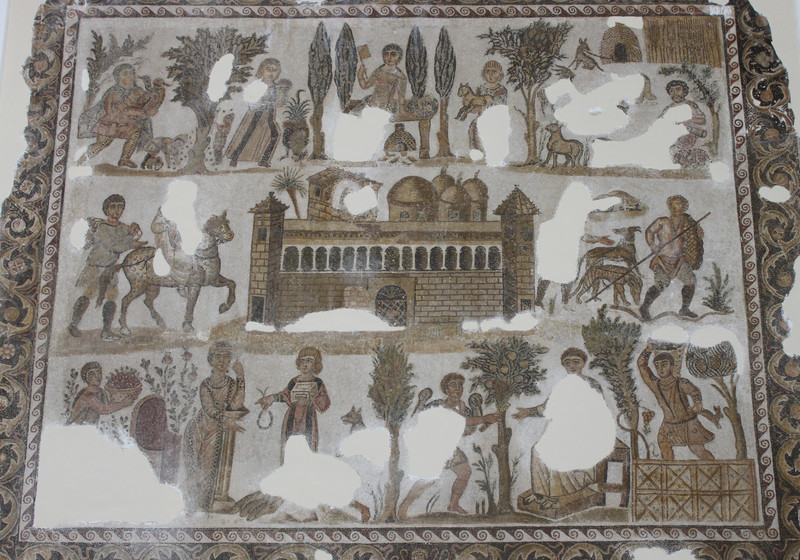
Dominus Julius Mosaic from Carthage, Bardo Museum. Copyright credit: Sean Leatherbury/Manar al-Athar
When are we talking?
Dr Place’s research focuses on 200-550 CE. The late Roman empire is full of intrigue and was a time of great change. While there was some stability under the emperor Septimius Severus, who ruled from 193-211 CE, with his death and the succession of his son Caracalla, a century of turmoil began.
Amidst the political chaos that characterised much of this century, the Christians rose in prominence. By the beginning of the fourth century, Rome would have its first Christian emperor, Constantine I. This emerging system would rapidly became established as the exclusive religion of the empire as Rome entered the fifth century.
Where are we talking?
The focus of Place’s research has been the coastal regions of North Africa, examining an area that spans Namibia to Morocco. Parts of North Africa began to be acquired by Rome in the 2nd century BCE with the end of the Third Punic War. Roman influence continued to expand in this region throughout the late Republic and into the Empire.
What is the source material like for fashion and togas?
Place’s research is based in part on literary sources but is supplemented with mosaics. She highlights the difficulties that come with using textual evidence to understand something that was visual. The terms used in the sources are not always easily matched to a surviving representation and it is extremely rare for any actual samples of clothing to survive to the modern day.
Matron at her Toilette Mosaic from Sidi Ghrib, Bardo. Copyright credit: Sean Leatherbury/Manar al-Athar.
How did people in North Africa use clothing to construct and express their identity?
Place’s research focuses on the impact that the growth of Christianity had on dress and identity. A particularly important author was Tertullian, a Christian writer who made some very vocal criticism of female dress in this region.
Although Roman writers had been critical of women dressing too provocatively before the advent of Christianity, for Tertullian there was an extra moral imperative for women to dress modestly and plainly. Austerity was a means of advertising one’s commitment to the new religion, most especially if one was wealthy enough to have a choice.
We see a stark contrast between words and deeds, however, when we consider the mosaics from the region. As Place notes, these don’t often show people have taken Tertullian’s advice – quite the opposite!
Tune in to hear all Place’s insights into the local trends for women and men and the place of the toga.
Tomb cover for Victoria, originally from Tabarka, now in the Bardo. Copyright credit: Sean Leatherbury/Manar al-Athar.
Interested in learning more about this fascinating topic? You can consider more of Dr Amy Place’s work at Academia.edu
Episode 98 – Cincinnatus, Suffect Consul
Oct 17, 2019
Show notes
It’s c. 460 BCE and this hectic year in Roman history continues! In this episode we consider Rome in the wake of the sneak attack on the Capitol by Herdonius’ disaffected Sabines. During the challenges of wrestling control back, the Romans lose one of their own. The consul Publius Valerius Pubicola falls in battle. This is a tragic loss and opens the way for Lucius Cincinnatus to return to the narrative.
Episode 98 – Cincinnatus, Suffect Consul
Looking to catch up on the narrative before diving into this episode? You can find out more about the earlier events of this year here.
Who’s Who
Consuls
Publius Valerius P. f. Volusi n. Publicola (cos II)
Gaius Claudius Ap. f. M. n. Inrigillensis (or Regillensis) Sabinus
Suffect Consul
Lucius Quinctius Cincinnatus
Tribune of the Plebs
Aulus Verginius
Marcus Volscius Fictor
A Man of the Land
There’s nothing quite like a man who farms. For fans of men of the land, Cincinnatus is here for you. We explore the important symbolism of Cincinnatus working the land and his reaction to learning about his election as suffect consul.
A New Political Strategy
Cincinnatus takes the opportunity to lead in a new way. With much rhetorical flourish, our new consul lays forth a plan that spells trouble for the plebeians and the ambitions of the tribunes. We dig into the discrepancies between our sources – Livy and Dionysius of Halicarnassus have different takes on the essential narrative. This is very revealing in terms of thinking about the aims of our written sources for this period.
Things to Look Forward To
a taking of auspices
a desire for a dictator
some senatorial love for our man Cincinnatus
Alexandre Cabanel 1843. Cincinnatus receiving the ambassadors of Rome. Image Source: Wikimedia Commons
Our Sources
Primary sources
Dr G is reading Dionysius of Halicarnassus Roman Antiquities 10.17-19
Dr R is reading Livy 3.19.1-3
Secondary sources
Broughton, T. R. S. 1951. The Magistrates of the Roman Republic, Volume I (American Philological Association)
Eck, W. (Colonge) ‘Suffect Consul’ Brill’s New Pauly, Cancik, H. Schneider, H., Salazar, C. F. (eds.), accessed online 29-9-2019
Lomas, K. 2017. The Rise of Rome: from the Iron Age to the Punic Wars (1000-264 BC) (Profile Books)
Müller, C. (Bochum) ‘Q. Cincinnatus, L.’ Brill’s New Pauly, Cancik, H. Schneider, H., Salazar, C. F. (eds.), accessed online 29-9-2019
*Special Episode* – The Thread of Women’s Representation
Oct 04, 2019
Show notes
In this special episode, we’re joined by Liz Smith, who has recently completed her doctoral research of the representation of women’s dress in statuary at Macquarie University. Together we’ll trace the threads of evidence for women’s attire in the Roman world.
The Thread of Women’s Representation with Liz Smith
Liz’s research includes the fashion of women’s dress in ancient representations in order to investigate what we can learn about the representation of women. This means considering how representations of women in statuary were often mediated by a male perspective and asking what this might reveal about women’s lived experience.
The Importance of Material Evidence
A consideration of material evidence, especially when combined with inscriptions offers an alternative to the literary sources for thinking about women and daily life in the ancient world. Our evidence in this episode dates from the third century CE, which means we’re thinking about a Rome embroiled in empire and imperial rule.
In this episode we’ll be considering the head coverings on statues in the round and sepulchral depictions of women. We explore the implications of topics such as:
drapery in statues and reliefs
the colour of statuary
the stola
the palla
dress as status
Epiktesis
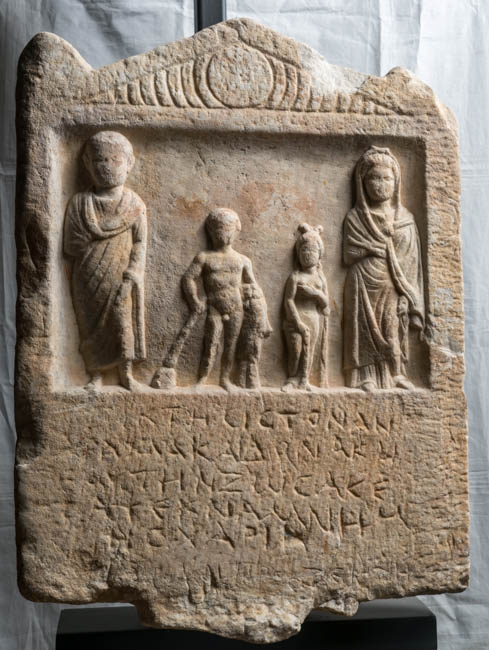
Epiktesis outlives her family. We consider the monument she dedicates to her husband, her children, and herself. Liz takes us through the pose adopted by Epiktesis – the Large Herculaneum Woman Type – and its implications.
The husband remains unnamed in this relief as do the children. This in itself is somewhat unusual but this evidence goes to the next level when we consider that the children are represented as divinities!
With Epiktesis herself depicted in a very modest, unrevealing style and her daughter assuming the quite revealing Bathing Aphrodite Type, this representation has a lot to offer in terms of thinking about the meaning conveyed by poses and attire.
Liz explains how size plays a role in the representation of family in this monument and we consider what this might have suggested to an ancient viewer. We also consider the unique aspects of this piece in terms of its arrangement of the figures and their poses.
Aurelia Eutychia “I am Prosperous” c. 250s CE
We consider the sarcophagus dedicated by Aurelia to herself and her husband Marcus Aurelius Marino which can still be seen today in Ferrara. Liz takes us through the significance of the statuesque features of this artefact.
Social status is a particular feature at play in all these representations and the capacity of Aurelia to have for a sarcophagus where the figures display a range of statuesque features tells us a lot about how she wanted to be understood by her community.
Sarcophagus dedicated by Aurelia Eutychia to herself and her husband Marcus Aurelius Marino. Side panel.
Liz explores the implications of Aurelia’s personal representation of herself. We discuss the potential implications of being veiled versus not being veiled.
Here’s the inscription found on the sarcophagus:
Aurelia Eutychia built this sarcophagus while alive for herself and her husband Marcus Aurelius Marino a veteran of Syrian lineage at the behest of the patron and her most dutiful husband with whom she lived for forty-three years by order of the patron out of his own funds. If someone after the death of the both opens it they will deposit a thousand sesterces to the tax authorities.
Translation ~ Liz Smith
Join us for a lively exploration of women’s representation through statuary and inscription!
Addendum: In exciting news, in the time between our chat with Liz and the release of this episode, we can confirm that Liz has passed her doctoral examination and joins us as a full academic. Congratulations Dr Liz Smith!
Edit: Since conducting this interview, further analysis of the sarcophagus dedicated by Aurelia has revealed the insight that Aurelia would have been Marcus Aurelius Marino’s enslaved property, before he freed and married her. As his freedwoman, Aurelia would have been bound by custom and law to respect Marcus and give him services (operae), even after her manumission. Accordingly, it is all the more interesting that Aurelia represented herself as an equal partner to her husband through the statuesque elements we see on the front and lateral sides.
Episode 97 – Surprising Sabines
Sep 19, 2019
Show notes
We return to our narrative of Rome’s history of its foundation with some surprising Sabines. It’s still 460 BCE , which is an indication of just how complicated Rome’s history is becoming when we read our sources.
Both Livy and Dionysius of Halicarnassus are very focused on the ongoing conflict between the Roman elites and the emerging claims to power from the plebeians.
We wouldn’t would to give too many spoilers away, but while the Romans are busy trying to figure out what their internal politics will look like, there might just be an enemy on the horizon!
Episode 97 – Surprising Sabines
You can catch up on the earlier action of this year here.
Just Your Everyday Ongoing Political Conflict
Some of the complications in the City stem from the young patricians who have become a force to be reckoned with, terrorising plebeians. The tribunes have been lobbying for changes that would make Roman law transparent but so far there’s been no real movement on the issue. There are a number of things to consider, such as:
connections between this conflict and the First Succession;
the use of annual levies by the patricians as a means of controlling the plebeians;
and the role of local warfare in preventing plebeians from engaging fully in Rome’s politics.
Surprise, Surprise, it’s the Sabines!
Just when the Romans are caught up in their own problems, the Sabine Appius Herdonius turns up with a goodly number of supporters and seizes the Capitol. Our sources disagree on just how large Herdonius’ force is or who is part of it, but, regardless of the figures and identities, the narrative follows the same trajectory – infiltration!
We discuss the various strategies credited to Herdonius for entering the city and his apparent aims in making such a bold move. Suffice it to say, word of Rome’s internal unrest has spread…
Sabine Attack as a Microcosm of Rome’s Internal Trouble
Needless to say, the Romans are less than pleased to have an intruder in the heart of the City. Like a kicked beehive, the citizens rally to defend themselves! It’s not long though before this chaos turns into competing calls to arms. The consuls and tribunes seize upon the moment to offer differing opinions about the situation and urging the citizen body to divergent actions.
Hear how the tensions rise and the Romans respond to the Sabine threat in this episode!
Our Main Players
Consuls
Publius Valerius P. f. Volusi n. Publicola (cos. II)
Gaius Claudius Ap. f. M. n. Inrigillensis (or Regillensis) Sabinus
Tribunes
Aulus Verginius
Marcus Volscius Fictor
Sabines
Appius Herdonius
Tusculans
Lucius Mamilius
Our Sources
Livy Ab Urbe Condita 3.15-18
Dionysius of Halicarnassus Roman Antiquities 9.14-16
Topography of the ancient Capitol, according to the arbitrary reconstitution of Nardini, in The Roman Capitol in Ancient and Modern Times (1906). Source: Wikimedia Commons
At the Movies – Once Upon a Time in Hollywood
Sep 05, 2019
Show notes
Warning! This post and episode contain huge spoilers.
Dr G and Dr Rad always enjoy a trip to the movies, as you tell from our past forays in classics like Spartacus,Gladiator, and the contemporary farce Hail, Caesar! We are planning to record more special episodes when we see a historical flick or television series that sparks our interest. This week we saw Tarantino’s latest offering, Once Upon a Time in Hollywood (2019).
Bonus Episode – Once Upon a Time in Hollywood The audio is a little variable on this one, but we decided to keep at much as possible rather than cut. Equipment checking is a high priority before our next recording session.
Did we mention the spoilers? They are coming…
The two main characters in this film (Rick Dalton, played by Leonardo DiCaprio, and Cliff Booth, played by Brad Pitt) are fictional, but the backdrop to their story is historical. Whilst occasionally flashing back to earlier points, the majority of the film takes place in Hollywood, 1969. 2019 marks the fifty-year anniversary, so the release is timely. This was a pivotal year for America in many ways. The protest movement against the Vietnam War reached new heights in the wake of the Tet Offensive in 1968, not only in terms of the numbers who attended protests such as Vietnam Moratorium Day, but also with the trial of the Chicago Eight for demonstrations during the August 1968 Democratic National Convention. This was also the year that the assassin of Martin Luther King Jr was captured and tried, and the Black Panthers were named as enemies of the state by the FBI for being a communist organisation. These are not the events that Tarantino focuses on.
What is Hollywood Anyway?
Dalton is an actor trying to keep his career afloat and Booth is his stuntman, BFF and all-round handyman. The Hollywood that they used to know is disappearing. For decades, the film industry had been controlled by the major studios (such as MGM, Paramount, Warner Bros) and each movie was subject to strict censorship rules. By 1969, the studios were no longer as dominant and the Production Code had been abandoned, opening the door for a wider range of artists and film subjects. The Graduate (1967) would have been unthinkable at the beginning of the decade and in 1969 Dennis Hopper’s ground-breaking, counter-cultural classic, Easy Rider, would be released.
Even so, Hollywood was about to be rocked by something more earth-shattering than a progressive movie. In August 1969, Charles Manson decided that it was time for his followers to unleash the race war that he had dubbed ‘Helter Skelter’ after the Beatles song from the 1968 White Album. This would lead to the grisly Tate and La Bianca murders. The crimes committed by the Manson Family had many implications, but it is the build-up to these events that Tarantino traces as Dalton and Booth cruise through Hollywood.
Hollywood with a Twist
Just as the audience is preparing to see Sharon Tate and her house guests get brutally murdered by Manson’s drug-addled followers, Tarantino turns audience expectations on their head. Dalton and Booth, who live next door to Tate and Polanski, are attacked by the Family and it is the latter who suffer a gruesome end. This is not the first time that Tarantino has ventured down this road with historical fare. Django Unchained (2013) and Inglorious Basterds (2009) both play with historical reality. Is it in the interest of providing his audience with a sense of catharsis? What are the implications of counterfactual history – of exploring the ‘What ifs?’ of history? This may seem harmless and perhaps beneficial; can exploring what didn’t happen help to shed fresh light on what did happen?
Respected historians such as Niall Ferguson have trodden down this path, but others such as Richard J. Evans have emphatically refuted the value of “parlour games” that seem to lament ‘if only’, rather than ask ‘what-if?’ (Hatherley, 2014). Do these issues apply to historical films, which obviously aim to entertain? Is the silver screen a suitable place for such games, or does the wider audiences of a feature film make counterfactuals more dangerous? This is history at its most controversial.
Join the Doctors as they explore the ins and outs of the 60s, hippies and history.
For those interested in learning more about Hollywood in the Manson era, we cannot recommend ‘You Must Remember This’ enough. Host Karina Longworth has produced a 12-part series exploring Charles Manson, the Family and Hollywood in the late 1960s.
If you are more of a true crime buff, you may be interested in checking out the Last Podcast on the Left (hosted by Ben Kissel, Marcus Parks and Henry Zebrowski) and their series on Charles Manson (Starting at Episode 147). These guys have a conversational, hilarious podcast that is also exceptionally well-researched.
And finally, if you’re just loving all things 1969, check out Parcast Presents the ‘Summer of ‘69’ series, which features a number of episodes on Manson, the Manson Girls BUT also other fascinating tales from this pivotal year.

 Our TOPPODCAST Picks
 Stay Connected