Join Dr Rad and Dr G as we discuss, spar, and laugh our way through different aspects of the ancient Roman world! Our main series ‘From the Foundation of the City’ follows Roman history year by year from the traditional foundation date of 753 BCE. We also interview academics and specialists from around the globe for their insights into history and the representation of Rome and the ancient Mediterranean in popular culture. Dr Fiona Radford is an expert on Rome on film and wrote her thesis on Kubrick’s Spartacus. Dr Radford is exponent of not only Ancient History, but also Reception Studies. Dr Peta Greenfield is an expert on the Vestal Virgins. Dr Greenfield’s research interests include: religion and politics in Rome, the late republic and Augustan period, and the role of women.
Special Episode – Women and Money with Professor Karen Carr
Nov 04, 2021
Show notes
We sat down recently to have a conversation with Professor Karen Carr who is Emerita at Portland State University. She holds a doctorate in Classical Art and Archaeology and we were thrilled to discuss the ideas for her latest work. We explore Carr’s research on the connections between women, money, and the economy in the ancient world.
Special Episode – Roman Women and Money with Professor Karen Carr
Carr has an impressive breadth and depth to her research work. She’s the author of Vandals to Visigoths: Rural Settlement Patterns in Early Medieval Spain. Carr also has a book coming out in 2022 called Shifting Currents: A World History of Swimming. However, in this conversation we were focusing on her radical new theories on women and their place in economies. The conversation ranges from the Stone Age through to the modern world! Professor Carr is currently writing a book on this topic that is slated for release in 2023 through the University of Liverpool Press.
Thinking about ancient economies
Professor Carr suggests that manufacturing, and thus the production of wealth, was initially tied to the work of women. They say that money makes the world go around, so it seems like women were making the world go around since the Stone Age! They helped to produce items like beads and textiles that could be used for trade long before humans invented coinage.
This all started to change when Greeks and Romans started to export silver and gold in larger quantities, especially in the form of coinage. Mining for metals and minting the coins was largely men’s work and this type of money started to be promoted as ‘masculine’, while items like beads and textiles were labelled as ‘feminine’. As parts of the world, such as Asia and Africa, continued to engage in the manufacture of these goods for trade, foreigners also started to be associated with femininity. If you are starting to feel like the economy in the ancient world was complex, you would be correct!
Penelope and the Suitors by J. W. Waterhouse. Work that wool, Penelope!
Roman Women and Money
Tune in to hear how all of these developments may have contributed to slavery in the ancient and modern world. With the fashion industry being one of the largest contributors to carbon emissions and coming under more scrutiny for the poor conditions of workers, you won’t want to miss Professor Carr’s theories about how contemporary attitudes towards fast fashion may go back further than you think.
Close-up of some of the coins from the Frome Hoard. This hoard contains 52 503 Roman coins which date from 253-305 CE!
Music and Sound Effects
The music featured in this episode is an original composition for our podcast by the glorious Bettina Joy de Guzman.
Episode 118 – The Death of Appius Claudius
Oct 14, 2021
Show notes
Appius Claudius: what a man, what a couple of decemvirates! But while the title of this episode might have given some things away, it’s all about how it happens.
If our sources are to be believed, 449 BCE was one hell of a year. In our previous episode, we witnessed the end of the tyrannical Second Decemvirate and the Second Secession of the Plebeians. Two patricians, Valerius and Horatius, had managed to coax the plebeians back to Rome and their protest helped to oust the decemvirs from power. This episode, we will delve into the aftermath of these dramatic events, and we finally get to kill off that much-hated decemvir, Appius Claudius.
Episode 118 – The Death of Appius Claudius
Is Justice blind? We’ll find out in the case of Appius Claudius! Image Source: Salvis Juribus
Review the Career of Appius Claudius
Looking to catch up to speed before heading into this episode?
With the office of the tribune of the plebs restored, it is time to secure some new consuls as well. Who better than the patricians who defied the decemvirs, Lucius Valerius Potitus and Marcus Horatius Barbatus? And isn’t an interesting coincidence that these two men were chosen to mop up the mess when their ancestors, P. Valerius Volusi Publicola and M. Horatius Pulvillus, were consuls back when the Republic was first established in 509 BCE?
The Romans are known for associating particular gens with certain characteristics and policies, but it also may be the case that Romans followed paths that would uphold their family legacy.
The Valerio-Horatian Laws
In spite of their patrician backgrounds, the consulship of Valerius and Horatius was particularly beneficial for the Roman people. This is largely due to some new laws that were introduced, now known as the Valerio-Horatian Laws. According to our sources, the legislation:
restored the sacrosanctity to the tribune of the plebs and instituted harsh penalties for anyone who violated this law
restored the consular law about the right of citizens to appeal. They also ensured that all future magistracies that were created would include the right to appeal.
the decisions of plebeians (plebiscites) would now be considered binding for all Roman people, and not just the plebeians.
These laws are clearly a direct response to what had transpired under the Second Decemvirate and restored a lot of power to the people.
We’ll explore some of the ramifications of these laws, the scholarly controversy over the dating, and what some of the more conservative patricians thought about them.
The Death of Verginia by Doyen (1756-8). Image Courtesy of Wikimedia Commons.
The Death of Appius Claudius
With these new laws in place, the people feel confident enough to seek vengeance. Appius Claudius, the most despised decemvir, is the first to be targeted. His attempted abduction of the free Roman maiden, Verginia, comes back to haunt him as her father is now a tribune of the plebs.
In both Livy and Dionysius of Halicarnassus, Verginius pursues Appius Claudius and has him arrested, seemingly with the intention of bringing him to trial. But while he awaits justice in prison, Appius Claudius ends up dead. At this point the accounts of Livy and Dionysius of Halicarnassus diverge. You won’t want to miss all the twists and turns that accompany his demise!
Our Players
The Decemvirs
Appius Claudius. Ap. f. M. n. Crassus Inregillensis Sabinus Pat – Cos. 471, 451
The Senators
Lucius Valerius Potitus
Marcus Horatius Barbatus
The Verginii and Supporters
Verginia – a Roman maiden, murdered by her father in order to protect her from the lust of Appius Claudius
Verginius – father of Verginia and newly elected tribune of the plebs
Publius Numitorius – Verginia’s maternal uncle and newly elected tribune of the plebs
Lucius(?) Icilius – Verginia’s betrothedand newly elected tribune of the plebs
Tribunes of the Plebs, 449 BCE
Lucius Verginius
Lucius Icilius (who had served as a tribune previously)
Publius Numitorius
Gaius Sicinius – son of the man who was first tribune chosen on Sacred Mount (L?.Sicinius)
Marcus Duillius (who had served as a tribune previously)
Marcus Titinius
Marcus Pomponius
Gaius Apronius
Appius Villius
Gaius Oppius
Other Notables
Gaius Claudius – uncle of Appius Claudius
Sources
Dr G reads Dionysius of Halicarnassus Roman Antiquities 11.45-46
Thanks to Orange Free Sounds, BBC Sounds, and Sound Bible for sound effects and the incomparable Bettina Joy de Guzman for our music.
Special Episode – Disruption with David Potter
Sep 23, 2021
Show notes
Disruption is at the heart of great changes in human society. How might we understand disruption? How can we recognise it? And just what historical precedents do we have for successful change? We sit down with Professor David Potter to examine just these kinds of questions!
David Potter is Francis W. Kelsey Collegiate Professor of Greek and Roman History and Arthur F. Thurnau Professor at the University of Michigan and has written extensively on the ancient world. In his latest book Disruption: Why Things Change, Professor Potter considers the disruption in Rome that reverberates today: the rule of Constantine and the relationship of Rome with the Christian Church.
Special Episode – Disruption with David Potter
The Disruption of Constantine
Setting the stage is the life and times of the Roman Emperor Constantine. He is famous for bringing Christianity into Roman imperialism in a way that would have been unthinkable to Romans of previous generations. Professor Potter takes us through some of the pivotal moments in Constantine’s rule. These are revealing for how Constantine builds towards consensus with Christian bishops.
What does this change look like to the Romans? How did the thinking about Christians change? What steps did Constantine take that separated him from the emperors that came before?
All this and more comes up for discussion in this episode.
Statue of Constantine at York. He became emperor in 306 CE in Roman Eboracum, now modern York. This statue is a modern piece by the sculptor Philip Jackson and was unveiled in 1998. Image courtesy of Wikimedia Commons.
Disruption as a Model for Action
One of the key threads in Potter’s book is that there are recognisable patterns for successful moments of disruption. A consideration of Constantine and Christianity in Rome is really just the tip of the iceberg with this text. Potter’s view extends beyond ancient Rome to consider the rise of Islam, the Protestant Reformation, the Enlightenment and French Revolution, as well as disruptive political theories such as those of Marx and Spencer.
What we see by taking a long view of history is that there’s room to consider disruption not just as a culmination of circumstances, but as a potentiality that can be tapped into.
Things to Listen Out for
The writer Eusebius’ enthusiasm for Constantine’s adoption of Christianity
The Donatist controversy in North Africa involving book burning
Constantine’s letter to the Praetorian Prefect
Julian’s Theodoric Neoplatonism!
The emperor Heraclius and the kings of Persia
Significant Works by Professor Potter
The Origin of Empire: Rome from the Republic to Hadrian
Constantine the Emperor
The Victor’s Crown: A History of Ancient Sport from Homer to Byzantium
Theodora: Actress, Empress, Saint
Disruption: Why Things Change
Disruption: Why Things Change by David Potter
Episode 117 – The Death of the Decemvirate
Sep 16, 2021
Show notes
We have been trapped under the tyrannical rule of the Second Decemvirate for too long!
But never fear, listeners. Their day has finally come. In this episode, we finally see the decemvirs overthrown and the office of tribune of the plebs restored. It is a time of non-stop drama!
Episode 117 – The Death of the Decemvirate
All About the Aventine
With Dionysius of Halicarnassus’ account getting very patchy, and Diodorus Siculus considered unreliable, Livy provides the bulk of the detail for this episode. The movements of the plebeians are a little confusing, but two locations are mentioned, the Mons Sacer (or Sacred Mount) and the Aventine. Both of these locations were also mentioned in the accounts of the First Secession of the Plebs in 494 BCE, but the Sacred Mount is definitely most associated with this event.
In 449 BCE, the Aventine seems to play more of a role. Cicero’s references to the Second Secession in his pro Cornelio and de re Publica indicate that the plebs seceded to the Mons Sacer before heading to the Aventine Hill, whereas Livy’s plebs move from the hill to the Sacred Mount when it becomes clear that the senate was not making any decisions in a hurry. Diodorus Siculus only mentions the Aventine. With such a spotlight on this location, Dr Rad started reading the excellent work of Lisa Marie Mignone (2016). She has investigated the Aventine as it has developed a reputation as being particularly plebeian – but why?
The Significance of the Aventine
Mignone explains that the link between the Aventine and the plebs was firmly established by Alfred Merlin’s L’Aventin dans l’antiquité (1906), and Mignone is not so sure that we should be labelling any region of the city this way. However, there are a few notable reasons for this association, outside of the secessions:
the lex Icilia de Aventino publicando from 456 BCE (which seems to have led to the distribution of land on the Aventine to plebeian families) and
it was the locale of the temple of Ceres, and Gaius Gracchus (a troublesome tribune of the plebs) fled to the Aventine in 121 BCE when his career took sour turn. Indeed, Gracchus was zeroing in on the temple of Diana Aventiniensis, which Dionysius claimed was the plebs place of retreat during the Second Secession.
However, hundreds years separate these instances, and since the majority of Rome’s populace were plebeian, is that enough to claim the Aventine had a distinctly plebeian character? This will be something we shall continue to explore as we progress through the Republic.
The Ultimatum
As Livy provides the most extensive narrative for this part of the tale, we pursue his version of events. The Senate continues to dither, despite the threat posed by a group of armed men on the outer edge of the city. Tired of waiting, the rebel army decide to leave the Aventine for the Mons Sacer (or Sacred Mount), and are followed by many Roman citizens, united in their determination to show the patricians that they mean business. It’s either the plebeians or the decemvirs, and the senators need to choose! The days of the decemvirate might be numbered!
It Takes Two, Baby
With the city of Rome practically deserted, Valerius and Horatius are finally able to persuade their fellow senators that the decemvirate needs to end. Rome needs her plebeians back! The dynamic duo set off to negotiate an end to the second secession and the plebs manage to secure the return of the tribune of the plebs. According to Dr G’s account, they may even have secured an upgrade in status for the decisions made by the tribal assembly. From now on, the tribal assembly would be on equal footing with the centuriate assembly and the decisions of the plebeians would apply to everyone in the city.
With the reassurance that there would be no punishments for the secession, the plebs agree to return to Rome… just in time to witness the official resignation of the decemvirate. Appius is not happy about it, but most of his fellow Roman have ceased to care about his feelings by now.
Our Players
The Decemvirs
Appius Claudius. Ap. f. M. n. Crassus Inregillensis Sabinus Pat – Cos. 471, 451
Spurius Oppius Cornicen
Quintus Fabius M. f. M. n. Vibulanus Pat – Cos. 467, 465, 459
Quintus Poetelius Libo Visolus
Manius Rabuleius
Marcus Cornelius – f. Ser. n. Maluginenesis Pat
Lucius Minucius P. f. M. n. Esquilinus Augurinus Pat – Cos. 458
Marcus? Sergius Esquilinus Pat
Titus Antonius Merenda
Caeso Duillius Longus?
The Senators
Lucius Valerius Potitus
Marcus Horatius Barbatus
The Verginii and Supporters
Verginia
Verginius – father of Verginia
Publius Numitorius – Verginia’s maternal uncle
Lucius(?) Icilius – former tribune of the plebs and Verginia’s betrothed
Other Notables
Marcus Duillius (a former plebeian tribune)
Sources
Dr G reads Dionysius of Halicarnassus Roman Antiquities 11.44 and Diodorus Siculus Bibliotheca Historica 12.25
Dr Rad reads Livy ab Urbe Condita 3.52-54
Broughton, T. R. S., Patterson, M. L. 1951. The Magistrates of the Roman Republic Volume 1: 509 B.C. – 100 B.C. (The American Philological Association)
Ungern-Sternberg, J. von. 2005. “The Formation of the ‘Annalistic Tradition’: The Example of the Decemvirate” in Raaflaub, K. A. ed. 2005. Social Struggles in Archaic Rome: New Perspectives on the Conflict of the Orders, Expanded and Updated Edition (Blackwell), pp 75-97
Music and Sound Effects
Additional music and sound in this episode includes an original composition for our podcast by the glorious Bettina Joy de Guzman. Sound Effects courtesy of BBC Sound Effects.
If you are interested in reading one of the major scholarly works we consulted for the episode, Mignone’s volume contains a lot of fascinating detail about the Aventine Hill!
Special Episode – Pompeii with Professor Ray Laurence
Aug 19, 2021
Show notes
We sit down to talk to the fabulous Professor Ray Laurence from Macquarie University in this special episode about urban space in Pompeii and the place of children within the society. These topics are close to his heart as his work mostly focuses on:
The Roman City
Communications and Mobility – especially Roman roads
Age and Ageing in the Roman World
Special Episode – Pompeii with Professor Ray Laurence
You may also recognise his name because, in addition to his scholarly publications, Ray has worked with TEDEd to produce some amazing short videos on the life of children in Ancient Rome. Join us for this fascinating discussion on life in Pompeii!
The Urban Environment and Street Life
Pompeii is a very famous site, but there are a lot of misconceptions about what this place was actually like before the eruption. Ray Laurence explains why life in Pompeii was tough and how the built environment reflects the fact that this was a very average town. It had been around for centuries before the eruption in 79 CE and shares the influences of various people who lived in the region, including the Etruscans, the Oscans, the Samnites, and finally, the Romans.
The layout of Pompeii evolved over time and areas like the Forum were used in different ways throughout its existence. We can learn more about how people experienced the urban environment by piecing together a variety of evidence including wheel ruts, the width of streets, graffiti patterns, literature, and the building remains. While Pompeii may not have been especially fancy, it was a bustling town and people spent a lot of time in the streets, conducting business, conversing, stopping at shrines, fetching water, or grabbing some takeaway.
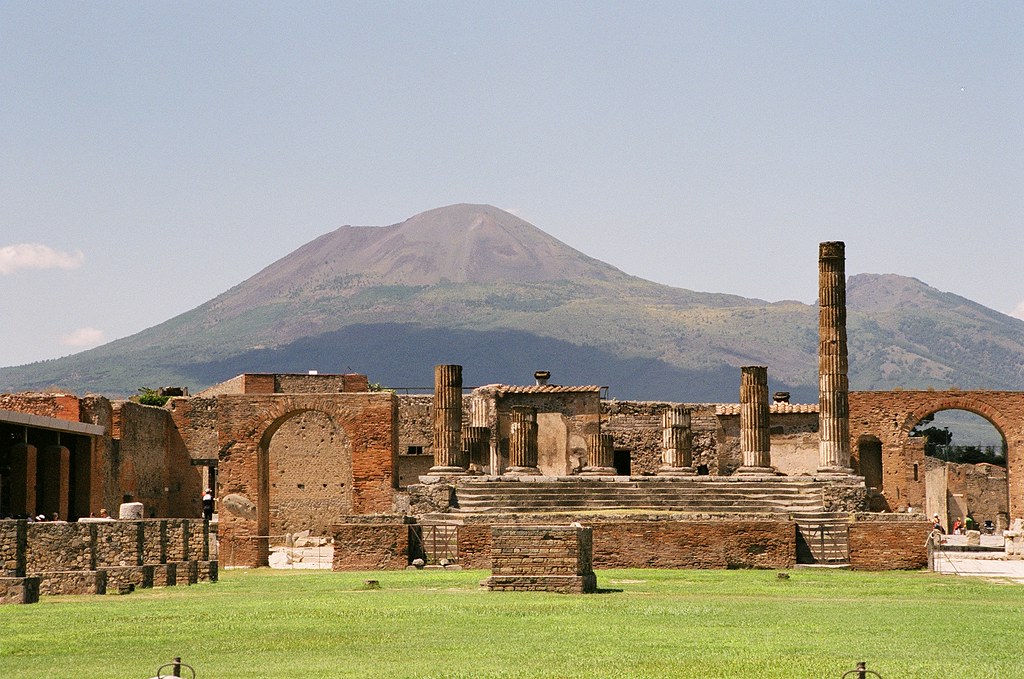
The Forum, Pompeii.
Children in Pompeii
We tend to see Pompeii from the perspective of adults as children leave less evidence – whether this is literary, archaeological or even human remains. Scholars such as Katherine Huntley and Ray Laurence urge us not to discount their experiences as they make up a sizeable proportion of the town. Once we start thinking about the urban layout from their perspective, it is surprising what we can discover.
By using the average heights of adults in Pompeii, we can approximate the growth of children in the towns and thus consider how accessible the amenities were for the smallest residents. For instance, children over six years old would probably be able to access water fountains and the bars, therefore securing their own food and drink! As they grew older, they would have had more ease of access to sacred spaces such as household shrines.
Katherine Huntley has carried out extensive global studies of children’s drawing and applied what they have uncovered to the graffiti of Pompeii. In spite of the differences in time and culture, there are patterns in how children start drawing that can help us to determine which samples of figural graffiti in Pompeii were produced by children.
The Temple of Isis, Pompeii.
There are also famous examples of children, such as Numerius Popidius Celsinus, a six year old who paid for the restoration of the Temple of Isis after it was damaged in the earthquake in 62 CE. In recognition of his contribution, he was elected to the town council! This seems odd to modern eyes, but Ray explains that he was not the only child to become a part of the ordo of decuriones. What we wish we knew was how these children moved around the town as they made their way to meetings! Nonetheless, these examples demonstrate that once we look a little harder, there is a lot that can be learned about the presence of children in Pompeii.
Sources and Further Reading
Huntley, K. V. (2018). ‘Children’s Graffiti in Roman Pompeii and Herculaneum.’ In The Oxford Handbook of the Archaeology of Childhood, edited by Sally Crawford, Dawn M. Hadley & Gillian Shepherd, 376-386. Oxford: Oxford University Press.
A still from ‘A Glimpse of Teenage Life in Ancient Rome’
Episode 116 – The Second Secession
Aug 12, 2021
Show notes
CW: The accounts of Verginia include paedophilic desire and violence against women.
The Second Secession is a contested moment in Roman’s early republican history. The fallout from two key events lead us to this point according to our later written sources: one is the murder of Lucius Siccus Dentatus “the Roman Achilles” and the other is the murder of the young plebeian Verginia (also known as Virginia). We’ll be exploring what the sources can tell us and what we might make of this challenging moment in Rome’s history.
Episode 116 – The Second Secession
The Second Decemvirate
In what feels like a period of time packed with action, the second decemvirate continues to rule in Rome. Originally placed in power to oversee the the project of writing down laws, there has been a big shift from serving the state to serving their own self-interest. With all other magistracies suspended while the decemvirate remains in power, Rome feels increasingly adrift. The further things drift, the more likely a secession of the plebeians becomes…
Looking to recap earlier material on the decemvirate? It all begins with Episode 109!
Fathers in Rome
We follow Verginius, the father of Verginia, who flees Rome after murdering her in the forum and returns to the armed forces. How he copes with his grief and what he chooses to do next will determine much of what follows. This leads us to consider the nature of Roman patriarchal society. What do the Romans value when it comes to familial and state structures and how does this system affect men and women differently?
Being a father is one role that many Roman men fulfilled, but it came with other duties like those to the state. We spend time in Roman camps, with men reflecting on their duty, what might be politically appropriate, and what kind of leadership they want from the ruling elite. All of this should give the patricians pause. It certainly has the decemvirate worried.
Things to come as the Secession hots up
Tune in the hear the conflicting accounts of this period that come down to us including:
The call to revolt against the decemvirs and restore the republic!
The rumour that the decemvirate has already been overthrown and doesn’t require anyone’s revolution!
The sacred quality of the army standards
Rival groups of ten!
Guillaume Guillon-Lethière c. 1800 The Death of Virginia. You can explore this artwork in detail of Google Arts & Culture
Our Players
The Decemvirs
Appius Claudius. Ap. f. M. n. Crassus Inregillensis Sabinus Pat – Cos. 471, 451
Spurius Oppius Cornicen
Quintus Fabius M. f. M. n. Vibulanus Pat – Cos. 467, 465, 459
Quintus Poetelius Libo Visolus
Manius Rabuleius
Marcus Cornelius – f. Ser. n. Maluginenesis Pat
Lucius Minucius P. f. M. n. Esquilinus Augurinus Pat – Cos. 458
Marcus? Sergius Esquilinus Pat
Titus Antonius Merenda
Caeso Duillius Longus?
The Senators
Lucius Valerius Potitus
Marcus Horatius Barbatus
The Verginii and Supporters
Verginia
Verginius – father of Verginia
Publius Numitorius – Verginia’s maternal uncle
Lucius(?) Icilius – former tribune of the plebs and Verginia’s betrothed
Other Notables
Spurius Tarpeius
Gaius Julius
Publius Sulpicius
Marcus Oppius
Sextus Malius (or Manlius)
Sources
Dr G reads Dionysius of Halicarnassus Roman Antiquities 11.40-44 and Diodorus Siculus Bibliotheca Historica 12.22-25
Dr Rad reads Livy ab Urbe Condita3.49-51
Broughton, T. R. S., Patterson, M. L. 1951. The Magistrates of the Roman Republic Volume 1: 509 B.C. – 100 B.C. (The American Philological Association)
Ungern-Sternberg, J. von. 2005. “The Formation of the ‘Annalistic Tradition’: The Example of the Decemvirate” in Raaflaub, K. A. ed. 2005. Social Struggles in Archaic Rome: New Perspectives on the Conflict of the Orders, Expanded and Updated Edition (Blackwell), pp 75-97
Music and Sound Effects
Additional music and sound in this episode includes an original composition for our podcast by the wonderful Bettina Joy de Guzman. Sound Effects courtesy of BBC Sound Effects Beta, and 13NHarri.
Episode 115 – The Anatomy of a Murder
Jul 15, 2021
Show notes
CW: The accounts of Virginia include paedophilic desire and violence against women.
Virginia has been murdered by her own father in the Forum in an attempt to protect her from the decemvir Appius Claudius. As far as Virginius and most other Roman dads are concerned, death is better than dishonour. What will this act mean for Virginius and his family? How will it impact Appius Claudius? Tune in to find out as we venture once more into the rule of the Second Decemvirate and deal with the aftermath of one of the crises of the Conflict of the Orders.
Looking to get up to sped on Verginia’s story so far – it begins here. Yes, you’re right, there’s a variety of ways to spell her name!
Episode 115 – The Anatomy of a Murder
Charlotte Mary Yong 1880. The Death of Verginia. Courtesy of Wikimedia Commons
Chaos in the City
Even though this is a key moment in the conflict between patricians and plebeians, there are still some intriguing differences in the accounts provided by Livy and Dionysius. In Dr Rad’s account, Verginius is quick to fight his way out of Rome in the midst of the chaos with a band of supporters, leaving Verginia’s fiancée Icilius and her uncle Numitorius to display the body of the murdered girl to the crowd.
In a scene very reminiscent of Lucretia’s body being used to incite the overthrow of the monarchy, Verginia’s corpse is used as a symbol of the corruption of the Second Decemvirate and the crowd starts to get dangerous. It seems that they may also have some allies – the disgruntled patricians who also despise the decemvirs. The leaders of this faction include Valerius and Horatius, and they are getting a lot of love from the citizens for standing up to Appius Claudius and his cronies.
Meanwhile, in Dionysius’ account, there is a lot more focus on the fate of Verginia’s body. When Appius tries to have her removed from the Forum, the people claim her body for their own and stage a funeral procession for the murdered girl. Livy and Dionysius clearly have included different details regarding the aftermath of her death, but in both accounts, she is clearly a symbol in life and death.
These stories highlight how women are used by male writers to draw attention to the virtues and vices of the men around them. In this sense, these histories were not striving for an analytical and objective account, but one that promoted a desirable ideology for their own time. It is very clear that these were histories designed to inspire those who read them to act in ways that would benefit the state and keep order.
A Real Cliffhanger
In spite of their differences, both Livy and Dionysius end up leading us to the same point. We switch from events in Rome to Verginius’ return to his army encampment. Covered in the blood of his daughter and still clutching the murder weapon, he makes a rousing speech in both accounts, trying to persuade his fellow-soldiers that the real criminal in this sordid affair is Appius Claudius. Will the soldiers support him in seeking vengeance against the decemvir? Or will the tyrannous rule of the ten continue?
Gabriel François Doyen c. 1757. La Mort de Virginie (The Death of Virginia)
Our Players
The Decemvirs
Appius Claudius. Ap. f. M. n. Crassus Inregillensis Sabinus Pat – Cos. 471, 451
Spurius Oppius Cornicen
Quintus Fabius M. f. M. n. Vibulanus Pat – Cos. 467, 465, 459
Quintus Poetelius Libo Visolus
Manius Rabuleius
Marcus Cornelius – f. Ser. n. Maluginenesis Pat
Lucius Minucius P. f. M. n. Esquilinus Augurinus Pat – Cos. 458
Marcus? Sergius Esquilinus Pat
Titus Antonius Merenda
Caeso Duillius Longus?
The Senators
Lucius Valerius Potitus
Marcus Horatius Barbatus
The Verginii and Supporters
Verginia
Verginius – father of Verginia
Publius Numitorius – Verginia’s maternal uncle
Lucius(?) Icilius – former tribune of the plebs and Verginia’s betrothed
Our Sources
Dr Rad reads Livy, From the Founding of the City 3.48-50
Dr G reads Dionysius of Halicarnassus, Roman Antiquities 11.37-40
Additional music and sound in this episode includes an original composition for our podcast by the wonderful Bettina Joy de Guzman. Sound Effects courtesy of Audio Micro and Fesliyan Studios.
Sandro Botticelli c. 1496-1504. The Story of Virginia. Courtesy of Wikimedia Commons. This painting presents the different phases of Virginia’s story in different parts of the painting. From left to right: Virgina is violated by Marcus Claudius while in the company of other women; Marcus Claudius takes her to the tribunal presided by Appius Claudius who declares her to a slave; The family of Virginia plead for justice; Verginius murders Virginia and then flees Rome on horseback.
Episode 114 – The Tale of Verginia
Jun 17, 2021
Show notes
CW: The accounts of Verginia include paedophilic desire, violence against women
The story of Verginia is an achingly tragic tale central to understanding the Second Decemvirate. Both Livy and Dionysius of Halicarnassus go into some detail about what happens and how it unfolds and we’ll explore both accounts to compare and contrast them.
Episode 114 – The Tale of Verginia
Reading our Sources on Verginia
Dr Rad takes us through the complexities of thinking about Livy’s context and how that might influence his presentation of the material. Dr G explores the connection between the Latin term virgo (virgin) and her name Verginia. There’s plenty of parallels that will emerge between Verginia’s story and the story of Lucretia, whose fate seals the demise of the Roman monarchy.
What Horror…
Verginia is the daughter of a well-known centurion who is fighting on one of Rome’s frontiers. But conflict emerges when Appius Claudius decides that he wants her for himself. He seems heedless to reason or morality when it comes to Verginia and this leads him to engage in a set of behaviours that are appalling.
What to listen out for
Verginia’s story is one that involves a number of strange and dangerous concepts:
Claiming people from the street as slaves
Convoluted plans to remove a young woman from her family
Legal arguments around the claim that someone is a slave
Arguments for how to protect women’s virginity
What does it mean to be a citizen?
Official summons and strategies to foil summons
Groups of women akin to a tragic chorus
A butcher stand and the connection of Venus with the Cloaca Maxima
Our Players
Decemvirs
Appius Claudius. Ap. f. M. n. Crassus Inregillensis Sabinus Pat – Cos. 471, 451
Spurius Oppius Cornicen
Quintus Fabius M. f. M. n. Vibulanus Pat – Cos. 467, 465, 459
Quintus Poetelius Libo Visolus
Manius Rabuleius
Marcus Cornelius – f. Ser. n. Maluginenesis Pat
Lucius Minucius P. f. M. n. Esquilinus Augurinus Pat – Cos. 458
Marcus? Sergius Esquilinus Pat
Titus Antonius Merenda
Caeso Duillius Longus?
Appius Claudius’ client
Marcus Claudius
The Verginii and Supporters
Verginia
Verginius – father of Verginia
Numitoria – mother of Verginia
Publius Numitorius – Verginia’s maternal uncle
Lucius(?) Icilius – former tribune of the plebs and Verginia’s betrothed
Our Sources
Dr Rad reads Livy 3.44-48
Dr G reads Dionysius of Halicarnassus Rom. Ant. 11.28-37
Joshel, S. 2002. ‘The Body Female and the Body Politic: Livy’s Lucretia and Verginia.’ In Sexuality and gender in the classical world: readings and sources, edited by Sandra R. Joshel & Laura K. McClure, 163-190. Oxford: Blackwell.
Keegan, P. 2021. Livy’s Women. New York: Oxon.
Sound Credits
Additional music and sound in this episode includes an original composition for our podcast by the fabulous Bettina Joy de Guzman
Heinrich Friedrich Fuger – The Death of Virginia. Courtesy of Wikimedia Commons user Jbribeiro1
Special Episode – The Archaeology of Early Rome with Darius Arya
Jun 03, 2021
Show notes
In this very special episode we’re joined by archaeologist Darius Arya. Darius has lived and worked as an archaeologist in Rome for over twenty years!
Special Episode – The Archaeology of Early Rome with Darius Arya
We wanted to learn more about the archaeological record for the early period of Rome’s history. While we’ve been focused on reading and interpreting the literary sources of Livy and Dionysius of Halicarnassus, there’s a wealth of other evidence for the ancient past to consider. Archaeology is fundamental in revealing elements of the past that aren’t written down. Even more interesting is that the archaeological remains can suggest new interpretations about the past that conflict or add complexity to the literary sources.
You may have seen Darius on television. He’s presented a number of documentaries on the ancient world and we are absolutely thrilled to explore Rome’s early history with his expertise. Things to listen out for in this episode:
The importance of topography
The connections between the Etruscan peoples and the Romans
Discussion of how the Etruscans dominate the archaeological record compared Rome’s other early neighbours, the Volscians and the Aequians
What we can say about the Sabine peoples
Key sites of interest when thinking about early Rome and her neighbours
We recommend having a map handy to spot all the places that are touched on in this far-ranging and engaging conversation. The map below has some of places mentioned on it and also provides some guidance on the languages of the different regions.
Darius Arya can be found on social media, posting about Rome and the sites he’s working on and the museums he’s collaborating with. You can catch him on Twitter @DariusAryaDigs, Instagram @dariusaryadigs, and his limited series podcast Darius Arya Digs.He is the director of The American Institute for Roman Culture. Their mission “to preserve and protect Rome’s extraordinary and unique cultural legacy through education, outreach, and action.” He is also the director of Ancient Rome Live which is dedicated to providing free-to-access resources for learning about ancient Rome.
Guide to Locations and Peoples
Aequians – the Aequian peoples are an Italic group that inhabited the Apennine mountains east of Rome and to the south of the Sabines.
Albano – in the Castelli Romani region to the south-east of Rome. There is a a lake and a hill named for Albano
Anio, river – The Anio starts in the Apennines east of Rome and flows through Tivoli before joining the Tiber
Antium – south of Rome and slightly east, a coastal city
The Castelli Romani region (please note this is to the south-east not south-west of Rome!) – includes the modern towns which are also ancient sites: Albano, Castel Gandolfo, Frascati, Tusculum. Often associated with the Aequians in the literary sources for the early Republic.
Castel Gandolfo – in the Castelli Romani region to the south-east of Rome. Most famous now as the location of the Pope’s summer residence!
Circeo (ancient Circeii) – South and east of Rome. A coastal site that is further south and further east than Antium. Modern San Felice Circeo, the site is known for its beach. In ancient Rome, this was where a treaty was signed between Carthage and Rome in 509 BCE!
Frascati – in the Castelli Romani region to the south-east of Rome.
Ostia – west of Rome, a port settlement at the mouth of the Tiber river.
Sabines – a peoples living to the east of Rome and north of the river Anio in the mountainous Apennine region
Sant’Omobono – an archaeological site in Rome next to the church of Sant’Omobono, at the junction of the modern via L. Petroselli and il Vico Jugario at the foot of the Campidoglio (the ancient Capitoline hill). This site contains altars and temples to Fortuna and Mater Matuta and is considered very important for understanding the development of urbanisation in Rome.
The Sant’Omobono archaeological site where temple remains date back to the 7th century BCE! Courtesy of Wikimedia Commons
Tusculum– in the Castelli Romani region to the south-east of Rome. Famous in our written sources for the early Republic as a friend of Rome, but also later famous as where Cicero had a villa.
Pomezia – directly south of Rome. The modern township on the ancient site of Lavinium and located in the Pontine marshes.
Veii – about sixteen kilometres north of Rome. An Etruscan city built on a plateau of tuff and was considered to be in an extremely defensible and strategic location. Veii is the most significant southern city of Etruria.
Volscians – the Volscian peoples are thought to be a group of Osco-Umbrian speakers who inhabited the area south of Rome, which is characterised by hills interspersed with marshes such as the Pontine marshes.
Episode 113 – Farewell to the Roman Achilles
May 13, 2021
Show notes
We are deep in the Second Decemvirate (c. 449-447 BCE) and Rome faces war on two fronts. The complications of this new political arrangement and the increasing pressure of armed conflict places the decemvirate under stress as they need to decide how to lead Rome while facing patrician opposition from the Senate. All the while, Rome’s enemies head closer…
Episode 113 – Farewell to the Roman Achilles
Enter a Plebeian Hero!
Into this fiery atmosphere, Lucius Siccius Dentatus re-enters the narratives of Livy and Dionysius. He is both well-known and well-loved and we find him serving with the decemvirs at the Sabine front. And its not long before he begins to voice his dissatisfaction with the decemvirs’ approach to power. According to Livy he proposes succession…
Murder Most Foul
Our sources agree that Dentatus is murdered by his own and this episode is all about sifting through the details provided by Livy and Dionysius. Despite scholarly misgivings that Dentatus may be a fictionalised creation, there’s no denying that his presence in a historical narrative adds a certain exciting sheen to proceedings.
Things to tune in for:
Duelling accounts the murder of Dentatus
Murder investigations Roman style
The intriguing qualities of the legate
The amazing last stand of a plebeian hero
Looking to relive the highlights of Siccius Dentatus’ life? Check out our back catalogue:
and additional sound effects from BBC Sound Effects Beta
Aniello Falcone c. 1640. Roman soldiers in the circus. Courtesy of Wikimedia Commons. Not a Roman battle or ambush, but a sense of Roman soldiers in movement to add to the story at hand.

 Our TOPPODCAST Picks
 Stay Connected