TopPodcast.com
Menu
  • Home
  • Top Charts
  • Top Networks
  • Top Apps
  • Top Independents
  • Top Podfluencers
  • Top Picks
    • Top Business Podcasts
    • Top True Crime Podcasts
    • Top Finance Podcasts
    • Top Comedy Podcasts
    • Top Music Podcasts
    • Top Womens Podcasts
    • Top Kids Podcasts
    • Top Sports Podcasts
    • Top News Podcasts
    • Top Tech Podcasts
    • Top Crypto Podcasts
    • Top Entrepreneurial Podcasts
    • Top Fantasy Sports Podcasts
    • Top Political Podcasts
    • Top Science Podcasts
    • Top Self Help Podcasts
    • Top Sports Betting Podcasts
    • Top Stocks Podcasts
  • Podcast News
  • About Us
  • Podcast Advertising
  • Contact
Not in our directory?
Add Show Here
Podcast Equipment
Center

toppodcastlogoOur TOPPODCAST Picks

  • Comedy
  • Crypto
  • Sports
  • News
  • Politics
  • True Crime
  • Business
  • Finance

Follow Us

toppodcastlogoStay Connected

    View Top 200 Chart
    Back to Rankings Page
    Courses

    Speech and Language Kids Podcast

    The Speech and Language Kids Podcast is BACK and better than ever! Learn how to treat communication challenges in children without losing yourself in the process. Speech-language pathologist Carrie Clark shares her best tips, tricks, and strategies to help children improve their communication skills in all areas: speech, articulation, phonology, language, literacy, social communication, stuttering, voice, AAC, functional communication, and more! Plus, Carrie will walk you through the best ways to save time and streamline what you do so your clients make faster progress and you can be more effective in less time (and stop taking work home)! Listen to the live recordings inside The Hub at Hub.SpeechAndLanguageKids.com

    Advertise

    Copyright: © Copyright: Speech and Language Kids 2013

    • Apple Podcasts
    • Google Play
    • Spotify

    Latest Episodes:
    How to NOT Take Data during Speech/Language Therapy Nov 25, 2024
    Show notes

    How to NOT Take Data during Speech/Language Therapy

    Data or it didn’t happen, right??

    As speech-language professionals, it is crucial that we collect data to know exactly how our clients are doing.

    Or is it?

    Today we’re going to explore the questions of how much data do you ACTUALLY need to collect and how can you streamline your data collection processes.

    Listen to the Podcast Here

    You can listen to the full podcast episode below:

    How Often do you Really Need to Collect Data?

    • Every time they say the sound or do the skill?
    • Once per session?
    • Once per week?
    • Once per month?
    • Once per year?

    Carrie’s Sweet Spot for Collecting Data

    Our students don’t usually make such fast progress that you need to collect full data more than once per month.

    Their performance next week will look very similar to their performance this week.

    And copious amounts of time on data collection reduces the quality of your therapy (meaning they make even slower progress).

    That’s why I only collect full data once per month!

    What about the Rest of the Month?

    Just because you’re not collecting data on every repetition, doesn’t mean you don’t know what’s going on.

    With caseloads nearing 100 kids sometimes, we can’t be expected to remember each and every session we do and how the child was doing.

    Instead, we can take a quick note at the end of every session that tells us how the child was doing without taking up much time.

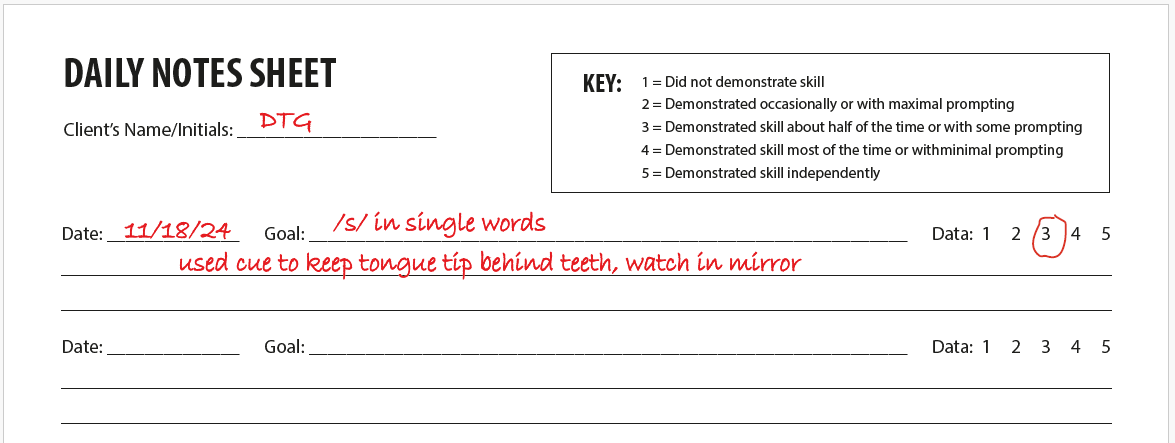
    Carrie’s Super Awesome Daily Notes Page for Speech-Language Professionals

    carrie's daily notes page for speech therapy rubric style grading

    Daily Notes Page Available for Download inside The Hub

    If I’m not doing a full data day, this is the only data I collect.

    I rate the student’s performance on a scale from 1-5.

    I add a quick note so I remember what cue I did or what I want to try next time.

    That’s it!

    I do it during my session so I’m not taking work home.

    Click Here to Join The Hub to Download the Daily Notes Page!

    But what about data for Medicaid/Billing/Whatever Else?

    This is the biggest hesitation that I hear about this approach.

    How can I bill medicaid/insurance/etc. if I don’t have numeric data?

    Well…

    you do.

    4 out of 5 is 80%

    3 out of 5 is 60%

    As long as you are still taking your detailed data at least once per month, you’ll be able to stay on track.

    And the billing machines will appreciate their numeric data.

    DISCLAIMER! I’m not an expert when it comes to billing. Please check with your billing company before taking this advice!

    What if my employer requires data on every repetition?

    Tell them I said that’s silly.

    Ok, don’t really do that.

    I don’t need angry calls.

    But in all seriousness, this is not best practice.

    It does not help the kids.

    It does not support you.

    If this requirement is being forced on you, then your job becomes to advocate for yourself and your clients and ask for an alternative option.

    So How Does this Look in Practice?

    1. At the beginning of the month, choose 1-3 skills to target for each student.
    2. For the first three weeks of the month, take only rubric-style data on the notes page.
    3. For the last week of the month, take your full data during your sessions and jot down 1-3 skills for next month.

    Need some help?

    We have all of the tools and resources you need to make this happen!

    Just join us inside The Hub and take “The Way”.

    In this series of videos, I’ll show you exactly how to get set up for this Way of doing speech therapy.

    I’ll even give you the data pages!

    Come let me help you!

    Click Here to Join The Hub to Download the Daily Notes Page!

    The post How to NOT Take Data during Speech/Language Therapy appeared first on Speech And Language Kids.


    No-Prep December Challenge! I Challenge You to Do Less Nov 18, 2024
    Show notes

    No-Prep December Challenge! I Challenge you to do Less

    Do you think you could go a full month without prepping any activities for therapy?

    Would you like to try?

    December is a notoriously busy month and usually our clients and students are all zany with that “pre-holiday” energy.

    So how about this year, you give yourself some slack?

    We’re doing a no-prep challenge this year and it’s going to change the way you look at therapy!

    Listen to the Podcast Here

    You can listen to the full podcast episode below:

    Rules for the No-Prep December Challenge

    1. You may not prep any therapy activities during the month of December
    2. You may not take elaborate data on student progress more than once in December (use rubric-data instead)

    How to Prep for the No-Prep December Challenge

    1. Set up your speech folders (see last week’s podcast episode)
    2. Choose 1-3 skills to target for each student in December
    3. Grab no-prep kits or other no-prep materials and drop in their folders
    4. Print out a rubric-style data sheet for each student and put in your data binder
    5. Watch the webinar on the 25th for more details

    What your Sessions will Look like Instead:

    1. Students come in and grab their folder
    2. Students practice their skill by itself for a few minutes
    3. Students grab a game, craft, or other activity off the shelf
    4. You continue to practice their skill during that activity

    Tools for Success for the No-Prep December Challenge

    Don’t worry, I have everything you need to make this easier!

    Inside The Hub, I’ll give you…

    • No-Prep Kits to put in your folders
    • Monthly Planning Page to keep track of who is working on what
    • Rubric-Style Data Sheets to make data collection a breeze
    • Webinar on Nov. 25th to walk you through setting it all up
    • More Videos on how to do no-prep therapy for various skills

    Click Here to Join The Hub
    and Start Today!

    Free plans available!

    The post No-Prep December Challenge! I Challenge You to Do Less appeared first on Speech And Language Kids.


    Set up a Folder System for Effortless Speech Therapy Sessions Nov 11, 2024
    Show notes

    Set up a Folder System for Effortless Speech Therapy Sessions

    Your students come into your therapy space and they know what to do.

    They grab their speech folders from the bin by the door.

    They walk to the table and sit down.

    They open their folders and get out their practice page.

    And they start practicing their skill quietly to themselves.

    While everyone is coming in and getting settled, you have a few minutes to walk around and make sure everyone is practicing correctly.

    You give a few redirections and corrections to help them get it right.

    Sound like a dream?

    Well, today I’m going to show you how to set up speech folders for your own effortless speech therapy sessions!

    Listen to the Podcast Here

    You can listen to the full podcast episode below:

    How do Speech Folders Work?

    1. Each student has a folder
    2. You drop what they’re working on into the folder
    3. When it’s time for speech, they grab the folder
    4. They do “drill work” at the beginning by practicing their skill over and over again for as long as you can keep their attention
    5. You keep working on that skill while playing games or doing other activities
    6. Once they’ve mastered that step, you send that one home as homework (to reinforce) and add something new to their folder

    HINT: Our No-Prep Therapy Kits inside The Hub are perfect for this and will allow you to plan once for weeks of therapy!

    How to Set Up Speech Folders

    1. Get a file box
    2. Put hanging folders in to house the students’ individual folders (one per group/class/grade level or one for each student)
    3. Label each folder accordingly (student initials or name of grouping)

    Need product recommendations? See my recommended files, boxes, carts, etc. inside The Hub.

    What if you Only Have a Small Number of Students?

    1. Get a 3-ring binder for each child
    2. Put a page on the front with the child’s name
    3. Put in 15 plastic page protectors plus three divider tabs

    How do Speech Folders Work for Teletherapy?

    1. Create a folder for each child
    2. Save them all in a place you can easily access during sessions
    3. Have a folder on your computer for links to their therapy activities

    What to Do During your First Session:

    1. Show student their speech folder or speech binder, explain this is where their work will be
    2. Have them decorate the front with things that are important to them
    3. Use this as a bonding time to talk about their interests and strengths
    4. Store in the speech box when done

    More Info, Training Videos, and Product Suggestions:

    Are you ready to set up your speech folders?

    I have everything you need inside The Hub:

    • Video explanations of how to do this
    • Product recommendations with links for folders, boxes, etc.
    • No-Prep therapy kits to fill the folders

    Click Here to Join The Hub
    and Start Today!

    Free plans available!

    The post Set up a Folder System for Effortless Speech Therapy Sessions appeared first on Speech And Language Kids.


    The Way of the Unstressed Speechie: Speech Therapy without Tears Nov 06, 2024
    Show notes

    If you’re a speech-language pathologist, SLPA, SALT or some other alphabet soup doing speech therapy with kids… And you’re stressed out… And overwhelmed… You are not alone! There are so many kids right now that need support and not enough of us to go around. So what’s an SLP to do? Well don’t worry, I’m Carrie Clark and in this episode of the speech and language kids podcast, I’m going to show you the way to be UNSTRESSED (just like a shwa) and do speech therapy without tears. And by that I mean your tears. Not the kids. I can’t guarantee the kids won’t cry. The Way: An easier path for speech therapy Working as a speech-language pathologist is hard. And working in a school setting can feel even harder. But I’ve spent the last 16 years of my career figuring out a better way. The Way is my streamlined system that allows you to see more students in less time. And it will help your students make faster progress, too! How to Streamline Speech Therapy Using “The Way”: No Prep Speech Therapy: By using child-led therapy, we can practice speech/language skills with little to no prep time on our part. Set Up Therapy Folders: Drop no-prep activities into each student’s therapy folder. We can increase retention (with less prep time) by using the same material over and over and changing the fun activity. Plan for a Full Month at Once: Most of our students don’t make fast enough progress that they need a new plan each week. Plan once for a full month and use the same stimulus material (worksheet/flashcard/etc.) for the full month. Make Group Sessions Easier: Using the folder system, students can come in and practice their skill right away. Then continue to practice during a game, craft, or play activity. Try 5-Minute Sessions: Tired of group therapy? Instead of seeing 4 kids in a 30-minute group, try seeing each child individually for 5 minutes. You’ll use up the same amount of time in your schedule but students will make faster progress (more info on the research behind 5-minute sessions here) Collect Full Data only Once Per Month: You don’t need to collect data on every repetition a child makes! Collect full data only once per month. During the rest of the month, focus on therapy time and give each session a rating on a scale of 1-5. Streamline Admin Tasks and Systematize Larger Tasks: Spend less time on your paperwork and planning by eliminating unnecessary tasks, finding shortcuts, and using checklists for recurring tasks Write Better Goals: Learn how to write goals that are easy to measure and make the most impact for the student Organize Your Stuff: Declutter and pair down your things. Then, store things in a way that makes them easier to put away. Learn More about “The Way”: Are you ready to get started with The Way? I’ve laid this all out in a video course… …and the first three modules are free! Visit Hub.SpeechAndLanguageKids.com to start!


    Why Use AAC for Toddlers or Children? Oct 10, 2016
    Show notes

    Why Use AAC for Toddlers or Children?

    AAC devices are augmentative/alternative communication systems that allow a person to communicate with those around them without speaking. There are many different types of AAC but the most common are high-tech AAC Devices that allow a person to push a button to speak a message. These are helpful for children or adults who have either lost the ability to speak or who are not able to speak well enough to clearly communicate everything that they want to say.

    So why would you need to use AAC with a toddler or child and how does it work?

    Why to Use AAC Podcast:

    Today we’re talking about how, when, and why to use AAC or augmentative-alternative communication devices and systems. AAC allows children who are not able to talk to use something else to communicate with those around them. Every child has the right to communication and it is our job as speech-language pathologists to figure out a way for every child to do just that.

    This podcast will go over the basics of what is AAC, how to use it to help a child communicate, when it is appropriate to use AAC, and why it should be considered as an option for non-verbal and minimally-verbal children. Click the play button below to hear the whole podcast, or scroll down to read the quick notes:

    AAC Curriculum for Speech/Language Therapy

    Free AAC Activity

    Teach the word “Help” using AAC

    Download for Free!

    Or, Get the Full AAC Curriculum

    Speech Therapy Demo Session for AAC

    Watch the AAC Therapy Session Demo

    Show Notes:

    What is Augmentative/Alternative Communication (AAC)?

    AAC is the term used to describe any form of communication that a person can use that is not speech. This may include pointing to pictures of what the person wants, using sign language, or using a device that will speak a message when a specific button is pushed.

    When Should AAC be Considered for a Child?

    AAC should be considered for any child when his/her speech output is not adequate to communicate everything that the child wants/needs to communicate.

    Things to consider:

    • Child’s frustration levels
    • Adult frustration levels
    • Access to school curriculum
    • Participation in classroom activities
    • Ability to demonstrate knowledge to teachers
    • Access to home and community environment
    • Ability to interact appropriately with family and peers
    • Independence in developmentally-appropriate daily activities

    What Prerequisite Skills Does a Child Need Before Trying AAC?

    In short, there are no skills that a child MUST have before AAC can be tried. Though, here are a few of the common misconceptions about this:

    These are commonly used as excuses why AAC devices should not be attempted with children but these are WRONG:

    • The child must understand cause and effect (AAC teaches cause and effect quite effectively)
    • The child must understand that a picture represents an object (again, AAC teaches this)
    • Child must have good enough motor skills for AAC (there are lots of alternatives for children who can’t access a device with their hands)
    • Child must understand enough language for AAC use (babies don’t have great language before they are introduced to speech)
    • Child must be interested in communicating (even inappropriate behaviors can be shaped into intentional communication)

    For more information about these “prerequisites”, click the link: http://www.speechandlanguagekids.com/what-are-the-prerequisites-for-using-an-aac-device-augmentativealternative-communication/

    Options for AAC devices, methods, and systems

    • Gestures/Body Language
    • Sign Language
    • Object Symbols (objects glued to cards)
    • Picture Boards
    • Picture Exchange
    • Written Messages (paper or typed)
    • Single Button Voice-Output Devices
    • Multi-Button Voice-Output Devices
    • Dynamic-Display Voice-Output Devices

    How to Introduce the System:

    Make it as natural as possible. Think of it as similar to how you would encourage a late talker to talk.

    1. Get Familiar with the Child’s System
    2. Model AAC Use Around the Child
    3. Encourage the Child When he Attempts to Use it and Provide Differential Reinforcement
    4. Have the Device Present at All Times
    5. Set Up Opportunities for the Child to Use the AAC Device (in the classroom, at home, in speech, etc.)
    6. Train Other Adults on How to Set Up Opportunities and Provide Differential Reinforcement

    For more info on getting started, click the link: http://www.speechandlanguagekids.com/help-child-use-aac-home-classroom-hint-easier-think/

    AAC Curriculum for Speech/Language Therapy

    AAC Curriculum and Mini-Course

    Teach a child to start communicating using an AAC/Communication Device or System

    $19 ~ Buy Now!

    Or, Download the Free Sample

    Carrie Clark, Speech-Language Pathologist

    About the Author: Carrie Clark, MA CCC-SLP

    Hi, I’m Carrie! I’m a speech-language pathologist from Columbia, Missouri, USA. I’ve worked with children and teenagers of all ages in schools, preschools, and even my own private practice. I love digging through the research on speech and language topics and breaking it down into step-by-step plans for my followers.

    Connect with Me:

    The post Why Use AAC for Toddlers or Children? appeared first on Speech And Language Kids.


    Why Do Speech Therapists Group Children Together? Sep 12, 2016
    Show notes

    In this episode of the Speech and Language Kids Podcast, speech-language pathologist Carrie Clark discusses the benefits of groups speech therapy for children and why speech therapists group children together. Carrie also discusses the types of cases that benefit from individual therapy.

    Click Here to Download Your Free Group Therapy Resource Pack

    Benefits of Group Speech Therapy:

    Time Constraints

    • Only certain times the child can be out of class
    • Only certain times the therapist is available

    Peer Support/Normalization

    • See that they’re not alone
    • See that this is normal
    • See that others can overcome it

    Increased Awareness of Skills

    • Be able to hear the error in someone else’s speech
    • Know what the other person should do to fix

    Learning Through Teaching

    • Teaching a peer can be a very effective way to learn

    Benefits of Perspective Taking

    • See what it’s like to be on the other side of communication problems

    Practice with Peers/Better Generalization

    • It’s different to work on new skills with peers than with adults

    When Individual Therapy is Needed:

    Children with Severely Limited Attention

    • If they can’t learn or practice if there are ANY distractions or other people

    Children in Certain Stages of Learning with Childhood Apraxia of Speech

    • When first learning speech sounds and getting past initial phases, need lots of repetition

    Children who aren’t Making Progress with Group Therapy

    • Possibly time for a change
    Click Here to Download Your Free Group Therapy Resource Pack

    More Resources for Speech-Language Pathologists:

    Looking for more therapy ideas and resources to help you provide the BEST services to your clients? Join us in The SLP Solution, our membership program for speech-language professionals! Inside the membership, you’ll find:

    • Step-By-Step Guides for teaching a variety of speech/language/communication skills
    • Pre-Made Worksheets and Therapy Activities for hundreds of different topics
    • Training Videos for dealing with difficult disorders or problems
    • Answers to Your Questions in our exclusive SLP community
    • Tools and Resources to help you with your paperwork and admin tasks
    • Continuing Education through our monthly webinars and webinar recordings

    To join us in the full SLP Solution, or to snag a free membership, click on the button below!

    JOIN THE MEMBERSHIP TODAY!

    Carrie’s Best Tools to Simplify your Life:

    You have a lot on your plate. Let me help with that!

    I’ve put together my best resources here. Whether you’re streamlining your job as a speech-language professional, helping your child with his communication challenges, or trying to meet the diverse needs of your students, I’ve got you covered.

    Choose the resource that you need most right now:

    Watch “Quick Tip” Videos on Instagram

    Access Carrie’s Free Material Library

    Get Materials and Support in The Hub

    Grab our Full Language Curriculum

    The post Why Do Speech Therapists Group Children Together? appeared first on Speech And Language Kids.


    The Speech Therapist’s Role in Reading and Writing in Children and Adolescents Aug 08, 2016
    Show notes

    The SLP’s Role in Helping Children and Adolescents with Reading and Writing Skills

    In this episode of The Speech and Language Kids Podcast, speech-language pathologist Carrie Clark discusses what speech therapists can do to help with literacy (reading and writing) skills in children and adolescents.

    Free activity main idea and supporting details worksheets

    Free Activity: Main Idea and Details

    Get the 4-page workbook for teaching main idea and details

    Download for Free!

    Or, Get the Full Language for Literacy Curriculum

    What is Literacy?

    • Pre-reading skills like phonological awareness and basic language skills
    • Reading skills
    • Writing skills

    Why do Children with Speech and Language Delays have Trouble with Literacy?

    • Children with repaired phonological (speech) problems still have underlying problems that can come back up with literacy skills (more likely to have reading problems later).
    • Children with language delays are missing a grasp of how to use their language for a variety of different literacy tasks.

    What Does ASHA Say About our Role?

    Roles for Speech-Language Pathologists

    Prevention—Communicating risk factors to teachers and parents, and working with them to develop programs to help children acquire explicit, age-appropriate knowledge, skills and strategies of the components of language that contribute to reading and writing development.

    Identifying At-Risk Children—Assisting in development and implementation of screening (e.g., instruments and teacher observation checklists) and referral procedures for very young children, as well as older school-age children, including modifying procedures to reduce bias (e.g., dynamic assessment techniques and criterion referenced tasks) for culturally and linguistically diverse populations.

    Assessing—Selecting, implementing, adapting, and interpreting assessment tools and methods to evaluate skills in spoken language, reading, writing and spelling.

    Providing Intervention—Collaborating with teachers and families to plan intervention goals and activities, as well as modifying curricula to keep students progressing in the general education curriculum.

    • Phonological Awareness Skills: https://www.speechandlanguagekids.com/ultimate-guide-phonological-awareness-pre-reading-skills/
    • Literacy Activities and Guides: https://www.speechandlanguagekids.com/literacy-resource-page/
    • Reading Comprehension: http://www.speechandlanguagekids.com/5-tasks-to-improve-your-childs-reading-comprehension/
    • Reading Fluency: https://www.speechandlanguagekids.com/tips-for-improving-reading-fluency/
    • Writing Narratives: https://www.speechandlanguagekids.com/ultimate-guide-to-teaching-written-narratives-by-grade-level/
    • Persuasive Writing: http://www.speechandlanguagekids.com/how-to-teach-persuasive-writing-for-children

    Documenting Outcomes—Establishing a tracking system for identifying new or re-emerging literacy deficits and documenting outcomes of intervention goals and plans.

    Program Development—Directing or participating in teams to develop school or system-wide strategic approaches to early identification and intervention for children with reading deficits.

    Advocating for Effective Literacy Practices—Providing information about literacy development to state and local agencies that plan and evaluate curricula, establish comprehensive assessments and set related policies; educating them about relationships between spoken language and written language (i.e., reading, writing and spelling) and the benefits of collaborative instructional approaches.

    Advancing the Knowledge Base—Conducting scientifically-based research on early literacy development.

    Free activity main idea and supporting details worksheets

    Free Activity: Main Idea and Details

    Get the 4-page workbook for teaching main idea and details

    Download for Free!

    Or, Get the Full Language for Literacy Curriculum

    The post The Speech Therapist’s Role in Reading and Writing in Children and Adolescents appeared first on Speech And Language Kids.


    Hypernasality Speech Therapy: Treatment Activities Jul 11, 2016
    Show notes

    Hypernasality Speech Therapy: Treatment Ideas for Hypernasal Speech

    Hypernasality occurs when a child speaks with too much nasal resonance.

    Airflow tends to be directed up into the nasal cavity during speech instead of primarily through the oral cavity.

    Nasal emission is when that air comes all the way out through the nose. This can make a puffing or noisy sound in the nose during speech.

    This page explains how to do speech therapy for hypernasal speech. We’ll also show you where you can access our full Resonance Curriculum for therapy or home use.

    Resonance/Nasality Curriculum for Speech Therapy

    Resonance Curriculum

    A Structured Program for Treating Hypernasality in Speech Therapy

    View the Resonance Curriculum

    Listen to the Podcast on Hypernasality Speech Therapy:

    What Goals Should I Write for Hypernasality Speech Therapy?

    Check out this sample goal for hypernasality speech therapy! Keep in mind, you should modify this goal to meet the needs of each individual client or patient that you’re working with:

    The patient will demonstrate appropriate oral and nasal resonance during a 30 minute unstructured conversation in 2 speaking settings with no more than 2 instances of hypernasality.

    Therapy Phases for Hypernasality Speech Therapy:

    1. Refer to ENT: All clients who exhibit voice issues should be referred to an ENT first to check the structures and functions and be cleared for therapy. If hypernasality is present, it may be secondary to a cleft palate and would need to be addressed first.
    2. Discriminate Between Oral Vs. Hypernasal: The client will be able to discriminate between appropriate oral resonance and hypernasality during speech after listening to a speaker (live or recorded) 85% of the time independently on 3 out of 4 data collection days.
    3. Technique Practice: After the effective technique has been identified in therapy, the client will practice that technique.
    4. Oral Resonance in Vowels: The client will use oral resonance when saying vowels 80% of the time with no more than 2 cues on 3 out of 4 data collection days.
    5. Oral Resonance in Words: The client will use oral resonance in words 80% of the time with no more than 2 cues on 3 out of 4 data collection days.
    6. Oral Resonance in Phrases : The client will use oral resonance in phrases 80% of the time with no more than 2 cues on 3 out of 4 data collection days
    7. Oral Resonance in Sentences: The client will use oral resonance in sentences 80% of the time with no more than 2 cues on 3 out of 4 data collection days.
    8. Oral Resonance when Reading: The client will use oral resonance when reading aloud independently 80% of the time with no more than 2 cues on 3 out of 4 data collection days.
    9. Oral Resonance in Conversation: The client will independently use oral resonance during conversation in the therapy setting with no more than 2 cues on 3 out of 4 data collection days.
    10. Generalize Oral Air Flow to Other Environments: Student will use correct oral airflow in a variety of situations and environments.

    *** Discontinue Therapy if Not Making Progress: If no progress is made after 6 weeks, client should be re-evaluated by ENT.

    Therapy Activities and Techniques for Hypernasality

    • Stimulability probe: Try to get the child to imitate oral resonance
    • Altering Tongue Position: Try for a lower, posterior tongue placement
    • Open Mouth: Have the child speak with his mouth more open
    • Change Volume: Try different volumes to see which has less nasality
    • Change Pitch: Try different pitches to see which has less nasality
    • Auditory Feedback: Teach the child to hear the difference between nasal and oral resonance in himself and others
    • Feedback: Tell the child if productions are oral or nasal so he can learn to feel the difference
    • Focus on the Facial Mask Area: Have the child draw his focus and attention to the eyes/nose area of his face
    • Bio-feedback: Give the child immediate feedback on if air is coming out of the nose like placing a mirror right below nose or using a See Scape

    Source:

    The Voice and Voice Therapy, Seventh Edition: By Boone, McFarlane, and Von Berg

    A Structured Curriculum for Treating Hypernasality and Other Resonance Disorders:

    Resonance/Nasality Curriculum for Speech Therapy

    Resonance Curriculum

    A Structured Program for Treating Hypernasality in Speech Therapy

    View the Resonance CurriculumCarrie Clark, Speech-Language Pathologist

    About the Author: Carrie Clark, MA CCC-SLP

    Hi, I’m Carrie! I’m a speech-language pathologist from Columbia, Missouri, USA. I’ve worked with children and teenagers of all ages in schools, preschools, and even my own private practice. I love digging through the research on speech and language topics and breaking it down into step-by-step plans for my followers.

    Connect with Me:

    The post Hypernasality Speech Therapy: Treatment Activities appeared first on Speech And Language Kids.


    Speech Therapy for Stuttering: Exercises to Help a Stuttering Child Jun 13, 2016
    Show notes

    Speech Therapy for Stuttering: Exercises to Help a Stuttering Child

    How can we help children and teens who stutter?

    There are many speech therapy techniques and exercises that we can use to help individuals speak more fluently.

    On this page, we’ll show you how to do speech therapy for stuttering at the different age levels. We’ll show you the best exercises, strategies, and therapy materials to use when helping children and teens who stutter.
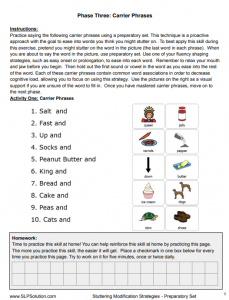
    Stuttering Curriculum for Speech Therapy

    Stuttering Curriculum

    A Structured Program for Helping Children who Stutter (in Speech Therapy or at Home)

    View the Stuttering Curriculum

    Stuttering Therapy Exercises and Techniques:

    The purpose of speech therapy for children who stutter is to help them learn how to communicate effectively and easily. Sometimes that means eliminating the stutter all together, such as with preschoolers experiencing developmental disfluencies. But often, especially for our older clients, the stuttering may never fully go away. Our job then is to help them communicate to their best ability and to help them learn how to handle stuttering and disfluencies when they arise.

    Take a look at our therapy ideas below. Scroll down to the age group that you are working with and see what we recommend at each of these ages. Or, check out our Full Stuttering Curriculum here.

    Jump to an Age Group:

    Preschoolers

    Elementary School

    Middle School/High School

    Stuttering Therapy Techniques for Preschoolers:

    Many preschoolers go through periods of dysfluency where they will stutter off and on for a while. This happens as their mouths are struggling to keep up with all of the things that their developing minds want to say. For many children, this stuttering goes away on its own. For others, they will develop persistent stuttering that will require more therapy.

    Here are the “red flags” or warning signs that may indicate that a child is more likely to have persistent stuttering that will require therapy:

    • A parent, sibling, or other family member who still stutters
    • Stuttering starts after age 3 ½
    • Stuttering has been occurring for at least 6 months
    • Preschooler is a male
    • The child has other speech sound errors or trouble being understood
    • The child’s language skills are advanced, delayed, or disordered

    Source: http://www.stutteringhelp.org/risk-factors

    Stuttering Therapy Activities for Preschoolers

    For preschoolers, it’s usually a good idea to begin with indirect therapy as this will promote smoother speech without directly talking about the stutter (which can sometimes upset a child or cause more pressure). If indirect therapy doesn’t work, or if the child is already upset by his/her stuttering, we can move to direct therapy activities.

    Indirect Therapy:

    • Identify fast vs. slow speech from the therapist
    • Practice using fast and slow speech for the child
    • Practice slow, smooth, exaggerated speech

    Direct Therapy:

    • Identify bumpy vs. smooth in the therapist’s speech
    • Practice bumpy and smooth speech for the child
    • Identify the child’s speech as bumpy or smooth during play
    • Ask the child if his speech was bumpy or smooth
    • Response Contingency: Praise/Reinforce smooth speech and provide immediate, direct corrective feedback for disfluent speech (“Oops, that was bumpy, let’s try it again)

    Stuttering Therapy Techniques for Elementary Age Children:

    Once children enter school, if they are still stuttering then we are ready to start addressing the stuttering directly. The stuttering therapy techniques you use at this age will depend on what each child needs. But here are some simple stuttering therapy activities you can use to help children who stutter communicate more easily:

    Stuttering Therapy Activities for Elementary School Aged Children:

    1. Learn About the Respiratory System

    Start by doing a lesson all about the respiratory system. Use pictures, charts, models, or whatever you have available to you. Practice inhalation and exhalation, as well as deep and shallow breathing with the students. Talk about how we speak on exhalations and practice taking a deep breath in and then slowly exhaling while saying a single word. Gradually increase to speaking in longer phrases and sentences while using gentle exhalations. Talk about breathing timing during conversations (when to take a breath).

    2. Practice Smooth, Prolonged Speech while Playing Games

    Take whatever games you have available and practice using smooth, prolonged speech during those games. For example, you can have children play “Go Fish” and make sure they slow down and elongate their words when asking “Do you have a…”. Or, you can have them take a turn in a board game and use their slow, smooth speech to describe what happened (ex: “I rolled a four. I’m going to move four spaces”).

    3. Learn About the Types of Stuttering

    Help students learn about the different types of stuttering and which ones they do. Help them identify when they have stuttered and what type it was. Practice the different types of stutters to desensitize them to it.

    4. Practice Fluency Shaping Techniques

    Practice different techniques that help a child speak fluently for a period of time. These include slow/stretchy speech, easy onset, yawn-sigh, etc.

    4. Teach the Students Stuttering Modification Techniques

    Help the students learn the different techniques they can use if they anticipate a stutter (preparatory set), are in the middle of a stutter (pull-out), or have stuttered and can’t move on (cancellations). Practice demonstrating these while playing games (pretend to stutter so you can use a technique).

    Stuttering Therapy Techniques for Middle School/High School Clients:

    Now we’re ready to dive deeper. Older clients who stutter can benefit from learning these stuttering therapy techniques and practicing with these stuttering therapy activities:

    Speech Modification (Fluency Shaping) Techniques:

    Speech modification (including fluency shaping) strategies (Bothe, 2002; Guitar, 1982, 2013) include a variety of techniques that aim to make changes to the timing and tension of speech production or that alter the timing of pauses between syllables and words. These modifications are used regardless of whether a particular word is expected to be produced fluently. Strategies associated with speech modification include:

    • rate control,
    • continuous phonation,
    • prolonged syllables,
    • easy onset,
    • light articulatory contact.

    Other speech modification strategies, including appropriate use of pausing, are used not only to increase the likelihood of fluent speech production but also to improve overall communication skills (e.g., intelligibility, message clarity, etc.). In addition to being used for improving communication skills, pausing is also an effective method of rate control.

    Keep in mind the child may be self-conscious about using these techniques.

    Stuttering Modification Strategies (Reducing Physical Tension/Struggle)

    • Identify where in the speech mechanism physical tension is and release it.
    • Traditional stuttering modification strategies include preparatory set, pull-out, and cancellation and require a child to identify a moment of disfluency before, during, or after it occurs, making adjustments to reduce tension and struggle. The specific strategy that is selected will depend on when the client “catches” the disfluency, whether it be following a moment, in the moment, or in anticipation of the moment of disfluency (Van Riper, 1973).
    • These strategies, like speech modification strategies, are introduced along a hierarchy of speaking situations that varies both with linguistic demands and with the stressors of the environment.

    Strategies For Reducing Negative Reactions (Personal And Environmental Context)

    • Desensitization
    • Cognitive Restructuring
    • Self-Disclosure
    • Support Group (grouping your kiddos who stutter)

    Click here to access our guided program for addressing negative emotions for clients who stutter
    (Inside The Curriculum)

    A Structured Curriculum for Stuttering Therapy:

    Stuttering Curriculum for Speech Therapy

    Stuttering Curriculum

    A Structured Program for Helping Children who Stutter (in Speech Therapy or at Home)

    View the Stuttering Curriculum

    Listen to this as a podcast:

    Carrie Clark, Speech-Language Pathologist

    About the Author: Carrie Clark, MA CCC-SLP

    Hi, I’m Carrie! I’m a speech-language pathologist from Columbia, Missouri, USA. I’ve worked with children and teenagers of all ages in schools, preschools, and even my own private practice. I love digging through the research on speech and language topics and breaking it down into step-by-step plans for my followers.

    Fun Fact: I have a son with sensory seeking and some sensory avoiding behaviors. As I type this, he is on my lap while I bounce him up and down on my knees because we are waiting for his brother to be done in a class. We’ve found that giving him deep pressure is the best way to help his sensory needs. We do big squeezes, wrap him in blankets, and push down on his head. That one was the weirdest for me because I don’t enjoy that type of sensory but he LOVES it. I just push on his head and he calms right down!

    Connect with Me:

    Carrie’s Best Tools to Simplify your Life:

    You have a lot on your plate. Let me help with that!

    I’ve put together my best resources here. Whether you’re streamlining your job as a speech-language professional, helping your child with his communication challenges, or trying to meet the diverse needs of your students, I’ve got you covered.

    Choose the resource that you need most right now:

    Watch “Quick Tip” Videos on Instagram

    Access Carrie’s Free Material Library

    Get Materials and Support in The Hub

    Grab our Full Language Curriculum

    The post Speech Therapy for Stuttering: Exercises to Help a Stuttering Child appeared first on Speech And Language Kids.


    Childhood Apraxia of Speech | Treatment Ideas and Exercises May 09, 2016
    Show notes

    Childhood Apraxia of Speech | Treatment Ideas and Exercises

    Childhood Apraxia of Speech (CAS) is a motor speech disorder where a child knows what they want to say but the sounds won’t come up correctly.

    We can help children with CAS with speech therapy activities and exercises to boost motor speech skills.

    On this page, we’ll give you information about childhood apraxia of speech how speech therapy exercises can help those children improve their speech skills

    Free CV, VC, CVC, CVCV Flashcards and Worksheets

    Free Flashcards: CV, VC, CVC, CVCV Words

    Practice cards and worksheets for children with Apraxia and other motor speech disorders

    Download for Free!

    Or, Get the Full Motor Speech Curriculum

    What is Childhood Apraxia of Speech?

    Childhood Apraxia of Speech (CAS) is a rare, neurologically-based speech disorder where the child knows what he wants to say but the message gets mixed up in the motor-planning and execution phase so the sounds come out all wrong.

    What are the Symptoms of Childhood Apraxia of Speech?

    Though the diagnosis of CAS is relatively new, experts have agreed that CAS usually includes these 3 generally-agreed upon components:

    • Inconsistent errors on consonants and vowels in repeated productions of syllables or words(meaning that if the child says the same word many times, it may sound differently each time)
    • Lengthened and disrupted coarticulatory transitions (meaning that the child’s speech sounds choppy or disconnected due to trouble transitioning between sounds or between words in older children)
    • Inappropriate prosody, especially in the realization of lexical or phrasal stress between sounds and syllables (meaning that the rhythm, intonation, and stress of speech may sound off, the child may sound robotic, have incorrect phrasing, or stress the wrong words or syllables)

    Listen to the Podcast on Childhood Apraxia of Speech:

    Sometimes it can be difficult to know exactly what you should be working on with your children with childhood apraxia of speech. In this podcast episode, I break down speech sound learning in different levels. Then, I give practical therapy activities that can be used for each level. Click the play button below to listen to the entire episode. Or, scroll down to see the notes below.

    Preview

    How to Do Speech Therapy for Apraxia of Speech:

    Apraxia of Speech Level 1:
    Imitating Actions

    Start Here For…

    • Children who are unable to imitate speech sounds
    • Children who are not tuned in enough to work on anything during sessions
    • Children who have emotional issues and are not willing to work with you on their speech during sessions

    Therapy Activities

    • Do a reinforcer probe and offer those preferred reinforcers if the child imitates a basic action like clapping hands, stomping feet, raising hands, etc.
    • Take pictures that represent the actions you want the child to do and print them on cards. Have the child draw one card from a bag and do that action.
    • Make a movie on your phone where the child is your shadow and imitates what you do (do it in reverse as well).

    Apraxia of Speech Level 2:
    Functional Sounds, Sound Effects, Vocalizations

    Start Here For…

    • Children who are able to imitate actions but unable to imitate or produce sound combinations (like CV, VC)
    • Children who need a little confidence boost before working on sound combinations (this could be mixed in)

    Therapy Activities

    • Play with vehicles and make engine sounds (or sirens).
    • Feed puppets or stuffed animals and have them make exaggerated “mmmm” noises.
    • Have the child request pieces to an animal puzzle by making that animal’s noise (reduce complex noises down to one sound, like “eee” for monkey).

    Apraxia of Speech Level 3:
    Sound Combinations (CV, VC)

    Start Here For…

    • Children who are able to imitate or produce some sounds but are not yet spontaneously combining 2 sounds, like consonant- vowel or vowel-consonant
    • Children who are doing some sound combinations on their own but can’t say very many (or enough to communicate much)

    Therapy Activities

    • Get some sort of a riding toy like a bike or a swing and stop the child until he says “go” again.
    • Throw small objects up onto a higher surface (like a table), each time, have the child say “up” to indicate he wants another thing to throw up.
    • Put coins in a piggy bank and have the child say “in” to get each coin to indicate he wants to put it in.

    Apraxia of Speech Level 4:
    Repeated Strings of CV or VC

    Start Here For…

    • Children who are able to combine a vowel and consonant together but are not yet producing longer utterances
    • Children who are doing some CV, VC, and CVCV combinations on their own but can’t say very many (or enough to communicate much)

    Therapy Activities

    • Sequence words that the child can do together to work on articulatory transitions (the same word repeatedly or alternating two words together).
    • String together several of a word that the child can say and then add a word that the child can’t say to the end that only varies by one sound (bow, bow, bow, boy).

    Apraxia of Speech Level 5:
    Add a Structure, Add a Sound

    Start Here For…

    • Children who are able to say some limited structures (like CV, VC, and CVCV) but struggles to say longer or more complex words
    • Children who are able to use some sounds in CV, VC, and CVCV structures but not very many

    Therapy Activities

    • Increase vowels by sequencing pictures together that start with the same consonant and change the vowel, like “boy, bee, bay, bow, bow”, etc. Lay the cards in a row and have the student say the sequence.
    • Increase consonants by using the same vowel and changing the consonant, like “me, tea, key, pea, we, see”.
    • Increase structures by taking a known word and adding a sound like, “key…keep, pea…peep, we…weep”.

    Apraxia of Speech Level 6:
    Sound Accuracy in Phrases and Sentences

    Start Here For…

    • Children who are able to produce single words of many structures with good speech sound accuracy but intelligibility decreases in phrases and sentences

    Therapy Activities

    • Create worksheets similar to the previous section where you provide the pictures and they glue them on, but this time, build sentences, like “see..(next line)..I see…I see cat…I see the cat”.
    • Use one carrier phrase and fill it with different words that the child has mastered, like “I see bat, I see cat, I see hat, I see mat”. Use flip books if you have them or make your own.

    Apraxia of Speech Level 7:
    Sound Accuracy in Connected Speech

    Start Here For…

    • Children who are able to produce sounds correctly in simple sentences and phrases but intelligibility decreases in connected speech

    Therapy Activities (work on speaking clearly in tasks with increasing complexity, don’t move on until the previous level is clear)

    1. Have the child describe pictures using full sentences (“the girl is walking her dog in the park”).
    2. Have the child complete automatic speech tasks like saying the pledge of allegiance or the months of the year.
    3. Have the child answer open-ended questions like “tell me about your last birthday party”.
    4. Have the child read a short paragraph.
    5. Have a conversation with the child about a specific topic with the expectation that you will be listening for his speech sounds.
    6. Listen for correct speech sounds in conversational speech and correct using feedback as needed.

    A Structured Curriculum for Motor Speech Disorders:

    Children with Childhood Apraxia of Speech (CAS) require a different approach to speech therapy than other children.

    Our Motor Speech Curriculum is specifically designed with the principles of motor learning in mind. This Curriculum includes everything you need to improve speech clarity using a motor speech approach.

    Free CV, VC, CVC, CVCV Flashcards and Worksheets

    Free Flashcards: CV, VC, CVC, CVCV Words

    Practice cards and worksheets for children with Apraxia and other motor speech disorders

    Download for Free!

    Or, Get the Full Motor Speech Curriculum

    Carrie Clark, Speech-Language Pathologist

    About the Author: Carrie Clark, MA CCC-SLP

    Hi, I’m Carrie! I’m a speech-language pathologist from Columbia, Missouri, USA. I’ve worked with children and teenagers of all ages in schools, preschools, and even my own private practice. I love digging through the research on speech and language topics and breaking it down into step-by-step plans for my followers.

    Connect with Me:

    The post Childhood Apraxia of Speech | Treatment Ideas and Exercises appeared first on Speech And Language Kids.


    Previous 1 2 3 4 5 6 10 Next

    Related Podcasts

    Coffee Break French

    1

    Coffee Break French Courses
    EconTalk

    2

    EconTalk Courses
    TED Talks Education

    3

    TED Talks Education Courses
    The Torch: The Great Courses Podcast

    4

    The Torch: The Great Courses Podcast Courses
    LSE: Public lectures and events

    5

    LSE: Public lectures and events Courses
    Homeschool Better Together

    6

    Homeschool Better Together Courses
    footer-logo

    Contact Us

    Toll Free: 844-670-7747

    Links

    • Home
    • Top Charts
    • Networks
    • Apps
    • Independents Podcasts
    • Podcast Advertising
    • Podcast News
    • Contact Us
    • About Us
    • Analytics & Insights

    Stay Connected

      Privacy, Terms of Use & Our Code of Ethics Protecting Content Creators Copyrights