47. Larry Braitman – fishing for dot-com dollars with Flycast
Dec 10, 2023
Show notes
Larry Braitman was co-founder of Flycast, a dot-com-era digital ad network known for its direct-response focus, lower entry costs for advertisers and publishers, relative ease of use and optimization, and explicit embrace of what the Wall Street Journal called remnant (or unsold) inventory.
Larry founded Flycast — named for his co-founder Richard Thompson’s precision piscine pasttime — in the summer of 1996 in San Francisco, where he’d relocated from his hometown of Philadelphia. Flycast IPO’d in 1999 and sold to the roll-up holding machine CMGI in January, 2000.
This proved to be excellent timing, of course, just months before AOL-Time Warner and the end of days, and CMGI’s all-stock deal, priced at a reported $559 million, rose at the peak of the dot-com bubble to a staggering $2.2 billion. (CMGI’s own IPO was put on hold in 2000 and it was out of the internet ad business by 2003.)
At the time, Flycast had revenues of about $25 million, up from less than $5 million in 1998, and was running at a loss. In total, it raised $20 million and had about 800 publications in its ad network, 75 employees and 300 advertisers, according to public filings.
Larry started his professional life as a corporate attorney and tax partner in Philadelphia. Seeking a second act, he met Rick Thompson through a VC who’d rejected an earlier newsletter startup he’d pitched. At the time, Thompson was a student at Wharton Business School.
As Larry tells Marty in this reflective episode, Flycast emerged from multiple brainstorming sessions as the last in a string of previously-discovered ideas. From the beginning, it stressed self-serve automation and practical tools for ad buyers and publishers, a down-market DoubleClick for the DIY domain.
Candid photos (shot on film!) of the early Flycast team hard at work in their SoMa offices in SF (mid-1990s)
Components of its solution included:
AdAgent — desktop tool for ad buyers to schedule up-front and “opportunistic spot buys”
Media Templates — automation tools for common requirements like A/B tests, day/time buys
AdReporter — measurement tool
In the pre-programmatic era, Flycast offered the ability to prepopulate prices within an ad server to meet reach targets. The “Blind Buy” was a lower-cost option, familiar to ad network users even today: you don’t know where your ad’s running, but it’s cheap.
Tactics such as the “Tonnage Buy” and the “Media Blitz” reveal the company’s unpretentious tone and tilt toward usability, giving buyers an option to set a high CPM and get a virtual “ton” of impressions.
Pricing was a percent of media with a limited freemium/try-before-you-buy model. Larry says Flycast started its fees at 15% of media spend, and its website ultimately broadcast a list price of 30% (presumably negotiable).
Not long after CMGI acquired Flycast, it shut it down. CMGI itself was a victim of the dot-com meltdown. In all, it had rolled up (and then down) some 50 companies, including Engage, AdSmart, AdForce, AdKnowledge and Flycast. Its last bold venture was acquiring the search-engine AltaVisa in 2002 and selling it a year later at a 94% discount.
In 2005, Larry was back at it, co-founding Adify Corporation. Adify was a white-label solution to build vertical ad networks, going to market based on an anchor-tenant and long-tail model. Ultimately, it helped power 100 networks, including Martha Stewart’s lifestyle sachet and Forbes’ business-financial mesh, and was acquired by Cox in 2008 for a reported $300 million.
These days, Larry is an early-stage investor who likes to work with companies across a range of industries, advising on practical matters such as strategy and helping to line up initial funding rounds. None of these companies is in ad tech.
46. Jay Schwedelson – was WebConnect the first ad network?
Dec 10, 2023
Show notes
Jay was the founder of a very early ad network called WebConnect, in the second half of 1995, that was notable for taking a then-unusual but prescient stance against the use of third-party cookies for “tracking” — a business decision that Jay admits “was wrong,” ultimately forcing WebConnect to transform into an email-focused services shop.
Jay grew up in the database marketing business, starting in his parent’s garage in Jericho, Long Island, where the Schwedelsons bootstrapped a startup that collected and collated terrestrial address lists for consumer magazines such as Sports Illustrated. As a college student in Southern Florida in the ’90s, Jay immediately saw the Internet as an opportunity to build a similar operation for websites.
The WebConnect model was simple: Jay and some friends called webmasters on the phone and asked if they could “exclusively” represent them to advertisers. Text ads were then sold to buyers at a flat rate of $50-100 a month, consisting of text links out to the advertisers’ website. Through the cold-call brute-force method, the startup signed on about 1,000 publishers into its network and began to aggregate themes: e.g., a few dozens golf-themed websites could be packaged as a “Golf Channel” and ads sold through the network to brands who thought golfers were a good fit for their product.
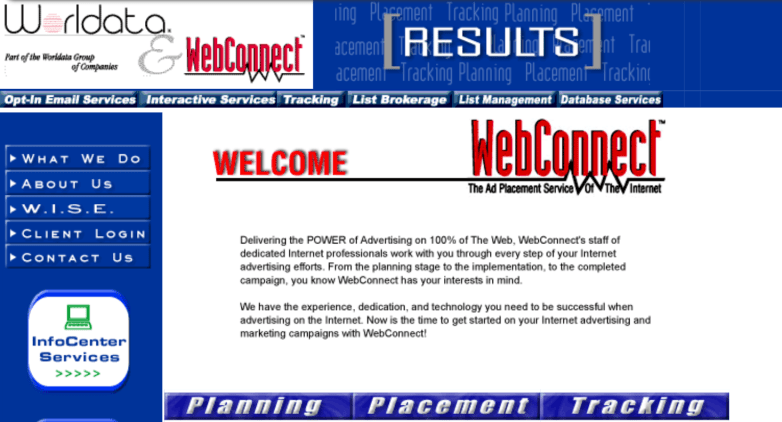
In fervid, microscopic early web — around 1995 and 1996 — Jay found a greenfield, with “zero ads” and no real competition, but that changed. DoubleClick entered as a competing ad network that first year, followed by 24/7 and Real Media and Flycast, and others. WebConnect built a “rudimentary” ad server that powered reporting, as well as a portal for publishers to sign up and join its network. An early goal (as we see from the early website screen shot above) was to get the entire Internet into the mesh, but it became unrealistic.
Notably, as DoubleClick embraced cookie-based profiles of web surfers, Jay found the idea of cross-domain tracking personally distasteful:
I was like, wait a minute. So you’re telling me we’re gonna drop something on somebody’s computer, and then we’re gonna follow them around the internet and we’re gonna see what they’re doing?
And then we’re gonna target based on that? — that’s horrible! This is a terrible idea. They’re gonna get into a lot of trouble … but there was no trouble to get into.
Jay Schwedelson
Cookie-based profiles became a competitive differentiator for DoubleClick and other networks, and then an industry standard, and so WebConnect with left with a portfolio of contextually-targeted sites that did not perform as well as others networks’ audience-based offerings. It ended up losing publishers and advertisers and started to focus on email.
Around the turn of the millennium, many ad networks acquired or built email services. DoubleClick had DART Mail, 24/7 had 24/7 Mail, FlyCast acquired an email provider. These businesses were largely divested later, as lower-growth, leaving Jay to forge a second act under different corporate names — WorldData, Outcome Media — very close to his origin story, collecting personally-identifiable IDs with permission from consumers to be stored in data-bases and used for direct marketing.
Which ultimately may be a more durable — certainly more transparent — approach than web cookies.
Another early website, post-WebConnect but still focused on lists
45. Jim Jorgensen – the amazing dot-com adventure of AllAdvantage
Dec 10, 2023
Show notes
Jim Jorgensen is a prolific serial entrepreneur and co-founder of a well-known dot-com advertising startup called AllAdvantage. The company paid people to surf the web as part of a multi-level marketing program. Launched in April, 1999, without a product, it ultimately raised $175 million from blue-chip VCs and was on track to go public in March 2000 – one short year after its launch – at a unicorn valuation of $1.4 billion.
Then the market crashed. Two years after its founding, the company was a chapter in ad tech history, cited by chroniclers such as Roger Lowenstein in his Origins of the Crash as an object lesson in collective confusion.
As Jorgensen reveals to Marty in this rollicking episode, AllAdvantage is more fairly seen as an experimental business model with a viral component that was more a symptom than a cause of its distorted dot-com economics.
Jorgensen himself is a tall, gregarious personality with a fund of stories and a varied career. Trained as an accountant, he’s a born entrepreneur. On a tip from a professor at Stanford, in the 1970’s, he hooked up with the tennis pro Billie Jean King and became her business manager for a couple of decades, meanwhile launching sports-related ventures such as WomenSports Magazine, Women’s Professional Softball League, and the still-thriving World Team Tennis league.
Moving to L.A., he was a Hollywood business manager for a while; clients included Sharon Stone, Lily Tomlin and the (brilliant) writer John Hughes. But by 1999, Jorgensen was back in San Francisco, teaching entrepreneurship at Stanford Business School, and living in a seven-bedroom faculty palace with a swimming pool, tennis court and hexagonal “shed” formerly inhabited by Nobel Laureate Joseph Stiglitz, who continued to drop by.
AllAdvantage happened quickly. Already in his early 50s, Jorgensen originally wanted to launch a travel website but became intrigued by an idea pitched to him by a Stanford student named Johannes Pohle for a product that would pay people in exchange for requiring them to watch ads while they surfed. Jorgensen added the component of multi-level marketing, where a customer gets paid a commission for referrals.
Two other graduating twentysomething Stanford students – Carl Anderson and Oliver Brock, a friend of Pohle’s from Germany – joined the founding quartet, and AllAdvantage was launched in April, 1999, one month after its conception. At first, it was simply a website that collected names and a promise of product launch “in six to eight months.”
By the second day, the website had collected 24,000 names, and VC’s were baited. Raising $2 million was not difficult. The next $173 million took less than a year. By March 2000, the company had over 1,000 employees, a couple dozen sales offices, and the services of notorious dot-com i-banker Frank Quattrone, at CSFB.
As launched in August, 1999, AllAdvantage hosted a one inch-high applet that sat on the top or bottom of the screen. It could be turned on or off; when on, it tracked the user’s surfing behavior and served ads. There were two ads, one in the middle and a smaller one off to the side, and they rotated every 20 seconds or so.
This is what the viewbar looked like:
And this is what the website looked like (retrieved from the Internet Archives, missing some images):
Targeted behavioral ads would seem to be a benefit, but the company itself admitted in a filing that “During 1999 and the first quarter of 2000, substantially all of the advertisements we sold were not highly-targeted.” The market demand wasn’t there yet, although DoubleClick was a major partner and reseller.
AllAdvantage’s soon-ubiquitous slogan “Get Paid to Surf the Web” was an afterthought, but it caught on. At first, users were promised 50 cents an hour for up to 40 hours a month of surfing; 10 cents per hour for their first referral; and 5 cents for up to four more referrals. Doing the math, payouts could get into the $15,000 per month range – but that was (presumably) very rare. These rates were lowered significantly within a few months, and a sweepstakes was later added, but costs always exceeded revenue.
Total membership grew from about 5 million in late 2000 to 8 million in May, when growth slowed dramatically. From a rate of almost 900,000 new members snagged in January 2001, new signups fell to 200,000 in August.
And the company never quite figured out a working business model. Revenue per active user peaked at just over $2.00 in March, 2000, when its cost per user was $10.00. That math doesn’t work.
The company’s burn rate was legendary, even for the time. In July 2000, it earned $14 million from advertisers and paid out almost $50 million. In total, the company is estimated to have lost over $100 million of the VC’s money.
It must be said that most of this debacle was not AllAdvantage’s fault. To interpret the company as some kind of pyramid scheme or “fraud” (as Lowenstein characterizes it, unfairly) is to ignore the context; had the market continued on its current trajectory, Jorgensen’s company might have found a path to profitability.
Yet there is evidence the whole “Get Paid to Surf the Web” thing lacked long-term appeal. Plenty of people tried it, but few stuck around. Only about 20% of members were “active,” on average, meaning 80% of people tried it and left. (These numbers were self-reported and published in a Stanford Business School case study.)
AllAdvantage was also particularly susceptible to fraud. Jorgensen tells Marty that some users were posting pictures of their pay-out checks on the web, and others were printing out the pictures and trying to cash them as checks. Free programs like FakeSurf and MyAdvantage appeared that faked web surfing, so a user could be paid while not surfing – or even set up robotic PCs to receive checks.
As Jorgensen points out, AllAdvantage was well aware of these schemes and took steps to combat them. They appointed a Chief Privacy Officer and had a fraud department, staffed with PhDs, who sat on a windowless room and were aided by anonymous white hat crusaders, some of whom (rumor has it) may have been behind the original hack-apps.
But as #PaleoAdTech listeners know all too well, the year 2000 was cruel to everybody in the advertising business.
When the floor fell away from dot-com funding starting around March, 2000, as IPOs and other exits grew unrealistic, the dot-coms pulled their ad spend and the publishers and intermediaries suffered. Here’s a chart of online advertising (indexed to 10/99 = 100) showing the massive spike as AllAdvantage prepped for its IPO and the vertiginous cliff-walk after AOL acquired Time Warner in March.
Interestingly, the get-paid-to-watch-ads paradigm remains, and it was not original to AllAdvantage. Jorgensen mentions the precedent of NetZero, launched a year before AllAdvantage, which provided free ISP service in exchange for enduring a 3.5-inch viewbar with ads. There was also PowerAgent, briefly headed by Paleo Ad Tech guest David Carlick, which was formed in 1994; it originally focused on email ads and managed to raise almost $20 million from power players such as Ross Perot’s EDS. It couldn’t seem to release a product out of beta. Others in the space included Juno, Freei, Spinway and BlueLight Internet (owned by Kmart) … and more.
These days, Jorgensen remains in the Bay Area and has a number of start-up ventures running. None is in ad tech.
44. Shawn Riegsecker – getting to the Basis Technologies of Centro
Dec 10, 2023
Show notes
Shawn is the Founder and CEO of Basis Technologies, aka Centro, and a well-known figure on the ad tech circuit for two decades. He started the company back in 2001 with the vision of being a comprehensive, automated and intelligent software platform for digital media, focused on mid-market agencies and brands. In his spare time he’s an activist for all the right causes and an angel investor.
Shawn is also the -two in our recent one-two punch of influential Chicago-based ad tech startups. Like his fellow hometown hero Matt Spiegel, who co-founded Resolution Media in 2003, Shawn proves that not all good digital media ideas come from the coasts or the Middle East. The Midwest has its deep thinkers as well.
Adopted into a pious Mennonite family, Shawn originally aspired to follow in the footsteps of the savior and become a pastor, attending a small Christian college and transferring to Bowling Green State University. Luckily for ad tech history — as Shawn tells Jill and Marty in this riveting recital, — although “there was not a lot of competition” at BGSU, the school was home to a very well-known professor named Martha Rogers, founding partner of the Peppers & Rogers Group and co-author of the best-selling The One to One Future (1993) about what used to be called “database marketing.”
Inspired by Dr. Rogers, Shawn began his career getting newspapers like the Akron Beacon-Journal and the Cleveland Plain Dealer onto the internet. It was a feverish time, Shawn recalls: “There were no rules, nobody understood what they were doing. But we knew we had to get moving in that [digital] direction.”
Eventually he joined #PaleoAdTech favorite Dave Morgan at Real Media in the 1990s, helping to aggregate local media for larger national advertisers. When Real Media’s DoubleClick acquisition fell through at the last minute, Shawn spoke up to execs to face “serious operational and scale issues … relative to the ad sales network side [of the business]” — and the idea for Basis was born.
What was the Basis vision? “It was workflow automation,” explains Shawn. “[It] was the concept of just stringing together and creating databases and creating workflow, connected workflow across all the different publishers.”
Bootstrapping through the lean early ’00s, Shawn slowly built a business with the help of consultants Joe Kelly and Ken Wallace. Things changed in about 2011-12, when ad tech adapted to the advent of programmatic and real-time bidding; that caused a moment of reexamination, and a platform retooling, as Basis/Centro incorporated a DSP into its workflow automation suite.
(By the way, #PaleoAdTech regulars will remember our episode with Ratko Vidakovic, co-founder of SiteScout, a DSP acquired by Centro in 2013.)
Offering a mix of software and services, Shawn says his team now consists of about 1,000 people spread around 20 offices in the U.S. and Canada, still headquartered in Chicago. They have “close to 500 agencies up and running on the platform.” He’s still focused on automating workflows and acquired QuanticMind last year to incorporate more SEM into the mix.
“So eventually,” Shawn says, “we believe that all media should be able to flow through a singular platform based upon the audience that I want to pay for and reach.”
43. Matt Spiegel – making a Resolution (Media) for search
Dec 10, 2023
Show notes
Matt worked at the LA-based ad network L90 and then in DRTV before co-founding the pioneering search agency Resolution Media in Chicago in 2003.
Resolution was acquired by Omnicom in 2005, and Matt went on to become CEO at Omnicom Media Group Digital, ultimately helping to launch and lead Omnicom’s Accuen programmatic trading desk.
Leaving Omnicom in 2011, he joined gaming ad tech startup Tap.Me as CEO for a brief stint before guiding its 11 employees over to MediaMath and #PaleoAdTech’s old friend Joe Zawadzki. Interviewed at the time, Joe extolled the ancillary skills of Tap.Me: “They thought their commercial go-to-market was around the mobile gaming opportunity. In pursuit of that they built an underlying mobile and video ad server ….”
Matt joined Joe for a bit running business development and client teams at MediaMath before hooking up with the influential consulting-cum-connections business with a similar name, MediaLink. Since 2018, Matt has led a team at TransUnion, where he is currently EVP Media & Entertainment Vertical. (TransUnion acquired Neustar for a reported $3.1 billion last year in a bold identity-driven union.)
In this panoramic episode, the loyal Chicagoan tells Marty that his entry into digital came via a landline call in a frat house he was visiting, and he feels fortunate to have spent some time in DRTV — which led him to see the opportunity in search before most holding companies did.
He recalls: “This was essentially a new form of response-driven advertising. I became an instant believer, and what was interesting is at that time … the big agencies were not believers.”
Matt worked at the Marina del Rey-based ad network L90 for none other than fellow Chicagoan Frank Addante, who later founded Rubicon Project and is now CEO of Magnite. Shortly after Matt left L90, it acquired DoubleClick’s media assets and changed its name to MaxWorldWide. (For more on this exciting saga check out our episodes with Bill Wise and Nancy Marzouk.)
Starting Resolution Media with three friends in an office space next to an adult-film production company, Matt credits early success to a focus on regional e-commerce “catalogue companies” (e.g., TireRack) and work for OMD and Starcom in Chicago.
The agency licensed technology, focusing on campaign execution, and it made money by arbitraging clicks — that is, charging clients a (reasonable, undisclosed) percent on top of what the campaign cost.
Matt believes this experience in search outfit him well to help found Omnicom’s Accuen trading desk. “What I saw,” he says, “was this [programmatic] was search all over. I mean, this literally was the search business just now applied to a display unit instead of a text unit and with an auction that functioned a little bit differently. But at the core, the auction-based inventory was not committed up front, where you needed to use technology to optimize the spend and you can do it on the fly.”
Following the Resolution playbook, Accuen licensed the tech and focused on executing campaigns. Like other trading desks, it charged clients a markup on media that was undisclosed, but considered lower than prevailing ad network rates.
Today at TransUnion, Matt is trying to “ride the identity wave.” He’s doing that by working to provide “access to good identity … targeting attributes and segmentation strategies.” His assumption that “we’re not going back to a context-only era” is one that many #PaleoAdTech listeners have good reason to believe.
42. Joseph Zito – the logic of Datalogix and Oracle
Dec 10, 2023
Show notes
Joseph started in mar-tech at Experian before joining Datalogix in 2012. Working for Eric Roza and based in New York, he was with DLX — as it is known in the industry — through many ups and downs on its way to a reported $1.1 billion acquisition by Oracle in 2014.
Post acquisition, Joseph worked with the Oracle Data Cloud team until 2019, when he left to join customer analytics startup Custora, itself acquired by Amperity later that year. Today, Joseph runs his own startup, {X}Form Coaching & Consulting, based in NYC.
As Joseph tells Marty in this colorful episode, Datalogix began life in 2002 as a direct mail cooperative called NextAction. Direct mail coops typically consist of retailers who pool their CRM files, based on catalogue and other data collected from customers; they then make that data available to non-competing marketers on a cost-per-lead (or CPM) basis. For example, a home decor retailer might contribute files of households with particular geo-demo-purchase characteristics; a shoe retailer could do the same; and so on. Contributors often gain insights into their audiences based on ID matches (e.g., name-address) and can get net new leads who match either their own audiences (‘lookalike’ targeting) or defined features (e.g., ‘luxury shoppers in Denver’).
All of this should sound very familiar by analogy to digital marketers, who often aren’t aware of the sophistication of direct marketing in real life.
The actual targeting and mailing is done by a third-party without the coop data user learning the actual names/addresses, unless they respond to the mailing. And any unique IDs are usually suppressed, so coop members aren’t giving up proprietary data. Coops differ in their members, modeling methods and transparency. (Regular listeners will remember our discussion with DoubleClick’s co-founder about the acquisition — and later sale — of Abacus, another direct-mail coop.)
In fact, Datalogix was spawned from a merger of a company called Data Logix, founded in Boston by a venture capitalist, and NextAction, which was actually founded by the former President and CFO of Abacus and a staff of ex-Abacusites, in 2002. Major competitors were Experian, i-Behavior and Abacus, which eventually ended up owned by Epsilon.
Roza joined NextAction in 2007 at a time when it required a reported personal infusion of funds. He proceeded to build a culture in Westminster, Colorado, that was loose on structure and tight on wellness. (A well-known Crossfitter and box owner, he would later become CEO of the fitness franchise.) Zito joined the company’s NYC office as a committed advocate of the DLX experience.
Joseph points out that there were a number of “existential moments” in the startup’s path. As it moved from offline to online solutions, Datalogix required a number of data partners to function. One set of partners provided a link between logins (e.g., emails) and third-party cookies — think large publishers. These partners powered an onboarding product, similar to and perhaps even predating LiveRamp’s. Another set of partners provided retail purchase data tied to personal identifiers (e.g., emails), often via loyalty programs. This latter set of data allowed Datalogix to offer its ‘killer app’ and ‘transformative product,’ an ability to offer both CRM-based online audiences and a closed-loop measurement facility. Partners dropping in and out unexpectedly furnished some of these fraught moments.
In 2012, Datalogix gained a valuable partnership with Facebook to track the offline impact of online ads and later expanded the model to Twitter and other large pubs. The arrangement was scrutinized at the time and later suspended by Facebook in 2018, as the company continued to sift through the fallout from Cambridge Analytica. Nonetheless, Datalogix’s ‘ROI product’ proved successful and at one point DLX claimed 80% of the top US advertisers and 7 of 8 of the top publishers as clients.
At the time of acquisition, the company’s revenues were about $125 million. Joseph explains that the company moved into Oracle’s offices in Colorado, but not before Oracle agreed to build a Crossfit gym on premises. Red tape expanded but the culture endured. Joseph moved from managing the Lumascape to the DMP migration from the Oracle Marketing Cloud to the ODC — a political and strategic struggle. Eventually, both Tawakol and Roza left, and Joseph moved back to his roots in mar-tech at Custora.
Datalogix continues to function as Oracle Advertising, part of the Oracle Advertising and CX suite.
41. Lynda Clarizio – making the case for AOL, Nielsen and The 98
Dec 10, 2023
Show notes
Lynda Clarizio is an attorney-turned-ad tech exec who was a leader at AOL for a decade, running its consumer web sites, ad sales and operations, and its Platform-A rollup. She later ran Invision and Nielsen’s US media business. She’s co-founder of The 98, an early stage venture fund advising and investing in tech businesses founded by women.
Growing up in an intensely Italian-American milieu in New Jersey, Lynda was early interested in international relations and studied it at Princeton and Harvard Law School. After a bivouac at the State Department, she joined Arnold & Porter in Washington D.C. and became one of its first woman partners.
Her connection with AOL began at Arnold & Porter, where she was outside counsel. Twice refusing offers to join AOL as an attorney, she eventually took a role as SVP Strategic & Financial Planning in 1999, at the height of AOL-frenzy. Although she was working on a different deal at the time (eBay), she was present during the lead-up and consummation of the ill-fated merger with Time Warner, which marked the peak of the dot-com boom in March, 2000.
As Lynda tells Jill and Marty in this behind-the-scenes episode, there was compelling rationale behind the merger, driven by AOL’s need for access to distribution pipes and its imperative to diversify beyond the Internet. It was ultimately doomed by the economic downturn and severe cultural constraints.
She rode out the aftermath, ultimately rising to EVP of AOL’s Audience Business. Nurturing a longstanding “obsession” with Google, Lynda says she felt an outsourcing agreement with the search engine in its pre-revenue days — while lucrative for AOL and catalytic for Google — was a strategic misstep, preventing AOL from building its own search capability. She was determined AOL avoid a similar fluff in display, so she found Advertising.com, a successful Baltimore-based ad network co-founded by our previous guest John Ferber and his brother Scott.
She shepherded the acquisition of Advertising.com by AOL in 2004 and became its president two years later, as revenue doubled and accounted for 25% of the portal’s total. AOL later acquired behavioral ad platform Tacoda (founded by our previous guest Dave Morgan) and contextual targeting company Quigo, both in 2007.
As the Wall Street Journal said in a story from 2008: “Her reward: She gets to try to clean up one of the Internet company’s messiest divisions.” The article referred to her appointment as President of Platform-A, a mash-up of the Ad.com network, Tacoda, Quigo and other elements that were intended to accelerate AOL’s transition from an ISP to a proto-programmatic ad business.
It was a difficult time to assume this responsibility. As an eMarketer chart from 2008 shows, all the ad players were struggling amidst another economic downturn:
And Lynda tells us she “did my best” but “was fired on the front page of the Wall Street Journal” in early 2009. Somebody had to take the fall.
As an interesting omen, New York Times columnist Saul Hansell wrote a piece when her promotion was announced that began: “Here’s a warning to Lynda Clarizio: There may be a curse on your job.” He pointed out that since 2001, seven people had been head of AOL’s ad sales group.
She joined Invision as CEO and then briefly linked up with our previous guest Brian O’Kelley at AppNexus in 2013 before signing on to Nielsen as President of the US Media business, leading the Watch measurement product. At Nielsen, she tried to expand Watch from its core TV and Cable roots into digital and streaming channels — which would require “considerable investment,” — and she left in 2018. (Invision was acquired in 2016 by MediaOcean.)
A pioneering woman throughout her career — her Princeton class was only its eighth co-ed cohort, — Lynda focuses today on advising measurement companies and on helping women in business. She co-founded Brilliant Friends in 2018 as an advisory and investment club, and more recently turned it into The 98, an early-stage venture fund for women.
The name “The 98” refers to a sobering statistic: only 2% of venture dollars today go to start-ups founded by women.
40. Brian O’Kelley (part 2) – the Right Media experience
Dec 10, 2023
Show notes
Part 2 of an ongoing conversation with Brian O’Kelley, one of the most influential people in the last two decades of ad tech. He led the technology team at Right Media that launched the first real exchange for ad networks. After Right Media was sold to Yahoo in the eventful year of 2007, Brian co-founded AppNexus, a pioneer in programmatic advertising and real-time bidding. The company grew over 11 years to 1,000 employees and was sold to AT&T for $1.6 billion in 2018.
AppNexus was folded into Xandr and is now pending a sale to Microsoft, a long-time AppNexus partner.
Today, Brian is the founder and leader of Scope3, which helps companies monitor and reduce emissions in their supply chain.
In this entertaining episode, Brian focuses on his experience at Right Media, which extended from 2004 through its sale to Yahoo in 2007, the year he co-founded AppNexus. Brian heard about the start-up from a posting on the Princeton alumni network; Right Media co-founder Matt Phillips was a Princeton alum, although the two men didn’t know one another. Betraying a charming naivete, Brian showed up for his interview in a suit.
At the time, Right Media was incubating in the offices of Poindexter, an innovative digital media agency and tech shop started by Joe Zawadzki, an early supporter. He gave the founders office space and tried unsuccessfully to get his board to fund the start-up (which is a story deftly related in our action-fevered Zawadzki episode here).
Brian was vastly overqualified to build the Right Media website, so he was handed over to Joe, who employed him as a contracting engineer. Over the next year, Brian developed a relationship with Phillips and began to believe he could deliver a performance-based ad server that was un-gamable, as DoubleClick Media Networks’ had been so spectacularly in the deft hands of RM co-founder Mike Walrath. (Brian details how in the episode, and Bill Wise sketches a similar story in our special holiday episode.) In 2004, Brian joined the RM team as an engineer.
What followed was a flurry of innovation that left a lasting legacy on the industry. It included a predictive ad server that optimized based on effective CPM (eCPM), equivalent to CTR x CPA, requiring the clever use of a Bayesian algorithm to predict response rates to ads. (The story of this 18th century cleric and his theorem so beloved of modern data scientists is related here.) Brian also built an early SSP — perhaps the actual first, predating AdMeld — not as a product but rather to help direct traffic toward Right Media’s actual business, which was its ad network.
And then of course the ad exchange itself, which as Brian describes it began as a “stupid feature” in his multi-tenant SSP to allow ad networks in Europe to bid on overflow inventory from other networks and vice versa. So speculative was this bid-on-overflow feature that initially Mike Walrath wouldn’t plug Right Media into it, and Brian turned to partners.
Surprisingly to some, Brian’s RM career involved a heavy component of business development. This included Yahoo, whose Andy Atherton and Ryan Christensen (a future AppNexus leader) pivoted from skeptics to investors in Brian’s network exchange and in Right Media. Ultimately, of course, Yahoo would acquire Right Media and appoint Mike Walrath for a time as a leader in its programmatic ventures.
Brian didn’t join Yahoo — but did co-found the even more successful AppNexus, which he is scheduled to tell us about soon as his adventure continues ….
39. Brian O’Kelley (part 1) – from LA2Nite to Right Media
Dec 10, 2023
Show notes
Part 1 of a multi-part conversation with Brian O’Kelley, one of the most influential people in the last two decades of ad tech. He led the technology team at Right Media that launched the first real exchange for ad networks. After Right Media was sold to Yahoo in the eventful year of 2007, Brian co-founded AppNexus, a pioneer in real-time bidding. The company grew over 11 years to 1,000 employees and was sold to AT&T for $1.6 billion in 2018.
AppNexus was folded into Xandr and is now pending a sale to Microsoft, a long-time AppNexus partner.
Today, Brian is the founder and leader of Scope3, which helps companies monitor and reduce emissions in their supply chain.
In this engaging episode, Brian takes Marty back to his high school days in Eugene, Oregon, where he was almost expelled for launching a project to share academic work on what we would today call the open web. Brian also relates the saga of how relentless entrepreneurial instincts and a litigious customer got him into trouble with the authorities at Princeton, where he majored in computer science.
After college, Brian co-founded a company called LA2nite.com that had the entirely sensible idea of taking ticket sales to the web, beating TicketMaster as first mover. Unfortunately, internal friction and the phyrric perils of playing against a “massive monopolist” doomed the young Tigers, and LA2nite.com is yet another stencil in the dot-com boneyard.
Moving back east, Brian did a few things before landing an interview for which he was overqualified at Right Media. Routed down the hall, he contracted for Joe Zawadazki at Poindexter before joining Mike Walrath and Matt Phillips’ team at Right Media full-time.
In next week’s episode, Brian takes us through the day-to-day grind at Right Media to launch an exchange for ad networks — and the nail-biting sale to Yahoo.
38. Brian Lesser – from 24/7 to Xaxis and Xandr
Dec 10, 2023
Show notes
Brian Lesser was a long-time leader at WPP entities such as the Media Innovation Group (MIG), Xaxis and GroupM. He left GroupM in 2017 to join AT&T, ultimately guiding the newly-formed Xandr ad platform, which included AppNexus. Since 2020, Brian has been CEO of InfoSum, a distributed data collaboration platform.
His exposure to the ad business began early and at a lofty level, when as a pre-teen he trailed his dad into the offices of Ogilvy & Mather on 8th Avenue in NYC, where Mike Lesser was CEO. The well-appointed office, “nice suits and … funny friends” intrigued the young Brian.
Nonetheless, in short-lived rebellion, he studied political science at the University of Pennsylvania in preparation for a legal-political career: a few months in the district office of the long-time, late NJ Democratic Senator Frank Lautenberg redirected him back to the ad business.
Brian joined DMB&B and then Procter & Gamble, learning brand management on a series of ultra-glamorous accounts with an alimentary theme: Pampers, Charmin and Baby Wipes. Later, he worked at a high-flying dot-com web-building shop called iXL, which like so many high-flying dot-com web-building shops imploded dramatically in 2001. (Years later, iXL emerged from bankruptcy and was folded into Razorfish.) Meanwhile, a suddenly unemployed Brian Lesser did what #PaleoAdTech co-host Martin Kihn did a few years earlier and got an MBA from Columbia Business School.
In 2006, Brian found himself inside David Moore’s innovative 24/7 Media as head of product marketing. At the time, as Brian tells Marty in this panoramic episode, 24/7 had three business lines: an ad server (Open Adstream), ad network and search ads business. It had recently acquired a search marketing firm called Decide Interactive.
Brian made his way to VP of product management and was at 24/7 when in one of the most dramatic turnaround stories of the dot-com era, it was acquired by WPP for a healthy $650 million in mid-2007. (You can hear the Battle of Britain-esque saga from 24/7 founder David Moore himself on a previous episode here.)
Thus, Brian was acquired into WPP and launched on a decade of stellar career wins as he helped invent the modern programmatic agency. His first stop was the Media Innovation Group, a kind of engineering skunkworks within WPP that built technology for the use of its agencies. MIG built a platform that has been called by some the first DMP — at least, for agencies — and the first agency trading desk, before those terms were current.
Funded by a $6 million investment approved by Sir Martin Sorrell, who ran WPP, MIG bought a Netezza database and built what Brian calls a “performance database” for ads, pixeling ad units and tying them to people via cookies; by linking these browser-level journeys to outcomes across a heterogenous campaign, the platform could measure and ultimately optimize performance. Open Adstream was wired in as well, and the value to clients was an ability to see across ad networks, and later real-time impressions.
It was called Zeus (or ZAP for Zeus Advertising Platform) and was not sold separately. [Trivia: Zeus was later used by the Washington Post as the name of its premium ad network in 2021.] After a combustive scene orchestrated by Sir Martin, components of WPP including MIG, MEC Audience Buying and Planning Team and targ.ad, which pre-combustive scene were somewhat in competition, were combined into a single node. What emerged was Xaxis, announced in 2011 and led by Brian Lesser.
Xaxis was “the central audience-buying company for GroupM,” and it rolled out in North America, Europe and Australia; its pitch was campaign optimization. In the beginning, Brian says, value-based pricing prevailed, and Xaxis’ clients were okay with fees based on “a percent of media.”
After Rocket Fuel went public admitting to take rates that approached half of media spend, advertisers took notice, and Brian admits this event “definitely had an impact,” which peaked in 2015-16 and then “settled down.”
Xaxis’ success propelled Brian into WPP orbit, and he was named CEO of GroupM in 2015 at a time when the WPP Group commanded $106 billion of media spending and was the largest media-buying company on earth. He oversaw over a dozen holding company entities including Wavemaker, Mindshare, MAXUS and MediaCom, and of course Xaxis. It was — as he freely admits — a “promotion” (in air quotes), putting him on top of a complex, matrixed organization vigorously spinning wheels within wheels.
At the time, his appointment was welcomed by programmatic pundits but worried traditionalists, who feared a harbinger of a robot invasion. They were right and wrong, as Brian told a reporter for Campaign at the time: “The role of the machine should be to make the agencies more efficient so that they can focus on the brilliant ideas that our clients expect from them.”
But his appointment is still a symbolic moment in the dash of data-driven advertising, as machines gained a seat in the wood-paneled board rooms offline.
A meeting with AT&T Chairman and CEO Randall Stephenson in Dallas, the same day Amazon bought Whole Foods, convinced an initially reluctant Brian that AT&T could succeed where others (aka Verizon, which eventually sold its media dreams to PE) had struggled. He joined in 2018 amidst a flurry of generally favorable media coverage, including this Superman-ish Ad Age cover:
Sept. 10, 2018 issue of Ad Age, announcing Brian Lesser’s move to AT&T
AT&T’s vision seemed logical and was later summarized by AppNexus’ Brian O’Kelley as “data plus media plus connectivity equals more money.” However, issues emerged immediately: the Trump-fired Department of Justice sued to block AT&T’s planned merger with CNN-owning Time Warner. If the suit succeeded, the grand vision wasn’t so grand; and most of Brian’s first year on the job turned out to be diverted into legal channels. Plans were delayed for a critical year.
Stephenson told Brian to “hit the ground running” in mid-2018, once the merger was approved. Around then, Ad Age’s Jeanine Poggi described Brian as “a popular man at Cannes this week” and quoted him as saying: “The future state of the ad business is a platform business”
He explicitly cited Google and Facebook as models, although not precise analogies because their content was worse. Meanwhile, behind the scenes, Brian and his team had been scouring M&A targets large and small, eventually landing on O’Kelley’s AppNexus, which it acquired for a reported $1.6 billion in 2018. (Working the deal was none other than David Moore’s right-hand man John Hsu, whom Brian befriended at 24/7, and who was now AppNexus’ CFO.)
Shortly thereafter, AppNexus was combined with AT&T’s ad businesses including DirecTV and a big data team to form Xandr (based on Alexander, as in Graham Bell), with Brian leading. Xandr’s mission was to build a cross-channel ad buying platform with inventory from multiple sources including other MVPDs (e.g., Altice USA and Frontier Communications), including TV, video, display and other formats, on phones, TVs and computers.
Brian Lesser and AT&T CEO Randall Stephenson at the launch of Xandr
Xandr was unleashed during a three-day event at the Ritz-Carlton Bacara, hosting Derek Jeter and Issa Rae.
SANTA BARBARA, CALIFORNIA – SEPTEMBER 16: attends the Relevance Conference at The Ritz-Carlton Bacara, Santa Barbara on September 16, 2019 in Santa Barbara, California. (Photo by Rich Polk/Getty Images for Xandr)
O’Kelley left before the year was out and later admitted confusion over AT&T’s strategic direction. TimeWarner was renamed WarnerMedia. Ultimately, Brian himself left the company in 2020 after Stephenson was replaced by John Stankey, whom Brian respected but whose ad tech vision perhaps varied from the original plan. Ultimately, AT&T sold Xandr to Microsoft, spun off WarnerMedia to Discovery, and “walked back” the platform idea, much like Verizon before them. A colorful postmortem in Variety neatly summed up the likely culprits in its headline: “… Culture Clashes, Massive Debt and Donald Trump”
Although content for the moment at home “hanging out with my kids,” Brian helped InfoSum raise its Series A and joined as CEO in 2020 at the start of the pandemic. He’d been a customer at AT&T and was impressed by the company’s privacy-safe data collaboration technology, which spins up clean rooms and co-ops among parties without co-mingling data.
Would he ever go back to running an agency or holding group? “I’d never say never,” Brian admits, “but I like running a tech company.”
[In a final piece of ad tech trivia: Brian Lesser was actually the very first guest on our friend Zach Rodgers‘ long-running AdExchanger Talks podcast, back on Sept. 23, 2016.]

 Our TOPPODCAST Picks
  Stay Connected