27. Rex Briggs – the theory of Marketing Evolution
Dec 10, 2023
Show notes
Rex founded Marketing Evolution in 2000 to build on the cross-channel measurement and audience insight techniques he started to develop as a young researcher at Yankelovich and Wired in the mid-1990s.
You can find a meticulous biography of Rex right here and his outfit Marketing Evolution continues to add value here. These days Rex is a speaker, author, visionary pundit and very entertaining podcast guest, as Marty and Jill discover this week.
He has been working in and around the area of ad effectiveness and impact measurement since the early days of digital. He was Wired’s first chief researcher, starting in 1995, at a time when staffers sat on desks made out of hollow-core doors and filing cabinets in an effort “to seem more start-up-y.”
Wired Offices in San Francisco in Early 1996
Rex applied experiments on the HotWired home page. This version from late 1995 is an example of the type of page benefitting from his neural network-driven optimization approach. (For a fascinating look back at HotWired’s history and design evolution, check out this article. There was apparently “nasty fighting” over the idea of putting ads on the home page; in a magazine paradigm, covers were ad-free.)
Rex became known for pioneering an ad effectiveness testing methodology that used test-and-control design and intercept surveys to determine the impact of particular ad campaigns on self-reported purchase intent. The method used different servers and the substitution of public-service ads (PSAs) in a set-up that later became a standard way to measure the impact of digital ads. It was widely noticed and adopted by industry bodies such as the IAB. (You can find the full study here.)
Rex founded Marketing Evolution in 2000 as an alternative to joining the research team at Amazon — a decision made, he says, mostly for reasons of meteorology (rain) and matrimonial harmony. His vision was to develop a platform that could combine online and offline impression and sales data in a unified framework, to determine the ultimate drivers of ad effectiveness and consumer motivation. It was an ambitious vision that remains active today.
In this reflective conversation, Rex tells Jill and Marty why the dot-com boom “wasn’t as boom-y” for him as for others; why Wired was such a great place to work; what he didn’t foresee about the dangers of clustering algorithms; and what we can all learn from the development of (living) trees.
26. Manu Mathew – raising the Visual IQ of ads
Dec 10, 2023
Show notes
Manu was the co-founder and CEO of Visual IQ from 2006 to its sale to Nielsen in 2017. Visual IQ was a pioneer and dominant player in the space of multi-touch attribution (MTA), which is the application of rules and complex models to impression-level data to determine which elements of a campaign contributed how much to the desired outcome.
In a typical scenario, a programmatic advertiser would give a platform such as Visual IQ access to its ad server log files, and the platform would ingest data around each impression (publisher, size, version, time) as well as data about the desired goals or KPIs (sale, signup, click). This data was combined at the browser-level using third-party cookies as the unifying ID, and the model would estimate the impact of the different ad placements on the outcome. Ideally, the advertiser could then use this analysis to shift tactics, campaigns, publishers and timing to improve their return on ad spend (ROAS).
Needless to say, cookie deprecation and tools like ad blockers change the value of any MTA platform today, but Visual IQ was undoubtedly an innovator. Founded by Manu and Anto Chittilappilly in Anto’s kitchen in the Greater Boston area, Visual IQ was inspired by Manu’s earlier work at the digital agency Carat, which acquired his database marketing startup Vizium in 2002.
Spurred by a memory of using an Oracle BI tool to slice data from his earlier career as a technology consultant, Manu decided to build a better data visualization tool for marketers — until, he tells Marty and Jill in this high-IQ episode, he realized that “nobody wants to pay for that” … and moved on to providing higher-order computational “insights.”
“Right from the beginning,” he says, “we went for the hard problem.” Namely: Using machine-learning to determine the fractional attribution for different elements of the campaign. And Manu admits he was surprised to learn that “marketers want control over how they interpret their data,” so Visual IQ added some less accurate but easier-to-explain rules-based levers “about five or six years” after launch.
Those of us on the circuit in the mid-2010’s remember what a darling MTA was in its moment, and the frenzy culminated in the one-two acquisitions of competitors Adometry and Convertro (by Google and AOL, respectively) on the exact same day of May 6, 2014. Told about the sale(s) at a conference, Manu admits he thought: “This should make for an interesting board meeting.”
Perennially courted over the years by marketing clouds and others, Visual IQ finally agreed to be acquired by Nielsen in 2017 and Manu left in 2018. Today he heads up Ad-Lib.io, which provides tools for creatives and business teams to collaborate on assets for dynamic campaigns. He still lives and works in Boston.
25. Jeremy Ring – We Were Yahoo!
Dec 10, 2023
Show notes
Jeremy Ring was the first on-staff salesperson at Yahoo!, joining just before the IPO in 1996. He entered the Yahoo! rocket very early and rode it through its rise and rise until shortly after the dot-com bust of 2001, when he decided “it was time” and disembarked. Subsequently, Ring got into politics in the State of Florida as a State Senator, and he now runs the GTM Group consulting firm.
Jeremy is the second in our (so far) two-part interview series featuring early, early Yahoo! employees and FoJ’s (Friends of co-founder Jerry Yang) who lived to write a book about it. The first was Episode #23’s David Shen, author of Takeover. Jeremy’s own book is called We Were Yahoo!, published in 2018 and spanning the period of Ring’s Yahoo pre-history to a recap of the company’s management steps and missteps since he left.
Starting as a media planner in New York City in the early 1990’s, Jeremy actually replaced our previous guest Steven Comfort at the pioneering agency Messner Vetere and placed some of the first online banner ads for clients such as MCI. He began to work with an agency called Interactive Media Sales, which won the Yahoo! media sales RFP before it had its own sales team.
Eventually, as Jeremy tells Marty in this far-ranging chat [Jill is out this week], Yahoo! decided to hire him as their first sales staffer and his Hoboken apartment became the company’s East Coast HQ around the time of the IPO. Jeremy worked closely with co-founder Jerry Yang – whom he describes as “beloved” and someone who “remembered your name” – and co-founder David Filo, certainly less exuberant externally but “internally … very active.”
The dot-com boom times were fun, of course – “You give a bunch of people in their twenties a lot of money and they’re going to find a way to have fun,” he says – but “we were not ‘The Wolf of Wall Street.’ … It was not a sex and drugs and rock and roll kind of place.” Despite the occasional trashed hotel room and high-stakes poker game.
As he describes it, Jeremy saw the dot-com crash coming around the time that many of his customers, preponderantly venture-backed dot-com companies, stopped paying their bills. He sold Yahoo! stock, left after the crash and never looked back.
Yahoo! had opportunities to acquire rising stars like Google and Facebook, at various points, but Jeremy thinks its biggest preventable mistake during his tenure was its elevation of product over sales, minutely respecting an uncontextual reverence for search-as-editorial that made it much too late to see the business opportunity in paid search and CPC ads.
And what are his feelings looking back at his Yahoo! experience during those extraordinary years? “Mixed,” Jeremy admits. “But Yahoo! definitely changed the world.”
24. Tolman Geffs – banking on ad tech and media
Dec 10, 2023
Show notes
Tolman is a long-time investment banker and advisor to luminaries in the ad tech, media and data-driven enterprise world. He’s the man who sold the mighty AdExchanger to Access Intelligence in 2017, almost 10 years after its founding, and he’s been an observer-participant in the #PaleoAdTech universe for more than twenty years.
As he tells Marty [Jill is off this week] in this wide-ranging and perceptive chat, Tolman has been around long enough to see a number of market cycles, and “we never learn,” he says. “We’re approaching another one now,” he warns, but “sit tight … the universe doesn’t end.” Long-term gains to productivity based on connectivity and data-driven methods are adding meaningful, sustained value into the economy.
Tolman is currently Executive Partner at BrightTower, an investment banking advisory firm, and before that he spent 16 years at the Jordan Edmiston Group (JEGI), also an independent i-bank.
While he was at JEGI — as attendees at IAB and AdExchanger and other conferences will no doubt remember, — Tolman was involved in a number of ad tech, mar-tech and related deals such as Acerno’s sale to Akamai and i-Behavior’s sale to KBM Group.
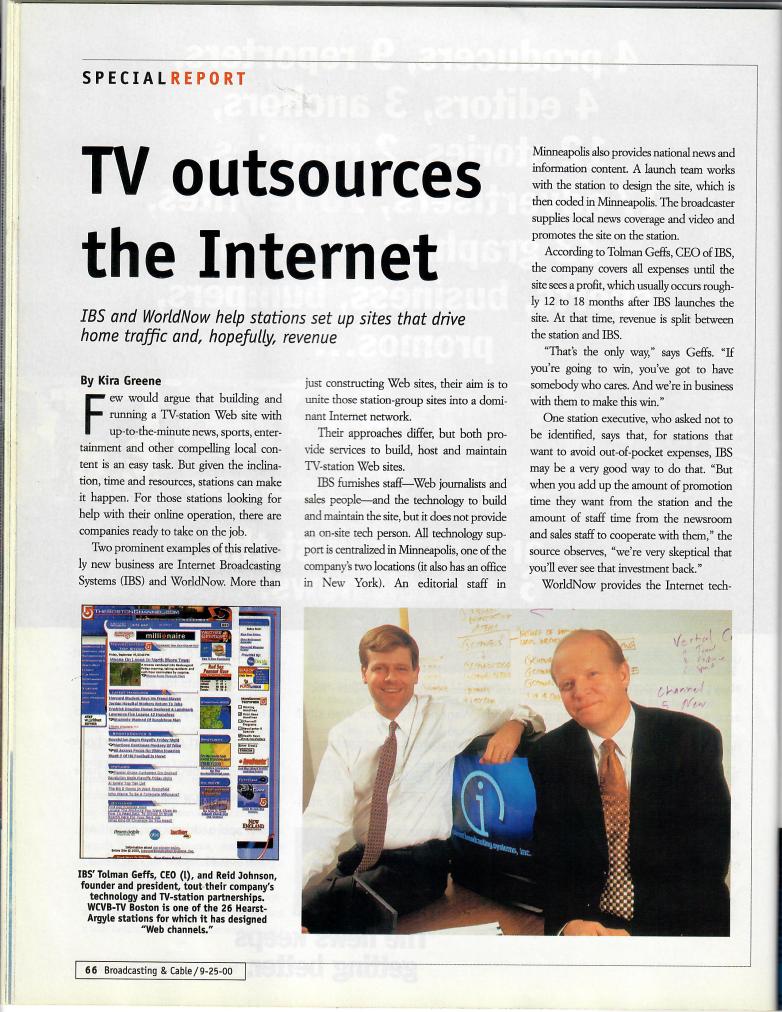
Starting life as an aspiring physicist, Tolman ended up in NYC at now-defunct Lehman Brothers as an M&A analyst. After a tour of duty through the benighted corridors of McKinsey, he ended up in the media business, eventually as CEO of a company called Internet Broadcasting Systems, which built the biggest network of local TV news sites in the U.S.
At IBS from 1999 to 2004, Tolman experienced the range of boom-to-bust emotions and found himself looking for a transitionary perch by networking with the legendary founding partner of JEGI, Wilma Jordan. Joining the bank in 2004, he saw the rise of programmatic platforms, the twilight of “100% markup, 50% margin” ad networks, and the transformation of the ad tech industry from “a teen dance party” to a “mature, more reliable” set of processes, practitioners and rules.
In this episode, Tolman explains why most ad networks ultimately failed; why the “programmatic gold rush” never quite happened; what’s so special about the Trade Desk and Jeff Green; and why the IAB’s long-time CEO Randall Rothenberg deserves a lot of credit for clarifying the rules of the game.
If you’d like to see Tolman himself in action back in 2010 at an IAB conference, check out this YouTube video:
23. David Shen – inside Yahoo!’s ad revolution
Dec 10, 2023
Show notes
David Shen was employee #17 at Yahoo!, hired by founders and Stanford classmates Jerry Yang and David Filo to shepherd the user experience — and eventually the ad experience — for the pioneering and absurdly successful directory and portal to the nascent internet.
David is also the author of the best behind-the-scenes look at Yahoo!’s ad evolution, a book called “Takeover: The Inside Story of the Yahoo Ad Revolution” (available here).
A digital ad historian after our own heart, David has also collected and archived a range of important Yahoo! creative executions from the 1990’s and early 2000’s that can be enjoyed on YouTube:
David designed the Yahoo! logo and was there when the first grainy banner-ad image was pushed live in 1995 to the chorus of lead engineer Donald Lobo sighing, “We sold out.”
“I think there was a pervading notion or hatred … of advertising,” David tells Marty and Jill in this reflective episode. “In fact, there were a lot of people who had this dream: Could we build a Yahoo! without any advertising?”
Intriguingly, after a troubled experiment with the ad server NetGravity (later acquired by DoubleClick), Yahoo! chose to develop and use its own in-house technology for ad serving, insertion, scheduling, accounting and measurement. (For a reason David reveals in the interview, these tools were all named after Camelot-Era notables.)
Yahoo! was a bellwether of the dot-com boom, going public on very little revenue in 1996 — only two years after it was founded in a famously messy trailer on the Stanford campus, — and rising up and up to a peak valuation of $128 billion in 2000, more than Ford and Chrysler combined.
That same year, Yahoo! was the most popular website in the world. Soon, things changed.
“You think that something like that’s always doing to last, right?” says David. “Well, you know what? The music stops.”
At its nadir, Yahoo!’s stock was priced at $8 for a valuation of $5 billion, 96% below its peak. It entered a period of rotating CEOs and halting M&A that continues to this day.
After the dot-com bust, Yahoo!’s management became more amenable to ad formats that would have been deemed too intrusive pre-2001. Thus the notorious Yahoo! home-page takeover ad so beloved of upper-funnel advertisers was born, inaugurating an era of D-HTML and Flash-driven creativity that tested (and often broke) the outer limits of home browser connectivity.
Iconic early examples of HPTO’s (as the media agencies invariably acronymized them) were the birdseed-themed Ford Explorer launch, Britney Spears’ beloved Diet Coke spot, and creatives for films such as The Incredible Hulk and Pearl Harbor that were perhaps more exciting than the source material.
David left Yahoo! in 2003 while his friends Jerry and David were still very much in evidence. He’d witnessed the glorious rise and thudding fall of the exclamation mark, and he was ready to turn the (web) page.
Today, David runs David Shen Ventures and enjoys biohacking, coaching and living his best life in Northern California.
And if you’d like to see early footage of the Yahoo! founders looking like the kids they actually were, this Stanford-produced video is 30 minutes of fun:
22. Michael Provenzano – issuing an Invite (Media) to Google
Dec 10, 2023
Show notes
Michael was one of the co-founders of Invite Media in 2007, with college classmates at the University of Pennsylvania. He and co-founders Nat Turner and Zach Weinberg met in an entrepreneur’s club in college, and Nat was inspired by a summer internship at pioneering video ad network VideoEgg to build a dynamic-creative ad platform. This morphed into a semi-baked idea to develop Facebook apps plus an ad server … until a recruiter connected the quixotic grads with ad tech paladin Brian O’Kelley.
In “typical Brian” fashion – recalls Michael in this lively interview – O’Kelley told them they were snorkeling a suboptimal reef and should build a bidder. Fresh from the Right Media acquisition into Yahoo, O’Kelley was launching his next venture called Adnxs (later AppNexus), and he astutely foresaw an ad market bifurcated into buy- and sell-side platforms on either side of a real-time exchange.
So the idea for Invite actually emanated from O’Kelley and was (so he told me in an interview a few years ago) the recipient of technical guidance from the “godfather” of ad tech himself, Dr. Boris Mouszykantskii now of IPONWeb.
Michael vividly recalls Invite’s sketchy early office space and frat-like atmosphere (43 boy-men, 2 women); the sleepless nights caused by payroll-making agita and rival DSP Turn; and the ultimate fear that the lack of real-time inventory – beyond non-real time Right Media and AppNexus itself – presaged the boys being stuck with a solution in search of a problem.
Then around 2008, things changed. Google released its real-time exchange, AdX; the Ventura-based Ad:ECN from pre-Trade Desk visionary Jeff Green appeared; and other DSPs began to pick up speed. Suddenly, there was inventory for the bidder to bid on – and the business started to grow beyond Right Media connectors, serving mainly ad networks “who wanted more control.”
Google called in 2010 and acquired Invite for a reported $81 million, explicitly as an investment in “exchange bidding.” Coming soon after its acquisition of AdMeld (an SSP), Invite formed the basis for its DSP which was renamed DFA and now DV360. Presumably little of the original code remains, but the ROI on the original Invite investment is staggering.
Shortly after the acquisition, Michael took time off to travel to Italy and came back to co-found Vistar Media, a company that began in 2011 to provide programmatic methods – data-driven, measurable – to digital out-of-home, a slow-growing category with little programmatic inventory. Admitting that getting an “old school category moving” has been “harder than I thought,” Michael persevered into building a 145-person, profitable company.
Then COVID hit. Despite an existentially trying year, Vistar is back to record-breaking quarters, Michael told us and AdExchanger Talks recently. Also in this episode: why TripleLift is a company everyone should emulate; why there were “bodies” in the company’s temporary NYC co-working space; and why Michael doesn’t really think they sold Invite too early.
21. Mark Zagorski – eXelate, Telaria & DoubleVerify
Dec 10, 2023
Show notes
Mark Zagorski is a tenured ad tech CEO, having led eXelate (acquired by Nielsen), Telaria (later Magnite) and currently DoubleVerify. But more than that, he’s a true ad tech O.G., joining pioneering agency Modem Media/Poppe Tyson as an A.E. in the mid-’90s right as digital ads were getting started. (For more on Poppe Tyson, check out this episode.)
As Mark tells Marty and Jill in this career-spanning saga, he started life in NYC wanting to work for Spin magazine, going so far as to sneak into their offices to drop a resume. Spin looked elsewhere, so he joined some brands after business school as a manager. At Honeywell, his boss asked him to help build a website for this new thing called the Internet, and he enrolled in a class at the Learning Annex.
Visiting Honeywell’s agency one day, he heard that an upstairs neighbor was hiring — this was the legendary Poppe Tyson, which merged with Modem Media to bolster its media buying capabilities. At PT/MM, Mark saw the explosion of the scale and scope of the web — and got an idea.
His next chapter (which he jokingly called “The Dark Era”) was an attempt to bring digital advertising to the websites of local linear media. At WorldNow (1999-04) and later MediaSpan (2005-08), he tried to convince local media owners that their businesses were threatened by the web and to rev-share ad spots on their websites. He admits he may have been a bit early, in an era of narrow-band and early broadband.
Getting stations onlineMark Zagorski at WorldNow
After an arm-waving meeting in a Manhattan coffee shop, Mark made the leap to join an early-stage startup called eXelate in 2009 as CRO. eXelate was similar to BlueKai and TACODA as a data-oriented behavioral targeting company and later DMP. He became CEO in 2010 and helped steward eXelate through an acquisition by Nielsen in 2015. He was head of Nielsen Marketing Cloud until 2017.
20. Ari Lewine – going native with TripleLift
Dec 10, 2023
Show notes
Ari is the co-founder, along with Eric Berry and Shaun Zacharia, of TripleLift, a programmatic ad platform that helps advertisers and publishers to do native advertising. And native of course is a space that was identified in 2011 in an OMMA keynote by investor Fred Wilson, inspired by in-stream social ad formats (particularly on mobile) that blend in with the surrounding publisher context.
Ari and his co-founders met at then-white-hot-DSP AppNexus (now Xandr), where Ari was a young account exec with a specialty in handling Israeli ad networks. He left AppNexus with his co-founders (aka friends) in 2011 without a clear idea of what kind of company they were going to found, joining an accelerator in Times Square with little heat and light-deprived due to a New York Times billboard on the window units. An early idea to automate Pinterest marketing fizzled when Pinterest “didn’t return our calls and emails,” as Ari recalls.
By 2012, the team had identified the native opportunity — originally calling it ‘organic’ and ‘sponsored images’ — and set about trying to sign up publishers. Their first success was with a blogger who ran a site called FoodGawker, which led to a vertical-focused strategy starting in food. The team assembled enough publisher scale to enlist its first ad customer, Chobani, and from there expanded into fashion and other industries.
TripleLift co-founders Ari Lewine, Eric Berry and Shaun Zacharia
In contrast to many of our other episodes, TripleLift’s is a story of great timing, rising markets and ultimately happy outcomes. In March of 2021, private equity player Vista Equity acquired a majority stake in the company for a reported $1.4 billion, more than either YouTube or PayPal enjoyed. Native ads perform well, are adapted to mobile and other platforms, and TripleLift’s tech seems poised to succeed in CTV as well.
In this entertaining and eventful discussion, Ari tells Marty [Jill is out this week] why his childhood dreams of being a brain surgeon derailed; how his parents encouraged entrepreneurialism; how a brother-in-law in the printing business may have jump-started his ad tech career; why 2012 was such a great time to be an ex-AppNexus startup; the secret to building momentum when you’re a tiny team outnumbered by rivals; and how to get gorillas like Google’s DV360 to pay attention and integrate (hint: get their customers to request it).
19. Scott McCorkle – hitting the ExactTarget at MetaCX
Dec 10, 2023
Show notes
Scott McCorkle was a long-time leader and visionary at ExactTarget, a pioneering ESP and mar-tech hub that was acquired by the mighty Salesforce in 2012. He’s currently the CEO and co-founder at MetaCX, an outcome-based collaboration tool for software buyers and suppliers.
As Scott tells his former employee (full disclosure), Jill, and his former tough-minded Gartner analyst assessor, Marty, in this charming episode — the first mar-tech episode in this thus far ad tech-focused podcast, — he originally nurtured dreams of playing professional baseball, abandoned them rapidly for computer science at Ball State University and an MBA at Indiana University’s Kelley School of Business.
He joined firms such as Eli Lilly in product roles and ended up at IBM in 1997 when they acquired an artfully-named firm called Software Artistry, where he was V.P. of Engineering. A subsequent startup called Mezzia rode the dot-com boom up and then had a somewhat lackluster exit but still lives on in a facilities planning suite, an exhibit of stamina of which Scott remains justifiably proud.
Having met for a number of years with the co-founders of another Indianapolis-based startup called ExactTarget — Scott Dorsey and Chris Baggott, — Scott segued to a role as as President of Technology and Strategy in 2005. He was part of the team that brought ExactTarget public in 2012 and sold the company to Salesforce in 2013 for a reported $2.5 billion. He was CEO of the Salesforce Marketing Cloud until 2016, when he left to build his new journey (get it? BUILD his JOURNEY? heh heh ? … heh? … is this thing on?).
In this episode, the Indiana-based McCorkle tells Jill and Marty how he grew up in a rural area with “modest means” but loved to play around with his Apple 2e; why he never actually moved his home away from Indianapolis (and why that wasn’t actually a problem); why Salesforce made its move in 2016; and what’s so special about the time period of 2007-2008.
That latter point is one we’re going to explore in future episodes, not all of which will be about email. Enjoy!
18. Kevin Ryan – up and down and up with DoubleClick
Dec 10, 2023
Show notes
Kevin Ryan was part of the trio that led DoubleClick from its inception in the mid-1990s through its traumatic post-crash chapter and back toward health and the sale to private equity in 2005 — the critical years where it established its product and market dominance and was ready to be spruced up (by others) for its ultimate exit into Google and ad tech legend. Ryan was CFO for a few months and then President, taking over leadership from co-founder Kevin O’Connor [check out our amazing episode #12 with Kevin O] during the tense moments of the early ’00s, when the industry faced an existential crisis.
He left in 2005 and went on to found and co-found a litany of companies including MongoDB with DoubleClick co-founder Dwight Merriman, Business Insider with Henry Blodget and Gilt, among others.
Officially, he is the CEO and founder of AlleyCorp, which is an investment firm based in Ryan’s long-time home town of NYC.
As Ryan tells Marty in this fast-paced reflection [Jill is out this week], after leaving investment banking he was exposed to the nascent internet and the promise of digital marketing and commerce when he worked managing operations at EW Scripps, which gave us Dilbert. Exploring ways to scale ad-selling on the popular Dilbert website, Ryan met with “the five companies” who did web ad sales at the time, including DoubleClick, where he became employee #12ish.
As CFO and then President, Ryan complemented the other Kevin (O’Connor) by focusing on running the business, managing global expansion and rapid growth, while O’Connor and Merriman excelled in product innovation and strategic nuance. One of the first NYC-based startups in the sector, DoubleClick grew to 2,000 employees and a market cap approaching $15 billion within 4-5 years after launch.
It was known for its incredible parties — one of which Ryan tells us cost $200,000 — and indelible branding, as “DoubleClick Welcomes You to Silicon Alley!” imprinted a decade of Manhattan’s jealous youth. They also had an HQ in a former ice rink with a basketball court. Here’s the lobby:
DoubleClick welcomes you to DoubleClick
Ryan shares his take on government investigations in the early ’00s, why he likes Burning Man, why early-stage VCs should probably be close to their portfolio companies, why Hellman & Friedman was “the right winner” in the DoubleClick acquisition stakes, and why he doesn’t get up in the morning thinking “advertising is so great!”

 Our TOPPODCAST Picks
  Stay Connected