57. Mike Yavonditte – optimizing Alta Vista, Quigo and Yieldmo
Dec 10, 2023
Show notes
Mike Yavonditte is the CEO and co-founder of Yieldmo, an advertising platform specializing in mobile, optimization and curation. He was formerly CEO of Quigo, an innovative semantic ad network that built a formidable competitor to Google’s AdSense and was acquired by AOL in 2007 for a reported $340 million. Before that, he worked at Alta Vista and Juno, a pioneering ISP that launched a number of luminous ad tech careers at the dawn of the internet.
Mike’s journey began with a “desktop news” startup, built with his first cousin Ray LaChance, which was scrutinized, rejected and then copied by Halsey Minor’s then high-flying CNET. He left that startup in late 1994, around the time of the launch of Netscape, and joined ZDNet (Ziff-Davis) and then DE Shaw, the technical publisher that incubated and ultimate spun-off Juno.
Juno greeted the dawn of online advertising and simultaneously spawned multiple proto-legends, including Gokul Rajaram (later of Google’s AdSense) and David Jakubowski (later of Facebook, etc.). Juno was a free ISP that subsidized its email service with targeted ads, using demographic data.
Mike’s next stop was AltaVista, at one time the leading search engine, which had both pay-per-click (ultimately outsourced to Overture, formerly GoTo.com and the inventor of PPC) and banner ads tied to keywords. Mike was on the team that signed strategic partnerships with big-money advertisers, many of them dot-coms flush with IPO and venture capital and in need of click-driven traffic to their sites.
AltaVista displayed banner ads linked to keywords entered by the searcher
After the crash, Mike relocated back to NYC and met with a couple of Israeli co-founders of Quigo, which they pitched to him as “the world’s best web crawler.” Impressed, he joined the four-man team as CEO and helped redirect the founders from their original strategy of selling to governments. Quigo was a legitimately advanced web crawler, capable of locating and analyzing text deep in the cryptosphere of the web.
Quigo’s next move was to package semantic analysis of web pages it had crawled, using ML to identify keywords (topics) that could be associated with the page and pushed to search engines, which used the topics for indexing and SEO. The semantic analysis tech competed with Applied Semantics, acquired by Google (for AdSense); and addressing the void after the Semantics acquisition, Quigo licensed its tool to Google’s then-search competitors, including Overture and Yahoo.
Ultimately, Quigo took the semantic tech back from the licensees and built its own stack to compete head-to-head with AdSense. The company was successful in signing premium publishers, including CNN, Fox News, ESPN and Time, Inc. The latter deal encouraged AOL to acquire the company in 2007, the same year it acquired TACODA; it was folded into Advertising.com and became a part of AOL’s publisher offering.
After a break from ad tech, Mike got back into it in 2012, co-founding Yieldmo to build measurement and testing tools for the then-new mobile ad formats.
“Everyone was so obsessed with [mobile] programmatic,” he remembers, “but I didn’t [think] that a lot of people were going to build testing systems and measurement systems and all the things that you might have to build in order to test new types of ad formats. And so we decided that we were going to do that and ultimately merge it into the programmatic world.”
Yieldmo became known for its creative mobile ad formats (which Mike points out are often patented). The best-known is probably the ‘hyperscroller,’ which determines where the person is on the page relative to the ad tag and the viewable window, and uses motion to capture attention, giving the viewer the illusion they are controlling animation in the ad unit.
Today, Yieldmo is focused on ML/AI and analysis of its data set, aimed at the challenge of inventory curation, including matching inventory to creative and optimizing to the advertisers’ KPIs.
56. Tom Chavez – giving us the Rapt on Krux and data
Dec 10, 2023
Show notes
Tom co-founded the Data Management Platform (DMP) Krux in 2010, and it was acquired by Salesforce in 2016 and became part of its Marketing Cloud. Before Krux, Tom co-founded a company called Rapt in the late 1990s, a yield-management optimization platform that sold into supply chain providers before making a hard pivot into advertising, managing publisher inventory by applying the same mathematical principles used for supply chains. Rapt was acquired by Microsoft as part of its impressive ad tech acquisition binge in 2007-08, when it also swept up aQuantive, Ad:ECN, and more.
Currently, Tom is co-founder of Super{set}, a startup studio with multiple products in its portfolio, all focused in one way or another on challenges around data management. Marquee brands under the Super{set} umbrella are clean-room tech solution Habu and privacy-management tech Ketch.
As Tom tells Marty and Jill in this intriguing episode, he grew up in Albuquerque, NM as the middle child in a house “with a lot of love” and a strong bias toward academic achievement. Although Tom’s Mexican-American mom didn’t go to college, she vowed early on that she’d send all five of her kids to Harvard — and she did.
Tom enjoyed a double major in computer science and philosophy, at the intersection machines and people, and like a surprising number of comp-sci types pursued an avocation for music (which persists). He ended up at Rockwell and then Sun Microsystems as a systems architect in the late 1990s, joining just after the exit of Sun’s legendary founder Jim Clark. Clark of course co-founded Netscape, the first commercial browser, in 1994.
At Sun, Tom developed supply-chain optimization software, and its success at Sun and then Cisco led him to co-found Rapt in 1999. At first, Rapt focused exclusively on the same supply-chain challenges, building software to optimize — for example — configurations for hardware; there was not a pixelated banner ad in sight. But around 2003, he made contact with Yahoo at a time when Yahoo was looking for a yield management solution.
“This is funny,” Tom admits, “but I had no idea what CPM stood for. Literally … So we just learned, right? That’s the game, just learn fast. We started to wrap our heads around advertising and discovered that all of the math that we had developed for the pricing of high-tech components like microprocessors could be pointed directly — and much more productively — [at advertising].”
Then came a hard pivot into ad tech and a slide away from supply-chain. Yahoo became a major customer of the newly ad-tech-ified Rapt, as did AOL and Microsoft.
In 2008, Microsoft lost DoubleClick to Google, failed to acquire Yahoo, and acquired Aquantive for $6 billion, along with the much smaller AdECN and Rapt. Tom worked at Microsoft for a few years on its publisher solutions, alongside the legendary Jeff Green and under Scott Howe. (For more on Microsoft’s peregrinations in the ad space, check out Marty’s oral history here.)
In 2010, Tom and Vivek Vaidya co-founded Krux. (Vivek had been the first person hired at Rapt, as an engineer.) The vision was to focus on the ad world’s data layer, rather than its endpoints (publishers, content). There wasn’t yet a DMP category. Demdex was founded in 2008 and BlueKai even earlier, in 2007, but the latter didn’t add DMP functionality until a few years before its acquisition by Oracle in 2014.
Krux’s go-to-market focused on data sovereignty. “We used to have stickers,” says Tom, “we put them on our laptops … and the slogan was, ‘Krux — it’s your data.'” Data belonged to the principal, not third parties or partners or others who “coast behind you and take your data.” It also emphasized segmentation on useful attributes, building out audiences at vast scale, using some early and innovative AWS techniques.
Salesforce acquired Krux in 2016 for a reported $700 million, after a period of partnership.
After the acquisition, Tom says, “I was sitting on my couch saying, ‘My goodness, this company building stuff sure is fun. Please, God, could there be more than one? … Can we parallelize company building?
“Can we take lessons learned from the prior 20 plus years? Can we capture those lessons and bring them to bear so that when we are working with new teams, as I like to say, why make old mistakes? There are all of these new mistakes just crying out for attention?”
55. Ari Paparo – influencing DoubleClick, Beeswax and more
Dec 10, 2023
Show notes
Ari Paparo is a well-known ad tech influencer, blogger, fellow podcast host, serial entrepreneur, raconteur and man-about-town in his longtime home of Manhattan. He worked in product management at DoubleClick, AppNexus and Nielsen – and was the CEO and co-founder of Beeswax, which was acquired by Comcast’s Freewheel division in 2020 for an undisclosed amount at a time when it had raised $28 million.
Not surprisingly, entrepreneurship runs in Ari’s family. His father Michael was a prolific dreamer with an insatiable portfolio of new business ideas. (We recommend reading Ari’s moving profile of his dramatic dad on the occasion of his passing.) The elder Paparo holds a patent for the lubriciously-titled “Binding a previously prepared grain-based product to a support member” (Ari’s paraphrase: “French toast on a stick”) … and another one for “Golf shoe insoles for improving the golf swing” (each insole is different, of course).
The younger Paparo’s NYC childhood was “not chaotic,” he insists, “but there were fat times and there were lean times.” Intriguingly, Paparo’s friend and longtime Manhattan-based ad tech co-conspirator Joe Zawadzki, founder of MediaMath, told #PaleoAdTech that he had a similarly quixotic, idea-machine dad.
After enjoying a Georgetown liberal arts and marketing education, with a minor in oil painting, Ari worked at a couple of pre-internet startups before landing at Blink.com, an online bookmarking service. While bookmarking enjoyed a brief vogue in the ‘90s and Blink.com managed to raise at least $10 million during the dot-com days, it ultimately liquidated itself to the Vendare Group in 2002. Ari later re-acquired part of it as a profitable side-hustle.
Then Ari landed at DoubleClick, which was enduring some difficult turn-around years. (For more on this, we recommend two ‘oral histories’ of DoubleClick, one in print and another actually oral: Marty’s 2018 piece for AdExchanger, which quotes Ari; and Ari’s own recent podcast for Marketecture.tv, which accesses usually inaccessible sources within the Googleplex, and more.) But when Ari joined, in 2004, co-founder Kevin O’Connor had left and the company was “at its nadir.”
What followed was “a masterful management job,” led by new CEO David Rosenblatt, who pared down a “sprawling” product portfolio, divesting non-ad related businesses like email and search; reorganized the engineering team along agile lines; and energized a spiritually depleted post-crash culture. Ari focused on rich media product management, and he continued on at Google after the search monolith acquired DoubleClick in 2008.
At Google, Ari admits, he was a non-engineer in a cult of engineers. Fit was suboptimal. Yet there began another stage of Ari’s career – this time, as an influencer – when Business Insider, then pathologically obsessed with Google, ran a story called “Who’s Who at Google New York,” by Nicholas Carlson (who later wrote a very good book about Marissa Mayer and Yahoo). The BI story provided oddly detailed resumes of random Googlers, including a squib about Ari alongside this picture:
The Gossip: Liked, but ‘lower level,’ Ari is one of many DoubleClick executives who others say don’t get enough respect from Mountain View.
Business Insider
The phrase “lower level” did not sit well with our hero. (He was Group Product Manager, a fairly senior role at Google, and had been a VP at DoubleClick.) So he marched down to Starbucks, where BI was camped out live-blogging, and confronted the scribes. BI promptly became pathologically obsessed with Ari Paparo, elevating him to the ranks of Top Follows on Twitter, and Ari’s career as a prolific, clever, widely-followed tweeter began. The real @aripap is currently at almost 24K followers on Twitter.
Ari was adept at writing popular columns for the industry’s preferred trade publication, AdExchanger. As an insider with an outsiders’ skeptical gaze, Ari was quick to identify in plain-spoken, deft prose what we did and didn’t really know about hot topics, including the “Programmatic Waterfall Mystery” (featuring header bidding when nobody knew what that was) … and, famously, the “death” of the cookie, channeling Charlton Heston (“Google, You Finally Really Did It!”).
The latter was written so fast that some of us suspected supernatural intervention. However, Ari explains that he “writes a greater amount of content, at scale, than just about anyone I’ve ever met.” A production machine. That industrious streak thrived during lockdown, when he YouTubed things like a poolside chat on the future of advertising and hosted a number of Beeswax webinars that were actually informative. Our personal favorite was “Les cas d’utilisation de la Log Data,” en francaise avec une phrase en anglais. (Ari n’apparait pas dans celui-ci.)
From 2014-2020, Ari ran the buy-side platform Beeswax, which he founded. The idea for the company came to Ari when he worked at AppNexus, co-founded by esteemed #PaleoAdTech friend Brian O’Kelley. Ari says he was “a big supporter” of AppNexus’ vision of being a customizable platform for ad tech, but he felt the product could be more flexible – and cheaper. So he launched Beeswax as a bidder-as-a-service(tm), providing separate, highly customizable SaaS software for a subscription price starting around $10K per month.
The highly flexible Beeswax team – Ari is standing, second from right.
The product did well among ad networks, who preferred it to the more established IPONWeb, run by the Godfather of Ad Tech, aka Dr. Boris, discovered in his Right Media days by O’Kelley. Selling Beeswax to brands direct proved more difficult, as they favored plug-and-play over micro-tuning and didn’t have the elite athletic requirements of the networks.
Comcast’s Freewheel video-focused division acquired Beeswax in 2020. Although Beeswax didn’t set out to be a video DSP, a growing portion of its traffic took that form, and many of its ad network customers dealt in video. Also – as Ari explains to Marty (Jill is off this week) in this fascinating ride – Freewheel historically avoided programmatic technology because its TV customers didn’t want or need it (yet).
After a year at Comcast, Ari finally combined his content-creation and company-founding impulses into Marketecture.tv. The purpose of the venture is to produce video, audio and written content, including interviews with CEOs and founders, focused on particular (mostly ad- and mar-) tech products “to help buyers evaluate tech vendors minus the B.S.” It’s a freemium subscription product.
At the same time, the indefatigable amateur baker recently unleashed the private beta of LaunchScience. The product helps product management teams organize their workflows and launches and is based on Ari’s workplace experience with Google’s so-called “readiness” launch process. If you’d like to be in the beta, you can get on the list.
What’s next for our guest? Perhaps a better question is: What isn’t?
54. Lee Nadler – marketing DoubleClick in Silicon Alley
Dec 10, 2023
Show notes
Lee was the first head of marketing at DoubleClick, hired by co-founder Kevin O’Connor in 1996 as employee #17 with a mandate to help the other 16 people meet Kevin’s vision-quest to “dominate internet advertising.” The startup had been clicked-off barely two years earlier in the basement of O’Connor’s home in suburban Alpharetta, Georgia.
These days, Lee is a fractional CMO, executive guide and founder of the Sherpa Marketing agency, based in New York. He’s also an ad industry influencer, entwined with the Advertising Club for years, inducted into the AAF Hall of Achievement and named by Ad Age as one of 21 people to watch in the 21st century.
Lee started his career on the account side of New York ad shops, beginning at a small agency in New Jersey that handled the Prodigy account. A joint venture between IBM and Sears, Prodigy was a proto-walled garden and ISP that was able to do some basic banner ad targeting for subscribers. Next stop was KBS&P, where Lee worked on the legendary Snapple account.
“That showed me the power of building a movement,” he tells Jill and Marty in this thoughtful episode.
Lee’s entree into DoubleClick was via a connection at the Ad Club, where he was then a “young pro.” At the time, highly-respected print publishing exec Wenda Harris Millard was a member of the board and was hired by Kevin O’Connor to help legitimize DoubleClick’s proposition to publishers and media buyers in NYC. Millard was DoubleClick employee #16 and she recommended Lee as the start-up’s first professional marketing lead.
Lee recalls the extreme skepticism, even disrespect, that greeted his move into digital, particularly among some high-caste agency creatives.
“You can’t always get validation,” he recalls. “Sometimes you have to kind of put yourself out there … for what you believe.”
When he joined, Lee met a furiously-growing ad network and server with a charismatic co-founder and a lot of new ideas — but no real marketing discipline. Quickly, Lee got to work on a positioning statement, a brand identity, and a flurry of brilliant guerilla-style tactics that were rapidly noticeable even to New Yorkers who didn’t work in media.
Early logos and treatments took full advantage of the click-click DoubleClick gimmick:
The best-known click-click placement was a sign Lee put up by the Flatiron Building at 22nd Street and Broadway in Manhattan that read: “DOUBLECLICK WELCOMES YOU TO SILICON ALLEY.” Despite some gentle skepticism — this time, from his bosses, “the Kevins” O’Connor and Ryan — the sign showed immediate impact and stayed up for five years. (The spot is now taken by Apple.)
Other tactics included providing umbrellas outside agencies during rainy days; dragging banners behind planes over the Hamptons with a sign saying Turn over, DoubleClick is watching your ad campaign; rewarding people at industry events who remembered to click-click their glasses in a particular way … and so on.
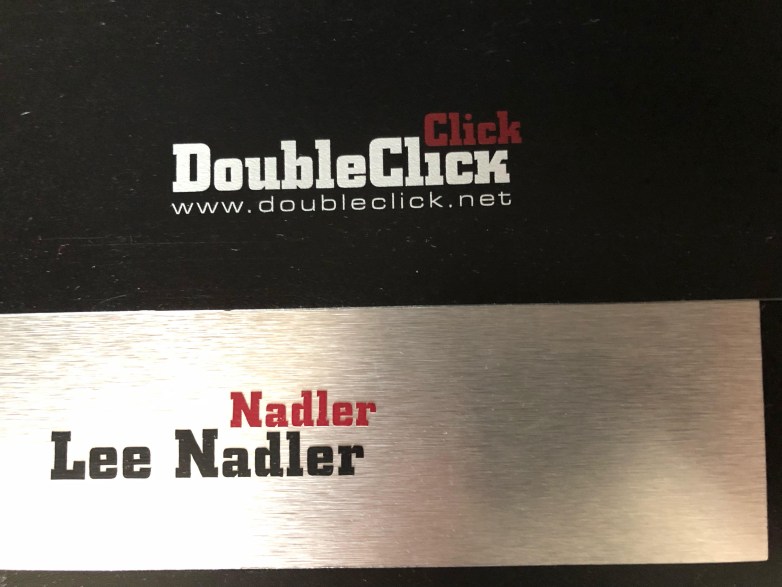
As the company grew from 20 to over 1,000 employees in a few years, Lee tried to clarify and preserve the culture. He printed up a mission statement on the back of everyone’s business card:
Building one-to-one relationships millions at a time
DoubleClick business card
And he put together a booklet that summed up the culture of the “Clicker,” or DoubleClick employee. Here are some excerpts:
Most notable was a crisp set of definitions to guide new recruits and those in need of recalibration. Herein — for those who wonder — are the tenets of those who are “Clickers” and those other types:
“We weren’t just a bunch of lunatics kind of running around,” Lee says. “There was a purpose, which was, have fun, work hard and also create a movement.”
In 1998, Lee himself moved from marketing to NYC marketers to helping to build out the international expansion of the company, starting in Japan. He recalls being in Australia when the IPO occurred, and he “took a pause … and went to Nepal for the first time.” So began another phase of the ad-man’s career, as he’s exposed to the Tibetan Sherpa people and “very taken by the whole culture.”
Impressed by the native resilience and grounded optimism of the Sherpas, Lee had a jarring return to dot-com reality at the Biltmore in Arizona for the DoubleClick salesforce conference and IPO celebration.
Early DoubleClickers convening at the Biltmore in Arizona circa 1998
“In Nepal, in the villages, the kids were saying, ‘Namaste, do you have a pencil?’ And I came back to the Biltmore and the internet sales guys were pounding their fists on the table … saying, ‘Why is the fucking internet so slow?!’ And I was, like, wow, this is the same planet.”
Lee left DoubleClick in 1999, but he didn’t go far. Co-founding an agency called Digital Pulp (which still exists, sans the original founders), he continued to market for DoubleClick and help some of its customers build plans and digital assets. He went on to manage marketing, new product launches and a start-up accelerator for MINI/BMW Group.
And he stays in touch with the Sherpas, after whom he named his agency Sherpa Marketing and his blog called the TheSherpa Path.
Looking back on his time at DoubleClick — when it arguably reinvented advertising for the digital age — Lee remains positive:
“For me, DoubleClick allowed me to be at my best. I think it pushed a lot of other people to be at their best at a pretty early age in their career. … There was an ability to try new things without fear. And we were there, creating something very special. And we knew it.”
53. Omar Tawakol – from BlueKai to AI and the all-new Rembrand
Dec 10, 2023
Show notes
Omar Tawakol launches his new venture today – it’s called Rembrand (“without the T”), an AI (of course)-driven platform for virtual video product placement. Think of it as a native format for video to replace overtly interruptive last-gen experiences, particularly for creator and short-form video.
Jill and Marty were honored to be included among a handful of high-powered media outlets to announce the launch of Rembrand, which emerges from stealth mode today with about $8 million Series A in the hat and a team of ten, including seven AI-optimizing engineers.
Omar was the co-founder of a couple of previous success stories, most notably BlueKai, the data provider and early data management platform (DMP) acquired by Oracle in 2014 for over $400 million, a 10x net revenue multiple. After Oracle, he co-founded Voicea, an AI voice recognition platform that provided bulleted action summaries of meetings and calls. The latter was acquired by Cisco in 2019.
Omar’s journey began in Cairo and then upstate New York, giving him what he sees in retrospect as an appreciation for perspective. And like most – all? — #PaleoAdTech guests, he “was entrepreneurial from the beginning,” starting with a proto-tchotchke company selling to neighbors when he was five.
He shifted his focus from engineering to comp. sci. at Stanford in the mid-1990s, where he worked on a class project that included mapping the extant internet onto a wall. After graduation, he worked briefly at a Netscape spin-off called Navio before launching his first venture, a recommendation engine company called CoRelation.
CoRelation was technically successful early on and employed then-blazing ensemble methods to provide product recommendations for early e-tailers including Barnes & Noble (who didn’t want to use Amazon, for obvious reasons), Nordstrom, etc. CoRelation was acquired by another startup, later called Audience Science, in 2002. Omar’s team of ten joined a cadre ten times larger, and he himself became CMO.
Starting as a web analytics company larger than Omniture at the time, Audience Science shifted into behavioral targeting and was a direct competitor of Dave Morgan’s Tacoda, acquired by AOL in 2007. After a year at the mobile analytics startup Medio, acquired by Nokia, Omar “got the itch” that would become BlueKai.
BlueKai had its first all-hands meeting the first week of January, 2008. Its founders were Omar, Grant Ries, Mike Bigby and Alexander “Hoosh” Hooshmand, a veteran of Right Media. By July of that year, they convinced five major players to join their data exchange: Kayak, Expedia, Cars.com, eBay and Datalogix.
The founding insight for BlueKai came in part from Kayak, which was a data company that sold its search capabilities, unbundled from the overhead of selling and servicing tickets (like its larger rival Expedia). Omar and his team looked at the ad business and realized that targeting data could be more valuable than media, so they founded BlueKai with a mission: We do not sell ads.
The original BlueKai was a data exchange. Its media agnosticism allowed it to partner with behavioral and other ad networks, including Datalogix, which bundled media with its data product. BlueKai built a real-time bidded auction system for data, with buyers paying to be included in the order of pixels fired on the partners’ sites.
The data itself was behavioral and linked to intent. Early on, its most valuable segments were auto and travel intenders, browsers who had looked at certain car, truck or holiday info on Kayak or Cars.com, for example, and could be targeted elsewhere on the web. Naturally, this data works better than vaguely accurate demo data, and at first BlueKai had only a single direct competitor, eXelate.
The company faced challenges from DSPs and agencies, but its most formidable hurdle was mobile. Without cookies in apps, identifying users wasn’t easy; and ultimately, BlueKai adopted a probabilistic model incorporating IP address, location, OS and other signals, which was not as accurate as its browser product.
Within a few years, driven by customers, BlueKai built and launched a product that would later be called a DMP. (Most likely, the first explicitly-named DMP was Demdex, later Adobe Audience Manager.) In addition to buying data, customers like Expedia and eBay were using BlueKai to manage data. Launching a separate SKU for the DMP was a big shift for BlueKai, driven by a recognition that customers would always value first-party data more highly than third-party data, no matter how useful. And that buyers (as opposed to pubs and providers) could use a DMP to gain additional insight into the audiences visiting their sites.
Adobe acquired Demdex in 2011. In 2013, BlueKai was sitting in a cone of silence, trying to acquire a then-independent LiveRamp. Omar’s pitch to the board was that cookies were going away – a prescient call, maybe – and BlueKai would need a way to tie pseudonymous cookie IDs to more stable IDs such as LiveRamp’s. The cost was high (eventually, Acxiom got LiveRamp). And suddenly – “out of the blue,” he says – three public companies appeared, wanting to acquire BlueKai.
Oracle won the bid. Omar sat down with Larry Ellison, whom he describes as a hyper-focused data processor with a need to know what’s real; and Ellison told him he would be boot up a data business and give him resources to acquire the components he needed to build out his graph: which in turn lead to the Oracle Data Cloud, led by Omar, and the major acquisitions of AddThis, Crosswise, Datalogix and Moat.
Somewhat pensively, Omar describes the fate of the BlueKai DMP, split off from the Data Cloud, embedded in the Marketing Cloud, diffused functionally throughout the larger Oracle org, and entrusted to enterprise mar-tech sellers who were not ideally suited to run an ad tech operation. It might have done better alone.
The day after he left Oracle, in 2018, Omar spoke to AI sage Ahmad Abdulkader and began to think about applying voice AI to the workplace. He tells Jill and Marty – in this wide-roaming episode – that an inspiration came from an earlier meeting with Microsoft’s Satya Nadella, who provided a precise itemized recap and action-item minutes after a meeting. Voicea was created – in the words of a Cisco marketer – “to make the best of us like the rest of us.” The company prototyped in 2017, launched in 2018, and was acquired within two whizzing years.
Like Voicea, Rembrand inhabits AI space. An inspiration came from Google, which started its search ad business (as did Yahoo) with visual banners, then moved into native pay-per-click ads, a new approach that actually works. Consumers gliding into short-form video avoid interruptive ads whenever possible. Product placement is a big, largely manual, long-lead-time business. Combining this alchemy, Rembrand aims to automate the creation, distribution, targeting and measurement of in-video product placement.
It requires videogame-like AI approaches that obey the laws of physics. Rembrand’s test cases are creators with relatively stable visual milieus, where product images fit and suit their own brands. Eventually, the vision is to turn the two-sided marketplace into an API-driven engine allowing user-level targeting and flexibility. And a new form of programmatic advertising is born, cookie-free, visual and natively integrated into the scene.
We here at #PaleoAdTech love the idea, for what its worth, and look forward to the AI-driven retinal rewards to come.
52. Ana Milicevic – managing data from Demdex to Sparrow
Dec 10, 2023
Show notes
Ana Milicevic was a seasoned product manager in New York City in 2009 when she joined a wily data management startup called Demdex, which was then swirling around a programmatic audience-building space soon labeled Data Management Platform (DMP). Within two years, Adobe acquired Demdex and folded it into its emerging ad tech and data suite as Adobe Audience Manager, which persists to this day.
Currently, Ana is principal and co-founder of Sparrow Advisors, a consultancy focused on data management. She founded it in 2015 with her sister, Maja, an ad tech vet (AppNexus, Sovern).
At the time of its sale to Adobe, Demdex was still relatively small, having raised about $8.5 million and enjoying a team of 30-35 based on the far, far west side of Manhattan, in pre-WeWork space shared with Invite Media, among others. Adobe paid a reported $109 million for the company.
Demdex was co-founded in late 2008 by Randy Nicolau, who had been president of Playboy Enterprises and a direct marketer. The relatively rapid exit happened after a flurry of activity at Adobe, which acquired Omniture in 2009, tried to acquire Invite Media, consulted with LUMA Partners and others … and more, in a dramatic aside that can be relished in our recent Brian Andersen episode.
As Ana tells Jill and Marty in this trenchant retelling, she shifted early in her career from coding to product management, an emerging discipline, because she liked to engage with “actual business humans.” A prolific linguist, she worked for a time for the United Nations in NYC and made her way to city permanently, exploring the then-modest East Coast startup milieu.
After postings in video streaming and “putting radio on the internet” — yes, she’s aware of the Silicon Valley resonance, but she was there first, — she was lured by Randy (a board member at the video startup) to join Demdex as one of a small handful of employees.
The initial vision for the company was to help e-commerce sites to build profiles of customers based on their purchases and behaviors on owned and operated sites. It was a first-party data foray, which proved to be more interesting to publishers than e-tailers.
An early description of the company:
The firm creates a ‘behavioral data bank’ of audience profiles with anonymous data captured from clients’ web sites, purchased from third-party data sellers or exchanges, and generated from ad campaigns. This data can then be used for content management, multivariate testing and analytics.
Like most DMPs, Demdex also built a SaaS tag manager, primarily to ensure its marketing customers could implement the DMP tags sooner than “six to nine months,” a typical IT queue.
A differentiator for Demdex compared to other early DMPs — especially BlueKai, but also eXelate and Lotame — was its emphasis on first-party data, and later probabilistic profiles based on ‘traitweights.’ It used both a first-party and a third-party cookie, collecting 1P, 2P and 3P data, which it assembled into audiences either for sale (from a publisher) or purchase (by ad buyers) — or for analytics, testing, etc.
This emphasis on first-party data meshed well with Omniture’s (aka Adobe Analytics’) use of first-party pseudonymous data for site analytics: Omniture already had a vast network of enterprise customers. Within two years of its joining the Adobe suite, analytics accounted for 10% of the company’s revenue. Expanding into audience-building for media made sense.
Although BlueKai (later acquired to Oracle) was the best-known DMP, it initially dealt only in third-party profiles tied to 3P cookie IDs, based on browsing behavior across websites, or so-called ‘cookie pools.’ Demdex’s differentiation was — as Ana says — “first-party data.” A purchase for a retailer could be mapped to a taxonomy that indicated demographic traits such as interests, family size, gender, location, spending power, etc. A publisher could tag an ID based on content consumption (e.g., sports fan, luxury automotive enthusiast) of interest to certain ad buyers.
Ana describes the evolution of Demdex’s signature ‘traitweight’ — a poetic neologism no longer much used, like ‘hepcat’ and ‘totes magotes‘ — which was an algo that scored people against some 40 behavioral and demographic variables. Using scores instead of a binary in/out method obviously expanded the size of the segments by lowering average accuracy.
At the time of the acquisition, Demdex was working on a further refinement of traitweights using ‘signals’, including more detail than before, as well as a major brand refresh with a new logo. Which might have been a good idea:
Ana left shortly after the deal to join SAS under Bill Stratton (now at Snowflake), to support a newly-launched entertainment and media vertical; and then Signal, a retooled DMP (formerly BrightTag) popular with retailers and a large company in Japan; and then entrepreneurship.
Sparrow combines Ana’s data product expertise with her sister’s ad tech perspective:
We’ve productized a lot of how consulting should go to market, and we can be very prescriptive and proactive with our clients.
51. Wes Nichols – measuring the impact of MarketShare
Dec 10, 2023
Show notes
Wes was the co-founder with Jon Vein of the marketing and media analytics platform MarketShare, founded in 2006 and sold to Neustar in 2015 for a reported $450 million. At the time, its annual revenues were about $60 million and customers included MasterCard, Intel and Twitter.
Wes is currently a Partner at March Capital, based in L.A., and is a Board Director for data insights company Disqo, healthcare AI firm Suki, ActionIQ, AI semantics software Persado and data infrastructure company Adverity.
MarketShare was a complex (and not inexpensive) offering, combining marketing science and services, that used both top-down (marketing mix) and bottom-up (attribution) methods to tell its big ad-buying enterprise clients (1) what their real return on ad spend (ROAS) was, and (2) how shifting the mix could improve results.
It emerged from Wes’ adventures in direct marketing and media agencies. Running a DM-focused portfolio within Omnicom in the early 2000’s – as he tells Marty in this rousing ride, — he remembers vividly one unsettled ad buyer asking him:
“If people can search for what they want [i.e., use Google] why do I need to invest in my brand anymore?”
The question sat with Wes and echoed other pleas to help determine the real response to ad dollars, on both performance-direct and upper-funnel (brand) values, in an increasingly digital ad-sphere.
At the same time, Wes had run across the work of some credentialed academics – particularly Dominique (Mike) Hanssens of UCLA and David Reibstein of Wharton – who were working on the media measurement knot. Existing solutions included marketing and media-mix models, which could be complex and multidimensional, but were both backward-looking and inexpressive. Also slow: many brands refreshed these models annually, or at best quarterly.
On the other hand, a class of digital multi-touch attribution (MTA) providers were gaining adherents. Tools such as Visual IQ, ClearSaleing (sold to eBay), and then Adometry, Convertro, and Abakus (all acquired), provided improvements on last-click measurement by looking at the user path. MTA’s benefits were intriguing but generally digital-only (not including TV, radio, OOH, etc.) and of primary use in assessing the trade-off between paid search and digital display.
So MarketShare is one of those handful of startups that began life in the academy. (Others were Abakus, the CDP Amperity and the analytics tool Custora.) Wes and his co-founder Jon Vein, whom he met through mutual friends, spent a couple years bootstrapping the solution and adapting Hanssens and others’ work into a commercial solution. That took about two years and yielded some patents.
“I knew we had to get the math right,” Wes tells Marty.
Wes Nichols (in pink) and Jon Vein, co-founders, frollicking at Cannes in 2015.
How did MarketShare work?
MarketShare distinguished its approach from last-click, first-click and so-called “matched pairs” methods. The latter was apparently used by MTA providers, who would acquire voluminous path data for anonymous consumers (via cookie log files, generally), sift and compare similar paths. Ideally, there were enough paths to find sufficient examples with (and without) particular exposure types.
Guided by Hanssens and others, MarketShare took a more holistic approach that included experimental design and targeting based on persuadability. So-called ‘uplift models’ recognize that different portions of a given audience have different levels of persuadability: some will buy anyway (‘sure things’), some will never buy (‘lost causes’), others hate ads and some portion can be influenced. Who are they?
In addition to recognizing uplift, MarketShare’s models adjusted bottom-up attribution with top-down econometric methods. In this way, it could recognize offline and non-marketing effects, such as TV and radio, weather, seasonality, trade promotions, alien invasions, etc. Algorithmic models at the user-level could be linked with these top-down methods.
Data was onboarded via email systems, direct mail databases, cookie log files, media plans, point-of-sale data, etc. Additional data was linked for geographies (e.g., weather, store promotions) and time series. Wes admits that data collection and transformation, in the early years, was “difficult.” Services were required.
Methods used by the team included logit choice models for individual consumers, transformed to deal with multiple touches, frequency, etc.; systems of regression model equations for marketing mix, considering intermediate outcomes using hierarchical Bayesian priors; and discrete choice models for attribution.
Ultimately, MarketShare built a market-level model, translating each market-level effect into a currency (like sales). Various granular time series components were incorporated into a decomposition model to build new composite variables, with factors or ‘conduit variables.’ These accounted for effects such as offline media, pricing changes, seasonality, competitors, etc.
The Neustar deal came “out of the blue,” says Wes, based on a meeting with a board member during a pre-IPO corridor. Shortly after acquiring MarketShare, Neustar was taken private and ultimately restructured. Some of its data assets were sold to Matt Spiegel and a team at TransUnion last year.
Stay to the end to hear about Wes’ interesting sideline activity – a first for Paleo Ad Tech – as an LAPD Reserve Officer. Yes, he went through the entire Police Academy and has a speedy draw, friends. Perps beware.
50. Brian Andersen – shining a light on LUMA Partners
Dec 10, 2023
Show notes
Brian Andersen is the Co-Founder — with Terry Kawaja — and the Head of Digital Marketing Investment Banking at LUMA Partners, a small but mighty I-bank that is the premiere boutique operating at the luminescent nexus of digital media and marketing technology.
Founded in 2010, LUMA is the best-known bespoke advisory service in ad- and mar-tech, running the most alpha-rich congregations — the Digital Marketing Summit, or LUMA DMS; the highly liquid Cannes Blanc party; various discreetly furbished dinners that, if you haven’t heard of them, you may not belong, — and genuinely inspired content marketing, from parody videos to that ubiquitous logo-rific series of LUMAScapes (created by Terry).
And then there are the deals, starting with Dapper->Yahoo within a few months of LUMA’s founding in the fall of 2010, rapidly tailed by Demdex->Adobe, Admeld->Google, Interclick->Yahoo … and many others.
As Brian tells Marty in this special holiday-season episode, our 50th (!), he first met Kawaja in the course of circling Invite Media as a potential acquisition by his then-employer, Omniture. In fact, Omniture had agreed to acquire the then-minuscule Invite as a DSP “workflow tool” to complement Omniture’s web analytics suite, when Brian was Vice President of Corporate Development. Adobe’s $1.8 billion acquisition of Omniture in 2009 paused the transaction, and when Adobe returned later, Google had moved in, advised in part by Terry Kawaja.
In the deal debrief, Brian recalls, Terry told the Adobe team: “You just didn’t move fast enough.” Not long after, Brian and Terry ran into one another at a BlueKai conference and mutually announced intentions to leave their bivouacs — Brian at Adobe, and Terry at GCA, where he was Co-Head of Digital Media, after a career in M&A at big banks such as Citigroup and Credit Suisse First Boston.
Initially reluctant, due to an early mismatch with investment banking at Robertson Stephens, Brian decided to sign up as the Silicon Valley half of LUMA.
Terry Kawaja (left) and Brian Andersen, co-captains of the S.S. LUMA, somewhere in France.LUMA-naries at the 2014 DMC – Brian is at left; Terry is be-logoed.
Tall and athletic, Brian was a formidable defensive end at UC Davis, where he majored in engineering and was two-time All Conference. Ironically disliking I-banking, he moved into business development roles at Interwoven and then Omniture, founded by Josh James in a dorm room Utah in 1996.
Within a few years, LUMA added partners Dick Filippini (2nd from left) and Mark Greenbaum (right).
From the beginning, Brian says, LUMA’s approach had two pillars: (1) deep industry expertise; and (2) strategic thinking. Neither is as common as you might assume, particularly in the ad- and mar-tech space, which until the last decade was considered unpredictable and suspiciously specialized. As advisors, LUMA doesn’t do traditional pitch cycles but rather functions as a kind of digital yenta, detecting chemistry and suggesting matches drawn from its capacious network of disrupters and acquirers.
Brian admits it hasn’t always been easy. There are ups and down in business cycles, of course, and while 2021 was a record year — with 15-16 deals for the LUMA team — 2022 was a different story. But at a recent DMS in Menlo Park, Brian gave a presentation pointing out that the valuations of public companies in the space are simply reverting to normal levels after a feverish period of froth and FOMO. So perhaps we’re all more normal now … ?
Brian remains optimistic.
Google’s Neal Mohan was indirectly responsible for bringing Brian and Terry together, around the Invite Media deal, in 2010.
49. David Wamsley – running an AdAuction in the dot-com days
Dec 10, 2023
Show notes
David Wamsley was the co-founder and CEO of an innovative platform called AdAuction.com, which procured remnant inventory from a group of publishers including Match.com and eBay and sold it in an eBay-like declining-price auction. The company launched in the fall of 1997, was folded into a B2B company called OneMediaPlace by a group of investors including the holding company CMGI … and ultimately fell victim to the dot-com meltdown.
At its peak in 1999, the company had raised $88 million, sold space for over 100 publishers including Netscape and BizTravel, and hosted at least 675 buyers in its multi-weekly auction events, based in San Francisco. Before winding down, Wamsley was expanding AdAuction’s auctions to other remnant media, including print, DRTV and radio.
Wamsley launched an incubator called Campsix, raised some $20 million, and lost that venture as well in the wake of the dot-com dream jackhammer known as the year 2000.
After some quiet time in Thailand, Wamsley followed the lead of Jim Clark into Florida real estate, suffered boldly through the reversals of 2008; then launched a PR agency, also based in Florida. He is currently Founder & CEO at Rosebud Communications.
As David tells Marty in this festive episode, he never quite liked working for others. After graduating from FSU, he moved to Atlanta and became enraptured by the web while recovering from a weight-lifting injury in Las Vegas. Making his way to Silicon Valley, he joined companies such as Sega and Big Book in marketing and sales roles, before coming across an online auction platform developed by Moai Technologies, launched in 1996.
Using Moai’s auction tech and $300,000 from friends and family, David launched AdAuction in 1997 with his friend Chris Redlitz, now an investor and philanthropist.
There was a cautionary precedent. A company called Adbot, based in Chicago, held its first “live” online ad auction in April, 1997. Building its own ad server, Adbot seems to have used an auction system based on phone calls and whiteboards, like Sotheby’s. It didn’t even survive 1997, however, due to an SEC investigation.
AdAuction.com benefitted from the Adbot flameout, picking up customers, and the company proved adept at Wamsley’s later profession: PR. It was covered in outlets such as Wired, the Industry Standard, the Wall Street Journal, CNET and AdAge.
It later hired the Ingalls Moranville agency to build out some rather frisky campaigns with winky taglines:
“Opportunity Clicks” “It’s like Vegas, only everyone wins and there’s no buffet”
An AdAge story from May, 1998, admired the company’s confidence and cited 45 web publishers registered at an early auction (including Elon Musk’s city-guide startup Zip2), and 150 media buyers including Modem Media. Dave is quoted as saying AdAuction could make $7 million in 1998 and sometimes realized CPMs over $10.
The auction mechanism was — of course — not programmatic in the post-Millennial sense. Publishers offered six-figure batches of impressions and set a starting price in the platform. Every two minutes, the price dropped until there was a bidder. Auctions were not continuous but rather “events,” as Dave says, starting on the third Thursday of each month and increasing in frequency to multiple daily sessions. Selling 300,000 impressions was a good day for a publisher. Total proceeds to AdAuction from an auction could be around $200,000.
Recall that in 1997, the entire online ad business was only $550 million, per Forrester, doubling in 1998 to $1 billion.
As Dave admits, AdAuction was not an engineering-driven venture. It used Moai’s auction tech; AdForce and then DoubleClick as its ad server; and the SF-based agency Organic to build its UI. Yet it was sailing steadily until everything capsized in 2000. In April, CMGI put $25 million into the company (part of a final round of $67 million), shuffled management, and AdAuction was renamed OneMediaPlace.
AdAuction team (Wamsley at left) appeared in Forbes in 2000
By this time, the founding team had moved on. Today, Dave lives in Florida and runs his PR agency. His most recent venture is a solution called ByLineBuddy, which programmatizes the creation and distribution of original thought content for clients.
48. Brian O’Kelley (part 3) – the AppNexus adventure
Dec 10, 2023
Show notes
We welcome Brian back for the third (and – for now – final) episode on his revelatory career, from his days as a high-school entrepreneur and javelin-tosser in Eugene, Oregon to his college career as a comp-sci major at Princeton and then co-founder of a dot-com Ticketmaster-manque called LA2Nite.com (in episode one); through his key role in building out the technology at epochal Right Media, which pioneered both supply-side technology and a form of ad exchange, before being acquired by previous investor Yahoo for a sweet $680 million in 2007 (in episode two).
This episode opens with Brian being fired by Right Media’s management the day before the Yahoo deal closes, reducing his payout, and – as he tells Marty in this riveting ride – pretty much writing him out of the Right Media story. Although known in the inner rings of the NYC ad tech super-circle, Brian didn’t feature in post-deal recaps and found himself meditatively running around the island of Manhattan, contemplating his life.
He didn’t contemplate for long, co-founding AppNexus in 2007 with Mike Nolet, a young product manager at Right Media. The company started as a proto-PaaS, building scaled hosting infrastructure for ad tech companies in an era when the newly-launched AWS wasn’t fast enough to handle real-time bidding. Raising money in the boom year of 2007 proved to be as easy as pitching his hero Marc Andreessen and Vinod Khosla. Then came the crash.
Cash-constrained, after his non-compete with Yahoo expired, Brian decided to focus on building applications and services for real-time bidding in the cloud. Gradually, he began to compete with SSPs like AdMeld, creating conflicts (check out our Ben Barokas episode for more); and then with DSPs like Invite Media, which he’d closely advised. (We did an episode on Invite here.)
But the real competitor was always Google, an adversary so formidable that it inspired Microsoft to join an alliance with AOL and invest in AppNexus – providing exclusive access to inventory on MSN.com and Outlook, etc. – simply to temper Google’s march to domination of search, supply (acquiring AdMeld), demand (acquiring Invite) and the exchange in between (acquiring DoubleClick and building AdX).
Ultimately, as Brian admits, Google proved to be too strong: “They won,” he says. Approached by AT&T in 2018, Brian agreed to sell AppNexus for a bit under $2 billion. At the time, AT&T was combining a data and identity infrastructure with a media business and wanted to combine AppNexus with DirecTV. It’s a strategy they ultimately unwound, selling AppNexus (as part of Xandr) to Microsoft at the end of last year. (Our chat with Brian Lesser gives some flavor here; and for more on Microsoft and AppNexus see Marty’s ‘oral history’ of Microsoft’s ad business in AdExchanger here.)
So AppNexus landed where Brian O’Kelley wanted it to land, although not by his preferred flight plan. Not a Hollywood ending, perhaps; more like a Menlo Park ending.
These days, Brian is very visible as the founder of Scope3, which is engaged in the admirable mission of trying to reduce the carbon footprint (and other evil exhaust) of media, advertising and beyond.

 Our TOPPODCAST Picks
  Stay Connected