TopPodcast.com
Menu
  • Home
  • Top Charts
  • Top Networks
  • Top Apps
  • Top Independents
  • Top Podfluencers
  • Top Picks
    • Top Business Podcasts
    • Top True Crime Podcasts
    • Top Finance Podcasts
    • Top Comedy Podcasts
    • Top Music Podcasts
    • Top Womens Podcasts
    • Top Kids Podcasts
    • Top Sports Podcasts
    • Top News Podcasts
    • Top Tech Podcasts
    • Top Crypto Podcasts
    • Top Entrepreneurial Podcasts
    • Top Fantasy Sports Podcasts
    • Top Political Podcasts
    • Top Science Podcasts
    • Top Self Help Podcasts
    • Top Sports Betting Podcasts
    • Top Stocks Podcasts
  • Podcast News
  • About Us
  • Podcast Advertising
  • Contact
Not in our directory?
Add Show Here
Podcast Equipment
Center

toppodcastlogoOur TOPPODCAST Picks

  • Comedy
  • Crypto
  • Sports
  • News
  • Politics
  • True Crime
  • Business
  • Finance

Follow Us

toppodcastlogoStay Connected

    View Top 200 Chart
    Back to Rankings Page
    Business

    Nonprofit Ally Podcast

    Steve Vick from NonprofitAlly.com talks with nonprofit experts about social media strategies, capacity building, board of director development, fundraising and budgeting.

    Advertise

    Copyright: Nonprofit Ally © 2013

    • Apple Podcasts
    • Google Play
    • Spotify

    Latest Episodes:
    NPA 015: Tips on How to Apply for 501.c.3 Tax Exempt Status Aug 05, 2014
    Show notes

    In this episode I talk with Thomas Wrobel from the Nonprofit Legal Center (nonprofitlegalcenter.com). Tom is a lawyer with 17 years of experience. He specializes in nonprofit law. Tom answers some basic legal questions you need to ask yourself when you apply for 501.c.3 tax exempt status. His advice will help you prepare your IRS form 1023, so you can get your 501.c.3 tax exempt status for your nonprofit.

    Here are some of the questions he answers in this interview:

    Question: How do I know if I qualify as a 501.c.3 nonprofit?

    Check the IRS website to see if you fall within their guidelines. You can do that here: http://www.irs.gov/Charities-&-Non-Profits/Charitable-Organizations/Exemption-Requirements-Section-501(c)(3)-Organizations

    You can also do a Google search and see if there are other organizations that provide similar services to yours that already have their 501.c.3.

    Question: Do I have to be a 501.c.3?

    You do not have to be a 501.c.3 until you reach an annual revenue of $7,500/year.

    If you exceed this threshold you can find a fiscal sponsor. Basically, you would operate under the umbrella of an already existing 501.c.3 nonprofit.

    It is recommended you start the 501.c.3 application process as soon as you can.

    Question: What are the different types of religious 501.c.3s?

    Churches, synagogues and mosques are organizations that have weekly services and have a congregation. Churches are automatically tax exempt (even without their 501.c.3). But, if you get your 501.c.3 you can be a tax deduction for your donors AND you do not have to file an annual form 990. Let’s repeat that. A church that is recognized as a 501.c.3 does not have to file tax form 990!

    Ministry or afterschool religious based programs become tax exempt once they have their 501.c.3 status. Religious organization (not churches) will still have to file IRS tax from 990.

    Question: What are some of the things I should look for when recruiting board members.

    Recruit members that are assets to your organization. Look to community members that have skills that meet your needs (fundraisers, grant writers, marketers, laywers, etc). Avoid having relatives on your board. It is technically OK to have a relative on your board but it can raise a red flag with the IRS – best to avoid this.

    Question: How do I make a three year budget projection for a startup nonprofit?

    Your budget is your best guess. Include your expected fundraising revenue, any program fees you expect to collect and figure in your office expenses (phone, computer, copier). Be sure your revenues and expenses balance out. It is OK to carry over a little revenue into the next fiscal year. But if you carry over to much profit – or run to large a deficit – this will raise a red flag with the IRS.

    Your budget is a “guess-timate”. Do your best to balance your revenue and expenses for each fiscal year.

    PROGRAM LINKS & RESOURCES

    Thomas Wrobel: Mr. Wrobel has assisted hundreds of organizations, across the country and internationally, in successfully attaining nonprofit tax exempt status with their state and the IRS. He is committed to making life easier for people who are doing good work in the world.

    You can reach Tom through his website at: www.nonprofitlegalcenter.com

    In this episode we mentioned the NOLO guide to starting a nonprofit. You can learn more about this book using the link below:


    The post NPA 015: Tips on How to Apply for 501.c.3 Tax Exempt Status first appeared on Nonprofit Ally.

    NPA 013: Planning an Event for your Nonprofit Jun 16, 2014
    Show notes

    Many nonprofits will host an event of some type over the course of the next year. It may be as simple as a member meeting or more complex like a multi-day music festival. In either case, a successful event entails planning, coordinating, outreach and management. In this episode I talk with Jessica Edwards, the Executive Director of the Southeast Alaska State Fair, who talks with us about how she and her team pull-off hosting and average of one event per month. This includes a four day state fair, a two day beer festival and a one night film festival.

    Jessica walks us through the process of organizing a large event. This includes planning/preparation, marketing, hosting, contingency planning, and post event wrap up.

    MARKETING

    • If you hold more than one event each year, it is a good idea to cross-market upcoming events with the current events your are advertising. This way you can introduce other events you host when people sign-up or order tickets for your current event.
    • Be sure that you are branding your events with your logo, the event logo and any original art that you may use.
    • Be sure to advertise on all available mediums. This include: social media, posters, newspapers, radio station, flyers, pamphlets, website and word of mouth. Be all everywhere.
    • Use scarcity! If your event has limited tickets available, then use that to your advantage. Jessica tells us that their beer festival has 1400 tickets available and they sell out in hours.
    • What is “special” about your event? Location? Guest speaker? Art? Entertainment?

    PLANNING

    • Start early. Very Early.
    • Make a list of your needs (credit card processor, poster art, hall rental, guest speakers, sponsors, etc) and put them on a timeline for completion.
    • What is your budget?
    • Do you have to build or order anything? These things typically take more time than you think. Plan early.
    • Line up and lock-in your speakers, entertainment, etc early and make sure they are available for your event.
    • Identify the needs you will have during the event and start lining up volunteers. Be sure to match a volunteers skills to their duties. This will help volunteers feel more like they contributed.

    HOSTING THE EVENT

    • Meet often with staff and volunteers. This will keep everyone on the same page and help you prioritize any last minute needs. This also works as a team building exercise.
    • Keep a list(s) and visit it often. Keep it updated.
    • Set up a communication system. Are you going to use handheld radios, cellphones, email, etc?
    • Have a contingency plan. What happens if the power goes out? Are you prepared for a medical emergency? What is a volunteer or staff member is sick and can’t show up?
    • If you are the one running the event, then do not get caught up in taking care of things your self. Find a volunteer and delegate this responsibility. Keep your eye on the big picture
    • Know who your “go to” people are. Who is the tech person, the medical person, the maintenance person, etc?

    POST EVENT

    • Have a plan for what needs to be done once your event is over. This may include clean up, thank you cards, returning of rental equipment, etc.
    • Post event activities can effect whether someone returns next year to help again.
    • Be sure to celebrate.
    • Thank everyone – volunteers, sponsors, staff, board members, guest, speakers, entertainment, etc. Do your best to personalize these thank yous. A sponsor thank you should be different that a volunteer thank you.
    • Plan post event needs by thinking through the entire event. Do you need to track who attended the event? Do you need to track money? Do you need to transport anyone or anything?

    By being prepared and having a plan you can reduce the stress on your team and help ensure the enjoyment of those who attend your event.

    PROGRAM LINKS

    Jessica Edwards is the Executive Director of the Southeast Alaska State Fair. You can learn more about the fair at:

    Website: www.seakfair.org

    Phone: 907-766-2476

    Artwork by Kevin Forster, Deft Yeti Studios

    The post NPA 013: Planning an Event for your Nonprofit first appeared on Nonprofit Ally.

    NPA 012: Using Social Media for Storytelling May 27, 2014
    Show notes

    In this episode we talk with Julia Campbell from jcsocialmarketing.com about how to prepare and implement a social marketing campaign that helps tell your story using social media. Julia is a trainer and coach who helps nonprofits reach their goals using digital marketing and social media. She has been recognized as a Top Nonprofit 150 Blog from topnonprofits.com and a Top 40+ Digital Strategists in Marketing for 2014 by Online Marketing Institute. Here is an outline of some of the topics we talked about.

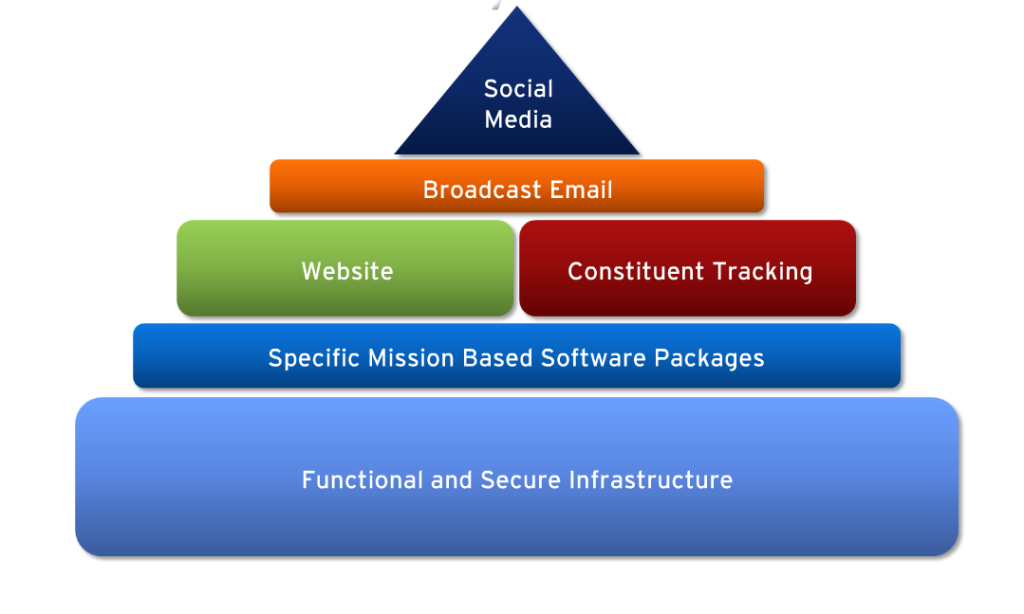
    Social media is not a silver bullet. You need an infrastructure underneath your social marketing. This includes:

    • A website is a must. Once someone learns of your organization they are going to look for your website.
    • A mailing list that allows you to divide your contacts into groups (board, voluteers, staff, etc).
    • A database to track your constituents, volunteers, donors and staff.
    • A functional infrastructure which includes your computer, a secure internet connection, computer networks, mission based software, etc.

    Here is the Technology Pyramid from Nonprofit Technology:

    Nonprofit Technology Pyramid

    Links & Resources

    If you would like to learn more about Julia Campbell you can visit her at:

    • Her website: jcsocialmarketing.com
    • Facebook: facebook.com/jcsocialmarketing
    • Twitter: twitter.com/juliacsocial
    • Linkedin: linkedin.com/juliacampbell
    • Pinterest: pinterest.com/juliagulia77

    Here are links to some of the resources mentioned in this podcast:

    • Social Media Workflow Infographic
    • Nonprofit Technology Pyramid (from Idealware)
    • Why Nonprofits need to be Storytellers – Andy Goodman
    • Hootsuite – Social Media Scheduler
    The post NPA 012: Using Social Media for Storytelling first appeared on Nonprofit Ally.

    NPA 011: Charitable Giving – Using Story Telling to Find your Donors May 13, 2014
    Show notes

    Finding donors for your nonprofit can be a daunting task. But using some simple nonprofit story telling techniques can help you find new donors and retain them for years to come.

    In this podcast I talk with Sierra Jimenez, Development Director at Southeast Alaska Independent Living (S.A.I.L. ). Sierra built a 500 person donor base, using nonprofit story telling techniques, in just seven years. Donations to S.A.I.L, which started at zero, now bring in over $110K annual.

    Sierra shares with us some of the techniques she used to bring in new long-term donors. Here are some of the simplest ways to get started:

    • Use Social Media
      • Telling your Story Through Photo’s on Facebook
    • Hold events for public relations and awareness raising, not just to raise money.
      • Use events to share and show your mission
    • Send newsletters
      • Easy way to share your story and keeps your organization fresh in people’s minds

    Become an Ally!

    Nonprofit Ally is looking for writers to post relevant and informative blog post on this website. You’ll get your own login and author page. You can hear more about this during the last ten minutes of this podcast. Or visit nonprofitally.com/ally to learn more.

    Links & Resources

    Southeast Alaska Independent Living: sailinc.org
    Brock Warner, Warchild – Nonprofit Ally Podcast 006: Nonprofit Fundraising and Donor Retention

    [one_third first=first]
    [/one_third]

    [one_third]
    [/one_third]

    [one_third]
    [/one_third]

    *The links go to Amazon.com. These are affiliate links. Thank you for considering purchasing these books.

    The post NPA 011: Charitable Giving – Using Story Telling to Find your Donors first appeared on Nonprofit Ally.

    NPA 010: Dealing with Rogue Board Members Apr 23, 2014
    Show notes

    Dealing with a rogue board member creates turmoil and dysfunction within an organization and can be a tricky situation to resolve. In this podcast I talk with Laurie Wolf, MNPL, CFRE – the Vice President/COO of The Foraker Group – about how to identify, deal with and prevent rogue board members. Laurie gives training’s on nonprofit governance, strategic planning and resource development. She was selected as one of the “Top 40 under 40” leaders in Alaska by the Chamber of Commerce in 2005.

    Definition of a Rogue Board Member

    A rogue board member is a board member who uses their authority outside the jurisdiction of the board as a whole. Often their actions are no longer serving the better good of the organization but instead our based on a personal agenda and what they feel is “right” for the organization. Rogue board member behavior can manifest in many ways but commonly targets the organizations Executive Director. This can result in staff feeling bullied and/or abused by the rogue member.

    Signs You Have a Rogue Board Member

    Micro-managing staff, board meetings become full of surprises, adversarial behavior (including playing devil’s advocate), knit-picking executive director decisions, often loudest board member, member yields more power than other members (remember all board members should have equal power), executive director (and other board members) begin feeling bullied.

    How to Deal with a Rogue Board Member

    Talking directly with someone that demonstrates hostility and unpredictability is challenging. But not addressing the situation can lead to a passive-aggressive situation where some type of “explosion” can happen at an inappropriate time and/or location. Do your best to deal with a rogue board situations as soon as possible. Here are some suggested steps to take:

    1. Talk to the Member: Directly communicate with the board member. This should be a non-confrontational conversation focused on listening and relationship building.
    2. Involve the Board Chair: Go to your board chair (unless your chair is the rogue member) and let them know about the situation. The board chair should then have a peer-to-peer discussion with the rogue member to determine the nature of the behavior and possibly help the rogue member adjust their behavior in accordance with proper board governance.
    3. Have a Conference Meeting: If behavior continues, again inform the board chair and request the three of you (the rogue member, the board chair and your self) meet to discuss the situation and how to resolve the conflict. This is a good time to brush up on “I statements”. Note: This is not a “secret meeting”. The board president should keep the other board members informed of the situation as it develops.
    4. Hold an Executive Session: By this time, it is likely the entire board is aware of the situation. The board should an executive session (including the rogue member and possible the executive director) to discuss the situation and try to remedy it
    5. Removal of Board Member: This is a tough situation, but the board has to do what is best for the health, and in some cases the survival, of the organization. Be sure that your organizations bylaws are followed to the letter.

    Risk/Consequences of Having a Rogue Board Member

    • Not longer fulfilling mission
    • Lose board members
    • Lose your executive director and other staff member(s)
    • Lose credibility as an organization within your community
    • Legal issue (depending on extent of abuse)

    Preventative Measures

    • Have a strategic plan and stay focused on mission
    • Create board member job descriptions
    • Be sure to govern in accordance with your by-laws
    • Have a strong Board Development committee focusing on training, recruitment, mentoring

    Links & Resources

    “Board Bullies”, an article by The Foraker Group CEO/President, Dennis G. McMillian
    The Foraker Group Newsletter
    The Foraker Group Webpage: www.forakergroup.org
    Contact the Foraker Group: www.forakergroup.org/index.cfm/contactformontact

    [one_half first=first]


    Governance as Leadership:
    Reframing the Work of Nonprofit Boards

    [/one_half]

    [one_half]


    Focus on Sustainability:
    A Nonprofit’s Journey

    [/one_half]

    The post NPA 010: Dealing with Rogue Board Members first appeared on Nonprofit Ally.

    NPA 009: Getting Sponsors for your Nonprofit Apr 01, 2014
    Show notes

    In this episode of the Nonprofit Ally Podcast I talk with Kim Skildum-Reid who is the Director and Owner of Power Sponsorship (PowerSponsorship.com). Kim offers a wealth of information on how to attract corporate sponsor partners for your nonprofit. She is the author of the The Sponsorship Seeker’s Toolkit, Fourth Edition.

    PROGRAM LINKS

    Kim Skildum-Reid is the Director and Owner of Power Sponsorship.
    Website: Power Sponsorship
    Linkedin: linkedin.com/in/kimskildumreid
    YouTube: youtube.com/PowerSponsorship

    RESOURCES

    The following links are from Kims blog at powersponsorship.com.
    What You Need Before You Seek Sponsorship
    Sponsorship Pricing Basics
    Can We Target Multiple Sponsors?
    Best of the Power Sponsorship Blog
    10-minute Sponsorship Tutorials

    Suggested Reading


    The post NPA 009: Getting Sponsors for your Nonprofit first appeared on Nonprofit Ally.

    NPA 008: Grant Writing – From Preparation to Submission Feb 24, 2014
    Show notes

    In this podcast I talk with Ann Myren from Resources and Results Consulting LLC. She is a nonprofit consultant specializing in grant writing and strategic planning. In this episode she talks about planning to write a grant, how to find grants, grant writing best practices and gives us a “grant writing check list” you should use before you submit your grant application.

    To start the podcast we played a quick game of “Fact or Myth”. Spoiler alert… they all turn out to be myths:

    1. Start ups can’t get grants. MYTH
    2. We must have matching funds to get grants. MYTH (but good idea)
    3. We must be a 501.c.3 to get a grant. MYTH (funding criteria could allow for partnering with another nonprofit)
    4. Grant writing is complicated and takes specialized skills. MYTH
    5. We can’t ask for a lot of money. MYTH
    6. We already got a grant from Agency “A”, we can’t ask them again. MYTH
    7. There are no grants for the services we provide. MYTH
    8. Grants won’t cover our operating expenses. MYTH
    9. We can function on grants alone. MYTH

    TIPS TO GETTING YOUR FIRST GRANT

    • Get a strategic plan. Show how you are going to do what you say you are going to do. A strategic plan is your blue print and demonstrates to the grantor that you have your act together.
    • Go for smaller grants first. Not necessary but good to build off of for next grant.
    • Research granting agency. Who have they given to in the past, do you meet their requirements, can they fund the amount you need.
    • Contact the funder. Read their website to see who to contact and if it is encouraged.
    • Get letters of support from other organizations.
    • Have a budget – not just for project but for entire year.

    REVIEW YOUR GRANT PRIOR TO SUBMISSION

    Ask Yourself

    • Did you repeat yourself? Do you say the same thing in multiple sections?
    • Did you put supporting information in the grant? Did you compare it to other successful projects? Did you use quotes that substantiate your statements?
    • Did you answer all the questions completely?

    Other Checks

    • Check spelling and grammar.
    • Check your math. Is the budget laid our correctly? Does it add up?
    • Be sure to have someone proof read your grant prior to submission.
    • Keep all final documents organized in a way you can find them again on your computer. If you can’t find it you can’t repurpose for another purpose. (See organizing files here).

    PROGRAM LINKS

    Ann Myren can be contacted in at:
    Website: myrenandstern.com
    Linkedin: http://www.linkedin.com/pub/annmyren

    RESOURCES

    foundationcenter.org
    grantstation.com

    The post NPA 008: Grant Writing – From Preparation to Submission first appeared on Nonprofit Ally.

    NPA 007: Preparing to Fundraise with Crowdfunding Feb 07, 2014
    Show notes

    In this podcast I talk about what you need to have prepared before you start crowdfunding. I also talk about why our nonprofit only got five new likes on our Facebook page after being featured on a Facebook page with 15,000+ followers.

    Here is an outline of the crowdfunding portion of this podcast.

    Preparing to Fundraise

    PLANNING

    Here are the questions you will want to answer when you meet with your fundraising team.

    WHY are we fundraising?

    HOW much money do we need to raise?

    WHAT kind of fundraiser are we going to have?

    • Peer to peer, crowd funding, event?
    • What is our budget?

    WHEN:

    • Will we kick off the fundraiser?
    • When does the fundraiser end?

    WHO is going to:

    • Create content on the campaign page
    • Send thank yous
    • Post to social media
    • Deposit check in the bank
    • Post posters/flyers
    • Make phone calls
    • Track donors

    WHO are you going to ask?

    • Demographics
    • Who will contact who and when

    CREATE CAMPAIGN CONTENT

    Make a campaign page (your fundraiser home page) – don’t expect people to click through your site to find your website. Include details on:

    • What you need the money for
    • Why you need it
    • How much it will cost

    Use a visual at the top of the page:

    • Video are all the rage now
    • At least picture or slideshow. Preferably with a person or animal in it

    MARKETING AND OUTREACH MATERIAL

    Much of you campaign marketing/outreach material can be pre-made.

    • “Asking” emails and letters
    • Premade postcards, rackcards, business cards and brochures
    • Social media campaign content
    • Benchmark materials (e.g. email announcing you have reach 30% of your goal)
    • Incentives/perks

    Program Links

    PTAT – Facebook Engagement

    Fundly Crowdfunding Overview

    Nonprofit Elevator Pitch

    The Mini Facebook Campaign

    The post NPA 007: Preparing to Fundraise with Crowdfunding first appeared on Nonprofit Ally.

    NPA 006: Nonprofit Fundraising and Donor Retention Jan 20, 2014
    Show notes

    In this podcast I talk with Brock Warner who is the fundraising manager at War Child. Brock just finished a big fundraising campaign and he fills us in on some of the strategies he used that helped them realize a 30% increase in donations. We also discuss ways to increase donor retention from year to year.

    PROGRAM LINKS

    Brock Warner is a fundraiser at War Child and a blogger at iamafundraiser.com. You can also follow him on Twitter as @BrockWarner.

    • Website: www.warchild.ca
    • Blog: www.iamafundraiser.com
    • Twitter: @BrockWarner

    RESOURCES*

    *These are some of the resources that were mentioned in the podcast. The links go to Amazon.com. These are affiliate links. Thank you for considering purchasing these books.

    The post NPA 006: Nonprofit Fundraising and Donor Retention first appeared on Nonprofit Ally.

    NPA 005: The Effects of Founders Syndrome Dec 16, 2013
    Show notes

    Founders syndrome is not a disease, but for many nonprofits it is smart to take precautions to prevent its effects. In this podcast, I talk with Kay Clements who started experiencing the effects of burnout after serving as the general manager of a small public radio station in California. Though she did not experience “text book” founders syndrome, many of the symptoms were similar. Her story is raw, honest and enlightening.

    Here are a few ways founders syndrome can be defined:

    • when the founder of an organization is unable (or unwilling) to adapt as an organization changes and grows
    • when the structure of an organization becomes dependent on the founders system of making things work, making it difficult to replace the founder without collapsing the organization
    • when an organization becomes identified by its founders personality to the point that – when the founder leaves – the organization can no longer function.

    At the end of this podcast I go over some ways to help prevent the onset of founders syndrome.

    I also share with you some exciting news I received about a nonprofit I am starting. The effects of this news won’t be known for a few more weeks, but I wanted to let you know about it as I plan to update you on its progress.

    PROGRAM LINKS:

    Kay Clements
    General Manager – KHNS
    Website: www.khns.org

    Other Topics Mentioned
    Noble Paws Inc.

    The post NPA 005: The Effects of Founders Syndrome first appeared on Nonprofit Ally.

    Previous 1 8 9 10 11 Next

    Related Podcasts

    How I Built This with Guy Raz

    1

    How I Built This with Guy Raz Business
    Planet Money

    2

    Planet Money Business
    Inside Strategic Coach: Connecting Entrepreneurs With What Really Matters

    3

    Inside Strategic Coach: Connecting Entrepreneurs With What Really Matters Business
    BiggerPockets Real Estate Podcast

    4

    BiggerPockets Real Estate Podcast Business
    The Smart Passive Income Online Business and Blogging Podcast

    5

    The Smart Passive Income Online Business and Blogging Podcast Business
    Bad With Money With Gabe Dunn

    6

    Bad With Money With Gabe Dunn Business
    footer-logo

    Contact Us

    Toll Free: 844-670-7747

    Links

    • Home
    • Top Charts
    • Networks
    • Apps
    • Independents Podcasts
    • Podcast Advertising
    • Podcast News
    • Contact Us
    • About Us
    • Analytics & Insights

    Stay Connected

      Privacy, Terms of Use & Our Code of Ethics Protecting Content Creators Copyrights