TopPodcast.com
Menu
  • Home
  • Top Charts
  • Top Networks
  • Top Apps
  • Top Independents
  • Top Podfluencers
  • Top Picks
    • Top Business Podcasts
    • Top True Crime Podcasts
    • Top Finance Podcasts
    • Top Comedy Podcasts
    • Top Music Podcasts
    • Top Womens Podcasts
    • Top Kids Podcasts
    • Top Sports Podcasts
    • Top News Podcasts
    • Top Tech Podcasts
    • Top Crypto Podcasts
    • Top Entrepreneurial Podcasts
    • Top Fantasy Sports Podcasts
    • Top Political Podcasts
    • Top Science Podcasts
    • Top Self Help Podcasts
    • Top Sports Betting Podcasts
    • Top Stocks Podcasts
  • Podcast News
  • About Us
  • Podcast Advertising
  • Contact
Not in our directory?
Add Show Here
Podcast Equipment
Center

toppodcastlogoOur TOPPODCAST Picks

  • Comedy
  • Crypto
  • Sports
  • News
  • Politics
  • True Crime
  • Business
  • Finance

Follow Us

toppodcastlogoStay Connected

    View Top 200 Chart
    Back to Rankings Page
    Education

    Mastering Business Analysis

    Your key to advancing your career as a Business Analyst and beyond

    Advertise

    Copyright: © MasterClass 247 LLC

    • Apple Podcasts
    • Google Play
    • Spotify

    Latest Episodes:
    MBA026: Guarding Against Scope Creep Jun 30, 2015
    Show notes

    In this episode, you’ll find out about the importance of guarding against scope creep and tools to help stop scope creep.

    Dave Saboe is the host of the Mastering Business Analysis podcast. He has two decades of experience as a Business Analyst and has experienced the negative impact scope creep can have on projects. His scope creep alarm goes off whenever someone says “could you just . . . ” or “while we’re in there, we might as well . . . “

    http://traffic.libsyn.com/masteringbusinessanalysis/MBA_026.mp3

    Show Notes

    Scope creep isn’t just the nickname of that weird guy with chronic bad breath down the hall. It also refers to uncontrolled changes or the continuous growth in a project’s scope. Often, this addition to scope comes without corresponding changes to the budget, resources, and schedule. Scope creep is also known as requirements creep and can occur when the project scope is poorly defined and as a result, requirements are added that do not align with the objective of the project. By “scope of the project”, we’re referring to the boundaries of the project, problem, or intent. Scope helps define the project’s parameters.

    Fight scope creep daily

    Certainly, there are requirements changes that don’t fall into the category of scope creep. If a requirement was previously missed and yet is needed to achieve the objective of the initiative, that is not scope creep. Similarly, a change of detail such as needing a field to appear on the first screen of an application rather than the last page is not scope creep.

    Scope creep can lead to gold plating, which is the practice of going beyond the project scope in the belief that you are adding value. However, these additions to scope may not be needed by the customer and certainly don’t add sufficient value to make up for the increased time and cost.

    Scope creep is consistently listed as one of the top three reasons for project failure. Depending on which study you read, failed or challenged projects (those that exceed budget or time constraints) account for between 34% and 75% of all projects. So one to two thirds of projects outright fail or exceed constraints, and scope creep is a major contributing factor.

    The common perception with some stakeholders is that it’s cheaper to make additional changes while you’re making changes to the system. Often that’s true. By taking advantage of bundling similar tasks together, you achieve certain cost and time savings. However, there’s also an opportunity cost that is frequently not considered in these decisions. Taking time and resources away from the main objective of your project leads to delays and increased cost. The benefit of the additional scope may not sufficiently support the cost associated with the lost time and resource constraints.

    There are also downstream impacts to consider. The later in the project lifecycle you add scope, the more costly it is to implement. Having to rework the code, testing (including additional regression testing), the time to perform proper change control procedures, and related activities all result in delays and increased cost. You may lose your first mover advantage or violate regulations if timing is critical to your project.

    Not all scope creep is created equal

    Scope creep is not always negative, depending on the situation. New features and functionality can give your product the edge over the competition if you implement it early enough. It may be the case that while the additional scope does not exactly align to your project’s objectives, it is sufficiently important to add this scope to your project to gain an advantage.

    No worries . . . We’re Agile!

    While it’s true that changing requirements have less of an impact with Agile and other iterative delivery methods, scope creep still sneaks into those projects and pushes out your backlog, leading to delays in delivering high priority intent. Agile allows you and your team to focus on the next priority. When scope that is not aligned to your project or objective is added to your backlog, there must be proper prioritization and a trade-off with something in your backlog that is properly aligned. Again, there’s an opportunity cost and the potential for delays to your shippable product and increased budget requirements. You must educate your team on the trade-offs and opportunity costs associated with adding scope.

    The Five Main Causes of Scope Creep

    1. Poorly defined scope and objectives
    2. Miscommunication or misunderstandings about the project intent and vision
    3. Poorly defined, ambiguous requirements
    4. Lack of a proper change control process
    5. Weak project management and negotiation skills

    Solutions to Scope Creep

    1. Make sure that you understand the project vision, goals, and objectives. Share the project intent and vision with your team, document the objectives and scope statement to clarity the boundaries of your project, and establish key metrics to evaluate the project’s success. Ensuring the team and stakeholders understand the goals and intent and establishing key metrics will allow you to tie back requests for additions to scope and have informed discussions as to whether or not that additional scope aligns to the project goals.

    2. Understand priorities. You must prioritize and document the priority of each requirement. In addition, you should understand priorities at a project level. What is most important to your sponsor and customers? Is the highest priority time to market, cost, or inclusion of all scope? Indicate the project priorities to understand that which is most important. Prioritization will allow you to facilitate trade-off discussions when new scope is added.

    3. Create clear, high quality requirements. Your requirements should be clear, unambiguous, and testable. Include diagrams and define any terms used. If possible, include criteria for success. This will allow little room for interpretation of the requirements. Remember that if something can be interpreted in different ways, it will inevitably be interpreted the wrong way. Also, involve end users early. If you fail to include end users, you may find that you build a process or system that does not meet the needs of the end users.

    4. Use tools to guard against scope creep. The following tools can be invaluable in guarding against scope creep:

    • Traceability Matrix: Traceability allows you to trace every requirement back to higher-level intent. This ensures that any scope added can easily be traced back to an objective, vision, or success metric. This tool will help you validate if the scope should be added. If it cannot be traced back to an objective or success metric, the addition is likely out of scope.
    • Change control: A defined change control process will help you establish credibility when resisting additions to scope. For each change, you perform a cost-benefit analysis and document the reason for the change as well as the consequence of not making the change. You also make note of the impacts of the change such as extensions of the delivery date, additional resources, or budget changes. The change request must be agreed to by the team, sponsor, and budget owner. This allows you to assess the impact and benefits of making a change before implementing it.
    • Context diagram: A context diagram is a simple visualization of the system and high-level processes that allows you to identify scope boundaries. It can be shared with your project team to ensure a common understanding of the scope of your effort.
    Context Diagram Example

    Context diagram. Source: Wikipedia.

    With these tools and techniques, we can act as guardians against scope creep.

    What’s Your Take?
    Do you have any tips for stopping scope creep? What has and has not worked for you? Share your thoughts in the comments below.

    Links mentioned in this episode

    • Traceability Matrix Template

    Thank you for listening to the program

    To get more valuable content to enhance your skills and advance your career, you can subscribe on iTunes.

    Also, reviews on iTunes are highly appreciated! I read each review and it helps keep me motivated to continue to bring you valuable content each week.

    The post MBA026: Guarding Against Scope Creep appeared first on Mastering Business Analysis.


    MBA025: Don’t Just Make Software, Make an Impact – Interview with Gojko Adzic Jun 23, 2015
    Show notes

    In this episode, Gojko Adzic speaks with us about how to deliver solutions that the business truly needs to achieve their goals and avoid creating shelfware. He’ll also introduce us to a tool that he uses called Impact Mapping.

    Gojko Adzic is a software delivery consultant who works with organizations to improve the quality of their software products and processes. Gojko is also an award winning author and wrote several books including Fifty Quick Ideas to Improve your User Stories, Impact Mapping, Specification by Example, and Bridging the Communication Gap.

    After listening to this episode, you will understand:

    • How to focus on creating an impact for your organization instead of just creating software
    • How to use impact mapping
    • The different applications for impact maps (there are more than I thought)
    • What to do when you receive a requirement that’s actually a solution

    http://traffic.libsyn.com/masteringbusinessanalysis/MBA_025.mp3

    Show Notes

    Business representatives like to propose solutions without having the technical expertise and software development teams propose solutions often without fully understanding the business need. Sometimes Business Analysts introduce a third solution. The answer is for Product Owners and Business Analysts to become influential in building a bridge between the business users and technology teams to make sure we build the right solution. However, we must first understand the problem we are trying to solve. What is the business need and goal?

    Focus on creating impacts and not software. These are impact in terms of the way people work, the way people interact with our business, and the way people live.

    Jeff Patton made a statement recently that most people in the software field think their job is to deliver software, but it’s not. Their job is to change the world. Focus on outcomes, not outputs.

    Try to figure out what the change in the world outside us is that we’re trying make happen with our software and then build a plan to shape that instead of just building software.

    Impact Mapping

    An Impact Map is a visualization of the business goals, the impacts on customers that we want to create to achieve the business goals, and potential scope to deliver the business goal. The format is similar with a mind map.

    Impact Mapping helps start creating several levels of value where lower level outcomes get connected to higher level outcomes. By creating a visual tying the outcomes and levels of value together, it can help us choose the right path to have the most meaningful impact to the organization.

    Impact Mapping helps create a roadmap to ensure the team is aligned and heading in the right direction to achieve the organization’s goal. But that’s just the beginning. Some organizations have found different uses for Impact Mapping.

    To explore the uses for impact mapping, think of a two-by-two matrix where one axis is ability to decide on investments and the other is the risk of making a wrong product management decision.

    1. Where the ability to make investment decisions is high and the risk of making wrong decisions is low (perhaps because we can test and adjust), people most often use Impact Mapping as living roadmaps.
    2. In cases such as banks and insurance companies where there are many stakeholders and many want different things, the risk of making the wrong product management decision is low because the markets are relatively stable, people use impact maps to outline the options and get stakeholders to visualize what they want and make good decisions.
    3. The risk of a wrong product decision is high, such as companies that build physical products, medical devices, or innovative products, they use impact mapping to generate a conversation on discovering a product.
    4. There’s a lot of money of the table and it’s easy to make decisions, but the risk of making a product decision is huge. These organizations use impact mapping to define where they want to do customer research to discover the right product and possibly create multiple products at the same time.

    How to Create an Impact Map

    To create an impact map, you most often start with the business goal (why are we doing this). The next level is customers or actors. On the third level, you connect the changes or the impacts on those customer segments that could potentially lead to achieving the business goal. The fourth level is typically the software solutions (epic level user stories or high level use cases).

    The other option is to start with the deliverables and work your way backwards. This is sometimes useful for organizations with large backlogs to help them make connections and prioritize.

    When do we use impact maps?
    On a new initiative in which the business goal is well defined, we would start an impact map at the beginning of the effort and review/revise it at the end of each milestone. This allows for the team to focus and ensure you continue to work on the right thing. This creates a flexible, living roadmap. It also allows us to have a good conversation and reporting approach tied to delivering impacts and not just delivering software. We can start changing the reporting structure for software delivery – not hours or story points (activity), but behaviors that lead to impacts. That allows us to report on value achieved.

    Impact mapping can be applied to agile environments, traditional (waterfall) approaches, in non-software development organizations, or even in organizational restructuring.

    Advantages of Impact Mapping
    Impact mapping is a conversation technique. It helps remind people of important questions to discuss. The biggest advantage is that it’s visual, it’s collaborative, and it’s fast.

    In Summary
    As BAs, we are champions for the business. We’re guardians to make sure we drive positive, impactful change.
    Impact mapping can help guard against scope creep, help the team to focus on delivering the change with the most impact, and create small feedback loops to make sure you’re on the right track. It has uses beyond software development to help you achieve your desired outcomes.

    Gojko’s Tip
    Whenever you receive a requirement that is actually a solution, inquire about the behavior change that the solution is going to create. If we have a behavior change that allows us to monitor progress in a meaningful way, we will get more rapid feedback. Additionally, this helps guard against scope creep and makes sure we are aligning to organizational goals.

    What’s Your Take?
    Have you used impact maps, mind maps, or a similar tool? If so, what was the outcome?

    Links mentioned in this episode

    • Learn more about Impact Mapping from Gokjo’s website: http://www.impactmapping.org/
    • Getting the most out of impact mapping: http://www.infoq.com/articles/most-impact-mapping
    • Impact Mapping – now helping Indonesian Hospitals: http://www.marcusoft.net/2014/02/HospitalImpactMap.html
    • Making an Impact on 7000 Orphanages: http://www.infoq.com/articles/impact-map-orhpanages

    Thank you for listening to the program

    To get more valuable content to enhance your skills and advance your career, you can subscribe on iTunes.

    Also, reviews on iTunes are highly appreciated! I read each review and it helps keep me motivated to continue to bring you valuable content each week.

    The post MBA025: Don’t Just Make Software, Make an Impact – Interview with Gojko Adzic appeared first on Mastering Business Analysis.


    MBA024: Lead with the Power of a Jedi – Interview with Heather Mylan-Mains Jun 16, 2015
    Show notes

    In this episode, we’re joined by Heather Mylan-Mains. Heather is going to share with us how to motivate and inspire as a leader based on her presentation entitled “BA Jedi Master Leadership Academy – Learn How to Lead with the BA Force”.

    Heather Mylan-Mains is a consultant, deputy VP Chapters IIBA® and an instructor for B2T Training. Through her extensive experience, she has been able to participate in many roles in projects and there is no part of the RACI matrix she has not been responsible for! The force is strong with this one . . .

    After listening to this episode, you will understand:

    • How Business Analysts can lead like a Jedi
    • How to expand your network and build relationships
    • How to avoid becoming an energy vampire
    • What to do to prepare for your next encounter to start off on the right foot

    Show Notes

    As a Business Analyst, you have to meet new people and establish relationships quickly, especially if you’re in a consulting role. Luke Skywalker’s journey to becoming a Jedi Knight is similar to the Business Analyst journey into leadership.

    Networking
    Networking is not a natural skill. It must be practiced. As Business Analysts, the information we know is important, but knowing the people with the right information is more important.

    Building and nurturing relationships builds trust. In Star Wars, Luke Skywalker starts out his adventure by meeting one person (or android in this case) – C3PO and expands his network from there and moves him to an entirely new career as a Jedi.

    The introduction is just the beginning of networking. You must also know what value you can bring to the team and then deliver on that value. Take time to build relationships.

    Relationship building
    Invest time to build relationships, learn about other people, and create a reciprocal relationships. Make sure you’re not always asking them for something, be willing to share information as well. Have an open dialogue and remain transparent about your actions. Be clear in the “what’s in it for them” message.

    You must be willing to give up some of your time. Meet with people outside of the project environment – at lunch, for a quick coffee, or for a walk.

    Are you willing to help solve the problem?
    Don’t be the “it’s not my job” type of person. Be involved in identifying and solving problems in your organization. [Think of when Luke, Leah, Han, and Chewy were trapped in the trash compactor. Each took action to solve the problem and see what would work]
    Often as Business Analysts, we don’t have the answers to form a solution. To find a solution, it may require involving others in your network or experimenting to see what works.
    As a leader, you must be willing to be the person that starts the conversation.

    Remove Roadblocks
    As a leader, you should be instrumental in removing roadblocks for the team and let the team go on to glory. This also helps build great relationships. Have the foresight to identify risks and obstacles, even if it means having a difficult conversation with someone.

    Develop Positive Relationships – Avoid the Dark Side
    Understand and nurture positive relationships in which you’re both getting something out of the relationship. However, you must also end some relationships that are toxic or not creating a positive environment.

    Don’t be an energy vampire. Keep things positive. Instead of stating what can’t be done, think about ways we can do something.

    How to Motivate and Inspire
    Be a mentor and be willing to be mentored. To be a leader, you must also learn to delegate. Let someone else shine and give them opportunities to learn on their own.

    Use the BA Force
    Being able to meet people and draw them in right away is a key leadership skill. This leads to inspiring others to take action. Having a quick introduction is a great way to help people feel confident in your abilities. Be good at introducing yourself.

    As Business Analysts, we often rely on other people sharing information. Creating an environment in which those people know, like, and trust you is key to information sharing and collaboration.

    Recommended Next Steps:
    One thing you can do today and see positive results right away is to create an “elevator introduction”. Within three minutes, be able to share three things about yourself and have three things to ask someone else. Develop and practice this script and customize it for different contexts such as attending a conference, at a school event, or at a new company.

    What’s Your Take?
    Do you think the BA journey to leadership is similar to a Jedi’s journey? Perhaps you think it’s more like Indiana Jones’ journey. Any other analogies for a journey to leadership? Please leave your comments below.

    Links mentioned in this episode

    • Link to Heather’s presentation: http://www.buildingbusinesscapability.com/presentations/2013/1268.pdf
    • Connect with Heather Mylan-Mains on LinkedIn: https://www.linkedin.com/in/heathermylanmains

    Thank you for listening to the program

    To get more valuable content to enhance your skills and advance your career, you can subscribe on iTunes.

    Also, reviews on iTunes are highly appreciated! I read each review and it helps keep me motivated to continue to bring you valuable content each week.

    The post MBA024: Lead with the Power of a Jedi – Interview with Heather Mylan-Mains appeared first on Mastering Business Analysis.


    MBA023: Using Behavior Driven Development for Better User Stories – Interview with Jeffrey Davidson Jun 09, 2015
    Show notes

    In this episode, we’re joined by Jeffrey Davidson. Jeffrey will help us to better understand how to get better at user stories and how behavior driven development (BDD) helps create a shared understanding. We also discuss how to create the nirvana state of living requirements.

    Jeffrey Davidson is the past president of the IIBA Dallas chapter and is an agile coach and trainer. Jeffrey is a frequent speaker at industry conferences where he discusses writing better user stories and other topics related to improving project and team performance.

    After listening to this episode, you will understand:

    • The three Cs of user stories
    • How to use acceptance criteria to specify details in a user story
    • The benefits of using behavior driven development
    • How the Three Amigos technique can uncover missed requirements
    • How BDD will make auditors love you

    Show Notes

    What is a User Story?

    A user story is a tool to help you to organize your work. It’s a means to help you understand and make sure you’re getting the right stuff done.

    The Three Cs

    A user story has three components – a card, a conversation, and a confirmation (based on the work of Ron Jeffries). The card is in reference to the small index card on which user stories were originally written. User stories should be brief with just enough to know the intent.

    Conversation means that it’s a reminder that we need to have a conversation or a reminder of a conversation we’ve already had. The confirmation is the acceptance criteria and helps you to understand when you’re done with the story.

    A user story is not the requirement. It’s a statement about the intent, the functionality, and why it’s important. If there are what can be referred to as requirements in a user story, they’re the acceptance criteria.

    What is Acceptance Criteria?

    Acceptance criteria are the conditions that must be true for the story to be done. Acceptance criteria and the conversation we should be having about what functionality we’re delivering is best done through forms of a captured conversation.

    “Acceptance criteria is really your proof of understanding.”

    That’s where Behavior Driven Development (BDD) comes in

    At its heart, BDD is about understanding. BDD is somewhat like a modified version of a use case. Is should be from a user role perspective based on the goal they’re trying to achieve. BDD states the interaction and behaviors of the user and the system. Start with a given context and articulate the expected response when they perform a specific action.

    The format includes context, action, and response.

    • Given . . . (a particular role in a context)
    • When . . . (they perform a specific action)
    • Then . . . (the expected response of the system)

    As a species, humans communicate best in two ways – stories and pictures. The given, when, then structure creates a framework for a story that is understood by the entire team as well as end users.

    The benefits of using behavior driven development are that the statements are in an easy to understand language and they do not specify the design. Using BDD increases knowledge of the business domain and allows you to create better solutions for your users. Additionally, by automating the testing you can achieve the nirvana state of living requirements.

    Recommended Next Steps

    If you’re new the industry, review some of the information about behavior driven development.

    If you’re experienced, get together with two other people on your team (Three Amigos) and discuss how the system should interact with a specific role given a context.

    Links mentioned in this episode

    • Jeffrey’s blog: http://goodrequirements.com/
    • More about BDD: http://goodrequirements.com/bdd/
    • Follow Jeffrey Davidson on Twitter: https://twitter.com/jeffreygoodreq
    • Jeff Patton interview: http://masteringbusinessanalysis.com/episode-016-user-story-mapping-with-jeff-patton/

    Thank you for listening to the program

    To get more valuable content to enhance your skills and advance your career, you can subscribe on iTunes.

    Also, reviews on iTunes are highly appreciated! I read each review and it helps keep me motivated to continue to bring you valuable content each week.

    The post MBA023: Using Behavior Driven Development for Better User Stories – Interview with Jeffrey Davidson appeared first on Mastering Business Analysis.


    MBA022: How to Know Where to Focus Your Efforts – Interview with Chris Matts Jun 02, 2015
    Show notes

    In this episode, we’re joined by Chris Matts. Chris will introduce us to the Cynefin framework and how he uses it to understand where to focus business analysis activities and where the focus should be more product management driven. Chris also discusses Real Options, which is a decision-making process for managing uncertainty and risk that he developed.

    Chris Matts is a program manager, business analyst, agile coach, and author. Chris is known for delivering business value while managing project risk. Chris developed Real Options and worked with Dan North to develop the “GIVEN-WHEN-THEN” template for Behavior Driven Development when BDD was just starting to be used.

    After listening to this episode, you will understand:

    • The difference between product ownership and business analysis
    • What the Cynefin framework is and how you can use it to determine where to focus your energy
    • When you should get out of the way and let developers handle the project
    • How to bring new business analysts up to speed quickly
    • Understand how to use Real Options to reduce risk and make better decisions

    Key Takeaways

    What’s the difference between product ownership and business analysis?

    Business analysis is a toolkit and product management is a toolkit. The confusion is with the job title. If you can access your end customers and understand their processes, you’re performing business analysis work. Product management is more about the market and understanding customer needs.

    The Cynefin Framework

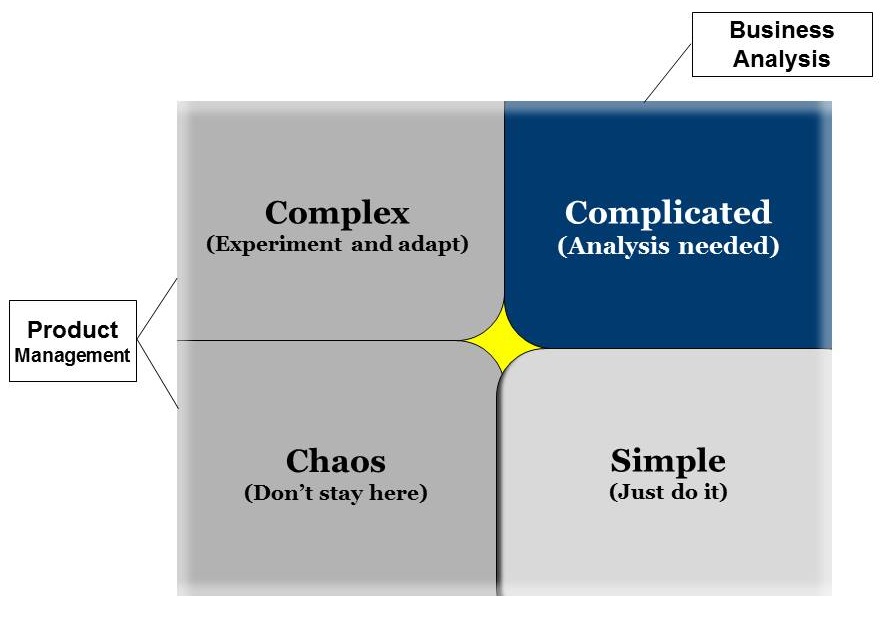
    The Cynefin framework is made up of five domains. The Knowable space consists of the Obvious domain and the Complicated domain. The Unknowable (Emergent) space consists of the Complex and Chaos domains. In the center is the Unknown domain.

    1) Obvious: In the Obvious domain, you can get out of the way and let the developers handle it. We can’t add much value through analysis and may even be slowing things down.

    2) Complicated: It’s knowable in that you can speak with customers and users to understand what they want, but we need to do some analysis to understand the real needs. The Complicated space is the realm of the business analyst.

    You’ll often find business analysts working in environments such as enterprise software where you have a very complicated domain inside the organization where you need to make a lot of changes.

    3) Complex: Can’t know what the outcome will be, so we need to run some experiments where it’s safe to fail. This is usually the realm of the product manager. They run experiments and look at the data to drive decisions. This is a situation in which you have a large number of customers, potentially with different needs and you can’t possibly talk to all of them.

    4) Chaos: You think you’re in the Obvious domain and suddenly the world has shifted beneath your feet and you fall into a chaotic space where you don’t have a good idea of what’s happening. It’s a transient area in which you just need to act. You may run a few experiments just to see what happens, rather than having enough information to make a hypothesis.

    5) Unknown: In this area, you really don’t know where you are. You don’t have enough information to know which domain you’re in at the moment.

    To take advantage of the Cynefin framework and ensure you know where to focus your efforts, explain the Cynefin concept to a group of people and together they try to determine which domain each project is in. Through a group conversation of differing viewpoints, you may uncover things others haven’t considered.

    Cynefin Framework

    Real Options

    Waterfall projects have increasing risk because you are investing more capital as time goes on and you don’t know the result until the end of the project. Real Options is an approach for better risk management and decision making.

    The three things to keep in mind about options:

    1. Options have value
    2. Options expire
    3. Never commit early unless you know why.

    Don’t commit early unless you know why. If you can resolve the uncertainty, then you can commit. The difference between Real Options and procrastination is the understanding that options expire. We can’t leave a decision for the point after which the option expires.

    Think in terms of options instead of commitments. To understand when your options are expiring, start with your goal and work backwards.

    Focus on outcomes and business value as expressed by metrics rather than focusing on outputs and deliverables.

    Bonus Tip: To bring new people up to speed quickly, try pairing. Paired analysis (similar to an apprenticeship) will help bring a more junior person up to speed quickly by pairing with a more experienced Business Analyst. Once the pair is through the higher risk portions of the project, the newer analyst can take over.

    Links mentioned in this episode

    • 7 information smells of domain modelling: http://www.infoq.com/articles/seven-modelling-smells
    • Chris’ Book “Committment”: http://commitment-thebook.com/
    • Chris’ Blog: www.TheITRiskManager.Wordpress.com
    • Follow Chris on Twitter: https://twitter.com/papachrismatts

    Thank you for listening to the program

    To get more valuable content to enhance your skills and advance your career, you can subscribe on iTunes.

    Also, reviews on iTunes are highly appreciated! I read each review and it helps keep me motivated to continue to bring you valuable content each week.

    The post MBA022: How to Know Where to Focus Your Efforts – Interview with Chris Matts appeared first on Mastering Business Analysis.


    MBA021: Is the Business Analyst Role Just Overhead? Interview with John Sextro May 26, 2015
    Show notes

    “Let’s get rid of Business Analysts and ScrumMasters.” In this episode, we’re joined by John Sextro. John recently gave a provocative lightening talk at a conference about removing Business Analysts and ScrumMasters from agile teams. We’ll discuss what this would mean for the BA role.

    John Sextro has been in the software industry for 21 years and coaches agile teams. John is also the host of This Agile Life – a podcast that has a group of developers and agile coaches discuss real world issues they’re seeing in agile software development. He is a frequent speaker at agile conferences.

    After listening to this episode, you will understand:

    • Why John made the provocative statement about getting rid of Business Analysts
    • The value that ScrumMasters and Business Analysts bring to agile teams
    • What it would mean to the organization to be able to move Business Analysts and ScrumMasters off agile teams
    • How to allow teams to use a whole team approach for Business Analysis activities
    • What the Business Analyst can do for the organization if moved out of an agile team

    Key Takeaways

    Are Business Analysts and ScrumMasters mostly overhead to the company?

    The skills are sometimes seen as something anyone on the team can have and do. When you have a highly efficient and effective team, then may be able to move away from having a dedicated Business Analyst or ScrumMaster.

    The ScrumMaster may shift from having one team to having two or three teams as the teams mature. Business Analysts may be moved off agile teams to other roles.

    What does an agile Business Analyst do?

    • Talk to users and stakeholders to discover what is currently done and what needs to change
    • Understand how people use the system and what their goals are when they interact with the system.
    • Help transition that information to the team, usually in user stories
    • Ensure that the team is focused on value and delivering the most valuable thing
    • Help the Product Owner prioritize the backlog
    • Bridge the gap between business and technology

    Business Analysts help teams avoid the mistake of working on lower priority items by helping them to understand priorities and the value of their backlog items.

    Once teams are mature, they may begin shifting the need for a dedicated Business Analyst and adopt a whole team approach. This means that the team takes the tasks and responsibilities of the Business Analyst and spreads them throughout the team so that everyone is capable of speaking with users, writing user stories, understanding value, etc.

    Why would an organization want to move Business Analysts off of agile teams?

    Perhaps it would be more efficient for developers to speak directly with business representatives instead of going through someone like a Business Analyst. Have developers and the Product Owner work directly with users without working to translate those interactions and collaboration into documentation.

    This would remove some cost overhead for operating the team. The organization can also add more developers to the team based on the openings created by removing the ScrumMaster and Business Analyst to increase throughput.

    Business Analysts may be able to move to a higher role on the organization such as at a PMO level to provide value for more strategic or enterprise initiatives while still being available to coach and support teams when needed.

    Bonus Tip: For effective stand-up meetings, focus on the value you delivered and not the tasks in which you’ve participated. Use the same approach for your meetings. Make sure there’s an agenda for any meeting to which you’re invited. Also, find out why you’re invited and the value you’re expected to bring to the meeting.

    Links mentioned in this episode

    • This Agile Life Podcast: http://www.thisagilelife.com/
    • This Agile Life – Episode 73: In a World Without business Analysts: http://www.thisagilelife.com/73/
    • Effective Stand-up Meetings: http://www.thisagilelife.com/66/
    • Follow John Sextro on Twitter: https://twitter.com/johnsextro

    Thank you for listening to the program

    To get more valuable content to enhance your skills and advance your career, you can subscribe on iTunes.

    Also, reviews on iTunes are highly appreciated! I read each review and it helps keep me motivated to continue to bring you valuable content each week.

    The post MBA021: Is the Business Analyst Role Just Overhead? Interview with John Sextro appeared first on Mastering Business Analysis.


    MBA020: The Value of Certifications – Interview with David Mantica May 19, 2015
    Show notes

    In this episode, David Mantica, President of ASPE-SDLC, shares his views on the value of professional certifications – both to the individual and to the organization.

    David Mantica is president of the American Society of Professional Education Inc. (ASPE-SDLC) and has two decades of experience as a business leader in the training industry. David has participated in numerous certification committees and supported the work of certifying bodies including the Scrum Alliance, PMI, IIBA, and others. He speaks at numerous IIBA and PMI chapter meetings, and several conferences and Career Fairs.

    After listening to this episode, you will understand:

    • The value of professional certifications to you and to your organization
    • The differences between the three major Business Analysis certifications
    • The benefits of joining a professional organization
    • What NOT to put on your resume
    • Next steps if you are interested in earning a certification

    Key Takeaways

    Certifications can help standardize a position and allows hiring professionals to get a higher level of comfort in hiring someone who can continue to grow in that position. You have a standard way of speaking, doing practices, and a standard skill set.

    Employers are looking for master level capabilities. The first step is having a certain level of professional experience – whether through being a subject matter expert in a certain domain or a higher level of education and experience so you can synthesize the information in a complex environment. Once you have that first level of experience, that’s when certifications become more important to take your next steps.

    Benefits to you:

    • A certification provides a level of credibility that a resume can’t give.
    • People with certifications earn more money even when holding everything else equal because you can quality and quantify your experience.
    • You get a level of professional recognition and connect with an association to grow and learn.

    Benefit to the hiring organization:

    • The continuing education requirements needed to maintain your certification means that certification holders must continue to learn and grow in their profession.
    • Common Language: The software development lifecycle is so complex by itself that having a language issue and differences in common terms makes it even more difficult to work. The certification standardizes the language so that professionals can talk the same talk and avoid confusion simply because of different meaning in the same terms.
    • Hiring: Certifications give hiring companies a confidence level that people have a set level of experience.
    • Productivity: The hiring organization will also get increased productivity, less rework, and move value out of deliverables because the certification holder brings knowledge and experience.

    Your next steps for certification:

    • Review the requirements for each certification and determine if you meet those requirements.
    • If you do not meet the requirements, begin tracking your experience so that you will more easily be able to complete the application in the future. You can also join professional associations before you take the exam to get the benefit of learning and growing with others.
    • If you do meet the requirements, you can begin filling out the application and preparing for the exam.

    Links mentioned in this episode

    • ASPE website: http://www.aspe-sdlc.com/
    • Acclaim tool: https://www.youracclaim.com/
    • International Institute of Business Analysis (IIBA): http://www.iiba.org/
    • Project Management Institute (PMI): http://www.pmi.org/
    • 2010 BA Salary Survey
    • 2009 BA Salary Survey

    Thank you for listening to the program

    To get more valuable content to enhance your skills and advance your career, you can subscribe on iTunes.

    Also, reviews on iTunes are highly appreciated! I read each review and it helps keep me motivated to continue to bring you valuable content each week.

    The post MBA020: The Value of Certifications – Interview with David Mantica appeared first on Mastering Business Analysis.


    MBA019: Why Start with Why? Interview with Stephen Shedletzky May 12, 2015
    Show notes

    In this episode, leadership speaker and Start With Why facilitator Stephen Shedletzky helps us understand how to apply the Start With Why concept to our role to help our organizations work on the right things and deliver value to customers. He’ll also share his thoughts on how to inspire others to take action.

    After listening to this episode, you will understand:

    • Why starting with ‘why’ is critical to your organization
    • How to apply the Start With Why approach to your projects
    • How to inspire others to take action
    • How the 12th step of Alcoholics Anonymous can help you.

    Stephen Shedletzky helps leaders and their teams accomplish remarkable things. Inspired by–and in partnership with–Simon Sinek’s “Start With Why” movement, Stephen speaks, leads workshops, consults, and coaches organizations to help them discover and articulate their driving purpose and, in doing so, become more sustainable and successful than ever.

    Key Takeaways

    How can we apply the principles of Start With Why to our projects?

    When you ask questions that begin with “why”, it becomes trigger an emotional response and people may become defensive. You can ask any “why” question in a way that is more open ended that begins with “what” or “how”. Instead of asking ‘Why do you want the button there?’ ask ‘What’s the importance of putting the button there?’. Now you can get to the root cause (why) and allows us to recommend different alternatives or approaches.

    Before you can begin using the Start With Why concepts in your one life, first you must get clear on what’s important to you. Get clear on your values and beliefs and why. What impact do you want to have on others?

    Use ‘Start With Why’ to network and build your influence

    Once you are clear on your ‘Why’, you can attract people who also believe in having the same impact or who are inspired by the contribution and impact that you intent do make on others and the world around you. Together you can accomplish more.

    When you know your ‘Why’ and start with why and we are consistent with how we bring that ‘Why’ to life through our words and actions, we can more easily find those with a similar purpose and build relationships. We can come together in ways that inspire us and have a greater impact on your organization and the world. It can inspire others to take action.

    “Relationship is the foundation of accomplishment” – Peter Docker

    Anytime we can increase the depth and breadth of our relationships, we can accomplish more.

    You can apply these principles by creating a genuine, inspiring vision on our projects of what we’re trying to achieve and why. Create a sense of purpose that aligns to other people’s values. Share your story of how your project or initiative inspires you.

    “Progress is made when people come together around a common cause and contribute their gifts toward accomplishing it.”

    What can you do today to get positive results?

    Trust is the human currency. It takes time to build and an instant to break. We develop trust when we feel that someone else has our best interest in mind – that they are there to serve us instead of their own self-service. So what can we do to increase trust?

    Show up to serve. If you want to feel more engaged in the projects that you’re working on, figure out how you can help the people around you feel more engaged. In turn, you will feel more engaged. Above all, don’t forget to show up to commit and serve others.

    Links mentioned in this episode

    • Start With Why website
    • Stephen’s website InspirAction: http://inspiraction.ca/
    • Follow Stephen Shedletzky on Twitter: Follow Stephen
    • Get the first chapter of Steven’s book ‘Blind Spots: Solving hidden business problems‘ for free and find out how to make genuine connections on purpose by starting with why.

    Thank you for listening to the program

    To get more valuable content to enhance your skills and advance your career, you can subscribe on iTunes.

    Also, reviews on iTunes are highly appreciated! I read each review and it helps keep me motivated to continue to bring you valuable content each week.

    The post MBA019: Why Start with Why? Interview with Stephen Shedletzky appeared first on Mastering Business Analysis.


    MBA018: Step Up to Leadership with the Five-Rule Framework – Interview with Scott Stribrny May 05, 2015
    Show notes

    What makes a great leader? In this episode, Scott Stribrny begins to answer this question by presenting a business analyst relevant five-rule framework to apply in real life. Scott will discuss principles that guide effective leaders and will explore the short-term orientation of leadership with examples for day-to-day action as well as the long-term orientation of leadership.

    By listening to this episode, you will understand why a great business analyst must also be a strategist, an executor, a talent manager, and a human capital developer. As business analysts aspire to reach more senior levels in the organization, they must become proficient in all of these areas as well as invest in their own personal proficiency.

    After listening to this episode, you will understand:

    • How a Business Analyst can step into a leadership role
    • How to use the five-rule framework to guide behavior and decision making
    • Why investing in yourself is critical
    • What you can do today to advance your leadership skills

    Key Takeaways

    Leadership is not a role or title. It’s a behavior. There are rules for leadership that help to improve the business outcomes as a result of systematic, principle based leadership.

    Five key rules that guide behavior and decision making

    To be an effective leader, you must be 1) a strategist, 2) an executor, 3) a talent manager, 4) human capital developer, and 5) you must invest in your own personal proficiency.

    Leaders help shape the future by acting as a strategist. They get things done that result in favorable business outcomes by executing those strategies. Leaders also know that it’s about people – they engage today’s talent and build the next generation by developing human capital that will serve the future of the enterprise. All of these are tied together by investing in your own development.

    Become a human capital developer:

    At the individual level and in the short term, help to strengthen others by pairing with them. This could be another business analyst, a Product Owner, developers, or others within your organization.

    In the longer term, develop human capital for the future. Determine what kind of skills development and mentoring opportunities are available to your peers to help them and the organization grow.

    Start locally with your network and then expand organizationally with your peers so that they can do the same and spread excellence. Remember that to be a human capital developer, you must first be proficient in your own skills before people will follow you.

    Build on local successes to develop your credibility. As you gain more credibility, you can find opportunities to extend the perception of your leadership capabilities to others based on local successes.

    Let’s get tactical . . .

    To become a leader, have a leadership model or some kind of guiding principle. Each day, ask yourself “How am I going to be a strategist or execute that will add value to my organization? How am I going to develop human capital?”

    Don’t forget to invest in and develop yourself. In addition to training, self-study, and similar activities, you should spend time in self-reflection. At mid-day or at the end of the day, reflect back on what took place that day and think about what you are going to do differently tomorrow. Seek out feedback to get to the reality of the situation.

    Effective leadership has everything to do with what we can do with and through other people.

    In agile transitions, leadership is a shift from command and control to more of a commitment based style. Create a safe environment to build team relationships. That forms the basis for knowledge transfer and collaborative relationships.

    Continue to develop your ability to practice clear thinking and embrace the reality of the situation. Rise above the details.

    What you can do today to improve your leadership skills

    • Self-reflect and assess your own leadership proficiency according to the five-rule framework. Pick one thing to upon which to focus to become more effective and take action.

    Links mentioned in this episode

    • Group Atlantic website: Group Atlantic
    • Send an email to BALeadership@GroupAtlanitc.com to get Scott’s three article series on leadership
    • Connect with Scott Stribrny on LinkedIn: Scott Stribrny on LinkedIn
    • Follow Scott on Twitter: Follow Scott on Twitter

    Thank you for listening to the program

    To get more valuable content to enhance your skills and advance your career, you can subscribe on iTunes.

    Also, reviews on iTunes are highly appreciated! I read each review and it helps keep me motivated to continue to bring you valuable content each week.

    The post MBA018: Step Up to Leadership with the Five-Rule Framework – Interview with Scott Stribrny appeared first on Mastering Business Analysis.


    MBA017: Does Your Communications Engine Need a Tune-Up? Interview with David Barrett Apr 28, 2015
    Show notes

    Improve your communications skillsIn this episode, David Barrett speaks with us about what I feel is the most important skill for a Business analyst . . . communication. David is the National Program Director for the Centers of Excellence in Project Management and Business Analysis at the Schulich School of Business and is one of the founders of the International Institute for Business Analysis.

    David will help us to understand the three phases of communication and how to become a great communicator. Listen for some practical, actionable advice on improving your communications skills.

    After listening to this episode, you will understand:

    • Why communication and presentation skills are critical to your success
    • The three phases of communication and how to use them to improve your communication skills
    • How to scale your communication
    • Why making use of common BA tools will help your communication

    Key Takeaways

    Business Analysts need strong communication skills. Presentation skills are critically important to get your point across, influencing and negotiating skills are needed to drive decisions, and we need to engage with different people (and deal with difficult people). All of these areas are part of the Business Analyst role and are critical to your success.

    To scale your communication to a wider, more diverse audience, first you must understand what your audience needs. Be briefer than otherwise to start. Assume the audience doesn’t want it all. Communicate the bottom line up front with additional information afterwards. Put the request and executive summary up front. This provides context for your audience.

    The three phases of communicating are: Being prepared, delivering well, and follow up afterwards

    1. Preparing – doing your homework and knowing your audience
    2. Delivering well – making sure the message is understandable
    3. Follow up – getting feedback and using feedback to adapt and improve

    Business Analysts should make better use of communications plans along with their stakeholder analysis. One of the biggest benefits a Business Analyst can bring is to ensure we build it right the first time.

    Tips to improve your communication:

    • Find a Toastmasters group and practice to improve your verbal communication skills.
    • For writing, get someone to review your work and provide feedback. Use their feedback to make sure your message is clear and meets the audience’s needs.
    • Use spell check but by all means, but you must proofread.
    • Communicate the bottom line in the beginning to provide context and then include additional relevant detail.
    • Understand the technology that can help us communicate.

    The one thing you can do today to improve your communication right away: Find a coach or mentor. Seek out other people to coach you, help you, and advise you. Never go it alone.

    Links mentioned in this episode

    • David Barrett’s website: http://davidbarrett.ca/
    • Toastmasters website: http://www.toastmasters.org/
    • Leadership Perspectives LinkedIn Group: https://www.linkedin.com/groups/Leadership-Perspectives-7443903/about
    • David’s LinkedIn profile: https://ca.linkedin.com/in/davidbarrettca
    • Follow David Barrett on Twitter: http://twitter.com/dbarrett1
    • David’s You Tube channel: https://www.youtube.com/user/dbarrett5895

    Thank you for listening to the program

    To get more valuable content to enhance your skills and advance your career, you can subscribe on iTunes.

    Also, reviews on iTunes are highly appreciated! I read each review and it helps keep me motivated to continue to bring you valuable content each week.

    The post MBA017: Does Your Communications Engine Need a Tune-Up? Interview with David Barrett appeared first on Mastering Business Analysis.


    Previous 1 24 25 26 27 28 Next

    Related Podcasts

    Making Sense with Sam Harris

    1

    Making Sense with Sam Harris Education
    Grammar Girl

    2

    Grammar Girl Education
    Good Life Project

    3

    Good Life Project Education
    Explain It to Me

    4

    Explain It to Me Education
    Team Never Quit

    5

    Team Never Quit Comedy
    Optimal Living Daily – Personal Development and Self-Improvement

    6

    Optimal Living Daily – Personal Development and Self-Improvement Alternative Health
    footer-logo

    Contact Us

    Toll Free: 844-670-7747

    Links

    • Home
    • Top Charts
    • Networks
    • Apps
    • Independents Podcasts
    • Podcast Advertising
    • Podcast News
    • Contact Us
    • About Us
    • Analytics & Insights

    Stay Connected

      Privacy, Terms of Use & Our Code of Ethics Protecting Content Creators Copyrights





