TopPodcast.com
Menu
  • Home
  • Top Charts
  • Top Networks
  • Top Apps
  • Top Independents
  • Top Podfluencers
  • Top Picks
    • Top Business Podcasts
    • Top True Crime Podcasts
    • Top Finance Podcasts
    • Top Comedy Podcasts
    • Top Music Podcasts
    • Top Womens Podcasts
    • Top Kids Podcasts
    • Top Sports Podcasts
    • Top News Podcasts
    • Top Tech Podcasts
    • Top Crypto Podcasts
    • Top Entrepreneurial Podcasts
    • Top Fantasy Sports Podcasts
    • Top Political Podcasts
    • Top Science Podcasts
    • Top Self Help Podcasts
    • Top Sports Betting Podcasts
    • Top Stocks Podcasts
  • Podcast News
  • About Us
  • Podcast Advertising
  • Contact
Not in our directory?
Add Show Here
Podcast Equipment
Center

toppodcastlogoOur TOPPODCAST Picks

  • Comedy
  • Crypto
  • Sports
  • News
  • Politics
  • True Crime
  • Business
  • Finance

Follow Us

toppodcastlogoStay Connected

    View Top 200 Chart
    Back to Rankings Page
    Education

    Mastering Business Analysis

    Your key to advancing your career as a Business Analyst and beyond

    Advertise

    Copyright: © MasterClass 247 LLC

    • Apple Podcasts
    • Google Play
    • Spotify

    Latest Episodes:
    MBA046: The Product Owner / Business Analyst Relationship Nov 17, 2015
    Show notes

    In this episode, Bob Galen help us to better understand the role of the Product Owner and how Business Analysts can best support the PO and the team.

    

    After listening to this episode, you'll understand:

    • The role and responsibilities of a Product Owner
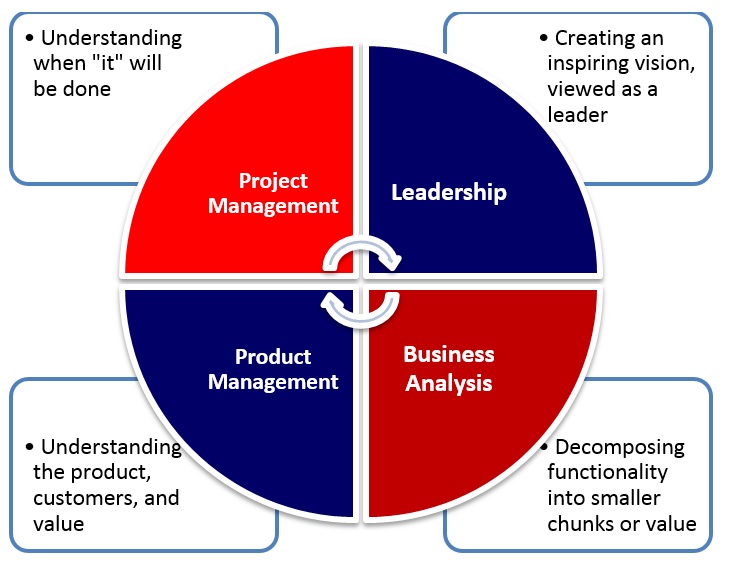
    • The four quadrants that make up the Product Owner role
    • How a business analyst can best work with and support the Product Owner
    

    Show Notes

    The Product Owner role

    There’s a person referred to as a Product Owner on Scrum teams, but in Bob’s view, it’s not a stand-alone role; they need help. It’s extremely difficult to find someone who is outstanding in each of the four quadrants. They will need complimentary help to supplement those areas where they have weaknesses.

    If a Product Owner (PO) has strong product management skills, they may be weak in Business Analysis. A Business Analyst can partner with the Product Owner by breaking down features and capabilities into smaller chunks that the team can deliver in small iterations, creating meaningful user stories or use cases, and helping the PO understand impacts and dependencies.

    In some organizations, instead of having a Business Analyst on the team, there’s a pool of Business Analysts coupled with the product organization from which the Product Owner can pull for support.

    Sometimes, organizations convert Business Analysts to Product Owners. In those cases, the Product Owner has strong Business Analysis skills, but lack strength in product management or another area.

    The Four Quadrants

    Four quadrants of a product owner

    The Product Owner role is an aggregate role and the Business Analyst can partner with the Product Owner to complement the role with their skills.

    Leadership: This quadrant includes having the ability to create an inspiring vision, leading by example, defending the team, and being viewed as a leader in your organization. A person weak in this quadrant might augment their ability to create an inspiring vision by inviting other leaders in to create and communicate that vision and the ‘why’ behind it.

    Business Analysis: This quadrant includes story writing and defining acceptance criteria. It may also include approaches such as modelling and behavior driven development (BDD). A Product Owner with weak Business Analysis skills may partner with a Business Analyst or Quality Engineer to support this area. One of the challenges for a traditional (waterfall) Business Analyst moving to agile is in the shift to creating lightweight requirements with the team.

    Project Management: This quadrant includes understanding the backlog and linkages between backlog items, and addressing risk. It also involves the ability to forecast delivery or functionality based on the backlog and team’s ability to deliver. The Business Analyst can also supplement the Product Owner in this area as could a Project Manager or someone with similar skills.

    Product Management: This quadrant includes roadmaps and working with customers and stakeholders. Often this is outwardly focused.

    Product Owner: “BA, you complete me”

    Business Analysts and testers have the ability to connect the dots. They understand the lifecycle from concept (ideation) to cash (delivery to end user). Having this end-to-end view and sharing it with Product Owners will help ensure the delivery of value to customers.

    Sometimes, teams focus too much at the story level without seeing the big picture. Try to rise above the story and understand the goal. Make the demo yours. Focus not on the stories, but the story behind the stories and make sure the team sees the big picture.

    As a Business Analyst, you need to bring curiosity and openness to the team. Ask why and don’t be afraid to suggest that the team shouldn’t do something.

    Listen to the full episode to hear all of Bob’s tips.

    http://traffic.libsyn.com/masteringbusinessanalysis/MBA_046__The_Product_Owner_-_Busines.mp3

    Z

    Your Homework

    We’ve lost the essence of the User Story; the story. Start talking more and writing less. Richer conversations around the narrative of the story and ‘why’ behind each story will create a better understanding between the Product Owner and the team. The Business Analyst should be a storyteller can convey the goal and intention behind each User Story so that the development team can create the best solution.

    Links mentioned in this episode:

    • Bob’s website
    • Bob’s podcast Meta-Cast
    • Books by Bob Galen
    Bob Galen

    Bob Galen

    President and Principal Consultant of RGCG, L.L.C.

    Bob Galen is the President of RGCG, L.L.C., an agile methods coaching & training consultancy. He is a deeply experienced agile coach who is active in the agile community and regularly writes & teaches on all topics related to the agile methods. Bob wrote the book Scrum Product Ownership, which is focused on that role and driving value in team delivery. He is a frequent contributor to BA Times and often speaks at industry conferences.
    • X
    • LinkedIn

    Thank you for listening to the program

    To get more valuable content to enhance your skills and advance your career, you can subscribe on iTunes. Also, reviews on iTunes are highly appreciated! I read each review and it helps keep me motivated to continue to bring you valuable content each week.

    The post MBA046: The Product Owner / Business Analyst Relationship appeared first on Mastering Business Analysis.


    MBA045: The Agile BA – Myths and Misconceptions Nov 10, 2015
    Show notes

    In this episode, Bob Woods helps us understand how a Business Analyst can complete an agile team and dispels some of the myths and misconceptions about agile.

    Bob Woods

    Bob Woods

    Agile Coach & Delivery Manager at MATRIX Resources

    Bob Woods is an Agile Coach and Delivery Manager at MATRIX. He has been in IT for over 18 years serving in such roles as Sr. Systems and Networking Engineer, Project Manager, Program Manager, and Agile Coach. Bob has spent years working with organizations on collaborative lean development, Agile testing techniques, requirements analysis, project envisioning, relationship management, and Agile leadership.

    • X
    • LinkedIn
    

    After listening to this episode, you'll understand:

    • The myths about the role of a business analyst in agile
    • The realities of being an Agile BA and how a BA can support an agile transition
    • How a BA can complete an agile team
    

    Show Notes

    In many organizations transitioning to agile, the Business Analysts feels like either they have no place or are unsure what their role should be. As a result, some myths about the role of a Business Analyst on an agile team are common.

    The reality is that organizations that are embracing the agile concepts are finding that the Business Analyst is a critical role on agile teams. There are types of Business Analysts with the right mindset to go from a strict waterfall environment to an agile environment and really help the team to be successful. A strong Business Analyst with the right mindset can also help dispel some of those myths about agile that are holding organizations back from transitioning or seeing the benefits of agile.

    Myth: There’s No Documentation in Agile

    This is a common misconception. Documentation is needed in agile, especially in regulated environments. However, it’s not the same type of documentation in traditional (waterfall) approaches.

    The focus is on Lean documentation. Business Analysts can help by understanding documentation needs and prune it down and create lean, valuable documentation in the right ways so we can still be compliant and do the right thing. Think of documentation as the simplest thing that will work done just in time.

    Myth: There’s No Role for a BA on an Agile Team

    The fact that the Business Analyst is quickly becoming a critical role for agile teams. There are strong parallels between what a great agile team does (adapt quickly, work with the business daily, deliver business value, collaborate, continuously improve, etc.) and the role of a great Business Analyst. The Business Analyst can use their skills in these areas to create a high performing agile team.

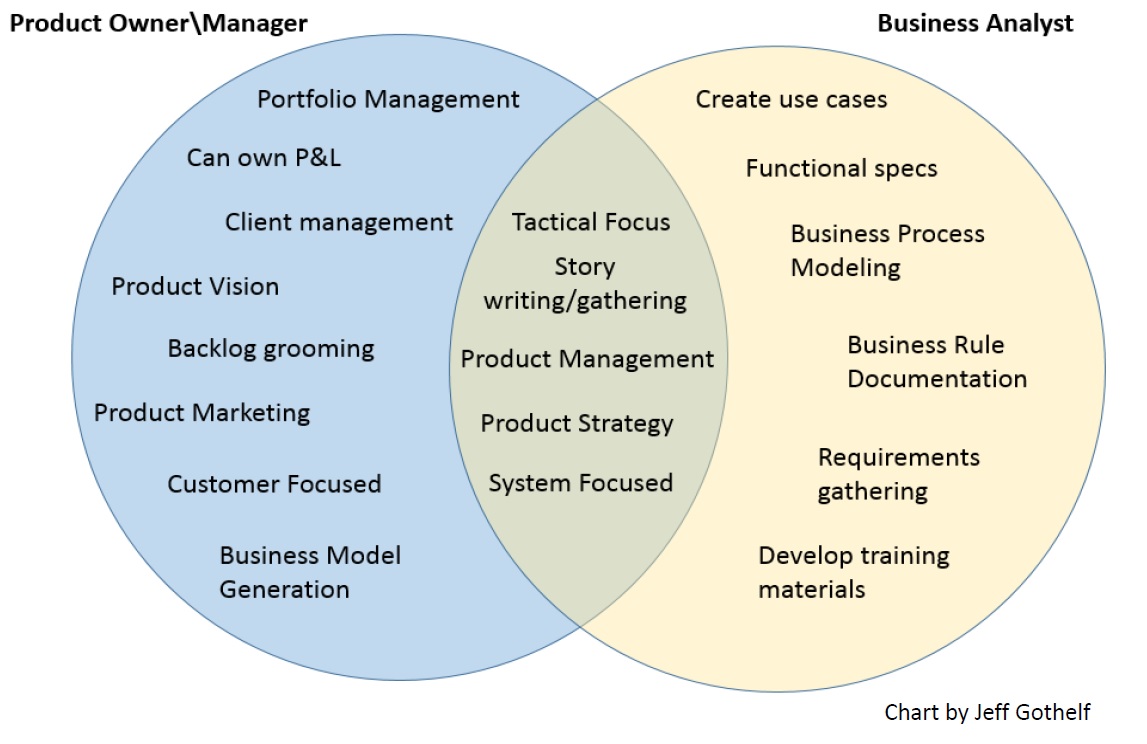
    What about the Product Owner? There seems to be a lot of overlap between the role of the Product Owner and the Business Analyst.

    While there can be some overlap between roles, the Product Owner is often more outward (customer) facing while the Business Analyst is often more inward (team) facing or right in the middle. Product Owners can focus on product vision, ordering the backlog to achieve the highest value, and even marketing and other operational aspects of delivery. Business Analysts often create models to develop a shared understanding of customer needs and other approaches to help decompose and refine small pieces of value (via User Stories or Use Cases) that the team can deliver.

    Product Owner / Business Analyst Relationship

    Image from Bob Woods’ Agile 2015 Presentation

    Where overlap in the roles exist, there’s an opportunity for the Product Owner and Business Analyst to collaborate and work together to help the team deliver superior value to the customer. Each can be both inward and outward facing, just to different degrees.

    The Mindset Shift

    The change in mindset that needs to take place for a Business Analyst to be successful in an agile environment includes a shift towards lean, simplicity, and transparency. This also requires maximizing the amount of time spent on the right things.

    Remember . . . It’s not about you, it’s about the team. A great Business Analyst will use their skills to set the team up for success. In agile, you either succeed as a team or you fail as a team.

    Agile BA, You Complete Me

    A great agile Business Analyst can complete a team. A BA can help the team to collaborate better, create a shared understanding, be a final set of eyes on quality, and help the team focus on delivering the right value to the customer.

    “Having a BA on the team is not a Get Out of Engagement Free card for the Product Owner.”

    However, it’s important to note that just because you have a Business Analyst on the team, that doesn’t mean you can drop some of the activities important to each agile team member’s role.

    Z

    Your Homework

    1. Read the book, Discover to Deliver and learn about the Seven Product Dimensions and structured conversations. Help individuals focus on the seven dimensions that make up a great product.
    2. Continue to provide a leadership role for your team. Help them to apply the principles of agility. Go back to the 12 principles of the Agile Manifesto and think about how your role can be defined in each principle. That will help you become an Agile BA.

    What’s your take?

    Have you experienced and myths or misconceptions about agile or the role of the BA? Please share your experience and comments in the section below.

    Links mentioned in this episode:

    • Bob’s Agile 2015 slides and abstract
    • Matrix Resources website and blog
    • Bob’s LinkedIn post about The Agile BA

    Thank you for listening to the program

    To get more valuable content to enhance your skills and advance your career, you can subscribe on iTunes.

    Also, reviews on iTunes are highly appreciated! I read each review and it helps keep me motivated to continue to bring you valuable content each week.

    The post MBA045: The Agile BA – Myths and Misconceptions appeared first on Mastering Business Analysis.


    MBA044: Business Process Automation Nov 03, 2015
    Show notes

    In this episode, Glenn Burnside talks to us about business process automation; what it is and how to get started with a BPA effort.

    Glenn Burnside

    Glenn Burnside

    Executive Vice President of Operations at Headspring

    Glenn Burnside has been delivering software projects and leading development teams for over 15 years, ranging from high-speed data acquisition libraries to global e-commerce solutions, as well as enterprise products for both the medical and financial industries. Glenn is also a regular speaker at community user groups.

    • X
    

    After listening to this episode, you'll understand:

    • The difference between business process analysis, process management, and business process automation
    • How to identify opportunities for process automation
    • How to create a business case for business process automation
    • What to look for in an automation tool
    

    Show Notes

    Business process automation (BPA) can lead to increased quality, higher throughput, and increased capacity to take on more business. BPA is any undertaking in which you want to apply automation tools to existing activities that are performed manually today. Process automation often leads to faster processes with less errors.

    In some organizations, governance over the process (Business Process Management) doesn’t exist. That’s where business process automation can be used to not only accelerate the process, but to also create the rules and governance around a process. Automation can also provide metrics and intelligence about the process that can be fed back into analysis to continuously improve the process.

    Analysis is Key
    In order to have a successful business process automation effort, you need to start with an analysis of the process. Business Process Analysis (the ‘other’ BPA) is critical for two reasons. First, the analysis determines the specific process to automate. Secondly, it ensures that you optimize the process definition and quality of outcomes you want to achieve from a process before trying to automate it.

    Without analyzing the process first, you may end up automating a process that is inherently ineffective or ought not to be done in the first place. Don’t forget to observe the process yourself so you can see the true process.

    “The system of record for an existing business process is the process itself, not anyone’s recollection of it.”

    Where to Begin
    In any workflow, there are points at which humans need to make informed decisions based on heuristics or expert judgment. The decision points in this process are often difficult to automate. Some of the easiest areas to automate are activities that are administrative in nature, data capture, and the conveying of information to the right end points for humans to make the right decision.

    The first place to look for automation opportunities and areas of information transfer, administrative activities, and data capture and logging. Understanding the queues and data validation components of a process will also help in understanding what to automate.

    Let machines do what they’re good at, which are objective, repeatable activities and let the people focus on where they add value, which are the expert, cognitive thinking processes.

    The next generation of machine learning will change the way we automate processes. Analysts will spend more time defining the decision making model and then allowing the machine learning platforms to start applying that model to large data sets rather than trying to rely on human expertise for every decision.

    The Business Case for BPA
    The value proposition for automating a business process is waste elimination and increased throughput. Understanding the value added activities in a process and automating them allows for reduced errors due to manual intervention and an accelerated delivery of value. BPA can help reduce or eliminate many of the lean forms of waste such as wait time, hand-offs, and overproduction.

    You can increase the delivery of value without increasing headcount and free individuals to contribute more value to an organization in ways that only humans can do.

    BPA projects can pay for themselves very quickly through increased capacity and the ability to take on new business.

    Business process automation can lead to increased quality, higher throughput, and increased capacity to take on more business. Begin by analyzing the process to identify waste, understand value added activities and identify opportunities for automation.

    Z

    Your Homework

    When analyzing a process, you’ll need to go observe the process for yourself. Often, there’s a vast difference between a documented process, what a manager says a process is, and the actual process. Without this knowledge, your analysis is likely to be incorrect.

    What’s your take?

    Have you used any business process automation tools or worked on a BPA effort? Please share your experience and comments in the section below.

    Links mentioned in this episode:

    • Headspring Website
    • Follow Headspring on Twitter

    Thank you for listening to the program

    To get more valuable content to enhance your skills and advance your career, you can subscribe on iTunes.

    Also, reviews on iTunes are highly appreciated! I read each review and it helps keep me motivated to continue to bring you valuable content each week.

    The post MBA044: Business Process Automation appeared first on Mastering Business Analysis.


    MBA043: Abuser Stories – Think Like a Bad Guy Oct 27, 2015
    Show notes

    In this episode, Judy Neher shows us how to use an approach that she calls Abuser Stories to address potential security gaps in your system.

    Judy Neher

    Judy Neher

    President/CEO of Celerity Technical Services, Inc.

    Judy Neher is an agile trainer and coach, passionately transforming government software teams from traditional development practices to agile practices for the last 12 years.

    Judy has over 27 years of experience with the Intelligence Community as a mathematician, computer scientist, traditional software manager, and ultimately, as an agile coach, trainer and leader.

    • X
    

    After listening to this episode, you'll understand:

    • How to apply Abuser Stories to address security features
    • How and when to include security related non-functional features in your definition of done, User Stories, and Abuser Stories
    • What tool you can use to identify security features for your software
    • How to prioritize security features
    

    Show Notes

    Abuser stories take the concept of user stories and flips it on its side so we start thinking from a hacker’s perspective. Instead of looking at who are our users, we look at who are our adversaries. Who wants access to our data, who wants access to our systems, and what is their motivation?

    Abuser stories allow us to put the bad guy hat on to help us identify potential security gaps and other risks. It allows us to look at our systems from an attacker’s perspective.

    An example of a typical user story might be: “As a Facebook user I want to be able to log into Facebook so that I can get access to my profile.” That story inherently has a lot of places were a hacker would want to gain access.

    We can take this user story and look at it from an attacker’s point of view. An abuser story might be “As an attacker I want to be able to get a user password so that I can access their personal data.” This approach allows us to understand where we might introduce vulnerabilities into our system by implementing a simple login story. It allows us to identify potential threats and understand how to address those threats.

    Abuser stories also help us understand the threat and how to prioritize features to address those threats based on the potential risk.

    Abuser stories will go on the product backlog along with your other user stories. As were defining our features, we’re looking at the security around those features and were able to prioritize the security around those features based on the threat. If the threat is likely to happen and will have a high impact, the abuser stories will be prioritized higher.

    Acceptance criteria
    With user stories we have acceptance criteria to confirm that the story is done and acceptable. With abuser stories, the details are defined by reputation criteria. How can we define that the attack is not possible? The reputation criteria allows us to prove that the threat has been mitigated.

    We can include security needs in a variety of ways. Security concerns can be addressed as part of user story, as part of your definition of done, or as part of the acceptance criteria in a user story.

    Judy advises including security professionals in your story refinement sessions to help you identify specific security needs and perhaps brainstorm some of the abuser stories. Story demos are also a great place to include security professionals to provide feedback on potential threats and risks.

    Due to the lack of availability of security professionals, everyone on the team needs be responsible for system security. Security cannot be an afterthought. That’s where abuser stories can help you to think differently about potential threats.

    Abuser stories in practice
    Whereas user stories can be prioritized based on business value, abuser stories carry negative business value. Consider the amount of damage it would cause if an attacker gain access to your data. The goal in each sprint is to optimize the net business value. If there is a low likelihood of an attack taking place and only a small amount of potential damage, the negative business value would be low.

    The use of personas for potential internal and external attackers can also help you discover and address threats.

    Z

    Your Homework

    1. Think about both internal and external threats to your software and create personas to represent individuals who may intend to exploit your system.
    2. Identify features and user stories with potential risk in your backlog and create abuser stories to address security gaps.

    What are your thoughts?

    Do you have any tips address system security? Have you used any of the techniques Judy mentioned? Please share your experience and comments in the section below.

    Links mentioned in this episode:

    • Judy’s Website Celerity Technical
    • NIST Security Controls Catalog

    Thank you for listening to the program

    To get more valuable content to enhance your skills and advance your career, you can subscribe on iTunes.

    Also, reviews on iTunes are highly appreciated! I read each review and it helps keep me motivated to continue to bring you valuable content each week.

    The post MBA043: Abuser Stories – Think Like a Bad Guy appeared first on Mastering Business Analysis.


    MBA042: Stop Using User Stories – Interview with Jim Benson Oct 20, 2015
    Show notes

    In this episode, author, speaker, and Kanban pioneer Jim Benson advises us to ditch User Stories and shows us what to do instead. Jim’s recommendation: use the scientific method.

    Jim Benson

    Jim Benson

    CEO of Modus Cooperandi

    Jim Benson is an internationally recognized speaker and author. He is a pioneer in applying Lean and Kanban to knowledge work, and his books include Personal Kanban and Beyond Agile.

    Jim is CEO of the collaborative management consultancy Modus Cooperandi and founding partner of Modus Institute.

    • X

    http://traffic.libsyn.com/masteringbusinessanalysis/MBA_042__Stop_Using_User_Stories_-_I.mp3

    

    After listening to this episode, you'll understand:

    • Why Jim recommends against the use of User Stories
    • The problem with User Stories
    • How to use the scientific method for better results
    • The impact of using a hypothesis instead of a user story
    

    Show Notes

    In the last few episodes, we’ve discussed how you can be effective using User Stories. Now, thought leader Jim Benson suggests that we should stop using User Stories in favor of an approach better aligned to the scientific method.

    The Problem with User Stories
    Jim’s main issue with User Stories is that they’ve moved away from their original intention and become functional requirements in a pretty wrapper. Developers read the User Story (functional requirement) and build it. This assumes that the who, what, and why of the User Story is correct and it will properly address the business goal.

    We started using User Stories because we lacked empathy towards our customers. However, we still took our own assumptions that we used to put in the detailed design document and put it in the wrapper of a User Story.

    Use a Hypothesis
    In reality, everything we’re doing is an assumption or a hypothesis. When we present ideas as a hypothesis, we’re saying three things:

    1. I think this is true, but I’m not sure
    2. This is the hypothesized solution for the hypothesized problem
    3. I’m giving you a set of unit tests upfront

    A well-crafted hypothesis will encapsulate everything that agile is supposed to do in a more honest way.

    The original thought behind User Stories is that the team could write them. As we’ve moved away from that original intent, the Product Owner often writes the story with their assumptions, pushing them on to the team. Using a hypothesis allows us to have better conversations about our assumptions and goals.

    Getting Started
    To get started using a hypothesis instead of a User Story, we must first understand the organization’s goals for the next three months. This is what the organization wants to accomplish in the next three months, which Jim calls “strategic intents”. Get everyone in the organization together to discuss the strategic intents so that everyone is aware of the goals. Everyone can then share their ideas as to how to support those strategic intents.

    Ideas are then gathered into big bets and small bets. Big bets are similar to projects, but Jim finds that if you call them bets, people make them smaller (up to one month). All of the ideas and strategic intents are based on hypotheses.

    Because most organizations don’t do this, you can start by decomposing your User Stories by challenging your assumptions about who the customer really is, what you’re trying to achieve, and how you would test that. Then take that information and create a hypothesis.

    Hypothesis Design
    A hypothesis might be stated as: We believe that if we do <what the action is>, we will get <result>, and we will test it by <metrics, criteria, and other tests>. You should also think about and articulate who your customer is.

    The hypothesis has initial acceptance criteria and tests to understand when the code is complete and working properly. It also has acceptance criteria and metrics based on after the solution is implemented and people interact with it to understand how (if at all) the solution impacts the strategic intents. This allows organizations to rapidly learn and adapt.

    A hypothesis still follows the three “Cs” of a User Story; Card, Conversation, and Confirmation. The hypothesis should be short (fits on a card), it needs to be discussed to understand and challenge assumptions (conversation), and it has acceptance criteria (confirmation). A team can use spikes to experiment and learn what will work.

    Jim’s approach to using a hypothesis drives collaboration, adaptability, and creates a learning organization.

    Z

    Your Homework

    Take a few User Stories (especially those that the team is doubtful about) and rewrite them as hypotheses. Treat it like a guess that you can prove or disprove and learn something.

    What are your thoughts?

    Have you used any variations on User Stories? Please share your experience and comments in the section below.

    Links mentioned in this episode:

    • Jim’s Website Modus Cooperandi
    • Jim Benson’s books on Amazon
    • Personal Kanban website

    Thank you for listening to the program

    To get more valuable content to enhance your skills and advance your career, you can subscribe on iTunes.

    Also, reviews on iTunes are highly appreciated! I read each review and it helps keep me motivated to continue to bring you valuable content each week.

    The post MBA042: Stop Using User Stories – Interview with Jim Benson appeared first on Mastering Business Analysis.


    MBA041: What’s the Second Best User Story? Oct 13, 2015
    Show notes

    In this episode, consultant and author James Robertson helps us to break down user stories into smaller, more manageable pieces. He also shows us how to look critically at user stories to make sure they don’t specify a solution.

    James Robertson

    James Robertson

    Co-founder of The Atlantic Systems Guild

    James Robertson is a consultant, teacher, author, and project leader whose area of concern is the requirements for products and the contribution that good requirements make to successful projects.

    He is the co-author of the best-selling book “Mastering the Requirements Process, Third Edition”, which provides guidance on finding requirements and writing them so that all the stakeholders can understand them. He also co-founded the Volere approach to requirements engineering.

    

    After listening to this episode, you'll understand:

    • How to get started with user stories
    • How to break down large, high level stories
    • How to look critically at user stories
    • Why the second best user story may be better
    

    Show Notes

    We often see people creating initial user stories and then treating them as if they are cast in concrete. Instead, think of user stories as an opportunity to explore the real need. Think of agile development as two parts; discover and deliver.

    Use the story to discover the real need. Start by think of it as not a user story, but as a story of a need. Using “I want” in a story sometimes leads us to prematurely identify a solution. To instead focus on the real need, switch to “I can”.

    After the story is initially written, it needs to go through processing or refinement. The initial story does not need to be written so as to fit in a single iteration. It can be later refined and right-sized. Focus on the business or user need and keep the stories high level.

    After you have the initial story, you can refine and split the high level story (epic). One way to do this is to look at the user role to identify if there are different roles that have a similar need and split the stories based on that more detailed role. The key is to make sure the epic is the right story.

    The most common format for a user story is: As a <role>, I want <need> so that <goal>.

    When you look critically at the user story, make sure the role is valuable to the organization, the need is truly a need and not a solution, and that the goal is valuable to the role. Look for the second right story; the story that digs deeper to discover the real need.

    Often, people assume that they know the answer. Challenge assumptions to find a user story that expresses the real need and allows software engineers to find the right solution.

    Z

    Your Homework

    1. Don’t write stories starting with “I want” because that leads you to a solution. Instead, start with “I need” or “I can”.
    2. Look for the second right story. Look critically at your user story and identify ways to improve it.
    3. Don’t forget non-functional requirements. Review your user stories to make sure and non-functional aspects are identified.

    What’s your take?

    What do you find challenging about User Stories? Please share your experience and comments in the section below.

    Links mentioned in this episode:

    • James’ Website Volare Requirements
    • Pearson LiveLessons video course
    • YouTube video: Perfectly Formed Requirement
    • YouTube video: Brown Cow

    Thank you for listening to the program

    To get more valuable content to enhance your skills and advance your career, you can subscribe on iTunes.

    Also, reviews on iTunes are highly appreciated! I read each review and it helps keep me motivated to continue to bring you valuable content each week.

    The post MBA041: What’s the Second Best User Story? appeared first on Mastering Business Analysis.


    MBA040: User Stories – Are You Ready? Oct 06, 2015
    Show notes

    In this episode, Leslie Morse helps you get started with User Stories – what they are, common pitfalls, and how to know when a story is ready.

    Leslie Morse

    Leslie Morse

    Managing Director at Davisbase Consulting

    Business Analyst by trade, collaborative entrepreneur at heart; Leslie has over 15 years of experience in information technology, digital business strategy and consulting services. Her diverse experience across business and IT roles in start-up, small business, and Fortune® 50 organizations allows her to quickly assimilate to new client situations and rapidly uncover ways to add value.

    • X
    • LinkedIn
    

    After listening to this episode, you'll understand:

    • The three “C’s of a user story
    • How user stories can increase outcomes while reducing output
    • Common pitfalls when using user stories (and how to avoid them)
    • How to know when a story is ready
    

    Show Notes

    User stories are pretty simple; they’re nothing more than a construct for phrasing on option for something we could deliver to satisfy a customer. This differs from what we would traditionally think of as a product or software requirement. The word “requirement” is not the most appropriate because of the negotiable and adaptable nature of stories.

    The most commonly used format for user stories has three parts; a role, a function that the role is trying to accomplish, and why they are looking to accomplish that function. Teams often use the “As a <role>, I want <what they want to do> so that <goal>”. User stories help us to understand the who, what, and why behind the solution.

    Some teams prefer to put the “why” first because that is often the most important component of a user story.

    A user story is still incomplete with those three parts. User stories need to have acceptance criteria or conditions of satisfaction so that we understand what kind of a solution will meet the customer’s needs.

    Acceptance Criteria
    The simplest way to start using acceptance criteria is with a bulleted list of what would need to be true for the solution to be acceptable.

    Acceptance criteria gives us boundaries for what’s good enough, which helps us understand when to stop and avoid gold plating the solution. Acceptance criteria sets the parameters for what is “just enough”.

    Think of acceptance criteria as a checklist of things you’re going to look for in order to make sure you have built the functionality to satisfy the user’s needs. It’s the first level of extra detail and clarity that gives us context for what it is we’re looking to build.

    The story alone is not enough
    Even with the acceptance criteria, a user story cannot convey all of the information needed to develop a solution. Some teams make the mistake of trying to imbed all of the details and specifications in the user story.

    Agile thought leader Ron Jeffries talks about the three C’s of user stories. This approach helps us to better understand the intent of a user story. The three C’s are: Card, Conversation, and Confirmation.

    We’re looking for user stories to fit on a small index card. While often the current practice is to enter the user stories into a software tool, keep the spirit of the physical card alive and keep your stories brief. A physical card that can be read from several feet away forces the user stories to be concise and exclude a lot of the detail.

    If you can’t Tweet your user story, it’s probably too long.

    Cards also serve as a physical placeholder for a conversation. The card is a single atomic product option about which we can have a conversation. In agile, documentation should be the result of a conversation and collaboration instead of a replacement for it. Cards don’t need to include a lot of the detail because the detail is provided through a conversation.

    The confirmation is the acceptance criteria we mentioned earlier. It is used to confirm our understanding of the story and helps drive the conversation.

    Why not create and refine all your stories upfront?
    A large component of agile is about risk mitigation and cost of delay. Think of user stories as inventory. The more inventory you have in the warehouse, the more capital you have tied up in that inventory and if something changes, your inventory will go to waste.

    The more we invent in this inventory of information, we’re increasing the risk that we’ve spent time building out details that we’ll never actually use. We need just clarity of user stories in the backlog for this release horizon.

    INVEST in good user stories
    Bill Wake created an approach for identifying the qualities of a good user story using the acronym INVEST. Invest stands for Independent, Negotiable, Valuable, Estimable, Small, and Testable.

    • Independent implies that each story is an independent piece of functionality that could work on its own.
    • Negotiable means that stories are a projection of what we think we’re going to do and they’re open to negotiation about what is included in each story.
    • Valuable means that each story has a value to the user based on the “why” portion of the story. We also make sure they’re valuable by writing them in plain English so that anyone can understand them.
    • Stories are estimable, meaning that we understand enough about the story to be able to estimate its size.
    • Small (or sized appropriately) refers to the idea that near term stories need to be small enough to start and finish in a single iteration; ideally fit in half or less of the sprint duration.
    • Stories must also be testable and the criteria must be clear and measurable.

    Are we ready yet?
    Teams should have a definition of done for their stories. The definition of done is the criteria that every story must meet to be considered complete.

    Teams should have a definition of ready for their user stories. The definition of ready is the conditions that must be true for the team to pull a story into their sprint and begin working on it.

    Leslie user four questions to help teams understand if a story is ready.
    1. Do we have a shared understanding of the story? She uses three additional questions to qualify the shared understanding.

    • Can you describe our technical approach for how we’re going to build the solution?
    • Can you describe how we’re going to prove we haven’t broken something else by building this?
    • How are we going to demonstrate the result of this story when it’s complete to show that it meets the acceptance criteria?

    2. Given what we’ve learned based on our conversation about the story, do we feel that the story is sized appropriately?

    3. Do we know enough about the story to plan our tasks?

    4. Are any incoming dependencies fulfilled?

    These four questions area good filter to understand that if the answer to all four are yes, we have a good understanding of the story and it is ready to start.

    Z

    Your Homework

    1. If you’re never used user stories before, focus on quantity over quality. If you focus on perfection at the beginning, you’ll never get started.

    2. Make time for cross functional collaboration. Remember that having good user stories and a well refined backlog takes time. You can’t put it all on the shoulders of the Product Owner. Each team member should make a little time to review the backlog and understand what’s coming up. They should also make time every sprint for backlog refinement to refine and get near term stories to a ready state.

    What’s your take?

    Do you use User Stories? Do you experience any challenges in using User Stories? Please share your experience and comments in the section below.

    Links mentioned in this episode:

    • Davisbase Webinars
    • Sizing to the Horizon blog
    • Leslie’s Presentation on The Role of BA
    • Leslie’s BBC presentation on Advanced User Stories

    Thank you for listening to the program

    To get more valuable content to enhance your skills and advance your career, you can subscribe on iTunes.

    Also, reviews on iTunes are highly appreciated! I read each review and it helps keep me motivated to continue to bring you valuable content each week.

    The post MBA040: User Stories – Are You Ready? appeared first on Mastering Business Analysis.


    MBA039: The Big Deal with Big Data Sep 29, 2015
    Show notes

    In this episode, Cormac Walsh helps us to better understand what big data is, why you should care about big data, and how to get started.

    Cormac Walsh

    Cormac Walsh

    Head of Data Analysis at Fonacta Enterprise Solutions

    Cormac Walsh is the head of data analysis at Fonecta Enterprise Solutions where he helps organizations by producing quality and actionable insights. Fonecta Enterprise Solutions is a leading provider of data driven insight. They provide the right answers to industry, allowing them to make better decisions. Cormac frequently writes and speaks on big data topics.

    • X
    • LinkedIn
    

    After listening to this episode, you'll understand:

    • What big data really is
    • The difference between a Data Scientist and an Analyst
    • How to get started using big data
    

    Show Notes

    What makes data big data? Big data characterized by a diversity of sources and a correlation and connection of different data sources together. It doesn’t matter how much data you have; if there isn’t diversity of sources, it’s not big.

    As you add an increasing number of diverse sources that make sense together and the data quality is sufficient, then you have the opportunity to explain past events. Of course, what people really want is the ability to predict what’s going to happen in the future. With sophisticated modeling of data, you have the opportunity to start predicting the future for short to medium horizons. Similar to predicting the weather, the farther out into the future you attempt to predict, the higher the risk that the predictions will be inaccurate.

    Big data can be used for everything from ice cream sales and positioning of gas stations to predicting crime and reducing credit card fraud.

    The first step is to understand what problem you’re trying to solve. From there, you can begin to determine what data is available internally to help address the problem. If needed, it’s fairly easy to add data from external sources to improve the quality and depth of the data you have.

    Once we find the data that we have, we bring it into a secure and coherent environment and then work on how to use the data to achieve the desired results. It’s not just the data; just giving people numbers doesn’t work. Insight doesn’t come from interacting with a spreadsheet. Information needs to be presented in a way that promotes a playful interaction with the data.

    What You Need to Know About Big Data
    A word of caution . . . In any project or experiment with big data, the client must be made aware that too often, these types of projects turn into huge efforts without seeing a benefits for a long time. This is usually due to far too ambitious and aggressive scope at the beginning of the project.

    To address this, understand at the start of the project what the end point should be and then distill the requirements down to find the simplest thing that we can measure to which we can very quickly access. After you achieve the first small win, build the platform on the small, incremental benefits. Every iteration should depend on the success and the delivery of insight from the previous iteration.

    Data Scientist vs Data Analyst
    The term Data Scientist implies that you will use the scientific method. It helps if you have a scientific and mathematic background. A data scientist does not bring an opinion; they let the facts speak for themselves. They are skilled at and comfortable with manipulating and working with data.

    Analysts such as web analysts understand at their core how things work and trends. They bring their opinion into it as they use their past experience and judgment to make some decisions. This applies whenever an analyst has domain expertise.

    Big data is a very powerful technology opening capabilities and opportunities which, if done properly, look like magic to your competition. In any successful implementation, it’s likely to have been built incrementally and started with small goals and promises. In any learning system, it will start from basic and obvious ideas and then test, measure, and adapt. It’s an evolutionary system.

    Z

    Your Homework

    1. Don’t try to do it internally or by yourself. In many organizations, the data is shielded by vested interests (“It’s my data”). The vested interests of the data holders may override the interest of the company.
    2. Try to control ambitions. Start small and incrementally build on results.
    3. If someone tells you that a big data system will be able to flawlessly predict the future of your business, don’t believe them.

    What’s your take?

    Have you been involved in a big data project? Please share your experience and comments in the section below.

    Links mentioned in this episode:

    • Fonecta website
    • Cormac’s Blog

    Thank you for listening to the program

    To get more valuable content to enhance your skills and advance your career, you can subscribe on iTunes.

    Also, reviews on iTunes are highly appreciated! I read each review and it helps keep me motivated to continue to bring you valuable content each week.

    The post MBA039: The Big Deal with Big Data appeared first on Mastering Business Analysis.


    MBA038: Use Cases, CX, and UX: Putting it all together Sep 22, 2015
    Show notes

    In this episode, Kurt Bittner shares his thoughts on the problem with eliciting requirements from Subject Matter Experts and how to bridge that gap with approaches from Customer Experience (CX) and User Experience (UX).

    Kurt Bittner

    Kurt Bittner

    Principal Analyst with Forrester Research

    Kurt Bittner is a leading expert on Agile and iterative software development approaches. Kurt is the author of three books, including The Economics of Iterative Software Development. Kurt was previously with the consulting firm Ivar Jacobson International where he was CTO—Americas and guided Fortune 100 companies in their Agile transformation journeys. He also led requirements tool strategy and development for Rational Software and led the early development of the Rational Unified Process.

    • X
    

    After listening to this episode, you'll understand:

    • Why eliciting requirements from a SME is dangerous
    • How approaches from CX and UX can lead to better requirements
    • What keeps analysts from talking to users
    

    Show Notes

    The Problem With Requirements Elicitation
    Despite all of the requirements elicitation and documentation techniques we have, there’s still a high percentage of requirements that get implemented and are never used or no one cares. Based on research by Microsoft, which matches Kurt’s anecdotal evidence, about one-third of the ideas for new features are good, one-third don’t change anything, and one-third actually make things worse.

    The research also shows that highly paid people’s opinions tend to dominate discussions around product ideas, but their ideas aren’t any better than anyone else’s (they’re not worse either). You don’t know where in your organization good ideas are going to come from.

    This aligns with Kurt’s research with DevOps and continuous delivery because the faster you create feedback loops and get valuable feedback, the faster you can understand if your idea was a good one or not. You can then decide what to do more or less of.

    This relates back to requirements because there is a fundamental flaw in the belief that you will get a Subject Matter Expert from whom you will elicit, document, and implement the right set of requirements. In reality, that Subject Matter Expert is only one person and they are subject to the same distribution mentioned earlier.

    If you don’t talk to the right person or enough of the right people, no matter how good you are at eliciting requirements, the end result is unlikely to have the desired outcome.

    To prevent this from happening to you on your project, you can get faster feedback on the idea. Try out the idea (or small parts of the idea) with A/B testing or blue/green deployments where you deploy to a smaller subset of users and get feedback that way.

    Focus groups and expose the idea to a broader set of stakeholders also helps in getting rapid feedback.

    Using Customer Experience Techniques
    More recently, Kurt has been using some of the techniques from Customer Experience (CX) such as ethnographic research (a fancy way of saying “get out and talk to your customers). Observe real users to see what they do and how they work. Don’t ask them what they do – observe them. Often people say they do something different than they actually do. As you observe them, ask them questions to understand why they’re doing what they do.

    It’s not that our normal elicitation techniques are bad and we need to get rid of them. We just need to broaden the sources of input and get as close to the end user as possible.

    The Problem With Agile
    So often in agile (specifically with Scrum), we see a similar problem with Product Owners. If people perceive the Product Owner to be the single source for product ideas, we fall into the same trap. In reality, the Product Owner doesn’t have the time or ability to talk to all possible stakeholders and users to become the expert on all things.

    If you demonstrate working software at the end of each sprint to not just the Product Owner, but to actual users, you can get much more meaningful feedback. While this doesn’t solve the input problem related to the original idea, it does give us feedback that we can use to adapt or pivot.

    The approach of using Customer Experience ethnographic techniques and User Experience (UX) tools such as personas with our elicitation helps to improve the inputs.

    Personas and Use Cases
    In Use Case modeling, we have the concept of an actor, but we never really talk about how to describe that actor. Using personas from UX allows us to get more detail about that actor and better understand their needs and how they would use the system. User Experience people have rediscovered the concept that Use Case modeling discovered 25 years ago and has added to it. Personas allow us to better understand the actor and their needs.

    Connecting with Customers
    Observing and talking to your customers and end users is easier than you think. It’s like a party – everyone is interested in talking about themselves. As long as you don’t overwhelm them with questions and documents or take up too much of their time, they are quite often happy to speak with you.

    Showing interest and helping them to understand that the solution you’re working on is intended to benefit them, they are usually happy to work with you.

    The idea of getting up and talking to customers came up in prior episodes with Jeff Patton and others. The one caution is that the stakeholders and Subject Matter Experts mentioned earlier sometimes act as gatekeepers to the user community and their organizational power comes from the fact that they are promoting themselves as being representatives of those users. By sawing that you can’t speak to the users, they are trying to protect their organizational power. You need to find a way to work with actual users without jeopardizing your relationship with those stakeholders and Subject Matter Experts.

    Other Tools You Can Use
    Another tool from CX and UX that you can combine with Use Cases and other documentation methods is journey maps. Journey maps help us understand how the customer goes through using the system or a business process and shows all of the touch points with an organization.

    You can think of a Use Case as being similar to a journey map. Some people don’t respond well to the narrative form of a Use Case as it is often text based and difficult to read. A more visual from such as a journey map can often be more accessible to a broader set of people. Depending on your audience, you can use the spirit of a Use Case in the format of a journey map.

    How Do We Do This in Agile Environments?
    When we spoke to Ian Spence about Use Case 2.0, he gave us a way to use Use Cases in agile environments. User stories or Use Cases 2.0 can be developed from the journey map. That allows us to create small slices in an iterative and incremental manner.

    Journey maps and personal help you to identify the outcomes that the user is trying to achieve. Ultimately, you need to be concerned with outcomes what outcomes does the user hope to achieve and how would they measure the success of that outcome. Starting with the outcome allows us to build better use cases or user stories.

    Once you understand the outcome, you need to have an explicit understanding of what solution will generate that outcome.

    After you understand the outcomes and solution, you can begin to write the requirements. The requirements describe the characteristics of the solution. With this understanding, you can craft a requirement with a measurement of the success, and a definition of “done”. The requirements should not specify how to do it, but instead what and how to measure success.

    Including some measurement of success in your requirement is a game changer. It makes you think about the requirement differently and makes it easier to collaborate with the developers and testers.

    Z

    Your Homework

    1. Get out and talk to real users and figure out how to incorporate their feedback into what you’re building.
    2. Spread the circle wider in terms of skill. Develop a relationship with people with design skills, learn from them, and start incorporating some of the things they do into your work.
    3. Understand IU modeling and User Experience and understand what to capture in the prototype and usability information versus in the requirement.

    What’s your take?

    Have you used any of the techniques Kurt mentioned or approaches from other fields? Please share your experience and comments in the section below.

    Links mentioned in this episode:

    • Forrester Research website: https://www.forrester.com/Kurt-Bittner
    • Kurt’s books on Amazon

    Thank you for listening to the program

    To get more valuable content to enhance your skills and advance your career, you can subscribe on iTunes.

    Also, reviews on iTunes are highly appreciated! I read each review and it helps keep me motivated to continue to bring you valuable content each week.

    The post MBA038: Use Cases, CX, and UX: Putting it all together appeared first on Mastering Business Analysis.


    MBA037: The Key to Better Collaboration Sep 15, 2015
    Show notes

    In this episode, Jim Tamm will share some essential skills for effective collaboration and practical tools designed to help you manage your own defensiveness, build trust, reduce conflict, and create a more collaborative working environment.

    Jim Tamm

    Jim Tamm

    Radical Collaboration

    Jim Tamm is an author and former Senior Administrative Law Judge where he had jurisdiction over public sector disputes in the workplace. He was also a member of a collaboration special task force to design and teach collaboration skills to highly conflicted public sector organizations. Jim gave the closing keynote at Agile 2015 with a presentation entitled “Want Better Collaboration? Don’t be so Defensive!”.

    • Facebook
    • X
    • LinkedIn
    

    After listening to this episode, you'll understand:

    • The importance of good collaboration
    • Five key skills to promote better collaboration
    • Why being defensive reduces your ability to collaborate
    • How to lower your defensiveness
    • How to deal with others who won’t collaborate
    

    Show Notes

    The environment you create has a great impact on your ability to collaborate. According to research by Kotter & Heskett, there is a real and measurable difference between collaborative and adversarial workplaces.

    In collaborative workplaces:

    • Net income improved 755%
    • Stock price grew 826%
    • Revenue increased 516%
    • Workforce expanded 246%

    What is collaboration?
    Collaboration is a level of cooperation and active collaboration that goes beyond simply working together. We want to get individuals and teams to be proactive in working together effectively with other counterparts and looking out for the interests of all parties involved, focusing on mutual gains.

    Where do we start?
    Start by realizing that collaboration is critical to success. There’s no way that companies can compete externally if they can’t collaborate internally. There are some specific skills needed if you want to build a more collaborative working environment or just get better at individual collaboration.

    Red Zone vs. Green Zone
    Green Zone (collaborative mindset) environments are high trust and low blame, allowing for greater collaboration. These environments allow for mutual support, honesty, openness, and appropriate risk taking. People in the Green Zone are internally motivated and find work more pleasurable as a result.

    In red zone, if you try something new and it fails, someone is blamed. In the green zone, if you try something new and it fails, the conversation revolves around what was learned. Red Zone (combative mindset) environments are those with low trust and high blame. They are characterized by risk avoidance, cynicism, suspicion, and people are externally motivated.

    Beware: The shift from Green to Red can happen fast!

    The Path to Better Collaboration
    There are five key skills needed to create better collaboration.

    1. Collaborative Intention – Be able to stay focused on mutual gains when you hit a rough patch. When someone makes a mistake, do you get curious or get furious?
    2. Truthfulness – Create an environment where it’s safe for people to speak the truth. You can’t solve problems if people aren’t able to raise difficult issues and have truthful conversations.
    3. Self-Accountability – What choices are you making on a regular basis? Get people to understand the choices they have and empower them to make the right choices. They must then take responsibility for the resulting outcomes.
    4. Self-Awareness – Become more aware of your own defensiveness. When people feel threatened, they often become defensive, their IQ drops 20 points, and they get stupid (due to the fight or flight response). They can’t solve problems in this state and it invites others to become defensive. The ability to reduce your defensiveness has a positive impact on collaboration.
    5. Negotiating and Problem Solving – Being able to work your way through the conflicts that are inevitable in most working relationships. This allows you to resolve the conflict in a way that supports the relationship instead of undermining it.

    These skills can all be learned, practiced, and improved.

    Don’t be so defensive
    Our own reaction of defensiveness leads to lower collaboration. Defensiveness does not protect us from other people, it defends us from fears we don’t want to feel. The key is to understand and be aware of your own signs of defensiveness and take action. Lower your own defensiveness to increase your collaboration and ability to solve problems.

    How do we know if we’re getting defensive? When we get defensive, it’s often because we feel that someone has done something to us and we need to defend ourselves from that person. In reality, when we get defensive, it’s because there’s some fear inside us that we don’t want to feel. Common fears include fears about our significance, competence, and our likability. Most of us aren’t aware of this fear until it’s too late and we’ve become defensive.

    To help keep this from happening to you, pay attention to your outward behavior. The outward signs of defensiveness are usually easier to spot at an earlier point and can serve as an early warning system. Learning the behaviors you exhibit when you’re becoming defensive and be aware when those behaviors are present. Once you notice that you are behaving defensively, you can take action to move back into the Green Zone.

    The path to avoiding defensiveness is:

    1. Notice when you’re becoming defensive
    2. Acknowledge that you are getting defensive
    3. Take action to move back into the Green Zone

    Actions may include slowing down, make your self-talk a little less toxic, or whatever action is appropriate for your own defensive behaviors.

    What if others people are defensive?

    What can we do if we’re in the Green Zone but others are in the Red Zone?

    • First, it’s not effective to tell the other person that they’re getting defensive. That doesn’t work.
    • Make sure that you stay in the Green Zone. Don’t let others push your buttons and draw you into the Red Zone.
    • Put more energy into listening. People often become defensive when they feel that they’re not being heard. Use your active listening skills.
    • Use interest based negotiation. Focus the conversation on what all of the interests are of all involved parties.

    Listening is one of the best relationship tools we have. We all think we do it well and most of us are terrible at it. Basic listening skills are great for improving the effectiveness of the team.

    Better collaboration leads to better engagement and a higher quality end result. Remember that collaboration starts with you. Be aware of when you’re drifting into the red zone and use some of the approaches mentioned in this episode to get back in the green zone. Lowering your own defensiveness allows you to increase your collaboration and ability to solve problems.

    Z

    Your Homework

    Focus on better understanding your own defensiveness. Identify your own signs of defensiveness and start looking out for those signs. By creating this awareness, you can take action to shift back to the green zone and improve collaboration.

    What’s your take?

    Would you say most of your interactions are Red Zone or Green Zone? Do you have any tips for improving collaboration? Please share your experience and comments in the section below.

    Links mentioned in this episode:

    • Jim’s website: Radical Collaboration
    • Jim’s Book, Radical Collaboration, on Amazon
    • Jim Tamm’s presentation from Agile 2015

    Thank you for listening to the program

    To get more valuable content to enhance your skills and advance your career, you can subscribe on iTunes.

    Also, reviews on iTunes are highly appreciated! I read each review and it helps keep me motivated to continue to bring you valuable content each week.
    iTunes

    The post MBA037: The Key to Better Collaboration appeared first on Mastering Business Analysis.


    Previous 1 22 23 24 25 26 28 Next

    Related Podcasts

    Making Sense with Sam Harris

    1

    Making Sense with Sam Harris Education
    Grammar Girl

    2

    Grammar Girl Education
    Good Life Project

    3

    Good Life Project Education
    Explain It to Me

    4

    Explain It to Me Education
    Team Never Quit

    5

    Team Never Quit Comedy
    Optimal Living Daily – Personal Development and Self-Improvement

    6

    Optimal Living Daily – Personal Development and Self-Improvement Alternative Health
    footer-logo

    Contact Us

    Toll Free: 844-670-7747

    Links

    • Home
    • Top Charts
    • Networks
    • Apps
    • Independents Podcasts
    • Podcast Advertising
    • Podcast News
    • Contact Us
    • About Us
    • Analytics & Insights

    Stay Connected

      Privacy, Terms of Use & Our Code of Ethics Protecting Content Creators Copyrights