TopPodcast.com
Menu
  • Home
  • Top Charts
  • Top Networks
  • Top Apps
  • Top Independents
  • Top Podfluencers
  • Top Picks
    • Top Business Podcasts
    • Top True Crime Podcasts
    • Top Finance Podcasts
    • Top Comedy Podcasts
    • Top Music Podcasts
    • Top Womens Podcasts
    • Top Kids Podcasts
    • Top Sports Podcasts
    • Top News Podcasts
    • Top Tech Podcasts
    • Top Crypto Podcasts
    • Top Entrepreneurial Podcasts
    • Top Fantasy Sports Podcasts
    • Top Political Podcasts
    • Top Science Podcasts
    • Top Self Help Podcasts
    • Top Sports Betting Podcasts
    • Top Stocks Podcasts
  • Podcast News
  • About Us
  • Podcast Advertising
  • Contact
Not in our directory?
Add Show Here
Podcast Equipment
Center

toppodcastlogoOur TOPPODCAST Picks

  • Comedy
  • Crypto
  • Sports
  • News
  • Politics
  • True Crime
  • Business
  • Finance

Follow Us

toppodcastlogoStay Connected

    View Top 200 Chart
    Back to Rankings Page
    Education

    Mastering Business Analysis

    Your key to advancing your career as a Business Analyst and beyond

    Advertise

    Copyright: © MasterClass 247 LLC

    • Apple Podcasts
    • Google Play
    • Spotify

    Latest Episodes:
    MBA016: User Story Mapping with Jeff Patton Apr 21, 2015
    Show notes

    In this episode consultant, author, and agile thought leader Jeff Patton shows us how to use Story Maps to create a shared understanding of a feature and create thin slices that relate to the minimum viable product and additional releases. Jeff also shares his thoughts on the proper way to use User Stories and how to avoid some common pitfalls with User Story Mapping.

    After listening to this episode, you will understand:

    • Why Jeff believes the word “requirements” means “shut up”
    • What User Story Maps are and how they can create a shared understanding within your team
    • How to use Story Maps to create slices of functionality and break a large effort into smaller pieces
    • How to avoid the common pitfalls with User Story Mapping
    • Why User Stories aren’t a different way of writing requirements

    Key Takeaways

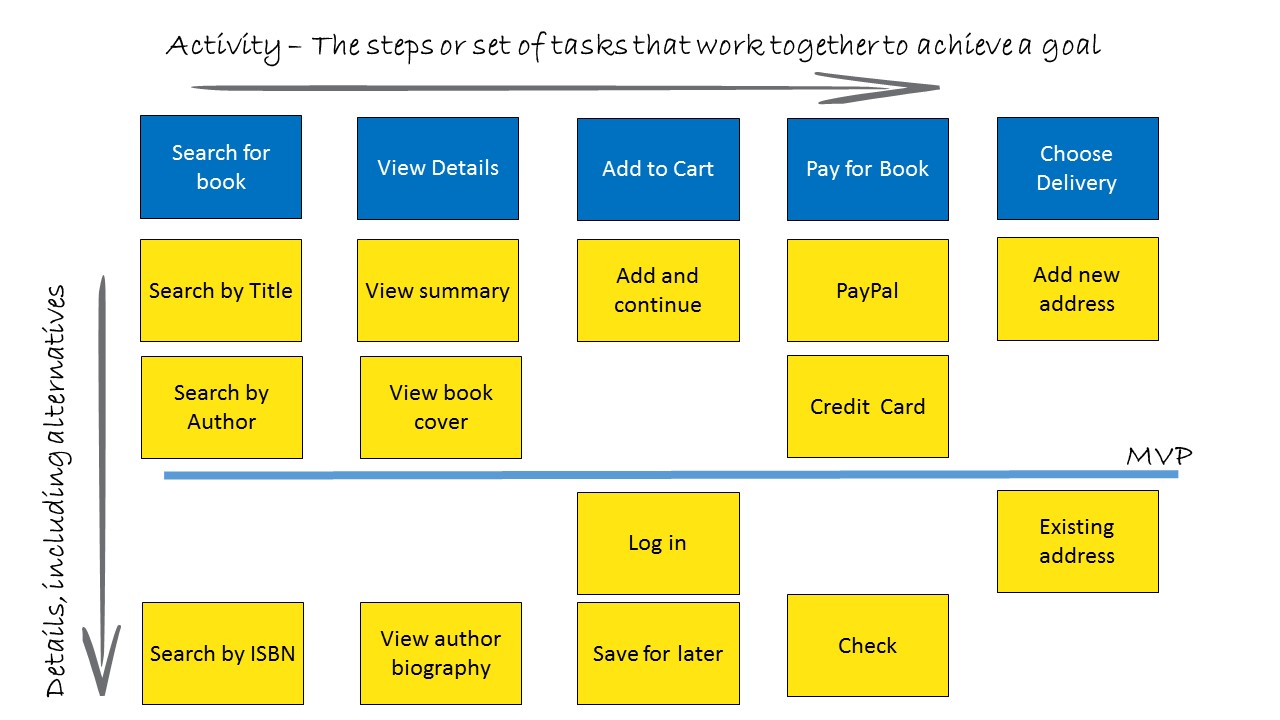
    A User Story Map is a useful tool for the team to understand the big picture, giving them the ability to see the entire breadth of the system and the various users and uses. It arranges user stories into a holistic model to help understand the system functionality while allowing you to identify gaps and slice functionality into releases.

    Keep in mind that User Stories get their name from how they’re supposed to be used. They’re a different way of working, not a different way of writing requirements.

    Story mapping follows a narrative that supports slicing and trade-offs to get the most value for the money. Use the map to create a shared understanding.

    There’s never enough time and money to build everything that people ask, but if you’re paying attention, there’s generally enough time to make people happy. Focus on what people really need to be successful and build just that – not build what they say they need. It’s all about managing the time and resources we have and making as many people happy as we can.

    After you have made your initial story map and have been working on the project for a while, you can re-map the feature because often things may have changed or you may have learned something new.

    Avoid the common traps of story mapping:

    • Making the maps too detailed (especially early on)
    • Thinking in terms of features (Instead, think in terms of use and customer experience – the steps people take to achieve a goal)
    • Mapping the whole product instead of only mapping the feature or capability you’re changing.

    Two things you can do today:

    1. Go to where your users are and talk to them
    2. Stop writing stories and start telling stories. Have conversations . . . get to the whiteboard and start drawing pictures.
    Sample Story map

    Click to view larger image

    Links mentioned in this episode

    • Jeff Patton’s book, User Story Mapping: http://www.amazon.com/User-Story-Mapping-Discover-Product/dp/1491904909
    • Jeff’s Website: http://jpattonassociates.com/
    • Story Mapping Quick Reference from Jeff Patton: http://jpattonassociates.com/story-mapping-quick-ref/

    Thank you for listening to the program

    To get more valuable content to enhance your skills and advance your career, you can subscribe on iTunes.

    Also, reviews on iTunes are highly appreciated! I read each review and it helps keep me motivated to continue to bring you valuable content each week.

    The post MBA016: User Story Mapping with Jeff Patton appeared first on Mastering Business Analysis.


    MBA015: Promise Theory for Team Cooperation – Interview with Mark Burgess Apr 14, 2015
    Show notes

    In this episode, Dr. Mark Burgess, creator of CFEngine, explains how he uses concepts from physics to explain how complex systems work. He uses his Promise Theory to not only develop better computer systems, but also to give us a better framework for individual and team interactions.

    After listening to this episode, you will understand:

    • How we can use concepts from different disciplines and apply it to our work
    • How an orchestra is like a highly distributed, cooperative system
    • The two ways to successfully create scale
    • How to use continuous delivery concepts to make sure they are aligned and on course

    Key Takeaways

    Physics is great at describing how stuff works. It shows how stable a system is (a question that computer science doesn’t answer). Mark showed us how to use other diciplines to get ideas and create new concepts as he did with Promise Theory.

    Scaling has 2 aspects: Can I cope with the load (can I produce results fast enough) and can I produce the right results? That’s what we’re trying to get at with Promise Theory. While originally applied for complex computer systems, Promise Theory can be applied to human interaction.

    Promises help us get away from commands and obligations. Obligations manifest themselves in teams, which are essentially distributed systems, by contradictions and unhealthy conflicts. With promises, the notion of contradiction goes away. It allows you to contextualize information and keep it local because that person is completely in control of what they’re promising.
    Obligations are in line with a command and control approach while promises promote a cooperative approach.

    There are two ways to scale teams (which are really highly distributed, cooperative systems): 1) Like an orchestra, with each independent agent working off the same sheet of music and with a light touch from a conductor to keep everyone in time, or 2) Act more like a jazz band and coordinate by listening and getting signals from one another.

    In a highly coupled system (or team), things (both good and bad) get transmitted very quickly. With weakly coupled systems, you can stop some of the bad things being transmitted as efficiently. Complexity Theory helps to understand the impacts of highly coupled systems.

    Links mentioned in this episode

    • Mark Burgess’ website: http://markburgess.org/index.html
    • Mark’s books and other publications: http://markburgess.org/writing.html
    • More about Promise Theory and how it applies to complex systems and teams: http://markburgess.org/blog_devops.html

    Thank you for listening to the program

    To get more valuable content to enhance your skills and advance your career, you can subscribe on iTunes.

    Also, reviews on iTunes are highly appreciated! I read each review and it helps keep me motivated to continue to bring you valuable content each week.

    The post MBA015: Promise Theory for Team Cooperation – Interview with Mark Burgess appeared first on Mastering Business Analysis.


    MBA014: The Future of Business Analysis – Interview with David Mantica Apr 07, 2015
    Show notes

    In this episode, David Mantica, President of ASPE, shares his views on the future of the business analyst role and how we can open up new opportunities for career growth and drive valuable change in our organizations.

    After listening to this episode, you will understand:

    • How different organizations are structured to manage business analysis activities
    • The trajectory of the Business Analyst role and why there’s now some confusion about the role
    • The spectrum of business analysis and how to climb the value ladder to grow your career
    • How to create new opportunities for yourself and help build the future of your organization
    • Why being uncomfortable may be the best thing for your career

    Key Takeaways

    Career growth and new opportunities are often not planned for in your development path. It’s based on the skill and success of that individual, and when you climb the value ladder to bring more and more value to your organization, you may be given opportunities to have a seat at the table and shape the future of the organization.

    The work we’re doing as project professionals is a linchpin for competitive advantage and it enables the long term success of the organization. If you can build a group of analysts who rise above the end project work and note taking, you’ll build a group of management consultants who have domain knowledge and understand the operation of the organization and can therefore help plan the future of the organization. The opportunity to grow the Business Analyst role is moving out of the project world and into the world of defining where the company is going in terms of its systems, processes, and products.

    If you can show your value in being a business adviser (even on your current projects) and show the extent of what you can do, that may cause your organization to create a role in which you can add even more value and help shape the future of your company.

    As you move up and have the opportunity to set direction, the details become more ambiguous and we need to build top level skills – your ability to deal with conflict, ability to problem solve, ability to negotiate in a way that seeks balance, and strong presentation skills. If you have a great idea but can’t present it in a compelling way, no one will listen.

    The way to build those skills is by forcing yourself to get into situations that require you to develop your presentation skills or deal with conflict and negotiation. Put yourself in uncomfortable situations that will allow you to stretch and grow – even if you’re bad at it as first. Understand conflict and cognitive diversity and be able to embrace it in order to move forward. Take action and speak with your manager about stretch assignments.

    Of course, it’s always helpful to find a good mentor on the business side who can help you to understand the motivations of your customers.

    Links mentioned in this episode

    • ASPE website: http://www.aspe-sdlc.com/
    • Free resources (webinars, templates, and more) from ASPE: http://www.aspe-sdlc.com/offers/
    • Toastmasters: http://www.toastmasters.org/

    Thank you for listening to the program

    To get more valuable content to enhance your skills and advance your career, you can subscribe on iTunes.

    Also, reviews on iTunes are highly appreciated! I read each review and it helps keep me motivated to continue to bring you valuable content each week.

    The post MBA014: The Future of Business Analysis – Interview with David Mantica appeared first on Mastering Business Analysis.


    MBA013: Trust is the New Workplace Currency – Interview with Nan Russell Mar 31, 2015
    Show notes

    In this episode, Nan Russell shares with us how to build trust and the effect increased trust (or the lack of trust) can have on your team and the organization. She’ll also help us to understand how the little things we do can hurt the bigger things we want to do and how to use behavioral integrity and elevated communication to grow trust.

    After listening to this episode, you will understand:

    • How to use behavioral integrity and elevated communication to grow trust
    • The impact trust or a lack of trust can have on your team
    • Why trust is never earned
    • How to be worthy of another person’s trust
    • What you can do to expand trust across the organization

    Key Takeaways

    The lack of trust in an organization leads to increased bureaucracy and the hording of information. With trust, there’s less overhead and people are free to innovate and do more great work.

    Most people get it backwards when building trust and start with someone else. Start with yourself. Be worthy of another person’s trust. Building trust is a skill and you must make a conscious decision to create it. We can do this by:

    1. Having competence in our role. Competence is the first parameter people need to demonstrate.
    2. Create an alignment between your words and your actions. This means acting with behavioral integrity.
    3. Manage and clarify expectations so that there is a clear understanding as to what is expected.
    4. Use elevated communication by making a decision about whether the relationships matters more than any single outcome. This includes everything from thoughtful transparency to the understanding of self-behavior.
    5. Extend trust to others.

    Remember that trust is never earned, trust must always be given. Create a winning culture in your team or organization. It’s hard not to build trust when you show up as authentic people doing great work.

    Links mentioned in this episode

    • Nan Russell’s Website – http://www.nanrussell.com/
    • Nan’s books: http://www.nanrussell.com/index.php/books/
    • Nan’s articles in Psychology Today: https://www.psychologytoday.com/blog/trust-the-new-workplace-currency

    Thank you for listening to the program

    To get more valuable content to enhance your skills and advance your career, you can subscribe on iTunes.

    Also, reviews on iTunes are highly appreciated! I read each review and it helps keep me motivated to continue to bring you valuable content each week.

    The post MBA013: Trust is the New Workplace Currency – Interview with Nan Russell appeared first on Mastering Business Analysis.


    MBA012: Beyond Requirements – Interview with Kent McDonald Mar 24, 2015
    Show notes

    Beyond RequirementsIn this episode, Kent McDonald shares his thoughts on requirements analysis in an agile environment and will give you tips on how to make your agile projects more successful.

    After listening to this episode, you will understand:

    • The role of the agile analyst and how it differs from analysis on traditional projects
    • The mindset and underlying principles to be successful in an agile environment
    • How to apply techniques usually not found in the Business Analyst toolbox to be more successful on agile projects
    • Practices that you can use right away to get positive results

    Links mentioned in this episode

    • Kent’s Website – Beyond Requirements: http://www.beyondrequirements.com/
    • Real Options (Chris Matts): http://www.infoq.com/articles/real-options-enhance-agility

    Thank you for listening to the program

    To get more valuable content to enhance your skills and advance your career, you can subscribe on iTunes.

    Also, reviews on iTunes are highly appreciated! I read each review and it helps keep me motivated to continue to bring you valuable content each week.

    The post MBA012: Beyond Requirements – Interview with Kent McDonald appeared first on Mastering Business Analysis.


    MBA011: Make Your Waterfall Projects More Agile Mar 17, 2015
    Show notes

    Make your waterfall projects more agileIn this episode, we discuss practices from agile that you can implement in your traditional (waterfall) projects that will allow you to reduce risk, adapt to change, and accelerate project delivery.

    In this episode, you will understand:

    • How to use some of the values, principles, and practices of agile to adapt to change and speed up the delivery of working software
    • How agile practices reduce risk
    • Techniques from agile that you can use right away and get positive results

    Links mentioned in this episode

    • The Agile Manifesto: http://agilemanifesto.org/
    • The Scrum Guide: http://www.scrumguides.org/

    Thank you for listening to the program

    To get more valuable content to enhance your skills and advance your career, you can subscribe on iTunes.

    Also, reviews on iTunes are highly appreciated! I read each review and it helps keep me motivated to continue to bring you valuable content each week.

    The post MBA011: Make Your Waterfall Projects More Agile appeared first on Mastering Business Analysis.


    MBA010: Make Virtual Meetings More Effective – Interview with Angela Wick Mar 10, 2015
    Show notes

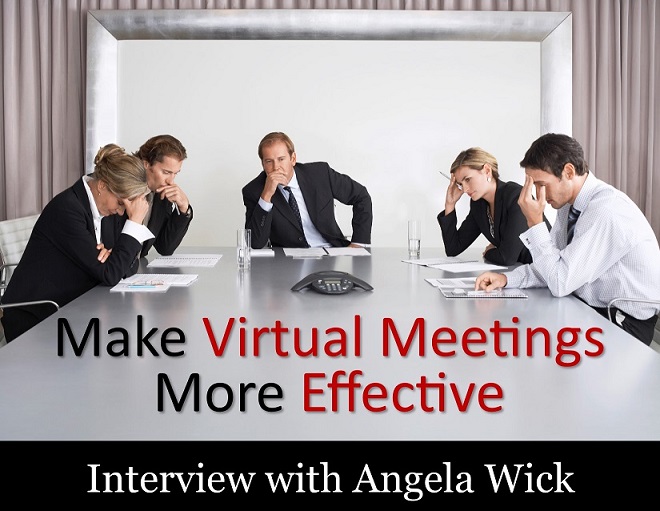
    Make virtual meetings more effectiveIn this episode, we’re joined by Angela Wick of BA-Squared. Angela shares her tips and techniques for making virtual meetings more effective. You’ll learn the signs that people are multitasking and understand how to use virtual collaboration tools to keep people engaged and run a successful virtual meeting.

    In this episode, Angela shares with us:

    • The biggest problem with virtual meetings (and how to address it)
    • How to keep people engaged during the meeting
    • Ways of using virtual collaboration tools to keep everyone focused on the meeting goal
    • Her thoughts on what you can do today and get positive results from virtual meetings right away

    Links mentioned in this episode

    • BA-Squared website: http://www.ba-squared.com
    • Virtual collaboration resources: http://www.ba-squared.com/virtual-collaboration-resources
    • Conference Call In Real Life (video below)

    Thank you for listening to the program

    To get more valuable content to enhance your skills and advance your career, you can subscribe on iTunes. Also, reviews on iTunes are highly appreciated! I read each review and it helps keep me motivated to continue to bring you valuable content every week.

    Do you have a suggestion for a future episode or a question you would like answered on the podcast? Use the widget on the side of the screen to leave a voice message or send an email to Podacast@MasteringBusinessAnalysis.com

    The post MBA010: Make Virtual Meetings More Effective – Interview with Angela Wick appeared first on Mastering Business Analysis.


    MBA009: Exploring the 7 Product Dimensions for Better Requirements Discovery – Interview with Mary Gorman Mar 01, 2015
    Show notes

    Using the 7 product dimensions for better requirements analysisIn this episode, we’re joined by Mary Gorman, co-author of Discover to Deliver. Mary will take us on a deep dive into a holistic framework to discover product requirements, the 7 Product Dimensions. She will also share with us models to use as you move through the 7 Product Dimensions that will allow you to discover requirements that may be missed using other methods.

    In this episode, Mary shares with us:

    • How to use an Options Board to collaborate with product partners
    • A holistic approach to exploring a product to discover requirements
    • Models we can use to explore requirements and create a shared understanding
    • Mary’s thoughts on what you can do today and get positive results right away

    Links mentioned in this episode

    • The Discover to Deliver website: http://discovertodeliver.com/
    • Resources from the Discover to Deliver website: http://www.discovertodeliver.com/resource.php
    • Discover to Deliver BookDiscover to Deliver – Get the Book! Discover to Deliver – Agile Product Planning and Analysis

    Don’t forget – you can get a 20% discount on Mary and Ellen’s book by going to her website and using the coupon code MBAD2D

    Thank you for listening to the program

    To get more valuable content to enhance your skills and advance your career, you can subscribe on iTunes.

    Also, reviews on iTunes are highly appreciated! I read each review and it helps keep me motivated to continue to bring you valuable content each week.

    The post MBA009: Exploring the 7 Product Dimensions for Better Requirements Discovery – Interview with Mary Gorman appeared first on Mastering Business Analysis.


    MBA008: How to Discover Product Requirements – Interview with Ellen Gottesdiener Feb 24, 2015
    Show notes

    Interview with Ellen GottesdienerIn this episode, Ellen Gottesdiener shares an effective approach to discovering product requirements. You will understand how to break out of being an order taker and become a product co-creator.

    Ellen’s holistic approach to requirements discovery includes a mindset shift that needs to take place to recast stakeholders as product partners, how to get everyone on the same page and focused on the most valuable, near term product options. You will find out how to create a structured conversation that will allow you to collaborate and decide what to work on first.

    In this episode, Ellen shares with us:

    • How to better collaborate with customers and stakeholders
    • An approach for understanding and developing a shared understanding of value
    • How you can create planning horizons to focus discussions
    • A holistic framework for discovering product requirements

    Links mentioned in this episode

    • The Discover to Deliver website: http://discovertodeliver.com/
    • Article: It’s the Goal, Not the Role
    • Resources from the Discover to Deliver website: http://www.discovertodeliver.com/resource.phpDiscover to Deliver Book
    • Discover to Deliver – Get the Book! Discover to Deliver – Agile Product Planning and Analysis

    Don’t forget – you can get a 20% discount on Ellen and Mary’s book by going to her website and using the coupon code MBAD2D

    Thank you for listening to the program

    To get more valuable content to enhance your skills and advance your career, you can subscribe on iTunes.

    Also, reviews on iTunes are highly appreciated! I read each review and it helps keep me motivated to continue to bring you valuable content each week.

    The post MBA008: How to Discover Product Requirements – Interview with Ellen Gottesdiener appeared first on Mastering Business Analysis.


    MBA007: How to be a Badass Business Analyst – Interview with Bob Prentiss Feb 17, 2015
    Show notes

    Interview with Bob PrentissWant to be the go-to person on projects, in high demand and highly regarded? In this episode, you’ll discover how to do exactly that. Bob Prentiss is the Founder and Principal Consultant at Bob the BA, Inc. He’s a trainer, mentor, consultant, major nerd, and all around badass Business Analyst. Become a badass BA and take your Business Analysis skills to the next level.

    In this episode, Bob shares with us:

    • Insights on what it takes to be successful as a Business Analyst in today’s world
    • How to know when business analysis is being done well
    • Stories and examples that illustrate what it means to be a badass
    • The one thing you can do today and get positive results right away

    Links mentioned in this episode

    • Bob’s website – Bob the BA: http://www.bobtheba.com

    Thank you for listening to the program

    To get more valuable content to enhance your skills and advance your career, you can subscribe on iTunes.

    Also, reviews on iTunes are highly appreciated! I read each review and it helps keep me motivated to continue to bring you valuable content each week.

    The post MBA007: How to be a Badass Business Analyst – Interview with Bob Prentiss appeared first on Mastering Business Analysis.


    Previous 1 25 26 27 28 Next

    Related Podcasts

    Making Sense with Sam Harris

    1

    Making Sense with Sam Harris Education
    Grammar Girl

    2

    Grammar Girl Education
    Good Life Project

    3

    Good Life Project Education
    Explain It to Me

    4

    Explain It to Me Education
    Team Never Quit

    5

    Team Never Quit Comedy
    Optimal Living Daily – Personal Development and Self-Improvement

    6

    Optimal Living Daily – Personal Development and Self-Improvement Alternative Health
    footer-logo

    Contact Us

    Toll Free: 844-670-7747

    Links

    • Home
    • Top Charts
    • Networks
    • Apps
    • Independents Podcasts
    • Podcast Advertising
    • Podcast News
    • Contact Us
    • About Us
    • Analytics & Insights

    Stay Connected

      Privacy, Terms of Use & Our Code of Ethics Protecting Content Creators Copyrights