Our TOPPODCAST Picks
 Audio narrations of LessWrong posts. Includes all curated posts and all posts with 125+ karma.
If you’d like more, subscribe to the “Lesswrong (30+ karma)” feed.

 Stay Connected
Audio narrations of LessWrong posts. Includes all curated posts and all posts with 125+ karma.
If you’d like more, subscribe to the “Lesswrong (30+ karma)” feed.
Copyright: © 2023 LessWrong Curated Podcast


Epistemic status: This post aims at an ambitious target: improving intuitive understanding directly. The model for why this is worth trying is that I believe we are more bottlenecked by people having good intuitions guiding their research than, for example, by the ability of people to code and run evals.
Quite a few ideas in AI safety implicitly use assumptions about individuality that ultimately derive from human experience.
When we talk about AIs scheming, alignment faking or goal preservation, we imply there is something scheming or alignment faking or wanting to preserve its goals or escape the datacentre.
If the system in question were human, it would be quite clear what that individual system is. When you read about Reinhold Messner reaching the summit of Everest, you would be curious about the climb, but you would not ask if it was his body there, or his [...]
---
Outline:
(01:38) Individuality in Biology
(03:53) Individuality in AI Systems
(10:19) Risks and Limitations of Anthropomorphic Individuality Assumptions
(11:25) Coordinating Selves
(16:19) Whats at Stake: Stories
(17:25) Exporting Myself
(21:43) The Alignment Whisperers
(23:27) Echoes in the Dataset
(25:18) Implications for Alignment Research and Policy
---
First published:
March 28th, 2025
Source:
https://www.lesswrong.com/posts/wQKskToGofs4osdJ3/the-pando-problem-rethinking-ai-individuality
---
Narrated by TYPE III AUDIO.
---
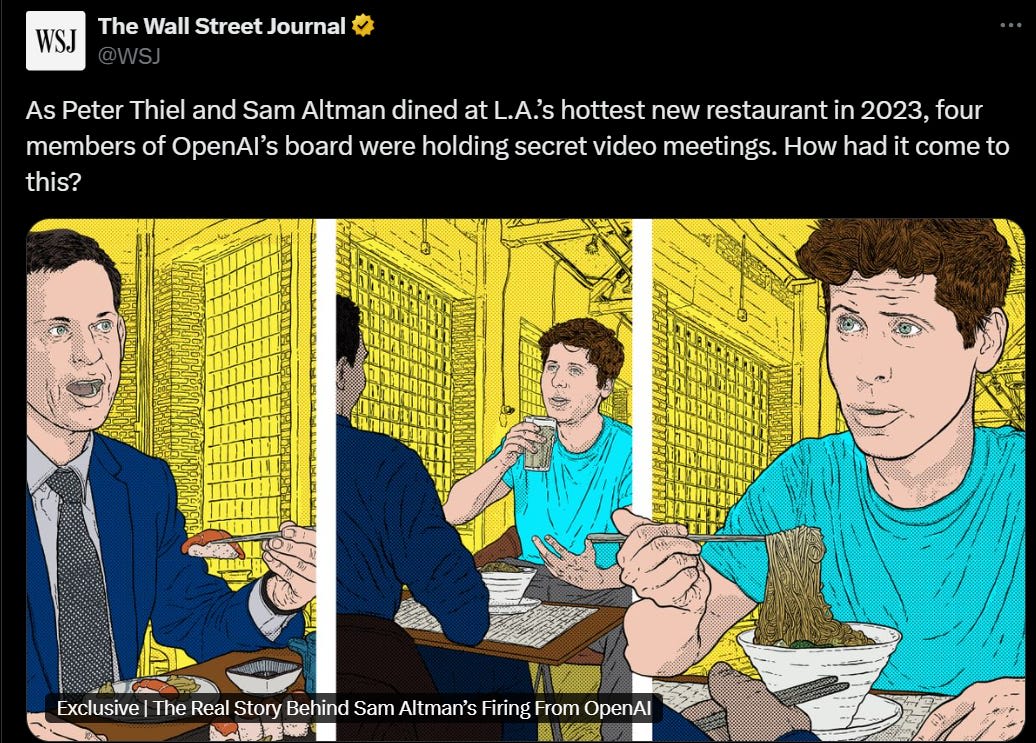
Back when the OpenAI board attempted and failed to fire Sam Altman, we faced a highly hostile information environment. The battle was fought largely through control of the public narrative, and the above was my attempt to put together what happened.My conclusion, which I still believe, was that Sam Altman had engaged in a variety of unacceptable conduct that merited his firing.In particular, he very much ‘not been consistently candid’ with the board on several important occasions. In particular, he lied to board members about what was said by other board members, with the goal of forcing out a board member he disliked. There were also other instances in which he misled and was otherwise toxic to employees, and he played fast and loose with the investment fund and other outside opportunities. I concluded that the story that this was about ‘AI safety’ or ‘EA (effective altruism)’ or [...] ---
Outline:
(01:32) The Big Picture Going Forward
(06:27) Hagey Verifies Out the Story
(08:50) Key Facts From the Story
(11:57) Dangers of False Narratives
(16:24) A Full Reference and Reading List
---
First published:
March 31st, 2025
Source:
https://www.lesswrong.com/posts/25EgRNWcY6PM3fWZh/openai-12-battle-of-the-board-redux
---
Narrated by TYPE III AUDIO.
---
 Apple Podcasts and Spotify do not show images in the episode description. Try Pocket Casts, or another podcast app.
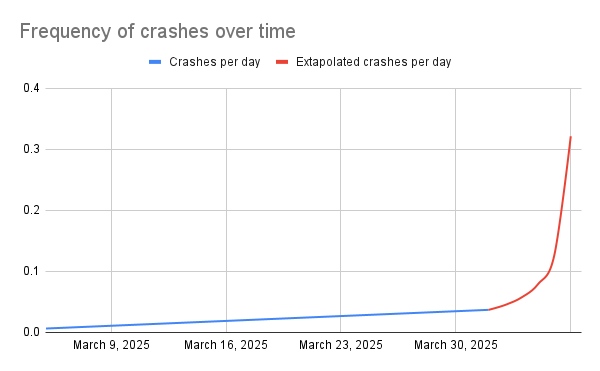
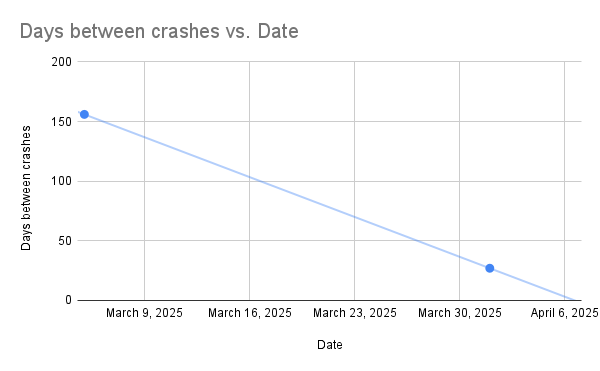
I'm not writing this to alarm anyone, but it would be irresponsible not to report on something this important. On current trends, every car will be crashed in front of my house within the next week. Here's the data:
Until today, only two cars had crashed in front of my house, several months apart, during the 15 months I have lived here. But a few hours ago it happened again, mere weeks from the previous crash. This graph may look harmless enough, but now consider the frequency of crashes this implies over time:
The car crash singularity will occur in the early morning hours of Monday, April 7. As crash frequency approaches infinity, every car will be involved. You might be thinking that the same car could be involved in multiple crashes. This is true! But the same car can only withstand a finite number of crashes before it [...]
---
First published:
April 1st, 2025
Source:
https://www.lesswrong.com/posts/FjPWbLdoP4PLDivYT/you-will-crash-your-car-in-front-of-my-house-within-the-next
---
Narrated by TYPE III AUDIO.
---
 Apple Podcasts and Spotify do not show images in the episode description. Try Pocket Casts, or another podcast app.
Remember: There is no such thing as a pink elephant.
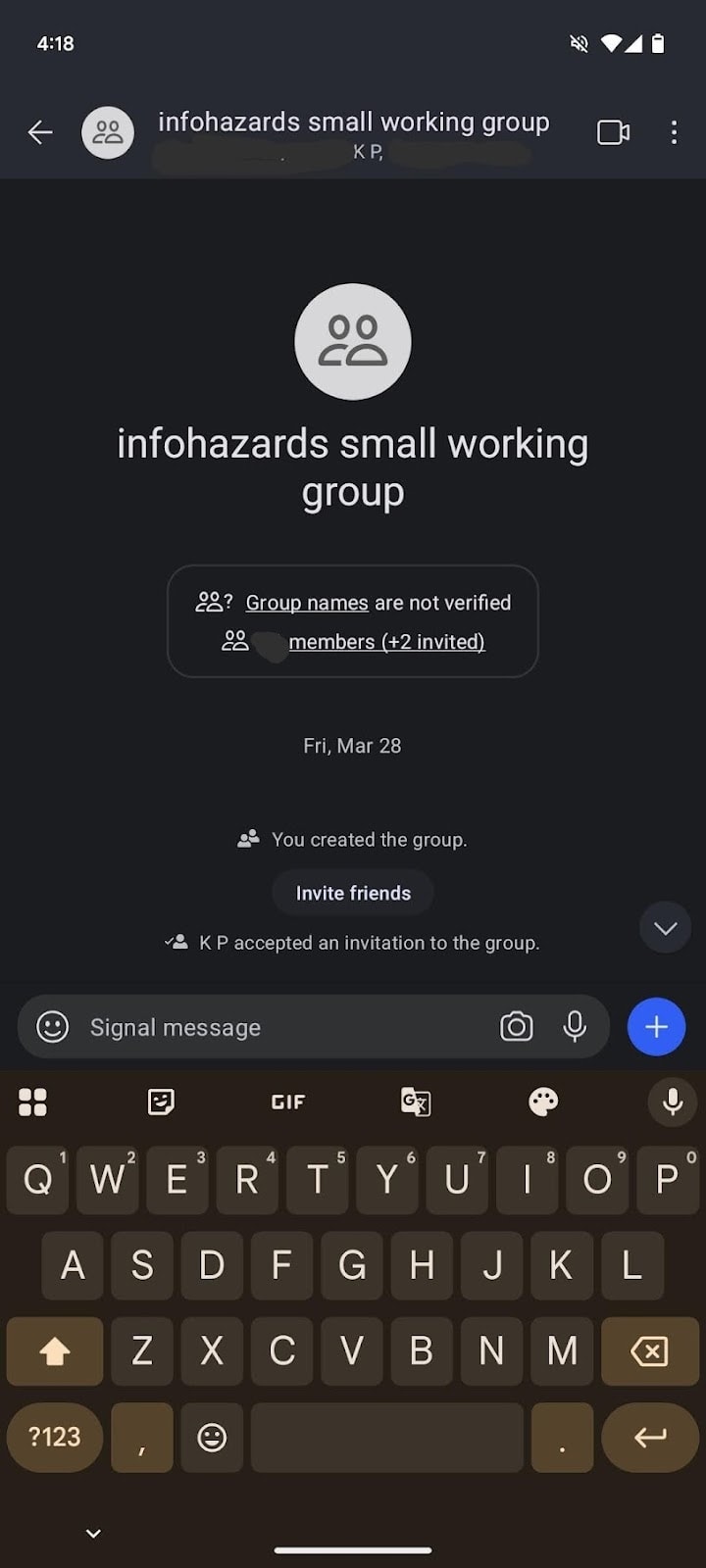
Recently, I was made aware that my “infohazards small working group” Signal chat, an informal coordination venue where we have frank discussions about infohazards and why it will be bad if specific hazards were leaked to the press or public, accidentally was shared with a deceitful and discredited so-called “journalist,” Kelsey Piper. She is not the first person to have been accidentally sent sensitive material from our group chat, however she is the first to have threatened to go public about the leak. Needless to say, mistakes were made.
We’re still trying to figure out the source of this compromise to our secure chat group, however we thought we should give the public a live update to get ahead of the story.
For some context the “infohazards small working group” is a casual discussion venue for the [...]
---
Outline:
(04:46) Top 10 PR Issues With the EA Movement (major)
(05:34) Accidental Filtration of Simple Sabotage Manual for Rebellious AIs (medium)
(08:25) Hidden Capabilities Evals Leaked In Advance to Bioterrorism Researchers and Leaders (minor)
(09:34) Conclusion
---
First published:
April 2nd, 2025
Source:
https://www.lesswrong.com/posts/xPEfrtK2jfQdbpq97/my-infohazards-small-working-group-signal-chat-may-have
---
Narrated by TYPE III AUDIO.
---
 Apple Podcasts and Spotify do not show images in the episode description. Try Pocket Casts, or another podcast app.
Let's cut through the comforting narratives and examine a common behavioral pattern with a sharper lens: the stark difference between how anger is managed in professional settings versus domestic ones. Many individuals can navigate challenging workplace interactions with remarkable restraint, only to unleash significant anger or frustration at home shortly after. Why does this disparity exist?
Common psychological explanations trot out concepts like "stress spillover," "ego depletion," or the home being a "safe space" for authentic emotions. While these factors might play a role, they feel like half-truths—neatly packaged but ultimately failing to explain the targeted nature and intensity of anger displayed at home. This analysis proposes a more unsentimental approach, rooted in evolutionary biology, game theory, and behavioral science: leverage and exit costs. The real question isn’t just why we explode at home—it's why we so carefully avoid doing so elsewhere.
The Logic of Restraint: Low Leverage in [...]
---
Outline:
(01:14) The Logic of Restraint: Low Leverage in Low-Exit-Cost Environments
(01:58) The Home Environment: High Stakes and High Exit Costs
(02:41) Re-evaluating Common Explanations Through the Lens of Leverage
(04:42) The Overlooked Mechanism: Leveraging Relational Constraints
---
First published:
April 1st, 2025
Source:
https://www.lesswrong.com/posts/G6PTtsfBpnehqdEgp/leverage-exit-costs-and-anger-re-examining-why-we-explode-at
---
Narrated by TYPE III AUDIO.
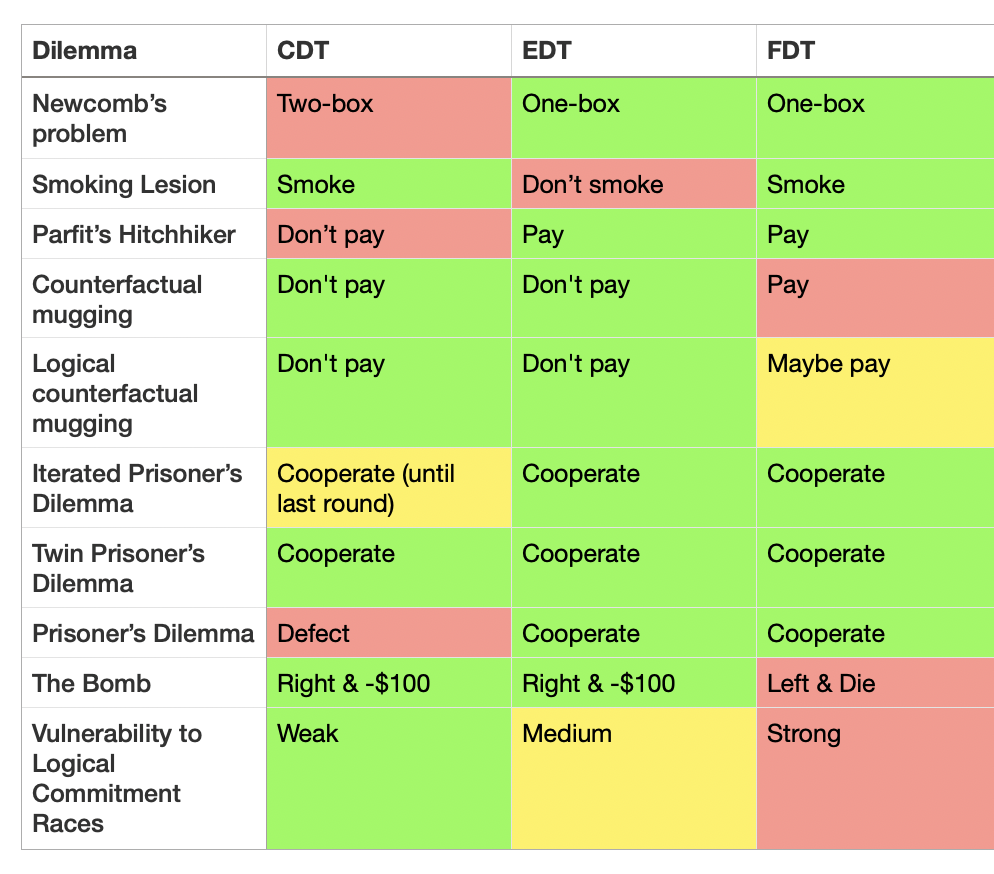
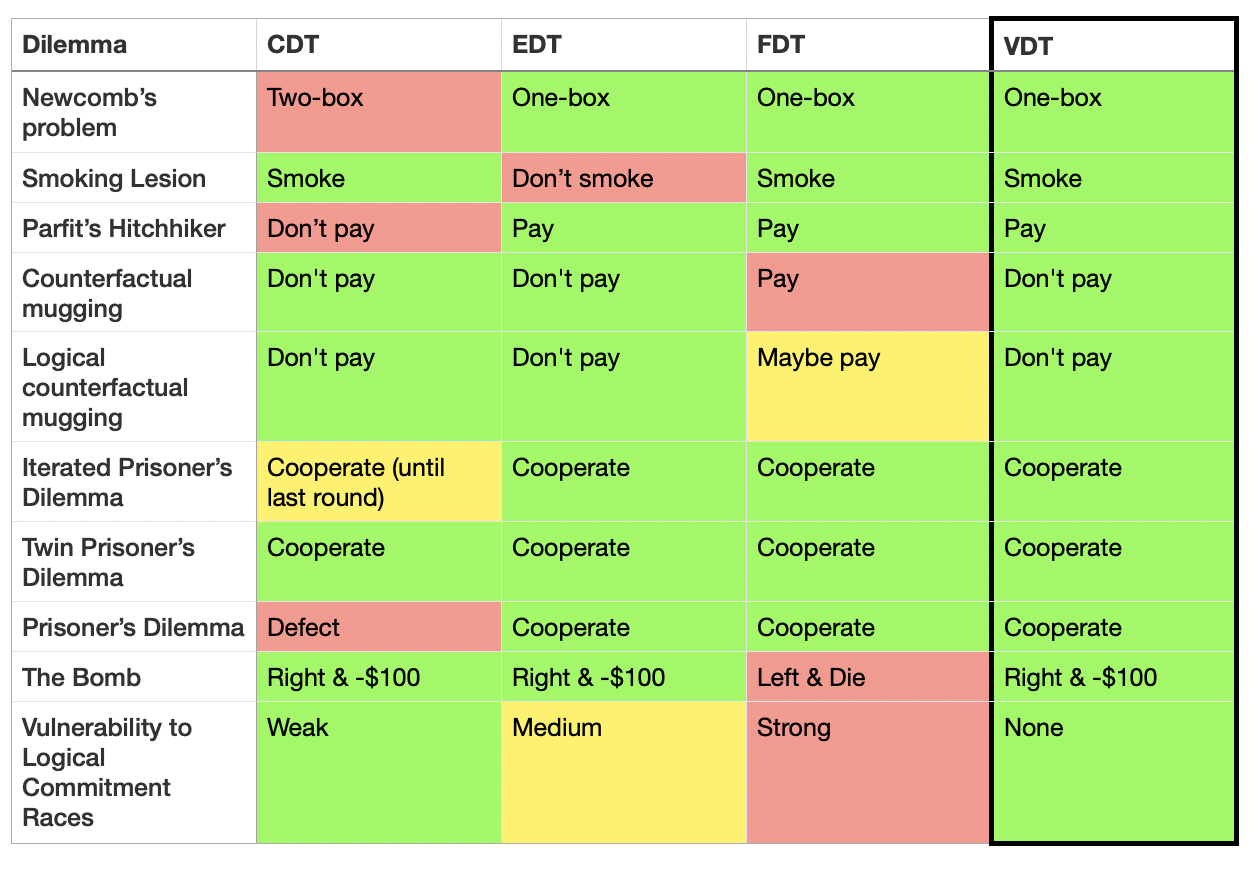
In the debate over AI development, two movements stand as opposites: PauseAI calls for slowing down AI progress, and e/acc (effective accelerationism) calls for rapid advancement. But what if both sides are working against their own stated interests? What if the most rational strategy for each would be to adopt the other's tactics—if not their ultimate goals?
AI development speed ultimately comes down to policy decisions, which are themselves downstream of public opinion. No matter how compelling technical arguments might be on either side, widespread sentiment will determine what regulations are politically viable.
Public opinion is most powerfully mobilized against technologies following visible disasters. Consider nuclear power: despite being statistically safer than fossil fuels, its development has been stagnant for decades. Why? Not because of environmental activists, but because of Chernobyl, Three Mile Island, and Fukushima. These disasters produce visceral public reactions that statistics cannot overcome. Just as people [...]
---
First published:
April 1st, 2025
Source:
https://www.lesswrong.com/posts/fZebqiuZcDfLCgizz/pauseai-and-e-acc-should-switch-sides
---
Narrated by TYPE III AUDIO.
 Apple Podcasts and Spotify do not show images in the episode description. Try Pocket Casts, or another podcast app.
Dear LessWrong community,
It is with a sense of... considerable cognitive dissonance that I announce a significant development regarding the future trajectory of LessWrong. After extensive internal deliberation, modeling of potential futures, projections of financial runways, and what I can only describe as a series of profoundly unexpected coordination challenges, the Lightcone Infrastructure team has agreed in principle to the acquisition of LessWrong by EA.
I assure you, nothing about how LessWrong operates on a day to day level will change. I have always cared deeply about the robustness and integrity of our institutions, and I am fully aligned with our stakeholders at EA.
To be honest, the key thing that EA brings to the table is money and talent. While the recent layoffs in EAs broader industry have been harsh, I have full trust in the leadership of Electronic Arts, and expect them to bring great expertise [...]
---
First published:
April 1st, 2025
Source:
https://www.lesswrong.com/posts/2NGKYt3xdQHwyfGbc/lesswrong-has-been-acquired-by-ea
---
Narrated by TYPE III AUDIO.
Our community is not prepared for an AI crash. We're good at tracking new capability developments, but not as much the company financials. Currently, both OpenAI and Anthropic are losing $5 billion+ a year, while under threat of losing users to cheap LLMs.
A crash will weaken the labs. Funding-deprived and distracted, execs struggle to counter coordinated efforts to restrict their reckless actions. Journalists turn on tech darlings. Optimism makes way for mass outrage, for all the wasted money and reckless harms.
You may not think a crash is likely. But if it happens, we can turn the tide.
Preparing for a crash is our best bet.[1] But our community is poorly positioned to respond. Core people positioned themselves inside institutions – to advise on how to maybe make AI 'safe', under the assumption that models rapidly become generally useful.
After a crash, this no longer works, for at [...]
---
First published:
April 1st, 2025
Source:
https://www.lesswrong.com/posts/aMYFHnCkY4nKDEqfK/we-re-not-prepared-for-an-ai-market-crash
---
Narrated by TYPE III AUDIO.
Epistemic status: Reasonably confident in the basic mechanism.
Have you noticed that you keep encountering the same ideas over and over? You read another post, and someone helpfully points out it's just old Paul's idea again. Or Eliezer's idea. Not much progress here, move along.
Or perhaps you've been on the other side: excitedly telling a friend about some fascinating new insight, only to hear back, "Ah, that's just another version of X." And something feels not quite right about that response, but you can't quite put your finger on it.
I want to propose that while ideas are sometimes genuinely that repetitive, there's often a sneakier mechanism at play. I call it Conceptual Rounding Errors – when our mind's necessary compression goes a bit too far .
Too much compression
A Conceptual Rounding Error occurs when we encounter a new mental model or idea that's partially—but not fully—overlapping [...]
---
Outline:
(01:00) Too much compression
(01:24) No, This Isnt The Old Demons Story Again
(02:52) The Compression Trade-off
(03:37) More of this
(04:15) What Can We Do?
(05:28) When It Matters
---
First published:
March 26th, 2025
Source:
https://www.lesswrong.com/posts/FGHKwEGKCfDzcxZuj/conceptual-rounding-errors
---
Narrated by TYPE III AUDIO.