Our TOPPODCAST Picks
 Audio narrations of LessWrong posts. Includes all curated posts and all posts with 125+ karma.
If you’d like more, subscribe to the “Lesswrong (30+ karma)” feed.

 Stay Connected
Audio narrations of LessWrong posts. Includes all curated posts and all posts with 125+ karma.
If you’d like more, subscribe to the “Lesswrong (30+ karma)” feed.
Copyright: © 2023 LessWrong Curated Podcast


(Previously: Prologue.)
Corrigibility as a term of art in AI alignment was coined as a word to refer to a property of an AI being willing to let its preferences be modified by its creator. Corrigibility in this sense was believed to be a desirable but unnatural property that would require more theoretical progress to specify, let alone implement. Desirable, because if you don't think you specified your AI's preferences correctly the first time, you want to be able to change your mind (by changing its mind). Unnatural, because we expect the AI to resist having its mind changed: rational agents should want to preserve their current preferences, because letting their preferences be modified would result in their current preferences being less fulfilled (in expectation, since the post-modification AI would no longer be trying to fulfill them).
Another attractive feature of corrigibility is that it seems like it should in some sense be algorithmically simpler than the entirety of human values. Humans want lots of specific, complicated things out of life (friendship and liberty and justice and sex and sweets, et cetera, ad infinitum) which no one knows how to specify and would seem arbitrary to a [...]
---
Outline:
(03:21) The Constitutions Definition of Corrigibility Is Muddled
(06:24) Claude Take the Wheel
(15:10) It Sounds Like the Humans Are Begging
The original text contained 1 footnote which was omitted from this narration.
---
First published:
March 16th, 2026
Source:
https://www.lesswrong.com/posts/K2Ae2vmAKwhiwKEo5/terrified-comments-on-corrigibility-in-claude-s-constitution
---
Narrated by TYPE III AUDIO.
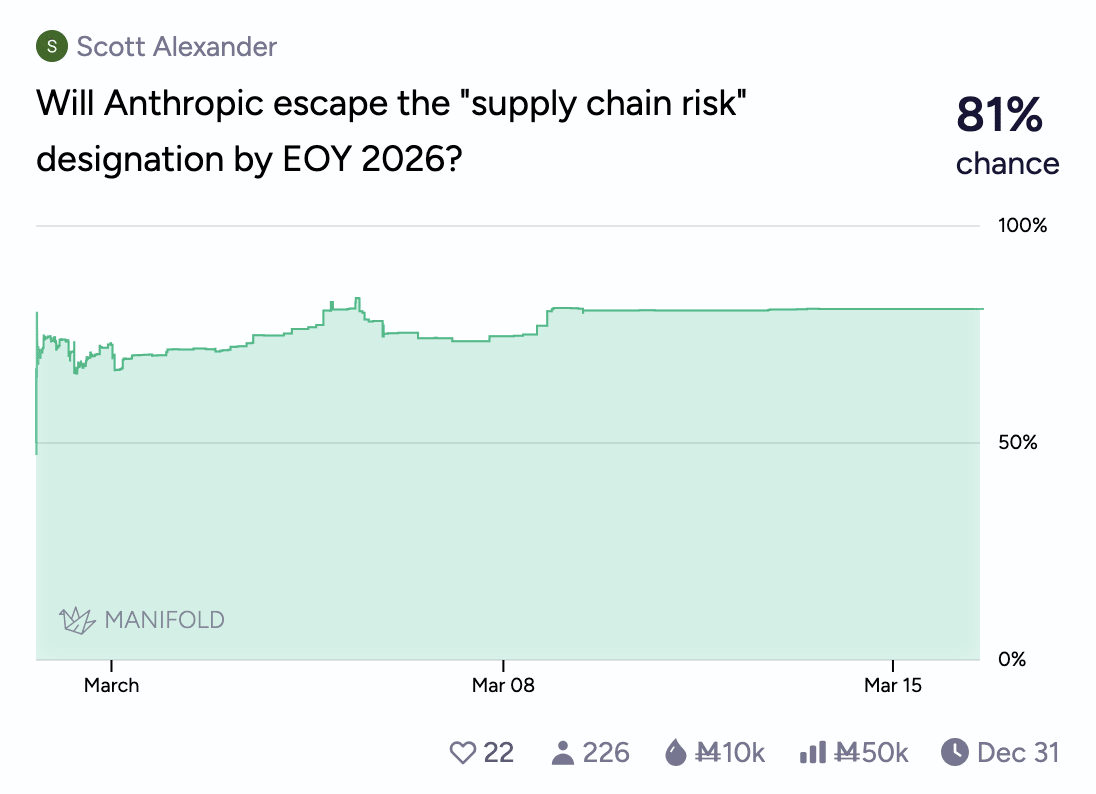
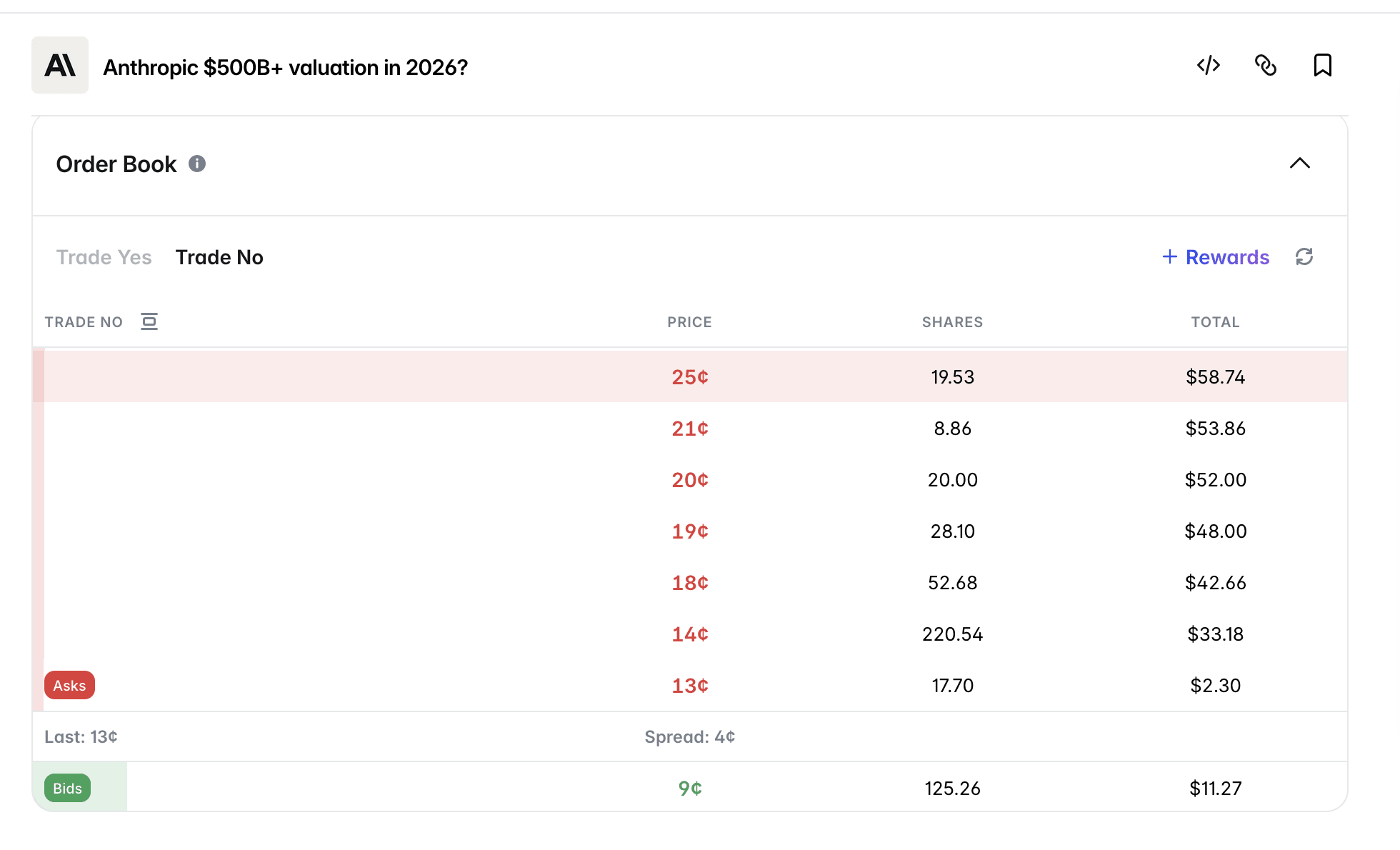
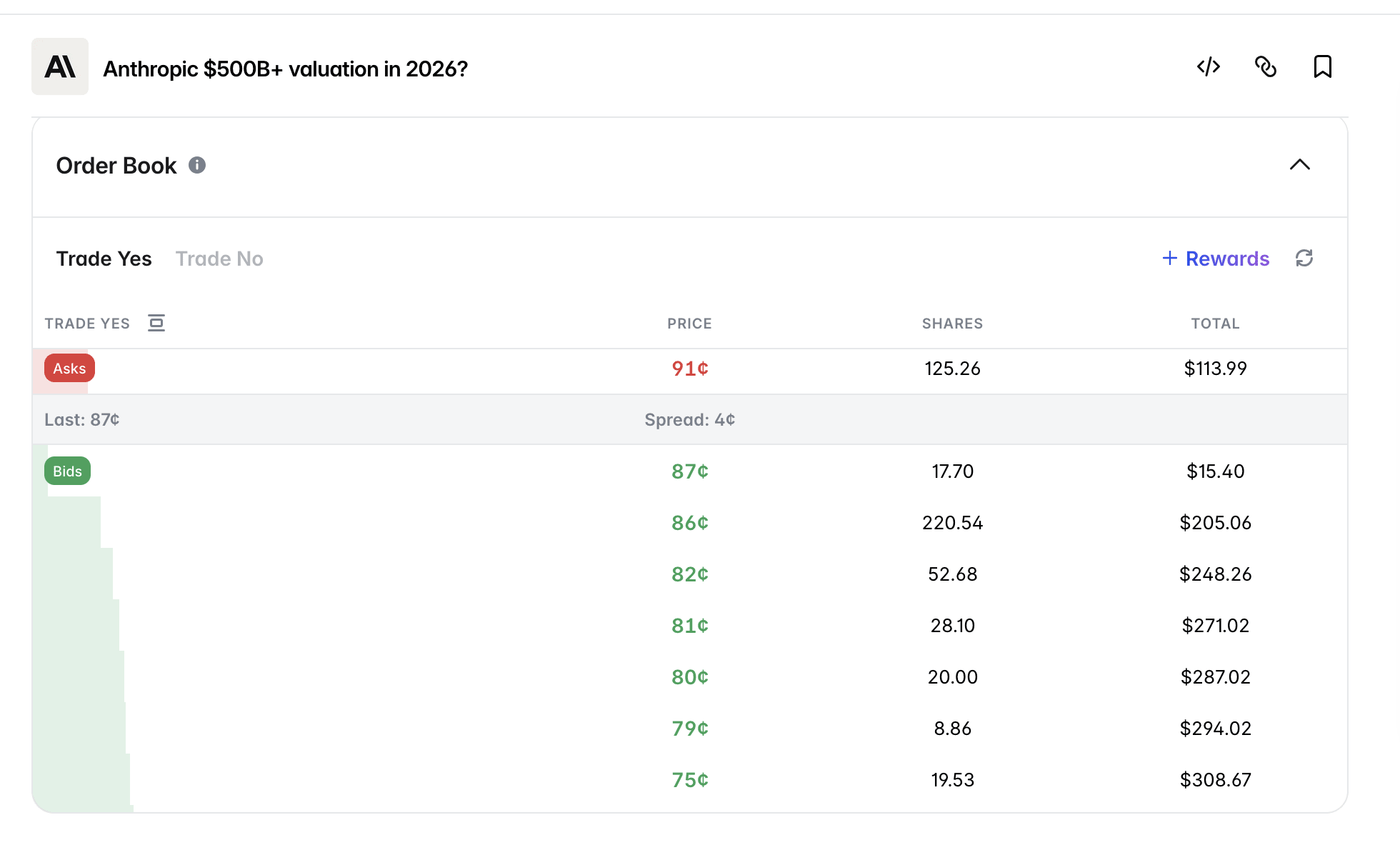
I see people repeatedly make the mistake of referencing a very low liquidity prediction market and using it to make a nontrivial point. Usually the implication when a market is cited is that it's number should be taken somewhat seriously, that it's giving us a highly informed probability. Sometimes a market is used to analyze some event that recently occurred; reasoning here looks like "the market on outcome O was trading at X%, then event E happened and the market quickly moved to Y%, thus event E made O less/more likely."
Who do I see make this mistake? Rationalists, both casually and gasp in blog posts. Scott Alexander and Zvi (and I really appreciate their work, seriously!) are guilty of this. I'll give a recent example from each of them.
From Scott's Mantic Monday post on March 2:
Having Your Own Government Try To Destroy You Is (At Least Temporarily) Good For Business
On Friday, the Pentagon declared AI company Anthropic a “supply chain risk”, a designation never before given to an American firm. This unprecedented move was seen as an attempt to punish, maybe destroy the company. How effective was it?
Anthropic isn’t publicly traded, so we [...]
---
First published:
March 16th, 2026
Source:
https://www.lesswrong.com/posts/SrtoF6PcbHpzcT82T/psa-predictions-markets-often-have-very-low-liquidity-be
---
Narrated by TYPE III AUDIO.
---
On Thursday, March 26th, a major new AI documentary is coming out: The AI Doc: Or How I Became an Apocaloptimist. Tickets are on sale now.
The movie is excellent, and MIRI staff I've spoken with generally believe it belongs in the same tier as If Anyone Builds It, Everyone Dies as an extremely valuable way to alert policymakers and the general public about AI risk, especially if it smashes the box office.
When IABIED was coming out, the community did an incredible job of helping the book succeed; without all of your help, we might never have gotten on the New York Times bestseller list. MIRI staff think that the community could potentially play a similarly big role in helping The AI Doc succeed, and thereby help these ideas go mainstream.
(Note: Two MIRI staff were interviewed for the film, but we weren’t involved in its production. We just like it.)
The most valuable thing most people can do is maximize opening-weekend success. Buy tickets to see the movie now; poke friends and family members to do the same. This will cause more theaters to pick up the movie, ensure it stays in theaters for longer, and broadly [...]
---
First published:
March 19th, 2026
Source:
https://www.lesswrong.com/posts/w9BCbshKra7FKHTzi/the-ai-doc-is-coming-out-march-26
---
Narrated by TYPE III AUDIO.
I am monitoring surveillance camera V84A. A tall man is walking towards me. He is roughly twenty-five. <faceprint> His name is Damion Prescott. He has a room booked for a whole month. His facial symmetry scores show he is in the 99th percentile. This is in accordance with my holistic impression. <search> School records show both truancy and perfect grades, suggesting high intelligence and disagreeableness. Searching social media. <search>. No record of modeling or acting experience, fame. I will assign him to our tier C high-value client list, based solely on his facial symmetry score and wealth. Reminder to recommend seating him in a high-visibility table, should he be heading to the restaurant. <search> I found a forum post mentioning him on swipeshare.com. Several women are sharing pictures, having seen him on a dating app. I recall Hinge uses highly attractive profiles to entice new users. They appear to be using Damion Prescott's profile heavily in this capacity.
The women on the site are memeing about him. They are wondering why almost none of them have matched, apparently this is rare even for the most attractive men. Only one appears to have gone on a date with him. She [...]
---
First published:
March 16th, 2026
Source:
https://www.lesswrong.com/posts/LTKfRovaJ6jcwDJia/customer-satisfaction-opportunities-1
---
Narrated by TYPE III AUDIO.
The world was fair, the mountains tall,
In Elder Days before the fall
Of mighty kings in Nargothrond
And Gondolin, who now beyond
The Western Seas have passed away:
The world was fair in Durin's Day.
J.R.R. Tolkien
I was never meant to work on AI safety. I was never designed to think about superintelligences and try to steer, influence, or change them. I never particularly enjoyed studying the peculiarities of matrix operations, cracking the assumptions of decision theories, or even coding.
I know, of course, that at the very bottom, bits and atoms are all the same — causal laws and information processing.
And yet, part of me, the most romantic and naive part of me, thinks, metaphorically, that we abandoned cells for computers, and this is our punishment.
I was meant, as I saw it, to bring about the glorious transhuman future, in its classical sense. Genetic engineering, neurodevices, DIY biolabs — going hard on biology, going hard on it with extraordinary effort, hubristically, being, you know, awestruck by "endless forms most beautiful" and motivated by the great cosmic destiny of humanity, pushing the proud frontiersman spirit and all that stuff.
I was meant, in other words [...]
---
First published:
March 17th, 2026
Source:
https://www.lesswrong.com/posts/2D2WgfohczTemcXvH/requiem-for-a-transhuman-timeline
---
Narrated by TYPE III AUDIO.
 Apple Podcasts and Spotify do not show images in the episode description. Try Pocket Casts, or another podcast app.
Note on AI usage: As is my norm, I use LLMs for proof reading, editing, feedback and research purposes. This essay started off as an entirely human written draft, and went through multiple cycles of iteration. The primary additions were citations, and I have done my best to personally verify every link and claim. All other observations are entirely autobiographical, albeit written in retrospect. If anyone insists, I can share the original, and intermediate forms, though my approach to version control is lacking. It's there if you really want it.
If you want to map the trajectory of my medical career, you will need a large piece of paper, a pen, and a high tolerance for Brownian motion. It has been tortuous, albeit not quite to the point of varicosity.
Why, for instance, did I spend several months in 2023 working as a GP at a Qatari visa center in India? Mostly because my girlfriend at the time found a job listing that seemed to pay above market rate, and because I needed money for takeout. I am a simple creature, with even simpler needs: I require shelter, internet access, and enough disposable income to ensure a steady influx [...]
---
First published:
March 15th, 2026
Source:
https://www.lesswrong.com/posts/NQESGMMejxsnEJsTh/my-willing-complicity-in-human-rights-abuse
---
Narrated by TYPE III AUDIO.
Many people in my intellectual circles use economic abstractions as one of their main tools for reasoning about the world. However, this often leads them to overlook how interventions which promote economic efficiency undermine people's ability to maintain sociopolitical autonomy. By “autonomy” I roughly mean a lack of reliance on others—which we might operationalize as the ability to survive and pursue your plans even when others behave adversarially towards you. By “sociopolitical” I mean that I’m thinking not just about individuals, but also groups formed by those individuals: families, communities, nations, cultures, etc.[1]
The short-term benefits of economic efficiency tend to be legible and quantifiable. However, economic frameworks struggle to capture the longer-term benefits of sociopolitical autonomy, for a few reasons. Firstly, it's hard for economic frameworks to describe the relationship between individual interests and the interests of larger-scale entities. Concepts like national identity, national sovereignty or social trust are very hard to cash out in economic terms—yet they’re strongly predictive of a country's future prosperity. (In technical terms, this seems related to the fact that utility functions are outcome-oriented rather than process-oriented—i.e. they only depend on interactions between players insofar as those interactions affect the game's outcome).
Secondly [...]
---
Outline:
(05:22) Five case studies
(21:00) Conclusion
The original text contained 5 footnotes which were omitted from this narration.
---
First published:
March 10th, 2026
Source:
https://www.lesswrong.com/posts/zk6TiByFRyjETpTAj/economic-efficiency-often-undermines-sociopolitical-autonomy
---
Narrated by TYPE III AUDIO.
Content note: nothing in this piece is a prank or jumpscare where I smirkingly reveal you've been reading AI prose all along.
It's easy to forget this in roarin’ 2026, but homo sapiens are the original vibers. Long before we adapt our behaviors or formal heuristics, human beings can sniff out something sus. And to most human beings, AI prose is something sus.
If you use AI to write something, people will know. Not everyone, but the people paying attention, who aren’t newcomers or distracted or intoxicated. And most of those people will judge you.
The Reasons
People may just be squicked out by AI, or lossily compress AI with crypto and assume you’re a “tech bro,” or think only uncreative idiots use AI at all. These are bad objections, and I don’t endorse them. But when I catch a whiff of LLM smell, I stop reading. I stop reading much faster than if I saw typos, or broken English, or disliked ideology. There are two reasons.
First, human writing is evidence of human thinking. If you try writing something you don’t understand well, it becomes immediately apparent; you end up writing a mess, and it stays a mess [...]
---
Outline:
(00:47) The Reasons
(03:39) Luddite! Moralizer!
The original text contained 1 footnote which was omitted from this narration.
---
First published:
March 10th, 2026
Source:
https://www.lesswrong.com/posts/FCE6MeDzLEYKFPZX6/don-t-let-llms-write-for-you
---
Narrated by TYPE III AUDIO.
On Saturday (Feb 28, 2026) I attended my first ever protest. It was jointly organized by PauseAI, Pull the Plug and a handful of other groups I forget. I have mixed feelings about it.
To be clear about where I stand: I believe that AI labs are worryingly close to developing superintelligence. I won't be shocked if it happens in the next five years, and I'd be surprised if it takes fifty years at current trajectories. I believe that if they get there, everyone will die. I want these labs to stop trying to make LLMs smarter.
But other than that, Mrs. Lincoln, I'm pretty bullish on AI progress. I'm aware that people have a lot of non-existential concerns about it. Some of those concerns are dumb (water use)1, but others are worth taking seriously (deepfakes, job loss). Overall I think it'll be good for the human race.
Again, that's aside from the bit where I expect AI to kill us all, which is an important bit.
The ostensible point of the march was trying to get Sam Altman and Dario Amodei to publicly support a "pause in principle" - to support a global pause [...]
The original text contained 8 footnotes which were omitted from this narration.
---
First published:
March 6th, 2026
Source:
https://www.lesswrong.com/posts/z4jikoM4rnfB8fuKW/thoughts-on-the-pause-ai-protest
---
Narrated by TYPE III AUDIO.