TopPodcast.com
Menu
  • Home
  • Top Charts
  • Top Networks
  • Top Apps
  • Top Independents
  • Top Podfluencers
  • Top Picks
    • Top Business Podcasts
    • Top True Crime Podcasts
    • Top Finance Podcasts
    • Top Comedy Podcasts
    • Top Music Podcasts
    • Top Womens Podcasts
    • Top Kids Podcasts
    • Top Sports Podcasts
    • Top News Podcasts
    • Top Tech Podcasts
    • Top Crypto Podcasts
    • Top Entrepreneurial Podcasts
    • Top Fantasy Sports Podcasts
    • Top Political Podcasts
    • Top Science Podcasts
    • Top Self Help Podcasts
    • Top Sports Betting Podcasts
    • Top Stocks Podcasts
  • Podcast News
  • About Us
  • Podcast Advertising
  • Contact
Not in our directory?
Add Show Here
Podcast Equipment
Center

toppodcastlogoOur TOPPODCAST Picks

  • Comedy
  • Crypto
  • Sports
  • News
  • Politics
  • True Crime
  • Business
  • Finance

Follow Us

toppodcastlogoStay Connected

    View Top 200 Chart
    Back to Rankings Page
    Kids & Family

    Learn With Less

    If you’re looking for information about baby development, or looking for ideas about how to play with your baby to support development, Learn With Less (formerly Strength In Words) is where we discuss all things early parenthood and early childhood. We help families (expecting parents, new parents, and seasoned parents) navigate those early years in an inclusive, educational, and supportive space. Join Ayelet Marinovich, M.A., CCC-SLP, author, singer, imperfect mother of two and pediatric speech-language pathologist, for a podcast for parents, caregivers, and educators of infants and toddlers of all developmental levels. Learn With Less is the place for families to access high quality, evidence-based resources about how their infants and toddlers learn and develop; for regular sessions of music, play and developmental information for both you and your baby, subscribe on Apple Podcasts and visit https://learnwithless.com!

    Advertise
    • Apple Podcasts
    • Google Play
    • Spotify

    Latest Episodes:
    Going Back To Work After Baby, With Lisa Abramson Oct 10, 2018
    Show notes

    What can parents do to prepare for a smooth transition? On this episode of the Learn With Less podcast, Ayelet sits down with Lisa Abramson, an entrepreneur, speaker, best selling author, executive coach and advocate for maternal mental health. She founded Wise Mama and co-founded Mindfulness Based Achievement, the New MBA, which teaches high potential women leaders how to create sustainable success. We spoke about Lisa’s professional background, as well as her personal transition into motherhood, and how she came to do the work she’s doing today. We touched upon the current state of maternity / paternal leave in the United States, and some of the major areas or issues for parents to consider when facing an impending return to work. Most importantly, we covered Lisa’s top tips and resources for families – what parents can do to prepare, or to make the transition back to work a smoother process. Quick access to links in this episode: Overwhelmed: How To Work, Love and Play When No One Has The Time, by Brigid Schulte (affiliate link) The Wise Mama Guide to Maternity Leave, by Lisa Abramson (affiliate link) Join the Wise Mama 30-day Meditation Challenge Watch Lisa’s Tedx talk about her experience with postpartum psychosis CONNECT WITH US! Ayelet: Facebook / Instagram / Pinterest / YouTube Lisa: Website / Facebook / Instagram Text transcript of this episode Ayelet: Welcome to episode 67 of the Strength In words Podcast. Today I am speaking with Lisa Abramson, an entrepreneur, a speaker, best selling author, executive coach, and advocate for maternal mental health. What can’t she do? She founded Wise Mama and cofounded Mindfulness Based Achievement, which teaches high potential women leaders how to create sustainable success. Lisa, thank you so much for being here. Welcome to Learn With Less. Lisa: Ah, thanks so much for having me. Ayelet: So I have asked you today to come onto the show to speak to us about the topic of going back to work after having a baby, but first I would love if you would tell us just a bit more about you and how you got into the work you’re doing today. Lisa: Yeah, absolutely. So about five years ago, I quit my job running marketing at a high tech company. We’re doing mobile advertising and that looked great on paper. I had kind of climbed the ranks and was sitting in on the executive team and making big decisions, but inside I was like, this doesn’t cut it for me. This isn’t what I was meant to do. And I kind of felt like I didn’t have enough meaning and purpose in my work, so that led me on a journey to figure out what I wanted to do next and that ended up transforming into creating a business and wanting to empower women. So, I started teaching about mindfulness, wellbeing, and doing executive coaching. So I kind of, my overachiever went nuts in the professional development space and I just, I couldn’t get enough of it. It’s like why aren’t we taught these skills in school, especially as it relates to, you know, creating a growth mindset and really the tools of mindfulness, like all these inner resources, I feel like a lot of times we’re over indexing on knowledge and content and forgetting about these internal resources that are so important to wellbeing. So I started teaching about wellness and wellbeing, doing workshops at Google and Salesforce and other companies around the Bay Area. And then I had my first daughter Lucy, and that really changed everything… for many reasons, for the better because I became a mom and also lead to what of the biggest struggles of my life. I experienced postpartum depression and a rare form of postpartum depression called postpartum psychosis and ended up in the hospital and it was a thorough butt-kicking: here I was teaching about wellness and wellbeing and then I found myself so unwell and really had no framework for this or what – that it could even happen that… I knew new moms say, oh, sometimes new moms are sad, I’d heard of that, but I’d never heard of like new moms go crazy. And that was what happened to me. So after that experience and picking up all the pieces and recovering and moving forward, I founded Wise Mama and wrote a book, the Wise Mama Guide to Maternity Leave about all this stuff that I wish I would have known about this process and transition. So I’ve always been doing coaching, but now I’ve found that I love coaching moms, really transitioning them around maternity leave and their careers. I think we’re all just more committed and dedicated to our careers than maybe in generations past, because we’re a little older when we’re having our first children. So it’s a big shift and I think having support around that is important. Ayelet: Oh my gosh. Absolutely. Well, I would love for you to break down for us a bit about the current state, right, of maternity and paternal leave in the United States. So, and then can you also just, you know, run through some of the major issues or areas for parents to consider when facing an impending return to work. Lisa: Yeah, absolutely. So you know, the issues on the systemic level, they’re everywhere. Unfortunately the leave policies in the US pretty much stink and that’s unfortunate. In Europe there are a lot better. I really think the postpartum timeframe, you know, it is a year, a year of recovery, of integration, but that’s not really what’s available here, which is unfortunate, but that is what’s standard in many parts of Europe. But given that we do have shorter leaves or sometimes, you know, it could be eight weeks or 12 weeks, some generous companies give six months. But what I think is most important is for new parents and especially moms to get really clear about what success looks like for them or what they want. Because I feel like a lot of the women I coach, they’re optimizing on like the “should’s” and I think that I was doing that. My former self was doing that and it’s like, “I should go for that promotion, I should optimize this and that, I should say I’ll go on that business trip even though I don’t really need to be there.” I should, should, should, or even I should check my email first thing in the morning. I should be available 24/7. So if you’re optimizing for those “should’s” and really falling into what Brigid Schulte in the book, “Overwhelmed,” which is a fabulous book… she talks about the ideal worker and this myth of the ideal worker that’s basically a young man in his early twenties with no kids, no family, no responsibilities, and we’re all trying to be that person, but it just doesn’t work. And I think as a society, unfortunately we tend to under-value that care-taking responsibility that’s so vital. It’s the fabric of… I think the well-being of our entire nation is like mothering and taking care of the next generation and supporting them. And yet it doesn’t seem to have enough value sometimes because there’s, you know, moms aren’t getting paid for the hard work that they’re doing in the home. So I think that there’s really like four steps that you can do to kind of think about your leave and what you’re working on, about kind of what’s success for you, and kind of digging into that, creating a roadmap about how you’re going to get there and what you need to achieve, what’s the mindset you want to adopt or that feels good to you. And then what are the internal resources you need to build, whether it’s more self compassion, learning how to hold better boundaries, or mindfulness techniques. Like what are you going to do, how are you going to rely on a support system? So those are some of the things that I love working with new parents on. Ayelet: That’s great. So can you tell us a little bit about what those mindfulness techniques are? Lisa: Yeah, so one thing I think is really important is because there’s a lot of tough moments in the first year of being a mom and you know, and frankly in life. So I think one thing I really love to do is like savor the good. So when there is something where you feel like you’re getting that, like beautiful little snuggle, or this moment – this weekend, my daughter, my older daughter Lucy, made her first lemonade stand and I was just like, let me just like, be in this moment so fully and enjoy that this is like so fantastic. For me, the baby phase is hard, but like older kids I’m like, I love, love, love that. I love interacting, hearing how her little mind works. So I think intentionally growing those moments of joy and slowing down to see them happening, so you can both like, yeah, you know, there’s a lot of studies have shown that we have a negativity bias based on our survival instinct. So we’re looking for things that are wrong all the time. And in order to counterbalance that, we really do need to be intentional about looking for what’s right, what’s going well, and that’s.. It’s a daily practice. It’s a checking in because otherwise really your mind: the default state is to look for what’s wrong. Ayelet: Absolutely. And I mean of course in those early weeks and months of motherhood, often there are a lot of things either going wrong or that are difficult, and especially that first time around figuring out what, what is even normal is such a difficult thing to navigate. So yeah, having these, just creating moments within your day of trying to focus on those things that are going well can be very helpful. I have found that to be very helpful, as well. Lisa: Absolutely. I think also like just some block and tackling things about talking to your partner about roles and responsibilities of who’s gonna do what, and even like being really explicit about that. It’s sometimes awkward and uncomfortable, those conversations, but they’re so important. And I think also, just especially when you’re pregnant with your first and you might have some time and you’re thinking about planning, I recommend shifting so much of the focus from necessarily the birth experience to, like, what’s going to happen after the birth. I know for me I was really nervous about childbirth so I spent so much time and like took a lot of classes about the childbirth and that was 24 hours of my life. And then I had like this whole other piece that I was like, oh, and now I have the baby. Oops! I didn’t really plan for that part. I mean I tried to, but really I just bought stuff which wasn’t what I needed. I needed like a lot of other types of support. So even little things, like I tell women when they’re pregnant, first off, get a therapist just in case you need one, just make one initial appointment with a therapist. So if you have a complication because one in six moms has some form of maternal mental health concern. So you’re not alone if you have some trouble adjusting to this major life change. So I think all new moms should be supported there. So get a therapist. I think also make a list of your favorite spots for takeout and like what you and your partner like to order from the places so you can text that easily to a friend when someone says – anytime in the first year when someone says, Hey, can I help you with something? Give them a task, please give them a task so it can say bring me this. Also like just grocery store supplies. Like what is your list of staples, what brands do you like? Make that once and then give that to, you know, your in-laws where you could even give that to if you have a, you know, a mother’s helper or nanny, you know, look in my fridge and see – if any of these 15 items are missing, go get a refill. Like, there’s something called mental load and moms experience very significantly, which is just, we got a lot of stuff on our mind that we’re trying to do, trying to accomplish, keeping tabs on. So the more you can get that out of your head and onto paper so someone else can help, I think that that makes a big difference. So there’s bigger concept, internal resources like the cherishing the good, so important, but there’s also like block and tackling: let’s make your day to day reality better. Ayelet: I love that. That’s great. So let’s see. We are going to take just a break to hear a word from our sponsors and then we will hear a few tips, more tips and some more specific resources from Lisa about easing that transition as well as your favorite resources that you like to recommend to families interested in seeking out more things about this topic. Ayelet: Okay. Lisa, you’ve already given us a few really great tips, but let’s hear some more. What can parents do to prepare for or make that transition back to work a smoother process. So, a few things that we’ve already touched upon are things like those mindfulness techniques, writing those wonderful things down and a lot of that I think keeping track of things. I mean especially as a new mom, like things go in and out of my head. You know, how are you going to remember anything if you don’t write it down? So I love that for tracking the good things and then tracking the things that you just need. And I love that because for several reasons, number one, because they’re more likely to get done and number two, because I think in those early days and weeks and months, we can often, I think if you’re one of those kinds of people who likes to track things or who can like get a little bit nutso about tracking things, it can get, it can make you crazy like tracking feedings, tracking sleep, all of those things, but tracking things that are actually good for us and helpful for us and our mental health and our family like wellness – that is such a leg up, I think, on those tracking sort of mechanisms. And it’s, it’s a much healthier way to deal with that need to sort of be in control of something when you’re so out of control in those early days. Lisa: Yeah, no, I totally agree, and I think that there’s some of those kind of like practical tracking things. But then there’s also getting clear on like, how can I get those needs met? I think quite easy to fall into the role of, of a self sacrifice, looking out for everyone else’s needs and forgetting about her own. But that really doesn’t do us any good and you cannot be there if you’re frazzled and you’re not getting your own needs met, you really can’t be there for your family the way that you want to. You can’t show up. But actually I think there’s a step before that is sometimes we don’t even know what our needs are. So there’s actually some exploration that I think can be really helpful to deal with a coach or with the therapist. But like what are my needs? What really recharges me and I think here, too, is what are the needs that recharge me that are healthy, that aren’t just like numbing or distraction because those are just kind of short term fixes and sometimes we need them but also like what really feels good and fuels you. So I know that an hour of a conversation and a walk with a friend that could get me like weeks of well-being points. So like, but what are the things that really like, recharge you? Ayelet: Totally. What are some other things for you that you like to use, I’m curious, if you’ll share. Lisa: So, a nap for sure. A nap all the time. And now it’s like it’s raining in my head and I’d take a nap and I’m like, oh, the sun’s shining again. So yeah, I mean even just a 20 minute nap. Meditation, of course, for me is really centering, practicing self compassion. Journaling can be really wonderful. Calling a friend, especially a friend, you know, that’s a mom can be really supportive. Being out in nature, just fresh air or reading People magazine. I love that one. Yeah, exactly. But you’re like, you know, like all the things that I don’t know. I, I love it, and I can’t say I even read it. It’s like flipping through the photos. It’s not even reading, it’s like flipping through the pages and looking at the photos. So I know that I’ve had like a rough week if it takes me like five days to not read-read people magazine, kind of like, oh I didn’t even have time to like flip through 60 pages of pictures. Ayelet: And advertisement…

    Full show notes at the publisher

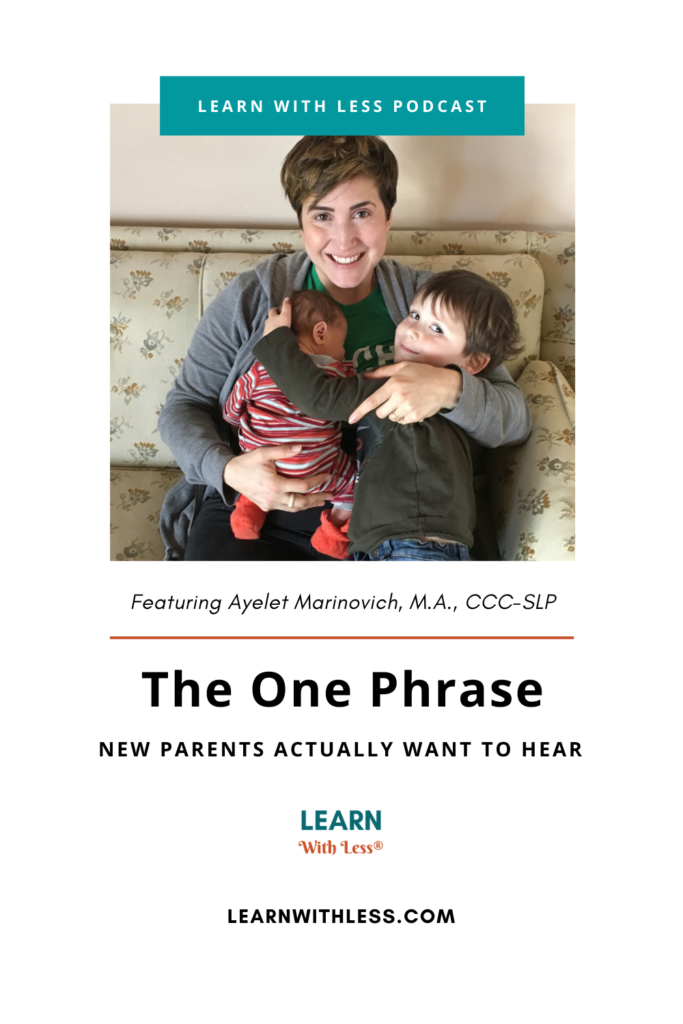
    The One Phrase New Parents Actually Want To Hear Oct 02, 2018
    Show notes

    As New Parents, There’s So Much…

    I’ve been spending a lot of time talking with new and expecting parents, caregivers, and professionals working with young children.

    Having been through the “beginning” of parenthood with a new baby twice myself, each conversation brings up memories (and often a wave of emotions!), feelings of vulnerability and self-doubt, and also a sense of absolute awe for the new life and new beginning.

    Now that I’m no longer in “the thick of it,” I find myself on the outside looking in. I find that there are two polar extremes that we often see when it comes to life as a new parent, and neither of them are particularly healthy.

    We often get stuck in the two extremes of the portrayal of early parenthood:

    On the one side is this glowy, radiant, beautiful, “perfect” new relationship (that we often see on our Facebook or Instagram feed): a curated reality in which all things go swimmingly – the pregnancy, birth, and postpartum period… in which breastfeeding is always easy, a partner is endlessly helpful, a baby is instantly sleeping through the night, an older sibling is calm and adaptable, and our own bodies snap back into shape with the flip of a switch.

    On the other side is the deep depths of darkness, where anxiety and comparison and cynicism rule, sleep deprivation and hormones make us totally loony tunes, where the only bedtime story in existence is “Go the &%!K to Sleep,” and where it feels like no one is there for us. Not even Dr. Google.

    The reality is that early parenthood is both of these things, and none of them, and we can flip from one to the next and back again in a matter of minutes (if not seconds).

    The Comparison Game Is Dangerous

    When we look at other new parents and caregivers, and other peoples’ babies, it’s impossible not to look back at ourselves in comparison. We see our babies as a reflection of ourselves, and we want them to do well.

    We want to provide the “best start” in life, just like Sally down the street who always seems to have it together (guess what: Sally hasn’t told you about her postpartum anxiety or about the difficulty she’s having with her partner or about the fact that her older child is driving her bonkers).

    We think we have to have “this learning toy” and “that set of high contrast black and white images.”

    We think we have to come up with activities that are super out-of-the-box and creative, or have a plan for this craft ready.

    We think we have to keep giving them something they haven’t seen before.

    So what’s the phrase that all new parents want to hear, you ask?

    “You’re Already Doing It.”

    Infants and toddlers are happy with Tupperware and old boxes, most of the time.

    Ok, so we don’t have to over-plan things.

    So the question becomes: how do we elicit the power of those natural objects? How do we insert ourselves in that play, too? It’s one thing to watch your baby entertain herself with Tupperware… but how do you get “in there” with them, and add to the activity without getting in the way or being overly directive?

    Am I Doing It Right? Am I Doing Enough?

    You want to do well. You want to feel like you’re not just “winging it.”

    And there’s also a matter of getting the most “bang for the buck:” if you’ve got 10-20 minutes to spend with your baby between the time you get home and the time you have to start thinking about getting dinner on the table or bath time and bed time started, what’s the most productive thing you can do?

    In a way, it’s fear-driven: you want the best for your baby, and you want to make sure you’re interacting with them “correctly.” And that’s why the first question is often “what do I need to buy?” or even “what if I could subscribe to something and it would all just be sent to me with everything I needed?”

    I Can Offer Something Better.

    What if you already had everything you needed?

    What if the “best” toys for your baby were hidden, in plain view, right there in your home (or attached to you)?

    What if you were given the recipe: exactly what you needed, instructions for what you might do, the developmental impact of the activity, and sample “scripts” to get you started actually implementing the activity – so you know exactly what you’re doing…?

    What if you realized you were already doing so many of the “right” things to support your baby’s development?

    Imagine How Empowering That Would Be

    No more “winging it.”

    No more play room comparisons.

    No more drawing a blank when you could have been engaged in play.When you recognize the tools you already have to boost your baby’s development, you’re able to maximize the time you have with your baby, you’re empowered to “get it right,” and you’re able to unlock the power of everyday routines and objects to figure out how to play with your baby. Get everything you need inside the Learn With Less® Simple Parenting Toolbox.

    Learn With Less® Simple Parenting Toolbox:

    A collection of resources to help you feel like a competent, confident, capable parent.

    Everything you need to actually enjoy playing with your tiny human (using materials you already have – no extra time or energy required!).

    Resources to make life easier – and the place to put it all together so you feel less lonely.

    A set of high-quality, developmentally enriching ideas to share with another caregiver who will be spending time with your baby, to find common ground, and to put your mind at ease that your baby will be enjoying high quality activities with each of you!

    Discover the ultimate simple parenting toolbox now!

    The post The One Phrase New Parents Actually Want To Hear appeared first on Learn With Less.


    Raising Emotionally Intelligent Kids Through Play Sep 11, 2018
    Show notes

    How do we raise emotionally intelligent children? On this episode of the Learn With Less podcast, Ayelet sits down with Kelli McCarty, a marriage and family therapist and founder of Toys With Intent, to discuss the ways in which we can raise emotionally intelligent children, how play factors into emotional intelligence in our young children, and Kelli’s top tips and resources for integrating social/emotional development and social cognition into play. The basic takeaway? It really comes down to intentionality in the tools we choose to use in our parenting and in our homes. Quick access to links in this episode: 1-2-3 A Calmer Me: Helping Children Cope When Emotions Get Out Of Control, by Colleen Patterson (affiliate link) The Whole-Brain Child, by Dan Siegel (affiliate link) Slumberkins (affiliate link) Generation Mindful and the Time-In Tool Kit Generation Mindful’s mindfulness card games (affiliate link) The Moodsters storybooks (affiliate link) EQTainment board game (affiliate link) CONNECT WITH US! Ayelet: Facebook / Instagram / Pinterest / YouTube Kelli: Website / Facebook / Instagram Text transcript of this episode Ayelet: Welcome to episode 65 of the Learn With Less podcast. Today I’m speaking with Kelli McCarty, a marriage and family therapist who has worked in schools and in the mental health field for over 10 years. Kelli now runs Toys With Intent, a website dedicated to providing social and emotional resources for families with young children and with teens. Her mission is to help parents raise children to be more emotionally intelligent and to help parents become more intentional about the toys and products they bring into their homes. Kelli, thank you so much for being here and welcome to Learn With Less. Kelli: Thank you so much, I’m so happy to be here. Ayelet: So I have asked you to come onto the show today to speak about raising emotionally intelligent children. But first I’d just love to hear a bit more about you and how you got into the work that you’re doing today. Kelli: Sure! As you heard in the introduction, I am a marriage and family therapist and former school counselor, and a mother, too. And I really started Toys With Intent kind of wrapping all those experiences together, but mostly because I was kind of, for lack of a better word, appalled at some of the toys and products and books out there for children. There seemed to be a lack of educational and healthy toys and products out there that really enhance children’s development or they were really hard to find, and I would often get these kind of pointless toys or books that were given to my children that didn’t really have a positive message, either. So I basically wanted to do something about that. So I created the website Toys With Intent, so parents and educators could find helpful educational, social-emotional books and toys all in one place. And then, ideally the parents and educators would use these toys to help enhance their child’s EQ. So really, Toys With Intent, is a place where you can go to find better and more helpful toys, books and products for kids. Ayelet: Wonderful and necessary. That’s great. Because as we all know, there’s so much stuff out there and it can be really hard. I mean, you and I are both in existence because we both wanted to create something that was sort of a hub for people to be able to come and create that high quality resource for families. I love what you’re doing. Great. So I would love for you, this is sort of a big question, but can you break it down for us? How does play factor into what you’re calling emotional intelligence in infants and toddlers and I guess with that, what is emotional intelligence? Kelli: So emotional intelligence is really the ability to understand yourself and to understand others. I mean that’s what it is at its core. And so when we think about how to develop that in children, we look to play because play is really the work. It’s the work of a child. That’s what they’re doing. That’s all they really know and that’s how they experience the world. And for me, I’ve always said, okay, so if play is the work, then the toys are the tools, right? So the toys or the tools that children play with can really be influential in helping to develop the child’s EQ, I know you know this, but one of the first EQ skills babies learn is recognizing facial expressions and cues, right, in themselves and others and this ability to recognize their own emotions and the emotions of others is a necessary skill to be able to interact with others, show empathy, demonstrate appropriate social skills later in childhood and throughout life. So when we think about how babies and toddlers play, and what they play with, parents and caregivers can certainly start to develop these EQ skills by utilizing things like mirrors, right? For example, where the baby can see different expressions. When babies or toddlers are playing with dolls with different facial expressions. A parent can say, you know, why is that dolly upset? Or why is that doll sad? You know, a big part of play in childhood is also books, the books that children read. So, even when you’re reading a story and little Johnny gets upset and the story the parent can work it through with the child, very young child can start to understand, look, he’s crying, that means he’s sad – naming out loud the emotions of others. So, again, when you look at what the child is actually playing with, it can be really helpful in teaching these emotional intelligence skills. Like I mentioned, there’s a lot of kind of pointless toys or maybe almost harmful products out there that actually are kind of counterintuitive to teaching the skills that we want, especially when you get into the preschool years. There’s stories about children whining and misbehaving and getting what they want and acting out, and as a parent, those probably aren’t the skills we want to be enhancing and encouraging in your child. So really, with the play, and the toys and the books you choose, you can be reinforcing the values and skills you want to be teaching through the actual toy. Ayelet: Ah, that’s really nice. I love how you put that. You’ve used the term EQ a couple of times. Would you please define that for our audience in case people are not sure what that means? Kelli: Sure, so EQ is just a shortened phrase for emotional intelligence, which again, is just understanding yourself, having an awareness of your own emotions and the emotions of others. Ayelet: Wonderful. And this is, of course, this is social-emotional development, but it’s also part of an area of cognitive development as well and what we talk about as far as social cognition, which is that understanding… I can’t break it down enough, right? Because it’s all totally related and as we talk about a lot on the Learn With Less podcast, all of those areas of early development in the early years, especially the infant and toddler years are so intertwined, right? This is social-emotional development, this is social communication, this is social cognition. It’s all interrelated, and it all feeds into each other. So, let’s just take a quick break to hear a word from our sponsors, and then we’ll hear a few tips and resources from Kelly about integrating social-emotional development and social cognition into play as well as a few of her favorite resources that she likes to recommend to families who are interested in seeking out things about this topic. Ayelet: Okay, Kelli, let’s hear a few of your top tips for families who are looking for more ideas to integrate these aspects of social and emotional development, social cognition, emotional intelligence, into play. Kelli: Yeah, I think the first thing is just to be really mindful of the toys and books and products that you choose. You know, you mentioned that there can be so much and actually research says more toys does not equal better. In fact it’s overwhelming for the child. And there’s actually a lot of negatives to having too many things. So first, that’s definitely the message I want to send home is that you don’t need all these books and toys and products. But when you do bring home some, make sure they’re intentional. You know, again, every toy and book has a message. So it’s important to really evaluate what that message is sending and what it’s teaching your child. You know, I mentioned books earlier. To me, that’s kind of the easiest because I think almost every parent reads their child a book before bed – babies through preschool children, and so on. So I really view books as a really easy way to incorporate social/emotional development in children. There’s a book called “One, Two, Three, A Calmer Me,” “Bye, Bye, Toddler Time.” I mean there’s so many different books that you can read every night… instead of princesses and dinosaurs, why not read a book about empathy and kindness and, you know, all the appropriate skills you want to be teaching. It’s a very kind of simple shift that you can do that can actually really change your child’s development. You know, I talked about the mirrors, that’s kind of another way you can kind of incorporate them facial expressions. Talking out loud -whenever you see in a book or a show or whatever, different emotions. Although your child’s young, this is their development, right? It’s all sinking in. You know, another thing is that the dolls and toys you have should really reflect the world that we live in. This is another way to enhance your EQ is to bring diversity to toys and books. You know, different races, body types, non able bodied people. This exposure early will definitely help them, you know, as they grow in the future, it won’t be something strange or new. Understanding others, again, is a huge part of EQ, and you can do that with your toys – just diversifying them. I know screen time can be a very controversial topic, but if you do decide to do screen time, there’s also a simple shift you can make. Again, instead of Mickey Mouse, you can choose Daniel Tiger, which always incorporate social/emotional themes, a spin off of Mr. Rogers. So, for every toy or book there is, there’s actually a positive one, that you could do a simple shift out, if you want to do it that way. Ayelet: I love it because it’s really so much about being intentional, and that’s really it. I mean it’s just, like you said, it’s a very simple shift into how we are exposing our children to the world. I believe as well in that power of… what did you say? You said teaching about others, right? That is such a wonderful way to expose a child to people who look different from them. People who do things differently, whether that’s your next door neighbor or a person across the world. That’s wonderful. And of course that’s also how our children are categorizing things, right? They’re already categorizing what a girl does versus what a boy does or, I mean, you mentioned to me earlier that you have a three-year old. I have a four and a half year old. It’s true – it’s like it’s incredible what they come up with as far as, like from a year ago to now, what my child “believes” about the world based on other people that he’s been exposed to, other things that he’s categorized or classified. Kelli: Well, stories, too, right? If they read in a book that the doctor is always a boy and, you know, it’s always a white mommy and a white daddy… I mean this is how a child frames their world, so the non-gender toys and letting boys play with dolls… I mean there’s all sorts of different ways to help break down some of the stereotypes that get formed at a very, very young age. Like you just mentioned, a four and a half year old can already kind of compartmentalize different categories. Ayelet: Yeah. Thanks for breaking that down for us. Now, can you give us a few of your favorite resources to share with families who are looking for more places to find this good stuff? Kelli: Sure, yeah. A big part of my job is searching all of this out, it’s finding the best stuff that’s out there because, like I said, for every toy out there, there’s a positive version of it. I do believe that. I know there’s a lot of infants and babies and toddlers in your community, so I’ll mention Slumberkins – are you familiar with them? So they were actually on Shark Tank, but what it is, it’s a little plush doll or toy, a stuffed animal, but each of them comes with a little story about… one of their topics is mindfulness, conflict resolution. They have all these different “positive life skills” is what they call them and basically the plush toys serves as sort of a security attachment and then they have these positive stories that you read each child every night. So they really start young, they’re, you know, right out of the womb. They’re like, here’s a, here’s a positive story you can read your child every night and here’s the security plush toy to go along with it. So I like them because they start really, really young. Generation Mindful – that’s another great resource. They came up with the “time in” versus the “time out.” So the creators of that have a whole toolkit and they have, you know, mindfulness card games. Again, once your children get a little bit older and they get into board games and stuff like that, there’s positive, you know, SEL (social emotional learning) board games too that exists and kids really don’t notice the difference if it’s fun and engaging. So, Generation Mindful is also an amazing resource. I have their Time In Tool Kit. I use that to help teach emotion regulation for my three year old, which again, being able to manage your emotions is huge for emotional intelligence. I know this is more for parents, but anything by Dan Siegel we’re a huge fan of – The Whole Brain Child is a great resource just to kind of understand your child better. So I like, I like his books. We have a lot of parenting books on the website as well as your children get into the maybe the preschool and the early elementary school years. There’s a line called the Moodsters, and they’re essentially just little characters, but each of them it’s representative of a different emotion. So there’s Quigley for scared and there’s Razzie who’s the angry, you know, monster. And I use that with my daughter and she just thinks that they’re just like Disney characters to her. She doesn’t know the difference. Right? Oh, that’s Razzie… Ayelet: They very much actually remind me of the Pixar movie, Inside Out. Kelli: That’s another great resource that they get a little bit older. I mentioned the board games. There’s a line called EQtainment, or EQ is the board game and it teaches social skills and that’s more for like five, six, seven, eight year olds. But again, just just being mindful that every toy you have, there’s a different version of it and a healthier way. Ayelet: Earlier you mentioned just the simple idea of looking at pictures or books. And of course, again, you don’t even need a book for this. You can literally skim through a magazine and look at faces and talk about what they look like or how they’re feeling or who they are or what they’re wearing. And that’s so much vocabulary that you’re giving your child just in observations. And of course teaching them to be observant. Kelli: Again, you don’t even need anything – you can be at the playground, right? It’s, that’s a very simple way of when you’re walking around or you see people, someone’s hurt or someone’s angry, like you said, just building a vocabulary. That’s a great point is that it’s another kind of basic skill that if they can’t name the emotion, that’s a number one starting point, so using those words out loud is really, really helpful in helping them to form that EQ as they get older. Ayelet: Wonderful. Well thank you so much Kelly, and of course we can find you at toyswithintent.com and you’ve got a ton of great resources on your website as well and we’ll link to all of that in the show notes for people who’d like to find you ag…

    Full show notes at the publisher

    Perinatal Mood Changes and Postpartum Mood Disorders Aug 15, 2018
    Show notes

    What is a Postpartum Mood Disorder? On this episode of the Learn With Less podcast, Ayelet sits down with Dr. Katayune Kaeni to address the topics of postpartum depression, anxiety and OCD. Dr. Kat is a psychologist and specialist in maternal mental health and perinatal mood and anxiety disorders. She works with moms and families to heal from the difficulties of depression, anxiety and other mood changes that can happen during conception, pregnancy, miscarriage, loss of a baby, birth and postpartum. In addition to her professional training, she also draws from her own personal experiences with the challenges of postpartum to discuss this topic. We’ll hear about her own professional and personal background, and how it is she came to do the work she’s doing now. There are so many misconceptions about the various ways hormones can affect our postpartum experience (and beyond!). Dr. Kaeni gives us a brief overview of the differences between the “baby blues,” postpartum depression, and postpartum anxiety, dispels some of the common myths about postpartum mood disorders, and tells us what, in her opinion as a professional who works with families struggling with the transition into parenthood, are the best places to start for new parents experiencing postpartum mood disorders. Quick access to links in this episode: Mom and Mind Podcast, hosted by Dr. Kat Kaeni Dr. Kathleen Kendall Tackett, PhD, IBCLC, FAPA Postpartum.net Maternal Mental Health Now Seleni Institute Postpartum Stress Center 2020 Mom CONNECT WITH US! Ayelet: Facebook / Instagram / Pinterest / YouTube Kat: Facebook page / Facebook group / Twitter / Instagram Text transcript of this episode Ayelet: Welcome to episode 64 of the Learn With Less podcast. Today I’m speaking with Dr Katayune Kaeni, a psychologist specializing in perinatal mental health, and the creator and host of the Mom and Mind podcast. Dr. Kat has a private practice where she focuses on supporting new mothers and their families. She volunteers with postpartum support international, and she works with San Bernardino County’s maternal mental health work group as a subject matter expert to provide training to local mental health and allied healthcare providers. So Kat, thank you so much for being here. Welcome to Learn With Less. Kat: You’re welcome. I’m really happy to be here and share whatever I can about maternal mental health. Ayelet: Well, it’s a such an important subject as we all know. And I’ve asked you to come onto the show today to speak about this topic of postpartum depression, anxiety, OCD. But why don’t you tell us just a bit about your own professional and personal background and how it is that you came to do the work that you’re doing now? Kat: So I’ve been a therapist for quite a while now and I’ve lost count, but so, in terms of my professional background, I’ve always known I wanted to be a therapist. I took a peer counseling class at age 12 and I was like, Yup, this is it. So I’ve been on this trajectory for a while. So in terms of why I started into this particular specialty is because I went through it, so let’s see. I was already a psychologist working in a major medical system and I got pregnant with my first child, she’ll be eight this next month. Yeah. So I got pregnant with her, pregnancy was fine and great and wonderful. And then after her birth, looking back now I know that my anxiety started day one after her birth and for about a year I went through what again, what I know now to have been postpartum depression, postpartum anxiety and postpartum OCD. But it did take me a long time to figure it out. And it’s just heartbreaking that, you know, as a therapist, I’m supposedly supposed to be trained in sort of all things mental health and I didn’t know what was going on because really there’s a lack of training for just about everybody, for therapists, for doctors, OB’s really. I mean it’s, it’s getting better these days, but there’s a lack of training so other people weren’t recognizing it. I wasn’t recognizing that I hadn’t had the training to recognize it. I just knew that I didn’t feel well. They knew that I was ashamed and I felt like, especially as a therapist, it should be able to handle everything and know what was going on and yeah, there’s just all this shame and guilt and confusion around that period of time. And once I figured it out and started reading about it and saw my symptoms listed in a book, I could see that, oh, this isn’t just in my head, it’s a thing that was such relief. So since then I’ve really been “gung-ho,” all-in to making sure that other moms get the information that they need. Ayelet: Absolutely. And I mean, like you said, early parenthood is so – in general – such a time of that vulnerability, overwhelm, you know, a lack of confidence. All of those things. You’re in charge of a new human being. So of course you’re going to be feeling those feelings already. And then to have that sort of bombarded as well with another layer is, yeah, it’s rough. Kat: Yeah, it was a lot. Knowing what I know now I can look back and say like, Oh yeah, of course… I had several risk factors that would have put me in a more vulnerable position for that. And, it’s so nice to know that now, but I wish I had known it then. Ayelet: Right. Well I look forward to hearing a bit more about some of those kinds of things as we share them over the course of this episode. But first I think, you know, there’s a lot of misconceptions about the various ways that hormones can affect our postpartum experience. So can you give us just a brief overview of the differences essentially between, you know, the baby blues, postpartum depression, and postpartum anxiety. Kat: Yeah. First of all I’ll say about hormones is that if you are already in your history, have a sensitivity to the hormone changes like PMS, PMDD, those kinds of things, you’re more likely to experience a perinatal anxiety or depression either in pregnancy or in postpartum. And again, it’s different for everybody but so there’s like a biological sensitivity there. But for even for people who don’t necessarily have that history, they can still develop symptoms certainly. So for the baby blues, which are very common in about 80 percent of women are about the two weeks after birth. So you’ll have, it’ll be like a PMS, there might be weepiness, tearfulness, agitation, but you’ll also be able to have some periods of time where you feel okay and it’s not, it’s doesn’t feel heavy, it doesn’t feel like it’s dragging you down completely. But it’s an emotional rollercoaster with the sleep deprivation. So, you know, adjustment, getting used to new stuff. So again, that’s about 80 percent of women experience this period of time and it usually resolves and in about two weeks with good enough rest and nutrition and support and that things that can help someone in the healing process anyways. But for about 20 percent of women (and it’s different and for different ethnic groups, that number), um, but overall about 20 percent of women will experience more intense symptoms or if during that two weeks or if their symptoms are lasting for longer than two weeks, we’re probably looking at more like a perinatal mental health challenge, more than just baby blues. So those again, if it lasts longer than two weeks, if it feels pretty intense, like it’s like you’re not feeling like yourself or things feel very strange or you, you know, you’re just not quite sure what’s going on. That’s, those are generally signs that something deeper might be happening. Yeah. So that was, I don’t know if I answered all your questions Ayelet: Well, I think so think that’s a wonderful description of the difference between certainly the baby blues and then postpartum mood disorders in general. Can you give us – because I think there is a big sort of misunderstanding or lack of understanding about the difference between postpartum depression and postpartum anxiety. How are those things different? And I think also, I mean I’ve read so much about how postpartum anxiety for instance, is extremely under-diagnosed, so can you talk a little bit to that? Kat: Yeah. So there’s a lot of times depression and anxiety coming together. It’s relatively rare that you would be just depressed. You couldn’t be just anxious – you’re more likely to be anxious for a period of time. But eventually that could wear on too… Ayelet: Right! Not to be minimized in and of itself. Kat: So in terms of depression, depression feels like you’re not motivated, you feel sad, you feel down, you can identify that feeling. What’s difficult in this period of time is that you may be having an increase in sleep issues, either feeling very, very tired or not tired, just unable to sleep, rather.. not tired is a separate diagnosis. But feeling – which I can get into. But yeah, I can tell you, I can tell you everything. So right. The depression: appetite changes, sleep changes, feeling down low motivation, feeling bad about yourself again, which is very common in this period of time. And, but more like the, I’m a bad mom. What’s wrong with me? I can’t do this. Ayelet: To a debilitating state. Kat: Right. So all of these symptoms in terms of like, clinical diagnosis, part of what we look at is the symptom set. If you’re meeting some of the criteria for the symptoms, but also if you’re having difficulty functioning. So for a lot of women they start to have difficulty functioning, getting through the day, doing kind of, self care, sometimes difficulty doing baby care as well. So we’re really looking for, again, is this happening for longer than two weeks? Is it affecting your ability to get through the day? So depression feels heavy, it feels low, your mood is low. You might be crying a lot. In the more severe symptoms are having thoughts of suicide or what I call escape fantasies, like I don’t want to be here anymore. Not necessarily that you want to die, but you just can’t do this. So, once it gets to that point, the more moderate to severe symptoms, that’s when we start to be in, you know, obviously more and more concerned and something to be taken very seriously. Need to seek help. So in terms of anxiety, anxiety will look a little bit different. Anxiety can look like busy, doing a lot of things – from the outside, this is what it might look like. Difficulty sitting down and resting, difficulty sleeping when you can or resting when you can. Uh, what’s happening internally is a lot of worry and that worry, it can be on a spectrum from relatively mild worries to very intense and severe worries. So the worry can be, you know, let me just say there’s a normal hyper-vigilance right after birth and in the first several months of just kind of checking on baby and making sure they’re okay, but this kind of worry is unrelenting. You’re not relieved by checking. It’s, you know, needing to check all the time and it can get to a point where it can develop into an obsessive compulsive type pattern where you’re constantly checking. I mean, there’s several moms that I met with who talk about laying down with their baby, but just watching them the whole time, not being able to sleep at all, waiting for something because they’re afraid of SIDS or they’re afraid of some other kind of thing that they’ve heard about. So their vigilance is just like on full volume and unfortunately the sleep deprivation makes all of this worse and with anxiety, it can become a sort of a cycle. Like for instance, another example is a mom whose… you know, her primary job is to feed, whether it’s nursing or bottle feeding. They might anticipate the baby waking up so they’ll just tell themselves, well, I’m just not going to go to sleep because the baby’s just going to wake up anyways and so I’ll just hang out until. So in the meantime they’re losing sleep and they’re having difficulty functioning. Oftentimes, looking on the Internet for “how do I make sure to get my baby to sleep or eat,” and then the worry starts piling up. That’s an example of what anxiety can look like and feel like. In terms of the obsessive compulsive part… So, a lot of moms, and dads, frankly, experience what we call intrusive thoughts. These are really like thoughts that come in very quickly, sometimes not anticipated, sometimes related to the situation you’re in and they’re often very scary thoughts or worrisome thoughts. A very common one is like, “what if I drop my baby?” and that it’s not just a passing thought. It’s like, some people will experience a really physical response and their whole body will sense this tenseness of like, what if my child gets hurt, what if I hurt my child? And because they’re so worried about it, a thought, and that thing happening, they might start to develop behaviors to help cope with that, so that those things don’t happen. So, for instance, if the concern is that “what if I drop my baby,” they might start avoiding stairs or avoiding narrow doorways or places where they are unsure of their footing, that kind of stuff. Again, to the point where they’re not able to do their daily stuff because of those worries. Again, all of this is on the spectrum so people might be experiencing some of that. What I do really want to say about those intrusive thoughts is they can be very scary and worrisome. Some people get visual images with the thought when I think it’s very important to know is that even though you’re a scared by the thoughts and maybe doing whatever you can in your power to not do those things, intrusive thoughts don’t make those things happen. You’re not going to do them. It’s purely fear based, purely anxiety based. It is not at all out of a desire or want to do those things. It is absolutely just anxiety kind of edits. Again, with the volume turned up to 11. Ayelet: I think it took having a baby for me to recognize in my own self how absolutely tied up our identities are completely interlaced with our hormones, our hormonal balance and so when when those things go, you know, quote unquote “out of whack,” it affects every part of us. So, thank you for that description. I think it’s especially important because as you said, postpartum mood disorders can occur with people who have had mood disorders in the past, but it can affect anyone and so it’s something that you know, especially if for instance you never experienced anything like this, it’s, it can be a hard thing to recognize within yourself. Kat: Oh, absolutely. And especially with, well, there are different ways that this manifests, but like with new parenthood, because we’re all told that, you know, like motherhood is magical and all of this great stuff, is going to happen and you’re going to get this, you’re going to know what to do when you don’t know what to do and when it doesn’t feel magical, it feels like a personal issue and it’s absolutely not! I mean, this, I frankly, I think all that stuff is a setup and we’re all worse off because of this idealized image of motherhood and it, it puts us into a position to feel extra vulnerable. Ayelet: Right. And you know, needing to raise ourselves to some level that is, say “Instagram-worthy,” for instance. Yeah, it’s, it’s tough. It’s so tough. Kat: Yeah, it is. I have some thoughts about social media, but… There’s so much pressure during this period of time. I feel like this is the most scrutinized period of time in a woman’s life. Everybody’s giving you their advice and opinion and telling you what to do and you’re just, you know, trying to figure out how to get some sleep half the time. And it’s, it’s a lot. It’s really intrusive, I feel, from the outside world. Ayelet: Right, whether or not you are dealing with a mood disorder – so intense. Yeah. Well, thank you. That’s great. Let’s take just a brief break to hear a word from our sponsors and then we’re going to hear a few tips and resources from Dr Kat about some of the common myths and best places to start for struggling families as well as her own favori…

    Full show notes at the publisher

    Developmental Leaps and Sleep Jul 11, 2018
    Show notes

    How does development influence sleep habits? Ask any new parent about their top struggles and most likely, sleep is in the top five! Contending with sleep regressions, sleep props, sleep crutches, sleep deprivation, sleep changes, sleep experts and philosophies in the infant and toddler years is enough to make even the most sane of us go mad. On this episode of the Learn With Less podcast, Ayelet sits down with Dr. Sarah Mitchell of Helping Babies Sleep, a chiropractor and sleep consultant who brings a remarkably inclusive approach to an often divisive topic. Ayelet and Sarah discuss Sarah’s personal journey into sleep consulting, a few of the truths and falsehoods about what a sleep consultant is (and isn’t!), common sleep changes that correlate with developmental leaps and growth periods in the first years of life, and a few tips and resources for families hoping to make informed decisions about what’s right for them. Quick access to links in this episode: The No-Cry Sleep Solution, by Elizabeth Pantley (affiliate link) The Sleep Lady’s Good Night, Sleep Tight, by Kim West (affiliate link) Learn With Less Podcast Episode, “The Permanence Of Objects” Dunstan Baby Language The Wonder Weeks by Frans X. Plooij and Hetty van de Rijt (affiliate link) Sarah’s Online Course, “Baby Sleep Training Step-By-Step” Sarah’s free Facebook Group, “Ask The Sleep Expert” CONNECT WITH US! Ayelet: Facebook / Instagram / Pinterest / YouTube Sarah: Facebook / Instagram / Twitter Text transcript of this episode Ayelet: Welcome to episode 63 of the Learn With Less podcast. Today I am speaking with Dr. Sarah Mitchell, who is a sleep consultant, chiropractor and the owner of the website Helping Babies Sleep. Sarah’s own experience with sleepless nights due to postpartum anxiety and a crying baby, left her searching for answers of her own, and she now works to empower tired, frazzled parents to get their children to sleep and helps by educating parents on age appropriate sleep needs and sleep options. Sarah, thank you for being here. Welcome to Learn With Less. Sarah: Thank you for having me. I’m so excited to be part of your community and sharing some different perspectives and some educational information for your listeners. Ayelet: Fantastic. That is what we aim to do in general at Learn With Less, so we’re very happy to have you be part of that, and today I’ve asked you to come onto the show to speak about the ways in which development can affect sleep changes in those early months and years. But first I want to hear a bit about you and what brought you to the kind of work that you’re doing today, and you know why you’re so passionate about it? Sarah: Well, I’m so passionate about sleep just because I need a lot of it! I really need a lot of sleep. I need at least nine hours to feel good in the morning. And when I had a child like that just completely rocked my world. You know, I come from… chiropractors tend to be more holistic and natural. So that’s where I was coming from. I had a midwife for my birth and a doula and I planned on like babywearing and feeding on demand and all that great stuff for, you know, months and months to come. And I was so confident I was going to be so great at all of this that I’d actually registered for a pilates class four weeks postpartum. Like, in advance of my birth. Like now I’m like, oh my God, I was so overconfident. And then things did not go as planned, which I’m sure many of our listeners today can relate to. Parenting is just, you know, you think you’re this organized Type-A, make-things-happen kind of gal and parenting hits in like all of your expectations of the window and you realize you have to reassess how you parent and how you are as a person and just, like, things in general. Ayelet: Exactly. We’re so familiar with that. That idea of, you know, and we’ve had a guest on the Learn With Less podcast recently who said “I was the best parent before I had kids.” Sarah: Exactly! That’s exactly what it was. So things went sideways from our birth. My son was 10 pounds, four ounces. I was undiagnosed gestational diabetes. Like I tested negative at the test that I actually had, and then he came out and got stuck at the shoulders, my doula was in tears at my birth, like that kind of goes to show you how, how things go and then, you know, that started us on a really bad sleeping path and my son would not sleep, and I was waking up every two hours to nurse him back to sleep, and the baby wearing just didn’t really work because it put so much pressure on the whole downtown area. And then, you know, then there was the night that I heard him crying for me and I looked because we were co-sleeping kind of more out of desperation than really the natural parenting thing, but you know, you do what you gotta do. And I heard him crying, and I looked for him beside me, and he wasn’t there, and I was kind of groggy, and then I start frantically going through the sheets trying to find him, with my heart just racing. And he had been safely stowed in the bassinet beside my bed! And I’d been so tired that I’d forgotten that I put him in, and I was like, okay, this is not working for us at that point. And so I used my academic training as a chiropractor… I read everything out there that was available on sleep and there’s very actual, very few scientific studies out there. And I read just the different techniques in books and I put a plan into place for our family to get us sleeping more than two hours at a time and to stop using the boob as a soother because that’s what I had been doing. And by the time he was four months, he was 20 pounds. So, obviously, I had a lot of good, fatty milk, but I just kept, I didn’t know what else to do like I, that was what I had been ingrained with, just feed him. That’s what it was. Ayelet: Right. And just to say out there, that is something that many of us do and there is nothing wrong with doing that. There is nothing wrong… like, Sarah, I know you and I know your philosophy and I think that it’s important that people understand that you are very much of the mind that… like clearly that’s what you wanted to do, but it just wasn’t working for you. And that’s okay. Sarah: My policy is, whatever works for you works. That’s awesome. I’m just sharing my story about how I felt, how it didn’t work for me in the end, how I was hoping it would. And move from there! So I started getting into becoming a sleep consultant because of that experience, because by the time we could finally… when I took that back and he started getting the sleep and making the changes to have him happier, even though he was happy to begin with, but once he got more sleep, he was even happier. So that’s how I kinda got into it and I, I really enjoy it because the people that reach out to me, you know, they had a journey, like I had! Something, they’re struggling with something and they want some insight. So it’s just the way… I really enjoy empowering parents, particularly moms who have been struggling. Ayelet: I love that you pointed out how few scientific studies there are because, as we know, sleep tends to be one of these sort of highly divisive topics in early parenting. And I do think that new parents often come into parenthood like you did, and like I did certainly, with a particular philosophy or sort of expectation about what’s going on or what’s going to happen or how we’re going to deal with that sleep deprivation, which we know is coming… and then our own realities hit and maybe what we thought about ourselves or who our babies would be, you know, doesn’t always turn out to be the case. And though some babies follow, I think what tends to be purported to be that sort of quote unquote typical sleep trajectory some don’t, and what we read about sleep is often based on theory instead of fact. And then personally, like in my own experience, I would, I’d try to, say, follow the advice of one of those sleep experts and then feel like a complete failure because my baby was say not interested and falling asleep on his own. And I was telling you, Sarah, before we started this interview that now that I have two little people, I realize how much of our own opinions are based on our own experiences, right? And especially because my baby, my second baby was one of, I like to call them one of those “unicorn babies” who actually just wanted to be put down and be able to fall asleep on his own, which of course as I said, was completely the opposite of my first. I was like, oh my God, what? This does happen! It wasn’t me, right? So taking that pressure off and then, you know, all that said, we have certain preconceived notions about also what hiring a sleep consultant means or even what a sleep consultant does. So I would love it if you could just sort of talk to us about some of those misconceptions that you face as a sleep consultant. And you know, feel free to sort of blow those myths out of the water for us. Sarah: Ok. Well, the first one I get a lot is, “I don’t want to do CIO – cry it out.” And so, the first question I ask is, what does cry it out mean to you? Because to me, cry it out means extinction. It means to close the door and not return. And I do not subscribe to that train of thought. I really believe that we treat our children with respect, and if I was that child, I would want to be acknowledged and know that I’m heard. So I would say that mostly consultants, I’m not really sure, but we don’t do this whole cry it out thing. Depending who you’re hiring, they may have a specific school of thought that they follow. So that’s a good question to answer. Do you have many techniques have you follow one technique? And most of us like what I do is I look at a person’s parenting history. The age of your child is so important because some techniques work better with smaller kids but they don’t work as well as older kids, and take all that into consideration. And then also what’s your timeline, like what’s your… Do you want to make changes fast and then get really consistent about your message about how sleep happens and make those changes really quickly. Or do you want to go really slow and change like how one thing at a time to work on, you know, work for, for a longer period of time. And that’s kind of in a nutshell and you know, when I’m working with someone, what we do is we work one to one and we share a google sheet so that you log your child’s activity and then I hop on and see how things are going, make suggestions for timing – timing is so important – and you know, what is reasonable. So I think a lot of people when they start sleep training on their own, one of the reasons people fail is that they’re not sending the child up for success with reasonable expectations. So maybe they’re expecting like their three month old breastfed baby to sleep 12 hours at night. Where, in my world, I don’t think that’s reasonable, and I also think it could hurt your milk supply if you’re not keeping that night feed at that age. And so that’s not something that I would promote, but then you know, there are other people out there who will tell you, oh yeah, I had a three month old, and I breastfed and he slept 11 hours. Ayelet: Exactly! Sarah: I feel like I err on the conservative side of things. Ayelet: Got it. Ok, interesting. Sarah: Because, yeah. So that’s kind of what sleep consultants do. Look at your activity, look at your history, see where you may be going wrong and make suggestions for changes and guide you through that process. Ayelet: It sounds like just the idea that you help educate families not only on what their choices are but what that implication is. And that for me, gosh, I mean that sounds like something I could have really used, especially in those early days because especially if you are making specific decisions about what you want for your baby and your own sleep needs or philosophies, you also… like when you’re in that early, early parenting days and months, you’re so sleep deprived to that like you can’t even imagine sleeping again. And the idea. I remember feeling two times around that like even though I knew like, oh my God, this is going to be my life for the next 18 years. This is horrible, like, I can’t do this, right? And we know that things change and things shift and sleep also is affected by developmental changes and we’re going to hear much more about that in just a few minutes, but just to have someone like, like you Sarah, would been really useful to have some sort of guide to, to help families feel like, okay, this is what’s happening right now, here are some ways to shift that and you can do it this way or that way, and it totally just depends on your own priorities as a family. Sarah: And on that note, like most consultants, most sleep training packages don’t start until four or six months. You know those first three months if you see someone that has a newborn package that’s not sleep training, that’s about, you know, learning to read your child’s cues more easily. So for example, I really confused hunger with – or, fatigue with hunger. So I kept feeding him when he was supposed to be napping kind of thing. So the newborn stuff, we teach you more of those things rather than like a cry it out sleep training option. That’s not what’s happening in those newborn stages, you know? Okay. At 10 weeks when that whole witching period in the evening might start to be seen and that’s when you want to try and bump up your bedtime a little bit earlier and awake times, too. The most common parenting error is keeping our kids awake too long, and in the newborn stage is really more like, you know, just telling parents, like you’re in charge of deciding when nap time is. So you don’t want to keep your child up too long because then it’s harder to fall asleep and stay asleep. That’s that whole sleep begets sleep idea, right? The four to six months period, that’s when you start getting into like, okay, what are your sleep crutches? What is, what’s that external thing that your child needs to help them relax into sleep that they need again, when they wake up like every three hours through the night, what is it, that’s your sleep crutch. How are we going to tackle that to start removing some of your child can then develop self soothing skills. Those are skills that we all have that help us relax down into sleep at night and that’s really what sleep training is educating you on sleep needs and then how are we going to conquer the crutch? Basically, how are we going to take that away so that self soothing skills, can start to appear and then in my program too, we talk about like maintaining your milk supply through breastfeeding and how are we going to manage feeds depending on your child’s, your child’s age. So sleep during doesn’t also necessarily mean getting rid of all those night feeds. So that’s a common misconception. Yeah. So I think when we go back to that misconception thing, is that what age of the child are we talking about? Right? Because really, most of them will be four months old. And are you breastfeeding or formula feeding, because that will affect your child’s ability to have certain length stretches at night and what sleep training techniques are we using? Because in my world, we’re not using close the door and not go back in – that’s not a technique. That’s just one action. Ayelet: Interesting. And again, that is something that many people do and have done and that is absolutely fine to make a decision for your own family that you want to do. Sarah: Yes. And if you do that, you know, it works great for some people, I just think that if you’re going to pay someone to invest in coaching, that’s, you know, do other options before you have to resort to that! Ayelet: Yeah. Well actually that’s a really important message, right? Like, if you want to hire a sleep consultant, you need more of that education like you said, and if you’re going to do cry it out, then maybe j…

    Full show notes at the publisher

    Raising A Multilingual Family Jul 05, 2018
    Show notes

    Growing up with multiple languages Raising bilingual children has become a hot topic over the last few decades. We are starting to understand more about the brain benefits of being bilingual or multilingual, but what does it actually look like to raise a multilingual family? On this episode of the Learn With Less podcast, Ayelet sits down with Erez Podoly and Andrea Scaiewicz, who are the parents of two school-aged trilingual children. Ayelet, Erez and Andrea discuss challenges they’ve encountered while raising a multilingual family, their own strategies for success when it comes to bilingualism and multilingualism, and of course, their best tips and resources they recommend based on their own experiences. Quick access to links in this episode: Learn With Less podcast episode about Musical Patterns Learn With Less podcast episode on raising bilingual babies Text transcript of this episode Ayelet: Welcome to episode 62 of the Learn With Less podcast. Today I am speaking with Erez Podoly and Andrea Scaiewicz, who are parents of two school-aged children in the San Francisco Bay Area. Erez and Andrea grew up speaking Hebrew and Spanish respectively, and decided to raise their children in a multilingual environment. Though their experience is not unique, per se, it is one that gives us all insight into the realities of raising a multilingual family. That’s why I’m so pleased to have them here to join us today to lend us their perspective. So Erez and Andrea, thank you for being here and welcome to the Learn With Less podcast! Erez: Good morning, and thank you for having us. Ayelet: So I’ve asked you to come onto the show today to speak just about your experiences as parents raising a multilingual family. But first I’d love to just hear a bit about each of your backgrounds, so, you know, where you grew up, what languages were spoken in your homes, and community. Erez, let’s start with you if that’s okay. Erez: Sure, sure, and thank you for the introduction and for the invitation. And as you said, I’m the proud father of two kids, 13 year old boy and a nine year old girl, and I’m the proud spouse of a brilliant scientist (Andrea will present herself in a minute). Was born in the US to Israeli students, who took me later back to Israel. So I spent most of my life in Israel, and spoke mostly Hebrew, learned English as a second language at school. Ayelet: It is interesting, actually, your story because you were born here in the US, but then you moved back to Israel where you spoke Hebrew and I assume when you were… Erez: Actually, they insisted on Hebrew, exclusively. So… I had another language, but then I lost it! Ayelet: Right. You had a bilingual experience but then it was gone. But we’ll talk a bit more about that and how that sort of influenced you in, in just a moment. But Andrea, let’s hear from you as well. Andrea: Hi. I was born in South America, in Uruguay. I lived there half of my life speaking many Spanish. I did learn English as a second language. When I went to school there was no English at school, so my parents sent me to private lessons that I had after school. So most of the people my age then, if their parents didn’t pay for English lessons, they don’t know English. Then when I was in my twenties, I moved to Israel – I didn’t know Hebrew, and I started studying Chemistry in the university and I somehow I picked up the Hebrew along the way, I met my Erez, my husband, and I learned Hebrew. So, I became trilingual when I was in my twenties. Ayelet: Yeah, amazing. Andrea: We had our first son while living in Israel and after a couple of years we moved to the Bay Area, and that’s how we became a trilingual family. Ayelet: Right! Amazing. So I think the question I’d love to ask you next is really, you know, did you have a plan, per se, for how to go about raising a multilingual family or did you mostly just wing it – and then also what was the sort of strategy you used? For instance, did you each speak your native tongue exclusively? How did you do it? Let’s hear it. Andrea: I think that at the beginning when Ofir, our son, was born, for me it was more natural to speak in Spanish, that was my mother language and that’s how I communicated with him. We did know that it’s recommended just to stick to one language. For example, I stick to Spanish, and Erez stick to Hebrew, and that’s what we did at the beginning, but it was a bit more complicated than that because areas was picking up the Spanish as well. Erez: Yeah, exactly. I think one thing led to the other, in a way, you know – it was important to me to learn Spanish. Even before we had kids, so I took Spanish classes at the Hebrew University in Jerusalem while doing my undergrad in Chemistry and later with PhD, and we spoke to each other actually two languages: Hebrew and Spanish. I think it was a weird mixture of both – it was a Hebrish! Some kind of a mixture and only if you knew the two languages you could actually capture what’s going on. Yes, we did speak to our first child two languages, but actually it was a continuation of that Hebrish! No, it was not very didactic, in a way. I think only when we moved to the US and added a third language to the portfolio of languages, then we developed a strategy, but he didn’t try to speak anything. He said his first words later compared to other babies. Ayelet: How much later? Andrea: I remember. He was two. And it was, it was very interesting to see. I used to, you know, there were other kids that were already saying first words at 10, 11 months, and Ofir was saying nothing. But then after he turned two, two and a couple of months he just rushing through both languages. It was amazing. I mean, they take longer to grow up with one language, but when they start, they have them both. And it happened also to our daughter. Our daughter was more complicated because she was born here and she had three languages, not two. Ayelet: From the very beginning, right. Andrea: Yeah, because at home we have Spanish and Hebrew, and she went to daycare since she was like seven, eight months. Ayelet: And that was in English? Andrea: Yes. Ayelet: So again, just to recap, the home languages were, of course, each child would hear one, essentially one language from each of you with Andrea speaking Spanish and Erez speaking Hebrew, and then the language that you spoke together to each other was sort of a pigeon or as they say, pigeon language of as you referred to it as Spangbrew… or… either way! Erez: It’s funny because it was fascinating to follow the process Ofir, our first child, was going through when we arrived at the US, we thought that he would be more comfortable Hebrew, we looked for Hebrew speaking languages, but and for four months he didn’t say a word in English. Of course there weren’t bilingual in English and for four months, I think, and please correct me if I’m wrong, she was mumbling, the accent, the American accent, in a meaningful way. Andrea: He was like, with his trains, because he loved trains back then. And then, he was like, “Rrrrr, rrrr, rrr,” and slowly he started adding words, and he would play, “rrr, rrrr, yes” and “rrr, rrr, stop,” “rrr, rrrr, no.” It was it was very interesting to see how by four months after arriving here, he was speaking English, without any problem, the perfect accent. That’s another thing about him. He has the right accent in each one of the three languages. Ayelet: Yes. That’s, that is amazing. What you described as ‘jibberish’ is… the technical term within language learning and linguistics is called jargon, right? Which is that like all of the sort of intonations and this and the speech sounds of, of a specific language without the content. Right? And we know that in general, even with any child who is learning language, whether it’s a monolingual child, bilingual, multilingual, that you will hear those early communication milestones that we know preclude verbal language before, in all of the language or languages that, that child is exposed to. So if the child is hearing Mandarin than the babbling and the jargon, we’ll be using the intonations and the sounds of the language or languages that that child speaks. So it’s really interesting and wonderful to hear that. I also wanted to just say to anyone listening that of course this is, this is you guys, this is your experience, your family’s experience to anyone else who’s listening, who has or is considering raising a bilingual or multilingual family, it may look very different to you. And some children, you’ll see that those first words appear later, and some won’t. It’s totally different and I think it does depend on the number of languages, the amount being spoken, what also the home languages being spoken between the parents are so perhaps you know, Ofir had to deduce because he was listening to the two of you speak together this sort of combination language, he took some time to figure out, “okay, well they’re speaking to me very specifically when they’re talking to me, but then when they’re talking to each other it’s a little different.” So and there again, there’s no right or wrong approach to this. Just like there’s no right or wrong approach to parenting. Right? Erez: Well, let me tell you something interesting about what you’ve just commented. We thought he doesn’t have the ability to separate this weird mixture that we’ve created, but he, you know, right at the beginning when in some peculiar ways, he could identify someone who is, who can speak only one of the languages and address this person with one clean language. He was using just words and vocabulary and grammar from one language and we… that was so surprising and overwhelming. We couldn’t understand, how did he figure it out? That was… do you remember that, Andy? Andrea: Yeah, I think and also for us, for me, at least. The Spanish was a need because many of my family members, they don’t speak English very well. So I really wanted our kids to be able to communicate with that part of the family, so for me there was no doubt that my kids need to speak Spanish even though we don’t live in a speaking Spanish and I think that that was kind of something that we always kept in mind and I think that’s also the reason why Erez picked up Spanish also, and felt that if he wanted to communicate with my family, he had to speak Spanish. So I think that’s why we also transmitted to all of these years, is that that’s who we are. That’s how our family works and that’s how… I mean, we have to. The other thing I wanted to add is that we mentioned here that at the beginning we stick to one language and I would address them in Spanish, and Erez in Hebrew, but as kids grow up, especially if they grow up in an English speaking country like we are in now, it changes. It changes because they live and breathe and play and feel in English. Now it doesn’t mean that it’s forgot the languages. They both read, speak very well, in Hebrew and Spanish. But, I think that we at some point we had to kind of give up that telling them like, no, please speak to them in Spanish, or please speak to me in Hebrew. Because they spend their whole day in English and it happened to Ofir, if you remember, Erez, when he would come back from school and first grade it was, I think you were. I was like, well, how was your day? Either one of the languages and he would start speaking in English. And we would say, okay, can you try saying this in Spanish or in Hebrew? And at some point, he started saying, “whatever. I don’t want to make this effort.” So, we decided to kind of give up, ok, you want to tell me in English – we wanted communication with our son, more than him being trilingual. So we gave them both the freedom to express themselves in English, and amazingly, they do in the three languages now. In our experience, at least from mine, if you don’t force them, they will address you in the language you want them to. Sometimes they will do it in English, but they know they have it and they use it – and they use it when they want to… it’s, it’s, it’s amazing – they use it when they want to be able to have a more personal conversation, you know, something like, even if you are arguing or if you are kind of saying something more like laughing, “I love you,” it’s definitely… they will use the language in different circumstances. It’s amazing to see how they choose… now they choose either language to say different things. We gave them the freedom. And you know, I’ve seen other families that addressed their kids and tell them, “No, say that in English,” or say that in Spanish, or say that in Hebrew. And it’s a trade-off: If you want communication, or if you want the language. But I think if you let them be, and let them say what they want to say in the language they want to say…. Eventually, they will come back to the language you want. Ayelet: That’s very interesting. I would love to hear a bit about what would you consider the most surprising challenges that you had in raising a multilingual family? Erez: I think, I’ll tiptoe, but I think that the most surprising challenge was the difference between siblings, between our two kids. While one is, I’d say, even a natural talent with languages, the other one struggles. So, we asked ourselves, actually, what we do? Of course, you as a parent want to take responsibility or you take the blame, and you have guilty feelings, and I think that the answer actually was very simple and interesting for parents. With one, we started with two languages, as we already told, and with the other one was exposed immediately to three languages. I’m not sure if that can actually a rule of thumb, or it can be generalized, but I think it’s easier and when we started with two languages and maybe three is a little too much. Ayelet: For her, perhaps. Andrea: Exactly – and I think that depends also on the kid. Some kids, you know, are better with languages than others, and I think it can also influence. But I think also maybe at the beginning our daughter was a little bit, it was a little bit harder for her, but I think now she’s getting way, way better in all of the languages. She’s also in the Spanish immersion program at the school, so that helps a lot. We’re very grateful that we live in this area or you can send your kids to a Spanish immersion program, and there’s also a Mandarin immersion program… so I think those are great for kids if you want to raise a multilingual kid. Ayelet: Yeah, that’s amazing. What were some of the kinds of struggles? Can you just give us a little bit of a sense of the kinds of things that she’s struggled with? Andrea: Well, I think I mentioned that a little bit of a struggle before – it was a little bit frustrating sometimes when they don’t speak to you in the language you want them to speak, but I think that we kind of gave up a little bit but it paid off because it didn’t stop them from speaking their language. And I think you can go back and tell your kids, say that in that language, say that in Spanish, say that in Hebrew, but I don’t know, maybe other parents are better than we could make them say it again in another language – especially with our son! Our daughter, actually, she’s better at that. She will try and say it in another language when we ask, but we try not to because, again, we want more communication. And we do… I mean there’s a lot of work when you raise multilingual kids, you know, they take lessons, they learn how to read and write outside school in those languages, they have to do homework which they don’t like… It’s not everything pink and happy. But, in our case, it’s part of who we are and our family. Erez: Let me add one more thing that we do, we actually make sure that they have friends speaking those languages. Ayelet: So you’ve sought out those communities? Erez: Yes. So we’re engaged with two communities or let’s say the Spanish-speaking language community and the Hebrew speakers here in the Bay Area. So we make sure…

    Full show notes at the publisher

    Positive Discipline and Brain Development Jun 13, 2018
    Show notes

    Positive parenting, positive discipline, and infants and toddlers We know there is no “correct” way to parent, but how do various parenting styles impact our child’s brain development? If there are ways to inherently boost self-regulation skills in a toddler or support a young child’s executive functioning skills, how can we integrate those habits or strategies into our everyday interactions with our infants and toddlers? On this episode of the Learn With Less podcast, Ayelet sits down with Julietta Skoog, a certified Positive Discipline advanced trainer focusing on parent education in the early years. Julietta is the co-founder of Sproutable, and has developed an online series of digital resources for families with toddlers and preschoolers. Ayelet and Julietta discuss what “Positive Discipline” is as it relates to infants and toddlers, the developmental science behind some of the positive parenting techniques and strategies with regard to cognitive and social/emotional development, and Julietta’s top tips and resources for families who’d like to start incorporating Positive Discipline into their parenting from day one. Quick access to links in this episode: Positive Discipline video series from Sproutable, for families with toddlers and pre-schoolers (affiliate link) Children: The Challenge, by Rudolf Dreikurs (affiliate link) Books That Heal blog Joyful Courage podcast Connect with us: Ayelet: Facebook / Instagram / Pinterest / YouTube Julietta: Website / Facebook / Instagram / YouTube Text transcript of this episode Ayelet: Welcome to episode 61 of the Learn With Less podcast.Today I am speaking with Julietta Skoog. Julietta is a certified Positive Discipline advanced trainer with an Ed.S. degree in school psychology and a master’s degree in school counseling from Seattle University. As a school psychologist and counselor with Seattle public schools since 2005, her trauma informed expertise includes early child development, autism, learning disabilities, anxiety and behavior disorders, as well as leaving friendship groups, classroom lessons, parent education and teacher trainings based on positive discipline, social thinking and mindfulness. Her popular keynote speeches, classes and workshops in Seattle have been described as rejuvenating, motivating, and inspiring, which is why she’s here today. She co-founded Sproutable in 2016 for parents of children birth to five who need support and tools to navigate the early years while growing remarkable. Sproutable recently launched their online Positive Discipline series for toddlers and preschoolers with videos under five minutes that show these tools in action. Julietta has learned the most from her own three daughters, ages nine, six and 11 months. Julietta, thank you so much for being here. Welcome to Learn With Less. Julietta: I’m so happy to be here. This is the best way to spend a morning is with you. Ayelet: I’m so happy to hear it. Obviously, Julietta, you and I have a lot in common, which is why you’re here today and why we’ve connected in the first place. So let’s talk a little bit about that. I’ve asked you of course to come onto the show today to speak about Positive Discipline and the role it plays in relation to brain development, but first let’s just hear a little bit about you. What brought you to the kind of work that you’re doing today and why you’re so passionate about it? Julietta: Yeah! You know, like you read, I started as a school psychologist and school counselor. I’ve always loved kids. I’ve always known since I was one of those who used to babysit everybody in the neighborhood and babysat for as long as I can remember, so I’ve always worked with kids. And then as a school psychologist and counselor and this school’s doing a lot of the clinical work and evaluations. I kept getting younger and younger because I was so passionate about early intervention and felt that I was most helpful in the way that I could help educate parents as well, so not just doing the diagnosing but how can I actually make a difference at home outside of school. So that led me to all the Positive Discipline training and doing all of the parent education that I’ve been doing over the last many years and just it’s so reinforcing when parents are like, oh my gosh, it just made such a difference. Like our whole family has been changed or I just wish I had you on my shoulder all the time. So I just felt the most helpful when I was educating the parents and then also as I grew my clinical expertise younger and younger, so that really finding the early intervention being the most successful. So really, you know, selfishly, I felt like I could, I can do more the more, the earlier we can intervene. Ayelet: Well and we know so much about – research-wise that is, of course, when parents and caregivers have information from way early on, we can make the most difference then going forward. So let’s see, tell us what is Positive Discipline as it relates to those infants and toddlers? Can you clarify also for our listeners who might be wondering what’s the difference between positive parenting and Positive Discipline? Julietta: Yeah, I mean it’s all the same. I think the misnomer is that it just implies you just need to be positive and happy and then your kids are going to totally comply, and everybody’s going to be lovely and there’s gonna be no challenges anymore. There’s going to be no behaviors. They think if you just are positive and they’re friends and suddenly everybody is calm and happy all the time. So what I try to teach is that Positive Discipline, it really is about being connected. The positive part is about being connected and intentional and the discipline part means to teach. So it really, especially in infants and toddlers, it’s about teaching those skills early on, being intentional about what we want them to be when they’re 25. So having that long-term road. That to me is like the difference with Positive Discipline versus some of the other styles of parenting is that we keep those long-term skills in mind and we think about, okay, when they’re 25, we want them to be resilient or responsible, independent or happy, confident. So, what language are we going to use with them now? What skills are we going to teach now so that we can start to grow those seeds and help to build that brain that is more integrated by the time they’re 25, how do we help build that brain to be the best they can be when they’re, when they grow up and you’ve got to start now, right? All of those neurons need to start now. So it really is about Positive Discipline is about that language that we use with them and then that trusted relationship in terms of consistency and intention. So, you know, even with my own little baby, my 11-month old, it’s how I’m playing with her, how I’m approaching her nap that I just put her down for how I’m approaching her meals and how those interactions are with her sister. It’s how I help facilitate those. So you know, Positive Discipline with infants and toddlers are about, it’s about that encouragement versus praise, just from that moment that she was born. It’s actually in this amazing, you know, we’ve got the video and the audio from when our children are born and from this baby number three, the first words that came out of my mouth was, “you did it, you’re here!” You know, it’s like, already. I’m encouraging like you can do this so as opposed to the praise of “good girl.” So even as early as that, our language starts to shift that. And then this real – I think as we’ll talk more about the developmental science, but this idea of connection before corrections. So with our littles and even with the babies and the toddlers, you’re connecting to them or connecting to that right brain, leading them over to their more logical left brain. So we’re just always building in that connection. Our first before a correction. And then the correction part again is around what are we teaching, how you teach those skills? And then this idea of capability. So just they’re differentiating in those early years between needs and wants. And then again, just to teaching those skills, so reframing, just stopping the behavior, but about giving them those opportunities to grow their brain. So that to me is Positive Discipline in that infant, toddler time. Ayelet: Yes. That makes so much sense. And I love your example of literally when she came out, you’re, “you did it! Yay!” Julietta: The even funnier part, I will say, is the doctor who was delivering her is amazing. She goes into, she said at one point that I was like, “you got this, I believe in you!” And she was like, are you talking to me? And I was like, yes, I am! Actually, I tell my parents that I work with, it’s actually like a fluency of language, when you’re learning a new language, it takes, in the beginning, awhile. It can take a few years before it becomes just more of an automatic so, start it the first day so that you’ve got it when you really need it, when they’re six and seven and eight and 10 and 14. Ayelet: And I love that this is how we make those great kids. This is how we make good humans. So I want to talk more about that because of course that is why we are all here, right? As parents, we want to have a little bit of that backing to make us feel like we’re not just screwing it up. Because I think for all of us, we all feel that way either every once in a while or every day and depending on the season of parenting, it is hard, so obviously we want those tools to know to help us feel validated in what we’re doing and why what we’re doing is quote unquote “right thing to do” and of course there is no such thing as the right way to parent, but I want to hear a little bit about the developmental science behind some of these Positive Discipline techniques and strategies with regard to cognitive development and social and emotional development. Can you talk a little bit about that for us, Julietta? Julietta: I can. And I appreciate you know, the difference also with Positive Discipline is that it doesn’t say “this is the right way to do it.” Because, what is important for you? What values, what compass do you want as a family for when they’re 25, and then that creates your roadmap and then having developmental science behind it and the research to back you up on that gives you that confidence to just relax into it and be into your own integrated brain so that you can be creative and mindful and in the moment and not be in your fight or flight part of the brain. Just reacting, which often happens. That’s okay too, but the more that we practice that other part, so I think for me these early years, the brain science that Dan Siegel has brought to us, just the neuroscience around just the integrated brain. So again, this understanding of executive functioning and the prefrontal cortex in our children is not yet wired until really they’re 25. So all of these ways that we… So let me put it this way, the techniques that we’ve been talking about in Positive Discipline is now reinforced by this brain science. So, when we think about something as simple as routines, why do we want to set up routines as early as possible? Why do we want to have them visual? Why do we practice them with our kids? Why don’t they get it the first time. I’ve told them to wash their hands a thousand times after that. All those things like, why is that? Why do we need to do it? Why can’t we just let it go? Or just have a couple of days where we can be relaxed, or relax on the weekends and then why do they melt down on Sunday night? You know, the understanding of the brain science behind that is really fascinating, so what he talks about is the brain in the palm of the hand and this fight or flight response in our oldest part of the brain, and so the more that we can help our kids stay in that prefrontal cortex builds their executive functioning and then there’s lots of research coming out of Harvard – the Center for Developing Children at Harvard is a great resource as well. And so they reinforce that as well in some of their papers about how the executive functioning skills can be developed through establishing routines, by modeling social behavior, creating and maintaining these supportive and reliable relationships and you know, helps every time that we’re connecting in that way. Then I’m going to use, I know people can see me here, so I’m going to show this model that Dr. Siegel uses, that we can bring our brain back to this integrated prefrontal cortex. And then that builds the executive functioning skills. Now in our little ones, they need all the practice they can get with that because that creates this neurological loop. So I almost think of it as like tightening the lid and when they are in that part of the brain, it’s going to manifest in a lot of different ways. They’re going to be able to hold themselves back, not be so impulsive. They’re gonna be able to have better delayed gratification. You’ll be able to plan and organize and get creative and you know, it just kind of manifests in a lot of other different ways. I think that’s been the exciting research. First of all, it’s just our understanding about executive functioning, development, prefrontal cortex, just growth in general, right and left brain, peaks and valleys. Like, I always knew from working with kids with the four year olds were just so tough, like started off tough at two and then got harder and harder and now I understand, oh it’s because that right brain’s starting to develop more at three and then it peaks at four, you know, no wonder. And so as a parent, even with my own, I was able to relax when she was losing her mind, instead of saying, what’s wrong with you? I was like, oh, she’s hit her new developmental peak – yay! You, know, it’s a milestone, it’s like teething, right? That’s been really helpful. And then the other interesting – just two other points I’ll touch on briefly is Dr Lieberman is a psychologist who talks about the research where the same part of the brain that experiences verbal abuse is the same part of the brain that experiences physical pain. I think that has been really eye opening for a lot of parenting implications when it moved away from in the eighties more of a physical style of parenting to, really, it ended up just being more verbal – they just transferred that thinking to being more verbal and I think now we understand that no, the connecting and you know, making their brain feels safe is important. It’s not only because we’re going to get the behavior that we’re asking for and that we’re looking for, but it’s just as damaging as if we went for physical punishment. And then the other part that I had the last point just in terms of development I think is that, you know, our little ones are wired actually for focus and for independent, like they really are wired to do it themselves and figure it out and in this day and age, I think our parenting if we’re late or we’re busy or so we’re throwing their pants on for them or, or taking them away from that one activity when they’re actually naturally wired developmentally to just be into something and then we get frustrated when we’re like, oh they’re not listening to us or they won’t just do it faster. So I think that parenting would implication for me has been just to allow them more space for those adaptive skill development in themselves. Give them opportunities to feed themselves to – for toileting, for all those kinds of actions. Gross motor development, fine motor development, you know, just allowing them the space and time to do that because they are wired for that. Ayelet: I think it’s really important what you just said, that connection piece for families. Because I think we do, like you said, we get into that mode of, okay, the next thing, the next thing, the next thing, because we are so routines-based that for instance, I can give an example from my life when on M…

    Full show notes at the publisher

    Pairing Process Art and Early Literacy Experiences Jun 04, 2018
    Show notes

    Open-Ended Art Activities For Infants and Toddlers Creative development ideas for families: pairing child-directed art activities with book appreciation never felt so easy. On this episode of the Learn With Less podcast, Ayelet sits down with Julia Linsteadt, one half of the brains behind KidArtLit, whose goal is to make it easy for families to ignite creativity and a love of reading in their children. In our conversation, we discussed the inspiration behind KidArtLit, what process art is and how young infants and toddlers can partake in it, and tips and resources Julia has for parents of infants and toddlers who want to pair early literacy activities with art making. Quick Links From This Episode: The Artful Parent by Jean Van’t Hul (affiliate link) How to Read A Wordless Picture Book, featuring Megan Lingo of KidArtLit (Learn With Less Podcast Episode) How to Provide Early Literacy Experiences for Infants and Toddlers, featuring Kayla O’Neill of Parenting Expert to Mom (Learn With Less Podcast Episode) The Read-Aloud Handbook by Jim Trelease (affiliate link) Read Aloud Family by Sarah Mackenzie (affiliate link) Art Bar Blog from Barbara Rucci Connect With Us Ayelet: Facebook / Instagram / Pinterest / YouTube KidArtLit: Website / Facebook / Instagram Text transcript of this episode Ayelet: Welcome to episode 60 of the Learn With Less Podcast. Today I am speaking with Julia Linsteadt, one half of the founding team of KidArtLit. Julia and her business partner, Megan (who came onto the Learn With Less podcast in a previous episode speaking about wordless picture books), are both long time educators in the San Francisco Bay Area. They met at a local moms group when they were both struggling to reconnect with their passions while raising awesome kids. They believe that everyone is born an artist and that a good story can be powerfully transformational. Their goal is to make it easy for families to ignite creativity and the love of reading in their children. Oh Julia, thanks for being here. Welcome to Learn With Less! Julia: Thank you so much. I’m so excited to be here and to talk to you.. Ayelet: Well, I have asked you to come onto the show today to speak about process art and the unique spin that you and Megan have taken, and your pairing of early artistic endeavors and early literacy. But first, I’d love to hear just a little bit about you. What brought you to the kind of work you and Megan are doing today, and then why? Why are you so passionate about it? Julia: Okay, great. That’d be happy to share. Actually, I have a degree in English education and so I’ve always been a… really a lover of books. In addition to that, my background’s actually in theater. Ayelet: Me too! Julia: That’s right! So, I mean I feel like that’s like a really wonderful foundation for any development of art since it encompasses everything, right? If it’s got the movement, it’s got the voice, it’s got the, the visual effect of it all. And when I graduated from college and everything, I started actually working with a lot of different alternative educational groups and youth development groups and that kind of guided me into becoming and using more and more of like arts education in these different ways to really connect with children and help them connect with these other subjects that they were working on and doing. And so that kind of, over time, formed into its own thing and I eventually, once I had my own kids, was looking for classes for them that were arts-based, that were open ended. A lot of stuff that I had been doing in like outdoor education programs and things like that and I couldn’t find any. So I decided – took a leaf out of “The Artful Parent,” and I was like, she started, you know, a little art group in her backyard. And I thought, well, I can do that. So we started doing that with a moms group and from there I had… It was just like that little seed that planted. I was doing these open-ended experiences with very young children and with my own and kind of having that time and space to do that was just… it was eye-opening and from an educational standpoint and to see the growth in these young children with their families, doing these art activities in tandem and connecting them through storytelling and movement and singing and just watching these kids just grow and these families really grow through that creative love. That spun me off into doing more and becoming more of an arts educator and becoming a really big advocate for families to integrate creativity into their daily lives because of the difference it can make in their experience of connecting deeply with their kids and so that’s kind of my background and it led into Megan and me bumping into each other and kind of our worlds colliding because we were doing these cuts of tandem ways of approaching things and even the mine intended to be – it lead with art and a lot of ways. There’s a lot of story and literacy base in the background and Megan was doing a lot of leading with literacy, right. But there’s a lot of arts and creativity that was in the background of she was doing. And so when we connected it was just like this makes sense. It’s like two puzzle pieces coming together. Ayelet: Boom! And it’s so funny how you’re describing this because I feel like – and we were talking about this just before we went live, but all three of us are doing very similar things. Just coming at it from a different angle and it’s always so fun to meet other people who have those beliefs of the power of experiences for early childhood education and connecting families together with each other. It’s just, I love what you guys are doing and I can’t wait to explore now more with everybody else. So that was sort of a bit of the inspiration behind what you guys are doing now, which is KidArtLit. Can you tell us a little bit more about how that happened and what that “boom mind blown” moment was like for you? Julia: It was one of those things where you know, stuff just starts to happen and I feel like when something or somebody shows up in your life like multiple times, it’s like, hey, you need to pay attention to this. I at the time was working for a play cafe as their arts educator and so I would show up there. We’d set up all these different experiential learning environments for, for these little ones to do a lot of different hands on creative sensory experiences and I was on a local mom’s group and Megan posted something in there and she was interested in finding out from other moms like, Hey, I’m wanting to open up this play cafe over in the town that I live in. And I was like, oh my gosh, that’d be amazing. One, I was driving pretty far to get to this other one. I was like, oh if you open one where I’ll, say, just drive down the street. But also, because I’ve worked with one, I had a really good sense of like what that industry is like and how that business format goes. And I was like, you guys should chat like you’re, you know, like talk to the owner of this one so you can kind of really see what this is like. So I connected those two and then Megan and I kind of stayed in touch after that just because it was kind of interesting. And we also connected on Instagram. I really think Instagram was kind of the real incubator where we got to kind of just show each other what we were all about. We got to kind of, you know how it is. Yeah, like sneak around, see what he’s doing. And what’s your real philosophy here? And we did something called a freaky Friday where we swapped Instagram accounts and so she came on mine and we posted like three different books that kind of celebrate creativity and then I posted three different art projects that either went with a book or inspired storytelling in some way that was art based. And the reactions we got were huge. Our audiences both were just like, they just were so hungry for that and we realized that we were both telling kind of a one sided story of something and at a… I think it was on a play date because we started to hang out and do some play dates together (once we realized we lived in the same town, I was like, that’s crazy). Really crazy. And it was on a play date while we were chatting about some things like how we do take what I was doing with these different art experiences and take what she was doing and this, you know, online literacy realm and what she had done for a long time with classroom teachers and could bring that home for families because we both were doing it at home and seeing really great results with our own kids and we both were like, maybe it will be a literary magazine. Like that’s what we thought. Like, okay, let’s make this literary magazine. And then we were like, okay, what do we do with it? It’s like we made it and we had this glorious little thing, so we decided to just share it with our Instagram followers and just give it away and say, you know, try this out. Let us know what you think. Give us some feedback. We got a lot of feedback which was they loved it. They liked this combo of arts and books. I mean, that’s been around for eons, but I feel like bringing this concept of really connecting into the literacy development and really figuring out how to connect to that process oriented, open-ended art was kind of a different way of approaching this. Ayelet: And that’s what people want. I mean, that’s what I wanted as a parent. That’s what all of the Learn With Less audience is also all about. I mean, all parents want is… I mean we can read a blog post, an entire book and still feel like, Okay, I don’t, I still don’t know what to do. You know, maybe I understand a little bit more about the background, but how do I apply it right now? So that’s exactly what you guys are doing and it’s brilliant. It’s so simple. Julia: It’s great because that’s what we ended up with – with people being like, we love it, this is what we want. But like please don’t send me to the craft store. Ayelet: Yes, exactly. We don’t have enough time to do all that. Julia: Yeah. And then others were like, we love the library… don’t send me to the library. I’ve got four kids, like please don’t send me to the library and we were like, okay, this is not what I expected. Megan and I were both like, what is going on here? It took us awhile to process all that because we weren’t sure. We were so excited to create something. You’re like, look at this shiny, beautiful thing and I mean it feels like a baby a lot of ways and it’s not like it was an ugly baby. It was a really cute baby we created but like (no such thing, no such thing), but it was like, this isn’t being received quite the way that we anticipated, which is a really good learning curve to figure out like listen to your audience, right? But somebody said “we would do this if you gave us all the supplies and you gave us the book and then we might make that happen. Like we might actually do this.” And we’re like, okay, that’s that. And Megan’s like, because she’s with it. She’s like, Julia, it’s a subscription box. I’m like, Oh yeah, okay, great. Well how do we do that? Ayelet: Oh my gosh. Which led to the rest of this entire experience adventure. Well, I mean this is awesome and people, we are absolutely obviously linking in the show notes to KidArtLit where you can learn everything about KidArtLit and they’re incredible subscription boxes, which is so cool. We love them. But I think we want to hear also we’ve heard a little bit about this beautiful melding of arts and literacy. So let’s hear what his process art? A lot of people have heard this term, some people have never heard this term. What is process art and how can even, like you said, our youngest infants and toddlers partake in it. Julia: Well, so process for me has always been: it’s the process, right? It’s the experience of doing these things together. It’s not having that end product in mind necessarily and feel like it’s actually approaching art in a very scientific way in a lot of ways, at least that’s how I’ve always looked at it. It’s like, here are these materials, here’s the child. I’m going to give these to you and I’m going to not be in on top of this, and trying to like do this for you, but I’m going to stand back and really be that guide on the side and let you explore, discover, have those experiences of finding out like, Ooh, that slippery or Ooh, that’s rough, you know, and then kind of giving that space, I feel like that’s part of the process starts about is providing space and time for children to be able to just explore and make on their own terms. And I feel like as an art educator, it’s our job to find some really cool things for these kids to interact with. I mean honestly though, they love sticks and dirt and things. It can happen in so many different varieties and ways, but it can also be an incredible learning tool and avenue for other connections that can be created for young children. That’s what process art is to me is just, it’s this whole… And I always say to people it’s like from my own philosophy and kind of why I love that this box, it’s chaos in a fixed structure. Like we hold the space, we hold the structure, and then we put the children there and we say it’s safe. Take the risks that you want to take. Go for it. We’re here if you need us. Ayelet: That’s great because you are, you’re there, you’re present, you’re together. And it’s this like run wild young child. Great. Alright, so let’s just take a brief break to hear a word from our sponsors and then we’re going to hear a few tips and resources from Julia about her favorite ways to pair process art with early literacy activities and then some additional resources that she recommends to families interested in seeking out resources about that topic. Ayelet: Okay. Julia, let’s hear those tips. What are some of your sort of favorite tips and strategies that you like to use to encourage families when introducing art activities and/or early literacy activities to little ones. Julia: Well okay, so my tip number one is to have these tools available in your home, so having books and having art materials in your home and accessible to your children and having them in an area where you are able to be attentive to them while they are exploring these different things. But there are some different pieces that you can have to introduce right away and I was actually going to say we have a whole resource guide that Megan and I created that maybe we could link into. Ayelet: Absolutely. We will put it in the show notes for sure. Julia: Because that will give you a lot and we go into a whole detail as to like, you know, different things you can pull in there and put together. Ayelet: Can you give us a couple of examples of the kinds of art materials that you might – not that this is a be all end all guide. This is, you know, a couple of things you might throw out there for us. Julia: Sure. So for like really young, young children, I actually really think like having things like colorful blocks and toys that have these different colors on them that are in the realm of that rainbow spectrum are really great to have, to use so they can do patterning and ordering and things like that. And then you know, 3-D construction is, is something that’s really quite important for them to play with. I always think having a big tub like I dunno, like a Tupperware tub type of thing, but can you can pour stuff into for them to explore whether that be flour, baking soda and vinegar, even just water with a few different toys that you then can have them play with droppers and put things in. Those are some of my go-to’s for very young children and then as they move into the preschool time, that’s when we start to introduce things like different types of crayons. I mean I really do like the bigger chunkier crayons that they can use. That’s always really fun. Rollers are a really fun thing to have in there. And then honestly, anything from your recycling bin is just like…

    Full show notes at the publisher

    Learning, Executive Functioning, and Play May 16, 2018
    Show notes

    What is executive functioning? On this episode of the Learn With Less podcast, Ayelet sits down with Renee Peña Lopez, a special education and early childhood educator, to discuss how executive functioning is related to foundational learning and play in early childhood. We got the scoop about how to make play more purposeful to support this important part of brain development in infants, toddlers, and beyond. We spoke about Renee’s journey into the kind of work she does and why she’s so passionate about it, what executive functioning is and how it’s related to learning and play in early childhood, Renee’s favorite ways to make play more purposeful, and additional resources she recommends to families interested in seeking out resources about executive functioning, learning and play. QUICK LINKS FROM THE EPISODE The Happiest Toddler on the Block, by Harvey Karp (affiliate link) Mind in the Making, by Ellen Galinsky (affiliate link) Smart But Scattered, by Peg Dawson (affiliate link) Learn With Less podcast episode, “Holistic Learning” Learn With Less podcast episode, “Labelling Emotions” Learn With Less podcast episode, “Tips to Meet Your Infant or Toddler’s Sensory Needs” Learn With Less podcast episode, “Match, Classify, Pattern” Learn With Less blog post on travel math and music activities Social Stories by Carol Gray Understood.org Connect with us! Ayelet: Facebook / Instagram / Pinterest / YouTube Renee: Website / Facebook / Instagram / Pinterest Text transcript of this episode Ayelet: Welcome to episode 59 of the Learn With Less Podcast. Today, I’m speaking with Renee Peña Lopez. Renee is a licensed special education and early childhood teacher who has a passion for little people and their quirks. Renee pulls from her creative background in dance and her vast experience in an array of classrooms from museum education to progressive to play-based models. She truly believes that play matters in the lives of young children – and for it to matter, it must be purposeful. It is her passion to guide parents and teachers in this whirlwind time in a child’s life and to figure out together how to create a strong foundation to allow young children to be their best selves. You can find out more about her mission to help little people at madeforyoulearning.com. Renee, thank you so much for being here – welcome to Learn With Less. Renee: Hi, thank you, I’m so happy to be here. Ayelet: So, I have asked you to come onto the show today to speak about the area of brain development known as “executive functioning,” and how it relates to foundational learning in the first few years of life. But first, let’s just hear a little bit about you, what brought you to the kind of work you’re doing today, and what it is about it that makes you so passionate! Renee: Oh my goodness, such a… I could answer it for days. So, like you said, I started in – I had a creative background, I was dancing all my life, and I got hurt. Dancer injury, I got hurt, and my aunt said, “why don’t you go into teaching,” and I said… I don’t know. So I resisted it for the longest time. I did tutoring, and finally I found an early childhood job, and I was actually an administrator, and the director at the time, Elena – I’ll always be thankful for her – she pulled me aside and said, “I’m gonna teach preschool, and you’re going to be my assistant.” But there were only, like, four kids! And I was like, “um, do you need an assistant for four kids?” She’s like, “yeah, yeah, yeah, yeah – help me!” So, of course, lo and behold, I was left with four kids after only a month. And she’s like, “you got this! You can teach early childhood – I’m just going to tell you what to do!” And I’m like, “what?! What am I doing with these four kids?” So, I kind of fell into it. And then I found out about special ed, and see it work – and she was like, “you’re perfect for it! You’re dyslexic, you kinda ‘get’ kids, and they like you, and you really understand how their brain works. And I see it! You’re always processing the information and applying it – you should really be teaching.” So I got my Masters, all that logistical stuff that teachers get. And then I kind of just kept digging in, and kind of fell in love with pre-school aged kids, and especially I would say, like, two to… I still feel like “early childhood” should be to like six- or seven-years old, so I kind of think those ages. And yeah, all the little quirks and the weird things that happen. And then I became a mom and realized that I know nothing. Ayelet: Hahaha! Such a common phenomenon! Renee: And was like, okay, it’s a… you know, now that you’re past the guilt, like, what are you learning from this? So now, I’m kind of applying also my “mom world” to my work as well, so it just kind of fuels everything even more so than before. And executive functioning just kind of kept popping up in people, like kids I was tutoring, kids I was helping in a classroom, and I was like, I don’t really know what this is… so I just kind of kept digging and digging and digging, and one weird thing about I found about this work is that nobody really has a concrete definition – I mean, they do, but it’s very logistical. So, some people refer to it as “classroom management,” like it’s more for older kids, they often think of, like, middle school, or high schoolers, and it’s really like the foundations, like you said, the foundations of learning for kids. So, the simplest way I think of it, like, your brain is a computer, right? We have all these cognitive skills, and you need to learn to control and regulate your thoughts, and your emotions, and your actions, but what people always think of is, like, “oh, little kids can’t do that, they’re so emotional, you know they wanna control them” and it’s hard, right? But take a breath and just think that they’re always developing. Like, kids, their brain develops in such big spurts. Basically, what’s happening in the world of education is they’re realizing that kids need more than classroom management and behavior management, and it really starts when kids are younger, before the age of three, you know, they have all this brain growth, so why don’t we use it, right, and use it to our benefit – both as parents and as teachers – and help them to learn to control and regulate their thoughts and feelings and emotions… and really be able to sit back and say, I’m building these skills for life, right? So, sounds like a big ask of little kids. And you know what Piaget and all these fancy guys were kinda thinking about it, but they were thinking of it more in a scientific, like, “I wanna experiment” way, but we’re moving now to the 21st Century, we’re heading up with technology, we’re heading up with all these trains of thought, and we know a little too much, but really it’s about peeling back to the basics, and so, how do we create this, right? Ayelet: So yeah, the million dollar question, of course, is what is executive functioning first of all, and then secondly, how is it related to learning and play in our infants and toddlers? Like you said, let’s peel back the layers! Renee: Right. So, Executive Functioning, the Webster definition, is a focus on brain operation system, the cognitive skills, and I’m reading off my notes cause I can never get it right, we need to control, regulate our thoughts, our emotions, our actions in face of conflict or distraction. The best way I can describe it is, I’m thinking in classroom terms cause I’m a teacher, but the best way I can describe it is my toddler, this morning is a great example, she wanted these grapes. These grapes are huge, I know I have to cut them, I did not preface anything, I just took them from her and started cutting them. What does she do? Whaaaaa. Like, I’m just done with you mom. How dare you take those grapes from me. I’m just gonna throw myself on the floor cause that’s the only way I feel like I can get my point across. She’s 21 months yesterday, and so cognitive skill-wise she’s like, I can’t control this. We always think about these young guys, have these big emotions and we want to be there for them. That’s basically the basis of how this works for Littles, how to be there, how to help them conflict resolve and feel these big emotions without always feeling like the world is falling apart. Ayelet: Right, and what you described, of course, is cognitive development because executive functioning does fall within that domain of development, that area of development, but of course, we know that it is also highly interrelated and correlated to social and emotional development. And of course, as we talk about all the time on Learn With Less, the first three years especially of an infant or toddler’s life, it’s holistic learning guys. All of those areas of development are completely interrelated. Let’s break it down even more, just so people have a clear understanding. One thing that really helped me, when I was in grad school learning about, what is executive functioning, is my professor explained it as, essentially it’s all of the skills that you would need to function as an executive. Those things let … can you name a few of the kinds of skills? Renee: Some of the skills is follow directions, control impulses, the ability to focus, the ability to be patient, the ability to take turns. Sound familiar? Ayelet: Right. They’re all the things that toddlers struggle with. Renee: Exactly. Make judgements and project managing. Getting from one step to another, transitions. Ayelet: Oh God. We can all relate, right? That this is clearly a foundational skill. Renee: Exactly. It’s all there, right? It’s crazy, we’re asking these little beings to get it together cause I need you to get it together, but that’s basically … if you’re thinking like an executive, right, they’d be able to make decisions and be able to say yes and no. I feel like those wh-questions, not even h-questions, not even gonna tell the how questions, not even the why questions, just like what do you want to eat? Do you want this or do you want that? Those are still, you’d be surprised, and depending on their age, some kids can’t handle that, right? And that’s important. They have to be able to answer those questions. They ability to be patient, to wait your turn, actually has a – tied to self control. Back in 1972, Stanford University did that experiment, I don’t know if you read this experiment in grad school, you probably did, in which the marshmallow they put in with the three and four years olds and they tell them they have to sit there for fifteen minutes and that if they ate the marshmallow then that was it but if they waited the fifteen minutes then they would get a second marshmallow. First of all, the fact that you had a marshmallow there, I think I would’ve failed, I don’t know about you. Ayelet: You’re incentivized by marshmallows, huh Renee? Renee: I was like, ah man. They found, the study, over decades, that the kids that weren’t able to delay gratification, we live in such an instant gratification world, that they had higher issues of problem in behavior, and learning in school, and then the kids that waited had higher SAT scores and those positive things. Ayelet: And what age, remind us again, what age did they do that experiment with. Renee: Three to five year olds. Ayelet: Three to five year olds. Renee: So, that preschool age. Ayelet: So, some kids can be expected to have some sort of executive functioning and self regulation skills within that age range and some struggle with it. Which, of course, alludes to the fact that obviously, with toddlers, and older infants, of course, we’re gonna find that this a tough thing to manage. Renee: Yeah, definitely. Ayelet: How are these skills related to learning and play? Renee: I think often times we think … I tie it to language with these toddlers and to be able to help simplify the language in their heads because they’re learning to self-regulate and control and try to process and understand it so I often, I like when … I think it was “The Happiest Toddler,” kind of said, speak to your toddler like a caveman. And he said state the obvious, you know like “I know it feels …” and often times when you talk to a toddler who’s angry they’re not listening to you. They shut down and stop listening to you. I often sit with my daughter and I’ll sit there and I’ll say, “I know this is tough and I feel angry,” and I’ll just leave it at that and later on I’ll have a conversation with her, where I say, remember when you were angry about xyz and she’ll look at me and go, “uh huh!” It seems simple but it sets up the … she actually started these big emotions at 13 months and I remember she turned exactly 13 months and threw herself on the floor and I was like, what, this is happening to me? I remember going, okay, this can affect your play skills, right, because how are you going to socialize, how are you going to get to parallel play if you’re sitting there frustrated about taking something away from you? So I started that language processing, not outwardly but inwardly, I can see she’s starting to internalize that information and go, okay. Or I’ll say like … she’s an independent kid, she tends to be a Montessori type of kid, she wants to do everything herself, even more than a typical toddler, a little more than I’m expecting. And so I’ll often say, you can do hard things, because if she doesn’t get it in the first try she’s done, drops it and runs away. That can affect her in the long-term, executive functioning wise, because she doesn’t have the patience and the tenacity to stay with a project. You can see how it kind of, domino effects later on. Ayelet: Right, because it’s all connected to this ability to have the patience to problem solve, to work through something, to like you said, impulse control, like, I’m feeling mad, how do I deal with that, right? I love how you said, and we’ll get more into this in a little bit but, the idea that you were providing this emotional language for her, you were acknowledging how she was feeling and then relating even how you were feeling and when we do that, when we use emotional language with our kids we are providing them the tools, so that’s fantastic and I can’t wait to hear more about that Renee, but for just a second we’re gonna take a brief break to hear a word from our sponsor and then we’re gonna hear a few tips and some resources from Renee about her favorite ways to make play more purposeful and some additional resources that she recommends to families that are interested in seeking out resources about this topic. Okay Renee, let us hear some tips. What are some of those tips and strategies that you encourage families to integrate into their play to make that more purposeful and to integrate those executive functioning skills, or those emerging skills in terms of learning and brain development? Renee: I started a bit with the emotional language with kids and being able to name their … I often use that, I also use my daughter’s … in this case, she has something she loves, this vaca, it’s a cow, and I often use her doll to talk to but I’ll plant seeds. I’ll plant a seed at bedtime, like right now we’re working on potty-training and I’ll either do it with the book or I’ll plant a seed … you can either make books or you can easily take pictures and send them out to those companies. Ayelet: Those who print pictures, you mean? Renee: Print picture books and then they send them back to you in a picture book just to help with … just to give her context, cause really that’s what we’re guiding to our children now to do, is getting context to their purpose and their play is their work, it’s their life, what they’re living right now. So, if your child’s in symbolic play you’re gonna give her context. So, I see you’re feeding the baby and babies like to be held and babies like to have bottles. So, your job as the parent/teacher of these littles is to help give them context in their world and…

    Full show notes at the publisher

    Surviving And Thriving In The First Year of Motherhood: One Mother’s Celebration Story May 01, 2018
    Show notes

    How to Survive & thrive in the first year of motherhood: one mother’s celebration story On this episode of the Learn With Less podcast, Ayelet sits down with Rachel Kammeyer, a speech-language pathologist, long-time listener of the Learn With Less podcast, regular attendee of Learn With Less® “parent & me” classes, and mother to William, who has just celebrated his first birthday at the time of this recording. Ayelet says, “I’ve had the good fortune of getting to know Rachel over the last year, and I think her perspective, like all of the guests I bring onto the Learn With Less podcast, is one that can help us learn more about ourselves and our own experiences. I asked Rachel to be on today because her story is one that I think resonates with all of us, and her needs and desires as she grew into the incredible parent she is today, reflect exactly why I’ve created the resources you can find here at Learn With Less. I hope you’ll enjoy this great chat with Rachel. QUICK LINKS FROM THIS EPISODE Learn With Less podcast on iTunes Learn With Less podcast on Spotify Learn With Less® “Parent & Me” classes Understanding Your Baby book Learn With Less podcast episode, “How to Provide Early Literacy Experiences for Infants and Toddlers” Text transcript of this episode Ayelet: Today, I am speaking with Rachel Kammeyer, who is a speech-language pathologist, a mother, and a long-time listener of Learn With Less. Welcome, Rachel! Rachel: Thank you! This is great! Ayelet: I’m happy that you are joining me today, Rachel, and I just wanted to sort of pick your brain about a few things, and about your transition into motherhood. So, let’s start there. Why don’t you give us the back story – what did life look like for you when you were about to become a mom? Rachel: So, I was working at a skilled nursing facility, and for people who might not be familiar with that, it’s kind of like what we used to call a nursing home. So, I was doing a lot of rehab therapy. And then, when I was about 6 months pregnant, the company bought another facility that was way busier, and they decided to make me the sole speech therapist at both facilities. So, around Christmas time, I was working 14, 15 hour days, and I would joke to my boss that I was going to carry this baby to term. I asked them to bring in more help – so eventually, we were getting more help, and then, like many things, it was feast or famine. So, I went from working these crazy hours, to, by the eighth month of my pregnancy, only working 3 or 4 hours a day. And I was not complaining, at all. And then one night, I went to the bathroom, and I was bleeding. And it was… it was pretty significant, and it’s one of those things that, that late in the pregnancy, like, red flag, call the doctor right away. We went to the hospital, and I was having some Braxton Hicks-type contractions, but I was having a lot of them. And so, they were really worried that my uterus was just kind of freaking out, but I wasn’t dilated. Ayelet: How many weeks were you at this point? Rachel: At this point, I think we did the math, and I was like 33, 34 weeks, something like that. So late-ish, but still not quite to 38 weeks. So, they were like, “drink lots of water, we’ll give you a shot,” and they discharged me home. Well, I went to work the next day, and the nurses that I work with were like, “you look tired!” And I’m like, “well, I was in the hospital last night!” and they’re like, “what are you doing here?” And, you know, part of it’s my work ethic, and part of it’s like, it didn’t dawn on me that I should take it easy because I already felt like compared to the 18-hour day, the 4-hour day was taking it easy! So then they saw me pushing a wheelchair, and they were like, “STOP.” And I was like, you know what? You’re right! I’m tired. I’m going to do some self-care, and I’m gonna go home. I went home and I felt better, and then, some friends of ours were borrowing our truck. And they came by to pick it up, and my husband had ordered a pizza. And so, I went to the bathroom while he was pulling out, and there was more bleeding again. And I raced after him down the driveway, like, “hey! Come back, come back!” Ayelet: As one does when they’re bleeding, and heavily pregnant! Rachel: Right! Hehe! So then, I called his cell phone, and it was ringing in the garage, and I was like, “oh my god!” So then I was like, ok, I just very calmly packed my hospital go-bag, grabbed all our stuff, grabbed some stuff for him. Then when he walked in the door with the pizza, I’m like, “turn around, we’re going to the hospital, you can eat the pizza on the way!” And, basically, it was the same thing. They didn’t really know, I was having contractions, maybe I was just… some capillaries were popping or something, but at that point, they put me on bedrest. So, I called my boss and said, I’m not coming back. And luckily in the state of California, it actually did not disrupt my maternity leave almost at all, because you get a few weeks here before you have your baby, in addition to the time you have after. So, financially, it wasn’t a disaster or anything. But, you know, our house was full of Amazon boxes, the nursery wasn’t even painted… I mean, you don’t need a painted nursery when your baby comes, but you’re probably not going to paint the nursery after the baby comes! So, some co-workers came and helped my husband, they painted, and then, just one by one he knocked out the dresser, the crib – because when you register on Amazon for everything, it’s all gonna come in a box! There’s nothing that’s put together. Ayelet: Right, it’s flat-packed. Rachel: And he was amazing. I started struggling that first week with the idea of not being able to get up and do anything. I would try to get up and Dave’s like, “get back in bed!” Oh, I’m just going to the bathroom! And he’s like, “Yeah, that’s like the fifth time you’ve gotten up to go to the bathroom. Just go back!” But then, a week later, I discovered some really good Netflix binge-watching. And it turns out that laying in bed for three weeks before your baby comes may be advice that I would give any mom. Because I relaxed, I slept, and it gave me a lot of time to think about what motherhood was going to be like, and really read the books on labor and delivery, and get a lot of knowledge that I could have to be prepared. And I’m really glad that it worked out that way, because when the time did come – almost two weeks after his due date – we were ready! And we had a plan, and when things kind of got topsy-turvy with the doctor, we knew exactly what we wanted, and we were able to advocate and do what we needed to do, and everything came beautifully. William was born in 8 hours, with a natural labor and delivery, so it was really awesome. I learned that my husband is the strongest man in the world. And he caught William, so that was really sweet. Ayelet: Ohhh! And then he was here! So, then what happened? Rachel: So luckily-ish, I had thought I was going into labor a few days before. One of those nights, I called my mom and said, I think he’s coming! And they got in the car and drove from Texas to California the next day. But then, you know, the labor stopped, and they were like, well, we’re already in El Paso… we’ll just keep coming. So, my parents were actually already here, which we did not plan, but it worked out beautifully. We developed a phrase called, “step and fetch.” And, I needed a step and fetch! I would sit down to nurse, and I didn’t have water! And I’m like, I need my water! And, I love my husband, but he’s from the kind of people that “settled the West!” – like, go get your own water! And it’s like, “I can’t – I’ve got this little human that’s like… I don’t know how long this is going to take! So, my mom was amazing, and she would bring me my water – and I’m like, “please don’t ever leave, I’m going to need to be able to drink in six weeks!” But she stayed for a month. And, sort of to echo what Brooke had said also [in episode 57], she was singing from the very beginning to William. She had this beautiful like, “good morning to you…” and I was like, I’m never going to sing to William. Because, when I was in the fourth grade, I had a music teacher who said, “you can lip sync if you want, Rachel!” From that point on, I knew that I had stage presence, but not necessarily talent! And I was really self-conscious, especially about the singing, because as a speech therapist, I knew I should sing, and I knew how valuable it was, but I really… I mean, this is a baby who literally knows nothing about anything, right? And I was embarrassed to sing in front of him for a little while. And finally, what ended up happening, is that I just started singing everything. It seemed like the most natural way to talk to him, because then talking to him just seemed even weirder than the singing part! And then when I found Learn With Less, it was like, “oh! Ok! It’s great that I’m singing everything, and here’s a whole slew of other songs – oh and here’s someone with a beautiful voice so he can actually hear, like, what notes really sound like if he needs that! Because, kind of to skip ahead a little bit, after my mom left – she left the day that I started going to a play group through the San Mateo Parents Club, and, as extroverted as I am, I’m not really a joiner. I don’t really like groups, I’m not in clubs… I was on the Debate Team because that was an individual event. But I knew that I had to do that. I knew that for my – I didn’t have any friends in San Mateo. We had moved here, and I started working in a town that was, like, 20 miles away. I knew nobody, and I certainly didn’t know anyone who had kids. My family was all spread out in the rest of the country. So, I went, and because I was one of the few moms who had planned to stay home from the very beginning, they asked me to be the playgroup coordinator for our age group. And that turned out to be really nice, but, I mean, when you’re meeting new mom friends, it’s like a series of blind dates! And I was really sad, and I called my little best friends in Austin who I love, who are also speech therapists and also moms, and I was like, “I’m never gonna meet anyone as amazing as you!” And they were like, “well that’s not true, hang in there, but we’re here if you need us.” And just having that opportunity to be a little bit vulnerable about the struggle was really… it helped me relax a little bit, because I was so insecure about meeting friends, and I was so insecure about… there was this whole list of things I knew I probably “needed” to do. I knew I needed to sing, I knew I needed to meet people, and here was this deep chasm in my actual ability to do that. And so, one of my plans became to “stalk” people on Facebook who looked like they could be speech therapists or therapist friends in general – because I tend to like “helpers,” and, you were one of those people! And then it turns out you had this amazing community! So, persistence! I so much opened up after that, because then… sometimes it just takes a little bit of success to feel successful. And the family enrichment sessions were what I think I started with. And, I’m not going to lie, I have a hard time with podcasts. Like, I didn’t listen to talk radio, because it was a conversation that you couldn’t be a part of. And I always found that really frustrating as a very talkative extrovert. Like, you’d be in the car, and they’re talking about something, and you’re like, “I have – I wanna weigh in!” And so the live sessions were this perfect solution to that. Where, there was the flexibility and if I missed it and I really wanted the content, I could hear it if I wanted to, but even better, I could be a part of that exchange, and have the questions answered, and talk to these experts at the end, and that access – to me – is worth its weight in gold. That’s just been awesome, because, for me, it’s opened up a chance because I wasn’t going to read any more books… Plus, I’m getting enough resources between the LAB and the bigger community of moms that I have now. I have more sounding boards, so it doesn’t have to be “go to the book first.” It’s “go to the book AND.” Ayelet: Yeah! Can you talk a little bit about that – when you found Learn With Less, what were some of the things, in general, that it opened up for you? How did you find it? Rachel: I think there was a post on Facebook about an upcoming session, and I was drawn to that, because, as someone with a speech pathology background, and someone who has been working with kids since I was 14 years old, I felt really comfortable in the mom role. I’d been waiting to be a mom for a really long time. But, what I was drawn to was that I knew what the evidence would suggest, but I didn’t really have a lot of tools for implementing it in my day-to-day. And, I had primarily worked with adults, when I did work with kids, they were all over the age of three, and so, even just like playing with William, I had an idea of what it should be from a scientific standpoint, but what that would look like or how I could change the one thing I might know how to do to make it more interesting, day in, day out – especially if it was something that he particularly enjoyed, that was extremely valuable to me. So, the family enrichment sessions have been my favorite aspect because there’s a nice structure. And then, there are things that are new and things that are familiar, and then you always give a way to change it based on following your child’s lead. I knew that that was critical, but then there’s also that bridge of, “ok, well I can see that you’re interested in this, what am I going to do with that information now?” So, one example that I really loved was we have a digital picture frame. And William loved it! And, I was like, “Oh! He’s looking at pictures of the family!” And we could talk about it a little bit. And then you had – one of the things that I struggled with with William, he was not into reading. I didn’t even have story time as part of the bedtime routine, because he just wasn’t into it. And the speech therapist in the back of my mind was like, “Rachel! You’re supposed to be reading to your child! You’re not reading to your child!” And then the, like, practical mom part was like, “he’s so not into it, it would be a waste of our time!” Like, he just wants to eat the book… and, he’s not even… like, I can put the book in front of him, but he’s not even gonna look at it! He wants to chew on something else, or go play with something else. And then there was this great live session about early literacy, and I was like, “yes! Ok, I’m going to come up with really good strategies!” And then what I ended up learning was, oh, we’re already doing all the things that are age-appropriate! I can let this go and stop worrying, and look! The digital picture frame – that’s early literacy! [she lets out a big exhale] He – he likes books now, I didn’t have to make him like a book, now we can read, it’s good, and he’ll pick them up, and he still chews on them! Yeah, so, I really was drawn to the innovation. And you were doing a lot, I think at the time, you were doing a lot of like, “how to take one song and do it 3-4 ways.” And you were, like, walking around your neighborhood, singing a song – the same tune! And when I was in 5th grade, you know, I wanted to write jingles for advertisers because I liked making up songs. And I was like, “this is so cool!” because, you know, I’m doing this already, and I’m not the weirdo! This is actually really good “evidence based momminess.” But, not just that, but there are a lot of other people who are probably coming up with really cool songs, too, and we can all share them with each other, you know? So that, and then the other thing that I was really drawn to was that and then the flexibility – that William could come to the session. Because, I love that the parents clubs around here have, like, speaker…

    Full show notes at the publisher

    Previous 1 6 7 8 9 10 14 Next

    Related Podcasts

    Tumble Science Podcast for Kids

    1

    Tumble Science Podcast for Kids Education for Kids
    The Longest Shortest Time: A Women’s Health Show for Everyone

    2

    The Longest Shortest Time: A Women’s Health Show for Everyone Government & Organizations
    Dream Big Podcast for Kids

    3

    Dream Big Podcast for Kids Education for Kids
    Brains On! Science podcast for kids

    4

    Brains On! Science podcast for kids Education for Kids
    The Purrrcast

    5

    The Purrrcast Kids & Family
    The Dog Trainer’s Quick and Dirty Tips for Teaching and Caring for Your Pet

    6

    The Dog Trainer’s Quick and Dirty Tips for Teaching and Caring for Your Pet Education
    footer-logo

    Contact Us

    Toll Free: 844-670-7747

    Links

    • Home
    • Top Charts
    • Networks
    • Apps
    • Independents Podcasts
    • Podcast Advertising
    • Podcast News
    • Contact Us
    • About Us
    • Analytics & Insights

    Stay Connected

      Privacy, Terms of Use & Our Code of Ethics Protecting Content Creators Copyrights