If you’re looking for information about baby development, or looking for ideas about how to play with your baby to support development, Learn With Less (formerly Strength In Words) is where we discuss all things early parenthood and early childhood. We help families (expecting parents, new parents, and seasoned parents) navigate those early years in an inclusive, educational, and supportive space. Join Ayelet Marinovich, M.A., CCC-SLP, author, singer, imperfect mother of two and pediatric speech-language pathologist, for a podcast for parents, caregivers, and educators of infants and toddlers of all developmental levels. Learn With Less is the place for families to access high quality, evidence-based resources about how their infants and toddlers learn and develop; for regular sessions of music, play and developmental information for both you and your baby, subscribe on Apple Podcasts and visit https://learnwithless.com!
The Benefits of Music For Babies and Toddlers, with Nancy Kopman
Jan 21, 2020
Show notes
Why is Music Important for Infants and Toddlers? In this episode of the Learn With Less podcast, Ayelet is joined by Nancy Kopman, an early childhood educator and composer. Nancy has been creating, testing, developing, recording and performing her catchy, educational songs for children 0-10 for over 20 years. Her music can be found on TV, radio and online. Nancy’s work is celebrated worldwide by educators, therapists, family program directors, parents and caregivers. Her music is used in schools, daycares, Montessori environments, libraries, camps, internet radio and other children’s environments. On this episode, we discuss the ways in which music help to foster social/emotional development, what parents and caregivers can do to use music (even when they don’t consider themselves musical), and Nancy’s top tips and favorite resources for using music to engage with your baby and/or toddler. Great resources we mentioned in this podcast episode: Music With Nancy on YouTube Nancy’s music albums Pre-K Pages Preschool Inspirations Teach Preschool blog Sesame Street songs on YouTube Connect With Us Ayelet: Facebook / Instagram / Pinterest Nancy: Website / YouTube / Facebook / Instagram Text Transcript of this episode Ayelet: Today, I am speaking with early childhood educator and composer Nancy Kopman. Nancy has been creating, testing, developing, recording, and performing her short, catchy educational songs for children zero to 10 years for over 20 years. Her music can be found on TV, radio and online. She performs regularly in Toronto, Ontario and she does virtual video visits with her far away fans. Love the alliteration, by the way. Her work is celebrated worldwide by educators, therapists, family program directors, parents, and caregivers. Nancy believes that music is more than a universal language: it’s a communication tool that works far deeper than words. Music can soothe, reassure, comfort, validate, stimulate, relax and elicit joy and people of all ages, cultures, abilities and intellectual capacity. Music connects us at the roots of our instincts, making it a necessary tool in teaching and nurturing, developing minds. Nancy, I am in complete agreement with all of that and I want to thank you for being here. Welcome to Learn With Less. Nancy: Thank you so much for having me. It is such an honor and a pleasure to align my work with the work that you are doing, which I admire so much and feel is so important and I follow you every single day. So thank you very much for having me today. Ayelet: Thank you, Nancy. Well, I have asked you to come onto the show today to speak to us about all of the very many benefits of music for infants and toddlers. But first let’s just give a, give us a sense about more about you and how you got actually into the work that you’re doing today. Nancy: Okay, well, my background, let me start at the very beginning. My background is, uh, you know, my, like you, my philosophy as an educator is that we’re, we’re each born with an innate strengths and specific inclinations. And as you know, with the wonderful work you do, it’s our early life experiences that influence what we do with those attributes, um, who we ultimately become and how we design and implement our purpose into our community. So my background is that I come from a long line of educators, therapists, and musicians. So my developmental years were really saturated with opportunities to learn and observe how music in combination with emotional and intellectual nurturing can positively affect one’s development. Growing up I was formally musically trained with what’s called in Canada, the Royal Conservatory of Music. Um, it’s a method for learning the piano and I, I studied voice and flute and, uh, I learned to play the guitar on my own. And one of my favorite pastimes was experimenting with multiple tape recorders. That just goes to show you how old I am. And I used to just experiment with those tape recorders and record my own little songs. Um, I would do that for hours. My formal education is, I have two degrees, one in sociology with a focus on international education and another degree in early childhood education. But even though I learned a great deal about education on paper, I have to say that my Eureka moments in terms of combining music and education first came from my practical experience as a student teacher. I noticed very early on that singing little songs was magically effective with young children, whether they were songs that included directions for lining up or moving parts of the body, or even encouraging, relaxing and resting. Yeah. So it was during my first few years as a preschool teacher that I started creating my own little musical tunes to well-known nursery rhymes. And that developed into singing little tunes that I, that I made up myself. When I started teaching kindergarten, I was able to create more complicated songs to help my students remember specific concepts, like the names of the planets and what initial letter sounds were even how to sing the alphabet backwards. That’s a fun song. So pretty soon I had a small little repertoire of songs with content I had created myself. And it wasn’t long before my coworkers were asking me to record myself singing those songs so they could use them in their classrooms. So after I left the kindergarten classroom to start having children of my own, I started recording these little songs and running small music and movement groups around the city of Toronto. And then with the infinite reach of the internet, it was very, very easy to connect with other educators and parents much like how I did with you. And now I have connected with so many people organically all over the world who either have young children or who work with them. So that’s the metamorphosis of how I started to where I am today. It’s all very natural how everything unfolded. Ayelet: Totally. And I love it because I think our stories, you and I are, we have so much similarity. It just came totally organically out of our interests and our own experience and that’s a great way to do it. Nancy: I couldn’t agree more. I have to say that the most important, yeah, influencers of what I do are people I’ve come across who I’ve actually become friends with like you who share this philosophy and who share a certain type of energy and a relaxed outlook, but at the same time have a very focused outlook on how to educate children starting from when they’re babies. Ayelet: Well, you and I both know that music can support all areas of development and it is a big part of how I help families connect with their infants and toddlers in my Learn With Less™ Curriculum. But I know that your latest album focuses more specifically on social and emotional development. So let’s chat a little bit about that. How can music help to foster social/emotional development in especially the youngest of our little ones? Nancy: Well, it’s a, that’s, it’s an easy concept, but it’s a very complicated layered answer. A piece of music is comprised of multiple layers and elements that trigger emotional responses, as far as I’m concerned. I think a lot of people feel that way too. If you think of a song that you know that makes you feel tired or a song that makes you cry or makes you want to dance and sing out loud, I do that when I’m driving. I don’t know if you do too, but I know a lot of people who do that. It’s my own little dance party. So these responses, these emotional responses are all the result of the timing of a piece of music, the color of the music, the instruments, the percussion, et cetera, et cetera. When I’m writing a piece of music that is designed to open up an emotional window, so to speak, I carefully select the elements of that piece so that they reflect the purpose of the song. The lyrics are secondary, but they also play a very important role in awakening and creating a point of reference. For example, I have a song called Breathe in, Breathe out and in that song the music is designed to sound like a breath in and a breath out. And I actually timed the song according to my own breathing patterns. So it’s a very natural flow of and very conducive to breathing. And it’s designed to help children deep breathe and relax. Something that’s very important to a lot of educators right now, in terms of self regulation and when it’s practiced, it becomes an emotional tool for self regulation. But it’s the style of the music that I feel helps people feel that they are part of the song. Another example is my song Hard Feelings from my latest album, Senses. The music starts off a little bit sad and a little bit down sounding. And as the, as the lyrics describe how everyone has hard feelings, but that feelings come and feelings go. And the lyrics offer advice when it’s happening. “Stop and say what it was that made you feel that way. Take a breath, close your eyes to take some time to think and try to work through your hard feelings.” So it’s supposed to be like the way I was as a teacher, as I am with a teacher or with young children, I do tend to stop and sing a song that they are familiar with to help them remember the words of the song. It’s like an emotional trigger and a point of reference. And then that, that song ends with the music gradually becoming brighter as the lyrics teach children to tell yourself you’ll be okay. “Everything will be okay.” And songs like that help them stop and emotionally reset themselves when they find themselves in social situations that call for it acting like a, an inner voice because they’ve heard the song enough times to become part of their consciousness. I see that happen so many times. Ayelet: Absolutely and I love how you described how the, the actual music, the rhythm, the color, the brightness, the tones and even the rhythm can all influence that and all have a piece to do with that teaching and the influence of how a song can affect us, but also the theme and the lyrics themselves and all of it teaches about these skills, right? About self regulation, about labeling and identifying emotions so that we can use them, and about, you know, just how to use these tools to equip us as children and as adults to utilize what we have available to us. I love it. Nancy: That’s a really good point because I do find, coming from the background that I come from, which was a very emotionally supportive background, because of my parents’ parenting style and from what I was surrounded with, that… That was a real luxury to grow up with that kind of reinforcement and validation and support and not everybody has those emotional tools, unfortunately, in their background. So I do weave a lot of what works for me and what did work for me and what works for my family into the lyrics that I write for my songs so that they are a tool for parents, too. And, and like I said before, the music just makes it so much easier to remember. Ayelet: Right. And exactly like it’s such an important point. We’re talking about the benefits of music for babies and toddlers, but who is the vehicle that is going to serve that? Of course it’s the parent and caregiver. It’s the adult in the room. So that’s great. Nancy: And that’s why you do what you do. You’re offering those tools to people and that’s why I do what I do. And that’s what brought what drew me to your work because your little videos of you singing little songs and holding onto your little one’s feet and then turning to the screen and saying, “this is why I do it this way. And this is how you could also do it.” It’s, that’s a valuable resource to people who, let’s face it, we become parents whether we’re ready to or not or whether we know what we’re doing or what, whether we don’t know what we’re doing. And the parents who do choose to make the most of learning opportunities, we need all the help we can get, all of us. So we reach out to people who, who we feel reflects the parenting style that we want for ourselves. So we can share that through the work that you and I do. Ayelet: Exactly. And I think, you know, we tend as parents, so many parents and caregivers tend to ask the question, you know, what can I buy? What can I get? And creating these experiences of… Whether they’re musical movement, you know, language or, or just play in general. Like, it’s so all of it, that’s what we need, right? That’s what both of us teach. I think when, when we can show families that it’s, it’s already in your home, it’s, it’s what you use in the environment, whether it’s the music that you put on or the song that you sing or during that caregiving routine or doing that daily routine or the transition from one thing to the next, like you mentioned earlier. Like those are such powerful moments wherein we can utilize things like music and language and it’s just so important. Okay. So I have personally always loved using music with young children. I’ve done so as a pediatric speech language pathologist, as well as in my work as a parent educator and most definitely as a mom. But I know that, you know, being musical does not feel natural to every parent or caregiver out there. So what do you say to families who sort of have more difficulty getting musical? What suggestions do you have for them as far as harnessing the benefits of music, even if they don’t consider themselves musical? And we’ll get into a little bit more specific tips and resources later on in the show, but give us a little bit of what you know, what is something that you tend to say to people? Nancy: Well that’s actually one of the most common, that’s one of the most common things I hear from parents and educators. I actually heard it today from someone requesting to join my group on Facebook. It’s, it’s uh, I am joining the group because I can’t sing, I don’t sing, I don’t know how to sing or I don’t sing well. I don’t have a good singing voice. I don’t like singing in front of people. So one of my main goals with my songs and my resources, like my videos for people is, is to just turn it on and follow along with me. You don’t have to be a good singer, you don’t have to know anything about music, just follow me. But I’ve done all the work for you. I have, as you mentioned, 20 plus years of experience developing these songs, testing them with children, testing them with parents, testing them with children and parents together. I’ve got it all for you. All you have to do is just turn it on and follow. All of my music is available on iTunes and Spotify and YouTube and you just follow along. I also have a specific series of YouTube videos called Follow Nancy where you basically have a virtual music teacher singing and showing you the action. So like I said, just put it on and follow. Besides that, I make my songs really easy to remember and interpret or change with your own words or concepts or lyrics. Like I have said. Like I said before though, you don’t need to know how to sing well. You just don’t. You can be totally tone deaf. You just need to know and listen very carefully. People out there who are worried about your musical knowledge or abilities or singing voice. You don’t have to know how to sing well. You just need to know how to have fun singing. So let that sink in for a second. That comes from releasing yourself from judgment of your own voice. Just you. It doesn’t matter how you sound when you’re singing with children, what matters most is that you’re singing together. Children don’t judge you, you judge you. One of the first things that I learned that was so liberating in my early childhood education degree was I had this teacher in the very first day that we started. She said, you’re each going to come up here and take turns doing something really silly. You’re going to make a silly noise and you’re going to do something silly with your face, and you’re gonna mess up your hair and you’re going to jump up and down. Every single one of you has to do that. And that’s how you’re going to b…
Choosing Books for Infants and Toddlers, with Sara Rizik-Baer
Jan 08, 2020
Show notes
What’s important to look for when choosing books for infants and toddlers? In this episode of the Learn With Less podcast, Ayelet is joined by Sara Rizik-Baer, who serves as Deputy Director of the nonprofit organization, Tandem Partners in Early Learning. Sara has over 10 years of experience working in early education and family engagement. She has held multiple roles in the field as a family literacy specialist, professional development provider, preschool and transitional kindergarten literacy coach, and bilingual classroom teacher. Sara is fervently passionate about literacy, believes it takes a community to raise a child and wants to support every adult in that community with their ability to contribute to each child’s well-being and academic development. She also firmly believes that early education and specifically early literacy is the key to positive social change. On this episode, we discuss important factors for choosing books for infants and toddlers, how to actively engage infants and toddlers in early literacy experiences, and Sara’s top tips and resources for choosing excellent books for (and reading them with!) your infant or toddler. Great resources we mentioned in this podcast episode: Book sharing tips from Tandem Think Outside The Text, a Learn With Less podcast episode Lift The Flap For Language Book, from Learn With Less Colorín Colorado Reading Rockets Be Boy Buzz, by Bell Hooks Baby Loves Aerospace Engineering, by Ruth Spiro Baby Loves Coding, by Ruth Spiro Counting On Community, by Innosanta Nagara Oh, Oh, Baby Boy, by Janine McBeth From Head To Toe, by Eric Carle Brown Bear, Brown Bear, by Eric Carle My Very First Book of Colors, by Eric Carle Connect With Us Ayelet: Facebook / Instagram / Pinterest Sara and Tandem: Website / Facebook Text Transcript of this episode Ayelet: So today I am speaking with Sara Rizik-Baer, who serves as deputy director of the nonprofit organization, Tandem Partners in Early Learning. So Sara has over 10 years of experience working in early childhood education and in family engagement. And she’s passionate about literacy. She believes that it takes a community to raise a child, and wants to support every adult in that community with their ability to contribute to each child’s wellbeing and academic development. She also firmly believes that early education and specifically early literacy is the key to positive social change. So Sara, welcome. Thank you so much for being here. Sara: I am so excited to be here and talk about one of the things that I’m absolutely passionate about. Yes. So let’s get started. Ayelet: Yeah, let’s do it. All right. So I have asked you to come onto the show today to speak to us about choosing books for infants and toddlers. But first I’d love for you to just give us a little bit more of your story. Tell us about you and how you got into the work that you’re doing today. Sara: Yeah. So I started my career actually as a second grade bilingual teacher. And then I also as a high school teacher and I taught ethnic studies and I taught academic literacy for ninth graders. And both experiences really showed me that as much as my students were so brilliant, many of them were already coming into my classrooms behind in their language and literacy development. And so they were such geniuses but couldn’t necessarily comprehend all the texts that were given to them, nor express all of the things, the wonderful things they had to say, in writing. And so what I realized was after studying some brain development, that in order to really make a big difference here, I had to start a lot earlier. And what I really realized was how critical the first five years and really the first three years was in terms of shaping the brain structures absolutely necessary for language and literacy development. And so I decided to focus my work on their first five years. And so I found Tandem in 2009 and I became a community literacy specialist for Tandem, and absolutely fell madly in love with early education, and language and literacy. So I started doing professional development with teachers around that, family workshops, just adore being able to work with all of the adults that work with children and really making sure that they really understood how simple it is, yet so meaningful to have engaging conversations and share books with children. I decided to get a little deeper and so I ended up getting my master’s in language and literacy at Harvard graduate school of education, which was fabulous. And then came back to be a preschool literacy coach for a couple of years and then found my way back to Tandem as deputy director. And so for the last two years I’ve been able to now work in San Francisco, Alameda, and Contra Costa counties with Tandem to ensuring that all children are entering kindergarten ready to succeed and having the language and literacy skills, as well as early learning skills, in place so that when they enter kindergarten, they really can be successful. Ayelet: Nice. Well let’s hear just a little bit about some of the characteristics that you look for when choosing books for infants and toddlers. Because I know that Tandem has an amazing program where you share books. And so I want to know, you know, what are some of those features for parents and caregivers to be on the lookout for? Sara: Yeah, so generally, and I think probably a lot of people know this, but board books are the things you always look for for an infant and toddler. And the reason you want to use board books is because you want babies to feel free to bite the book, to play with the book. You don’t want to have them treat it too precious. At this age, we really want them to view books as almost like a favorite toy. So they’re getting really comfortable with the idea of holding a book and turning it. And so if they can’t have the ability to play with books like they can a toy, then they look at it as too precious and not something that they might want to gravitate towards. So we always want to make books really inviting. I also love anything that causes interaction. So, love those lift the flap books, I love books with textures, so anything that really stimulate the baby’s brain both visually as well as kinesthetically and tactilely, as well as books that really, you know, engage the parent with the child. Some of the books that I love for that for example, is this book Press Here because as a board book, the parent and the child can look together and the book tells exactly the different interactions the child can do with the book, with their hands, other than just necessarily being a story that they can tell. And then lastly, which I always have to advocate for, is really looking for books that feature diversity from a very young age. Oftentimes we don’t understand how important it is that children are seeing, you know, themselves represented in there and the books that they see or seeing the lives of other children as well. And so even though I love books about, you know, concept books and books about animals, I think if we’re ever looking at books that feature humans, it’s really important that children are seeing a multitude of the different kinds of humans that are there. And so I very much stress the importance of diversity even from a very, very, very, very young age. Ayelet: Yeah. And I love, I mean, I think that can take the form of obviously things like diversity in gender and sex, diversity in skin color, in age, in ability. Anything else you’d like to add? Sara: Yeah, all of those things actually. And so there’s a couple of books I even, you know, recommend, uh, for that. That I have the actually features many different kinds of diversity. So for example, Bell Hooks’ Be Boy Buzz is one of my favorite infant and toddler books. That features an African American boy and it’s really done in the language. It’s very colloquial, the way, the way the language is done and it’s very rhythmic, but very simple enough for an infant and toddler. Also, we love the Baby Loves Aerospace Engineering or Baby Loves Coding. Those books a lot of times featuring little infant girls or toddler girls in STEM topics and they’re done in a way that are very simple, but they’re really getting at really complicated science topics such as aerospace engineering or coding. Yeah. Another, another couple that I love or any, you know, Innosanto Nagara has written a book called Counting On Community, which is a very small board book, but I love it because within that book it really talks about the community. It’s a very, very simple language, but it really features a multitude of different ethnicities and cultures within that book. Ayelet: Hmm. Interesting. Okay. So that’s cool. I want to also just say we are focusing specifically on choosing books for infants and toddlers in this episode, but I think it’s really important to remember that there are lots of other ways that families can engage in early literacy experiences outside of books and buying specific books for your family. You know, obviously going to the library is another lovely way, but there are early literacy experiences all over the place, right. All over our homes. Anything with print, anything with even visual images, right? If you look at the cover of a book or the picture within a frame, there are early literacy experiences that you can attach to that in many ways. We didn’t talk about this much Sara, in our prep for this interview, but do you have anything just off the cuff to add to that? Sara: Yeah, and I think, I think really the thing that you always want to keep in mind with any interaction with children at this age, it’s really the amount of what we call “serve and return interactions.” And so what we used to think was it was the amount of words children were simply exposed to from their first five years. And I mean, that is very true, but what they’ve actually found, it’s mostly more about the interaction between child and adult that really shapes brain chemistry. And so I look at anything as a tool to encourage that interaction, and books happen to be a really great tool for that. However, there is many more ways to do that. So even when you’re outside with a child in the park and you’re pointing out things that you see, and you’re naming the object that you see out there and you’re having an extended conversation that is, that is really, really important. So, you know, basically what I always say is that what we’ve found is that it’s when children are hearing lots and lots of rich language, more complicated syntax, they’re being interacted in direct and meaningful ways and they’re hearing longer utterances. So I’m much more expanded speech that has really been proven to help language and literacy levels later on. Not only that… Ayelet: Well, also, you mentioned another thing which was that that rhythm, also, like rhythms within the context of a book, whether that is because it’s a rhyming book or there’s like an interesting sort of rhythm to the way that it’s being written. All of those are really wonderful as well. Sara: Absolutely. So phonological awareness is what you’re talking about. And that starts development, as you know, very, very, very early on. So children from the very moment they’re born – actually in the third trimester – are already developing parts of their brain, and they’re allowing them to perceive speech and sound. And so they respond a lot to hearing rhythms and different kinds of sounds in their environment. So songs and music are really, really great for building that. Kind of the way I always, the way I like to describe that too is imagine when you’re a little baby and you’re hearing all these kinds of sounds and you know, they kind of all flow together and actually by six months they’re actually starting to hear the difference, the separations in words. They’re starting to be able to make sense of the different sounds and phonemes and put them into words. So if I, if I and I, and I’m bilingual, so I speak English and Spanish. And so the way I can kind of give you an example is if I said to you, buenos dias como estas? You know, that’s a really quick, it’s a long string of words, a long string of sounds. But then let’s see what happens if I sing it, if I said, buenos dias, buenos dias, como estas? Como estas? What happens then is that the children can really slow down and even every single sound and every single syllable is much more exaggerated. And so they’re actually really developing ways in which they can perceive these different sounds and syllables a little bit easier than if they were to just hear it kind of go throughout and that’s another a recommendation I actually have, you know, other than just just singing songs in the car, in the park, anywhere you go. But I love books that feature songs. So when I go into a classroom and I’m choosing, if I’m going to infant and toddler classroom and I’m doing a read aloud with infants and toddlers, I very much often choose books that I can sing, both for the phonological awareness, but also the way they respond to song. Children just absolutely are engaged with the melodies and sounds and they can really get into it so I very often choose things like that too. Absolutely. Yeah. Well, and in my own sort of four pillar framework of my Learn With Less curriculum, the whole thing is it’s play, talk, sing and move. Those four elements, you add any more of those four elements to your daily interactions with your child and you’re golden. All right, so that leads your comment, really leads into the next question I have for you, which is really like, okay, what can we do to actively engage infants and toddlers in early literacy experiences? And we’ll get into specific tips and resources later on. But what would you say to the parent of a baby who just wants to mouth the book or to the parent of a toddler who with a short attention span or who isn’t, you know, using books “appropriately” or as as a parent would assume books are being used for? Sara: Yeah. So, um, so actually at Tandem, we have three book sharing tips and actually you can find on our website and that follows that. Exactly. And the first tip that we always say is follow your baby’s pace. So what that means is, is that you’re really, at this age, you want to make book sharing a really enjoyable experience. Nothing they ever feel forced to do. And so allowing a child to simply explore a book as long as they want to, it’s great. So even if that means they’re biting a book for a full five minutes or they look at it for 30 seconds and then they crawl away, that is okay. The idea is that you’re practicing and that you’re just showing the fact that the book sharing experience was very enjoyable. And then eventually they’re going to get more and more used to it and they’re going to actually gravitate towards it. And parents will usually find the more often they just have their children interacting with books alongside with them, the longer they’re actually able to stay and pay attention. But again, as I said, zero to three, allow them to bite the book. It’s okay. And we definitely want to teach about how to care for a book that they get older. And of course you want to build those skills. But really I just can’t emphasize enough that books should really be seen as a favorite toy. Some personal experience with that. I always, I love to use this example, a very close, close friend of mine Dulce Torres, who actually used to work with at Tandem, had a baby about two years ago. And she said to me, she said, okay, I’m going to just see if all the things that we’ve been teaching parents is true. And so, she and her husband have been every single night since that baby was born, reading books with the child and not just reading the books, thinking songs right before bedtime. And she told me it is true. She, she, I remember at the child’s one year birthday party, all the friends came, the child had…
How to Use Music To Support Early Communication
Oct 31, 2019
Show notes
How Music and Singing Promote Early Language Development in Infants and Toddlers In this session of the Learn With Less podcast (a special episode brought to you in partnership with the pod-conference, SLP Live), we discussed different ways that music and singing promotes early language development in infants and toddlers. We also discussed research that supports the use of music as a framework to support communication development. In addition, we explored different strategies to help keep a young child engaged in musical activities. Hi, I’m Ayelet Marinovich, your host. Welcome to Learn With Less, a family enrichment program for parents, caregivers, and educators working with infants and toddlers of all developmental levels. In this podcast series, we get together to sing a few songs, discuss some ideas for play, outlines, some insight about early development and talk about life as a parent or caregiver in these early years of parenthood. The mission of Learn With Less® is to provide peace of mind families already have everything they need to support the infants and toddlers in their lives. Now, before we get started, I would like to take a moment to let you know that I am the creator of the Learn With Less® Curriculum, the basis for which is outlined in my best selling books, Understanding Your Baby and Understanding Your Toddler. The Learn With Less® Curriculum also exists as both a live, local offering for families provided by me and a group of licensed facilitators, and as a virtual program. I am the sole recording artist on my musical album, which I do mention later in the episode, called Strength In Words: Music For Families. As the creator of the Learn With Less® Curriculum, I do receive royalties and collect membership and licensing fees. I’m also the host of the Learn With Less podcast, which is a free early development and early parenting resource for parents, caregivers and professionals working with families with infants and toddlers, and which occasionally informs my audience about my paid offerings. I also want to let you know that after listening to this episode of the Learn With Less podcast, you have a few learning outcomes: You will be able to identify ways that music and singing promotes early development in infants and toddlersYou will be able to identify research that supports the use of music as a framework to support early communicationYou’ll be able to pull from a repertoire of songs and rhymes to use in play or a therapeutic context that can target early communication and other early developing skillsYou’ll be able to identify additional songs that you already know that might also be utilized in a learning contextAnd you’ll be able to identify strategies to keep a young child engaged in musical activities Let’s start today’s episode by using our bodies and tapping to the beat. Don’t worry if you don’t consider yourself musical or if the rhythm doesn’t feel like it comes naturally to you. This is about the time you spend with your baby or toddler doing something together. We’ll talk more about why it’s so beneficial later in the episode. Sings Hello Song Great job. So that is our hello song and we start with some version of it each time in my podcast. This is a nice way to introduce the idea of ritual to a young child. I think we tend to get pretty caught up with the idea of babies becoming accustomed to routines, but I like to think of rituals as special things we can do within our families. More on that later, though. So I’m going to be using a mix of real instruments and things you can likely find in your home or can easily create out of items in your home. This is a shaker I made out of an empty container and a few rolls of scotch tape. The lid stays on with an added layer of baby proofing duct tape for peace of mind… Sings Rain, Rain, Go Away Now this is, of course, a nursery rhyme that I’ve put to a tune. Just using the rhythm and simply chanting the rhyme might be appealing for some of you out there. And that’s fine too. In fact, alternating rhythmic and melodic versus is a nice way to highlight different parts of musical experiences for your child. Rain, rain, gall while way, come again another day, my sweet baby wants to play. So rain, rain, go away. All right, so I wanted to take a moment and just speak about why we as parents and caregivers are always hearing people say things like, “Oh, play music for your baby, sing to your baby.” We hear it’s important and useful to expose your baby to music and rhythms and songs, but why now we’re going to get deeper into this in just a second and then we’re going to come back and I’ll show you a few other ways to utilize music within routines and rituals and talk a little bit more about why that’s so important. But let’s get to some of the research first. Okay. So I think that many of us have seen firsthand the power of music, right? We know that it can capture the attention of young children. We know that playing music and playing different kinds of music has an effect on our own mood and state. But what is it about that act of singing to a young child that is so magical? We know that infants and toddlers learn holistically, meaning that learning in one area cannot be separated from learning in another. They truly are learning through experience and in order to do that, each part of learning influences and informs another. I think that this quote from early childhood professional, Rebecca Parlakian sums up the beauty of the musical experience really nicely. Like all the best learning experiences in early childhood music activities simultaneously promote development in multiple domains, singing a lullaby while rocking a baby stimulates early language development, promotes attachment, and supports an infant’s growing spatial awareness as the child experiences her body moving in space. Rebecca Parlakian Music truly is a tool that naturally creates a holistic learning environment. When you move to the rhythm, you move your body either with large or small movements, engaging various muscle groups. When you listen and sing to a melody, it’s similar to intonation in our speech patterns, the various parts of a song like versus or a chorus create a pattern which we then decode and classify of the various elements. Finally we think of musical experiences as a moment of togetherness where we can look at each other, dance with each other and play together. So music really does beautifully address and help to promote all areas of development. And you can see how each of these elements is intricately layered on top of one another and is happening simultaneously and cannot be separated. So let’s talk about what it is that singing provides from a speech and language perspective. When we sing to a young child, we model first various components of language we model and make use of the vocabulary in a song. So when we sing a song over and over, that provides many opportunities to hear not only the speech sounds of particular words strung together, but also exposure to vocabulary. We can add to the experience of that vocabulary by using those words in context, putting music in the context of play or any of caregiving routines and singing about actions or concepts were engaged with or objects and people around us. When we sing, we also model phrasing in songs. Just like in speech, there are complete thoughts expressed within a conversation. These phrases in music are part of an overall structure and those are grouped by meter and tempo. There are rhythmic rules that govern a song which sometimes help to determine the genre of music. When we speak, we also use phrases in the form of punctuation or pauses. We also model grammar by singing within music. Just like when we speak, we can model various kinds of sentences such as questions, commands or statements. In song, we often use rhyming words, which helps to call attention to similarities and differences in speech sounds, the technical term for which is phonemic awareness. This kind of skill is essential for spoken language ability as well as for later developing skills like reading and writing. Singing also models the expression of thoughts or feelings. Elements of music such as phrasing or tonality and tempo affect the emotional quality of a song and fast or slow rhythms or pauses are used to highlight things like emotional content or to create anticipation. This is a beautiful way to integrate and address aspects of social and emotional development. Finally, singing can beautifully model joint attention skills. Joint attention is essentially the shared attention between you and your child upon another thing, an object or an event. It’s not merely that you are both looking at the same thing but that you’re both using words or gestures, gaze or other nonverbal communication to understand you’re both interested in the same object or event. And this is a crucial piece of communication and something that usually happens sometime in the later part of the first year of life. And it’s also crucial to the act of being musical in a group or with a partner. So in engaging in musical experiences with young children, we are inherently promoting all areas of development including cognitive communicative motor and sensory and social and emotional domains. We are also expressly modeling all different areas of speech and language and all different parts of communication, speech sounds or phonemes phonology, small and large units of meanings such as grammatical structures and phrasing, morphology and syntax specific vocabulary, semantics and social language such as emotional language in those parts of nonverbal communication like making eye contact and creating joint attentional opportunities, pragmatics. This is why music is so powerful. And if we are intentional about creating layers of experiences and approaching musical play from a multi-sensory perspective involving the auditory, visual, tactile, proprioceptive, vestibular, and even gustatory or taste senses, we can truly enhance a young child’s learning. We are going to discuss some of the specific research that supports use of music to promote language learning. All right, so we know that even within the womb, a fetus receives segmental and super segmental information from outside of the womb. Now what does that mean? So segmental refers to the phonemes or speech sounds and the tones of the voices we hear and super segmental refers to those patterns of rhythm, the stress of the voice, the intonation or malady, what we refer to as prosody of the voice. And we also know that newborns actually prefer their mother’s voices from the first days of infancy and that that is based on this prenatal learning. So once an infant has been born, research has confirmed that infant directed speech, often referred to as motherese or parentese is universally used by parents and caregivers and can be characterized by elements such as a slower rate, a higher frequency, a greater range of pitch variety, longer pauses and repetitive intonation contouring. So we know that parents and caregivers all over the world in every language and every culture use distinctive shifts in their speech patterns, like the ones I just mentioned. Research shows that when we use infant directed speech, young children are more and more responsive, they look longer and they focus more and their brains even respond more to hearing infant directed speech when they are sleeping. So when we think about the kinds of musical experiences we often engage in with young children or what many researchers have dubbed infant directed musical engagement, we think mostly of songs that maybe we use in play or play songs or lullabies, both of which we will hear many examples of. And these kinds of songs also share cross cultural features and elements used all over the world in all different children’s music such as the inclusion of simple repeated pitch contouring and the tendency of [inaudible] adults to sing familiar songs at the same often higher pitch and the primary shared feature then in infant directed speech and infant directed music is that presynaptic contouring or the tendency to make the voice sound more melodic and to hit an interesting range of pitches that often repeat themselves. Now, we know that repetition is key when it comes to early learning and now we can be sure that we are clearly helping young children to catch more of what we’re saying or singing by repeating within familiar speech patterns that follow grammatical rules and that change in pitch based on our intention. For instance, whether we’re asking question or making a statement or within a musical context that follows rules governed by rhythm, tempo, tonality, etc. In every culture around the world, we witness behaviors that adult caregivers perform with young children such as holding and rocking and singing. These are behaviors that are part of early musical skill development and they also develop an emotional connection between parent or caregiver and young child. This is of particular importance as we know that a young child’s strength of memory for learning of any kind depends not only on the quantity of exposure to experiences but also the quality in this case of the emotional context. So musical activities are commonly used in childcare settings all over the world and are strongly recommended by experts and national guidelines for early learning on a global level. And this is largely because music is a natural framework to address early development according to a review of research on early music instruction, music training programs for caregivers of young children are considered most effective when they include specific ideas for engagement with individual children when they provide a large repertoire of songs and when they emphasize the inclusion of children with special needs. I want to just say that many of us in the field of communication disorders and sciences have long recognized the benefits of using music to promote and facilitate communication development. But we are finally starting to see some of the research that supports this notion. Recent research into speech learning has proven that the learning of speech for infants as young as nine months is not only supported by speech input, but in fact musical input and that’s defined here as a broader set of patterned auditory stimuli that can also affect an infant’s processing of speech. In addition, these researchers state that enriched auditory environments beyond enriched language experience may be beneficial to learning. We know that music has the power to be a beautiful tool for learning as well as connection and engagement in musical experiences has the potential to address many of the social aspects of communication, the conception of a musical experience as a shared effective emotion experience as described by researchers, ovary and Molnar & Shekacs in 2009 suggest that when we hear music, we hear the presence or agency of another person whose actions we can interpret, imitate, and predict. Furthermore, we can use musical experiences in a therapeutic or educational context to create a musical, social, playful and imitative environment conducive to learning to take turns, learn to listen, learn to lead, learn to count, learn songs in a new language or simply learn to be together in a group. So this concludes our literature review. I would like to circle back around and give a little bit more practical ideas and information about using music within everyday routines and with everyday objects. So let’s talk a bit about how thinking familiar tunes can become rituals in and of themselves for you and a child. One thing I want to mention is that repetition is of course really great for young children. And repetition with variation is a really, really great. One way we can implement that idea is by singing familiar tunes and manipulating the words to make the s…
Learn With Less: For Families With Infants And Toddlers… or Why Strength In Words is Getting A New Home
Oct 04, 2019
Show notes
Early Parenthood Is Isolating
When I initially started my business, I was a pediatric speech-language pathologist with a brand new baby living as an expat in a foreign land.
I came up with a plan to woo other new parents and caregivers to
want to hang out with me.
Because, although I certainly experienced my share of the deep vulnerability, incredible lack of confidence, and insane level of overwhelm and anxiety that affects many new parents…
One thing I DID know about was how to play with a baby.
I wasn’t worried that I was “doing it wrong” or
“doing enough.”
I didn’t feel that, when it came to early development, I was
“just winging it.”
But I found, as I started leading part play groups / part
parent support groups out of my home, that many of my fellow new parents did feel
that way.
So I started showing my new friends simple ideas for supporting
and connecting with their babies (and as our children grew) and toddlers.
I showed them how to take simple objects, like the empty toilet
paper roll, and use it to support a baby’s understanding about important
developmental concepts.
I showed them why everyday routines, like changing a dirty
diaper or putting on your shoes, are often the most powerful moments for
learning.
I had come up with a name for my website (knowing nothing about websites),
and started blogging for fun.
I called my site “Strength In Words,” a play on my
language specialist roots, a nod to my hometown (go, Warriors!), and an
allusion to the fact that what we do and how we speak to our children as
parents in those first few years has an enormous impact on the way they learn
language and other developmental milestones.
But it never really felt like it was quite the
right name.
But as my work became more and more focused on creating online
content to reach a broader audience, I stuck with it.
Strength In Words was the name of my business, my brand, my
podcast…
But it didn’t say what I do, straightaway. It didn’t
scream,
“I help families with infants and
toddlers feel confident they can raise a great human from day one – without
having to buy a single toy!”
The first book, Understanding Your Baby, was, in written form, what
I had done with my friends during that very special postpartum period.
And then I wrote my second book, Understanding Your Toddler, which finished out the foundation.
And now, I had something.
I had a foundation.
I could see, SO much more clearly, what I had been trying to
build all along, but hadn’t yet had the words for.
I wasn’t just talking about the strength of our words, the
importance of early communication…
I was helping families see how they could support all areas of development.
I had developed an entire curriculum for parents and caregivers
to use with their babies and toddlers…
A framework to help them decode their tiny human’s development.
A way to see how their babies and toddlers learn, to discover
right along with them.
And a way to do it without the constant barrage of feeling like
they didn’t have the “right” toy.
A way to do it without feeling like they needed to be
“doing” more.
I started referring to it as the Learn With Less® curriculum. I started thinking about what that could mean.
And from there, things started to feel… right.
Learn
With Less says exactly what I help you see is possible.
It’s
exactly what I do.
It takes
my values: simplicity, education, ease…
And
packages them into three little words.
The Learn With Less curriculum is the heart of my business,
it’s what I teach, it’s what I stand for, it’s how I want to be seen.
And so, today, I present to you a shift, a rebrand, and a
settling in to what has been here all along.
Strength In Words has shifted to become the brand, Learn With Less®.
You can listen to the Learn With Less podcast, where we explore topics like understanding infant and toddler development, making more with less, balancing needs, priorities and relationships, setting up the environment for learning, setting limits and managing behavior…
You know, the stuff we experience that generally encompasses
our biggest challenges in these early years of parenthood.
The podcast brings you conversations. My Instagram and facebook feeds (both found now at @learnwithless) bring you conversation starters and visual ideas. My books bring you clear guides for you to read either on your phone late at night or as a traditional paperback when you have a free hand.
And should you want the path of least resistance – sending week-by-week developmental info and simple activities as your baby grows, just in time resources, support and conversations, should you want a sounding board of other parents and professionals (including me), you can join me in participating in the Learn With Less® curriculum (just head to learnwithless.com/online)
I also have some new things coming down the pipeline.
Without getting too deep into it, I’m finding new ways to serve the educators and professionals in my audience, as well, some of whom are also parents and caregivers.
If you are a professional working with infant or toddler families, and you’re looking for new ways to explore and share the ideas and conversations we have here at Learn With Less, you can head to learnwithless.com/certification.
And there you have it.
I would love to hear your thoughts – how do you define learning with less? What does
it mean to you? Are you a “learn with less parent?”
Send me a DM or tag me on Instagram at @learnwithless, and tell me!
How to Stop Yelling At Your Kids, with Amanda Rueter
Sep 11, 2019
Show notes
How do I retrain my brain to stop yelling at my kids? In this episode, we speak with Amanda Rueter, a mental health counselor, mother of two young boys, and founder of Messy Motherhood. Through her work, Amanda helps bust the myth of the “super mom,” and helps parents embrace their imperfections. We cover: Amanda’s background, and how she came to do the work she’s doing todayThe cycle of emotion for parents and caregivers: negative self-talk, common triggers, and why we explodeThe link between taking care of ourselves and taking care of our familiesAmanda’s top tips and resources for understanding and working around our own emotional triggers, so we can regulate our won emotions as parents and caregivers! Great resources we mentioned in this podcast episode: Messy Motherhood Mama’s Anger Management e-course Amy McCready’s book, “If I Have To Tell You One More Time” Learn With Less episode Using the Language of Listening with Infants and Toddlers, with Tracey Cutchlow Learn With Less episode Creativity Outlets for New Parents, with Beryl Young Connect With Us: Ayelet: Facebook / Instagram / Pinterest Amanda: Website / Facebook / Instagram / Pinterest Text Transcript of this episode Ayelet: Welcome to the Learn With Less podcast. So today I am speaking with Amanda Rueter. Amanda was a mental health therapist, turned mom to two boys actually. She is a mental health therapist, turned mom to two boys. She thought her experience and education would prepare her for motherhood, but she had no idea. She now writes on her blog, Messy Motherhood to help empower mothers and fathers to feel confident in themselves and their parenting so that they can build happier homes with their children. She is the force behind the popular Mama’s Anger Management e-course, which has helped almost a thousand mothers stop the yelling and start creating happier moments with their children. Amanda, thank you so much for being here. Welcome to Learn With Less. Amanda: I’m so happy to be here with you. Ayelet: Yay. So I have asked you to come onto the show today to speak to us a little bit about how we can stop yelling. Because let’s be honest, it’s something that we all do… and how we can make sure that we’re not the ones throwing the tantrums. Yes, I have caught myself there, but first, I would love to hear just a little bit more about you and how you actually got into the work that you’re doing today. Amanda: Sure. So I’d say that I accidentally fell into this work. I didn’t intentionally start my business talking about this, but there’s a good reason why I do. So I’ll start from kind of the very beginning. My background, I have a bachelor’s degree in child development and family studies and I’ve worked with children for a very long time. I was a nanny, did preschools, that whole thing to get me through college. And I went to grad school ride train as a play therapist and a children’s therapist. And then I worked with children mainly in the domestic violence field, working with moms and their children who are leaving violence situations. So I dealt with a lot of PTSD and safety planning and trying to help these kids and the moms kinda get back on their feet again. And so when I got pregnant I was like, oh, I’ve got this. Like, I’m going to be great. Like I have all this education. I’ve worked with kids for so long, I know how to emotionally regulate. Like I’m great. I got all this stuff, I’ve got it, but I didn’t. Um, and the thing that surprised me the most was my own anger. Like I, I teach people how to emotionally regulate, but then I wasn’t able to handle my own big emotions when it came to my kids. And so I actually quit my therapy job and started staying home with my boys, started a blog as just kind of like a hobby. And then one morning, my three year old spilled coffee on my computer and I, I blew up into what I call Hulk Mom. Like I started yelling and screaming. I think I was throwing stuff like it was bad. It was a really bad moment. And it was right after that that I was like, I’ve got to do something different. Like, you know better, you know the tools you have them, you’re just not using them. And so I went to my blog and started writing about my own journey with “stop yelling.” And that’s when things really started taking off. People were like, oh my God, me too. And you’re a therapist and you’re doing this. Like you know, all these kinds of things. So from there it’s kinda taken off and now I help moms all around the globe how to control their temper and stop yelling at their children. Ayelet: That’s a very, very important thing. Amanda: Yeah. So it wasn’t on purpose, but here I am. Ayelet: Well I just love that you come at it from that honest perspective because I think a lot of times we hear from quote unquote experts and if you’ve listened to the Learn With Less podcast and you’re part of this community, then you know that I, I abhor that term where it’s no such thing as a parenting expert. We are… those people don’t exist. So you and I, Amanda, have some knowledge and I’m so happy that you are willing to, number one, be honest and transparent about your experience, but also willing to share this knowledge with us. So thank you. So in your work you talk a little bit about sort of this cycle of emotion for parents and caregivers, which starts with that negative self talk and some triggers and then you know how those impact our own ability to stay calm and regulated. So I would love for you to just sort of talk through that as much as you’re able to just spell it out for us. That’s a nice big question for you. Amanda: It is, And seriously, since I’ve really been focusing on anger as a very specific emotion, you learn that there’s so much that goes into anger. Anger is typically what we call a secondary emotion. Anger happens because of all these other emotions that you’re feeling underneath the surface. And the problems I find specifically with busy parents is that we’re so busy taking care of all the things and our kids and our family that we don’t focus on all of those things happening underneath the surface. And then they end up boiling up. And then usually what happens is your, you’re already boiling underneath. You may not even recognize it and then your child does something that you don’t like and you explode all over your child, and then you say, well, my children, my child made me scream my child made me do this. But in actuality, if all that other stuff wasn’t happening underneath you probably would’ve been able to handle that situation a little bit better. So I do talk a lot about triggers that are happening underneath. And then we also have to be talking about the negative self talk and the way that you see yourself in the way you see yourself as a parent. And all of that plays a part in how you deal with your own anger and how you deal with your children. So, but there’s a lot going on underneath there and I could talk about it forever, but the three main triggers that I talk about, usually when we think about triggers, we think of like one specific thing that made you angry, that made you yell. But because I like to uncover all that, all that other stuff… There’s three main types of triggers. The first one is your emotional triggers, and those are those things that are happening that you don’t have a whole lot of control over. You’re worried about things happening with your child, you’re having a fight with your spouse about something, you’re having financial stress, you know all those emotional things that are happening can actually cause a lot of stress and that stuff boils, and that’s when you explode. So focusing on the emotional triggers is key. And I think the very first part. And the second trigger we have are environmental triggers and these are maybe some of the ones you’ve heard of before. A big environmental trigger for me is loud noises. So if my my house, if my kids are loud, then I have a tendency to get very angry and agitated. When I’m running late to something, when I’m busy doing all the things and I’m being interrupted 18 times from my children. Those are all those environmental triggers. And then we have snap triggers and these triggers are your pet peeves. These are the things that make you explode really quick, and they’re and we all have different snap triggers. For me, being hurt by my child, like I don’t know, it’d be like, you know, toddlers, you know, they throw these big body tantrums. They end up like smacking you in the nose or something and just makes me so angry. You know, it may not bother you, but it bothers me. Um, you know, some people can’t handle it when things get spilled or when something gets broken, those can be snap triggers. But they all play a part together and so you have to be aware of all three of those types of triggers so then you can be able to handle those situations that may cause you to yell or, or become angry. So that’s why we say that anger is a secondary emotion anyway. I don’t know if that answered your question. Ayelet: Yeah! No, that was super useful. I love that you’re spelling out those common triggers. And talk a little bit more about that, that sort of negative self-talk because it is that cycle of, okay, then we have this trigger. We burst out, we, we yell at our children, and then we tell ourselves, I’m a horrible person for yelling at my toddler. Amanda: Yeah, of course! I know that I felt that way. I mean, I think we all feel that way. Like you feel that guilt and those that, you feel like this horrible person for yelling at your child. And so what happens is that you have a tendency to treat yourself and treat others the way that you think about them. So if you think that you’re a bad parent, if you think that you’re incapable, if you think that you aren’t able to take care of your children, if you think you may not be cut up for this parenting gig, then you start believing those things. And then you start really, you know, treating your children like… You start treating them a little bit worse. You start treating yourself a little bit worse and then you get into this negative spiral of, I’m a terrible person. I’m never gonna be able to stop yelling at my children, my children are always making me angry. I’m never gonna be able to stop doing these things. And then you end up in this downward spiral and it’s hard to get out of that sometimes. So being aware of your own negative self talk is extremely important because we as humans have a tendency to always think negatively about things. We have to train ourselves to think more positively. There’s been numerous studies about this and they’re fascinating to me about how innately we go more towards the negative and we will even see our children more towards the negative. My child’s always yelling, my child never listens to me, my child, whatever. I mean, we all think the negative things in our head about our children, I do too! But being aware of that is key, especially when it comes to your children. Because when you think more negatively about your children, you are going to treat them in a more negative way. And so if you have a child who you think never listens to you, then you’re never going to expect that they do and you’re always going to be ready for the next time they tell you no, you’re always going to be ready to like jump on them or get angry at them or having to yell at them to get to them to do things. So being aware of your own negative thoughts about yourself and your child is really key, because you can’t take care of those emotional triggers if you really do think that you’re a terrible person or if you’re really not good at parenting, then you’re not going to be able to handle or cope as well whenever things happen. Ayelet: Yeah. You know it’s super interesting because I’m thinking as you’re saying this about what part of the brain is affected by like our making judgments right about ourselves, about others, about what’s a good idea or a bad idea, and then also the part of the brain that is, like, creating these anticipating patterns. These are all the same part of the brain that is this – the frontal lobe, right? This is that executive functioning area, that ability that makes us able to plan and make good judgements and anticipate behavior, number one, is the same part of the brain that is trying to help us make those good choices. But it’s also our downfall, right? Because we are making those judgments about ourselves and we’re anticipating these patterns. And if we get stuck in that pattern, then it’s a negative pattern. And at the same time, these are also the same, this is the same part of the brain that our children, especially toddlers… It’s totally… It’s growing rapidly. Amanda: Right! I mean, we don’t even get that part until you know, late adolescence. I mean, that is the last part to develop. And the brain isn’t fully developed until you’re in your mid twenties. So you can’t expect a toddler to have any of those abilities. Definitely. So, yeah. Ayelet: So powerful. Um, and, and also, okay, so now what do we do with this? Right. Okay. So what in your mind really actually is that link between taking care of ourselves and taking care of our families and what, what does that look like? Because I know you also talk a lot about self care and you are also on a mission to revolutionize the way people think about what that is. And we talked a little bit recently with Beryl Young who’s all about creating opportunities and outlets for ourselves to take care of ourselves and taking those moments. But I would love to hear about your, what’s that link between taking care of ourselves and, and taking care of our family? Amanda: Sure. So you know, you’ve heard that thing that you have to put on your oxygen mask first before you can put it on the next, you know, fill your cup before you can give it to someone else. And I, I do agree with that. And I think that those are great analogies. Because the truth is, is that if you’re not able to cope with some of those personal triggers going on, if you’re not able to deal with some of those things that are happening to you, and some of them you can’t fix and you can’t always fix arguments right away. You can’t always fix financial struggles right away. But it’s how you cope with them that’s the important piece and if you are unable to cope with stress, then you’re not going to be able to parent your children the best way that you know how, because you’re always going to be bubbling up. You’re always going to be angry. You’re like, you know that’s going to be underneath the surface until you can learn how to make it die down a little bit, for lack of a better word. So for self care, I agree with Beryl, and I think we all need these moments of creativity. I know her, I think she’s fabulous, but I also think that self care gets a bad rap these days. And then a lot of parents hear self care and they’re like, well I don’t have time for that. And they just throw up their hands and they quit trying to bring these self care into their life because they have these ideas that self care is unattainable because of what’s being put out there in the parenting culture is that, you know, we need to be able to sit down and watch Netflix all day long or, or stay in bed and sleep late or go take a bubble bath or you know, even if there was an article that said recently that we should be having like you know, nights out with our girlfriends like twice a week or something and I’m like, ha! Who has time to do that? Like I don’t have time to do that. Or they’d be taking these long vacations with their spouses or whatever. It’s just not possible. Ayelet: And like, kuddos for you, if you are actually doing that, but… Amanda: Totally! That’s awesome. I would love to be able to do that. And I think, and I do have some friends who are very good at being able to do some, do those things because they have the support network, they have people who ar…
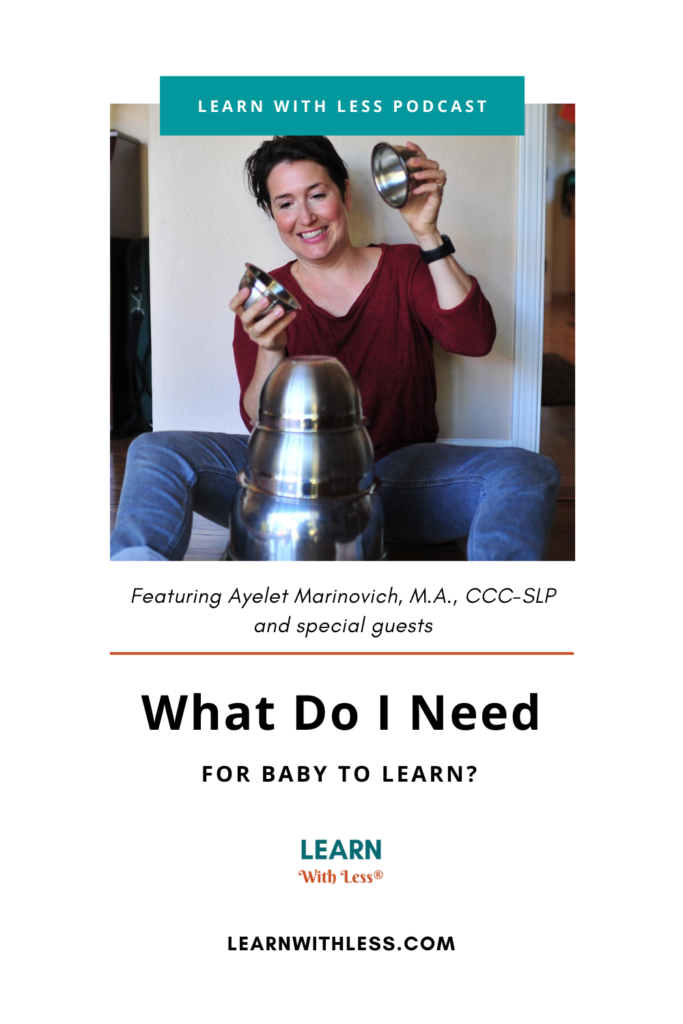
What Do I Need For Baby To Learn?
Aug 28, 2019
Show notes
How Do Babies and Toddlers Learn?
It’s so easy to get bombarded with the “stuff” of early parenthood.
Especially when hormones are “out of whack,” and the idea of getting more than a few hours of uninterrupted sleep seems years away.
The sense that we’re “winging it” is often all encompassing. We feel like we’re constantly playing catch up – which can be especially daunting for those perfectionists among us, or if we felt like we were pretty good at most things in life before parenthood.
So, we go out in search of the “best toys” to support our babies, or the “parenting expert” that can tell us the formula for sleep, discipline, introducing solids, potty training, or anything else we need to know – often right in that moment, and often desperately.
But let me tell you something…
We are all asking the same questions.
And our babies are all so very, very different.
In fact, when I incredulously placed my second child down in his bassinet “sleepy but awake,” (something that I had never ever done successfully with my first baby), I could NOT believe my eyes when he actually did the thing SO many of these so-called “sleep experts” said was supposed to happen.
I suddenly felt so validated – that it hadn’t been “my fault” – and that I simply had two tiny humans with radically different needs and preferences.
And what did I do first?
I called my mom.
I wanted to share my experience.
Learning Is Relational
I wanted to scream this information from the rooftops, and chat with every single new mom (and dad) I knew – about how some babies are sleep unicorns, and some simply have different preferences!
Because learning is relational. And we’re all learning off the cuff about how to parent each of our children.
But when we know more about how our babies learn and develop, and when we can compare notes with other families and have a sounding board about this crazy early period of time in parenthood…
Then we feel like we have options and ideas to know what our next steps are – even if we feel isolated at home with a tiny dictator.
I’d like to introduce you today to a series of parents and caregivers who have grown to feel supported and reassured – even as first-time parents, even if they weren’t raised with siblings, and even if they didn’t have much contact with babies most of their lives.
They’ve learned how to watch, observe, and discover their children – as well as what was happening to them – as they move through these first years of parenthood.
The first person I’d like to introduce you to is Gwen, who lived in the same part of London as I did when we first became moms.
Here’s how she describes journey into motherhood:
“I was a first-time parent. I’m an only child. In fact, myself, I didn’t grow up with siblings, I hadn’t had much contact with babies most of my life.
And so I came to motherhood with this being, feeling like a complete amateur, and, that’s a bit, I know I shouldn’t feel so critical of myself, but I felt, you know, a bit isolated and a little bit lost.”
Rachel, a speech-language pathologist who works primarily with adults, describes it in a different way:
“I felt really comfortable in the mom role. I’d been waiting to be a mom for a really long time…”
But at the same time,
“Motherhood is such a double-edged sword of feeling like you’ve got this, while simultaneously feeling like you have no idea what you’re doing.”
Lisa, a nurse practitioner, spoke about that overwhelm:
“And I think with the access that we have with social media, you know, oh, this is the thing to get, right? This is the thing to buy, you need this, you need that.
And then as a new parent you’re like, ok, well I guess I got to get that, but then you ended up just accumulating so much stuff that you know, I mean, where am I going to put it?
I have a small house, you know. I can’t always buy everything and then it might not really be useful. You know, you kind of get into the hype.”
Ok.
I think we can all agree that it would be AMAZING to just be able to drown out the noise… and discover what you actually NEED.
It really is fear-based.
As a new parent, you want the best for your kid. You want to make sure you’re interacting with them “right.”
Brooke, a marketing executive turned stay-at-home-mom, shared this:
“It wasn’t until about a month in that I felt like I wasn’t maximizing my time. And coming from a very stressful marketing job that was go, go, go all the time, doing multiple things. I mean, the amount of stuff that I got done in a day at that job is just, I mean, it blows my mind now.
You look at going from that to staring at this infant, and I just really was… I really had some struggling around how to, you know, make sure that I was doing the best job that I could as a new mom: now that I wasn’t in that marketing position, this was my new job! And I just felt like I didn’t have the resources to know exactly what to do.”
So, if you had a guide that told you – without you actually having to even pick up a book, and without you having to actually BUY ANYTHING – “if you do this, it helps this part of their brain develop,” would you be more inclined to actually do those activities?
Hidden Mysteries
Here’s the thing.
There are hidden mysteries behind how and what your baby is learning at every moment in those first three years.
So what if you could become a baby detective, uncovering the mysteries, so you never had to feel frustrated or bored?
What if you could discover how to connect with your baby through play, music, and movement… even if you don’t know the words to a single nursery rhyme?
What if you could discover how to give your baby the “right” stimulation, play, and interaction to develop – without ever having to hit the “buy” button on Amazon?
And what if you had a chance to actually observe other families doing the same kinds of activities, using simple, repurposed “toys” from their own homes, as well… even if you work full time or have limited offerings in your own community?
Here’s how Manuela, an actor and theater director, describes what she was able to gain in participation with the Learn With Less® Curriculum Online Family Program:
“Watch my child, and discover I wasn’t alone in discovering what was happening. So I was watching, observing, and together we used to discuss behaviors, our behaviors, too!
Not only our children, but also our reactions about them, about what was happening to us, as well. It was huge, it was huge.”
And Gwen, who you heard from earlier, described:
“Ayelet, she just brought us together and she created this community, which is a wonderful thing, which made me feel supported and reassured, and it’s just, it was such a wonderful warm feeling to meet… I think she just taught me that parenting is, is simple.
That you just need to get away from this tendency to just want to keep doing things, buying things, and reading books and so on. And you just need to sit back and observe your child and listen to them, and just let them lead you – as opposed to doing what instinctively I did, which was to want to lead her…
You gave moms so much confidence. I think that really is key. That’s what I was liking at the start. That is the key to so much of what parenting is, you know, and accepting that you’re not perfect. It’s a powerful way to guide our, our children. Parenting is such a marvelous journey of self discovery.”
Brooke feels that the community around the Learn With Less® Curriculum Online Family Program is different from what she’s found elsewhere.
“And moms are the worst to each other. I mean, really, the judgment comes from the other mom in the grocery store. And I feel like we just kind of put that on the back burner and we’re all there to really improve what we’re doing as mothers and parents, and make the most out of it for our kids.
So yeah, and as it’s grown, I think it’s been fun to invite like-minded women and men, and grandparents, and everybody in – caregivers of all kinds. And none of us are… and maybe I’m generalizing, but I don’t feel like it’s a “Pinterest mom” kind of group.”
Josh, a former high school teacher and the father of a toddler and new baby, shares this:
“I like the videos, reading the transcripts, there’s so much. You are very economic with your words and you’re very precise, which is beautiful because it doesn’t take long to read. They’re in small chunks, so I get them and I don’t feel like it’s interfering too much with my lifestyle.
And I love the posts that other people make, sharing, you know, we’re all in this together. It’s relational: learning is relational and that’s hard on line. It’s hard in an online community. So, you know, putting comments at the end and seeing what other people say, I mean, I forgot what the one mother said, it got me feeling and I wrote out all those thoughts. I was like, wow, that was really cool.
She just helped me really solidify a lot of what was going on in my mind, and look, that could not have happened if there weren’t other people involved. Yeah.
And it doesn’t all come from you. It comes from all of us, and you as that guide, creating that environment, creating an environment in which we explore and we look at and poke around and get frustrated with and figure out. So I love the interaction. I love the nuggets that I can chew on and come back to.”
Here’s Laura, who works full time and wants to savor the moments she has with her toddler daughter:
“It’s been an encouragement to move in the direction that I would like to be spending more time in. So, I have these buckets that I use to save water. So when we warm water for the shower, I fill up a bucket and then use that bucket to water the plants.
And my daughter’s super interested in the buckets and she just wants to play in them all the time, like splash around and get wet… and I sort of am like, ah, that seems cute and probably a good idea, but it’s such a mess, and I don’t have time…
And then I read one of the sensory play things and I was like, actually, like, that’s awesome. She’s interested in it. It’s free, it happens anyway. It’s like, it’s right there.
And so, it’s encouragement for me to like just step back and see that as an opportunity for her to engage and learn about like wetness and water and, just, you know, putting her hand in and seeing that it looks different under the water from above the water and gravity and just all these things and not worry so much about like, yeah, you’re going to have to change her outfit afterwards.
That’s not the end of the world, you know. So just encouragement that those things for her are valuable and it’s worthwhile…
It’s valuable to be reminded that that kind of thing is really valuable for her, and that there’s a reason to, to let that happen organically. And not have to like go to the swimming pool where I have paid for a swimming lesson in order for her to have her explore water.
You know, we could do it everyday in the bathroom. It’s just more integrated into our lives, which I think is a real positive.”
Rachel offered a similar sense of freedom as a result of participating in the Learn With Less®Curriculum Online Family Program – that sometimes…
“It’s one little sentence that can just like radically alter what you’re doing maybe in a moment, and you feel good about it. You feel like you don’t have to stress about it because it’s one tiny little thing, it’s one little detail and it’s just using what you already have.
But it’s also like a little revolutionary sometimes, especially when you are really tired and you’ve spent all morning and all you’ve really managed to accomplish is feeding everyone…”
Manuela and Gwen spoke together about their impressions:
“I think that the most valuable thing you gave us was really many different ways to connect with your child. So to discover how even very, very, very simple things. So this is the most valuable things I’ve learned. I think that is your work is to meet your child where they are. Acknowledge where they are.
And that’s just like 80% of the, the whole journey. It’s such an accessible approach in every way, including financially, but it’s, it’s really so encouraging and reassuring because it makes you realize that you can thread this into every single aspect of your day with your child.
You need to find out. Yes. It’s a way to learn how to see. And it’s personal. It’s totally individual and therefore it is perfectly suited to you and your child in that moment.”
Thank you Rachel, Brooke, Josh, Laura, Gwen, and Manuela for sharing your thoughts.
I’d like to invite you to learn more about learning with less. You can do that anytime by heading to strengthinwords.com/online to learn more about the program.
But I also want to tell you that I’m going to be holding a FREE live workshop on September 5, 2019, where I’m going to share how you can stop winging it and raise a great human from day one… without having to buy a single toy…
If you want to release the overwhelm, feel more like you’re “winning” it, and find support and community within the time you already have…
How Do You Learn to Follow Your Child’s Lead?
Aug 21, 2019
Show notes
Responsive caregiving starts with learning to follow your baby’s lead. In this episode of the Learn With Less podcast, Ayelet chats with Manuela and Gwen, two mothers living in London, who became parents at the same time as (and along with) Ayelet, and who became much of the inspiration for the Learn With Less® Curriculum Online Family Program. We cover the ways in which, through the powers of observation and the benefit of learning through a framework and in community from each other, these new parents learned to find the confidence to play with and support their babies, what types of activities they did to guide their children (using simple materials they already had), and how they learned to use play, communication strategies, music, and movement to support all areas of their children’s development. QUICK ACCESS TO LINKS FROM THIS EPISODE: The Learn With Less® Curriculum Online Family Program: stop winging it and raise a great human from day one – without having to buy a single toy Understanding Your Toddler: A Month-By-Month Development and Activity Guide For Playing With Your Toddler From One to Three Years, by Ayelet Marinovich Understanding Your Baby: A Week-By-Week Development and Activity Guide For Playing With Your Baby From Birth to 12 Months, by Ayelet Marinovich TEXT TRANSCRIPT OF THIS EPISODE Ayelet: I’m joined by Manuela and Gwen and we are sitting here in London… And we are just regaling the past. And I thought that there are not many more appropriate people than the two of you to help tell the story of how this whole thing was started. Because we met, actually, the three of us while we were still pregnant with our first. Yeah. And we met in a prenatal yoga class and I remember actually one of the first days that I met you, Manu. Well that I was just amazed by, you were just like the stuff you ever got, a long, beautiful dark hair and this just perfectly pregnant belly. And I was like, wow, she’s so cool. She’s so Italian. And, and then we walked out and you got on your motorcycle and you put on your helmet and you just sped away. And I was like, “wow, I can’t wait to see her next week.” Manuela: Pregnant on the motorcycles… not advisable! But… it was that, I know. Ayelet: A very easy way to get around in London. Manuela: And I also remember the first time I met you! I remember as yesterday. This woman, this girl, actually. I remember a lovely light, sunny day. There was light coming from the window, and I saw you with a green chiffon on your hair. I don’t know, you were so… energetic! I said, “oh!” This is my first memory of you. And it was magic, and I said, “I don’t think she’s English.” Because I didn’t hear your voice yet, but I was wondering where you were coming from. But I was amazed by your energy and your colors. I remember green, and the light. Gwen: My first memory was thinking, “she is not English!” because… I was sitting next to you on the yoga mat. And I’d never spoken to you before, I don’t think I’d even seen you before. And you just came and started having a conversation with me – with a beautiful, I remember, very open smile, and thinking, “how nice!” You know? So, the English are a wonderful people, you know, but it takes a little longer to open up. Manuela: So, you brought us this amazing energy, and then when you left, we struggled to find again! Gwen: That’s fast forward, huh? What about the babies? Manuela: Yeah! Right, what about the babies. And then we started this journey together. Yeah, and I remember it was really together in the real sense because we started to discover things together. Gwen: Yeah. I think if I were to summarize, I was a first time parent. I’m an only child. In fact myself, I didn’t grow up with siblings, I hadn’t had much contact with babies in most of my life. And so I came to motherhood with this being… Feeling like a complete amateur and, and that’s, I know I shouldn’t feel so critical of myself, but I felt, you know, a bit isolated and a little bit lost. And Ayelet, I think, as you were saying Manuela, she just brought us together and she created this community, which is a wonderful thing, which made me feel supported and reassured and it’s just, it was such a wonderful warm feeling to meet once a week and sometimes more. And then I think she just taught me that parenting is, is simple. That you just need to get away from this tendency to just want to keep doing things, buying things and reading books and so on. And you just need to sit back and observe your child and listen to them and just let them lead you as opposed to doing what instinctively I did, which was to want to lead her. Ayelet: But we’re the grown-ups, right? Isn’t that our responsibility? Gwen: Yeah! And, and I think I wouldn’t be lying if I said, I think the group we had at the time that Ayelet was leading really changed my parenting journey completely, gave me confidence and changed, changed my life in more ways than one. And, yeah. Fast forward to the day I heard you were leaving. What are we going to do? It was, what are we going to do? Manuela: We had the second child – without you! Yeah. We were, because we were still meeting a lot. Catching up. But having this big loss. Gwen: Yes, exactly. But you had sewn the seeds. Manuela: Exactly. Trying, trying to, to do exactly what we were doing. Even without you, but with your guide in our mind. Yes. Try to… We didn’t need to remember it because what we’ll learn together, uh, it was in our veins. It was already in us. Yeah. So we didn’t have to remember something but only to say, okay, let’s do yeah – Ayelet’s way what she would do that. Ayelet: First of all, what were some of the things that stand to you that we did together that, that were so special? Manuela: As, as Gwen said, I was, I’m also an only child, only child, so, and I really didn’t have any contact with babies in my life before, so I really didn’t know anything about babies. Not even a book about baby, nothing, nothing. We, for me it was this, watch my child, um, and discover – I wasn’t alone in discovering what was happening. So I was watching, observing and together we used to discuss behaviors, our behaviors too, not only our children’s behaviors, but also our reactions about them, about what was happening to us as well. It was huge. It was huge. We, uh, we are alone in London. We are alone and so we were, we were growing up children on our own. Yeah. So the support, it was like we were a big family, but not with the pressure of a, a family would have done if we would have been in a family context probably. Gwen: And I also think, yeah, as you were saying, talking about how the children were developing and their behaviors as you say, was helpful. And at the same time you were always saying we’re not comparing. Right. Yeah. It was done in such a nurturing and friendly way and, and, and just emphasizing that every child is different. Every child develops at their own pace and you know, in some context parents are kind of competing with each other and they compare the children and then they get anxious and you were doing everything you could, Ayelet, to sort of dispel that, immediately, and make sure everyone was observing their child as its own, as, as an entity in and of itself without ever thinking, oh, Joe’s kid of doing that or… And starting with yourself because, so yes, you were mentioning earlier, your little boy took his time to start walking and, and I remember one session where you openly talked about that and you were saying, yeah, you know, he’s, he’s not walking. And that’s, that’s kind of hard because I was expecting it to happen earlier, but I know that he will do it in his own time. And he did. Right. So, yeah, Manuela: For every child is different and this is incredibly special and what a parent should do is watch it, watching the progress and uh, and to try to guide them but not to teach – another thing. Yeah. Try to guide without, without teaching. Because I think that this is the main point I’ve learned. Ayelet: I think too, like when, when we’re grown up, we don’t, unless we’ve studied child development deeply, you know, in depth than how, when was the last time you played with a baby? Probably since when you were a baby, you know that it’s a very, as you were saying it, it takes this reframe to feel like, oh, okay, well this is, I can follow what my child is doing and then I can support her or him by, by following what he’s interested in or what he or she is doing. So I’m curious if either of you remember what, like if there are specific activities or specific moments or songs or things that we did that stand out to you as like an example of how we did that? Gwen: I mean the, uh, the one thing that always stuck with me and the way you conducted your sessions was always you reminded us, well, try to avoid a sort of flash card approach to “what’s this, what’s that” hold up a picture of a cat. The cat goes, “meow, and the dog goes woof, and yeah, and what is it? Ayelet: Right! That’s what we think of as teaching. Gwen: So to me that was, I think that was one of the first things you came up with. And I thought, yeah, of course! And, and then just giving the child different options. So if you had a basket full of objects, you would, instead of just taking one yourself and giving it to the child, you would offer the basket to the child and give them time. You would say, wait, wait, let’s just see what, what she or he decides to choose, what object they would like to play with. And then you were saying, okay, so giving lots of different options around it. Say, so what is it, see it, is it round? Does it make a noise? What kind of color is it? What do you like about it? What would you like to do with it? Do you want to put it near your nose? Do you want to hold it this way? Do you want to put it on the ground? And, and I’m, I’m doing like a completely, you know, it’s, I’m going a lot faster than you ever would have, but it’s just like between everything I have said, you would just pause and wait and observe and yeah, for, for, for first time parents, I think most first time parents, that’s quite hard. But you learn the value of that and you discover your child as they are, not as a reflection of yourself or as well as how you expect, perceive them to be. Ayelet: Yeah. But I also remember for instance, this is such a good example because Gwen, when I met you, you, you are this like warm, loving person who is quiet and gentle and your daughter was a spit fire and amazing and had all this amazing energy. And I mean I recall they, I don’t think they were sitting up yet, they were so little. And she, she would lean in and she would grab the ball and then, and then push it away and, and we had essentially a ballgame with these teeny tiny little babies and they would sort of take turns and sort of move it back and forth. And she wanted that ball – and she was – her personality was showing through from such an early age. And, and this was, I think the first time that we all witnessed this. Yes. And you were like, yeah, this is intense, and really hard for me cause she’s not like me! Gwen: Yeah, I remember that so well, she sort of tucked her chin in and her eyes were like daggers and you’re right. I couldn’t even see how fast that well, but I could sense, oh my goodness, I don’t think I would have ever done something like that when I was a small child and, and it’s true. In one of the sessions I was saying, one of my biggest challenges is realizing how different my daughter is to me. You know, and you go through pregnancy, just imagining a mini me of yourself popping out. And no! Of course not. Right. Yeah, they are. They’re sentient beings. Yeah. And you just seemed to go with it and that’s, I find that so hard. Just go with it. Manuela: And I have to say, also the music, the music. Instruments, different instruments to use and not only instruments, everything. Anything that was making a sound and then the voice, and then putting words together in songs. And that was amazing. I can see today after five years, how powerful was that for them? For them. Because this music is so present in Sofia’s life so much, so much in the she, today I think she’s able to invent songs everyday she invents songs and that she remembers that is amazing. And she has these huge links with the music. I think because she was born like this, no we did it. You, you, you let her in this journey, you let them in, in, in this journey. Gwen: Sounds, words, and rhythm. You were very… I think to me it was the just getting them to feel rhythm. And I Ariana lost dancing so much and from what I understand, you know, pretty good at it and I think that sense of rhythm comes through a lot. But you were teaching it to us in ways that was so simple to just do at home. Manuela: To repeat it. Gwen: To me as I’ve said, it was using simple materials in simple ways that you can easily do at home without a lot of paraphernalia. And that was reassuring, too. You don’t have to go out and buy all these things. Manuela: I remember one thing, the toilet paper – the toilet paper – that was amazing. I never thought about it. I never thought about it. Then I saw you putting things in the shape. Um, let’s see which shape can go through and which shape can’t. So because they are too big or because they are too small, that was amazing and Sofia could spend hours in that. And the same I did with Alice. Even if you weren’t here! So I taught Alice to use the different things in the home. Yes. Things. Uh, It was a way to see the way to see things in your house so you can use everything. Gwen: In the end, that’s all they want to play with. Yes. We have more toys than, I don’t want to admit – thanks to grandparents, amongst other things. Manuela: Yes, that’s the truth. Gwen: But they don’t want to play with most of their toys. They just love the things that you use in the home. Yeah. And they learn so much from those things. Ayelet: Right. And it’s up to us to figure out, not only are they the things that we’re using, but they are also very powerful learning materials. Just as powerful as the beautiful toys that you have in your home. They… The developmental value of that fancy wooden drum and the kitchen with shelves that you have in your, you know, playroom is the same as the shelves in your kitchen. Oh, I was going to ask, I think you consider yourself quite musical, Manuela you, I mean you come from, you’ve used music for many years and you’ve also had much music in your life as well. But did you, what do you think there were certainly people in our group who did not consider themselves musical and I mean obviously you can’t speak to that personally, but what were some of the observations that you had about that? And do you think that we were able to show how music was a powerful tool even to people who are not necessarily confident in their own use of music? Gwen: I mean, that’s, I, yeah, definitely I can vouch this, one of the lovely ladies in the group that is still a very, very good friend of us, Jenny, said to me at the start, you know, I never thought I could ever sing. And anyone who thinks they can’t sing probably isn’t very confident seeing with their child. And I think you’ve transformed that for her – to the extent that now she sings in the choirs at schools! And when she told me, I went, “you’re singing in a choir?!” I watched her last night! It was awesome! Yes! So yeah, as I said you gave moms so much confidence. I think that really is key. That’s what I was liking at the start. That is the key to so much of what parenting is, you know, and accepting you’re not perfect. Manuela: We did not feel alone in this journey. This is what it was. And this is what Gwen and I, because we talked about it with the second child and yeah, we felt a little bit alone. That was, even if, no, we weren’t alone at all. But yeah, there was, um, very, very powerful way to guide our, our children and ourself…
Where to Find Baby and Toddler Development Toys
Aug 15, 2019
Show notes
What baby toys do I actually need?
The baby industry would have you believe that toys with all the bells and whistles will do wonders for your young child’s development, yet experts in early learning disagree.
This leaves parents and caregivers feeling lost and confused.
You want to encourage your tiny human’s development, but you don’t know where to start!
There’s so much information out there, it’s easy to feel like you’re spreading yourself too thin.
And somehow, with all the play materials you’ve invested in, you’re out of ideas.
Text transcript of this episode
You and your young child(ren) are bored with the current selection of toys and activities in your home.
You know that your child responds to music, your voice, and enjoys exploring the environment but…
How do you structure your home and play materials to create the ideal learning environment?
How do you provide your child with developmentally appropriate play experiences when you barely have time and energy to take care of basic needs?
How do you “do it all” when you’re little one’s abilities and interests are constantly changing – and when you’re not quite clear on why certain toys are “better” than others?
The undercurrent of anxiety
Many of us feel an underlying sense of anxiety that we’re not doing enough or doing it right.
THis leads us as parents to be easy targets for the baby industry.
“You need more.”
“Get the latest learning toy.”
“Subscribe to get these expert-curated toys delivered straight to your home each month.”
What if there was another way?
What if there was a different way, a better way?
A simpler way?
What if there was a way to minimize the overwhelm and the “stuff” of early parenthood?
And what if this new way were able to save you time, energy, and money (your most precious commodities)?
… So you could raise happy, smart kids from day one… AND feel supported in doing it.
Because everyday household items are where it’s at.
Support your babies.
I know you want to support your precious, tiny humans
It’s my goal to show you how you’re often already doing it.
Now, over the next few weeks, I’m going to be talking more about how the Learn With Less™ Curriculum can help you along your early parenting journey.
But today, I just want to leave you with this little thought:
I want you to consider this reframe, for just a second:
Instead of constantly setting up completely new, separate activities for your child with a fancy “expert approved” toy…
Think about what you’re already doing in a different way.
Make tiny alterations and adjustments so that the time you’re already spending with your child, and the materials you already have in your home can be more enriching.
Now, I’d love for you to tell me over on Instagram or Facebook how you’re already learning with less in your family.
Creativity Outlets For New Parents, With Beryl Young
Jul 24, 2019
Show notes
Why (and how!) to have a creative outlet as a new parent In this episode of the Learn With Less podcast, Ayelet chats with Beryl Young, a mother, former elementary school teacher, and creator of the Momtography Method® and Recapture Self. Beryl fell in love with photography in 2009 as a way to document the exciting time of becoming a mom. Now, she’s helped thousands of moms around the world use their creative energy to love their photos and their life. We cover: Beryl’s background and how she came to do the work she’s doing todayThe reasons why having an outlet for oneself is important (even/especially in early parenthood!), How to incorporate room for small moments of creativity into your life, whether you work full-time or home is your workBeryl’s top tips and resources to help you “recapture” yourself! QUICK ACCESS TO LINKS FROM THIS EPISODE: Momtography.club: Capture yourself; create a life you love (Beryl’s website) CreativeBug: award-winning video classes for makers Abundant Mama: live and mother from a place of abundance TEXT TRANSCRIPT OF THIS EPISODE Ayelet: Welcome to episode 79 of the Learn With Less podcast! Today, I am speaking with beryl young. Beryl is a mother, former elementary school teacher and creator of the Momtography Method®. She fell in love with photography in 2009 as a way to document the exciting time of being a mom. Now almost 10 years later, she’s helped thousands of moms around the world to use their creative energy to love their photos and capture more of what matters in their life. Beryl, thank you so much for being here. Welcome to Learn With Less. Beryl: This is so exciting. Thank you for having me. Ayelet: So, I have asked you to come onto the show today to speak to us about, you know, why it’s so important for us as parents and caregivers to actually connect with some kind of creative outlet. But first I would love it if you could just tell us a little bit more about you and how you got into this work that you’re doing today. Beryl: Alright. So I’m Beryl Young. I live outside of the Washington D.C. Area, kind of in like the northern most tip of Virginia though, not in the city. We actually live in the country. I like to call it my little country retreat and it’s me and my eight year old daughter, and my husband, and we have two cats and a dog and we live a nice little quiet life together. But it wasn’t always that way. I remember, I know you just, you just released your [second] book recently and I remember those days with a young one at home and… The story of how I found photography is a little bit interesting, because my entry into parenthood was not the easiest. I don’t know if you’ve talked with your members at all about miscarriage and stillbirth and loss, but we… My first pregnancy was a pregnancy loss when I was 20 weeks pregnant. That was in 2009 so it’s been almost 10 years. And at that time in my life, you know, I was definitely one of those like check the boxes, go through the motions. Like I went to college, I got the job teaching in the public school system right after college and you know, I was doing all the things that I should do. And I got married to the boy that I met when I was in college. And then it was like, okay, the next logical thing is we start a family. And so, you know, I was going through those motions. And so having the stillbirth, it was like this really jarring thing and like grief as I had never experienced it before in my life. And so the camera unexpectedly, like I was learning photography because like a lot of parents, new parents, it’s like, wait, I want to be able to capture every little moment and get every little thing because I know everybody tells me it goes by so fast. So let me get the fancy camera and do something with it. And I was gifted a DSLR camera one of the big fancy, you know, has all the lenses and everything and I was gifted that as an early baby gift. And so then I had this camera that I was trying to learn and we had the loss… And the camera became this thing that was okay. I guess since I don’t have the baby to take pictures of, I’m going to use it to heal from the grief. And so the beauty of that is that I learned very early what a lifeline the creative process could be. And so, you know, I learned it I guess pre-kids although my first daughter who’s not here with us as the one that taught me that. We were lucky enough to very quickly get pregnant again. And so almost exactly a year later we had our daughter who’s now eight and she is spunky and she is independent and she was diagnosed with ADHD last year. So we’ve been on this very like wild journey with her. But the thing that has always been there through all of those trials of raising her has been the camera, and it’s the perfect lifeline. It’s the perfect entry into keeping that creative spark alive. I hear from so many moms that are like, oh, I used to do this before I had kids, I used to do this, whether it be a sport or a creative hobby or something that used to be able to leave the house and do that, you can no longer do anymore because life. And I’m like, well you have a camera at home. You can use this and still be creative. Yeah. Hopefully that answered your question. Ayelet: Yeah, I think that’s great. And if anyone has any questions who’s watching live, please go ahead and ask them in the chat or in the ask a question box below. So here’s a nice big question for you, Beryl. So why in your words, is having that outlet for oneself so important even or especially in early parenthood? And I think you answered that a little bit just now when you describe the sort of coming back from grief, it’s a healing tool for sure. What about other, because you’ve worked with so many new parents, especially moms, but I think also parents in general and caregivers. What are some of the reasons other people have expressed to you about why that creative outlet is so, has been so important? Beryl: So this has been expressed to me a little bit from some of my clients, but it’s something that I learned through the process of teaching the Momography Method®, and through my own experience now that I have an eight year old we, whether you’re a stay at home mom or a working mom, it’s busy like early parenthood when you’re taking care of little ones is just, it’s crazy. It’s, it’s there’s something new every day that you’re learning about yourself and it can be really easy to lose sight of that person that you once were because we’re such givers. We’re giving to our families and we’re giving so much of ourselves over to our children, which is not a bad thing, but then I find that I work mostly with moms that are in transition, whether it be the transition to, Ooh, I want to learn my camera because I just had a baby. Or then I work with a lot of moms that are in that transition from, wait, my kid, my child’s entering kindergarten, and now I’m going to have the whole day to myself again and maybe I want to go back to work or maybe I need something for myself or what, wait a second, I’m going to have this time. What do I do? And it can be a really rocky transition and I also work with moms who are sending their kids off to college or they’re just graduating from college. Right. And I found this link between, oh, the women I work with are in times of transition and the camera is something that can be there through all of those times. That transition, and you may use it differently, but I think it’s so important to keep that line of energy because I learned so much about myself about getting curious and it’s supported me through, I haven’t had the transition to college yet, but through any transition, I’m always going back to the creative process. And it’s not just photography, like photography is the main tool that I use, but I have other creative interests too and it’s just come to that like, oh okay, what do I need today for myself that can be done in like this little snippet of time and snapping pictures can be done in that little snippet of time. Ayelet: Absolutely. And I love that because it’s like whether it’s snapping pictures or maybe you’re a musical person and you really want to get into playing piano or something, right? I mean you can sit down and play with a piano or a stringed instrument or whatever it is or with a camera and you can involve yourself in that just for you. Or you can also find ways to involve your child at any age in that experience as well. And I’m thinking specifically, because I have sort of a musical background, of perhaps like you know, you have your baby laying on your, on the blanket and you sit down at the piano. Or you have your toddler planking out, plunking out little sounds on the, on the string or on the piano or whatever it is. And then you have, uh, you know, pretend camera or an actual, you know, old camera for your tiny person and those are ways that you can, not only can you experience that and do that sort of self care for yourself, which clearly is a huge part of what we’re talking about, but also there are ways that you can integrate your child into that in, in whatever way that makes sense. Beryl: Totally. I love that for a couple of reasons. First of all, I wrote a blog post years ago now, it must’ve been like five years ago. My daughter was probably about four years old and she was having a rough day. I was having a rough day, I was tired. I still worked full time. So this has only been my full time gig, teaching photography to moms, for about five years. Before that I was a classroom teacher for 10… and I came home, she was cranky. We were just both being grumpy in the house and it was in the middle of December, but it was actually warm outside. But I was like in such a mood that I like couldn’t get myself off the couch and I was like, you know what? No, I’m going to pick up my camera. I’m going to let her walk around in bare feet in the middle of December because it’s actually warm enough for her to do that. She went outside! Ayelet: And that’s exactly what she wants to do! Beryl: Right! So she goes outside and just starts picking up rocks and like exploring and doing her thing. But I had the camera and so we were both kind of recovering from that bad mood, doing what we each wanted to do. And unfortunately for me, maybe fortunately for my daughter, she has almost zero interest in the camera. She wants to take pictures sometimes but her creativity comes out in different ways. So like you said, you’re more musically inclined. She loves picking up a paintbrush and painting and I can still supervise her. Like I was never like the crafty activities mom and I know you’re all about learning with less. So like I was never, it took a lot for me to get the paint out and like be like, okay, I guess we’re going to make a mess now. And so instead of me getting all anxious and like upset about the mess I got the stuff out and then I would pick up my camera and take pictures. Ayelet: I love that. Beryl: Yeah. So I was doing what felt good to me from a creative standpoint. She was doing what felt good to her. We didn’t have to be doing the same thing in tandem all the time, which is kind of another thing I learned through that process. That it’s about honoring yourself and your creativity, but also honoring your child and how they’re seeing the world, too. Ayelet: That’s beautiful. I’m just like, as you’re talking, I’m just thinking about all these different ways that you could do that. Like if you’re a writer, you could just write down, like, your toddler painting could absolutely be an inspiration for a poem or a short story or just a narrative of what you did or what you’re… Like, I just love how many ways and it’s like this is not revolutionary, but it feels so obvious once you say it out loud, but it’s like, oh yeah, actually I can take care of myself while I’m taking care of this other tiny human and there’s ways to do that. Beryl: I think we’ll get so wrapped up though and like I have this tiny human and I have to keep my eye on them all the time and I have to make sure that they’re getting my time and attention and energy and yes, they want you there, but depending on the age of your child, you might need to keep your eye on them a little bit more. But there are ways that you don’t have to be doing the exact same thing as them. Right. You don’t have to just be watching them enjoy the world and explore the world. You can also explore and do things too. Ayelet: Absolutely. Yeah. And play, play together. Independent play for your child is probably going to be even likely, right. Because we’re all, in these early years, asking that question of how do I get my kid to play independently? Right? And this is one of those great ways. If you have a child who’s playing with open-ended creative materials, whatever those are, whether they’re, you know, blocks or a cardboard box or some painting or tape or whatever it is, like, your child — and you’re sitting there doing your own thing, whether you’re with them doing the same thing or doing it in your own way or doing your own thing, then you’re, that’s your answer, right. That’s great. Oh, very nice. Very empowering. So I see that we have a couple of questions. We’re going to get to those after the main portion of the interview. How can we, Beryl, and we’ve touched upon this a little bit, but let’s get a little bit deeper into how can we incorporate room for those small moments of creative juices that creative flow into our lives. Whether we work full time or whether homes our work? Beryl: So, everything that I teach in Momtography® and Recapture Self starts with being intentional. And so I think it is really important to ask yourself first, what is your purpose? What is your vision for both your child and yourself and then you have to craft your life around that vision. Now, beyond that, like sometimes we can have those like really big dreams and aspirations, right? Or not like it might just be, let me keep these tiny humans alive today, but I think it’s really important to get curious and ask the questions of like, okay, how can I make sure my child is fulfilled today and how can I also make sure that I am fulfilled today? And then beyond that then it’s making the time and space for it and really making the time and space for it depends on a lot of different factors, but I am all about setting timers. Yeah, 10 minute timers because sometimes the hardest part is getting started and convincing yourself that you do have time for that. You do have space. Sometimes it’s like, oh, in order, whether it be photography or painting or whatever, it’s like, gosh, I need to make sure that I sign up for lessons or that I have like an uninterrupted block of four hours to do this project that I want to do when I actually can make a lot of headway and get a lot of clarity and just short little snippets of time. So like you were just talking about the open ended activities like yes, set your child up with something. And then since my tool is usually the camera, maybe you’ve never thought of using the camera in that way before. So you pick up the camera and you see how that feels to use it while you’re taking photos of your child. But then through that process of being creative, I think creativity breeds clarity and so through that creative process you get more clear on what else you need for yourself. Totally. Yeah. It’s part intentionality. It’s part making time and space in a way that feels like — we work with the same mentor — that makes it feel like it’s impossible to fail. He likes to say it’s the next smallest step that it’s impossible to fail. Exactly. Ayelet: And this is like we’re breaking it down into teeny tiny little pieces because that’s oftentimes when we’re sleep deprived and overwhelmed and feeling exhausted at the end of the day, especially, you know, that’s all you can manage anyway. So yeah, I’m a fan of the timer. Beryl: Yeah, that’s great. I have a friend that is all about mo…
Thriving In Modern Motherhood, with Sophia Salazar
Jul 03, 2019
Show notes
How to build a sustainable lifestyle that includes self-care as a new parent In this episode of the Learn With Less podcast, Ayelet chats with Sophia Salazar, a self care advocate, life coach, mother, and co-founder of BirthBabyBody. Sophia believes that pregnancy, birth, and motherhood is a unique opportunity to harness and share your creative power as a woman, and she is the co-founder of BirthBabyBody, whose mission is to end the cycle of stress, information overload, and feelings of “not enough” that are present in modern motherhood. We cover Sophia’s background, and how she came to do the work she’s doing today, her definition of “self-care,” ways to create sustainable self-care habits, and the difference between “sustainability” and “balance.” Finally, Sophia shares her top tips and resources for practicing self-care in all areas of life. QUICK ACCESS TO LINKS FROM THIS EPISODE: BirthBabyBody: online education for modern parents and professionals Emotional Agility, by Dr. Susan David (Amazon affiliate link) TED Talk with Dr. Susan David on The Gift and Power of Emotional Courage Learn With Less™ Curriculum, a parent education and parent support hub for parents, caregivers, and educators of infants and toddlers Learn With Less podcast episode: Perinatal Mood Changes and Postpartum Mood Disorders, with Dr. Katayune Kaeni Learn With Less podcast episode: Family Wellness and Self-Care for New Moms, with Shannon Shearn of Savage Wellness TEXT TRANSCRIPT OF THIS EPISODE Ayelet: Welcome to episode 78 of the Learn With Less podcast! Today, I am speaking with Sophia Salazar, a self care advocate, life coach, mother, partner and former motorcyclist, world traveler, photographer, New Mexican transplant, women’s college graduate and so many other things. Sophia believes that birth, pregnancy, and motherhood is a unique opportunity to harness and share your creative power as a woman. She is the co-founder of BirthBabyBody, an online educational platform for pregnant and new moms. Sophia, thank you for being here. Welcome to Learn With Less. Sophia: Thanks for having me, it’s a pleasure to be here! Ayelet: So, I have asked you to come onto the show today to speak to us about self care and sustainability in early parenthood. But first, I would love it if you could just tell us a bit more about you, and how you got into the work that you’re doing today. Sophia: Yeah, so basically long story short, when I got pregnant, I had a really intense prenatal anxiety and then we ended up in the NICU with our newborn and that was really hard. And then about eight months postpartum, I had postpartum… I started to get postpartum anxiety really terribly. And so, during that time I was searching for answers to enhance my own wellness and enhance my own self care. I birthed through a birthing center and in the birthing center model there is a community that’s available to you. We had prenatal yoga classes and all that sort of thing and there was a lot of postpartum support even when I was in the NICU. And I kept wondering like how do we bring that to other women who may be suffering like I am, or just to people in general who are just stressed out by being new parents. And so that led me to Doctor Katherine Melot who’s a pediatric chiropractor who had the same ideas that I did in terms of bringing online education to people or rather education about self care and wellness to people online. And doing that by having a hub for that type of education and not just focusing on birth prep or pregnancy stuff, but the whole thing, which is a, yeah, a more comprehensive view of pregnancy, preconception birth and postpartum and understanding that postpartum is anytime after you have a child, not just the first six weeks. Ayelet: Yes. And we have another episode on that with wonderful Dr. Kat Kaeni, who’s a maternal health and postpartum perinatal expert. So yay. So this really is, again, we’re looking at things holistically. I think oftentimes we do feel like, oh, you’re pregnant and then you have a baby. And those are two separate things. But of course they’re all pieces of the same pot and we feel very different after we’ve had a child. We’re different people. We have a big, big shift in our own personal identity. So I would love for you to speak a little bit, first of all, just to define for us in your mind that term “self care.” Because I think, you know, over the last few years it’s become a big buzzword in the whole wellness space. But really what does self care entail and what does it mean to you? Sophia: So, self care is anything that you do for yourself that promotes physical, emotional, mental, financial, and professional wellbeing. So this is the part where I take a more comprehensive view. It’s not about just, like, getting a massage. I mean, obviously, and I think that if you’re part of the wellness community, like your understanding that self care is a little bit more comprehensive than that, but it’s something that like, it’s a daily practice. It’s not a luxury. It’s not, you know, a vacation in the summer. It’s not like alone time once every couple of months. It’s not that, it’s creating a habit of wellness and that looks differently to different people. It depends on what brings you fulfillment, spiritual, like fills your own personal cup. And so I often use the analogy, you know, when you’re sitting on a plane and they’re telling you like to prepare for the oxygen masks and all that sort of thing. They always say like put your own oxygen mask on first before helping other people. The same thing goes to like filling your own cup first, because then you’ll have something to give to others. And I think oftentimes we get very depleted, especially when you’re taking care of other people. And, and I understand that like in having a child, like things change and sometimes you do go, your own personal self gets put to the back a little bit because that baby is a priority, but it’s remembering like, oh, you’re still there and you still need to fill that cup in order to be able to give to not only your child, but to your relationship, to your career and to your friendships. And so I think, yeah, I just think it’s a little bit more comprehensive and I think that there are things that we can do to ensure that we’re practicing self care every day. And that has to do with understanding our own personal values and emotions and all that sort of thing. Ayelet: Yeah. So all right. How the heck you do that? Yeah, how can we create sustainable self care habits? And is that the same thing as finding balance? Sophia: So I think the term balance is very misleading. I think it often makes us think of like a pie chart or you know, or the scales where it’s like where you have to equally give to all parts of your life and that’s somehow balance. But rather I like to reframe it and think about personal sustainability, because what is sustainable for you is different than what’s sustainable for my life, one. And two, we have to take into consideration the season of life that we’re in. This is something that the leadership coach Michael Hyatt talks about when you’re thinking of making any kind of goal, or different kind of change in your life is, you know, right now, if, if you’re a parent, that’s the season of life that you’re in and that, prioritizing different things in your life is going to look differently than when it did in your 20s or what it’s going to look like in your sixties. And so you really have to be cognizant and take that into consideration. The other thing is, if you’re looking at sustainability and you’re thinking like, okay, well how do I prioritize wellness and self care? You have to take a look at your values. What is most – and values are what’s really important to you in your life, your convictions, that sort of thing. Again, they differ for different people. My values, my top three values right now are stability, security, creativity, and giving. And then when you have, you identify your values in order to create less psychological stress for yourself, you act according to your values. Because when you don’t act according to your values, that causes cognitive dissonance, which is psychological stress, right? So when you’re acting according to your values, then things start to kind of feel more in line. And what I believe is that we as a society don’t value self care. So it’s going to be, so it’s going to take a little extra work to say like, oh, personal wellness is actually a really important thing in my life. And it’s a value. And once you identify that, then you can start taking action toward it. So for me, I’m an introvert mostly, and I’m also highly sensitive and I know that my self care or wellness involves having a long time. When I exercise for example, yeah I do like go to a gym, but I like to stretch in the morning by myself. You know, some people may be differently. Maybe you like to go out and jog with a group of people. You really have to be self aware to understand like what’s your personality, like what are your tendencies towards, and then you know, and what fills your own personal cup. And one thing I want to point out is like when you’re taking action towards your values (and we all know this) emotions, certain emotions come up, right? There are always emotions in life. And I think we, we easily label them into positive and negative emotion, but I just consider them all human emotion and you know, we’ll talk about the challenging emotions in terms of, you know, feeling like you’re resentful, right? Like, I think that’s a thing that comes up for a lot of women is, or parents, stay at home parents, etc., who feel like, oh, I’m doing all of the, you know, management of the household and this other person isn’t stepping up. Or, you know, why am I always stuck with the dishes? Or, you know, and one partner may be, may feel like, why am I always stuck with planning all of the social events or whatever. You know, those kinds of emotions that come up. One thing that I think we have to keep in mind, not just as parents but as human beings, is to learn how to lean into the emotion and really sit with it and validate it and say, hey, emotion, like I see you and I hear you just like you would with a good friend. Like if a good friend came over to you and they were stressed out and… You wouldn’t just be like, no, you know, I just, I can’t, I don’t want to hear you right now. It’s funny, actually had a friend do that to me yesterday… Ayelet: “I can’t deal with your emotions right now!” Sophia: It was a really tough conversation and she was not in a psychological space to listen to my difficult emotions and I understand and I respect that. And that was hard and I cried afterwards and I think that we could have been… Ayelet: And actually, she was practicing self care! Sophia: Yeah! She was practicing self-care, and I, I was, I think responding with self care in terms of like, oh, I understand this really difficult emotion and I’m going to sit here with it instead of trying to push it away, which I think that we, we’ve learned how to do. Whether it’s like, you know, as simple as like, you know what, I’m not going to think about that. I’m just going to scroll through Facebook mindlessly or you know what, I’m just going to have another glass of wine, you know, whatever it is that, you know, for me a long time ago it used to be like adrenaline kind of sports, you know, I’m not going to think about that. I’m going to go ride my motorcycle, you know, that kind of thing. Ayelet: We numb, instead of dealing with the issues at hand. Which, I mean we do, I think as you mentioned, we do very well in our society. We tackle the symptoms and not the underlying issues. Sophia: And this comes really from the work of Dr. Susan David who wrote a book called Emotional Agility, she has a TED talk also that you can look up that summarizes the concept of her book, but she talks about not just trying to be positive all the time, which I think our society is very attached to right now of like, no, you have to be, you have to be happy. That’s the whole point. You have to be thinking positively about things. And the reality is, like the reality of life is more complex than that. We have the range of human emotions and when you acknowledge all of them, not just the positive ones, then you yourself feel more psychologically validated. Even if somebody, especially, I think also, when you have a partner you’re discussing difficult emotions with. So I think in this process of, of self care and creating self care rituals and habits that you’re remembering to be compassionate with yourself and to listen to yourself kindly and to validate and say like, you know, that your whole human experience is a valid experience. Ayelet: Yes, absolutely. I think so often we see on social media for instance, and every kind of media we see these, especially when it comes to motherhood or parenthood in general, it’s like either this like “I’m so happy and my baby’s so beautiful and I’m so glowy” or this like super snarky, “Yeah. You know, F this” and nothing in between, right when we have to, when we can have these conversations about everything in between… That’s where I think for me, the kind of self care that I like to engage in, that’s where it happens for me and that’s where I can feel sustained. And, um, what’s the word? Fulfilled. Sophia: Yeah. I think it’s also just that idea of being heard and seen for who you are. Ayelet: And for your own experience. Sophia: Yeah, absolutely, like your experience is valid. And, and I think as you mentioned with media, particularly with social media, because we can curate our lives really well on social media and, you know, portray whatever we want to, I think it’s a very difficult to be the person to say, “Hey, well actually this is the reality.” And I think it’s funny because I had this conversation with the friend yesterday about how, you know, I was talking about how much of a difficult time I’ve been having because I feel like I need more community in my life. And I was essentially complaining about the places in my life that don’t have community or support, you know. And at one point she kind of stopped me and said, well, wait a second. Like, you need to be grateful. You need to like, let’s just, let’s do a gratitude exercise right now. Tell me one thing you’re grateful for. And I was like, no, no, no, no. You don’t understand. This has nothing to do with that, with not being grateful. I am absolutely grateful. I love, you know, my family, my daughter, etc., etc. However, or rather not even however, AND I am also feeling these very strong emotions. And there’s nothing wrong with that. And I’ve had people tell me, you know, to my face like, oh, your anxiety, your, you know, thoughts about these things, that’s a weakness in you. And I don’t see it that way. I see it as like, this is part of my whole human experience. We’ve been taught to see it as a weakness in ourselves. If you read any of Brene Brown’s work on vulnerability and shame, like, you know about this, is that we, anytime anybody talks about anything negative that they’re experiencing, people want to really pull back from that and be like, like, it’s almost like contagious or something, you know, and say like, oh no, no, no, no. I, you know, and really it’s like it because it makes us uncomfortable. It’s a difficult discussion and conversation to have and to sit with somebody else’s very strong emotions, even – even strong positive emotions sometimes for people, is difficult. And so… Ayelet: I was going to say, we have this tendency to, to want to solve a problem for somebody else. And if we can give it a label, then we feel as the recipient of that information, like we’ve done our job somehow. But I think what you’re saying is so true that sometimes just labeling the emotion, labeling, putting it out there, how you’re feeling, and this is different from…

 Our TOPPODCAST Picks
  Stay Connected