TopPodcast.com
Menu
  • Home
  • Top Charts
  • Top Networks
  • Top Apps
  • Top Independents
  • Top Podfluencers
  • Top Picks
    • Top Business Podcasts
    • Top True Crime Podcasts
    • Top Finance Podcasts
    • Top Comedy Podcasts
    • Top Music Podcasts
    • Top Womens Podcasts
    • Top Kids Podcasts
    • Top Sports Podcasts
    • Top News Podcasts
    • Top Tech Podcasts
    • Top Crypto Podcasts
    • Top Entrepreneurial Podcasts
    • Top Fantasy Sports Podcasts
    • Top Political Podcasts
    • Top Science Podcasts
    • Top Self Help Podcasts
    • Top Sports Betting Podcasts
    • Top Stocks Podcasts
  • Podcast News
  • About Us
  • Podcast Advertising
  • Contact
Not in our directory?
Add Show Here
Podcast Equipment
Center

toppodcastlogoOur TOPPODCAST Picks

  • Comedy
  • Crypto
  • Sports
  • News
  • Politics
  • True Crime
  • Business
  • Finance

Follow Us

toppodcastlogoStay Connected

    View Top 200 Chart
    Back to Rankings Page
    Technology

    Developing Perspective

    Developing Perspective is a podcast discussing the news of note in iOS Development, Apple and the like. Hosted by David Smith, an independent iOS developer.

    Advertise
    • Apple Podcasts
    • Google Play
    • Spotify

    Latest Episodes:
    #179: Avoiding the Stampede. Apr 03, 2014
    Show notes

    A few words of appreciation for the new lottery based WWDC ticket sales. Get your name in the hat by Monday morning.

    Then I talk through some of the tradeoffs involved in choosing the level of abstraction to use for your web-service backends, explaining my own tendency to go pretty low level. Starting from these few posts:

    • The Parts of Your Platform
    • Web Hosting For App Developers
    • On Running Your Own Servers, and Why We’re Not

    #178: Customer Escape Hatches Mar 27, 2014
    Show notes

    After taking credit ;) for Apple’s experiments in search improvements I dive into a few changes to the App Store that could improve doing business in the store.

    Make the App Store Refund policy more obvious

    I really don’t understand why Apple makes the refund process so opaque and awkward. I know from my own experience in physical stores that a clear and easy refund policy helps drive sales. It is far better than a ‘trial-mode’ because it sustains the value of the app (rather than giving it away for free then asking for money later). However, it still maintains that escape hatch for purchases unsure of whether they really want the app.

    I’d love two things, neither of which are actually policy changes.

    • Educate App Store customers about what the policy is and ideally phrase it in clear terms.

    I’m sure there is an internal policy within Apple customer support, but I haven’t been able to find a clear explanation of it. The legalese Terms and Conditions for the App Store states that “All sales and rentals of products are final” but that is clearly not the actual policy since people get refunds all the time. Whatever the policy is this should be clear the customers.

    • Make the process of applying for a refund clear and straightforward.

    Right now you go to reportaproblem.apple.com and then fill in a form. I’d love to see this integrated into the App Store app itself. Perhaps even into the Purchased Apps area.

    Make in-app purchases (especially consumable) more honest

    Building on a blog post I wrote last year I would love to see the App Store better inform its customers about how in-app purchases will affect their experience of an app.

    • Present a typical overall cost for an app in the App Store description

    Make it clear that when you are downloading an app that says ‘free’ next to it that you may not actually be making the less expensive choice. Also, provides a clear expectation about the type of app the user is about to interact with.

    • Show how much you have spent on the app with each new purchase.

    Be upfront with the user about how much money they have spent. Allowing them to make a more informed (and less manipulated) decision.

    Drop or reframe the Top Grossing Chart

    The Top Grossing chart was ostensibly added to help improve the visibility of higher paid apps within the store, at least that is how it appeared to me externally. If that is the goal it entirely fails to do that. Either drop the list or perhaps change it to only include paid apps, or at least exclude consumable in-app purchases from the ‘app revenue’ number.


    #177: Something in Mind. Mar 13, 2014
    Show notes

    I will be at NSConference next week, if you are a listener of the show please make sure you find me and say hi.

    Continuing my series of Towards a Better App Store, trying to find practical suggestions for how we could improve the App Store. Today I’m going to focus on Search.

    • Physical Design: Make the cards interface for search optional (if not eliminated).
    • Ranking: Rewards or punish applications based on objective measures. For example, recently updated, crash frequency, refund requests, reviews, etc.
    • Curation: While still algorithmically based periodically vet the most popular keywords to ensure good relevance.
    • Power Search: Add the ability to filter and manage search results to more finely tune the results.

    #176: Make it up in Volume Mar 06, 2014
    Show notes

    Towards a Better App Store: Part 2

    Make it up in Volume

    This is Part 2 of an ongoing series trying to explore practical ways that the App Store could be better for customers. Today I’m going to talk about the Store’s size.

    The size of the App Store’s catalog is often thrown around as a valuable, useful metric for judging the heath and vitality of the ecosystem. That may have been true before a certain scale. There is value in having a diverse and deep inventory that mets every need but beyond a certain point it completely looses relevance. Duplication, ‘spamming’ and decay of older apps hurts the store more than helps it. In many ways the incredible volume of the Store is at the core of many of the other challenges it faces. App Review takes longer than developers would like. Search becomes tricky. Editorially curating new arrivals becomes daunting.

    It isn’t an easy problem to solve. How do you determine which apps should be allowed in which should not. Just how many Flappy clones should be allowed to exist in the Store? 5, 10, 1000? It isn’t just the overall size that is a problem though, the rate of increase is also increasing.
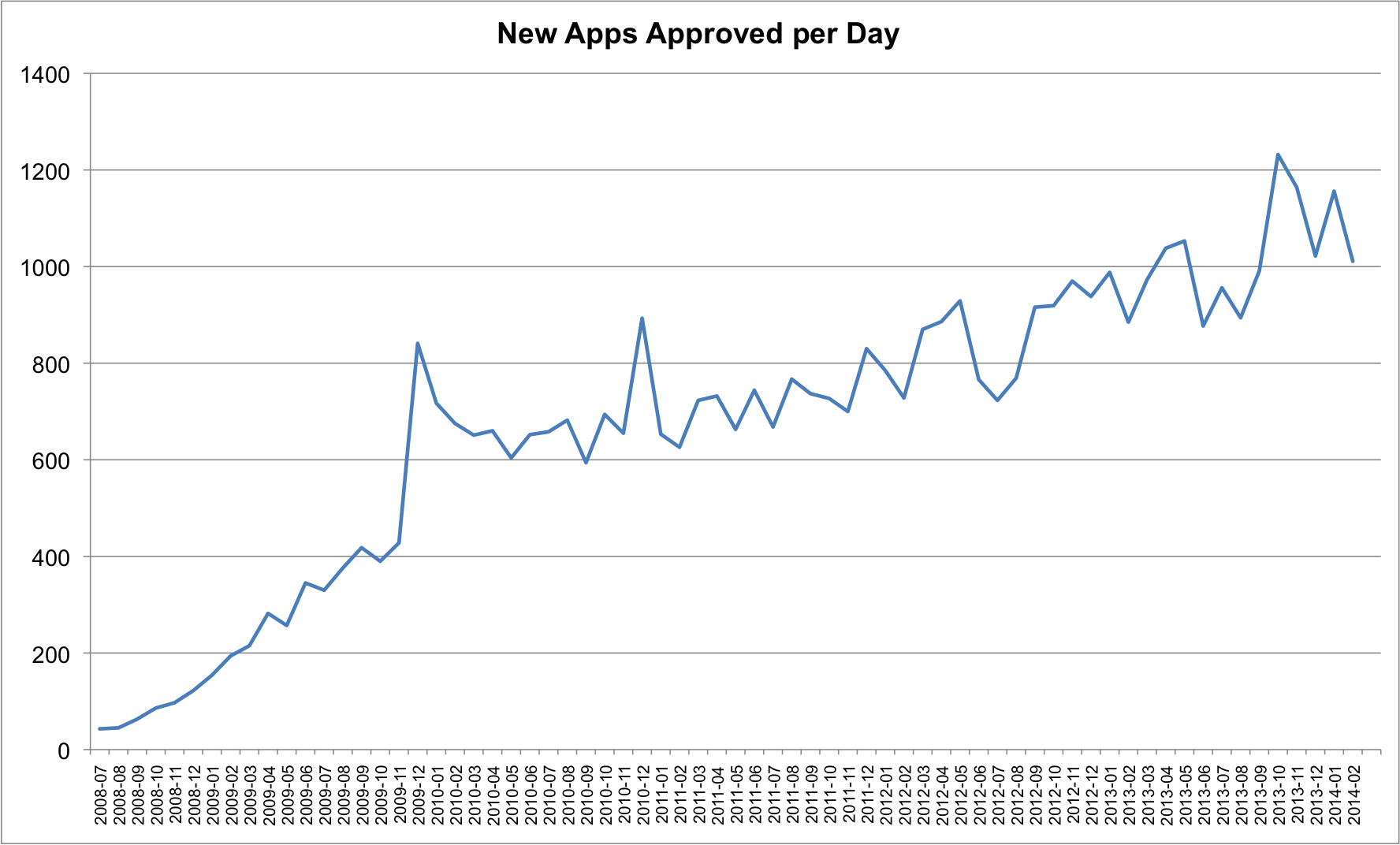
    This is only new apps approved on the store (taken from 148Apps), add to this updates and it is an incredible volume.

    Also, how many of the apps on the App Store are being actively maintained. I’d guess the number is pretty low but the old apps still stay there. Buoying the numbers but not actually providing good value to

    Aside on Apple

    For this whole series I’m going to assume that tackling the questions of making the App Store better aren’t constrained by budget nor desire. I’m going to assume that somewhere in Apple’s Profit & Loss they can find whatever resources they need to attack these challenges. Furthermore, I’m going to assume that they have a desire to make the App Store as customer friendly a place as possible. Both of these seem like reasonable things to assume but I feel I should put that out there before I begin.

    Recommendations

    I had initially gone down the road of trying to work out ways to make judgments about which apps are the ‘good’ ones and which ‘deserved’ to be in the Store. It very quickly became clear that this was nearly impossible to do. While I (personally) can look at apps on the store and say they don’t belong, based on my own tastes. This never generalized. The App Store would be worse off if it were filtered with too harsh an opinion. I had also thought of applying other external limits on the number of apps. Things like raising the cost per submission or number of new apps per developer per year. These would only really affect the current trend of re-skinned apps (which can be better addressed directly), I’d rather have things simple for the majority than punish everyone for a few bad apples.

    I’m reminded of a parenting adage. Have few rules but strictly enforce them. I think this would do much to improve the situation on the Store. The App Review Guidelines are a pretty solid set of rules. They have evolved and adapted to the times but overall they do a pretty good job of keeping out the stuff that is objectively ‘junk’. There are of course grey areas, as there should be, but I don’t have too many complaints with the guidelines we have today. The area that I think we could do much better on is the way in which they are enforced. Specifically, when they are enforced. As best I can tell, other than in exceptional cases once an app is approved it is always approved.

    #1: Apps should be required to pass approval on an ongoing basis.

    The purpose of the having app review and rules about what constitutes an acceptable app is to form and direct the content of the store in the customer’s favor. This applies to things like avoiding crashing, malware ridden software. It equally applies to establishing a baseline of design and development standards that everyone must meet. Having things like the Human Interface Guidelines (HIG) as a requirement for submissions establishes a bare minimum for quality for all apps. However, the App Store is a vibrant, ever moving ecosystem. What was acceptable a few years ago is likely not today, at least not without any adaptations. This applies most concretely to supporting new versions of iOS. Since February 1st all new submissions just be built against the latest SDK and be “optimized for iOS 7”. If that applies on the front end, it should be reapplied to the back-catalog as well.

    Exactly how this would be applied doesn’t really matter. It could be applied on a monthly, quarterly or (honestly) even annual basis. The important thing is that it would create a Store where any app a customer purchases would be assured of meeting and complying with the current set of guidelines. The stated goal of the Guidelines is to “ensure they are reliable, perform as expected, and are free of offensive material.” I believe every app on the store should meet those criteria.

    If older apps no longer meet the stated guidelines for what an app should be they should be de-listed (still available to re-download if already purchased). Leaving space on the virtual shelves for apps that provide the best possible experience for customers. This would constitute a lot of work for the App Review team, but I think it is hard to argue that the result wouldn’t be worth it for customers.


    #175: Towards a Better App Store: Part 1 Feb 27, 2014
    Show notes

    This begins a multi-part series on how I think we could move the App Store forward. I had initially thought this could be a single show but quickly realized that it will take quite a few 15 minute conversations to really unpack what can practically be done to make the App Store a better place.

    A note on Show Notes. I’m planning to continue the long form notes for now, but realize that they are only a taste of what is discussed in the show and not a transcript.

    The Goal

    It is perhaps a bit glib to assume that the App Store is in need of fixing. It is perhaps the most success software marketplace in history. It has facilitated the download of over 60 billion applications. It removed a tremendous amount of friction and hassle with software distribution. It has allowed the creation of a new way for customers to think about software.

    But I think it can be better. I have genuine, personal affection for the App Store. It has allowed me personally to do things I never thought possible. But (to quote myself):

    I want to believe that the App Store is a special place. I want for it to be the singularly best venue for customers to come and find innovative, well designed, quality software. Software that pushes the boundaries of what is possible and continually amazes and delights its customers. I want for there to be an aspirational pull upwards on my own development. I want to feel like I need to work extra hard to make sure my apps meet the high standards my customers have been trained to expect.

    I don’t think the App Store lives up to these projected goals, but I think it could.

    When trying to think of the areas and ways in which the App Store could be improved it is likely not productive to think from a developer’s point of view. In all cases for the App Store to be successful it needs to be customer oriented. I need a target towards which to aim. With this in mind I started out with the goal making an app store that:

    Helps customers find quality apps to fill their current need as quickly as possible.

    That need could be specific (I need to listen to a podcast) or general (I’m bored, What fun apps have come out recently). In either case the goal of the App Store should be to help customers find a robust, quality app in as few taps as possible. Stated in the converse it would minimize customer confusion, disappointment and regret.

    Generally speaking this will also help out developers. Many discussions of what would make the App Store better tend to focus around a theoretical divide between “Good” developers and “Bad” developers. I know I myself have fallen into this stereotyping, but it is unlikely to be productive when considering a broader context. There are some behaviors that we can likely all agree are undesirable (copyright infringement, deceptive marketing, etc) but beyond that it is constructive to start with an assumption that all apps enter the store equal and are differentiated based on the market itself not our own notions.

    The Problems

    Over the next few weeks I plan to unpack ways this could improve in the following areas:

    • Catalog Size
    • Business Models
    • Search
    • Ratings
    • Editorial
    • Categories
    • Top Charts

    #174: A Livelihood Feb 12, 2014
    Show notes

    There is something tragic about the Flappy Bird saga. The events and realities of it aren’t necessarily anything new but they showcase some of the darker sides of our industry.

    The Hate

    Things like Twitter and the short attention span culture that grows up around it have developed a mentality where it seems perfectly acceptable to tear apart other people or their work. Over the weekend I was disheartened to see so many people I know and admire passing judgement on someone they didn’t know based on 140 character messages. Guessing the motives of anyone other than your closest friends is a fools errand, and even for them it is usually a terrible idea (just ask my friends). People are complicated, fragile and valuable. Projecting into someone else’s situation and then passing degrees on how they respond isn’t nearly as productive as projecting yourself into their situation and trying to learn for yourself.

    Words have meaning and I see no clearer example of how powerful they can be than what happened to Dong Nguyen. I genuinely hope he is able to move on from this in a positive way.

    Jeff Vogel’s take on this is worth a read. He comes from a background where he has had to deal with this type of interaction. While he has a variety of good points I found his observations about the role PR companies play in business very germane to this audience. The blessing and curse of being an independent is that you often interact directly with your customers. It is impossible for this to not impact you personally and emotionally. Human nature is to dwell on the negative far more than the positive. If you aren’t careful about drawing boundaries you’ll go crazy.

    A lesson

    There are a number of more squishy lessons to learn from Flappy Bird, but there is one that is manifestly practical. Never, ever, ever share revenue numbers publicly. As soon as you throw a number out there it will be all anyone can talk about. This is a natural reaction since it is one of the only things about your unique situation that is directly comparable to theirs. That voyeuristic tendency is highly venomous. Every single article I’ve read since has thrown that number around as a core part of their justifications. Just don’t do it. While I know it can be frustrating to see y-axis without numbers or to want to learn from the experiences of others it is never a great idea, and this coming from someone who tries very hard to share my numbers, stats and results.

    Localization Results

    I published a breakdown of the impact of localizing Pedometer++. Overall it was a great success.

    A request

    I’ve never really asked for iTunes reviews, it isn’t something I think is particularly important nor something I like doing. However, the quantitative side of me really wonders if it is as important as various podcast hosts say. So I’d like to conduct a little experiment. If you have time over the next week I’d love for you to write or rate the show in iTunes. You can find it here. I’m skeptical but very curious about what an influx of reviews would do. Thank you.


    #173: Roses by Other Names Feb 05, 2014
    Show notes

    I’m trying a new format for show notes. This is half blog post, half podcast. Let me know what you think.

    I’m not going to wade into the specifics of the Paper-on-Paper-on-Paper-on-Paper battle but I thought it was an interesting topic to address more generally. Naming is an important part of creating, launching and marketing a product. Along with your icon it is probably the single most significant part of your branding efforts. It is what people will search for and how they will tell others about your app. Here are some of the things I’ve learned from my tenure in the App Store.

    Remember folks, I’m not a lawyer. Don’t base your legal or branding choices solely on the recommendation of a 15 minute podcast.

    Considerations when choosing a name

    There are two general groups that your app’s name can fall into:

    • A unique, contrived or invented word. Some examples of this category are Groupon, YouTube, Snapchat and Pinterest. The advantage of these is that they are typically easier to defend and protect. Because you made up a word it is hard for people to claim collisions are coincidence.
    • A more generic term. Some examples of this category are Audiobooks, Paper, Flashlight and Camera. The advantage of these is that they are easily recognizable and have built in search optimization. However, they are much trickier to defend and lay claim to.

    Some App Store Realities

    • Name “squatting” is a reality of the Store. While Apple has a variety of policies in place to attempt to mitigate this it is easy for someone to lay claim to a name in the Store without really using it to sell an actual product.
    • As of today there have been 1,509,669 apps approved in the life of the App Store. With that large of a pool it is very likely that all the basic, short names have already been used for most common nouns and verbs (The Oxford English Dictionary only has around 250,000 words for comparison).
    • Name duplication is possible through a variety of means. I used to think that once a name was “claimed” it was no longer possible for another app to have the exact same name. This isn’t true. Whether by guile or glitch I’ve seen many instances where a name has been duplicated exactly.
    • Beyond direct duplication you can also indirectly duplicate an app by adding text or characters to the end of the name. Just do a search for “Flashlight” in the App Store to see what this looks like. This is often also done to improve search ranking in the Store.
    • Search optimization is an important part of getting your app in front of your customers. Your app’s name (whether just a name or name-plus-tagline) and keywords are the only texts used in search so what you choose for this is very important. This is another area where being more generic can be useful. Naming your app Camera+, Camera Awesome, or Camera Plus gives you immediate advantage for people going to the store and searching for “camera” apps.

    Higher Powers

    • Trademarks are the legal means of protecting your name and preventing customer confusion. Not everything can be trademarked, nor does getting a trademark solve all your problems.
    • As with most things involving lawyers it is only partially a question of who is “right” in a trademark dispute. It is who can fight the longest, best fight and convince the highest power to take their side. I know of many stories of “little guys” getting trampled by someone who had the budget mount legal battles that the rightful owner just couldn’t sustain.
    • Apple generally seems to have a two tier approach to disputes. When it is a clear violation of an valid, simple trademark they are very quick to act. When things start to get more gray and complicated they step back and let the parties work it out between themselves. I think this approach makes a lot of sense and while it can be frustrating if you are fighting the later case its really the most reasonable approach for them to take.

    General recommendations

    The easiest way to avoid his whole thing is to try and name your apps in as unique a manner as possible. Invent a name and then market around that. You can incorporate parts of the generic terms to make it more recognizable (e.g. Fantastical). You loose the native search optimization of this but can easily make up for that using your keywords.

    Trademark your name and hope for the best, realizing that whatever you do you may need to get a lawyer involved at some point.


    #172: Going Global. Feb 03, 2014
    Show notes

    Lessons learned from launching Pedometer++ 2.0. Stopping worrying too much about version numbers. Leaving time buffers to accommodate iTunes Connect issues. The success of localization.


    #171: Pros and Cons of Localization. Jan 22, 2014
    Show notes

    I recently went through the process of localizing Pedometer++. Today I walk through my thought process and experience doing that. Whether you should localize isn’t always a simple question.

    • Previous Episode on Localization
    • WWDC Video about Localization
    • Apple Developer Overview
    • My Cheat Sheet for looking up Languages
    • iTunes Connect Transporter
    • Tethras, the service I use

    #170(#156): Distinctiveness Jan 15, 2014
    Show notes

    I’m renumbering the shows going forward. Early on the show’s history I made a few mistakes where I skipped numbers in the ordering. Now the numbers correctly reflect the number of episodes I’ve created to-date.

    I’ll be speaking at NSNorth in Ottawa, Canada. The conference runs from May 8-10.

    Today my main topic is about distinctiveness. Stemming from my experience with copy-cat apps of Pedometer++.


    Previous 1 4 5 6 7 8 23 Next

    Related Podcasts

    Reply All

    1

    Reply All Games & Hobbies
    Inside VR & AR

    2

    Inside VR & AR Gadgets
    Note to Self

    3

    Note to Self News
    BrainStuff

    4

    BrainStuff Natural Sciences
    This Week in Tech (Audio)

    5

    This Week in Tech (Audio) News
    Hands-On Tech (Audio)

    6

    Hands-On Tech (Audio) Technology
    footer-logo

    Contact Us

    Toll Free: 844-670-7747

    Links

    • Home
    • Top Charts
    • Networks
    • Apps
    • Independents Podcasts
    • Podcast Advertising
    • Podcast News
    • Contact Us
    • About Us
    • Analytics & Insights

    Stay Connected

      Privacy, Terms of Use & Our Code of Ethics Protecting Content Creators Copyrights