TopPodcast.com
Menu
  • Home
  • Top Charts
  • Top Networks
  • Top Apps
  • Top Independents
  • Top Podfluencers
  • Top Picks
    • Top Business Podcasts
    • Top True Crime Podcasts
    • Top Finance Podcasts
    • Top Comedy Podcasts
    • Top Music Podcasts
    • Top Womens Podcasts
    • Top Kids Podcasts
    • Top Sports Podcasts
    • Top News Podcasts
    • Top Tech Podcasts
    • Top Crypto Podcasts
    • Top Entrepreneurial Podcasts
    • Top Fantasy Sports Podcasts
    • Top Political Podcasts
    • Top Science Podcasts
    • Top Self Help Podcasts
    • Top Sports Betting Podcasts
    • Top Stocks Podcasts
  • Podcast News
  • About Us
  • Podcast Advertising
  • Contact
Not in our directory?
Add Show Here
Podcast Equipment
Center

toppodcastlogoOur TOPPODCAST Picks

  • Comedy
  • Crypto
  • Sports
  • News
  • Politics
  • True Crime
  • Business
  • Finance

Follow Us

toppodcastlogoStay Connected

    View Top 200 Chart
    Back to Rankings Page
    Education

    Derek Sivers podcast

    Derek Sivers very short articles and audiobook chapters, read by Derek Sivers. Transcripts at https://sive.rs/blog

    Advertise

    Copyright: © 2022 Derek Sivers

    • Apple Podcasts
    • Google Play
    • Spotify

    Latest Episodes:
    Want anonymity? Make a persona not a mystery. Feb 02, 2023
    Show notes

    Because of my open inbox, I meet a lot of strangers. I love it. Almost everyone tells me who and where they are in the world. If they don’t, I wonder.

    Am I talking with someone from Australia? Philippines? Brazil? Are they 20 or 60? Male or female? It doesn’t really matter, but the brain can’t help wondering. It’s human nature to want to know who’s speaking. If they don’t say, it creates a mystery.

    Once people start wondering, they need to know. Mysteries are intriguing. They’re unsettling.

    That’s a problem if you really want to be anonymous. If you defiantly refuse to say who you are, it can make people angry that you’re upsetting social reciprocity. You know who they are, but they don’t know who you are. It feels rude. An obsessive personality might make it their damn mission to figure out who you are! You don’t want that.

    So for real anonymity, don’t create a mystery. Create a believable persona. Then nobody will wonder.

    If you don’t want any attention, just pick a very common name like Mary Kim or Adam Johnson.

    Use an AI face generator to create a completely believable face to match your new name. Download it once and use it everywhere. Run it through face aging software to use this same persona for the rest of your life.

    Pick a city and say it’s your location, to avoid that question too.

    For email, Mailbox.org is great, and doesn’t care who you are.

    Create social media profiles with your new name, email, city, and face.

    Nobody will wonder who you are if you answer that question. Instead of block and battle, deflect and settle. That’s better anonymity.

    But if you want to be both anonymous and famous, pick a name that is rare but believable. Cool but not too cool. Tom Kahlo. Keaton Carolina. Miles Wenley. Pick a name that has the .com domain available, so you can really brand it.

    Now you can create anything online freely, and nobody will doubt your identity. Create and post a back-story to answer (instead of avoid) the frequently asked questions. Then, instead of wondering who you really are, they can focus on what you’re really saying.


    I want to lose every debate. Jan 31, 2023
    Show notes

    My favorite moments in life are when someone shows me a new perspective — a way of thinking I had never considered.

    Ideally it’s something I opposed, but they help me understand why it works for them.

    • The sex worker explains why she loves her job.
    • The Singaporean in the three-piece-suit explains why clothing is like the SMTP protocol.
    • The Hindu explains why poverty doesn’t upset her.
    • The Muslim explains why Islamic law is a perfect recipe for peace.
    • The hedonist justifies her partying, and tells me the most heart-warming explanation for her ugly tattoo.

    These conversations are the most memorable — the most life-changing — because I get a personal introduction to a mindset — a walk-through of a thought process. I get to understand their reasoning.

    Then those people I thought were wrong, stupid, or crazy suddenly make sense.

    Thinking that people are stupid is not thinking. Understanding them is.

    I never want to debate, but if I had to, I would hope to lose. I don’t want to convince anyone of my existing perspective. I would rather be convinced of theirs. It’s more interesting to assume that they are right.


    Conversations with Tyler Cowen Jan 29, 2023
    Show notes

    Tyler Cowen is my favorite interviewer of all-time. His interviewing style has spoiled me for all others. He creates a tasting feast for the mind.

    First he finds brilliant accomplished people that he wants to learn from — people that are not too famous so they are not too polished in their answers.

    Then he does a ton of research in advance of each interview, reading all of their books and all of their previous interviews, searching for interesting topics that haven’t been explored enough. So he knows that when he asks the Portuguese economist about the food in Djibouti, or the novelist about French versus Russian ballet, that they'll have an interesting opinion.

    He’s asking questions for himself, not us. Because he doesn’t pander down to the audience, we get to rise up. He’ll dive straight into a question about the Saramaccan language of Suriname, or the location of every Hieronymus Bosch painting, without stopping to explain. If the question and answer interests you, you can find out later what that was about.

    He encourages his guests to answer succinctly so they can have time to cover many subjects. So it's never a whole conversation about Irish history or the synthesis of Spinoza and Sufism or any one topic. He jumps right into the next surprisingly specific question, always keeps it moving, and skips the conversational fluff.

    As an example, here are a few of my favorite conversations, and just a few of the topics they cover.

    Dana Gioia

    • the best art museum you’ve never heard of
    • the optimism of the Beach Boys
    • the Jungianism of Star Trek
    • why narrative is necessary for coping with life’s hardships
    • why we stopped building cathedrals

    Katherine Rundell

    • the thrills and dangers of rooftop walking
    • why children should be more mischievous
    • what it’s like to eat tarantula
    • the power of memorizing poetry
    • the Kafka book she gives to toddlers

    John McWhorter

    • Indonesian should be the world’s universal language
    • why Mandarin won’t overtake English as the lingua franca
    • circumstances that create Creole languages
    • the decline of American regional accents
    • why Shakespeare needs an English translation

    These conversations inspired me to read The Odyssey, the Bible, a great comic book about immigration, and many other books on my reading queue now.

    These conversations made me want to learn Swahili and Indonesian, try the vegetables in Chennai, and probably twenty other actions I’ve taken from their various topics.

    If you like to broaden your horizons, you’re going to love this.

    Go to ConversationsWithTyler.com and subscribe to the podcast. Or click “all episodes” at the top of the page to browse the archive.

    I also like his blog, “Marginal Revolution”, and his books, “Stubborn Attachments”, and “Discover Your Inner Economist”.

    Conversations with Tyler logo

    Reading the Bible start to finish Jan 27, 2023
    Show notes

    I like going to the source. Like finding musicians’ influences, and getting to know that music too. Same with film, art, philosophy, and technology.

    I also like doing what people I admire recommend. And a few people I really admire suggest we read the entire Bible.

    So to go to the source of western culture, and do what the wise people say, last year I read the Bible, start to finish. Every sentence very thoroughly. It took months. It was frustrating, fascinating, and very enlightening. (I took a ton of book notes while reading, to help me remember everything, but I won’t be publishing them.)

    If you’re thinking of reading it all, I have two bits of advice:

    Sample many different translations.

    I started with one called “The Bible: Designed to be Read as Living Literature, the Old and the New Testaments in the King James Version”. I assumed I needed to read the legendary King James version, since that’s the one that influenced so much English literature. But it was so tough to get through. Almost every sentence took extra work to understand, even after two hundred pages. Some people love it, but just I didn’t. So huge thanks to Kevin Kelly, who recommended I try other translations.

    I bought four different versions, and spent a couple hours reading the same passages in each one.

    • New International Version
    • New Living Translation
    • English Standard Version
    • and The Message.

    I chose the New Living Translation, and started from the beginning again. Some day I’ll read a very different version for a different experience.

    Watch the BibleProject videos.

    I didn’t discover these videos until after I was 500 pages in, often confused, and searched the web for explanations. I wish I would have watched them first because they were so helpful! So well done. So interesting, clearly explained, and visually captivating.

    I highly recommend you:

    1. Watch an hour or two of their introduction videos at BibleProject.com.
    2. Pick a translation and begin reading.
    3. Before or after each chapter (actually book), go back and watch their overview video for that book to help understand it better.

    I ended up watching almost every video on their site, at least ten hours’ worth, and found it almost as enlightening as the reading itself. A friend who has never read the Bible (and doesn’t want to) watched a few hours with me, and found them fascinating too.

    I’m really glad I did this huge project, and I’m curious to learn more.

    stack of bible versions

    Make believe Oct 30, 2022
    Show notes

    Kids scream, “Monster in the hallway!”, and hide behind the couch. They stack up cushions for protection, and plan their defense. They know it’s not true — there’s not really a monster in the hallway — but it’s exciting to feel the adrenaline of panic, then make a shelter and feel safe.

    One kid yells, “The floor is hot lava!” The familiar room transforms into islands among danger. Leaping between furniture is a fun physical challenge.

    One slips and wails, “Help! I’m falling! Save me! Save me!” This new scenario lets one kid feel cared for and protected, while the other kid gets to be the rescuing hero.

    Mom calls, “pancakes are ready!”, and all stories stop when the kids run into the kitchen.

    Kids believe anything fun for a while. It’s called “make believe” because they’re making up beliefs. Each belief gives them a new situation, and lets them adopt a new role like protector or inventor. “Make believe” has a purpose.

    But when people grow up, they won’t believe anything unless they’re convinced that it’s true. (Or they insist that it’s true because they believe it.)

    • “The world is going to hell so I need to prepare my bunker to survive.”
    • “I would be creatively prolific and super-productive if I could quit my job.”
    • “My evil ex dumped me even though I was perfect so that’s why I can never love again.”

    None of these statements are true. But we like the way they feel to believe. We can be the hero of an exciting or romantic story.

    Following a religion improves your daily actions, feels wonderful, and connects you to a worldwide community. These are better reasons than insisting it’s absolutely true.

    Same with philosophies, nationalities, norms, and concepts like loyalty, destiny, and identity. None of these are true. But they are useful.

    Adopt them for their purpose, while knowing they are make believe.

    kids jumping on couch
    photo © Donnie Ray Jones

    Daily run, part two Oct 28, 2022
    Show notes

    In my previous post, “a daily run” — (please read it first) — running was a metaphor for whatever actions you take in your life. The story is about how we choose beliefs because they’re useful, not true.

    Beliefs make emotions. Emotions make actions.

    Actions come from emotions. Emotions come from beliefs. So choose whatever belief makes you take the action you want.

    Picturing one future makes you quit. Picturing another future makes you jump out of bed, full of inspiration and action. A single thought can exhaust you or motivate you.

    One belief makes you act selfish. Another belief makes you act generous. One thought makes you do something stupid. Another thought makes you do something smart. What matters is the action they create. So choose the thought that works for you.

    In the story, picturing a pot of gold, or a tiger, or hot coals, made real improvements in the runner’s actions.

    Adopt beliefs for your current needs only.

    What works for others might not work for you. What you needed yesterday might not be what you need today. Life is nuanced. Choose your goals and beliefs only for how they help you now.

    Last week, my over-confidence was getting in the way of my learning. So I chose to believe I’m bad at this and have a lot to learn. This week it’s time to perform, so to summon the courage, I choose to believe I’m great at this. Neither belief is true, but I adopted them because they helped me take the right actions.

    Drop beliefs that aren’t helping you anymore. Ignore social pressure to be the way you used to be.

    In the story, picturing a pot of gold didn’t work well in the past, but later worked great during a different situation.

    Adopt beliefs just for fun, to try different ways of being.

    Don’t over-focus on the usual goal. Take your eyes off the prize and look around. Creative experiments, curiosity, and adventures are fun. Fun is always a legitimate and underrated goal.

    Different beliefs serve different goals.

    Gurus and pundits prescribe their beliefs. But their prescription might only apply if you have a very specific situation and destination. Advice should come with this disclaimer.

    Don’t care whether something is true — only whether it works for you.

    When you declare a belief to be true, it closes minds, cements identities, and leads to tribal fights with anyone who doesn’t find that belief to be true for them.

    Beliefs are a means to improve actions. To say that one belief is the best — that one is right and others are wrong — is ignorant of the purpose of beliefs, and the nuanced differences in people’s current needs.

    I’d love to hear your thoughts on this subject, and how the explanation could be improved. This will probably be the topic of my next book.

    trail through forest
    photo © Josephine Stenudd

    Daily run, part one Sep 28, 2022
    Show notes

    Every day you go on a long run through the forest.

    You picture a pot of gold at the end. It helps you finish when you feel like quitting.

    One day you pretend there’s a tiger right behind you. It makes you much faster, so you keep using this approach.

    A running expert suggests you try acting like you’re running on hot coals, to keep you on the front of your feet. You try it, and it improves your stamina and energy.

    Sometimes, to shake things up, you try running barefoot, or with your eyes closed, or with your arms out like an airplane. Every time you hear or think of a new way to run, you try it to see how it works and how you feel. The variety is fun.

    Eventually you realize you could make this path better for others, so you bring a shovel to smooth out bumps and fill in holes. You imagine future runners being thankful for whoever did this.

    One day, when filled with money frustrations at home, you run while picturing that pot of gold again, and are surprised to find it now makes you run faster than ever.

    A new book declares that the single best way to run, after hundreds of scientific experiments by the experts, is, in fact, to act as if a tiger is behind you. Millions of readers (they call themselves “tigerists”) are happy that tigerism has the answer.

    So, can we say that one of these ways to run is true? Please read part two now.

    trail through forest
    photo © Josephine Stenudd

    Your explanations are not true Sep 20, 2022
    Show notes

    We all confabulate without realizing it.

    To confabulate is to create an explanation that you believe to be true. “Con” means together, and “fabula” means story or fable, so: to put together a story. Confabulate. To fabricate. When you don’t know why you did something, your subconscious invents an explanation that you think is a fact.

    The clearest example comes from people who have a disconnect between the left and right hemispheres of their brain.

    A researcher shows a patient a message in his right eye, saying, “Please close the window.” The patient gets up and closes the window. Then the researcher shows a question to that patient’s left eye, “Why did you close the window?” The patient says he chose to do it because he was cold.

    A researcher says, to only one ear, “Please walk.” The patient starts walking. Then they ask the other ear, “Why did you walk?” The patient says she was walking because she felt like getting a drink.

    The patients don’t think they are inventing explanations. They completely believe that those are the real reasons.

    That’s confabulating. Similar to rationalizing: to justify and explain with a rational-sounding reason. We all do it all the time. We think our reasons are true.

    Considering this, what should we do?

    Stop asking people for explanations, and ignore the ones given. Since our reasons are unknowable, focus on actions.

    Doubt your own reasons, no matter how true they seem. Get curious about what your other hidden explanations may be.

    What else?


    Shortest date, and ketchup Sep 12, 2022
    Show notes

    Here’s a story about my shortest date, and ketchup.

    I was dating in New York City, and matched with someone named Kelly. We agreed to meet, so I called her to decide where. She had a miserable voice, creaky and weary, but I tried not to judge.

    I suggested we meet at a bar at 35th Street and 8th Avenue. Although she’s from New York, she didn’t know where that is.

    I said, “You really don’t know where 35th Street and 8th Avenue is?”

    She said, “No.”

    I said, “Well, just ask anyone. Everyone else knows.”

    OK, now I’m judging. Miserable voice. Doesn’t know the basic layout of the city she lives in. Two red flags.

    I started to add her to my phone, so I said, “I have two friends named Kelly. Can you tell me your last name?”

    She said, in her weary voice, “I’m not going to tell you my last name. You could be a serial killer.”

    What the …? OK. Fine. Three red flags.

    So a couple days later we met at the bar at 35th Street and 8th Avenue. She looked good. We said hello. I asked if she’d like a beer. She said yes. I brought two beers back to the table.

    On the table is a bottle of ketchup. Huh. “Ketchup.” I never really noticed that word before. Where is it from? It doesn’t look Latin, French, or Germanic.

    So the first thing I say is, “Where do you think the word ketchup is from?”

    She looked at me with disgust, and said, just sneering the whole time, “What? What kind of question is that? Who cares? Why would anyone care about that?”

    I looked at her and thought for a second. Miserable voice. Doesn’t know her city. Assumes I’m a murderer. And now doesn’t have the slightest bit of curiosity about anything — no willingness to engage in the tiniest bit of wonder.

    I decided I didn’t want to know her. I got up and said, “I’m gonna go now.”

    She said, “But you haven’t even had a sip of your beer!”

    I said, “Take care,” and left. Shortest date ever.

    Years later, I’m living in Singapore, which is next to Indonesia, so I’m reading a book about Indonesian history. It says there is only one word in English that comes from the Indonesian language. Ketchup.

    I was amazed. I laughed. Question answered.

    My instinct was right to walk out on that date. Little interesting things are all around us. But the uncurious will never know.

    bottle of ketchup ketchup photo by Betsssssy

    Anything You Want — third edition for 2022 Aug 25, 2022
    Show notes

    In 2011, I got a phone call from a number I didn’t recognize.

    “Hello?”

    “Derek. It’s Seth Godin.”

    “Wow! Hi Seth!”

    “I’m starting a new publishing company, so I want you to write a book. Short, like a manifesto. Will you do it?”

    “Uh, sure!”

    “Great. I look forward to it.”

    “Thanks!”

    Over the next eleven days, I wrote the lessons I’d learned from starting, growing, and selling my company. He liked it, named it “Anything You Want”, and a few weeks later it was for sale. My first book. Simple as that.

    To me, it was no big deal - just telling my tale. But a lot of small business owners said my book helped them remember their purpose, and get re-excited about their business.

    Penguin bought Seth’s publishing company and re-released my book on Penguin Portfolio. But I wanted to self-publish.

    I want to own the rights to my books so I can do what I want with them: give them away, let people translate them, or sell them how I like. I’m thinking long-term. I’ve got many books to come, and I want them to be a matching set. So I bought back the rights from Penguin.

    I improved many chapters in “Anything You Want”, and added eight new chapters that were missing — points that people kept asking about over my last ten years of talking about this book — better explanations — better stories.

    Then I gave it a new cover to match all of my other books. (White, to represent its innocent naïveté.) I recorded the new audiobook, better than before.

    And now, it’s finally available, in its third and final edition, directly from me.

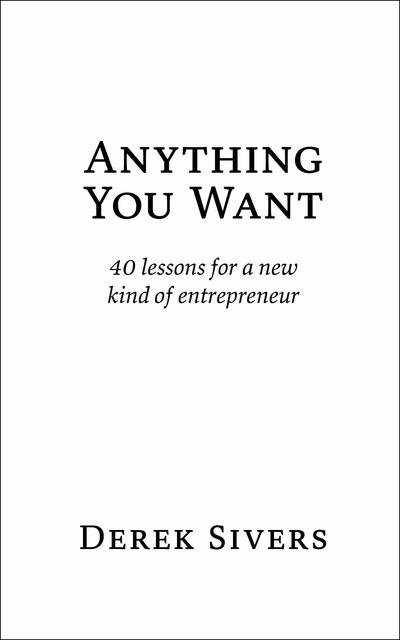
    “ANYTHING YOU WANT: 40 lessons for a new kind of entrepreneur”

    Get it at sivers.com.

    There are only 5000 limited-edition linen hardcovers printed, so get that version while they last. Even if you already read it, consider getting this as the permanent edition.

    The first copy is $19, which is $15 for the content, and $4 for the paper itself. All future copies cost only the price of the paper: $4. Paper books include all digital formats for free. As before, I’m giving all profits to charity.

    book cover of Anything You Want

    Previous 1 8 9 10 11 12 39 Next

    Related Podcasts

    Making Sense with Sam Harris

    1

    Making Sense with Sam Harris Education
    Grammar Girl

    2

    Grammar Girl Education
    Good Life Project

    3

    Good Life Project Education
    Explain It to Me

    4

    Explain It to Me Education
    Team Never Quit

    5

    Team Never Quit Comedy
    Optimal Living Daily – Personal Development and Self-Improvement

    6

    Optimal Living Daily – Personal Development and Self-Improvement Alternative Health
    footer-logo

    Contact Us

    Toll Free: 844-670-7747

    Links

    • Home
    • Top Charts
    • Networks
    • Apps
    • Independents Podcasts
    • Podcast Advertising
    • Podcast News
    • Contact Us
    • About Us
    • Analytics & Insights

    Stay Connected

      Privacy, Terms of Use & Our Code of Ethics Protecting Content Creators Copyrights