TopPodcast.com
Menu
  • Home
  • Top Charts
  • Top Networks
  • Top Apps
  • Top Independents
  • Top Podfluencers
  • Top Picks
    • Top Business Podcasts
    • Top True Crime Podcasts
    • Top Finance Podcasts
    • Top Comedy Podcasts
    • Top Music Podcasts
    • Top Womens Podcasts
    • Top Kids Podcasts
    • Top Sports Podcasts
    • Top News Podcasts
    • Top Tech Podcasts
    • Top Crypto Podcasts
    • Top Entrepreneurial Podcasts
    • Top Fantasy Sports Podcasts
    • Top Political Podcasts
    • Top Science Podcasts
    • Top Self Help Podcasts
    • Top Sports Betting Podcasts
    • Top Stocks Podcasts
  • Podcast News
  • About Us
  • Podcast Advertising
  • Contact
Not in our directory?
Add Show Here
Podcast Equipment
Center

toppodcastlogoOur TOPPODCAST Picks

  • Comedy
  • Crypto
  • Sports
  • News
  • Politics
  • True Crime
  • Business
  • Finance

Follow Us

toppodcastlogoStay Connected

    View Top 200 Chart
    Back to Rankings Page
    History

    Dead Ideas: The History of Extinct Thoughts and Practices

    We explore ideas once believed to be true but no longer. Each dead idea is explored in all its glorious eccentricity.

    Dead Ideas: The History of Extinct Thoughts and Practices is made with Jetpack Podcast. Full show notes and every episode at https://deadideas.net/

    Advertise

    Copyright: © (c) B. T. Newberg

    • Apple Podcasts
    • Google Play
    • Spotify

    Latest Episodes:
    Balance of Power II: Frederick the Great, Cabinet Warrior – European History May 07, 2017
    Show notes

    http://media.blubrry.com/deadideas/ia800607.us.archive.org/28/items/DeadIdeas38BalanceOfPowerIIFrederickTheGreat_201705/Dead%20Ideas%2038%20Balance%20of%20Power%20II%20Frederick%20the%20Great.mp3

    The Cabinet Wars were a period of supposedly restricted warfare, and no one was a greater Cabinet Warrior than Frederick the Great of Prussia. Though he was also in some ways the opposite. Today we look at the trajectory of Frederick the Great’s military thinking, from the early idealism of his Anti-Machiavel to his later years of restricted warfare.

    Be sure to support the show at www.patreon.com/deadideaspod to get your portrait drawn!

    Become our patron on Patreon at www.patreon.com/deadideaspod

    Host: B. T. Newberg

    Time/place: Europe, 1740-1786 CE

    Dead Idea: Balance of Power

    Click to view slideshow.

    Click to view slideshow.

    Main Sources

    “The Assassinations at Sarajevo.” (1914, Jul. 11). The Outlook, p. 577.

    “The Balkan Situation.” (1908, Oct. 17). The Outlook, p. 319-320.

    Calquhoun, A. R. (1910, Jan.). “The New Balance of Power in Europe.” The North American Review. pp. 18-28.

    “Death Agonies of the Triple Alliance.” (1906, Apr. 14). The Literary Digest, p. 575.

    Edwards, A. (1912, Dec.). “The New Map of Europe.” The Outlook, p. 855-860.

    “The Effect of the Polish Child Floggings on the Triple Alliance.” (1902, Feb. 1). The Literary Digest, p. 159.

    “Europe and the Balkans.” (1913, May 17). The Outlook, p. 97.

    “Europe’s Call to Arms.” (1914, Aug. 8). The Literary Digest, p. 215-216.

    “Ferdinand of Bulgaria as Enfant Terrible.” (1897, Oct. 2). The Literary Digest, p. 682.

    Frederick the Great. (1739/2017). Anti-Machiavel. Retrieved Mar. 15th, 2017, from: http://www.oocities.org/danielmacryan/antimac.html#chap26

    “The German Bugaboo.” (1914, May 2). The Literary Digest, p. 1040.

    Glenny, M. (2000). The Balkans: Nationalism, War and the Great Powers, 1804-1999. New York: Viking.

    Hubbard, J. M. (1890, Jul.). “Warlike Europe.” The North American Review, p. 125-126.

    Low, A. N. (1914, Nov.). “Weakness of the German Machine.” The North American Review, p. 699-708.

    Luard, E. (1992). The Balance of Power: The System of International Relations, 1648-1815. New York: St. Martin’s Press.

    Miller, H. A. (1914, Dec.). “Nationalism in Bohemia and Poland.” The North American Review, p. 879-886.

    Palmer, R. R. (1986). “Frederick the Great, Guibert, Bulow: From Dynastic to National War.” In: Paret, P., Ed. (1986). Makers of Modern Strategy: From Machiavelli to the Nuclear Age. Princeton, NJ: Princeton University Press.

    Paret, P., Ed. (1986). Makers of Modern Strategy: From Machiavelli to the Nuclear Age. Princeton, NJ: Princeton University Press.

    “The Renewal of the Triple Alliance.” (1902, May 31). The Literary Digest, p. 748.

    Schieder, T. (2000). Frederick the Great. Berkeley, S., and Scott, H. M., Ed./Trans. New York: Longman.

    “Status Quo in the Balkans.” (1903, Oct. 10). The Literary Digest, p. 473-474.

    Steiner, E. A. (1912, Nov. 9). “The Spirit of the Balkans.” The Outlook, p. 534-536.

    Van Hise, C. R. (1919, Jan.). “Preventing Future Wars.” The Forum, p. 77-86.

    “What Readers of the Outlook Think of the War.” (1914, Sep. 2). The Outlook, p. 44-47.

    Maps, pics, references, and more at http://www.deadideas.net. Music and graphic design by Rachel Westhoff.

    Dead Ideas: The History of Extinct Thoughts and Practices is made with Jetpack Podcast. Full show notes and every episode at https://deadideas.net/


    Balance of Power I: Never Again a Great War! – European History Apr 30, 2017
    Show notes

    http://media.blubrry.com/deadideas/ia800603.us.archive.org/35/items/DeadIdeas37BalanceOfPowerI/Dead%20Ideas%2037%20Balance%20of%20Power%20I.mp3

    The balance of power system in place prior to WWI was meant to prevent a great war from ever happening again. Then what happened? Not just any great war, but THE Great War. What was this system and how was it supposed to work?

    Be sure to support the show at www.patreon.com/deadideaspod to get your portrait drawn!

    Become our patron on Patreon at www.patreon.com/deadideaspod

    Host: B. T. Newberg

    Time/place: Europe, 1648-1914 CE

    Dead Idea: Balance of Power

    Click to view slideshow.

    Click to view slideshow.

    Main Sources

    “The Assassinations at Sarajevo.” (1914, Jul. 11). The Outlook, p. 577.

    “The Balkan Situation.” (1908, Oct. 17). The Outlook, p. 319-320.

    Calquhoun, A. R. (1910, Jan.). “The New Balance of Power in Europe.” The North American Review. pp. 18-28.

    “Death Agonies of the Triple Alliance.” (1906, Apr. 14). The Literary Digest, p. 575.

    Edwards, A. (1912, Dec.). “The New Map of Europe.” The Outlook, p. 855-860.

    “The Effect of the Polish Child Floggings on the Triple Alliance.” (1902, Feb. 1). The Literary Digest, p. 159.

    “Europe and the Balkans.” (1913, May 17). The Outlook, p. 97.

    “Europe’s Call to Arms.” (1914, Aug. 8). The Literary Digest, p. 215-216.

    “Ferdinand of Bulgaria as Enfant Terrible.” (1897, Oct. 2). The Literary Digest, p. 682.

    Frederick the Great. (1739/2017). Anti-Machiavel. Retrieved Mar. 15th, 2017, from: http://www.oocities.org/danielmacryan/antimac.html#chap26

    “The German Bugaboo.” (1914, May 2). The Literary Digest, p. 1040.

    Glenny, M. (2000). The Balkans: Nationalism, War and the Great Powers, 1804-1999. New York: Viking.

    Hubbard, J. M. (1890, Jul.). “Warlike Europe.” The North American Review, p. 125-126.

    Low, A. N. (1914, Nov.). “Weakness of the German Machine.” The North American Review, p. 699-708.

    Luard, E. (1992). The Balance of Power: The System of International Relations, 1648-1815. New York: St. Martin’s Press.

    Miller, H. A. (1914, Dec.). “Nationalism in Bohemia and Poland.” The North American Review, p. 879-886.

    Palmer, R. R. (1986). “Frederick the Great, Guibert, Bulow: From Dynastic to National War.” In: Paret, P., Ed. (1986). Makers of Modern Strategy: From Machiavelli to the Nuclear Age. Princeton, NJ: Princeton University Press.

    Paret, P., Ed. (1986). Makers of Modern Strategy: From Machiavelli to the Nuclear Age. Princeton, NJ: Princeton University Press.

    “The Renewal of the Triple Alliance.” (1902, May 31). The Literary Digest, p. 748.

    Schieder, T. (2000). Frederick the Great. Berkeley, S., and Scott, H. M., Ed./Trans. New York: Longman.

    “Status Quo in the Balkans.” (1903, Oct. 10). The Literary Digest, p. 473-474.

    Steiner, E. A. (1912, Nov. 9). “The Spirit of the Balkans.” The Outlook, p. 534-536.

    Van Hise, C. R. (1919, Jan.). “Preventing Future Wars.” The Forum, p. 77-86.

    “What Readers of the Outlook Think of the War.” (1914, Sep. 2). The Outlook, p. 44-47.

    Maps, pics, references, and more at http://www.deadideas.net. Music and graphic design by Rachel Westhoff.

    Dead Ideas: The History of Extinct Thoughts and Practices is made with Jetpack Podcast. Full show notes and every episode at https://deadideas.net/


    Serfdom VIII Finale: George Lucas’ Serf Wars (with guest Daniel Daughhetee) – Star Wars Mashup – Russian History Apr 23, 2017
    Show notes

    http://media.blubrry.com/deadideas/ia801603.us.archive.org/5/items/DeadIdeas36RussianSerfdomFinaleWithDanielDaughhetee_201704/Dead%20Ideas%2036%20Russian%20Serfdom%20Finale%20with%20Daniel%20Daughhetee.mp3

    Our serfdom grand finale! Guest Daniel Daughhetee of the Lesser Bonapartes and Canon Ball helps us bring it home in this cinematic mashup of the autobiography of runaway serf Nikolai Shipov with… Star Wars! Featuring music by David and Henry Dutton of 8-Bit Cinema!

    Be sure to support the show at www.patreon.com/deadideaspod to get your portrait drawn!

    Become our patron on Patreon at www.patreon.com/deadideaspod

    Co-host: Daniel Daughhetee

    Time/place: Russia, 1830-1845 CE

    Dead Idea: Russian serfdom

    A Map of Russia, 1834 CE, by Adam McKithern

    russia_1834-page-001

    Click to view slideshow.

    Glossary of Russian Words and Spellings

    • aul (ah-OOL) – a Caucasian mountain hut
    • bárshchina (BAHR-shchee-nah) – dues paid in labor to landlord; corvée
    • brat na braty (BRAT na BRA-tee) – the “brother for brother” system in which half the adult laborers of a commune worked the landlord’s fields on any given day.
    • burmistr (BOOR-mee-stur) – bailiff, manager of an estate
    • chernaia (CHUR-nai-yuh) – chimney-less hut
    • desiatina (DEE-syah-tee-nah) – a unit of area equal to 2.7 acres
    • izbá (eez-BAH) – hut
    • kholop (hah-LOHP) – slave
    • krepostnoi (kray-PAHST-noy) – serf
    • mir (MEER) – peasant commune; also means “world”, “peace”
    • obrók (ahb-ROHK) – dues paid in kind or money to landlord
    • oprichnina (ah-PREECH-nee-nah) – secret police of Ivan the Terrible
    • poméshchik (pah-MYEE-shuhk) – servitor landlord
    • Pomórskaia (POH-mohr-skai-yuh)– Old Belief, referring to liturgical forms retained from before the reforms of 1652-1658
    • saklya (SACK-lee-yuh) – a Caucasian mountain hut
    • sótskii (SOHT-skee) – peasant/serf assigned to keep order on an estate; lit. “hundredth” and in charge of 100 households
    • stárosta (STAH-us-tuh) – village elder
    • tiaglo (tee-ah-GLUH) – husband-wife work team
    • upravitel (oop-rah-VEE-tul) – steward, bailiff
    • versta (vyeer-STAH) – a unit of distance equal to 0.663 miles or 1.067 km

    Main Sources

    Avakkum. (1950/2003). “The Life of Archpriest Avakkum.” In: Fedotov, G. P., Ed. (1950/2003). The Way of a Pilgrim and Other Classics of Russian Spirituality. Iswolsky, H., Trans. Mineola, NY: Dover.

    Buggle, J. C., and Nafziger, S. (2015). “Long-Run Consequences of Labor Coercion: Evidence from Russian Serfdom.” Retrieved Jan. 7, 2017, from: http://www.johannesbuggle.com/docs/serfdom_1.4.pdf

    Domar, E. (1970). “The Causes of Slavery or Serfdom: A Hypothesis.” The Journal of Economic History, 30(1): 18-32. Retrieved Jan. 7, 2017, from: https://www.cambridge.org/core/journals/journal-of-economic-history/article/div-classtitlethe-causes-of-slavery-or-serfdom-a-hypothesisdiv/B6055D4D909C9D21B79BB42D2CD952C5

    Fedotov, G. P., Ed. (1950/2003). The Way of a Pilgrim and Other Classics of Russian Spirituality. Iswolsky, H., Trans. Mineola, NY: Dover.

    Gogol, N. V. (1834). Taras Bulba and Other Tales. Cournos, J, ed. Retrieved Mar 16, 2017, from: http://www.gutenberg.org/files/1197/1197-h/1197-h.htm

    Gorshkov, B. B. (2005). A Life Under Russian Serfdom: The Memoirs of Savva Dmitrievich Purlevskii 1800-1868. New York: Central European University Press.

    Hoch, S. L. (1986). Serfdom and Social Control in Russia: Petrovskoe, A Village in Tambov. Chicago: University of Chicago Press.

    Kolchin, P. (1987). Unfree Labor: American Slavery and Russian Serfdom. Cambridge, MA: Belknap Press of Harvard University Press

    Lincoln, W. (1994). The Conquest of a Continent: Siberia and the Russians. New York: Random House.

    MacKay, J. (2009). Four Russian Serf Narratives. Madison, WI: University of Wisconsin Press.

    Markevich, A., and Zhuravskaya, E. (2016). “The Economic Effects of the Abolition of Serfdom: Evidence from the Russian Empire.” Retrieved Jan. 7, 2017, from: http://piketty.pse.ens.fr/files/MarkevitchZhuravskaya2016.pdf

    Moley, H. (1866). Sketches of Russian Life Before and During the Emancipation of the Serfs. London: Chapman and Hall.

    Nafziger, S. (2013). “Russian Serfdom, Emancipation, and Land Inequality: New Evidence.” Retrieved Jan. 7, 2017, from: http://www.ucrs.uu.se/digitalAssets/336/c_336060-l_3-k_serfdom_emancipation_inequality_steven_nafziger.pdf

    Nafziger, S. (2011). “Serfdom, Emancipation, and Economic Development in Tsarist Russia.” Retrieved Jan. 7, 2017, from: 12.161.242.125/dotAsset/60e0d541-627e-4028-bca1-5fb981169cc2.doc

    Nafziger, S., and Lindert, P. (2013). “Russian Inequality on the Eve of Revolution.” Retrieved Jan. 7, 2017, from: http://web.williams.edu/Economics/wp/Nafziger_Lindert_Inequality_Sept2013.pdf

    Rosa, J. (2011). “The Causes of Serfdom: Domar’s Puzzle Revisited.” Retrieved Jan. 7, 2017, from: https://papers.ssrn.com/sol3/papers.cfm?abstract_id=1833511

    Semyenov, Y. (1944). The Conquest of Siberia. Dickes, E. W., Ed. London: G. Routledge & Sons, Ltd.

    Tolstoy, L. (1887). A Russian Proprietor and Other Stories. Dole, N. H., Trans. New York: Thomas Y. Crowell & Co.

    Tolstoy, L. (1852). The Cossacks. Maude, L., & Maude, A., Trans. Retrieved Jan. 7, 2017, from: http://www.fullbooks.com/The-Cossacks.html

    Wirtschafter, E. K. (2008). Russia’s Age of Serfdom 1649-1861. Maldon, MA: Blackwell.

    Maps, pics, references, and more at http://www.deadideas.net. Music and graphic design by Rachel Westhoff. Map by Adam McKithern.

    Dead Ideas: The History of Extinct Thoughts and Practices is made with Jetpack Podcast. Full show notes and every episode at https://deadideas.net/


    Serfdom VII: Siberians and Old Believers – Russian History Apr 16, 2017
    Show notes

    http://media.blubrry.com/deadideas/ia801609.us.archive.org/26/items/DeadIdeas34RussianSerfdomPart6CossacksOfTheWildSteppe/Dead%20Ideas%2035%20Russian%20Serfdom%20Part%207%20Siberians%20and%20Old%20Believers.mp3

    The conquest of Siberia! Kinda. Sort of. Well, in name at least. How in the hell did the Russians manage to grab the northern expanses all the way to the Pacific? Find out today. Also, who were the Old Believers and what zany adventures did their founder get up to? Find that out too. Nick answers all the burning questions you never knew you had.

    Be sure to support the show at www.patreon.com/deadideaspod to get your portrait drawn!

    Become our patron on Patreon at www.patreon.com/deadideaspod

    Co-hosts: Nick and Anna

    Time/place: Russia c.1500-1800-ish CE

    Dead Idea: Russian serfdom

    A Map of Russia, 1834 CE, by Adam McKithern

    russia_1834-page-001

    Click to view slideshow.

    Glossary of Russian Words and Spellings

    • aul (ah-OOL) – a Caucasian mountain hut
    • bárshchina (BAHR-shchee-nah) – dues paid in labor to landlord; corvée
    • brat na braty (BRAT na BRA-tee) – the “brother for brother” system in which half the adult laborers of a commune worked the landlord’s fields on any given day.
    • burmistr (BOOR-mee-stur) – bailiff, manager of an estate
    • chernaia (CHUR-nai-yuh) – chimney-less hut
    • desiatina (DEE-syah-tee-nah) – a unit of area equal to 2.7 acres
    • izbá (eez-BAH) – hut
    • kholop (hah-LOHP) – slave
    • krepostnoi (kray-PAHST-noy) – serf
    • mir (MEER) – peasant commune; also means “world”, “peace”
    • obrók (ahb-ROHK) – dues paid in kind or money to landlord
    • oprichnina (ah-PREECH-nee-nah) – secret police of Ivan the Terrible
    • poméshchik (pah-MYEE-shuhk) – servitor landlord
    • Pomórskaia (POH-mohr-skai-yuh)– Old Belief, referring to liturgical forms retained from before the reforms of 1652-1658
    • saklya (SACK-lee-yuh) – a Caucasian mountain hut
    • sótskii (SOHT-skee) – peasant/serf assigned to keep order on an estate; lit. “hundredth” and in charge of 100 households
    • stárosta (STAH-us-tuh) – village elder
    • tiaglo (tee-ah-GLUH) – husband-wife work team
    • upravitel (oop-rah-VEE-tul) – steward, bailiff
    • versta (vyeer-STAH) – a unit of distance equal to 0.663 miles or 1.067 km

    Main Sources

    Avakkum. (1950/2003). “The Life of Archpriest Avakkum.” In: Fedotov, G. P., Ed. (1950/2003). The Way of a Pilgrim and Other Classics of Russian Spirituality. Iswolsky, H., Trans. Mineola, NY: Dover.

    Buggle, J. C., and Nafziger, S. (2015). “Long-Run Consequences of Labor Coercion: Evidence from Russian Serfdom.” Retrieved Jan. 7, 2017, from: http://www.johannesbuggle.com/docs/serfdom_1.4.pdf

    Domar, E. (1970). “The Causes of Slavery or Serfdom: A Hypothesis.” The Journal of Economic History, 30(1): 18-32. Retrieved Jan. 7, 2017, from: https://www.cambridge.org/core/journals/journal-of-economic-history/article/div-classtitlethe-causes-of-slavery-or-serfdom-a-hypothesisdiv/B6055D4D909C9D21B79BB42D2CD952C5

    Fedotov, G. P., Ed. (1950/2003). The Way of a Pilgrim and Other Classics of Russian Spirituality. Iswolsky, H., Trans. Mineola, NY: Dover.

    Gogol, N. V. (1834). Taras Bulba and Other Tales. Cournos, J, ed. Retrieved Mar 16, 2017, from: http://www.gutenberg.org/files/1197/1197-h/1197-h.htm

    Gorshkov, B. B. (2005). A Life Under Russian Serfdom: The Memoirs of Savva Dmitrievich Purlevskii 1800-1868. New York: Central European University Press.

    Hoch, S. L. (1986). Serfdom and Social Control in Russia: Petrovskoe, A Village in Tambov. Chicago: University of Chicago Press.

    Kolchin, P. (1987). Unfree Labor: American Slavery and Russian Serfdom. Cambridge, MA: Belknap Press of Harvard University Press

    Lincoln, W. (1994). The Conquest of a Continent: Siberia and the Russians. New York: Random House.

    MacKay, J. (2009). Four Russian Serf Narratives. Madison, WI: University of Wisconsin Press.

    Markevich, A., and Zhuravskaya, E. (2016). “The Economic Effects of the Abolition of Serfdom: Evidence from the Russian Empire.” Retrieved Jan. 7, 2017, from: http://piketty.pse.ens.fr/files/MarkevitchZhuravskaya2016.pdf

    Moley, H. (1866). Sketches of Russian Life Before and During the Emancipation of the Serfs. London: Chapman and Hall.

    Nafziger, S. (2013). “Russian Serfdom, Emancipation, and Land Inequality: New Evidence.” Retrieved Jan. 7, 2017, from: http://www.ucrs.uu.se/digitalAssets/336/c_336060-l_3-k_serfdom_emancipation_inequality_steven_nafziger.pdf

    Nafziger, S. (2011). “Serfdom, Emancipation, and Economic Development in Tsarist Russia.” Retrieved Jan. 7, 2017, from: 12.161.242.125/dotAsset/60e0d541-627e-4028-bca1-5fb981169cc2.doc

    Nafziger, S., and Lindert, P. (2013). “Russian Inequality on the Eve of Revolution.” Retrieved Jan. 7, 2017, from: http://web.williams.edu/Economics/wp/Nafziger_Lindert_Inequality_Sept2013.pdf

    Rosa, J. (2011). “The Causes of Serfdom: Domar’s Puzzle Revisited.” Retrieved Jan. 7, 2017, from: https://papers.ssrn.com/sol3/papers.cfm?abstract_id=1833511

    Semyenov, Y. (1944). The Conquest of Siberia. Dickes, E. W., Ed. London: G. Routledge & Sons, Ltd.

    Tolstoy, L. (1887). A Russian Proprietor and Other Stories. Dole, N. H., Trans. New York: Thomas Y. Crowell & Co.

    Tolstoy, L. (1852). The Cossacks. Maude, L., & Maude, A., Trans. Retrieved Jan. 7, 2017, from: http://www.fullbooks.com/The-Cossacks.html

    Wirtschafter, E. K. (2008). Russia’s Age of Serfdom 1649-1861. Maldon, MA: Blackwell.

    Maps, pics, references, and more at http://www.deadideas.net. Music and graphic design by Rachel Westhoff. Map by Adam McKithern.

    Dead Ideas: The History of Extinct Thoughts and Practices is made with Jetpack Podcast. Full show notes and every episode at https://deadideas.net/


    Serfdom VI: Cossacks of the Wild Steppe (feat. Nikolai Gogol) – Russian History Apr 09, 2017
    Show notes

    http://media.blubrry.com/deadideas/ia801609.us.archive.org/26/items/DeadIdeas34RussianSerfdomPart6CossacksOfTheWildSteppe/Dead%20Ideas%2034%20Russian%20Serfdom%20Part%206%20Cossacks%20of%20the%20Wild%20Steppe.mp3

    Run away to join the Cossacks, young serf! Who were these cowboy-like steppe peoples? And what was their obsession with disdain for pants?! Anna digs into Russian author Nikolai Gogol for a unique view of these riders of the wild wastes.

    Be sure to support the show at www.patreon.com/deadideaspod to get your portrait drawn!

    Become our patron on Patreon at www.patreon.com/deadideaspod

    Co-hosts: Nick and Anna

    Time/place: Russia c.1834 CE

    Dead Idea: Russian serfdom

    A Map of Russia, 1834 CE, by Adam McKithern

    russia_1834-page-001

    Click to view slideshow.

    Glossary of Russian Words and Spellings

    • aul (ah-OOL) – a Caucasian mountain hut
    • bárshchina (BAHR-shchee-nah) – dues paid in labor to landlord; corvée
    • brat na braty (BRAT na BRA-tee) – the “brother for brother” system in which half the adult laborers of a commune worked the landlord’s fields on any given day.
    • burmistr (BOOR-mee-stur) – bailiff, manager of an estate
    • chernaia (CHUR-nai-yuh) – chimney-less hut
    • desiatina (DEE-syah-tee-nah) – a unit of area equal to 2.7 acres
    • izbá (eez-BAH) – hut
    • kholop (hah-LOHP) – slave
    • krepostnoi (kray-PAHST-noy) – serf
    • mir (MEER) – peasant commune; also means “world”, “peace”
    • obrók (ahb-ROHK) – dues paid in kind or money to landlord
    • oprichnina (ah-PREECH-nee-nah) – secret police of Ivan the Terrible
    • poméshchik (pah-MYEE-shuhk) – servitor landlord
    • Pomórskaia (POH-mohr-skai-yuh)– Old Belief, referring to liturgical forms retained from before the reforms of 1652-1658
    • saklya (SACK-lee-yuh) – a Caucasian mountain hut
    • sótskii (SOHT-skee) – peasant/serf assigned to keep order on an estate; lit. “hundredth” and in charge of 100 households
    • stárosta (STAH-us-tuh) – village elder
    • tiaglo (tee-ah-GLUH) – husband-wife work team
    • upravitel (oop-rah-VEE-tul) – steward, bailiff
    • versta (vyeer-STAH) – a unit of distance equal to 0.663 miles or 1.067 km

    Main Sources

    Avakkum. (1950/2003). “The Life of Archpriest Avakkum.” In: Fedotov, G. P., Ed. (1950/2003). The Way of a Pilgrim and Other Classics of Russian Spirituality. Iswolsky, H., Trans. Mineola, NY: Dover.

    Buggle, J. C., and Nafziger, S. (2015). “Long-Run Consequences of Labor Coercion: Evidence from Russian Serfdom.” Retrieved Jan. 7, 2017, from: http://www.johannesbuggle.com/docs/serfdom_1.4.pdf

    Domar, E. (1970). “The Causes of Slavery or Serfdom: A Hypothesis.” The Journal of Economic History, 30(1): 18-32. Retrieved Jan. 7, 2017, from: https://www.cambridge.org/core/journals/journal-of-economic-history/article/div-classtitlethe-causes-of-slavery-or-serfdom-a-hypothesisdiv/B6055D4D909C9D21B79BB42D2CD952C5

    Fedotov, G. P., Ed. (1950/2003). The Way of a Pilgrim and Other Classics of Russian Spirituality. Iswolsky, H., Trans. Mineola, NY: Dover.

    Gogol, N. V. (1834). Taras Bulba and Other Tales. Cournos, J, ed. Retrieved Mar 16, 2017, from: http://www.gutenberg.org/files/1197/1197-h/1197-h.htm

    Gorshkov, B. B. (2005). A Life Under Russian Serfdom: The Memoirs of Savva Dmitrievich Purlevskii 1800-1868. New York: Central European University Press.

    Hoch, S. L. (1986). Serfdom and Social Control in Russia: Petrovskoe, A Village in Tambov. Chicago: University of Chicago Press.

    Kolchin, P. (1987). Unfree Labor: American Slavery and Russian Serfdom. Cambridge, MA: Belknap Press of Harvard University Press

    Lincoln, W. (1994). The Conquest of a Continent: Siberia and the Russians. New York: Random House.

    MacKay, J. (2009). Four Russian Serf Narratives. Madison, WI: University of Wisconsin Press.

    Markevich, A., and Zhuravskaya, E. (2016). “The Economic Effects of the Abolition of Serfdom: Evidence from the Russian Empire.” Retrieved Jan. 7, 2017, from: http://piketty.pse.ens.fr/files/MarkevitchZhuravskaya2016.pdf

    Moley, H. (1866). Sketches of Russian Life Before and During the Emancipation of the Serfs. London: Chapman and Hall.

    Nafziger, S. (2013). “Russian Serfdom, Emancipation, and Land Inequality: New Evidence.” Retrieved Jan. 7, 2017, from: http://www.ucrs.uu.se/digitalAssets/336/c_336060-l_3-k_serfdom_emancipation_inequality_steven_nafziger.pdf

    Nafziger, S. (2011). “Serfdom, Emancipation, and Economic Development in Tsarist Russia.” Retrieved Jan. 7, 2017, from: 12.161.242.125/dotAsset/60e0d541-627e-4028-bca1-5fb981169cc2.doc

    Nafziger, S., and Lindert, P. (2013). “Russian Inequality on the Eve of Revolution.” Retrieved Jan. 7, 2017, from: http://web.williams.edu/Economics/wp/Nafziger_Lindert_Inequality_Sept2013.pdf

    Rosa, J. (2011). “The Causes of Serfdom: Domar’s Puzzle Revisited.” Retrieved Jan. 7, 2017, from: https://papers.ssrn.com/sol3/papers.cfm?abstract_id=1833511

    Semyenov, Y. (1944). The Conquest of Siberia. Dickes, E. W., Ed. London: G. Routledge & Sons, Ltd.

    Tolstoy, L. (1887). A Russian Proprietor and Other Stories. Dole, N. H., Trans. New York: Thomas Y. Crowell & Co.

    Tolstoy, L. (1852). The Cossacks. Maude, L., & Maude, A., Trans. Retrieved Jan. 7, 2017, from: http://www.fullbooks.com/The-Cossacks.html

    Wirtschafter, E. K. (2008). Russia’s Age of Serfdom 1649-1861. Maldon, MA: Blackwell.

    Maps, pics, references, and more at http://www.deadideas.net. Music and graphic design by Rachel Westhoff. Map by Adam McKithern.

    Dead Ideas: The History of Extinct Thoughts and Practices is made with Jetpack Podcast. Full show notes and every episode at https://deadideas.net/


    Serfdom V: Soviet Workfarm vs. Serf Commune: An Interview with Kristaps Andrejsons – Russian History Apr 02, 2017
    Show notes

    http://media.blubrry.com/deadideas/ia601608.us.archive.org/1/items/DeadIdeas33RussianSerfdomPart5SovietWorkfarmVsSerfCommuneAnInterviewWithKristapsAndrejsons/Dead%20Ideas%2033%20Russian%20Serfdom%20Part%205%20Soviet%20Workfarm%20vs%20Serf%20Commune%20An%20Interview%20with%20Kristaps%20Andrejsons.mp3

    How did the Soviet kolkhoz, or collective farm, stack up against the serf commune? Here to help us understand is Kristaps Andrejsons from the podcast The Eastern Border. Also, it’s my birthday! Yay!

    Be sure to support the show at www.patreon.com/deadideaspod to get your portrait drawn!

    Become our patron on Patreon at www.patreon.com/deadideaspod

    Interviewee: Kristaps Andrejsons

    Time/place: Imperial Russia and USSR eras

    Dead Idea: Russian serfdom

    A Map of Russia, 1834 CE, by Adam McKithern

    russia_1834-page-001

    Click to view slideshow.

    Glossary of Russian Words and Spellings

    • aul (ah-OOL) – a Caucasian mountain hut
    • bárshchina (BAHR-shchee-nah) – dues paid in labor to landlord; corvée
    • brat na braty (BRAT na BRA-tee) – the “brother for brother” system in which half the adult laborers of a commune worked the landlord’s fields on any given day.
    • burmistr (BOOR-mee-stur) – bailiff, manager of an estate
    • chernaia (CHUR-nai-yuh) – chimney-less hut
    • desiatina (DEE-syah-tee-nah) – a unit of area equal to 2.7 acres
    • izbá (eez-BAH) – hut
    • kholop (hah-LOHP) – slave
    • krepostnoi (kray-PAHST-noy) – serf
    • mir (MEER) – peasant commune; also means “world”, “peace”
    • obrók (ahb-ROHK) – dues paid in kind or money to landlord
    • oprichnina (ah-PREECH-nee-nah) – secret police of Ivan the Terrible
    • poméshchik (pah-MYEE-shuhk) – servitor landlord
    • Pomórskaia (POH-mohr-skai-yuh)– Old Belief, referring to liturgical forms retained from before the reforms of 1652-1658
    • saklya (SACK-lee-yuh) – a Caucasian mountain hut
    • sótskii (SOHT-skee) – peasant/serf assigned to keep order on an estate; lit. “hundredth” and in charge of 100 households
    • stárosta (STAH-us-tuh) – village elder
    • tiaglo (tee-ah-GLUH) – husband-wife work team
    • upravitel (oop-rah-VEE-tul) – steward, bailiff
    • versta (vyeer-STAH) – a unit of distance equal to 0.663 miles or 1.067 km

    Main Sources

    Avakkum. (1950/2003). “The Life of Archpriest Avakkum.” In: Fedotov, G. P., Ed. (1950/2003). The Way of a Pilgrim and Other Classics of Russian Spirituality. Iswolsky, H., Trans. Mineola, NY: Dover.

    Buggle, J. C., and Nafziger, S. (2015). “Long-Run Consequences of Labor Coercion: Evidence from Russian Serfdom.” Retrieved Jan. 7, 2017, from: http://www.johannesbuggle.com/docs/serfdom_1.4.pdf

    Domar, E. (1970). “The Causes of Slavery or Serfdom: A Hypothesis.” The Journal of Economic History, 30(1): 18-32. Retrieved Jan. 7, 2017, from: https://www.cambridge.org/core/journals/journal-of-economic-history/article/div-classtitlethe-causes-of-slavery-or-serfdom-a-hypothesisdiv/B6055D4D909C9D21B79BB42D2CD952C5

    Fedotov, G. P., Ed. (1950/2003). The Way of a Pilgrim and Other Classics of Russian Spirituality. Iswolsky, H., Trans. Mineola, NY: Dover.

    Gogol, N. V. (1834). Taras Bulba and Other Tales. Cournos, J, ed. Retrieved Mar 16, 2017, from: http://www.gutenberg.org/files/1197/1197-h/1197-h.htm

    Gorshkov, B. B. (2005). A Life Under Russian Serfdom: The Memoirs of Savva Dmitrievich Purlevskii 1800-1868. New York: Central European University Press.

    Hoch, S. L. (1986). Serfdom and Social Control in Russia: Petrovskoe, A Village in Tambov. Chicago: University of Chicago Press.

    Kolchin, P. (1987). Unfree Labor: American Slavery and Russian Serfdom. Cambridge, MA: Belknap Press of Harvard University Press

    Lincoln, W. (1994). The Conquest of a Continent: Siberia and the Russians. New York: Random House.

    MacKay, J. (2009). Four Russian Serf Narratives. Madison, WI: University of Wisconsin Press.

    Markevich, A., and Zhuravskaya, E. (2016). “The Economic Effects of the Abolition of Serfdom: Evidence from the Russian Empire.” Retrieved Jan. 7, 2017, from: http://piketty.pse.ens.fr/files/MarkevitchZhuravskaya2016.pdf

    Moley, H. (1866). Sketches of Russian Life Before and During the Emancipation of the Serfs. London: Chapman and Hall.

    Nafziger, S. (2013). “Russian Serfdom, Emancipation, and Land Inequality: New Evidence.” Retrieved Jan. 7, 2017, from: http://www.ucrs.uu.se/digitalAssets/336/c_336060-l_3-k_serfdom_emancipation_inequality_steven_nafziger.pdf

    Nafziger, S. (2011). “Serfdom, Emancipation, and Economic Development in Tsarist Russia.” Retrieved Jan. 7, 2017, from: 12.161.242.125/dotAsset/60e0d541-627e-4028-bca1-5fb981169cc2.doc

    Nafziger, S., and Lindert, P. (2013). “Russian Inequality on the Eve of Revolution.” Retrieved Jan. 7, 2017, from: http://web.williams.edu/Economics/wp/Nafziger_Lindert_Inequality_Sept2013.pdf

    Rosa, J. (2011). “The Causes of Serfdom: Domar’s Puzzle Revisited.” Retrieved Jan. 7, 2017, from: https://papers.ssrn.com/sol3/papers.cfm?abstract_id=1833511

    Semyenov, Y. (1944). The Conquest of Siberia. Dickes, E. W., Ed. London: G. Routledge & Sons, Ltd.

    Tolstoy, L. (1887). A Russian Proprietor and Other Stories. Dole, N. H., Trans. New York: Thomas Y. Crowell & Co.

    Tolstoy, L. (1852). The Cossacks. Maude, L., & Maude, A., Trans. Retrieved Jan. 7, 2017, from: http://www.fullbooks.com/The-Cossacks.html

    Wirtschafter, E. K. (2008). Russia’s Age of Serfdom 1649-1861. Maldon, MA: Blackwell.

    Maps, pics, references, and more at http://www.deadideas.net. Music and graphic design by Rachel Westhoff. Map by Adam McKithern.

    Dead Ideas: The History of Extinct Thoughts and Practices is made with Jetpack Podcast. Full show notes and every episode at https://deadideas.net/


    Serfdom IV: Stories of Serf and Master – Russian History Mar 26, 2017
    Show notes

    http://media.blubrry.com/deadideas/ia801605.us.archive.org/30/items/DeadIdeas32RussianSerfdomPart4StoriesOfSerfAndMaster/Dead%20Ideas%2032%20Russian%20Serfdom%20Part%204%20Stories%20of%20Serf%20and%20Master.mp3

    What was the relationship like between serf and master? Hear chilling first-hand accounts from 19th-century serf autobiographies!

    Be sure to support the show at www.patreon.com/deadideaspod to get your portrait drawn!

    Become our patron on Patreon at www.patreon.com/deadideaspod

    Co-hosts: Nick and Anna

    Time/place: Russia, 1834 CE

    Dead Idea: Russian serfdom

    A Map of Russia, 1834 CE, by Adam McKithern

    russia_1834-page-001

    Click to view slideshow.

    Glossary of Russian Words and Spellings

    • aul (ah-OOL) – a Caucasian mountain hut
    • bárshchina (BAHR-shchee-nah) – dues paid in labor to landlord; corvée
    • brat na braty (BRAT na BRA-tee) – the “brother for brother” system in which half the adult laborers of a commune worked the landlord’s fields on any given day.
    • burmistr (BOOR-mee-stur) – bailiff, manager of an estate
    • chernaia (CHUR-nai-yuh) – chimney-less hut
    • desiatina (DEE-syah-tee-nah) – a unit of area equal to 2.7 acres
    • izbá (eez-BAH) – hut
    • kholop (hah-LOHP) – slave
    • krepostnoi (kray-PAHST-noy) – serf
    • mir (MEER) – peasant commune; also means “world”, “peace”
    • obrók (ahb-ROHK) – dues paid in kind or money to landlord
    • oprichnina (ah-PREECH-nee-nah) – secret police of Ivan the Terrible
    • poméshchik (pah-MYEE-shuhk) – servitor landlord
    • Pomórskaia (POH-mohr-skai-yuh)– Old Belief, referring to liturgical forms retained from before the reforms of 1652-1658
    • saklya (SACK-lee-yuh) – a Caucasian mountain hut
    • sótskii (SOHT-skee) – peasant/serf assigned to keep order on an estate; lit. “hundredth” and in charge of 100 households
    • stárosta (STAH-us-tuh) – village elder
    • tiaglo (tee-ah-GLUH) – husband-wife work team
    • upravitel (oop-rah-VEE-tul) – steward, bailiff
    • versta (vyeer-STAH) – a unit of distance equal to 0.663 miles or 1.067 km

    Main Sources

    Avakkum. (1950/2003). “The Life of Archpriest Avakkum.” In: Fedotov, G. P., Ed. (1950/2003). The Way of a Pilgrim and Other Classics of Russian Spirituality. Iswolsky, H., Trans. Mineola, NY: Dover.

    Buggle, J. C., and Nafziger, S. (2015). “Long-Run Consequences of Labor Coercion: Evidence from Russian Serfdom.” Retrieved Jan. 7, 2017, from: http://www.johannesbuggle.com/docs/serfdom_1.4.pdf

    Domar, E. (1970). “The Causes of Slavery or Serfdom: A Hypothesis.” The Journal of Economic History, 30(1): 18-32. Retrieved Jan. 7, 2017, from: https://www.cambridge.org/core/journals/journal-of-economic-history/article/div-classtitlethe-causes-of-slavery-or-serfdom-a-hypothesisdiv/B6055D4D909C9D21B79BB42D2CD952C5

    Fedotov, G. P., Ed. (1950/2003). The Way of a Pilgrim and Other Classics of Russian Spirituality. Iswolsky, H., Trans. Mineola, NY: Dover.

    Gogol, N. V. (1834). Taras Bulba and Other Tales. Cournos, J, ed. Retrieved Mar 16, 2017, from: http://www.gutenberg.org/files/1197/1197-h/1197-h.htm

    Gorshkov, B. B. (2005). A Life Under Russian Serfdom: The Memoirs of Savva Dmitrievich Purlevskii 1800-1868. New York: Central European University Press.

    Hoch, S. L. (1986). Serfdom and Social Control in Russia: Petrovskoe, A Village in Tambov. Chicago: University of Chicago Press.

    Kolchin, P. (1987). Unfree Labor: American Slavery and Russian Serfdom. Cambridge, MA: Belknap Press of Harvard University Press

    Lincoln, W. (1994). The Conquest of a Continent: Siberia and the Russians. New York: Random House.

    MacKay, J. (2009). Four Russian Serf Narratives. Madison, WI: University of Wisconsin Press.

    Markevich, A., and Zhuravskaya, E. (2016). “The Economic Effects of the Abolition of Serfdom: Evidence from the Russian Empire.” Retrieved Jan. 7, 2017, from: http://piketty.pse.ens.fr/files/MarkevitchZhuravskaya2016.pdf

    Moley, H. (1866). Sketches of Russian Life Before and During the Emancipation of the Serfs. London: Chapman and Hall.

    Nafziger, S. (2013). “Russian Serfdom, Emancipation, and Land Inequality: New Evidence.” Retrieved Jan. 7, 2017, from: http://www.ucrs.uu.se/digitalAssets/336/c_336060-l_3-k_serfdom_emancipation_inequality_steven_nafziger.pdf

    Nafziger, S. (2011). “Serfdom, Emancipation, and Economic Development in Tsarist Russia.” Retrieved Jan. 7, 2017, from: 12.161.242.125/dotAsset/60e0d541-627e-4028-bca1-5fb981169cc2.doc

    Nafziger, S., and Lindert, P. (2013). “Russian Inequality on the Eve of Revolution.” Retrieved Jan. 7, 2017, from: http://web.williams.edu/Economics/wp/Nafziger_Lindert_Inequality_Sept2013.pdf

    Rosa, J. (2011). “The Causes of Serfdom: Domar’s Puzzle Revisited.” Retrieved Jan. 7, 2017, from: https://papers.ssrn.com/sol3/papers.cfm?abstract_id=1833511

    Semyenov, Y. (1944). The Conquest of Siberia. Dickes, E. W., Ed. London: G. Routledge & Sons, Ltd.

    Tolstoy, L. (1887). A Russian Proprietor and Other Stories. Dole, N. H., Trans. New York: Thomas Y. Crowell & Co.

    Tolstoy, L. (1852). The Cossacks. Maude, L., & Maude, A., Trans. Retrieved Jan. 7, 2017, from: http://www.fullbooks.com/The-Cossacks.html

    Wirtschafter, E. K. (2008). Russia’s Age of Serfdom 1649-1861. Maldon, MA: Blackwell.

    Maps, pics, references, and more at http://www.deadideas.net. Music and graphic design by Rachel Westhoff. Map by Adam McKithern.

    Dead Ideas: The History of Extinct Thoughts and Practices is made with Jetpack Podcast. Full show notes and every episode at https://deadideas.net/


    Serfdom III: The Draft and Marriage Negotiations – RPG – Russian History Mar 19, 2017
    Show notes

    http://media.blubrry.com/deadideas/ia601608.us.archive.org/12/items/DeadIdeas31RussianSerfdomPart3/Dead%20Ideas%2031%20Russian%20Serfdom%20Part%203.mp3

    Experience the horrors of the military draft and the joys (?) of marriage on a Russian serf commune in this role-playing game episode.

    Be sure to support the show at www.patreon.com/deadideaspod to get your portrait drawn!

    Become our patron on Patreon at www.patreon.com/deadideaspod

    Co-hosts: Nick and Anna

    Time/place: Russia, 1834 CE

    Dead Idea: Russian serfdom

    A Map of Russia, 1834 CE, by Adam McKithern

    russia_1834-page-001

    Click to view slideshow.

    Glossary of Russian Words and Spellings

    • aul (ah-OOL) – a Caucasian mountain hut
    • bárshchina (BAHR-shchee-nah) – dues paid in labor to landlord; corvée
    • brat na braty (BRAT na BRA-tee) – the “brother for brother” system in which half the adult laborers of a commune worked the landlord’s fields on any given day.
    • burmistr (BOOR-mee-stur) – bailiff, manager of an estate
    • chernaia (CHUR-nai-yuh) – chimney-less hut
    • desiatina (DEE-syah-tee-nah) – a unit of area equal to 2.7 acres
    • izbá (eez-BAH) – hut
    • kholop (hah-LOHP) – slave
    • krepostnoi (kray-PAHST-noy) – serf
    • mir (MEER) – peasant commune; also means “world”, “peace”
    • obrók (ahb-ROHK) – dues paid in kind or money to landlord
    • oprichnina (ah-PREECH-nee-nah) – secret police of Ivan the Terrible
    • poméshchik (pah-MYEE-shuhk) – servitor landlord
    • Pomórskaia (POH-mohr-skai-yuh)– Old Belief, referring to liturgical forms retained from before the reforms of 1652-1658
    • saklya (SACK-lee-yuh) – a Caucasian mountain hut
    • sótskii (SOHT-skee) – peasant/serf assigned to keep order on an estate; lit. “hundredth” and in charge of 100 households
    • stárosta (STAH-us-tuh) – village elder
    • tiaglo (tee-ah-GLUH) – husband-wife work team
    • upravitel (oop-rah-VEE-tul) – steward, bailiff
    • versta (vyeer-STAH) – a unit of distance equal to 0.663 miles or 1.067 km

    Main Sources

    Avakkum. (1950/2003). “The Life of Archpriest Avakkum.” In: Fedotov, G. P., Ed. (1950/2003). The Way of a Pilgrim and Other Classics of Russian Spirituality. Iswolsky, H., Trans. Mineola, NY: Dover.

    Buggle, J. C., and Nafziger, S. (2015). “Long-Run Consequences of Labor Coercion: Evidence from Russian Serfdom.” Retrieved Jan. 7, 2017, from: http://www.johannesbuggle.com/docs/serfdom_1.4.pdf

    Domar, E. (1970). “The Causes of Slavery or Serfdom: A Hypothesis.” The Journal of Economic History, 30(1): 18-32. Retrieved Jan. 7, 2017, from: https://www.cambridge.org/core/journals/journal-of-economic-history/article/div-classtitlethe-causes-of-slavery-or-serfdom-a-hypothesisdiv/B6055D4D909C9D21B79BB42D2CD952C5

    Fedotov, G. P., Ed. (1950/2003). The Way of a Pilgrim and Other Classics of Russian Spirituality. Iswolsky, H., Trans. Mineola, NY: Dover.

    Gogol, N. V. (1834). Taras Bulba and Other Tales. Cournos, J, ed. Retrieved Mar 16, 2017, from: http://www.gutenberg.org/files/1197/1197-h/1197-h.htm

    Gorshkov, B. B. (2005). A Life Under Russian Serfdom: The Memoirs of Savva Dmitrievich Purlevskii 1800-1868. New York: Central European University Press.

    Hoch, S. L. (1986). Serfdom and Social Control in Russia: Petrovskoe, A Village in Tambov. Chicago: University of Chicago Press.

    Kolchin, P. (1987). Unfree Labor: American Slavery and Russian Serfdom. Cambridge, MA: Belknap Press of Harvard University Press

    Lincoln, W. (1994). The Conquest of a Continent: Siberia and the Russians. New York: Random House.

    MacKay, J. (2009). Four Russian Serf Narratives. Madison, WI: University of Wisconsin Press.

    Markevich, A., and Zhuravskaya, E. (2016). “The Economic Effects of the Abolition of Serfdom: Evidence from the Russian Empire.” Retrieved Jan. 7, 2017, from: http://piketty.pse.ens.fr/files/MarkevitchZhuravskaya2016.pdf

    Moley, H. (1866). Sketches of Russian Life Before and During the Emancipation of the Serfs. London: Chapman and Hall.

    Nafziger, S. (2013). “Russian Serfdom, Emancipation, and Land Inequality: New Evidence.” Retrieved Jan. 7, 2017, from: http://www.ucrs.uu.se/digitalAssets/336/c_336060-l_3-k_serfdom_emancipation_inequality_steven_nafziger.pdf

    Nafziger, S. (2011). “Serfdom, Emancipation, and Economic Development in Tsarist Russia.” Retrieved Jan. 7, 2017, from: 12.161.242.125/dotAsset/60e0d541-627e-4028-bca1-5fb981169cc2.doc

    Nafziger, S., and Lindert, P. (2013). “Russian Inequality on the Eve of Revolution.” Retrieved Jan. 7, 2017, from: http://web.williams.edu/Economics/wp/Nafziger_Lindert_Inequality_Sept2013.pdf

    Rosa, J. (2011). “The Causes of Serfdom: Domar’s Puzzle Revisited.” Retrieved Jan. 7, 2017, from: https://papers.ssrn.com/sol3/papers.cfm?abstract_id=1833511

    Semyenov, Y. (1944). The Conquest of Siberia. Dickes, E. W., Ed. London: G. Routledge & Sons, Ltd.

    Tolstoy, L. (1887). A Russian Proprietor and Other Stories. Dole, N. H., Trans. New York: Thomas Y. Crowell & Co.

    Tolstoy, L. (1852). The Cossacks. Maude, L., & Maude, A., Trans. Retrieved Jan. 7, 2017, from: http://www.fullbooks.com/The-Cossacks.html

    Wirtschafter, E. K. (2008). Russia’s Age of Serfdom 1649-1861. Maldon, MA: Blackwell.

    Maps, pics, references, and more at http://www.deadideas.net. Music and graphic design by Rachel Westhoff. Map by Adam McKithern.

    Dead Ideas: The History of Extinct Thoughts and Practices is made with Jetpack Podcast. Full show notes and every episode at https://deadideas.net/


    Serfdom II: Serf World: Life on a Serf Commune – RPG – Russian History Mar 12, 2017
    Show notes

    http://media.blubrry.com/deadideas/ia601607.us.archive.org/9/items/DeadIdeasSerfdomPart2/Dead%20Ideas%20Serfdom%20Part%202.mp3

    What was life like on a Russian serf commune? Experience it today in our very first role-playing game episode! That’s right, we’re doing this as an RPG for an even more immersive experience. Check it out!

    Be sure to support the show at www.patreon.com/deadideaspod to get your portrait drawn!

    Become our patron on Patreon at www.patreon.com/deadideaspod

    Co-hosts: Nick and Anna

    Time/place: Russia, 1834 CE

    Dead Idea: Russian serfdom

    A Map of Russia, 1834 CE, by Adam McKithern

    russia_1834-page-001

    Click to view slideshow.

    Glossary of Russian Words and Spellings

    • aul (ah-OOL) – a Caucasian mountain hut
    • bárshchina (BAHR-shchee-nah) – dues paid in labor to landlord; corvée
    • brat na braty (BRAT na BRA-tee) – the “brother for brother” system in which half the adult laborers of a commune worked the landlord’s fields on any given day.
    • burmistr (BOOR-mee-stur) – bailiff, manager of an estate
    • chernaia (CHUR-nai-yuh) – chimney-less hut
    • desiatina (DEE-syah-tee-nah) – a unit of area equal to 2.7 acres
    • izbá (eez-BAH) – hut
    • kholop (hah-LOHP) – slave
    • krepostnoi (kray-PAHST-noy) – serf
    • mir (MEER) – peasant commune; also means “world”, “peace”
    • obrók (ahb-ROHK) – dues paid in kind or money to landlord
    • oprichnina (ah-PREECH-nee-nah) – secret police of Ivan the Terrible
    • poméshchik (pah-MYEE-shuhk) – servitor landlord
    • Pomórskaia (POH-mohr-skai-yuh)– Old Belief, referring to liturgical forms retained from before the reforms of 1652-1658
    • saklya (SACK-lee-yuh) – a Caucasian mountain hut
    • sótskii (SOHT-skee) – peasant/serf assigned to keep order on an estate; lit. “hundredth” and in charge of 100 households
    • stárosta (STAH-us-tuh) – village elder
    • tiaglo (tee-ah-GLUH) – husband-wife work team
    • upravitel (oop-rah-VEE-tul) – steward, bailiff
    • versta (vyeer-STAH) – a unit of distance equal to 0.663 miles or 1.067 km

    Main Sources

    Avakkum. (1950/2003). “The Life of Archpriest Avakkum.” In: Fedotov, G. P., Ed. (1950/2003). The Way of a Pilgrim and Other Classics of Russian Spirituality. Iswolsky, H., Trans. Mineola, NY: Dover.

    Buggle, J. C., and Nafziger, S. (2015). “Long-Run Consequences of Labor Coercion: Evidence from Russian Serfdom.” Retrieved Jan. 7, 2017, from: http://www.johannesbuggle.com/docs/serfdom_1.4.pdf

    Domar, E. (1970). “The Causes of Slavery or Serfdom: A Hypothesis.” The Journal of Economic History, 30(1): 18-32. Retrieved Jan. 7, 2017, from: https://www.cambridge.org/core/journals/journal-of-economic-history/article/div-classtitlethe-causes-of-slavery-or-serfdom-a-hypothesisdiv/B6055D4D909C9D21B79BB42D2CD952C5

    Fedotov, G. P., Ed. (1950/2003). The Way of a Pilgrim and Other Classics of Russian Spirituality. Iswolsky, H., Trans. Mineola, NY: Dover.

    Gogol, N. V. (1834). Taras Bulba and Other Tales. Cournos, J, ed. Retrieved Mar 16, 2017, from: http://www.gutenberg.org/files/1197/1197-h/1197-h.htm

    Gorshkov, B. B. (2005). A Life Under Russian Serfdom: The Memoirs of Savva Dmitrievich Purlevskii 1800-1868. New York: Central European University Press.

    Hoch, S. L. (1986). Serfdom and Social Control in Russia: Petrovskoe, A Village in Tambov. Chicago: University of Chicago Press.

    Kolchin, P. (1987). Unfree Labor: American Slavery and Russian Serfdom. Cambridge, MA: Belknap Press of Harvard University Press

    Lincoln, W. (1994). The Conquest of a Continent: Siberia and the Russians. New York: Random House.

    MacKay, J. (2009). Four Russian Serf Narratives. Madison, WI: University of Wisconsin Press.

    Markevich, A., and Zhuravskaya, E. (2016). “The Economic Effects of the Abolition of Serfdom: Evidence from the Russian Empire.” Retrieved Jan. 7, 2017, from: http://piketty.pse.ens.fr/files/MarkevitchZhuravskaya2016.pdf

    Moley, H. (1866). Sketches of Russian Life Before and During the Emancipation of the Serfs. London: Chapman and Hall.

    Nafziger, S. (2013). “Russian Serfdom, Emancipation, and Land Inequality: New Evidence.” Retrieved Jan. 7, 2017, from: http://www.ucrs.uu.se/digitalAssets/336/c_336060-l_3-k_serfdom_emancipation_inequality_steven_nafziger.pdf

    Nafziger, S. (2011). “Serfdom, Emancipation, and Economic Development in Tsarist Russia.” Retrieved Jan. 7, 2017, from: 12.161.242.125/dotAsset/60e0d541-627e-4028-bca1-5fb981169cc2.doc

    Nafziger, S., and Lindert, P. (2013). “Russian Inequality on the Eve of Revolution.” Retrieved Jan. 7, 2017, from: http://web.williams.edu/Economics/wp/Nafziger_Lindert_Inequality_Sept2013.pdf

    Rosa, J. (2011). “The Causes of Serfdom: Domar’s Puzzle Revisited.” Retrieved Jan. 7, 2017, from: https://papers.ssrn.com/sol3/papers.cfm?abstract_id=1833511

    Semyenov, Y. (1944). The Conquest of Siberia. Dickes, E. W., Ed. London: G. Routledge & Sons, Ltd.

    Tolstoy, L. (1887). A Russian Proprietor and Other Stories. Dole, N. H., Trans. New York: Thomas Y. Crowell & Co.

    Tolstoy, L. (1852). The Cossacks. Maude, L., & Maude, A., Trans. Retrieved Jan. 7, 2017, from: http://www.fullbooks.com/The-Cossacks.html

    Wirtschafter, E. K. (2008). Russia’s Age of Serfdom 1649-1861. Maldon, MA: Blackwell.

    Maps, pics, references, and more at http://www.deadideas.net. Music and graphic design by Rachel Westhoff. Map by Adam McKithern.

    Dead Ideas: The History of Extinct Thoughts and Practices is made with Jetpack Podcast. Full show notes and every episode at https://deadideas.net/


    Serfdom I: You Got Serfed! – The Rise of Serfdom in Russia – Russian History Mar 05, 2017
    Show notes

    http://media.blubrry.com/deadideas/ia601607.us.archive.org/20/items/DeadIdeasRussianSerfdomIYouGotSerfed/Dead%20Ideas%20Russian%20Serfdom%20I%20You%20Got%20Serfed.mp3

    What is serfdom, and why did Russia take it up just as it was dying out elsewhere in Europe, then keep it all the way up till the mid-19th-century? This institution of near-slavery is the focus of our new epic series. Today, find out how you got serfed!

    Be sure to support the show at www.patreon.com/deadideaspod to get your portrait drawn!

    Become our patron on Patreon at www.patreon.com/deadideaspod

    Co-hosts: Nick and Anna

    Time/place: Russia, from the late Roman period through 1861 CE

    Dead Idea: Russian serfdom

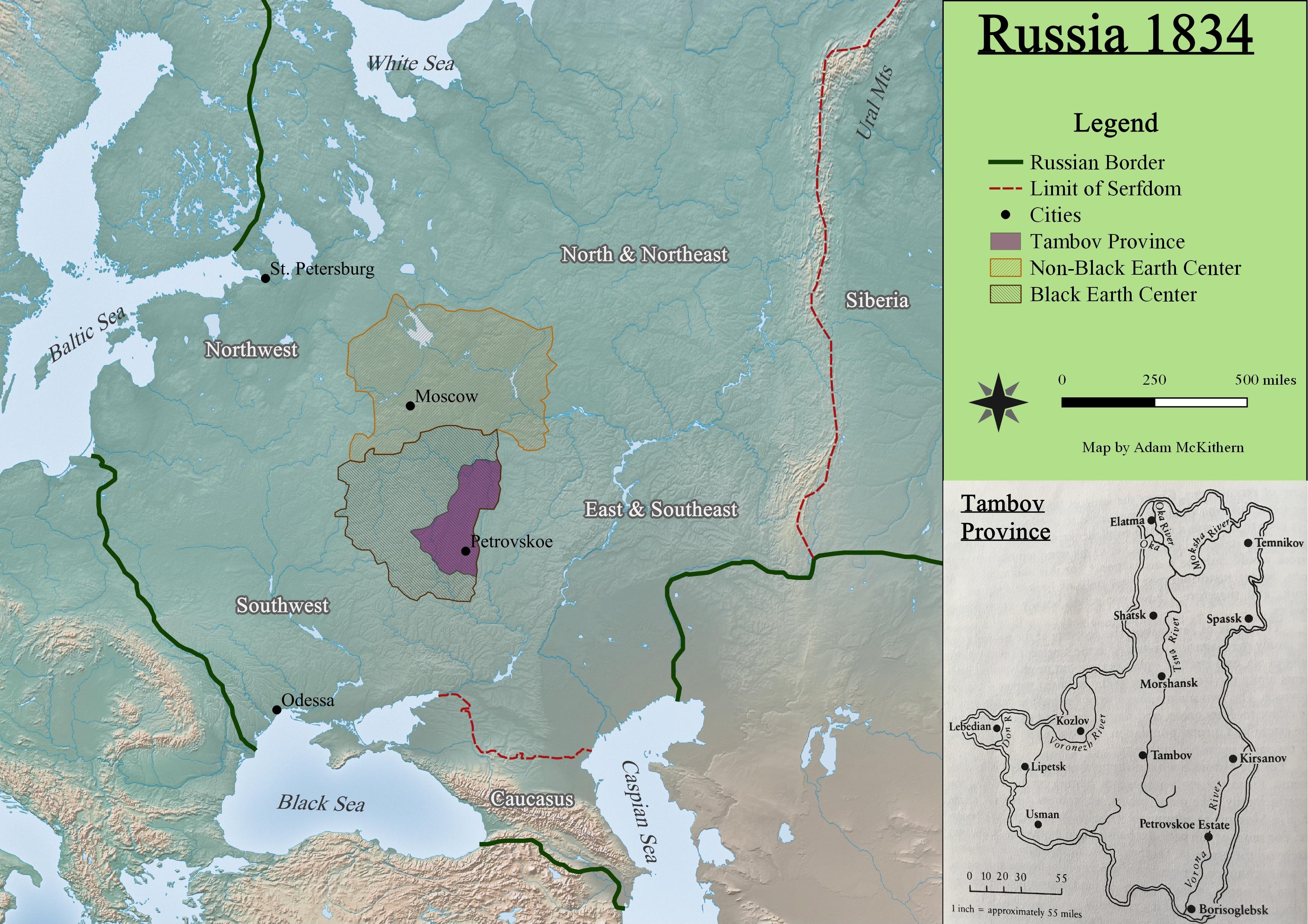
    A Map of Russia, 1834 CE, by Adam McKithern
    russia_1834-page-001

    Click to view slideshow.

    Glossary of Russian Words and Spellings

    • aul (ah-OOL) – a Caucasian mountain hut
    • bárshchina (BAHR-shchee-nah) – dues paid in labor to landlord; corvée
    • brat na braty (BRAT na BRA-tee) – the “brother for brother” system in which half the adult laborers of a commune worked the landlord’s fields on any given day.
    • burmistr (BOOR-mee-stur) – bailiff, manager of an estate
    • chernaia (CHUR-nai-yuh) – chimney-less hut
    • desiatina (DEE-syah-tee-nah) – a unit of area equal to 2.7 acres
    • izbá (eez-BAH) – hut
    • kholop (hah-LOHP) – slave
    • krepostnoi (kray-PAHST-noy) – serf
    • mir (MEER) – peasant commune; also means “world”, “peace”
    • obrók (ahb-ROHK) – dues paid in kind or money to landlord
    • oprichnina (ah-PREECH-nee-nah) – secret police of Ivan the Terrible
    • poméshchik (pah-MYEE-shuhk) – servitor landlord
    • Pomórskaia (POH-mohr-skai-yuh)– Old Belief, referring to liturgical forms retained from before the reforms of 1652-1658
    • saklya (SACK-lee-yuh) – a Caucasian mountain hut
    • sótskii (SOHT-skee) – peasant/serf assigned to keep order on an estate; lit. “hundredth” and in charge of 100 households
    • stárosta (STAH-us-tuh) – village elder
    • tiaglo (tee-ah-GLUH) – husband-wife work team
    • upravitel (oop-rah-VEE-tul) – steward, bailiff
    • versta (vyeer-STAH) – a unit of distance equal to 0.663 miles or 1.067 km

    Main Sources

    Avakkum. (1950/2003). “The Life of Archpriest Avakkum.” In: Fedotov, G. P., Ed. (1950/2003). The Way of a Pilgrim and Other Classics of Russian Spirituality. Iswolsky, H., Trans. Mineola, NY: Dover.

    Buggle, J. C., and Nafziger, S. (2015). “Long-Run Consequences of Labor Coercion: Evidence from Russian Serfdom.” Retrieved Jan. 7, 2017, from: http://www.johannesbuggle.com/docs/serfdom_1.4.pdf

    Domar, E. (1970). “The Causes of Slavery or Serfdom: A Hypothesis.” The Journal of Economic History, 30(1): 18-32. Retrieved Jan. 7, 2017, from: https://www.cambridge.org/core/journals/journal-of-economic-history/article/div-classtitlethe-causes-of-slavery-or-serfdom-a-hypothesisdiv/B6055D4D909C9D21B79BB42D2CD952C5

    Fedotov, G. P., Ed. (1950/2003). The Way of a Pilgrim and Other Classics of Russian Spirituality. Iswolsky, H., Trans. Mineola, NY: Dover.

    Gogol, N. V. (1834). Taras Bulba and Other Tales. Cournos, J, ed. Retrieved Mar 16, 2017, from: http://www.gutenberg.org/files/1197/1197-h/1197-h.htm

    Gorshkov, B. B. (2005). A Life Under Russian Serfdom: The Memoirs of Savva Dmitrievich Purlevskii 1800-1868. New York: Central European University Press.

    Hoch, S. L. (1986). Serfdom and Social Control in Russia: Petrovskoe, A Village in Tambov. Chicago: University of Chicago Press.

    Kolchin, P. (1987). Unfree Labor: American Slavery and Russian Serfdom. Cambridge, MA: Belknap Press of Harvard University Press

    Lincoln, W. (1994). The Conquest of a Continent: Siberia and the Russians. New York: Random House.

    MacKay, J. (2009). Four Russian Serf Narratives. Madison, WI: University of Wisconsin Press.

    Markevich, A., and Zhuravskaya, E. (2016). “The Economic Effects of the Abolition of Serfdom: Evidence from the Russian Empire.” Retrieved Jan. 7, 2017, from: http://piketty.pse.ens.fr/files/MarkevitchZhuravskaya2016.pdf

    Moley, H. (1866). Sketches of Russian Life Before and During the Emancipation of the Serfs. London: Chapman and Hall.

    Nafziger, S. (2013). “Russian Serfdom, Emancipation, and Land Inequality: New Evidence.” Retrieved Jan. 7, 2017, from: http://www.ucrs.uu.se/digitalAssets/336/c_336060-l_3-k_serfdom_emancipation_inequality_steven_nafziger.pdf

    Nafziger, S. (2011). “Serfdom, Emancipation, and Economic Development in Tsarist Russia.” Retrieved Jan. 7, 2017, from: 12.161.242.125/dotAsset/60e0d541-627e-4028-bca1-5fb981169cc2.doc

    Nafziger, S., and Lindert, P. (2013). “Russian Inequality on the Eve of Revolution.” Retrieved Jan. 7, 2017, from: http://web.williams.edu/Economics/wp/Nafziger_Lindert_Inequality_Sept2013.pdf

    Rosa, J. (2011). “The Causes of Serfdom: Domar’s Puzzle Revisited.” Retrieved Jan. 7, 2017, from: https://papers.ssrn.com/sol3/papers.cfm?abstract_id=1833511

    Semyenov, Y. (1944). The Conquest of Siberia. Dickes, E. W., Ed. London: G. Routledge & Sons, Ltd.

    Tolstoy, L. (1887). A Russian Proprietor and Other Stories. Dole, N. H., Trans. New York: Thomas Y. Crowell & Co.

    Tolstoy, L. (1852). The Cossacks. Maude, L., & Maude, A., Trans. Retrieved Jan. 7, 2017, from: http://www.fullbooks.com/The-Cossacks.html

    Wirtschafter, E. K. (2008). Russia’s Age of Serfdom 1649-1861. Maldon, MA: Blackwell.

    Maps, pics, references, and more at http://www.deadideas.net. Music and graphic design by Rachel Westhoff. Map by Adam McKithern.

    Dead Ideas: The History of Extinct Thoughts and Practices is made with Jetpack Podcast. Full show notes and every episode at https://deadideas.net/


    Previous 1 7 8 9 10 11 12 Next

    Related Podcasts

    Dan Carlin’s Hardcore History

    1

    Dan Carlin’s Hardcore History History
    More Perfect

    2

    More Perfect Government
    Casefile True Crime

    3

    Casefile True Crime Games & Hobbies
    The Way I Heard It with Mike Rowe

    4

    The Way I Heard It with Mike Rowe History
    BackStory

    5

    BackStory History
    The Black Dahlia Serial Killers

    6

    The Black Dahlia Serial Killers History
    footer-logo

    Contact Us

    Toll Free: 844-670-7747

    Links

    • Home
    • Top Charts
    • Networks
    • Apps
    • Independents Podcasts
    • Podcast Advertising
    • Podcast News
    • Contact Us
    • About Us
    • Analytics & Insights

    Stay Connected

      Privacy, Terms of Use & Our Code of Ethics Protecting Content Creators Copyrights




