TopPodcast.com
Menu
  • Home
  • Top Charts
  • Top Networks
  • Top Apps
  • Top Independents
  • Top Podfluencers
  • Top Picks
    • Top Business Podcasts
    • Top True Crime Podcasts
    • Top Finance Podcasts
    • Top Comedy Podcasts
    • Top Music Podcasts
    • Top Womens Podcasts
    • Top Kids Podcasts
    • Top Sports Podcasts
    • Top News Podcasts
    • Top Tech Podcasts
    • Top Crypto Podcasts
    • Top Entrepreneurial Podcasts
    • Top Fantasy Sports Podcasts
    • Top Political Podcasts
    • Top Science Podcasts
    • Top Self Help Podcasts
    • Top Sports Betting Podcasts
    • Top Stocks Podcasts
  • Podcast News
  • About Us
  • Podcast Advertising
  • Contact
Not in our directory?
Add Show Here
Podcast Equipment
Center

toppodcastlogoOur TOPPODCAST Picks

  • Comedy
  • Crypto
  • Sports
  • News
  • Politics
  • True Crime
  • Business
  • Finance

Follow Us

toppodcastlogoStay Connected

    View Top 200 Chart
    Back to Rankings Page
    Government & Organizations

    Core EM – Emergency Medicine Podcast

    Core EM Emergency Medicine Podcast

    Advertise

    Copyright: © Core EM

    • Apple Podcasts
    • Google Play
    • Spotify

    Latest Episodes:
    Episode 87.0 – Journal Review (Ketorlac Dosing + POKER Trial) Mar 06, 2017
    Show notes

    This week we discuss two recent journal articles - the POKER trial and the ketorlac analgesic ceiling

    https://media.blubrry.com/coreem/content.blubrry.com/coreem/Podcast_Episode_87_0_Final_Cut.m4a Download Leave a Comment Tags: Ketamine, Ketofol, ketorlac, POKER, Propofol, PSA

    Show Notes

    Take Home Points

    1. The POKER trial examined the difference between propofol and ketofol when it comes to adverse respiratory events. They found no significant difference between the groups. Given the increased risk of medication errors using two medication instead of one, you may want to avoid the mixture.
    2. Ketorolac has an analgesic ceiling effect lower than you may have thought. When comparing IV doses of 10mg, 15mg and 30mg they found no difference in analgesic effect. Given the risks of side effects may increase with higher doses, you may want to stick to the lower 10mg dose.

    RebelEM: The POKER Trial: Go All in on Ketofol?

    St. Emlyn’s: JC: Is Ketofol with the hassle?

    Core EM: Propofol vs. Ketofol in PSA

    EM: RAP: Just Enough Ketorlac

    RebelEM: The Ketorolac Analgesic Ceiling

    Core EM: Parenteral Ketorlac Dosing

    Propofol or Ketofol for Procedural Sedation and Analgesia in Emergency Medicine-The POKER Study: A Randomized Double-Blind Clinical Trial. PubMed ID: 27460905

    Comparison of Intravenous Ketorolac at Three Single-Dose Regimens for Treating Acute Pain in the Emergency Department: A Randomized Controlled Trial. PubMed ID: 27993418


    Read More

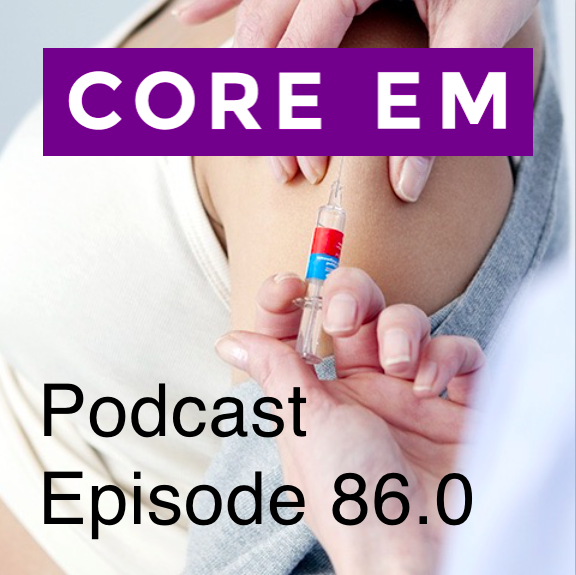
    Episode 86.0 – Anti-D Immunoglobulin (RhoGam) in Early Pregnancy Feb 27, 2017
    Show notes

    Do patients with 1st trimester bleeding need to get anti-D immunoglobulin if they're Rh negative? We dive into the topic this week.

    https://media.blubrry.com/coreem/content.blubrry.com/coreem/Podcast_86_0_Final_Cut.m4a Download Leave a Comment Tags: Early Pregnancy, Obstetrics, RhoGam, Vaginal Bleeding

    Show Notes

    Take Home Points

    1. An Rh negative woman can become alloimmunized to Rh antigen if exposed to blood from an Rh positive fetus. Theoretically, this alloimmunization can occur even in early pregnancy
    2. While anti-D immune globulin has clearly been shown to be beneficial in preventing alloimmunization in 2nd and 3rd trimester pregnancy, there is no evidence supporting use specifically in the 1st trimester
    3. Despite the absence of evidence, RhoGam administration has become routine in many places. At this time, it’s advisable to follow local practice patterns regarding which patients should be given RhoGam.

    References

    ACOG Practice Bulletin. Prevention of Rh D Alloimmunization. Int J Gynaecol Obstet 1999; 66(1): 63-70. PMID: 10458556 Recommendations reaffirmed in 2016

    Hahn SA et al. Clinical Policy: Critical Issues in the Initial Ealuation and Management of Patients Presenting to the Emergency Department in Early Pregnancy. Ann Emerg Med 2012; 60(3): 381-419. PMID: 22921048

    Hannafin B et al. Do Rh-Negative Women with First Trimester Spontaneous Abortions Need Rh Immune Globulin. Am J Emerg Med 2006; 24: 487-9. PMID: 16787810

    Visscher RD, Visscher HC. Do Rh-Negative Women with an Early Spontaneous Abortion Need Rh Immune Prophylaxis? Am J Obstet Gynecol 1972; 113(2): 158-65. PMID: 4623673


    Read More

    Episode 85.0 – Challenging Deliveries Feb 20, 2017
    Show notes

    This week we discuss three common complications of delivery: cord prolapse, nuchal cord and shoulder dystocia.

    https://media.blubrry.com/coreem/content.blubrry.com/coreem/Podcast_85_0_Final_Cut.m4a Download Leave a Comment Tags: Cord Prolapse, Nuchal Cord, Obstetrics, Shoulder Dystocia

    Show Notes

    Take Home Points

    1. If you have a patient with a cord prolapse, elevate the presenting part to take pressure off the cord, place the patient in trendelenburg and fill the bladder. Then, redline it to the OR for a c-section.
    2. Nuchal cord is common but likely not too dangerous. Just gently unwrap the umbilical cord and the fetus should be just fine
    3. Shoulder dystocia isn’t common but it’s a true emergency as the fetus can suffer severe hypoxia or death. You’ve got a bout 5 minutes to deliver. Immediately call for help from OB, place a foley catheter to drain the bladder and place the mom’s legs so that her knees are pressed into her chest. This helps to open up the pelvis and give more room for the shoulder to be delivered. If that doesn’t work, you can try the wood’s screw maneuver or place the mom on all 4s. If you’ve got an OR ready, pushing the head back in is also an option but only if you have an OR available

    Read More

    Core EM: Shoulder Dystocia

    emDocs: The Complicated Delivery: What You Can Do

    Del Portal DA et al. Emergency department management of shoulder dystocia. J Emerg Med. 2014 Mar;46(3):378-82. PMID: 24360351


    Read More

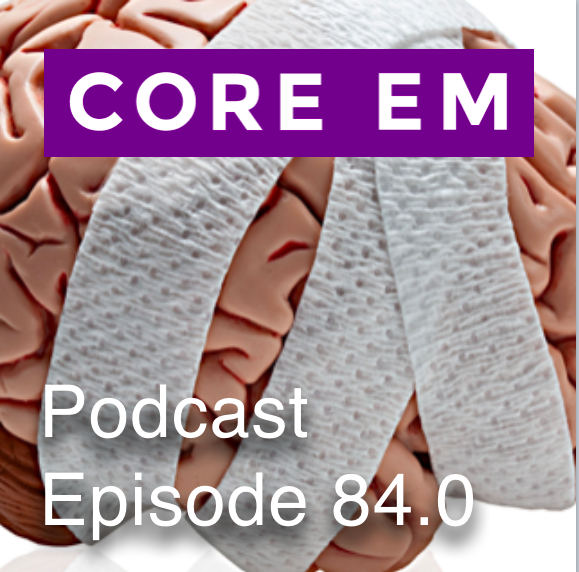
    Episode 84.0 – Traumatic ICH Management Feb 13, 2017
    Show notes

    This week we look at TBI and discuss some of the pitfalls and pearls in early management of traumatic ICH.

    https://media.blubrry.com/coreem/content.blubrry.com/coreem/Podcast_84_0_Final_Cut.m4a Download 2 Comments Tags: Head Injury, Hyperosmolar Therapy, ICH, Resuscitation, RSI, TBI, Trauma

    Show Notes

    Take Home Points

    1. If you get a heads up from EMS on an incoming trauma, take the lead time you get to clearly delineate everyone’s roles to help ensure the resuscitation runs smoothly.
    2. In the severe TBI patient, the key is in preventing secondary injury to the brain. We do this by guarding against hypoxia, hypercarbia, hypotension and aspiration. Max your pre-ox, get the ETT in quickly to prevent oxygenation and ventilation issues and keep the head up if possible
    3. Hypotension is rarely seen in isolated head trauma. If the patient is or becomes hypotensive, reassess for any sources of hemorrhagic shock that may have been missed and consider whether the meds you gave may have caused the problem.
    4. Hypertension is much more common and despite extensive research, we haven’t shown that dropping the patient to normal levels is beneficial. Keeping the SBP < 180 seems reasonable but check your local protocol as well.
    5. If the patient’s ICP spikes or your concerned about herniation, administer mannitol or hypertonic saline and get your neurosurgeon to the bedside since the patient is gonna need decompression
    6. Finally, make sure to reverse any anticoagulant the patient may have on board as this will hopefully prevent hematoma expansion.

    Read More

    emDocs: Roc Rocks and Sux Sucks! Why Rocuronium is the Agent of Choice for RSI

    Core EM: Podcast 31.0 – Rocuronium vs. Succinylcholine

    Core EM: Intensive Blood Pressure Lowering in Intracerebral Hemorrhage (ATACH-2 Trial)

    PulmCCM: Hyperosmolar Therapy for Increased Intracranial Pressure (Review)

    EM Cases: Episode 89 – DOACs Part 2: Bleeding and Reversal Agents

    Hopper AH. Hyperosmolar therapy for raised intracranial pressure. NEJM 2012; 367(8): 746-52. PMID: 22913684

    Wang X et al. Ketamine does not increase intracranial pressure compared with opioids: meta-analysis of randomized controlled trials. J Anesth 2014; 28(6): 821-7. PMID: 24859931

    Zeiler FA et al. The ketamine effect on ICP in traumatic brain injury. Neurocrit Care 2014; 21(1): 163-73. PMID: 24515638


    Read More

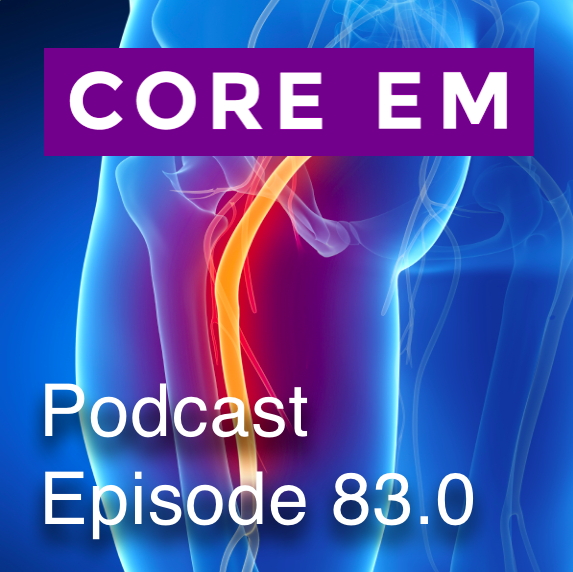
    Episode 83.0 – Lumbar Radiculopathy Feb 06, 2017
    Show notes

    This week we discuss a bit about back pain and specifically, lumbar radiculopathy with a focus on causes and red flags.

    https://media.blubrry.com/coreem/content.blubrry.com/coreem/Podcast_Episode_83_0_Final_Cut.m4a Download One Comment Tags: Back Pain, Low Back Pain, Musculoskeletal, Steroids

    Show Notes

    Read More

    St. Emlyn’s: Back to Basics: Back Pain in the ED

    Edlow JA. Managing nontraumatic acute back pain. Ann Emerg Med 2015; 66: 148-53. PMID: 25578887

    Goldberg H et al. Oral steroids for acute radiculopathy due to a herniated lumbar disk: a randomized clinical trial. JAMA 2015; 313 (19): 1915-23. PMID: 25988461

    Friedman BW et al. Naproxen with cyclobenzaprine, oxycodone/acetaminophen, or placebo for treating acute low back pain: a randomized clinical trial. JAMA 2015; 314 (15): 1572-80. PMID: 26501533


    Read More

    Episode 82.0 – ED Management of Seizures Jan 30, 2017
    Show notes

    This week we discuss the ED management of seizures focusing on treatment and workup particularly of a 1st seizure episode.

    https://media.blubrry.com/coreem/content.blubrry.com/coreem/Podcast_Episode_82_0_Final_Cut.m4a Download Leave a Comment Tags: Neurology, Seizure, Status Epilepticus

    Show Notes

    Take Home Points

    1. Get a detailed history to tease out whether the patient had a seizure or a syncopal event. Regardless, get an EKG on 1st time seizures in case it was actually syncope.
    2. BZDs are first line therapy for seizure termination. If you don’t have IV access, go with 10 mg of midazolam or 2-4 mg of lorazepam IM
    3. Always review the 5 main categories for causes of seizures in order to make sure you’re not missing anything. Those categories once again are vital sign abnormalities, CNS infections, toxic/metabolic issues, CNS space occupying lesions including masses and bleeds and finally epilepsy.
    4. In patients with a first time seizure without a particular cause and return to baseline neurologic status, there’s unlikely to be any benefit to a NCHCT or to starting an AED. Scheduling close follow up with a neurologist is very reasonable. The key is to do a thorough examination and make sure you’re not missing a subtle abnormality.
    5. Finally, in status epilepticus hit the patient with 2-3 hefty doses of BZDs and if the seizure is still ongoing, strongly consider moving to propofol and intubation in order to rapidly control the seizure activity.

    Read More

    Core EM: Parenteral Benzodiazepines

    LITFL: Seizure

    EMCrit: Podcast 155 – Status Epilepticus with Tom Bleck

    First10EM: Management of Status Epilepticus in the Emergency Department

    Huff SJ et al. Clinical Policy: Critical Issues in the Evaluation and Management of Adult Patients Presenting to the Emergency Department with Seizures. Ann Emerg Med 2014; 43(5): 605-25. PMID: 15111920


    Read More

    Podcast 81.0 – Visualization Jan 23, 2017
    Show notes

    This week, the podcast features a talk on Visualization given at the All NYC EM conference in October 2016.

    https://media.blubrry.com/coreem/content.blubrry.com/coreem/Podcast_Episode_81_0_Final_Cut.m4a Download One Comment Tags: All NYC EM, Human Factors, Performance Psychology, Sports Psychology

    Show Notes

    Read More

    EMCrit: EHPR Part 5: Using Mental Practice and Visualization Exercises by Mike Lauria


    Read More

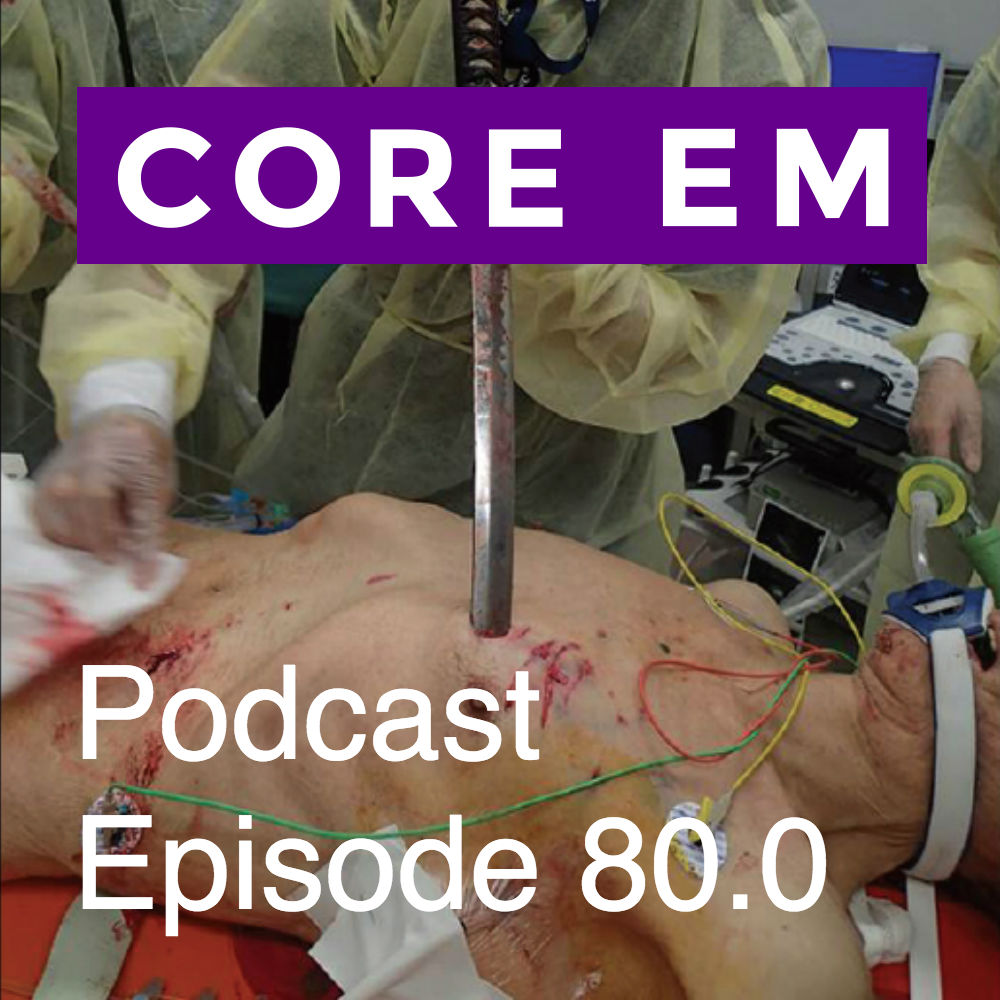
    Episode 80.0 – Penetrating Chest Trauma Jan 16, 2017
    Show notes

    This week we feature a short primer on penetrating chest trauma focusing on circulation first over airway and breathing.

    https://media.blubrry.com/coreem/content.blubrry.com/coreem/Podcast_Episode_80_0_Final_Cut.m4a Download Leave a Comment Tags: ED Thoracotomy, EFAST, Resuscitative Thoracotomy, Trauma, Ultrasound

    Show Notes

    Take Home Points

    1. Don’t rush to the airway. In most situations, you have some time so resuscitate before you intubate. Give blood products and get the BP up a bit to give yourself a little better physiologic situation in which to intubate.
    2. Start your massive transfusion immediately if the patient is shocked. There’s always a delay in getting products but the earlier you start, the shorter the delay.
    3. Include US in your primary survey. Your E-FAST should start with the cardiac window, then go to the lungs and then, finally, the abdomen. This order focuses on finding pathology you can fix immediately.
    4. If the patient is shocked and peri-arrest or recently lost vitals, open the chest and look for a fixable injury. Start with opening the pericardium to relieve tamponade, identify and repair cardiac wounds and cross clamp the aorta.

    Read More

    Larry Mellick: Open Thoracotomy Video

    EMCrit: Podcast 081 – An Interview on Severe Trauma with Karim Brohi

    LITFL: Penetrating Chest Trauma

    EM:RAP: How to Crack the Chest

    EM: RAP: Stabbed in the Chest


    Read More

    Episode 79.0 – The Traumatized Airway Jan 09, 2017
    Show notes

    This week we discuss facial trauma and the disasters it can cause to your airway management.

    https://media.blubrry.com/coreem/content.blubrry.com/coreem/Podcast_Episode_79_0_Final_Cut.m4a Download 2 Comments Tags: Airway, Cricothyroidotomy, RSI, Trauma

    Show Notes

    Take Home Points

    1. In a patient with significant head and neck trauma, EACH step of the airway management can be more difficulty. BVM may be hard, LMA may be hard, RSI may be hard, so don’t be afraid to ask for help early.
    2. Decide whether the patient has an actual obstruction of their airway. If they are obstructed above the larynx, don’t bother with your usual airway maneuvers, go directly to the surgical airway.
    3. When you do attempt RSI, have double suction and multiple airway techniques set up. This is the time to have your friend standing at your side, scalpel in hand and ready to move directly down the difficult airway algorithm if trouble arises.
    4. Finally, consider keeping the patient awake and preserving their own respiratory drive as it may give you more time to secure the airway.

    Read more

    LITFL: Facial Trauma

    LITFL: Airway in Maxillofacial Trauma

    EMCrit: Real Surgical Airway


    Read More

    Episode 78.0 – Effect of Conservative vs. Conventional Oxygen Use on Mortality Jan 02, 2017
    Show notes

    This week we discuss the OXYGEN-ICU trial exploring the effect of excess oxygen on ICU mortality.

    https://media.blubrry.com/coreem/content.blubrry.com/coreem/Podcast_Episode_78_0_Final_Cut.m4a Download Leave a Comment Tags: Critical Care, ICU, OXYGEN-ICU Study

    Show Notes

    Read More

    The Bottom Line: Normal Oxygen Versus Hyperoxia in the Intensive Care Unit (ICU) (OXYGEN-ICU)

    ScanCrit: Avoid the Oxygen Reflex

    REBEL EM: July 2015 REBEL Cast

    References

    Giradis M et al. Effect of Conservative vs Conventional Oxygen Therapy on Mortality Among Patients in an Intensive Care Unit: The Oxygen-ICU Randomized Clinical Trial. JAMA. 316(15):1583-1589. 2016. PMID: 27706466

    Meyhoff CS et al. PROXI Trial Group. Effect of high perioperative oxygen fraction on surgical site infection and pulmonary complications after abdominal surgery: the PROXI randomized clinical trial. JAMA. 2009; 302(14):1543-1550. PMID: 19826023

    Stub D et al. AVOID Investigators. Air versus oxygen in ST-segment-elevation myocardial infarction. Circulation. 2015;131(24):2143-2150. PMID: 26002889


    Read More

    Previous 1 13 14 15 16 17 24 Next

    Related Podcasts

    The Joe Rogan Experience

    1

    The Joe Rogan Experience Comedy
    More Perfect

    2

    More Perfect Government
    Casefile True Crime

    3

    Casefile True Crime Games & Hobbies
    Reply All

    4

    Reply All Games & Hobbies
    You Must Remember This

    5

    You Must Remember This Games & Hobbies
    Real Time with Bill Maher

    6

    Real Time with Bill Maher Games & Hobbies
    footer-logo

    Contact Us

    Toll Free: 844-670-7747

    Links

    • Home
    • Top Charts
    • Networks
    • Apps
    • Independents Podcasts
    • Podcast Advertising
    • Podcast News
    • Contact Us
    • About Us
    • Analytics & Insights

    Stay Connected

      Privacy, Terms of Use & Our Code of Ethics Protecting Content Creators Copyrights