TopPodcast.com
Menu
  • Home
  • Top Charts
  • Top Networks
  • Top Apps
  • Top Independents
  • Top Podfluencers
  • Top Picks
    • Top Business Podcasts
    • Top True Crime Podcasts
    • Top Finance Podcasts
    • Top Comedy Podcasts
    • Top Music Podcasts
    • Top Womens Podcasts
    • Top Kids Podcasts
    • Top Sports Podcasts
    • Top News Podcasts
    • Top Tech Podcasts
    • Top Crypto Podcasts
    • Top Entrepreneurial Podcasts
    • Top Fantasy Sports Podcasts
    • Top Political Podcasts
    • Top Science Podcasts
    • Top Self Help Podcasts
    • Top Sports Betting Podcasts
    • Top Stocks Podcasts
  • Podcast News
  • About Us
  • Podcast Advertising
  • Contact
Not in our directory?
Add Show Here
Podcast Equipment
Center

toppodcastlogoOur TOPPODCAST Picks

  • Comedy
  • Crypto
  • Sports
  • News
  • Politics
  • True Crime
  • Business
  • Finance

Follow Us

toppodcastlogoStay Connected

    View Top 200 Chart
    Back to Rankings Page
    Government & Organizations

    Core EM – Emergency Medicine Podcast

    Core EM Emergency Medicine Podcast

    Advertise

    Copyright: © Core EM

    • Apple Podcasts
    • Google Play
    • Spotify

    Latest Episodes:
    Episode 67.0 – Feedback Oct 10, 2016
    Show notes

    This week we review pearls from our Grand Rounds from George Willis, MD talking about feedback.

    https://media.blubrry.com/coreem/content.blubrry.com/coreem/Podcast_Episode_67_0_Final_Cut.m4a Download Leave a Comment Tags: Resident Education

    Show Notes

    Read More

    St. Emlyn’s: #TTCNYC Resources for Feedback Talk


    Read More

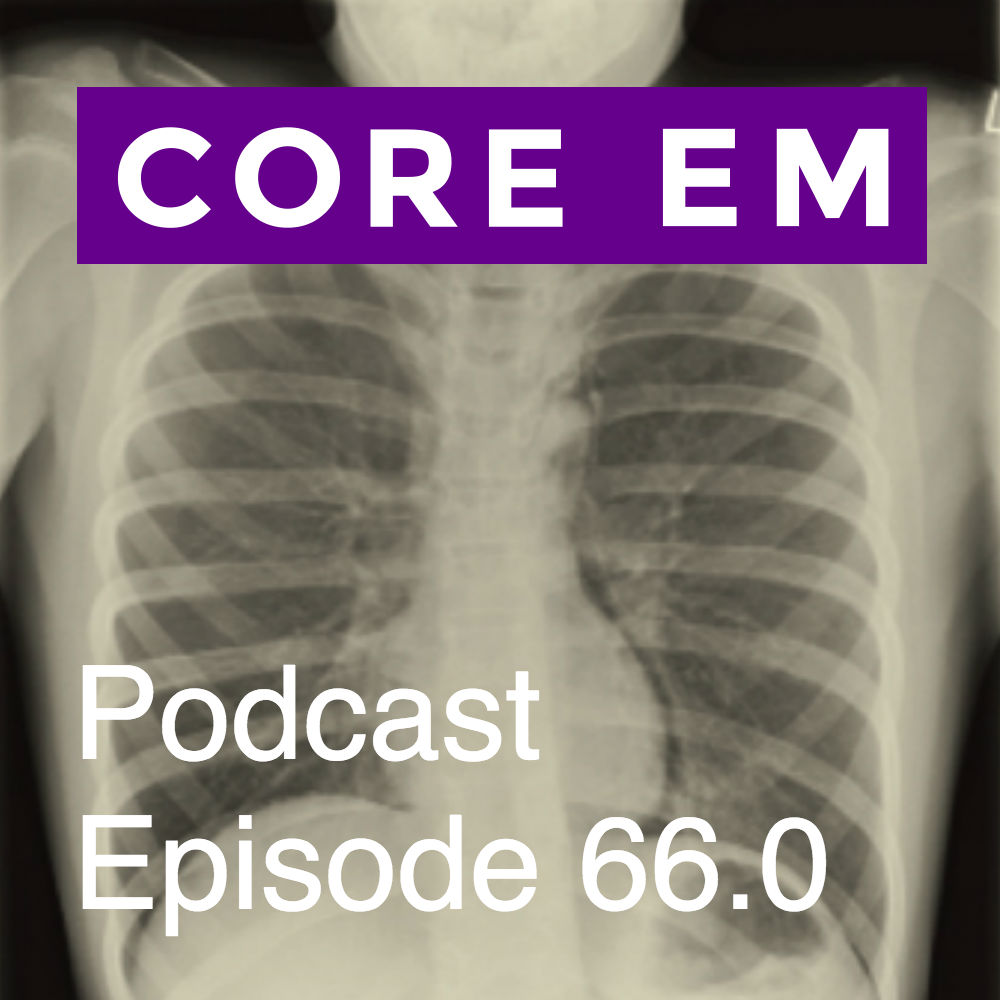
    Episode 66.0 – Boerhaave Syndrome Oct 03, 2016
    Show notes

    This week, we discuss Boerhaave syndrome focusing on making the diagnosis and managing the patient.

    https://media.blubrry.com/coreem/content.blubrry.com/coreem/Podcast_Episode_66_0_Final_Cut.m4a Download One Comment Tags: Chest Pain, Pulmonary

    Show Notes

    Take Home Points

    1. Keep esophageal rupture on your differential for deadly causes of chest, epigastric or back pain. We don’t see it often, but it’s a real thing.
    2. Boerhaave Syndrome is the spontaneous rupture of the esophagus that is caused by a sudden increase in intraesophageal pressure, as seen in forceful vomiting. So, if the patient presents with the right symptoms and any vomiting in their history, keep this diagnosis in mind. Other causes you might see, though less common, are childbirth, seizure, prolonged coughing or laughing, or weightlifting.
    3. ED management is essentially ABCs and broad spectrum antibiotics, and maybe even antifungals.
    4. As soon as you make this diagnosis, get you CT surgeon on board as the length of time to definitive treatment is directly related to mortality.

    Read More

    Radiopaedia: Boerhaave Syndrome

    LITFL: Roast Duck and Juniper Beer


    Read More

    Episode 65.0 – Pericarditis Sep 26, 2016
    Show notes

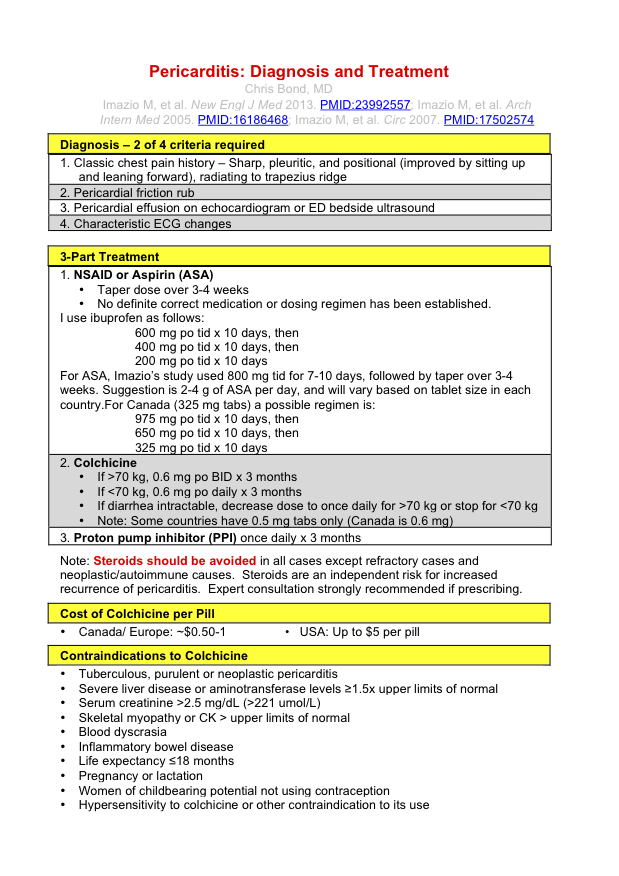
    This week we discuss the diagnosis and management of pericarditis with a focus on not missing the hidden STEMI.

    https://media.blubrry.com/coreem/content.blubrry.com/coreem/Podcast_Episode_65_0_Final_Cut.m4a Download Leave a Comment Tags: ACS, Cardiology, Cardiovascular, Colchicine, Pericarditis, STEMI

    Show Notes

    Read More

    ECG Case of the Week (Amal Mattu): Acute STEMI vs. Pericarditis Part 1 + Part 2

    REBEL EM: Colchicine for Treatment of Pericarditis

    SOCMOB: Pericarditis: Treatment and Diagnosis Pocket Card

    FOAMcast: Episode 54 – The Pericardium

    Core EM: Pericarditis

    Pericarditis PV Card (Chris Bond (socmob.org)

    Pericarditis PV Card (Chris Bond (socmob.org)

    References

    Brady W et al. Electrocardiographic ST-segment elevation: the diagnosis of acute myocardial infarction by morphologic analysis of the ST segment. Acad Emerg Med 2001;8:961–7. PMID: 11581081

    Bischof JE et al. ST depression in lead aVL differentiates inferior ST-elevation myocardial infarction from pericarditis. Am J Emerg Med 2015 PMID: 26542793


    Read More

    Episode 64.0 – Rate Control in Atrial Fibrillation Sep 19, 2016
    Show notes

    This week we discuss an age-old debate: Calcium Channel Blockers or Beta Blockers for rate control in atrial fibrillation.

    https://media.blubrry.com/coreem/content.blubrry.com/coreem/Podcast_Episode_64_0_Final_Cut.m4a Download Leave a Comment Tags: Atrial Fibrillation, Beta Blocker, Calcium Channel Blocker, Cardiology, Rate Control

    Show Notes

    CoreEM: Recent Onset Atrial Fibrillation

    ALiEM: Atrial Fibrillation Rate Control in the ED: Calcium Channel Blockers or Beta Blockers?

    ALiEM: Beta Blockers vs Calcium Channel Blockers for Atrial Fibrillation Rate Control: Thinking Beyond the ED

    Fromm C, et al. Diltiazem vs. Metoprolol in the Management of Atrial Fibrillation or Flutter with Rapid Ventricular Rate in the Emergency Department. J Emerg Med. 2015 Apr 22. PMID 25913166


    Read More

    Episode 63.0 – Discharge Glucose Levels Sep 12, 2016
    Show notes

    This week we discuss a recent article looking at the relevance of d/c glucose levels to patient revisits and subsequent hospitalization

    https://media.blubrry.com/coreem/content.blubrry.com/coreem/Episode_63_0_Final_Cut.m4a Download Leave a Comment

    Show Notes

    Driver BE et al. Discharge glucose is not associated with short-term adverse outcomes in emergency department patients with moderate to severe hyperglycemia. Ann Emerg Med 2016. PMID: 27353284


    Read More

    Episode 62.0 – VFib and Pulseless VTach Sep 05, 2016
    Show notes

    This week we discuss the ED management of cardiac arrest with VFib and pulseless VTach.

    https://media.blubrry.com/coreem/content.blubrry.com/coreem/Episode_62_0_Final_Cut.m4a Download One Comment Tags: Cardiac Arrest, Dual Defibrillation, OHCA, Ventricular Dysrhythmias, Ventricular Fibrillation, Ventricular Tachycardia

    Show Notes

    Take Home Points

    1. In cardiac arrest, the most important interventions are to deliver electricity quickly when it’s indicated and to administer good high-quality compressions with minimal interruptions to maximize your compression fraction.
    2. Medications like epinephrine and amiodarone have never been shown to improve good neurologic outcomes in the ACLS recommended doses. Don’t focus on them.
    3. Consider pre-charging your defibrillator to minimize pauses in CPR and maximize your chance for ROSC
    4. Finally, remember that as Emergency Physicians, we are specialists in the resuscitation of cardiac arrests. ACLS is just a starting point. Push your understanding of taking care of these patients so you can deliver the best care possible

    Additional Reading

    Core EM: Ventricular Tachycardia

    Core EM: A Simplified Approach to Tachydysrhythmias

    Core EM: Amiodarone, Lidocaine or Placebo in OHCA

    emDocs.net: Epinephrine in Cardiac Arrest

    REBEL EM: Beyond ACLS: Pre-Charging the Defibrillator

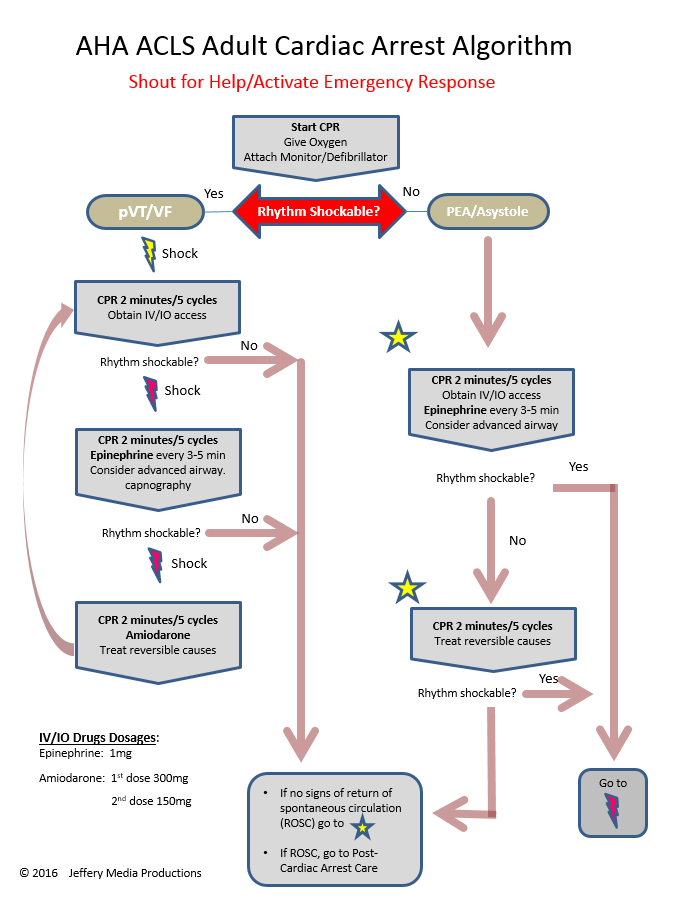
    ACLS VFib and VTach Algorithm

    ACLS VFib and VTach Algorithm

    References

    Driver BE et al. Use of esmolol after failure of standard cardiopulmonary resuscitation to treat patients with refractory ventricular fibrillation. Resuscitation 2014; 85(10): 1337-41. PMID: 25033747

    Kudenchuk PJ et al. Amiodarone, Lidocaine, or Placebo in Out-of-Hospital Cardiac Arrest. NEJM. 2016; PMID: 27043165

    Laina A et al. Amiodarone and Cardiac Arrest: Systematic Review and Meta-Analysis. Int J Cardiol 2016; 221: 780-8. PMID: 27434349


    Read More

    Episode 61.0 – Hypokalemia Aug 29, 2016
    Show notes

    This week we discuss the presentation and treatment of hypokalemia.

    https://media.blubrry.com/coreem/content.blubrry.com/coreem/Episode_61_0_Final_Cut.m4a Download Leave a Comment

    Show Notes

    Take Home Points

    1. Hypokalemia has a wide variety of presentations ranging from generalized weakness, to paralysis, to cardiac arrhythmia or cardiac arrest.
    2. When you discover hypokalemia, be sure to check and EKG. Think about underlying causes of hypokalemia, because it is rarely a solo event.
    3. Treat with oral potassium supplementation of 40-60 orally every 4-6 hours for mild hypokalemia and 10-20 mEq/hour IV for severe or symptomatic hypokalemia.

    Additional Reading

    LITFL: Hypokalemia

    LITFL: Hypokalemic Periodic Paralysis

    Core EM: Hypokalemia


    Read More

    Episode 60.0 – Aggressive Resuscitation of Diabetic Ketoacidosis Aug 22, 2016
    Show notes

    This week we discuss how to aggressively resuscitate patients with DKA as well as dispelling some dogmatic teachings on the topic.

    https://media.blubrry.com/coreem/content.blubrry.com/coreem/Podcast_Episode_60_0_Final_Cut.m4a Download Leave a Comment Tags: Cerebral Edema, DKA, Hypokalemia, Insulin, Resuscitation

    Show Notes

    Take Home Points

    1. DKA should be suspected in any patient with altered mental status and hyperglycemia. Get a VBG (ABG not necessary) to confirm the diagnosis.
    2. Hypokalemia kills in DKA. Aggresively replete potassium and consider holding insulin, which drops serum potassium, until K is greater than 3.5
    3. The insulin bolus isn’t necessary and appears to cause more episodes of hypokalemia. Just start insulin as an infusion at 0.14 units/kg
    4. Be vigilant about cerebral edema. Any change or deterioration in mental status should prompt treatment and evaluation. Mannitol in the euvolemic, normotensive patient and 3% hypertonic saline in the hypotensive/hypovolemic patient
    5. Finally, don’t forge to always hunt down the underlying cause of the DKA. Infection and non-compliance is the most common so liberally administer broad spectrum antibiotics if you’ve got even a hint of infection brewing

    https://www.youtube.com/watch?v=P9sKk4JZmso

    Additional Reading

    LITFL: EBM Diabetic Ketoacidosis

    Core EM: DKA

    Core EM: Episode 13.0 – Diabetic Ketoacidosis: A Case

    emDocs: Myths in DKA Management

    REBEL EM: Is There Any Benefit to an Initial Insulin Bolus in Diabetic Ketoacidosis?

    References

    Aurora S et al. Prevalence of hypokalemia in ED patients with diabetic ketoacidosis. Am J Emerg Med 2012; 30: 481-4. PMID: 21316179

    Boyd JC et al. Relationship of potassium and magnesium concentrations in serum to cardiac arrhythmias. Clin Chem 1984; 30(5): 754-7. PMID: 6713638

    Duhon B et al. Intravenous sodium bicarbonate therapy in severely acidotic diabetic ketoacidosis. Ann Pharmacother 2013; 47: 970-5. PMID: 23737516

    Fagan MJ et al. Initial fluid resuscitation for patients with diabetic ketoacidosis: how dry arethey? Clin Ped 2008; 47(9): 851-6. PMID:

    Goyal N et al. Utility of Initial Bolus insulin in the treatment of diabetic ketoacidosis. J Emerg Med 2010; 38(4): 422-7. PMID: 18514472

    Green SM et al. Failure of adjunctive bicarbonate to improve outcome in severe pediatric diabetic ketoacidosis. Ann Emergency Medicine 1998; 31: 41-48. PMID: 9437340

    Kitabchi AE et al. Is a priming dose of insulin necessary in a low-dose insulin protocol for the treatment of diabetic ketoacidosis? Diabetes Care. 2008;31(11):2081. PMID: 18694978

    Lebovitz HE: Diabetic ketoacidosis. Lancet 1995; 345: 767-772. PMID: 7891491

    Morris LR et al. Bicarbonate therapy in severe diabetic ketoacidosis. Ann Intern Med 1986;105(6):836. PMID: 3096181

    Muir AB et al. Cerebral edema in childhood diabetic ketoacidosis: natural history, radiographic findings, and early identification. Diabetes Care 2004; 27(7):1541-6. PMID: 15220225

    Okuda Y et al. Counterproductive effects of sodium bicarbonate in diabetic ketoacidosis. J Clinical Endocrinology Metabolism 1996; 81: 314-320. PMID: 8550770

    Savage MW et al. Joint British Diabetes Societies guideline for the management of diabetic ketoacidosis. Diabet Med. 2011 May;28(5):508-15. PMID: 21255074

    Villon A et al. Does bicarbonate therapy improve management of severe diabetic ketoacidosis? Crit Care Med 1999; 27: 2690-2693. PMID: 10628611


    Read More

    Episode 59.0 – Severe Decompensated Hyperthyroidism Aug 15, 2016
    Show notes

    This week we discuss the recognition, diagnosis and treatment of severe decompensated hyperthyroidism or thyroid storm.

    https://media.blubrry.com/coreem/content.blubrry.com/coreem/Podcast_Episode_59_0_Final_Cut.m4a Download Leave a Comment Tags: Thyroid Diseases, Thyroid Storm

    Show Notes

    Take Home Points

    1. Decompensated hyperthyroidism is a rare, life-threatening condition. It can develop in patients with long-standing untreated hyperthyroidism and is often precipitated by another event such as an infection, surgery, or trauma.
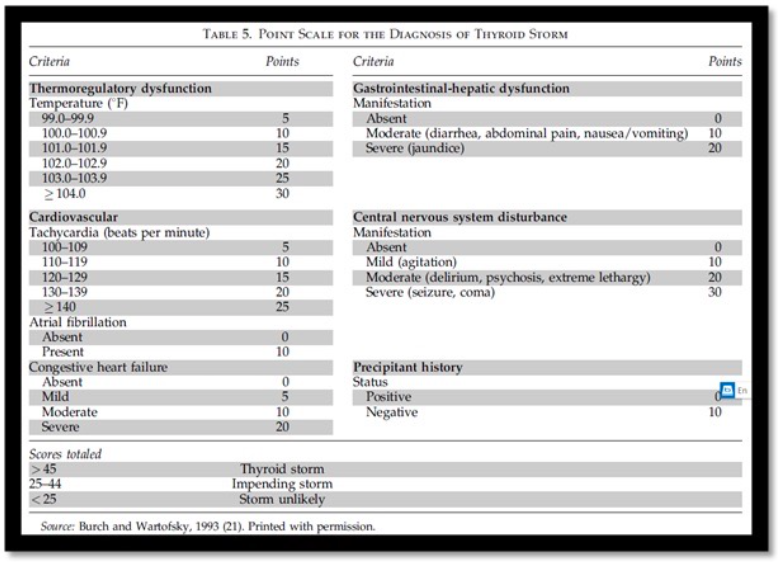
    2. Patients present with tachycardia, fever, altered mental status and GI symptoms. Keep thyroid storm in mind if a patient has a history of hyperthyroidism or if things just aren’t making sense with your patient, you can’t find a fever source, they have fever and new afib, things like that. You’re going to use a clinical scoring tool like the Burch-Wartofsky scoring system to make the diagnosis.
    3. Treatment is three-fold. First treat the peripheral effects with propranolol. Then prevent further synthesis of thyroid hormone with PTU and corticosteroids. And last prevent the further release of thyroid hormone with iodine. Be sure to hold off on giving the iodine until at least 1 hour after the patient receives PTU to avoid worsening the hyperthyroid.
    Burch Wartofsky Scale (maryland.ccproject.com)

    Burch Wartofsky Scale (maryland.ccproject.com)

    Additional Reading

    ALiEM: Diagnosing hyperthyroidism: Answers to 7 common questions

    ALiEM: Thyroid Storm – Treatment Strategies

    LITFL: Thyroid Storm

    WikeEM: Burch and Wartofsky Diagnostic Criteria for Thyroid Storm

    Akamizu T et al. Diagnostic criteria, clinical features, and incidence of thyroid storm based on nationwide surveys. Thyroid 2012; 22(7): 661-79. PMC: 3387770


    Read More

    Episode 58.0 – Hyponatremia Aug 08, 2016
    Show notes

    This week we discuss severe hyponatremia - presentation and treatment.

    https://media.blubrry.com/coreem/content.blubrry.com/coreem/Episode_58_0_Final_Cut.m4a Download Leave a Comment Tags: Electrolytes, Hypertonic Saline, Hyponatremia

    Show Notes

    EM Cases: Podcast 60: Emergency Management of Hyponatremia

    References

    Adrogue HJ, Maidas NE. Hyponatremia. NEJM 2000; 342(21): 1581-9. PMID: 10824078

    Moritz ML, Ayus JC. 100 cc 3% sodium chloride bolus: a novel treatment for hyponatremic encephalopathy. Metab Brain Dis 2010; 25: 91-6. PMID: 20221678


    Read More

    Previous 1 15 16 17 18 19 24 Next

    Related Podcasts

    The Joe Rogan Experience

    1

    The Joe Rogan Experience Comedy
    More Perfect

    2

    More Perfect Government
    Casefile True Crime

    3

    Casefile True Crime Games & Hobbies
    Reply All

    4

    Reply All Games & Hobbies
    You Must Remember This

    5

    You Must Remember This Games & Hobbies
    Real Time with Bill Maher

    6

    Real Time with Bill Maher Games & Hobbies
    footer-logo

    Contact Us

    Toll Free: 844-670-7747

    Links

    • Home
    • Top Charts
    • Networks
    • Apps
    • Independents Podcasts
    • Podcast Advertising
    • Podcast News
    • Contact Us
    • About Us
    • Analytics & Insights

    Stay Connected

      Privacy, Terms of Use & Our Code of Ethics Protecting Content Creators Copyrights