TopPodcast.com
Menu
  • Home
  • Top Charts
  • Top Networks
  • Top Apps
  • Top Independents
  • Top Podfluencers
  • Top Picks
    • Top Business Podcasts
    • Top True Crime Podcasts
    • Top Finance Podcasts
    • Top Comedy Podcasts
    • Top Music Podcasts
    • Top Womens Podcasts
    • Top Kids Podcasts
    • Top Sports Podcasts
    • Top News Podcasts
    • Top Tech Podcasts
    • Top Crypto Podcasts
    • Top Entrepreneurial Podcasts
    • Top Fantasy Sports Podcasts
    • Top Political Podcasts
    • Top Science Podcasts
    • Top Self Help Podcasts
    • Top Sports Betting Podcasts
    • Top Stocks Podcasts
  • Podcast News
  • About Us
  • Podcast Advertising
  • Contact
Not in our directory?
Add Show Here
Podcast Equipment
Center

toppodcastlogoOur TOPPODCAST Picks

  • Comedy
  • Crypto
  • Sports
  • News
  • Politics
  • True Crime
  • Business
  • Finance

Follow Us

toppodcastlogoStay Connected

    View Top 200 Chart
    Back to Rankings Page
    Amateur

    Coaching Soccer Weekly: Methods, Trends, Techniques and Tactics from WORLD CLASS COACHING

    Get an in-depth look at the methods, strategies and techniques used by a youth coach working full time with players of every age and skill level. This includes training plans, team management and planning ideas, latest trends in coaching and education, as well as interviews with other coaches and trainers that are on the cutting edge of soccer development.

    Advertise
    • Apple Podcasts
    • Google Play
    • Spotify

    Latest Episodes:
    #172 Functional Shooting Activities Dec 14, 2018
    Show notes

    Last weekend I had just one game with each of my teams. Really not much to tell. The kids played well and are continuing to make steady progress in the areas we’ve focused on.

    Looking through my session plans I realized that I haven’t done a shooting session in a while. Striking a Futsal ball is very unforgiving. If your technique is flawed in any way it’s hard to generate any power. I decided this week was a good time to do a session that revolved around ball striking.

    Today’s question comes from Kieran. His question is about training players to transition.

    Kieran says, “I coach a couple of soccer and futsal teams in New Zealand. The team I’m most excited about though is a team I have of U13 Girls. In an effort to bring more girls into the sport we prepared took a team to a major national futsal tournament. Out of a team of 9 I have 2 that have played every kind of “foot ball” before, 1 of whom is very good. The other 7 are brand new to the sport.
    They all had a great time, winning a game, narrowly loosing a couple of very exciting games and even managing a draw against one of the top teams. They’re now hooked and excited for the futsal season that starts in a week.
    We have trouble with individual ball skills but that will come in time. My biggest issue is getting the girls to switch on to the concept of transitions, both defensive and attacking. The bigger concern being defensive. When we loose possession we often have 3 players up the court watching the ball head the other way. I think this might be because most of them have netball backgrounds. They can press and mark fairly well but are very use to playing in set positions.
    I’d love to hear some thoughts on how to improve on transition play for U13 girls completely new to the sport.”

    Thanks for the question Kieran!

    The best way to train your players to transition is to include a transitional element in every activity that you do. As an example, if you’re playing 2 v 1 to goal then make sure that if the defender wins the ball they have a goal they can score into or a line that they can dribble across to score a goal.

    You can even include transition into a shooting activity. Look at the podcast episode on Creative Goalscoring. Those activities include a transition to defense.

    The other very effective tool is to use a rule in your small-sided games and scrimmages that encourages transition. My favorite is that if a team loses the ball they have to get all of their players back into the defending half (or third) of the field before the other team scores. If they don’t make it back then the goal counts double.

    You can also give them a time limit to get back. You could say that all defending players have five second to get back or the attacking team gets a point.

    In This Episode

    This week’s training sessions were focus on ball striking and finishing since this is such a challenging futsal skill and we haven’t specifically worked on the technique in a while. The patterns I use are specifically chosen because of how they relate to Futsal but they could also be used in an outdoor training session because the combination play involved still applies.

    Printable Show Notes

    The show notes for each episode are accessed through the WCC Training Center.

    They are FREE but you will need at least a Free Membership to the Training Center in order to view and print them. They’ll be available there for eight weeks before they’re placed in our archive which can be accessed at any time by Elite Members.

    Click on the image of the notes and if you’re already logged in to the Training Center you’ll be taken to the Podcast page. If you’re not logged in your be taken to a login page where you’ll also be able to login or register if you are not already a Member.

    Thank You!

    I received some great feedback and questions by email this week. I really appreciate everyone who takes the time to reach out with a suggestion or a question. The suggestions help me to improve the show and the questions allow me to share things that have worked well for me in the past. Many of which I borrowed from other coaches so it’s a chance for me to pay it forward.

    Future Episodes

    I’m going to be taking the next two weeks off from the podcast as a break for the Christmas and New Years holidays. I’ll be back in 2019 with more training sessions, interviews and commentary on youth soccer coaching.


    #171 Training the Key Elements of Attacking Dec 07, 2018
    Show notes

    My teams had their first Futsal games last weekend. I love the change in to a different form of soccer during the winter. What’s the old saying, “A change is as good as a rest.”? We’ll I had a rest over Thanksgiving and now a change to Futsal from outdoor soccer.

    I’m very happy with the way my teams started the season. I’m fortunate this year because almost all of my players have played Futsal in the past so it’s really been easy for me to build on top of what they already knew.

    Three weeks of practice of practice before our first game may have seemed like a long time between games for my players but it created a great opportunity for me to cover most of what I wanted to do so that they would be really ready for those first games.

    As much as we’ve worked on it, movement after the pass was still an issue. The kids still aren’t hardwired to move after every pass the way they need to be. We’ll continue to work on that and I’m sure it will improve in the coming weeks.

    Today’s question comes from Rob. His question is about discipline at practice.

    Robert says, “I coach two U10 teams, one A and one B. We practice at the same time and this is my first time coaching this age group.

    I’m having a lot of difficulty controlling the players during practice. They don’t listen when I’m talking to them, they’re there but talking or moving a ton in the tight space I bring them into. I imagine it’s a matter of how I choose my words, but they don’t even stop playing when I say freeze at the end of practice to bring it in. And they certainly have tons of problems listening.

    There are 6 or 7 very good players, 5 or 6 in between, and 6 who are awful and do not listen at all. Those last 6 really disrupt the practices a lot and I have them sit out for 5 mins or so and talk to them about how to have that not happen again.

    Do you have any advice for me or any books I can read to better educate myself on the topic?”

    Thanks for the question Rob!

    The U10 boys age group may be the toughest I’ve ever coached. It’s really hard to get them to focus at times. So many boys at that age have zero impulse control; they just do whatever they want.

    To start with be sure to keep instructions brief and get playing as soon as you can. Don’t expect adult levels of attention from eight and nine year olds.

    The other thing I would do is to focus most of my attention on the boys who ARE paying attention and doing what you ask. I’d say things like, “Bobby, Great job keeping the ball close and under control!” Then watch as the others start to keep the ball closer. “Sean, Nice play away on that move!” I’ll bet the other players will start trying that as well.

    This is an idea I got from Tony DiCicco’s book, “Catch Them Being Good”. All kids enjoy attention. If they’re getting attention for acting up then they’ll do that more. If they’re getting attention for being good then they’ll do that more.

    I would suggest having conversations with individual boys who are the worst offenders and their parents. Let them know that if they’re disruptive at practice you’re going to have them sit and not participate so that they don’t ruin the session for the boys that are listening. Hopefully the parents back you up and that should improve their behavior. If it doesn’t then that means that the parents can’t control them either and you’re in for a long season.

    In This Episode

    Last week I shared a defending session that I use during the winter indoor season. Today, I’ll share how I’ve been structuring my training sessions to focus on the key attacking techniques and tactics of Futsal. Although I’m doing these sessions indoor, the skills and ideas would transfer very well to the outdoor game so it’s a session you could use regardless if your team is playing indoor or outdoor at the moment.

    Please Help Spread the Word

    I really appreciate everyone who subscribes to the podcast, has written a review on iTunes, sent me a question by email or posted our links on social media. If you enjoy this podcast would like to contribute to its continued growth; I’d ask you to do one or all of these things this week. You’d be helping me spread the word about the show.

    Future Episodes

    I don’t have a specific topic in mind for next week’s podcast. There are a number of ideas on my list but I’ll wait to see how the weekend goes before I narrow it down to one.


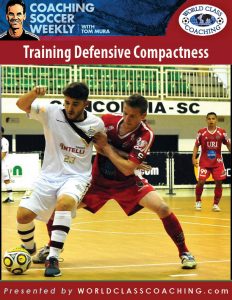
    #170 Training Defensive Compactness Nov 30, 2018
    Show notes

    I really enjoyed my Thanksgiving holiday break this year. It was a great opportunity to recharge my batteries and get ready for the start of the winter Futsal season.

    The extra time I had gave me the opportunity to observed SPORTING KC Academy Sessions. The quality of the players is obviously very high but what struck me most was the attention to detail from the coaching staff and the high expectations they held the players to.

    It’s easy to set up the activities and environments they create but that’s pointless without the focus and precision they demand of the players.

    My teams are back to training this week in preparation for start of our Futsal season this weekend. I’ve been focused on individual ball control and possession with my youngest team and more on structure and patterns of play with the older ones. There are times I’ll do the same things with all of my teams but ask more of the older players. This season I looked closely at what each group needed and tailored the session to them.

    Today’s question comes from David. His question is about identifying 2 v 1 situations.

    David says, “I have always been told by excellent coaches the key to their success is teaching players how to identify and create 2v1 attacking situations. This make sense but I struggle to understand what to tell the kids and how to show them to do it. Do you have any advice?”

    Thanks for the question David!

    I would start by playing 2 v 1 with the attacking players trying to finish into a small goal. This gives you the opportunity to coach all of the important concepts of this situation (ie. dribble at the defender, angle of second attacker, movement options, etc). Then I’d change to 3 v 2 and show the players how they can create a 2 v 1 by taking the ball at one of the defenders with the support of the second attacker. Continue to build up and finish with an even-sided game and see if the players are able to find the 2 v 1’s.

    If you see it, call it out, “That’s a 2 v 1.”, until the players start to see them on their own.

    In This Episode

    As I’ve discussed before, the teams in our club play Futsal during the winter months. If you’re not familiar with Futsal, it’s a 5-a-side game with four field players and a goalkeeper. Very effective Futsal teams are able to stay very compact defensively. The session I’ll share today gives you the opportunity to coach all of the keys to playing a tight, compact defense that will be very difficult to score against.

    Printable Show Notes

    The show notes for each episode are accessed through the WCC Training Center.

    They are FREE but you will need at least a Free Membership to the Training Center in order to view and print them. They’ll be available there for eight weeks before they’re placed in our archive which can be accessed at any time by Elite Members.

    Click on the image of the notes and if you’re already logged in to the Training Center you’ll be taken to the Podcast page. If you’re not logged in your be taken to a login page where you’ll also be able to login or register if you are not already a Member.

    Please Help Spread the Word

    I really appreciate everyone who subscribes to the podcast, has written a review on iTunes, sent me a question by email or posted our links on social media. If you enjoy this podcast would like to contribute to its continued growth; I’d ask you to do one or all of these things this week. You’d be helping me spread the word about the show.

    Future Episodes

    Next week I’ll share some of the activities I’m using to train the players to attack effectively in Futsal.


    #169 Don’t Just Follow Your Pass Nov 16, 2018
    Show notes

    My teams didn’t have any games this weekend fortunately because the weather in KC was more like winter than fall.

    I took the extra time I had to start my player evaluations. I spread them out over two weekends so that I can take the time to focus on each player.

    The way I plan the transition between the fall outdoor season and winter Futsal season indoor is to make sure that my teams don’t play for the first week so that we have time to prepare for the differences in the games.

    I’ll talk more about how we’re approaching the Futsal season in the coming weeks.

    Today’s question comes from a long time listener, Cory. His question is about playing against a kick and run style.

    Cory says, “The U12 boys team I coach has improved quite a bit over last year. We have been working on possession style soccer with emphasis on speed of play. I am most proud of the “way” we are playing and don’t get too focused on the score. More and more, the kids are playing soccer as a beautiful game!

    This being said, I notice that our team struggles against teams that play a “kick and run” style of play. Often these teams have bigger, athletic kids. The key characteristic of this style of play is for the team to boot the ball down the field and hope to get it to their teammate for a shot on net. Every goal kick is a lob down the field vs. an attempt to possess the ball by building out of the back. I’m not a fan of this style of play because it doesn’t do very much to help the players to develop but, regardless, it is effective sometimes in scoring goals and winning games
    From your perspective, we are the key elements that we need to prepare our teams for when playing against a “kick and run” style of play? Are there specific exercises you suggest that help to counter this style of play?.”

    Thanks for the question Cory!

    Playing against a team that plays very direct is often difficult for teams that play a possession style. We are asking our players to have 5 or 10 good passes to work the ball up the field to create a chance to score while the team playing direct doesn’t really even have to connect a pass: they just need kick the ball forward and have our players make one mistake and they can win it back near our goal. If they don’t connect the ball far from their goal so there’s much less danger. If we don’t connect passes we often lose it in our defending third of the field.

    My suggestion for preparing to play a team with a direct style is to work on bringing balls down out of the air. Start by working on the technique with out pressure then add pressuring players.

    I like to play an attack vs defense game where the attacking team plays a long ball in behind out defense and then we try to gain possession build up to try and dribble across the half line or score in small goals just the other side of the half line. Since this is similar to the challenges created by a, “Kick and Run” team I think you’ll see a good transfer of training.

    I also think that you prepare your players for the mental and physical challenge. Acknowledge the difficulty that the opponent presents but encourage the players to take it as a challenge. Have a parent count the number of passes your team is able to connect.

    Good luck and realize that no matter what the score is that in the long term your players are much better off because of how you’re helping them develop into skillful, smart, confident soccer players.

    In This Episode

    Today I describe a change I’ve made to the movement pattern that I use for all of my technical training activities. I believe that it is going to make these activities more realistic, more engaging, more fun and create a better transfer from training to games.

    Here’s a video that shows the way I’ve changed the movement patterns in my technical training activities.

    Future Episodes

    I’ll be taking next week off from the podcast while I celebrate Thanksgiving with my family. I’ll be back in two weeks with a new episode that will most likely focus on the work I’ve been doing with my team to prepare for the winter Futsal season.


    #168 The Importance of Providing Player Evaluations Nov 09, 2018
    Show notes

    I’m now officially finished with my fall season. Two of my teams played in a tournament last weekend to finish off the fall.

    I always put this tournament on my schedule but it’s hard to know what to expect from the weather. We were really lucky last weekend as it was mostly dry and not as cold as it’s been some years.

    Having a tournament at the end of the season is a great way to finish it off. It gives me a chance to see how far we’ve come and what we need to continue to improve on during the winter and spring. But the potential for some really nasty weather is always there in the late fall.

    This weekend we’re looking at lows in the single digits on Saturday for the boys tournament. Luckily, I have all girls teams this year 🙂

    Today’s question comes from long time listener and contributor Sammy. His question is about defending.

    Sammy says, “When defending, what are your thoughts on pressuring players to the sideline vs pressuring players to the middle where help is?

    I used to always coach players to pressure attackers into the sideline and use the sideline as an additional defender. The problem I found is that when my team wins the ball, we now have the same problem that we created for our opposition. The sideline is there acting as a defender and our counter attack are severely limited.”

    Thanks for the question Sammy!

    I prefer that defenders take the line away and force attackers to the inside for a number of reasons. First, that usually puts the attacker on their weaker foot. Second, there is so much more cover for the defender on the inside of the field. If a player is beaten down the line they can take a lot of space before facing pressure again. Lastly, as you said, when we win the ball we are in a position to move it into space and away from pressure very quickly.
    The only area on the field that I want defenders to show the player toward the line is near the edge of the penalty area. Then it’s more important to keep the ball out of the danger area.

    There’s no one right answer to this one, forcing wide attackers back inside it just my preference.

    In This Episode

    As our club wraps up the outdoor season we take the time to complete evaluations for each of our players. Today I’ll describe why we feel this is important, how our evaluations are structured and the tools we use to make these evaluations useful to the players their parents and their future coaches.

    Future Episodes

    Next week I’m going to describe a change I’ve made to the movement pattern I use for all of my technical training activities. It may not seem like a huge difference but it’s always been a sore point for me and this simple solution just didn’t occur to me until recently.


    #167 Fall Season Recap Nov 02, 2018
    Show notes

    I only had one team playing last weekend. My U17 girls competed in the Presidents Cup tournament. For those not familiar with how the state tournaments work in the U.S.; the top teams in each age group compete in the State Cup for a chance to win and go on to Regionals. The winners of Regionals move on to the National Championship.

    A few years ago US Youth Soccer created the Presidents Cup. The tournament gives teams that are not quite competitive enough for State Cup a chance to compete in a state tournament with a chance to move on to a regional and national tournament during the summer.

    Spoiler Alert: I’m free this summer. I tell you all about it in this episode.

    Today’s question comes from Stephen. His question is about strength training.

    Stephen says, “My question is about strength work. I have coached this team of boys for 4 years. Starting when they were U10s. This year, at U13 there has been a major uptick in injuries. We have players with pain resulting from physical growth. We have players picking up injuries in games, practices, at school or from goofing around with friends. Many of the players on my team are playing a lot of additional sports including soccer for other teams.

    While I have been disciplined with including warm ups (like you describe on your podcast) and a few minutes of stretching as we debrief at the end of the session, the injuries are definitely more common.

    I have noticed, that during the regular season, the training sessions are always based in technique, mental and tactical aspects. And for some players, that means almost every day. In a typical week, for example, a player will:

    – practice at school Monday afternoons, then with at the Club in the evening.
    – Tuesdays will be travel team practice.
    – Wednesday’s may be a school game (or practice) and then an evening session at the Club.
    – Thursday school practice and then an evening Club Academy session.
    – Friday a school game, and then a travel practice or a Club practice.
    – On Saturdays a travel game.
    – On Sundays a Club game.

    All the practices are play based, on the field and involve ball work, almost exclusively.

    How important is it to include strength work (and rest) into a player’s routine? How do you see differences play out across age groups? And what approaches have you seen work well, when younger, growing players have such crammed schedules across different teams and with different coaches?”

    Thanks for the question Stephen!

    You’ve described a schedule that has the kids training or playing everyday and sometimes twice a day. They’re not getting injured because they aren’t strong enough. They’re getting injured because they’re overtraining.

    Professional adult player for whom soccer is a job don’t train and play as much as you describe. Our Development Academy teams only train four times a week and they don’t play every weekend.

    They should have at least one full day off per week and they should never train twice in a day. I think you’re going to continue to see injuries as long as the players are training and playing the way you’ve described.

    The players in our club do not play for any other teams. Our club and high school seasons are separate. They are never playing both at the same time.

    No, I don’t think two training sessions in a day make sense for youth players at any age. All training has to be balanced with recovery. When training and recovery is out of balance then you get decreased performance and injuries.

    I encourage my players to participate in the SoccerFIT program that I’ve spoken about on the podcast in the past. Look for the episodes with Scott Moody for more about their programs. The ‘FIT’ stands for, “Functionally Integrated Training”. They use some weights with older more advanced players (U15 and above). Most of the exercises are done with body weight only.

    I’m not a strength and conditioning specialist so I send the players to SoccerFIT because that’s their focus.

    In This Episode

    Two of my teams are finished for the fall season. The other two play in a tournament this weekend that will be their last outdoor games of the fall. Today I’ll look back at my season and talk about what went well, what I learned and what I’ll change going forward.

    Future Episodes

    I encourage you to provide your players with evaluations at the end of each season. I’ll talk about why I think these are important and the tools I use to provide feedback to my players next week.


    #166 Week 3 of Decision Making MicroCycle Oct 26, 2018
    Show notes

    We had our last league games of the fall season last weekend. It was great to see so much of what we had been working on come together in those games. We still have a lot to improve but we’re definitely headed in the right direction.

    I had an encounter with a parent from one of the teams we played against over the weekend. This kind of thing doesn’t happen often but I thought I’d share it in hopes that it might help someone else that is faced with this situation in the future. I won’t go into all of the detail hear but I discuss it on the podcast and I’d be interested to hear any feedback you have.

    Today’s question comes from Jerry. He has a couple of questions about development versus winning.

    Jerry says, “I like to think I’m more about development of the players. That said, this is a very complex issue, I’ll list some of the things I have been facing and which are causing me not to always give equal playing time.

    – We have 3 players that aren’t nearly as good as the rest, big drop off…2 of them don’t put the time in at home (not asking a lot, just 20 minutes on days we don’t practice), and they miss a lot of practices. I just don’t feel its right to reward equal playing time to these 2 players. What would you do in this case?

    – All clubs aren’t about putting the best players together on the same team like yours, where you promote deserving players up to higher level teams. Even though I coach the A team, there are some players on the B team that should be on the A team. Part of this is keeping friends together, something I get…at what point should a player move on to another club where they try to put the best players together on the same team? How does your club balance friendships and putting best teams possible together?

    – I mentioned the 3 players above that aren’t nearly as good as my other players…they partly made the team due to politics at our club. How do you deal with that? I’ve heard politics affects all clubs even the top level ones (heard one parent said they would take their $20K donation away if their daughter didn’t make the team at a top level club in my area). What sort of politics have you faced and how do you deal with it?

    – How do you balance parents desire to win versus development? I have some parents who really want to win, way too much. I get it in tournament championships if you make it that far or State Cup…but the rest shouldn’t matter.

    How do you deal with these kind of parents.

    Thanks for the question Jerry!

    Below are the answers I shared in the comments section for Episode #162. I go into more detail on the podcast.

    1) If they’re not good enough, I wouldn’t have placed them on my team. If they’re on my team, they play at lease 50% of each game.

    2) Every parent has to do what’s best for their child. If playing with friends is the most important thing to the player then that’s what’s best for them. If they are driven to compete and develop then looking for a team with the best players is the right move.

    3) We don’t place players with friends in our premier program. That’s what the recreational program is for.

    4) I can honestly say that politics has nothing to do with our decisions at tryouts. Our Boy’s Director’s daughter was moved down two teams one year. We place players based on where they fit.

    5) I don’t coach to the desires of the parents. There are times that the better players will get more playing time (everyone still gets 50%) but that’s a decision I make based on what I think is best for the team and players.

    In This Episode

    In this, the third of three episodes focused on training decision making, I describe how I approached my last training session focused on this topic. I’ll let you know how I planned it, how the session started and what adjustment I made as we went through it based on how the players performed.

    Here’s the Diamond Shooting activity that I mentioned in this episode:


    Future Episodes

    I’m continuing to build my list of potential topics for the future. I haven’t decided on one for next week so if you have a suggestion I’d love to hear it.


    #165 Week 2 of Playing the 5 v 2 Game to Score Oct 19, 2018
    Show notes

    One of my teams had two interesting and very different challenges this week. During their first game of the weekend they played a team that they were clearly better than but were just coasting their way through the game. There was on urgency or intensity in their play. They knew they could get by on 50% effort so that’s how they played.

    In the beginning I let them play and watched to see if they would pick it up. When they didn’t I started to encourage them to ‘Go For It’ and ‘Play Quicker’. We talked about the issue at halftime and we picked it up a bit but we were never firing on all cylinders. We ended up winning the game 2-1 but could have easily given up a goal or two due to sloppy, unfocused play.

    Our second game was played in cold and raining conditions. I’m talking COLD. It was about 45 degrees (F) and raining. I was miserable and I was wearing waterproof clothes!

    Before the game I told the girls that they could play however they wanted in this game; the goalie could punt the ball, they could take goal kicks long, they could play long balls into the other team’s half and then play soccer there….whatever they wanted. I said, “The handcuffs are off, just go play, do your best and enjoy it as much as you can.”

    There was a bit of ‘kickball’ in the game but most of the time they were looking to connect even if they were playing longer balls than we normally would. They were also really creative in and around the other team’s box. We ended up winning 3-1 and scored a couple of very nice goals.

    Today’s question comes from Cesar. His question is about the difference between coaching boys and girls.

    Cesar says, “My name is Cesar and I am a soccer coach for a girls 2006 team this year. I’ve coached for about 7 years now. Last year I had the opportunity to coach a 2006 boys club team, that was my first experience as a high competition coach and it was a great experience. Prior to that I have been coaching in recreation league around my area. This year I had the the great opportunity to coach girls. My question is, is coaching boys different than coaching girls?

    I have been part of many teams but the majority have been just boys and this year I’ve giving myself the chance to coach all girls. I have found that coaching girls has been easier for me.

    I’ve heard a saying from a great baseball coach not long ago. He said, “Girls need to feel great to play good and boys need to play great to feel good”.

    I want to know your opinion in this topic. I found that theory to work for me when coaching. There are many sides to coaching but I found this theory interesting.

    Thanks for the question Cesar!

    I definitely think that there’s a difference. I also agree that coaching a good group of girls is easier than coaching a good group of boys. That’s not just my opinion but I’ve spoken with many coaches who feel the same way.

    The quote I like about coaching boys and girls is from Anson Dorrance. He says, “You drive men and you lead women.” If you try to drive women you lose them because they don’t think you care about them.

    I’m only coaching girls teams this year after coaching both boys and girls teams during the same season for many years. I’m enjoying it and the girls are developing from one week to the next. It sounds like your team is also doing well.

    In This Episode

    This is the second of three episodes focused on the 5 v 2 to Score game that I discussed last week. This is a game focused on decision making. I introduced it to the players last week but I didn’t feel like they completely grasped the concepts so I’ll let you know how it went this week along with the things that I changed and how they effected the session.

    Future Episodes

    Next week I’ll finish up the three part MicroCycle on 5 v 2 to score. I’ll describe how I’ll change the session to challenge the players and see how they adapt.


    #164 Training Combination Play to Score Oct 12, 2018
    Show notes

    Last weekend was another tournament weekend. It was local and it was nice to play a tournament close to home especially because the forecast was for rain all weekend.

    I had three teams in the tournament which may seem like a lot but it was manageable because it was spread out over three days.

    Friday was perfect, it was a great evening to play. The rain didn’t start until overnight.

    Saturday morning was stormy. The earliest games were canceled and recorded as draws. That’s not great if it happened to your team but at least they didn’t make the teams sit around all morning waiting to see if it would clear up. The afternoon was drizzly when my teams were playing but nothing that the kids couldn’t handle. I was done by 6 pm so I wasn’t effected by the stormy evening.

    Sunday stormy morning but the afternoon was decent. I got to meet Jacob and the guys from St. Louis Steamers when my U11’s were scheduled to play them. The game was called after 15 minutes because of lightning in the area. That was a shame because they have a good team and I was enjoying the matchup between two good teams that were playing good soccer. Hopefully they’ll bring their team back to town next spring or we find out way to St. Louis.

    Today’s question comes from Charles. His question is about playing two games in a day.

    Charles says, “I coach a u12 girls club team in Louisville Ky. Knowing that teams at that age play multiple games in a day, I find that the play during the 2nd game is usually at a much lower level(technically and tactically) We have talked about the right nutrition and rest between games, but it seems like a fitness issue. We have talked about focus and decision making when tired. I don’t want to focus on fitness at such a young age.

    Any thoughts?

    Thanks for the question Charles!

    What you’re describing could be a combination of physical and mental fatigue.

    My suggestion would be to have the players complete repetitive dribbling, passing or shooting activities that require the players to be in almost constant motion to challenge them physically before putting them in a series of small-sided games. End with a regular game or scrimmage with another team if possible to force the girls to compete when their already tired.

    I would see how the girls react to this method of practice and decide if it’s more of a physical or mental issue.

    In This Episode

    The more closely matched the teams, the harder it is to generate good quality scoring chances. If the defense is solid and not giving much away then your players need to be able to pull the defense apart. There are a number of ways to do this. Today I’m going to describe a practice that I used this week to help teach my players different ways that they can combine to unlock a good defense and create goal scoring opportunities.

    Here’s a video that shows how the 5 v 2 to Score activity works:


    Future Episodes

    Please keep the ideas for future episodes coming. Each week I receive one or two really good ideas that I add to my list.


    #163 Game Day Oct 05, 2018
    Show notes

    I only had three games again last weekend; one Friday, one Saturday and one Sunday. The teams all played very well. It doesn’t always work out that way so it’s fun when it does.

    We’re at the point in the season where I’m seeing the results of what we’ve worked on in training. It’s great to see them applying concept to games under pressure.

    Now it’s time to add on to that. For me, that means spending more time in 1 v 1 and 2 v 2 environments to help the players develop solutions to the problems they face in the game.

    They understand the framework that we’ve set up to play now they need to be able to improvise and create. I’ve talked about this in the past. Some coaches start with the skills and then work on the structure. I look at it the other way around. I want the player to understand how music is played before they start to improvise. I don’t think one way or the other is necessarily “Right”. This is just what has worked well for me over the years.

    Today’s question comes from Alan. His question is getting forwards to work together.

    Alan says, “I’m a girls high school JV coach and I have a senior and a freshmen forward who have never played together. They don’t pass to each other and try to dribble through two or more defenders. Any suggestions on how to fix this. Drills or exercises?”

    Thanks for the question Alan!

    I would suggest playing 2 v 1 and 2 v 2 games where your two forwards are paired together. Then they’re forced to play together in order to accomplish a common objective. I would also use pattern play to show them how they can work together to break down the defense. Hopeful forcing them to work together will show them how much more effective they can be together.

    In This Episode

    This week’s topic was suggested by a listener, Ryan. He suggested that I discuss “Game Coaching”. So I’ll share my game day process. I’ll discuss everything from how I prepare for games the night before to how I handle the post-game team talk.

    Future Episodes

    This week’s episode was inspired by emails that I’ve received from coaches that send in suggestions. If you have a topic that you’d like to hear more about on the show, please let me know.


    Previous 1 21 22 23 24 25 30 Next

    Related Podcasts

    Cycling 360 media

    1

    Cycling 360 media Amateur
    The T-Row & Funky Show

    2

    The T-Row & Funky Show Amateur
    Carolina Insider

    3

    Carolina Insider Amateur
    The Gabe Kuhn Show

    4

    The Gabe Kuhn Show Amateur
    Thru the Ringer

    5

    Thru the Ringer Amateur
    Cookies: A Basketball Podcast

    6

    Cookies: A Basketball Podcast Amateur
    footer-logo

    Contact Us

    Toll Free: 844-670-7747

    Links

    • Home
    • Top Charts
    • Networks
    • Apps
    • Independents Podcasts
    • Podcast Advertising
    • Podcast News
    • Contact Us
    • About Us
    • Analytics & Insights

    Stay Connected

      Privacy, Terms of Use & Our Code of Ethics Protecting Content Creators Copyrights