TopPodcast.com
Menu
  • Home
  • Top Charts
  • Top Networks
  • Top Apps
  • Top Independents
  • Top Podfluencers
  • Top Picks
    • Top Business Podcasts
    • Top True Crime Podcasts
    • Top Finance Podcasts
    • Top Comedy Podcasts
    • Top Music Podcasts
    • Top Womens Podcasts
    • Top Kids Podcasts
    • Top Sports Podcasts
    • Top News Podcasts
    • Top Tech Podcasts
    • Top Crypto Podcasts
    • Top Entrepreneurial Podcasts
    • Top Fantasy Sports Podcasts
    • Top Political Podcasts
    • Top Science Podcasts
    • Top Self Help Podcasts
    • Top Sports Betting Podcasts
    • Top Stocks Podcasts
  • Podcast News
  • About Us
  • Podcast Advertising
  • Contact
Not in our directory?
Add Show Here
Podcast Equipment
Center

toppodcastlogoOur TOPPODCAST Picks

  • Comedy
  • Crypto
  • Sports
  • News
  • Politics
  • True Crime
  • Business
  • Finance

Follow Us

toppodcastlogoStay Connected

    View Top 200 Chart
    Back to Rankings Page
    Technology

    Blockchain Archives – Software Engineering Daily

    Advertise
    • Apple Podcasts
    • Google Play
    • Spotify

    Latest Episodes:
    Unstoppable Domains: Blockchain Domains with Matthew Gould Aug 18, 2021
    Show notes

    Domain names are the address of your website that people type into the browser URL bar. Once purchased, a domain name is stored on your behalf by custodians like Google domains. Blockchain domains, on the other hand, are similar to regular domain names except they are stored and controlled in your cryptocurrency wallet.

    The company Unstoppable Domains provides blockchain domains that enable users to do things like keep a universal username across apps and websites, act as a website URL, act as a payment address for wallets, and much more. Replace cryptocurrency addresses with human readable names!

    In this episode we talk to Matthew Gould, Founder and CEO of Unstoppable Domains.

    Sponsorship inquiries: sponsor@softwareengineeringdaily.com

    Transcript

    Transcript provided by We Edit Podcasts. Software Engineering Daily listeners can go to weeditpodcasts.com to get 15% off the first three months of audio editing and transcription services with code: SED. Thanks to We Edit Podcasts for partnering with SE Daily. Please click here to view this show’s transcript.


    The post Unstoppable Domains: Blockchain Domains with Matthew Gould appeared first on Software Engineering Daily.


    Hedera Hashgraph: Proof-of-Stake Public Networks with Leemon Baird Aug 03, 2021
    Show notes

    Blockchain protocols like Bitcoin and Ethereum have changed the cyber world dramatically in the last decade. They’ve created communities of like-minded developers, generated new financial markets, and popularized “decentralization” in computer networks. However, they require large resources to operate which makes scaling difficult and transactions expensive.

    Hedera is a decentralized public network that takes the previous innovations a step further. The Hedera Consensus and Token service enables developers to make tokens and create publicly verifiable and scalable timestamps for any application at an incredibly fast speed, highest grade security, and extremely low bandwidth consumption.

    In this episode, we talk to Leemon Baird, Founder and Chief Scientist at Hedera Hashgraph. We discuss proof-of-stake public networks, the hashgraph consensus, and the future of blockchains.

    Sponsorship inquiries: sponsor@softwareengineeringdaily.com

    Transcript

    Transcript provided by We Edit Podcasts. Software Engineering Daily listeners can go to weeditpodcasts.com to get 15% off the first three months of audio editing and transcription services with code: SED. Thanks to We Edit Podcasts for partnering with SE Daily. Please click here to view this show’s transcript.


    The post Hedera Hashgraph: Proof-of-Stake Public Networks with Leemon Baird appeared first on Software Engineering Daily.


    Dark Forest: Transparency on Blockchains with Zero-Knowledge Proofs with Brian Gu Jun 21, 2021
    Show notes

    Complete information games are games where every player has information about the game sequence, strategies, and payoffs throughout gameplay. Playing chess, for example, relies on knowing the location of every piece everywhere on the board. In an incomplete information game like Minecraft, you continually gain new information during gameplay.

    Until very recently, incomplete information was nearly impossible on blockchains because every transaction and party is public. However, applied zero-knowledge cryptography on Ethereum has advanced greatly the past 18 months and is changing the transparency of blockchains.

    In this episode we talk to Brian Gu, a creator of the new game Dark Forest. Dark Forest is a space-conquest game built on Ethereum where players discover and conquer planets in an infinite, procedurally-generated, cryptographically-specified universe. It uses zero-knowledge proofs to validate game moves on Ethereum without sharing information to other players about the moves. We discuss the technology behind Dark Forest and the possibilities of a potentially less transparent blockchain future.

    Sponsorship inquiries: sponsor@softwareengineeringdaily.com

    Transcript

    Transcript provided by We Edit Podcasts. Software Engineering Daily listeners can go to weeditpodcasts.com to get 15% off the first three months of audio editing and transcription services with code: SED. Thanks to We Edit Podcasts for partnering with SE Daily. Please click here to view this show’s transcript.


    The post Dark Forest: Transparency on Blockchains with Zero-Knowledge Proofs with Brian Gu appeared first on Software Engineering Daily.


    Spacemesh: A New Consensus Protocol Anton Learner Jun 18, 2021
    Show notes

    Proof of Work cryptocurrency mining, as used on the Ethereum and Bitcoin blockchains, requires huge amounts of energy to validate transactions and generate new tokens. The alternative, Proof of Stake, needs large deposits of assets to be staked up front in order to work. While both consensus protocols have their own drawbacks, they are the current industry standards.

    The company Spacemesh developed a new consensus protocol with the goal of powering an energy-efficient, decentralized, secure, and scalable smart contracts global computer and a cryptocurrency in the permissionless settings. They call their protocol Proof of Space Time which works on a blockmesh structure rather than a blockchain. The Spacemesh protocol allows newcomers to contribute to the security of the cryptocurrency network via unused storage space on their hard drives, driving down energy consumption and enabling anyone with a computer to contribute.

    In this episode we talk to Anton Learner, Core Team Lead at Spacemesh.

    Sponsorship inquiries: sponsor@softwareengineeringdaily.com

    Transcript

    Transcript provided by We Edit Podcasts. Software Engineering Daily listeners can go to weeditpodcasts.com to get 15% off the first three months of audio editing and transcription services with code: SED. Thanks to We Edit Podcasts for partnering with SE Daily. Please click here to view this show’s transcript.


    The post Spacemesh: A New Consensus Protocol Anton Learner appeared first on Software Engineering Daily.


    Coinbase React Native: Building the Cryptocurrency Ecosystem with Brent Walter and Jacob Thornton Jun 14, 2021
    Show notes

    Coinbase is a very popular and well trusted cryptocurrency platform for buying and selling digital assets like Bitcoin, Ethereum, and many more. With Coinbase you can manage your portfolio of cryptocurrencies in 1 place like you would for other investments. There are added features like scheduling recurring purchases of assets, time-delayed withdrawals from digital vaults, and mobile apps with sleek UIs for mobile access to the markets. Coinbase has gained trust as a platform for storing digital assets in secure offline storage, using servers covered by insurance policies, by following industry best practices and supporting a variety of the most popular digital currencies.

    In this episode we talk to Brent Walter, a Senior Engineering Manager at Coinbase. Brent was previously an Advisor at With Labs and various other companies, and was a Director of Software Engineering at Western Digital before that.

    Sponsorship inquiries: sponsor@softwareengineeringdaily.com

    Transcript

    Transcript provided by We Edit Podcasts. Software Engineering Daily listeners can go to weeditpodcasts.com to get 15% off the first three months of audio editing and transcription services with code: SED. Thanks to We Edit Podcasts for partnering with SE Daily. Please click here to view this show’s transcript.


    The post Coinbase React Native: Building the Cryptocurrency Ecosystem with Brent Walter and Jacob Thornton appeared first on Software Engineering Daily.


    Episode Summary for Uniswap: Creating Liquidity in DeFi with Noah Zinsmeister Jun 03, 2021
    Show notes

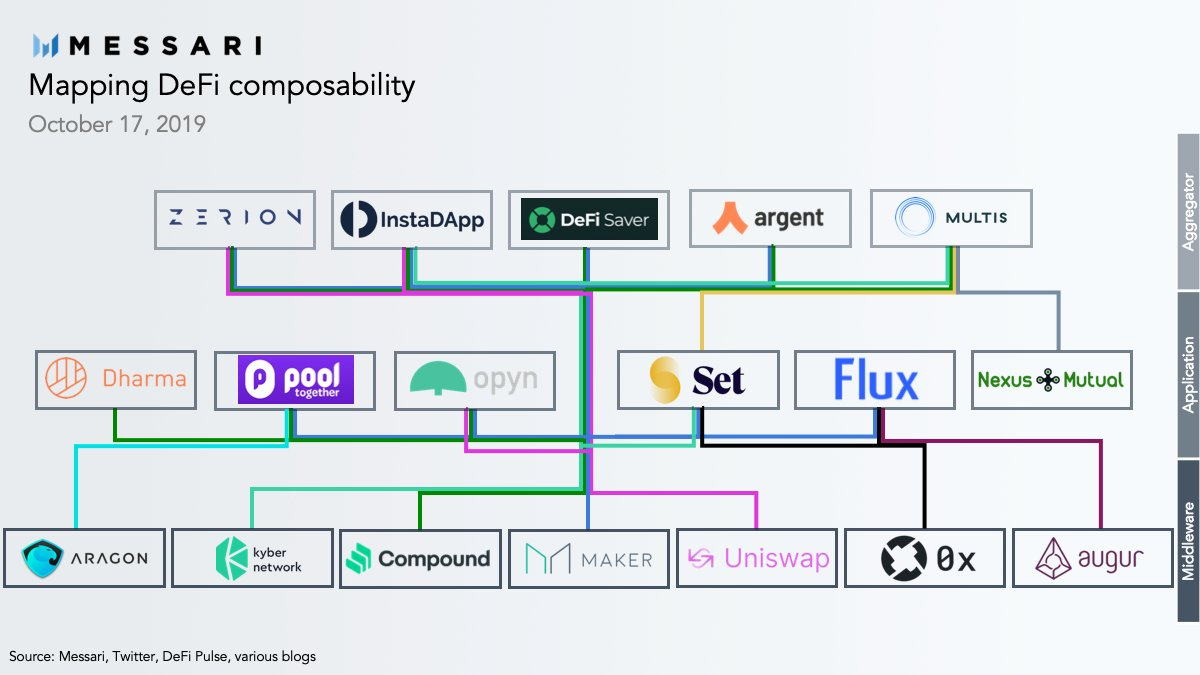
    Traditional financial institutions are siloed and often put up barriers, both regulatory and artificial, that prevent interoperability and introduce market efficiency. DeFi on Ethereum promises to provide a shared and uncensorable network that provides financial products that are universally accessible and interoperable with applications and products across the globe. However, much of the underlying infrastructure that underpins traditional finance must be remade so that Ethereum can provide the same functionality at the same efficiency. Their “Money Legos” are primitive building blocks that more complex applications and products can build upon.

    DeFi Money Lego Development: Messari Twitter

    Uniswap is one of those “legos”, a liquidity pool that complex applications can use to exchange assets at a fair market value trustlessly and on demand. For example if complex contracts need a liquidation layer to execute once certain conditions are met, they can use Uniswap to execute that liquidation.

    Uniswap as a liquidity pool serves fairly unique purposes in the DeFi space and has no analogous even in traditional finance. Its primary purpose is that it provides a way to exchange assets without a centralized exchange. These decentralized exchanges or “DEXs” are important and they are completely trustless, which as shown by Robinhood’s recent troubles is a fairly important safeguard. It also provides massive liquidity through unsecured loans, or “flash loans” by virtue of atomic transactions on Ethereum. This enables arbitrage opportunities that make the overall market more efficient. Finally, they can serve as a decentralized information source, or “oracle”, enabling other contracts to access price information without having to access the internet or other centralized sources. All of these abilities enable more complex contracts and serv as a building block for the DeFi space on Ethereum.

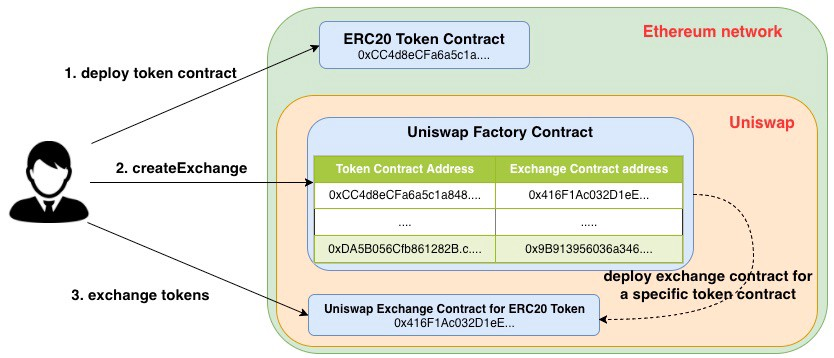
    Uniswap Contract Setup: Ocean Protocol

    Uniswap works as a “factory contract”, which holds the template and creates separate “pools” that handle the exchange of two specific assets. This simplifies both the accounting and the development logic of the contract. In addition if there was ever a bug there is limited bleed into the entire system. Uniswap exchange pools work as a two sided market: there are the liquidity providers and the traders.

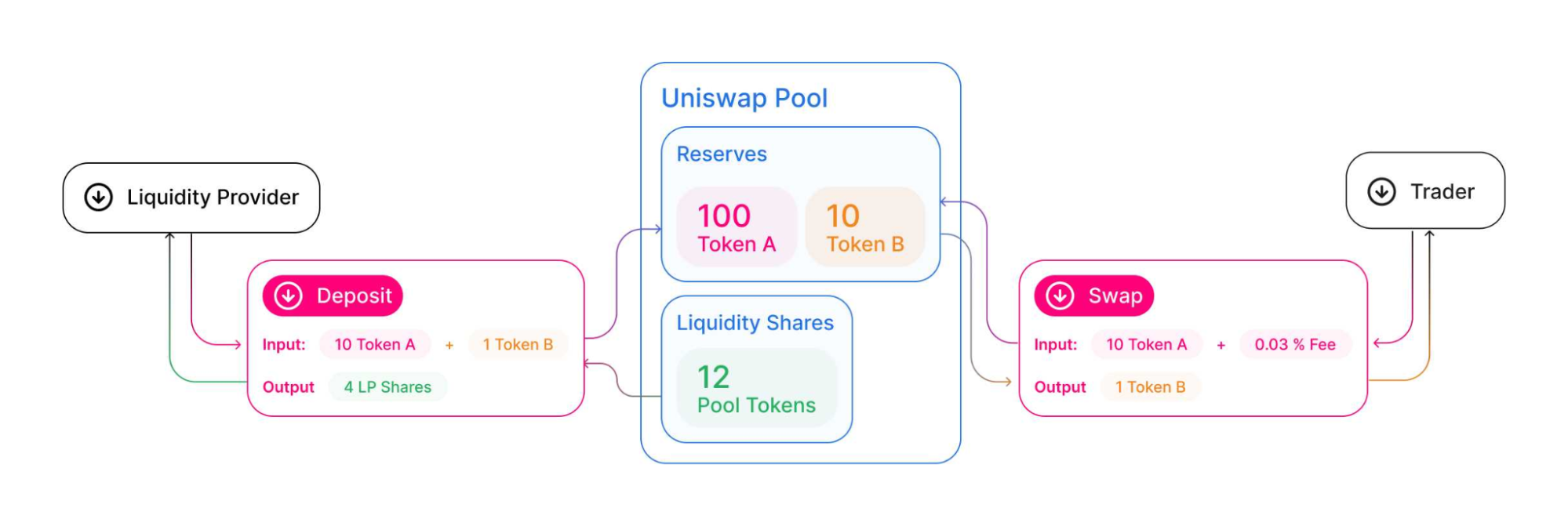
    Uniswap Pool Setup: Uniswap Docs

    Liquidity providers provide both assets in exchange for LP shares. Traders exchange one asset for another at a floating price plus a fee. In exchange for providing assets, liquidity providers receive a portion of the fees, prorated based on the percentage of LP shares each provider has. If a liquidity provider ever wishes to reclaim their assets, they simply return their LP shares to the pool, receiving their assets in return. By trading with the contract, you actually change the price, which subsequent trades will continue to change it by a small amount.

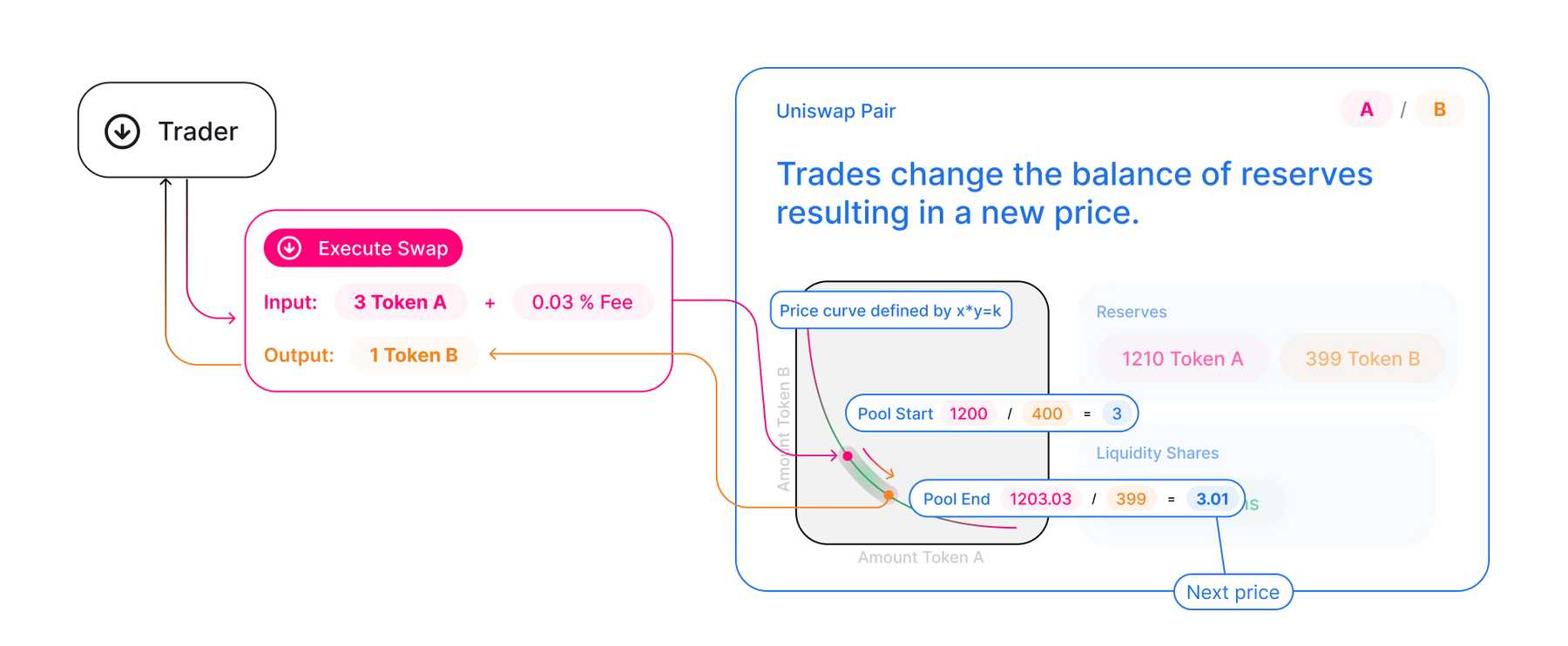
    Uniswap Price Mechanism: Uniswap Docs

    This floating price ensures that if there is ever a difference between the “real world price” and Uniswap’s price, arbitrage will ensure a quick correction. Since this price follows the real world price of the trading pair, it can then be used as an “oracle” for other decentralized contracts.

    Uniswap is currently developing and testing v3 of their protocol. V1 was a proof of concept that enabled swapping between Ethereum and ERC20 tokens. V2 served to extend that functionality to any token pair and introduced quality of life improvements such as flash swaps and price oracles. Uniswap v3 is focusing on bringing professional features to the protocol and making it on par with the capital efficiency of central exchanges. The crypto space is evolving quickly, however Uniswap looks like it is going to stay.

    This summary is based on an interview with Noah Zinsmeister, engineering lead @ Uniswap. To listen to the full interview, click here.

    The post Episode Summary for Uniswap: Creating Liquidity in DeFi with Noah Zinsmeister appeared first on Software Engineering Daily.


    Polygon: Connecting Ethereum Compatible Blockchain Networks with Denis Ermolin Jun 02, 2021
    Show notes

    Platforms like Ethereum have billions of dollars of market cap and large developer communities. However, it is still a challenge to build widely adopted DApps on it because of current limitations. Blockchain Proof of Work transactions are typically slow, and Proof of Stake transactions trade off decentralization to achieve high throughput. Transaction fees get expensive, especially for high network load times, scalability is low and this creates a bad user experience.

    The company Polygon (previously Matic Network) solves some of these problems with their platform for Ethereum scaling and infrastructure development. Polygon combines the features of stand-alone blockchains (like sovereignty, scalability, and flexibility) and Ethereum (security, interoperability and developer experience). These features enable scalable solutions on Ethereum and support a multi-chain Ethereum ecosystem (polygon.technology).

    In this episode we talk to Denis Ermolin, a Senior Software Engineer at Polygon. Denis was previously a Senior Software Engineer at Animoca Brands, and CEO of Moonrealm Entertainment before that.

    Sponsorship inquiries: sponsor@softwareengineeringdaily.com

    Transcript

    Transcript provided by We Edit Podcasts. Software Engineering Daily listeners can go to weeditpodcasts.com to get 15% off the first three months of audio editing and transcription services with code: SED. Thanks to We Edit Podcasts for partnering with SE Daily. Please click here to view this show’s transcript.


    The post Polygon: Connecting Ethereum Compatible Blockchain Networks with Denis Ermolin appeared first on Software Engineering Daily.


    Skynet Labs: Decentralized Internet with Matthew Sevey May 18, 2021
    Show notes

    The company Skynet Labs provides an open protocol for hosting data and web applications on the decentralized web. Skynet allows for decentralized, censorship-resistant, highly redundant storage and applications that are available around the globe. Developers don’t pay for their application’s storage, can launch apps with access to a user’s data right away, are free from corporations pulling access to their resources, and can maintain failover sites for when their primary site goes down.

    For users, you take your data with you without any corporate oversight, support developers and content creators by simply accessing their work, experience a web free of targeted ads, and never have to put your privacy or security at risk. Skynet is built on top of the Sia blockchain network, which is open-source and guided by the Sia Foundation.

    In this episode we talk with Matthew Sevey, Engineering Engineer at Skynet Labs. Before joining Skynet, Matthew was a Project Manager at Procter and Gamble and a web development fellow at Startup Institute before that. We discuss decentralized internet, the Sia blockchain network, and Skynet’s mission to build a better and more equitable ecosystem.

    Sponsorship inquiries: sponsor@softwareengineeringdaily.com

    Show Notes:

    Skynet Website Skynet Jobs Skynet Discord Skynet Hackathon SkyChat SkyFeed

    Transcript

    Transcript provided by We Edit Podcasts. Software Engineering Daily listeners can go to weeditpodcasts.com to get 15% off the first three months of audio editing and transcription services with code: SED. Thanks to We Edit Podcasts for partnering with SE Daily. Please click here to view this show’s transcript.


    The post Skynet Labs: Decentralized Internet with Matthew Sevey appeared first on Software Engineering Daily.


    Ethereum 2.0 | What’s the big deal? May 18, 2021
    Show notes

    Blockchain at a high level In order to provide context, it is important to recognize some basic characteristics of a blockchain. Before we talk about Ethereum, we need to step back and discuss what a blockchain actually is and what are all of these terms that are being thrown around when we talk about blockchain. Let’s start with some basic definitions. Blockchain: a cryptographically secure distributed ledger system with a shared state in which each state is dependent upon the previous one, making it difficult to modify the previous state. Cryptographically secure: something that is secured using mathematical proofs and algorithms that are virtually impossible to crack. Shared State: The shared state of a blockchain is the state in which the majority of the nodes within the network agree is the correct state. This is usually referred to as a consensus, and there are various methods of implementing consensus algorithms and protocols, each with their pros and cons. Follow this link for a basic overview of the core group of mechanisms that are used today. State Machine: It is an abstract machine that can be in exactly one of a finite number of states at any given time.[4] What is Ethereum? Ethereum is a “transaction-based state machine”[2], like other projects. However, Ethereum is different because it is a general purpose blockchain[1]. In order to achieve this general purpose property, Ethereum enables smart contracts to be written on the Ethereum network. These scripts of code live on the blockchain and are executed autonomously or are triggered from external calls. It is important to note that once these pieces of code are on the blockchain, they are there forever. With these additional features in mind, a better analogy for encapsulating the essence of Ethereum is a “distributed state machine”[3]. The state of Ethereum is a large data structure that holds a machine state(accounts, balances, code, etc.). This state can change from block to block according to a predefined set of rules, and can execute arbitrary machine code. EVM Architecture Ethereum’s virtual machine has a state transition function[3] which abides by a deterministic mathematical function: given an input, it will produce a deterministic output for the state. This state transition function is triggered by transactions being executed. A simple model of a transaction in the state machine A transaction is a single cryptographically-signed instruction constructed by an external entity(outside the scope of Ethereum). The two types of transactions are those resulting in message calls and those resulting in the creation of new accounts associated with code ( i.e., smart contracts)[1]. These transactions are batched into larger packets of data called “blocks”. Each of these blocks have a header, which holds relevant information corresponding to the transactions within the block. Each block must be validated through a consensus mechanism before it is added to the chain.(To learn more about the types of consensus mechanisms on the Ethereum Blockchain, click this link here). Currently, Ethereum can process approximately 500,000 transactiosn per day, and if at full capacity, at a rate of 13 transactions per second[7]. In order to execute these transactions in the EVM, we must use Gas. What is gas? In Ethereum, gas is a unit that measures the amount of computational effort required to execute specific operations on the Ethereum network[5]. This means that each transaction requires a transaction fee in order to successfully complete a transaction. Why does gas exist? Gas fees are a security measure for the Ethereum network. The fee requirement for every computation executed deters bad actors from overwhelming the network with an arbitrarily large amount of calls (spam!). Additionally, each transaction requires a limit for how many computational steps of code can be executed, preventing infinite while loops or other computational waste from being put in the code. Any gas left over from a successful transaction is returned to the caller of the transaction. Gas is denominated in Ethereum’s native currency, Ether (ETH) and can be broken down into smaller denominations as well (e.g., gwei). Here is a chart of common ether based units. The Ethereum 1.0 network is a proof-of-work based network. This means that most of the computation during transactions comes from “miners”. Miners can be rewarded for their service in the form of ether block rewards and transaction fees from gas payments[6]. The gas prices are dependent on two things: the requested gas price of the user and the miner’s willingness to accept the gas price presented to them. When there are more transactions being requested by users, the gas prices rise as block-space becomes more scarce. As Ethereum has grown in popularity, the transaction rates have only gone up. This has led to congestion of the network, leading to issues with scalability. An infamous example of this is the CryptoKitties Congestion Crisis back in December of 2017. Why is this relevant to Ethereum 2.0? Ethereum 2.0 is bringing a series of improvements to the network that address network efficiency, scalability, sustainability, and versatility. One of the main problems of Ethereum 2.0 seeks to solve the “Scalability Trilemma”. This trilemma can be broken into three main components: security, decentralization, and scalability. The ability to achieve these three properties without compromising the others is a problem within the blockchain space. Some of the key new features of Ethereum 2.0 will be: A move from Proof of Work to a Proof of Stake consensus mechanism The introduction of shard chains into the network The rolling out of EIP 1559 (Ethereum Improvement Proposal 1559) Proof of Work vs. Proof of Stake Proof of Work (PoW) requires miners to go through an intense race of trial and error to find the nonce for a block; blocks with a valid nonce can be added to the chain. This process can be very energy intensive. The security of this model is that miners are not incentivized to start their own chain because it undermines the system (no pun intended). Here’s a visual representation of the security model for Bitcoin as the example blockchain: Blockchain’s in general rely on having a single state of truth, and users of the blockchain will always choose the longest chain or heaviest subchain (Ethereum uses something called GHOST). The new hash of each block is also dependent on the hash of the previous block, making it easy to detect fraudulent transactions. In order for a miner to keep adding malicious, but still valid, blocks they would need over 51% of the network mining power to beat everyone else. As described earlier, mining is very energy intensive, meaning that one would need an obscenely large amount of computing power; the amount of energy spent could potentially outweigh any benefit from achieving a 51% attack. This makes the likelihood of an attack on the network very low. The issue with this model, however, is that proof of work runs on a large amount of energy output incentivized by the massive rewards for miners. The size of the mining network must be so large that attacks are virtually impossible. A network must expend Y amount of energy in order to defend against an attacker of size Y; this 1:1 cost ratio for attack and defense is not in line with the ideals of the crypto space — there is no advantage for the defender. This is where Ethereum 2.0’s Proof of Stake model shines. Ethereum 2.0 is moving to a Proof of Stake(PoS) model as the consensus mechanism for the network. This model enables a secure, decentralized consensus mechanism for the network with less energy needed to do so and it breaks the 1:1 defense-attack cost ratio. Anyone who stakes at least 32 ETH can become a validator node. These nodes don’t need to mine blocks; they only need to create blocks when chosen and validate proposed blocks when they’re not. Validators are rewarded for creating new blocks and for attesting to proposed blocks; if they attest to a malicious block, they lose their stake. The security of this model comes from the financial commitment by those who are willing to provide security to the network and the economic penalties to those who attempt to attack the network. Game theory economics supports that those who have a large amount of skin in the game, have no incentive to attack the system because they will lose their stake as well as a source of passive income from validating blocks. Furthermore, if there is a successful 51% take over of the PoS chain through majority collusion, which is highly unlikely, all the community needs to do is hard fork the chain and delete the malicious validators. Shard Chains With growing activity on the network, Ethereum needs to be able to handle more transactions per second without increasing the node size. Nodes are critical participating components which store and run the blockchain. Increasing the node size is not a practical solution because only those with expensive and powerful computers could do it. For scalability to be achieved, there must be more transactions per second combined with more nodes on the network; when there are more nodes on the network, there is more security as well. Sharding is the process of splitting a database horizontally to distribute the load. Within the context of Ethereum, sharding will help scale the network through the use of shard chains. Shard chains will reduce the network congestion and increase the transaction rate. This offloading of data to multiple chains allows for better scalability, meaning more network participation; you will eventually be able to run Ethereum on personal devices such as a laptop or phone. This increases security because the network will be more decentralized which makes the attack surface area smaller. Sharding will create a low barrier to entry for running clients on your own without relying on third party services, which reduces points of failure in the network. EIP 1559 EIP 1559 (Ethereum Improvement Proposal 1559) will change how users buy transactions on Ethereum. In the current Ethereum model, users place bids for block space by submitting a gas price they are willing to pay, and miners pick up transactions they wish to include in the next block; miners usually choose transactions with a higher gas price to make the maximum profit from each block. These transaction bids can lead to users paying more than is needed for their transactions. When network congestion is high, fees are high, meaning miner incentive is increased. However, when congestion increases, this does not mean security demand goes up at the same rate, which means Ethereum has to spend more for security than necessary. This is inefficient and has a negative impact on ETH holders because they are supporting these transactions. EIP 1559 introduces two new concepts: the BaseFee and the Miner tip. The BaseFee is the minimum fee required for a transaction to be included in a block; this fee can be adjusted per block(+/- 12.5% the previous block’s fee) based on network congestion of Ethereum; the reasoning for the adjustment is to allow the network to reach equilibrium by accommodating for network utilization. The miner tip is a separate fee that can be paid to incentivize miners to prioritize a transaction. There is also the introduction of larger block sizes, setting the max capacity to 25M GWEI from 12.5M GWEI previously. The transaction fees will no longer be paid to the miners, and instead will be burned, making transaction fees more predictable and reducing transaction time. The miners will make their profit from the miner tip and block rewards. This is a major shift in the current transaction paradigm on Ethereum because it will smoothen out the network fees, making Ethereum more scalable while still remaining secure. Let’s look at an example of the network at high congestion on Ethereum 2.0. When there is a surge in network activity (i.e., high transaction demand from users), the BaseFee will be increased. Eventually the BaseFee will be high enough that it disincentivizes users from transacting, bringing the network utilization back to equilibrium. You may ask why minors cannot artificially increase the BaseFee. The answer to this is the burning of the BaseFee. In EIP 1559, miners will only be able profit from block rewards and miner tips. When the BaseFee becomes too high, users are less incentivized to pay the BaseFee as well as the miner tip. Hence, miners have no incentive to raise the BaseFee artificially. In addition, users are able to specify a Fee Cap; this is the maximum they want to pay for a transaction. When EIP-1559 is launched, ETH holders will still pay block subsidies, but when network congestion is high, they will not need to pay for security because the demand of transactors pays for it. They are implicitly refunded through the burning of the BaseFee because this will increase the value of the ETH they still hold. What does this mean for Ethereum users? Security that is both economically and energy efficient The PoS model to which Ethereum is migrating offers an economically efficient, flexible way to validate blocks by aligning economic incentives of validator nodes; in the words of Vitalik Buterin, “security comes from putting up economic value-at-loss”. Since PoS is also highly energy efficient, it promotes more geographic decentralization than the PoW; GPU mining and ASIC mining are both very easy to detect because they require large amounts of electricity consumption, expensive hardware purchases and large warehouses. In contrast, PoS staking can be done on a regular laptop; this also makes PoS more censorship resistant as it is harder to track the nodes of validators than to track large mining operations of PoW. Although some argue that PoS is a “rich get richer” scheme, the reality is that the cost for staking is comparatively low (32ETH) next to the costs of ASIC mining where external resources are required, and is even more in favor of the rich who have the resources to support them. Furthermore, the rewards in PoS are quite low, about 0.5–2% of total ETH supply. A Better Experience Due to improvements in the transaction fee mechanism, causing a decrease in cost and faster transaction time, users will have a better overall experience using the network. The importance of the User Experience can not be understated. In order for there to be mass adoption, the users must enjoy using the technology. Economically Beneficial In addition to a better UX, the burning of the BaseFee also internalizes revenue that currently goes to miners, meaning ETH will become a productive asset since it is a required consumable for transactions. Moreover, the burning of ETH lowers inflation, potentially making ETH a deflationary asset, legitimizing it as a store of value. The state of Ether the asset will be more scarce as a liquid asset; most of the ETH will be either locked up in smart contracts and DeFi or it will be burned through transactions. For more information on the economic implications of ETH listen to this podcast here. Developing at Scale Lower transaction fees and chain sharding bode well for the Ethereum Developer community. These new features will enable developers to build decentralized protocols at scale without sacrificing security, and bring more innovation to the space. Alos, low transaction fees further democratizes who can build on Ethereum because the cost of deploying contracts to the network and running them will be much lower. Closing Thoughts There are tradeoffs to this new change and I recommend that you research these in order to have a well-rounded perspective. There are arguments and differing opinions around some of the concepts described in this article. Regardless, it is an exciting time for the Ethereum community and the Crypto-Blockchain community writ large. This article only scratches the surface of th…

    Full show notes at the publisher

    Uniswap: Creating Liquidity in DeFi with Noah Zinsmeister Apr 21, 2021
    Show notes

    A liquid market enables individuals or groups to quickly buy and sell assets. Decentralized platforms can struggle to execute trades when their platform does not have much liquidity for a specific token. Newer tokens or tokens with limited supply are most often the least liquid because there might be an imbalance of buyers and sellers. You can’t sell token A for price X without a consenting buyer on the other end.

    The company Uniswap is a decentralized protocol for creating liquidity and trading ERC-20 tokens on Ethereum. Uniswap encourages users to be “liquidity providers” whereby they pool their assets into funds that enable people to complete trades without an opposite party. Instead, they swap against the liquidity pool created by the liquidity providers. Every swap incurs a small fee, which is distributed proportionately to liquidity providers when they decide to pull their funds. Uniswap prices coins based on the simple formula x*y=k.

    In this episode we talk with Noah Zinsmeister, engineering lead at Uniswap. Noah also maintains web3-react, a framework for building blockchain applications. We discuss cryptocurrency liquidity, the Ethereum blockchain, and how Uniswap is building a community of liquidity providers and traders.

    Sponsorship inquiries: sponsor@softwareengineeringdaily.com

    Transcript

    Transcript provided by We Edit Podcasts. Software Engineering Daily listeners can go to weeditpodcasts.com to get 15% off the first three months of audio editing and transcription services with code: SED. Thanks to We Edit Podcasts for partnering with SE Daily. Please click here to view this show’s transcript.


    The post Uniswap: Creating Liquidity in DeFi with Noah Zinsmeister appeared first on Software Engineering Daily.


    Previous 1 2 3 4 5 10 Next

    Related Podcasts

    Reply All

    1

    Reply All Games & Hobbies
    Inside VR & AR

    2

    Inside VR & AR Gadgets
    Note to Self

    3

    Note to Self News
    BrainStuff

    4

    BrainStuff Natural Sciences
    This Week in Tech (Audio)

    5

    This Week in Tech (Audio) News
    Hands-On Tech (Audio)

    6

    Hands-On Tech (Audio) Technology
    footer-logo

    Contact Us

    Toll Free: 844-670-7747

    Links

    • Home
    • Top Charts
    • Networks
    • Apps
    • Independents Podcasts
    • Podcast Advertising
    • Podcast News
    • Contact Us
    • About Us
    • Analytics & Insights

    Stay Connected

      Privacy, Terms of Use & Our Code of Ethics Protecting Content Creators Copyrights