Inside Pirros: An AI Drawing Reviewer and Mira, an AI Partner Inside Revit
Nov 12, 2026
Show notes
For the TRXL Feature Spotlight I was joined by Ari Baranian, CEO and co-founder of Pirros, showing two tools that work together: the Pirros Quality Management System and Mira.
Ari used to be a structural engineer, so he knows how a review actually happens at a firm. Someone senior gets handed a set right before a submittal and has to find what's wrong. Those people are scarce, and their time is scarcer. I wanted to see what happens when an AI takes that seat, and whether anyone would trust it.
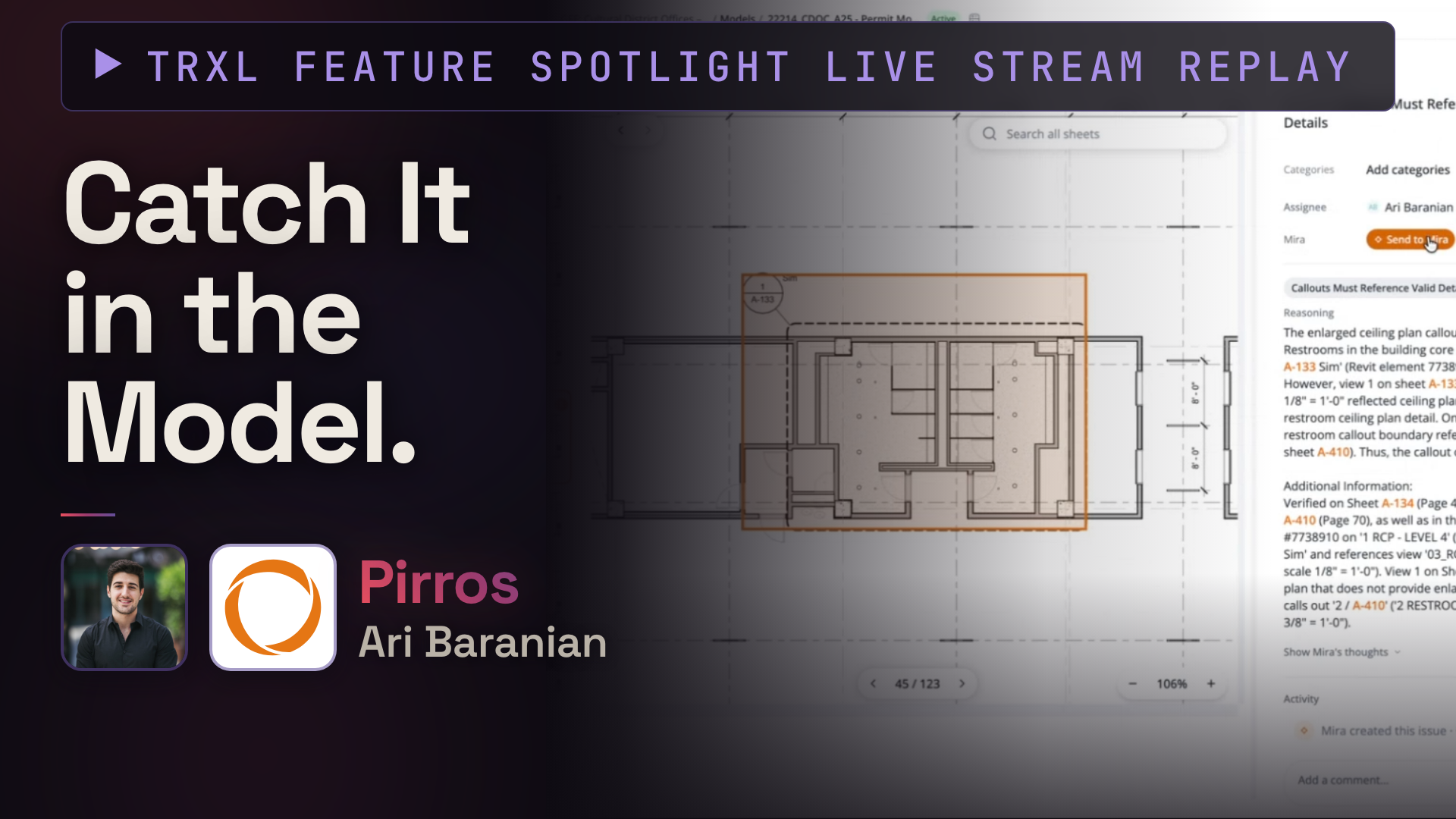
The Quality Management System runs a project through an AI reviewer. It checks against building codes (Ari showed ADA issues), a set of default rules for drawing set integrity like spelling and callouts that must reference somewhere real, your firm's standards, and your client's standards if they hand you theirs. Each flagged issue shows what's wrong, where it sits in the PDF set and the Revit model, and the reasoning behind it.
The part I care about most is how standards get in. Ari said customers could never really tell him what they look for in a review, because it only surfaces when a set is in front of them. The unlock was historical data: Bluebeam markups from past reviews, or recordings of page-turn meetings. Feed those to an AI, let it find what keeps getting flagged, and add it to a standards file. A red line on a PDF doesn't say why it's there, so getting the why on paper matters.
Ari also showed the reviewer working across disciplines. In one example, the architectural set referenced a structural detail correctly, but the structural set showed something different on top of the wide flange beam. The agent followed the reference chain and flagged it for coordination. A viewer asked a question during the demo about firms that don't have the other discipline's Revit model. Ari said you can add the structural PDFs as references, and specs too, since drawings and specs often disagree. While having access to models is a benefit, it still works without them.
I brought trust up repeatedly, so Ari walked through one check in detail. The firm standard says every site plan needs a north arrow. The agent saw one was missing, then checked the project metadata, found the north arrow parameter set to no on that sheet and yes on another, and told the user which toggle to flip. It does that research before it shows you an issue.
A few more mechanics from the Q&A:
Issues can be assigned to teammates, imported from ACC/Forma or internal peer reviews, and exported to PDF for people outside your firm.
Reviews can run on a schedule or at milestones. Each run has the context of the last one, so it closes out resolved issues, finds new ones, and costs less.
The PDF set is the source of truth for the review. The Revit model is a reference.
Mira
Mira is the AI engine behind the reviews, and it also works inside Revit. Ari asked it to list the families in a project, then showed what it can do with them. The team at Pirros built a skill that creates a family from a manufacturer cut sheet. Dan Stine posted about doing this for a pizza oven. Drop in the PDF and Mira builds the family, following your standards if they're documented. It can produce 3D geometry, 2D detail items, or both.
Mira also looks at what you're looking at. It takes a screenshot of the view, adds grids so it has some sense of scale, and reads the metadata and text of every element along with the image. Another skill converts a CAD import into a Revit drafting view. It places families, compares screenshots side by side, and asks you when no family fits. Ari kept returning to one point: the agent is tuned to ask instead of guess.
Skills were the part I found most useful as a practitioner. Ari had Mira lay out details on a sheet once, and it took a lot of thinking. At the end he told it to document everything as a skill. Now the task is a short list of clear steps and a rules section that grows as edge cases show up. Ari compared it to training an intern who doesn't know Revit yet. Because the steps are documented, the run is cheap. The agent also looks for a matching skill before it starts a task, so you don't have to train your team on each one.
I added my own take: skills are an iterative design process. You don't get a one-shot result. You start from a baseline, work through the project, then update the skill with what you learned. Ari agreed, and noted that anyone showing a magic one-shot prompt spent a long time iterating to get there.
Two stories from Ari stood out. One firm creates roughly 1,000 families a year because their procurement is tied to families, and Mira cut that time down enough that it led to the create-family skill. Another user complained Revit was slow, asked Mira why, and found 1.2 million warnings. Mira offered to fix the one issue behind nearly all of them, and the count dropped to about 500. I'm guessing a fix like this alone could pay for a seat of Mira.
Closing the loop
The two tools connect. When the reviewer flags an issue, you can assign it to someone or press Send to Mira. In the example, a callout on A-133 referenced the wrong view. Mira found the right reference on A-410, and if the same model is open, it starts a new chat and makes the change. Nothing changes until the reviewer approves. What I saw was not an AI that designs a building. It's help with the coordination and double-checking that wears people down.
Practical notes
Data: Customer data is kept separate. Models aren't trained across customers. Ari said the only tuning is on your own standards, and data is hosted on AWS in the same region as ACC.
Models and cost: Mira routes between frontier models and Pirros's own fine-tuned models depending on the task. You can't bring your own API key.
Plans: There's a free individual start with a token cap, and a team plan with a shared token pool that admins allocate. Skills sharing and your Pirros library of details and families come with the team plan.
Disciplines: Mira is trained across disciplines. Civil is the weak spot because that work happens in Civil 3D and AutoCAD. Ari said the engine is being ported to plugins for both.
Standards from your own files: Ari pointed Mira at a folder of 10 past models and 8 templates and asked it to find Revit standards. It listed what was already consistent (fonts, dimension styles, line styles) and what wasn't, like title blocks, then he turned that into a standards document. People have also built an /audit skill so a BIM manager can check a project against that file on a Friday.
Where to see it
Pirros.com/evan has more information and a way to book a live demo with your own questions. You can also read about the Quality Management System and Mira. Thanks to Ari for a demo with no filler, and to everyone who asked questions in the chat.
My Favorite Moments from Episode 247 "It's on the Server Somewhere"
Nov 10, 2026
Show notes
Arc 3 presenting sponsor
Speckle makes design data actually usable across projects, so your team can trust it, own it, act on it, and make better decisions faster.
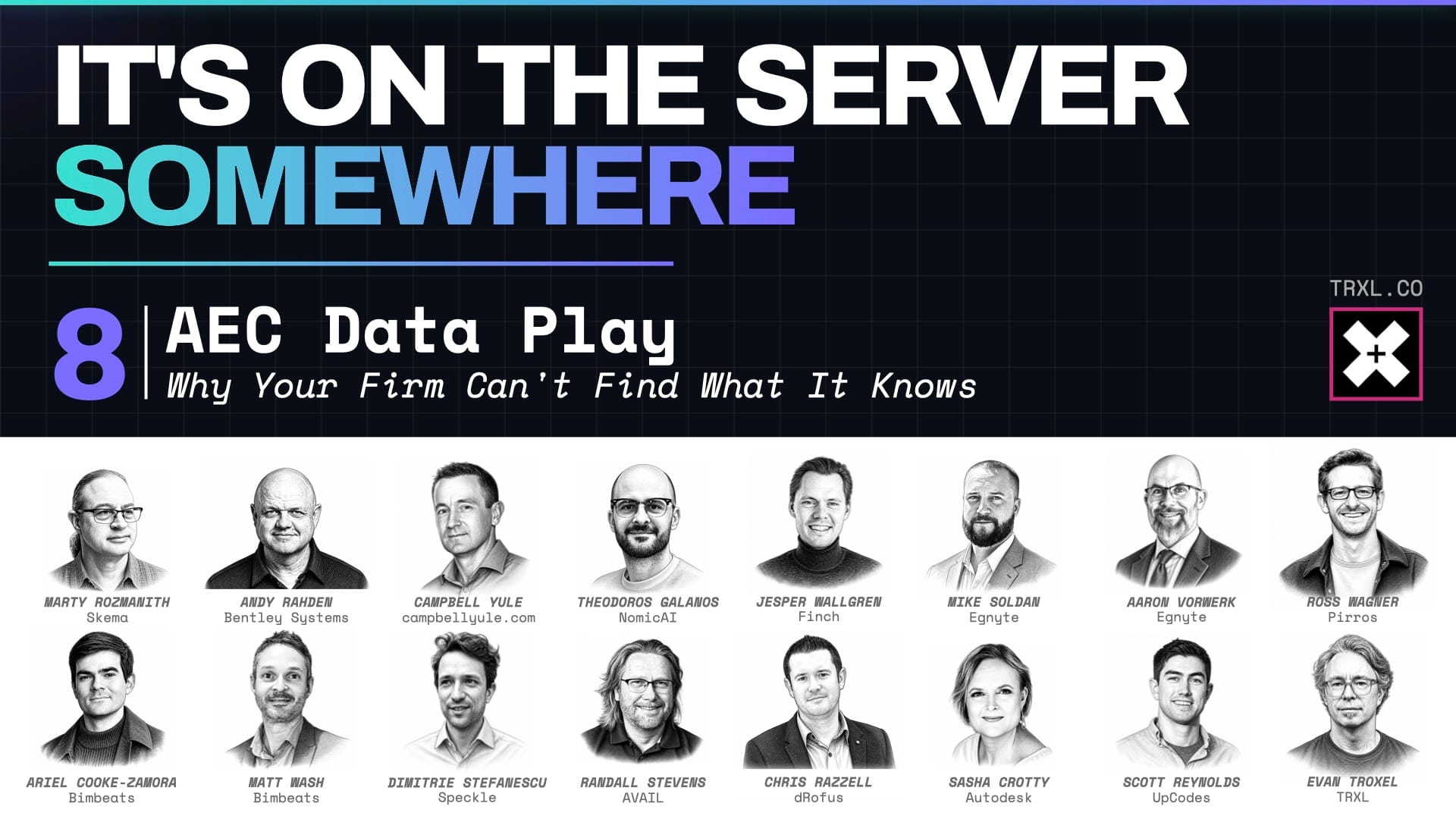
Every episode of this series, I go back through the full conversation and pull the lines I don't want you to miss. Here are 21 of them from Episode 247, “It's on the Server Somewhere.” Each one has who said it and a timestamp if you want to hear it in context.
On where the why goes
“Up to 80% of the data on that project, not data outside of that project, but data on that project, doesn't sit in those tools or systems. And so there's so much communication happening, so much other stuff that doesn't live in a project delivery platform, and that's where the decisions are made. That's where the why sits.”Aaron Vorwerk, Egnyte · ▶ 0:09:39
“Comparisons are easy. Why that was changed is a very different animal and is not represented in the contract deliverables at all. It's in the emails, it's in the Slack threads, the Teams chats, the digital whiteboards, beautiful places where things go to die.”Aaron Vorwerk, Egnyte · ▶ 0:11:38
“There's always one person at a firm that knows everything. They know where all the skeletons are in the closet. … But how do you capture that? That's tricky.”Ross Wagner, Pirros · ▶ 0:15:55
“There's such a lack of mentorship sometimes at a firm that's moving so fast that you just have to slow down and teach people and show what good looks like.”Ross Wagner, Pirros · ▶ 0:16:24
“It doesn't have to be perfect. It just needs to be written down. We just need to document the decision, have the discussion, do the back and forths so we can come back in the future, we can reference it, or we can learn from it.”Scott Reynolds, UpCodes · ▶ 1:18:23
On shared language and messy data
“You don't need everyone speaking the exact same language, but you need enough shared meaning for your data to move across different disciplines and life cycles.”Andy Rahden, Bentley Systems · ▶ 0:21:29
“Where it breaks is when you try to force a monolithic standard across every single discipline. That's when you get resistance, and that's when you start getting workarounds.”Andy Rahden, Bentley Systems · ▶ 0:22:03
“There is this false bill of goods maybe that was sold to everyone when it comes to BIM, and I think everyone visualized everyone in the project's going to be working in this collaborative space. One big file that's got absolutely everything in it.”Chris Razzell, dRofus · ▶ 0:50:47
“The space is king in Finch, while in almost all other software, the wall is the main element.”Jesper Wallgren, Finch · ▶ 0:37:35
“Garbage in, garbage out. You need to be careful around this. And to a certain extent, that stands true. But there's added nuance today. An AI agent can whiz through your inconsistencies in naming or in misclassification of parameters, and can fix those things in an instant.”Dimitrie Stefanescu, Speckle · ▶ 0:22:43
“There's a lot of people out there who say, “Well, our BIM's not good enough, and we really need to clean up our data so that we're ready for AI.” The AI doesn't care. Your data is whatever your data is. It's a cluttered garage.”Marty Rozmanith, Skema · ▶ 0:34:37
On starting before the structure is perfect
“I would caution any firm who is procrastinating or not starting until they know exactly how to structure it. I would say just go ahead and start structuring it because the answer is going to reveal itself as you're working and asking questions to your own data.”Ariel Cooke-Zamora, Bimbeats · ▶ 0:03:26
“These systems, they're going to hallucinate, and it's up to firms to, one, structure their data, and then two, define the skills that they're going to give the agents to interpret that data.”Ariel Cooke-Zamora, Bimbeats · ▶ 0:03:15
“Whenever you pair an agent and a simple old-fashioned database, a SQL database, it will always work.”Theodoros Galanos · ▶ 1:31:16
“The best information's at the edges of the network. It's the people doing the work that actually know.”Randall Stevens, AVAIL · ▶ 1:06:50
“Windows file folders were never designed to hold and capture anything except storing the file and then putting a name on a folder that gave you some small amount of contextual information to be able to know what's in that folder, and then it stops.”Randall Stevens, AVAIL · ▶ 1:07:57
“Governance has to come first. In our space, there's some folks that are pretty laissez-faire about this, that I think there will be bites. I would bet my house there's going to be some major breaches in the next 12 to 18 months because of this stuff.”Mike Soldan, Egnyte · ▶ 1:23:25
“Security through obfuscation. … It felt safe, but once that content's indexed and AI can find it contextually, it's going to surface it up really fast. So this issue of messy data just becomes an even bigger problem.”Mike Soldan, Egnyte · ▶ 1:26:31
On habits that make the data worth keeping
“A lot of the time people do things because it's fast, so we have to make using the correct standard faster.”Sasha Crotty, Autodesk · ▶ 1:13:35
“The benefit of me doing this slightly differently is just so much bigger than the pain of doing it slightly differently.”Matt Wash, Bimbeats · ▶ 1:15:28
“So you can go from the very simple, “Hey, you've just helped me do my timesheet,” to now organizationally, how do we deliver our projects based on actual time rather than the fictitious timesheet?”Matt Wash, Bimbeats · ▶ 1:17:14
Graitec provides AEC software, training, and expert support to help architects, engineers, and construction teams design, build, and manage projects more effectively.
With support from
AVAIL's content management system (CMS) helps architecture and engineering teams find, manage, and reuse their Revit, AutoCAD, Civil 3D, and other technical content in one place.
😎Win a pair of Ray-Ban Meta Smart Glasses courtesy of Graitec. Enter Here. (entering shares your contact info with Graitec)
That's the whole episode's worth of highlights. Full conversation's at trxl.co/247 if any of these made you want the rest.
249: 'Level Two Autonomy for Architects', with Julian Geiger
Nov 10, 2026
Show notes
Julian Geiger joins the podcast to talk about what it takes to bring AI into the software architects and builders use every day. As Chief AI Officer at the Nemetschek Group, Julian works on AI inside products like Archicad, Solibri, and Bluebeam, and on how the company uses AI internally. The conversation covers why the hardest problems in AEC are about process, collaboration, and information, why AI should take on the code lookups and documentation grind, how a shared intelligence layer across tools could keep project context intact, and why design judgment may end up worth even more.
This episode is especially relevant for firm leaders, BIM managers, and design technologists trying to separate AI demos from AI they can rely on. Julian's advice is practical. Use the tools yourself, watch how fast they change, and get your project data organized well enough that a new hire could make sense of it.
Why it's relevant: Julian is Chief AI Officer here. Nemetschek is the parent company of Graphisoft, Bluebeam, Allplan, Solibri, dRofus, and more, and he says AI is the reason the group is integrating more than ever after years as a financial holding company.
Why it's relevant: Julian refers to the intelligence layer Nemetschek announced in October 2024, the shared AI foundation meant to carry project context across the group's tools.
Why it's relevant: Julian talks about Nemetschek using this cross-tool platform internally first, and about openness as the reason customers should choose the tools, not lock-in.
Why it's relevant: Julian calls the first Archicad AI Assistant a beta experiment and describes what it could do from the start, like resizing every window in a model or a first-pass code compliance check in some jurisdictions, with a deeper version on the way.
Why it's relevant: Julian points to Bluebeam's AI-powered review and drawing comparison, which shows up as a regular button in the interface rather than a chatbot. Smart Overlay looks like the feature he means.
Why it's relevant: One of the Nemetschek tools where Julian wants AI to have the full project context, whether that context lives in Archicad, Allplan, Solibri, dRofus, Bluebeam, or third-party software.
Why it's relevant: The model that shipped the week before this conversation was recorded. Julian cites its big jump on a CAD benchmark next to a much flatter result on design judgment, and its slick villa demo that still says nothing about constructability.
Why it's relevant: Julian's story about his father, an accordion, and a driver Claude Code rewrote, plus my suggestion to point these tools at a copied folder of your own work and have them interview you.
Why it's relevant: One of the tools I suggest connecting to a copied folder of your own work so it can interview you, and the kind of foundation model that already understands what you mean when a site search doesn't.
Why it's relevant: Julian uses level two driver assistance, where the car keeps the lane but you're still responsible, as the level AI in design still has to reach.
Why it's relevant: I bring up Clippy, and Julian explains why old in-app suggestions failed. "Business letter" was far too broad a category, and there wasn't enough intelligence behind the suggestion to beat what you'd do yourself.
Julian Geiger is Chief AI Officer at the Nemetschek Group, the parent company of Graphisoft, Bluebeam, Allplan, Solibri, and other AEC software brands. He leads the group's AI and data strategy, covering both AI inside its products and how the company uses AI internally. Before joining Nemetschek in 2024, he was a product manager at Google, where he led manufacturing product globally, and earlier worked at BMW and started his career at Boston Consulting Group. He is not an architect by training and focuses on turning fast-moving AI progress into tools AEC professionals can rely on.
Inside MKS DTECH's Rhino Sync and Nessie: Shared Rhino Models and Revit Data in the Browser
Nov 05, 2026
Show notes
The TRXL Feature Spotlight is a live, hands-on stream. A company that builds a tool shows what it does, with a person who knows it inside and out driving the demo, and I react as a practitioner. This one was with Mauro Sabiu and Mikael Santrolli, the co-founders of MKS DTECH, a London design technology company started by architects. Both of them came out of practices like Zaha Hadid Architects and Foster + Partners, and they founded the company in 2019.
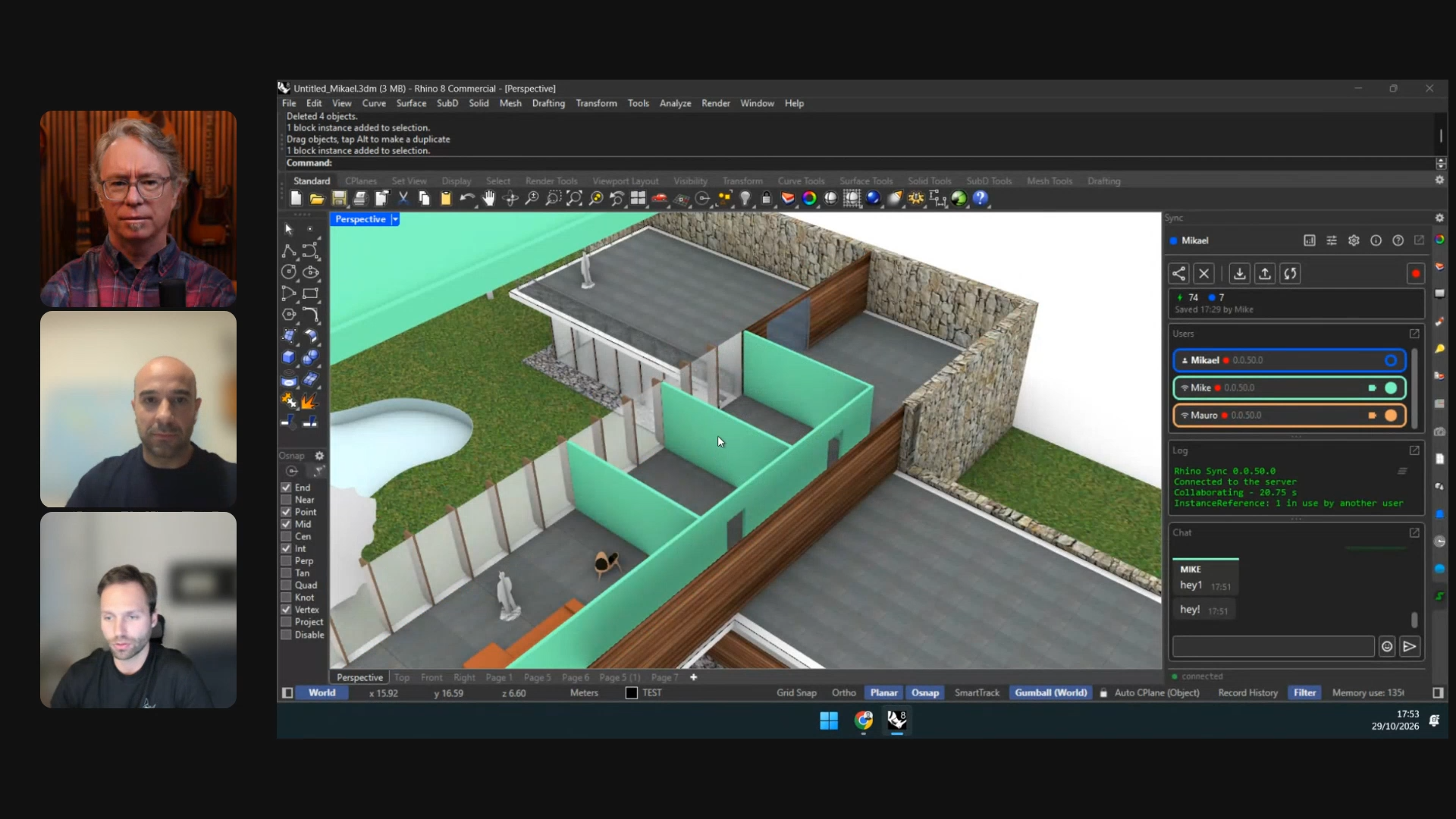
They showed two tools. Rhino Sync lets several people work in the same Rhino file at the same time. Nessie pulls Revit project data into a browser so BIM managers and document controllers can see it, edit it, and automate around it. I wanted to see both because they go after two things I've watched firms struggle with for years: splitting a model into pieces and merging it back together, and not knowing what's happening across a pile of Revit files.
Mauro opened with a quick overview. MKS DTECH's flagship product is BEAM, which adds BIM objects and data to Rhino and exports to Revit and IFC. It was first released in 2020, and Mauro said it has pushed six billion objects through export and is used in more than 100 countries. Rhino Sync and Nessie are the newer pair, and Mikael ran the live demos.
Watch the Replay
Rhino Sync: several people, one Rhino file
Mauro compared the idea to a central model in Revit, with the difference that this is a Rhino file. One person works on the facade, another on the core and shell, someone else on the landscape, and the end result is a single central file ready to hand to consultants. He was clear that this is not worksessions, which are closer to links in Revit.
Mikael's demo started in Google Drive, though the storage can also be a network disk, OneDrive or Dropbox. When you join, Rhino Sync makes a local copy of the central file on your machine. A panel shows who is in the file, which version they're on, and a dot that tells you whether they're broadcasting live changes.
There are three speeds of collaboration, and that was the part I found most practical:
Live preview. Mikael turned on his teammates' cameras and watched them move around the model, then turned on per-user coloring to see exactly what they were touching. Each change is owned by whoever made it. When he tried to select a wall Mike was editing, Rhino Sync wouldn't let him.
Quick changes. This is a new mode that syncs only the delta. Mauro pushed his quick changes, Mikael pulled 15 objects, reloaded, and the trees were his to move. Saving the central file is the slow step. Mikael said a one-gigabyte file can take two minutes to synchronize, which is the pain quick changes are meant to avoid.
Sync. When the team is happy, sync compiles everything into the final 3DM in your storage.
It isn't only geometry. Layers synced in the demo, and the locking system also covers materials and other Rhino objects. Mikael said layouts have been supported for the last two or three weeks, with the layout order still unsolved. Every panel is detachable if you have multiple screens.
Rhino Sync and who can see what
I asked about the chat, since people may want to go back and find when a decision was made. Mikael said the chat used to be live only. Now the last 100 messages are encrypted to your session, optional if you'd rather not, and MKS DTECH has no visibility into them. Change packets are encrypted to the session as well and stored only for a few minutes or as long as the session lasts.
The same thinking applies to the file. Rhino Sync produces a normal 3DM, there's nothing different about it, and MKS DTECH doesn't store the data.
A viewer in the YouTube chat asked about "who did what and when," and I added why. There is no ledger beside the 3DM yet. Mikael said a history mode is planned, possibly with a comment when you sync, and in network mode every synchronization is already saved as its own 3DM.
Two uses I hadn't thought of came up. HGA has a project lead who stays in Rhino without modeling, watches what everyone is doing, and sends screenshots and comments instead of opening a read-only file. I compared it to watching someone play a video game on YouTube, except it's a model being built. And Mikael said the heaviest adoption they've seen is in US universities, where a studio can share a large site context model. My reaction to that one: don't touch my model, Mikael.
Nessie: Revit project data in a browser
Nessie was developed with Heatherwick Studio, and Mauro described three pillars: monitoring, data consistency, and automation. The demo used sample projects and fake users, which Mikael pointed out up front.
The monitoring side starts with a project list you can tag, group by typology, sort by last activity, and view on a map. A live tab shows who is working in which file right now, on cloud and network files alike. Mikael said an older live-monitoring view stopped working when teams moved to Forma and BIM 360, and Nessie brings it back. Sessions show how long Revit was open and how often someone synchronized, which helps you catch the person who leaves Revit open for days.
Inside a project, a few things stood out:
Warnings and standards. You can change the severity of Revit warnings or hide the ones you don't care about, and you can set up the INI files from the browser so they apply when Revit opens. Mikael called that a massive pain point for IT teams who otherwise script and republish every change.
Forma connection. Nessie matches Revit sheet IDs to the published sheets in Forma. I was struck by how much was visible with no Revit or Forma session open. Schedules sync too, so a door schedule is one export to Excel instead of waiting two or three minutes for the file to open. Data goes up when someone opens or syncs a model, in under about 20 seconds for a 300 to 400 megabyte file, so you're reading the last sync, not the live model.
Link diagram. Green files are in Nessie and blue files are external links. I said it's useful as a diagram for understanding what's going on.
Editing sheets, revisions and rooms. You can pin several files, edit sheet values, export to Excel, re-import, and see what's pending until the next sync. Rooms follow the same workflow, plus a 3D viewer that colors by a parameter like occupancy so a room with no value stands out.
Analytics. File size, groups and families over time, so you can see when something ballooned.
Automation in Forma
Nessie can publish files on a schedule, then print sheets from that publish. If syncs are newer than the last publish, it publishes first, and the PDFs land in a folder in Forma every morning. Two token-based functions were also shown: IFC export, and issuing files, which Mikael described as a mini transmittal that sends consultants a stripped-down set on a schedule.
Practical notes
Rhino Sync is in beta and free to use. Mikael said they released version 50 the day of the stream and documented the workflow in a wiki.
Nessie data hosting. MKS DTECH offers managed storage in isolated databases for each tenant, or you can bring your own server by connecting your Azure or AWS storage and SQL server.
Revit side. Edits made in the browser are written back to Revit. Sheets and revisions work now, rooms are in development.
Demo data. The Nessie figures in the demo were sample data, not customer results.
My Favorite Moments from Episode 246 "Someone Already Figured This Out"
Nov 04, 2026
Show notes
Every episode of this series, I go back through the full conversation and pull the lines I don't want you to miss. Here are 13 of them from Episode 246, “Someone Already Figured This Out.” Each one has who said it and a timestamp if you want to hear it in context.
On "the pile"
“We get the cart in front of the horse and we think we're just going to put this tool into place and it can leverage all of our historic knowledge when we really don't have historic knowledge. We have a pile of stuff that's not well understood.”Aaron Vorwerk, Egnyte · ▶ 0:06:11
“For 15 years, ever since we've had digital capture of most of this stuff, everyone's been saying, that's your goldmine. That's your IP. … The issue has been being able to turn it into usable structured content and be able to do something with it.”Mike Soldan, Egnyte · ▶ 0:08:02
“The firms not doing anything with the data are just missing out on a valuable learning resource. It's sitting on a mountain of books that you're not reading.”Ariel Cooke-Zamora, Bimbeats · ▶ 0:13:22
“Is your portfolio of designs that you have becoming a true asset, and can you leverage it? A lot of people are asking themselves that question. And then they realize that in order for that to be a productive asset, they need to open old clunky files, and that data is stale and it's wrong.”Dimitrie Stefanescu, Speckle · ▶ 0:14:08
Arc 3 presenting sponsor
Speckle makes design data actually usable across projects, so your team can trust it, own it, act on it, and make better decisions faster.
On what a firm's history is worth
“We have plenty of information about what got done. What we don't have very good information about is why the decisions were made.”Randall Stevens, AVAIL · ▶ 0:22:08
“Only 20% of all the stuff that I've ever learned in the technology side of this is still relevant. … Lawyers, their case backlog almost never goes invalid.”Marty Rozmanith, Skema · ▶ 0:01:55
“A lawyer that's been practicing for 50 years is that much more valuable than a lawyer that's been practicing for two years. And I'm thinking, well, it should be that way for architects, but with architects, there was no real way of capturing things and reusing them like lawyers could.”Marty Rozmanith, Skema · ▶ 0:02:16
“How are you going to convince a client that you're going to build their 21st hospital better than the previous 20 hospitals that you've built if you don't have access to the data of those previous 20 hospitals?”Dimitrie Stefanescu, Speckle · ▶ 1:25:22
“You could take all 27,000 of those details, and I could give them to you, and I just throw them out on the floor. You'd go, they're worthless. The same details with now an organizational interface and metadata around them allows you to get to the one out of the 27,000 that you need is where most of the value is.”Randall Stevens, AVAIL · ▶ 0:38:00
“Don't put 15 years of files into a cloud-based repository just for the sake of doing that. Understand what is it that you're trying to decide.”Sasha Crotty, Autodesk · ▶ 1:03:08
“Pick that outcome first and start in a small way. Don't do it by a massive data dump.”Sasha Crotty, Autodesk · ▶ 1:03:37
“How do you know what bad is if you don't ever capture bad? … Or if you're training a brand-new person, how do you show them what bad looks like?”Sasha Crotty, Autodesk · ▶ 0:28:05
“The weekly time sheet. … There's the fictitious one that you do on a Friday afternoon when you're trying to remember what you've done versus, well, what did I actually do?”Matt Wash, Bimbeats · ▶ 0:40:51
Graitec provides AEC software, training, and expert support to help architects, engineers, and construction teams design, build, and manage projects more effectively.
With support from
AVAIL's content management system (CMS) helps architecture and engineering teams find, manage, and reuse their Revit, AutoCAD, Civil 3D, and other technical content in one place.
😎Win a pair of Ray-Ban Meta Smart Glasses, courtesy of series partner Graitec. Enter the giveaway. (Entering shares your contact info with Graitec.)
That's the whole episode's worth of highlights. Full conversation's at trxl.co/246 if any of these made you want to hear the rest.
What Do You Keep When You Leave a Platform?
Nov 02, 2026
Show notes
If your firm switched away from its main design platform next year, what would you take with you, and what would you have to rebuild?
💡Who this episode is for: Especially relevant if you're a principal, CIO or BIM manager who signs the software contract or has been told to get ready for AI, and who hasn't yet asked what the firm keeps, what it pays for, and what it can take when it leaves.
Summary
This newsletter is a breakdown of the finale for The Next AEC Tech Stack, the third episode of Arc 3 and the ninth in the series. The first episode in this arc asked what a firm's project history is worth. The second asked why you can't use it. This one asked whose it is, what it costs to leave, and what you're signing up for when it lives in someone else's platform.
I talked to Randall Stevens at AVAIL, Sasha Crotty at Autodesk, Andy Rahden at Bentley, Scott Reynolds at UpCodes, Chris Razzell at dRofus, Ross Wagner at Pirros, Aaron Vorwerk and Mike Soldan at Egnyte, Dimitrie Stefanescu at Speckle, Marty Rozmanith at Skema, Matt Wash and Ariel Cooke-Zamora at Bimbeats, Jesper Wallgren at Finch, Holger Kreienbrink at Graphisoft, Clifton Harness at TestFit, and Campbell Yule. The vendors gave nearly the same first answer: the customer owns the data. The answers stopped matching one layer up, with the tags, relationships and intelligence a platform builds on top of it.
A reminder that applies to every episode in this series: these conversations were recorded weeks ago, and the tools have kept moving since. Sasha said Autodesk's API pricing would probably change. Autodesk's own post says pricing for AEC Data Model API Data Out took effect October 6, 2026, so check where that stands in your agreement.
This series brought to you by
Graitec provides AEC software, training, and expert support to help architects, engineers, and construction teams design, build, and manage projects more effectively.
With support from
AVAIL's content management system (CMS) helps architecture and engineering teams find, manage, and reuse their Revit, AutoCAD, Civil 3D, and other technical content in one place.
Arc 3 presenting sponsor
Speckle makes design data actually usable across projects, so your team can trust it, own it, act on it, and make better decisions faster.
💡
Free and paid subscribers are getting the same full newsletter for this series. Normally the full edition of Leadership Edge is a paying-member benefit. For The Next AEC Tech Stack it isn't: every edition goes out complete to everyone on the list, free accounts included. Graitec and AVAIL funded the series, and Speckle presented Arc 3, so the industry could actually use it.
If someone forwarded this to you, sign up free and future editions land in your inbox as they publish. TRXL+ members also get the ad-free feed, the full back catalog, and all the content that goes back behind the paywall when the regular schedule returns after this series.
Catch the full episode
What's Inside
Yours or rented. The vendors I asked told me the customer owns the data. What did they say about the tags, relationships and intelligence a platform adds on top?
The machinery. Aaron Vorwerk said a firm that leaves Egnyte keeps its work. Campbell Yule said the cost of leaving the cloud has nothing to do with file formats. What is each of them pointing at?
On the hook. Andy Rahden told me who is liable when an agent acts on ungoverned data. Mike Soldan said he'd bet his house on what comes next.
1,200 plumbing sheets. Aaron described a handover that failed. How long did the owner's staff spend typing it back in?
AI-ready, or marketing. Andy Rahden gave me a test for telling the two apart. Chris Razzell and Aaron Vorwerk added theirs.
Fifty bucks a day. Matt Wash showed me what usage data told one firm about 90 engineers who opened AutoCAD drawings for ten minutes at a time.
The intent. Clifton Harness said AEC data isn't very valuable. What did he say is missing?
248: Whose Data Is It, Anyway?
Oct 29, 2026
Show notes
Last episode ended on a question: who owns your data once it lives in someone else's platform, and what happens when an AI starts reading it? In the series finale I put it to the vendors. Randall Stevens at AVAIL, Sasha Crotty at Autodesk, Andy Rahden at Bentley, Scott Reynolds at UpCodes, Chris Razzell at dRofus, Ross Wagner at Pirros, Marty Rozmanith at Skema, and Aaron Vorwerk at Egnyte each say what a firm keeps, what it rents, and what walks out the door when it leaves. Aaron, Mike Soldan at Egnyte, Andy, and Campbell Yule take on who is liable when something goes wrong. Dimitrie Stefanescu at Speckle, Matt Wash and Ariel Cooke-Zamora at Bimbeats, Holger Kreienbrink at Graphisoft, Jesper Wallgren at Finch, and Clifton Harness at TestFit weigh in on what AI-ready means, and whether to wait until the data is clean.This episode is especially relevant for principals, CIOs, and BIM managers who sign the software contract or have been told to get ready for AI, and who haven't yet asked what the firm keeps, what it pays for, and what it can take with it when it leaves.Original episode page: https://trxl.co/248Listen wherever you get your podcasts.Watch This on YouTube: Jump to a section 0:00 Introduction2:24 AVAIL: your data versus value a platform adds10:02 Autodesk: leaving a platform, and API pricing19:53 Bentley and UpCodes: consent, rent versus own24:12 dRofus and Pirros: who owns a shared project31:38 Egnyte and Campbell Yule: what you lose when you leave39:54 Bentley: provenance and who is liable43:07 Egnyte: 15 years of files and breach risk48:29 Egnyte: what owners get at handover52:10 What AI-ready means: Bentley, Egnyte, dRofus1:04:05 Speckle, Bimbeats, Egnyte: AI-ready in practice1:12:42 Finch, Graphisoft, Speckle: don't wait for perfect data1:19:30 Bimbeats: crashes and license savings1:27:02 UpCodes, Campbell Yule, TestFit: does it hold up?1:33:56 What firms should start doing Subscribe to the podcast on YouTube Arc 3 presenting sponsor Speckle makes design data actually usable across projects, so your team can trust it, own it, act on it, and make better decisions faster. This series brought to you by Graitec provides AEC software, training, and expert support to help architects, engineers, and construction teams design, build, and manage projects more effectively. With support from AVAIL's content management system (CMS) helps architecture and engineering teams find, manage, and reuse their Revit, AutoCAD, Civil 3D, and other technical content in one place. 😎Win a pair of Ray-Ban Meta Smart Glasses courtesy of Graitec. Enter Here. (entering shares your contact info with Graitec)Episode Links:The SeriesThe Next AEC Tech Stack — Series hub · Arc 3: The AEC Data Play — Arc 3, episode 3 of 3, and the series finale. Arc 3 is presented by Speckle.Previous episodes in the series:TRXL 238 — Half Your Day Isn't DesignTRXL 239 — You're Not Going Home EarlyTRXL 240 — I've Got to Get My Project Out on FridayTRXL 241 — From Autocomplete to Agent, Where AEC Actually IsTRXL 242 — Designing for 100 Years… in 100 Seconds?TRXL 244 — Who Signs When the AI Is Wrong?TRXL 246 — Someone Already Figured This OutTRXL 247 — It's on the Server SomewhereVoices in This EpisodeRandall Stevens — CEO and Founder, AVAIL — LinkedIn · AVAIL, From Project Knowledge to Capital ResourcesSasha Crotty — VP, AEC Data, Autodesk — LinkedIn · AutodeskMarty Rozmanith — CTO & Co-Founder, Skema — LinkedIn · SkemaAndy Rahden — Chief Revenue Officer, Bentley Systems — LinkedIn · BentleyScott Reynolds — CEO & Co-Founder, UpCodes — LinkedIn · UpCodesChris Razzell — Managing Director & Chief Revenue Officer, dRofus — LinkedIn · dRofusRoss Wagner, Assoc. AIA — Head of Industry & Product Strategy, Pirros — LinkedIn · PirrosAaron Vorwerk — AEC Practice Leader, Architects + Owners, Egnyte — LinkedIn · EgnyteMike Soldan — SVP, Global Technology Solutions, Egnyte — LinkedIn · EgnyteDimitrie Stefanescu — CEO & Co-Founder, Speckle — LinkedIn · SpeckleMatt Wash — CEO, Bimbeats — LinkedIn · BimbeatsAriel Cooke-Zamora — Product Operations Lead, Bimbeats — LinkedIn · BimbeatsJesper Wallgren — CPO & Co-Founder, Finch — LinkedIn · FinchHolger Kreienbrink — Director, Product Intelligence & Partnerships, Graphisoft — LinkedIn · GraphisoftClifton Harness — CEO & Co-Founder, TestFit — LinkedIn · TestFitCampbell Yule — LinkedIn · WebsiteAlso thanked in the close, though not heard in this episode:Gavin Nicholls — Digital / National Computation Lead, Architectus — LinkedIn · Aussie BIM Guru on YouTubeTheodoros Galanos — Generative AI Leader — LinkedInWho Owns It, and What Leaves With YouAVAIL on the index model — AVAIL — Randall Stevens on why AVAIL doesn't take possession of a firm's content, what a customer can export, and where the line sits between your work product and value a platform adds.Autodesk on ownership and pricing — Autodesk AEC Data · Data Model APIs included with subscriptions, plus flexible ways to scale — Sasha Crotty on why the relationships between data are the hard part to export, and how API pricing is being set. The linked Autodesk Platform Services post is the company's own account of the AEC Data Model API pricing she describes.Bentley on consent — Bentley — Andy Rahden on the data agreement registry, why customer data isn't used to train AI without explicit consent, and what to rule out in a vendor agreement.UpCodes on renting intelligence — UpCodes — Scott Reynolds on what a firm rents (the checking layers and code data) and what stays its own (decisions, projects, and knowledge).dRofus on who owns a shared project's data — dRofus — Chris Razzell on why data in a collaborative project belongs to the building owner, and how dRofus keeps one client's data from another's.Pirros on security — Pirros — Ross Wagner on SOC 2 Type 2, firm-specific workspaces, and why detail libraries stay out of any model trained across the industry.Egnyte on data it never takes — Egnyte — Aaron Vorwerk on why Egnyte studies patterns rather than a customer's files, and what a firm loses (the machinery, not the work) if it leaves.Skema on where pricing is heading — Skema — Marty Rozmanith's comments from the last episode on the move from license-based to transaction-based pricing.Campbell Yule on cloud lock-in — Website — Why transfer costs, not file formats, are the lock-in problem now that files live in the cloud.AEC Magazine — AEC Magazine — Martyn Day's publication. His warning about platforms embedding between a firm and its downstream work is how the episode opens.Palantir — Palantir for construction — The example Martyn Day gave of a platform that gets very hard to remove once it's embedded, and the comparison I put to Randall Stevens.Liability, Security, and HandoverDodge Construction Network and Egnyte report — Architects and contractors underestimate cyberattack risk (Building Design + Construction) — Coverage of the study behind Aaron Vorwerk's figure that 59% of AEC firms had a cyber threat in the last two years. Dodge and Egnyte published the report, Data Resilience in Design and Construction.Egnyte AI readiness — Egnyte — Mike Soldan on classifying content by metadata instead of perfecting folder structure, retention policies, and why he expects breaches from firms that put margin ahead of governance.The architect's instruments of service — AIA Contract Documents — The standard owner-architect agreement I describe on the show: the architect owns its instruments of service and the owner gets a license to use them on that one project.Bentley on provenance — Bentley — Andy Rahden on audit trails as an insurance policy, using a highway utility clash and a change order as the example.What AI-Ready MeansSpeckle on getting out of Revit files — Speckle — Dimitrie Stefanescu on moving data out of Revit and into a neutral database, going to the source instead of reading data back out of PDFs, and the hidden-geometry problem.Bimbeats on Elastic and measuring workflows — Bimbeats · Elastic — Matt Wash on structuring data in Elastic so the database and the models can keep improving without rework. Ariel Cooke-Zamora on why understanding your own workflows is how you evaluate a new tool.Graphisoft on agents that enrich a model — Graphisoft — Holger Kreienbrink on agents that check a model and suggest what's missing while the design is underway.Finch on structuring as you learn — Finch — Jesper Wallgren on why structuring your own drawings teaches you something, even if AI will eventually do it.TestFit on intent — TestFit — Clifton Harness on why drawings and models are derivatives of a building's intent, and what context an AI needs to avoid hallucinating.IFC — buildingSMART, Industry Foundation Classes — The open format I describe before Campbell Yule's segment, and his point that it has never carried a whole project.Where the Data Pays OffBimbeats on crashes — Bimbeats — Ariel Cooke-Zamora and Matt Wash on pulling crash timestamps, machine metrics, and journal logs into one summary, and two crashes from the same week with two different fixes.BricsCAD — Bricsys BricsCAD — The concurrent-license option Matt Wash's example firm moved to from named AutoCAD users, taking its spend from about $90,000 a year to $15,000.Revizto — Revizto — The coordination platform in Matt Wash's crash example, where a user had four models open and tried a Revizto export.UpCodes on checking against historical projects — UpCodes — Scott Reynolds on testing a review against past projects to see what it catches that you didn't.Previous TRXL Episode MentionedTRXL 237 with Phil Read — TRXL 237 — The Interns Will Have Interns, with Phil Read — The conversation Chris Razzell refers to when he talks about the sawtooth diagram and keeping a human in the loop.Series PartnersThese companies took part in The Next AEC Tech Stack.Speckle (Arc 3 presenting sponsor)Graitec (foundation partner)AVAIL (supporting sponsor)AutodeskBentleyBimbeatsChaosdRofusEgnyteFinchGraphisoftPirrosSkemaTestFitTwinMasterUpCodes🛠️The tools I use to make this show: trxl.co/toolsEvery voice in this episode is on trxl.co/guests with their own bio.Connect with EvanLinkedInYouTubeEpisode Transcript:
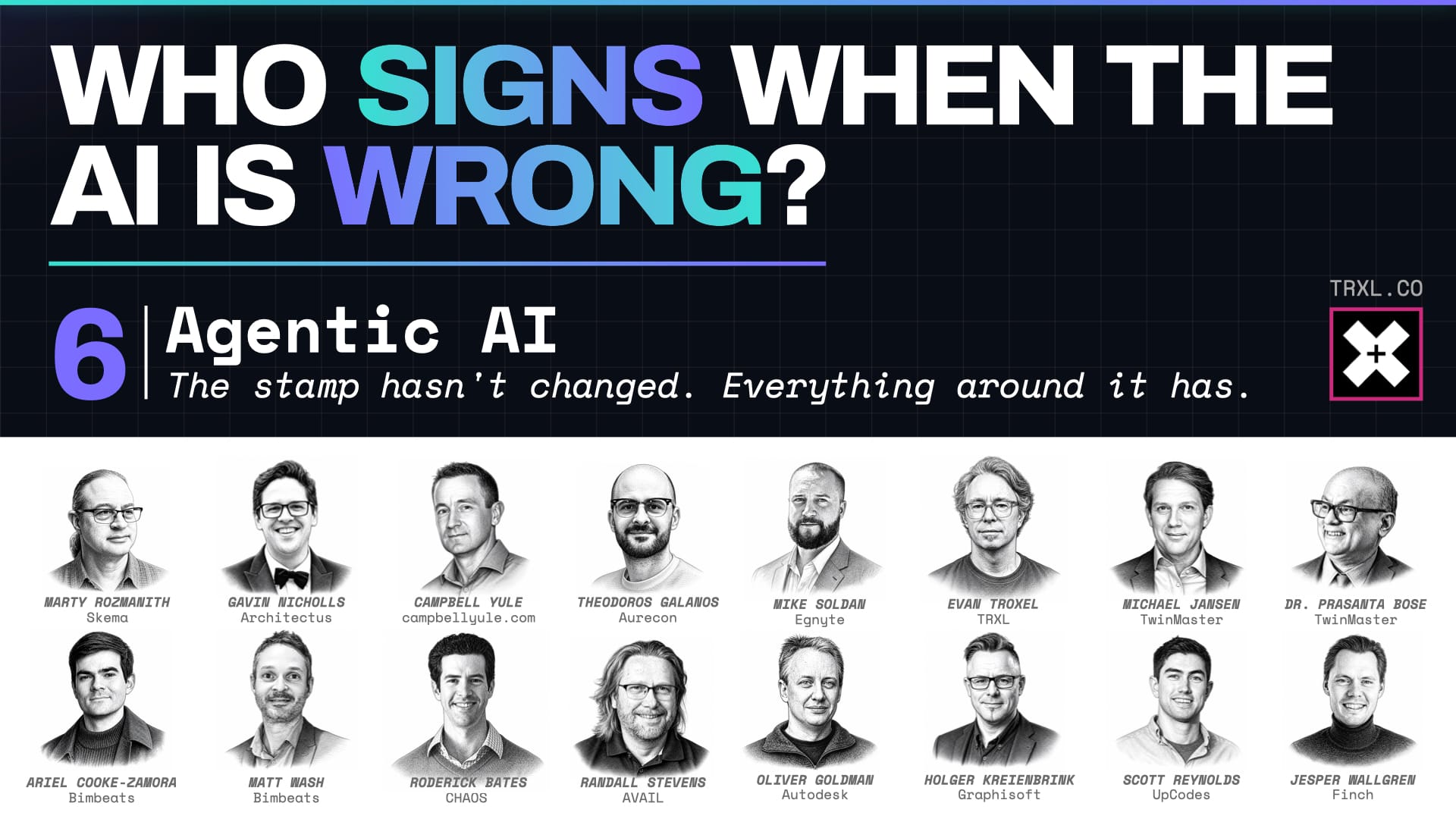
My Favorite Moments from Episode 244 "Who Signs When the AI Is Wrong?"
Oct 28, 2026
Show notes
Every episode of this series, I go back through the full conversation and pull the lines I don't want you to miss. Here are 18 of them from Episode 244, “Who Signs When the AI Is Wrong?” Each one has who said it and a timestamp if you want to hear it in context.
On liability
“Arch-e is not a licensed architect, didn't go through the NCARB process, and doesn't sign drawings. So how do we make sure that there's a human being, a project designer in charge, who is responsible in the end for what happens and maintains control?”Michael Jansen, TwinMaster · ▶ 0:51:00
“With any AI workflow integrated into architecture and engineering, at the end of the day, it's going to be someone's professional stamp on the piece of paper… it's going to be the person with the stamp that's going to be held liable.”Ariel Cooke-Zamora, Bimbeats · ▶ 0:11:20
“Ultimately, I'm responsible for the products that I deliver. I'm accountable for those, and it doesn't matter what tools I use or how good they are or they aren't, I still carry that accountability.”Oliver Goldman, Autodesk · ▶ 0:16:53
“You're still going to have to have humans in the loop, at least for the very purpose of absorbing liability… Somewhere there has to be a person who is going to have a disincentive to do things poorly, and a machine won't. AI doesn't care. It may seem very human, but it does not care.”Roderick Bates, Chaos · ▶ 1:58:31
On how much to trust the output
“Hallucination is starting to disappear. The models are good enough… Inaccuracy based on poorly structured data and poorly accessed data is a bigger problem.”Mike Soldan, Egnyte · ▶ 0:03:52
“As soon as you've run some automation tool across your whole [project], somebody's probably going to need to go say, “I now need to go look at every piece of data,” unless you can automatically check it somehow. Now I've got more work to do. You just created more work, not less work.”Randall Stevens, AVAIL · ▶ 0:09:51
“The AI is great at finding things, but it's not 100% sure. It's just like if you had asked Claude about your Excel file and it calculates things wrong and misses things. That's the current state of AI.”Jesper Wallgren, Finch · ▶ 0:29:14
“If you had an intern that did this, and you said, “No, you did this wrong, let me show you,” and they said, “Okay, got it,” and then you gave them a new project and they did the same thing wrong again, I think that person might be packing up their desk. And yet with AI, you say, “Well, I'll give it a pass.””Roderick Bates, Chaos · ▶ 0:36:30
“I guess people will check it one time, three times, five times, 10 times, and then check it less and less and less, and being more confident that what the AI has created is okay with them. I guess that's where we're going.”Holger Kreienbrink, Graphisoft · ▶ 0:44:04
On what the tools catch, and what nobody has measured
“Does it catch every mistake? No, it is not 100% coverage and replacement of a plan review. Not at all. It is very much that second set of eyes over your shoulder.”Scott Reynolds, UpCodes · ▶ 0:54:23
“We're very strict teachers against AI. I don't know if we are as strict on ourselves… Okay, you can do it 93%. Oh, that's not enough, because I need 99. Are we 99? Do we know that?”Theodoros Galanos, Aurecon · ▶ 0:58:09
On how AI is affecting practice
On who you need to hire: “Someone who knows how to check. And there we come to the problem again. The juniors, will they be able to check it in 20 years?… You need to understand the logic of building to check what the computer and the AI does in the end.”Holger Kreienbrink, Graphisoft · ▶ 1:00:41
On where architects add value: “I went to the viewing [of a new property] and I stood on the street and I thought, “This doesn't have a nice feel.” Straight away I knew there was no way the AI was ever going to tell me what it felt like to be in that space.”Matt Wash, Bimbeats · ▶ 1:24:00
On blind trust: “There is AI brain rot. And I think there's a temptation of people to outsource a lot of the critical thinking to AI systems. And I think that's when you're using it in a detrimental way.”Scott Reynolds, UpCodes · ▶ 1:29:50
On the transition from CAD to BIM: “In a way, back in the day, it was a raising of the bar, which I think took a little while for the profession to overcome. So if there's a lowering of the bar now, maybe it's about time.”Marty Rozmanith, Skema · ▶ 1:38:50
On fees, jobs, and what comes next
“As programmers, we've gotten enormously more productive, and yet the number of jobs in the field has just continued to increase. Why? Because it turns out that if it takes fewer people to produce one piece of software, what the world wants is more [...] software.”Oliver Goldman, Autodesk · ▶ 1:12:21
“If you're charging out on an hourly rate, and your work that previously used to take you 100 hours now takes you 70 because AI has helped you out, maybe you can increase your hourly rate by a little bit because you're using some technology… you've sort of given away that productivity gain to the client.”Campbell Yule, campbellyule.com · ▶ 2:23:20
“What I tell firms to focus on is automate your margin savers. A lot of firms are chasing the revenue multipliers and the top line multipliers, but I think it's a much sexier conversation to talk about where is there waste in your firm.”Mike Soldan, Egnyte · ▶ 2:13:07
This series brought to you by
Graitec provides AEC software, training, and expert support to help architects, engineers, and construction teams design, build, and manage projects more effectively.
With support from
AVAIL's content management system (CMS) helps architecture and engineering teams find, manage, and reuse their Revit, AutoCAD, Civil 3D, and other technical content in one place.
😎Win a pair of Ray-Ban Meta Smart Glasses, courtesy of series partner Graitec. Enter the giveaway. (Entering shares your contact info with Graitec.)
That's a lot of ground. The full conversation is at trxl.co/244 if any of these made you want the rest.
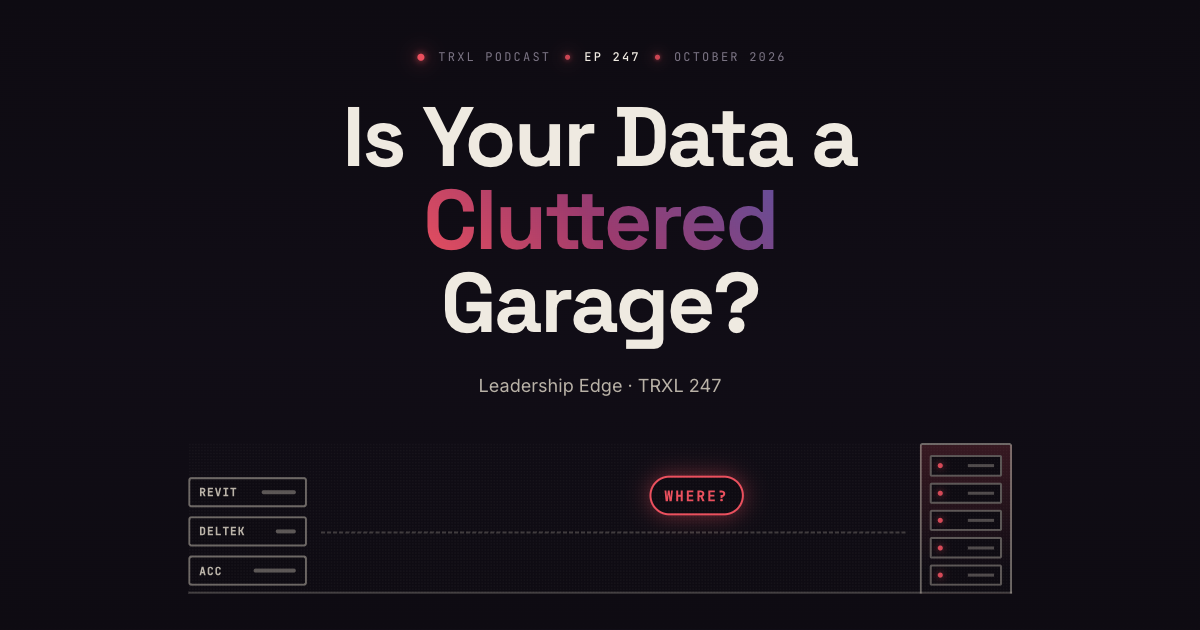
Is Your Data a Cluttered Garage?
Oct 26, 2026
Show notes
If an AI tool went through your firm's shared drive this afternoon, what would it find that you didn't know was there?
💡Who this episode is for: Especially relevant if you're a CIO, BIM manager or design technologist who has been told to get the firm's data AI-ready and needs to know what that means on a Monday morning.
Summary
This was the second episode of Arc 3 in The Next AEC Tech Stack. The first one asked what a firm's project history is worth. This episode asked why you can't use it. Two reasons kept coming up: the data means different things to different systems and different people, and it's scattered across far more places than anyone planned for.
I put that to Ariel Cooke-Zamora and Matt Wash at Bimbeats, Randall Stevens at AVAIL, Aaron Vorwerk and Mike Soldan at Egnyte, Ross Wagner at Pirros, Sasha Crotty at Autodesk, Andy Rahden at Bentley, Dimitrie Stefanescu at Speckle, Chris Razzell at dRofus, Marty Rozmanith at Skema, Jesper Wallgren at Finch, Scott Reynolds at UpCodes, Campbell Yule and Theodoros Galanos. What stood out to me was where they split. Some said structure the data first and write down what every field means. Others said an AI agent can work through the mess, and the real gap is the decisions nobody recorded.
A reminder that applies to every episode in this series: these conversations were recorded weeks ago, and the tools have kept moving since.
This series brought to you by
Graitec provides AEC software, training, and expert support to help architects, engineers, and construction teams design, build, and manage projects more effectively.
With support from
AVAIL's content management system (CMS) helps architecture and engineering teams find, manage, and reuse their Revit, AutoCAD, Civil 3D, and other technical content in one place.
Arc 3 presenting sponsor
Speckle makes design data actually usable across projects, so your team can trust it, own it, act on it, and make better decisions faster.
💡
Free and paid subscribers are getting the same full newsletter for this series. Normally the full edition of Leadership Edge is a paying-member benefit. For The Next AEC Tech Stack it isn't: every edition goes out complete to everyone on the list, free accounts included. Graitec and AVAIL funded the series, and Speckle presents Arc 3, so the industry could actually use it.
If someone forwarded this to you, sign up free and the rest of the series lands in your inbox as it publishes. The next episode, 248, is about who owns your data once it lives in someone else's platform. TRXL+ members also get the ad-free feed, the full back catalog, and all the content that goes back behind the paywall when we return to our regular schedule following this series.
Catch the full episode
What's Inside
The dictionary. Ariel Cooke-Zamora's first question to an LLM about Revit warnings got a wrong answer. What did he have to write down so it stopped?
Clean it first? Marty Rozmanith called a firm's data a cluttered garage and said nobody has to wash it before using it. The people selling structure see it differently.
The why. Aaron Vorwerk heard from customers that up to 80% of a project's data never sits in the delivery tools. Where does it sit?
Nine digits. A customer that hadn't classified its data typed a short request into an AI tool. Mike Soldan told me what came back in two seconds. Spoiler: It’s not good.
One database or many. Chris Razzell said the model is the wrong home for most project data. Sasha Crotty and Campbell Yule came at it from different angles.
Retrieval Augmented Generation (RAG). Theodoros Galanos said it works in only two cases. Which two, and what does he pair an agent with instead?
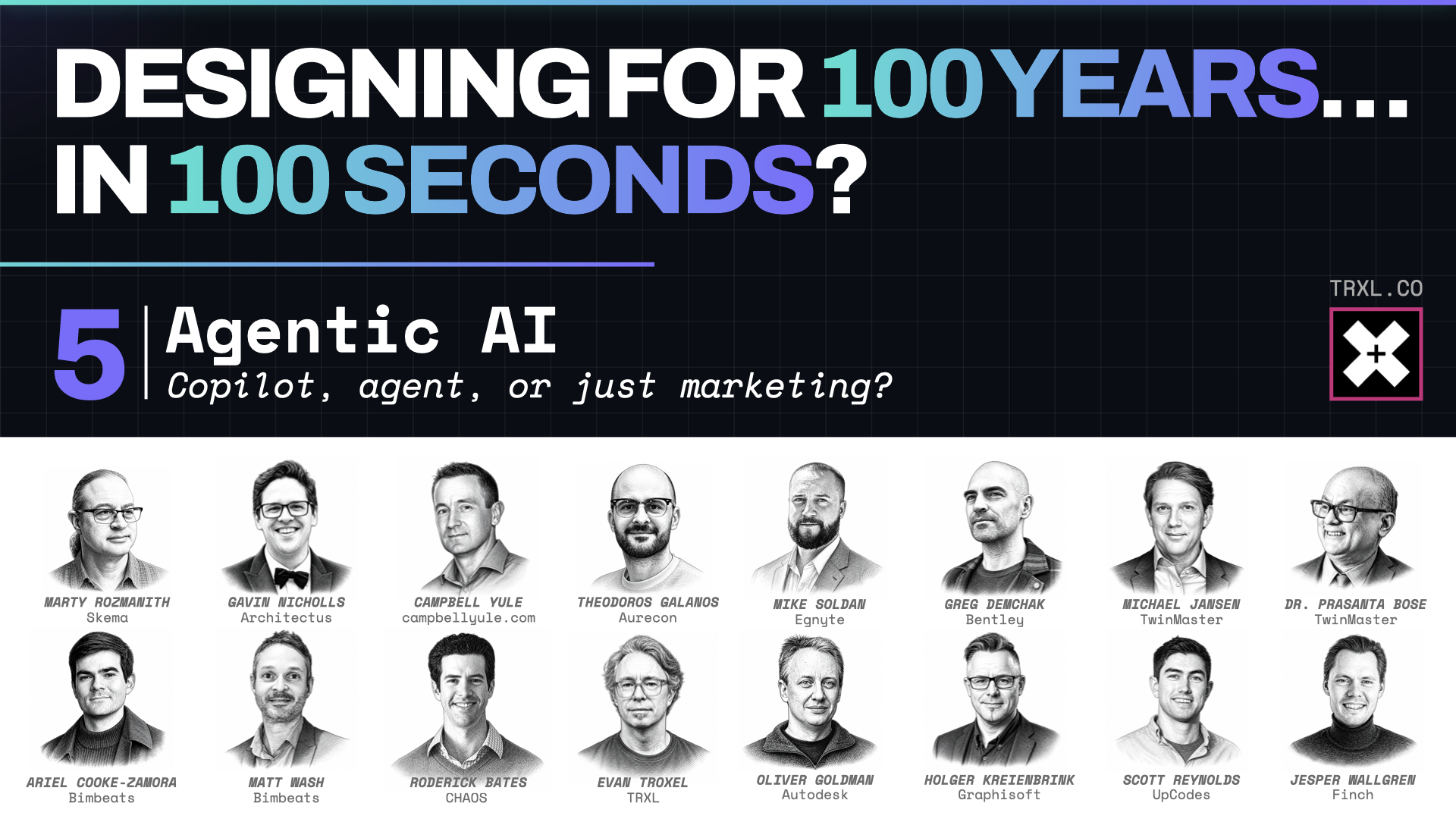
My Favorite Moments from Episode 242 "Designing for 100 Years… in 100 Seconds?"
Oct 24, 2026
Show notes
Every episode of this series, I go back through the full conversation and pull the lines I don't want you to miss. Here are 18 of them from Episode 242, “Designing for 100 Years… in 100 Seconds?” Each one has who said it and a timestamp if you want to hear it in context.
On what an agent actually is
“MCP servers, one way to think about them, and the way I think about them from a software perspective, is they're just like a… a new kind of API that's accessible to agents instead of to programmers.”Oliver Goldman, Autodesk · ▶ 0:15:20
“An atomic agent… is something that you can write a task for that can get something done at a certain level. And then you have to orchestrate them, and that's how you drive the bigger process.”Mike Soldan, Egnyte · ▶ 1:07:00
“What we're really doing here is business process analysis, the same thing that humans have done to try to make businesses more efficient for 50 years. You just have better tools to do it that are more automated.”Mike Soldan, Egnyte · ▶ 1:10:10
“A lot of the assistance you're seeing added on to Revit and Trimble and other tools like this—these are not agentic systems. They count doors and windows… It's not really agentic behavior.”Michael Jansen, TwinMaster · ▶ 1:31:50
On risk and trust
“Stack enough agents together and you get a different kind of risk, each one inheriting the last one's mistakes, a small error compounding until you're left with a confident answer and no way to see how it got there.”Evan Troxel · ▶ 0:47:40
“What we don't want is an AI to be a black box, where you feed it 20 years of firm history, and then it starts spitting out designs and you don't know why.”Marty Rozmanith, Skema · ▶ 1:03:00
“You never have a decision in isolation. You always have the traceability.”Scott Reynolds, UpCodes · ▶ 0:49:30
“They just treat it as a data engineering problem, but it's actually a core expertise problem.”Theodoros Galanos, Aurecon · ▶ 1:24:40
On what's working right now
“Show me this complete building model and render and isolate all the concrete and then color code the concrete based on the quantity of embodied carbon… And that is something you can do today.”Greg Demchak, Bentley Systems · ▶ 0:19:30
“And the agent said, 'There is no QA/QC process here. It's clear that people are marking up on the same drawing at the same time. The recommendation is to move to Bluebeam Studio.'”Matt Wash, Bimbeats · ▶ 1:15:50
“Revit crashes. I lose an hour of work. I smash my head against the wall, and I open Revit again, and I keep working. And IT probably had no idea that this even happened.”Ariel Cooke-Zamora, Bimbeats · ▶ 1:13:20
“It's not paying to be a Luddite and say, 'Well, nobody's using AI,' or, 'We're not gonna use it,' 'cause it can save you a hell of a lot of time.”Marty Rozmanith, Skema · ▶ 0:41:10
“For a while people said the best code is self-commenting. I think AI is better at reading comments.”Gavin Nicholls, The Aussie BIM Guru · ▶ 0:53:40
On prompting a building
“I don't think you should design anything that should last for 100 years in 100 seconds.”Jesper Wallgren, Finch · ▶ 0:00:00
“Prompt architecture, for me, that sounds like the person that goes to the architect. They speak. They say, 'I want the building with this, and that,' and then the architect goes to work and turn that into drawings.”Jesper Wallgren, Finch · ▶ 1:54:20
“It's not just a hair blower or something mechanical which you can create, which is there a thousand times, which you can prompt. But for architecture, I don't want to have it, and I don't believe in that.”Holger Kreienbrink, Graphisoft · ▶ 1:58:40
“If you could almost ingest all of the work of, say, Frank Lloyd Wright, and then you could show him your project and just have him critique you, it'd just be brutal.”Roderick Bates, Chaos · ▶ 1:41:30
“The part of conceptual design that an architect commonly does isn't just following the rules. There's multiple things that you're holding in your head, many of them at tension with each other.”Campbell Yule, campbellyule.com · ▶ 2:06:30
This series brought to you by
Graitec provides AEC software, training, and expert support to help architects, engineers, and construction teams design, build, and manage projects more effectively.
With support from
AVAIL's content management system (CMS) helps architecture and engineering teams find, manage, and reuse their Revit, AutoCAD, Civil 3D, and other technical content in one place.
😎Win a pair of Ray-Ban Meta Smart Glasses, courtesy of series partner Graitec. Enter the giveaway. (Entering shares your contact info with Graitec.)
That's the whole episode's worth of highlights. Full conversation's at trxl.co/242 if any of these made you want the rest.

 Our TOPPODCAST Picks
 Stay Connected