TopPodcast.com
Menu
  • Home
  • Top Charts
  • Top Networks
  • Top Apps
  • Top Independents
  • Top Podfluencers
  • Top Picks
    • Top Business Podcasts
    • Top True Crime Podcasts
    • Top Finance Podcasts
    • Top Comedy Podcasts
    • Top Music Podcasts
    • Top Womens Podcasts
    • Top Kids Podcasts
    • Top Sports Podcasts
    • Top News Podcasts
    • Top Tech Podcasts
    • Top Crypto Podcasts
    • Top Entrepreneurial Podcasts
    • Top Fantasy Sports Podcasts
    • Top Political Podcasts
    • Top Science Podcasts
    • Top Self Help Podcasts
    • Top Sports Betting Podcasts
    • Top Stocks Podcasts
  • Podcast News
  • About Us
  • Podcast Advertising
  • Contact
Not in our directory?
Add Show Here
Podcast Equipment
Center

toppodcastlogoOur TOPPODCAST Picks

  • Comedy
  • Crypto
  • Sports
  • News
  • Politics
  • True Crime
  • Business
  • Finance

Follow Us

toppodcastlogoStay Connected

    View Top 200 Chart
    Back to Rankings Page
    Technology

    TRXL Podcast

    Hosted by Evan Troxel, TRXL is a leading podcast and online resource for architecture, technology, and innovation in the AEC industry.

    Advertise

    Copyright: © Evan Troxel, all rights reserved.

    • Apple Podcasts
    • Google Play
    • Spotify

    Latest Episodes:
    247: It's on the Server Somewhere Oct 22, 2026
    Show notes

    The last episode made the case that your project history is worth something. This one asks why you can't use it. Two reasons keep coming up: the data means different things to different systems and different people, and it's scattered across far more places than anyone planned for.Ariel Cooke-Zamora at Bimbeats explains how a data dictionary keeps an AI from misreading your data, and I add a caveat about keeping it pruned. Randall Stevens at AVAIL describes a customer running 180 applications, and says the best information is at the edges of the network. Aaron Vorwerk and Mike Soldan at Egnyte cover where the reasons behind a project's decisions end up, and why governance has to come before AI touches your files. Ross Wagner at Pirros asks how a firm captures what its one all-knowing person knows. Sasha Crotty at Autodesk talks about getting data out of Revit files and how much confidence you can put in it. Andy Rahden at Bentley, Dimitrie Stefanescu at Speckle, Chris Razzell at dRofus, Marty Rozmanith at Skema, and Jesper Wallgren at Finch take on shared language, minimum standards, and where the data should live. Matt Wash at Bimbeats, Scott Reynolds at UpCodes, Campbell Yule, and Theodoros Galanos add the habits, the documentation, and the reasons Theodoros says RAG doesn't work.This episode is especially relevant for CIOs, BIM managers, and design technologists who've been told to get their data AI-ready and want to know what that means on a Monday morning.Original episode page: https://trxl.co/247Listen wherever you get your podcasts.Watch This on YouTube: Jump to a section 0:00 Introduction1:27 Bimbeats: a data dictionary for AI4:00 AVAIL: 180 applications, one project name8:33 Egnyte and Pirros: where the why lives18:24 Autodesk, Bentley, Speckle: opening the data up25:29 dRofus and Autodesk: a starting point32:08 Skema and Finch: a reusable back catalog43:13 Campbell Yule: IFC and the translation problem45:08 dRofus: documents, files, and data53:34 Autodesk and Campbell Yule: data first, model second1:00:21 Speckle and dRofus: standards and the golden thread1:04:40 AVAIL: who curates the data1:12:05 Real-time validation, habits, and governance1:26:53 Theodoros Galanos: why RAG doesn't work1:33:19 How far back to go, then stop and start Subscribe to the podcast on YouTube Arc 3 presenting sponsor Speckle makes design data actually usable across projects, so your team can trust it, own it, act on it, and make better decisions faster. This series brought to you by Graitec provides AEC software, training, and expert support to help architects, engineers, and construction teams design, build, and manage projects more effectively. With support from AVAIL's content management system (CMS) helps architecture and engineering teams find, manage, and reuse their Revit, AutoCAD, Civil 3D, and other technical content in one place. 😎Win a pair of Ray-Ban Meta Smart Glasses courtesy of Graitec. Enter Here. (entering shares your contact info with Graitec)Episode Links:The SeriesThe Next AEC Tech Stack — Series hub · Arc 3: The AEC Data Play — Arc 3, episode 2 of 3. Arc 3 is presented by Speckle.Previous episodes in the series:TRXL 238 — Half Your Day Isn't DesignTRXL 239 — You're Not Going Home EarlyTRXL 240 — I've Got to Get My Project Out on FridayTRXL 241 — From Autocomplete to Agent, Where AEC Actually IsTRXL 242 — Designing for 100 Years… in 100 Seconds?TRXL 244 — Who Signs When the AI Is Wrong?TRXL 246 — Someone Already Figured This OutVoices in This EpisodeAriel Cooke-Zamora — Product Operations Lead, Bimbeats — LinkedIn · BimbeatsMatt Wash — CEO, Bimbeats — LinkedIn · BimbeatsRandall Stevens — CEO and Founder, AVAIL — LinkedIn · AVAIL, From Project Knowledge to Capital ResourcesAaron Vorwerk — AEC Practice Leader, Architects + Owners, Egnyte — LinkedIn · EgnyteMike Soldan — SVP, Global Technology Solutions, Egnyte — LinkedIn · EgnyteRoss Wagner, Assoc. AIA — Head of Industry & Product Strategy, Pirros — LinkedIn · PirrosSasha Crotty — VP, AEC Data, Autodesk — LinkedIn · AutodeskAndy Rahden — Chief Revenue Officer, Bentley Systems — LinkedIn · BentleyDimitrie Stefanescu — CEO & Co-Founder, Speckle — LinkedIn · SpeckleChris Razzell — Managing Director & Chief Revenue Officer, dRofus — LinkedIn · dRofusMarty Rozmanith — CTO & Co-Founder, Skema — LinkedIn · SkemaJesper Wallgren — CPO & Co-Founder, Finch — LinkedIn · FinchScott Reynolds — CEO & Co-Founder, UpCodes — LinkedIn · UpCodesCampbell Yule — LinkedIn · WebsiteTheodoros Galanos — Generative AI Leader — LinkedInWhere the Data Actually LivesBimbeats on the data dictionary — Bimbeats — Ariel Cooke-Zamora on writing definitions so an LLM doesn't misread your data, using the two ways Bimbeats logs Revit warnings as the example. Matt Wash on the Outlook and Teams habits that let his time sheet categorize itself.AVAIL on the tech stack survey — 2025 AEC Technology Stack Survey, full report · Results announcement — Randall Stevens on the survey of what firms run, the customer with 180 applications, and the finding that about half the firms still bridge design data to ERP by hand. The 2026 survey is on its way, so watch for it.AVAIL on capital resources — AVAIL, From Project Knowledge to Capital Resources — Randall Stevens on his white paper, capturing intent when information is created, and why he'd start with the last five hospitals instead of the twenty-fifth.Egnyte on where the "why" lives — Egnyte — Aaron Vorwerk on the share of project data that never sits in a delivery platform, auto-classification, auto-extraction, and the context layer. Mike Soldan on project graphs and why governance has to come before the AI pipeline.Pirros on the person who knows everything — Pirros — Ross Wagner on audit trails, the one person at a firm who holds the answers, and how to capture what a person does well before it walks out the door.Opening the Data UpAutodesk on the AEC Data Model — Autodesk AEC Data · Autodesk Forma — Sasha Crotty on getting data out of Revit files, querying doors across every model in a project, adding cloud-native properties without touching the model, and mapping properties with a confidence score.Bentley on shared meaning — Bentley — Andy Rahden on why a firm needs enough shared meaning for data to move across disciplines without forcing a single standard, and where the Bentley Information Schema fits.Speckle on a lower minimum — Speckle — Dimitrie Stefanescu on how an AI agent can work through inconsistent naming, why design needs to link to numbers, and the standards a general contractor wants to enforce on its design partners.dRofus on the federated data layer — dRofus — Chris Razzell on the difference between documents, files, and data, why he calls "common data environment" a misnomer, the golden thread, and using dRofus to harvest historic projects. An MCP server is on the way.Skema on a reusable back catalog — Skema — Marty Rozmanith on the lawyer comparison, why a back catalog is your IP, and why he says your data doesn't need cleaning before you start.Finch on the plan library — Finch — Jesper Wallgren on spaces as the main element, customers building their own plan library, and a graph model that predicts a room's type from its relationships.UpCodes on writing it down — UpCodes — Scott Reynolds on why AI can handle messy data but can't use a decision nobody recorded.BIM 3.0, Open Formats, and RAGCampbell Yule on what comes after BIM 2.0 — LinkedIn · Website — Campbell on why a digital twin needs spaces, volumes, and location more than wall construction, and on the translation problem between IFC and newer formats.That Open Company — That Open Company · Fragments documentation — Co-founded by Antonio González Viegas, who Campbell discusses. His Fragments format is the example for a new format that still has to translate back to IFC.TRXL 225 with Antonio González Viegas — TRXL 225 — A Nuclear Bomb Moment, with Antonio González Viegas — Antonio's earlier episode on this show, on open source tools for working with BIM data.Theodoros Galanos on RAG — Executable Standards · LinkedIn — Why he says retrieval-augmented generation works in only two cases, and why pairing an agent with a plain database gives the same answer every time, as he wrote in his executable standards article. See also Retrieval-augmented generation for the basics.IFC — buildingSMART, Industry Foundation Classes — The open standard behind the IFC-to-Fragments translation Campbell and Chris Razzell discuss.Tools and References MentionedArcol and Snaptrude — the front-end conceptual design tools Campbell Yule says produce the simple spaces model a digital twin can use.Autodesk Forma — where Sasha Crotty places the data foundation for the AEC Data Model.Archicad — Chris Razzell's example of a platform that can hold a single model instead of 100 files.Bluebeam Studio — the document collaboration tool Chris Razzell names, a sister brand of dRofus.Deltek — the ERP system in Randall Stevens' project name example.Knowledge Architecture — Chris Parsons' firm, which Randall Stevens names when he talks about the knowledge management layer.Series PartnersThese companies took part in Arc 3 of The Next AEC Tech Stack.Speckle (Arc 3 presenting sponsor)Graitec (foundation partner)AVAIL (supporting sponsor)AutodeskBentleyBimbeatsdRofusEgnytePirrosSkemaUpCodes🛠️The tools I use to make this show: trxl.co/toolsEvery voice in this episode is on trxl.co/guests with their own bio.Connect with EvanLinkedInYouTubeEpisode Transcript:

    Full show notes at the publisher

    The Why Walks Out the Door Oct 19, 2026
    Show notes The Why Walks Out the Door

    If your most experienced architect retired on Friday, what could your firm still find on Monday?

    💡Who this newsletter is for: Especially relevant if you lead a firm, run BIM, or manage design technology, and you know the project archive is worth something but can't say how to get at it.

    Summary

    This was the first episode of Arc 3 in The Next AEC Tech Stack (TRXL 246). The first two arcs were about tools. This one is about what the tools leave behind: every model, drawing set, spec and email thread your firm has produced, still sitting on a server years after the project closed out. Every company in this arc says it can turn that into an asset, so I asked them all the same thing. What is it worth, and why does so little of it get used again?

    The answers worth your time were the ones that named what is hard: a pile of files isn't knowledge, the reasoning behind a decision is the part nobody records, and the people who hold it are the ones closest to retirement.

    This series brought to you by
    The Why Walks Out the Door Graitec provides AEC software, training, and expert support to help architects, engineers, and construction teams design, build, and manage projects more effectively.
    With support from
    The Why Walks Out the Door AVAIL's content management system (CMS) helps architecture and engineering teams find, manage, and reuse their Revit, AutoCAD, Civil 3D, and other technical content in one place.
    Arc 3 presenting sponsor
    The Why Walks Out the Door Speckle makes design data actually usable across projects, so your team can trust it, own it, act on it, and make better decisions faster.
    💡 Free and paid subscribers are getting the same full newsletter for this series. Normally the full edition of Leadership Edge is a paying-member benefit. For The Next AEC Tech Stack it isn't: every edition goes out complete to everyone on the list, free accounts included. Graitec and AVAIL funded the series, and Speckle presents Arc 3, so the industry could actually use it.
    If someone forwarded this to you, sign up free and the rest of the series lands in your inbox as it publishes. TRXL+ members also get the ad-free feed, the full back catalog, and all the content that goes back behind the paywall when we return to our regular schedule following this series. Catch the full episode

    What's Inside

    • What a firm's history is worth. Marty Rozmanith said a lawyer's old cases keep their value for a whole career. Why haven't an architect's?
    • Pile versus asset. Aaron Vorwerk called most firm archives a pile of stuff that's not well understood. What turns a pile into something a person can use?
    • The why. Randall Stevens said firms keep a record of what got done and lose why it was decided. Can that get captured while people work?
    • Clean data first? Theodoros Galanos said getting your data right is a war you can't win. What does he tell firms to do instead?
    • Small firms. Roderick Bates asked what a firm with six bathroom renovations is supposed to train on.
    • Who pays for it. Chris Razzell split his own answer between an angel and a devil. Where did he land?

    246: Someone Already Figured This Out Oct 15, 2026
    Show notes

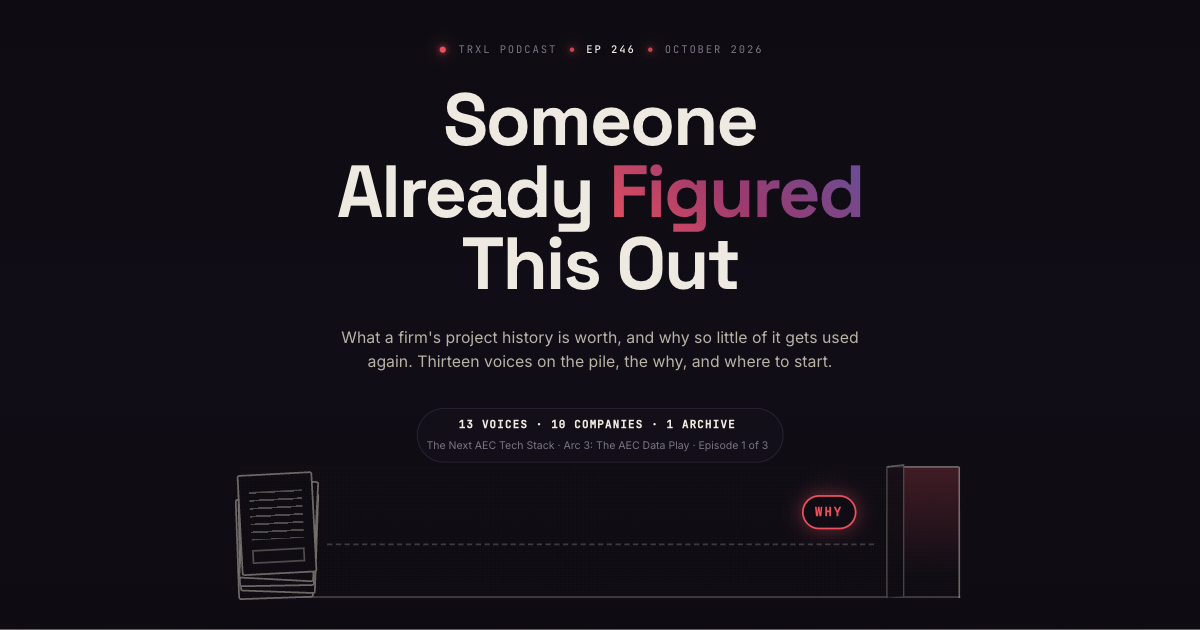
    Arc 3 of the Next AEC Tech Stack series is about your data. Most firms are sitting on years of project information, and every company in this arc says it can turn that into an asset. This first episode asks what that history is worth, and why so little of it gets used again.Marty Rozmanith at Skema starts with lawyers, whose old cases keep their value for a whole career. Randall Stevens at AVAIL calls project knowledge a capital resource, and says the part firms never capture is why a decision was made. Aaron Vorwerk and Mike Soldan at Egnyte separate a pile of files from data you can use. Ross Wagner at Pirros and Dimitrie Stefanescu at Speckle describe what leaves when your most experienced people do. Matt Wash and Ariel Cooke-Zamora at Bimbeats show what firm data can tell you about your own time and fees. Sasha Crotty at Autodesk says to start with the question you want answered. Chris Razzell at dRofus takes on who pays for good data. Roderick Bates (Chaos), Scott Reynolds (UpCodes), and Theodoros Galanos weigh in on small firms, public data, and why waiting for clean data is the wrong move.This episode is especially relevant for firm leaders, BIM managers, and design technologists who know the project archive is worth something and can't say how to get at it.Original episode page: https://trxl.co/246Listen wherever you get your podcasts.Watch This on YouTube: Jump to a section 0:00 Introduction1:33 Skema: lawyers and the case backlog3:14 AVAIL: project knowledge as a capital resource5:12 Egnyte: a pile of files, not usable data9:35 Pirros and Bimbeats: where the data lives13:48 Knowledge that walks out the door (Speckle, Pirros, AVAIL)25:34 Autodesk and AVAIL: context, decay, and what to keep31:30 Theodoros Galanos: you can't "get your data right"34:28 Is data worth more than the fee? Egnyte, AVAIL, Bimbeats43:29 Rework, new revenue, and dRofus on the value of data53:12 Does good data make the architect worth more?59:43 Small firms vs. big archives: Chaos and UpCodes1:02:38 Where to start: Autodesk and dRofus1:14:19 Pirros and Speckle: your own standards, what works today1:26:08 The firm of 2030 Subscribe to the podcast on YouTube Arc 3 presenting sponsor Speckle makes design data actually usable across projects, so your team can trust it, own it, act on it, and make better decisions faster. This series brought to you by Graitec provides AEC software, training, and expert support to help architects, engineers, and construction teams design, build, and manage projects more effectively. With support from AVAIL's content management system (CMS) helps architecture and engineering teams find, manage, and reuse their Revit, AutoCAD, Civil 3D, and other technical content in one place. 😎Win a pair of Ray-Ban Meta Smart Glasses courtesy of Graitec. Enter Here. (entering shares your contact info with Graitec)Episode Links:The SeriesThe Next AEC Tech Stack — Series hub · Arc 3: The AEC Data Play — Arc 3, episode 1 of 3. Arc 3 is presented by Speckle.Previous episodes in the series:TRXL 238 — Half Your Day Isn't DesignTRXL 239 — You're Not Going Home EarlyTRXL 240 — I've Got to Get My Project Out on FridayTRXL 241 — From Autocomplete to Agent, Where AEC Actually IsTRXL 242 — Designing for 100 Years… in 100 Seconds?TRXL 244 — Who Signs When the AI Is Wrong?Voices in This EpisodeMarty Rozmanith — CTO & Co-Founder, Skema — LinkedIn · SkemaRandall Stevens — CEO and Founder, AVAIL — LinkedIn · AVAIL, From Project Knowledge to Capital ResourcesAaron Vorwerk — AEC Practice Leader, Architects + Owners, Egnyte — LinkedIn · EgnyteMike Soldan — SVP, Global Technology Solutions, Egnyte — LinkedIn · EgnyteRoss Wagner, Assoc. AIA — Head of Industry & Product Strategy, Pirros — LinkedIn · PirrosAriel Cooke-Zamora — Product Operations Lead, Bimbeats — LinkedIn · BimbeatsMatt Wash — CEO, Bimbeats — LinkedIn · BimbeatsDimitrie Stefanescu — CEO & Co-Founder, Speckle — LinkedIn · SpeckleSasha Crotty — VP, AEC Data, Autodesk — LinkedIn · AutodeskChris Razzell — Managing Director & Chief Revenue Officer, dRofus — LinkedIn · dRofusRoderick Bates — Senior Director, Product Operations, Chaos — LinkedIn · ChaosScott Reynolds — CEO & Co-Founder, UpCodes — LinkedIn · UpCodesTheodoros Galanos — Generative AI Leader — LinkedInWhat a Firm's History Is WorthSkema on the lawyer comparison — Skema — Marty Rozmanith on why a lawyer's old cases keep their value for a whole career, and why architects never had a practical way to reuse theirs. Later, on what manufacturing does that AEC doesn't: carry lessons from one product generation to the next.AVAIL on project knowledge as a capital resource — AVAIL, From Project Knowledge to Capital Resources — Randall Stevens on the white paper, why the "why" behind decisions is what firms fail to capture, and why he'd start from today's work instead of feeding 15 years of files into an AI.Egnyte on structured and unstructured data — Egnyte — Mike Soldan on what unstructured means, how small language models can tag thousands of documents, and the 15-year "goldmine" claim. Aaron Vorwerk on the difference between a pile of files and usable knowledge.Pirros on collective memory and standards — Pirros — Ross Wagner on how firms remember by project, what walks out the door with a person, and what happens when a firm sees its own details laid out in one place.Bimbeats on firm data as a learning resource — Bimbeats — Ariel Cooke-Zamora on benchmarking, fee accuracy, and structuring data so people can learn from it. Matt Wash on the typical-details business case and the weekly time sheet.Speckle on the access problem — Speckle — Dimitrie Stefanescu on tacit knowledge locked in people's heads, data fatigue, and what a firm can see on a live project today.Autodesk on context and starting small — Autodesk · Datum — Sasha Crotty on capturing why a decision was made, learning from the last five projects instead of 15 years, and picking the outcome before uploading anything.dRofus on who pays for good data — dRofus — Chris Razzell on a "democratized organizational intelligence layer," data transformation, private clouds, and whether you charge for better handover data.Chaos on large firms training on their archives — Chaos — Roderick Bates on why big firms' repositories become an advantage, and what a small firm does with six bathroom renovations.UpCodes on public data and the infrastructure behind it — UpCodes — Scott Reynolds on building codes as public data, and why handling tens of thousands of code updates a month is the advantage.Theodoros Galanos on the exhaust — Why "get your data right" is a war firms can't win, and how agentic workflows can become the engine that generates good data.Tools, Events, and References MentionedARKI — the AI tool for typical details in Matt Wash's business-case example, built by Natalia Bakaeva.TRXL 183 — An Appetite for Transformation, with Natalia Bakaeva — Natalia Bakaeva's earlier episode on this show.NotebookLM — Ariel Cooke-Zamora's example of feeding project PDFs to an LLM.Deltek — the ERP system in Matt Wash's time sheet example.Populous — where Marty Rozmanith's stadium back-of-house example comes from.Bluebeam — the redlining example in Randall Stevens' segment on capturing intent.Series PartnersThese companies took part in Arc 3 of The Next AEC Tech Stack.Speckle (Arc 3 presenting sponsor)Graitec (foundation partner)AVAIL (supporting sponsor)AutodeskBimbeatsChaosdRofusEgnytePirrosSkemaUpCodes🛠️The tools I use to make this show: trxl.co/toolsEvery voice in this episode is on trxl.co/guests with their own bio.Connect with EvanLinkedInYouTubeEpisode Transcript:

    Full show notes at the publisher

    Architects at Slantis Build Their Own Revit Tools. Here's What That Looks Like. Oct 14, 2026
    Show notes Architects at Slantis Build Their Own Revit Tools. Here's What That Looks Like.

    In September, Mercedes Carriquiry and Nicolás Martínez from Slantis walked me through how AI adoption actually spreads across a 250-person architecture studio: the maturity framework, the strategy, the culture work. It was a good conversation, but it was still a conversation about a framework.

    Catch up on the first session here.

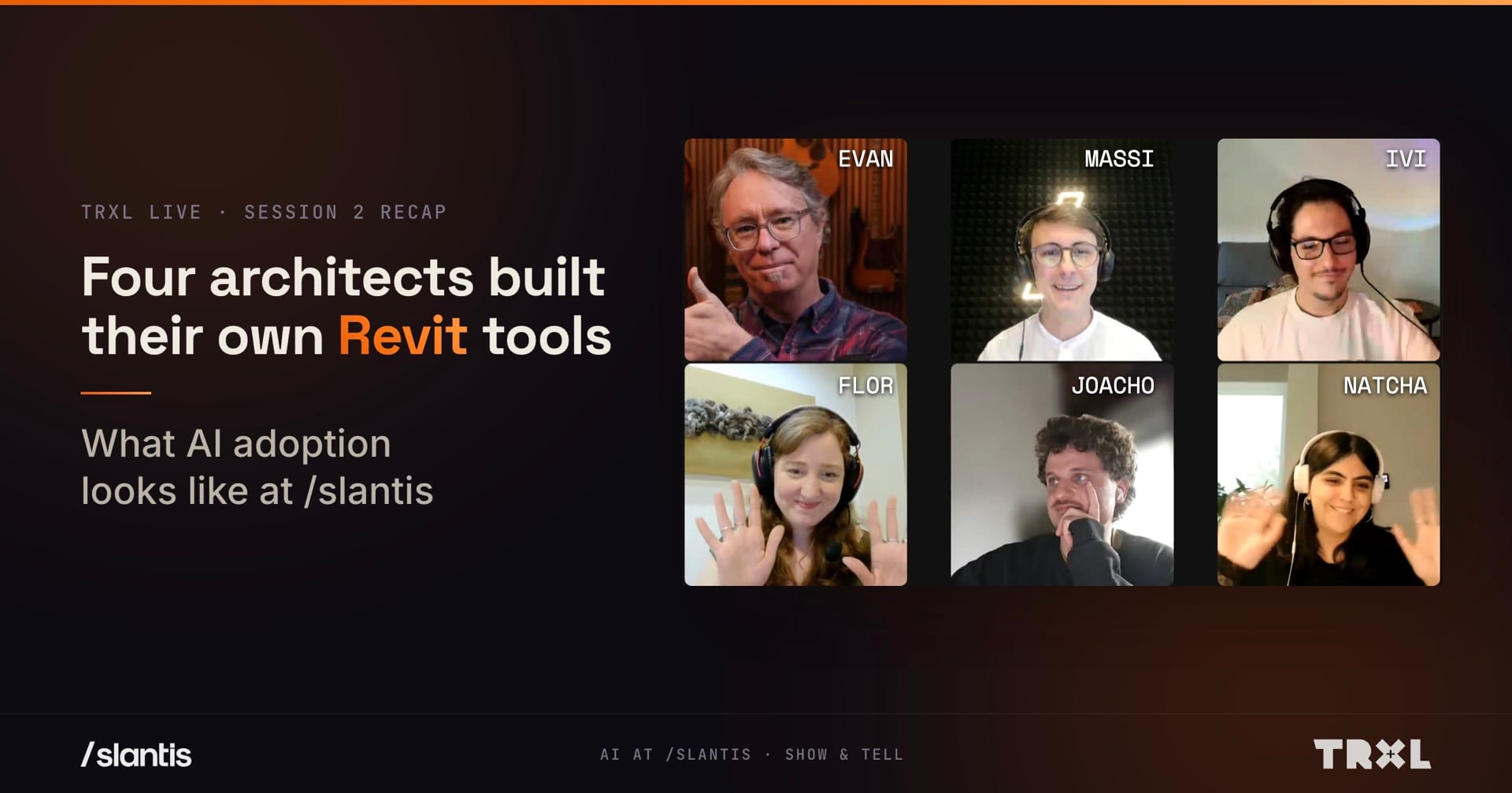
    This time, applied research lead Massimiliano Fraga (Massi) and four others from Slantis's production and research teams got on camera and showed me the tools they built. Actual Revit add-ins, running live, made by architects who aren't developers by training.

    A framework tells you adoption is possible. Watching four people demo tools they built in their spare time tells you what it costs, what it looks like day to day, and where it pays off.

    Watch session 2 here.

    HD Details: cutting a 10-hour task to five minutes

    Nazarena (Natcha), a project architect at Slantis, built HD Details with her colleague Bas after a request landed in a Slack channel: could anyone automate pulling construction details out of finished projects and into the firm's shared detail library?

    The old process was brutal. Export every detail from a closed project as an individual file, strip out anything tied to that client's standards, rename and tag everything by hand. Natcha said one project used to eat a whole afternoon, and on one roof-detail project she spent about 10 hours.

    The tool walks through that same process as a guided sequence inside Revit. Pick the drafting views you want to keep (it remembers which ones you've flagged as you work), dump them into a disposable intermediate file, strip client-specific line styles and keynotes automatically, then tag and export each detail into the library. It now takes about five minutes, and a person is still in the loop at every step, deciding what's good enough to go into a shared resource everyone else will pull from.

    Natcha had never built a tool before this one. She started with a Dynamo script a colleague had already begun, then kept extending it and iterating with the help of Claude Code until it became HD Details.

    Model Care: letting a BIM manager stop being a full-time janitor

    Florencia (Flor), a project architect and BIM specialist at Slantis, built Model Care to solve a different problem: Revit models degrade, and most firms only find out when something is already slow or broken.

    Model Care runs a full set of health checks against a model at any project stage and scores it against criteria Slantis weighted themselves. Flor's point was that off-the-shelf model checkers count every flagged item the same, and that isn't how it plays out on a real project. A missing phase assignment doesn't matter the way a broken shared coordinate system does. The dashboard separates "fix this first" from "fix this when you have time," explains why each issue matters, and exports a report the team can hand to a client or pull into Notion (it's my favorite database that runs all of TRXL too), where Slantis already tracks every project.

    I asked the obvious question: why not buy one of the many existing health checkers? Her answer was that none of them let Slantis weight the checks to their own workflow or project phase. A generic plugin isn't going to close that gap.

    She also showed a companion tool, Revit Detective, a one-click diagnostic for the BIM specialists who want a deeper look. Both came out of production time, not weekend hours. Slantis treats this as sanctioned work, which is a big part of why it exists.

    Spawn: turning a photo into a native Revit family

    Spawn, built by Ivan (Ivi), is the one that's hardest to believe until you watch it. Ivi is an architecture student who has been writing code on the side for about a year, and he built a Revit add-in in Claude Code that generates native Revit families from a reference photo or a manufacturer's cut sheet.

    Drop in a photo of a lamp, pick a model (he used Opus 5.5 for the demo), set the level of detail, and Spawn builds a 3D object. It flags what it couldn't model with confidence (in the demo, the power cord) and lets you refine with plain-language prompts like "remove the smaller shade" before generating the family. Given a spec sheet with real dimensions, it reads the measurements directly, and one experimental mode produces a parametric family you can keep adjusting inside the project.

    Ivi was upfront that parts of this are still experimental. He built in hard spending and time caps, plus per-user limits on the back end, because he has read the stories about surprise bills from AI tools with no limits set. If this category of tool spreads, the cost guardrails will matter as much as the output.

    Magic Tools: making Revit's buried commands findable

    The last demo, from Joaquin (Joacho), hits something every long-time Revit user knows: the ribbon holds more tools than anyone can remember, and most of them stay buried.

    Joacho and a small research team (Fede, Maru, and Emmy) built Magic Tools, a pyRevit-based launcher that surfaces the commands you need. An assistant that would answer "is there already a tool for this?" in plain language is still in progress. He showed two once-separate tools, a category manager and a batch filter override, merged into one view for managing view templates after the team realized they were solving the same problem from two directions. He also showed a quick-access panel that changes what it offers depending on whether you're in a sheet, a view, or have an element selected.

    Joaquin has no formal coding background. Dynamo and Revit were as close as he had gotten before this year, and he doesn't think of this as becoming a developer. He thinks of it as customizing the tool he already uses every day.

    Slantis is open-sourcing a subset of Magic Tools through the pyRevit community, after testing to make sure nothing ships that could crash someone else's model. You can find them at magictools.slantis.com.

    What this tells you (Don't skip this part.)

    A project architect, a BIM specialist, an architecture student, and a project developer each had a recurring annoyance in their own workflow, and each had dedicated time to go fix it. Slantis calls that time "the branch": the space between projects where people can pursue a skill or build something.

    The tools are useful. The structure behind them is what matters more. This studio decided that giving people time to solve their own problems with these new AI tools is worth more than squeezing every hour into billable work. Massi put it plainly on the stream: architects are natural problem-solvers, and when you hand them tools like these, you get more of this.

    None of the tools are for sale (yet). Slantis is still running safety checks before anything leaves the studio, apart from the open-source pieces.

    If you run a studio and wonder whether this could happen under your own roof, Slantis's answer is to give people the time and see what comes back.

    If this sounds interesting, watch the video here.


    245: 'System of Record, Systems of Action', with German Aparicio Jr. Oct 13, 2026
    Show notes 245: 'System of Record, Systems of Action', with German Aparicio Jr.

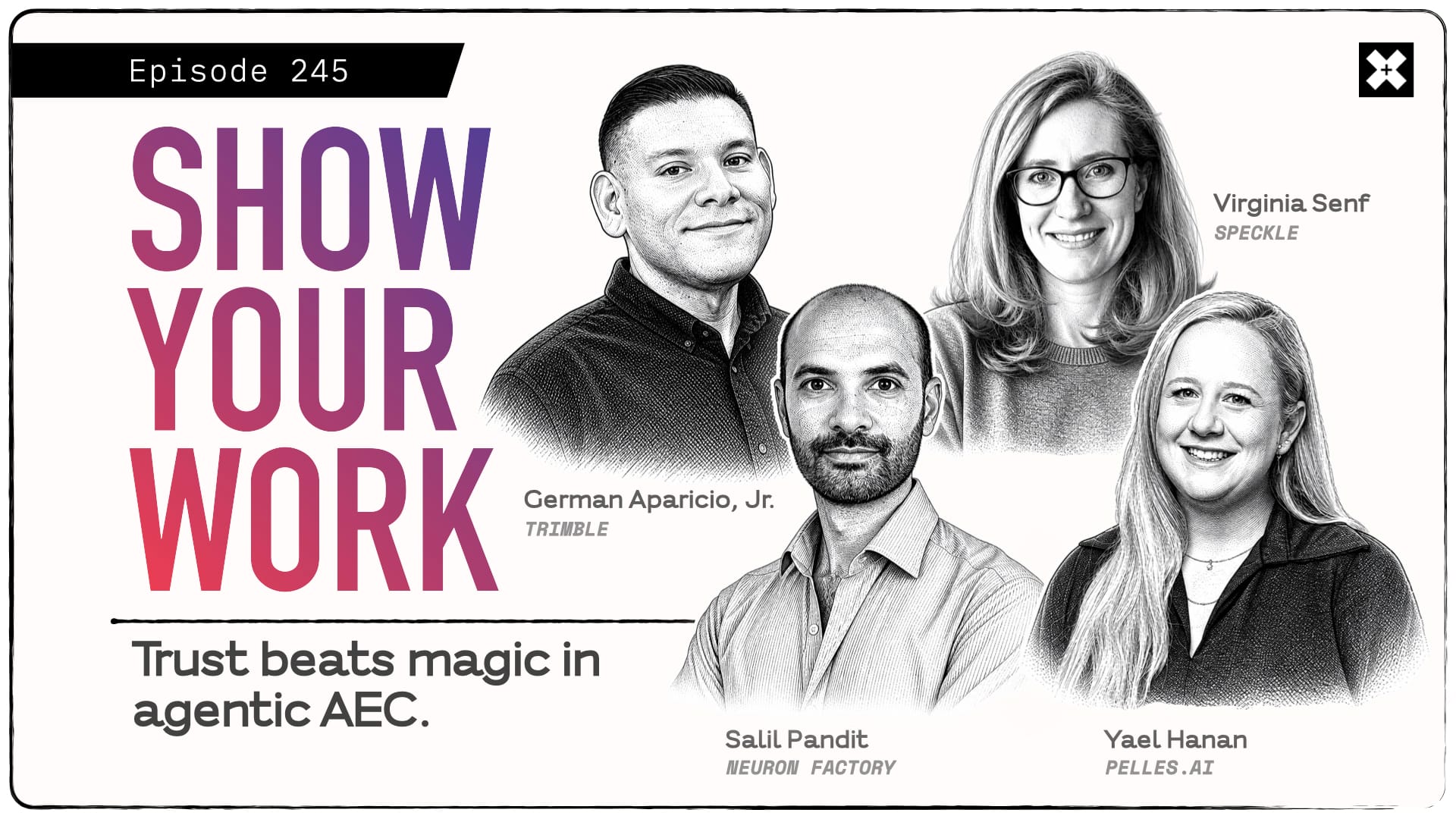
    German Aparicio, Jr. of Trimble joins Speckle's Virginia Senf, Neuron Factory's Salil Pandit, and Pelles.ai's Yael Meretyk Hanan to talk about Trimble's equity-free 0-60 Challenge and what it takes for startups to build real integrations inside a large AEC platform company. We explore founder time versus accelerator upside, Trimble as a system of record looking for systems of action and intelligence, why trustworthy model data matters more as AI gets faster, and why risk reduction is harder to measure than hours saved.

    This episode is especially relevant for AEC founders weighing corporate accelerators, practitioners who want to understand what Speckle, Neuron Factory, and Pelles are actually shipping into the Trimble stack, and firm leaders headed to Trimble Dimensions who want a preview of the Demo Day conversation before they get to Las Vegas.

    Original episode page: https://trxl.co/245

    245: 'System of Record, Systems of Action', with German Aparicio Jr.
    Listen wherever you get your podcasts.

    Watch This on YouTube:

    Jump to a section

    0:00 Introduction

    4:00 How Trimble Zero Sixty works

    9:20 Why Speckle joined the program

    12:20 Neuron Factory: Suffolk Boost vs. Trimble

    15:20 Pelles.ai: customer demand brings Accubid

    17:40 Is another program worth founder time?

    23:40 Why Trimble runs it: system of record

    28:00 Cohort breakthroughs: pre-con data meets the field

    31:10 Equity-free and open vs. walled gardens

    34:00 AI makes per-client customization cheap

    40:50 Trust in data gets harder as AI speeds up

    48:00 Risk reduction vs. hours saved

    57:40 Show your work: transparency drives adoption

    58:40 Demo Day at Trimble Dimensions

    1:01:30 How to get involved

    Subscribe to the podcast on YouTube

    Episode Links:

    Connect with the guests

    • German Aparicio Jr on LinkedIn — Program Manager of Early Innovation and Partner Development at Trimble Ventures; leads the 0-60 for Startups program.
    • Trimble — Platform company across AECO software and field systems; host of the 0-60 Challenge and Dimensions.
    • Virginia Senf on LinkedIn — Chief Growth Officer at Speckle.
    • Speckle — AEC data intelligence layer; integrating with Trimble Connect in this cohort.
    • Salil Pandit on LinkedIn — Co-Founder and CTO of Neuron Factory.
    • Neuron Factory — AI platform for pre-construction, integrating with Trimble Connect and ProjectSight.
    • Yael Meretyk Hanan on LinkedIn — Co-Founder and CEO of Pelles.ai.
    • Pelles.ai — AI infrastructure for trade contractors; connecting into Accubid, Connect, ProjectSight, and Trimble ERP.

    Trimble 0-60 and Dimensions

    • Trimble 0-60 for Startups — Overview of Trimble's startup program and how the Challenge fits inside it.
    • Trimble 0-60 Challenge at Dimensions — Demo Day context for the 2026 challenge finalists.
    • Trimble Dimensions — Annual conference in Las Vegas (November 9–11, 2026); German notes Demo Day scheduled November 10 at 10am.

    Tools and Platforms Mentioned

    • Trimble Connect — Collaboration platform treated here as a system of record for models and project data.
    • Trimble ProjectSight — Construction project management platform several finalists are integrating with.
    • Trimble Accubid — Electrical takeoff tool that pulled Pelles into the Trimble ecosystem via customer demand.
    • Vista by Trimble — Construction ERP mentioned alongside other Trimble ERP connections.
    🛠️The tools I use to make this show: trxl.co/tools

    About German Aparicio Jr:

    German Aparicio Jr is Program Manager of Early Innovation and Partner Development at Trimble Ventures, where he leads Trimble's 0-60 for Startups program and the 0-60 Challenge. A licensed architect with roots at Gehry Technologies and Trimble Connect, he spent a decade in consulting before shifting into corporate innovation. On this episode he frames Trimble as a system of record looking for systems of action and intelligence from the startup ecosystem, without taking equity for the privilege.

    About Virginia Senf:

    Virginia Senf is Chief Growth Officer at Speckle, the AEC data intelligence layer that pulls model information out of design tools into a normalized, trustworthy dataset. She leads Speckle's go-to-market after running Autodesk's emerging AEC data strategy following the UNIFI acquisition, where she was COO. In this conversation she speaks for a more established startup still choosing an equity-free corporate accelerator, and for the trust problem that gets worse as AI makes it easier to query bad data.

    About Salil Pandit:

    Salil Pandit is Co-Founder and CTO of Neuron Factory, an AI platform for pre-construction used by large global GCs. Before construction tech he spent nearly a decade at Alphabet across Google Glass, YouTube TV, and Waymo, after earlier work at DreamWorks and Boeing. Here he talks about building Trimble Connect and ProjectSight integrations himself, correlating pre-con decisions with field outcomes for the first time, and why showing the AI's reasoning beats promising hours saved.

    About Yael Meretyk Hanan:

    Yael Meretyk Hanan is Co-Founder and CEO of Pelles.ai, building AI infrastructure so trade contractors can assemble their own agents, apps, and workflows. A former construction lawyer with sales and operator experience across the US, Middle East, and Asia, she entered Trimble's program after customers asked for Accubid and broader Trimble ecosystem connections. She makes the case for starting with customer demand, measuring risk reduction honestly, and treating Dimensions as both product and business opportunity.

    Connect with Evan

    • LinkedIn
    • YouTube

    Episode Transcript:


    Do You Know Your Firm's Error Rate? Oct 12, 2026
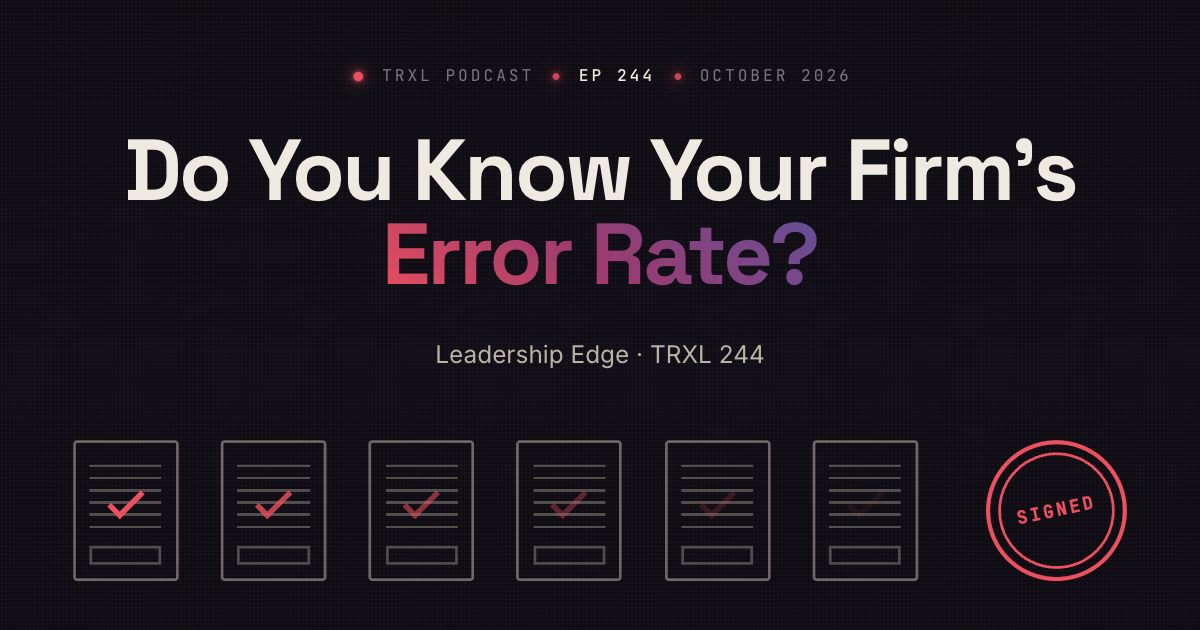
    Show notes Do You Know Your Firm's Error Rate?

    If an AI tool revises a thousand sheets overnight and you stamp the set (digitally, of course... because who has time for that) in the morning, what exactly did you check?

    💡Who this episode is for: Especially relevant if you put a license behind the work, or you're the person deciding how much of the checking a tool is allowed to do.

    Summary

    This was the last episode of Arc 2 in The Next AEC Tech Stack (TRXL 244). The first two asked what these tools can do. This one asked what happens when they're wrong, who is still on the hook when they are, and how the next generation learns the job when the work they used to learn on goes away.

    I put those questions to fifteen people. Almost everyone said the stamp stays with a person today. What varied was how much it takes to stand behind one now.

    The risks that stood out to me weren't about a model making things up. They were about checking that gets thinner as the output gets better, a profession that has never measured its own error rate asking a machine for 99% accuracy, and a fee structure that hands the savings to the client. A reminder that applies to every episode in this series: these conversations were recorded weeks ago, and the tools have kept moving since.

    This series brought to you by
    Do You Know Your Firm's Error Rate? Graitec provides AEC software, training, and expert support to help architects, engineers, and construction teams design, build, and manage projects more effectively.
    With support from
    Do You Know Your Firm's Error Rate? AVAIL's content management system (CMS) helps architecture and engineering teams find, manage, and reuse their Revit, AutoCAD, Civil 3D, and other technical content in one place.
    💡 Free and paid subscribers are getting the same full newsletter for this series. Normally the full edition of Leadership Edge is a paying-member benefit. For The Next AEC Tech Stack it isn't: every edition goes out complete to everyone on the list, free accounts included. Graitec and AVAIL funded the series so the industry could actually use it.
    If someone forwarded this to you, sign up free and the rest of the series lands in your inbox as it publishes. TRXL+ members also get the ad-free feed, the full back catalog, and all the content that goes back behind the paywall when we return to our regular schedule following this series. Catch the full episode

    What's Inside

    • What the stamp covers now. A digital signature can go on every sheet in a set at once, so what does a signature prove anymore?
    • Slop, not hallucination. Mike Soldan says the bigger risk is reference content that's five years old, and that changes what a firm should be policing.
    • Checking less and less. Holger Kreienbrink expects people to verify AI output five times, then ten, then stop, and isn't sure that ends well.
    • The intern double standard. Roderick Bates compares the pass AI gets with the pass no human employee would get.
    • Nobody measures the humans. Theodoros Galanos asks whether anyone who demands 99% accuracy from a machine knows their own number.
    • Where the reps go. If drafting was how people learned why a door swings the way it does, what replaces it?
    • The fee that gives it away. Campbell Yule explains how hourly billing turns a productivity gain into the client's discount.

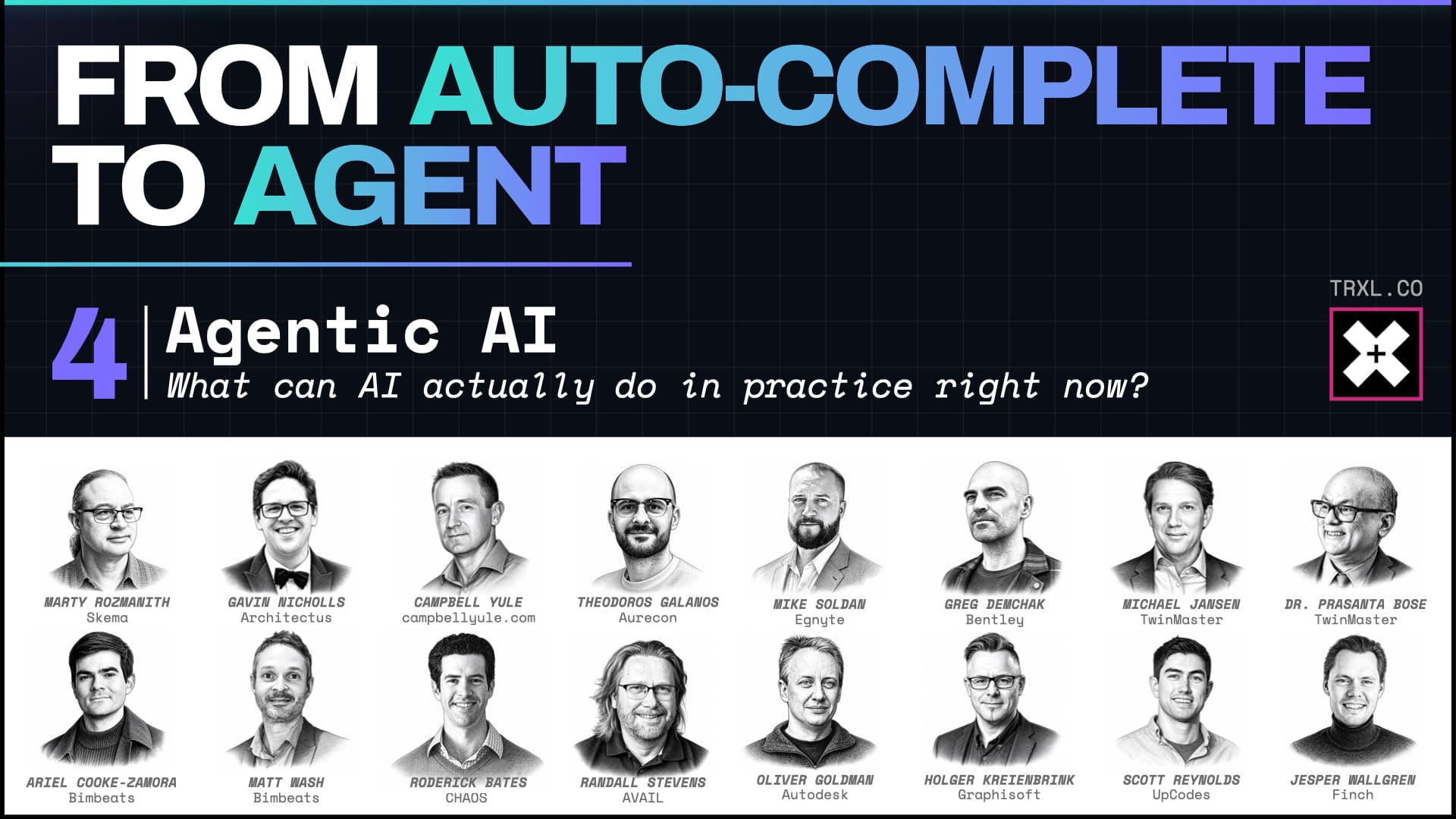
    244: Who Signs When the AI Is Wrong? Oct 08, 2026
    Show notes

    This is the last episode of Arc 2. The first two asked what these tools can do. This one asks what happens when they get it wrong, who is still on the hook when they do, and what that means for the people coming up in this profession.Mike Soldan says the bigger risk now is reference content that's five years old, not a hallucination. Randall Stevens points out that running automation across a whole drawing set can leave someone checking every piece of it. Oliver Goldman says the accountability stays with whoever delivers the work, whatever tools they used. Holger Kreienbrink expects people to check AI output less and less until they sign without looking. Scott Reynolds tested its review against the 1981 Hyatt walkway collapse and the Champlain Towers collapse. Theodoros Galanos asks whether we hold AI to a standard we've never measured ourselves against. Then the harder question: who do firms still hire, and how does the next generation learn when the grunt work goes away? Roderick Bates, Marty Rozmanith, Matt Wash and Ariel Cooke-Zamora, Prasanta Bose and Michael Jansen, Jesper Wallgren, Gavin Nicholls, and Campbell Yule weigh in, and close on the firm of 2030 and why billing by the hour gives the productivity gain away.This episode is especially relevant for principals who put their stamp on drawings, firm leaders deciding how much to trust these tools, and anyone responsible for training the next generation when the work they learned on is disappearing.Original episode page: https://trxl.co/244Listen wherever you get your podcasts. This series brought to you by Graitec provides AEC software, training, and expert support to help architects, engineers, and construction teams design, build, and manage projects more effectively. With support from AVAIL's content management system (CMS) helps architecture and engineering teams find, manage, and reuse their Revit, AutoCAD, Civil 3D, and other technical content in one place. 😎Win a pair of Ray-Ban Meta Smart Glasses courtesy of Graitec. Enter Here. (entering shares your contact info with Graitec)Watch This on YouTube:Subscribe to the podcast on YouTubeEpisode Links:The SeriesThe Next AEC Tech Stack — Series hub · Arc 2: Agentic AI — Arc 2, episode 3 of 3. Arc 3 starts next week.Previous episodes in the series:TRXL 238 — Half Your Day Isn't DesignTRXL 239 — You're Not Going Home EarlyTRXL 240 — I've Got to Get My Project Out on FridayTRXL 241 — From Autocomplete to Agent, Where AEC Actually IsTRXL 242 — Designing for 100 Years… in 100 Seconds?Voices in This EpisodeMike Soldan — SVP, Global Technology Solutions, Egnyte — LinkedIn · EgnyteRoderick Bates — Senior Director, Product Operations, Chaos — LinkedIn · ChaosRandall Stevens — CEO and Founder, AVAIL — LinkedIn · AVAILMatt Wash — CEO, Bimbeats — LinkedIn · BimbeatsAriel Cooke-Zamora — Product Operations Lead, Bimbeats — LinkedIn · BimbeatsOliver Goldman — VP, Software Architecture, AEC Solutions, Autodesk — LinkedIn · AutodeskJesper Wallgren — CPO & Co-Founder, Finch — LinkedIn · FinchScott Reynolds — CEO & Co-Founder, UpCodes — LinkedIn · UpCodesHolger Kreienbrink — Director, Product Intelligence & Partnerships, Graphisoft — LinkedIn · GraphisoftPrasanta Bose — CEO & CTO, TwinMaster — LinkedIn · TwinMasterMichael Jansen — Chief Business Officer, TwinMaster — LinkedIn · TwinMasterTheodoros Galanos — Generative AI Leader — LinkedInMarty Rozmanith — CTO & Co-Founder, Skema — LinkedIn · SkemaGavin Nicholls — National Computation Lead, Architectus — LinkedIn · Aussie BIM Guru on YouTube · ArchitectusCampbell Yule — LinkedIn · WebsiteLiability and the StampEgnyte on where a human still verifies — Egnyte — Mike Soldan on firms setting their own checkpoints, and why stale reference content is now a bigger risk than a fabricated answer.Chaos on why building is hard, licensed or not — Chaos — Roderick Bates on licensure, risk, and why the physical work of building a building doesn't replicate easily.AVAIL on trust and the stamp — AVAIL — Randall Stevens on an industry that runs on trust, and why automating across a full drawing set can leave someone checking every piece of it.Bimbeats on where liability lands — Bimbeats — Ariel Cooke-Zamora on liability routing to the stamp, insurance for AI agents, and the Waymo parallel. Matt Wash on the digital stamp that already goes on sheets nobody opened, and on AI as an extra check rather than an excuse.Trust and VerificationAutodesk on accountability and staged changes — Autodesk · Autodesk Forma — Oliver Goldman on why warnings get clicked through, presenting AI output as work in progress, a read-only MCP server for Revit, staged changes you approve, and bringing a firm's own agents into the loop.Finch on rules you can trust — Finch — Jesper Wallgren on live key figures, a "spell check" for plans, and who writes the rules (the firm, not Finch).UpCodes on flagging without deciding — UpCodes — Scott Reynolds on why a human verifies everything, why the review won't be made more "forgiving," and testing against historical failures.Chaos on the double standard — Chaos — Roderick Bates on checking work you don't have the knowledge to judge, deterministic tools that teach, and users "rolling the dice" on outputs.Graphisoft on trust decay — Graphisoft — Holger Kreienbrink on checking less and less over time, and a generation raised on answers it doesn't question.TwinMaster on verifiable agents — TwinMaster — Prasanta Bose on agents that show their reasoning so a person can check them. Michael Jansen on the questions firms ask once they get serious about agentic tools.Theodoros Galanos on who's liable, and how good humans are — Why we're always liable today, how embedded verification could change that, and why we demand 99 percent from AI without knowing our own number.Who You Still HireGraphisoft on knowing the logic of building — Holger Kreienbrink on needing someone who knows where the water goes, and what happens to junior work.Egnyte on business process analysts — Mike Soldan on who the large firms are hiring to map their processes before AI touches them.TwinMaster on judgment, writing, and growth — Prasanta Bose on why architects need to be good writers. Michael Jansen on what the outsourcing wave did to headcount.Autodesk on what happened to software jobs — Oliver Goldman on programmers getting far more productive while the number of jobs kept growing.Theodoros Galanos on the middle of the ladder — The cohort educated before ChatGPT and hired after it, and what education should teach instead.Bimbeats on capturing knowledge and proving competence — Matt Wash on capturing senior knowledge as mentoring time shrinks, and assessing students out loud. Ariel Cooke-Zamora on generalists who orchestrate. — Knowledge Architecture — Chris Parsons' firm, which Matt Wash names on who to hire.UpCodes on AI brain rot — Scott Reynolds on showing the rationale and code sections so junior staff build the skill, not only the answer.Skema on raising the bar — Marty Rozmanith on the move from AutoCAD to Revit, and why it raised the bar on what you had to know.Gavin Nicholls on the about-face — Architectus — On years of teaching manual methods meeting AI that codes well, a PDF binder shipped in two prompts, and why a firm needs someone close to full-time on this.Chaos on what the profession could lose — Roderick Bates on losing the artist's eye, clients as critics, and the tragedy of the commons in training vendor systems.The Future of the ProfessionTwinMaster on business models beyond the fee — Michael Jansen on new service lines, and why a fee ends when the job does.Skema on the standard of care — Marty Rozmanith on why the hours-to-standard-of-care equation is breaking.Bimbeats on what this costs later — Matt Wash on human capital versus AI capital, and the token bill nobody plans for yet.The firm of 2030 — Oliver Goldman, Mike Soldan, and Theodoros Galanos on productivity, the person down the hall with 30 years of answers, and taking out intermediation. Roderick Bates on what to stop doing, Scott Reynolds on what to start doing.Campbell Yule on fee structure — Campbell Yule — Why billing hourly gives away the productivity gain, and how lower risk lets firms fix the fee on front-end work.Tools, Events, and References MentionedOpenAI GPT-6 Astra — text to geometry, named in the episode open, along with Anthropic's Opus 5.5, SpaceX’s Grok Bot, OpenAI Dots, and Meta’s Muse.Y Combinator — where Ariel Cooke-Zamora saw a company selling insurance for AI agent mistakes.Waymo — Ariel Cooke-Zamora's self-driving liability parallel.Bluebeam — the digital stamp in Matt Wash's segment.Claude Code — Oliver Goldman's example of calibrating trust in an assistant.Perplexity — Holger Kreienbrink's example of skipping pages of reasoning.Hyatt Regency walkway collapse (1981) and Champlain Towers South collapse (2021) — the historical cases Scott Reynolds tested against.NCARB — "Arch-e didn't go through NCARB," in Michael Jansen's list of client questions.V-Ray and Enscape — Chaos' renderers, in Roderick Bates' segments.D5 Render — named with Enscape when Evan says renderings became free.AIA — the AIA National talks where Roderick Bates saw pro-AI statements booed.Series PartnersThese companies took part in Arc 2 and agreed to be asked hard questions about their own AI.Graitec (foundation partner) · Autodesk · AVAIL · Bimbeats · Chaos · Egnyte · Finch · Graphisoft · Skema · TwinMaster · UpCodes🛠️The tools I use to make this show: trxl.co/toolsEvery voice in this episode is on trxl.co/guests with their own bio.Connect with EvanLinkedInYouTubeEpisode Transcript:

    Full show notes at the publisher

    My Favorite Moments from Episode 241 "From Autocomplete to Agent: Where AEC Actually Is" Oct 07, 2026
    Show notes My Favorite Moments from Episode 241 "From Autocomplete to Agent: Where AEC Actually Is"

    Every episode of this series, I go back through the full conversation and pull the lines I don't want you to miss. Here are 16 of them from Episode 241, "From Autocomplete to Agent" — a quote, who said it, and a timestamp if you want to hear it in context.

    On what "AI" actually is right now

    My Favorite Moments from Episode 241 "From Autocomplete to Agent: Where AEC Actually Is"“95% of the tools that we see that are calling themselves AI tools are actually LLM wrappers—a bit of code wrapped around an existing LLM.”Michael Jansen, TwinMaster · ▶ 0:00:03
    My Favorite Moments from Episode 241 "From Autocomplete to Agent: Where AEC Actually Is"“Smart rules can look intelligent, but they're just rules.”Campbell Yule, campbellyule.com · ▶ 0:38:09
    My Favorite Moments from Episode 241 "From Autocomplete to Agent: Where AEC Actually Is"“For me, LLMs are like a command line where you don't have to know the syntax—you just say human-readable English.”Marty Rozmanith, Skema · ▶ 0:42:15
    My Favorite Moments from Episode 241 "From Autocomplete to Agent: Where AEC Actually Is"“You're describing what you want with natural language. It's then instantiating Python code snippets and building little widgets within MicroStation—you could use that to build a bridge, build a building, generate geometry.”Greg Demchak, Bentley Systems · ▶ 0:27:14

    On where AI actually helps, and where it doesn't

    My Favorite Moments from Episode 241 "From Autocomplete to Agent: Where AEC Actually Is"“We want to see AI on the tedious tasks—this is what no one wants to do. We have to be very careful in creativity.”Holger Kreienbrink, Graphisoft · ▶ 0:10:59
    My Favorite Moments from Episode 241 "From Autocomplete to Agent: Where AEC Actually Is"“As architects, we make a thousand decisions, and our decisions are interconnected across the entire life cycle [of the building].”Michael Jansen, TwinMaster · ▶ 0:00:32
    My Favorite Moments from Episode 241 "From Autocomplete to Agent: Where AEC Actually Is"“Find what's bleeding. Find what is painfully slow. Re-architect that thing. Stop worrying about that task level. It's gonna solve itself.”Mike Soldan, Egnyte · ▶ 1:59:53
    Listen to the full episode

    On adoption and who resists it

    My Favorite Moments from Episode 241 "From Autocomplete to Agent: Where AEC Actually Is"“Most enterprise have a lot of inertia of change. We hate change. We love to do as is.”Prasanta Bose, TwinMaster · ▶ 0:03:40
    My Favorite Moments from Episode 241 "From Autocomplete to Agent: Where AEC Actually Is"“The moment that anyone rushes to AI, that's usually an alarm bell for me—you didn't solve the first problem, so don't become an AI product.”Gavin Nicholls, The Aussie BIM Guru · ▶ 1:07:49
    My Favorite Moments from Episode 241 "From Autocomplete to Agent: Where AEC Actually Is"“When you turn [AI] loose on your drawings when they're at seventy-five percent, ninety percent, the risk level goes way up.”Randall Stevens, AVAIL · ▶ 0:52:30

    On what's coming for firms and the people in them

    My Favorite Moments from Episode 241 "From Autocomplete to Agent: Where AEC Actually Is"“[With AI] you will be able to achieve more with less people—and I think that goes for all knowledge-based firms.”Jesper Wallgren, Finch · ▶ 1:56:42
    My Favorite Moments from Episode 241 "From Autocomplete to Agent: Where AEC Actually Is"“I think we will never be busier. There is already too many things to do and not enough expertise.”Theodoros Galanos, Aurecon · ▶ 2:09:28
    My Favorite Moments from Episode 241 "From Autocomplete to Agent: Where AEC Actually Is"“The conversations that I'm having with C-suite across every organization right now is that they're worried about AI, and they're worried that they're not moving fast enough—and that if they miss out, they're gonna go out of business.”Matt Wash, Bimbeats · ▶ 1:49:14
    My Favorite Moments from Episode 241 "From Autocomplete to Agent: Where AEC Actually Is"“I think the firm of 2030—it's gonna be highly streamlined. You'll be able to go from a proposal to documentation in significantly less time than you were historically speaking.”Roderick Bates, Chaos · ▶ 1:58:14

    On how to actually engage with it

    My Favorite Moments from Episode 241 "From Autocomplete to Agent: Where AEC Actually Is"“Stop taking people's word for what works and what doesn't. Start testing and experimenting yourself.”Scott Reynolds, UpCodes · ▶ 1:16:49
    My Favorite Moments from Episode 241 "From Autocomplete to Agent: Where AEC Actually Is"“The best advice I could give to anyone who's asking about how to stay on top of the AI technology is to engage with a steady hand.”Oliver Goldman, Autodesk · ▶ 1:46:57
    Listen to the full episode
    This series brought to you by
    My Favorite Moments from Episode 241 "From Autocomplete to Agent: Where AEC Actually Is" Graitec provides AEC software, training, and expert support to help architects, engineers, and construction teams design, build, and manage projects more effectively.
    With support from
    My Favorite Moments from Episode 241 "From Autocomplete to Agent: Where AEC Actually Is" AVAIL's content management system (CMS) helps architecture and engineering teams find, manage, and reuse their Revit, AutoCAD, Civil 3D, and other technical content in one place.
    😎Win a pair of Ray-Ban Meta Smart Glasses, courtesy of series partner Graitec. Enter the giveaway. (Entering shares your contact info with Graitec.)

    That's the whole episode's worth of highlights. Full conversation's at trxl.co/241 if any of these made you want the rest.


    BIM Didn’t Solve the Knowledge Gap Oct 05, 2026
    Show notes BIM Didn’t Solve the Knowledge Gap

    If ninety percent of a hospital's room requirements can be templated from work you've already done, why does the next project still open on a blank page?

    💡Who this episode is for: Especially relevant if you lead healthcare planning, design technology, or a firm, and you know the best knowledge still lives in a few senior heads, with no plan for what happens when they leave.

    Summary

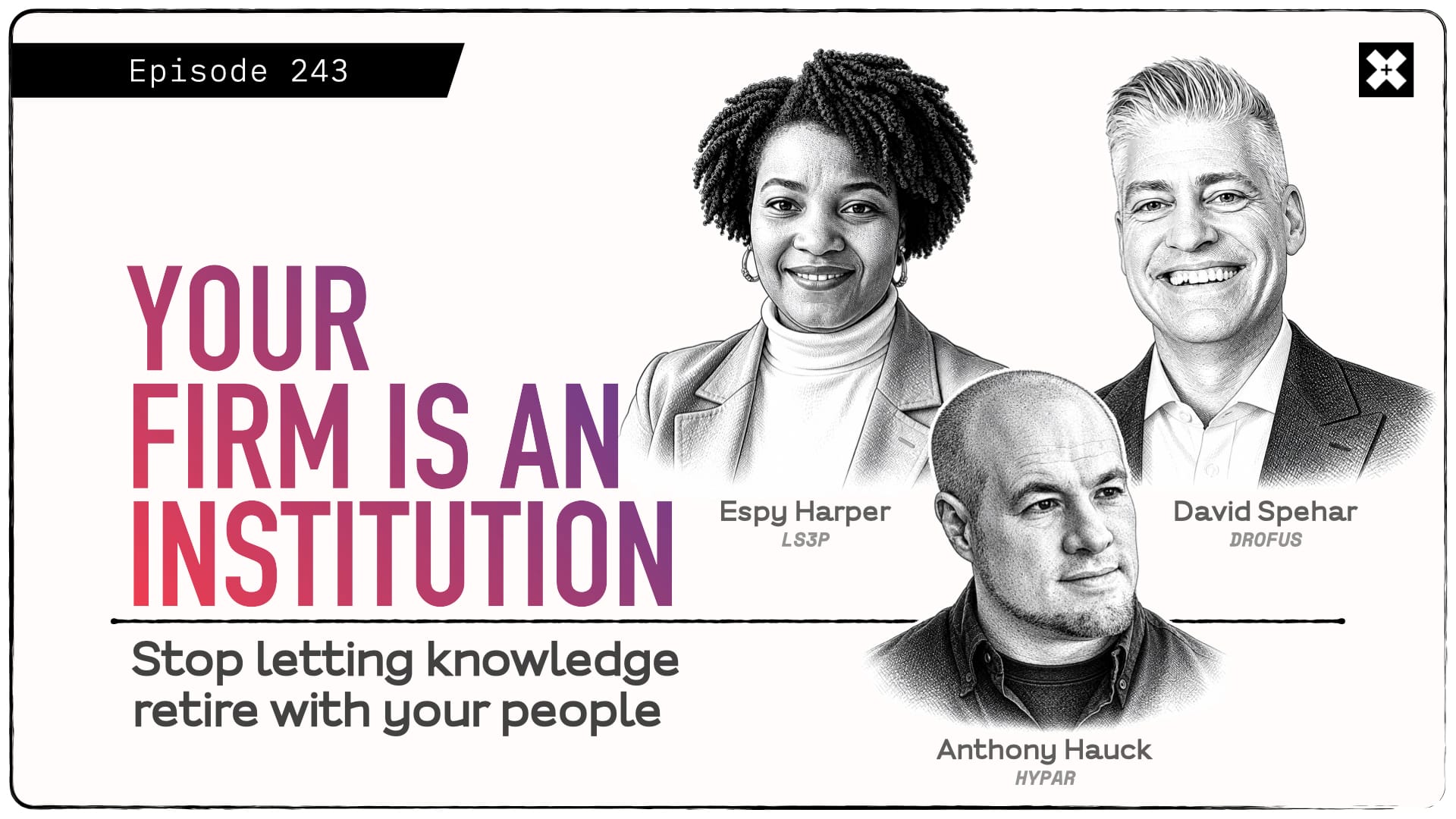
    For this special partner episode (TRXL 243), I moderated a discussion on data-driven design for healthcare with Espy Harper (Innovation Leader and Associate Principal at LS3P), David Spehar (Regional Sales Manager for the Americas at dRofus, and a recovering architect), and Anthony Hauck (co-founder and Chief Product Officer at Hypar). dRofus and Hypar produced the episode with me.

    Hospitals force you to hold the macro and micro at the same time. Espy opened with a medications-dispensing machine whose drawer needs more than three feet to open, discovered when drywall is already up. David described the traditional stack: about thirty Excel files, a couple of Revit models, SketchUp, bum wad (I prefer to call it trace), and someone with thirty years of planning experience who "just knows." Anthony talked about clients who nod through plans and elevations, then freeze when they finally see a 3D room and ask whether that thing is really going to be there.

    Espy and David both landed on the same range independently: roughly eighty to ninety percent of room information for healthcare clients who keep standards in a structured database is already predefined. The rest is frosting. That should free time for design and for the operational questions clients actually care about. It only works if somebody treats the firm, or the owner portfolio, like an institution that keeps knowledge on purpose.

    This newsletter is made possible by

    dRofus: a planning and building information management platform for room requirements, equipment, space data, and project standards across the building lifecycle.

    Hypar: 3D space planning software for complex buildings in early design, built so program data and live layouts can move together instead of bouncing through PDFs for two weeks.

    💡 Free and paid subscribers are getting the same full newsletter for this partner episode. Normally the full edition of Leadership Edge is a paying-member benefit. dRofus and Hypar funded this episode so the industry could use the whole write-up, free accounts included.
    If someone forwarded this to you, sign up free and future editions land in your inbox. TRXL+ members also get the ad-free feed and the full back catalog. Catch the full episode

    What's Inside

    • Thirty Excel files and a head full of hospital info. What "keeping track of it all" looks like without a structured database, and what that does to the next generation of planners.
    • The BIM knowledge divide. Why David thinks BIM made the gap between experts and tool users worse, not better.
    • Ninety percent frosting. How much room data Espy and David say can be reused job to job, and what that buys back for design.
    • Trash cans and trust. Why a client request that feels too small for schematic design is exactly what derails a meeting if you have nowhere to put it.
    • Two kinds of owners. David puts the mandate on building owners. Anthony puts it on the owners of design firms. Both are talking about who refuses to start from zero.

    243: Your Firm Is an Institution Oct 01, 2026
    Show notes 243: Your Firm Is an Institution

    Espy Harper, David Spehar, and Anthony Hauck join the podcast to talk about data-driven design for healthcare, where a missed clearance or a misplaced outlet stays built into a hospital for decades. We explore why firms treat every project like their first, how as much as 90% of room requirements can be templated and reused, and how a live link between a room-data database and a 3D planning tool lets one equipment change ripple through every affected room. We also get into bringing nurses and department heads into early design, and who should own the data once the building opens.

    This episode is especially relevant for healthcare planners, design technology leaders, and firm principals who know their best knowledge lives in a few senior people's heads, and are wondering what it would take to turn it into something the whole firm can use.

    Original episode page: https://trxl.co/243

    243: Your Firm Is an Institution
    Listen wherever you get your podcasts.

    Watch This on YouTube:

    Subscribe to the podcast on YouTube

    Episode Links:

    Connect with the Guests

    • Espy Harper
      • LinkedIn
      • LS3P
    • David Spehar
      • LinkedIn
      • dRofus
    • Anthony Hauck
      • LinkedIn
      • Hypar

    About This Episode's Partners

    This is a special partner episode, produced in partnership with dRofus and Hypar.

    • dRofus
      • drofus.com
      • dRofus is a planning and building information management platform that helps organizations and design teams in healthcare, aviation, government, retail, and more manage room requirements, equipment, space data, and project standards throughout the building lifecycle. By connecting owners, architects, engineers, and contractors around a shared source of truth, dRofus improves collaboration, reduces costly redesigns, and ensures projects remain aligned with operational and capital planning goals.
    • Hypar
      • hypar.io
      • Hypar is 3D space planning software for complex buildings, built for early design. Drop in your program and CAD, then drag rooms into place with walls already sized. Hypar is intuitive enough that clients can help shape the rooms in your design meetings. It checks areas and equipment clearances as you go. Hold several options in one model and change one on the spot. When a client spots a need pre-design missed, fix the requirement and design together in the same meeting. Revit takes over for construction documents.

    The Tools in This Conversation

    • Hypar
      • hypar.io
      • Hypar documentation
      • Why it's relevant: Hypar’s 3D space planning software, where Espy moves from bubble diagram to exploded axonometric in about two seconds and walks nurses through five layout options with a couple of clicks.
    • dRofus
      • drofus.com
      • dRofus for architects
      • Why it's relevant: the structured database David describes for room requirements, equipment, and facility standards, including the change log Espy calls one of its most underrated features.
    • Connecting dRofus and Hypar
      • dRofus integrations
      • How to import a dRofus program into Hypar (video)
      • Updating your dRofus program through Hypar (video)
      • Why it's relevant: the two-way link the panel keeps coming back to, where a program comes in from dRofus, gets tested as geometry in Hypar, and flows back.

    Previous TRXL Episodes

    • TRXL 032: 'Punctuated Equilibrium', with Anthony Hauck
    • TRXL 003: 'A Local Maxima', with Ian Keough
    • TRXL 014: 'A Degree of Nuclear', with Andrew Heumann
    • TRXL 048: 'How it Started; How it's Going', with Ian Keough and Clifton Harness
    • TRXL 175: 'Realtime Decision Making', with Ian Keough and Keith Fine
    • TRXL 202: 'Knowledge Management is Everyone's Job', with Katie Robinson and Christopher Parsons
    🛠️The tools I use to make this show: trxl.co/tools

    About Espy Harper:

    Espy Harper, M.Arch, EDAC, SSGB, is the Innovation Leader and an Associate Principal at LS3P. She spent more than 25 years as a healthcare planner, the one in the room who kept asking "what if" and pushing to find out whether something could be done, and that habit eventually became a firmwide role. Today she works on how LS3P brings new technology, digital workflows, and research into everyday project delivery, with a focus on getting past pilots and into adoption that lasts. Her background in evidence-based design shapes how she sees a firm's accumulated room data: pair it with how spaces perform, and you can answer questions for clients that no one could answer before.

    About David Spehar:

    David Spehar is the Regional Sales Manager for the Americas at dRofus, where he helps organizations adopt data-driven design workflows. A registered architect since 1994 and an early BIM adopter, he spent more than a decade managing large, complex architectural projects before moving into design technology implementation at large architecture firms and then joining dRofus. He calls himself a recovering architect, and says the customers he talks to today are still fighting the same problems he fought 20-some years ago. That practice-side memory shapes how he talks about structured data: as a way to get hard-won knowledge out of senior people's heads and into something the whole team can use.

    About Anthony Hauck:

    Anthony Hauck is co-founder and Chief Product Officer of Hypar, which he started with Ian Keough in 2018 to build space planning software for complex buildings, with healthcare at the front of the line. Before Hypar he spent more than 20 years across architecture, engineering, construction, and IT, followed by a decade at Autodesk as Director of Product Management for Revit and then Director of Product Strategy for AEC Generative Design. Knowing documentation models from the inside gives him a clear sense of why early design needs something faster and looser. He's also personally interviewed two dozen healthcare planners about how they carry knowledge from one project to the next.

    Connect with Evan

    • LinkedIn
    • YouTube

    Episode Transcript:


    Previous 1 2 3 4 15 Next

    Related Podcasts

    Reply All

    1

    Reply All Games & Hobbies
    Inside VR & AR

    2

    Inside VR & AR Gadgets
    Note to Self

    3

    Note to Self News
    BrainStuff

    4

    BrainStuff Natural Sciences
    This Week in Tech (Audio)

    5

    This Week in Tech (Audio) News
    Hands-On Tech (Audio)

    6

    Hands-On Tech (Audio) Technology
    footer-logo

    Contact Us

    Toll Free: 844-670-7747

    Links

    • Home
    • Top Charts
    • Networks
    • Apps
    • Independents Podcasts
    • Podcast Advertising
    • Podcast News
    • Contact Us
    • About Us
    • Analytics & Insights

    Stay Connected

      Privacy, Terms of Use & Our Code of Ethics Protecting Content Creators Copyrights