Time and Attention is a podcast that will help you become more intentional and productive. Hosted by Chris Bailey, the author of two productivity books, and Ardyn Nordstrom, a nerdy economist, the show covers topics as diverse as productivity, focus, procrastination, time management, money, happiness, gratitude, and disconnecting. We occasionally also welcome a bestselling author onto the show to talk about a book they wrote.
15: The Weight Loss Challenge
Oct 22, 2019
Show notes
Takeaway:Over the next 13 weeks I plan on losing 20 pounds by doing three things: making myself more accountable, tracking my weight and food intake, and anticipating any weekly obstacles that might arise. Want to join me?
Estimated Reading Time:2 minutes, 30s.
Podcast Length25 minutes, 27s (link to play podcast at bottom of post).
Between now and January 14th (the next 13 weeks), I plan on losing 20 pounds, going from 190lbs to 170 lbs. Of course, a 13-month weight loss challenge is anything but a long-term solution to eating better and living a healthier life. But I plan on experimenting with that idea, too.
Lately, I’ve been slacking in the healthy eating department. Between work travel, writing deadlines, and personal events—including getting married and going and on a honeymoon—my food habits have slipped, and I’ve become a tad heavier than I’d like. Nothing crazy, just some extra weight that it’s now time to kick. It’s time to bring more awareness back to eating, and develop some healthy eating habits that stick.
In this week’s episode of Becoming Better, my cohost/wife and I dig into this challenge (she’s planning on losing 10 pounds along with me).
My question for you is, want to join us? At the end of the episode, we put a call out, asking if anyone listening to the episode—and now, reading this post—is game to participate in this same challenge with us, to lose a specific amount of weight by January 14th. If you want to join, just shoot us off an email with how much weight you plan on losing by January 14th. Set a calendar reminder to follow up on that message when the 14th comes around, to let us know how it went! We’ll expect your response
If you’re looking for some inspiration for what to do differently—beyond bringing some awareness to what you eat, and reconnecting with what constitutes a healthy diet, perhaps by reading my favorite food book How Not to Die—below are the three main strategies we’ll be using to keep ourselves motivated!
1. Accountability
Accountability can help immensely in the formation of new habits. Here are a few ways we plan on becoming more accountable for the next 13 weeks:
By finding an accountability partner. I’m partnering with my friend David—who wants to shed a few pounds as well. I’ll also, of course, be partnering with Ardyn at the same time.
By tracking each other’s activity (through the Apple Watch Activity app).
By developing joint rituals, like eating and working out together more often.
2. Tracking
In addition to taking before and after pictures, we’ll be tracking our progress through daily weigh-ins on our smart scale, which allows us to see how our weight changes over time. I’ll also chat on a regular basis with my accountability partner (every week or two), so we can chat about how things are going, and whether we’re on track to meet our goals. In addition to recording weight, Ardyn and I (and my accountability partner David) will be recording everything we eat in MyFitnessPal, the popular food-tracking app, to curb overeating.
3. Anticipating Obstacles
When you try to develop a new habit without first anticipating obstacles that might get in the way of the habit, you’re far more likely to fail. For this reason, I’m making it a weekly ritual to anticipate any obstacles to eating healthily every Sunday, when I also plan out my week. Obstacles are infinitely easier to deal with before they arise, rather than after.
—
If you have a few pounds to part ways with, I hope you’ll join us on the challenge!
Can drinking alcohol make you more productive (or creative)?
Oct 08, 2019
Show notes
Takeaway:
Drinking alcohol can drain your energy the next day and leads to many negative health effects, but it can also lead you to loosen up, have more fun, and generate more creative ideas. It’s worth consuming alcohol strategically and with intent, rather than out of habit.
Estimated Reading Time:
2 minutes, 11s.
Podcast Length26 minutes, 2s (link to play podcast at bottom of post).
Obligatory disclaimer: you should consult with your physician before taking any advice from the internet—particularly advice involving how to consume a drug such as alcohol. Alcohol can impact your productivity quite a bit: if you were to go out tonight and have several vodka sodas with a lime twist (my drink of choice), you’d have one hell of a time trying to focus and be productive tomorrow. Since my experiment to drink only water for a month—while cutting out alcoholic, sugary, and caffeinated drinks—I’ve started to view consuming alcohol through a completely different lens: as a way of borrowing both energy (and happiness) from tomorrow. Having a few drinks can be fun, but you usually have to pay the price later on. In this week’s episode of Becoming Better, my cohost Ardyn and I dig into the pros and cons of drinking alcohol. The list of pros is not long. But with that said, occasionally indulging in a drink or two can lead you to become more creative, especially when you don’t overindulge. Alcohol does lead your mind to wander more, but since it makes your mind less inhibited you’re also more likely to generate creative ideas while under the influence. For this reason, whenever I’m stuck on a problem, or want to brainstorm a project, I’ll sit down with a notepad and a glass of wine, to see what ideas arise. Creativity aside, alcohol can of course also lead you to loosen up, and have a bit more fun when you’re out with friends. As you might have guessed, the cons list for drinking alcohol is much more expansive. Alcohol compromises our sleep and energy, and can lead us to gain weight and overeat. On top of this, it impairs our memory, and is harmful to our liver, brain, and cardiovascular system. It can also increase the risk of us developing some types of cancer. And this doesn’t even account for the fact that, when we overindulge, we’re more likely to do stupid things that we regret. For these reasons, much like with caffeine, it’s worth consuming alcohol strategically and deliberately, instead of out of habit. Before having a drink, ask: will you regret borrowing energy from tomorrow? Is the cost of feeling a bit drained worth the enjoyment you’ll get today? Do you plan on doing a bit of creative work to take greater advantage of your wandering mind? Sometimes alcohol is worth consuming—but it just as often isn’t. I’ve started to drink less since beginning to think about alcohol this way—and at the same time, I feel better about having a drink or two when the time is right.
13: Taking Advice From Experts
Sep 24, 2019
Show notes
Takeaway:Some experts are worth listening to, and others aren’t. To find the good ones, look for those who have dug deeply into a topic, aren’t afraid to be vulnerable about where they fail, don’t speak from a pedestal, and are further along in exploring a topic than you are.
Estimated Reading Time:3 minutes, 47s.
Podcast Length28 minutes, 14s (link to play podcast at bottom of post).
There are a lot of people out there who call themselves experts—and as someone who writes books, gives speeches, and has a podcast about becoming more productive, I’d include myself in this category.
Here’s the thing about expert advice, though: we live in a world where anyone can call themselves an expert, whether they deserve to be one or not. All anyone needs is an online platform—a blog, social media account, or LinkedIn profile—and boom! They can label themselves an expert, a “thought leader,” or, worst of all, a “guru”. So how do you separate the real experts from everyone else? Enter this week’s guest on my podcast, Cait Flanders (a link to play the episode is at the bottom of the post).
Nine years ago, Cait Flanders started a blog named Blonde on a Budget, to chronicle her journey to pay off $30,000 of debt, and write about her various experiments on personal finance. Her website took off, very quickly becoming one of the most popular personal finance blogs on the internet.
One experiment that she conducted for the website—doing a yearlong shopping ban, where she saved half of her income, and didn’t buy anything she didn’t absolutely need—went viral, which led to her first book, The Year of Less, that, to date, has become one of the bestselling personal finance memoirs of all time.
Then, one night, Cait decided to pack it all in. She published a blog post that I still remember landing in my email inbox, named, Why I’m Retiring from Personal Blogging, and since that date, apart from sharing the occasional nature photo on Instagram, she has posted pretty much nothing online. She packed up her Twitter account, the Facebook page for her blog, her podcast, and everything else. It’s all gone.
In that post, she wrote about blogging:
“It’s just not as fun anymore. I used to open up new browser tabs and visit people’s blogs like I was walking into their dorm rooms and sitting on their beds. Then we’d share life updates, what little bits of advice we had, and both walk away feeling like we’d had a great conversation with a friend. Now, it feels like every platform (blogs, social, etc.) is a place for people to shout and be heard. We have been told we need to build, grow, make money and have all the answers. We need to be experts. I don’t want to be an expert. I just want to be a human.”
This last line struck me, hard—especially as someone who makes his living being a productivity “expert”.
But something else also struck me: that Cait is right! There are so many experts out there, telling us what to do—how much money to save, how to work, and how to live our lives. If any odd person can just call themselves an expert, who should we trust and believe?
That’s when I realized I had to get Cait on the podcast to chat about this idea. At the end of our chat, we settled on a few criteria for figuring out whether an expert is worth listening to.
Great experts:
Have done the work. This is obvious, but easy to forget. Cait loves to follow book authors, rather than bloggers, for this reason. The best experts don’t just have opinions about a given topic, as anyone on the internet can—they’ve been researching a topic, experimenting with it, and exploring it for years.
Aren’t afraid to be vulnerable. Experts are humans, like everybody else on the planet. They should be open about their failures, in addition to sharing their successes. When an “expert” isn’t open about where and when they fail, and pretends to be perfect, they become far less believable. Look for experts still asking questions, who don’t pretend to know everything about a topic.
Shouldn’t speak from a pedestal. There’s nothing worse than reading advice that talks down to you. This characteristic may not discredit an expert as much as the other items on the list. But it does call into question the advice someone gives. Look for someone who isn’t just trying to fix you while pretending to be perfect.
Are much further along in exploring a topic than you are. Of course, it’s helpful if they’re also further along in exploring the idea compared to most other experts.
Naturally, there are more variables to consider than these—but the ones above are a terrific place to start.
12: Drinking Caffeine Intentionally
Sep 10, 2019
Show notes
Takeaway:For the greatest performance benefits, drink caffeine strategically, instead of habitually.
Estimated Reading Time:2 minutes, 50s.
Podcast Length24 minutes, 35s (link to play podcast at bottom of post).
This week on Becoming Better, we dig into the science behind how you can extract as much energy—and productivity—out of caffeine as possible.
I write about caffeine quite a bit on ALOP, and for good reason: it can give us a great boost of productivity and focus, if we consume it deliberately and strategically.
As always, in case you don’t have the time (or inclination) to listen to this week’s episode, here are a few of our favorite strategies that we mention on the show!
Consume caffeine before working on your most important tasks. Be thoughtful about when you consume caffeine; I find that it’s helpful to have a cup of coffee right before working on a task that requires hyperfocus, rather than just at the same time each morning. This way, I can benefit more from the energy boost it provides. Given that caffeine boosts your mental and physical performance in pretty much every measurable way, this boost is worth deploying wisely.
Consider consuming caffeine differently if you’re an introvert. If you’re an introvert, you’re more stimulated by your environment by default, compared to extroverts and ambiverts (those who are somewhere in between). Given that caffeine is a stimulant, if you’re an introvert, it can sometimes lead you to feel overstimulated and anxious. Be especially mindful of this effect when consuming caffeine before social taxing-tasks, such as giving a presentation or attending a party.1
Mind the 8-14 hour rule. The research shows that it takes caffeine 8-14 hours to metabolize out of our system (though everyone is wired differently). Make sure that you don’t consume too much caffeine within the 8-14 hour window before you head to bed.
The best time to drink coffee is between 9:30 and 11:30 a.m. This is when our cortisol levels are the lowest, and when our energy levels naturally dip in the morning. Because of this, we get a larger boost from caffeine around this time. I typically hold off until 10 a.m. on days I’ll be drinking coffee, to experience the greatest boost.
Every once in a while, reset your caffeine tolerance. This ensures that caffeine provides you with the biggest boost possible, and also makes you less dependent on the drug. Here’s how to reset your caffeine tolerance. Pro tip: wait until you get sick to reset your tolerance. You’ll likely experience flu-like symptoms while your body adjusts to going without caffeine, but your mind will just ascribe what you feel from caffeine withdrawal to the fact that you’re under the weather.
Try not to consume caffeine two days in a row. This is the golden rule I follow, and it’s what allows me to experience an energy boost from caffeine, without any withdrawal symptoms on days I don’t feel like having any. Once our body adjusts to how much caffeine we consume every day, over time, we need to keep consuming the same amount in order to not experience withdrawal symptoms. Going a day or two between each dose of caffeine can ensure that you get all of the benefits out of caffeine, without any of the withdrawal symptoms.
Watch out for hidden caffeine—especially in decaffeinated coffee and sodas. In just a twelve-ounce can of Diet Coke, for example, there’s 46mg of caffeine—that’s as much as is in many cups of tea. In a Starbucks brewed decaf coffee, there can be as much as 30mg of caffeine. Watch out for hidden caffeine in beverages such as these, and in foods such as chocolate.
Here’s hoping that these tips prove helpful the next time you decide to caffeinate!
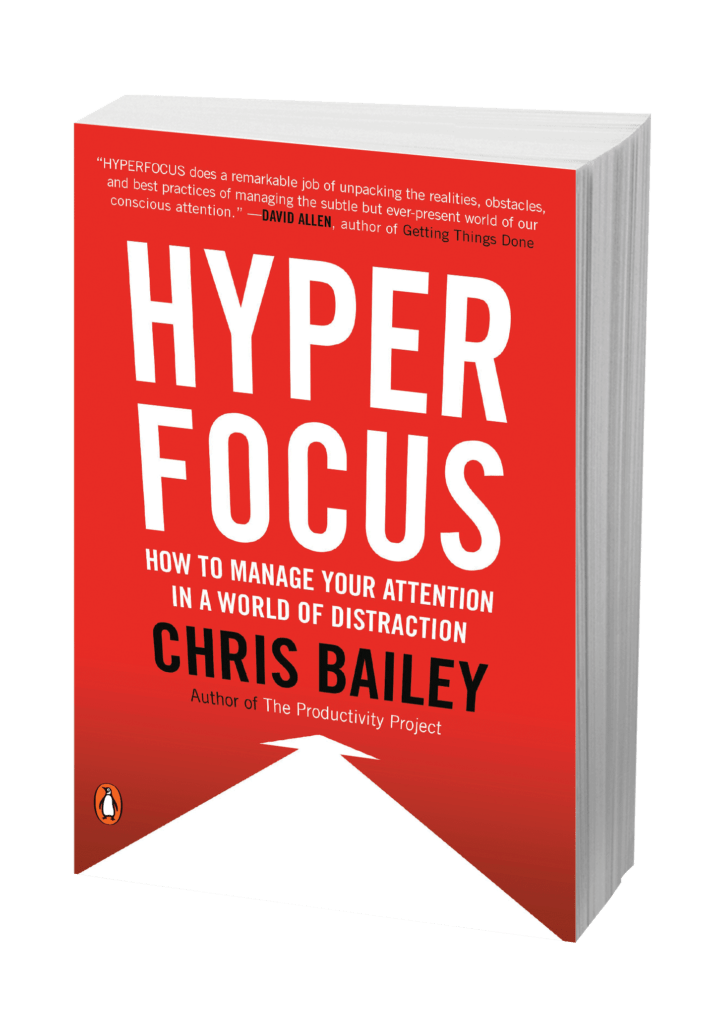
Today, a new version of the book hits store shelves, as a paperback published by Penguin Books! Same book, but with nice new packaging (including a little penguin on the front), at a slightly cheaper price.
I know your time is valuable, so I’ll cut right to the chase. If you haven’t checked out the book, it would mean a lot to me if you did. If you dig the posts on my site, I’m confident that you’ll enjoy the book, too.
Here are links to pick up the paperback in the US and Canada!
Audible (same book; linking to this just for fun!)
Have a wonderful week! Chris
P.S.This week’s episode of the podcast is all about how to read a nonfiction book. The episode is more interesting than it sounds, and you can play it below!
10: How to Stay Accountable
Aug 13, 2019
Show notes
Takeaway:Three ways to hold yourself accountable for doing aversive tasks: get a deadline (however you can); fire up Focusmate; and get an accountability partner.
Estimated Reading Time:2 minutes, 2s.
Podcast Length16 minutes, 33s (link to play podcast at bottom of post).
Research shows that the more unstructured a task is, the more likely you are to procrastinate on it. One of the best ways to combat this? Get other people to hold you accountable for getting your most aversive tasks and projects done.
In this week’s episode of Becoming Better, Ardyn and I chat about our favorite strategies for doing this. It’s a bite-sized episode this week, but in case you don’t have the time or the inclination to listen, here are three simple accountability strategies we chatted about!
1. Get a deadline. You should be able to feel deadlines approaching. There are a lot of productivity tactics and hacks out there—but hardly anything will make you as focused or productive as a fast-approaching deadline. If you don’t have a deadline for an unstructured project, get one. If a project is so big that you can’t feel the deadline for it approaching, ask for deadlines for major milestones with the project. However you can, however you need to, get a deadline. Tell someone about your deadlines, for added accountability.
2. For instant accountability, fire up Focusmate. Or as an alternative, work alongside someone who’s as focused as you desire to be. I’ve written about Focusmate quite a bit lately, for good reason: it’s a way to instantly hold yourself accountable for working on something you’re stuck on. The website works by teaming you up—via live video—with someone who also wants to focus on work for a 50-minute block of time. It’s one of the best productivity websites out there, and it allows you to instantly enter into hyperfocus mode.
3. Find an accountability partner. At the start of each week, my wife emails me the three main things she wants to accomplish in her research that week. And then, at the end of the week, she follows up on that email to tell me how things went. It’s a simple ritual that takes her just a few minutes, and it’s all the motivation she needs to actually get those things done. Find an accountability partner who you can update on your work each week; send them your intentions and goals, and check in with them when the week is done to tell them how it went.
With so many of us doing knowledge work for a living, our work is highly unstructured. These three simple tactics let you hold yourself accountable, and as a result, make you significantly more likely to get your work done.
9: The Practical Benefits of Meditation
Jul 30, 2019
Show notes
Takeaway:Meditation saves you time because it allows you to work more efficiently. Five practical benefits of having a meditation ritual: you’ll be happier (which makes you more productive); you’ll have greater clarity of what’s important as you work; you’ll develop deeper relationships; you’ll focus deeper; and you’ll become less dependent on your addictive devices.
Estimated Reading Time:4 minutes, 8s.
Podcast Length34 minutes, 12s (link to play podcast at bottom of post).
For a simple, accessible guide on how to meditate, check out this post I wrote a while back!
Meditation is a topic I often write about on ALOP. Why write about meditation on a productivity blog? Simple: a meditation practice will provide you with some remarkably practical benefits, chief among which is that it actually saves you time.
Most writers focus on the spiritual benefits of meditation. While I find these nice, they’re not why I meditate. I meditate because doing so makes me more productive. For every minute I spend meditating, I get many more back in how much more efficiently I’m able to work. I’m more focused, resilient, and calm. My mind is better organized, I have more energy, and I’m better able to relate to other people.
I’m confident you’ll experience these same things if you decide to adopt a meditation practice.
In this week’s episode of Becoming Better, I’m joined by special guest co-host Jon Krop. In addition to being a good friend with a decent microphone, Jon is a Harvard-trained lawyer who teaches meditation at the largest law firms across the United States. He credits meditation with allowing him to turn his life around when he was studying to become a litigator, and is convinced a practice will help you out immensely, too. Having experienced many of the benefits, I’m inclined to believe him. In this week’s episode, we coverwhat meditation is and how to do it, and take turns sharing our favorite practical, tactical benefits of adopting a practice. In case you don’t have the time or inclination to listen to this one, here are the five practical benefits we dig into!
1. Meditation makes you happier. Once you begin meditating, you’ll notice that your quality of life drastically improves. According to Jon, this is the main reason that we should meditate—other benefits are subsidiary to this one. Negative emotions become less punishing. You experience more joy, and less suffering. You’re able to feel content regardless of your external circumstances. From the outside in, your life doesn’t change much. Meditation doesn’t change the things you experience. But it teaches you to relate to the things you experience differently: the bad things don’t affect you as much, and you’re able to savor the good things more fully.
2. Meditation gives you clarity of what’s important. One of my favorite benefits of meditation is how it helps us step back from the mental chatter in our head. This is a nice benefit in general, but it’s especially powerful during stressful times. When ^$% hits the fan at work, you’re able to focus. When the water tank starts leaking in your house, you’re able to calm down and take care of things more easily. During stressful times, the mental chatter in our head can obscure the way we perceive things. Meditation helps us become one step removed from this mental chatter, so we can maintain clarity of what’s important.
3. Meditation makes you kinder, and a better person. I’ll never forget something that my now-wife said to me during my productivity experiment to meditate for 35 hours in a week (while being as productive as possible). While we were chatting over dinner, she said to me, “You know what, Chris, I’ve never felt more loved as I do right now, with you doing this weird experiment.” As David Augsburger, a Baptist minister and author, has put it: “Being heard is so close to being loved that for the average person, they are almost indistinguishable.” Meditation makes you compassionate, loving, and kind. It also better equips you to be of service to people, because you’re more focused and effective—there’s more room to be there for others. Meditation doesn’t just let you give more of yourself to your work; it lets you give more of yourself to the people in your life.
4. Meditation makes you more focused.Studies show that our mind wanders for 47% of the day. In other words, we’re focused on what’s in front us just 53% of the time. Let’s say you’re awake for 16 hours. That equals 7.5 hours you spend unfocused each day so any amount of improvement in how well you’re able to focus can save you a ton of time. Thankfully, meditation improves the quality of your attention in this way. Let’s say that through practicing meditation, you’re able to improve the number just a bit—to 37% instead of 47%. That increase alone leads you to be focused for 1.6 more hours each and every day.
5. Meditation makes you less dependent on your most addictive devices. Some tactics for dealing with distraction are pretty helpful. Putting your phone screen in “greyscale mode” (which turns your phone’s screen black-and-white), disabling notifications, and setting screen time limits all help. But these solutions are external. The best internal strategy for making your mind less reliant on digital distraction is to make your mind less stimulated (if you’re curious, I chat more about this idea in a recent talk). The best strategy for making your mind less stimulated? Practice meditation.
8: Tracking Your Time
Jul 16, 2019
Show notes
Takeaway:Keeping a log of how you spend your time, even if just for a few days, makes you aware of whether you’re spending time on what’s actually important to you. Keeping a time log sounds like a hassle, but it takes less time and attention than you might think. Plus, doing so lets you discover how many hours you actually work, step back from the stories you tell yourself, makes time feel richer, and may end up being the push you need to change how you spend your time.
Estimated Reading Time:3 minutes, 45s.
Podcast Length36 minutes, 50s.
Time tracking is something I often write about on ALOP, and rightfully so: tracking your time helps you gain perspective on your life, so you can determine whether the way you spend your time is true to your priorities and what’s important to you. On this week’s episode of Becoming Better, my special guest Laura Vanderkam and I dig into the intricacies of managing and tracking your time—including how and why you should keep a time log, the stories we tell ourselves around how we manage our time, and what Laura has learned from tracking her time every single day for years.
The episode is well worth a listen—and there’s a link to play the episode at the bottom of this post—but as always, in case you don’t have the time to do so, here are the best nuggets from our conversation, including how to track your time, and why you should do it.
In looking over your time log, Laura recommends asking yourself a few things:
What do you like about your schedule? Make sure you celebrate your wins, and the things you’re doing right already, instead of just picking apart all of the ways that you could do better.
What do you want to do more of?
What do you want to do less of?
Different people will want to track different things. For example, depending on your situation, you may be interested in paying special attention to things such as how much time you spend:
Doing housework and errands;
Watching TV;
Spending leisure time unintentionally;
With people and family;
Working.
You don’t have to make a pie chart and account for everything, but you’ll want to look out for whether you’re spending your time intentionally, in ways that are important to you.
Tracking your time takes less time and attention than you might think. It takes just a few seconds to jot down what you worked on during each half-hour chunk of time, and once you settle into the practice, you can update your time tracking sheet every hour or two, recalling what you just did.
Why You Should Track Your Time
There are countless benefits to tracking your time. Here are just a few of them:
You can see how many hours you actually work. As Laura explains in the episode, we tend to overestimate how many hours we work by a significant margin (sometimes by as much as 20-30 hours). A time log lets you see, at a glance, how many hours you truly spend at work and at home.
You can separate from the stories you tell yourself. We tend to tell ourselves things such as that we have no free time, that we spend very little time with our family, and that we work far too many hours. Tracking your time lets you verify if these stories are actually true.
You discover what your priorities actually are. It’s one thing to believe that something is important to you; it’s another to invest time in what you consider to be important. Keeping a time log lets you see how many hours you’re spending on things you deeply value, and how many hours you spend on tasks that are convenient and easy to do.
Time feels richer. Much like how keeping a food log leads you to eat less, keeping a time log lets you bring greater awareness to how you’re spending your time. In practice, this feels great: meaningful activities like spending time with family feel more meaningful, because you’re able to reflect on their value to you. You feel more productive working on important tasks at work, because you notice how much time you spend on them. Time feels richer when you’re aware of how you spend your time.
A time log can lead to real change. Noticing that you spend 10 hours each week commuting may lead you to work from home more often, or find a job closer to you. Noticing that you spend just a few hours a week with friends may lead you to reach out to them more often. Noticing that you have more leisure time than you think you do may lead you to spend your leisure hours more productively.
There are countless other benefits, but these are a few of my favorites!
7: Discovering Your Biological Prime Time
Jul 02, 2019
Show notes
Takeaway:You should work around your energy levels; working on more important tasks when you have the most energy, and less productive tasks when your energy dips. Below is how to calculate when your energy peaks (your “biological prime time”), and a few suggestions for working around your energy levels.
Estimated Reading Time:3 minutes, 11s.
Podcast Length22 minutes, 25s.
Our energy-per-hour isn’t consistent, and because of this, neither is our focus nor productivity. Luckily, though, there are a few ways to calculate exactly when you have the most energy throughout the day, so you can work around how much energy you have; doing more productive and meaningful things when you have the most energy, and less important things when your energy naturally dips. (My cohost Ardyn and I dig deep into this idea in this week’s episode of Becoming Better—the link to play the episode and subscribe to the podcast is at the bottom of this post!)
There are three main ways to calculate when your energy peaks. Here are the best methods, inspired largely by Dan Pink’s fantastic book, When, on how to time your life:
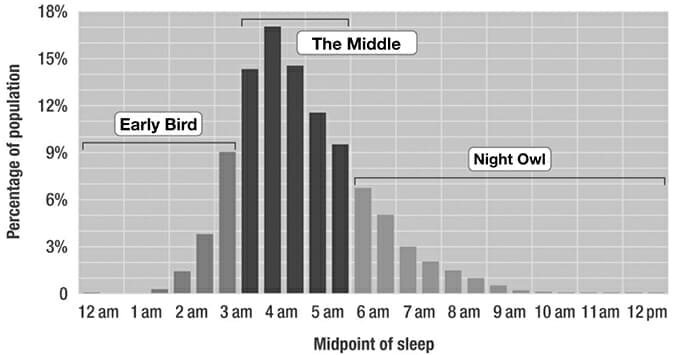
Easy enough, and pretty accurate. Think about a free day—the weekend, or a weekday when you don’t have much to do that day or the next. Ask: when do you usually go to sleep on these days? When do you wake up? Finally, what’s the midpoint of those two times? (E.g. I go to sleep at 11 p.m. and wake up at 7 a.m., so my midpoint is 3 a.m.) Find where your midpoint lies on the chart below.1
Easy, but less accurate. Ask yourself what time you wake up on weekends (or free days). If it’s the same as weekdays, you’re likely an early riser. If it’s a little later, you’re probably somewhere in the middle. If it’s much later, especially if it’s 90 minutes or more, you’re probably a night owl.
Difficult, but most accurate. Chart your energy levels. I recommend collecting data every hour, for two or three weeks, so you can find a general pattern. If you really want to get an accurate reading, I suggest cutting caffeine/alcohol/sugar during this time. Here’s an article I wrote a while back on how to calculate your “biological prime time” using this method.
Once you find out when your energy peaks, there are a bunch of ways to work around these hours. You can:
Block off that time in your calendar. I like to block off 10 a.m.-noon in my calendar most days (this is when my energy peaks). When you block off your peak energy time in your calendar, people will just assume you have meetings or other important commitments during that time, and are unlikely to ask for your time then.
Take advantage of energy dips by doing creative work. You’re more creative when you have the least energy, because your brain is less inhibited, and doesn’t hold back on the ideas it generates. Take advantage of this by working on creative tasks when you have less energy.
Work out, take a break, and clear your mind when your energy dips. This way you can further build up how much energy you have in your focus hours.
Mind the prime times of people around you. If you have people that you meet with often—or live with!—pay attention to when they have the most and least energy. If you work with a bunch of morning birds, you may make your team a good deal more productive by scheduling big meetings and projects for the morning, and not deferring important work to later in the day.
Mind your constraints. It’s great to know when your energy peaks, but you should also work around the constraints of your life. If you have lots of energy midmorning, but yet you find that you’re the most productive in the early morning before your spouse and kids wake up, then it’s likely worth doing your most productive activities then.
If you’re looking to work around your energy levels, the three strategies above, as well as Dan’s book, When, will come in handy—they certainly have for me. As Dan puts it: “I used to believe in ignoring the waves of the day. Now I believe in surfing them.”
Source for this chart: Dan’s book. He repurposed it from world-renowned chronobiologist Till Roenneberg‘s research. I’ve lightly modified the chart to fit this article. ↩
6: How to Travel Smarter
Jun 18, 2019
Show notes
Takeaway:The trick to traveling smarter is to prepare ahead of time, and develop strong traveling habits. Some ideas covered below: creating a default packing list; preparing things to consume and work on while you’re offline; leaning into how tired you are while traveling; and making your trip feel more like home.
Estimated Reading Time:5 minutes, 46s.
Podcast Length29 minutes, 22s.
Whether you’re traveling for a business trip, for fun, or something in between, here are some strategies to manage your energy, get more done, and just enjoy traveling more. As someone who travels 50-60% of the time, I couldn’t stay sane without these tactics.
As always, my cohost and I dig deep into these tactics in this week’s episode of Becoming Better—but if you don’t have the time or inclination to listen, here’s a summary of what we talked about!
To Do: Before Traveling
Create a default packing list, that contains everything you could ever want possibly pack. This is one of my favorite strategies for saving a ton of time each time I travel. I have a snippet of text (that I store in TextExpander, though a simple text document would do) that contains every possible thing I could ever want to pack for any trip, ever. On the list is everything from a travel belt, to my Nintendo Switch, to printed information about my flights. When packing for a trip, I just paste this snippet of text into a new document, and delete the items I won’t need. This helps me pack for trips without forgetting anything, in a very small amount of time.
Prepare things to consume and work on while offline. This is key. It’s easy to burn through a lot of time on long plane rides, or while just waiting around. Download a few podcast episodes or audiobooks to treat yourself while traveling—or use a read-it-later app like Instapaper or Pocket in order to read a bunch of articles. Make sure to also download work to do ahead of time. If you want to be productive, avoid downloading things like movies in order to nudge yourself into doing higher-quality tasks. If you’re traveling with someone, be sure to plan for that, too. When we travel together, my partner Ardyn and I never travel without a cribbage board.
Plan ahead for time zone changes. If you’ll be transversing across time zones, shift your wakeup and bedtime an hour or two before you leave, to make time zone shifts less jarring. When you begin traveling, eat and sleep on a schedule consistent with where you’re going. This helps get your mind into where you’re going. It’s important to stress about time zone shifts an appropriate amount—I don’t overthink them if I don’t have to “perform” on a trip (ie. do some work or give a talk), but shift my wakeup times a tad leading up to the trip if I’ll need to hit the ground running.
Find a solid travel rewards card. If you travel often, a good travel rewards card can grant you access to airport lounges, comprehensive travel insurance, trip delay and cancellation insurance, and even hotel room upgrades. Not to mention that it can give you the points you need to go on a free trip every once in a while. My favorite card for this is the American Express Platinum card, but that one has a hefty annual fee. (Here are a few of the best ones if you live in the US.)
Scope out airport lounges ahead of time. I use LoungeBuddy for this. Airport lounges aren’t always worth the cost of admission—they can cost upwards of $50-100 when you don’t have lounge access included with your credit card, or don’t have a fancy first class ticket or elite status with an airline. But if you have a long layover, they can be worth it: while they’re pricey, lounges often include meals, drinks, showers, and a place to hunker down to get some work done and avoid the chaos of the airport.
Check out SeatGuru when checking into your flight. SeatGuru lets you type in your flight deals to see which seats on the airplane are good, and which ones suck. Scope it out when checking into your next flight.
Plan around disruptions to your routine. When it comes to how disruptive it can be, travel is infinitely easier to plan around ahead of time. Before heading out, schedule time to exercise, meditate, and maintain your keystone habits. I also like to scope out healthy meal options ahead of time, as well as what restaurants I want to check out, so I don’t resort to ordering in.
To Do: While Traveling
Lean into your tiredness. If you’re traveling across time zones, take advantage of how tired you are on the first day. Do your best to live in the time zone you’ve arrived in: your first day may be crappy, but you’ll adjust more quickly to the change. Pro tip: do creative work during this tired day. Your mind is the most creative when you’re tired, because your brain is less inhibited.
Work on what you’ve prepared! You almost never get as much uninterrupted focus time as when you’re traveling. Don’t waste this time! Read the articles you’ve saved for the trip, watch the TED talks you’ve downloaded, and work on the stuff you’ve prepared.
Make your trip feel more like home. If you’re like me, the more you travel, the more you miss home. This is why I do my best to bring home to me; packing things I enjoy at home, like my favorite kinds of tea and coffee, and calling loved ones more often than I regularly would. If you’re like me, this will give you a pretty good boost of energy!
A few things to buy/pack, which I never travel without:
Good noise-canceling headphones. Or, at the very least, good earplugs. I never travel without my Bose headphones—but there are great noise-cancelling headphones out there at a lot of different price points.
A light-blocking sleep mask. Works great for when you need to sleep on a flight, or sleep in a hotel room or bedroom that doesn’t have blackout blinds.
A portable speaker. I never travel without a portable speaker. When I first picked one up, I didn’t expect to use it much. Now, I never travel without it. It’s great for listening to music, podcasts, and audiobooks in a hotel room.
A portable clothing steamer. While most hotels have irons, I hate ironing, so I travel with a portable steamer. There’s very little setup involved in using one, and steaming clothes takes a fraction of the time that ironing does. If you dislike steaming clothes as well, or just want to same some time, hang your clothes up when you’re taking a hot shower or bath. The steam should remove most of the wrinkles in your clothes, and you may not need to steam or iron afterward.
If you’re looking to maintain how much energy you have, get more done, save time, and enjoy travel more, these tips will help! Have a great trip :-)

 Our TOPPODCAST Picks
  Stay Connected