Restart Podcast Ep. 59: Lasers lighting up the sky, with Seb Lee-Delisle
Dec 18, 2020
Show notes
For our last episode of the year, we so happy to bring you this interview with laser interactive artist, presenter and Repair Café volunteer Seb Lee-Delisle. Restart first met him at Hackaday’s Unconference in London a couple of years back. (In recent years, we’d noticed he became a regular at his local Repair café.)
But during the past decade, Lee-Delisle’s probably most known for some of his interactive light installations, and work for performers such as Fat Boy Slim.
Lasers
Dave talks with him about lasers over the decades, how they started cool, got a bit naff and became cool again. And then of course about this strange year, and how like many artists, Lee-Delisle faced a wave of cancellations. During the first lockdown, instead of clapping for the National Health Service, he began projecting his thanks on tall buildings in his hometown of Brighton.
This led to a much more ambitious (and interactive) idea, appropriate to the socially distant scenario, “Laser Light City”. Why not allow viewers to control high-powered lasers beaming into the urban night sky? He dazzled and thrilled people with this installation in Brighton, Leeds, then Worthing and soon to be arriving in Newcastle.
The nerd niche
Lasers are beams that can be controlled using timing and mirrors, and this is where the art lies. Lee-Delisle writes most of his own code for his projects, and is a big believer in open source. He talks about the benefits of offering up his “ofxLaser” code library even when he felt it wasn’t ready.
Confessing to be addicted to repairing stuff, Lee-Delisle is a strong believer in the power of nerd communities, and the potential of entertainment for and by nerds. YouTube and maker/repair communities are flourishing and a constant source of inspiration. And of course, the nerd (live) comedy scene has really opened up whole kind of entertainment that he didn’t have growing up. (We nod our heads when he expresses his frustration with the hit BBC show The Repair Shop — it does not share enough detail about the fixes!)
To close, Lee-Delisle recognises he’s had a very good year, during difficult times for others. But we’re really glad that he’s sharing some of his light with the world. (And literally letting us play with lasers!)
Restart Radio: Lamps at the end of the tunnel — a new lighting refurbishment business
Dec 10, 2020
Show notes
It’s our final radio show of a year full of bad news, and we have some good news to share. To kick us off, Janet and Ugo speak to Jonathan Samuels, a lighting designer who has worked in live entertainment for decades. After theatres and live performances were shut down this year, Samuels adapted and launched a new business in lighting refurbishment and repurposing objects into lamps.
Refurbish, lights, action!
For Samuels, working in live events meant a very uncertain and frustrating year. At Restart, much of our work revolves around in-person events so our community can sympathise immensely. With his usual work impossible, he decided to venture into refurbishing and reuse and started an online business selling his creations. His experience in theatre — making practicals for the stage and dismantling lighting equipment — provided him with many skills in lighting refurbishment. However, Samuels explains that he still had a lot to learn when starting his business.
While Samuels has developed a strong appreciation and interest in lighting through his career, another driving force behind his business is his commitment to reuse. Scrolling through his selection of lamps, one will find antique Anglepoise and other renowned names. But what is also striking are the upcycled pieces, lights made from everything from bygone Burgoyne bottles to Bunsen burners and more. He doesn’t just extend the lifespan of lamps but also gives a new life to objects that are otherwise unusable.
Progress on policy
News from the UK and the EU allowed us to wrap up 2020 with a celebration. First, we discuss the UK Parliament’s Environmental Audit Committee report, containing many of the recommendations we gave in our evidence to its enquiry. It calls on the government to enshrine the Right to Repair in law. This includes affordable spare parts, access to software tools used for repair and commitments to software support. This is a big moment.
The news out of Brussels also marks a move forward in the fight against unrepairable, throw-away products. A recent European Parliament vote means that the European Commission now has the go-ahead to push on. Next year we hope to see laws aimed at extending the lifetime of products such as smartphones and laptops.
Our final story is a reminder of why this legislation is so necessary. We share reports that the new macOS update has been slowing and even bricking ‘older’ machines. ‘Old’ however only means around six years old, which is unacceptable. While the problem appears to be fixed now, many users faced a huge shock. It’s another reminder for those using older hardware to hold off on updates in the future until they’ve been tested by others first.
Restart Podcast Ep. 58: You say you want a Repair Revolution
Nov 27, 2020
Show notes
This month, Dave talks to John Wackman and Elizabeth Knight who are prolific in the New York repair community. After years of involvement in repair cafes, they decided to share what they learned by writing a book. Repair Revolution: How Fixers Are Transforming Our Throwaway Culture, is a lesson in how to start a repair cafe and how to fix. Knight and Wackman also note that integral to the book is its collection of personal stories from repairers all over the continent. These are stories of community that Restarters will recognise well.
The repair revolution across the pond
Knight tells us of how she first became involved in the repair movement. It’s a story of noticing the failures in the system around you – even in your local area – and feeling the need to fix it in whatever way you are able. This ethos is carried throughout our conversation with Knight and Wackman, and throughout the book itself.
In comparison to the items that we fix at Restart Parties, much of the fixing chronicled in Repair Revolution is of a different ilk. Household electronics like lamps are one of the most common fixes that they have seen coming to repair cafes. But there is also a focus on activities like visible mending of clothes, patching up of stuffed animals, and woodworking. It is a refreshing reminder that the repair movement looks different in every iteration across the globe.
Community is at the core
Knight and Wackman emphasise that community is perhaps simultaneously the biggest facilitator and result of the repair cafe movement. Repairers come together to share their skills, not only out of care for the planet, but also care for others.
“[Repair] is more than just an opportunity to fix broken things. It’s also an opportunity to fix broken systems and relationships…It creates opportunities to nurture neighbourly networks and it calls on the invaluable wealth of community knowledge.”
Repair Revolution contains many stories of how community repair has affected individuals in a deep and personal way. Knight and Wackman share a few of these stories with us. Some stories are moving, others are funny, but they all emphasise the human element of repair and how it connects us.
An intergenerational approach
Part of Knight and Wackman’s vision for the future of repair is transferring skills to younger generations. Repair is an essential skill that is being lost. They would like to see it re-introduced into traditional education and, until then, they are “providing teachers” to preserve these skills. While the Right to Repair movement is working to make repair more accessible on a large scale, Knight and Wackman recognise that for the time being community efforts are crucial to create repair opportunities.
Restart Radio: The dangers of serialisation in smartphones with Rico Cerva
Nov 10, 2020
Show notes
Talking about the issue of smartphone repairability is one that has been unavoidable over the years. This month we decided to finally look at this problem in depth. Ugo and Janet are joined by Rico Cerva, one of the most skilled and well-known iPhone repairers we know. He tells us about how iPhone repair keeps getting more complicated and how the barriers against fixing them have changed for the worse.
First, we take a look at some big electronics news in the UK. Regulator Ofcom announced that from December 2021 telecommunications companies will not be able to sell locked handsets in Britain. Next, the BBC reported that both the Liberal Democrats and the Green Party agreed that a repairability rating scheme should be introduced to products in the UK. This comes after France decided to introduce a similar scheme that will begin in 2021. Finally, we share some good news about the Right to Repair proposition that was on the ballot in Massachusetts. Despite a large-scale effort to scaremonger by the automotive industry, the law passed with 75% of the vote last Tuesday.
The seriousness of smartphone serialisation
With the recent release of the iPhone 12, so came the new issues in repairing this device. YouTuber and advocate for Right to Repair Hugh Jeffreys discovered an issue that meant the camera on the newest Apple phone could not be replaced by third parties if broken. This problem, Cerva says, is down to serialisation. He says
“You need the Apple machine to pair the new display to the phone. Even if you take two original screens and you swap them over, if they’re not the correct serial number, you’re going to have some weird glitches or issues.”
Apple has introduced serialisation by pairing component parts to phones. The result is that independent repairers are not able to repair devices with spare parts – even genuine parts that have been removed from the same Apple product. This way, only repairers who are part of Apple’s Independent Repair Provider programme will be able to repair devices. This applies to even common fixes like screen and camera replacements. As such, repair will get more expensive and independent repairers will not be able to work.
Cerva points out that even though he has found physical workarounds for most of Apple’s pre-iPhone 12 repair barriers, the trend is towards total lockdown of these devices. These workarounds have to be performed on such a microscopic scale and with such delicate skill that most independent highstreet repair shops – and definitely at home repairers – are being pushed out of the picture.
How is this affecting independent repairers?
This problem is also not unique to Apple. YouTuber Riki Kim revealed that Samsung has also started to introduce serialisation to its devices via the fingerprint sensor and a recent software update. Together, Samsung and Apple devices represent two-thirds of the European market share, so these developments have huge consequences. Even Cerva, who can complete these complicated workarounds, wonders how sustainable it will be to run an independent repair business in the coming months and years. Repairers like Cerva work to provide a fair price and the best quality for their customers. But this means soon they may not be able to compete with the industry’s continuous barriers against their work.
What can be done?
Cerva believes consumer awareness can help combat this worrying trend. We point out that much policy work surrounding the Right to Repair focuses on hardware and the availability of spare parts. On software locks and serialisation, policy must catch up. Furthermore, if this trend continues, there is a worry that the issue of serialisation could spread to other electronic devices too.
What brings some light to the conversation is Cerva’s belief in the repair network and the independent repair community. He tells us how businesses with different specialities are coming together to solve problems and help each other provide services to keep going.
Restart Podcast Ep. 57: “Heroes of Repair” European video series
Oct 28, 2020
Show notes
In October, the European Right to Repair campaign launched “Heroes of Repair”, as part of their celebration of International Repair Day. The video series aims to highlight the human face of repair by profiling individuals working to strengthen the repair movement. Restart’s very own Chloé Mikolajczak talked to us about why this campaign is necessary and how Right to Repair has developed over the last year.
We also get to hear from some repair heroes first hand about how and why they are involved in repair. Throughout the podcast Paul O’Donell, Sepp Eisenriegler, Janine Korduan and Cerys Jones tell us how they got involved in repair, what inspires them in their work, and why the Right to Repair matters to them.
Anyone can be a Hero of Repair
In London and across the UK, we have an incredibly strong and involved Restart community. It was heartening to hear from Mikolajczak, and the heroes themselves, that this is mirrored across Europe. The aim of the campaign is to highlight those working to support repair initiatives and elevate Right to Repair. Furthermore, she hopes that the campaign empowers other repairers to upload their own videos. On International Repair Day, YouTuber Jessa Jones from iPad Rehab shared her own video.
“The idea wasn’t to say someone is a hero for doing something absolutely incredible. The people we are putting forward are normal people like you and I who are contributing significantly to their community through repair. It’s not just a small group of people that can be heroes – everyone can be a repair hero.”
Learning from each other
We talk to Mikolajczak about why it is so important to run Heroes of Repair as a European campaign. She tells us about how the repair movement varies between countries. Many countries are in different stages of development regarding government policy on repair. Awareness and support of the movement differs too. By raising awareness of the initiatives happening in each country, Mikolajczak hopes that we can learn from each other and strengthen the movement.
Highlighting the human face of repair
Mikolajczak explains that the regulations that they are fighting for will affect the lives of citizens in ways they may not realise. The key aims of Right to Repair are: to ensure that products are designed and built to be repairable, that repair is affordable and accessible, and that consumers are informed on what they are buying.
All of these measures will directly impact citizens, save them money, and help protect the environment in the process. Mikolajczak also talks about the barriers she faces working on this campaign. This includes the need to push back against corporations and lobbyists who are constantly working to avoid regulation.
Next year can be better for Right to Repair
Finally, we hear some of the highlights and successes of the European Right to Repair campaign this year. These include the European Commission’s new Circular Economy Action Plan and movement towards regulating smartphones. All in all, the hope is that more organisations will lend their support and the movement will continue to grow.
Whether you are an individual, a business or an organisation, you can get involved with the Right to Repair campaign.
Restart Radio Republished: Ada Lovelace Day and the stories of women in STEM
Oct 13, 2020
Show notes
To celebrate Ada Lovelace Day, we’re republishing this 2018 interview with Suw Charman-Anderson, founder of the Ada Lovelace Day (ALD), which annually supports and increases the visibility of women in Science, Technology, Engineering and Maths (STEM) careers.
First, we discuss how ALD started and how it came to be such a huge initiative, with international events happening each year.
We then ask Suw why she chose Ada Lovelace as a symbol for this project. She tells us the story of Ada, a 19th-century mathematician who worked with polymath Charles Babbage on the design of the ‘Analytical Engine’, a vision of the first mechanical computer. Ada has been considered the first ever computer programmer, with a computing language now named after her.
Then, we talk about the importance of role models for girls and women to go into science. Girls and women are still underrepresented in STEM, especially in fields such as physics or computing. Also, the historical contributions of women to science and tech have commonly been overlooked.
At Restart, we are interested in engaging people with technology from early on – we chat with Suw about the need to engage girls from a very young age to actually change the gender disparity in STEM. Not only to motivate girls to go into these fields of education, but also to actually continue their careers after their training.
Suw walks us through her own career in science, having graduated from Geology and struggling to find her professional path. She went into publishing and journalism, and reminds people that it is fine to have a less conventional career path.
Before ALD, Suw co-founded the Open Rights Group in the UK, which campaigns for digital rights. We relate their early work on intellectual property law to the US Right to Repair initiative, discussing whether we actually own our devices when our access to repair is denied. And of course, whether Lovelace would’ve been a repairer and user of free and open-source software.
Restart Podcast Ep. 56: A smartphone OS that respects user data privacy, with Gaël Duval
Sep 22, 2020
Show notes
To kick off the autumn season of the podcast, we talked to French entrepreneur and founder of e Foundation, Gaël Duval. Duval has spent years developing alternative operating systems in an effort to improve user experience and efficiency. Now, with his non-profit organisation e Foundation, he is prioritising user data privacy with /e/, an operating system for smartphones. We find out why a change in our approach to data protection is such a necessity.
From Mandrake to /e/
So we begin with the critical question: why did Duval become interested in user privacy and data protection? He tells us of how his previous work such as Mandrake Linux, was guided by usability and efficiency. Over time though, Duval noticed a shocking decrease in user privacy and a lack of government regulation in this area. So, he created the /e/ operating system to “give users a way to escape the mass surveillance of personal data.”
‘De-Googling’ and data privacy
At present, /e/ is the main product of e Foundation. It offers an alternative to iOS and Android that prioritises user data protection while ensuring ease of use. When informed about the dangers of data tracking, many smartphone users are concerned with these issues. So why is next to nothing being done to stop it? Duval explains why many users do not seem to be bothered in an actionable way to protect their privacy. He says that often it comes down to a – possibly unfounded – trust in well-known brands, and a misunderstanding of how our data could potentially be used.
“I really support the idea that by default our personal data should belong to us and not to others. If you want to give your personal data, you can do it, but do it explicitly. Do it on purpose but [don’t] let all your personal data be cached for some reason that we don’t always know.”
Integral to /e/ is the concept of ‘de-googling’ a device, and on a larger scale, the systems that we use. Duval explains the many inconspicuous and insidious ways that the biggest technology companies are collecting our data – with Apple and Google forming a duopoly that holds the most control. Piece by piece, e Foundation has removed the integration of Google services from their operating system in order to eliminate any unnecessary data tracking performed by Android. Not only does he question the data practices that these companies use but also the market control they have. He thinks that there needs to be a shift in power to make OSes and app creation more open.
The ecosystem of an OS
Duval explains the process it takes to create the complex ‘ecosystem’ of an OS and how they use open source software to develop an OS that can work for all. Every part of /e/, from cloud services to the way that users sign in, has been built with privacy in mind. What sets it apart from other alternative OSes is their effort to ensure compatibility with users’ existing digital habits. For some, it is impossible not to use major apps like Instagram and WhatsApp. While these might have questionable approaches to data gathering, Duval stresses the need for users to have the option to access them for /e/ to compete with mainstream OSes.
Finally, we touch on a topic that we are all too familiar with – software obsolescence. Most smartphone manufacturers refuse to commit to long-term software and security updates. Duval reassures us that built into the ethos of /e/ is a commitment to combat software obsolescence by producing patches and long-term updates that secure the OS. While there are of course limits to this, it is clear that the approach e Foundation is taking is much more sustainable than that of the major OS creators.
Restart Radio: Hackney Fixers’ laptop repair and reuse project
Sep 09, 2020
Show notes
On our first radio show back for the new season, Ugo is joined by James Diamond from Hackney Fixers. They talk about the laptop repair and reuse project that Hackney Fixers are undertaking to benefit the community. Over the last few months, it has become even clearer that we need to support those without the necessary access to electronics and the internet. Many community repair projects have taken it upon themselves to do something about it. We hear how.
False alarm over right to repair
Before our interview, we take a look at some recent news stories involving the movement and our electronics ecosystem. In Massachusetts, The Alliance for Automotive Innovation has funded an advert against the right to repair for independent vehicle repair. Their claim is that a new proposition, aimed at expanding right to repair for independent mechanics, would make data collected by cars vulnerable to interference from stalkers and predators. This sends a very emotive warning to supposed potential victims. Ugo and James agree this is a scaremongering technique. Instead, they question the motives of those disrupting progress on the right to repair and the interests that back them.
How sustainable are our supply chains?
We then look at the European Commission’s recently announced plans to create domestic supply chains for lithium and other raw materials. 93% of the magnesium currently used in EU products is sourced from China and this is not an anomaly in the way that our current – particularly electronics – supply chains operate. Ugo and James discuss what the solutions to these concerns could be. While the EU are planning to open more mines in Europe, they stress that the focus should be shifted towards sustainability and reuse in order to conserve these materials.
Staying connected
James tells us how the pandemic has impacted Hackney Fixers, preventing them from running their Restart Party events, quintessential to their identity. These difficulties are something that we are sure all community repair groups have felt throughout the last few months. Recently though, Hackney Fixers have been spending time using their skills to refurbish laptops to donate to those in need. James tells us about how they started their collaboration with Mer-It, an Islington-based community project, and the effect that it has had on those who they have helped so far.
Repair and reuse to enhance inclusion
During the pandemic, many of us have been pushed online – even more so than we already were. While this may not have been so problematic for some, for those who do not have their own computer or internet connection this has been a major barrier to their lives. Across all generations, the closure of communal spaces, schools, and workplaces has exposed the inequalities in access to what could be considered an essential resource. This is why the work that community repairers are doing to increase access is so vital. James emphasises that this need will continue even now that school is back in session.
We also take a chance to express again how important it is to combat barriers to repair. During this time it is ever more important that people are able to repair, and that manufacturers reduce software and hardware barriers. This will help us stay connected and access the resources we need. To round out our discussion, James tells us about some unexpected repairs and his renewed belief that further life and utility can be found in even the least promising looking devices.
Hackney Fixers are not currently looking for new donations, however they may start accepting them in later months. In the meantime, check out our database of UK projects to find out where you can donate your old devices!
Restart Podcast Ep. 55: Why we need climate education, with Teach the Future
Jul 28, 2020
Show notes
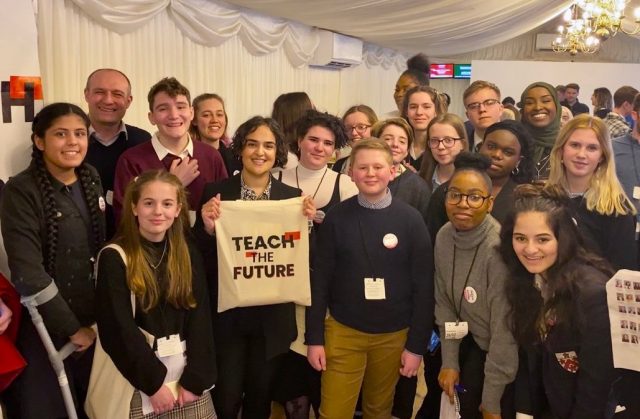
As a very unusual school year came to a close, we talked to Jude Daniel Smith, a youth activist and Campaign Coordinator for Teach the Future. Despite only joining the organisation in February, Jude has already been part of big progress made since. We talk about how he started in the climate movement and why the need for climate education is so urgent.
In recent years, the climate movement has seen more young people come to the forefront. Most high profile perhaps, being in the international School Strike for Climate movement – those like Greta Thunberg, Alexandria Villasenor, and Leah Namugerwa.
In the UK however, a new and pointed movement is growing rapidly. Run jointly by UKSCN (UK Student Climate Network) and SOS-UK (Students Organising for Sustainability UK), Teach the Future aims to reshape the school curriculum to reflect the urgency of the climate crisis and equip younger generations for its inevitable impact on their future. Jude believes that this urgency is what is mobilising younger activists so strongly in this area.
The steps to climate education
Teach the Future are very clear in their path to change. Jude explains the 3 key asks of the movement and why they are so vital to progress.
First, they are calling for a government review. This will examine how the current education system is equipping students with the knowledge to manage the coming ecological crisis.
Second, Jude points out that only 75% of teachers have said that feel equipped to teach their students on the climate crisis. He does note that his Geography teacher went above and beyond to teach them on the topic. But this is an outlying case. It is not enough for teachers to care about the climate crisis if they are not empowered to teach it. So, it is down to those in government and on school boards to support educators in this vital way.
“Our biggest inspiration was in reality more of a let-down, like we’d been let down by our education system…We were sort of doing it through frustration rather than from inspiration.”
The third ask, an English Climate Emergency Education Act. Teach the Future members have already drafted this bill and they say that it would be the first piece of education regulation to be written by students.
Teach the Future with Nadia Whittome MP
Integrating climate change across the curriculum
What Jude emphasises about climate education is that it must not be optional or a side-note to a larger topic. Rather, the climate crisis is the bigger issue. He points out that in the current curriculum, most students will only be able to access more detailed learning on the climate through advanced Geography. Or sometimes optional modules in Design and Technology (a subject somewhat analogous to the US’ “shop class” of old). What Teach the Future are calling for is the integration of climate issues across the board, as Jude argues that these topics are applicable to all subjects in one way or another.
Access and agency
Importantly, we also grapple with the fact that access to resources and information on sustainability is not equal in England. Growing up in Sheffield, Jude speaks from personal experience of seeing reactions to the climate movement from an area previously so based in the coal mining industry. Here we see how a lack of government support for these communities compounded with a lack of education on the climate crisis can sew disillusionment or simply apathy. Jude believes that universal climate education backed by the government is what is needed to “turn anxiety into agency.”
Restart Radio: Our 2020 Summer Reading List
Jul 15, 2020
Show notes
On July’s episode, we hear from several members of the Restart Team with their reviews of books for our summer reading list. First, though, we discuss the current inquiry on electronic waste by the UK Parliament’s Environmental Audit Committee. In late June, Ugo was invited to give oral evidence at a hearing of the EAC. He shared how right to repair regulation can help prevent e-waste, and how manufacturers around the world have been systematically undermining campaigners’ efforts in this respect.
EAC reflections
Before we jump into our reading recommendations, Ugo and Holly discuss some key takeaways from the hearing of the EAC inquiry. We listen to quotations from Jim Puckett of Basel Action Network, Libby Peake of Green Alliance, and a short exchange between Ugo and Nadia Whittome MP. Discussing these, we discuss how the focus needs to be shifted from recycling to extending the lifecycle of electronics, especially as the disposal of electronics is harming the planet more often than we are aware. In addition, we emphasise again the need for the right to repair to prevent device obsolescence.
Our summer reading list
Design Justice: Community-Led Practices to Build the Worlds We Need by Sasha Costanza-Chock
First up for our reading list reviews, James tell us about Sasha Costanza-Chock’s book Design Justice: Community-Led Practices to Build the Worlds We Need. In the book, Costanza-Chock follows the design process from origin to output. The book examines how design traditions have developed, how they interact with the world around them, and their socio-historical effects. James highlights the importance of considering design as a political act and becoming aware that most devices and objects are not necessarily designed with everyone in mind. He highlights also that the fourth chapter of the book – ‘Design Sites: Hackerspaces, Fablabs, Hackathons, and DiscoTechs’ – may be of specific interest to our Restart community.
Hello World: How to be Human in the Age of the Machine by Hannah Fry
Next up is Neil’s review of Hello World: How to be Human in the Age of the Machine by Hannah Fry. Fry’s book focuses on the increasing prevalence of decision-making algorithms in our daily lives and aims to inform us on how these may be influencing and shaping our society in unseen ways. While Neil stresses that this book is not anti-algorithm, he tells us of Fry’s integral examination of how bias is built into these systems, both knowingly and unknowingly – simultaneously mimicking and advancing dangerous societal power structures.
The Case for the Green New Deal by Ann Pettifor
Ugo shares a glowing review of Ann Pettifor’s The Case for the Green New Deal, a book that he had been wanting to read for a while and he was not disappointed. Pettifor accentuates the fact that we desperately need true system change if we want to respond effectively to climate change. She calls for change to financial systems and the way that we are programmed in regards to consumption. This volume surely speaks to many of the issues discussed at the top of the show, and helps explain why activists should not underestimate the role of finance if we want to make a real impact.
Lo-TEK, Design by Radical Indigenism by Julia Watson
Finally, Janet shares her thoughts on Lo-TEK, Design by Radical Indigenism by Julia Watson. The book focuses on how we can learn from indigenous approaches to design in order to develop more sustainable infrastructure. Janet’s main criticism of the book is the lack of indigenous voices actually included in this discussion and the feeling that it operates more as an outsider’s view on how these concepts can be adapted. Still, Watson holds space for an important conversation about how TEK – or Traditional Ecological Knowledge, as coined by Eva Marie Garroute – can lead us to a positive change in our technological trajectory.

 Our TOPPODCAST Picks
  Stay Connected