TopPodcast.com
Menu
  • Home
  • Top Charts
  • Top Networks
  • Top Apps
  • Top Independents
  • Top Podfluencers
  • Top Picks
    • Top Business Podcasts
    • Top True Crime Podcasts
    • Top Finance Podcasts
    • Top Comedy Podcasts
    • Top Music Podcasts
    • Top Womens Podcasts
    • Top Kids Podcasts
    • Top Sports Podcasts
    • Top News Podcasts
    • Top Tech Podcasts
    • Top Crypto Podcasts
    • Top Entrepreneurial Podcasts
    • Top Fantasy Sports Podcasts
    • Top Political Podcasts
    • Top Science Podcasts
    • Top Self Help Podcasts
    • Top Sports Betting Podcasts
    • Top Stocks Podcasts
  • Podcast News
  • About Us
  • Podcast Advertising
  • Contact
Not in our directory?
Add Show Here
Podcast Equipment
Center

toppodcastlogoOur TOPPODCAST Picks

  • Comedy
  • Crypto
  • Sports
  • News
  • Politics
  • True Crime
  • Business
  • Finance

Follow Us

toppodcastlogoStay Connected

    View Top 200 Chart
    Back to Rankings Page
    Gadgets

    The Restart Project Podcast

    Let’s fix our relationship with electronics

    Advertise
    • Apple Podcasts
    • Google Play
    • Spotify

    Latest Episodes:
    Restart Podcast Ep. 70: An epic journey through climate history with Alice Bell Nov 24, 2021
    Show notes

    This month we talked to author and activist, Alice Bell about her recent book entitled, Our Biggest Experiment: An Epic History of the Climate Crisis. Bell’s extensive research into the topic along with her work as a director at Possible, made her the perfect person to join us in the month of COP26.

    In November, we were thinking a lot about carbon emissions and who is most responsible for the state of our climate. Bell’s immense historical knowledge helps us understand the massive impact that the UK has had on the world trajectory towards huge consumption of fossil fuels and other damaging practices.

    So where did it all begin?

    We start our conversation by asking where did climate change begin – or at least where do our records start? Bell tells us about the ‘Little Ice Age’ and the factors that are thought to have caused it. Despite such early signs that human activity was causing changes to the climate, the idea that temperatures could rise was not the biggest worry back then. Unfortunately, this perception seems to have persevered in the minds of powerful figures for a long time. Even now, when the risk is much more widely recognised, severe enough action is still not being taken.

    From Captain Planet to Klimastreik

    Bell tells us about a few figures who were vital to the progress of climate science but who were either largely ignored or forgotten. Eunice Foote and John Tyndall both made note of the link between CO2 levels in our atmosphere and changing temperatures in the 1800s which makes you wonder how we got this far without taking action earlier. We also consider the problematic way that the onus of fixing the climate is continuously pushed onto younger generations.

    Climate activism has a complicated and difficult past. We discuss the racist overtones of the overpopulation discussion and the way that this has shifted blame onto different groups over the decades. Luckily, climate science has changed a lot over the years. However, this does not mean that those responsible are doing enough.

    Recognising our historic debt

    Bell points out the hypocrisy of many richer nations, especially in the lead up to an event like COP26. There is evidence of fossil fuel use as far back as 4,000 years ago in Mongolia. However, industrialisation in the UK and other countries is really what set us on course for where we are today. It is essential that these countries take more responsibility for their impact.

    “It’s really one of the many tragedies of the climate story – that many countries that have done very, very little to cause this problem are dealing with the biggest impacts. And also because of centuries of exploitation, they’re not in a financial position to be able to deal with this.”

    It is not just responsible for the emissions that we create in the UK, but also our consumer emissions overseas. Bell points out that many of the ‘successes’ the UK have had – for example phasing out the use of coal – are only possible because of outsourcing.

    And what about the future?

    Bell does not have high hopes for COP26 or major world governments. But conferences are not the only way to make a change. She believes that activists and organisations like Restart, play an essential role in educating people on how they can have an impact.

    Overall, it is a message of realism but also hope. Now that we have seen the outcome of COP26, there is likely a lot of disappointment or despair. However, Bell says it is not ‘game over’ just yet.

    Links:

    • Our Biggest Experiment: An Epic History of the Climate Crisis by Alice Bell
    • Possible
    • The Human Planet: How We Created the Anthropocene by Simon Lewis and Mark Maslin
    • Restart Podcast Ep. 69: Exploring our consumption emissions with Professor John Barrett

    [Feature image courtesy of Alice Bell]

    The post Restart Podcast Ep. 70: An epic journey through climate history with Alice Bell appeared first on The Restart Project.


    Restart Podcast Ep. 69: Exploring our consumption emissions with Professor John Barrett Oct 25, 2021
    Show notes

    We hear a lot about carbon emissions in the news and they are a major culprit in the climate crisis. Sometimes, it can be difficult to track where these emissions are coming from. Manufacturers are rarely thorough or honest in accounting for their output. As individuals, it can be frustrating to not have control over this.

    In celebration of Repair Day 2021, we held a webinar alongside the European Right to Repair campaign on consumption emissions. We explored what consumption emissions are, how to minimise them, and how repair helps. In this episode, you will hear a Q&A facilitated by Ugo Vallauri and Chloé Mikolajczak. We were lucky enough to be joined by Professor John Barrett from the University of Leeds to answer these questions and give a short presentation on the topic.

    What are consumption emissions?

    Most simply, consumption emissions are emissions released during the production of the things that we buy. As opposed to our territorial emissions which are those produced in the UK. Barrett explains to us exactly why accounting for them is so essential in reducing the harm that we are doing to our planet. According to him, consumption emissions are “widely neglected” when considering solutions to reducing our environmental impact. Part of the reason is that they are not as visible as territorial emissions. It is more difficult for the government to claim victory in reducing them and therefore less appealing. In reality, once we do account for our consumption emissions, our national impact is almost doubled.

    We also ask specifically about “Scope 3” emissions in reporting by big companies, a category that is often the most forgotten. Scope 3 emissions encompass many things but mainly the “downstream” impacts of a company’s activities, like a product being manufactured. Barrett says that it is crucial that companies become better acquainted with these impacts and account for them. He also stresses that the best way to minimise these emissions is to lower production rates in the first place.

    Taking actual accountability

    When we talk about minimising our carbon emissions, a common rebuttal is that our efforts as the UK are pointless unless countries like China lower their emissions too. However, Barrett helps us refute that claim by explaining the various falsehoods and the part that we have to play in these very figures. A significant part of industry in China is down to demand from consumers in places like the UK – making us accountable.

    “If we don’t take responsibility for all our consumer products, we are saying that we deserve a greater percentage of the global remaining carbon pie. That to me is clearly linked to the discussion on justice and the right to develop. And the right for countries to access carbon where it is needed to enable that development.”

    Barrett also pushes for accountability in managing our carbon output in consideration of the rest of the globe. The UK has the funds and resources to do better. Therefore, we must take this action on behalf of those who cannot.

    How repair can help

    We briefly discuss solutions for emissions reduction like carbon offsetting. However, Barrett believes that efforts like this are nowhere near enough to what is needed.

    “Clearly the best way to reduce the impact of the product from the consumer element is actually not to buy it because then we know that there’s zero impact associated with it”

    He points out that one of the very best ways to minimise consumption emissions is to not buy products in the first place. This does not mean that we should stop buying smartphones altogether. Rather, that if we repair instead of buying new ones so often we can minimise our individual impact. In order to make this an option for everyone, we need policy measures that make repair as accessible and simple as possible.

    Links:

    • Professor John Barrett
    • Positive low energy futures study
    • John Barrett speaking at Climate Assembly UK
    • Watch the full webinar here
    • Sign our petition to give everyone a real right to repair

    [Photo courtesy of Ted McGrath, is licensed under CC BY-NC-SA 2.0]

    The post Restart Podcast Ep. 69: Exploring our consumption emissions with Professor John Barrett appeared first on The Restart Project.


    Restart Radio Republished: Mark Phillips photographs ‘essential’ repair Oct 13, 2021
    Show notes

    We revisit an episode from 2018 with photographer and friend of Restart, Mark Phillips. Phillips has an exciting exhibition, ‘Repair is Essential’, co-produced with Alex Horn of West Central London Fixers, currently showing at The Tabernacle in London. You can check it out through Sunday 17th October!

    Phillips’ portfolio is expansive and immersive. In this interview, he tells us about his work photographing repair culture – from Cuba to our very own Restart Parties. In the last few years, his work has only developed more as he has spent time travelling around Europe photographing repair in Scandinavia, Germany, and professional repairers in the UK.

    We have a solution to new unrepairable phones

    Before we get into the interview though, we have an important announcement about Repair Day. On 16th October it is he fifth annual International Repair Day. This year the theme is “Repair lowers carbon emissions,’ in response to this year’s IPCC report and the upcoming COP26 summit. ​​There is no better time for us to concentrate on how our work as a repair community is vital in the ongoing fight against climate change. And it is also a time to celebrate repair! Whether online or in-person we hope you get to repair together this year.

    We also have a big announcement from Right to Repair EU with the launch of the 10-year smartphone campaign. We explain what the 10-year smartphone is, why it needs to be the new standard, and why you might not be able to buy one just this second. These reasons are further supported by some recent news about the new iPhone 13 and Apple’s increasingly frustrating crusade against third party repair.

    Photographing ‘essential’ repair

    Phillips explains to us the origins of his interest in photographing repair culture. On a trip to Cuba for an academic conference, he could not help but note the way that the people there put painstaking effort into repairing the smallest things. Phillips decided to capture this unique culture of repair and took photos of lighter refurbishers on the street and a wrench held in the door of a car – you never know when a repair will be needed. This is when he began documenting ‘the never-ending life of Cuban things’. Since then, Phillips has embarked across the globe to photograph repairers of all kinds – including much of our local repair community here in London.

    The drive to repair exists for many different reasons. In Cuba and Ghana, for example, this drive is often born out of necessity. While recognising the unfortunate circumstances, we can learn from those who are constantly being forced to innovate and reuse what they already have. By documenting this repair culture, Phillips encourages us to think of the opportunities that we have and expand our understanding of why repairing is so essential – as is the focus of Phillips’ exhibition.
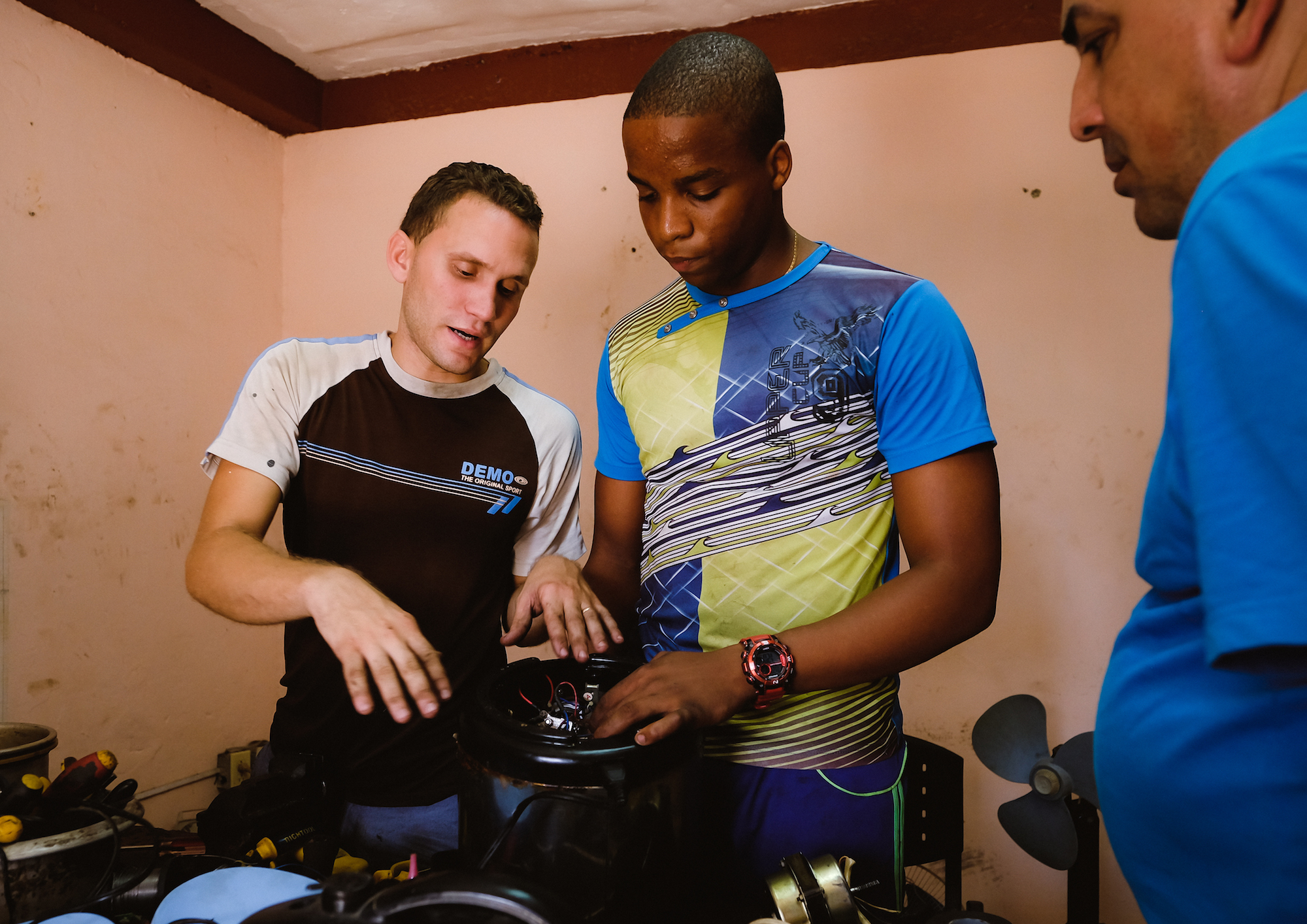
    Repair is Essential - image copyright Mark Phillips

    Documenting repair at home

    While Phillips has spent a lot of time photographing repair culture abroad, he also is very involved in photographing our London community. From repair businesses to Restart Parties, if you love an image we have shared it was likely taken by him. We know that photographing in these spaces can be challenging and Phillips tells us more about why. This is only part of the reason that we are so thankful for his work with us over the years.

    Finally, we share our views on the future of repair culture. Mark tells us about some sustainable design projects that have inspired him and given him hope. However, we also note the lack of these projects. Since this discussion, we have fortunately seen more of these examples pop up. Nonetheless, there is always room for innovation and this work becomes more urgent and essential every day.

    Links:

    • Repair is essential: an exploration of repair culture in Cuba
    • Get involved in Repair Day 2021
    • Find out more about the 10 year smartphone
    • Euronews: iPhone 13 screen cracked? Here’s how Apple stops Face ID working if you try to fix it yourself
    • Mark A Phillips Photography
    • Restart Radio: Photographing repair culture

    [Images by Mark A Phillips, licensed under CC BY 4.0.]

    The post Restart Radio Republished: Mark Phillips photographs ‘essential’ repair appeared first on The Restart Project.


    Restart Podcast Ep. 68: Inequalities in UK craft and making, with Dr Karen Patel Sep 29, 2021
    Show notes

    This month we spoke to Dr Karen Patel from Birmingham City University about her work on Craft Expertise, a project researching inequalities in the craft sector and documenting experiences of makers from marginalised backgrounds. Dr Patel interviewed over 20 women on their experiences in craft.

    Her research pertains specifically to the craft sector but we found that there are many similarities to the repair community – both positive and negative. Dr Patel shared insights with us from her research and we considered how we can support minority groups in our own repair community.

    Barriers in craft

    There are multiple barriers to success – and simply to entry – into the craft world, mirroring those we see in repair. Dr Patel discussed how these are often related to people’s identities and pointed at minority groups.

    For example, those who come from a working-class background may find it harder to build a career in craft. Craft is viewed by many as precarious work and even by some parents of craftspeople, is treated as a hobby rather than a job. Along with its lack of inclusion in school curriculums and higher education, this view only becomes reinforced further.

    For female makers and makers of colour, Dr Patel tells us about the lack of safe spaces in the craft sector. Studios, fairs, classrooms and more are all spaces that are often white and disproportionately male-dominated. This means that other makers can feel unwelcome, unsupported and unsafe in these environments.

    The report found that microaggressions were an all too common occurrence in the craft sector. Almost all of the women interviewed reported these or worse.

    We discuss how microaggressions can be extremely difficult to report and act on as they are often behaviours that are difficult to identify and therefore report. Another form of discrimination is the exotification, and resulting devaluing of expertise and experience, when it comes to makers of colour creating cultural objects.

    How to tackle these inequalities?

    Like craft, the repair sector can feel like a very male-dominated space. While our community is explicitly a radically open and supportive space, we have received comments in the past from women who have not felt respected or listened to by male peers.

    We ask Dr Patel if our Rosie the Restarter skillshares are a good tactic for supporting female-identifying and non-binary repairers in the repair community.

    We also have an essential discussion about how we could better tackle incidents of discrimination at Restart Parties or in the extended online space. This includes making the process safer and easier to report these occurrences if they do happen.

    Finally, we talked about the dynamics around gendered activities. Binaries around who craft and repair are traditionally for are limiting for everyone. We commit to working to make our community more inclusive and equal for all.

    Links:

    • Craft Expertise
    • Dr Karen Patel – Birmingham City University
    • The Politics of Expertise in Cultural Labour: Arts, Work and Inequalities by Karen Patel
    • Cyberfeminism, technology, and international ‘development’ by Radhika Gajjala and Annapurna Mamidipudi
    • The Maker Stories podcast
    • Rosie the Restarter

    [Feature image courtesy of Dr Karen Patel]

    The post Restart Podcast Ep. 68: Inequalities in UK craft and making, with Dr Karen Patel appeared first on The Restart Project.


    Restart Podcast Ep. 67: Reflecting on repair during the pandemic Aug 26, 2021
    Show notes

    Our summer podcast season has come to a close and what a time it’s been! We revisited our archive and picked some of the episodes where our discussion touched on the pandemic and the events of the last eighteen months.

    Throughout the episode, we hear select clips from nine recent guests and situate these discussions. We cover healthcare, from patents and barriers to medical device repair. We reflect on how workers in the electronics industry have been negatively affected including those working in factories in Asia, to professional repairers on the high streets of London.

    False and real silver linings during the pandemic

    There were a lot of expectations at the beginning of the pandemic about how measures like lockdown might have a silver lining in terms of lowering carbon emissions. We hear how this was not necessarily the case and instead learn what active changes we can campaign for to make a real difference.

    Luckily, we also had some big glimmers of hope and optimism in our community over the last year. We spoke to repairers who were fixing donated laptops to give to those in need and an artist who managed to create a stunning piece of interactive art to bring joy to the community despite the circumstances.

    Links:

    • Restart Podcast Ep. 51: Copyright law, ownership and crisis with Aaron Perzanowski
    • U.S. PIRG: 43,000 call on ventilator manufacturers to release repair information
    • U.S. PIRG: Hospital technicians renew urgent call for Right to Repair medical equipment
    • Restart Radio: Reuse and repair with two frontline medical professionals
    • Restart Podcast Ep. 60: Helping electronics workers improve conditions
    • Restart Radio: Reusing laptops for digital inclusion with Mer-IT and Hackney Fixers
    • Restart Podcast Ep. 54: Shoes and urgent system change with Tansy Hoskins
    • Restart Podcast Ep. 52: Combining nostalgia with the new at Armstrong Audio
    • Restart Podcast Ep. 59: Lasers lighting up the sky, with Seb Lee-Delisle

    The post Restart Podcast Ep. 67: Reflecting on repair during the pandemic appeared first on The Restart Project.


    Restart Radio: A small ask Aug 12, 2021
    Show notes

    Happy August, listeners! We’re on our summer break but there will be a special podcast episode in the coming weeks. In the meantime, we have a simple ask for your help.

    Please take a couple of minutes to complete the Restart Radio listeners survey.

    The last time we conducted a survey of listeners was in 2019 and we found it incredibly helpful and took action based on many of your suggestions – this included the type of guests that we brought on, building the archive page for easier navigation of content, and transcripts which we are working on creating for each episode.

    We really appreciate everyone who has taken the time to respond so far. We heard from a listener in Canada who commented that our “variety of subject on sustainability and repair is years beyond other outlets” which is part of the reason why we see value in producing the shows.

    We’re also interested to hear that multiple listeners would like us to get more into the ‘nitty gritty’ about repair, pointing to our serialisation episode as a stand out in this area – which we are proud of!

    We’d love to hear what you think of the content that we have been creating – what have you liked and what we could improve. We haven’t had quite as much of a response as we did last time we conducted one of these surveys so please if you haven’t done it yet go fill it in. We look forward to hearing from you!

    Fill in the survey here!

    The post Restart Radio: A small ask appeared first on The Restart Project.


    Restart Podcast Ep. 66: Ancient cob building, part of a low-tech future Jul 28, 2021
    Show notes

    In our final episode of the summer season, we talk to Kate Edwards about building with cob and why it is a really sustainable way forward. Please fill in our 2021 listener survey at https://therestartproject.org/radiosurvey. Whether you are a long-term or new listener of the podcast we would love to hear your thoughts on what you like and what we could improve. ⁠


    Restart Radio: Our 2021 Summer Reading List Jul 14, 2021
    Show notes

    Before we get into the news and our Summer Reading List, here’s a plea to respond to our listener survey. We last did one of these in 2019 and found it really helpful in improving our work and making sure that our listeners enjoy the content that we produce. Fill it in here!

    Right to Repair – in the UK and abroad

    Has the news in the UK surrounding Right to Repair been giving you deja vu? For us, it feels like forever since the UK government first announced these changes and since they were adopted in Europe back in March. The rules that came into effect last week mean that repairing all new white goods, including dishwashers, washing machines, fridges, and TVs, must be better supported by the long-term availability of spare parts. Overall, it is a move forward but some of the media reporting surrounding the regulations was misleading.

    In the US, there was also positive news for Right to Repair. President Biden issues an executive order that gives the Federal Trade Commission increased powers to enforce rules helping independent repair compete. We also hear Steve Wozniak – co-founder of Apple – talking about his support for the right to repair and how he would not have gotten to where he is without it.

    A selection of our summer reading list

    Under a White Sky: The Nature of the Future by Elizabeth Kolbert – reviewed by James

    This is a book about humans trying to fix problems in the environment, and then making them worse, and then trying to fix them again. It’s about how we’re past conversation and preservation and now onto a stage of intervening to try and avert irreversible disasters. And how hard that is.

    Undoing Optimization: Civic Action in Smart Cities by Alison Powell – reviewed by Neil

    What are smart cities? Who creates them and who are they for? Powell explores these questions and more in Undoing Optimization. Her book delivers a thoughtful and comprehensive critique of the concept of smart cities, while also providing a broader look at the tension between corporate power, state power and citizen power.

    We Are Bellingcat: An Intelligence Agency for the People by Eliot Higgins – reviewed by Janet

    We’re here for any book that tells the story of a community of collaborative geeks, who look to solve problems and mysteries together. Bellingcat starts with Higgins at his laptop in Leicester, and tells the story about how he honed his skills together with others around the world, forming teams of “amateur” sleuths who solved the mystery behind the downing of Malaysia Flight 17 in the Ukraine and exposed various war crimes in Syria.

    Check out our full reading list for blurbs on the other books on our list:

    • Atlas of AI by Kate Crawford
    • Entangled Life: How Fungi Make Our Worlds, Change Our Minds & Shape Our Futures by Merlin Sheldrake
    • Flash Forward: An Illustrated Guide to Possible (And Not So Possible) Tomorrows by Rose Eveleth
    • Free, Fair, and Alive: The Insurgent Power of the Commons by David Bollier and Silke Helfrich
    • Less is More: How Degrowth Will Save the World by Jason Hickel
    • Our Biggest Experiment: A History of the Climate Crisis by Alice Bell
    • The Art of Disruption: A Manifesto For Real Change by Magid Magid

    Links:

    • Fill in the 2021 listener survey
    • Our full post on the UK’s new Right to Repair rules
    • Executive Order on Promoting Competition in the American Economy
    • Steve Wozniak speaks on Right to Repair

    [links to purchase books are affiliate links so that you can support both us and independent bookshops via bookshop.org]

    The post Restart Radio: Our 2021 Summer Reading List appeared first on The Restart Project.


    Restart Podcast Ep. 65: Saving memories and exposing ‘branded’ repair with Jessa Jones Jun 29, 2021
    Show notes

    This month, we had the pleasure of talking to repairer and activist, Jessa Jones. Jones is the founder of iPad Rehab and has carved out her own space in the repair world as a self-taught microsolderer and logic board repair teacher. We found out what makes her approach to repair and teaching unique, why she is so impassioned in her work, and what tools repairers in the US have to advocate for themselves.

    From the toilet phone to teaching repair

    It is clear that Jones has the drive to repair, as she recounts how a two-year-long effort to fix her waterlogged phone catapulted her into becoming the technician that she is today. Part of what makes Jones so strong is the combination of her experience in molecular biology and as a stay-at-home mum. She describes her approach to repair as from a physician’s perspective. As such, she uses her problem-solving skills to diagnose a device, almost as you would a human body.

    The team at iPad Rehab is also predominantly made up of former stay-at-home parents, and mostly women too. They also recruit students from the local high school robotics team. Jones points out that Anna and Ryan — both teenagers — routinely perform repairs that Apple themselves will not do, such as replacing charging chips. Companies like Apple’s refusal to repair is part of what motivates Jones in her work. A major factor though is the emotional element of succeeding in rescuing people’s memories that would otherwise be lost.

    Repair barriers and the “branded repair” lie

    With a fascinating analogy between logic boards and cities and the human body, Jones explains the importance of schematics. While repair is not impossible without them, schematics make the job much easier and quicker. As time goes on, schematics become even more necessary as manufacturers build barriers to repair into device designs.

    Jones runs us through just some of the numerous barriers to repair in iPhone models over the years. These affect parts from home buttons to batteries to screens. She emphasises the urgent worry that serialisation and pairing of parts — one of the biggest barriers to independent repair — is becoming more commonplace.

    Perhaps the most galvanising point that Jones makes about “branded repair”, is how manufacturers mislead consumers relating to their own “repair” process. She explains how Apple has managed to market its sales of refurbished devices as repair. As a result, customers often lose their data and memories. And additionally, have to pay extortionate prices for something as small as fixing the charging port. Jones uses her voice and platform to inform consumers that this is not — and should not be — the only way.

    Right to Repair in the US

    On June 11th, the day before our interview, the New York State Senate passed their first Right to Repair bill. While this is a landmark move for the state legislature, it is not law yet. It must also be passed by the New York State assembly – something that Jones says is unlikely to happen. She is not pessimistic though. While recognising the legislation is difficult to pass, she says it likely hinges on our ability to be vocal enough to gain the spotlight.

    “These manufacturers are highly motivated to maintain their pyramid scheme and that means a constant barrage of messaging. There’s a lot of folks that haven’t really thought about Right to Repair and if what they’re hearing is a constant stream of this isn’t safe … then that could be really dangerous.”

    There are many wealthier parties interested in keeping Right to Repair quiet, spreading damaging and false messaging to the public. Activists and groups like Louis Rossmann’s Repair Preservation Group — of which Jones is on the board — are working tirelessly to get the real repair message heard.

    Links:

    • iPad Rehab
    • iPad Rehab/Jessa Jones’s YouTube Channel
    • Vice: He Was Murdered in a Hate Crime. She Brought His Blood-Soaked Phone Back to Life
    • The Guardian: Sidestepping Apple: the third-party tinkerers fighting for your right to repair
    • iFixit: Victory! New York Senate Passes Landmark Right to Repair Bill
    • Restart Radio: The dangers of serialisation in smartphones

    [Photo courtesy of iPad Rehab – Jessa Jones (pictured far right) and the iPad Rehab team]

    The post Restart Podcast Ep. 65: Saving memories and exposing ‘branded’ repair with Jessa Jones appeared first on The Restart Project.


    Restart Radio: Borrowing boom at Library of Things Jun 08, 2021
    Show notes

    As businesses and community spaces are able to pick up operations again, we talk to Alys Penfold about her work with Library of Things. Penfold is currently the Borrower Support Lead at Library of Things and tells us about their mission, their impact, and exciting new locations that are opening soon.

    While we were regularly going into the office, Restart shared an office with Library of Things. It’s lovely to catch up and talk about how borrowing and repair intersect.

    First, we discuss the news and start with a cautionary tale. Promises from manufacturers need to be watched closely at risk of them falling apart. The complete overhaul and watering down of Samsung’s Galaxy ‘upcycling’ scheme is evidence of this. Next, we move onto the potential – perhaps hopeful – fall of Bitcoin and why this would be beneficial for the planet. And finally, some good news as Consumer NZ recycles the French repairability index for mobile phones. This move makes us optimistic that similar indices could spread further than France and New Zealand.

    Library of Things is on a mission

    The bold aim of Library of Things is to make “borrowing better than buying”. Penfold tells us how they do this, including reducing costs for consumers, reducing waste, and building a local community. Since starting their pilot location in West Norwood they have expanded across London to make borrowing more accessible to local communities. Library of Things is a look into what our buying habits could be like once we realise that consumerism is not sustainable in many areas.

    Their catalogue hosts a variety of items to be borrowed, some that surprised us. The things range from DIY to hobbying to adventuring and more. They cater to everyone’s needs whether you need to borrow a waffle maker, a tent, or a circular saw. And the range of things that can be borrowed is regularly expanding.

    Penfold shares some stories about how she has witnessed the impact of their work. There are many reasons why people borrow – it could be more practical, cheaper, or more ecologically conscious.

    Environmental impact and repair

    Library of Things’ work does not only benefit the borrowers but also the environment. By preventing people from buying an item that they will likely only use a few times, they are helping tackle the mounting pile of e-waste that the UK produces. So far, through their Crystal Palace site alone they have prevented 15,900 kg more of this waste.

    Penfold tells us how they partner with manufacturers to create a symbiotic relationship of sorts. Major companies donate products to Library of Things and in turn, they are able to provide information on how long the products last and what needs to be fixed. Many of the things that Library of Things have in their catalogue would rarely be used by the average consumer. What they have found is that with regular use by their borrowers, the products are not necessarily designed with long lifespans that support frequent use.

    Collaboration and growth

    Library of Things are planning to open many new locations in the coming months and are opening a new Hackney Wick site on June 15th. Around the country, there are also independent borrowing services popping up all over. Many of them have links to repair cafes and transition groups. We’re excited to see where Library of Things goes next! If you would like a Library of Things near you then head to their website for more information.

    Links:

    • Library of Things
    • Sign our petition for a real Right to Repair
    • iFixit: Galaxy upcycling: How Samsung ruined their best idea in years
    • Vice: Elon Musk Says Bitcoin Has ‘Great Cost’ to Environment and Tesla Will No Longer Accept It
    • Reseller: Consumer NZ launches mobile phone repairability score

    [Photo courtesy of Library of Things]

    The post Restart Radio: Borrowing boom at Library of Things appeared first on The Restart Project.


    Previous 1 3 4 5 6 7 25 Next

    Related Podcasts

    Inside VR & AR

    1

    Inside VR & AR Gadgets
    100 Watts and a Wire

    2

    100 Watts and a Wire Gadgets
    All CNET Video Podcasts (video)

    3

    All CNET Video Podcasts (video) Gadgets
    TechStuff

    4

    TechStuff Gadgets
    The Vergecast

    5

    The Vergecast Gadgets
    Embedded Weekly Podcast – Unknown

    6

    Embedded Weekly Podcast – Unknown Gadgets
    footer-logo

    Contact Us

    Toll Free: 844-670-7747

    Links

    • Home
    • Top Charts
    • Networks
    • Apps
    • Independents Podcasts
    • Podcast Advertising
    • Podcast News
    • Contact Us
    • About Us
    • Analytics & Insights

    Stay Connected

      Privacy, Terms of Use & Our Code of Ethics Protecting Content Creators Copyrights