Restart Podcast Ep. 88: Saving reusable products from the shredder, with West London Waste Authority
Jun 29, 2023
Show notes
Have you ever binned or recycled something that was still working, or could have been repaired? The answer is likely, yes. Based on the results of our recent Waste Composition Analysis, conducted with West London Waste Authority (WLWA), it’s a habit that is even more common than we thought.
This March, we spent a week looking at small electrical products brought to the Abbey Road Household Waste and Recycling Centre, and analysed what could have been reused and repaired. In this episode, we tell you more about the results of this study. Ugo also spoke to Emma Beal, Managing Director at WLWA, about the state of recycling and reuse in the UK and what she hopes we can do to improve the e-waste issue.
From novel to normal
When thinking about how to shift public attitudes to waste, Emma points out that once we work as a whole, change comes quite easily. She cites the non-existent practice of recycling three decades ago compared to how common it is now. As our waste problem grows, she believes that a shift to reuse is inevitable. And when people look back in decades to come, they will be incredulous to the fact that it was not always the norm.
But how do we make it commonplace now? We need to rethink the definition of waste, as Emma states:
“Waste is defined by the person who is not wanting it anymore…the regulation flows from the fact that it has been defined as waste. And it’s only wasted because it’s not wanted, it doesn’t mean it’s not useful, it doesn’t mean it’s not valuable.”
We need to see our stuff as valuable, even once we don’t want it anymore. And this doesn’t just need to be done at council level but also within our communities.
What’s happening in reuse?
While we’d love to, we recognise it’s not possible to reuse everything. Repairing, and even just testing products takes time and money, and we also know that there isn’t the demand to reuse everything. For those at the receiving end, though, reuse is incredibly beneficial. We’ve seen this through our work donating laptops and running the Brent Fixing Factory with WLWA. And there are of course also huge environmental benefits.
Emma tells us about their work monitoring the costs and logistics of reuse, in a hope to be able to scale it in a reasonable way. She tells us about some of the other projects that are working to increase reuse such as, Manchester Renew Hub, reuse shops on waste sites, and our very own Fixing Factory. These initiatives are important not only in developing and testing ways to keep things in use, but also to make reuse more visible to the public. This visibility and communication is what Emma believes will really push reuse to become more popular with the public. Once people see how important it is, there’s no stopping it.
Restart Podcast Ep. 87: Exploring Brighton’s repair and reuse ecosystem
Jun 01, 2023
Show notes
This month, we take a deep-dive into a local repair and reuse ecosystem. Brighton seemed like a great case study for this so we spoke to Victoria Jackson and Sam Jarman from Brighton Repair Café and Dr David Greenfield from Tech-Takeback, two of the amazing projects working together to reduce waste in the city.
A decade of repair with Brighton Repair Café
Brighton Repair Café is one of the longest-running repair cafés in the UK, holding their first event all the way back in 2013. Victoria and Sam were both studying sustainable design at the time and were interested in the journeys that we take with our things, from their design inception, to when they break, to how we can reconnect through repair. They were inspired by the Dutch repair café model to hold their first repair session and since then, have been steadily running events around the city. They’ve also served as inspiration for more repair cafés popping up in Brighton and Hove and the surrounding area, and are part of the Community Repair Network.
Victoria and Sam share what they have learned from running repair events for so long, from de-gendering repair to making sure that its a fun and rewarding activity. They believe that repair is so rewarding that once someone has a positive experience, that’s all they need for it to snowball into something bigger.
“It is quite experiential. So as soon as someone experiences that opportunity, we don’t have to do too much work in that respect because they understand how good they feel when they fix that object with the support of somebody else. They also understand how important those communities are.”
It’s their hope that in the future, repair will become so popular that there will be a repair cafe in every town, university, and school. They believe that the knock-on effect of teaching young people about repair would be huge, especially with how many skills have been lost over recent decades. And they’ve already started this mission, working with a local university to set up a student-led repair café.
Repairing at Brighton Repair Café [Photo courtesy of Brighton Repair Café]
Give and take with Tech-Takeback
We then talk to David from Tech-Takeback, who were recent collaborators with Brighton Repair Café as part of Brighton council’s Circular Saturday scheme. Tech-Takeback began in 2016 as pop-up events in Brighton and London, expanding in 2020 into the organisation that they are now. They run RevaluElectricals, collecting unwanted and broken electrical devices from Brighton residents to hopefully give them a new life. David gives as a breakdown of some of their data including, the most collected devices and the massive amount of e-waste that has been saved since they started. 25,000 items have already gone on to have a second life!
He explains their processes for reusing tech, it’s an elaborate process but worth it. Much of the collected items end up going to charities, being sold in the Revaluit shop, or being given away on Freegle. And while some items do end up being recycled, they are first stripped for useful parts and materials.
“We need the government to start thinking about the metrics for reuse. Everything at the moment is focused on recycling…above recycling, we should be having refurbishment, repair, remanufacturing, reuse, and we should be having prevention.”
Not only do Tech-Takeback reduce e-waste and provide affordable tech to those who need it, the data that they have gathered during their work has been incredibly informative for our own research and for the larger repair ecosystem.
Repair event at Tech-Takeback [Photo courtesy of Tech-Takeback]Brighton Repair Café and Tech-Takeback, are examples of projects that we need to have in every part of the UK. These aspirations though, need a lot of support, especially from the government and local councils. All of our guests agree that not enough is currently being done, pointing to Wales as an example of a truly bolstered repair culture. We hope to use the connections built and data collected by projects like these to inform our work and campaign for Right to Repair across the whole of the UK – and the world.
Restart Podcast Ep. 86: Why repairers need hope, not guilt, with Katie Treggiden
Apr 25, 2023
Show notes
This month we talked to author and communicator, Katie Treggiden about her recent book entitled, Broken: Mending & Repair in a Throwaway World. Katie has put decades of thought into helping creatives and makers become more sustainable but also forgive themselves when they can’t be.
Back to her roots
Having grown up surrounded by nature in Cornwall, Katie tells us about her surprising origin story. She spent over a decade working in advertising before pivoting towards her life-long love of writing. With this, she also folded in a new interest – purpose-driven craft and design. Since then, she has explored what this actually means through writing dissertations, books, and hosting a podcast on the topic. With all this experience under her belt, she decided that she wanted to help makers develop their working practices to fit the circular future that we need to build.
How craftspeople are using repair
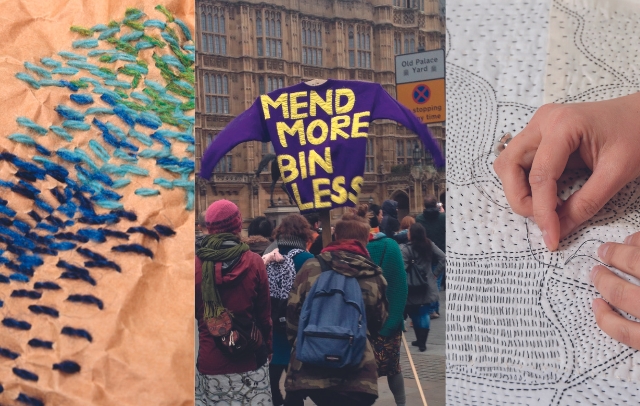
Katie has previously written about waste and reuse, and her new book Broken puts the focus on repair. She shares some standout case studies from the book of artists and craftspeople who are incorporating repair into their work. These include Celia Pym, Bridget Harvey, Ekta Kaul – all artists who explore repair in entirely different ways.
L-R: Work by Celia Pym, Bridget Harvey, and Ekta Kaul
Katie notes her interest in the different ways repair can be used for example, as a tool to restore practical value, or to add artistic value, or even for self-care. We talk about where repair and hacking fits into the larger culture of craft, and more specifically the ‘craft of use’. She notes how much more difficult electronic repair often is compared to more traditional craft and making. This is especially true now that manufacturers make an effort to conceal the craftsmanship that goes into making (and therefore taking apart and repairing) our devices.
Letting go of guilt in order to move forward
While individual action is of course important, system change is essential for the scale of the problem we are dealing with. When running her courses for creatives, Katie really focuses on this point as key to forward movement. Instead of being weighed down by the personal guilt of climate breakdown, makers need to be led by curiosity and experimentation instead of sustainability perfectionism. We all have a part to play in helping the planet, but it is not our responsibility alone.
“I think really until companies are responsible for the things they sell for their whole lifetime, repair is not going to be the norm.”
Additionally, she stresses the need to be compassionate. There are so many reasons why people may not repair. These include social stigma, a lack of time or resources, or that their stuff is simply not designed to be repaired. Knocking down these barriers is not something anyone can do on their own, rather, we need collective action to change the system.
Practising ‘defiant hope’
It’s difficult to stay optimistic about our power to enact change but Katie believes hope is one of the most important tools we have. There isn’t a one size fits all solution to being sustainable, but what can join us all together in our efforts is our common goal.
“One of the most important parts of my job is staying hopeful and and helping to keep other people hopeful.”
Restart Podcast Ep. 85: The local businesses giving your stuff a ‘second life’
Mar 24, 2023
Show notes
This week we’ve been celebrating London Repair Week by highlighting the heroic repair businesses all over the city. Our directory of repair shops, LondonRepairs.org, was recently relaunched with a new dedicated website. Here you can find over 300 reliable businesses to fix your stuff. In this month’s podcast, we spoke to two of these repairers about their passion for fixing, the barriers to their work and what could revitalise the repair economy.
Meet the businesses
Junaid Syed is one half of the team of brothers that run Holborn-based Saras Fix. Having grown up repairing and fixing computers in their mother’s school, they have a lifetime of experience to draw on when fixing customers’ electronics. He recounts a very memorable repair that he performed during the lockdown, when he had to take a risk that absolutely paid off and helped someone in need.
Junaid and his brother, Jawad at their shop
Xenis Stylianou has been in the electronics repair trade for over 30 years and runs his business, Zen’s Electronics Workshop near Finsbury Park. Having learned his trade through training schemes and skilling up with different engineers, he explains how difficult it is to gain experience this way nowadays. He believes that a lot more support for professional repair is needed, especially in terms of training paths and apprenticeships, otherwise we risk losing these essential skills to time.
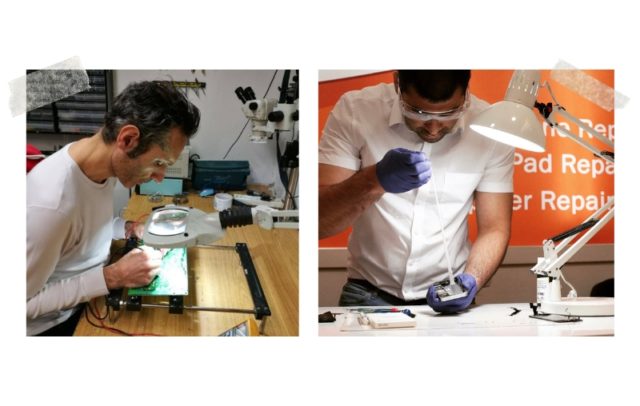
Xenis and Junaid repairing at their shops
The state of repair today
With so many decades of fixing experience, Xenis can give us a first hand account of how things have changed. Speaking on his area of expertise of audio-visual equipment, he tells us that not only has everything become harder to open, and therefore repair, but also products are being produced at much lower quality than in decades past.
“It’s a top down thing…over time manufacturers have actually reduced their build quality to come in line with the cheaper brands. And because now everything’s built to cost, the engineer at the other end repairing the equipment is not taken into consideration anymore.”
Both Junaid and Xenis agree that the various barriers that manufacturers put on repair are not only affecting the operation of repair businesses but also the customer’s autonomy to make choices about their device.
Keeping repair alive
So, if being a professional repairer is so challenging, how do they find the drive to keep it up? Xenis and Junaid care about their customers and reducing electronic waste.
Junaid describes it as “giving back a second life to the broken devices which would’ve ended up in a landfill” and it’s an aspect of repair that he’s incredibly passionate about. He also regularly volunteers at repair events, donating his time and years of experience to help people learn to repair their own stuff. No matter if people want to try to repair their stuff at home or bring it straight to a professional, he stresses that London’s repair businesses are here to help.
Restart Podcast Ep. 84: Repairmongers, remakeries, and repair hubs
Feb 28, 2023
Show notes
This month, join us for an expert panel on community-led high street repair! We gathered together Katie Bellaris from Re:Make Newport, Elaine Brown from Edinburgh Remakery, Sue Briggs from The General Store Selkirk, and Lorna Montgomery from Share and Repair Bath to talk about their experiences setting up high street repair projects in their area. We’re hoping that by hearing about their different operating models, approaches, and tips and tricks it will inspire some of you to support repair and reuse on your local high street.
The money question
All of these ventures run with slightly different business models and approaches to funding their work. What they all agree on is the central role of generous donations from their local communities. Whether it’s financial donations, volunteering or donations in cake form, it all helps to keep them running. Sue also taught us a new term, referring to The General Store as a ‘repairmongers’, steadfastly placing themselves as a community institution.
The General Store Selkirk [Photo courtesy of The General Store Selkirk]
Reaching out
We ruminate on how the location and demographics of each project’s local area affects the way that they operate. Whether it is the difference in affluence between Bath and Newport, or the remoteness of Selkirk in comparison to Edinburgh Remakery’s shopping centre location. What Katie loves about Re:Make Newport – echoed by everyone else – is the way that their shop brings people together.
“The essence of what we do is all about community, it’s about bringing people together. And I love being in the shop and the atmosphere there is electric. You’ve got people of all generations, all ages talking about repair and sharing tips and knowledge and the way that they look at repair and reuse.”
Inside Re:Make Newport [Image by Mark A Phillips, licensed under CC BY 2.0.]
What about you?
So what if you want to start a project like this? Our panel say ask others for help. They’ve found that other people in the repair space are more than happy to share their expertise and experience. After all, we are all working towards the same goal of more accessible repair and reuse for all. We want a repair and reuse hub in every town across the UK. In London we’re starting with Fixing Factories and can’t wait to see where they take us.
And in case you’re wondering about the cryptic comment in her introduction, in a previous life Sue played a murder victim on the TV show Taggart!
Restart Podcast Ep. 83: Meet the students Fixing Things for the Future
Jan 30, 2023
Show notes
It’s been an ongoing question in our community of how to get young people involved in repair culture. In this month’s podcast, we were delighted to talk to students, Carl Mau and Beat Schneiderhan, and their teachers, Felix Lossin and Walter Kraus, who have a plan. Based at the Rudolf Steiner School in Munich, not only do they have a weekly repair cafe led by students but lessons on repairing are also integrated into their curriculum. And they have created a guidebook on how to start a student repair shop at any school. We spoke to them about this innovative idea and how it has been received by students.
Integrating repair
Carl and Beat tell us about their experience being students of the repair workshop and how excited they are to share the opportunity with more schools. In addition to their weekly repair cafe, students who opt to study repair have up to four dedicated classes per week. They feel that the skills they are learning in their repair classes will stay with them for the rest of their lives, and in some cases seem much more applicable than more traditional classes.
The ‘learning by doing’ ethos
They describe the teaching method of the repair classes as “learning by doing”, often the students are encouraged to work without the assistance of teachers as much as possible. Carl points out that this has made him more confident to attempt repairs at home and he hopes that this mindset will carry on once he graduates.
“It’s the realisation that the students kind of lose their fear of something so easy. When they see how easy it is they get used to it and will repair for themselves. And every time something is broken, they are ready to try to repair it.”
Fixing Things for the Future
Finally, we discuss their guide called Fixing Things for the Future. It details how to start a student repair workshop from scratch, covering everything from tools to tutorials. Felix points out how important student safety is when operating one of these projects. The guidebook has an extensive section on how to keep students safe and help them confidently deal with electricals.
Beat hopes that in the future there will be a repair workshop at every school, in every country! If this sounds like something you could help set up, they now have an English version of the guide available for download.
Restart Podcast Ep. 82: No need for new toys, we have Team Repair
Dec 14, 2022
Show notes
We’re officially in the holiday season now and like many, we have presents and toys on the mind. For our December episode, we spoke to Anaïs Engelmann and Megan Hale from Team Repair. They run a 12-month fixing programme that could be a perfect gift for any young person in your life.
Starting fixers young
The team of Team Repair is composed of five design engineering graduates who are linked by their passion for reducing e-waste. Their company aims to introduce and teach children about repair and sustainability, each month sending them a new gadget to fix. These gadgets include hand-held game consoles and remote controlled cars – its such a fresh and engaging approach to capturing children’s minds.
Anaïs and Megan explain to us how they came to repair at different stages of their lives, proving that it is never the wrong time to learn these crucial skills. They believe that getting children interested in repair early is integral to inspiring our next generation of fixers and repair-friendly designers.
Another lovely aspect of the Team Repair model is encouraging generational skill sharing. Whether it is parents helping their children with the repair kits, or Team Repair themselves going into schools. At Restart, we recognise how important this skill sharing is in teaching younger people and also not letting this knowledge be lost to time.
Building in circularity
They tell us how a key feature of their project is building circularity into their work. It is not necessarily a popular approach with investors but Team Repair recognise the importance of this aspect of their work. In an effort to solve the issue of e-waste, it only makes sense to reuse the gadgets that they send out.
Their hope is that by educating children on repair and waste reduction, these skills will come in handy when Right to Repair legislation also moves forwards in the coming years. It’s a hope that we definitely share and are working towards making a reality all the time.
Team Repair’s fixing programme is such a cool concept and we cannot wait to see how it develops and what other toys there are to fix!
Restart Podcast Ep. 81: Launching the new Fixing Factory
Nov 28, 2022
Show notes
This month, we spoke to Restart’s Shelini Kotecha and Possible’s Dermot Jones about Fixing Factories. We’ve been working with Possible to open up two Fixing Factories this year, gathering lots of interest along the way. The Brent Factory, based in the Abbey Road waste facility opened in April this year and has been a hub for laptop repair and reuse. At the end of October, we were excited to finally open the Camden site, on Queen’s Crescent high street. Queens Crescent Fixing Factory will fix any small electronics and get lots of new people into fixing.
The new Camden Fixing Factory
Dermot tells us about the wonderful celebration that marked the opening of the Camden Fixing Factory. It was a great community showing, with neighbours coming together and sharing homemade food and knowledge with each other.
He also tells us about their plans for making the Fixing Factory self-sustaining, including some creative ways to get artists involved in adding value to repaired items. The opportunities for involvement are seemingly endless and span a wide range of fixing abilities. Dermot also does a shout out for the evening repair club, which provides a fun space for tinkerers who want to get started in their learning or take on more time consuming repairs.
Learning from each other
We’ve learnt an incredible amount over the last months working at the Brent Fixing Factory. Shelini shares with us some of the lessons that have come out of the project. She also highlights the power of our volunteers in shaping what the Fixing Factory has become. Both Shelini and Dermot make it abundantly clear that this is an ever evolving process, and that everyone who is involved is helping mould it into the best version that it can be. The Camden site will be shaped by the months of experimentation already done at the Brent site. But with a different type of location and more opportunities for public engagement, there are also a whole raft of new lessons to be learned.
They share some wonderful stories of how the Fixing Factory project has affected both volunteers and patrons alike. From helping exchange students find inner-confidence to encouraging a member of the public to further advance her education in fixing. It’s stories like these that give us inspiration as the project progresses.
Restart Podcast Ep. 80: Voices of Fixfest 2022
Oct 27, 2022
Show notes
From 30th September – 2nd October, members of the repair community from all over the world gathered together to share their ideas and passion at Fixfest 2022. From fixers and tinkerers, to academics and activists we all had something to teach and learn from each other. It was a chance to explore new ideas, hear different perspectives, and – perhaps most importantly – interact in person for the first time in a while.
In this episode, we wanted to make the most of this rare opportunity. We spoke to 7 Fixfest attendees about where repair is now and where they hope to see it in the future. You’ll hear a host of different voices including:
The theme for 2022’s Repair Day, also celebrated this October, was ‘Repair Everywhere’, and we wanted to know what this phrase meant to our community. To some it was an aspiration, a desire for repair to be visible everywhere – in schools, community centres, in our media, on high streets, and even in prisons. For others, it represents the overwhelming prevalence of repair in our lives and culture. Our speakers argue that it’s not that repair isn’t happening, rather that it’s not being highlighted as the essential tool that it is.
Repair’s impact on cost of living
The cost of living crisis has been all-consuming recently. We know that repair and reuse will be integral tools to tackle this issue and help those who cannot afford to buy new. But we’re curious to know how this presents in other parts of the world.
Looking to the future of repair policy
We also delved into the state of the Right to Repair movement across the globe. We are all at different points in our fight for a real Right to Repair. For some, the movement is almost non-existent in their country. Mathew tells us how excited he is to be the first person to bring this issue to light in his country. In the US, it seems that public opinion is in firm support of Right to Repair, now it’s time to push for this right to be legally supported and protected. Leanne tells us about the burgeoning movement in Australia, and the steps that have been taken by their government to put the wheels in motion on what the Right to Repair could look like in their country.
Ultimately, we’re all at different stages of our journey towards Right to Repair. But one thing that Fixfest showed us is how united we are in the goal of bringing back repair.
Restart Podcast Ep. 79: eSpares wants you to clean your filters
Sep 29, 2022
Show notes
This month, we had a very handy conversation with some friends from our sponsor eSpares. Eleanor Cochrane and Mariya Peynova are the Brand Manager and Social Media Manager for eSpares, respectively. We took this opportunity to properly introduce our listeners to their work and also answer a few questions about household repair and maintenance. In the process, we learned that there is probably a lot more regular maintenance that we should all be doing.
First, we chatted about how eSpares are empowering their customers to fix their own stuff. They tell us about the trove of repair manuals, tutorials, and more that can be found on their website. Eleanor also shares her own stories of initial DIY repairs and her experience of the concerns that many beginners will have. They hope that the content on their website and the support that they provide will give customers more confidence to give repairing a go.
“What we do try and do is educate people about their rights…this should be something that they’re entitled to. Choice is something that we should always have when it comes to machines that we have bought.”
We discuss accessibility of spare parts and the way that consumer calls for repairability have progressed over recent years. Mariya posits that due to the rising cost of living, people are more keen to repair their things. They also share an anecdote which proves that this is definitely the right thinking. One of their customers managed to repair a second-hand range oven and save thousands of pounds in the process. Eleanor and Mariya use these types of stories to prove that repair is really possible for everyone (even if manufacturers make it difficult on purpose) if you have good support and learning materials.
Maintenance: a very good place to start
In the second half of the episode, Eleanor and Mariya answer repair queries sent in by the public. They share the most common and first port of call fixes that are likely to be causing the problem. A lot of these fixes are related to maintenance of your machine. They recommend that you regularly check the filter of your washing machine, tumble dryer, and vacuum cleaner. It’s a super helpful reminder and encouraging that a relatively small fix can be the answer to your machine working 100% again.
If you want to attempt any of these fixes or something more technically complicated, the information and help that you need are on the eSpares site. Eleanor tells us about all the channels that they are using to spread repair information and tutorials. There are so many written tutorials on their website, or if you are more visually inclined they also regularly post on their YouTube channel and TikTok account.
The key take away from our chat with Eleanor and Mariya is: don’t be afraid to try repair. Even if you’re not feeling confident now, there is a plethora of information out there and often, someone to offer moral support along the way. Now go clean those vacuum filters!

 Our TOPPODCAST Picks
  Stay Connected