TopPodcast.com
Menu
  • Home
  • Top Charts
  • Top Networks
  • Top Apps
  • Top Independents
  • Top Podfluencers
  • Top Picks
    • Top Business Podcasts
    • Top True Crime Podcasts
    • Top Finance Podcasts
    • Top Comedy Podcasts
    • Top Music Podcasts
    • Top Womens Podcasts
    • Top Kids Podcasts
    • Top Sports Podcasts
    • Top News Podcasts
    • Top Tech Podcasts
    • Top Crypto Podcasts
    • Top Entrepreneurial Podcasts
    • Top Fantasy Sports Podcasts
    • Top Political Podcasts
    • Top Science Podcasts
    • Top Self Help Podcasts
    • Top Sports Betting Podcasts
    • Top Stocks Podcasts
  • Podcast News
  • About Us
  • Podcast Advertising
  • Contact
Not in our directory?
Add Show Here
Podcast Equipment
Center

toppodcastlogoOur TOPPODCAST Picks

  • Comedy
  • Crypto
  • Sports
  • News
  • Politics
  • True Crime
  • Business
  • Finance

Follow Us

toppodcastlogoStay Connected

    View Top 200 Chart
    Back to Rankings Page
    Gadgets

    The Restart Project Podcast

    Let’s fix our relationship with electronics

    Advertise
    • Apple Podcasts
    • Google Play
    • Spotify

    Latest Episodes:
    Restart Podcast Ep. 98: It’s official, the UK needs more reuse options Oct 19, 2024
    Show notes

    Have you ever binned or recycled something that was still working, or could have been repaired? Our new report says that the answer is likely, yes. Did you want to do so? Our polling suggests, no!

    Last year, we conducted a small study on rates of reuse and repair at a waste and recycling centre in London and found that almost half of the small electricals that went to scrap, could have been either repaired or directly reused. We had our suspicions that this wasn’t a stand alone occurrence, so we set our sights on something bigger. In this episode, we talk to Restart’s own James Pickstone about our new BREW (Beyond Recycling of E-Waste) report into reuse at UK waste facilities, and Sarah Ottoway, Sustainability and Social Value Lead at SUEZ about their new report into uptake of reuse options at their own facilities.

    The Headlines

    The main – unfortunate but compelling – takeaway from the BREW report shows that there is nowhere near enough of this activity happening. In fact, we found that only around half of waste facilities in the UK have any kind of reuse stream and only around a fifth offer reuse for small electricals. It’s a shockingly low statistic that desperately needs to change. If you want to dive deeper, you’re in luck. James takes us on a journey through our findings and what they mean. Including an even more appalling figure on repair at waste facilities.

    For SUEZ, their findings are looking a bit brighter. They found that the majority of visitors to the HWRCs were already users of the on-site reuse shop and regularly so. Furthermore, those who weren’t using the shop were already engaging in similar activities eg. charity shopping and buying second hand. It’s a welcome insight into people’s mindsets and a positive sign that more people are picking up sustainable habits.

    The art of what could be

    James and Sarah run us through what reuse options really look like at these facilities. One of the most impressive perhaps, is Suez’s 6,000² foot ‘renew hub’ in Manchester which caters for upcycling and repair for everything from bicycles, to fabric and upholstery, to woodworking. She is clearly immensely proud of what they have built there and recounts to us the inspiration that she feels just by walking through its entrance. It’s the kind of facility that we want to have in every area of the UK and its the kind of inspiration that we need to make it happen.

    As well as the reuse initiatives at council run sites, James points out that there are also many grassroots initiatives spread out around the UK. These are a more than worthy alternative but they also still need funding.

    Manchester Renew Hub

    So what’s stopping us?

    Our polling showed that 85% of the British public think items brought to waste facilities should be kept in use through being repaired/refurbished or donated/sold. And the same percentage support government-set targets for reuse. So what’s stopping that from happening? We talk to both of our guests about the barriers and solutions to encourage more reuse options. Sarah says that a lot of the time, the barriers are actually quite practical. Issues of too little space, too little time and too little funding are preventing more options like reuse hubs or refurbish and repair programmes from popping up. These are problems that occur on a case by case basis and while reuse could use more funding as a general rule, its a tricky issue to solve.

    But there is action that policymakers can be taking. Sarah and James both run us through some of these potential options including new reuse targets, removal of VAT on repairs and spare parts, and financial incentives for manufacturers to provide longer repair support for products. It’s exactly the kind of thing that we’re asking for in the UK Repair and Reuse Declaration – which has already proven popular with citizens and MPs alike.

    Links:

    • Learn more about our BREW report
    • Read the full ORA report
    • Read the full SUEZ report
    • Read about our 2023 waste study
    • Discover and sign the Repair and Reuse Declaration

    [Images by Mark A Phillips, licensed under CC BY 4.0.]

    The Beyond Recycling of E-Waste (BREW) project was supported, in part, by IMPETUS.

    IMPETUS is funded by the European Union’s Horizon Europe research and innovation programme under grant agreement number 101058677. Views and opinions expressed are, however, those of the author(s) only and do not necessarily reflect those of the European Union or the European Research Executive Agency (REA). Neither the European Union nor the granting authority can be held responsible for them.

    The post Restart Podcast Ep. 98: It’s official, the UK needs more reuse options appeared first on The Restart Project.


    Restart Podcast Ep. 97: Beyond the repair manual, with Shannon Mattern Aug 29, 2024
    Show notes

    For our August episode, we spoke to professor and writer, Shannon Mattern about her writing on the history of repair and repair manuals. It’s a theme that she has almost unknowingly been pursuing in her work for many years, bringing it to areas of thought that we haven’t yet explored on the show.

    The repair manual brings into play lots of elements that fascinate Mattern including graphic design and instructional media but perhaps what stands out most is her belief that the genre isn’t always so straight forward in its pedagogical nature. In fact, in classes she often encourages students to use the repair manual as a lens through which to reinvent objects in a more considered way.

    From stewardship to sealed devices

    The modern repair manual – the one that Right to Repair activists across the world are fighting against – commonly tells us not to even open our devices instead of to repair them. But how did we get here? Mattern takes us through a brief history of the repair manual in its various iterations. From handwritten and drawn examples centuries ago, to the first printed manuals, and then the boom of private goods (and the means to repair them) in the 1950s. She points out that repair manuals have always had a complicated relationship with their reader and this approach is not wholly new. Thats why collectives like Videofreex found a need to produce their own literature on repairing equipment, just one example of the many responses to the genre.

    We also touch on the need for oral histories and manuals, rather than the published ones that we are used to seeing from manufacturers. Its a practice particularly common in places like Cuba where getting your hands on a written manual can be prohibitively expensive, if they exist at all. But this also rings very true when considering Restart’s own network of community repairers today.

    A page from El Libro De La Familia
    A page from El Libro De La Familia
    A page from Videofreex's Spaghetti City Video Manual
    A page from Videofreex’s Spaghetti City Video Manual

    Bending the rules of the manual

    As has become clear, the repair manual will never be the be all end all of repairing an object – or our world. Mattern shares some more inventive ways that repair manuals have been used as a ‘boundary object’ in order to encourage conversation and cooperation, especially in the community action space. Rather than being only used as instructive pieces, the manual can actually be a tool in itself. And in fact, this resonates deeply with us, as Restart would not be what it is today if not for the wonderful community of people sharing their skills, their knowledge, and collaborating to make a change.

    Links:

    • Maintenance and Care by Shannon Mattern
    • Step by Step from ‘Repair Manual’ by Shannon Mattern
    • ‘The pandemic is a portal’ by Arundhati Roy
    • Repair Culture: Reparación “the never-ending life of Cuban things …” by Mark A Phillips

    [Photos courtesy of Internet Archive, London Community Video Archive and the Experimental Television Centre]

    The post Restart Podcast Ep. 97: Beyond the repair manual, with Shannon Mattern appeared first on The Restart Project.


    Restart Podcast Ep. 96: It’s time for a Student Repair Revolution Jun 27, 2024
    Show notes

    We spoke to Restart’s own Pascale Hall and James Pickstone, and Dr Kersty Hobson from Cardiff University about the Student Repair Revolution project and their learnings and hopes for the future of student repair initiatives.

    Unique and familiar challenges

    We know that engaging young people in repair is no easy task which is partly why the Student Repair Revolution project was set up in the first place. So, we discuss the main challenges that were found when trying to set up initiatives in universities. Kersty stresses that it really is dependent on the unique situation of each institution. Campus layout, student extracurricular culture, and the types of courses offered can all affect how easy it is to establish repair groups at a university. Students are also time poor, which means that accessibility and visibility of these repair activities is vital.

    But as Pascale and James point out, not all the barriers that they found are unique to university students. There are also the all too recognisable challenges of obtaining insurance for events and finding the volunteers to run them – issues that any repair group organiser will recognise. What seems to be clear is that the ‘traditional’ repair cafe model does not suit universities… especially when it falls on a hungover Sunday morning.

    Collaboration is key

    Pascale says that one of the most exciting parts of working on this project has been seeing the knowledge and experience sharing between student groups. With such a daunting task, it’s clear that we need to be fostering collaboration between those who are really motivated to establish repair on campuses. And working with local groups is important also. Not only because community repairers can share their experiences in organising events, but they can also pass on their fixing skills which are sadly being lost between generations.

    Kersty stresses throughout our conversation that students also need encouragement to get involved in repair.

    “I don’t think we can assume that we’ve got a young generation of repairers waiting in the wings. I think we need to be part of the change to facilitate and empower them to be able to do repair.”

    While young people are interested in repair – whether for environmental or financial reasons – it’s not enough to expect them to become leaders of the movement on their own. There is a wealth of knowledge on technical skills, Right to Repair policy, and community organising that is just waiting to be shared with the next generation of repair rebels.

    Links:

    • Get involved: Be Part of the Student Repair Revolution!
    • Read: What is the university for these days? Rethinking the foundations of the ‘circular campus’
    • Listen: Restart Podcast Ep. 83: Meet the students Fixing Things for the Future

    [Feature image courtesy of University of Leeds]

    The post Restart Podcast Ep. 96: It’s time for a Student Repair Revolution appeared first on The Restart Project.


    Restart Podcast Ep. 95: There’s hope yet for UK waste and repair policy, with Green Alliance Apr 18, 2024
    Show notes

    This month, we spoke to Libby Peake, Head of Resource Policy at Green Alliance about their work on waste and resources, and how we can get the UK government to act urgently to tackle these issues.

    Libby begins by giving us a rundown on government resources policy over the last decade and how it stacks up to the measures that have been put in place in European countries. As she says, ‘bits and bobs’ have been done including on resource and energy efficiency, but it’s not what we need to make a major difference.

    “The UN has been raising alarms about the amount of resources that are extracted from the earth. It’s nearly quadrupled since the 1970s and the UN has estimated that that’s driving 50% of global emissions and 90% of biodiversity loss and water stress. So, the planet cannot handle it if we keep extracting resources to this extent.”

    We also touch on the UK’s shocking production of electrical waste (e-waste): The 2024 Global E-Waste Monitor was published soon after our interview and the UK are still number 2 on the leaderboard of the world’s highest producers of e-waste per person. It’s a leaderboard that we’re not happy to be near the top of, but there are things that we can do to change this.

    One way we’re going about this is with the UK Repair and Reuse Declaration. We talk to Libby about Green Alliance’s involvement in shaping and promoting the declaration and how it could be used as a political tool in the future – including at our joint parliamentary event in May!

    Now, while recent movement on Right to Repair and waste reduction policy has been slow, Libby is far from pessimistic about the future. She believes that momentum on these issues is ramping up, and as long as we – along with our amazing community and partners in the space – keep putting on pressure, changes will be coming soon. It’s the type of insight and optimism that reminds us why community repair culture is so important.

    Links:

    • Green Alliance
    • Ask your MP to sign the Repair and Reuse Declaration
    • Find out more about what’s happening in Europe
    • The Global E-Waste Monitor 2024
    • Material Focus: Is FastTech the new Fast Fashion?
    • Donate to us and Big Give will double it!

    The post Restart Podcast Ep. 95: There’s hope yet for UK waste and repair policy, with Green Alliance appeared first on The Restart Project.


    Restart Podcast Ep. 94: How to talk about avoiding waste, with Keep Britain Tidy Mar 13, 2024
    Show notes

    Do you know the most effective way to reduce our waste? If you’re a regular listener, then probably yes. But it may surprise you to find out just how many people believe that recycling is the answer to our climate crisis.

    This February, Keep Britain Tidy released a report on how to talk about avoiding waste more effectively with the general public. We spoke to Anna Scott about their main findings and how we can better explain the waste hierarchy.

    The social conundrums of buying less

    Before we dive into the research, we caught up about how the recent Buy Nothing New Month campaign went. For the last two Januarys, KBT has encouraged people to challenge themselves to a month of not buying anything new. This means participating in activities like reuse, repair, and buying second hand. Anna shared some of her own experiences participating in the challenge and navigating the ways that overconsumption has been ingrained into our societal norms.

    What do people actually think of waste prevention?

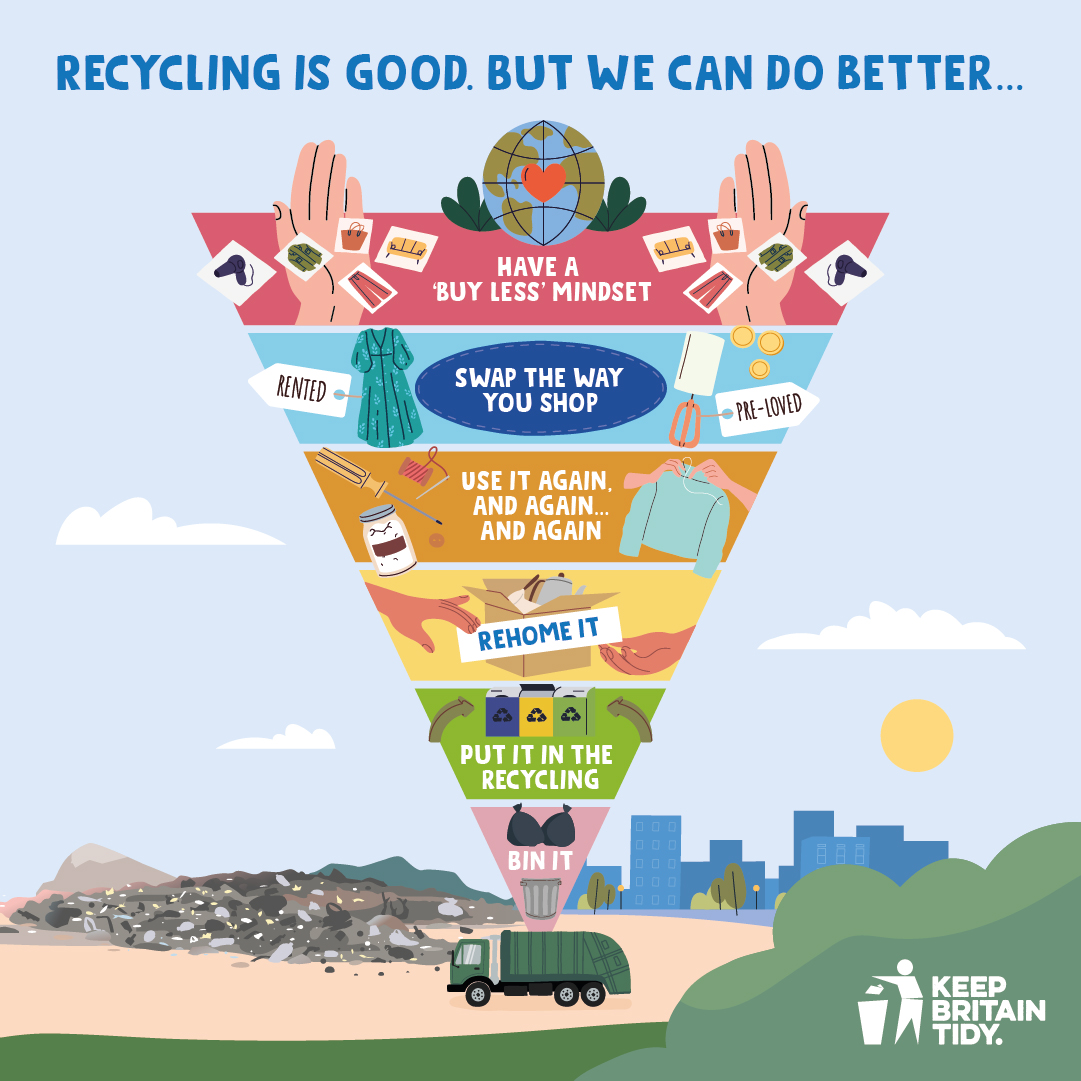
    From KBT’s research, it turns out that the majority of people don’t quite understand the best ways to minimise waste. Anna shares that only 4 in 10 people were able to identify that reduce and reuse should come before recycling. This means that it’s important to be as specific as possible when talking about ways to cut waste.

    “It feels like people don’t really seem to understand waste prevention. It feels like the ‘reduce, reuse’ part of ‘reduce, reuse, recycle’ has got lost along the way somewhere. People don’t seem to understand that reduce and reuse are better than recycling.”

    Other communication tips that Anna shared include: giving people practical solutions; explaining why these behaviours are beneficial; and using more active and specific terms such as, repair, mend, share, rather than words like reuse and reduce. They also found that these communications need to be tailored depending on who you’re trying to reach and at what point in their waste prevention journey they are at.

    Keep Britain Tidy's waste hierarchy

    Upping the profile of repair

    A statistic from the report that shocked us is that only 30% of people surveyed by KBT have heard of renting initiatives like lending libraries, and even less at 27% have heard of repair cafes. While in our own communities, community repair is always top of mind, it’s important to remember that it is still quite a novel concept to most of the British public.

    Anna says that in order to really get waste prevention in the public consciousness and cut through the barrage of advertising people see every day, we need major collaboration between organisations to get these messages amplified. It also turns out people are more likely to listen to charities than the government on these issues – so I guess it’s our job to get this done!

    Links:

    • Keep Britain Tidy’s report and social pack
    • Learn about Buy Nothing New Month

    [Graphics courtesy of Keep Britain Tidy]

    The post Restart Podcast Ep. 94: How to talk about avoiding waste, with Keep Britain Tidy appeared first on The Restart Project.


    Restart Podcast Ep. 93: A 2023 Restart Retrospective Dec 18, 2023
    Show notes

    For our final episode of the season, Ugo and Fiona sat down for a chat about the year that was 2023. From launching the Repair and Reuse Declaration to the biggest Repair Day ever to some major wins for Right to Repair across the world. It’s been an amazing year and we couldn’t have done it without our community here in London and further afield.

    What has been the progress on Right to Repair?

    Gains in Europe

    Ugo talks us through the long list of upcoming legislation that is set to be up to bat next year. This includes new rules surrounding smartphones and tablets; consumer rights; and a repairability index for vacuum cleaners. He notes that its going to be a busy year as campaigners try their best to get legislation passed before the elections shake everything up.

    How are we learning from this in the UK?

    While progress on legislation is slow in the UK, Fiona points a few opportunities in the next year for action. This feels especially possible because of the strength our movement has gained in the UK this year. We’ve spent the year connecting and brainstorming with stakeholders and organisers to develop the Repair and Reuse Declaration which now has over 240 signatories!

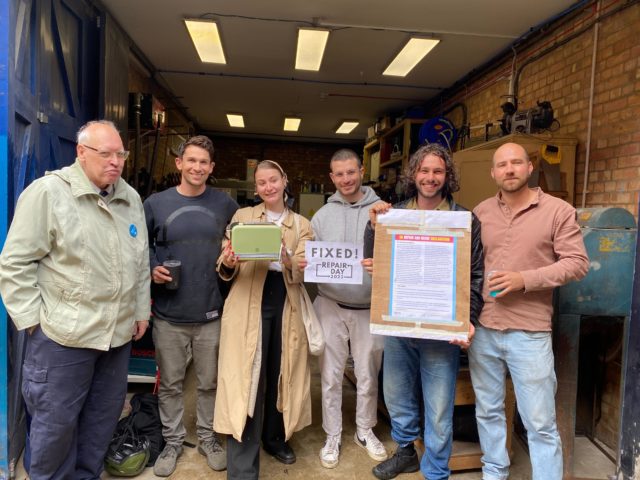
    Repair Day 2023 in London
    Makers Cabinet pose with the declaration on Repair Day

    More developments in the US

    Our allies in the US have been making major waves this year – especially when it comes to state-specific legislation in California and Minnesota. Ugo also covers some developments backed by our friends at U.S. PIRG. They’ve been facing up to huge names like Google and Microsoft. Despite all this success, we’ve got plenty more to do!

    What are we up to locally?

    In London, our network continues to grow with new groups popping up all the time. Fiona shares some examples of unique events that have happened this year. We also look back on the Fixing Factory project which we continued to learn from and hope to develop even further.

    Our Fixing Factory work in Brent also allowed us to undertake some exciting research. We worked with West London Waste Authority to investigate the e-waste that was brought to a recycling centre. The results were shocking but also inspired us to find solutions.

    Our vision for 2024

    Fiona and Ugo share their hopes for the future and our work next year. We foresee some ripe opportunities for campaigning in the UK, with the looming general election. Further afield, Ugo is especially excited to see the repair movement grow across the world – with developments already happening in Taiwan, Columbia, and more.

    Fixfest UK 2023 attendees
    Our community celebrate at Fixfest UK

    Links:

    • Why Google announced Chromebooks will last for 10 years
    • Microsoft offers extended Windows 10 support, with added cost
    • What happened on Repair Day 2023?
    • The Repair and Reuse Declaration
    • What a waste: our study shows almost half of electricals sent for recycling could be reused
    • Open repair reaches a major milestone: over 100,000 records of repair
    • We won the European Union Prize for Citizen Science—Digital Communities Award!
    • Discover the Community Repair Network
    • Read about what happened at Fixfest UK 2023

    [Feature image by Mark A Phillips, licensed under CC BY-NC-SA 4.0]

    The post Restart Podcast Ep. 93: A 2023 Restart Retrospective appeared first on The Restart Project.


    Restart Podcast Ep. 92: Taking repair on the road Nov 30, 2023
    Show notes

    We’re going on a repair road trip this month as we talk to Simon Frémineur and Jinny Uppington about their respective mobile repair initiatives. Travelling repair cafes are a popular idea in our community, with quite a few iterations popping up across the UK and abroad. We speak to our guests about the benefits of a mobile unit, including being able to reach communities who cannot access repair as easily.

    The Repair Café Mobile takes Wallonia

    Simon talks us through the origins of the Repair Café Mobile and the excitement that has surrounded it ever since he first pitched it to Repair Together back in 2017. What started as an idea for his final thesis project is now a popular mobile repair site that we loved seeing in person at Fixfest 2022. He talks us through the four stations of the trailer and how he adapted it to best replicate community repair events – which he’s now been able to take to around 100 events across Wallonia.

    The trailer boasts a whole range of equipment including tools, spare parts, and even a 3D printer! He also tells us about the ways he is considering expanding and altering the trailer such as, a bicycle version for use in more built-up urban areas.

    Reaching rural communities with the Fixy Bus

    Next, we speak to Jinny Uppington, Fixy Lead at Resource Futures. The Fixy van has been travelling all over Somerset to reach those in more rural areas and spread the word of community repair. Jinny tells us about the overwhelming popularity of the Fixy van, with its recognisable graffiti exterior that regularly gets spotted when out and about.

    Not only are they amplifying repair, Jinny tells us about the work that Resource Futures have been doing with Donate IT to tackle digital exclusion. Their tech amnesty initiatives have helped many residents in need, with the over 1,500 devices donated! She stresses the importance of partnerships for this project and it sounds like they have formed a thriving repair ecosystem in Somerset.

    The Fixy van in Yeovil

    Links:

    • The Repair Café Mobile
    • Watch: See the Repair Café Mobile in action
    • The Fixy Project
    • Watch: Learn more about Fixy

    [Feature image courtesy of Repair Together; Diagrams courtesy of Simon Frémineur; Le Repair Café Mobile by Repair Together / Simon Frémineur is licensed under CC BY-NC-SA 4.0]

    The post Restart Podcast Ep. 92: Taking repair on the road appeared first on The Restart Project.


    Restart Podcast Ep. 91: Voices of Fixfest UK 2023 Oct 21, 2023
    Show notes

    On 30th September, over 100 fixers, organisers, researchers, and more from around the UK came together for Fixfest UK 2023! This year’s edition was held in Cardiff and co-organised with our friends at Repair Cafe Wales.

    We spent the day sharing our experiences and expertise on how to build the movement and bring repair to the fore both locally and nationally. It was an incredibly supportive atmosphere, including a session on how to take care of yourself as a repair facilitator.

    In this episode, we wanted to share a taste of the conversations going on on the day. We spoke to 8 Fixfest attendees about how they’ve been uplifting repair in their communities, what they hope for the future, and how we can get repair on the government’s agenda.

    You’ll hear a host of different voices including: Clare Seek from Repair Cafe Portsmouth, and Nicole Barton from Cambridge Carbon Footprint from England; Elaine Brown from Edinburgh Remakery, and Jane Dixon from Share & Repair Network from Scotland; Phoebe Brown from Repair Cafe Wales, and Hayley Roberts from RE:MAKE Newport from Wales; and Chris McCartney from Repair Café Belfast, and Caroline McGuiness-Brooks from Repair Café Foyle in Northern Ireland.

    Repair for Everyone

    On October 21st, we’re marking the seventh International Repair Day. The theme for 2023 is ‘Repair for Everyone’, we wanted to know what this phrase meant to UK organisers. It’s clear that accessibility is key to the answer to this question. We need repair to be affordable and abundant. This includes making an effort to start repair cafés in more hard to reach areas, and also making sure that we considering the global community in this movement.

    “They can come in, watch repair, get the confidence to do it and then make that a part of their lifestyle. So repair cafes are the future, as far as I’m concerned.”

    Hopes for the future

    We hear all about how the different organisations and initiatives are championing repair in their local areas but we also want to know what they hope will happen in the next five years. It turns out, our community has big aspirations. Many say that their main goal is simply to do even more of what they’re already doing – bringing repair to as many people as possible.

    We want to increase the reach of repair projects across the UK. And importantly, Chris emphasises the need to do this in a sustainable way, by finding new partners who can offer support and make repair cafés self-sustaining. Some want to use repair cafés as a vehicle to educate people and spread the message of climate action. What is probably the biggest shared aspiration is that of finding a permanent space for repair projects so the group took great inspiration from a visit to RE:MAKE Newport at the beginning of the weekend and a session on dedicated repair spaces. Almost everyone also wants to grow aspects of their operations, especially by incorporating borrowing libraries into their work.

    How can we engage politicians?

    Another exciting event at Fixfest UK was the unveiling of the new Repair and Reuse Declaration. It’s one of the ways we are taking action to make repair for everyone and demanding that the UK government support repair. Our guests share a host of ways that they’ve engaged their local politicians but what seems to work best is inviting them to an event, repairing something for them and really demonstrating the value of repair.

    “Befriend your local [politicians], get them in so that they can see what you do because once they see your repair cafés and they see what difference it makes to the community and to the environment, they’re going to be blown away.”

    If you want the UK government to take action on repair please sign the declaration as a group or organisation and encourage your local MP to do the same!

    Links:

    • Read more about what happened at Fixfest UK
    • Sign the Repair and Reuse Declaration
    • What’s happening on Repair Day 2023
    • View the global map of Repair Day events

    (Feature image by Mark A Phillips, licensed under CC BY-NC-SA 4.0)

    The post Restart Podcast Ep. 91: Voices of Fixfest UK 2023 appeared first on The Restart Project.


    Restart Podcast Ep. 90: Meet TV’s Retro Electro Workshop ‘super fixers’, Rob Howard and Matt Marchant Sep 28, 2023
    Show notes

    Pinball machines are whirring and circuitboards buzz as we talk to ‘super-fixers’ Rob Howard and Matt Marchant from the TV show Retro Electro Workshop, about the experience of making a show about retro repair and how to encourage more people to repair their things. Retro Electro Workshop features Rob, Matt, and Shamil (who you will remember from our episode about Armstrong Audio) as we watch them dig out broken treasures and repair them to their former glory.

    The ‘warm buzz’ of repair

    It’s hard not to want to dive into repairing your stuff when you hear Matt and Rob talk about it. From the satisfaction of making an antique radio sing again, to the sensory experience of hearing clicking contacts and smelling electrical components firing, it’s clear that they live and breathe repair. The hosts share their favourite repairs from the show including an old pinball machine, wartime radios, and a very sentimental Pinnochio toy. But more than anything, Matt and Rob say it’s the process of repairing they love – no matter the final outcome (though the pinball machine did sound fun to play with).

    The older, the better

    New isn’t always better according to Rob and Matt (and us). While they recognise the limits of old cassette players for example, a lot of older devices were built to last unlike more contemporary gadgets. They tell us about the time when receiving a service manual with your device was the default, and things were designed to be taken apart and repaired.

    “I think people have sort of forgotten that a little bit. We talk about circular economy, we talk about sustainability. But there’s still a lot of people who just think the first thing that happens if their appliance breaks is just to bin it, rather than actually, well maybe there is a repair thats sort of cost effective and sustainable for it.”

    Nowadays, a lack of repair guides and the abundance of glued and teeny tiny parts means that the average person will have a very difficult time repairing their gadgets. Perhaps, having a go at fixing an older item thats been sitting in your attic is a good place to start.

    https://therestartproject.org/wp-content/uploads/2023/09/Retro-Electro-Workshop-Ep5-Matt-Food-mixer-clip.mp4

    Why not give it a go?

    An important lesson for any budding repairers is just give it a go – your device is already broken anyway! Of course don’t go sticking your hands into the back of a radiator, says Rob, but if you take the proper precautions, there’s nothing to be afraid of with repair. Both Rob and Matt believe that repair education should be built into the curriculum in schools so that people can keep repair in mind as a solution from an early age. They’ve already received many letters from viewers who either were inspired to dig out an old toy and fix it up to working condition, and hope that Retro Electro Workshop will inspire you as well.

    Links:

    • All episodes of Retro Electro Workshop are available to stream for free on UKTV Play
    • Fix It Workshop
    • Restart Podcast Ep. 52: Combining nostalgia with the new at Armstrong Audio

    [Images and video courtesy of UKTV’s Retro Electro Workshop]

    The post Restart Podcast Ep. 90: Meet TV’s Retro Electro Workshop ‘super fixers’, Rob Howard and Matt Marchant appeared first on The Restart Project.


    Restart Podcast Ep. 89: What happens to your waste? with Oliver Franklin-Wallis Aug 01, 2023
    Show notes

    In the final episode of our summer season, we talked to author and journalist, Oliver Franklin-Wallis about his new book entitled, Wasteland: The Dirty Truth about What We Throw Away, Where It Goes, and Why It Matters. Oliver spent four years researching waste of all kinds, the people that handle it, and its effect on our planet. Having just conducted our own research into e-waste at a recycling centre, we were excited to learn about a more expansive view of the issue.

    The reality of recycling

    Oliver has been reporting on and thinking about waste for many years, from writing about Project Sword in China to the pollution of our rivers here in the UK. He’s passionate about making the massive issue of human-produced waste more visible to us. Off the bat, he shares some shocking statistics about the amount of waste that we, as a society, throw away each year. In the UK alone, this is ~1.3kg per person, per day. In the US, the number is even higher.

    Perhaps, more shocking than these figures is what Oliver calls “the foundational lie” of our recycling rate as a country. He is far from anti-recycling, sharing compelling figures with us like “an aluminum can that’s recycled, has a 95% lower carbon footprint than one that’s made of virgin materials.” But he points out that the way recycling rates are calculated in the UK is unhelpful in significantly reducing our waste output, substantially overestimating the amount of materials actually recycled.

    “In some cases, half of what we’re saying is recycled is not being recycled at all. A lot of the times we don’t know what’s happening to it when we get there.

    So, it’s insane to me that the government can be slapping us on the wrist for recycling the wrong yogurt pots or putting things in the wrong bins, when the reality is we don’t actually know what’s happening to this stuff.”

    We need more transparency in these processes and to better understand the value of our stuff and as such, put more thought into where it goes if we discard it. Oliver tells us about some ways that the government could more productively tackle recycling such as Deposit Return Schemes.

    What happens to our exported waste?

    While researching, Oliver travelled across the UK and the world including to Accra, New Delhi, and Fresno. He was struck by the differences between Global North and South in resources for treating waste safely and the role it played in each place.

    “Economic inequality, is at the heart of a lot of what we’re talking about when we’re dealing with waste, right? Rich people get to deal with it in an environmentally safe and fair manner, and the Global South overwhelmingly doesn’t.”

    It’s imperative that if we are to continue exporting waste to the Global South, that we ensure it is not harming the people that live there and the exporting of waste is done in a more responsible way.

    Positively, we also discuss how exporting what we call “waste” can often benefit those in countries like Ghana and India. The market for second-hand goods and the efforts put into repairing items means that much of the waste is reused. By looking at how clothing is resold in markets like Kantamanto, or electronics harvested by ‘burner boys’ in the now non-existent Agbogbloshie, and repaired in Accra. We could learn how to think about waste differently and in a more productive way.

    Repairing to reduce waste

    Oliver points out the way that Right to Repair uniquely benefits electronics users in places like Ghana. Here it is even more important that software updates and such are ensured for many years, as the lives of these electronics are being extended beyond their first user. We also discuss the huge issue that is ‘must-shred’ contracts and how an appalling amount of brand-new and usable tech is being shredded constantly.

    As it didn’t make it into the book, Oliver takes a chance to talk about his experience attending a Hackney Fixers Restart Party, praising the positivity and energy. He speaks about the sentimental value of repair and the way it strengthens our connections with our stuff, and unites people across the world.

    Links:

    • Read Wasteland: The Dirty Truth about What We Throw Away, Where It Goes, and Why It Matters
    • The Guardian: ‘I spot brand new TVs, here to be shredded’: the truth about our electronic waste by Oliver Franklin-Wallis
    • More on these topics: Restart Podcast Ep 29: Tracing global flows of electronic ‘discards’ with Josh Lepawsky

    [Feature images courtesy of Oliver Franklin-Wallis]

    The post Restart Podcast Ep. 89: What happens to your waste? with Oliver Franklin-Wallis appeared first on The Restart Project.


    Previous 1 2 3 4 25 Next

    Related Podcasts

    Inside VR & AR

    1

    Inside VR & AR Gadgets
    100 Watts and a Wire

    2

    100 Watts and a Wire Gadgets
    All CNET Video Podcasts (video)

    3

    All CNET Video Podcasts (video) Gadgets
    TechStuff

    4

    TechStuff Gadgets
    The Vergecast

    5

    The Vergecast Gadgets
    Embedded Weekly Podcast – Unknown

    6

    Embedded Weekly Podcast – Unknown Gadgets
    footer-logo

    Contact Us

    Toll Free: 844-670-7747

    Links

    • Home
    • Top Charts
    • Networks
    • Apps
    • Independents Podcasts
    • Podcast Advertising
    • Podcast News
    • Contact Us
    • About Us
    • Analytics & Insights

    Stay Connected

      Privacy, Terms of Use & Our Code of Ethics Protecting Content Creators Copyrights