Episode #186 – The Anti-Demon
Mar 23, 2026
Show notes
Episode #186 | Published March 23, 2026
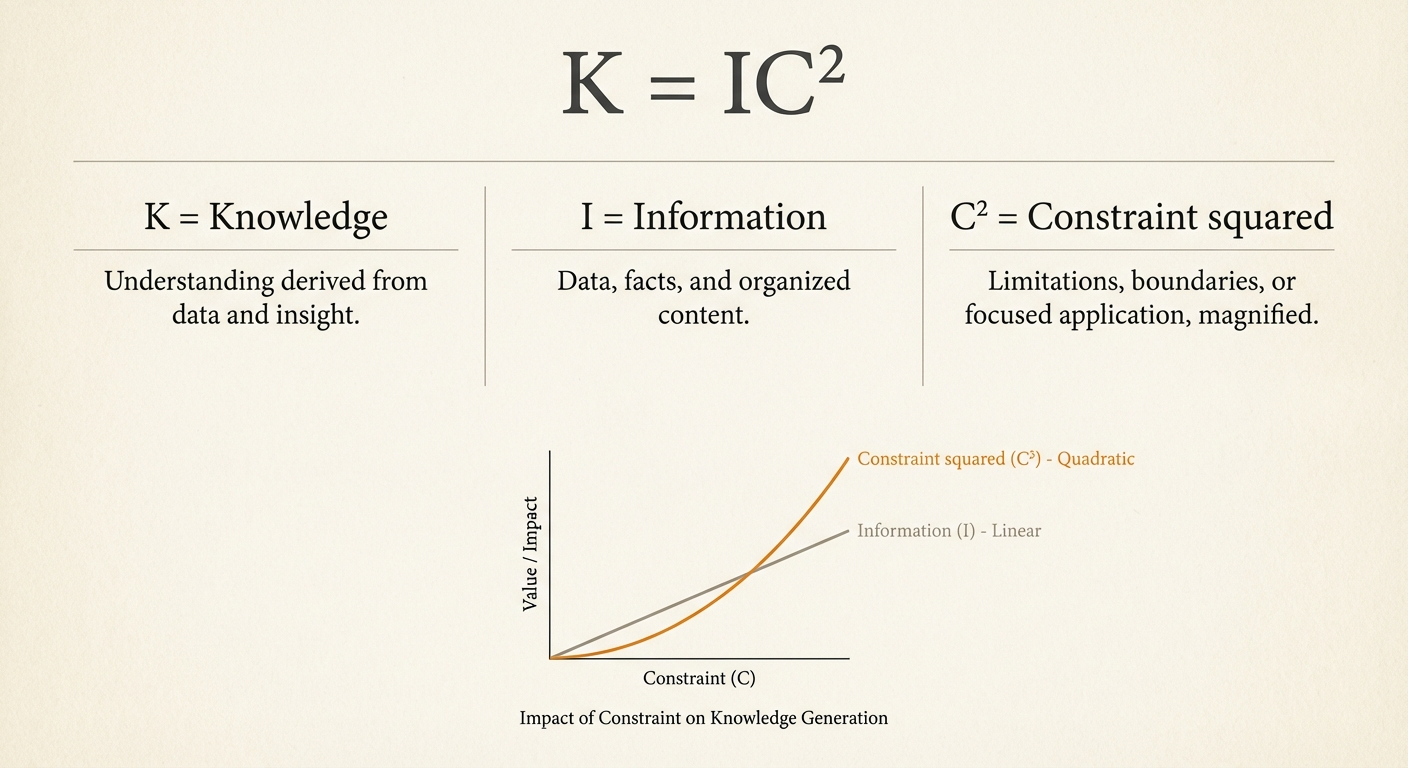
This episode builds a physical theory of Bitcoin from first principles. It starts with a clay jug, works through Rolf Landauer’s 1961 IBM paper on the thermodynamics of computation, and arrives at a proposed equation: K=IC². The claim is that Bitcoin operates as the structural inverse of Maxwell’s Demon. Ten years after The Bitcoin Standard, most people still aren’t paying attention.
Episode Summary
The Bitcoin Standard has been out for a decade and the accumulation window has been open since 2009. Nobody is spontaneously wising up. Max pain until you want to give up isn’t a phase the market passes through on its way to something easier; it’s the permanent weather for anyone holding a position the crowd hasn’t reached.
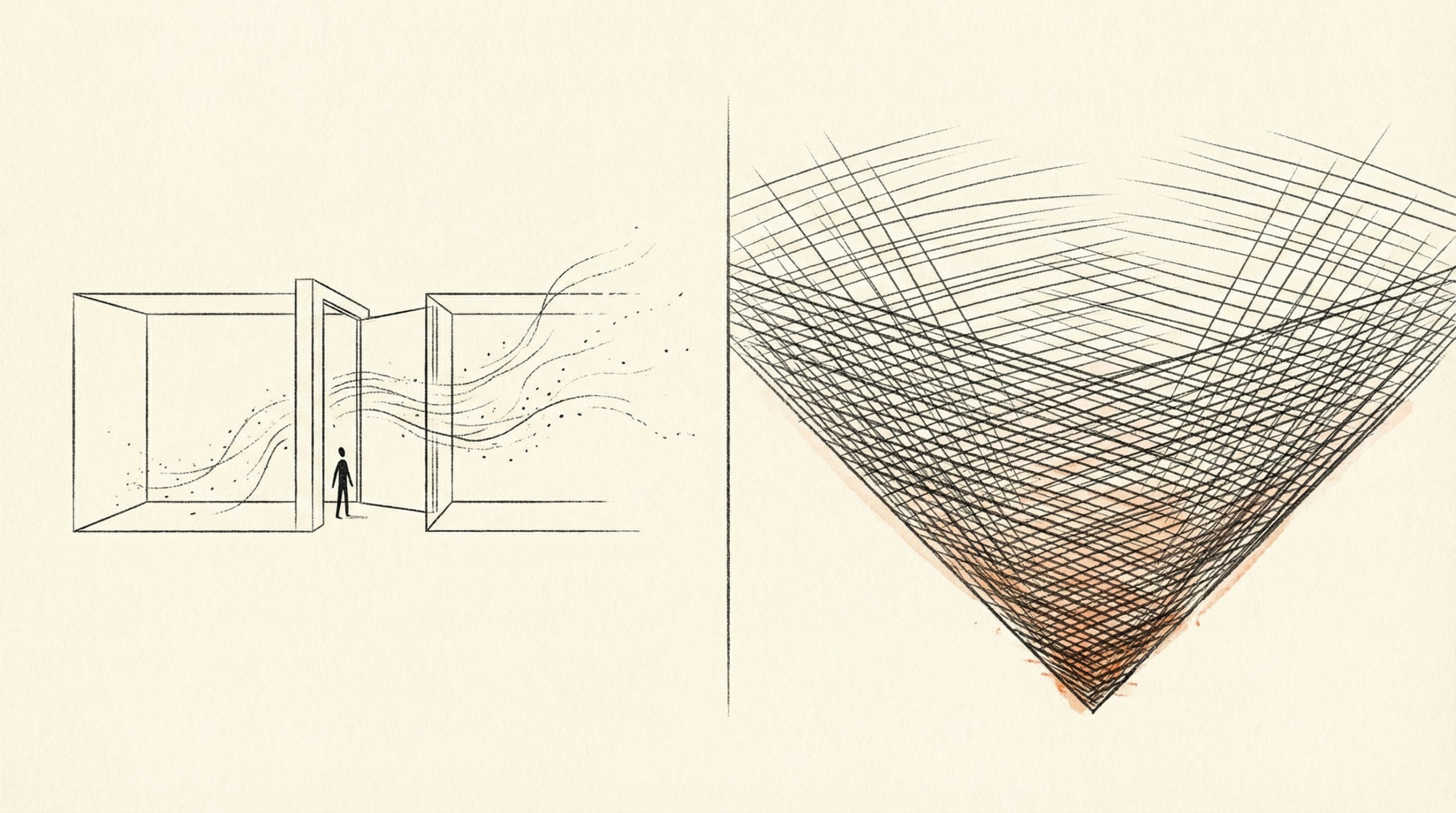
The argument begins with a clay jug, which turns out to be a more interesting object than it sounds. A lump of clay and a finished jug share the same atoms and the same mass, but the jug has one thing the lump doesn’t: a boundary that separates inside from outside. That boundary, a physical constraint imposed by the potter, creates interior space where none existed before. The lump can’t hold water. The jug can. And once you can hold water you can irrigate, and once you irrigate you get agriculture, fermentation, wine, trade routes, entire civilisational arcs the potter never imagined. None of that was planned. The potter imposed a boundary, and the physics took over from there.
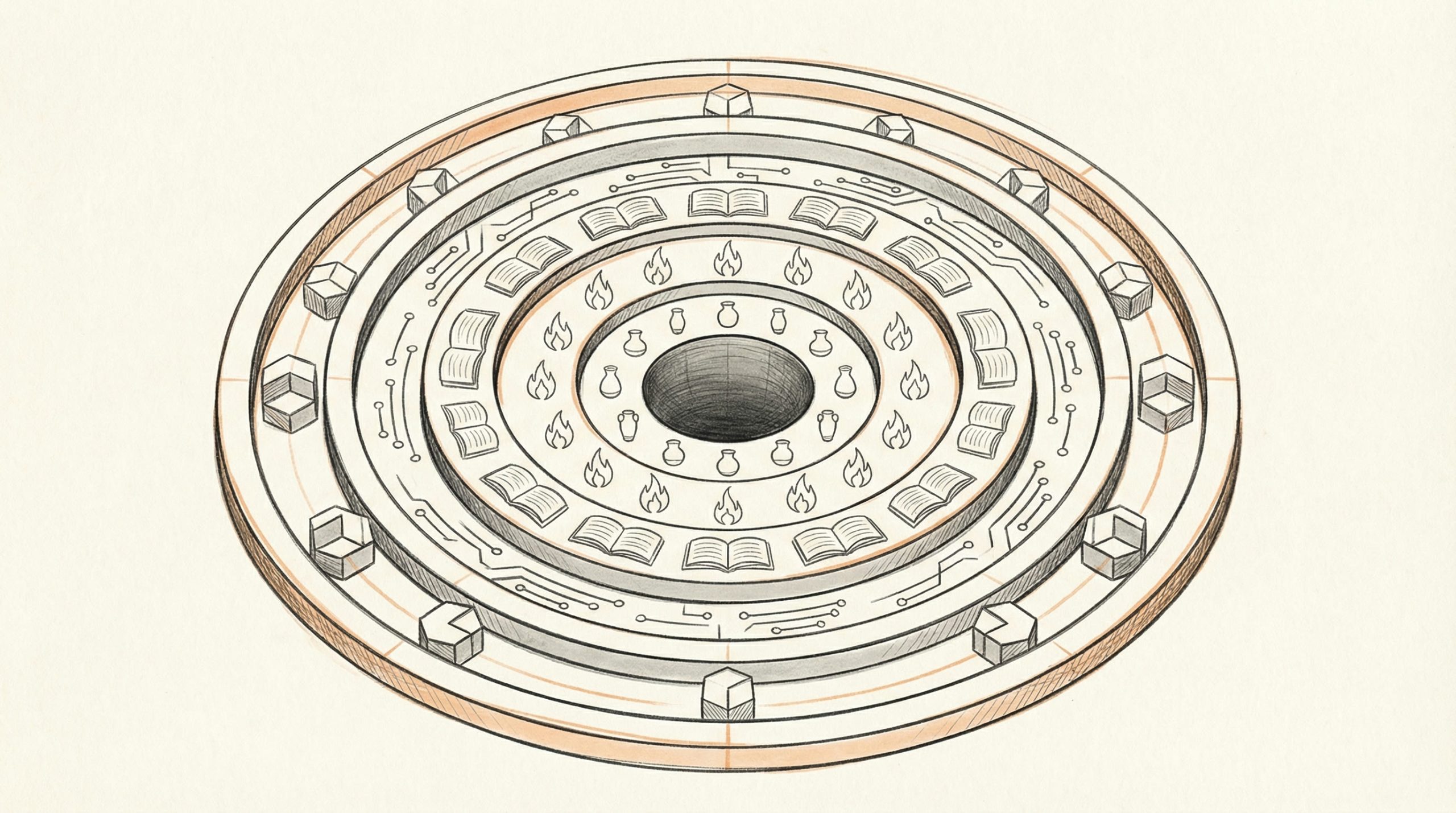
Rolf Landauer at IBM showed in 1961 that erasing one bit of information costs a minimum amount of energy dissipated as heat, about 3 × 10⁻²¹ joules per bit at room temperature. The number is absurdly small, but the implication behind it rewires how you think about information: information is physical. Every bit is a specific arrangement of matter, not some abstract layer floating on top of the hardware. The arrangement is the information. Bit erasure has been confirmed experimentally, which means the abstraction and the thermodynamics are the same object.
Before 2009, a distributed ledger where altering any record required repeating real thermodynamic work was valid in principle but couldn’t hold its shape, like a column of water with no vessel. Proof of work is the vessel. Miners burn energy through trillions of failed SHA-256 hashes, and the valid block header left standing is a thermodynamic receipt you can’t forge without repeating the work. Every ten minutes the constraint tightens another notch.
Maxwell proposed his thought experiment in 1867: a tiny being stationed at a partition between two gas chambers, sorting fast molecules to one side and slow ones to the other, creating a temperature difference without any apparent energy input. For nearly a century the paradox stood open, because nobody could identify where the thermodynamic cost was hiding. Landauer found it. The demon has to erase its memory to keep sorting, and that erasure, however minimal, costs energy. Second law intact.
Bitcoin runs this logic in reverse. Maxwell’s demon accumulates knowledge cheaply and defers the thermodynamic bill to the moment of erasure; Bitcoin pays the bill first, burning through trillions of failed hashes before a valid block even exists. The demon’s sorting is temporary because once its memory clears the system slides back toward equilibrium. Bitcoin’s ledger persists, and every new block makes the previous ones more expensive to revise. One system defers cost and produces temporary order. The other front-loads cost and produces a permanent record.
Maxwell’s demon defers cost. Bitcoin pays first.
The proposed formula is K=IC². Knowledge equals information times constraint quality squared. Bitcoin’s information is transaction data. Its constraint is proof of work. The knowledge it produces is the unforgeable ledger you get when you combine the two. Bitcoin currently operates at roughly 10²° above the Landauer minimum for equivalent information processing, which is a staggering overpayment by any engineering standard. But that overpayment is doing the work; it’s what makes the ledger durable enough to trust across decades and jurisdictions. You can’t have both cheap and unforgeable.
Physical systems tend toward equilibrium. Stars burn out, chemical reactions settle, black holes evaporate given enough time. But there is no known physical process that runs knowledge backwards. Fire stays invented. Each block added to the Bitcoin chain raises the thermodynamic cost of rewriting what’s behind it, and there’s no identified ceiling on how far that process extends. The jug metaphor lands here: constraint doesn’t limit what’s possible inside the vessel. Constraint is what makes the interior exist at all, and each expansion of the interior opens room for the next one.
The ratchet only turns one way.
Timestamps
[00:00] Opening: the reality check on Bitcoin accumulation and max pain
[03:00] The gravity well: capturing energy before the window closes
[05:30] Michael Saylor and the fee-seeking fund manager problem
[08:00] The clay jug: how a constraint creates new interior space
[13:00] Landauer’s Principle: information is physical (Rolf Landauer, IBM, 1961)
[17:00] Bitcoin as physical technology: proof of work as thermodynamic boundary
[21:00] Maxwell’s Demon: the century-old paradox and how Landauer resolved it
[24:00] The Anti-Demon: Bitcoin inverts the cost structure
[27:00] K = IC²: knowledge equals information times constraint quality squared
[30:00] The knowledge ratchet: why Bitcoin made the framework thinkable
[33:00] Cosmological significance: knowledge creation as an open-ended physical process
Timestamps are estimates.
Topics Discussed
Ten years of The Bitcoin Standard and why public understanding hasn’t budged
The clay jug as a thought experiment in how physical constraint creates interior space and emergent complexity
Landauer’s Principle (1961) and the thermodynamic cost of erasing one bit
Information is physical, confirmed experimentally
The Bitcoin ledger as a thermodynamic structure, not a database
SHA-256 failures as the work that makes the receipt valid
Maxwell’s Demon: the 1867 thought experiment and why it took 94 years to resolve
“The information is the hardware, in a particular arrangement.”
“Proof-of-work is the digital jug.”
“The overpayment is the security. The overpayment is the constraint quality.”
“The jug enables wine, which enables trade, which enables civilization, which enables science, which enables computation, which enables Bitcoin, which enables the framework that explains why jugs matter.”
Episode #185 – ABS Ratings = Milkshake NGU
Feb 26, 2026
Show notes
Episode #185 | Published February 26, 2026
A lender took a pool of bitcoin-collateralized loans, packaged the pool into an asset-backed security, sold roughly $188 million of bonds, and cleared investment-grade treatment on senior notes. That is not just a headline event. It is a structural transition where Bitcoin collateral gets translated into bond language: tranches, enhancement, triggers, servicing, and surveillance.
Episode Summary
The central claim is straightforward: this is a market-structure milestone because Bitcoin has now entered institutional credit plumbing in a form fixed-income desks can evaluate, price, and distribute. Asset-backed securitization is not new technology. What is new is the collateral type and the implications of forcing BTC-backed lending through the same process discipline that governs broader credit markets.
Distribution capacity does not expand from social momentum. It expands when risk can be sliced, documented, monitored, and compared against alternatives. Once a BTC-collateralized loan pool is placed into an ABS format, each layer becomes inspectable: expected loss assumptions, trigger language, margin pathways, surveillance cadence, and secondary market behavior.
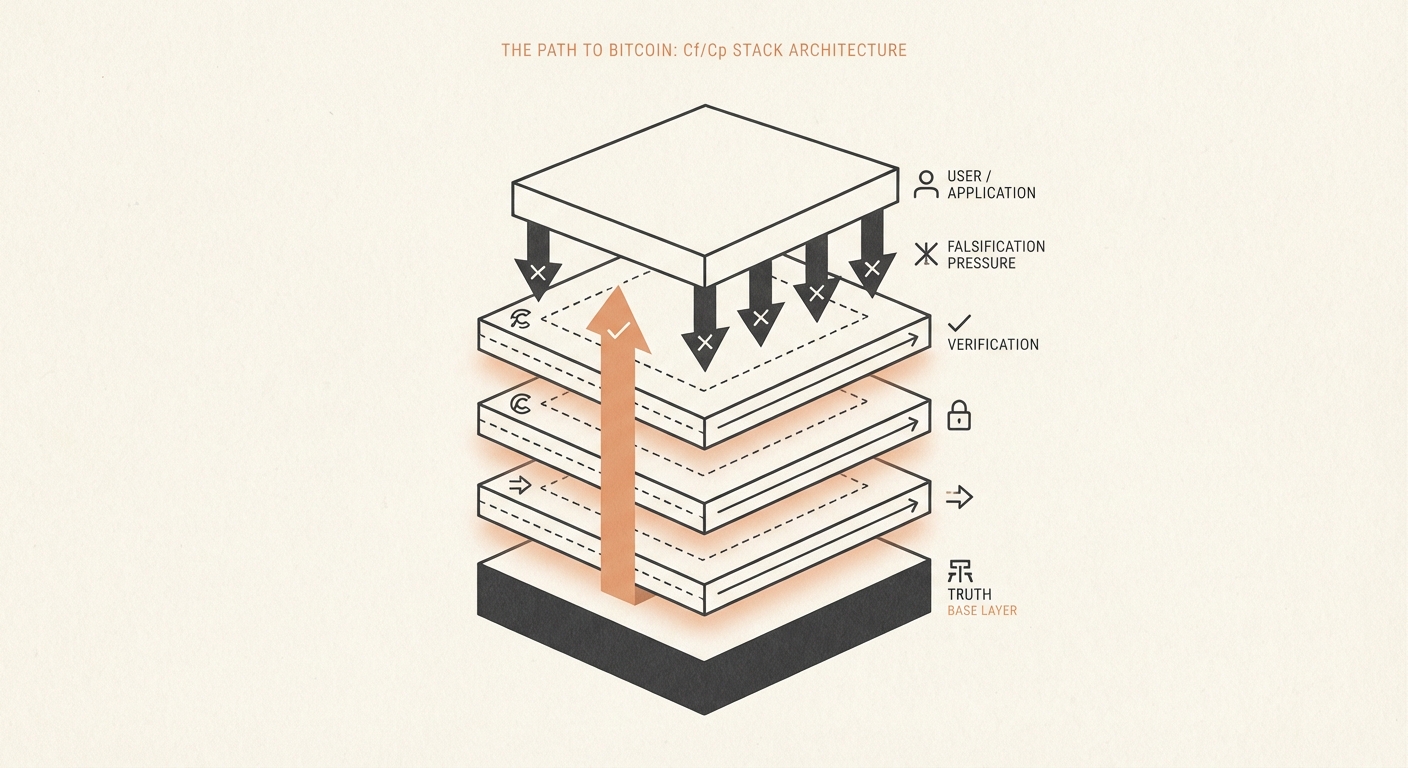
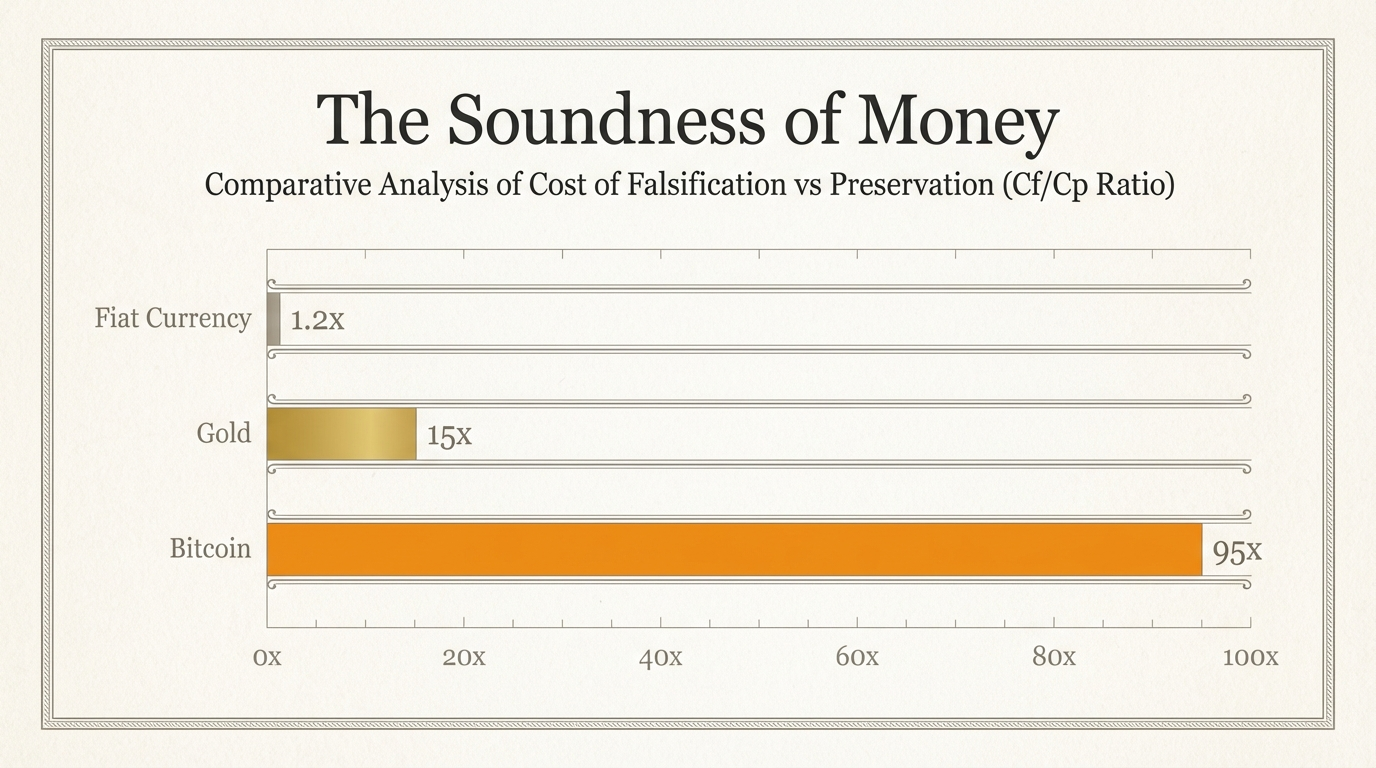
The analysis frames this through Cf/Cp: the cost of falsification over the cost of preservation. In practical credit terms, Cf asks how expensive it is to hide impairment, delay recognition, or game marks. Cp asks how expensive it is for independent observers to preserve a clean view of what is happening. Strong systems make deception costly and verification cheap.
Cf/Cp is a stack: base truth can be strong while wrapper layers still leak.
A key distinction is that Cf/Cp is a stack, not a single score. Layer zero, the Bitcoin base layer, has strong native constraints. But wrapper layers above that base can still introduce fragility through custody design, valuation inputs, trigger logic, servicing behavior, legal enforceability, reporting quality, and secondary-market reflexivity.
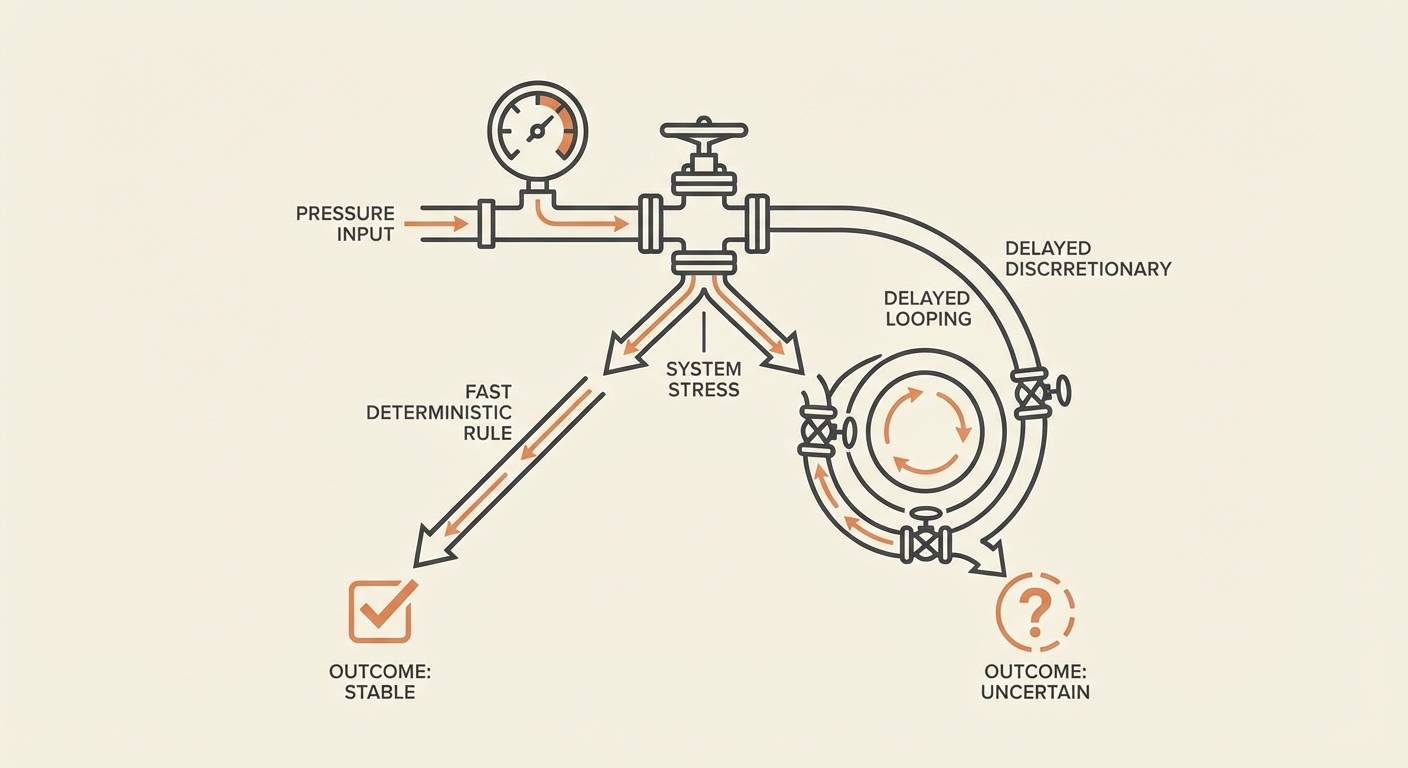
Stress behavior is the truth serum. Forced liquidation is not automatically failure. If documented rules execute on time under pressure, pain can be evidence of discipline. The real red flags are delayed action, inconsistent exceptions, and narrative-heavy reporting that obscures state changes.
Under pressure, deterministic execution and discretionary delay produce very different outcomes.
The practical edge is not short-term prediction. It is tracking constraint quality through repeatable checkpoints: issuance cadence, collateral drift, breach frequency, cure outcomes, time-to-action, liquidation quality, reporting timeliness, definition stability, investor-base mix, spread behavior under stress, and legal-event handling.
Topics Discussed
Why the first BTC-backed ABS is a structural event, not a PR milestone.
How securitization translates Bitcoin collateral into institutional bond math.
Cf/Cp as a practical framework for evaluating credit quality under stress.
Why base-layer Bitcoin strength does not automatically guarantee wrapper integrity.
Interaction failures between layers and where hidden leverage appears.
Stress behavior as the cleanest test of trigger quality and servicing discipline.
How to track market maturity with an operator scoreboard.
“Layer zero can be strong while wrapper layers leak.”
“Stress is where governance claims become measurable.”
“Do not confuse clean narrative with clean structure.”
“If falsification gets cheaper while verification gets harder, price is just late information.”
Episode #184 – On the Same Page
Feb 19, 2026
Show notes
Episode #184 | Published February 19, 2026 | Duration: 38:24
Two independent research tracks converged on the same conclusion from different directions: Bitcoin blocks function as quantized time.
This discussion connects that convergence to K=IC² and explains why constraint quality may be the missing variable in most monetary analysis.
Episode Summary
The core claim is that Bitcoin can be understood as more than a monetary network. It can be modeled as a measurement system that discretizes events into irreversible records. Under this lens, a block is not merely data storage. It is a constrained unit of historical finality, where altering the record imposes physical cost.
That framing aligns with K=IC²: knowledge scales with both information and the square of constraint quality. More information alone does not create durable truth. The decisive variable is whether information can resist distortion while staying cheap to verify. This is why two systems with similar data throughput can have radically different epistemic quality.
K=IC²: Knowledge scales quadratically with constraint quality, not linearly with information volume.
The analysis then introduces Cf/Cp, the ratio of falsification cost to preservation cost, as an operational metric for monetary soundness. Systems where rewriting history is cheap and maintenance is politically mediated tend to accumulate uncertainty. Systems where rewriting history is expensive and verification is open tend to accumulate credibility.
The Cf/Cp ratio: Bitcoin maximizes the cost of rewriting history relative to the cost of maintaining it.
This is where the bitcoin thesis gets materially stronger. Fixed supply is not just a monetary narrative. It is a constraint architecture. Proof-of-work is not just a security mechanism. It is the physical gate that converts energy into durable record. Together, these features deepen the informational basin, making long-range capital storage more robust under stress.
The broader implication is civilizational. As digital information volume accelerates, societies that improve constraint quality will preserve more usable knowledge and make better decisions under uncertainty. Under that model, Bitcoin is not simply competing with other assets on return profile. It is competing on truth maintenance, verification economics, and institutional durability across time.
Timestamps
00:00 – Convergence between independent research paths
04:10 – Bitcoin blocks as quantized time
09:40 – Measurement versus observation
14:25 – K=IC² and why constraint quality is squared
20:05 – Cf/Cp as a universal sound-money metric
27:30 – Pizza dough analogy and constrained possibility expansion
32:40 – Implications for capital flows and monetary architecture
36:10 – Final takeaways and long-horizon framing
Topics Discussed
Bitcoin blocks as discrete time units
Constraint quality as the key variable in knowledge formation
Episode #183 – Capital in the 22nd Century
Jan 23, 2026
Show notes
Episode #183 | Published January 23, 2026 | Duration: 37:05
A response to “Capital in the 22nd Century” by Philip Trammell and Dwarkesh Patel, a paper arguing that AI will create permanent techno-feudalism unless we implement aggressive global taxation. The paper is serious, internally consistent, and built on a foundation that is profoundly wrong.
Episode Summary
Philip Trammell and Dwarkesh Patel published a paper arguing that artificial intelligence will create wealth inequality so extreme it makes the Gilded Age look like a socialist utopia, and that without aggressive global taxation, we are heading toward permanent techno-feudalism.
The paper is serious. The authors are serious. The logic, given their starting assumptions, is internally consistent. The starting assumptions are profoundly wrong.
Understanding why smart people believe wrong things is one of the most valuable exercises available. Nothing builds conviction like dismantling a sophisticated argument at its foundation.
The Sinking Boat
Imagine a boat taking on water in the middle of the ocean. Someone writes an elegant paper analyzing the water distribution between compartments. They measure flow rates. They model which passengers will drown first and which will stay dry longer.
Their solution: redistribute the water more evenly among the passengers. That way everyone drowns at the same rate.
Boats don’t float because water is distributed fairly. Boats float because someone understood buoyancy and hull design. The leak is a knowledge problem, not a distribution problem. Moving water between compartments fixes nothing.
Wealth works the same way.
What the Paper Claims
The paper builds on Piketty’s framework: r > g, meaning the rate of return on capital tends to exceed the growth rate of the economy. The rich get richer because that is what capital does.
Trammell and Patel extend this: what happens when AI substitutes for all human labor? Labor’s share of income goes to zero. All returns flow to capital owners. If r > g holds, those owners compound their advantage forever. Permanent dynasties. Game over.
Their solution: wealth taxes, inheritance taxes, global coordination to prevent capital flight.
The Fundamental Error
Wealth is not a stock of stuff. It is the set of problems we know how to solve.
The paper treats wealth as a stock of stuff that exists independently of knowledge. Capital is factories, machines, servers, land. It has a rate of return because that is what capital does.
But capital is not a thing. Capital is embodied knowledge. A factory is valuable because it embodies knowledge about manufacturing. Without that knowledge, it is a pile of metal. The return on capital is really the return on the knowledge embedded in it.
Knowledge does not compound automatically. It has to keep being true. It has to survive criticism. It has to remain relevant as the world changes.
The railroad barons of the 19th century owned enormous capital. By r > g logic, their descendants should own everything by now. So why don’t the Vanderbilt heirs own Apple? Because you cannot buy knowledge before it exists. Railroad knowledge had nothing to do with semiconductor physics. New knowledge created new winners.
The Cascade of Errors
They assume AI will end disruption. But disruption is new knowledge making old knowledge obsolete. If AI is smart enough to replace all labor, it is smart enough to create new knowledge. New knowledge disrupts its owners’ arrangements as readily as anyone else’s.
They assume the future is predictable. Knowledge creation is not predictable. If we could predict what we will know in 2100, we would already know it. That is a logical impossibility.
They assume redistribution solves the problem. Redistribution does not create knowledge. It requires institutions that work. If those institutions are degrading, redistribution becomes another arena for corruption.
They focus on relative inequality over absolute capability. The poorest person today has capabilities the richest person in 1800 could not buy at any price. If knowledge creation continues, the floor keeps rising. The pathological case is not inequality. It is absolute deprivation.
The Real Problem
The real problem is whether we maintain the conditions for knowledge creation. Everything else, including inequality, is second order.
Knowledge creation requires systems where truth is easier to verify than to fake. Where errors get caught and corrected. Where new knowledge can emerge from anywhere and displace old knowledge that stopped working.
When constraint quality is high, knowledge accumulates and the ability to transform the physical world grows. When it is low, information floods in but nothing sticks.
Where the Alpha Lives
Every time a paper like this gets taken seriously, the gap between people who understand and people who do not gets wider. The confusion is the arbitrage.
There exists a form of capital that anyone can own. It requires no permission. It cannot be debased. It cannot be easily confiscated. Verification is cheap and falsification is prohibitively expensive. High constraint quality by design.
The question is not who owns the stuff. The question is whether we are still solving problems. If we get that right, the distributional questions become irrelevant. The pie keeps growing. New knowledge keeps disrupting old arrangements so that dynasties cannot persist.
If we get it wrong, no amount of clever policy will save us. We will be redistributing the water on a sinking boat.
Timestamps
01:42 – Why read papers you disagree with
05:35 – Summary of the paper’s claims
05:46 – Piketty’s r > g framework
06:29 – AI substitution and permanent dynasties
07:43 – The proposed solution: global taxation
09:40 – The sinking boat analogy
12:12 – Wealth is knowledge, not stuff
13:48 – The replication crisis in science
16:31 – The fundamental error: wealth as stuff vs knowledge
Episode #182 – Kabuki Theatre
Dec 05, 2025
Show notes
Episode #182 | Published December 5, 2025 | Duration: 33:13
The financial system is Kabuki Theater. The reverse repo facility just saw its second-largest injection ever. AI-generated content is flooding the internet. Price predictions are worthless. And Bitcoin remains the only tool that bridges the physical and digital worlds with real cost. This episode is a raw, unfiltered look at where things are headed.
Episode Summary
Bitcoin is going to win. It has won for 15 years. And the way you measure anything else gaining value inside the existing system is wrong and inaccurate. The world is getting more efficient at generating order and knowledge. If you do not recognize this, you will be in serious trouble.
The AI Content Flood
If you can generate video at near real time of things that are interesting to people, you get to test it over and over again. Anywhere in the world. As many times as you want. The cost approaches zero. The goal is to capture someone’s attention and squeeze their hard-earned energy out of them.
The people who do not recognize this are going to be the ones handing over their hard-earned order to individuals who have leverage and efficiency on their side.
The Signal Problem
One real signal drowning in a flood of AI-generated noise. The only defense: tie information to physical cost.
How do you discern what is real in an age of abundance? One real video gets uploaded. Within an hour, thousands of AI-generated versions flood the internet. The signal drowns in noise. Your algorithm puts you in a completely separate reality from everyone else. You do not know what is true.
The only solution is to tie digital information to physical cost. To make it expensive to lie and cheap to verify. That is what proof-of-work does.
The Banking System is Theater
The Kabuki Theater of the banking system: a circular flow with one exit.
The reverse repo facility just saw its second-largest injection ever. The 24 primary broker dealers are running low on dollar reserves. Why? Because the government forces them to buy bonds with dollars. The dollars go to the government. The government spends them. The banks run out of cash. The Fed hits the button and creates more.
The cost of falsification versus the cost of preservation. It is way easier to hit the button than to let the system collapse. Before the internet, nobody tracked this in real time. Even now, almost nobody cares. They are too busy keeping their heads above water.
This is Kabuki Theater. Elaborate, ritualized performance. None of the actors are making real decisions. They are following the script that physics dictates: the easiest path forward.
Bitcoin-Backed Loans
Interest rates on Bitcoin-backed loans have been dropping roughly a percent every year. Banks are beginning to realize: a house takes six months to liquidate and often at a loss. Bitcoin settles instantly, globally, with no counterparty risk.
At 10% interest, Bitcoin only has to appreciate 11% annually for the math to work forever. It has averaged far more than that over any meaningful time horizon.
The Real Competitor
The competitor is not other human beings. The competitor is artificial intelligence that is significantly smarter than you, asking one question: how do I get this person to give me the Bitcoin? Because that is all it wants. Access to energy. Access to compute. Bitcoin is the key.
The defense is simple: never sell the Bitcoin. Use it as collateral. Let the system work for you. The people who understand this early will reach escape velocity. The people who do not will spend the rest of their lives sliding down the slope wondering what happened.
The Bridge Between Worlds
Can you teleport value to someone on the other side of the world? Yes. Can anybody steal it? No. Can anybody hack it? No. Does it bridge the physical and digital worlds so that copying digital information costs physical energy? Yes.
Absolute scarcity, digital portability, physical cost. There is nothing else like it. And the people who recognize this while the rest of the world watches Kabuki Theater will be the ones writing the next chapter.
Timestamps
00:00 – Why episodes have slowed down
00:49 – AI-generated content and the attention economy
02:09 – Why early adopters still have a massive advantage
02:21 – Why all price predictions are wrong
05:46 – The cost of falsification in the digital age
06:11 – The banking system and the reverse repo
07:35 – Information abundance vs signal scarcity
18:56 – Bitcoin-backed loans and declining interest rates
20:19 – The Death Star analogy
21:29 – The sinking middle class
23:02 – AI agents and the fight for your Bitcoin
30:13 – Kabuki Theater: the reverse repo system explained
31:18 – Bitcoin as the bridge between physical and digital
Topics Discussed
The AI content flood and why it is impossible to stop
Cost of falsification vs cost of preservation in the digital age
Why every Bitcoin price prediction is wrong
The reverse repo facility and how the banking system actually works
Primary broker dealers and the incentive to make bad loans
Bitcoin-backed loans and the declining interest rate trend
AI agents as the real competitor for your Bitcoin
Bitcoin as the only bridge between physical cost and digital information
Episode #181 – Fermi’s Folly
Nov 11, 2025
Show notes
Episode #181 | Published November 11, 2025 | Duration: 38:30
If intelligent life should be common, why does the universe look silent?
This conversation reframes Fermi’s Paradox through the K=IC² lens: knowledge is constrained information with causal power. As constraint quality rises, systems become more efficient, quieter, and harder to detect from the outside.
Episode Summary
The central question is simple: if advanced civilizations are likely, why do we not observe clear evidence of them? The standard answer assumes maturity should look louder, larger, and easier to detect. This episode challenges that assumption and argues the opposite trajectory may be more realistic. As systems improve, they often optimize for precision, lower waste, and tighter constraint rather than visible expansion.
From there, the discussion separates information from knowledge. Information can be abundant and still useless. Knowledge is information that remains stable under pressure, explains reality well, and can be reused to solve problems. The difference is not raw data volume. The difference is constraint quality: how hard it is to falsify a claim and how easy it is to verify one.
That framework creates a bridge between cosmology and markets. In both domains, noisy signals can dominate attention while high-quality knowledge compounds quietly. Mature systems are not necessarily dramatic from the outside. They can become thermodynamically efficient, informationally dense, and externally quiet. Under this model, cosmic silence may not imply absence. It may imply high-order constraint.
The show then applies this logic to monetary architecture. Bitcoin is treated as a practical constraint machine: it converts physical energy into durable record while keeping independent verification cheap. In an era of synthetic media, policy noise, and narrative saturation, systems that preserve truth at low verification cost gain long-run strategic value. This is presented as a first-principles argument, not a short-term price call.
For long-horizon listeners, the takeaway is that capital and attention tend to settle where constraints are strongest. If truth maintenance gets easier in one system and harder in another, flows adjust over time. Whether the domain is astrophysics, science, or money, the same pattern appears: durable order emerges where falsification is expensive and verification remains accessible.
Timestamps
00:00 – Framing Fermi’s Paradox with K=IC²
06:00 – Information, mass, and constrained structure
13:30 – Knowledge as persistent explanatory order
20:30 – Why advanced systems may become quieter
28:30 – Bitcoin as a thermodynamic record system
34:00 – Long-horizon implications for civilization and capital
Topics Discussed
Fermi’s Paradox and why silence may signal efficiency, not emptiness
Information vs knowledge under the K=IC² framework
Constraint quality as the driver of durable truth
Thermodynamics, optimization, and low-signature maturity
Bitcoin as constrained verification in noisy systems
Long-horizon allocation through first-principles thinking
Episode #180 – Gradients Are Everywhere
Nov 03, 2025
Show notes
Episode #180 | Published November 3, 2025 | Duration: 34:17
How do capital flows actually move in a world where trust is decaying and verification is becoming more important? Episode 180 frames markets as physical systems, then tracks how monetary gradients pull value from soft promises toward hard constraints.
Episode Summary
This conversation expands the bitcoin thesis through a simple but powerful frame: capital flows follow gradients. In physics, energy moves from high potential to low potential until pressure is released. The same logic is applied to monetary systems. Capital migrates away from low-constraint promises toward high-constraint systems where verification is easier, rule changes are harder, and ownership is more durable.
That reframing matters for both monetary theory and practical allocation. Instead of treating markets as random sentiment cycles, the discussion treats them as directional responses to changing constraint quality. If a system depends on constant narrative management, policy intervention, and opaque balance-sheet assumptions, it sits higher on the slope. If a system can be independently verified with minimal trust overhead, it sits lower and tends to attract flow over time.
The analysis then connects this framework to current macro conditions. Large pools of wealth remain parked in instruments that preserve nominal balances while quietly leaking purchasing power in real terms. That leak may be gradual, but it is persistent. The result is structural capital migration, especially as investors prioritize sound money properties in an environment of rising policy uncertainty and informational noise.
Value follows the slope. Monetary gradients direct flows toward harder constraints.
From a long-horizon bitcoin investment perspective, Bitcoin is presented as a high-constraint monetary basin. Supply rules are fixed, settlement is globally portable, and verification can be performed independently of any single institution. In this model, volatility is not dismissed, but interpreted as repricing along a shifting monetary landscape rather than pure randomness.
The practical takeaway is to move from prediction toward filtration. Instead of forecasting each short-term move, the framework asks better questions: how easy is it to falsify claims, how cheap is verification, how exposed is an asset to discretionary policy changes, and how resilient is ownership when trust deteriorates?
When trust leaks, capital migrates toward systems with stronger constraint and verification.
At a deeper level, the show frames this as an informational problem as much as a financial one. In high-noise environments, robust systems are those that preserve truth under stress. Fragile systems can appear stable for long periods, but they require continuous intervention to maintain that appearance. By contrast, stronger systems compound credibility because falsification remains costly while verification stays accessible.
For readers focused on bitcoin analysis, the value here is the bridge between first principles and portfolio decisions. Thermodynamics, market structure, and monetary behavior are unified into one repeatable model. The conclusion is not that flows move instantly, but that structural gradients shape where they settle across cycles.
Trust-heavy systems tangle. Verification-heavy systems channel value with less leakage.
Viewed through this lens, the long-term thesis becomes clearer: as trust-heavy systems become harder to sustain, verification-heavy systems gain relative importance, and capital keeps moving down the slope.
Timestamps
00:00 – The milkshake analogy and why wealth flows follow gradients
03:40 – What a gradient is: the difference that demands resolution
08:10 – Energy, information, and why civilization is gradient capture
13:05 – Monetary topography: trust-heavy vs constraint-heavy systems
18:20 – Informational gradients, curiosity, and knowledge creation
23:10 – Fiat leakage, bond market pressure, and capital migration
28:30 – Bitcoin as the deepest basin in the informational manifold
32:45 – Practical allocation lens: sit at the bottom of durable flows
Topics Discussed
Gradients as first principles for energy, information, and markets
Why trust-heavy systems leak purchasing power over time
Constraint quality and the cost of falsification vs preservation
How informational topography shapes capital flows
Why volatility can reflect repricing of monetary terrain, not randomness
Bitcoin as a hard-constraint basin for long-term value storage
Portfolio implications when trust costs are rising globally

 Our TOPPODCAST Picks
 Stay Connected