The Lonely Voice: 'The Typewriter' by Dorothy West
Sep 09, 2026
Show notes( Anchor Books )
A man spends his days as a janitor, but in his imagination, he is someone else.
In Dorothy West’s “The Typewriter,” a young girl’s typing exercises give her father an unexpected escape from the disappointments of his life.
As Millie takes dictation, her father invents letters from a persona he creates — one “J. Lucius Jones” — a wealthy businessman who speaks the language of success, power and money. For a few minutes at a time after work each day, the drudgery of his real life falls away. He is no longer the man who cleans buildings and struggles to make ends meet. He is the man he once imagined he might become.
It is a beautiful and painful premise for a story — and an astonishing one for a writer who was only 17 when she wrote it. “The Typewriter” tied for second place with a story by Zora Neale Hurston in the 1926 fiction contest sponsored by Opportunity magazine, and its publication helped propel West into the literary world of the Harlem Renaissance.
But the story is less interested in success than in the psychology of failure. West gives us a man who has spent years adapting to a life that feels smaller than the one he once imagined. His fantasy is modest, almost absurdly so — and yet it sustains him.
Then the typewriter disappears.
What happens to J. Lucius Jones then?
West reveals just how much of a life can be invested in a fantasy, and how devastating it can be when that fantasy is taken away.
And why does this man invest in that imaginary world? Why does anyone? Why indeed?
On this episode of The Lonely Voice, we look at Dorothy West’s remarkable early story —and the lonely, fragile man trying to become someone else — word by dictated word.
Dorothy West is the author of "The Typewriter." It appears in the collection The Richer, The Poorer: Stories, Sketches and Reminiscences.
The Lonely Voice: 'Able, Baker, Charlie, Dog' by Stephanie Vaughn
Aug 26, 2026
Show notes <i>Sweet Talk</i> by Stephanie Vaughn( Other Press )
Some stories about childhood are really stories about the adults we become — and about the things we understand differently when we look back.
Stephanie Vaughn’s “Able, Baker, Charlie, Dog” is a beautifully complicated story about memory, family and a daughter trying to understand her father. The story’s narrator, Gemma, looks back on her childhood as the daughter of an Army officer, moving with her family from place to place. Her father is a larger-than-life figure: intelligent, demanding, funny, unpredictable and deeply interested in language and the world around him.
He is an intensely curious man. He teaches Gemma the military alphabet — Able, Baker, Charlie, Dog — and, in many ways, he becomes the force around which the family revolves. His career falters. His marriage becomes strained. And the qualities that make him fascinating — his precision, his force of personality, his insistence on order — can also make him frightening and unpredictable. He drinks. His temper can be frightening. His ambitions and disappointments affect everyone around him.
What makes Vaughn’s story so compelling is that she doesn't reduce her father to either a good man or a bad one. Instead, she allows him to remain complicated. The adult narrator can recognize things about her father that the child she once was could not. But that new understanding doesn't erase the affection, confusion or even wonder she felt as a child. She tries to hold all of him in her memory — the brilliant man, the difficult man, the father she loved and the father she couldn't always reach.
And that may be what makes this story feel so true. Memory isn't a neat record of what happened. It's something we continually revise as we grow older, adding context to moments we once couldn't understand.
Vaughn's prose is funny, precise and deeply observant. She captures the strange intimacy of family life — the private language, rituals and memories that can seem ordinary when we're living them and become almost mythic when we look back.
“Able, Baker, Charlie, Dog” is ultimately a story about a daughter trying to see her father clearly — and discovering that seeing someone clearly doesn't necessarily mean arriving at a simple answer.
Andrew Porter joins Peter Orner and Yvette Benavides to discuss “Able, Baker, Charlie, Dog” by Stephanie Vaughn.
Stephanie Vaughn is the author of the story “Able, Baker, Charlie, Dog” from the collection Sweet Talk.
Guest: Andrew Porter is the author of five books, including “The Imagined Life” and “The Disappeared.” He is a professor of English and director of the creative writing program at Trinity University in San Antonio.
The Lonely Voice: 'The Claw' by José Emilio Pacheco
Aug 12, 2026
Show notes
Perhaps one of the hardest things to live with is the life we imagine we might have had. We can spend years looking at someone else and wondering what they were given that we were not — beauty, love, opportunity, happiness. And over time, that comparison can become its own kind of prison. José Emilio Pacheco’s “La Zarpa,” or “The Claw,” is a haunting story about what happens when envy takes hold of a life and refuses to let go.
The idea is profound not because it’s complicated, but because it resonates. It’s profundity lies in that resonance. It gives language to something deeply human that most of us recognize but rarely articulate.
Pacheco was one of Mexico’s most important writers of the 20th century — a poet, novelist, essayist and translator whose work often looked closely at memory, childhood, aging and the ways people make sense of their own lives. In “The Claw,” he turns his attention to something much more ordinary — and perhaps much more dangerous: envy.
At the center of the story are two women whose lives become intertwined from childhood. One is beautiful. The other is not. One seems to receive all the things the world has to offer — attention, affection, opportunity — while the other watches from the margins.
And what begins as a childhood comparison becomes something darker over time –a very long time.
What makes this story so compelling is that Pacheco doesn't give us a simple villain. Instead, he asks us to sit with an uncomfortable question: What happens when we spend our lives measuring ourselves against someone else? When admiration becomes resentment, and resentment becomes a way of seeing the world?
“The Claw” is also a story about the stories we tell ourselves. We can spend decades building an explanation for why our lives turned out the way they did — and sometimes that explanation becomes more powerful than the truth.
So we’ll have to talk about the unreliable narrator here. But it’s an idea that serves our discussion here. The narrator may be unreliable not because she deliberately deceives us, but because she has become the author of her own version of the past.
There’s something almost fairy-tale-like about the story, but its emotional territory is painfully familiar. Most of us have known envy. Most of us have compared ourselves to someone else. And most of us, at one time or another, have wondered what our lives might have looked like if we had been given someone else’s face, someone else’s luck, someone else’s life.
That’s where Pacheco’s claw finds us.
Today, on The Lonely Voice, “La Zarpa,” or “The Claw,” by José Emilio Pacheco.
The hosts discuss the translation by Francisco Fenton.
The Lonely Voice: 'The Boat' by Alistair MacLeod
Jul 15, 2026
Show notes <i>Island: The Complete Stories</i> by Alistair MacLeod ( W. W. Norton & Company)
What do we inherit from the places we come from?
A landscape. A language. A way of seeing the world. Maybe even a sense of who we are meant to become.
In Alistair MacLeod’s short story “The Boat,” a young man grows up on the rugged coast of Cape Breton Island, where his family’s life is shaped by the sea. The ocean provides for them, but it also demands something in return. It becomes a symbol of the ties that hold a family together — and the forces that can pull them apart.
MacLeod was known for writing about communities caught between tradition and change. His stories explore the tension between loyalty and independence, between the lives we inherit and the lives we imagine. “The Boat,” first published in 1968, captures a deeply human struggle: honoring where we come from while finding the courage to choose our own path.
At the center of the story is a son shaped by his family’s complicated relationship with the sea. His mother loves the ocean and the life it represents, while his father is a fisherman because of tradition and expectation, even though he seems drawn to books and a different kind of life. The son grows up caught between those worlds — connected to his family and his home, but also wanting to find his own path.
That conflict is familiar across generations and cultures. Many of us know what it means to feel connected to a place, a family or a history while wondering whether we are meant to follow a different path. Leaving can feel like a betrayal. Staying can feel like a sacrifice.
MacLeod’s writing is quiet and thoughtful. He brings the world of the story to life through the sound of the wind, the work of fishing, and the silence between family members. He invites us to think about the choices that shape our lives.
“The Boat” is also a story about memory. It is told by a narrator looking back, trying to understand the people and experiences that formed him.
As we know here on The Lonely Voice, sometimes the stories that stay with us are not the ones that give us answers. They are the ones that leave us with questions.
On this episode of The Lonely Voice, we’ll explore "The Boat," Alistair MacLeod’s story about family, identity, ambition and the powerful ties between a person and the place they call home.
The Lonely Voice: ‘Asigh’ by Mary Lavin
Jun 04, 2026
Show notes( Scribner)
The focus on this episode of the podcast is a masterclass in domestic tension and psychological confinement: the 1959 short story "Asigh" by the incomparable Mary Lavin.
If you are new to Mary Lavin, you are in for a revelation—and we think you will become a fan of her work.
She wrote at a time when Irish literature was heavily dominated by male perspectives — writers like Joyce and Beckett. Lavin carved out her own space where she could build worlds around the inner lives of women.
The story centers on a young woman living under the thumb of a controlling father. For the simple sin of seeking a brief moment of human connection — of speaking to a young man the father deemed unsuitable — the protagonist faces a punishment from him that leaves her physically maimed.
What makes Lavin a true master of the form is her refusal to shout. That’s a recurring theme for us here on "The Lonely Voice." There is no need to shout. We take our explosions in small doses that are no less devastating for being subtle.
"Asigh" operates in the quiet spaces, the heavy silences, and the subtle shifts in domestic power dynamics. Lavin blends a deep human sympathy (the main character feels things deeply) with an unflinching realism (the main character is surrounded by hardship).
In this episode, we unpack how Lavin uses the rugged Irish landscape to mirror a type of imprisonment the protagonist endures. We'll see how this character endures the loneliness of the physical space and maintains a longing for connection. We will marvel at Mary Lavin's "arrow in flight."
Mary Lavin is the author of "Asigh."
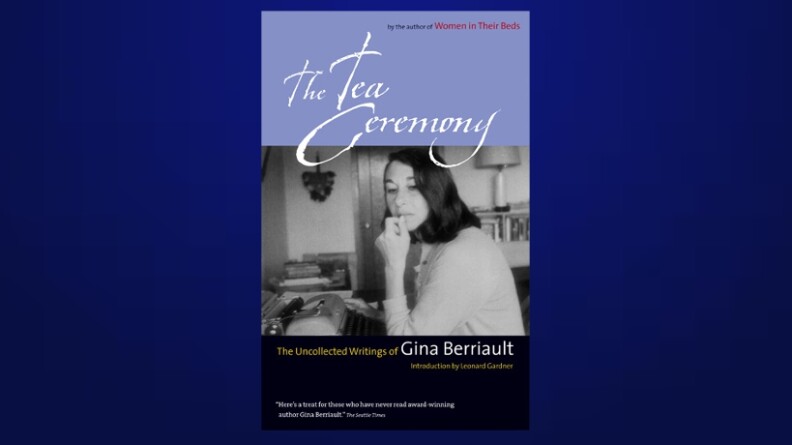
The Lonely Voice: ‘The Tea Ceremony’ by Gina Berriault
Apr 22, 2026
Show notes <i>The Tea Ceremony: The Uncollected Writings of Gina Berriault</i> ( Counterpoint Press )
Texas Public Radio had the rare and wonderful opportunity to host acclaimed author Peter Orner at a special event last January. After over five years of collaborating on "The Lonely Voice," we were all in the same room — in person — while discussing his latest novel, "The Gossip Columnist's Daughter." We also recorded a couple of episodes of "The Lonely Voice."
We always go back to short stories. We had to. How often does one get to sit in the same room with Peter Orner and talk about stories? For this special time together, there was one author we had to make time for — Gina Berriault.
If you’ve listened to this podcast before, you know that we love short stories and that the stories of Gina Berriault are some of our favorites. They sort of set the standard.
We’ve covered a few of her stories over the years, including “Stolen Pleasures,” a story about two sisters — Fleur and Delia.
This time we are talking about “The Tea Ceremony,” and it features the sisters in their childhood. Front and center is Delia. She’s a noticer. She's bright and observant — even if she is rather shy and doesn't have any friends.
But right under everyone else's nose is the fact that the teacher, Miss Ferguson, considers Jolie Lotta something like her pet, a favorite student. Delia easily surmises that what’s behind this is Jolie’s beauty. And her mother, Adrianna is beautiful, too.
A tea ceremony occurs in the story — a ritual-filled spectacle that is so sublime that Delia feels like she would like to capture its beauty by drawing it. But she can’t muster a way.
And then she considers her own family situation, her "rain-stained bungalow," her blind mother and the disarray and disorder that can’t be helped along in her family.
Years later, she is still thinking about the ceremony and what the idea of beauty can really mean to her.
There is a lot going on here with the idea of beauty — not just for some aesthetic quality or as something life-saving, a transformative force that allows us to transcend a "world awry" or a life full of compromise. She can escape the confines of her past and the expectations of that life and make her own way, shape her own identity — through her appreciation of beautiful things. It is a means of future for herself—one she feels she can choose for herself.
The Tea Ceremony is a story collection that was compiled by Berriault's daughter and her partner, Leonard Gardner, following her death in 1999, and is celebrated for its spare, elegant prose.
As we’ve said before on this podcast, and as Peter Orner surmises, Berriault has a knack for taking ordinary characters and situations and imbuing them with a fullness and a dignity — that maybe all the rest of us want and deserve, too. There is something powerfully emotional in that.
This is the way that Berriault manages her characters, these outsiders, suffering the losses of goals that they can’t quite name but that they hunger for just the same. That’s how Delia feels about beauty — about harnessing it in some way, if only for a little while.
We believe this is precisely what Berriault does with her story writing. She captures the beauty inherent in people's lives. An ordinary world is never just that. Or it is — and there is beauty there, too.
How fortunate we all feel to have been in the same room with Peter Orner. And then to have the opportunity to discuss a story by Gina Berriault? Well—how lucky can we lonely voices be?
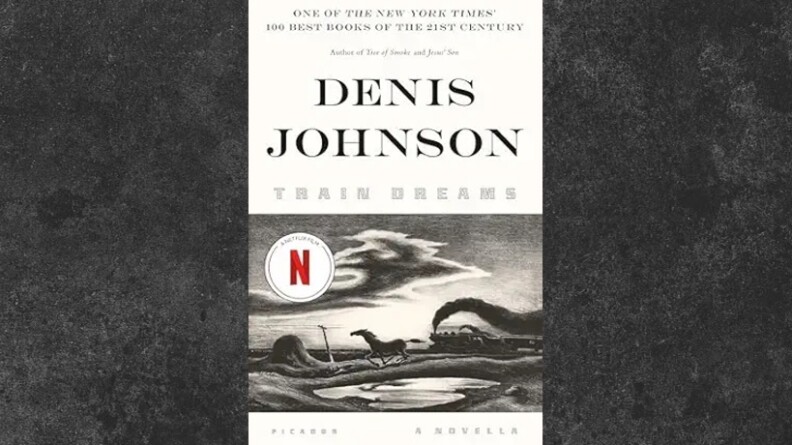
The Lonely Voice: 'Train Dreams' by Denis Johnson
Mar 29, 2026
Show notes <i>Train Dreams</i> by Denis Johnson ( Picador Paper )
Alex Gordon, a Chicago-based editor and journalist, joins the program.
He is the perfect guest host to join The Lonely Voice for an episode about Train Dreams by Denis Johnson.
This is a podcast where we celebrate the short story. That means we explore the worlds that authors build in just a few pages. We’ve taken that idea to heart so much, we’ve even veered before into one episode about poetry.
Every once in a while, a piece of fiction comes along that is too complex for a single story, yet too distilled to be an expansive novel. It lives in that haunting middle ground genre of the novella.
A book that many critics call the "perfect novella" is our focus today. We’re talking about Denis Johnson’s Train Dreams. Originally published in The Paris Review and later a finalist for the Pulitzer Prize, this slim volume manages to pack an entire American century into just about 116 pages. It’s a story that doesn’t just sit on your shelf; You don’t forget about it after you close the book. It lingers in your mind like a dream.
Doesn’t it stand to reason that someone would eventually adapt a movie from the novella?
Train Dreams is the story of Robert Grainier, a laborer in the American West during the early 20th century. We follow him through the logging camps and the construction of the Great Northern Railway. But this isn’t just a historical chronicle. It’s a meditative, even disorienting journey through grief, isolation, and the terrifying beauty of a wilderness that is slowly being erased by progress.
We’ll be discussing Denis Johnson’s impressionistic storytelling, how we drift through time and memory. He shows us a man who survives unspeakable tragedy only to become a ghost in his own life — or to quietly and temperately resist that fate.
Alex Gordon enlightens us on some of the back-story of Denis Johnson’s research for the book. And we’ll see how those elements and scenes figure in the film.
Clint Bentley directed the movie and co-wrote the screenplay with Greg Kwedar. Joel Edgerton plays Robert Grainier.
We’re not film experts, but we love movies —especially those inspired by short works of fiction —or that lend themselves to a podcast like ours where we just want to talk about stories. You know us —that’s what we’re all about.
Whether you have read the book ten times or have seen the movie three or four times — or are hearing about them for the first time today, grab a coffee and settle in. Let’s head into the Idaho Panhandle.
Denis Johnson is the author of Train Dreams.
GUEST: Alex Gordon is a Chicago-based editor and journalist, who most recently has detoured into the realm of marketing and media services.
The Lonely Voice: 'Gómez Palacio' by Roberto Bolaño
Mar 15, 2026
Show notes Roberto Bolaño
On this episode Peter Orner and Yvette Benavides discuss the story “Gómez Palacio” by Roberto Bolaño.
This is a story selected by Peter Orner for this episode. It’s a curious choice — but not altogether surprising as it seems to be a favorite story for the legions of aficionados of Bolaño’s stories.
For many of us, the favorite Bolaño story is any one that we happen to be reading.
In “Gómez Palacio” an unnamed protagonist is far from home in the country of Mexico — specifically the town of Gómez Palacio where he is staying briefly to conduct workshops with a handful of students — none of whom he is terribly impressed with.
A friend named Montero is mentioned — but we don’t know a lot about him, except that he works for the arts council that helped the main character find this gig. And we can also assume that he is someone who sort of understands the protagonist’s temperament.
A character we do see is the director of the arts council. She is described candidly as "plump" and in other ways that are not so flattering — if only a little tactless.
But this is the way the protagonist surmises everyone — including his young charges.
The director picks up the writer every single morning in a boat of a sky-blue car.
They sit together and have coffee, and she tells him that her husband does not seem to understand the life of the writer.
His perspective is how sad everything seems. He thinks that he is “confusing sense with sensitivity.”
The writer has trouble sleeping. He has nightmares.
He includes odd details about being very thirsty –and the ways that keeps him awake. His solution is to drink water, but then having to get up to go to the bathroom becomes a problem, too. Everything is kind of awful for him.
But think about this: How is it that if things were so awful when he was 23 — all these small moments of things he considers with disdain — why have they become such deep memories, recalled with yes, a tactlessness — but wrapped around a wistfulness, too, and a beauty that he finally gives over in a very particular way to Gómez Palacio.
The Lonely Voice: 'Berries' and 'At Night' by Varlam Shalamov
Feb 01, 2026
Show notes Kolyma Stories by Varlam Shalamov(NYRB )
On this episode, Peter Orner joined us in person in the TPR studios in San Antonio.
On this episode Yvette Benavides and Peter Orner discuss stories by the Russian writer, Varlam Shalamov.
He was a journalist and a writer. In 1936, he was arrested for counterrevolutionary activities and sent to the Soviet Gulag. After surviving 15 years in prison campus, he was released and would go on to write short fictional stories that reflect the years he spent in the Gulag.
The New York Review of Books (NYRB) published Kolyma Stories, in 2018. The translation is by Donald Rayfield. This volume, along with a second titled Sketches of the Criminal World with a translation by Alissa Valles, make up the first complete English translation of Shalamov’s stories— the only ones based on the authorized Russian text.
As remarkable as this access to these stories 90 years after Shalamov was first arrested, is how they can still matter so much.
In 1951, when he started writing, Shalamov was focused on a particular place and time — not as a journalist, but as a story writer.
He brings such humanity to the telling, a poetry to the descriptions of the place, the hunger of the people, the uncertainty and the fragility of life that ruled the day.
For us in 2026 there are still challenging themes to understand — about persecution and inhumanity.
But there is far more than that, and we find that we are moved by glimmers of resonance and of hope and light in the most abject and distant of places.
Peter Orner and Yvette Benavides discuss “Berries” by Varlam Shalamov. They also reference the stories “At Night” and “RUR.” All of the stories can be found in the collection, Kolyma Stories — translated by Donald Rayfield and published by New York Review of Books.
The Lonely Voice: Four stories by Mavis Gallant
Jan 11, 2026
Show notes Mavis Gallant( Knopf )
This is a special 50th episode of the podcast. To celebrate, we have one of our favorites — Mavis Gallant — and not just one, but four stories.
There’s a series of four Mavis Gallant stories that might be presented to us in various sequences and that feature the stories of three characters — "Edouard, Juliette, and Lena."
We hope that’s clear. Four stories. Three characters. Edouard narrates throughout.
It starts with “A Recollection” a rather vague title for a story that establishes a lot that’s going on during a contentious time in occupied France.
Edouard tells of his marriage of convenience with Magdalena. Whose convenience is it? She is over ten years older than he is. She is originally from Hungary and a Jewish convert to Catholicism. She avoids deportation thanks to her marriage to Edouard. But while he finds her cosmopolitan and curious in her choice to be ignorant about politics, they part ways.
Another woman in his life appears in “The Colonel’s Daughter” and in “Rue de Lille." Her name is Juliette.
Edouard has been on some adventures and Juliette — still a tender-aged teen — visits him in the hospital. She is a lonely girl — an only child whose father has been lost in the war and whose mother remains distant and aloof.
In Edouard she finds a cause. In her, he finds someone to take care of, a woman-child.
But it’s clear, his attempts to blunt the sharp edges of her loneliness, fall short. And as she grows older, it is as if he has stayed just exactly who he has always been. And through it all, she is the polar opposite of the Magdalena with her expensive, sophisticated attire and Chanel perfume.
Juliette would like to have children. There is even a name for an imagined child. But Magdalena will not give Edouard the divorce that would allow him to marry Juliette and have a child.
But that’s not quite the point, as we discuss in our conversation.
Everyone gets older in this series of stories. Things outside the characters change. Technologies take hold. Conventions change. Wars begin. Other wars begin. Disasters change the landscape.
But the tiny stories we carry around with us that come from exactly who we are at our core — are immutable — for better or for worse.
Mavis Gallant is the author of "A Recollection,” “The Colonel’s Daughter, “The Rue de Lille,” and “Lena.”

 Our TOPPODCAST Picks
  Stay Connected