The Lonely Voice: 'Out with the Old' by Richard Yates
Dec 28, 2025
Show notes
“Out with the Old" by Richard Yates is a New Year's Eve story.
It's set on December 31, 1950, in the tuberculosis ward of Mulloy’s Veterans Hospital in New York.
Tiny and Jones are patients in the ward — of building seven, to be specific. And it's worth noting. They are in a building that's set apart from the other veterans.
In the hospital where each day is like the next, they want to break up the monotony of things during the holiday season.
At the appointed time, Tiny (whose nickname is ironic) will come out in only a towel made to look like a diaper and parade around looking like Baby New Year.
But they need someone to look like Father Time.
One patient they settle on is McIntyre. And even though he’s only 41 years old, he looks the part — gaunt, grey-haired and haggard. The problem is — he won’t do it.
And then we learn about his recent visit home. The complicated reentry for him is compounded by the fact that he has been in the hospital a long time — years, in fact.
The alienation from the family, the isolation that the hospital engenders — along with the fact that he seems to know he is quite ill — combine to make him want to keep to himself.
He is also consumed with the idea of writing a letter to his daughter — the objective for which is not certain. And when the mystery of this particular activity grows, an unexpected shift occurs in the story.
New Year’s Eve can be a fraught time in the best of circumstances. For McIntyre — as aloof as he is in the hospital, as distant as he is from his family, and as squarely he is coming to terms with the facts of his life — it becomes an opportunity that no one really expected.
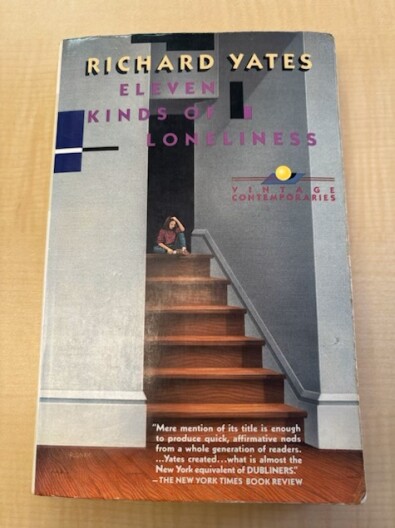
Richard Yates is the author of "Out with the Old." It can be found in the collection "Eleven Kinds of Loneliness."
The Lonely Voice: 'The Loudest Voice' by Grace Paley
Dec 21, 2025
Show notes Grace Paley
We are excited and happy to be talking about a Grace Paley story again. And it’s one we bring to you to coincide with the holidays.
Shirley Abramowitz is the “voice” of the title. She is “the loudest voice” in the school. The sixth-grade teacher, Mr. Hilton, knows this about her, indeed summons her and gives her the role of a kind of narrator of the Christmas pageant.
Never mind that Shirley is Jewish—as are many of the other kids in the program. For her, as we see, it is quite enough to be included, to be counted, to be taken as someone with skills and talents — never a fool.
And that’s not even the biggest conflict here. Her mom isn’t too thrilled with the way the school makes all the kids participate in the holiday program — without considering their religious backgrounds and beliefs. It’s a tension that’s on a low simmer, but Shirley will have to figure out how to adjust and stay true to who she really is.
This story has been often anthologized, but we want to shine a light on its ubiquity — not just as a Christmas story but as a really great story — for any time of the year — any day at all.
Because we are talking about Grace Paley, we’ll talk about voice. We’ll also read a paragraph or two — or three. With Paley, you read the words, and you read them aloud — and delight in them.
The Lonely Voice: 'Fun with a Stranger' by Richard Yates
Dec 07, 2025
Show notes Richard Yates
Yvette Benavides and Peter Orner discuss “Fun with a Stranger” by Richard Yates.
As with a previous episode, the focus again is a school story — with a teacher and her third grade class.
In the previous episode, William Maxwell’s “Love” helped us see the ways a protagonist learned a lesson about love through his fifth grade teacher, Miss Vera Brown. He learned about love — that it blooms in beautiful and unforgettable ways. Miss Brown was pretty, gentle, and compassionate. The protagonist feels a kind of love from her — and for her.
This time, we see another teacher, Miss Snell, who might seem the polar opposite of Miss Brown. As we discuss here, Miss Snell isn’t all that lovable. She’s an older woman who is described as having a homely smile and mannish features. She’s also tough on her students, even keeping to the regular school day schedule on the last day before the Christmas holiday.
But there are lessons to be learned in this story, too, about love — about compassion. Yates is known for presenting characters in all too real ways that we might interpret as cruel perhaps. Not all teachers are physically attractive. Not all of them are good at throwing little parties or choosing gifts for young children. Miss Snell is set in her ways. She is doing what she knows how to do — and is just who she is — despite what day in December it might be.
And she is as unforgettable as Miss Vera Brown in that other story. Miss Brown was isolated from her students at the end. She died alone. Miss Snell seems to go through her life alone. But her kind of loneliness is something quite else.
And it’s only a writer like Richard Yates who could compose the stories in Eleven Kinds of Loneliness and create the taxonomy of people bereft of love or of friendship — or even of a kind of kinship with the itinerant group of third graders who want to forget about their teacher over Christmas or after the third grade.
Miss Snell will make an indelible imprint and remain almost like a word in their vocabulary — part of the language they will always speak. “And that’s just the way it is with words,” as Miss Snell said.
Richard Yates is the author of "Fun with a Stranger." It can be found in the collection Eleven Kinds of Loneliness and in The Collected Stories of Richard Yates.
The Lonely Voice: ‘Love’ by William Maxwell
Nov 16, 2025
Show notes William Maxwell
What do you expect from a short story with such a title as “Love”?
It’s not about familial or romantic love. It isn’t about a friendship either.
This is a story about a teacher. Sure, the narrator seems to have been infatuated with the teacher—a young woman named Miss Vera Brown—when he was in the fifth grade.
His nostalgic recollection of her classroom imbues here with a kind of saintliness. She was angelic in his telling.
And then something happens and the boy must learn a difficult lesson about what ends up happening when we have love, give love, are loved.
In this discussion, Peter Orner and Yvette Benavides also make mention of Charles Baxter and his ideas of what he calls “the half-known world.”
This is the way we come to know characters in stories. They are only half-known to us. And it's enough. It's necessary.
This is how we know our teachers, after all. They stand before us—fully who they are as teachers.
But who they are and what they do outside of the classroom is not known to us.
And the mysteries inherent in the relationship we have with our teachers take on even more significance in a story like this one by the great William Maxwell.
Find the story in "All the Days and Nights: The Collected Stories" by William Maxwell.
The Lonely Voice: 'Panteón de Dolores' and 'Emergency Room Notebook, 1977' by Lucia Berlin
Nov 02, 2025
Show notes Lucia Berlin (Buddy Berlin )
Reading the stories of Lucia Berlin can be an intense experience. The pacing of each moves with suddenness but then also lingers for brief moments of beauty and light juxtaposed with something unseemly and sad.
Characters want connection and love—and sometimes settle for something else that can lead to bad decisions—broken hearts, addiction.
Generally acknowledged are the autobiographical details in Berlin’s stories—the alcoholism and addiction, the humor and the heartbreak.
In the two stories we cover in this episode—"Panteón de Dolores" and "Emergency Room Notebook, 1977"—there’s family dysfunction and tragedy, too, set against the backdrop of another country and its culture and rituals or a hospital—another place with its protocols and routines. Except within all that can be expected in these settings there is something totally new to make us pay attention to situations and people to whom we might never have given a second thought.
Lydia Davis has long championed the work of Lucia Berlin, noting her awe of the natural world, the suddenness in the prose, her pacing, dialogue, characterization, a romanticism that is cut off by realism.
There are brutal elements in these stories to be sure. Berlin is unflinching. She is also compassionate, depicting again and again the beauty that can coexist with human frailty, the tenderness that twins with toughness, and the fullness of life that can be measured in sudden, small moments.
The Lonely Voice: 'The Rain' and 'Elegy of Fortinbras' by Zbigniew Herbert
Oct 26, 2025
Show notes Zbigniew Herbert
On this episode, Peter Orner and Yvette Benavides welcome the poet Nicholas Regiacorte to the Lonely Voice clubhouse to discuss two poems by Zbigniew Herbert— “The Rain” and “Elegy of Fortinbras.”
Grace Paley famously compared poetry to short fiction.
She once wrote that, "A short story is closer to the poem than to the novel (I've said that a million times) and when it's very, very short... should be read like a poem. That is slowly."
The reverse can be true, and a poem can be read like a story.
So it stands to reason that when Orner and Benavides had a chance to break all the rules and invite a poet to discuss poetry on a podcast that is a celebration of the short story, it wasn’t a big lift. It was, in fact, kind of perfect to be able to welcome in Nicholas Regiacorte to discuss two poems by Zbigniew Herbert.
Herbert was a poet and a prose writer. He was born in 1924, and his work was shaped by the upheaval caused by World War II and the subsequent Soviet-imposed communist rule in Poland.
He is known for having taken a moral stance against totalitarianism. He is also known for his poetic alter-ego, "Mr. Cogito." His style combines contemporary concerns, irony and allusions to critique oppressive systems.
But you don’t need to know any of this to appreciate his poetry—particularly the two poems selected by Nicholas Regiacorte and Peter Orner for this very special episode of The Lonely Voice.
Zbigniew Herbert is the author of “The Rain” and “Elegy of Fortinbras.”
Nicholas Regiacorte(S. Regiacorte)
Guest: Nicholas Regiacorte
Nicholas Regiacorte is a transplant to the Midwest, having spent his childhood in Maine, high school and college in the South. After grad school at the University of Iowa and a Fulbright year in southern Italy, he settled with his family in Galesburg, Illinois. His poems have appeared in Copper Nickel, Mary, New American Writing, Descant, Bennington Review, Colorado Review, Verse Daily, Dialogist, Tupelo Quarterly, Peripheries, and elsewhere. A finalist for numerous prizes, including Rescue Press, New Issues, and Cleveland State’s first book prize, American Massif is his first book. He currently teaches at Knox College, where he directs the Program in Creative Writing.
The Lonely Voice: 'The Death of Elsa Baskoleit' and 'Parting' by Heinrich Böll
Oct 19, 2025
Show notes Heinrich Böll
On this episode, Peter Orner and Yvette Benavides discuss “The Death of Elsa Baskoleit” by Heinrich Böll. And stay tuned for a bonus discussion about another Heinrich Böll story, “Parting.”
On "The Lonely Voice" podcast, where we celebrate the short story, we were bound to get around to Heinrich Böll. What took us so long? He was a master of the 20th century short story–and he was prolific.
He was German and chronicled World War II, the bleakest of postwar years, but also the rebirth and prosperity of the country over the next three decades.
His themes can be rather bleak — about the hypocrisy of governments, about alienation. But in his short stories he also endowed his characters with a sense of decency and dignity—and of an understanding that they deserve good things in this life, that, in fact, they should want those things for themselves.
Böll was considered one of the greatest German writers and he was awarded the Nobel Prize in Literature in 1972.
We see in his stories the need he felt to center the moral duty of writers to address social and political issues of their time. But like all of the great masters of the short story, his stories are for all time — even today, perhaps especially so, for us Lonely Voices.
"The Death of Elsa Baskoleit"
In the story “The Death of Elsa Baskoleit,” the protagonist describes the rather neglected neighborhood where he grew up. Mr. Baskoleit was a grocer. He puts on as if he has no patience for the children who run around making noise. He grunts and complains, but he gives them apples to eat—an important act of kindness.
The protagonist is taken with the nightly view he has of the grocer’s daughter, Elsa–clad in green and pirouetting at the window. He is entranced. Soon, he comes to see that the neighbors don’t like what they see. There is something vulgar or unseemly they find in her dancing.
The boy’s family moves away from the neighborhood. Years pass. A war comes—a long one. And on the occasion of his return to the old building as an adult he learns of Elsa’s death.
What happens next is an echo or homage to Anton Chekhov’s story “Misery,” but Böll’s story must be taken on its own. This particular situation of a parent losing a child is so beyond imagining, so beyond language or words. It can only be articulated as a story — in a fiction — for the rest of us to understand what it means to be bereft, what it means to lose almost everything and let that loss color every interaction—for all the years to come.
“Parting”
Maybe we’ve all had this kind of situation with someone — a friend or loved one or lover — where we’ve said our solemn goodbye and braced ourselves for a parting. But then we’re still standing around together, standing at the gate or the platform … or maybe the car won’t start and we keep on saying good bye, keep making small talk as if we’ve just met, only occasionally dipping into the ancient history, remarking on a happier moment, a shared laugh, a time when saying goodbye didn’t even seem like the final chapter we’d ever have to write.
Heinrich Böll is the author of “The Death of Elsa Baskoleit” and “The Parting.”
The Lonely Voice: 'Nine Months Since Forever' & 'The Giver of Nicknames' by Rémy Ngamije
Jul 25, 2025
Show notes
On this episode of The Lonely Voice, super special guest, Rémy Ngamije, joins in to discuss his story, “Nine Months Since Forever” found in his collection Only Stars Know the Meaning of Space: A Literary Mixtape. We also share a short bonus conversation about another story, “The Giver of Nicknames.”
Rémy Ngamije is an award-winning Rwandan-born Namibian author.
He's also the author of the award-winning The Eternal Audience of One and the book we’ll talk about today.
Only Stars Know the Meaning of Space is his collection of award-winning fiction. The subtitle of the book is “A Literary Mixtape.”
The first story we’re discussing is “Nine Months Since Forever.”
It puts us in the mind of stories by Raymond Carver that explore the themes of friendship and marriage among the working class and characters who struggle with disillusionment and communication that sometimes falls short.
We imagine people always make comparisons between Ngamije and other great authors.
But these stories are in a class by themselves, partly because they are set in Namibia, a country on the southwestern coast of Africa.
But even for American audiences the characters and situations can also be very familiar.
Case in point, “Nine Months Since Forever.” The parenthetical subtitle of this one is “(Cicero’s Interlude)”.
Cicero is our protagonist and first-person narrator. He tells us about the ways that “marriage gives you someone to blame” when you have to miss a night out with the friend group.
The thing is Cicero loves his wife, Nicole. She is his friend. His person. But Cicero is torn between this reality in his life and another one—the grip that his friends have on him. Nicole seems true blue. Loyal.
But this is also how Cicero describes Rambo. He’s a guy who “keeps showing up to serve in the trenches of our lives, throwing himself on grenades and carrying the wounded across mine-ridden marshes with bullets zipping past him,” says Cicero.
It’s also Rambo, out of all the guys in the group, who really knows that Cicero loves Nicole. And it’s also Rambo who says that Nicole makes Cicero feel “loved.”
“That’s why we call Rambo the Sage,” says Cicero, because “he’s the only one brave enough to use cataclysmic words like love."
Rambo was his best man when he married Nicole. And he invited the “other guys” to the wedding “to keep the peace.”
It’s the other guys who perhaps don’t have the words or the understanding about this big life transition that Cicero has made. And their inability has a gravitational hold on Cicero. It’s a part of him he has trouble shaking off. He recognizes that even though they are past the games and carefree days of childhood and are men now, they were “still in the same place” in many ways.
Cicero is still growing into his married life. But he doesn’t mind it at all. He really enjoys it. There are things he cannot admit to his friends about this part of his life.
Says Cicero in the story, “I found myself with Nicole, and now I’m not so sure if the squad and I are still down for life. I mean, I’ve already promised this life and the next to my wife.”
And yet, in the critical moment when Cicero must defend his wife and his new role as her husband, Cicero does something that shows this dilemma, this duality that continues to bring tension to his friendships, his marriage.
Listen in as The Lonely Voices discuss two stories by Rémy Ngamije.
Rémy Ngamije
Rémy Ngamije is an award-winning Rwandan-born Namibian author, editor, publisher, photographer, literary educator, and entrepreneur.
His books include The Eternal Audience of One—which was honored with a Special Mention at the inaugural Grand Prix Panafricain De Litterature and won the inaugural African Literary Award from the Museum of the African Diaspora—and Only Stars Know the Meaning of Space, his collection of award-winning fiction.
In 2021 he won the Africa Regional Prize of the Commonwealth Short Story Prize and was shortlisted for the AKO Caine Prize for African Writing in 2021 and 2020. He was longlisted and shortlisted for the 2020 and 2021 Afritondo Short Story Prizes respectively. In 2019 he was shortlisted for Best Original Fiction by Stack Magazines.
Rémy is the founder and chairperson of Doek, an independent arts organization in Namibia supporting the literary arts and the editor-in-chief of Doek! Literary Magazine, the country’s first and only literary magazine. He is also the founder and director of several literary initiatives such as the Bank Windhoek Doek Literary Awards, the Doek Literary Festival, and the Doek Anthology.
His fiction, nonfiction, and poetry have appeared in The Johannesburg Review of Books, Lolwe, American Chordata, LitHub, Granta, One Story, and Best American Essays 2024 among many others.
More of his writing and complete publishing history can be found on his website: remythequill.com
The Lonely Voice: 'The Origin of Sadness' & 'Real Losses, Imaginary Gains' by Wright Morris
Jul 18, 2025
Show notes
On this episode we’re talking about Wright Morris. We’ll focus on two of his stories from his Collected Stories: 1948-1986, published in 1986.
We’ll start off with “The Origin of Sadness”—and then stay tuned for a short bonus conversation about “Real Losses, Imaginary Gains.”
My own fascination with Wright Morris started probably 30 years after this story collection was published. He was prolific and published novels, memoirs, stories, and even photography and had a long career in writing that started in the late 1940s.
But it was, I believe, 2016 when I first read an essay by Peter Orner about Wright Morris. It was in Orner's memoir in essays, "Am I Alone Here?” Notes on Living to Read and Reading to Live. The story by Morris he wrote about was “A Fight Between a White Boy and a Black Boy in the Dusk of a Fall Afternoon in Omaha, Nebraska.”
I confess I wasn’t familiar with Morris’ work before this.
He may not be the most popular writer. However, he is for me now, of course, the kind of writer that Orner and I adore—perfect for this podcast.
What is it that we love? Well, as Orner said in his essay, “No writer I could name builds his prose so completely around answerable questions.”
Orner discerns this quality in Morris’ novel Plains Song (different from Kent Haruf’s Plainsong).
Says Orner, “[He] specializes in what I’ll call inarticulate wonderment.”
I remember being struck by this description. “Inarticulate wonderment.” His characters walk around in this state of awe that is difficult to articulate but is also something we recognize.
There’s a strangeness in these stories. But it isn’t weird for weird’s sake. There isn’t anything gratuitous here. By its very definition, strangeness is just out there, different, odd, peculiar. Yes, and—with Wright Morris—what is strange in his stories is discernibly real.
And as with so many other things we talk about on The Lonely Voice, you just have to read the story to know what I mean. There’s that "inarticulate wonderment" again.
In “The Origin of Sadness,” there’s a guy named Schuler who is unconventional. OK, he's odd. He is a guy who likes what he likes—canned grapefruit over fresh, his wife Doreen’s shiny black hair, cough drops—and in one almost unbearably beautiful moment in this story—remembering that he was once “an adventurous child.” Remembering. Schuler ruminates on his memories and the way the passage of time informed, not just his work, but his life.
All stories are about loss. A protagonist has lost something, searches for it, doesn’t know it’s missing—and that becomes the problem. For Schuler, what he “was really seeking” is the "origin of sadness."
He can be stopped in his tracks by “fossil forms, like a packet of letters, undisturbed since the moment of pressing,” and consider both their beauty and their long, quiet, history right there on the cold, packed ground at the edge of an arroyo and feel his “elation” turn to a “numbing pang of loss” at the silent solitude of those relics lying there alone.
Is it valid to say those fossils were able to “slip time’s noose” because Schuler found them? Did he find what he was looking for? Did he learn that sadness never ends?
The Lonely Voice: 'Clara' by Roberto Bolaño
May 30, 2025
Show notes Roberto Bolaño
Peter Orner is in Chile for the Cátedra Abierta en Homenaje a Roberto Bolaño con Peter Orner—a lecture honoring Roberto Bolaño sponsored by the Universidad Diego Portales.
So though we didn’t want to impose on Peter while he was away, it also seemed a good time to pay tribute to Roberto Bolaño in one more way—here on "The Lonely Voice with Peter Orner."
Bolaño was born in Chile—and though he lived in Mexico with his family for a time and then in Spain, he is generally considered a Chilean writer.
Maybe we’ve all seen the images of Bolaño. There is something ineffable in his attractiveness, something very hard to name. We admire the long curly hair, the large glasses, the ubiquitous cigarette. Perhaps he wears a leather jacket. Maybe a t-shirt and blazer.
There’s something ineffable in his writing too that makes it difficult to describe or define. We just know it’s great.
Often people tell me they avoid Bolaño thinking—just by his own outward appearance—that his work is too challenging and inaccessible.
Those who are not deterred by the superficial, find soon enough that he is someone who appreciated clarity—a story you can tell without a lot of pyrotechnics. His stories have characters we feel we knew once or characters that resonate—even when they are quite enigmatic, even troubling.
Bolaño published novels and stories. Many still consider him to be primarily a poet. He was also a reader—and reading about his reading life is almost as enjoyable as reading something by the author.
In the story “Clara” we see something of the economy of poetry. But this is a story—a great one. It involves a man dragging the past behind him over three decades worth of a sort of an itinerant relationship with a woman named Clara.
When they were young, she was beautiful to the man. And for whatever else elements that attraction, he seems unable to disconnect from her completely over long years—even when she is making her own life away from him.
He's the narrator. He tells his version of things. And whether he is truthful or not, kind in the telling or not, what we have here is a love story that a lot of us might recognize with characters that are likely familiar.
The passage of time, a kind of regret, and loneliness— I mean, what is not to love?

 Our TOPPODCAST Picks
  Stay Connected