Manufacturing and industrial environments provide their own unique
challanges for wireless communications. Harsh conditions, both indoors and
out, create a daunting task for engineers work through. This is where we
come to discuss those challenges, share ideas and help one another out.
My name is Scott McNeil and welcome to the Industrial Wi-Fi Shop
Don’t forget to check out our new document library with free valuable downloadable content!
Miliwatt to dBm conversion table
Wireless IoT reference charts for types and security
Best practice white papers to help you stay on your game
On with Episode 28!!
Who is MP Antenna?
MP Antenna, based in Elyria, Ohio, designs and manufactures patented multipolarized antennas engineered for reliable connectivity in challenging RF environments. Its antennas are particularly well suited to mobile and industrial applications, including autonomous vehicles, mining operations, warehouses, and other congested or highly reflective spaces where motion, changing orientation, and multipath can disrupt conventional antenna performance. With in-house engineering, customization, simulation, and an anechoic test chamber, MP Antenna helps customers select and integrate antennas tailored to their specific applications.
Let’s talk about the basics first!
Gain
What does antenna gain actually mean?
Higher gain does not mean the antenna amplifies the radio signal or creates additional power
Gain generally comes from reshaping the coverage:
More energy in the desired direction
Less energy in other directions
Often a narrower beamwidth
A high-gain omnidirectional antenna can flatten the vertical pattern, potentially creating poor coverage directly above or below it
In an industrial environment, modest gain with more uniform coverage may outperform a high-gain antenna
Gain applies on both transmit and receive
Questions:
When does adding gain make an industrial Wi-Fi deployment worse?
How trustworthy are gain numbers when comparing different manufacturers?
What is the difference between gain and antenna efficiency?
Polarity
The more precise RF term is polarization, although people sometimes say polarity
Polarization describes the orientation and behavior of the antenna’s electric field
Common forms include:
Vertical
Horizontal
Slant, such as ±45 degrees
Circular
Multi-polarized designs.
Polarization mismatch creates loss
Device orientation matters:
A rotating forklift.
A tilted handheld scanner.
A vehicle moving over changing grades.
An access point mounted incorrectly.
Reflections from racks, machinery, walls, tanks, and the ground can alter a signal’s polarization
Questions:
How much signal can we lose simply because two antennas are oriented differently?
How can polarization diversity help when the endpoint’s orientation is unknown or constantly changing?
Can polarization diversity compensate for poor antenna placement, or only make a good installation more resilient?
Horizontal/Vertical Beamwidth
Beamwidth describes the angular width of an antenna’s main coverage lobe
It is normally measured between the points where signal strength falls 3 dB below the peak—the half-power points
Two dimensions are usually specified:
Horizontal beamwidth: coverage around the antenna in the azimuth plane
Vertical beamwidth: coverage above and below the horizon in the elevation plane
An omnidirectional antenna is approximately 360 degrees horizontally, but it is not omnidirectional in every direction
Use the “donut” analogy carefully:
A basic vertical omnidirectional antenna resembles a donut
Increasing gain often makes that donut wider and flatter
Real patterns are less perfect than the textbook drawing
Directional antennas concentrate energy into a sector or beam
Narrow beamwidth can:
Extend useful range
Reduce unwanted RF from other directions
Require more accurate alignment
Beamwidth should match the physical geometry of the application,not merely the desired distance
Mounting height and vertical separation can matter as much as horizontal distance
Questions:
Why isn’t a 360-degree omni also 360 degrees vertically?
How do gain and beamwidth trade against one another?
When should we choose a sector or directional antenna instead of an omni?
How precise does antenna aiming need to be in a real industrial installation?
VSWR/SWR
SWR means standing-wave ratio; VSWR means voltage standing-wave ratio
In typical antenna discussions, the terms are often used interchangeably
VSWR indicates how well the antenna system’s impedance matches the transmission line and radio
A perfect match is 1:1, although no real broadband installation remains perfect under every condition
Common reference points:
1.5:1: generally a very good match
2:1: commonly considered acceptable in many systems
Higher values mean more energy is being reflected toward the transmitter
A 2:1 VSWR corresponds to approximately:
11% reflected power
0.5 dB mismatch loss
About 9.5 dB return loss
An antenna can show a good match but still have:
Low efficiency.
Poor radiation pattern
Incorrect polarization
Unsuitable beamwidth
Lossy cabling
VSWR can change when the antenna is installed near:
Metal
Concrete
Machinery
A vehicle body
An undersized ground plane
Other antennas
Questions:
Can an antenna have a great VSWR and still perform badly?
Why can an antenna test well on the bench and change after installation?
How much can cables, adapters, or damaged connectors affect the reading?
Where should VSWR be measured, at the antenna or at the radio end of the cable?
Antenna Patterning
An antenna pattern is a map of how strongly an antenna transmits or receives in different directions
Patterns should ideally be understood in three dimensions
Data sheets commonly reduce the pattern to two cuts:
Azimuth or horizontal plane
Elevation or vertical plane
Important pattern features include:
Main lobe
Side lobes
Back lobe
Nulls
Front-to-back ratio – primarily Yagi and other directionals
Beamwidth
Coverage is rarely a perfect circle, cone, or donut
Pattern charts are often normalized to the antenna’s peak, so they show relative directionality rather than actual received signal strength at a specific distance
A polar plot’s scale matters. A plot using 5 dB divisions can look dramatically different from one using 10 dB divisions
Check whether a published pattern represents:
One frequency or the entire band
One polarization or multiple polarizations
A free-space test or an installed configuration
A simulated or measured result
Pattern shape can change across 2.4, 5, and 6 GHz
Mounting hardware, enclosures, ground planes, nearby metal, and cable routing can distort the pattern
Questions:
How should a Wi-Fi engineer read a polar plot without being an antenna engineer?
Which matters more in a moving industrial application: peak gain or pattern consistency?
What should listeners look for when a data sheet shows only one polished-looking pattern?
How much does the pattern change across a wide frequency band, like 6GHz for example?
If you would like to connect with Ben or learn more about his employer, MP Antenna, then check the following:
Don’t forget to check out our new document library with free valuable downloadable content!
Miliwatt to dBm conversion table
Wireless IoT reference charts for types and security
Best practice white papers to help you stay on your game
On with Episode 27!!
Every successful industrial wireless network has one thing in common, and it isn’t just great RF design. Behind every reliable deployment is a foundation of thorough documentation, consistent layouts, and disciplined engineering habits that often go unnoticed but make all the difference when it’s time to troubleshoot, expand, or hand the project off to someone else.
Wireless Designs Don’t Fail… Documentation Does
One of the biggest reasons wireless projects become expensive isn’t RF coverage—it’s that nobody knows what was actually installed.
Missing AP naming standards
No cable labeling
Unknown switch ports
Missing VLAN documentation
No IP address inventory
Nobody knows why Channel 44 was selected
The Million-Dollar Visio
Real documentation includes:
Fiber routes
Industrial switches
Patch panels
Wireless backhaul
Control cabinets
Antenna locations
Elevations
Cable lengths
Redundant paths
The Hidden Cost of “Future Me Will Remember”
Every engineer has done this. “I’ll remember why I changed that.”
Three years later… Nobody remembers.
Examples:
Static routes
QoS changes
Radio power adjustments
Disabled data rates
DFS exclusions
RRM disabled
CurWB channel selections
If there isn’t a note… It effectively never happened
Pictures Are Documentation
Take pictures of EVERYTHING
Examples:
Cabinet before wiring
Cabinet after wiring
Antenna mounting
Cable routing
Patch panels
Fiber trays
Grounding
Pole installations
Control room racks
Phones have become one of the best engineering tools.
Build Documentation While You’re Walking
Instead of:
Survey —> Finish Project —> Spend 3 days documenting
Try to document continuously
Voice notes
Tablet/phone notes
OneNote
Hamina notes
Photos
GPS pins
Documentation should happen during deployment whenever possible
Naming Things Is Hard… Until You Have Standards
Everyone eventually invents names like:
AP-East
AP-East-2
AP-East-New
AP-East-New-Final
AP-East-Final2
Instead, develop standardized naming conventions. Examples to include in names could be:
Building
Area
Floor
Cabinet
Function
Same applies to:
Switches
Controllers
Fiber and copper patch panels
Consistency matters more than creativity.
Standard Deliverables Every Wireless Project Should Include
Create a checklist. For example:
RF heatmaps
Predictive models
Final validation surveys
Spectrum captures
Switch configs (where applicable)
AP configs
Firmware versions
IP & VLAN documentation
SSIDs
Authentication methods
Full devices inventory / BoM
Mounting details
Photos
Backup configs
Habits that save projects
Not technical skills… Habits. Examples include:
Label every cable
Save configs before changes
Export controller backups
Verify drawings before leaving site
Document assumptions
Keep changelogs
Date every document
The “Invisible Design”
Customers notice:
Fast Wi-Fi
Roaming
Coverage
They never notice:
Naming conventions
Documentation
Labels
Change logs
Asset tracking
Configuration standards
Drawing quality
Yet those invisible things are often what make the network maintainable.
“Good wireless is visible on Day One. Great engineering is invisible for the next five years.”
If you would like to connect with Trae or learn more about his employer, Prism Systems Inc, then check the following:
The Industrial Wi-Fi Shop Podcast – Ep. 26 Industrial Wireless Challenges Round Table
Jun 01, 2026
Show notes
In this round table episode of the Industrial Wi-Fi Shop Podcast, Scott, Jeremy, Justin, and Troy dig into the real-world challenges that come with designing, troubleshooting, and securing wireless networks in industrial environments. The discussion covers the difference between industrial Wi-Fi and enterprise Wi-Fi, how harsh plant conditions affect wireless performance, why OT priorities differ from IT priorities, and where newer technologies like Wi-Fi 6E, Wi-Fi 7, private LTE, and Wi-Fi HaLow fit into the picture.
Industrial wireless is rarely a one-size-fits-all problem. In manufacturing and other OT settings, teams have to think about uptime, reliability, roaming behavior, security, physical access, antenna placement, coverage, capacity, and the long-term maintainability of the system. This episode focuses on those practical realities and highlights why wireless in the plant is often more about dependable delivery than raw throughput.
Upcoming Events
Be sure to check out upcoming Wi-Co events at wi-co.org.
We also encourage you to visit our document library, where you’ll find free downloadable resources, including:
Miliwatt to dBm conversion table.
Wireless IoT reference charts for types and security.
Best-practice white papers designed to help you stay current.
Topics Covered
This episode was built as a round table discussion around 11 core topic areas:
1. RF in harsh environments
How heat, dust, humidity, metal, vibration, and washdown conditions affect wireless design and long-term reliability.
2. Industrial Wi-Fi vs. enterprise Wi-Fi
Where the design rules diverge, what enterprise teams often miss, and what industrial sites actually need from wireless.
3. RF interference and coexistence
How to deal with noise from motors, drives, arc welders, VFDs, and other radios in crowded plant environments.
4. Assessment and troubleshooting in OT
What a good wireless site survey looks like in a factory, what tools matter most, and how troubleshooting differs from office networks.
5. Mobility and roaming
Best practices for handhelds, AGVs, AMRs, forklifts, mobile HMIs, and other devices that depend on seamless roaming.
6. Coverage vs. capacity
When the issue is truly signal reach versus when it is client density, airtime contention, or application behavior.
7. Security in industrial wireless
How to balance security requirements with uptime, device constraints, legacy systems, and operational practicality.
8. Wireless for machine connectivity
Where wireless makes sense for PLCs, I/O, sensors, and control-adjacent applications, and where it still creates too much risk.
9. Designing for uptime and resilience
Redundancy, failover, mesh vs. infrastructure, backhaul options, and what “good enough” looks like in production environments.
10. Emerging technologies and what’s real
Wi-Fi 6, 6E, and 7, private LTE/5G, LoRaWAN, Wi-Fi HaLow, and how to evaluate which technologies are actually useful on the plant floor.
11. Antenna selection and third-party options
What to do when you don’t have a compatible antenna available that meets your application needs.
Guest Introductions
Troy Martin
Troy brings deep experience across a wide range of industrial environments, including pulp and paper, nuclear, oil and gas pipelines, and pharmaceuticals. His background includes Wi-Fi design tools, scanning and testing tools, mesh deployments, point-to-point links, camera backhaul, mustering solutions, and wireless sensor backhaul.
Justin has spent two decades with Phoenix Contact and works across wireless and automation-related challenges. His perspective adds practical insight into industrial deployments, product development, and the realities of supporting customers in the field.
Scott brings real-world industrial wireless and OT networking experience, including assessments, deployments, security concerns, and design tradeoffs in challenging environments.
Jeremy contributes practical insight from the engineering and deployment side, especially around wireless design choices, emerging technologies, and plant-floor realities.
One of the biggest themes in this episode is that industrial wireless cannot be treated like ordinary enterprise Wi-Fi. In OT environments, availability often matters more than confidentiality, because a missed message can affect a process, a machine, or even worker safety. That means reliability, determinism, and resilience often take priority over designs that would be perfectly acceptable in an office network.
The panel also explains why many industrial sites still rely on flat networks, why security upgrades can be difficult to implement without downtime, and why wireless must often be evaluated on a case-by-case basis. In many environments, the challenge is not whether wireless can work in theory, but whether it can work consistently in the presence of interference, harsh conditions, and operational constraints.
Security and Segmentation
Security is another major thread throughout the conversation. The group discusses how wireless signals can extend beyond the physical boundary of a plant, creating exposure far outside the immediate site perimeter. They also explain why segmentation, layered defense, and proper firewall policies are essential in OT, especially where wireless devices connect to systems that can influence real-world operations.
A recurring point in the episode is that baseline security matters more than advanced monitoring tools if the foundational architecture is weak. In other words, specialized detection platforms and advanced analytics only go so far if the network is still flat, overexposed, or poorly segmented.
Wireless in the Real World
The episode includes a number of practical examples that show why wireless design decisions matter. The panel talks about industrial sites where radios are visible far beyond the property line, where weak security leaves control systems exposed, and where wireless sensor data can create both value and risk. They also explore how cloud-connected sensor systems and wireless monitoring tools can improve visibility without needing to become part of the core control network.
Toward the second half of the episode, the conversation shifts to emerging wireless technologies. The team discusses Wi-Fi 6E and Wi-Fi 7 deployments, antenna challenges, spectrum availability, and what industrial teams should realistically expect from the newest standards. The consensus is clear: new technology is useful, but only when it solves an actual operational problem.
Conclusion
Episode 26 is a practical discussion for anyone working in industrial networking, automation, OT, or plant-floor wireless design. Whether you are dealing with RF interference, roaming, security, uptime, or the decision of whether wireless even belongs in a given application, this episode offers useful perspective from people who have spent real time in the field.
If your team is evaluating industrial Wi-Fi or trying to improve wireless reliability in manufacturing, this episode is built to help you think through the tradeoffs before making deployment decisions.
The Industrial Wi-Fi Shop Podcast – Ep. 25 Industrial Wireless Clients
Mar 30, 2026
Show notes
Upcoming Events! Upcoming Wi-Co Events Be sure to check https://wi-co.org/ Don’t forget to check out our new document library with free valuable downloadable content! Miliwatt to dBm conversion table Wireless IoT reference charts for types and security Best practice white papers to help you stay on your game Why specialized industrial wireless clients? Wireless clients are the bridge between the past and the present. The vast majority of industrial devices, PLCs, drives, sensors, HMIs, and controllers, are engineered for deterministic performance and long service life, not wireless connectivity. They ship with Ethernet ports, not radios. Industrial wireless client radios exist specifically to give these wired-by-design devices a wireless presence without requiring any changes to the device itself or the control program running inside it. Freedom of movement changes what’s possible on the plant floor. Conveyors, AGVs, robotic arms, transfer carts, and overhead cranes all move, and running Ethernet cable to something that moves is either impractical, expensive, or eventually guaranteed to fail. Wireless clients eliminate the cable entirely, giving mobile and rotating machinery reliable network connectivity that moves with the equipment. Wireless clients enable the Industrial Internet of Things (IIoT) without a forklift upgrade. Adding wireless clients to existing field devices means real-time data, cycle counts, temperatures, fault codes, production rates, can flow to SCADA systems, historians, and cloud analytics platforms without replacing equipment that still has years of useful life left. The radio does the heavy lifting; the device just keeps doing its job. In hazardous, remote, or physically inaccessible locations, wireless isn’t a convenience, it’s the only option. Tank farms, offshore platforms, grain elevators, and mining operations all present environments where pulling cable is either dangerous, cost-prohibitive, or physically impossible. Industrial-grade wireless clients, rated for wide temperature ranges, vibration, and hazardous area classifications, make instrumentation and control possible in places where no wire will ever go. Phoenix Contact 1021 Industrial Wireless Client Modes: In FTB mode, the client radio acts as a wireless bridge allowing multiple wired end devices to communicate transparently via Layer 2 or Layer 3 communication. FTB is used when wirelessly connecting to a Phoenix Contact WLAN module configured as an access point. In SCB mode, data is transmitted transparently on Layer 2. Only the device whose MAC address is entered for the radio can be accessed via WLAN, and only one wired device may be connected. In MCB mode, the Phoenix radio uses a Layer 2 NAT function when communicating to the access point, allowing multiple wired clients to communicate over the wireless connection. All wired clients behind the device are transmitted with the MAC address of the radio, the number of wired clients is unlimited. Client (NAT) breaks into two sub-modes: 1:1 NAT, where each LAN device is allocated an IP address from the higher-level network so it can be reached from the WAN IP masquerading, where the NAT device acts as a proxy and all LAN devices communicate externally using only the NAT device’s own WAN address — with TCP/UDP ports used to differentiate between devices. This is useful when you have duplicate IP address spaces across identical machine cells. Client (VXLAN), the fully transparent bridge and VxLAN (Virtual Extensible LAN) enable transparent PROFINET and PROFIsafe communication, which is critical in automation networks. This mode is documented in relation to the WLAN 1000 client family pairing with the new WLAN 2300 access points. It’s standards-based (RFC 7348), so it isn’t locked to Phoenix Contact infrastructure the way FTB is. What is VxLAN? VxLAN wraps a complete Ethernet frame inside a regular IP/UDP packet so it can travel anywhere IP travels, then unwraps it at the other end, making two distant devices believe they’re sitting on the same local wire. Why it matters for industrial wireless specifically: Protocols like PROFINET and PROFIsafe are “Layer 2 snobs”, they expect to see the real MAC address of the device they’re talking to, unmodified, end to end. Modes like MCB swap out MAC addresses behind the scenes, which breaks PROFINET. VxLAN mode preserves everything inside the tunnel, the receiving device opens it up and sees the exact original Ethernet frame, MAC address intact, as if the wireless hop never happened. VXLAN vs FTB — what’s the difference? Both achieve true Layer 2 transparency, but: FTB is Phoenix Contact proprietary and requires a Phoenix Contact AP on the infrastructure side VXLAN is standards-based (IETF RFC 7348) and works with any AP or controller that supports VXLAN termination, including the Phoenix Contact WLAN 2300 series access points ProSoft Technologies RLX2-IHNF-A, Four Operational Modes Explained Master – The Master is the anchor and root of the entire RLX2 wireless network. Every other radio in the network, Repeaters, Bridging Clients, and Clients, ultimately connects back to the Master, either directly or through a chain of Repeaters. There is typically one Master per wireless network, though multiple Masters can coexist without special programming for redundancy. Repeater – The Repeater is the workhorse of the ProSoft network. It connects wirelessly to a Master (or another Repeater), extends the wireless coverage area, and simultaneously allows additional radios to connect through it. It is also the factory default shipping configuration, every RLX2 radio ships as a Repeater out of the box, ready to link to whatever Master it finds. Bridging Client – Bridging Client is the mode used when you want to connect multiple wired Ethernet devices through a single RLX2 radio to a third-party 802.11 access point, not a ProSoft Master. Think of it as the “multi-device adapter” for foreign Wi-Fi infrastructure. Bridging Client mode is specifically designed for environments where the access point is not a ProSoft radio. It uses standard 802.11 association and works with the AP’s existing SSID and security settings. Note that some third-party AP controllers (notably Cisco WLC systems) may require additional configuration to allow multiple MAC addresses over a single wireless association — the same consideration that applies to MCB mode in other industrial radio families. Client – Client mode is the simplest connection mode in the RLX2 lineup — one radio, one wired device, one wireless connection to a third-party access point. It’s the “single device adapter” for foreign Wi-Fi infrastructure. The radio can be configured in two sub-modes: Auto, the radio automatically detects the MAC address of whatever is plugged into its Ethernet port and uses it for the wireless association. Easy, fast, and appropriate for most single-device setups Specify, the operator manually enters the MAC address of the target device. The manual notes this is only necessary for devices that do not send unsolicited Ethernet packets — meaning the device is passive and doesn’t announce itself. ProSoft’s guidance is to try Auto first and only use Specify if Auto doesn’t work As you probably know, Scott and Jeremy work with different application types for the most part. Jeremy primarily touches mobility applications with mixed/client and infrastructure. Jeremy generally works with whatever infrastructure the end customer has for enterprise and occasionally gets to build both ends of the WLAN. Jeremy’s team used to use the Aruba501, which had a lot going for it. RSSI log, simple interface, remote packet capture, exportable logs.. <- You could do a lot to troubleshoot these devices. I was just on a call with a vendor and it is both nice and disheartening to hear that telemetry and data can be hidden because the “casual end customer” will generate more nonsense complaints if the nerd knobs are exposed. Sometimes you have to get into the weeds, limiting MCS, NAT/IP Masquerading to work around passive client issues. What is a Passive Client? A passive client is a device that does not actively participate in normal network communication unless it is polled or queried. In practical terms, a passive client: Does not initiate traffic on its own May not send ARP, DHCP renewals, or periodic data Only responds when another device communicates with it Examples in industrial environments PLCs waiting for control traffic I/O devices that only respond to cyclic polling Sensors that do not generate unsolicited traffic NAT, specifically IP masquerading, helps by making multiple downstream devices appear as a single active client to the wireless network. The radio handles all communication on behalf of the devices behind it, so the infrastructure only needs to track one MAC and IP address. This keeps passive devices reachable even if they never transmit, but the tradeoff is that Layer 2 transparency is lost, which can break protocols that rely on seeing the original MAC addresses. So this is one of the main reasons we lean on the Siemens hardware. Siemens Siemens SCALANCE typical models: W734 – WiFi 4 and WUM763/766 The WiFi4 stuff is well established and has tons of features. Dynamic antenna selection NAT/IP Masquerading Remote capture on WLAN interface Available APs <- helps identify interferers Signal Recorder Piecewise site survey, lots of KPIs and if you have Siemens infrastructure you can get both sides of the conversation. Detailed Logging Config Plugs iPCF Force Roam on IP Down Most of this is still present in the WiFi6 hardware. PoE capability is not present in the WUM763. Siemens cabinet based models are IP30 The hardened units are IP65, and typically use some variation of M12 connector. D-coded or X-coded 8 pin. 1. Transparent Bridge (Default / Standard Mode) True Layer 2 bridge Passes all MAC addresses unchanged Supports: PROFINET PROFIsafe Multiple devices behind the client are fully visible to the network This is the primary and most important mode for all of these clients. 2. Layer 2 Tunnel Mode (Used with IPCF) Required when running IPCF (deterministic wireless) Encapsulates Ethernet frames for controlled delivery Maintains full Layer 2 transparency Used specifically for: Real-time industrial communication Deterministic cyclic traffic Siemens explicitly calls out using “Layer 2 Tunnel” MAC mode with IPCF 3. Standard Wi-Fi (DCF) vs IPCF Operation This is a major behavioral “mode” difference: DCF (Default Wi-Fi) Standard contention-based Wi-Fi Works with any infrastructure Non-deterministic IPCF Mode Scheduled medium access (deterministic) AP controls airtime Used for: Motion control Real-time automation Important: IPCF and standard Wi-Fi cannot be mixed in the same cell Aunex Aunex wireless clients are designed to be flexible and infrastructure-agnostic. They behave more like traditional Wi-Fi clients with options for bridging or NAT, making them easy to integrate into mixed networks. The tradeoff is that they rely on standard Wi-Fi behavior, so they don’t provide the same level of deterministic performance or deep diagnostics that more specialized industrial platforms offer. They have 6E Clients. Core Design Approach MODAS clients follow a standard 802.11 client model and are designed to work with a wide range of third-party access points and controllers. They support: Single-device client operation Multi-device bridging Layer 3/NAT-based connectivity The focus is on adaptability rather than tightly controlled, deterministic wireless behavior. Networking Behavior Layer 2 Bridging Can pass Ethernet frames between wired devices and the WLAN May support multiple MAC addresses depending on configuration and infrastructure Works best in networks that allow multi-MAC clients NAT / Routing Modes Supports Layer 3 NAT / IP masquerading Useful for: Handling duplicate IP address spaces Reducing MAC scaling challenges on controllers Simplifying machine-level network integration MAC Handling Can operate as: Transparent bridge (when supported) Single visible client using NAT Wireless Capabilities Operates using standard Wi-Fi (DCF) Supports common enterprise features: WPA2/WPA3 Roaming (model dependent) No deterministic scheduling mechanism like IPCF Legacy Interface Flexibility (Key Differentiator) One area where MODAS clients stand out is support for legacy industrial interfaces, including: RS-232 / RS-485 serial connectivity Serial-to-IP conversion (serial tunneling) Ability to transport legacy protocols over Wi-Fi Why this matters Many industrial systems still rely on serial communications MODAS devices can act as a bridge between legacy serial equipment and modern IP networks Enables: Retrofit of older machines without replacing hardware Wireless connectivity for devices that were never designed for Ethernet Typical behavior Serial data is encapsulated into IP packets Transported over Wi-Fi Reconstructed at the receiving end This allows legacy devices to function across a wireless link as if they were locally connected. Diagnostics and Management Provides standard industrial diagnostics: RSSI / signal strength Link status Throughput and error counters Typically lacks deep RF time-series logging found in more specialized platforms If you would like to connect with Scott or learn more about his employer, Global Process Automation (GPA), then check the following: Scott McNeil – https://www.linkedin.com/in/americanmcneil/ GPA – https://www.global-business.net/ If you would like to connect with Jeremy or learn more about his employer, Prism Systems Inc, then check the following: Jeremy Baker – https://www.linkedin.com/in/jeremyabaker/ Prism Systems Inc – https://www.prismsystems.com/
The Industrial Wi-Fi Shop Podcast – Ep. 24 Clip, Click, Survey!
Feb 09, 2026
Show notes
IWS Episode 24 Show Notes – Clip, Click, Survey: Modern Tools for Industrial Wireless
Upcoming Events!
WLPC – Phoenix AZ USA 2026
Main Conference: 17-19 FEB 2026
Boot Camps: 14-16 FEB 2026
Upcoming Wi-Co Events
Thursday, 12 March 2026 — Stockholm, Sweden (Downtown Camper by Scandic)
Thursday, 9 April 2026 — Helsinki, Finland (Epicenter)
Thursday, 16 April 2026 — Philadelphia, PA, USA (1100 Pattison Avenue)
Wednesday, 22 April 2026 — Toronto, Canada (Steam Whistle Brewing)
Wednesday, 29 April 2026 — Frankfurt, Germany (Hilton Garden Inn Frankfurt City Centre)
Thursday, 21 May 2026 — Brussels, Belgium (Park Inn by Radisson)
Wednesday, 3 June 2026 — Oslo, Norway (Telnor Expo)
Thursday, 2 July 2026 — Lyon, France (Mob Hotel)
Wednesday, 9 September 2026 — Manchester, UK (Stoller Hall)
Thursday, 24 September 2026 — Cleveland, OH, USA
Wednesday, 7 October 2026 — Montreal, Canada
Tuesday, 10 November 2026 — Washington, DC, USA
Don’t forget to check out our new document library with free valuable downloadable content!
Miliwatt to dBm conversion table
Wireless IoT reference charts for types and security
Best practice white papers to help you stay on your game
IWS Episode 24 – Clip, Click, Survey: Modern Tools for Industrial Wireless
Device Positioning & Strategy
What problems Hamina aimed to solve with the Clip, e.g., reduction of cables, simplification of surveys, lighter carry-loads vs traditional hardware.
Hardware Design Philosophy
Explaining the rugged and compact industrial design:
Dust/splash resistance
Drop and temperature tested
Silent with no active cooling needed
All-day battery life with USB-C charging.
Clip vs Nomad Comparison
The product page clearly separates Clip from Nomad, a more traditional shoulder-strap survey device with advanced packet capture and spectrum capability.
What were the tradeoffs and why two device formats?
Airtool and WiFi Explorer sensors
Wireless Connection Workflow
How Clip connects wirelessly via BLE to phones/tablets (vs USB-C for Nomad) and why that matters for field surveys, including reliability and freedom of movement.I
Integration with Hamina Onsite
Clip is designed to work seamlessly with the Hamina Onsite app, covering multi-floor surveys, real-time troubleshooting, and live heatmapping.
How does this tight integration improve productivity?
Wi-Fi Generation Support
Support for 2.4, 5, and 6 GHz Wi-Fi including Wi-Fi 7 and earlier standards
why multi-band support is crucial today.
Spectrum Capabilities
Clip offers a standard RF spectrum view without full raw RF energy, ideal for most surveys, while Nomad can be expanded with tools like NetAlly NXT-2000 for full spectrum analysis.
How does the base capability serve most use cases vs advanced stakeholders?
Real-World Testimonials
Clip’s official product page shows quotes from Wi-Fi experts (HPE, Cisco, and independent professionals) praising its clip-on mobility and cable-free operation.
Who all has had a chance to put this new device through its paces?
Survey Speed & Accuracy
What are the operational impacts of lighter tools?
More surveys per day, faster thank-you motion compared to traditional bulky gear.
How can the Hamina Clip Benefit OT Wireless Deployments?
Rapid Field Validation
The Clip’s portability enables quick turn-key surveys on manufacturing floors, warehouses, and other OT sites where wired hardware is impractical.
Cable-Free Freedom
Field engineers no longer need to carry or manage USB cables, especially useful in large industrial spaces or dense production aisles.
Lightweight for Frequent Use
At ~282 g, the Clip stays in everyday bags, encouraging more frequent and thorough surveys.
BLE Connected Surveys
Wireless BLE connectivity allows uninterrupted survey data capture even while moving through metal-rich OT spaces with reflection and interference.
Environmental Ruggedness
Designed to withstand dust, splash, heat, and cold, essential for industrial and factory climates.
Multi-Band Wi-Fi Coverage
Coverage of 2.4 GHz, 5 GHz, and 6 GHz bands gives visibility into dense enterprise/OT traffic environments and supports future-proof deployments.
Efficient Troubleshooting
Instant heatmaps with Hamina Onsite allow engineers to quickly identify dead spots, interference zones, and roaming boundaries in OT environments.
Training & Documentation
Ease of use lowers the learning curve for technicians new to site surveys, reducing training costs and increasing survey adoption.
Site-Wide Consistency
Lighter tools mean more consistent usage across large facilities, improving coverage baseline documentation for OT support and SLA validation.
Flexible Deployment Model
The existence of both Clip and Nomad allows teams to choose the right tool for the job, lightweight speed or full technical capability, without sacrificing unified software workflows.
The Milesight Field Tester FT101 is the ultimate companion for signal assessment and optimization in LoRaWAN® networks. Featuring a 5.72-inch HD touch screen, it provides real-time network signal testing and analysis at your fingertips, making it easier to deploy and manage LoRaWAN® devices.
A long-range communicator based on Wi-Fi HaLow, the communication range is 1–2 km. It can be used to extend the coverage of traditional networks through bridging, to set up LAN, or to serve as an IoT protocol. Pair two devices for use, or work with the HaLow gateway.
Ensuring better internet today and tomorrow. Wi-Fi 7 is on its way. If you’re looking to monitor your current and future internet performance, get ahead of the curve with our new 6177 agent. Our new agent ensures you can reliably monitor, test and remotely troubleshoot your existing Wi-Fi networks and any upgraded or future Wi-Fi 6, 6E, or 7 network. This means you can confidently deploy our best-in-class monitoring solution knowing your investment is futureproofed to work today and for years to come.
It all began with an idea. Then a community of wireless engineers formed to create an affordable tool tailored to the every day needs of someone in Wi-Fi.
Introducing Sidos Wave, the most advanced and accurate Wi-Fi measurement device on the market. The Wave is rugged, blazing fast, lightweight, and capable of performing high-precision surveys across 2.4 GHz, 5 GHz, and 6 GHz bands.
Conventional Wi-Fi was designed for people, not for machines. When multiple wireless devices are involved and movement occurs, delays can bring systems to a halt.
For industrial control systems, the maximum latency and minimum data rate in the worst case are what matter — not just the advertised best values. We promise nothing we cannot uphold in 99.9999% of cases.
CyberScope Air enables SecOps or NetOps teams to discover, validate, and scan edge infrastructure and IoT, OT, and ICS devices whether WiFi or Bluetooth/BLE. Assessing cybersecurity posture of WLANs against policies, generating reports, and performing ongoing monitoring for changes has never been easier.
The LinkRunner AT 4000 is a cutting-edge network cable tester for modern networking tasks and infrastructural diagnostics. Designed for network engineers requiring a robust toolset for both fiber and Multigigabit Ethernet environments
This portable iPerf tool allows you to proactively validate network performance conveniently, even when infrastructure accessibility is limited. It accomplishes the same network port tests as LinkSprinter and seamlessly reports back to Link-Live.
Airconsole is our popular portable, battery powered, RS232 Serial over WIFI and/or BT Adaptor. Designed to be seamlessly used with Mobile Apps on iOS, Android and also on PC, MAC OSX and Linux, Airconsole provides flexible and convenient access to physical Serial and Ethernet ports from devices (such as iPads and iPhones) that have only WIFI or BT interfaces.
Discover unknown IP addresses, assign an IP address via BOOTP or DHCP, and set to static or change the IP address of Ethernet/IP enabled devices.
It replaces your computer based BOOTP/DHCP Server and will quickly assign any IP address to any industrial BOOTP or DHCP enabled control device, like Programmable Controller, PLC communication modules, smart switches and I/O adapters.
This is not a port scanner that chokes networks. It actively listens to network traffic to discover devices by looking for EtherNet/IP, Profinet, GigE, ARP, and other discoverable packets. If a device sits silently on the network, it will not be discovered.
It works with many brands of Ethernet devices including Allen Bradley and Siemens. We do not have a comprehensive list of brands that it works with. DHCP and BOOTP assignment will always work, IP discovery works with popular devices, and Set to Static and Change Static IP require that the device be Ethernet/IP compliant.
Determine a better placement for your access point, identify channel conflicts or troubleshoot configuration issues that may affect your Wi-Fi network’s connectivity and performance.
WLPC is all about the people. Whether you’re just starting your career in WLAN technologies or you’ve been in the field for decades, we would love to see you at one of our upcoming events.
#WLPC is a vendor-neutral event, free of sales pitches, where Wi-Fi enthusiasts gather to discuss technology, share knowledge, and engage in one of the best tech communities in the world. Each event offers multiple ways to learn and grow your skills and knowledge through Boot Camps, Deep Dives, and Presentations, along with valuable connections and learning that happen over meals, drinks, and in the hallways.
Wi-Co, short for Wireless Community, is the brainchild of Peter Mackenzie and Alan Blake, on a mission to make the Wireless Community party like it’s 1999 (but without the B rates).
Their strategy? Well, it’s all about “bringing the herd together” by organising Affordable, Accessible, Local Events, all over the world, where knowledge is shared.
They’ve got the leading technology companies in on the action too! With the help of these benevolent backers, Wi-Co ensures that their events are not just Wireless strong but also financially fit.
If you would like to connect with Ali or learn more about his employer, Nile, then check the following:
The Industrial Wi-Fi Shop Podcast – Ep. 22 Industrial Strength, Wireless Freedom!
Dec 09, 2025
Show notes
Free 3D Printer Plans!
Oscium WiPry790x and Clarity/Lucid DIY bracket posted on Thingiverse. Bring your own hair ties. I have been informed that Printables is better so I will post it there soon.
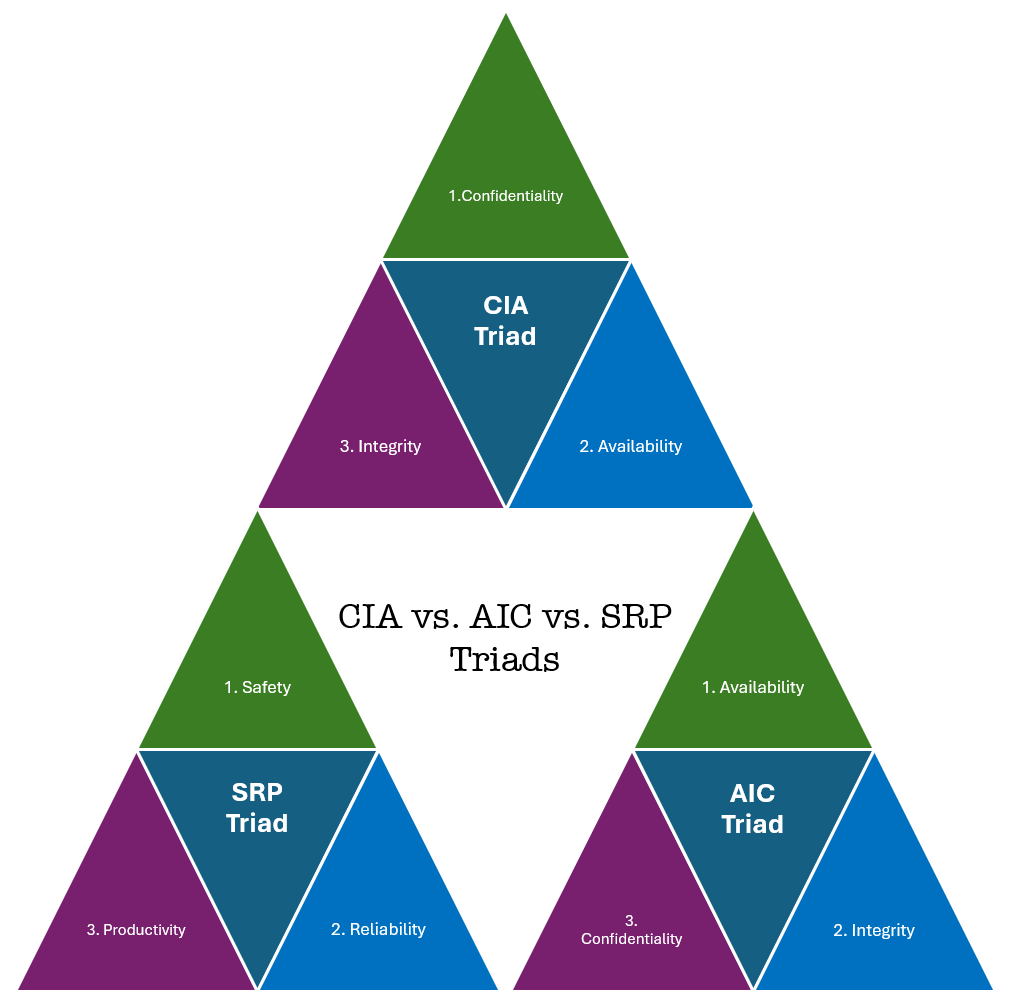
Cybersecurity differs between IT systems, OT (operational technology), and ICS (industrial control systems) in factory automation because their priorities aren’t the same.
CIA Triad (IT Focus)
Confidentiality
Ensures sensitive data remains accessible only to authorized users through measures like encryption and access controls. This prevents unauthorized disclosure, such as in data breaches or eavesdropping.
Integrity
Maintains data accuracy, completeness, and trustworthiness over its lifecycle using checksums, hashing, and version control. It protects against unauthorized modifications, ensuring information cannot be altered without detection.
Availability
Guarantees timely and reliable access to data and systems for authorized users via redundancies and protection from disruptions like DDoS attacks. This supports business continuity by minimizing downtime from failures or threats.
AIC Triad (OT Focus)
Availability
Prioritizes uninterrupted system operation to avoid production halts in operational environments. It ranks highest because downtime in factories can cause significant financial losses or safety risks.
Integrity
Ensures processes and data remain accurate and unaltered for precise control of physical operations. This prevents errors that could lead to equipment damage or faulty outputs.
Confidentiality
Protects trade secrets and process knowledge, though it takes lower priority than uptime and accuracy. Measures focus on preventing leaks without compromising operational access.
SRP Triad (ICS Focus)
Safety
Protects human lives, health, and the physical environment from harm due to system failures or cyberattacks. It demands fail-safes that halt operations if risks emerge, overriding other concerns.
Reliability
Ensures predictable, continuous operation with minimal unplanned downtime in industrial processes. This maintains stable performance under varying conditions without surprises.
Productivity
Maximizes efficiency and output while implementing security that does not hinder operations. It balances protections to sustain high throughput in automation
systems.
Form factors
Industrial OT network equipment, like switches, routers, and firewalls comes in tough, compact “brick-like” designs that fit right into factory cabinets or on machines. These smaller, modular boxes snap onto DIN rails, stick to walls, or even mount on poles, with rugged metal cases that seal out dust, shakes, vibrations, extreme heat or cold, and chemicals—think gear built to survive a noisy plant floor 24/7 without failing.
In contrast, standard enterprise IT network gear is shaped like slim, rack-sized trays for offices or data centers, sliding neatly into 19-inch shelves with fans for cooling in air-conditioned rooms. These flat boxes pack tons of ports on the front for easy cabling in clean spaces, using standard plugs and relying on steady power and no harsh conditions, so they’re lighter on armor but great for quick setups in controlled environments.
PoE structure
Power over Ethernet (PoE) in industrial switches works by sending low-voltage DC power alongside data signals through standard Ethernet cables, eliminating the need for separate power lines to devices like cameras, sensors, or lights on a factory floor. The switch acts as the power source (PSE), detecting compatible powered devices (PDs) via a handshake process before delivering power over spare wire pairs (Mode B) or data pairs (Mode A), ensuring safe delivery up to set limits without harming non-PoE gear. This simplifies wiring in harsh environments where outlets are scarce, and industrial models add ruggedness for vibration, dust, and temperature extremes.
PoE standards have evolved from basic IEEE 802.3af (Type 1, up to 15.4W PSE/12.95W PD at 44-57V) for simple devices, to 802.3at (Type 2/PoE+, 30W PSE/25.5W PD at 50-57V) using two pairs for more demanding ones, then 802.3bt Type 3 (PoE++/60W PSE/51W PD) and Type 4 (90W PSE/71.3W PD), which tap all four pairs for high-power needs like pan-tilt-zoom cameras or wireless access points. Higher versions support more current (up to 960mA per pair in Type 4) and precise power negotiation via LLDP for efficiency.
Stronger PoE versions demand more robust DC input power to the switch itself—often 48-54V or higher (up to 60V+ in some industrial setups), compared to basic 24V systems in low-power OT environments—because they must convert and budget higher wattage across multiple ports without overheating. For instance, a Type 4 switch powering several 70W devices needs beefier internal supplies and cooling, pulling from redundant DC sources to maintain uptime, while lower PoE sticks to lighter 24-48V rails common in factories. This scales power handling but requires matching the switch’s input rating to avoid failures in high-density setups.
The Industrial Wi-Fi Shop Podcast – Ep. 21 HaLow Can You Go!
Nov 03, 2025
Show notes
Free 3D Printer Plans!
Oscium WiPry790x and Clarity/Lucid DIY bracket posted on Thingiverse. Bring your own hair ties. I have been informed that Printables is better so I will post it there soon.
Don’t forget to check out our new document library with free valuable downloadable content!
Miliwatt to dBm conversion table
Wireless IoT reference charts for types and security
Best practice white papers to help you stay on your game
IWS Episode 21 – HaLow Can You Go
HaLow Basics
Wi‑Fi HaLow is based on IEEE 802.11ah, a standard in the Wi‑Fi family that extends connectivity for IoT and machine‑to‑machine devices .
It operates in Sub‑1 GHz frequency bands ( 902–928 MHz in the U.S.), enabling long‑range communication—up to about a1 km outdoors and superior object penetration .
HaLow uses narrow channel widths (1–16 MHz), which improve range and energy efficiency compared to traditional Wi‑Fi that uses 20–160 MHz .
Supported modulation schemes include BPSK, QPSK, 16‑QAM, 64‑QAM, and 256‑QAM, offering adaptable data rates from 150 Kbps to 80 Mbps (theoretical with 4 spatial streams) depending on channel width and link quality .
It relies on OFDM (Orthogonal Frequency Division Multiplexing) to reduce interference and maintain link stability across multiple subcarriers .
Features like Target Wake Time (TWT) and long sleep cycles keep devices in low‑power mode most of the time, drastically extending battery life .
Security uses WPA3 and Wi‑Fi Enhanced Open, comparable to current enterprise‑grade Wi‑Fi .
Rumor has it you can link 88 of them together and push 1.21 Gigawatts
Frequencies
900MHz
USA: 902-928 MHz
Australia, New Zealand: 915–928 MHz
Japan: 916.5–927.5 MHz and 920.5–921.5 MHz…trials underway to open up spectrum at 850MHz across Japan for Wi-Fi HaLow
China: 755–787 MHz or sometimes 779–787 MHz
Korea: 917.5–923 MHz and 925–931 MHz
Vietnam: 918–923 MHz
Europe
Wi-Fi HaLow (IEEE 802.11ah) in Europe operates mainly within the 863–868 MHz sub-GHz ISM band, which offers significantly less spectrum compared to the U.S., creating certain limitations and regulatory constraints.
The European channel plan allocates just 5 MHz of spectrum in the 863–868 MHz range, split into five 1 MHz channels—much narrower than the U.S. allocation.
In some parts of Europe, an additional 2 MHz covering 915.8–917.4 MHz and 917.4–919.4 MHz is available for two additional channels, but full uptake is limited.
Channels typically available: 1 MHz and 2 MHz channel widths only.
Duty Cycle and Power Limitations
European regulations (ETSI/EN 2202, ERC Recommendation 70-03) strictly limit duty cycles—access points usually have a duty cycle restriction of 10%, while client stations are often restricted to 2.8%.
These limits mean Wi-Fi HaLow data transmissions can only occupy the airwaves for a small fraction of time, making it less suitable for continuous, high-bandwidth uses like video streaming
What does HaLow look like on spectrum analysis?
HaLow testing at a 2MHz wide channel
HaLow testing at a 4MHz wide channel
HaLow testing at a 8MHz wide channel
“I’m fine to make the offer that the first 10 people to screen grab this image and send it out on their socials to their customers to see what their customers would like to do with the extra data throughput we can offer at hundreds of meters of distance…will get 2 x HaLowLink 1 devices from me to start their Wi-Fi HaLow journey. Just ask them to tag me (Andy), Morse Micro and the Industrial Wi-Fi Shop of course!!!” – Andy McFarlane
Just right click and “save as” for the image above! Don’t forget to tag Scott & Jeremy too!
Let’s talk Use Cases / Applications
Worth initially positioning Wi-Fi HaLow as the connectivity power behind IoT 2.0 … .being clear on how the first generation of IoT use cases opened up, what their restrictions are and how Wi-Fi HaLow is underpinning a new generation of higher throughput use cases.
Commercial / Enterprise
Video Security Cameras
Smart Meters (Electricity meters rather than water or gas meters)
Smart Buildings (Door locks, behind the meter devices ref power load management)
Industrial / Manufacturing
AMR’s both inside the factory/warehouse and outdoors
Grid monitoring
Transportation: Rail, Fleets, Asset Tracking
UAV
Retail security, asset tracking and ESL(Electronic Shelf Labels)
Are there any verticals we missed?
Doing some AI digging (fast becoming a secondary hobby of mine):
**********
Several HaLow vendors have established partnerships with major industrial control companies like ABB, Honeywell, and Rockwell Automation to deploy robust industrial IoT solutions.
Notable HaLow Vendor Partnerships
Morse Micro and Gateworks: This partnership focuses on bringing Wi-Fi HaLow to industrial IoT environments including smart factories, transportation systems, and energy infrastructure. Their collaboration emphasizes secure, long-range, low-power wireless connectivity tailored for industrial settings, which aligns with the needs of companies like ABB and Rockwell Automation.
**********
Gateworks (Whole USA Solution) How does this figure in with tariffs, MM and working with customers with something like a no China policy?
**********
Morse Micro and Gateworks are collaborating on projects that deliver industrial-grade Wi-Fi HaLow (IEEE 802.11ah) connectivity designed specifically for tough industrial environments such as smart factories, transportation systems, and energy infrastructure. Together with Silex Technology, they have developed a high-performance ecosystem that enables secure, low-power, long-range wireless connectivity ideally suited for:
Large sprawling industrial facilities and remote infrastructure with Wi-Fi coverage exceeding 1 km
Battery-powered sensors and devices requiring ultra-low power consumption
Smart factory applications including wireless sensors, automated mobile robotics, and machine health monitoring
Smart transportation projects such as train safety systems, fleet management, and predictive maintenance
Smart energy solutions including grid management, solar inverters, wireless EV charging, and smart meters
Key technology developed by the partnership includes the GW16159 industrial-grade M.2 Wi-Fi HaLow card, manufactured by Gateworks using Morse Micro’s MM6108 SoC. Gateworks also released the GW11056 Development Kit for accelerated evaluation and prototyping, enabling faster time-to-market for industrial automation and monitoring use cases.
Additionally, here’s a few links you might like to use.
The Industrial Wi-Fi Shop Podcast – Ep. 20 900MHz or Bust!
Sep 16, 2025
Show notes
Free 3D Printer Plans!
Oscium WiPry790x and Clarity/Lucid DIY bracket posted on Thingiverse. Bring your own hair ties. I have been informed Printables is better so I will post there soon.
Keith Jones CEO of Prism Systems has provided 2 license codes for the PrismStats Live software (iOS) a URWB commissioning tool. Helpful for spot checking, parsing, and troubleshooting Cisco URWB Fluidity deployments created by Prism Systems! Email Jeremy if interested!
Don’t forget to check out our new document library with free valuable downloadable content to help you in your wireless endeavors in the industrial and manufacturing air space!
On with the show! IWS Episode 20 – 900MHz or Bust
A little bit about 900MHz in general
ISM frequency space
802.11 channel designations
902 – 928 MHz
1 MHz wide channels
General dynamics of 900MHz
distances/ranges
Penetration values
Power consumption
Esteem Horizon 900 radios
Channel structure
Channel widths
5, 10 and 20 MHz wide options
Realistic bandwidth and constraints
Up to 72mbps at 20 MHz wide channel
OFDM (Orthogonal Frequency-Division Multiplexing – I wanted to sound smart)
Power
802.3at PoE+
12VDC Direct
IndustrialMESH and path redundancy
What is IndustrialMESH?
How is it handled
Self-Healing, redundant, backup communication paths – Automatic Switching
Uses standard network Spanning Tree Protocol (STP, RSTP, MSTP)
Routes can be configured, controlled and prioritized by user or Auto-MESHing (“Rapid Ready” Mode of operation – similar to an ad-hoc network.)
Can this be configured dynamic or does it have to be manually configured/static. (See above)
Additionally, the MESH Bridge links can be individually configured for always up status or dynamically controlled based upon RSSI thresholds
The Industrial Wi-Fi Shop Podcast – Ep. 19 CURWB Appeal!
Aug 19, 2025
Show notes
IWS Episode 19 Show Notes – C-URWB Appeal!
Free 3D Printer Plans!
Oscium WiPry790x and Clarity/Lucid DIY bracket posted on Thingiverse. Bring your own hair ties. I have been informed Printables is better so I will post there soon.
Keith Jones CEO of Prism Systems has provided 2 license codes for the PrismStats Live software (iOS) a URWB commissioning tool. Helpful for spot checking, parsing, and troubleshooting Cisco URWB Fluidity deployments created by Prism Systems!
If you are interested in one of these two license keys, please email Jeremy at Jeremy@industrialwifishop.com
Don’t forget to check out our new document library with free valuable downloadable content to help you in your wireless endeavors in the industrial and manufacturing air space!
On with the show! IWS Episode 19 – C-URWB Appeal!
URWB technology was first introduced in the market in 2005 by Fluidmesh Networks, focusing on ultra-low latency and ultra-reliability for mission-critical wireless connectivity.
Cisco acquired Fluidmesh Networks in 2020, integrating URWB technology into its portfolio and advancing its capabilities alongside Wi-Fi technology.
URWB uses a specialized implementation of MPLS over wireless links to enable very low latency and reliable transmission in mobility scenarios, supporting “make-before-break” handovers for seamless connections to moving vehicles.
*** What is MPLS! ***
Multiprotocol Label Switching, is a networking technology that uses labels to route data more packets efficiently. MPLS works by attaching a small “label” to each data packet as it enters the network. This label acts like a shortcut, indicating the path the packet should take through the network. Instead of routers making complex routing decisions based on destination IP addresses, they can quickly forward packets based on the attached label, leading to faster data transmission
The technology features patented Multipath Operations (MPO), which delivers uninterrupted connectivity by duplicating high-priority traffic on multiple uncorrelated frequency paths, dramatically reducing packet loss and latency. This provides greater redundancy for implementations.
URWB has been widely adopted in various industries including mining, entertainment, utilities, ports, manufacturing, rail, and smart cities, supporting heavy applications like autonomous vehicles, remote-controlled cranes, and industrial automation.
In 2025, Cisco announced combining URWB functionality with Wi-Fi capabilities in its access points, allowing unified infrastructure and management to support both technologies simultaneously, thus simplifying deployments and reducing operational overhead.
C-URWB is NOT 802.11 !!! – although it is built upon and extends the 802.11 technology foundation.
802.11 is mainly an access technology for end-user devices like computers and smartphones, URWB functions as a wireless backhaul technology. It connects network infrastructure elements (such as access points, controllers, and industrial devices) with managed, optimized communication links.
URWB offers features beyond standard Wi-Fi, including seamless “make-before-break” handoffs, multipath operations (sending duplicate packets over separate paths to ensure reliability), and RF interference mitigation for highly reliable connectivity in challenging environments.
Has two flavors: FluidMax which is the backhaul (fixed point) and Fluidity where mobile clients need to roam as in rail or warehouse AGVs.
Igor – been at Cisco 5 years as a pre-sales engineer, came over as part of the Fluidmesh acquisition in 2020. Prior to that, worked in the transportation sector as a systems integrator for airport people, movers and commuter rail systems for about 7 years. Back in 2012 i was tasked with finding a commercial off the shelf wireless product that would be good for mobility and wire-like roaming for airport people movers. It was at that time we were testing cisco, fluidmesh, and a few other vendors to see what would meet our success criteria as our wireless product for our train systems. We initially went with cisco 3602Es and 5500 wlc controllers running WGB and pre .11r neighbor table configurations…with later projects shifting to Fluidmesh, Fluidity architectures, and that seamless roaming, high-throughput and low latency connectivity over wireless.
Matt – been at Cisco for 18 years, pre-sales engineer supporting lots of customers – financial, professional services, hosted collaboration, shuffled to the IoT team about 4 years ago. I grew up farming and live on a small farm now, about 60 acres give or take. I have the property covered in Wifi+CURWB and have hundreds of IoT devices on-net across the property. Neck deep in all things RF and wireless – lora, 433, BLE, you name it and i’m interested. 4400, 5500, 9800, I’ve worked with all the things.
What is URWB and why should we care about it?
High level, it’s an ethernet backhaul technology over wireless, which utilizes the unlicensed 5 GHz and eventually 6 GHz spectrum with our recent announcement with catalyst 9800 controllers
It’s great for fixed point to point point, multipoint and mixed backhaul for static environments with a set and forget antenna alignment and stable RSSI
As well as mobility connectivity, to connect moving assets such as trains, utility vehicles, ship the shore cranes, mining dozers, and AGVs back to their OT edges and cores
What is the next big release on the roadmap?
17.18.1
Next would be Catalyst Center support and configuration…sometime next year
Currently, this is considered a beta release, with the gold star release firmware coming out in 3-6 months.
Highly encourage downloading and playing with it.
What problems will the 802.11/URWB simultaneous modes solve?
1 box solution for reliable WiFi and wireless backhaul to Cisco controllers via URWB
Providing a cheaper solution (vs 2 box), less SmartNet and DNA license seats…and a true commercial grade wireless backhaul product on a proven Cisco Catalyst wireless platform.
Digital divide or equity projects, where you want wi fi for underserved areas (mostly outdoor)
Similarly, providing Wi-Fi on moving vehicles. Take for example a commuter rail system that has public facing Wi-Fi in the vehicle and an external URWB Fluidity backhaul to the trackside network. Couple that with urwb seamless roaming, you’ll have bidirectional high-throughput, and low-latency connectivity for Wi-Fi passenger use.
Wi fi hotspots in typical IoT vehicles. Think of your outdoor utility vehicles, container handler vehicles at a port. Maybe it’s a forklift running over urwb and then providing wi fi connectivity within a hundred foot radius of that parked forklift for tablet, cell phone connectivity, whatever is needed to manage the day to day operations and manufacturing process at that site.
Overhead crane connectivity in manufacturing environments to backhaul fisheye cameras and PLC comms.
Are there any plans to provide beacons so standard tools can be used for RF Validation, or is Telemetry king?
For now, telemetry is king, and using software tools such as PrismStats to capture, analyze and post process the telemetry stream for both fixed and mobile connectivity. Nothing beats real empirical measurements in RF environments, and PrismStats is a quick, easy, cheap and reliable way to get this data in the hands of the engineers.
TBD, I’m sure there will be better hooks into AI-RRM, Wireless Config Analyzers, and other standard features you see with Cisco Wireless, though it’ll take some time to fully integrate to the bells and whistles we offer with Wifi.
What are the most useful documents you reference even at your current level of expertise?
Right now, digging into the Cisco Live On Demand Library. Lots of great wi fi and u r w b content there…and goes back a few years.
Unplugged Connectivity YouTube channel. 100s of videos and episodes about all things Cisco Catalyst and Meraki Wireless…and a few URWB sessions there
Cisco TDM, Ordering Guides, and CVDs
Google AI searches…digging through all of the public facing configuration guides; hardware install guides, datasheets, etc to answer very specific RF questions.
Tell us about an interesting project you have worked on and how URWB solved the complications the customer faced.
Igor – Digital divide during covid using Meraki MRs for wifi and FM URWB radios to underserved areas in Dallas-Fort Worth, as well as City of Wake Forest. PtMP and relay architectures mostly. Something that can also be replicated with outdoor campus connectivity we see in hospitals, colleges, and corporate campuses. With DoTs, lots of intersection connectivity to traffic management solutions and cctv cameras on those tall vertical assets. So next time you are at a red light, look up and you might see a square panel used as the directional backhaul to another traffic light a quarter mile away.
Indoor AGV connectivity has also been a top use case with fluidity, so various customers there using fluidity, and in some cases, using wi fi wgb for not so mission, critical connectivity. MPO is a great benefit here, with packet duplication/deduplication of that mission-critical PLC.
Ports and terminals, fluidity, connectivity to these vehicles using multiple 90 degree horn antennas off of those high mast light poles to provide connectivity for terminal operating system (tos) applications.
Train to ground for mission-critical traffic backhaul, as well as not so mission-critical wifi ap backhaul, passenger signage and VoIP e-tel
Open pit mining, combination of fixed PtP and PtMP backhaul to temporary trailer setups, and then configuring fluidity to those large mining vehicles. Great for ad hoc environments with constantly changing topology and redesigning with line of sight in mind.
Jeremy- I really like the new hardware, no more overly protective hiding of my M12 cable.
Use cases & Stories
Scott – I deployed what was originally a FluidMesh system for a wood chip yard for a paper mill. Four giant automated machines for the dispersal and reclamation of wood chips for the beginning of the paper making process. Two monster chip “Stackers” and two giant chip “Reclaimers”
Deployment ran great for several years. Ended up replacing original FluidMesh hardware with updated C-URWB hardware due to FM being end-of-life and could not get spares (well, and one did fill with water after a particularly bad storm)
Jeremy – I have participated in several POCs for passenger rail control, a Smart Farm using Fluidity and FluidMax as the backhaul. Commissioned production systems include several steel mill cranes, a port or two, some modified R-Coax applications, several themed rides, and a partridge in a pair tree.
If you would like to connect with Matt Virus or Igor Moiseev or learn more about their employer, Cisco, then check the following:

 Our TOPPODCAST Picks
  Stay Connected