TopPodcast.com
Menu
  • Home
  • Top Charts
  • Top Networks
  • Top Apps
  • Top Independents
  • Top Podfluencers
  • Top Picks
    • Top Business Podcasts
    • Top True Crime Podcasts
    • Top Finance Podcasts
    • Top Comedy Podcasts
    • Top Music Podcasts
    • Top Womens Podcasts
    • Top Kids Podcasts
    • Top Sports Podcasts
    • Top News Podcasts
    • Top Tech Podcasts
    • Top Crypto Podcasts
    • Top Entrepreneurial Podcasts
    • Top Fantasy Sports Podcasts
    • Top Political Podcasts
    • Top Science Podcasts
    • Top Self Help Podcasts
    • Top Sports Betting Podcasts
    • Top Stocks Podcasts
  • Podcast News
  • About Us
  • Podcast Advertising
  • Contact
Not in our directory?
Add Show Here
Podcast Equipment
Center

toppodcastlogoOur TOPPODCAST Picks

  • Comedy
  • Crypto
  • Sports
  • News
  • Politics
  • True Crime
  • Business
  • Finance

Follow Us

toppodcastlogoStay Connected

    View Top 200 Chart
    Back to Rankings Page
    Education

    The Fresh Perspective

    Come join the conversation about freethought, philosophy, politics, religion, atheism, science, logic, reason, rationality, social issues, morality, current events, and more!

    Advertise

    Copyright: © Free Thought Initiative (c) 2019

    • Apple Podcasts
    • Google Play
    • Spotify

    Latest Episodes:
    Great Ideas from Stoicism Mar 28, 2020
    Show notes

    The Fresh Perspective Podcast - Episode 37How’s it going everyone? I’m Nick and you are listening to Episode 37 of the Fresh Perspective Podcast.How can we deal with the terrible injustices of life? How can we carry on when we are asked to do the impossible? Does your happiness depend more on your circumstances or your attitude? The ancient Stoics, including Marcus Aurelius, Seneca, and Epictetus had some powerful answers to these questions that have survived since ancient Greece and Rome. Today, I'm accompanied by my friend Sam Wagner for a six-part conversation about this fascinating philosophy and what freethinkers like you can learn from it.This program is brought to you by your Local Free Thought Forum.We help those in need of an inclusive, supportive, and free-thinking community by hosting public discussions on moral philosophy, healthy living, and science, to improve the cohesion, health, and scientific literacy of our society. Everyone is welcome, (regardless of personal background, religious belief, political leanings, etc.) to participate in these open and civil discussions every week.To find a Free Thought Forum meeting near you, or to join in this week’s Online Group Meetings, please visit FreeThoughtForum.org.Part 1 – The Study of StoicismNICK:“No greater thing is created suddenly, any more than a bunch of grapes or a fig. If you tell me that you desire a fig, I answer you that there must be time. Let it first blossom, then bear fruit, then ripen.” – EpictetusZeno of Citium, like many of us, searched for direction in his life. As a young man, he visited his local oracle who said that “he should take on the complexion of the dead.” He would later interpret this advice to mean that he needed to study the wisdom of long-dead philosophers. Although Zeno was a wealthy merchant, he lived a modest life. After surviving a violent shipwreck, he dedicated even more of his time to studying the words of his favorite philosophers such as Socrates and Plato. After his death, his teachings were joined by those of great Stoic writers such as Seneca (the Younger), Epictetus (a former slave), and Emperor Marcus Aurelius. Through several generations, Stoicism went on to influence Christianity and inspire great thinkers such as Thomas Aquinas, Spinoza, Nelson Mandela, and Viktor Frankl.Marcus Aurelius once said, “Time is a sort of river of passing events, and strong is its current; no sooner is a thing brought to sight than it is swept by and another takes its place, and this too will be swept away.”Today I’m joined by Sam Wagner, an Assistant Group Leader for the Free Thought Forum, a well-read student of philosophy, and an educator working now at Utah Valley University. To start with, Sam, I would like to ask, what drew you to study Stoicism in the first place, and why do you think that it is an important thing for people to study these days?SAM:Thanks, Nick! Just as a disclaimer, right at the beginning, I’m not a credentialed expert. My background is in the sciences. I began my interest in Stoicism shortly after my faith transition during a time in my life when I was doing a lot of soul-searching. I was hoping to find a philosophy or world-view that could guide my life. I first came across Stoicism from a podcast by the philosopher Massimo Pigliucci. The podcast was “Rationally Speaking.” As far as why we should study it, I think it is very appropriate for the present moment. Right now, we are in the midst of the coronavirus [pandemic]. Most of us are staying inside so that we can prevent its spread. Stoicism is a philosophy that’s extremely practical. It’s one that can help us deal with challenges as they come up.It is really counter-intuitive in a lot of ways. A lot of times when we deal with challenges, we just react emotionally. Stoicism, instead, asks us to take a step back to understand the situation rationally and use our rational understanding of the situation to respond in a way that corresponds with our highest ideals; something that corresponds to the Stoics’ four cardinal virtues.In history, for example, Victor Frankl (who was mentioned) and Jane Stockdale (who was a prisoner of war), this philosophy helped individuals like them deal with really awful circumstances. Even though it is a philosophy that has helped prisoners of war and holocaust victims, it is also a philosophy that can help us with more typical issues that come up (such as challenges we have at work, or challenges that come up in relationships).Over the last few years, I’ve read up on it. It’s a topic that I love talking about and I’m happy to be here today to discuss it!NICK:I’d like to know a little more about these famous Stoic philosophers. An interesting quote comes from Seneca, the teacher of Nero who said, “What need is there to weep over the parts of life? The whole of it calls for tears.” What can you tell us about the context of this quote and of Seneca himself?SAM:One way that the Stoics handle challenges is that they deal with them before they come up. Like I mentioned earlier, it’s not about reacting to things when they occur. In any life, no matter whose life it is, you’re going to meet challenges. You’re going to have tragedies. You’re going to have difficulties that come up. In Stoic philosophy, instead of waiting until they occur, you prepare yourself emotionally (and even physically) before you have to face them.So the context of the quote occurred when Seneca was sentenced to death by Nero for being in a plot to assassinate him, although a lot of people think that he was entirely innocent. He was Nero’s teacher, but Nero didn’t really follow his teachings super well. Seneca was sentenced to death. He knew he was going to die and his family, his wife and kids, were in tears! That’s the context of the quote, “What need is there to weep over the parts of life? The whole of it calls for tears?” In Stoic philosophy, there are a couple of ideas that might help us contextualize this quote. What Seneca may have been saying is that, to his wife and children, “You knew that there would be tragedies your entire life. This is something you’ve been preparing for.” There is also looking at the bigger context of things, and recognizing that things that occur are part of a greater whole. So one analogy that’s often given is if you get mud on your boot, you know, it’s not great for the foot, but the foot’s fulfilling an important purpose for the whole.If you think back to the example of Socrates, he was, of course, a role model for a lot of these Stoics. He was sentenced to death much like Seneca for a reason he shouldn’t have been. He was forced to drink hemlock. Even though he was given opportunities to escape, he turned the opportunities down. Well, in dying while standing by his principals, Socrates set an example for many future philosophers to come. Recognizing that, Seneca acted as though his execution was going to be part of a greater whole. That could have also been something that could be considered a source of comfort.About Seneca himself… Seneca is, compared to the Stoic Writers… The three that we really have complete writings that we turn to are Epictetus, Marcus Aurelius, and Seneca. Seneca is probably the easiest person to read. He deals with everyday issues that come up. His writing is just very simple. Markus Aurelius kind of rambles and Epictetus is, for the most part, easy to read, but he gets into some deep philosophy too. If you’re looking for some light reading and some really easy to digest good advice, Seneca is the person to turn to.Part 2 - Before Correcting Others, Improve YourselfNICK:What does it mean to live a good life? Several philosophical schools in ancient Greece attempted to answer this question, such as the Epicureans. They taught that the ideal life was filled with pleasures and the avoidance of pain and fear. The Stoics, on the other hand, believed that the good life could be realized if one lived virtuously. Epictetus taught, “The essence of philosophy is that a man should so live that his happiness shall depend as little as possible on external things.”Sam, what would you say are the major differences between Stoicism and other schools of thought?SAM:Well, Stoicism emerged shortly after Socrates, at the same time as many other schools of thought. One that is, of course, really famous is Aristotle’s. Aristotle is the student of Plato, so kind of the intellectual grandson [to Socrates]. Aristotle had the idea of the “Golden Mean.” There are things in life like health and money. Aristotle’s idea is that you don’t want to go to extremes. You need to have enough, but you don’t have to have this over-abundance.There’s another school of thought that was radically different from Aristotle’s. This school of thought was that of the Cynics. The Cynics believed that, to live a good life, all you had to do was to live virtuously. And things like money and wealth didn’t matter at all. It was actually even more extreme than that. The Cynics believed that you should purposefully avoid the things that most people go after, that money is a distraction, and that you shouldn’t be part of the rat race like everyone else. The most famous Cynic was Diogenes and he took this to an extreme. He actually lived in a barrel (or ceramic pot) just in the street and, in a lot of ways, he was an extremist. He would just mock bystanders as they would pass and pedestrians. In fact, he made fun of Aristotle. There is a story, (I’m don’t know if it’s a true story or if it’s anecdotal) that Aristotle had this idea that man is an animal on two legs without feathers. So Diogenes actually plucked a chicken and said, “This is Aristotle’s man!” and just let it loose.Stoicism is, of course, different from Aristotle’s view and the view of the Cynics. In the Stoic view, instead of having to just reject money or health or the pursuit of the things that people typically go after, you can take them if they come to you. You just can’t let them get in the way of being a good person. So I think that Stoicism really distinguishes itself if you happen to end up in circumstances where you can’t get things like money and health, where the good things of life are deprived of you, Stoicism says, “Hey you can still be a good person. There is still a way to live a good life.”NICK:So would you say that the Cynics were the hipsters of their day?SAM:Yeah, they were often homeless, on the streets. Yeah they were, definitely.NICK:With virtuous living made paramount, followers focused on their own character development before attempting to correct others. “If thy brother wrongs thee,” Epictetus taught, “remember not so much his wrong-doing, but more than ever that he is thy brother.”“Living virtuously” is something within the reach of every human being. It means personally and completely adopting ethical characteristics such as Temperance, Courage, Wisdom, and Harmony. We develop character as we live virtuously, accept responsibility, and close the gap between what we are doing and what we’re capable of doing. This quest to realize one’s greatest potential was considered by the Stoics to be the only true good and life’s most important purpose.According to Seneca, “If one does not know to which port one is sailing, no wind is favorable.”As far as I understand it, Sam, virtue, character, and life’s purpose for the Stoics were all intertwined. What else can you share with us about this idea of “living virtuously?”SAM:Yeah, I think when we hear the word, “virtue,” based on our backgrounds, or in modern times, we view it differently than people in ancient Greece and Rome would have seen it. A lot of times, when we think of “living virtuously,” we think in terms of “moral purity” or “chastity.” But for people in ancient times, it was a lot more than that. Living virtuously had to do with living ethically.There’s actually a quote that I’d like to share from Markus Aurelius. It says, “Humans have come into being for the sake of each other, so either teach them, or learn to bear them.” A lot of people think that Stoicism is just really about not having feelings, not having emotions, that it’s a completely dispassionate philosophy. That’s not really accurate at all. Stoicism is a very social philosophy. There are emotions such as the desire to be good that are really at the core of Stoicism. Instead of not having emotions, true Stoicism is truly all about letting reason direct your actions. Part of letting reason direct your actions is trying to do what the Stoics refer to as, “living in accord with nature.” There are different ideas as far as what it means to live in accord with nature, but my interpretation of it is that it has to do with living rationally, understanding the world as it is, understanding your own nature, and then trying to find a harmony between those two things.I think that one way to think of it is if you imagine that you’re on your deathbed and you’re thinking back on how your life has gone and you’re going through things that you regret and things that you’re happy about. My guess is that things like wealth, money, and reputation, are going to be less important than the things that have to do with living virtuously like being kind with other people, helping people with their issues, and forming social connections. The things that, when you’re on your deathbed, you’ll really value are the types of things that you’ll get when you exemplify the four cardinal virtues, Temperance, Courage, Wisdom, and Harmony.Part 3 – Let Your Hardships Refine You, Not Define YouNICK:“We suffer not from the events in our lives, but from our judgment about them.” - EpictetusWhen life’s challenges arise, it is common to think of oneself as the victim of a story, rather than its hero. We may believe that we are entitled to some level of happiness or comfort, but this is an idea completely rejected by the Stoics!We should focus on the things we can control (such as our reactions, judgments, and personal improvement), rather than worry about things outside our control (such as other people, our upbringing, or the weather). Marcus Aurelius wrote, “When you arise in the morning, think of what a precious privilege it is to be alive - to breathe, to think, to enjoy, to love” and “You have power over your mind - not outside events. Realize this, and you will find strength.”We can’t always control what goes on around us, but we can control our mindset. Someone with a stoic mindset, for example, may reframe and re-contextualize their negative experiences as opportunities to calmly respond with dignity and heroism. According to Epictetus, “The greater the difficulty the more glory in surmounting it. Skillful pilots gain their reputation from storms and tempests.”Now, Sam, some people may think that the Stoics are saying that “everything happens for our benefit” or that “everything happens for a reason,” but that really isn’t the point here is it?SAM:There are many Stoics who have this idea of “providence,” which is very similar in a lot of ways to the religious idea that comes up a lot. But, you also find that they’re really humble. For example, Marcus Aurelius is really open to the idea that everything is just atoms bumping into each other (which is an Epicurean idea). In order to be a Stoic, you don’t have to subscribe to the idea that the world is what it should be. I think what you can do instead is recognize that there are things outside your control. Things are just going to be the way they are. If you direct your energy to just regretting that the world isn’t what it should be, then you are going to waste a lot of your effort. Learning to accept the world, as it is, and learning to accept the fact that there are things that you can’t change – I think that’s wisdom that you can take from Stoicism without having to believe that we live in the best of all possible worlds.Part 4 – Money is Just a Means to an EndNICK:“For the wise man regards wealth as a s…

    Full show notes at the publisher

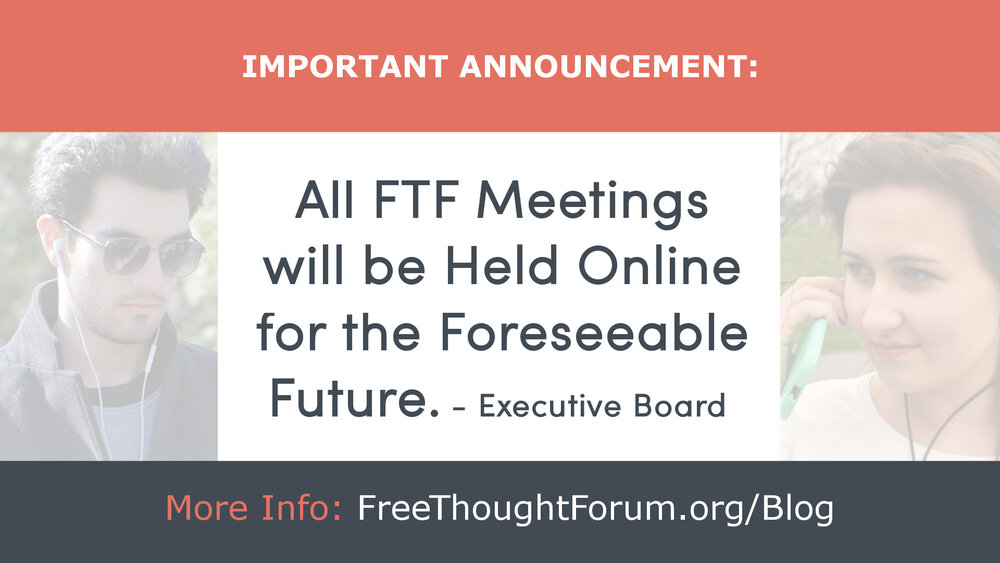
    All FTF Meetings will be Held Online for the Foreseeable Future Mar 17, 2020
    Show notes

    TLDR: Due to the growing threat of COVID-19, We are moving all our meetings online. You are invited to join us every Saturday morning, Sunday morning, and/or Sunday evening on our Discord Server. Please spread the word so that no one has to go through this without a friendly community! https://www.freethoughtforum.org/blog/moving-online #QuarantineLife #community #stayhomechallenge #coronavirus #friends

    Announcement_Move_Online.jpg

    To the Members of the Free Thought Forum and to everyone similarly affected by the isolating measures made necessary by the COVID-19 Pandemic,

    Effective March 16th, 2020, all Free Thought Forum meetings will be moved online for the foreseeable future. Also, all additional in-person recreational activities and volunteer projects will be canceled until further notice. This announcement is in response to the rising threat of the coronavirus, the recommended measures from the WHO and the CDC, the unfortunate closure of The Clever Bean in Draper, and the guidelines set forth by our nation’s President and other government officials to avoid social gatherings of 10 people or more.

    Many of us, our community members, friends, and family, will soon be dealing with the psychological and emotional effects of social-distancing, isolation, and living under a quarantine. In many ways, the inclusive, supportive, and freethinking community that the Free Thought Forum has to offer will be needed more now than ever. Therefore, we encourage everyone reached by this announcement to invite others to participate in our upcoming online events:

    • Saturday Mornings (10-12 MDT)

    • Sunday Mornings (10-12 MDT)

    • Sunday Evenings (6:30-8:30 MDT)

    Everyone is invited to participate (no matter their political leanings, religious beliefs, age, gender, race, or education level). As we spread the word about who we are and what we do, we each give those we care about a positive way to satisfy that ever-present need for social interaction and friendship.

    We will continue to operate as normally as possible. Our programs and services will still be made available to the public, and our weekly, monthly, and quarterly events will continue to take place, albeit now 100% online. We will shift to performing internet-based community service, and temporarily convert our Springville and Draper groups to online-only groups.

    Our original Online Group will continue to meet on our Discord Server (https://discord.gg/2W4KCMC) on Sunday evenings at 6:30 PM MDT. In addition to those digital meetings, we will also hold meetings every Saturday at 10 AM (MDT) and every Sunday at 10 AM (MDT). With these three options for the public, we will hopefully be able to serve many who are quarantined at home, who can continue to work, those currently receiving medical treatment, and more.

    We will continue to use the free services made available by the Discord app. Our Discord Server will serve as our primary online meeting location. If you haven’t yet downloaded that app to your phone and computer, please do so before this weekend’s events. If our Discord Server goes down, our back-up plan is to assemble on our newly-created WhatsApp chat group (https://chat.whatsapp.com/Dm8oQHYHlIICtggGdN6AJ8). To ensure that our community can remain strong and connected through this difficult time, we also encourage our members to subscribe to our newsletter and our other social media accounts as listed on our website (https://www.freethoughtforum.org/social-media).

    If you haven’t yet already, please give our most recent podcast episode on the COVID-19 pandemic a listen (https://www.freethoughtforum.org/blog/how-bad-is-the-covid-19-pandemic) and share it with others. It contains important facts and guidance on what we can each do to slow the spread of this virus and help scientists find a cure.

    Additional information will be made available to you through our podcast and our newsletter as it becomes available. Thank you, everyone, for your flexibility and resilience during this economic and public health crisis. The Free Thought Forum will be here for you, granting you a place where you are free to speak your mind, every week. Please treat your local grocery store workers with patience and kindness, follow the guidance of your medical professionals, and do what you can to bring out the best in those around you.

    Sincerely,

    The Executive Board

    www.freethoughtforum.org


    How Bad is the COVID-19 Pandemic? Mar 16, 2020
    Show notes

    The Fresh Perspective Podcast - Episode 36How’s it going everyone? I’m Nick and you are listening to Episode 36 of the Fresh Perspective Podcast.Wow! I can’t get this episode out fast enough! Things are changing crazy fast out there, but I’m sure I have a few things to share here that will still be useful long after this pandemic has run its course. For those listening further into the future, our Folding@Home Team code is 236268. If you don’t yet know what I’m talking about, stay tuned!The Novel Coronavirus COVID-19 has now become a global pandemic that is hitting the United States particularly hard. While we can criticize the government or stockpile toilet paper all day, that isn’t really doing much about the pandemic itself. In this episode, I will give you a quick recap on how bad the coronavirus is, why it is going to get worse, and what average citizens like you and I can do to slow its spread and even help scientists discover a cure by volunteering some of our computers’ processing power to disease research.This program is brought to you by your Local Free Thought Forum.We help those in need of an inclusive, supportive, and free-thinking community by hosting public discussions on moral philosophy, healthy living, and science, to improve the cohesion, health, and scientific literacy of our society. Everyone is welcome, (regardless of personal background, religious belief, political leanings, etc.) to participate in these open and civil discussions every week.To find a Free Thought Forum meeting near you, or to join in this week’s Online Group Meeting, please visit: FreeThoughtForum.orgAt this point, you may be sick of hearing about the coronavirus. Covid-19 has been a major news story for months that has, itself, become viral. The everyday dramatic closures and rising numbers are like rocket fuel for the 24-hour news cycle. It has flooded our social media feeds along an exponential curve and is dominating our public conversation. But, as usual, the good information about what it is and what to do has been mixed with some pseudoscience.As far as I can tell, here is the bottom line: Broadly speaking, the more seriously we take this pandemic, the better off we’ll be. If we all take important measures, this exponential rise in cases may slow and plateau earlier than expected. However, the less seriously we take it, the worse off we’ll be, and the more it will continue to spread despite the warnings of the scientific community. The US, thus far, has taken the latter option, so we are all off to a rough start.I will do what I can in this podcast to give you some good and accurate information along with something positive to do while you self-quarantine. Many of us are not content to just wait things out, and I am glad to say that we do have a way that we can actually help further the scientific research needed to find cures, not only for the family of coronaviruses, but also for cancer, ALS, Parkinson’s, Huntington’s, Influenza, and so on. I’ll be happy to walk you through all that at the end of this episode, so if you can make it to a computer or laptop before then, you’ll be able to follow along! This episode has five parts:1. How Bad is it?2. Our Government’s Response3. How Much Worse Will It Get?4. How to Slow it Down5. How to Help Find a CureIf you have any corrections or updated information that can add to the conversation, please add your comments to this episode. I don’t have to tell you that things are getting crazy out there, and it is almost impossible for anyone to stay 100% up to date. Yet, after talking to a few of my family members, friends, and forum members, I have come to realize that some important ideas seem to be getting ignored in the storm of information on the news and social media. So, let’s give them some time!Part 1 – How bad is it?If you have been to your local grocery store recently, you may have been met with something resembling a scene from the Walking Dead. Even in my small town of Springville, Utah, many of our local stores have empty shelves and entire aisles that have been stripped bare. The panic on the faces of everyday people is haunting, to say the least. But if you haven’t yet had a chance to stockpile, you’ll be alright. I’ll get into that more in Part 4. For now, it is time to take a sober look at the pandemic itself.The SARS-CoV-2 virus is a betacoronavirus. The name comes from the word “corona,” or “crown,” because of its shape. It most likely came about when a bat passed it to a pangolin (an adorable endangered animal, much like a scaled anteater or armadillo) who then passed it to a human at a large outdoor seafood and live animal wet market in Wuhan, China. (This is just the most recent in a long list of terrible viruses out of China, but that is a discussion for a different day.) The disease caused by this virus is called COVID-19. No human immune system prior to this had been able to create a resistance to this disease. That is what makes it, and other such novel pathogens that make the jump from animals to humans, so dangerous.COVID-19 is a respiratory disease (first discovered in 2019). Symptoms tend to be unusually mild and include a runny nose, sore throat, cough, and fever. Those who are elderly or otherwise at risk may also experience more severe signs of infection such as the development of pneumonia or breathing difficulties. At this point, the death rate of young people infected is somewhere between 3.4% and 0.01%, but this percentage climbs to 5%, 15%, and even higher with age.One of the most dangerous things about COVID-19 is that it can infect a person without that person showing any signs or symptoms for 2-14 days. This is a particularly big problem because most of the people spreading it don’t even know they have it! In other words, you can spend your time around what appears to be perfectly healthy people for weeks and you may all still test positive. On January 20th, Washington State saw the first cases in the US. The World Health Organization (WHO) declared the rapid spreading of this disease an outbreak on January 30th. On March 11th, 2020, it was finally characterized by WHO as a global pandemic.As of March 13th, 1,629 cases have been reported in the United States, and 41 Americans have died. However, this information comes only from those who have been tested for the virus. No one can say how many more people have COVID-19 that haven’t yet been tested.Some air travel to other countries has been stopped, and universities, high schools, elementary schools, government programs, churches, political campaign rallies, amusement parks, concerts, Hollywood productions, and sporting events all over the country have been shut down to help slow its spread. Right now, even the members of the Executive Board of the Free Thought Forum are debating about whether or not we will move our in-person meetings to online meetings for the foreseeable future. All of these closures and interruptions to our day-to-day lives have had a real impact on our economy. The stock market has had its worse day since 1987 and has plummeted by over 27% (or 8,000 points).Now, we may have a very low reported number of people in the United States catching this virus thus far, but according to experts, we are following just 10 days (or so) behind Italy’s same exponential curve, a country that is now on complete quarantine, much like parts of New Jersey, New York, and Seattle. This virus is especially harmful to the elderly, but also to those with other conditions such as diabetes, heart disease, and lung disease, all conditions that are extremely common in the United States.Part 2 – Our Government’s ResponseWhy is our country getting hit so hard when compared with some others such as South Korea, Australia, or Scotland? To answer that, I’ll need to include some of the current political conversations that have crossed my radar. I should note that this commentary is all based on my personal take on the situation. The opinions expressed in this video do not necessarily reflect those of the directors or members of the Free Thought Forum.As a side note, I do realize that I keep saying “our government” and “our country.” Many of our listeners live outside of the United States and I want to give you all a shout-out because many of the things going on where I live are being echoed all around the world. This episode was originally written with a much more global snap-shot of this moment in time, but seeing as its length was getting out of hand, I had to pull back.On March 12th, Director of the National Institute of Allergy and Infectious Diseases, Dr. Anthony Fauci, had this to say to the US House of Representatives, "The system is not really geared to what we need right now... The idea of anybody getting [tested] easily the way people in other countries are doing it, we're not set up for that. Do I think we should be? Yes. But we're not... It is a failing. Let's admit it."Since the virus found its way inside our borders, the Centers for Disease Control (CDC) has only tested about 11,000 people, total. South Korea, on the other hand, has been testing about 10,000 people per day! Our extreme shortage of test kits is largely the result of our government’s choice to make our own, rather than use those provided by the WHO. But that isn’t the only place where our elected officials have dropped the ball in the eyes of their many constituents.Much of the problem comes from how we failed to respond to this threat before and during its early stages, despite seeing how terribly it devastated China. By the way, Iran, Italy, and Spain are in the same boat as us when it comes to a failure to get ahead of this emergency. It is important to note, however, that in the US, a strange politically-fueled denial about the seriousness of the coronavirus has become apparent. Republican Matt Goetz, for example, famously wore a gas mask on March 4th to protest what he saw as the absurdity of voting for a bill in the house that would dedicate billions of dollars to combat the coronavirus. Just five days later, he and other representatives announced that they had tested positive and would be self-quarantining until further notice.In 2018, the Trump administration cut 80% out of the CDC’s budget. Last month, the same administration’s new proposed budget would cut the CDC’s budget by another 16%. On February 26th, President Trump at a coronavirus press conference said that the current number of COVID-19 cases in the U.S. was “going very substantially down, not up.” When it comes to the death rate of those affected, he also incorrectly asserted that “the flu is much higher.” On that same day, Trump’s economic adviser, Larry Kudlow, also spread misinformation by saying, “We have contained this,” and “[I]t’s pretty close to airtight.” Most damning, in my opinion, is who our president put in charge of this crisis: Vice President Mike Pence, a politician notorious for not even believing in evolution. I’ll say that again, Mike Pence, someone who does not believe in evolution, is now in charge of our country’s response to a newly evolved pathogen. Unfortunately, any official information that the CDC and similar government agencies would like to share with the public must first be approved by him.I’ve now just heard that our president has declared a state of emergency and that workers can now expect some kind of reduced payroll tax. If we want our sick citizens to stay home, why would we give them incentives to get back to work to take advantage of a reduced payroll tax? Many of us watching this unfold can’t help but feel like this is all too little, too late.I’m just scratching the surface of the U.S.’s failure to prepare for or respond to COVID-19, but I think the point is clear. Now I know that some of our listeners and members are Trump supporters and with a situation that changes so quickly, I suppose we can excuse some level of miscommunication between government officials. It is also accurate to say that our lack of infrastructure and systems in place to deal with this can also be blamed on previous administrations. But here is the deal, epidemiologists and experts all over the country, especially those at the CDC, saw this all coming weeks and months in advance. If you don’t believe me, look up their reports on the coronavirus from January and February. A common excuse is that the news has been exaggerating how serious this really is, so we and our lawmakers have not been sure who to trust or what to believe. In response, I say that we need only look at the real situation, happening now, in other countries. If this was all an over-hyped news story, how can we explain what’s going on in China, South Korea, Japan, Australia, Iran, Italy, Spain, and beyond?Experts are telling Americans that if they get sick, they must stay home. However, most of us don’t have any kind of paid sick leave. About 80% of Americans live paycheck-to-paycheck and cannot afford an unexpected $500 expense. If we stop working, we stop earning. Many of us cannot afford healthcare. Many of us cannot afford to stay home with kids whose schools have closed. As you can see, the seemingly simple problem of slowing a pandemic quickly becomes a major economic and political issue.However, if you are a major bank you will not need to worry. Over 1.5 Trillian dollars’ worth of bailouts are making their way to Wall Street (an amount, by the way, that could cover an emergency Universal Basic Income of $1000 dollars a month to every American adult for four to five months).On a happier note, this idea of a Universal Basic Income has already been taken seriously by other affected countries. Japan has begun giving workers about $80 a day to stay home with their kids, and Hong Kong and Australia are now developing similar plans.Part 3 – How Much Worse Will It Get?Our number of hospitals, beds, gowns, respirators, and even our number of doctors and nurses is nowhere near high enough to deal with this situation. According to most experts, our hospitals and clinics are going to get slammed far beyond capacity with very little anyone can do about it this late in the game. In Italy, we already have tragic cases where a shortage of medical supplies and staff has led to doctors having to choose which patients to treat and which patients to ignore for days.Tom Frieden, a former Centers for Disease Control and Prevention director, said on March 9th that, “In just two months, the novel coronavirus spread from a cluster in Wuhan, China, to an impending global pandemic with cases in more than 60 countries. This is unprecedented. Never before has a new pathogen emerged and caused a global spread like this. And that’s scary. It’s new. It has the ability to cause enormous social and economic disruption.”The average infected person will go on to spread the disease to 2.3 other people. At that exponential rate, it is easy to understand why the numbers of confirmed cases nearly double, in certain areas, every day. According to Health Officials, COVID-19 is going to be worse than the epidemics and pandemics of recent memory like SARS, Swine Flu, Bird Flu, and even Ebola. However, it won’t be as bad as the 1918 Influenza pandemic. It may be helpful to compare it to a bad flu season. The seasonal flu can lead to the deaths of tens of thousands of Americans. (By the way, this is why getting a different flu shot every year is such a wise thing to do.) Influenza is a big deal. The Coronavirus is about twice as infectious and 10-50 times as deadly. Some early estimates stated that it will be about ten-times more severe than our worst flu seasons.At this stage, it is hard to say how long we will continue to infect one another. Depending on several different factors, the number of cases may start to slow sometime within the next 2-24 months. That’s quite the range, one that has a lot to do with what I brought up earlier about how many precautions we…

    Full show notes at the publisher

    How to Be a Great Volunteer Feb 27, 2020
    Show notes

    The Fresh Perspective Podcast - Episode 35

    How’s it going everyone? I’m Nick and you are listening to Episode 35 of the Fresh Perspective Podcast.

    Volunteering in your community is a great way to meet awesome people, gain some perspective from those who may be less fortunate, make a positive difference, and even help to further the frontier of science. It looks great on your resume when you are between jobs and makes for some memorable dates, family activities, and forum events. However, not all volunteers help as much as they think! Are you contributing in a meaningful way? How can you ensure that you are serving where your skills are needed the most? How can you avoid burnout?

    To answer all these questions and more, the Free Thought Forum has put together this “Elite Volunteer Training,” a set of seven guidelines that you can use in your community, workplace, teams, and anywhere else some common sense professionalism is needed.

    This program is brought to you by your Local Free Thought Forum.
    We help those in need of an inclusive, supportive, and free-thinking community by hosting public discussions on moral philosophy, healthy living, and science, to improve the cohesion, health, and scientific literacy of our society.

    Everyone is welcome, (regardless of personal background, religious belief, political leanings, etc.) to participate in these open and civil discussions every week.

    To find a Free Thought Forum meeting near you, or to join in this week’s Online Group Meeting, please visit: FreeThoughtForum.org

    Hello volunteers! Donating your time and skills enables you to actively improve your community, help those in need, and support a worthy cause. On a more personal note, volunteering may also help to improve one’s character, emotional health, professional skills, and work ethic.

    I’ve been amazed by how much I’ve come across community service and volunteerism in my studies of effective treatments for things like depression and anxiety. I feel like I can’t emphasize enough the positive health effects of setting your day-to-day concerns aside and unselfishly dedicating some of your time to a higher cause. To me, volunteering is a lot like fasting. It allows us to take a break from worrying so much about ourselves.

    When we think about why people volunteer, we may lean a bit cynical. After all, who is going to work hard unless they are fairly compensated? This is all just unpaid labor, right? This kind of approach to volunteerism seems backward to me. I am reminded of small communities such as the Amish who are famous for teaming together to build a barn or a home in just a few hours. I’ve had the opportunity to serve with volunteer emergency response teams, actively preparing for a flood or searching for missing people. I’ve also participated with unpaid actors, directors, dancers, lighting crews, sound technicians, set designers, and singers who pour weeks and months of intense free labor into a performance.

    When we are passionate about something, and especially when we belong to a team of people doing something worthwhile, don’t we work just as hard, if not harder, then we do when working for money? I think that realization gets to the heart of why we volunteer. It is more than that rush of dopamine we feel when we are acting altruistically. It is more than an inexpensive treatment for our emotional health issues. It is a celebration of what matters most to us, such as our community, humanity, or art. In my opinion, it is a call back to our evolutionary roots. When our ancestors were all hunters and gatherers, they probably worked hard as teams every single day for the benefit of the common good. This full-time labor helped them survive and thrive, long before personal property or wages came to define our place in society.

    Yet, even if our hearts are in the right place and even when we volunteer for all the right reasons, that doesn’t mean we are helping. What are the actual results of our participation? Are we, indeed, contributing in a helpful or meaningful way? If you spend time with other volunteers, you may have already noticed that some of us can be more trouble than we’re worth. Even here in Utah County, I’ve noticed an increasing number of nonprofits and civil services screening and interviewing their volunteers ahead of time. It is getting to the point where “don’t call us, we’ll call you” has become a standard response to those who wish to donate some of their time and skills where they’re needed.

    That leads us to the main purpose of this episode, to list some dos and don’ts that will help you be a better volunteer, team member, or employee. When we first collected this advice from experienced volunteers, coordinators, and employers, we couldn’t help but notice a great deal of overlap with general professionalism and self-management skills.) So before jumping into your next volunteer project, the first week at a new job, or something similar, please take a moment to consider the following guidelines:

    1. Call Ahead of Time

    Schedule each volunteer project at least two weeks in advance. Be specific about how many fellow volunteers you’ll bring and how long you’ll be able to serve. On the day before the event, a member of your group should call again to reaffirm that you still plan on coming to help. For your safety, be sure to also let your family and friends know of your plans.

    This may seem like over-communication, but calling ahead of time is a great way to establish a relationship of trust with whomever you are working. Your job, as an employee or volunteer, is to be predictable and dependable. If you are where you say you’ll be, when you say you’ll be there, then those who are in charge will have more reasons to believe that you can be trusted with the important tasks at hand. It is also important to note that volunteer coordinators and supervisors may have to rework their schedule and invest some prep work to accommodate you, so the least you can do is assure them that all those preparations won’t go to waste.

    2. Come Ready to Work

    On the day of the event, arrive about ten minutes early. Remember to dress right for the occasion. Do you need a coat, jeans, work boots, or gloves? Should you bring lunch, a shovel, or a flash drive? Come ready for any foreseeable task that you may be asked to perform. For your health and safety, it is usually a good idea to bring your fully-charged phone and a water bottle.

    The organization you’re serving may have volunteer shirts or hats for you. If you are volunteering with the Free Thought Forum, be sure to also snap on our official volunteer badge that can be ordered through our online store. Whatever the case, boldly announcing that you are here to volunteer through what you’re wearing is a great way to guarantee that you will be put to good use rather than being lost in a crowd.

    3. Help Precisely As Asked

    A great volunteer shows that they are just as serious about volunteer work as they are about paid work. They never try to simply “look busy,” nor do they stand around with their hands in their pockets.
    Stay engaged and make every volunteered minute count. Depending on the activity, casually chatting with others or texting could be extremely unprofessional. Follow the directions you are given as exactly as possible and ask questions if you are unsure about what to do. This can also help prevent burnout over many different projects. Over-performing or under-performing often causes more harm than good! (For instance, if you are helping to lift more than you can safely carry, then you may become a liability risk.) Once you finish a task, report right-away to your volunteer coordinator or supervisor for your next task. Stick to the plan, take breaks as directed, and leave only at the pre-determined time.

    4. Adopt Your Volunteer Coordinator’s Perspective

    How quickly should you perform your duties? How committed should you be to the task at hand? When in doubt, do your best to match the earnestness, commitment, seriousness, and vision of your volunteer coordinator or supervisor. When we try to put ourselves in the shoes of those in charge, we may gain a better perspective on how the whole operation could run more smoothly.

    5. Be Positive and Friendly

    Don’t forget to smile! Sometimes, a volunteer coordinator or supervisor is in charge of dozens of people, so a little patience, politeness, and friendliness can go a long way. Things like general negativity and gossip can spread like wildfire and quickly undermine the morale of the entire operation. Make sure constructive criticism goes where it will do the most good for everyone involved. A good goal is to develop a reputation as someone with an uplifting effect on others.

    6. Report on what you Do Well

    In the competitive scramble for promotions and recognition, it is up to you to be your own cheerleader. In the workplace, it is unreasonable to hope that someone else will notice you excelling at one task or another. Whatever your reservations about what feels like bragging or boasting, reporting your best accomplishments can lead to you being placed where you can do the most good in the future. When we look at the big picture, it is our responsibility to bring our skills and strengths to the attention of those in charge.

    7. Ask for Additional Training and Feedback

    You’ll know if you are a great volunteer if you are invited back to help again. Before you go, report on what you did well and ask about what you can do better. Your goal should always be to enthusiastically increase your skills and usefulness!
    If you have enjoyed this conversation or have learned something from it, please leave a like, subscribe, and share it with other open-minded people. All of those small things really do make a big difference and help others find our group and our podcast. Thank you!

    That is all I have for you today, but the conversation continues across social media and in the comment sections below. Do you agree with today’s message? Am I mistaken about some detail? What feedback or ideas do you have for this program or our organization? Feel free to share your perspective.

    A Special Shout-Out goes to Penny Davis, Dale Thurber Ph.D., and Brooke Freeman!

    Your monthly support makes this all possible. To check out our awesome donor rewards starting at one dollar per month, please visit freethoughtforum.org/donate.

    ___

    Written By Nicholas Burk, Executive Board Member © 2020 Free Thought Initiative


    What is Real? What is Right? Nov 28, 2019
    Show notes

    This article is an excerpt from a recent issue of our newsletter. Click here to read the full issue! Part 2 — The Truth Matters MostBy Nicholas Burk (Executive Board Member) Welcome to the second installment in our series exploring the Foundational Philosophy of the Free Thought Forum! Last time, we considered the need for a robust personal philosophy, the problems with many philosophical frameworks in existence, and the solutions proposed by this organization.Today, we will explore the first major proposal of the Foundational Philosophy, an idea offered as a possible guiding principle to the freethinker, a suggested secular set of values inspired by modern science and the careful study of moral wisdom from around the world.The idea is simple:The Truth Matters Most.But what do we mean by “The Truth,” and what can possibly take its place in the priorities of an individual or a society? Answers to these questions fill the world’s libraries. Today, we will try to answer them in one article. A Suggested EpistemologyWhat is true and how can we know it?At first glance, these may seem like absurd questions. Aren’t the answers obvious?! Certainly, we can all agree on what’s true and how we know it’s true, then move on.But that is the problem. We don’t agree. This isn’t a criticism of the inability of philosophers to come to a consensus. Rather, it is a sign that the correct answers aren’t as obvious as they may seem. In fact, these questions have been on the minds of our ancestors for as long as we have been human. Do ghosts exist? Can we actually practice magic? How can we know what the surface of Mars is like? What are the most unethical political movements in history? Why should we have laws? What does it mean to live a good life? These questions and others of their kind are connected to what we each consider “true,” what we consider “untrue,” and why. In philosophy, these questions all relate to one’s epistemology.For freethinkers of all kinds, the Free Thought Forum would like to present the following epistemology, proposed by our foundational philosophy, and represented by our symbol: The Truth-Seeker’s Compass. (Included herein is a diagram outlining the significance of each section of this icon.)NOTE: As with everything else produced by the Free Thought Initiative, this presentation is posed as a proposition and not as a prescription. It does not represent any kind of consensus among the participants at our events. It is also subject to change and improvement over time, spurred mostly by the feedback of our readers and forum members. If you find rough-edges that need smoothing-over, please take note and let us know! The Truth is a Distant GoalIn a way, the Truth is something that exists outside of us and beyond us. The facts of nature existed before there were humans to explore them. Likewise, a show of affection or violence had real predictable consequences long before any of our ancestors developed a set of communicable family rules.The Truth isn’t something that someone invents, has, owns, or can sell. It doesn’t only belong to a special class or a privileged group. It is not the sole property of a political party, a Yogi, or a math tutor. Rather, the Truth is a kind of ultimate standard, a distant goal, and a shining prize that every thinking being may pursue. With this perspective, the Truth is much like a mountain summit just beyond the reach of humanity (its intrepid climbers). We can each get closer to it, further from it, or view it from a different vantage point. We will never, however, get quite close enough to reach it. This is because the Truth is an abstract concept like one of Plato’s “perfect forms.” It represents the correct and moral answers to every possible question and the complete sum of possible knowledge and wisdom.The analogy of the mountain works in many ways. There is only one Truth, like a lone peak. However, there are infinitely more “wrong answers” that grow in number as we fall further away from the truth, much like the rocky mountain base.Like so many philosophical concepts, this epistemology isn’t about the destination; it is about the journey. When we are on the path towards the Truth, we gain knowledge and wisdom, become better people, and realize more of our greatest individual potential. Moving in any other direction causes us to stagnate or regress.In our journey up the mountain, we may find evidence-based facts, personal character growth, and other signs revealing we are going in the right direction. Sometimes we’ll find that we were heading the wrong way and must course-correct.The higher we climb, the more difficult the climb becomes. Likewise, as we grow wiser, the more aware we are of our own ignorance. Striving to reach the truth takes a concerted effort, but it can be done with a joy-filled heart and a sincere love for the journey itself. Nevertheless, when fellow climbers claim to have been to the top and back, we appropriately respond with skepticism. Anyone who tries to convince you that they know the absolute or ultimate truth is either mistaken or willfully attempting to mislead. The more we learn and experience in life, the less we take people seriously when they claim to have all the answers. We have found first-hand that the climb is just not that easy. That isn’t to say that we can’t hire a guide, or scale the mountain in a group. But I hope that we can agree that we are all on this journey together, each with only a vague idea of what lies at the top.Even with a “guide,” we each still operate under a unique personal philosophy. Metaphorically, we are all on slightly different parts of the mountain while using different (but similar) equipment. However, that doesn’t mean we all want to go different directions. Some beliefs and behaviors bring us closer to the mountain’s peak, while others may lead us to slip and fall. Wherever we land, it is up to us to dust ourselves off, look up at our goal, and begin again. RealityWhat is your relationship with reality? Do you try to only believe in things that are real?In part, The Truth is the most accurate conceptualization of the facts of reality. It is the “literal truth,” or the set of metaphysics that objectively match what is observed as closely as possible. It is the correct answer to “what is the nature of the universe?” This is all conveniently summarized by the term “Reality.”This is probably what most people mean when they use the word “true,” something interchangeable with the words “factual,” “accurate,” “correct,” or “real.” As a result, this is probably the section of this presentation that is the most straight-forward.If some unfortunate cataclysm swept all evidence for humanity from existence, the facts of reality will still remain, waiting to be rediscovered. A Hydrogen atom will still only have one proton and behave like Hydrogen. Gravity will still work on massive objects. E will still equal MC2. The so-called laws of Mother Nature would be left undisturbed.On the other side of that coin, there are still facts of nature waiting to be discovered. Sometimes they will be easy to understand, and in other cases, they may be incomprehensible. As Neil deGrasse Tyson has said, “The Universe is under no obligation to make sense...” One who follows the truth cares deeply about what is real. They act with respect to reality and are uncomfortable believing in or perpetuating something that is likely false. They only believe in something when they have good reasons to do so.A poor writer will try to write a research paper before doing any research. Likewise, someone who does not respect reality will find themselves believing almost anything, offering a shrug of the shoulders when asked why.A firm grip on reality leads to the development of an aversion to ignorant or dishonest positions, no matter their source. Fact becomes valued far more than opinion or conjecture.In a way, reality is the simplest part of the Truth. Its raw facts can be learned by a mildly-sophisticated program. Reality is experienced and manipulated by even the simplest of creatures. It is what we see when we look carefully at nature as it is. Science: The Key to RealityWhat is humanity’s greatest tool for finding facts about the nature of reality? Thus far, it has been the methods of Modern Science!In the Hebrew Bible, the prophet Elijah openly challenged the prophets of Baal to an ultimate contest. The first god, when called upon, to send down fire from heaven would be deemed the one true god. In a similar way, we can call upon the proponents of humanity’s finest fact-finding methods to participate in the following ongoing competition: Who can produce a system with greater predictive power, reliability, accuracy, and explanative utility than modern science?Our modern society is a testament to the fact-finding power of science. How different would our lives be without our electronics, the internet itself, our ability to feed billions, the unrivaled healing power of modern medicine, reliable flying machines, space exploration, knowledge of the universe smaller than the eye can see, or the comforts of innovations such as air conditioning or microwave ovens?Science has increased the quality of our lives as well as the length of our average lifespan, not to mention our knowledge of the universe within and without. Science has taken us physically past the moon and conceptually to the edge of space and time itself.By “the methods of science,” we mean the most generally accepted philosophy of science with its accompanying emphasis on careful observation, experiment, falsifiability, demonstrability, empiricism, coherentism, logic, deductive and inductive reasoning, rationalism, peer review, mathematical modeling, and so forth.The challenge has been extended since the days of Galileo, Isaac Newton, Charles Darwin, Marie Curie, and Einstein. What other disciplines can boast a greater breadth or depth of discovery? What other system has directly lead to greater technological innovation?Fire from the heavens, in the form of radio waves, has been called down from the satellites science has launched. What our ancestors may have called divine light now spills into our smartphones, giving us news from around the world, and beyond.Let the modern-day equivalents of the priests of Baal gather with their special cards, creams, crystals, oils, magic words, and vague promises. If a better key to reality exists, let it present and prove itself! MoralityWhat is your relationship with morality? Do you find yourself wondering if something is right? Do you do what you know you should?While the facts may inform our decisions, they don’t seem to tell us which decisions to make. Science may help you sleep better, but it can’t tell you why you should get out of bed. This all relates to a point of contention among philosophers, an argument made famous by David Hume: You can't get an OUGHT from an IS.I had an experience as a Kindergarten teacher that made this problem clear to me. I had a few students who saw no problem with telling the occasional lie. To help point out how dishonesty can lead to unintended (and sometimes terrible) consequences, I told the story of the Boy who Cried Wolf.The dramatic ending didn’t sit well with the kindergarteners, leading many to quiet and careful contemplation. Afterward, one of my students asked, “Is the story about the boy and the wolf true?”What a question! The sentiment of it certainly is, the lesson or moral of it was “true,” or at least helpful in sharing the importance of the development of a certain virtue. But was it “literally true?” Was it a fact of history?“What do you think?” was my answer. I wish my response was something more like, “It’s morally true.”This demonstrates the need to recognize that truth has multiple parts. One’s epistemology should not only allow for the facts of reality. It must also allow for moral wisdom.We can look at scientific fact like a sophisticated autopilot program. It can tell an airline pilot raw statistics about his altitude, fuel levels, and so forth. It may even give recommendations and warnings. But the pilot must make a decision about how to use that data. That calls to his sense of priorities, meaning, purpose, ethics, and other aspects of morality.From whence does our morality come? Evolution has certainly gifted us with a proclivity for certain prosocial behaviors. Our societies have also influenced what we consider good choices or bad choices. We have already taken scientific facts into consideration, so we now turn to the world’s cultures, mythologies, and philosophies.In part, The Truth is the best possible universally-applicable set of ethics informed by the greatest moral wisdom from across history, philosophy, mythology, and beyond. It is the “metaphorical truth.” It would be known by philosophers as the most sound value theory. It is the best answer to “How should one behave?” This is all summarized in our use of the term “Morality.”In ages long past, something that was “true” only when it met some high standard or served a particular purpose. A “true axe” was sharp and cut well. An archer’s aim was “true” if their arrow reliably hit their intended target. Put another way, a true thing was fit for a particular purpose.In the famous debates between Sam Harris and Jordan Peterson, Morality (as a distinct part of the Truth) tends to align with Peterson’s definition of “truth.” It the highest possible set of meta-ethics imaginable. It is what calls us to be better.Like the archaic usage, our model of the Truth is also a means to an end. But to what end? For our purposes, following the Truth can be thought of as performing the set of actions and choices that leads an individual to become the greatest possible version of themselves. It is the path to self-actualization, the course one should take in order to realize one’s greatest possible potential.Each action we take comes with a set of consequences. When we desire an ideal set of consequences, we can then move forward to align our behaviors with those that (as far as we can tell) set us up for those outcomes. We need not reinvent the wheel. The lessons of history, the wisdom of philosophy, and even mythological teachings may all be explored to help us better understand what set of consequences can be reasonably linked with which behaviors. On the larger scales of families, communities, society, humanity, and beyond, the Truth points us all toward an ideal future in which the greatest possible number of individuals are each able to self-actualize. It calls for the implementation of the political systems (whatever they may be) that actually result in the maximization of every individual’s ability to reach their greatest possible potential.With that vision of a future worth forging, a moral system can thus be conceivably created and promoted, flowing coherently from this epistemology.What we call “good” or “moral” can then be thought of as those behaviors which reasonably lead to the realization both of the individual’s greatest possible potential as well as the development of the society in which the greatest number may also realize their greatest potential.Put another way, something is only “good” if it is good for the individual and good for society. If a situation emerges in which society is helped at the expense of the individual’s potential, it is not moral. If an individual is benefited at the expense of society, the behavior in question is not moral. It is only when both are benefited that our model is satisfied.It should also be noted that there is no room in this value theory for what Thomas Paine calls “pious fraud,” “white lies,” or the mindset that “the ends justify the means.” Morality isn’t helped by compromising one’s morality. That is like going further into debt to pay off some debt, or demanding an eye for an eye and a tooth for a tooth! Proper morality makes you a better person and improves soci…

    Full show notes at the publisher

    Check out our Online Meetings! Nov 24, 2019
    Show notes

    The Fresh Perspective Podcast - Episode 34

    How’s it going everyone? I’m Nick and you are listening to the Fresh Perspective Podcast.

    I am pleased to announce that the first internet-based Free Thought Forum has been created! It is now in operation, meeting 100% online each week, giving freethinkers from around the world the chance to participate. The best part is that all of you listening right now (and in the future) are invited to join us!

    It is 100% free and you may even have a chance to chat with me and other members of our Executive Board at the next meeting! But how can our in-person meetings translate to a purely digital space? What additional challenges can be expected? And how can you get involved? In this quick episode, I will answer all that, and more!

    This program is brought to you by the contributing members of the Free Thought Initiative.

    We help those in need of an inclusive, supportive, and free-thinking community by hosting public discussions on moral philosophy, healthy living, and science, to improve the cohesion, health, and scientific literacy of our society.

    Everyone is welcome, (regardless of personal background, religious belief, political leanings, etc.) to participate (in-person) in these open and civil discussions each week.

    To find a Free Thought Forum meeting near you, to start your own local group, or to support this program through monthly donations, please visit freethoughtforum.org. While you’re there, be sure to check out our online store – now with freethought t-shirts, mugs, and other smart-looking swag!

    Our new Online Group represents an experiment. But, to be honest, so does everything about the Free Thought Initiative. Can we really have meetings where people can say whatever they need to say without fear of judgment or being thrown out? Can we really bring strangers from every belief and background together and have a meaningful, civil, and productive conversation without it spinning into chaos?

    At the time of this recording, our organization has about eight months of practical experience hosting over 50 public discussions, two festivals, and dozens of volunteer projects. Our programs and procedures have been well-tested and we have been prodded to tweak and improve them a great deal, thanks to the feedback from our guests, members, and listeners like you. What started out as a bold social test has now grown into a force for good in our communities and we are ready, once again, to expand.

    Before I jump into more information about our online meetings, I wanted to say that it has been a busy month, but our recent work has certainly paid off! Major improvements have been made to our organization, our website, and our content. (Further details of these improvements can be found in our monthly newsletter so feel free to sign up for it if you haven’t already.)

    I should also add as a side-note that our regular upload schedule (of about one episode per week) will continue to be disrupted a bit as the executive board focuses more of our time and resources on filing for our Nonprofit Status and Tax-exemption. We are seeking expert advice and doing what we can to get it all right the first time. Actually, if you happen to have experience with this kind of paperwork, we would love to hear your suggestions. After all that is completed, we will go back to our regular upload schedule. As a show of our gratitude for your patience and flexibility, we have some really great episodes coming in the near future!

    And now back to the exciting news at hand. If you would like to give our first Online Group a try, all of the information about its upcoming meetings can be found on its official webpage:

    https://www.freethoughtforum.org/online-group

    (I’ll be sure to add a link to it in the description below.) You may also find this page by visiting our website and by clicking on the “Groups and Events” link at the top. This will bring you to a list of all of our local groups in operation, including one that may be meeting near you! Select the “Online Group” option to access its page, complete with an events calendar and instructions on how to participate. At the time of this recording, we are hosting these events on our Discord server for a couple of hours on Sunday evenings. However, any of those details may change in the future so keep an eye on that official page. (Ideally, each Free Thought Forum has between five and fifteen regular freethinkers. If our online membership grows beyond that, then we may split the group into multiple groups. Whatever the case, it will be plainly stated on that page.)

    Once you’ve made it to our meeting, be sure to listen to its voice channel. While some of you may want to participate with your microphone, others may prefer to simply listen along as they type in the group’s text-based chat room. The Online Group will function much like our in-person groups. First-time visitors will be asked to fill out a Welcome Form (now a link to a digital form) and also be sent a link to a digital version of our guest pamphlet, summarizing our organization’s mission, the meeting’s schedule, rules, and so forth. A PDF file of the week’s discussion primer is shared much like how a printed copy would be shared. We will keep our opening and closing statements, the mid-way break, and so forth.

    Our Online Group will also host digital service projects! Members may be asked to download certain service apps, write and send encouraging messages, fill out surveys for a scientific study, donate some of their computer’s processing power to SETI or similar causes, and more!

    Pretty soon we will release an episode about our Harmony Festival, one of our four new secular annual celebrations centered on each of the four cardinal virtues of classical philosophy. Will such festivals also be celebrated online? Absolutely! Our board members and group leaders are a creative bunch, eager to translate everything awesome about our organization into their cyber equivalents. That eagerness, actually, is something they’ve had for some time.

    Even back in March of 2019 when our first experimental Free Thought Forum first assembled, our members have asked us to consider forming an online-only group that would meet weekly for open and civil discussions on digital platforms like Skype, Discord, or WhatsApp. I have to admit that I was, at first, hesitant to the idea. After all, we have had so many positive experiences talking face-to-face with whoever visited our meetings in Springville or Draper, Utah. All kinds of people came to meet others, share ideas, network, engage with multiple points-of-view, develop their critical thinking skills, learn, find friends, build a community, and more.

    Our venues of coffee shops and public parks were ideal for open discussion. Seeing friendly people face-to-face helped to ease the concerns of our first-time-visitors and allowed them to really open-up with their ideas. In addition, bringing food, snacks, and other items to share also helped to break-the-ice. Our in-person community service options are also abundant and it is satisfying to see the impact you’ve been able to make with your own hands.

    So far so good, but many of you remained persistent, and continued to ask about the possibility of meeting online. Over time, I became aware of the following five strong arguments to host digital meetings. Are there others I’ve missed? If so, be sure to add them with your comments!

    1. FUNCTIONAL SIMILARITY

    Almost everything done in a physical meeting can be done in a virtual one. Therefore, and from what we have tested thus far, it is reasonable to conclude that many of our practices and procedures in place for our physical meetings can be carried over. From a cynical perspective, I could say that online anonymity may bring out the worst in people. It is certainly true that many of us may behave worse as an avatar then we would as a person in public. Should our online discussions be subject to the assault of the overtly disruptive, we already have procedures in place to re-route the situation. Many of these procedures stem from our (recently updated) Five Rules of Civil Discourse:

    Be respectful of each other’s time by making your comments reasonably concise and by refraining from interruption.

    Focus your comments on ideas, not people.

    Recognize the authority of the appointed moderator.

    Allow for amicable disagreement and a diversity of opinions. (Your aim should not be to debate, convince, convert, or “win” the discussion.)

    Be prepared to explain the reasoning behind your ideas, if asked.

    By participating at our events, all involved agree to abide by those rules. If you are not able or willing to follow these rules, then you are welcome to share your ideas outside of our meetings such as in the comment sections of our social media pages. Our moderators are trained in de-escalation techniques and in other relevant skills. Should all our precautions and procedures fail, in the worst-case scenario, it is far easier to remove a would-be saboteur from a digital space than it is to remove them from a coffee shop or park. But that is the nuclear option. We would much rather give someone a chance to rant. Even if what they say is extremely unpopular or offensive, they are still welcome to participate as long as they are following our five rules. But if that rant repeatedly impedes on another guest’s ability to say what they need to say, then that is a problem. The good news is that we already have a solution to it. But here is the deal, while we prepare for the worst, we still hope for the best. Our in-person discussions have been the epitome of civility. Once guests understand that we really want to hear what they have to say, it tends to bring out the best in them. I have found that it is only when we try to control the narrative that the rebellious side of people comes out.

    This is all to say that I have no doubt that many of the challenges we have overcome in person can likewise be overcome in cyberspace. As our organization continually improves, we have every reason to believe that our meetings will continue to be the ideal places for these types of discussions, no matter how or where they are held.

    2. ANONYMITY

    Just as anonymity can be seen as an obstacle, it is also important to consider that people tend to feel more comfortable sharing their true thoughts and opinions online. When we say that we want open and unfettered discussions, we really mean it. Anonymity can also be a force for great good, especially when we find ourselves unable to say what we need to say in our day-to-day lives. For example, if you happen to be someone who belongs to a community that discourages or criminalizes freethinking, free speech, and free assembly, then participating in our online group under the protection of anonymity may be your best option.

    Those who visit our in-person meetings are seen in public with others who may have dramatically different political, religious, and philosophical opinions. For some, such a bold action can be socially detrimental as one’s family life is disrupted, employment is threatened, or one’s standing with a church is called into question. If this describes you, I hope you are able to take a break from that situation in a healthy way. Furthermore, I hope that our online meetings can give you that place where you can really say what is on your mind.

    3. ACCESSIBILITY

    While many of us are physically able to stand, walk, drive, and get ourselves to a coffee shop or park, some of us can’t. Some of us are hindered by psychological conditions and anxieties that restrict us to our homes. Those with dire health conditions or advanced age should also be considered. Our meetings are for everyone. Literally everyone who is able and willing to follow our Five Rules for Civil Discourse is invited. If online meetings allow more people to join, then hosting them is already a major part of our mission!

    4. OVERCOMING DISTANCE

    Most of you listening are nowhere near a physical Free Thought Forum. Our first two groups are in Utah, and even though we are growing quickly, it may take a lifetime before a local group holds its first meeting in your neighborhood. Of course, if you would like to accelerate that process, why not volunteer to become a Group Leader? Everything you need to start and run your group is on our website, and the board is happy to help you with each step along the way. With that said, we still want to bring our discussions on science, healthy living, and moral philosophy to as many people as possible. If you are miles away from where we meet, or if you are traveling, feel free to join us online!

    5. CONVENIENCE

    The fact that I can invite all of you listening through iTunes, YouTube, Bitchute, our Blog, and elsewhere, to meet on an app at a certain time where our voices and text can be instantly made available to one another is a marvel of modern science and technology. To put this in context, when I was young, I would connect cans to the end of a string to chat with my friends because our family members were using the house phones. I wrote physical notes to my crush in Jr. High because there was no time in the day when we could chat in person. I even folded those notes in awesome ways that made them lock into themselves – it was a ton of fun. I sent my first text as an adult, so you bet that participating in online meetings blows my mind! This technology is convenient, awesome, and provides a great platform that connects us. If some of you simply prefer online conversations to face-to-face interaction, I can’t blame you at all. You are welcome to join us too!

    If you have enjoyed this conversation or have learned something from it, please leave a like, subscribe, and share it with other open-minded people. All of those small things really do make a big difference and help others find our group and our podcast. Thank you!

    That is all I have for you today, but the conversation continues across social media and in the comment sections below. Do you agree with today’s message? Am I mistaken about some detail? What feedback or ideas do you have for this program or our organization? Feel free to share your perspective.

    A Special Shout-Out goes to Dale Thurber Ph.D., Shayne Wissler, Lance Freeman, and Brooke!

    Your monthly support makes this all possible. To check out our awesome donor rewards starting at one dollar per month, please visit: freethoughtforum.org/donate.

    ___

    Written By Nicholas Burk, Executive Board Member © 2019 Free Thought Initiative


    Developing Your Nonsense Detector Oct 20, 2019
    Show notes

    The Fresh Perspective Podcast - Episode 33How’s it going everyone? I’m Nick and you are listening to the Fresh Perspective Podcast.We are, each of us, bombarded every day by the nonsensical claims of advertisers, alternative-medicine gurus, the news media, conspiracy theorists, cult leaders, politicians, and so on. What can we do to sense nonsense before it gets past our defenses? Can we improve our individual powers of nonsense detection? In this episode, we will go over a few things you can do to tune, sharpen, and develop your personal nonsense detection kit, a set of critical thinking skills that allow you to better recognize fraud, woo-woo, BS, baloney, and pseudoscience for what they all really are.This program is brought to you by the contributing members of the Free Thought Initiative.We help those in need of an inclusive, supportive, and free-thinking community by hosting public discussions on moral philosophy, healthy living, and science, to improve the cohesion, health, and scientific literacy of our society.Everyone is welcome, (regardless of personal background, religious belief, political leanings, etc.) to participate (in-person) in these open and civil discussions each week.To find a Free Thought Forum meeting near you, to start your own local group, or to support this program through monthly donations, please visit freethoughtforum.org. While you’re there, be sure to check out our online store – now with freethought t-shirts, mugs, and other smart-looking swag!Open-mindedness is an important virtue for a Freethinker. If you are not open to new ideas, then you may be trapped by your own false presuppositions or foolish beliefs. A close-minded person may be unable to see the flaws in their current philosophy or accept better answers as they come along.On the other hand, skepticism is also an important virtue for a Freethinker. If we carry a predominately credulous perspective and are all-too-eager to believe everything we hear, then we make ourselves fools and easy prey to those who would take advantage of our gullibility. We would soon find ourselves holding tightly to flawed ideas that betray our ignorance, stupidity, or illogic to the world.The real trick is finding the proper balance between open-mindedness and skepticism. This is an ongoing quest for the Freethinker, Skeptic, Rationalist, or Truth-Seeker. The good news is that you have tools that can aid you in this quest. A legendary hero may be given a magic sword or special armor. Likewise, your inventory will hopefully house a number of tools such as a stack of good books, an understanding of logical fallacies, solid scientific literacy, a group of friends with whom you can freely discuss any and all important issues, and what I like to call a fully-functioning Personal Nonsense Detector.A nonsense detector can be compared to an EMF meter or metal detector. If it is working, a metal detector will alert you to when something metallic is nearby, even when it is out-of-sight. If it is not working, then it may fail to alert you or alert you randomly and waste your time.Everyone has a so-called “Nonsense Detector.” It is that line we have. When a claim crosses that line, something like an alarm sounds in our minds and we respond with doubt and distrust. The idea begins to “smell fishy.” It is the skill that allows us to sense when someone is likely lying or spreading an ignorant position. It saves us from falling for a scam and stops us from believing in something nonsensical. However, just because we all have one, doesn’t mean that it is calibrated correctly. In other words, our personal sense of skepticism may be engaged at incorrect times, blocking our minds from important information that is factually accurate and consistent with reality.Therefore, reality should be the goal. Reality should be our baseline, the reset-point to which all detectors should be configured. A well-functioning nonsense detector will cause someone to raise suspicion when something is not realistic. A poorly-functioning nonsense detector will cause you to be suspicious in error, much like when your body develops an intense allergy to things that are perfectly harmless. Perhaps the first sign that your detector is faulty is that you have to constantly make excuses (and engage in special pleading) for why your beliefs don’t match experienced reality. At that moment when you feel like you have to be dishonest, pause, and ask yourself why you feel compelled to stretch the truth, cover, or compensate for someone or something else.The following five suggestions on how to develop and improve your personal nonsense detector represent some general principals in science and in formal logic. This list is also inspired by similar ones proposed by Carl Sagan, Michael Shermer, Penn Jillette, and others. These suggestions can also be thought of as five tests, challenges, or gateways passable by only the best of ideas!1. CONSIDER HOW BADLY YOU WANT THE IDEA TO BE TRUEThere is a critical natural flaw in human thinking. No matter what we are trying to learn, we always have at least a little hope that the truth will end up being exactly what we want it to be. We really want the doctor to tell us that we are perfectly healthy. We really want people to see us as successful, clever, or beautiful. We really want our plans to work, and we really want the last gallon in our car to last for a few more miles.There is nothing wrong, per se, with strong desire. Sometimes it is a good thing like when we need the motivation to push ourselves or to take on challenges. However, when we are trying to find out what is real, our wants act like a wrench in the machine. It is like giving ourselves blinders or shooting ourselves in the foot. This is one way to understand the distracting and disruptive effects of “bias.”Bias is a real problem. When we deeply want, hope for, or need one idea to be right, above all others, we are showing a form of cognitive bias. This can lead us to show favoritism to one idea, even in the face of evidence against it. Our deep wants and desires change the way we look at things and change the way we try to find answers. It corrupts our experiments and blurs our ability to see reality as it really is.So here is a reality check: The act of wanting something to be true itself doesn’t affect how true the thing actually is. Just because you may really want the girl in your English class to have a crush on you, for example, that doesn’t mean that she does! Reality doesn’t care about what we want. You can wish something as hard as you like, but that does not make it true.This kind of desire (to be right or to have one’s beliefs confirmed) represents a kind of “default factory setting,” in the human mind. It is something that we have to learn to put aside. We need to be comfortable with learning and believing in reality, as it is, warts and all. Now, this may lead to the acceptance of facts that are not pleasant, impressive, or intuitive, but that is ok. We can’t always get the kind of answers we like and we should be totally fine with that. A good scientist will accept the results of a properly structured experiment, even if the results are unpleasant, disappointing, boring, frustrating, or counter-intuitive.So the next time you find yourself desperately wanting something to be true, recognize that as a sign to tread carefully. When you hear someone pandering to your passions, prejudices, or desires, that should also send up a mental red flag. Scammers will try to flatter you and trick you into thinking that they are on your side. That pandering sounds something like this: “Would you like to quit your job, spend more time with your kids, and make a million dollars from home?” “Are you tired of spending so much money and time on this or that?” “Welcome enlightened one! For you are one of the few people smart enough to have found our brotherhood who knows the real truth about the conspiracy!” “What do they know about it anyway? Don’t listen to the so-called experts. You know, you were right all along!”Rather than let ourselves be led by comfortable-sounding falsehoods, we should try to be open to all possibilities, even those we don’t necessarily like or want, especially when they don’t support our present views.2. WHAT ARE THE BEST ARGUMENTS AGAINST IT?If you are convinced that an idea doesn’t only have merit because of your personal desires, then it is time to see how well it measures up to the most rigorous scrutiny. Has anyone tried to disprove the idea? If so, what was their strongest argument? We shouldn’t just turn to the weak caricatures of the counter-argument. We need to give sincere consideration to the best case presented by the opposition. One way to do this is to go to the source of the counter-argument, rather than relying on a second-hand or third-hand version.Now that you have looked at all sides of the debate, it can also be telling to consider how the original claimant responded to the refutation. Were all naysayers smeared and branded as heretics, or was their rebuttal considered seriously? Whatever the case, it is a good sign if your idea comes from a source that allows for things like peer review, disagreement, debate, and open discussion.To get to the true nature of reality, we must often rely on more than just one mind. Ideas should be sent out to be tested in an intellectual gladiatorial arena, stripped of all external protections. It must be allowed to rise or fall based on its own merits. You can think of it this way: Answers to important questions are like players on two dodgeball teams. They all must be submitted to the most brutal game of testing, of arguments and counter-arguments. The last idea standing, the one that outlasts its rivals, is then declared the winner until a more capable challenger comes along.We can’t just ignore what the “other side” says. We shouldn’t only surround ourselves with yes-men, lest we find ourselves in the same place as the emperor with no clothes. We must be able to entertain more than one hypothesis, let each one be challenged, and be willing to drop good ideas for better ideas.3. DOES THE IDEA SHOW SIGNS OF LOGICAL FALLACIES?A good idea will be coherent and internally consistent. If there are several steps to an argument, each step must be valid, work on its own, or “support its own weight.” But here is the problem. At first, all ideas may look like they meet these high standards. They all have a claim to fame. So, much like the judges in a competitive talent show, we can ask each contestant to show us what makes them so special.The great majority of ideas out there claim to be more reasonable and logical than they really are. But you can develop the skills needed to accurately spot and dismiss the pretenders. With practice, it can be like catching those participants in a talent show who did not actually dedicate enough time and effort in preparation for their performance. They are elevated and popularized mostly by pretense. These pretenses that make ideas sound more palatable, harmless, rational, scientific, reasonable, or more logical than they actually are called, “logical fallacies.”If you have been listening to this podcast for a while, then you already know that we have a few episodes completely dedicated to common logical fallacies, explored one-by-one. They are some of our most popular podcasts, so if you haven’t yet given them a listen, I’d highly recommend it!4. OCCAM'S RAZORHere is a general rule in logic and philosophy: If two explanations seem equally valid, then the simpler one is usually correct. Look for the explanation that has the fewest steps and makes the fewest assumptions. It is not a perfect or fool-proof rule, but it is a very good test through which you should send any important idea. It is known as Occam’s Razor, named after a Franciscan friar who said something like, “more things should not be used than are necessary.”The concept that, with all things being equal, the one of two explanations that uses fewer steps is preferred, makes sense to me. When we lie, for example, we tend to add unnecessary steps and complications to what would otherwise be a straight-forward retelling of plain reality. Fraudsters usually claim that their ideas are exceptions to the norm that deserve special treatment. Anyone can make a convoluted word salad to make any idea sound impressive, but all it takes is a critical look below the surface to see the, often simpler, truth.Did a man in a black hat really jump through the window, steal the cookie, and run off laughing? Or did your four-year-old simply make up a story after they stole from the cookie jar? Are you really being contacted by a Nigerian Prince, or did a scammer just send you some spam?Connected to this preference for simplicity, in my mind, is a preference for normality. We would do well to ask, “does this idea fit with how the world usually works?” While surprising and rare things do happen, they are surprising and rare for a reason. We can be all-too-willing to accept something that is out-of-the-ordinary. While we may be easy to convince, hopefully, we all know others who generally skeptical and are hard to convince. Therefore, especially for young people, it helps to wonder, “well, what would my parents think?” or “What might my teacher say, if they were here?” before believing, doing, or buying something suspicious.When faced with something that is not normal, or seems unnecessarily overcomplicated, I think that an appropriate response is to start asking questions. Even if they are dumb questions, or “kill the mood” ask them anyway until you are satisfied. Ask as many questions as you want. When a scam artist or fraud is trying to pull a fast one on you, forcing everyone to slow down and address your questions is a great way to protect yourself. Before you agree to anything, especially if it strikes you as odd or complicated, you owe it to yourself to demand that it is properly explained. You owe it to yourself to only go along with what you can understand.5. DOES THE IDEA FOLLOW THE RULES OF SCIENCE?With all this talk about developing your nonsense detection skills, we haven’t yet tried to look at how these important concepts are utilized on a larger scale. How can a community, country, or humanity itself be protected from bad ideas? Well, Humanity does actually have a powerful nonsense detector called MODERN SCIENCE! This is science at its best! This is one of its most important jobs.When we think of science, we may think it is just a list of strict academic rules that people in a lab must follow. But scientific thinking is something you can implement in everyday life. It is a process that filters-out nonsense and falsehoods, leaving only the best answers behind. We can use this process to make wiser choices about how we handle our money, get a more accurate picture of the nature of our interpersonal relationships, see political arguments and advertisements in a more clear light, live healthier, and more.Here are some questions you can use to think more like a scientist: Can the idea be quantified, tested, and proven wrong by anyone? How reliable are its sources? Does it actually follow where the preponderance of evidence actually points? Is it the best answer we have so far with the most explanatory and predictive power?The more of these kinds of tests an idea can survive, the more likely it is to be true.If you have enjoyed this conversation or have learned something from it, please leave a like, subscribe, and share it with other open-minded people. All of those small things really do make a big difference and help others find our group and our podcast. Thank you!That is all I have for you today, but the conversation continues across social media and in the comment sections below. Do you agree with today’s message? Am I mistaken about some detail? What feedback or ideas do you have for this program or our organization…

    Full show notes at the publisher

    Building our Foundational Philosophy (Part 1) Oct 16, 2019
    Show notes

    This article is an excerpt from a recent issue of our newsletter. Click here to read the full issue! Part 1 — Who Needs Philosophy?By Nicholas Burk (Executive Board Member) Laying the Groundwork for Productive FreethoughtDeveloping and promoting freethought is one of life’s most important endeavors as it is a vital key in the liberation of the mind from the confines of echo-chambers, intellectual bubbles, dogmatic belief, and other mental traps in which we may find ourselves. Yet once we find our freedom, what is the next step? What should be our next goal? Join us as we take our first steps in the development of sound answers to this and other important life questions!Welcome to the first installment in our new series exploring the Foundational Philosophy of the Free Thought Forum! In this article, we will explore the need for a robust personal philosophy, the problems with many philosophical frameworks in existence, and the solutions proposed by this organization. Beliefs and BicyclesEvery single person operates under some kind of philosophical framework, whether they can articulate it or not. Living life day-to-day requires that we have passable answers to the profound (as well as mundane) questions that naturally arise from human existence.Just as a bike has practical use (it gets us places), a functioning personal philosophy also serves clear purposes. Your philosophy houses your fundamental beliefs, values, and worldview. It encapsulates your priorities, attitudes, and approaches to all subjects including politics, business, sports, art, religion, history, family life, drug use, education, and more. Every decision you make, especially the big ones, is based on your philosophy. Our personal philosophies come in all shapes and sizes, like the bicycles we may use to get to work. Some have the polish of famous philosophers like Plato or Spinoza. Others were picked up for a bargain, still covered in stickers of poetic platitudes. The bikes of others were gifted by grandparents, still covered in dust from the farm.How can we know what is real? What does it mean to live a good life? How should one deal with birth, love, pain, aging, and death? What is the difference between right and wrong? Is starting a career more important than starting a family? Why should we even get out of bed in the morning? We all have answers to these questions, and those answers usually come from that personal philosophical framework, a kind of metaphysical scaffolding built from the ideas we accepted from our parents, caregivers, teachers, religious leaders, community, culture, best friends, and so forth. But just like how some bikes are better than others for certain purposes, not all metaphysical models are created equal. We may all have answers to these big questions, but some of these answers can be unreliable, inadequate, or shockingly terrible! When Philosophies FailA poorly-made bike will fail under the stresses that a better bike will endure. Sometimes, all it takes is one spectacular crash and your ride is reduced to rubbish. For many freethinkers, a similar theological crash is already a large part of life.It is sobering to learn that your bike is just not good enough. Worse still is when you learn that it never was good enough. Like the cuts and broken bones of a crashed biker, many of us carry the psychological scars of having our metaphysics malfunction. The thing upon which we relied the most to make our decisions turned out to be fundamentally unreliable!This experience, however, is not necessarily common, nor do we necessarily want it to be. For many people, their philosophical views have never been truly tested. Such people may go their whole lives contently using something that is one real trial away from ruin. Perhaps every attempt should be made to convince such people to upgrade, despite the lack of an apparent personal crisis that would make the necessity for such a switch obvious.For all we know, we could each be operating under a philosophy that is extremely harmful to ourselves and others. But are we doomed to be ignorant of its failings before a crash? How can we know, prior to critical failure, if our answers are good, good enough, or even ideal? Philosophical Red FlagsWith the practical function of a personal philosophy in mind, it is not hard to picture what a failed or flimsy philosophy looks like. When we find ourselves stuck in bed (perfectly healthy, yet unable to rationalize our way out of it), when our beliefs don’t match or accurately predict experienced reality (within reason), when we are paralyzed by simple ethical questions, when we dramatically and continually fail to act according to how we believe we should, when we are easily fooled, or when we can justify behavior that is generally accepted as morally repugnant, then we may be detecting some of the warning signs of a failing philosophy. Rough Times AheadWhile philosophical discussions can be interesting and academic, they also have a more serious function. Life can be extremely difficult and unforgiving. There is rough terrain ahead for all of us and we need to ask ourselves if our personal metaphysical model is sturdy enough to get us over the next bump, and the next, and the next after that.A certain amount of unfairness, pain, and suffering is typical to human life. Financial challenges, depression, loneliness, rejection, and sickness are all par for the course. A wise person will expect all this as they travel down the road. So it is worthwhile to ask ourselves again, are our philosophical frameworks adequate to get us through the hard times to come? A Problem with Fundamentalist Religions, Cults, and Other Dogmatic GroupsDogmatic belief systems represent passing philosophies. These are bikes that are “good enough.” They get the job done, but are near impossible to fix or improve. For most riders, the awkward bends and sticking mechanics of the bike are passed off as charming features, not bugs.Although it can be terribly convenient to have all of life’s questions answered by a fundamentalist religious group or dogmatic ideology, a philosophy built on these foundations soon shows its cracks. Despite their sincere adherence and devotion, many “believers” find themselves experiencing the red flags previously discussed. Whether we like it or not, many belief systems and worldviews simply do not meet the basic needs of their adherents. This is easily put on display when one listens to the stories of ex-believers or studies the statistics of our society’s current mass exodus from organized religion. Especially when life serves us extreme hardships and near impossible choices to make, metaphysics that are “good enough” are laid bare as nothing close to good enough.Some of the blame for this failure can be placed on dogma itself. Unquestioning devotion is antithetical to freethought. Rigid systems are, by design, resistant to correction over time. Individual experiences, discoveries, and opinions are drowned out under the chorus’ call for obedience and conformity. It is often taught that these kinds of organizations and their teachings are flawless, forcing the adherents to point to themselves as the sources of any discovered flaws. In short, many philosophies contain at least this critical error: they do not encourage or incorporate free-thinking.People who find themselves in the middle of a fundamentalist religion, a rigid political movement, an ideologically uniform workplace, and other belief systems of the like, often are required (or at least socially pressured) to adopt the philosophical answers of the group with no questions asked. What is popular or permitted becomes equivalent to what is right. So far so functional, but what about those who have chosen to leave these belief systems behind? Metaphysical HomelessnessFor a large portion of those of us who leave religion, in particular, we find ourselves with a large void in our lives where our faith once was. Rejecting the guiding certainty of faith we had in childhood can turn our world upside-down. The easy answers we used to have at hand no longer work. We may find ourselves becoming amateur philosophers, retiring to moments of deep contemplation about our own morality, mortality, and the reason to carry on in the face of suffering, temptation, injustice, and our profound ignorance. But how far can one person go alone? How can one even determine what the first step should be? For the newly irreligious, an acute awareness of one’s individual inadequacy typically sets in, with no obvious remedy in sight.It is often the case that freethinkers, once free from strict and sub-par belief structures, set off to find some kind of “church-replacement.” To say that this kind of search tends to be difficult doesn’t do it justice. Many find themselves empty-handed, returning to the belief-system they had once rejected. Others drift into similarly rigid and flawed organizations that are near-indiscernible from the original.Likewise, when your bike has been disfigured beyond repair, it may be sobering to find yourself back at the same bike shop, considering whether or not you will take a chance again on a similar model that you know can’t survive even a single crash. What We NeedRather than create yet another dogmatic system that replaces or limits one’s personal philosophy, we need a philosophical base that one may use as a starting-off point, a foundation that can be used to support individual belief, freethought, and unique (but stable) metaphysics.When we have nowhere to stand epistemologically, no way to orient ourselves in the world, and no reason to remedy the situation, life can become a cold and empty experience. We all need a baseline of well-thought-out axioms to catch us when we fall, a default-mode to run on when our more elaborate systems fail. In moments of personal chaos, we all need something stable and sturdy under our feet.Ideally, such a foundation will lend itself for use by freethinkers as an option, a freely available resource, a suggestion, and not as a compulsory set of rules that calls for conformity. It would be like a biker’s catalog, listing only the most rigorously tested and reliable parts that one may use to construct a truly superior machine, order upgrades, and replace parts as needed.An ideal philosophical foundation would have the following characteristics:The Utilization of Freethought: It would respect the individual’s right to belief and self-sovereignty. It will allow questioning, criticism, critique, deconstruction, and any and all levels of willful implementation.An Accurate Epistemology: It would clearly lay out a path, a reliable system, to learn and understand reality, as it is. It would embrace objective facts and allow for new facts to be discovered and incorporated. In addition, it should protect us (as much as reasonably possible) from scams, frauds, tricks, poor logic, and false belief.Compatibility with the Real World: A proper foundational philosophy must be applicable in day-to-day life. If it creates unnecessary conflict through its implementation, then that is a sign of faulty construction. It should present metaphysics that plug-in easily to what is actually experienced and observed without upsetting one’s regular life.Universal Accessibility: Any person of any age from any part of the world should be able to put it to good use to the fullest possible degree.Convincing Power: It must contain potent arguments and strong reasons to follow the better angels of our natures, rather than fall victim to our more self-destructive passions, addiction, criminality, and so forth.Improving Influences on Self and Society: An ideal metaphysical model should promote, encourage, and facilitate what is best for the individual AND for society. Can a moral system that benefits only one or the other really be called a moral system?Stability in Crisis: As discussed before, life is rife with painful experience. It should offer meaning, purpose, and perspectives that can soften the blow of destabilizing events, realizations, or concepts.A Home for the Metaphysically Homeless: If one has left a terrible belief system, they are in need of an adequate replacement that keeps all that was good from their previous one but without all of its failings.Positive Propositions to Act: Philosophies that are only reactive (or do nothing but call out the problems in others) are not, by nature, sufficient to motivate a proactive lifestyle (one that is, arguably, far healthier than those dominated by criticism). A great foundation will provide reasons to live well, act morally, and make a positive difference in the world.Informative Utility: It would give you support and something like advice when you are making difficult life choices, allowing you to prioritize ideas and orient yourself in (what can be) a chaotic world.Marks of Great Influences: A philosophy invented in a vacuum will carry many of the limitations of its creators. Therefore, a great foundation will incorporate the ideas from famous philosophers, wise teachings from around the world, and other ideas that do not conflict with the other properties listed here.Utility over Time: An Ideal foundation can be handed down to children, grandchildren, and so on, over multiple generations.Self-Correction Mechanisms: It should be able to be modified and improved without sacrificing any of its utility. This kind of modification should be built-in, ensuring the best possible system at any given time.An Emphasis on Health: An ideal foundational philosophy will strive to appropriately meet the (physical, emotional, social, mental, etc.) needs of its users. Many of these basic needs are natural and are ignored at one’s peril.A Path Away From Meaningless Suffering: It would steer us away from additional and excessive pain and help us better recognize the lessons from constructive suffering when possible. Now under ConstructionThe Free Thought Forum exists, in part, to provide freethinkers with exactly this kind of secular, durable, practical, and satisfying alternative that incorporates all of the characteristics listed above and more. To get a general overview of how our FOUNDATIONAL PHILOSOPHY will be used within our organization, please take a look at our “mountain climber diagram” included in full-size near the beginning of this article.The Foundational Philosophy is inspired by scientific facts and moral wisdom from around the world. It is a set of carefully collected and refined axioms and orienting ideas (including suggested values, moral direction, and purpose) offered to those in need of a sturdy epistemology, a robust metaphysical model, and a secular moral framework upon which they can build.Freethought is at the core of our organization by design. By incorporating the ideas, feedback, experiences, and perspectives of many members (shared at our meetings and discussions), we are able to forge and improve this hearty philosophical framework week after week.What do you think of the progress we have made thus far? What are some ideas you have that should make it into this model, now under consecution? Please let us know and keep an eye out for the future installments in this series in which our Philosophical Foundation will be unwrapped in detail! Subscribe to our Newsletter

    Full show notes at the publisher

    A Framework for Life Oct 11, 2019
    Show notes This article is an excerpt from a recent issue of our newsletter. Click here to read the full issue!

    By Mark Horan (Draper Utah Group)

    children-1730248_1920.jpg

    Starting Out Stranded

    We were all profoundly naive when we entered this world. Each of us relied entirely on others for everything, including the information we needed to orient ourselves in the world. As children in a playground, we saw many different types of people doing many different things. We learned that people are naturally different. Throughout our lives, we have experiences that can change us. Sometimes, these experiences unify us. Sometimes, they make us foreign to one another.

    Often people get lost, resentful, angry, and even dangerous to themselves and others. We slip into despair and struggle to get out. Each of us has our own set of challenges, but also we have some in common.

    So what can be done? How can we understand this situation, and how can we cope?

    map-846083_1920.jpg

    A Map With Directions

    What if all of these challenges came with a set of rules? What if, instead of relying on your own trial-and-error, you could learn from others and gain a new perspective on how to change your situation?

    A framework for life is not only a map but a map with directions. If it is constructed properly, it will be clear, useful, and accurate. It will consist of many choices, showing a likely (or almost certain) result for each choice. It will say "if this, then that."

    teacher.jpg

    Like a Mentor or Guide

    A workable framework is one that guides its followers to the desired location. A GREAT framework guides its followers and also supplies them with honest information about what to expect on their journey. To understand the importance of frameworks, think of a student within a school. Would you have been able to learn algebra without a class schedule, a teacher, or a lesson plan? Most of us couldn't get close to grasping these concepts without them being made explicit.

    Frameworks come in many forms. Schools, churches, programs, forums, and creative content can all demonstrate a path used by others to accomplish meaningful things. They can come in the form of personal heroes, examples and role models. We love our heroes when they succeed in a way we can translate. Is it any surprise that many of us feel like we need a female president or an openly atheist president? When we don't have these kinds of examples, we are forced to venture out into the unknown without a guide. We are all on a hero's journey, and venturing out alone makes this quest so much more difficult.

    chart.jpg

    An Ideal Framework

    All of this brings us to a question: What type of framework do we want for ourselves and our families? From my perspective, an ideal framework has not yet manifested. It's a dream of building processes that reinforce and aid the human condition. It would facilitate the processes of identification, definition, clarification, deconstruction, modification, and skepticism. All of these are tied together as separate pieces of a combined mosaic. I believe that if they are ordered correctly, you can seed the ground for fast-paced growth without leaving anyone in a worse place.

    How far does your framework go in getting you where you want to be? Why isn't it getting you farther? This is an important question, well-worth your consideration. Such a question is nothing to fear. It aims for clarity and truth. If your framework isn't everything you need, how can you determine or find what's missing?

    team.jpg

    A Team Effort

    Most frameworks possess a critical flaw: They lack passive self-correction. An ideal framework would come from an organization that would be open to complaints, criticism, and correction. It would seek to understand complaints and allow them to lead the creation of as many new ideas, paths, and options as possible.

    Ultimately, frameworks are only as good as their creators and none of us are perfect. We need each other to identify, define and understand most things. The more we look to creating and improving our frameworks the better off we'll be. I think that the real paradigm shift will come when we focus on others and their complaints. Most people only need a little insight or help to get past their hang-ups but so few of us try to really help! When it comes to larger issues and complex problems, we obtain helpful data through listening. That data can then be used to define the problem plaguing those around us. That can then be used to solve the problem, not just for them, but for everyone else as well! This is the potential behind frameworks that lead individuals to impact the world in meaningful ways.

    Subscribe to our Newsletter

    Healthy Habits (Part 3) for the Mind Oct 06, 2019
    Show notes

    The Fresh Perspective Podcast - Episode 32

    How’s it going everyone? I’m Nick and you are listening to the Fresh Perspective Podcast.

    This episode is the third part of the series I like to call: “50 Habits For Maximizing Personal Health and Wellbeing.” In this series, we get to the bottom of what the experts actually recommend for the average person to be well, free from the noise of trendy health gurus, alternative medicine peddlers, and your eccentric uncle.

    Today, we are shifting focus from the body to the mind. Stay tuned as we consider 5 habits for a healthy mind – simple choices you can make to improve your cognition, brain function, memory, and overall mental health.

    This program is brought to you by the contributing members of the Free Thought Initiative.

    We help those in need of an inclusive, supportive, and free-thinking community by hosting public discussions on moral philosophy, healthy living, and science, to improve the cohesion, health, and scientific literacy of our society.

    Everyone is welcome, (regardless of personal background, religious belief, political leanings, etc.) to participate (in-person) in these open and civil discussions each week.

    To find a Free Thought Forum meeting near you, to start your own local group, or to support this program through monthly donations, please visit freethoughtforum.org. While you’re there, be sure to check out our online store – now with freethought t-shirts, mugs, and other smart-looking swag!

    In conversations about health, or any aspect of reality for that matter, it is important to remain as grounded and objective as possible. I will do my best to keep that in mind so that you can walk away with useful facts and not just a pile of opinions. My goals have been to start with a clean slate on any given subject, look into reputable sources, see what they say, and then build these lists from there. For every podcast released by the Free Thought Forum, a companion blog post is also created featuring a complete transcript of each episode. If you would like to take a look at my sources for the claims made here, you need only take a look at this episode’s corresponding blog post on our website.

    Your mind is your most valuable tool and one that should be kept sharp! Most of the time, we don’t like to consider how common it is for our brains to deteriorate as we age or as we submit them to abuse. When it comes to the gray matter between our ears, I figure that it is always better to be safe than sorry, and that starts with a good idea of what it takes to maintain one’s mental health.

    For our purposes, the general topic of “Mental Health” is divided into “Cognitive Health” (dealing with learning, memory, and general brain function) and “Emotional Health” (dealing with mood, stress, and so forth). I think this helps our conversation focus more on the brain and less on emotional disorders that deserve their own episodes.

    Now that we are in the right headspace, the time has come to explore five things you can do to allow your brain to function at its best!

    1. MAINTAIN YOUR PHYSICAL HEALTH THROUGH SUFFICIENT EXERCISE, SLEEP, & NUTRITION

    Alright, I have a confession to make. After talking about physical health and hygiene so much in past episodes, I said that we would move on to the mind. But some 80% of the relevant literature I’ve found on the behaviors that promote good brain function and cognitive health circle back to those things we have been talking about all along like exercise, proper diet, and getting plenty of sleep!

    The thing is, the separation between the mind and body is a completely arbitrary one. There really isn’t a place where your physical body ends and your brain begins. It is all connected, and that connection is something that seems to grow ever more significate as our research into neurology, psychology, and other related sciences continues to expand. In short, if you want to keep your brain well, you must also maintain your physical health.

    Your mental health, at any age, is strongly influenced by your physical wellbeing. Avoiding a sedentary lifestyle, exercising at least 30 minutes a day, drinking a glass of water with each meal, ensuring that half of each meal is comprised of diversified vegetables, getting about eight hours of sleep each night, and other such habits (explored in greater detail in “Part 1” of this series) have all been shown to protect against dementia and improve brain function such as executive control function, processing speed, synaptic plasticity, learning, memory, and other attentional processes.

    2. LEARN NEW SKILLS AND SOLVE CHALLENGING PUZZLES

    Your brain is a lot like your muscles in that it tends to be only strong enough to solve the problems with which it is presented. If you don’t happen to find yourself solving intense cognitive problems on a near-daily basis, then you would do well to take some time on most days to learn a new skill such as a language, dance, sport, or creative hobby. It also helps to play challenging word games like crossword puzzles, math games like Sudoku, and even difficult video games!

    Of course, not all games are created equal. The one you played for 5 hours last Friday probably didn’t weigh too heavily on your cognitive load. If a game is getting easy, you need to move onto a greater challenge. The novelty of the task at hand is a big part of its positive impact on your mind. So switch the difficulty setting to “Hard,” or give a new game a try with completely different core mechanics.

    3. DAILY BOOK READING

    If you know about my background teaching elementary students, you probably saw this coming from a mile away. This healthy habit is related to the last one, but the studies on how it affects your cognition really caught my attention and I feel that giving it its own place on this list is justified.

    Leisurely daily book reading has been shown to improve one’s academic performance, brain interconnectivity, vocabulary, overall intelligence, and more. Among the elderly, daily reading has even been shown to increase one’s lifespan!

    But there is a catch: Not all kinds of reading lead to the same benefits. When we read from computers, smartphones, tablets, or other screens, we typically engage less of our brains, show less focus, and remember less of what we read. Therefore, reading is best done with physical books. (In case you were wondering, fewer benefits have been found with magazines or newspapers.)

    You may be thinking, “But what about listening to podcasts?” I suspect that listening to a podcast is better for your brain than listening to something less mentally engaging, like pop music. But maintaining a coherent narrative in your mind, doing the mental work to translate words from a page, the focus required to make sense out of abstraction, etc. all lead to a much better mental workout than simply listening to something like your favorite radio personality. But, to be fair, I can be totally wrong about that. We know at least that book reading really goes a long way, so until I find out otherwise, I am perfectly comfortable asserting that we would do well to stick with the printed page for at least a few minutes every day.

    As a side note: If you are in need of something mentally stimulating to read that also happens to encourage freethought, feel free to visit the Recommended Reading List on our website! I’ve recently added a couple of volumes to it and I’m pretty proud of the collection we have so far.

    4. ABSTAIN FROM OR REDUCE DRUG AND ALCOHOL USAGE

    When teens or young adults are first convinced to try things like weed, vaping, smoking, or alcohol, they tend not to be aware of the real effects these things have on the brain. Now, do they cause holes to form in your brain like what I was told when I was a teenager? No, but the effect they have isn’t “zero” either. When talking about mental health, we need to be honest with ourselves and with the facts. If we end up sounding like your grandparents or like stoners, that shouldn’t matter. The truth is what matters most. So here is the truth: These substances are powerful, and that power should be respected.

    So that we don’t get lost in the weeds of this massive topic, I will give some statistics and move on. If you would like me to wrestle in greater depth with the mental effects of specific or general drug and alcohol use in the future, let me know!

    Compared to those who don’t use drugs or alcohol, long-term daily marijuana users have poorer learning, memory, and slower reaction times on some tasks later in life. Long-term tobacco users also have been shown to have overall worse mental health and a 20% increased risk for cognitive impairment later in life. Those who drink alcohol (at least weekly) have a 17% increased risk for cognitive impairment in late adulthood, a risk that rises sharply with additional alcohol consumption.

    5. TAKE A DAY OFF

    We would also do well to occasionally give our minds time to rest. Overworking and mental fatigue is directly linked to various mental and emotional disorders. Therefore, it is important to dedicate something like an entire day each week to less-mentally-taxing tasks.

    With that said, I’m not sure that starring at the TV, computer, or phone is considered a good break for your brain. I’m also not talking about sleep in this case. But there are people who tax their minds past their limits and I’ve seen the kind of devastating crashes that come as a result. If you don’t take enough breaks, your body tends to force you to take breaks, and that is a hard thing to watch. Your mental faculties need some time, every so often, to recover. So what things can you do to give your brain some much-deserved time off? I imagine that simple tasks like doing the dishes, gardening, or going for a walk all fall in this category. Perhaps even giving yourself some silence can help.

    I’ll wrap up this episode on that note. I suppose that I speak for many of us when I say that we may be addicted to distraction. Ask yourself, when was the last time you listened to silence, or the white noise of the wind or city around you? Intentional periodic disconnection from the endless deluge of information made possible by the internet could yield impressive results. Maybe getting some peace and quiet is also worth thinking about when were are thinking about cognitive health.

    If you have enjoyed this conversation or have learned something from it, please leave a like, subscribe, and share it with other open-minded people. All of those small things really do make a big difference and help others find our group and our podcast. Thank you!

    That is all I have for you today, but the conversation continues across social media and in the comment sections below. Do you agree with today’s message? Am I mistaken about some detail? What feedback or ideas do you have for this program or our organization? Feel free to share your perspective.

    A Special Shout-Out goes to Shayne Wissler, Lance Freeman, and Brooke!

    Your monthly support makes this all possible. To check out our awesome donor rewards starting at one dollar per month, please visit: freethoughtforum.org/donate.

    SOURCES

    Vaynman, Shoshanna, and Fernando Gomez‐Pinilla. "Revenge of the “sit”: how lifestyle impacts neuronal and cognitive health through molecular systems that interface energy metabolism with neuronal plasticity." Journal of neuroscience research 84.4 (2006): 699-715.

    Voss, Michelle W., et al. "Revenge of the “sit” II: does lifestyle impact neuronal and cognitive health through distinct mechanisms associated with sedentary behavior and physical activity?." Mental Health and Physical Activity 7.1 (2014): 9-24.

    Lee, Yunhwan, et al. "Systematic review of health behavioral risks and cognitive health in older adults." International psychogeriatrics 22.2 (2010): 174-187.

    Hillman, Charles H., et al. "Physical activity and executive control: implications for increased cognitive health during older adulthood." Research quarterly for exercise and sport 75.2 (2004): 176-185.

    Small, Gary W., et al. "Effects of a 14-day healthy longevity lifestyle program on cognition and brain function." The American journal of geriatric psychiatry 14.6 (2006): 538-545.

    Walker, Matthew P., et al. "Cognitive flexibility across the sleep–wake cycle: REM-sleep enhancement of anagram problem solving." Cognitive Brain Research 14.3 (2002): 317-324.

    Allaire, Jason C., et al. "Successful aging through digital games: Socioemotional differences between older adult gamers and non-gamers." Computers in Human Behavior 29.4 (2013): 1302-1306.

    Mahncke, Henry W., et al. "Memory enhancement in healthy older adults using a brain plasticity-based training program: a randomized, controlled study." Proceedings of the National Academy of Sciences 103.33 (2006): 12523-12528.

    Ferreira, Nicola, et al. "Associations between cognitively stimulating leisure activities, cognitive function and age‐related cognitive decline." International journal of geriatric psychiatry 30.4 (2015): 422-430.

    Davis, Philip, et al. "Reading: Brain, Mind and Body." Reading and Mental Health. Palgrave Macmillan, Cham, 2019. 293-320.

    Duff, Dawna, J. Bruce Tomblin, and Hugh Catts. "The influence of reading on vocabulary growth: A case for a Matthew effect." Journal of Speech, Language, and Hearing Research 58.3 (2015): 853-864.

    Ritchie, Stuart J., Timothy C. Bates, and Robert Plomin. "Does learning to read improve intelligence? A longitudinal multivariate analysis in identical twins from age 7 to 16." Child development 86.1 (2015): 23-36.

    Bavishi, Avni, Martin D. Slade, and Becca R. Levy. "A chapter a day: Association of book reading with longevity." Social Science & Medicine 164 (2016): 44-48.

    Jabr, Ferris. "The reading brain in the digital age: The science of paper versus screens." Scientific American 11.5 (2013).

    Hall, Wayne, and Michael Lynskey. "Long-term marijuana use and cognitive impairment in middle age." JAMA internal medicine 176.3 (2016): 362-363.

    Lovell, M. E., et al. "Cognitive, physical, and mental health outcomes between long-term cannabis and tobacco users." Addictive behaviors 79 (2018): 178-188.

    Wu, Jing, et al. "Relation of cigarette smoking and alcohol drinking in midlife with risk of cognitive impairment in late life: the Singapore Chinese Health Study." Age and ageing 48.1 (2018): 101-107.

    Welch, Killian. "11 Cognitive and behavioural effects of chronic alcohol excess." (2017): A6-A6.

    Kuroda, Sachiko, and Isamu Yamamoto. "Why do people overwork at the risk of impairing mental health?." Journal of Happiness Studies 20.5 (2019): 1519-1538.

    Prasad, Bhairav, and Charu Thakur. "Chronic Overworking: Cause Extremely Negative Impact on Health and Quality of Life." Int. J. Adv. Microbiol. Health. Res 3.1 (2019): 11-15.

    ___

    Written By Nicholas Burk, Executive Board Member © 2019 Free Thought Initiative


    Previous 1 2 3 4 5 6 9 Next

    Related Podcasts

    Making Sense with Sam Harris

    1

    Making Sense with Sam Harris Education
    Grammar Girl

    2

    Grammar Girl Education
    Good Life Project

    3

    Good Life Project Education
    Explain It to Me

    4

    Explain It to Me Education
    Team Never Quit

    5

    Team Never Quit Comedy
    Optimal Living Daily – Personal Development and Self-Improvement

    6

    Optimal Living Daily – Personal Development and Self-Improvement Alternative Health
    footer-logo

    Contact Us

    Toll Free: 844-670-7747

    Links

    • Home
    • Top Charts
    • Networks
    • Apps
    • Independents Podcasts
    • Podcast Advertising
    • Podcast News
    • Contact Us
    • About Us
    • Analytics & Insights

    Stay Connected

      Privacy, Terms of Use & Our Code of Ethics Protecting Content Creators Copyrights