Show notes
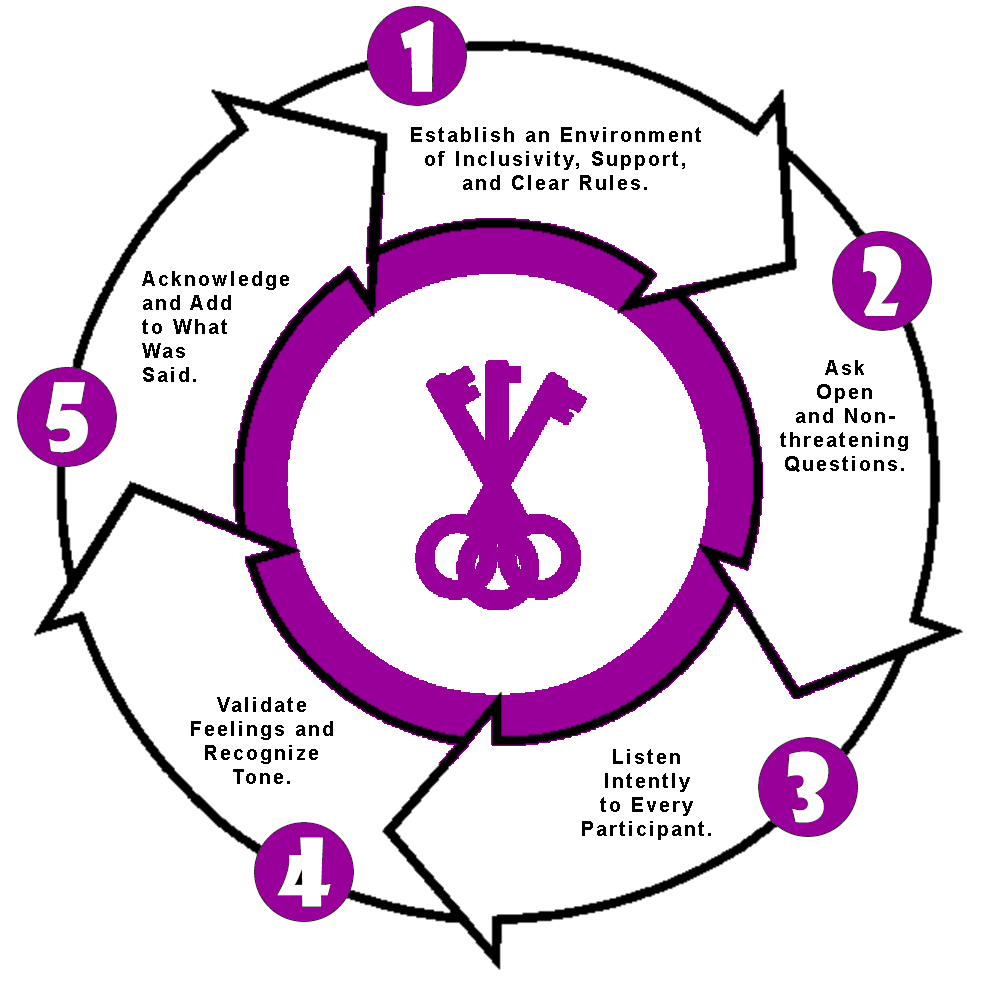
Establish an Environment of Inclusivity, Support, and Clear RulesForum Cycle | Introduction | Step 1 | Step 2 | Step 3 | Step 4 | Step 5 By Nicholas Burk (President)Publisher’s Note: The original version of this article was published in Vol. 3, Issue 3 of the Seeker’s Key. An archived copy of that issue is available on our Newsletter Page.“We have a choice. We have two options as human beings. We have a choice between conversation and war. That’s it. Conversation and violence…” — Sam Harris“If all mankind minus one, were of one opinion, and only one person were of the contrary opinion, mankind would be no more justified in silencing that one person, than he, if he had the power, would be justified in silencing mankind.” — John Stuart Mill“Think for yourselves and let others enjoy the privilege to do so too.” — VoltaireHuman beings are, primarily and essentially, emotional and social creatures. We share a deep psychological need to belong and to have meaningful relationships. No matter one’s mental state, background, personality, or social skills, we would each do well to prioritize the development and maintenance of friendship in every stage of life. Tremendous joy can come from making a personal connection, listening to a person’s reflections on their journey, thus far, and forging lasting friendships.However, most of us find ourselves in judgemental societies where we’re surrounded by insecure people (online and offline) who are eager to find the first reason to dismiss or dislike us. When we’ve been slapped by a few too many unfair and reflexive judgments, we tend to close-off and protect our thoughts and feelings. This coping mechanism is so common that we may not even be aware that we’re doing it. After all, our ideas and feelings are precious things. How can we keep sharing them with those who may fail to value them?Even when our ideas are wrong, misguided, or half-baked, they still matter to us. They are still an honest reflection of our unique perspective, products of our mind as it tries to make sense of life. True, people are technically doing us a service when they point out how wrong we are, but our emotional nature tends to undercut their efforts. More often than not, a harsh correction can lead us to double-down on our erroneous convictions. This is known as the “Backfire Effect,” one of several logical fallacies and psychological errors we all make as a result of our nature.Therefore, if we are all to become better thinkers, we need freethought communities that are willing to listen to our ideas, our REAL ideas, without sugar-coating or pretenses. Such communities should accept us, as we are, warts and all, before, during, and after we share our honest thoughts. And when we need correction, it is delivered to us in a generous and non-antagonistic manner. Real friendship lays the foundation needed to make these bitter pills easier to swallow in the healthiest way.The first step in the Forum Cycle addresses these needs. At the beginning of every freethought discussion, and multiple times throughout, we need to establish an environment of inclusivity, support, and clear rules. In other words, we must set the stage well enough that even the most guarded, shy, or self-doubting person can feel safe sharing their perspective. Every participant should feel that their experiences and insights aren’t wasted on the group. Most importantly, we need to do what we can to clearly communicate that we want to hear what they have to say. No matter how unpopular, inarticulate, or nervous they feel, every freethought discussion should be a refreshing and self-affirming experience. Every Person, a PhilosopherWhile our meetings are designed to help meet the emotional and intellectual needs of our members, they’re also a continuation of the rich legacy of freethought and informal philosophy. In the days of the European Enlightenment, for example, common workers, academics, and scientists met together in cafes to freely discuss mathematics, religion, politics, current events, and every other topic under the sun! These casual conversations paved the way for some of the greatest discoveries and progress in science and ethics.Immanuel Kant offered advice on how to host such conversations. He taught that everyone should agree to not repeat any offensive or foolish comments made by anyone present so that a truly free exchange of ideas could occur. Conversations should begin with a review of current events, continue with serious discussion, and end with humor.Spinoza observed that the theological discussions enjoyed by our ancestors focused too heavily on obedience and conformity, robbing us of true innovation or critical thought. He argued that unconstrained discussions based on reason and philosophy are what we need in our search for real understanding and rational truth. Voltaire loved the free markets, religious tolerance, diversity of thought, and the inclusive values of British Protestant Culture. Even though he was a cynical French Deist, his ideas were welcomed by his British contemporaries, just as he would go on to welcome theirs. Voltaire’s values are often summarized with the common saying, “I disapprove of what you say, but I will defend to the death your right to say it.”Thomas Paine was also a champion of free speech and a firm believer in every person’s capacity (when given the opportunity) to think rationally. These values inspired his famous pamphlets which served to unite the 13 American colonies into one nation with the shared vision to become a beacon of liberty to the world.Generations later, John Stuart Mill wrote that every person should be well-educated, free to express their opinions, eager to expose those opinions to honest criticism, and open to changing their mind when convinced to do so by strong arguments. While a government should allow its nation’s citizens to say, think, believe, and publish what they want, Mill also believed that our society should never try to control people through social pressure, cultural norms, or what he called “the tyranny of the majority.” He encouraged every person to live life as if it’s an experiment, try new things, be unique and eccentric, and allow others to do the same. This, he argued, was the only way to ensure that the truth was never suppressed and that society can improve over time.The Free Thought Forum proudly carries on this tradition. We affirm that every person should be allowed to say, in-person, what they need to say, even if, like these past freethinkers, their opinions may seem erroneous or nonsensical at first blush. What Inclusivity Sounds LikeWhat can you say to establish such an environment? The following are a few suggestions. Practice reading the following statements out loud a few times. You’re free to memorize and borrow them, but your goal should be to become comfortable enough with the message that you can use your own words to express the same meaning.“Thank you to those who’ve felt safe to share their thoughts. And thank you to everyone else who has helped them feel safe enough to do so in the first place.”“This is a place where we all can think out loud, so it’s ok if your thoughts aren’t complete or well-polished. We’re here to help one another, not judge.”“We want to make sure that everyone has time to participate without interruption, so I am reminding the group that we all need to follow Rule 1 and keep our comments reasonably concise.”“Feel free to agree or disagree with any comments made today. People come to our meetings to test out some of their ideas, so your feedback is always welcome.”“We all believe in different things, so you’re welcome to honestly speak your mind. We’re here to support each other on our different paths, not tell people what to believe.”“Every person here has the opportunity to discuss their evolving beliefs. We’re each allowed to come to our own conclusions.”“Rule 5 states that we should ‘allow for amicable disagreement and diverse opinions.’ It’s important that we remember that rule when talking about controversial topics.”“Putting your thoughts into words is an important intellectual exercise. The Free Thought Forum is like an intellectual gym!”“I appreciate you sharing your story. It’s given us all something to think about.”“We’ve covered a lot of ground. Still, I can’t wait to hear what you all have to say about this next part.”“I think that this has been one of our most interesting and thought-provoking discussions. I’m glad that I’ve had the opportunity to share it with this group, and I’m sure several of you feel the same.”Remember to begin and end every meeting with positivity. Freely thank everyone for their willingness to discuss important ideas with you. When expressing appreciation or re-establishing the proper tone of the meeting, be quick and specific. Sometimes, one or two simple comments like those above will do the trick! Welcoming First-Time VisitorsThe Free Thought Forum is a place where people can, and do, build life-long friendships. It’s primarily the responsibility of the Chapter Leader to create an atmosphere where any kind of person feels welcomed and appreciated. No matter what they believe or what emotional baggage they bring, the tremendous value of every person should be respected. Even in chapters where no member agrees with any other on a given issue, every member should still feel like they have an equal claim to chapter membership. In short, every chapter is made for its local community, so every person who visits should find belonging, by default.In our everyday lives, the fear of judgment, criticism, rejection, social pressures, and other factors cause many of us to socially isolate or self-segregate. The best way to counteract this is to approach each member, guest, and visitor as a potential life-long friend. A Chapter Leader takes the initiative, shares their name, starts a conversation, and acts like the kind of person that anyone would love to meet. They’re positive, helpful, grateful, genuine, and do their best to bring out the best in their fellow freethinkers.Our custom is to ask first-time visitors to share a little bit about themselves. (This usually takes place at the start of a meeting or its midpoint.) We ask things like, “What has been your journey as a freethinker so far?” At first, visitors may not feel like going into much detail. However, if they are, we should always be ready to listen!When interacting with a visitor for the first time, you may want to talk about yourself (and your chapter) and make your experiences, ideas, and opinions clear. However, this inclination may backfire and unintentionally communicate general disinterest in others, closed-mindedness, and even a few narcissistic tendencies. Therefore, a far better practice is to share very little about yourself while asking a generous amount of questions. Keep in mind that if a person properly feels welcomed and appreciated, you’ll have plenty of time in the future to talk about whatever you want. Be genuinely interested in what your new acquaintance has to say and ask follow-up questions. Let them talk about their ideas, their history, their interests, and their philosophical journey. Resist the urge to constantly declare when you agree or disagree. Avoid labeling or categorizing others while they share their stories. Enjoy their unique perspective without passing or expressing judgment.All this helps to convey that people can comfortably be their true selves around you and at the Free Thought Forum. Enforcing Our Five RulesJumping into a pool is less daunting if we know that we’ll be able to touch our toes to the bottom. It’s safer to walk down a staircase with the help of a handrail. Likewise, all healthy relationships need limits. In our interpersonal relationships, we should be clear, up-front, and consistent about personal boundaries. In much the same way, every meeting of the Free Thought Forum should be reliably and transparently run within the limits of our Five Rules for Civil Discourse.This set of clear and strict rules give the minimum amount of structure to our freethought discussions so that they may yield the most fulfilling and educational experience for all involved. More or less regulation has consistently led to diminishing returns, so we’re confident that we’ve found the right balance. At the beginning of a meeting, in spoken or written form, a Chapter Leader ought to share the following.By participating, all visitors and members agree to abide by these five rules:1. Be respectful of each other’s time by making your comments reasonably concise and by listening to the comments of others without interruption.2. Focus your comments on ideas, not people.3. Recognize the authority of the Chapter Leader as Moderator.4. Be prepared to explain the reasoning behind your ideas, if asked.5. Allow for amicable disagreement and diverse opinions. (Your aim should not be to convince, convert, or "win" the discussion.)A Chapter Leader also serves the important role of moderator, so whenever participants grow lax on any of these rules (or break them outright), this is the step in the Forum Cycle where the conversation is paused so that a reminder of the rule(s) in question can be given. For the vast majority of the time, this should be a plain, direct, and unemotional reassertion of the rules made to the group under the assumption that it was simply forgotten (as this is usually the case). It is almost always better to assume ignorance before assuming ill-will. People who’ve accidentally crossed a line tend to appreciate friendly reminders over personal attacks. Sometimes, we all need to hear things multiple times before it “sets in.”Bring up concerns early, when they’re still small. If you ignore casual rule-breaking at the beginning of the conversation, it can be impossible to fix the problem further down the road. By participating in our discussions, all visitors and members agree to abide by our five rules, so nearly everyone comes with the expectation that those rules will be enforced. Our Chapter Leaders have the authority to interrupt any participant, point out any rule violation, or call for additional five-minute breaks if any difficult situations arise. Most of the time, of course, they can sit back, enjoy the conversation, and preserve civility simply by being present. Helping Shy Freethinkers Out of Their ShellsNot all social gatherings are created equal. If people sense the smallest hint of hostility, that there is an in-group and an out-group, or that the social stakes are high, then they will typically keep quiet out of a fear of rejection. After all, who can risk making a bad impression among people who could be judgmental, overly critical, or close-minded? On the other hand, people are much more likely to open up and share their thoughts when they feel like they’re surrounded by open-minded, friendly, tolerant, and easy-going people.We would all do well to better communicate to others that they are welcome to share what they have to say. Invite your forum members to go on (and on) about their lives and their thoughts. Allowing someone a reasonable amount of time to properly put their perspective into words will help them feel more like you “get them,” and that they are, indeed, free to be themselves.Throughout the meeting, casually invite all participants to share their perspectives. Of course, if someone would rather listen and participate only as a spectator, they are certainly free to do so! Still, some people may consider it impolite to share their opinions unless they’re asked directly to share. So ask!An invitation to participate should be warm and casual, free of any tension or pressure, so that the person being asked feels like they have all of the liberty in the world to respectfully decline.Does someone want to listen, or are they patiently waiting for their turn to speak? If you don’t know them well enough to answer that question…
Full show notes at the publisher 
 Our TOPPODCAST Picks
  Stay Connected