TopPodcast.com
Menu
  • Home
  • Top Charts
  • Top Networks
  • Top Apps
  • Top Independents
  • Top Podfluencers
  • Top Picks
    • Top Business Podcasts
    • Top True Crime Podcasts
    • Top Finance Podcasts
    • Top Comedy Podcasts
    • Top Music Podcasts
    • Top Womens Podcasts
    • Top Kids Podcasts
    • Top Sports Podcasts
    • Top News Podcasts
    • Top Tech Podcasts
    • Top Crypto Podcasts
    • Top Entrepreneurial Podcasts
    • Top Fantasy Sports Podcasts
    • Top Political Podcasts
    • Top Science Podcasts
    • Top Self Help Podcasts
    • Top Sports Betting Podcasts
    • Top Stocks Podcasts
  • Podcast News
  • About Us
  • Podcast Advertising
  • Contact
Not in our directory?
Add Show Here
Podcast Equipment
Center

toppodcastlogoOur TOPPODCAST Picks

  • Comedy
  • Crypto
  • Sports
  • News
  • Politics
  • True Crime
  • Business
  • Finance

Follow Us

toppodcastlogoStay Connected

    View Top 200 Chart
    Back to Rankings Page
    Education

    The Fresh Perspective

    Come join the conversation about freethought, philosophy, politics, religion, atheism, science, logic, reason, rationality, social issues, morality, current events, and more!

    Advertise

    Copyright: © Free Thought Initiative (c) 2019

    • Apple Podcasts
    • Google Play
    • Spotify

    Latest Episodes:
    Celebrating Wisdom Sep 23, 2019
    Show notes

    The Fresh Perspective Podcast - Episode 31How’s it going everyone? I’m Nick and you are listening to the Fresh Perspective Podcast.When this episode was first recorded, we were just a couple of days away from the September Autumnal Equinox at my latitude. For members of a Free Thought Forum and others, this means that the time has come for the Wisdom Festival! Today, I’d like to take this special occasion to talk about this new tradition as well as the virtue of wisdom itself, one of the four cardinal virtues of classical philosophy, and, according to Plato, the most important characteristic of a philosopher-king.This program is brought to you by the contributing members of the Free Thought Initiative.We help those in need of an inclusive, supportive, and free-thinking community by hosting public discussions on moral philosophy, healthy living, and science, to improve the cohesion, health, and scientific literacy of our society.Everyone is welcome, (regardless of personal background, religious belief, political leanings, etc.) to participate (in-person) in these open and civil discussions each week.To find a Free Thought Forum meeting near you, to start your own local group, or to support this program through monthly donations, please visit freethoughtforum.org. While you’re there, be sure to check out our online store – now with freethought t-shirts, mugs, and other smart-looking swag!What does it mean to be wise? How can one develop wisdom? After we wrestle with those questions, I’d like to introduce you to the ideas and traditions behind the Wisdom Festivals hosted by this organization on the days before each September Equinox. This episode is divided into four parts. In order to get the most out of this podcast, please stick around for each one!Part 1 – What is Wisdom?Finding the best definition of wisdom, to me, is a captivating exercise. In a group of friends, it can spark a conversation that lasts hours. I will share some of my thoughts on it, but I’d also like to ask you for yours. To better conceptualize the virtue of wisdom, I’ve broken it down into four main ideas:1. A MULTI-LAYERED AND ORGANIZED PERSPECTIVE.One may see wisdom as the ability to recognize the harmony or conflict between many different perspectives at once and reliably prioritize and organize them in the most useful way. For example, a wise person is able to consider both the learned facts and moral sensibilities applicable in a given situation. This comes from a deep understanding not only of what is real but also what is right. Their actions and thoughts are not ruled by just one objective or presupposition. Rather, they carefully weigh multiple considerations with respect to things like complicating nuance, cultural norms, logical fallacies, long-term consequences, and so forth. Wisdom isn’t the stubborn reliance on one idea that cancels-out all others. Instead, wisdom is a developed skill that takes one’s experience into account with other factors and allows one to properly consider what one should do, what one shouldn’t do, and how to act as a result.2. PROPERLY APPLIED KNOWLEDGEWhen we are presented with neutral facts, what are we supposed to do with them? A wise person can give a good answer. Much like how engineering can be considered the application of science to innovate, invent, or solve real-world problems, wisdom can be considered the best possible application of knowledge, or knowledge put to good use. From this perspective, knowledge represents raw data, the facts, and plain information that doesn’t necessarily lend itself to any practical usage. A long list of memorized facts does not constitute wisdom. Yet when we take this raw data and consider how to best use it, we are exercising a modicum of wisdom. This is the process you go through when you solve a story problem in your math class. You may be told that a car has a 15-gallon tank, gets 30 miles per gallon, has only half a tank left, and is stopped at a gas station 10 miles away from the next gas station. Those are all just facts, words on a piece of paper. But then when you go to answer the question, “Can the driver reach the next gas station if they don’t fill their tank now?” that requires a little bit of wisdom. How wise a person is can be shown by how they use information. A wise person knows when to use specific tools of logic, when to estimate, when to through-out certain ideas, and when to highly value others. For example, if a child asked their parent, “Why do some berries taste bad,” a foolish parent may answer the question at face value, doing very little with the situation. A wise parent, on the other hand, may proceed to find out if the child has been endangering themselves by eating wild berries.3. EXERCISED CAUTION WHEN IT COMES TO ACTION AND BELIEFA wise person is also careful about what they believe. They are not easily fooled, nor are they overconfident. They recognize the value of learning and are quick to replace previously held concepts when they are shown to be false. The wise have discovered a healthy balance between skepticism and open-mindedness. They value what is taught by experts, but they do not blindly believe in any authority. Rather than accept the conventional wisdom of their time, a wise person is slow to make conclusions and quick to investigate, ask questions, and improve their understanding. This also carries over to their actions. They strive to always consider the short-term and long-term effects of their choices, and only do something if they have good reason to do it.4. MEANINGFUL DIALOGUECalling something wise can be like calling something beautiful. Through a subjective lens, stated wisdom seems meaningful to its listener. It strikes us as profound, insightful, intelligent, and surprisingly useful. In contrast, foolish speech seems vacuous, hollow, and barren. This relates to what Plato said, that wise people speak only when they have something important to say, but fools speak because they always have to say something. When you add your two cents, I suppose that it is helpful to contemplate your motives behind it. A wise person genuinely believes they have something to add to the conversation supported by a deep comprehension of the subject matter and careful consideration of the situation. A fool simply wants to meet a deadline or fill an awkward silence with noise.Part 2 – Developing WisdomIf you would like to be a wiser person, here are some things to try-out:1. THE WHY GAMEThink about one of your most important beliefs. Ask yourself why you believe it. Once you think of an answer, ask yourself why you believe that answer. Continue until you’ve reached a belief or an idea that you can’t explain and write it down. Now you’ve found something important to study and/or discuss with other freethinkers!2. DETECTING YOUR BLIND SPOTSThink of the last time you were not able to explain something to a child, were fooled, became angry during a debate, or when you dramatically changed your mind about something important. Consider how you felt and what you thought about that thing before and after your mind was changed. This may help you identify your personal “blind spots” or subjects that you would do well to think about more carefully in the future.3. READ ABOUT SOMETHING SOMEONE LIKE YOU WOULDN’T READWe can be picky about the kind of ideas we let into our minds. Without meaning to do so, we may find ourselves trapped in an echo-chamber of our own making, recycling the same ideas. A wise person actively tries to broaden their mind and deepen their well of knowledge. You can do this by choosing to read something you otherwise would never have read. Dive into it as far as you can! Even superficial knowledge of a topic previously foreign to you can one day prove useful in an unexpected way.4. THE BEST COUNTERARGUMENTSIt can be extremely helpful to dispassionately contemplate strong arguments coming from the “other side” of a debate. Think of a position you hold on a given issue. Then try to find the best possible arguments coming from those who hold the opposite position. Even if you don’t end up changing your mind, this exercise may powerfully enrich your perspective.Part 3 – Forging New FestivalsNow that we’ve given the concept of wisdom some time to swim in our thoughts, I want to better explain this weekend’s celebrations, and why this organization is hosting them in the first place.In the early days of the Free Thought Initiative, one discussion among board members drifted into the importance of traditions and seasonal celebrations within a community. We wanted to come up with four of them, four special events that could interrupt our regularly scheduled discussions on science, health, and philosophy. More importantly, holidays and annual events can bring fun, distinction, and a sense of unity to a group of people. This kind of cultural unity is something our local groups can really use, especially when we consider how diverse our members are and tend to be.Any Free Thought Forum may be comprised of members who are Atheists, Christians, Sikhs, Pantheists, Mystics, Hindus, Buddhists, Republicans, Democrats, Libertarians, Anarchists, and so forth, in various ratios. If we are to come together to celebrate something, it has to be something that we all can value, no matter our backgrounds or beliefs. In the wider picture, it wouldn’t be prudent to base these traditions on local cultural norms. If a Free Thought Forum was created in Taiwan, for example, it would be silly for them to throw annual parties about a culturally-specific idea like American Football.This line of thinking brought us to celebrations themed around moral virtues and common life goals related to those virtues. While many holidays and festivals call back to a person, historical event, region, product, or story, we set our sights to something more universal. The key was to select specific virtues that would apply to all people, from all regions, and across time.Another thing to consider was the timing. When would these four celebrations take place? After all, many countries around the world don’t even use the same calendar as we do in the United States. To answer that question, we turned to another concept that breaks through the barriers between cultures: Science. Scientific fact beautifully and equally applies to all peoples of the world. To find special times throughout the year, why not look at the actual seasons and orbit of the earth itself? If we are to have four annual secular celebrations, then it is perfectly reasonable to space them equidistantly, and according to natural phenomena, such as the solstices and equinoxes of our planet. For convenience, we can then make the official celebration times fall on the weekends just before each solstice and equinox. Since all of our groups meet on Saturday or Sunday, then all they would need to do is replace their regular meetings with these themed parties when the time comes.But what should we do at each of our annual festivals? That is completely up to you and our community! Feel free to be creative and inventive. Sharing your suggestions can help us all create a rich and meaningful experience each year. We have looked around the world for inspiration and have been pleased with what we have found thus far. Likewise, if you look near and far for great traditions and practices that match each theme, we would love to hear what you find.To see our official updated traditions for each of our festivals as well as a list of all such upcoming celebrations, please visit freethoughtforum.org/festivals.Part 4 – Wisdom Based TraditionsIn addition to your other local, national, and cultural festivities, we hope that you will join us for this year’s Wisdom Festival, a celebration of prudence, intellectualism, logic, learning, knowledge, education, intelligence, expertise, reason, rationality, brilliance, sagacity, and other related virtues. Participants are encouraged to value learning and understanding for its own sake, and not just as a means to an end. We set personal goals for the coming year regarding our individual education and each guest may select new free book to read. Past academic achievement is celebrated and the senior members of our families are honored. Starting in September of 2019, the following traditions connected to this festival were set in place and modified according to the feedback of our members:Looking Smart –Many participants will use the occasion to look smart, don dapper digs, and dress to the nines. Feel free to wear your best dress, your fanciest tie, or simply just come as you like.Intelligent Treats and Mystery Sacks – Dig into an assortment of (surprisingly healthy) erudite edibles. This year, we will have fresh vegetables, banana-oat cookies, and rice-crackers. Be sure to also pick up a grab-bag of intellectual goodies such as top-of-the-line pens, bookmarks, and owl-shaped erasers before you leave!Used Book Exchange – Bring one or more used books that you would like to donate or swap for one or more new reads from other freethinkers!Honoring Academic Achievement – We’d like to shine the spotlight on the sacrifice and personal improvement of our scholars, no matter their age! Did you learn a language, sign-up for your first college classes, graduate with honors, win 2nd place in a spelling-bee, learn how to play an instrument, earn 100% on an exam, or something similar? Let’s share that with the audience followed by some much-deserved applause.Party Games and Treasure Hunts – Be ready to test your knowledge and wit playing strategy and trivia games. Young guests can even go on a puzzle-based hunt for the chance to win some toy treasure!Suggested Family Tradition: Senior Interviews – Guests are encouraged to take some time in the week following this event to visit an elderly family member or friend and invite them to share their stories, memories, and life-lessons-learned for an enriching and educational experience for all involved.Additional Theming -- To ground the abstract concepts featured in this celebration, the following symbolism is utilized:The Colors Orange, Yellow, and Gold - In Europe and in North America, orange is strongly associated with the autumn season and with warnings calls to be careful. In the historical European arts of heraldry and vexillology, these colors were associated with prosperity (like fields of wheat), wealth, sunlight (enlightenment), and excitement. In Sikhism, Hinduism, and Buddhism, yellow represents knowledge, learning, mental development, and a grounded lifestyle. Orange (saffron) is also a sacred color of spiritual purity.The Owl - This was the symbol of Athens in the ancient world, a hub of the arts and scholarship. In classical mythology, the owl is a representation of Athena, the Greek goddess of wisdom. In Hinduism, an owl is the vahana of Lakshmi, the goddess of wealth, fortune, and prosperity.An Open Book - From the ancient halls of the Library of Alexandria to the ebook collection you have on your smart device, few of humanity’s tools over the years match the teaching power of books. Reading is one of the fastest and most efficient ways you may increase your knowledge, and knowledge is power!Which traditions would you like us to attach to these events? What do you think of our plans so far? Your FEEDBACK is welcome.If you have enjoyed this conversation or have learned something from it, please leave a like, subscribe, and share it with other open-minded people. All of those small things really do make a big difference and help others find our group and our podcast. Thank you!That is all I have for you today, but the conversation continues across social media and in the comment sections below. Do you agree with today’s message? Am I mistaken about some detail? What feedback or ideas do you have for this program or our organization? Feel free to share your perspective.A Special Shout-Out goes to Shayne Wissler, Lance Freeman,…

    Full show notes at the publisher

    Increasing Our Collective Cognitive Bandwidth Sep 13, 2019
    Show notes This article is an excerpt from a recent issue of our newsletter. Click here to read the full issue!

    Many Minds Make Light Work

    By Nicholas Burk, Executive Board Member

    choices.jpg

    Becoming a freethinker is a worthy goal, but that doesn’t make it easy. Life presents each of us with difficult choices, complicated problems, and profound mysteries. At times, we may feel particularly cavalier and jump into these challenges with both feet. Other times, we may freeze, overwhelmed by the endless avalanche of answers offered in our modern age. Many of us simply lack the time, energy, education, or temperament to wrangle with the philosophical questions intrinsic to the human experience.

    It may be tempting to settle for answers that are “good enough.” Dogmatic certainty and superstition, after all, have been the preferred coping mechanisms for most of our ancestors. But for a Freethinker, these options can’t be the only sources of help. What else is there?

    glass ceiling.jpg

    Limited Cognitive Capabilities

    Understanding the problem is the first step in finding the solution. In this case, our greatest asset, the human mind, also represents our greatest liability. Our impressive, (albeit imperfect) brains are each a sanctuary with a glass ceiling.

    Individually, our powers of critical thinking, discovery, problem-solving, and other similar operations is limited to the capabilities of the white and gray matter between our ears. When it comes to wrestling with big ideas, we each face very real limitations. For example, we are blind to many of our own biases, cognitive dissonance, and home-grown logical fallacies. One’s IQ, energy levels, time constraints, and current level of education all represent limits to the rate at which one may increase their understanding.

    When our ideas only live in our own minds, they are like blueprints without a construction crew, a locked treasure box, or a scientific experiment, waiting to happen.

    man-under-waterfall-2150164_1920.jpg

    The Need for Thick Skin

    A seemingly obvious way to overcome these obstacles would be to share the task of truth-seeking with other minds. See what the blueprints produce, open the box, and run the experiment! However, doing so opens one’s ideas up to possible criticism. Only when they are exposed can the failures of our preconceptions be laid bare. Our most profound discoveries may be deconstructed before our eyes, sending us back to square one. Our prized breakthroughs may not be treated with the respect we feel they deserve. As others open up, we may be exposed to ideas we don’t like or concepts that complicate the issue.

    A dedicated Freethinker must have thick skin. To them, the Truth must matter more than the slings and arrows endured along the path to obtain it. Truth-Seekers and Freethinkers alike must be willing to abandon faulty beliefs, like broken tools, in favor of those ideas that get them closer to a better understanding of reality, morality, and more. This is a journey of personal growth and perseverance.

    With all that considered, is it even worth it to expose others to ideas and expose ourselves to their ideas? Should it be said that the exploration of freethought is indeed improved through the shared consideration of multiple (and, at times, conflicting) opinions?

    wireless-1861612_1920.jpg

    Stretching Our Minds

    For many of us, open-mindedness represents a difficult challenge. How can we possibly entertain multiple perspectives on a given issue? We may think of ourselves like over-ambitious jugglers or an over-taxed internet router, plagued by inadequate bandwidth. If we share this important cognitive load with others, won’t we end up feeling stretched and bogged-down? Aren’t we all better off when we greedily guard our mental processing power, like a limited resource?

    Going It Alone

    As freethinkers, we tend to first approach life’s most important questions as lone wolves. (Of course, this isn’t always the case, but it is a trend made conspicuous as we later share with one another the stories of our individual lived experience.) In an attempt to distance ourselves from criticism, mental strain, and concepts antithetical to freethought such as dogma, coercion, or “group think,” it is understandable that we may prefer to forge our own path and produce our own answers.

    woman-2896389_1920.jpg

    Taking such a position is understandable. However, doing so returns us to that glass ceiling. Like Atlas, we find ourselves bearing an unbearable load without respite. Over time, as with many things in life, we become increasingly aware of our individual frailties and inadequacies. If we are to move beyond this cycle of lonely contemplation, we must be willing to add our voice to a forum, despite all of the reasons to hold back. It takes a little bit of bravery, a little bit of grit, and a thirst for discovery. It is the willingness to take a step into the dark, the deciding factor in a hero’s journey. When we are willing to endure criticism, mental exertion, and exposure to other ideas, we unlock a door to treasures beyond our comprehension!

    help.jpg

    Sharing the Burden

    The good news is that this quest for answers need not be done alone! We live in an age where concepts such as logical thinking, rationality, and self-determination are becoming mainstream values! Chances are good that where you live, you are able to find freethinkers with whom you can meet in person. When we find others with similar goals, an opportunity to work together arises. Rather than bearing the weight of the world’s ambiguities alone, we finally have a chance to share the cognitive load!

    Knowledge is power. Similarly, an assortment of sincere opinions, perspectives, and experiences laid before a listener enables them to form a better-informed view on the topic at hand. We are so much better served by carefully considering new points and counterpoints. The alternative is to live in a bubble, an echo-chamber, or a safe space in which our preconceptions may only be reinforced. How can people call themselves freethinkers if they only allow themselves to be exposed to a handful of comfortable opinions?

    free.jpg

    Freethinking and the search for facts and moral wisdom are, in fact, improved as they are shared. The fruits of this enterprise are more valuable because they have passed the inspection of a high number of critics. When multiple perspectives are taken into account, all involved are better for it.

    This need not be a taxing or draining experience. Proper utilization of a forum allows each freethinker to act as an additional processor, increasing the computing power of the overall system. Many minds make for light work!

    The Free Thought Initiative is an organization engineered to aid each member in their path to forge their own best-possible answers to life’s most important questions. Even when our individual backgrounds, beliefs, and perspectives vary, we are unified under common goals.

    card.png

    We are here to help. With a forum of fellow freethinkers, one mind is complemented by the power of many more. The chore of sorting through and learning from history’s greatest ideas becomes a game. Each week, we are able to send our ideas to be tested in an open marketplace. Our views are refined and we help each other grow. Our personal limitations fade-away and our unique talents are put to good use!

    Through weekly forums, we are improved. As a result, our communities are filled with more freethinkers, freely sharing their findings, and energized through the synergistic increase of our collective cognitive bandwidth.

    ___

    © 2019 Free Thought Initiative

    Subscribe to our Newsletter

    Stepping Up for the Animal Shelter Sep 11, 2019
    Show notes This article is an excerpt from a recent issue of our newsletter. Click here to read the full issue!

    By Nicholas Burk, Utah Valley Group

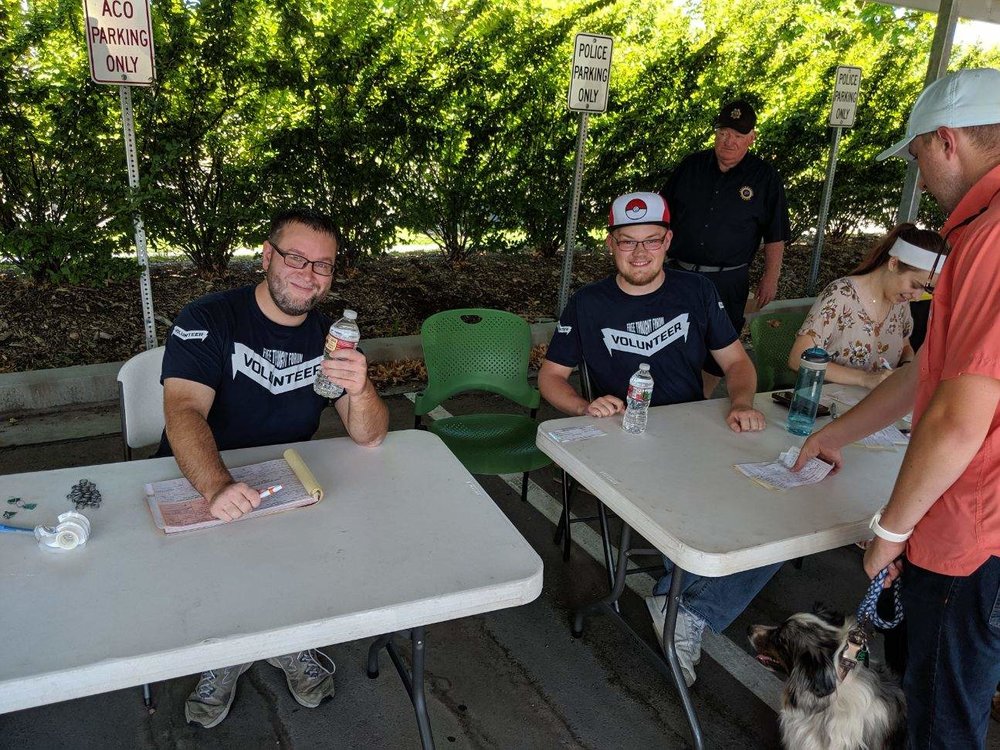
    On September 8th, 2019, the South Utah Valley Animal Shelter (SUVAS) held another public pet clinic and the Utah Valley Free Thought Forum was there! This brings our total man-hours donated to the shelter to 44, and we’re just getting started.

    9582.jpeg

    These clinics are usually housed in fire stations and parking lots where local pet owners can come and have their pets vaccinated and registered at a discounted price. Not only does this program improve the health of pets in the community, but it also provides important preventative work that frees up the shelter to help more animals.

    Saturday’s clinic was in Payson, but our group has also helped in Mapleton and Springville. The representatives from the shelter are sincerely grateful and have even brought us water bottles and doughnuts! They really know how to train their volunteers and put them to work. At first glance, helping the public with their paperwork and pets may not sound as glamorous as other volunteer opportunities. Yet we’ve found that this is where we have been needed the most – and nothing beats that!

    9581.jpeg
    9583.jpeg

    If you live in the area and would like to volunteer with us, check the Utah Valley group’s upcoming events or contact the South Utah Valley Animal Shelter directly (801-851-4080) and let them know that you’d like to help out at their next clinic. Thank you!

    ___

    © 2019 Free Thought Initiative

    Subscribe to our Newsletter

    Beyond Cults and Culture Wars: Building a Home For Freethinkers Sep 06, 2019
    Show notes This article is an excerpt from a recent issue of our newsletter. Click here to read the full issue!

    A Look into the Origins of the Free Thought Forum through the eyes of a Founding Board Member.

    By Jacob Collier, Utah Valley Group

    Hello Free Thought Forum! Before today, I hadn't put anything out there for our newsletter. As one of the founding board members of this organization, I figured it would be remiss of me not to explain my original motivations for starting this group with Nick and Lance…

    Before I begin, it’s important to note my background. I come from a currently-active polygamist group. My distaste for Joseph Smith and his teachings still make it quite difficult for me to get along with my family who, for the most part, still belong to that group. Likewise, I really wasn't comfortable being a part of the predominant religious group in my area, the LDS church. I had also recently ended a long term relationship. The combination of all these factors left me feeling pretty much on my own. As such, I began visiting a local ex-Mormon Meetup group that met at a local coffee shop.

    Unfortunately, this group didn't have consistently attending members. Anytime I went, I was equally likely to end up sitting there alone for an hour as I was to actually talk to anyone. Fortunately, when I was sitting in the coffee shop one day, wasting my time on my phone, Nick and his wife sat down and asked if I was part of the local ex-Mormon meetup group. We talked about a lot of the things that would end up becoming the core ideas of the Free Thought Forum. The rest is history.

    See, as humans, we all need to belong somewhere. The lack of any kind of social group can leave one feeling vulnerable, alone, and depressed. As a young non-believer, it can be quite difficult to find a group that promotes things like skepticism, open-mindedness, and freethought, without also being infested with the kind of rampant anti-white, anti-western sentiments that I have found in some predominately atheistic groups.

    pair-3798371_1920.jpg

    It’s important to have a healthy social group to find a spouse, to raise your children, to connect with others who share your core principles, to have a more local financial safety net, etc. Throughout history, humans have always benefited from these kinds of groups. While the criticisms toward our institutions of belief have been rightly aimed, it has left a lot of people feeling as though there is nowhere to turn to for the previous social necessities, while still holding some modicum of love and gratitude for your culture and the ideas that helped to create it.

    For all these reasons and more, the Free Thought Forum was founded in March of 2019. We sincerely hope to provide people with a life-long practical social “backbone” to meet their social needs and aid in their self and familial development.

    Can we measure up to that promise in the long run? I believe that with the efforts of Nick, Lance, myself, and you, our members, we will make that important difference. I believe that this organization will continue to grow and help far more people with stories similar to mine.

    ___

    © 2019 Free Thought Initiative

    Subscribe to our Newsletter

    Logical Fallacies (Part 3) and How to Avoid Them Aug 25, 2019
    Show notes

    The Fresh Perspective Podcast - Episode 29

    How’s it going everyone? I’m Nick and you are listening to the Fresh Perspective Podcast.

    Welcome to Part 3 of our series on logical fallacies and how to avoid them! We have looked at many of these common fallacies thus far, but there are still plenty more besides. If you have missed either of our last two episodes, I’m sure you would enjoy giving them a listen as well.

    Who doesn’t love a good card trick? No matter how closely we try to pay attention, all it takes is a clever sleight-of-hand or subtle misdirection on the magician’s part to bypass our powers of perception. In no time it all, we may find ourselves convinced that what we saw was magic.

    Logical fallacies are used in similar ways. They sure-up our ideas and make our arguments sound stronger than they really are. On the surface, we can amuse and dazzle our audience. Our logic may sound stable and well-thought-out, but upon further inspection, it is all just a trick. Behind the curtain, these flimsy fallacies can be seen crumbling under their own weight. Join me as we unveil four more common logical fallacies.

    This program is brought to you by the contributing members of the Free Thought Initiative.

    We help those in need of an inclusive, supportive, and free-thinking community by hosting public discussions on moral philosophy, healthy living, and science, to improve the cohesion, health, and scientific literacy of our society.

    Everyone is welcome, (regardless of personal background, religious belief, political leanings, etc.) to participate (in-person) in these open and civil discussions each week.

    To find a Free Thought Forum meeting near you, to start your own local group, or to support this program through monthly donations, please visit freethoughtforum.org. While you’re there, be sure to check out our online store – now with freethought t-shirts, mugs, and other smart-looking swag!

    13. COMPOSITION OR DIVISION

    This is when someone assumes that one part of something has to be applied to all, or other, parts of it; or that the whole must apply to its parts. Often when something is true for the part it does also apply to the whole, or vice versa, but the crucial difference is whether there exists good evidence to show that this is, indeed, the case. Because we observe consistencies in things, our thinking can become biased so that we presume consistency to exist where it does not.

    Daniel was a precocious child and had a liking for logic. He reasoned that atoms are invisible. Therefore, since he was made of atoms, he must be invisible as well. Unfortunately, despite this feat of logic, he lost the game of hide and seek.

    I’ve met so many people in Texas who are bad drivers. Therefore, Texans are all bad drivers.

    All joking aside, you may commit this fallacy more often than you think. It is hard not to make generalizations based on a small handful of examples. I see this a lot with people who break-up. They say things like “All men are so selfish” or “All women are crazy” without realizing that they may have just been unlucky enough to date someone who was especially selfish or crazy. We may admire a certain company and then be surprised when we meet one of its employees who doesn’t conform to our expectations. We may love the free sample, only to find that buying it in bulk was a bad idea.

    A related common sign that a scientific study was poorly done is that it has a small sample size. True, they found that 9 out of 10 people loved the taste of super-wow toothpaste, but only 10 people were asked about it in the first place. That is a terrible representation of the population. What is true of 10 people isn’t necessarily true for everyone. Now if the number of people surveyed was 2,000, that study just got a lot better.

    We also see this in politics. We assume that one member of a minority, for example, is some de facto representative of that minority, because those types of people must all act and think the same. Therefore, we can trust any one person to accurately speak for their social group, right? Wrong. I can’t speak for all aspiring free-thinkers. You can’t speak for all people who listen to podcasts. That line of thinking is just flawed.

    To avoid making this fallacy, slow down. Don’t be in so much of a hurry to find simple rules that explain complex things. Avoid making broad-sweeping statements or hastily-made generalizations. Even if we want things to behave in a pattern, that doesn’t mean they do. As I brought up before, reality can be messy, surprising, and filled with nuance.

    Instead, provide data, numbers, and actual relevant statistics, whenever possible. Scientific papers that have large sample-sizes, long-running experiments, and duplicated studies are all preferable to those without. Rely on reputable sources as long as you have a clear idea of how the data was collected. Rather than using vague generalizations and hoping that your audience agrees, let the experts, careful studies, and numbers speak.

    14. ANECDOTAL

    If you used a personal experience or an isolated example instead of a sound argument or compelling evidence, then you have presented anecdotal evidence. Which is easier? Understanding complex data and variation across a continuum, or believing in what someone said? Quantitative scientific measures are almost always more accurate than personal perceptions and experiences, but our inclination is to believe that which is tangible to us, and/or the word of someone we trust over a more 'abstract' statistical reality.

    Jason said that that was all cool and everything, but his grandfather smoked, like, 30 cigarettes a day and lived until 97 - so don't believe everything you read about meta-analyses of methodologically sound studies showing proven causal relationships.

    Even though the overwhelming majority of doctors and scientists assert that vaccines are safe, my little Kenny got a big cold after his first shot, so your child should never be vaccinated!

    We’ve really hit the motherlode with this fallacy. If you are going to be logical or scientifically-minded, you must be willing to let personal experiences go. They are like counterfeit money or the promise of a Nigerian Prince in your inbox. When it comes to figuring out what is real, personal stories are worthless.

    As a quick side note, on the moral, social, or emotional side of things, listening to someone’s story and experiences is really important. Sometimes, it doesn’t matter if something actually happened. The only thing that matters is that the person believes that it actually happened. If you are a teacher, a nurse, a counselor, or clergy member, then empathetic listening to someone’s personal experience is paramount. It is important to validate what a person is feeling, and offer them some open-mindedness.

    But this episode isn’t about relationship-building or giving emotional support. It is about maintaining a strong grasp on reality. It is about building a resistance to nonsense. When it comes to the cold hard facts, personal stories and experiences do not register as valid evidence. But why is that the case? Here are a couple of reasons.

    First off, our memories are not that reliable. We’re only human. When compared to video footage, data from sensors and other inanimate recordings, our most-detailed recollections come off as flawed, hazy, and highly corruptible. Every time we remember something, we taint that memory. If a question is worded a certain way, we will modify our memory to form what we think is a good answer. We tend to remember meaning, not facts. We interpret our experiences through subjective filters along continuums such as happy to sad, fair to unfair, or fun to boring. The formation of each memory is highly influenced by our stress-levels, our goals, our beliefs, and other factors in the moment (and after the fact).

    Secondly, personal experiences are easy to fabricate. Some people are extremely good at lying with a straight face. There are plenty of reasons for someone to be dishonest in any given situation. People do it all the time and they start young. So if you are about to believe someone’s story, just because they told you a story, that goodwill is probably going to be used against you.

    How can we avoid making this fallacy? Well, for starters, only use personal anecdotes for fun or for flavoring. By themselves, they shouldn’t be used to convince anyone of anything. Present Information that is objective or quantitative. Avoid arguments based on personal experience. A strong argument is not based on something so subjective or non-repeatable. Rather, use numbers, measurements, statistics, verifiable history, and other cold objective and quantitative facts. The truth should be something that is accessible to any seeker, not the unique experience of a privileged seer.

    15. NO TRUE SCOTSMAN

    If someone dismisses relevant criticisms or flaws to their argument by making an appeal to purity, then they have committed the “No True Scotsman” fallacy. In this form of faulty reasoning, one's belief is rendered unfalsifiable because no matter how compelling the evidence is, one simply shifts the goalposts so that it wouldn't apply to a supposedly 'true' example. This kind of post-rationalization is a way of avoiding valid criticisms of one's argument.

    Angus declares that Scotsmen do not put sugar on their porridge, to which Lachlan points out that he is a Scotsman and puts sugar on his porridge. Furious, like a true Scot, Angus yells that no true Scotsman sugars his porridge.

    Jordan said that if Matt was a real atheist, Matt would be a murderer. But Matt wasn’t a murder, so Jordan said he wasn’t really a TRUE atheist.

    This is another case of special pleading. It is like when someone is teaching you the rules of a new board game. At first, you’re both having fun, but when you start to win, they tweak and change the rules in their favor. What a rotten cheater! Well, people do the same thing in arguments, debates, and discussions. Hopefully, by now, you have developed a sense for when someone starts to change the rules mid-game. Here are a few things you can do to make sure they don’t get away with it:

    To start off, agree on definitions. Lockdown what you are talking about and what you mean when you both say certain words. After that, stick to them and never let them be altered. This is a pretty well-known fallacy, so if you pick up on it, call it out. “Are you saying that No True Scotsman would sugar his porridge?” You can also deconstruct the claim. If they say that Howard couldn’t be the thief because he is a good Christian, then throw the claim back at them. “So are you saying that it is impossible for a Christian to commit a crime?” In many cases, it is helpful to let a person’s social group, label, or status fade away. Treating people as individuals who act and think individually is far more practical. Lachlan is a Scotsman, but he also sugars his porridge, deal with it.

    16. THE TEXAS SHARPSHOOTER

    This is when someone cherry-picks a data cluster that suits their argument or finds a pattern to fit a presumption. This 'false cause' fallacy is coined after a marksman shooting randomly at barns and then painting bullseye targets around the spot where the most bullet holes appear, making it appear as if he's a really good shot. Clusters naturally appear by chance, but don't necessarily indicate that there is a causal relationship.

    The makers of Sugarette Candy Drinks point to research showing that of the five countries where Sugarette drinks sell the most units, three of them are in the top ten healthiest countries on Earth, therefore Sugarette drinks are healthy.

    The Texas Sharpshooter makes an argument based on certain information, then uses that same information to confirm it, often while dismissing whatever doesn't support it. He remembers the hits but forgets the misses. This is confirmation bias.

    If statistics are unusually wordy, oddly specific, leave out large sections of the relevant data, or seem unnecessarily convoluted, that should be a red flag that confirmation bias is running amuck. You and I both know that any data set can be manipulated to sound dramatic, impressive, or shocking. Does that mean that we should throw out any static we hear? Of course not. What it means is that we shouldn’t believe any percentage, graph, or chart on face value alone. To resist the allure of this fallacy, we must use some brainpower. Read and think about the information. What is actually being said?

    When I hear that less-than 1% of scientists seriously doubt evolution, I’m not impressed. So that is why that particular number is never brought up in creationist propaganda. Instead, only the credentials of the one or two scientists interviewed are mentioned.

    We run into confirmation bias every day. The trick is to embrace the whole truth, not just the parts that we like. After Tracy told me to get lost 50 times, she finally agreed to go with me on a date! She must me in love with me! Omar knew he bought the winning lottery ticket because he had a good feeling! But what about all of the other times he got a good feeling before buying a losing ticket? Judith knows her prayers are answered because this morning she couldn’t find her keys, said a prayer, and then found them! Well, what about all of her other prayers that went unanswered? You should listen to Todd’s 12 steps to becoming a millionaire because he owns a successful business. That’s great, but what about his five other businesses that went bankrupt?

    To get to the truth, we have to look at the whole picture. We need to count our misses, not just our hits. We have to remember the failures, not just the wins. All of the data is important, and it should be represented, even if it isn’t helpful. If you are making a claim, be upfront about the data that doesn’t match what you want. Talk about outliers, unexplainable oddities, and counterintuitive results. Sometimes, that is where new discoveries are waiting to be found.

    Sometimes the truth is messy, unflattering, inconclusive, boring, unpredictable, ugly, or unsatisfying. If you are a rational person, then you are concerned about what is true, rather than what you want to be true.

    If you have enjoyed this conversation or have learned something from it, please leave a like, subscribe, and share it with other open-minded people. All of those small things really do make a big difference and help others find our group and our podcast. Thank you!

    A Special Shout-Out goes out to Lance Freeman, Brooke, and Connie B. Your monthly support makes this all possible!

    That is all I have for you today, but the conversation continues across social media and in the comment sections below. Do you agree with today’s message? Am I mistaken about some detail? What feedback or ideas do you have for this program or our organization? Feel free to share your perspective!

    ___

    Written By Nicholas Burk, Executive Board Member © 2019 Free Thought Initiative


    Logical Fallacies (Part 2) and How to Avoid Them Aug 20, 2019
    Show notes

    The Fresh Perspective Podcast - Episode 28

    How’s it going everyone? I’m Nick and you are listening to the Fresh Perspective Podcast.

    I had a great time creating Part 1 of this series and it looks like you really enjoyed it too! We’re back with Part 2 in our three-part discussion about logical fallacies and how to avoid them.

    I’m sure you’ve heard that a fool and his money are soon parted. This is an idea that scammers, con artists, modern-day snake oil salesmen, and cult leaders all understand well enough. Think of the billions of dollars collected from all of the good people who fall for just one of these subtle lies, cons, or tricks! Entire industries and economies are built atop the premise that it is easy to fool the average consumer, but it doesn’t have to be that way. Today, we are taking a look at four more tricks used by the dishonest, the mentally clumsy, and, yes, even us when we are not being careful.

    This program is brought to you by the contributing members of the Free Thought Initiative.

    We help those in need of an inclusive, supportive, and free-thinking community by hosting public discussions on moral philosophy, healthy living, and science, to improve the cohesion, health, and scientific literacy of our society.

    Everyone is welcome, (regardless of personal background, religious belief, political leanings, etc.) to participate (in-person) in these open and civil discussions each week.

    To find a Free Thought Forum meeting near you, to start your own local group, or to support this program through monthly donations, please visit freethoughtforum.org. While you’re there, be sure to check out our online store – now with freethought t-shirts, mugs, and other smart-looking swag!

    Why is it so remarkably easy for scammers to fool us? Why is it so common for people to fall for ridiculous ideas or be cheated out of their money? You could say that it is because we all have feeble minds, but I don’t think that’s it. I think many of us fall for these fallacies mainly for two reasons:

    First, most of us simply lack any education on logical fallacies, common cons, or the tactics of scammers. So let’s spread a little education on this topic! When you have a clear understanding of logical fallacies, they are easier to detect. When you are being fed a lie, you are better able to pick up on its small red flags when the lie may otherwise fly under your radar. When you have a clear understanding of logical fallacies, deceptive advertisements, slanted news stories, and shady arguments will begin to “smell fishy.”

    Second, many of us see skepticism or doubt as untoward characteristics. Many of us make a choice to be trusting, agreeable, faithful, or open-minded. We rely on the better angels of our nature and hope that others have our best interests in mind. After all, what is the alternative? Constant cynicism and distrust?

    Here is an important thing to remember: Skepticism is not the same as cynicism or pessimism. If you are skeptical, that means that ideas have to meet a high standard before you believe them. You can be the most optimistic person in the world and still be a skeptic. In fact, that is probably the wisest option.

    To me, it isn’t a matter of temperament. It is a matter of self-defense. You can have faith in humanity but still lock your doors. Trust, but verify. Hope for the best, but prepare for the worst. Because, at the end of the day, it doesn’t matter how good-natured and kind the victim of fraud is. They are still the victim of fraud.

    Rather than looking only at the logical fallacies we or others may make, we will also consider what the better option would be in each case. For the most productive and intellectually honest discussions, these favorable behaviors should be followed as much as possible.

    Many of the definitions and examples used in this podcast come from yourlogicalfallacyis.com, an amazing tool created by the School of Thought organization. Those guys totally deserve all of the donations that come their way!

    9. APPEAL TO AUTHORITY

    This is when someone says that because an authority figure thinks something, it must, therefore, be true. It's important to note that this fallacy should not be used to dismiss the claims of experts, or scientific consensus. Appeals to authority are not valid arguments, but nor is it reasonable to disregard the claims of experts who have a demonstrated depth of knowledge unless one has a similar level of understanding and/or access to empirical evidence. However, it is entirely possible that the opinion of a person or institution of authority is wrong. Therefore the authority that such a person or institution holds does not have any intrinsic bearing upon whether their claims are true or not.

    Not able to defend his position that evolution 'isn't true' Bob says that he knows a scientist who also questions evolution (and presumably isn't a primate).

    My math teacher has been teaching math for 15 years. Therefore, she can never make a mistake in front of the class.

    “Nullius in Verba” is found on the coat of arms of the oldest science academy in the world, the Royal Society of London. Fellows of this society include Isaac Newton, Charles Darwin, Michael Faraday, Ernest Rutherford, Albert Einstein, and Alan Turing. The Latin phrase means “take nobody's word for it.” In other words, it doesn’t matter who said it. A bad idea is a bad idea. If something is real, there should be proof that it is real. “Because I said so” is never a valid argument. This principle is at the core of modern science. It doesn’t matter how famous or well-published you are. If you claim to have discovered or invented something new, your peers will still demand to see your evidence and paperwork.

    The only thing that guarantees that an idea is true, is that the idea is, in fact, true. It helps if your findings are reproducible. If other people can do the same things you did and find the same results, then you are working with good science. It doesn’t matter who says it first or who promotes it. So why not let the Ideas speak for themselves? The idea must be able to compete based on its own merits. If it is a good or bad idea, that should come to light through inspection, examination, testing, and discussion. So the next time you are at an elaborate presentation where someone is making a big show of their history and credentials, take it all with a grain of salt. Ask yourself: If a complete nobody presented it, would the speaker’s content still be valid?

    10. BLACK-OR-WHITE

    When someone presents two alternative states as the only possibilities, when in fact more possibilities exist, then they have committed the black-or-white fallacy. Also known as the false dilemma, or false-dichotomy, this insidious tactic has the appearance of forming a logical argument, but under closer scrutiny, it becomes evident that there are more possibilities than the either/or choice that is presented. Binary, black-or-white thinking doesn't allow for the many different variables, conditions, and contexts in which there would exist more than just two possibilities. It frames the argument misleadingly and obscures rational, honest debate.

    Whilst rallying support for his plan to fundamentally undermine citizens' rights, the Supreme Leader told the people they were either on his side, or they were on the side of the enemy.

    This fallacy is terribly simple, powerful, and speedily made. People say things like, “well everything is either a creator or a creation.” This dichotomous argument leads to incredibly lazing thinking, easily co-opted by escalating emotion or public mania. It is hard to spot a riot or violent protest that wasn’t spurred by this particular fallacy.

    We should always leave the door open for nuance and complex answers. Very few things in the real world are simple or plainly binary. If you tend to crowd out all possibilities for middle-ground, alternative explanations, unexpected variation, exceptions to the rule, or subtle gradations on a continuum, then you are not being reasonable. I have been in so many conversations where the way forward is to think of a third or fourth option. In a forum of free-thinkers, it may be tempting to tell someone “you’re wrong and I’m right,” but doing so runs the conversation into a brick wall. The other person loses face and you are both worse off. I like to think of discussions like many streams merging into a river. One stream doesn’t dominate the flow and force all other streams to match its direction. Rather, there is a convergence, in a new direction. Sometimes, that is the only way the truth is found. The answer isn’t just Einstein’s cosmological constant or the static universe model. The electron isn’t just a wave or a particle. Rome wasn’t simply an evil empire or a benevolent republic. Sometimes, we have to take the best parts of all previous arguments, combine them, and forge a new path forward.

    11. BEGGING THE QUESTION

    This is when someone presents a circular argument in which the conclusion was included in the premise. This logically incoherent argument often arises in situations where people have an assumption that is ingrained and taken in their minds as a “given.” Circular reasoning is the “smoking gun” of an illogical argument.

    The word of Zorbo the Great is flawless and perfect. We know this because it says so in The Great and Infallible Book of Zorbo's Best and Most Truest Things that are Definitely True and Should Not Ever Be Questioned.

    I see this a lot when skeptics debate fundamentalists. The fundamentalists believe that they already know the answer to a specific question. That is their starting point, so they try to make arguments that always point back to that belief. Even if you find holes, self-contradictions, or other problems with their proposal, they will still fall back on that fundamental belief, because it is, in their definition, always true, no matter what.

    In a logical discussion, you should be able to ask plenty of questions about the foundation of the other’s argument. Complex ideas should be able to be broken into smaller and simpler parts. But circular arguments don’t behave in this way. When you look below the surface of such, you find yourself back where you started. If you are not satisfied with a claim, ask the other person to explain it. If that explanation sounds week, dig deeper. If you hear the same ideas over and over again, then you should point that out.

    I have been approached by fellow church members, coworkers, and friends in the past who were working for multi-level-marketing companies. Asking Leading Questions was their bread and butter. What would you do if you had one million dollars right now? How would you like to quit you job? How would you like to work less and make more? Each question is carefully designed to lead you to answer a certain way. Likewise, when I showed some skepticism, I was met with circular logic. “What is the catch?” I would ask. “How could it be so easy?” I was told that there was no catch, and it was just that easy. There were never any down-sides, complications, or issues to consider. Each question I asked was just a dead-end, and met with a kind of auto-reply, leading me back to the first slide of the proposal. As you can imagine, I have gotten into the habit of turning down several of these so-called “once in a lifetime opportunities.”

    Another major rule to remember is that you should always start with an observation, not a conclusion. Good science, as well as good logical thinking, does not assume any kind of conclusion. It is disingenuous to start any experiment or line of logic with a predetermined end-point. If you are making the case for something, it should follow a linear progression. This idea leads to that idea. This other idea is based on those ideas. If your ideas seem to have popped into existence with no roots or foundation, then it may be this (or a similar fallacy) rearing its ugly head. Ask yourself, what led you to believe what you believe. Go as far back as you can. If the ideas along the way still stand on their own merits (like the bricks of a pyramid), then that is a good sign. If, instead, you find that they rely on your conclusion (like a marionette hanging from strings), that’s a bad sign.

    12. APPEAL TO NATURE

    This is the argument that because something is 'natural' it is therefore valid, justified, inevitable, good, or ideal. Many 'natural' things are also considered 'good', and this can bias our thinking. But naturalness itself doesn't make something good or bad. For instance, murder could be seen as very natural, but that doesn't mean it's always good or justifiable.

    The medicine man rolled into town on his bandwagon offering various natural remedies, such as very special plain water. He said that it was only natural that people should be wary of 'artificial' medicines such as antibiotics.

    This is definitely another fallacy we see a lot in alternative-medicine. What is with all this hate with modernity? It seems that some people have nothing but contempt for modern science, cars, shoes, airplanes, computers, and the like. The truth is that the rise of civilization and technology has improved our lives in countless ways. We are healthier, we live longer, and we are surrounded by conveniences that allow us to get more done and have more fun. True, there can be a unique beauty and simplicity to nature. But nature has its dark side.

    Rather than being stripped of all its natural goodness, this supplement is still covered in dirt! That means it has to be good for you, right? Wrong. We pasteurize milk for a reason. We refine aspirin from tree bark for a reason. Purified water is better for you than lake water. A multi-vitamin is better for you than a cup of pebbles. Fresh air, trees, butterflies, and flowers are all great and all, but do you know what else is natural? Flesh-eating bacteria, toxic volcano smoke, uranium, snake venom, and poison Ivy.

    To be fair, I make this mistake a lot too. You will hear me say that something is human nature, or perfectly natural. By itself, however, this is a weak argument. Because if something is natural for humans to do, this doesn’t make it good or bad. Rather, it’s just natural, plain and simple. This should be seen as a neutral statement.

    A far better practice is to come prepared to provide multiple forms of supporting evidence. To the rational thinker, a claim is only as good as its supporting evidence. The bolder your claims, the more evidence you should be prepared to provide in support of them. It is like what Carl Sagan said, “Extraordinary Claims Require Extraordinary Evidence.” So the next time you hear someone make an argument that something is great because it’s natural, don’t be afraid to point out that that is an appeal to nature fallacy.

    If you have enjoyed this conversation or have learned something from it, please leave a like, subscribe, and share it with other open-minded people. All of those small things really do make a big difference and help others find our group and our podcast. Thank you!

    That is all I have for you today, but the conversation continues across social media and in the comment sections below. Do you agree with today’s message? Am I mistaken about some detail? What feedback or ideas do you have for this program or our organization? Feel free to share your perspective!

    ___

    Written By Nicholas Burk, Executive Board Member © 2019 Free Thought Initiative

    August 18, 2019


    Announcing Our Official Flag Aug 15, 2019
    Show notes This article is an excerpt from a recent issue of our newsletter. Click here to read the full issue!

    BY NICHOLAS BURK, EXECUTIVE BOARD MEMBER

    Freethinkers and Truth-Seekers assemble! Your local Free Thought Forum now shares a proud banner with every other local group under the Free Thought Initiative. So how does this flag look? Why is it important, and what does it represent? Keep reading to be among to first to learn about our organization’s new colorful icon!

    Why Should We Have a Flag?

    A flag is a meaningful symbol that can be used to unite and rally people behind a powerful idea. As more Free Thought Forums are created, each one may fly our colors to show pride in our organization, dedication to our cause, and unity among our various members and groups.

    In the future, all meetings under the Free Thought Initiative, including weekly public discussions, will only be deemed official when and where our flag is displayed. This will also give people new to our organization a sign that they have found the correct group. Likewise, whenever our organization is found at festivals or city-wide celebrations, we will be accompanied by our flag.

    A flag also gives us an instantly-recognizable, simple, and distinct symbol that can be used on mugs, shirts, lapel pins, and any other items we may wish to give away as promotional items, sell to raise funds, or present as thank-you gifts.

    There is something inspiring about a good flag. It represents something deep in human consciousness, and allows us all to focus on the core concepts that make us who we are.

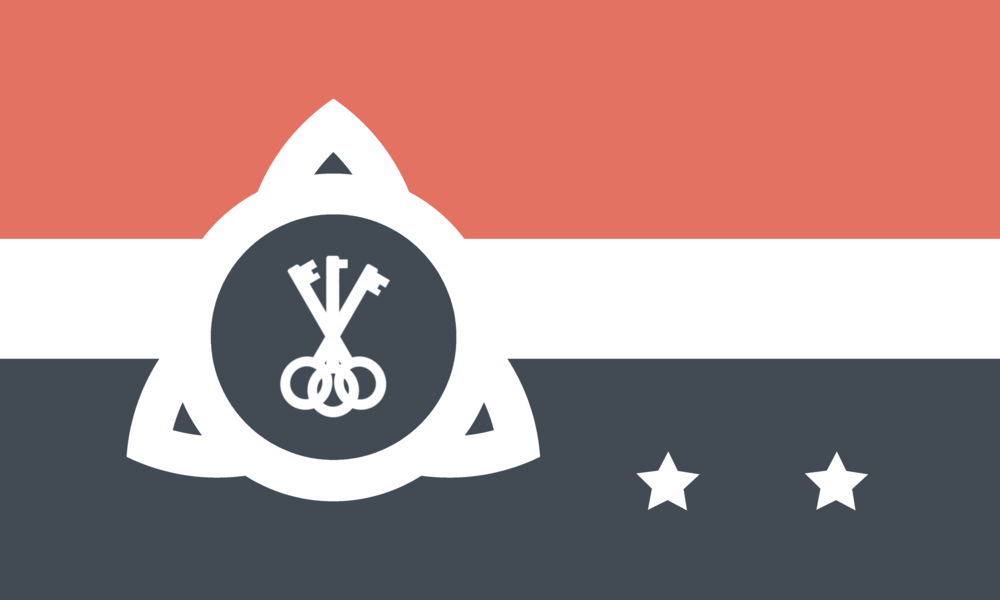
    It is with great pride that the Executive Council of the Free Thought Initiative presents the new official flag for our organization:

    The Official Flag of the Free Thought Initiative

    The Official Flag of the Free Thought Initiative

    Symbolism

    The Color Orange

    The “Terra Cotta Orange” in our flag represents the dawn and bright future of our organization as well as the passion and courage of our members. It is also symbolic of strong thinking, a stimulated mind, and calls back to the warm breakfast coffee (or juice) we enjoy at our preferred meeting locations.

    The Color Blue

    The dark and gray “Rhino Blue” symbolizes calmness, peaceful interaction, quiet contemplation, wisdom, sincerity, model citizenship, and the political freedoms we enjoy. Its juxtaposition to orange reflects a call to a life of healthy balance.

    The Color White

    Plain white denotes our promise as a nonprofit to transparency, integrity, and virtue.

    Tricolor Background

    The Three Stripes that constitute the background of the flag represent one’s dedication to our values both night and day, in public, and in private.

    The “Free Thinker” Symbol

    The “Free Thinker” Symbol

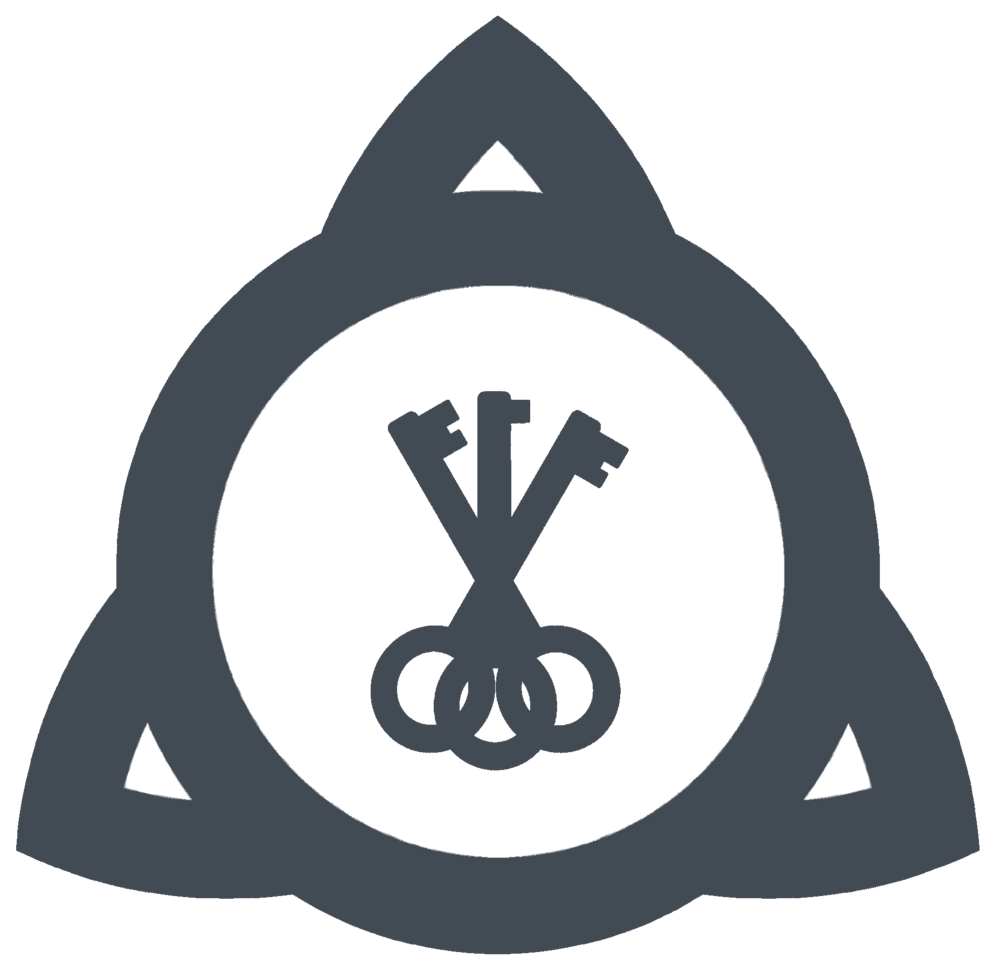
    The “Truth Seeker’s Compass” Symbol

    The “Truth Seeker’s Compass” Symbol

    Truth Seeker’s Compass

    Our organization’s main symbol of the “Freethinker” consists of a person with an “unlocked mind” speaking a word-cloud containing a key that can be used to unlock the minds of others. It reflects many things, including recovery from delusion, continual self-improvement, and self-actualization. Although it is not found on our flag, it is the direct inspiration for our “Truth Seeker’s Compass.”

    Centered in the first third of our flag is our white “Truth Seeker’s Compass,” a symbol which is formed from three interlocking word clouds, created by three different people sharing their ideas. These word clouds represent free thinking, education, and open discussion from members and guests at our meetings.

    When taken as one emblem, its round shape denotes our pursuit of moral ideas from around the world. The Blue World within the compass is in reference to our planet, the home of the entire human family. It also calls to our organization’s dedication to universal inclusivity, an invitation to all people, and the non-exclusive nature of our Foundational Philosophy (a common-ground code of ethics we offer to the world).

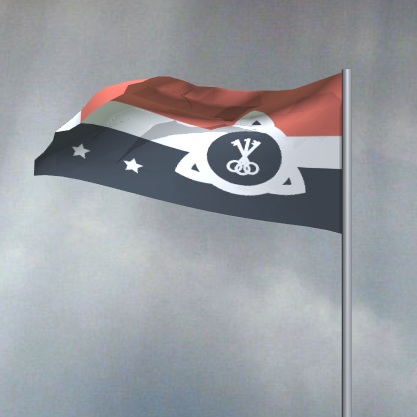
    Animated flag flying simulation with added white trim

    Animated flag flying simulation with added white trim

    The Three Points of the compass represent the three parts of The Truth and our sincere pursuit of them:

    • What is Real — The objective facts of Reality and Science.

    • What is Right — Moral Stories and the sound Ethical Behaviors that will plausibly lead to the most cohesive society in which the highest number of people are enabled to realize their greatest individual potential.

    • What is Currently Unknown — Mystery and The acknowledgment that we must all be willing to learn and adjust as better information becomes available.

    The Three Keys in the center of the compass spell the first letter in each word of our name, “Free Thought Forum.” They also represent the individual as well as societal desired fruits of our public discussions:

    • Enrichment

    • Enlightenment

    • Empowerment

    Two Five-Pointed Stars

    The number of points on each star stands for our Five Rules For Civil Discourse (the rules that regulate each public forum) and our five main services and programs:

    • Open Weekly Discussions

    • Group Leader Presentations

    • Semi-Monthly Volunteer Projects

    • First Week Freasts

    • Support Circle Meetings

    The first star, the Inner Star, represents a member of the local majority. The second star, the Outer Star, represents a local minority. Paired together, these stars stand for our invitation to both religious and non-religious people, conservatives and liberals, young and old, men and women, and so forth. Both the member of the majority and the minority stand on equal footing and both share an equal position in our organization.

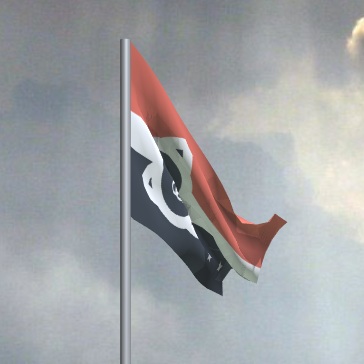
    Simulation of the Reverse Side Flying in the Wind

    Simulation of the Reverse Side Flying in the Wind

    Simulation of the Flag in Low-Speed Winds

    Simulation of the Flag in Low-Speed Winds

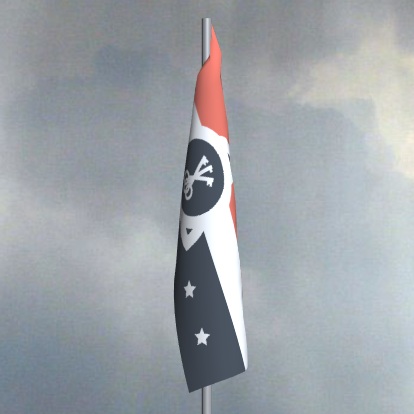
    Simulation of the Flag Hanging Without Wind

    Simulation of the Flag Hanging Without Wind

    Simulation of the Flag in High-Speed Winds

    Simulation of the Flag in High-Speed Winds

    Specifications

    Our Flag’s ratio is 3:5, and may be created as an applique, digital print, or embroidery flag. The design is uniform throughout. Therefore, its reverse side is the mirror-image of its obverse side.

    Colors

    Terra Cotta Orange

    • Hex: #E37262

    • RGB: (227, 114, 98)

    • CMYK: 0, 0.50, 0.57, 0.11

    White

    • Hex: #FFFFFF

    • RGB: (255, 255, 255)

    • CMYK: 0, 0, 0, 0

    Rhino Blue

    Hex: #424A54

    RGB: (66, 74, 84)

    CMYK: 0.21, 0.12, 0, 0.67

    Stripe Ratios

    The orange stripe covers the top 40% of the flag while the blue stripe covers the bottom 40%. The height of the white stripe is 20% of the overall height of the flag and is centered vertically.

    Compass

    The Truth-Seeker’s Compass symbol must be centered vertically (based on the overall shape, not the inner circle) and it’s center line must match the first 1/3 of the flag from the hoist edge. The full symbol is 2/3 the total height of the flag. The keys together are centered to the center point of the inner circle and are 2/3 the height of the circle. The tabs on the keys within the symbol should point back, to the fly of the flag.

    Star Placement

    Both five-pointed stars must be placed in-line with one another horizontally, pointing upwards. The height of each of the two stars is 1/10 the overall height of the flag. The center-point of each star is found in the intersection of edge lines found from the last horizontal third and sixth of the flag and the last fifth of the flag vertically.

    ___

    © 2019 Free Thought Initiative


    How to Create Engaging Conversations Aug 06, 2019
    Show notes This article is an excerpt from a recent issue of our newsletter. Click here to read the full issue!

    By Nicholas Burk, Executive Board Member

    It’s funny, when we are around certain people, we feel like we can talk all day! Yet in other situations, thinking of something to say is like pulling teeth.

    In each Free Thought Forum, it is our goal to help all guests and members feel like they can speak freely and enjoy participating in the conversation. Yet creating and maintaining an engaging conversation takes a little skill and practice. Today, we will go over five things you can do so that when you are talking with friends, family, coworkers, and fellow free-thinkers, everyone will be able to get a lot more out of the experience:

    friendship-1081843_1920.jpg

    1. Help Others Feel Welcome to Talk About Themselves and Their Ideas

    When the stakes are high, we tend to keep quiet. After all, who can risk making a bad impression among people who are judgmental, overly-critical, or close-minded? But when surrounded by open-minded and friendly people, we are much more likely to open up.

    We would all do well to better communicate to others that they are welcome to share what they have to say. Take a break from saying what’s on your mind and invite them to go on (and on) about themselves. By default, most of us can feel misunderstood, especially by strangers. Allowing someone the time to put their perspective into words allows them to feel more like you “get them,” and that they are free to be themselves.

    Some first-time guests to a Free Thought Forum may have not had the chance to really speak their minds in the past. As a result, they have something of a back-log of ideas that have never been expressed! It is perfectly reasonable to expect a newcomer to finally give voice to months of pent-up thoughts. If we are doing our job in creating an inclusive and friendly atmosphere, then they will be able to do just that.

    Another thing to keep in mind is that many people consider it impolite to share their opinions and ideas unless they’re asked. So ask! A good invitation to participate should be warm and casual, giving the other person the sense that they have all of the liberty in the world to respectfully decline.

    listen-1702648_1920.jpg

    2. Actively Listen

    Once someone feels included and welcome to speak their mind, then it is our job to listen, and listen well.

    A good listener doesn’t worry too much about sharing their own perspective. We should trust that our chance to speak will come, so we don’t let that distract us from what someone else has to say. We don’t think about what we will say next, and we don’t distract ourselves with internal commentary to the thoughts expressed.

    Make eye contact, nod along, and let the other person know that you understand what they mean. All these little things show that you actually care about what they have to say.

    restaurant-1807617_1920.jpg

    3. Ask Genuine Questions

    For a conversation to be truly engaging, there must be a real intercourse of ideas. After someone feels welcome to talk (and that you are listening), it is important to show interest in their chosen topic of conversation.

    Adding questions to a discussion is like adding logs to a campfire. Without them, it will quickly fizzle-out. Avoid asking yes-or-no questions. Focus on questions that open up the topic, rather than close it off. Rephrasing what the other person has said by putting it into your words is incredibly effective, especially when you follow that up with something like, “… is that a fair way to put it?”

    man-984433_1920.jpg

    4. Keep Personal Stories Short

    Once in a while, telling a story can add humor, relatability, and a personal touch to the overall exchange. But there can be too much of a good thing.

    Short stories work very well in group settings. Yet, on the rare occasion, you may have a great memory you want to share! In that situation, your audience will probably request more details. Naturally, you would do well to indulge them. Nevertheless, we should keep in mind that everyone probably has something to say. Therefore, keeping things short is a practical solution to the problem of limited time.

    calligraphy-2658504_1920.jpg

    5. Show Gratitude

    For some of us, it takes a tremendous amount of courage to say what we need to say, even if we look calm and collected on the outside.

    Perhaps the most important thing you can do to facilitate an engaging conversation is to clearly and reliably thank the participants for sharing. Doing so can relieve their anxieties that they have said something wrong or that their comment was disliked. Even if you disagree with their position on the given topic, thank them for their input.

    The truth is that a conversation can only take place if its participants actually participate. A date without discourse tends to go poorly, a teacher that prohibits questions may limit the learning of their students, and a forum of free-thinkers can only take off when everyone is able and willing to think out loud.

    ___

    © 2019 Free Thought Initiative


    Logical Fallacies (Part 1) and How to Avoid Them Aug 05, 2019
    Show notes

    The Fresh Perspective Podcast - Episode 27How’s it going everyone? I’m Nick and you are listening to the Fresh Perspective Podcast.The Human Mind is astonishingly complex, an impressive product of natural selection, and humanity’s greatest asset as a species. But if our brains had a “default mode,” it would be a power-saving mode labeled “Lazy thinking.” We naturally tend to prefer logical short-cuts, easy answers, and Ideas that “feel true,” even when they are false. This is why we are so easily hood-winked by smiling news reporters, fast-talking salesmen, pandering preachers, and anyone else who is eager to take advantage of our sloppy thinking. When our thinking is lazy, we tend to miss, fall for, and make logical fallacies. But what is a logical fallacy?Defined by the amazing website, Yourfallacyis.com: “A logical fallacy is a flaw in reasoning. Logical fallacies are like tricks or illusions of thought, and they're often very sneakily used by politicians and the media to fool people. Don't be fooled!” In this episode, the first in a three-part series, we will look at the first eight of 24 common fallacies that can hinder an intellectually honest and productive conversation among truth-seekers and free-thinkers. After each fallacy, a more preferable option is suggested that we can all use in our next forums, conversations, and debates!This program is brought to you by the members of the Free Thought Initiative.We help those in need of an inclusive, supportive, and free-thinking community by hosting public discussions on moral philosophy, healthy living, and science, to improve the cohesion, health, and scientific literacy of our society.Everyone is welcome, (regardless of personal religious belief, political leanings, etc.) to participate (in-person) in these open and civil discussions.To find a Free Thought Forum meeting near you, to start your own local group, or to become a member and support this program through monthly donations, please visit freethoughtforum.org.Rene Descartes was a big fan of thinking. He said, in a sense, that we should question everything, and doubt even our strongest-held beliefs. He’s the guy behind the Cartesian plane you first saw in your algebra or geometry class. He was a major part of the Scientific Revolution and a founding father of modern philosophy. Descartes was an absolute genius and free-thinker (long before freethought was cool). Even at his level of mental prowess, I find it interesting that he still spent much of his time quietly reflecting, thinking, and meditating. He suggested that we would all be better off if we just gave ourselves time to think. I think he’s right. When I look at logical fallacies, I get the sense that these are all mistakes we make when we are in a hurry. As we look at eight of these fallacies today, I invite you to slow down and really give yourself time to think.With a solid understanding of logical fallacies, you will be able to politely identify them when they are being used accidentally or intentionally. Doing so may allow a good-intentioned discussion to continue from the potential dead-ends caused by these examples of sloppy thinking.Rather than looking only at the logical fallacies we or others may make, we will also consider what the better option would be in each case. For the most productive and intellectually honest discussions, these favorable behaviors should be followed as much as possible.Many of the definitions and examples used in this podcast come from yourlogicalfallacyis.com, an amazing tool created by the School of Thought organization. Be sure to check their website out. If you like what you see, I strongly encourage you to send them a donation.1. STRAWMANThis is when someone’s argument is misrepresented to make it easier to attack. By exaggerating, misrepresenting, or just completely fabricating someone's argument, it's much easier to present one’s own position as being reasonable, but this kind of dishonesty serves to undermine honest rational debate.After Will said that we should put more money into health and education, Warren responded by saying that he was surprised that Will hates our country so much that he wants to leave it defenseless by cutting military spending.To keep from committing the strawman fallacy, why not try “steelmaning” your opponent’s argument instead? If you find yourself disagreeing with someone, pause, and see if you can rephrase their argument in the most generous way possible. If you do that well enough, the other person will feel like you “get it.” This allows them to relax and open-up a little to what you have to say. But if you cut them off and immediately jump into the argument with both feet, then they will probably feel like you never understood what they had to say in the first place.I think that the best way to steelman someone is by following Rapoport’s Rules. Daniel Dennett (an American Scientist and Philosopher) shares the following four rules that can help in his book “Intuition Pumps And Other Tools for Thinking.” These rules are summarized from those given originally by Russian-American mathematical psychologist Anatol Rapoport:You should attempt to re-express your target’s position so clearly, vividly, and fairly that your target says, “Thanks, I wish I’d thought of putting it that way.You should list any points of agreement (especially if they are not matters of general or widespread agreement).You should mention anything you have learned from your target.Only then are you permitted to say so much as a word of rebuttal or criticism.If we could all get into the habit of steelmanning the ideas of those with whom we disagree, we will come off as much more reasonable, open-minded, and fair.2. FALSE CAUSEIf someone presumes that a real or perceived relationship between things means that one is the cause of the other, they have committed the “false cause fallacy.” Many people confuse correlation (things that happen at around the same time) for causation (that one thing actually causes the other to happen). Sometimes correlation is coincidental, or it may be attributable to a common cause.Pointing to a fancy chart, Roger shows how temperatures have been rising over the past few centuries, whilst at the same time the numbers of pirates have been decreasing; thus pirates cool the world and global warming is a hoax.Remember that “Correlation is not Causation." Just because one thing seems like it causes another, that doesn’t mean it does. If more violent crimes take place when ice cream sales are high, does that mean that ice cream causes more violent crimes? If a group of people dance and a rainstorm takes place soon after, does that mean the rain dance worked? Of course not.Even though these examples sound silly, they represent a real problem. We are so easily tricked by fancy advertisements that make these false connections. I especially see this fallacy made with alternative medicines and pseudoscientific claims. The next time you hear someone say that one thing MUST have caused the other, I hope that you maintain a healthy dose of skepticism. If something does indeed lead to another, it should be something that can be demonstrated, not just supposed. Demand to see the evidence. If there is no evidence, then you are probably dealing with yet another case of correlation, not causation.3. SLIPPERY-SLOPEThis is when people say that if we allow A to happen, then Z will eventually happen too; therefore A should not happen. The problem with this reasoning is that it avoids engaging with the issue at hand, and instead shifts attention to extreme hypotheticals. Because no proof is presented to show that such extreme hypotheticals will in fact occur, this fallacy has the form of an appeal to emotion fallacy by leveraging fear. In effect, the argument at hand is unfairly tainted by unsubstantiated conjecture.Colin Closet asserts that if we allow same-sex couples to marry, then the next thing we know we'll be allowing people to marry their parents, their cars, and even monkeys.How can we avoid making the slippery-slope fallacy? Try this: Only make a case if there is a precedent. Has this one thing led to another in the past? Did that lead to yet another thing? If so - bring it up! Be ready to give evidence or examples and establish that “this has happened before.” If it hasn’t happened before, then you should be open about that. Admit that your argument is only conjecture, or just keep it to yourself. It is intellectually dishonest to scare people into agreeing with you because you made-up an unrealistic chain of events.4. AD HOMINEMWhen a person attacks their opponent's character or personal traits in an attempt to undermine their argument, then they have made this fallacy. Ad hominem attacks can take the form of overtly attacking somebody, or more subtly casting doubt on their character or personal attributes as a way to discredit their argument. The result of an “ad hom” attack can be to undermine someone's case without actually having to engage with it.After Sally presents an eloquent and compelling case for a more equitable taxation system, Sam asks the audience whether we should believe anything from a woman who isn't married, was once arrested, and smells a bit weird.In my opinion, Ad Hominem is one of the most cowardly and underhanded tricks people use to get out of having to really address the issues. It’s a distraction tactic. I see this all of the time on social media. So how can we avoid doing the same? Here is a great rule to live by: Only Attack Ideas, Not People. People have inherent worth and rights. Ideas do not. Don’t let the conversation get personal. Attacking a person is always off limits, but their IDEAS - their ideas are fair game. We should allow ourselves to criticize all claims and ideas, no matter who said them. Good ideas can take a beating. Bad ideas deserve to be beat!5. SPECIAL PLEADINGThis is when someone moves the goalposts or makes up an exception when their claim was shown to be false. Humans are funny creatures and have a foolish aversion to being wrong. Rather than appreciate the benefits of being able to change one's mind through better understanding, many will invent ways to cling to old beliefs. One of the most common ways that people do this is to post-rationalize a reason why what they thought to be true must remain to be true. It's usually very easy to find a reason to believe something that suits us, and it requires integrity and genuine honesty with oneself to examine one's own beliefs and motivations without falling into the trap of justifying our existing ways of seeing ourselves and the world around us.Edward Johns claimed to be psychic, but when his 'abilities' were tested under proper scientific conditions, they magically disappeared. Edward explained this saying that one had to have faith in his abilities for them to work.I see people moving the goal posts a lot when trying to believe in intelligent design. “Ha-ha,” they may say, “but there is no missing link between apes and humans.” Soon after, we find a fossil that comes from a creature that fits that description perfectly. But then the same intelligent design proponent says, “well where is the missing link between that fossil and humans?” You see, no matter how much evidence you throw at them, they will always demand more. This is “special pleading.”Do you engage in special pleading? Here is how to avoid it. Be consistent, and admit personal error. If you can’t admit it when you’re wrong, then you are not reasonable, and people will be able to tell! Be consistent, and play by the same rules that you expect of all other participants. If you say things like, “No, you’re right, I’ve never looked at it that way” or “I wish I knew all those things before, in that case, I was definitely wrong about that,” then you will be well on your way to thinking more logically. As an added bonus, people will probably find it easier to be around you.Another good rule is to agree on definitions before getting too deep in the conversation. If we can all agree on what we mean when we use words like “faith,” or “GMOs,” then we will be able to have a productive conversation. Otherwise, we may end up talking past one another, engaging in special pleading, or moving the goal posts.6. LOADED QUESTIONThis is when someone asks a question that has a presumption built into it so that it couldn't be answered without appearing guilty. Loaded questions are particularly effective at derailing rational debates because of their inflammatory nature. The recipient of the loaded question is compelled to defend themselves and may appear flustered or on the back foot.Grace and Helen were both romantically interested in Brad. One day, with Brad sitting within earshot, Grace asked in an inquisitive tone whether Helen was still having problems with her drug habit.The classic example is, “when did you stop beating your wife?” (This is where biased journalists show their hand.) If you are listening to news reporters and you pick up on one loaded question after another, you should probably reconsider tuning-in to that program.You can avoid asking loaded questions by only asking genuine questions. First off, being genuine increases your likability, charisma, and relatability. Your audience will be better able to sympathize with your position. Secondly, it leads to a more personal connection with the person with whom you’re talking. Who knows, maybe their answer will surprise you or change your mind!Here is another thing to keep in mind: Only ask a question if you really want to hear what the other person thinks. This is especially true when you do feel like your feathers are getting ruffled. Your questions shouldn’t be statements. You shouldn’t be playing to some audience. When you ask a question, it should be because the other person has an answer that you want to hear.7. THE GAMBLER'S FALLACYIf you said that 'runs' occur to statistically independent phenomena such as roulette wheel spins, then you’ve made this mistake. This commonly believed fallacy can be said to have helped create an entire city in the desert of Nevada. Though the overall odds of a 'big run' happening may be low, each roll of the dice is, itself, entirely independent from the last. So whilst there may be a very small chance that heads will come up 20 times in a row if you flip a coin, the chances of heads coming up on each individual flip remain 50/50, and aren't influenced by what happened before.Red had come up six times in a row on the roulette wheel, so Greg knew that it was close to certain that black would be next up. Suffering an economic form of natural selection with this thinking, he soon lost all of his savings.Here is the deal, human beings like to see patterns in nature, even when they don’t really exist. To keep from committing the gambler’s fallacy, you need to keep the basic rules of math in mind. Your roulette wheel, dice, coin, or any other random number generator doesn’t “remember” what it did last. Every spin, roll, or flip should be treated as a fresh new randomized experience. Each time, you should expect random results from random chance.8. BANDWAGONThis is an appeal to popularity or the fact that many people do something as an attempted form of validation. The flaw in this argument is that the popularity of an idea has absolutely no bearing on its validity. If it did, then the Earth would have made itself flat for most of history to accommodate that popular belief.Shamus pointed a drunken finger at Sean and asked him to explain how so many people could believe in leprechauns if they're only a silly old superstition. Sean, however, had had a few too many Guinness himself and fell off his chair.Can one person be wrong about something? Yes. So can groups of people be wrong about something? Yes. It’s like what your mo…

    Full show notes at the publisher

    Why Your Voice Matters Jul 30, 2019
    Show notes
    Newsletter_bar2.png

    Volume 01 Issue 07

    How’s it going everyone?

    Welcome to the 7th issue of our official newsletter! Use the button below to view the full PDF edition of this issue, complete with images and links. The raw information about our announcements this week is as follows:

    View Full Edition (PDF)

    Why Your Voice Matters

    Let’s say you find yourself in a conversation about science, politics, culture, or in another complicated intellectual topic. You have something you want to say, but don’t necessarily have special education or related experience with consideration to the subject at hand. What should you do? Whether it be in our weekly meetings, online, or in other interactions, we hope that you always have the courage to share your perspective.

    There is a mountain of reasons that we can each use to shy away from participation. Of course, patiently and thoughtfully listening is always a wise option. But today, we are talking about those moments in which we have something to contribute, but fear that we are not properly qualified to do so. Engaging in the forum, even when treading outside of your comfort zone, can have meaningful benefits to all involved. Here are five reasons why your voice really does matter:

    1. Your Perspective is Unique and thus Carries Intrinsic Value

    There are ideas that have only ever existed in your mind. You have seen and experienced things no other human being may ever fully understand. Likewise, you have made connections and insights that the world may never know.

    Why not share your unique thoughts? Even if you feel that adding your two-cents from the perspective of a mother, a farmer, a college student, a cancer patient, or a veteran isn’t that glamorous, helpful, or relevant, it still may add an additional dimension that enriches the conversation.

    Your fellow freethinkers want to hear what you have to say because it is you who is saying it. A Free Thought Forum is the place where every kind of person can have their voice heard.

    2. Thinking-Out-loud is an Important Part of the Learning Process

    In order to enjoy a fine meal, you may need some time to let it cool, to chew, or to cut it up. When we are exposed to big ideas, we can likewise benefit from exploring them, deconstructing them, and volunteering alternative viewpoints and interpretations.

    Engaging verbally with the other participants with the goal to “try out” or wrestle with a concept is a powerful mental exercise. Asking plenty of questions, rephrasing or summarizing an idea, agreeing on definitions, using the Socratic Method, and playing the role of “a devil’s advocate” are all techniques that can deepen the understanding of all involved.

    3. Sometimes the Experts are Wrong

    Can you imagine the kind of nerve it took for Edwin Hubble to publish his findings on the expanding universe, knowing that they would conflict with Einstein’s accepted idea of a cosmological constant?

    History is filled with those brave enough to question the conventional wisdom of their day. The vast majority of “experts” of the past have been usurped by humanity’s march of progress, fueled by newly discovered facts. We are all better informed today as a direct result.

    Admittedly, it is not realistic to expect armchair philosophers to crack the mysteries of the universe or solve the complex problems afflicting society. However, We can’t forget that blind obedience to the prevailing theories of the day is antithetical to the mission of a free-thinker.

    If you don’t understand what the experts have to say, bring it up! Such an honest approach can help everyone better comprehend an important issue. If you disagree with what the experts say, be prepared to state your reasons. If your arguments are refuted, you are now better for it. If your arguments hold weight, then you have opened the door to even bigger and better questions.

    A good rule of thumb is to seek first to understand an idea before attempting to replace it. With that said, we should never let a good answer keep us from finding a better one.

    4. You May Say What Others are Too Shy to Say

    Not all of us are comfortable speaking up in a public setting. If that is true of you, then you may be familiar with the relief that comes when a bold friend asks the same question that was on your mind.

    Others may have their reasons to pause or remain silent. But wouldn’t it be a tragedy if a meaningful conversation was snuffed out because no one was willing to get it started in the first place? Since the goal of each conversation is to enrich, enlighten, and empower all involved, it is alright to risk being offensive, sound silly, or expose some personal flaw.

    We are all in this together. Fear of judgment should be the last thing on the mind of a member of a Free Thought Forum. Therefore, if you think there is a comment or question going unsaid, why not say it? A quiet member of the crowd may be tremendously, albeit secretly, grateful.

    5. It Allows your Ideas to be Challenged or Corrected

    At a cruising speed of around 550 miles per hour, an airplane that is just one degree off from its true destination can quickly find itself dangerously off course.

    There is no shame in discovering that you are mistaken. Freely submit your view for review in the minds of your listeners. The additional brainpower may detect errors, logical fallacies, or problems that you may not have been able to find on your own, allowing for quick and personalized course-correction.

    Switching to a Monthly Newsletter

    It is true, all good things must come to an end. Based on your feedback, our Executive Board has decided to adjust the frequency at which new issues of our newsletters are sent out to our subscribers and posted to our blog.

    The eighth and final issue of “The Monday Memo” will be released on August 5th, 2019. On the following Monday, August 12th, our replacement newsletter will be introduced and distributed on a monthly basis. (There will be no need to unsubscribe to the Monday Memo or to subscribe to our new newsletter as all mailing lists and settings will be carried over to the new format.)

    Our monthly publication will boast a more elaborate presentation, rich with multiple writers, articles, and reoccurring features. Switching to monthly distribution will also reduce the number of emails sent to our subscribers. We hope you are looking forward to it as much as we are!

    Utah Valley Group CALENDAR

    • Aug 4 – Feast Sunday & Support Circle

    • Aug 10 – Volunteer Project: Springville Animal Shelter Clinic

    • Aug 11 – The Epic FIRST Meeting for a NEW Draper Group! (We will not meet in Springville on this date.)

    • Aug 18 – How to Moderate Public Discussions

    • Aug 25 – Great Ideas From Sikhism

    • Sep 1 – Feast Sunday & Support Circle

    • Sep 7 – Volunteer Project: Payson Animal Shelter Clinic

    • Sep 8 – Human-Caused Climate Change

    • Sep 12 – Volunteer Project: Spanish Fork Animal Shelter Clinic

    • Sep 15 – The Ideas and Ethics of Baruch Spinoza

    • Sep 22 – Wisdom Festival (Secular Autumnal Equinox Celebration)

    Draper Utah Group CALENDAR

    • Aug 11 – The Epic FIRST Meeting for a NEW Draper Group! (We will vote on future meeting dates, times, and topics at our first meeting.)

    Social Media Watch

    How many people have we reached this week? Here is a quick update:

    • YouTube Subscribers: 61

    • Freethinkers on Meetup: 61 (Utah Valley) and 66 (Draper)

    • Pinterest Monthly Views: 534

    • Facebook Page: 21 (Likes) 23 (Follows)

    • Minds Page Subscribers: 27

    • Discord Server Members: 16

    • Instagram Followers: 9

    • Bitchute Subscribers: 5

    • Reddit Followers: 4

    • Twitter Followers: 5

    Coming Soon to our Online Store

    The official store for the Free Thought Initiative is now under development. Stay tuned for upcoming announcements about our hats, jackets, new-and-improved volunteer shirts, tote bags, lapel pins, mini-flags, and more! All proceeds will go to funding our activities as a nonprofit while you walk away with some smart looking swag!

    ___

    Written By Nicholas Burk, Executive Board Member © 2019 Free Thought Initiative


    Previous 1 3 4 5 6 7 9 Next

    Related Podcasts

    Making Sense with Sam Harris

    1

    Making Sense with Sam Harris Education
    Grammar Girl

    2

    Grammar Girl Education
    Good Life Project

    3

    Good Life Project Education
    Explain It to Me

    4

    Explain It to Me Education
    Team Never Quit

    5

    Team Never Quit Comedy
    Optimal Living Daily – Personal Development and Self-Improvement

    6

    Optimal Living Daily – Personal Development and Self-Improvement Alternative Health
    footer-logo

    Contact Us

    Toll Free: 844-670-7747

    Links

    • Home
    • Top Charts
    • Networks
    • Apps
    • Independents Podcasts
    • Podcast Advertising
    • Podcast News
    • Contact Us
    • About Us
    • Analytics & Insights

    Stay Connected

      Privacy, Terms of Use & Our Code of Ethics Protecting Content Creators Copyrights