TopPodcast.com
Menu
  • Home
  • Top Charts
  • Top Networks
  • Top Apps
  • Top Independents
  • Top Podfluencers
  • Top Picks
    • Top Business Podcasts
    • Top True Crime Podcasts
    • Top Finance Podcasts
    • Top Comedy Podcasts
    • Top Music Podcasts
    • Top Womens Podcasts
    • Top Kids Podcasts
    • Top Sports Podcasts
    • Top News Podcasts
    • Top Tech Podcasts
    • Top Crypto Podcasts
    • Top Entrepreneurial Podcasts
    • Top Fantasy Sports Podcasts
    • Top Political Podcasts
    • Top Science Podcasts
    • Top Self Help Podcasts
    • Top Sports Betting Podcasts
    • Top Stocks Podcasts
  • Podcast News
  • About Us
  • Podcast Advertising
  • Contact
Not in our directory?
Add Show Here
Podcast Equipment
Center

toppodcastlogoOur TOPPODCAST Picks

  • Comedy
  • Crypto
  • Sports
  • News
  • Politics
  • True Crime
  • Business
  • Finance

Follow Us

toppodcastlogoStay Connected

    View Top 200 Chart
    Back to Rankings Page
    Technology

    StorageReview.com

    StorageReview.com is a leading provider of news and reviews throughout the entire IT stack – from the datacenter to the edge, and all points in between.

    Advertise
    • Apple Podcasts
    • Google Play
    • Spotify

    Latest Episodes:
    CTERA Data Archiving Solution Pairs InsightAI With CTERA Archive to Move Inactive Files Off Primary Storage With an Audit Trail Sep 17, 2026
    Show notes CTERA InsightAI graphic with a query box reading Ask CTERA InsightAI, what team is consuming the most storage, above folders scattered across a world map, CTERA marketing art CTERA InsightAI graphic with a query box reading Ask CTERA InsightAI, what team is consuming the most storage, above folders scattered across a world map, CTERA marketing art

    CTERA has launched the CTERA Data Archiving Solution, which pairs its InsightAI data service with CTERA Archive so the platform can recommend which files to move off primary storage and then execute the move under retention policy and an audit trail. It’s the product follow-through to the Cold Data Storage Report CTERA published a day earlier: across 856 file-share discovery scans covering more than 16PB of live production data, 4.4% of stored capacity was data users and applications regularly access, 88.3% of files hadn’t been accessed in more than a year, and less than 10% of capacity had been touched in the prior 90 days. The solution is part of the CTERA Intelligent Data Platform.

    CTERA InsightAI graphic with a query box reading Ask CTERA InsightAI, what team is consuming the most storage, above folders scattered across a world map, CTERA marketing art

    InsightAI Picks the Archive Candidates

    The identification step is where CTERA is putting the AI. InsightAI agents infer what a file contains from its metadata, meaning the filename, path, extension, and directory context, and assess its value to the business, then combine that with age, type, size, and usage patterns to surface archive candidates. CTERA’s argument is that age alone is a poor archiving signal; a five-year-old contract and a five-year-old build log have the same timestamp and very different retention value. InsightAI launched earlier this year as a natural-language interface for querying the platform’s file metadata, and CTERA has been steadily pointing the platform at AI workloads through its n8n integration and Fusion Direct.

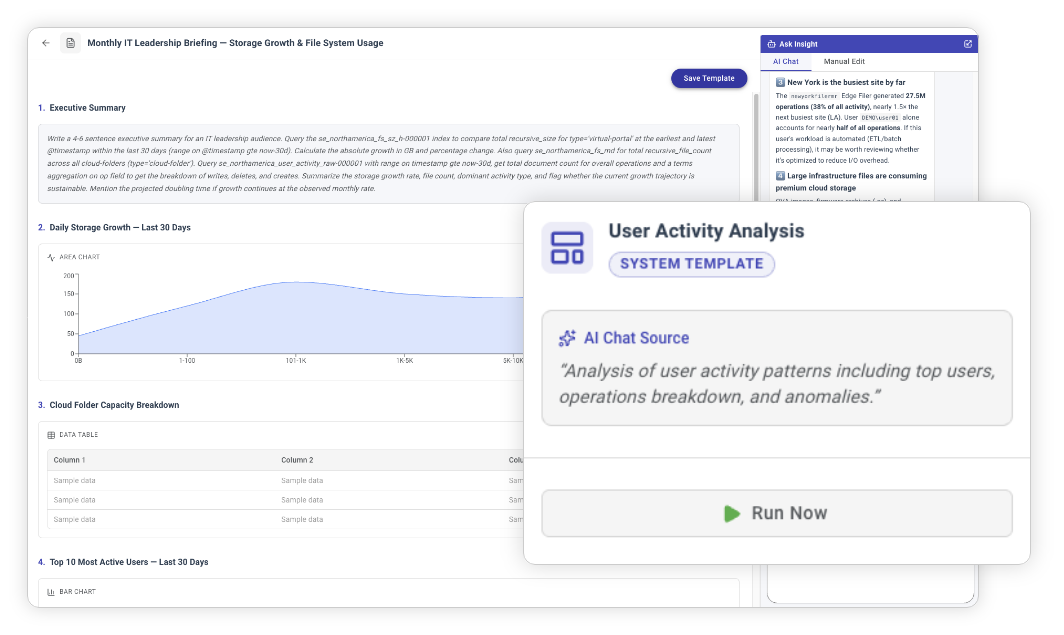
    CTERA InsightAI report builder showing a monthly IT leadership briefing on storage growth and file system usage, a User Activity Analysis system template card, and an Ask Insight chat panel, CTERA product screenshot

    CTERA Archive Moves and Governs the Data

    Once InsightAI has flagged the files, CTERA Archive moves them to a dedicated, isolated archival tier inside the same CTERA environment, and the target can be lower-cost on-premises hardware or cloud object storage; CTERA’s product page lists Amazon S3 Glacier Instant Retrieval and other S3 storage classes along with Azure Blob Cool and Cold tiers. Because the archived files stay inside the Intelligent Data Platform, CTERA says they remain governed and reachable by AI and analytics tools with no separate retrieval or rehydration step, so cold data leaves primary storage without leaving reach.

    On the governance side, CTERA Archive carries configurable retention policies, with two retention modes per the product page, and logs every archive and restore operation with the operator, source, destination, reason, file count, size, and timestamp; the logs are exportable for compliance reporting and legal discovery. CTERA also frames archiving as a security control, since moving inactive data out of SMB and NFS shares shrinks the volume of sensitive information exposed in the file system, and CTERA Vault can add WORM protection to the archived set.

    “Enterprise data volumes are going to continue to grow, but not all data needs to remain on primary storage or be immediately accessible. The challenge has always been knowing what data can safely move and then providing a practical path to execute that migration,” said Oded Nagel, CEO of CTERA. “By pairing CTERA InsightAI, which understands what data means to the business and not just how old it is, with the governance and controls of CTERA Archive, the CTERA Data Archiving Solution gives IT teams a much simpler, AI-guided way to bring discipline to the enterprise data lifecycle without sacrificing access. Archived data stays usable for AI and analytics rather than locked away.”

    CTERA didn’t state availability for the Data Archiving Solution in its announcement.

    CTERA Data Archiving Product Page

    The post CTERA Data Archiving Solution Pairs InsightAI With CTERA Archive to Move Inactive Files Off Primary Storage With an Audit Trail appeared first on StorageReview.com.


    Lenovo ThinkAgile VX850 V4 Takes On In-Memory Virtualization With New Deploy Tiers and Four-Hypervisor Express Bundles Sep 17, 2026
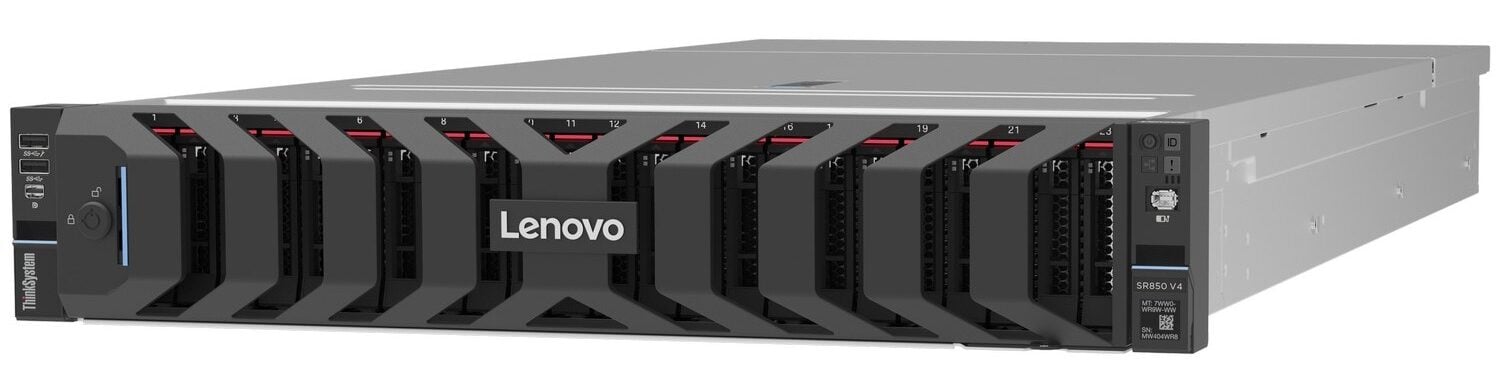
    Show notes Lenovo ThinkSystem SR850 V4 2U four-socket server front view with the security bezel and 24 hot-swap drive bays, Lenovo product image Lenovo ThinkSystem SR850 V4 2U four-socket server front view with the security bezel and 24 hot-swap drive bays, Lenovo product image

    Lenovo has added the ThinkAgile VX850 V4 to its virtualization lineup, a four-socket node it describes as purpose-built for highly virtualized and demanding in-memory workloads, and paired the launch with a three-tier deployment service framework and a set of pre-validated Top Choice Express bundles spanning Microsoft, Red Hat, SUSE, and Nutanix. The announcement follows Lenovo’s December expansion of the ThinkSystem and ThinkAgile portfolio and keeps the same pitch: modernize the virtualization estate in place, keep the hypervisor choice open, and leave capacity for AI work on the same infrastructure.

    Lenovo ThinkSystem SR850 V4 2U four-socket server front view with the security bezel and 24 hot-swap drive bays, Lenovo product image

    ThinkAgile VX850 V4 for In-Memory Virtualization

    Lenovo’s release positions the VX850 V4 for structured and unstructured data pools where a customer wants to consolidate critical applications and hold headroom for AI integration on the same hardware. Lenovo hasn’t published a product guide or spec sheet for the V4 yet. The VX850 V3 it replaces was a certified node built on the ThinkSystem SR850 V3, and the current four-socket ThinkSystem platform, the SR850 V4, is a 2U system with two or four Intel Xeon 6700-series processors at up to 86 cores each, 64 DIMM slots for up to 16TB of memory, up to 24 2.5-inch or 32 E3.S NVMe bays, nine PCIe 5.0 slots, and support for up to four single-wide GPUs. That is the memory and socket profile the in-memory positioning points at, and we’ll fill in the VX850 V4’s own configuration once Lenovo posts it.

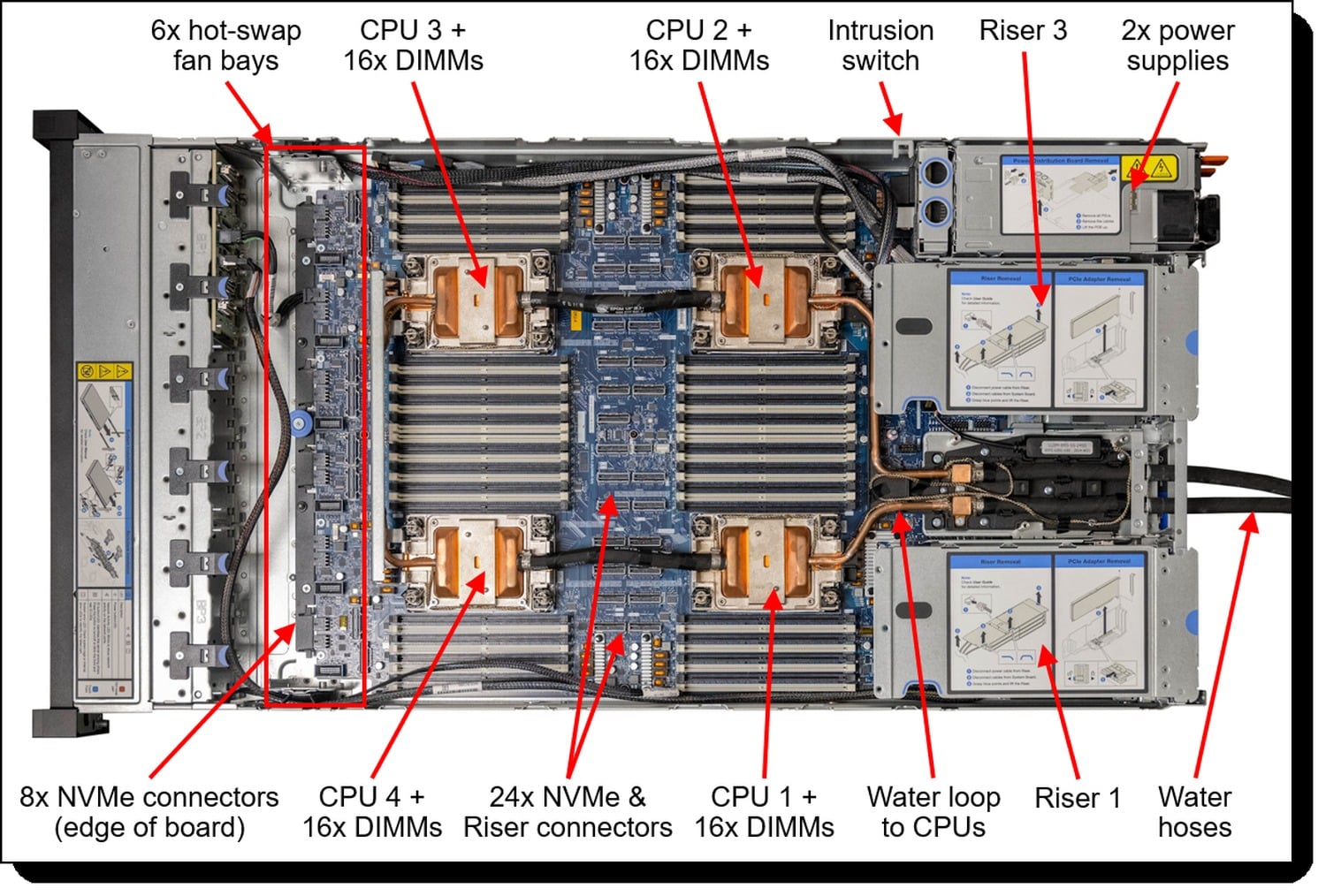
    Lenovo ThinkSystem SR850 V4 internal view with callouts for the four CPUs and their 16 DIMMs each, six hot-swap fans, NVMe and riser connectors, water loop, and power supplies, Lenovo product image

    Three Deployment Tiers

    Lenovo Infrastructure Deployment Services now come in three packaged tiers. Standard Deploy covers a structured readiness assessment and hardware installation. Premier Deploy adds implementation and an operational handoff so the environment is production-ready when Lenovo leaves. Premier Deploy Plus extends post-deployment assistance and adds a one-year infrastructure health assessment, with one stated exclusion: the DE Storage Array family isn’t covered by that assessment.

    Top Choice Express Bundles Across Four Hypervisors

    The Top Choice Express additions are pre-tested reference configurations for the platforms customers are moving to. On the Microsoft side, that means Hyper-V Ready Solutions on Windows Server and Azure Local on ThinkAgile MX V4 nodes for hybrid deployments managed through Azure. Red Hat OpenShift Virtualization Solutions cover KVM-based virtual machines alongside containers on one control plane, and SUSE Virtualization runs on ThinkSystem V4 hardware for the same VM-plus-container model. For shops that want compute and storage to scale independently, Lenovo pairs ThinkSystem servers with Nutanix Compute Cluster nodes under the Nutanix Cloud Platform.

    “Organizations are focused on modernizing virtualized infrastructure to improve efficiency and resilience while maintaining flexibility in an increasingly complex IT landscape,” said Scott Patti, vice president of Lenovo’s Infrastructure Solutions Group. Lenovo also cites IDC’s Matt Eastwood, senior vice president of the Enterprise Infrastructure and Datacenter Group, on the same theme: “Modernization is an in-place initiative; it does not require starting over.”

    Disaggregated Storage and Fleet Management

    Under the bundles, ThinkSystem Storage arrays paired with ThinkAgile HCI nodes give Lenovo a disaggregated option with integrated data protection, and the management layer is the updated XClarity Controller 3 BMC firmware plus XClarity One, both exposing standards-based APIs for visibility across hybrid environments. Lenovo didn’t state availability dates for the VX850 V4 or the new service tiers in the release.

    Lenovo ThinkAgile VX Series Product Page

    The post Lenovo ThinkAgile VX850 V4 Takes On In-Memory Virtualization With New Deploy Tiers and Four-Hypervisor Express Bundles appeared first on StorageReview.com.


    TrueNAS Proxmox Plugin Turns Every VM Disk Request Into an Automated zvol Over iSCSI or NVMe/TCP Sep 17, 2026
    Show notes TrueNAS and Proxmox logos on the TrueNAS Proxmox Plugin announcement graphic with the line Plugin Now Available on GitHub TrueNAS and Proxmox logos on the TrueNAS Proxmox Plugin announcement graphic with the line Plugin Now Available on GitHub

    TrueNAS has released a native Proxmox VE storage plugin that lets Proxmox provision and manage VM disks directly on TrueNAS systems. A disk requested in Proxmox becomes an OpenZFS zvol on TrueNAS 25.10 or later, published as an iSCSI LUN or an NVMe/TCP namespace, and the plugin handles creation, snapshots, resizing, migration, and deletion from the Proxmox side with no per-volume setup in the TrueNAS UI. The release is designated for Early Adopters, with TrueNAS Community Edition users getting it first and Enterprise support in validation.

    TrueNAS and Proxmox logos on the TrueNAS Proxmox Plugin announcement graphic with the line Plugin Now Available on GitHub

    What the TrueNAS Proxmox Plugin Replaces

    Most Proxmox-on-TrueNAS deployments run today on NFS or hand-built iSCSI LUNs. On NFS, Proxmox handles VM snapshots through QEMU copy-on-write files, and Proxmox’s own storage documentation says snapshots of large disks can take several minutes and, in extreme cases, hours. Manually configured iSCSI avoids that but had no native snapshot support before Proxmox VE 9, and every new disk means a new zvol, a new iSCSI extent, and a new LUN mapping on the array. Proxmox’s legacy ZFS-over-iSCSI plugin type narrowed the gap for ZFS-backed arrays, and TrueNAS now ships a purpose-built plugin in its place.

    With the plugin installed, storage operations stay inside the Proxmox interface. Administrators create VM disks, take OpenZFS snapshots, resize, migrate, and delete volumes, and TrueNAS provisions the underlying block devices as thin, sparse zvols on demand. Snapshots run natively on OpenZFS and include live VM snapshots that capture RAM state. Clones, moves, backups, and imports still run on the Proxmox host, and TrueNAS’s native NFS and SMB shares remain the path for file-based content such as ISO images and backup directories, served from the same pool.

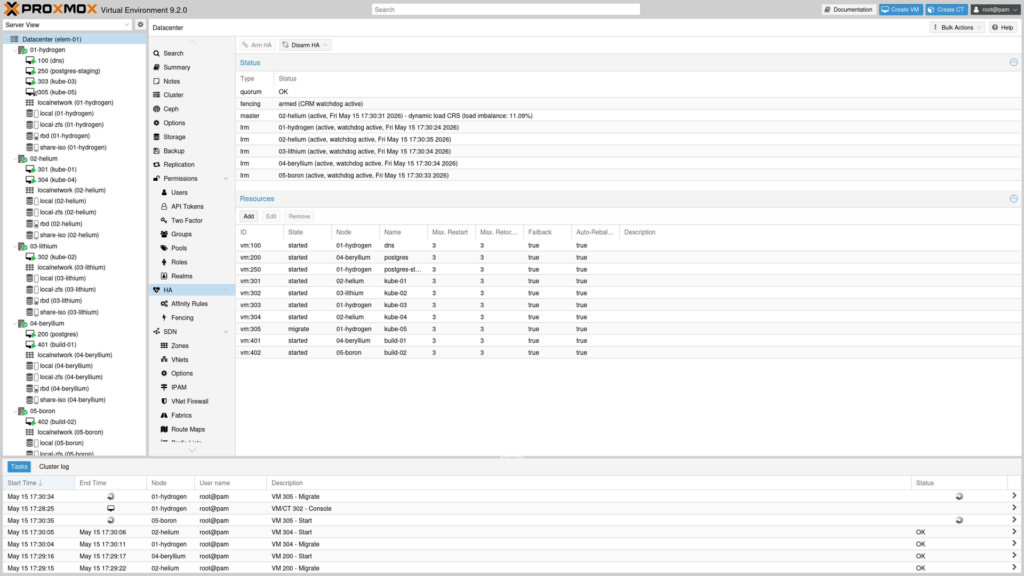
    Proxmox VE 9.2 HA Balancing Migration

    iSCSI and NVMe/TCP Support

    Transport is chosen per Proxmox storage entry. iSCSI works on Proxmox VE 8.x and later; NVMe/TCP requires Proxmox VE 9.x with the nvme-cli initiator installed on each node, and TrueNAS positions it as the option when latency matters most. Authentication uses a TrueNAS API key in place of the root SSH access some ZFS-over-iSCSI workflows require.

    For environments running several Proxmox clusters against one TrueNAS system, the plugin enforces one dataset and one iSCSI target or NVMe subsystem per cluster, which keeps extent names from colliding and separates each cluster’s storage. TrueNAS frames the design as separated compute and storage, with Proxmox on the compute side and TrueNAS as the data platform underneath, and TrueNAS is clear that it isn’t a substitute for a hyperconverged Ceph deployment.

    Installation and TrueNAS Support

    The plugin ships through a signed APT repository, with Bookworm packages for Proxmox VE 8 and Trixie packages for Proxmox VE 9. The installer detects the Proxmox version, runs cluster-aware with health checks and rollback, and a standalone .deb covers air-gapped nodes. TrueNAS-side setup steps are in the TrueNAS Proxmox VE Storage Plugin documentation.

    TrueNAS 25.10 or later is required on the storage side. The plugin runs on TrueNAS Community Edition and on Enterprise appliances including the H-Series and V-Series, which add high availability; Enterprise support is in active validation, and TrueNAS says it is orderable now through account teams, with a design review recommended before anything touches production. TrueNAS also says it will work with Proxmox partners on complete systems integration.

    TrueNAS Proxmox Plugin Availability

    The TrueNAS Proxmox Plugin is available now from the project’s GitHub releases page. TrueNAS recommends installing the Early Adopter release on a non-production Proxmox cluster first and verifying it against your workloads before moving production VMs onto it. TrueNAS’s announcement post covers the design rationale in more depth.

    TrueNAS Proxmox Plugin Releases Page

    The post TrueNAS Proxmox Plugin Turns Every VM Disk Request Into an Automated zvol Over iSCSI or NVMe/TCP appeared first on StorageReview.com.


    CoreWeave Deploys Multi-Rack Vera Rubin NVL72 Cluster: Hundreds of Rubin GPUs, 1.6 Tb/s Per GPU, and a No-Fee Archive Tier Sep 17, 2026
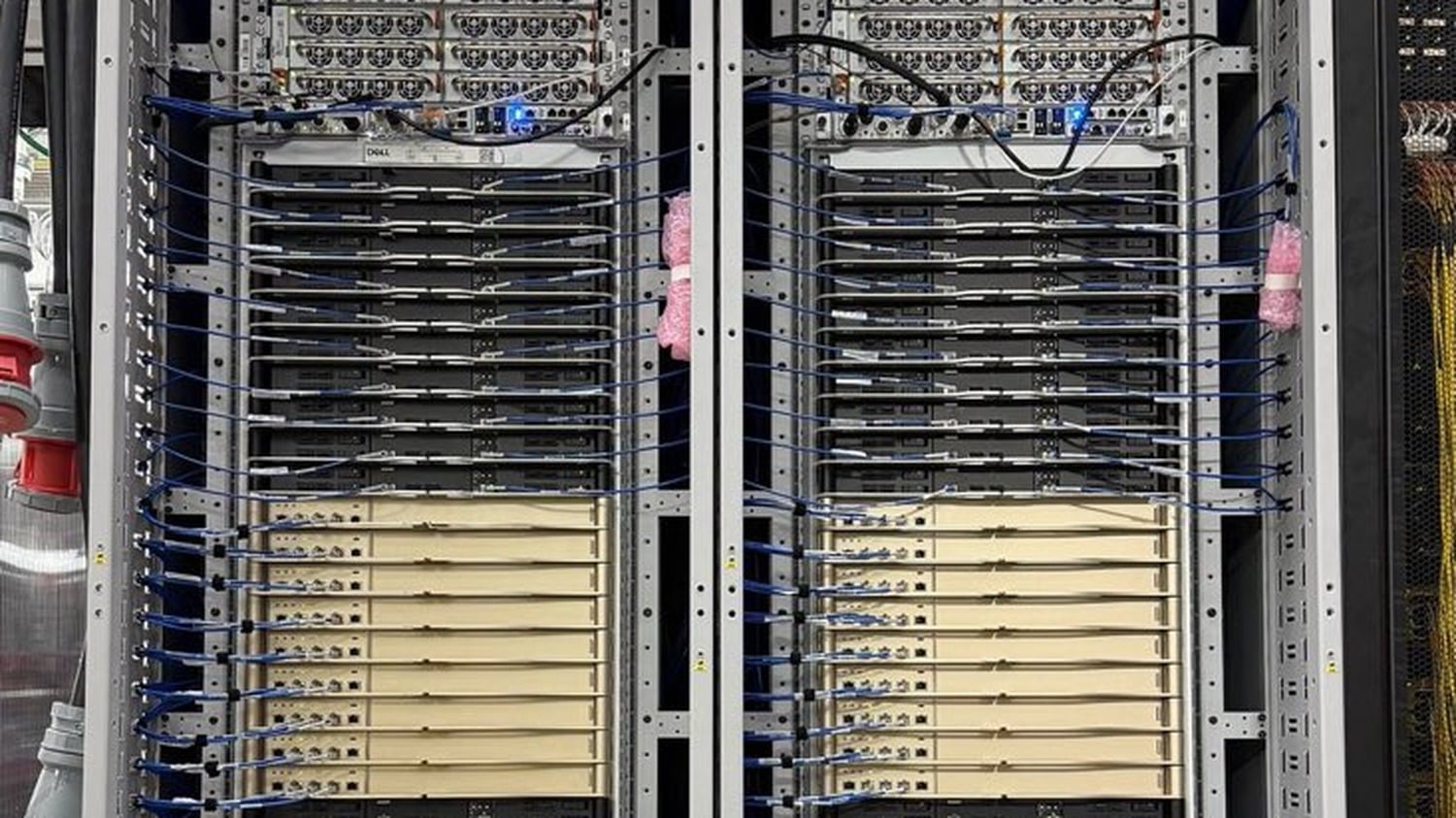
    Show notes Two Dell-built NVIDIA Vera Rubin NVL72 racks in a CoreWeave data center, cropped to the compute and NVLink switch trays, photo courtesy of CoreWeave Two Dell-built NVIDIA Vera Rubin NVL72 racks in a CoreWeave data center, cropped to the compute and NVLink switch trays, photo courtesy of CoreWeave

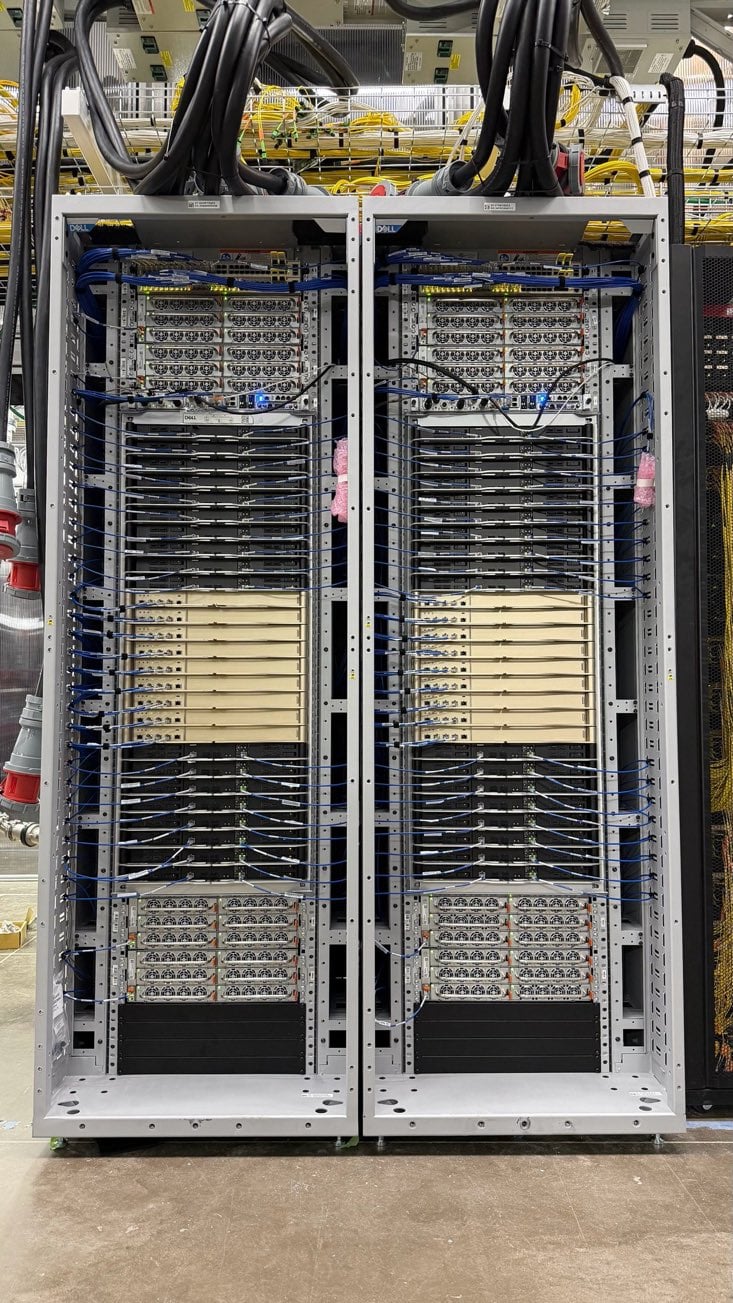
    CoreWeave has deployed a multi-rack NVIDIA Vera Rubin NVL72 cluster on CoreWeave Cloud, connecting hundreds of Rubin GPUs into a single scale-out environment aimed at agentic AI workloads. Each Dell-built rack carries 72 Rubin GPUs, 36 Vera CPUs, NVLink 6 as the scale-up fabric, BlueField-4 DPUs, and two ConnectX-9 SuperNICs per GPU, and the racks connect over NVIDIA Spectrum-X Ethernet in a two-tier, non-blocking fabric that CoreWeave says scales to roughly 128,000 GPUs. CoreWeave is the first cloud provider to validate and bring up a single Vera Rubin NVL72 and the first to publish measured performance from one; the platform’s first peer-reviewed numbers arrived in MLPerf Inference v6.1 last week, where CoreWeave’s own submission ran on GB300 NVL72. Alongside the compute, CoreWeave AI Object Storage picks up cross-region write acceleration and a new Archive tier.

    Two Dell-built NVIDIA Vera Rubin NVL72 racks cabled and powered in a CoreWeave data center, with the switch tier at top, compute trays in the middle, and power shelves at the bottom, photo courtesy of CoreWeave

    Multi-Rack NVIDIA Vera Rubin NVL72 Architecture

    The multi-rack build targets agentic execution paths, where serial reasoning loops and external tool calls compound data-access latency across distributed infrastructure. The two ConnectX-9 SuperNICs on each Rubin GPU provide up to 1.6 Tb/s of backend network connectivity per GPU across multi-rail, multi-plane paths, and CoreWeave describes the fabric as modular, so additional NVL72 racks join the same non-blocking topology as capacity grows. The racks run on 45°C liquid cooling.

    CoreWeave ties the racks together through its Mission Control software. A Rack LifeCycle Controller handles provisioning and lifecycle for each rack, hardware detection through firmware flashing, validation, power, and thermal loops; a rack-management layer called Racky controls power and infrastructure; and a programmable cooling controller called Valvey gives software-defined visibility and control over the liquid-cooling loops and environmental sensors.

    Racks reach production only after a staged validation pass. At the node level, that means hours of repeated GPU diagnostics, CPU-to-GPU transfer checks, interconnect and thermal validation under load, and realistic training runs. At the rack level, synchronized jobs across all 72 GPUs verify NVLink GPU-to-GPU performance, and any system landing below the expected range goes to troubleshooting. Across racks, CoreWeave runs distributed workloads, deliberately disables the NVLink paths to force traffic over the backend network, and watches the physical fabric for flaky links, rising error rates, overheating hardware, and uneven traffic, with load patterns that mimic agentic applications: sudden demand spikes, shifting concurrency, and bursts of communication. CoreWeave’s write-up on the multi-rack bring-up walks through each stage and makes an interesting read.

    AI Object Storage Updates: Cross-Region Writes and Archive Tier

    The storage side builds on CoreWeave AI Object Storage and its Local Object Transport Accelerator (LOTA), a caching proxy that runs on every GPU and CPU node in CoreWeave Kubernetes Service and holds objects on node-local NVMe. CoreWeave reports cached reads at up to 7 GB/s per GPU with p99 read latency more than 8x lower than reading from the bucket, and cites one frontier model provider running LOTA across more than 15,000 GPUs and 20PB of cache at a 99.7 percent hit rate. LOTA carries no additional charge.

    Cross-region write acceleration lets an application write to a bucket in a remote region at local latency without API or SDK changes. The application issues a standard S3 write to the LOTA endpoint; the object data lands durably in the local region while the metadata commits to the remote one; the object is immediately readable, including by the job that wrote it; and the data migrates to the remote region in the background. Applications see a single bucket namespace across regions with uniform IAM policies, lifecycle rules, and access controls, which removes the per-region forks and replication pipelines that checkpoint distribution across sites usually requires.

    “Our datasets span multiple regions, and we can’t afford to have our training schedule dictated by cross-region retrieval delays,” said Cécile Robert-Michon, director of internal infrastructure at Cohere. “CoreWeave AI Object Storage gives us a unified dataset footprint across regions with reads cached locally, so nothing waits on the network.”

    The Archive tier is a fourth storage class alongside Hot, Warm, and Cold, built for data that is written once and read rarely, such as older training checkpoints and raw datasets. It carries lower base-capacity pricing and drops retrieval, cache, per-request, early-deletion, tiering, and egress fees. CoreWeave’s suggested pattern keeps recent checkpoints in the faster tiers for immediate restarts and auto-tiers them to Archive after 60 days without a read. Both cross-region writes and the Archive tier are available now; CoreWeave’s storage post has the configuration details.

    CoreWeave GPU Compute Product Page

    CoreWeave AI Object Storage Product Page

    The post CoreWeave Deploys Multi-Rack Vera Rubin NVL72 Cluster: Hundreds of Rubin GPUs, 1.6 Tb/s Per GPU, and a No-Fee Archive Tier appeared first on StorageReview.com.


    MLPerf Inference v6.1: 5.7x Per-Accelerator Gains, a 512-GPU Run, and Vera Rubin’s First Peer-Reviewed Numbers Sep 16, 2026
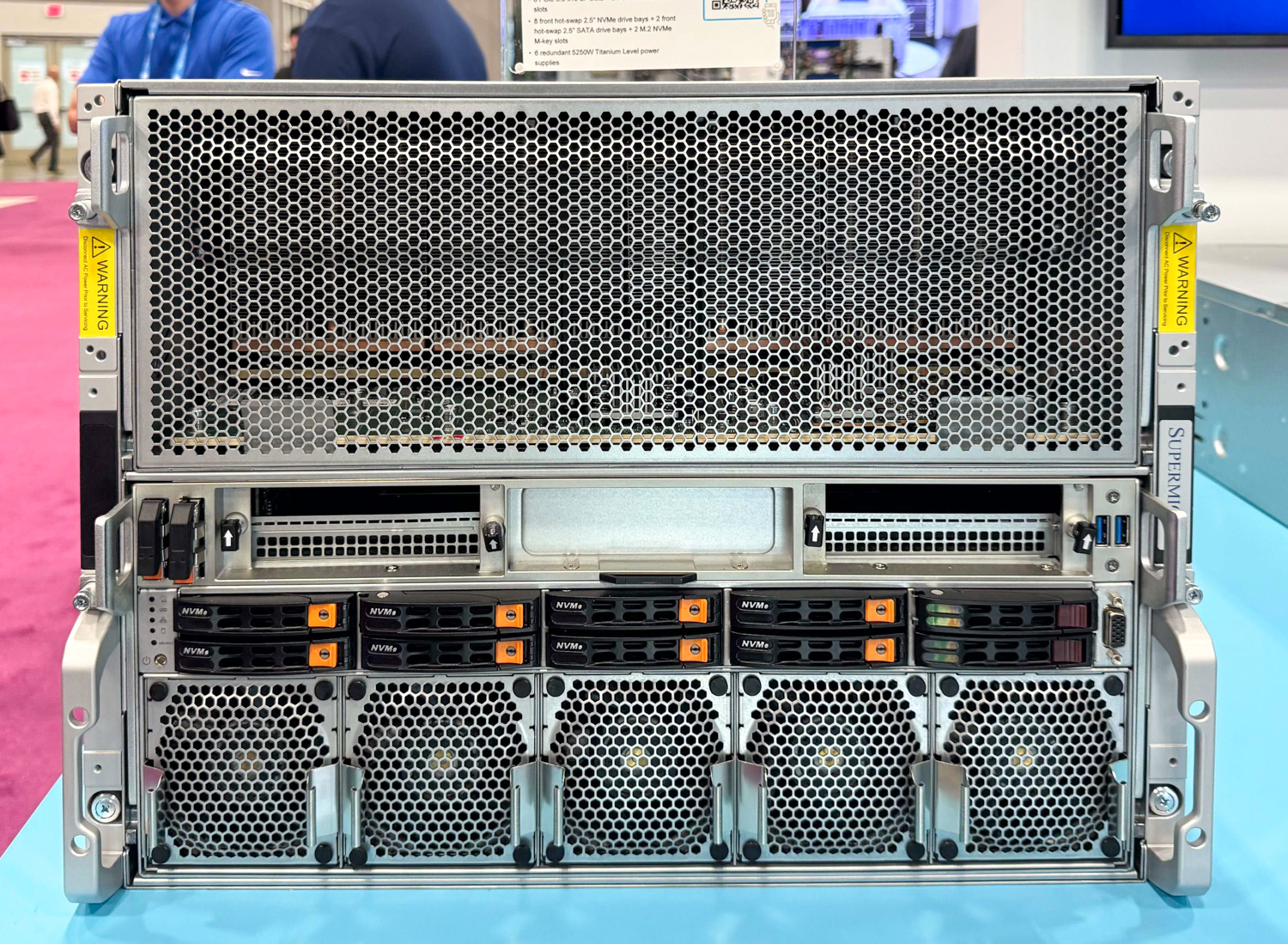
    Show notes Supermicro H14 server with AMD Instinct MI350X GPUs, front view showing the fan wall and NVMe drive bays Supermicro H14 server with AMD Instinct MI350X GPUs, front view showing the fan wall and NVMe drive bays

    MLCommons has published MLPerf Inference v6.1, and the round sets a participation record with 30 submitting organizations and 486 datacenter and edge results. Two new tests join the suite: an End-to-End RAG pipeline for the datacenter and an Edge Agentic Inference benchmark for single-user devices, and the results carry the first peer-reviewed numbers for NVIDIA’s Vera Rubin NVL72, AMD’s Instinct MI350P, Intel’s Arc Pro B70, and AMD’s Ryzen AI Max+ 395. On the pace of improvement, MLCommons says the best per-accelerator DeepSeek-R1 result in the server scenario is 5.7x better than in v5.1 a year ago, and the best VLM result improved 2.99x in the six months since v6.0.

    Supermicro H14 server with AMD Instinct MI350X GPUs, front view showing the fan wall and NVMe drive bays

    Two New Tests: End-to-End RAG and Edge Agentic Inference

    The End-to-End RAG benchmark measures a complete question-answering pipeline, several models and a vector database working together. The reference implementation runs four models together: gpt-oss-120B handles query decomposition, sufficiency checking, and answer generation; gpt-oss-20B grades retrieved documents; e5-base-v2 produces embeddings; and ColBERTv2 reranks passages. The corpus comprises 107,484 passages, chunked from 2,515 HTML files; the questions are 824 multi-hop tasks from Google’s FRAMES dataset; and each task can loop through up to 5 retrieval rounds before the pipeline decides it has enough evidence. Two metrics come out: documents per second for building the FAISS HNSW vector database, and tasks per second for answering questions against it. A Llama 3.1-8B judge scores the final answers against a 97% accuracy target, and the judging isn’t timed.

    The Edge Agentic Inference benchmark targets the coding-assistant pattern that has moved onto workstations and desktop AI boxes. The model is Qwen3.6-27B with thinking off, run as a Q4_K_M GGUF under llama.cpp in the reference, with a 32K context window served per turn. The performance workload is a recorded replay of 20 agentic coding trajectories drawn from SWE-bench Verified, totaling 1,007 turns, driven in a single stream with one request in flight, the way a developer on a laptop runs an agent. The reported metric is mean latency per turn, with time-to-first-token and time-per-output-token distributions alongside, and accuracy is gated separately by BFCL v4 at 97% of the reference score. MLCommons adapted the framework from its upcoming MLPerf Agentic datacenter benchmark.

    “We added the End-to-end RAG test because it’s clear that query-answering has evolved beyond simply an LLM trained on a corpus; stakeholders need to understand the real-world performance of the types of multi-step, multi-component pipelines that are being built today,” said Miro Hodak, MLPerf Inference working group co-chair. “Likewise, we added the Edge Agentic Inference test because complex inference systems with agentic properties are increasingly hosted on edge computing devices, creating a new set of performance challenges our customers face today.”

    The round also extends speculative decoding support, previously limited to DeepSeek-R1, to the GPT-OSS benchmark in the interactive scenario, and defines a new interactive scenario for the VLM test with responses targeted at about 1.5 seconds.

    New Silicon From the Desktop to the Rack

    NVIDIA’s Vera Rubin NVL72 makes its MLPerf debut in the preview category, submitted by NVIDIA and by Nebius on its VR200 NVL72. NVIDIA reports up to 2.5x higher token throughput than the GB300 NVL72 on DeepSeek-R1 across offline, server, and interactive scenarios using TensorRT-LLM, and up to 3.7x on the Qwen3 vision-language model using vLLM with NVIDIA Dynamo. Those are NVIDIA’s comparisons against its own prior generation, and the preview designation means the platform is expected to be commercially available by the next round.

    AMD expanded its MLPerf Inference 6.1 submission to six model families across language, reasoning, text-to-video, and recommendation tasks, deploying the Instinct MI355X, MI350X, and the new MI350P PCIe card. The 512-GPU Crusoe cluster built on the MI355X is covered below, along with AMD’s own breakdown of the round.

    Intel’s Arc Pro B70 shows up in a four-GPU node with 128GB of combined VRAM that Intel used for Llama 3.1-8B, Llama 2-70B, gpt-oss-120B, Whisper, and the new E2E-RAG test; Intel reports gpt-oss-120B improved 36% in server and 27% in offline over v6.0 on the same hardware. On the CPU side, Intel says Xeon 6980P Llama 3.1-8B server throughput rose 2.4x from v6.0 on identical silicon, a software-only gain.

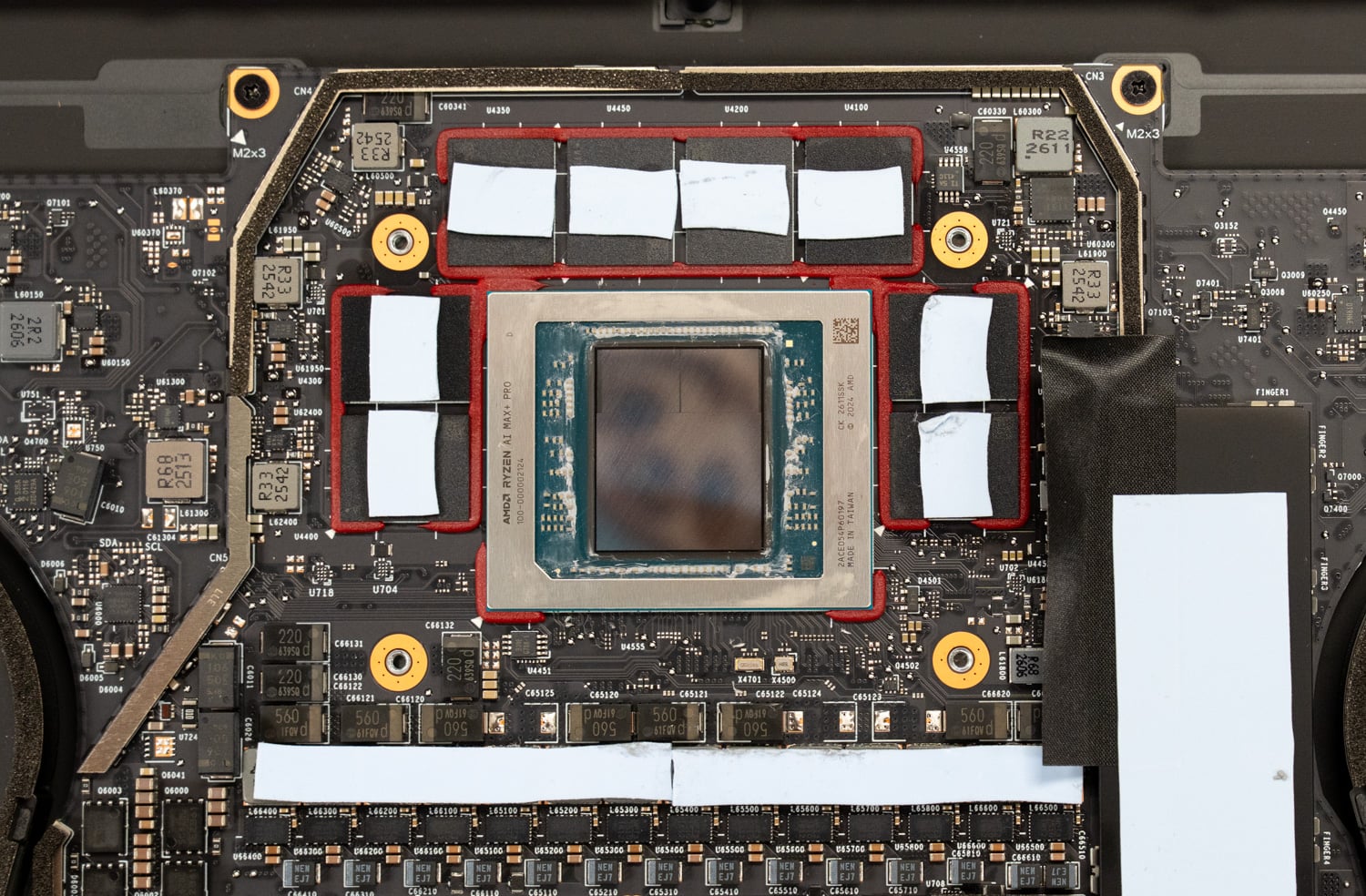
    The Ryzen AI Max+ 395 appears through Atlas Inference, a first-time submitter that ran the new Edge Agentic workload on both an NVIDIA DGX Spark and an AMD Strix Halo desktop with the same engine and quantization recipe. Atlas reports 20.1 tokens per second on the DGX Spark, completing all 1,007 turns in under 64 minutes, and 19.63 tokens per second on Strix Halo. That’s a narrower gap than we measured between the two platforms with off-the-shelf runtimes in our Ryzen AI Halo and DGX Spark reviews, and it’s the kind of result the new benchmark is designed to surface.
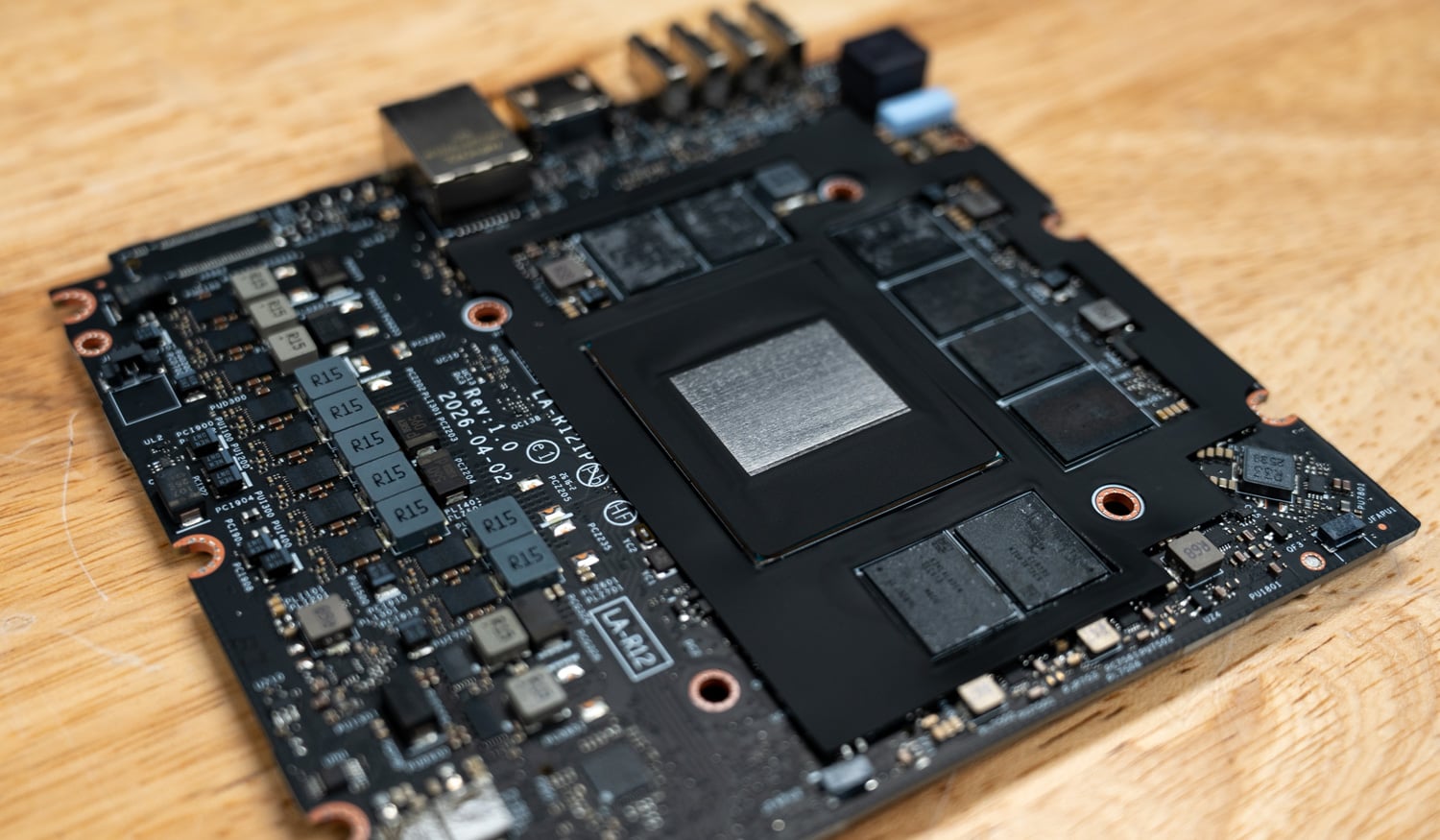
    AMD Ryzen AI Max+ 395 Strix Halo mainboard from the Ryzen AI Halo desktop with the SoC and LPDDR5X packages exposed

    Bigger, More Diverse, and More Distributed

    Multi-node submissions hit a record this round, up from zero in v4.0, and three stand out. Crusoe, another first-time submitter, ran the largest system in MLPerf Inference history with AMD: 512 Instinct MI355X GPUs across 64 nodes on a standard RoCE Ethernet fabric, submitted for gpt-oss-120b and DeepSeek-R1. AMD reports 5.75 million tokens per second in the offline scenario and 5.39 million in server on gpt-oss-120b from that cluster, and 2.90 million offline and 2.41 million server on DeepSeek-R1, which AMD calls the highest aggregate token throughput in MLPerf history, with throughput scaling near-linearly from 1 to 64 nodes. The gpt-oss-120b run served the model as 512 independent single-GPU replicas in native MXFP4; DeepSeek-R1 used SGLang with one eight-GPU replica per node. AMD separately cites a 72-GPU GPT-OSS-120B submission at 95% scaling efficiency and 1 million tokens per second, the same headline it hit on MI355X in v6.0.

    Cisco submitted the benchmark’s first cross-vendor heterogeneous system, pooling eight NVIDIA H200 and eight AMD Instinct MI350X GPUs into a single inference pool over a Cisco Silicon One G200 fabric, the same mixed-accelerator approach it’s selling through its Secure AI Factory. The geographically distributed entry came from MangoBoost with Dell: four sites on two continents, hosted by MangoBoost, Dell, TensorWave, and Microsoft Azure, spanning the Pacific and running as one endpoint at what MangoBoost reports as 97% scaling efficiency. MangoBoost also claims the first prefill/decode-disaggregated results on AMD Instinct GPUs.

    Elsewhere in the results, CoreWeave reports 1.16 million tokens per second aggregate on GB300 NVL72 with per-GPU offline throughput up 17% since v6.0, HPE cites 8,500 tokens per second per GPU on DeepSeek-R1 across two Compute XD690 servers with Blackwell Ultra, and Google focused its submission on DeepSeek-R1, citing the industry’s shift to large mixture-of-experts models. gpt-oss-120b drew 112 submissions, the most of any MLPerf workload.

    AMD’s Two CDNA 4 Form Factors: OAM and Dual-Slot PCIe

    AMD’s CDNA 4 architecture is available in two physical form factors to meet specific data center power and cooling constraints. The flagship Instinct MI355X targets high-density compute nodes using an OAM form factor on an OCP Universal Baseboard (UBB 2.0) platform, providing 256 compute units, 288 GB of HBM3E memory, and 8 TB/s of aggregate memory bandwidth. It delivers up to 10.1 PFLOPS of peak theoretical MXFP4 and MXFP6 matrix compute. The newly introduced Instinct MI350P adapts that same CDNA 4 silicon into a dual-slot PCIe 5.0 add-in card for standard enterprise chassis, housing 128 compute units, 144 GB of HBM3E memory, 4 TB/s of bandwidth, and delivering up to 4.6 PFLOPS of peak theoretical MXFP4 and MXFP6 matrix performance.
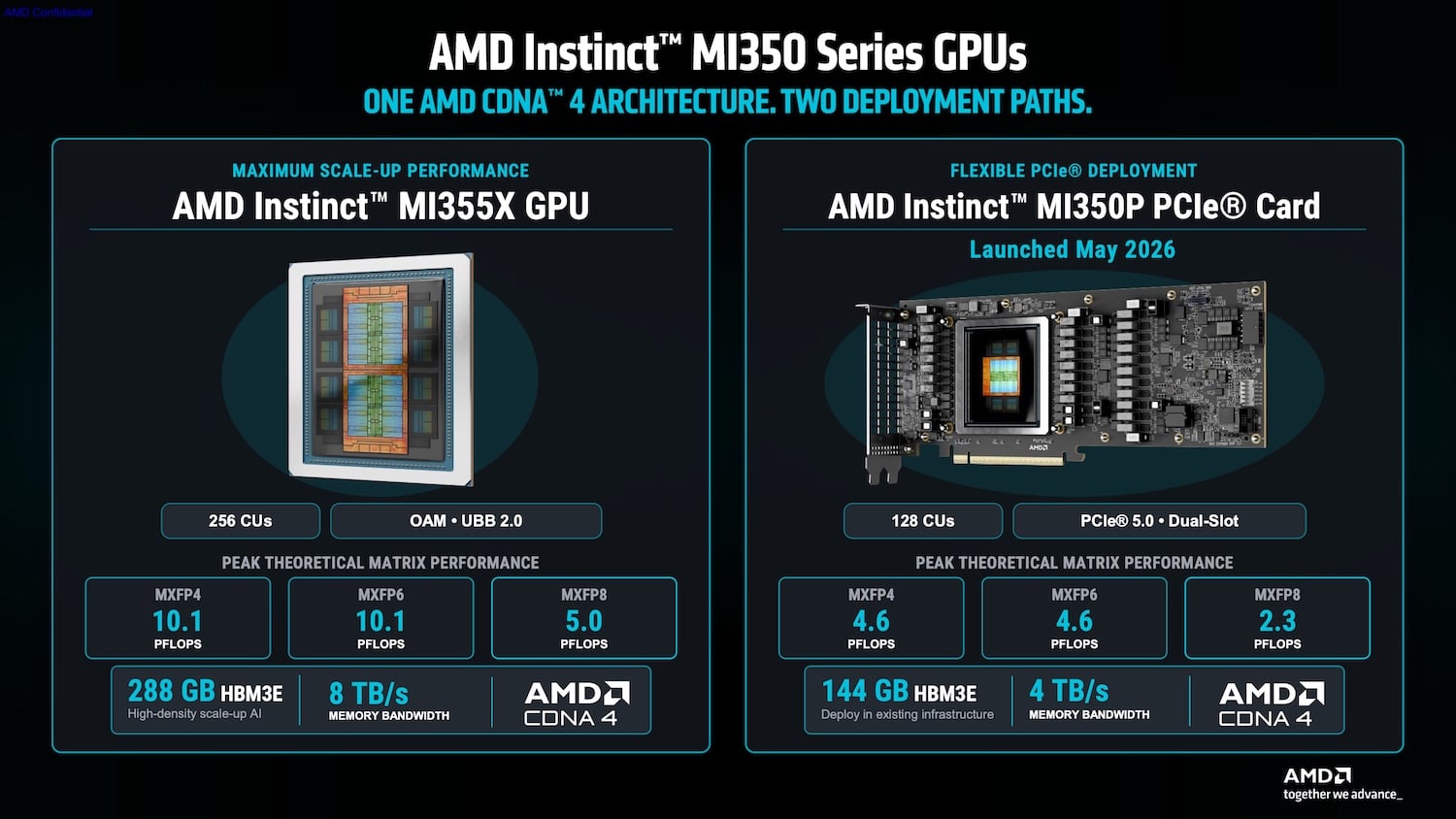
    AMD slide comparing the Instinct MI355X OAM GPU (256 CUs, 288GB HBM3E, 8TB/s, 10.1 PFLOPS MXFP4) with the Instinct MI350P dual-slot PCIe card (128 CUs, 144GB HBM3E, 4TB/s, 4.6 PFLOPS MXFP4)

    Software-Driven Generational Uplift on Identical Silicon

    Software optimizations in AMD ROCm v7 yielded measurable throughput gains on identical MI355X hardware during a single MLPerf cycle. Testing on an eight-GPU MI355X node showed GPT-OSS-120B throughput rose by 28% in the Offline scenario and 38% in the Server scenario, while Wan-2.2 SingleStream performance improved by 70%. At cluster scale, 72 MI355X accelerators in MLPerf 6.1 achieved higher aggregate GPT-OSS-120B throughput than a 94-GPU configuration reported in round 6.0. In competitive comparisons published by AMD, the eight-GPU MI355X led submitted results against the NVIDIA B200 and B300 on GPT-OSS-120B, while the 72-GPU cluster led NVIDIA’s GB200 submission.

    In its first MLPerf round, the dual-slot MI350P submitted across five Closed workloads, posting leading results against selected submissions of the NVIDIA RTX PRO 6000 Server Edition and H200 NVL. For deployments sensitive to power and cooling budgets, an eight-GPU MI350X system maintained approximately 80% of the MI355X platform’s benchmark performance across GPT-OSS, Llama, Wan, and DLRM workloads, while the MI355X carries a 40% higher rated TDP. A commissioned study by Signal65 reported that these throughput numbers translated to lower operational cost per document and higher token output per dollar within fixed latency limits.
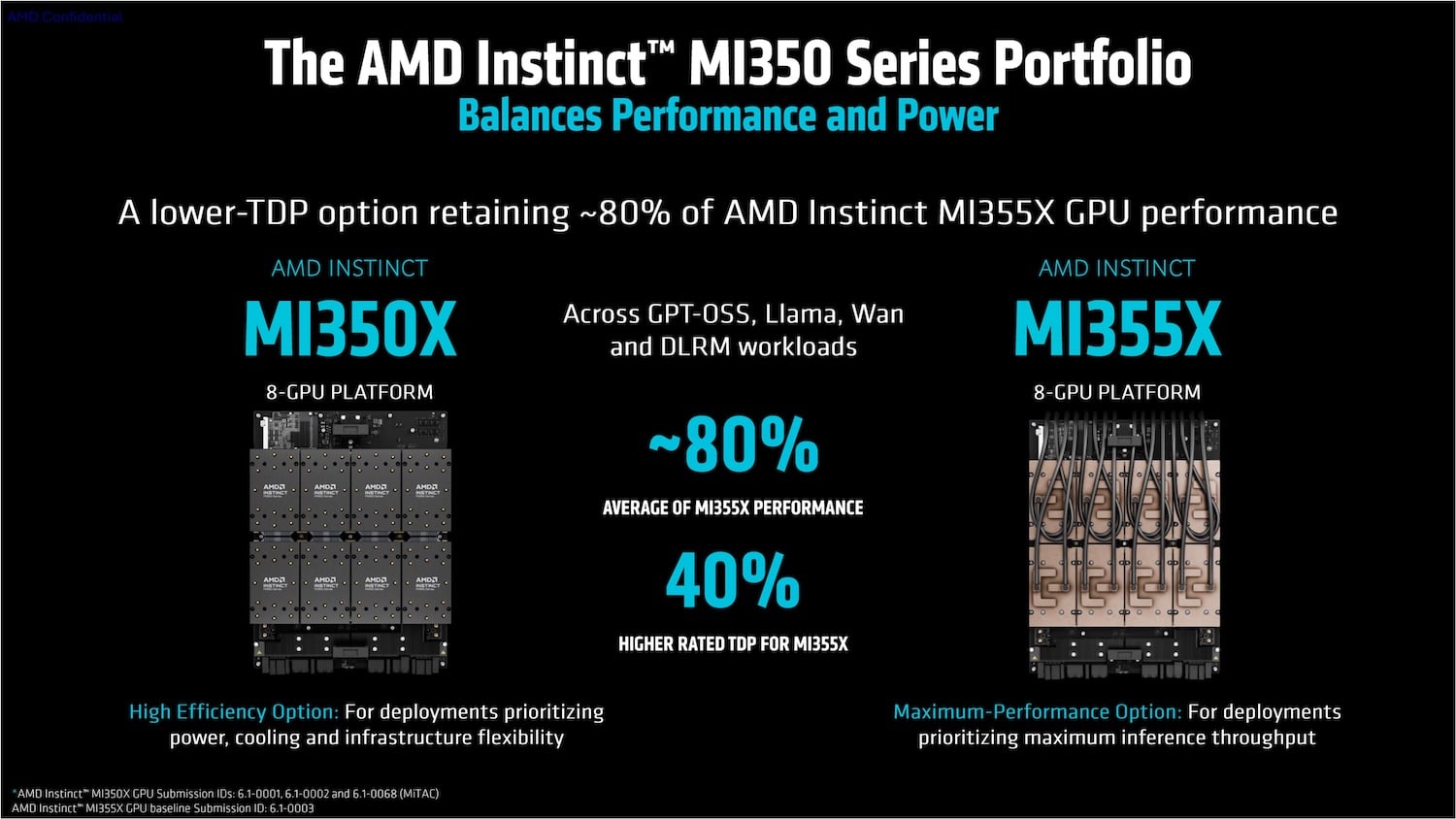
    AMD slide showing an eight-GPU Instinct MI350X platform retaining about 80% of MI355X performance across GPT-OSS, Llama, Wan, and DLRM workloads with the MI355X carrying a 40% higher rated TDP

    AMD Partner Results and the Korea-to-US Cluster

    AMD says comparable MI355X submissions from seven partners, Dell Technologies, Oracle, Hewlett Packard Enterprise, Supermicro, MangoBoost, Crusoe, and MiTAC, averaged within 4% of its reference system results, with some runs matching or slightly exceeding them.
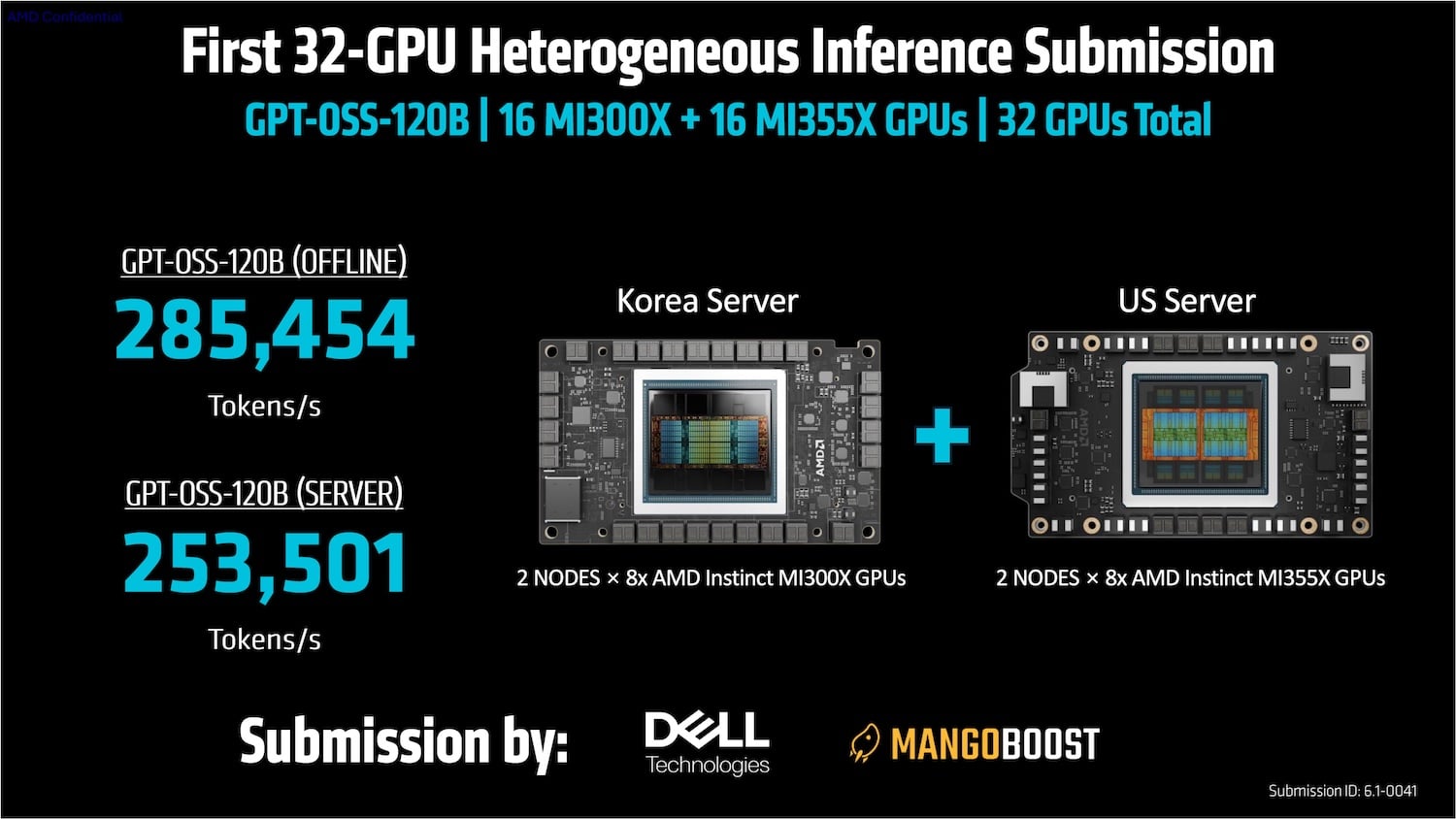
    AMD slide on the first 32-GPU heterogeneous MLPerf inference submission by Dell and MangoBoost: 16 Instinct MI300X GPUs in Korea and 16 MI355X GPUs in the US serving GPT-OSS-120B at 285,454 offline and 253,501 server tokens per second

    The MangoBoost and Dell entry noted above is the benchmark’s first heterogeneous 32-GPU serving configuration, bridging 16 previous-generation Instinct MI300X GPUs in Korea with 16 Instinct MI355X GPUs in the United States into a unified GPT-OSS-120B endpoint. The split-cluster configuration delivered 285,454 Offline tokens per second and 253,501 Server tokens per second. The submissions ran on ROCm 7; AMD points to the ROCm 10 release, with vLLM, SGLang, and ROCm.AI profiling tools, as the path forward ahead of the HBM4-based MI400 Series and the MI500 generation that follows.

    The Harness That Replaces MLPerf Inference in the Datacenter

    Sixteen of the 30 submitters used MLPerf’s API-centric harness this round, up from a single open-division submitter in v6.0. The harness runs a true client/server setup over standard APIs against a hosted endpoint, which is how datacenter inference is deployed, and it already carries the new Edge Agentic test, VLM-Interactive, gpt-oss, DeepSeek-R1, Llama 3.1-8B, and text-to-video. It’s the foundation of MLPerf Endpoints, which opens on-demand rolling submissions in October 2026 and replaces MLPerf Inference as the datacenter benchmark in 2027, with normalized results and expanded agentic workloads planned for Endpoints v1.0.

    “Moving forward, MLPerf Endpoints will replace Inference in our family of benchmarks for the datacenter, and the quick uptake of our API-centric harness will contribute to making that transition seamless,” said David Kanter, head of MLPerf. The six first-time submitters this round are Atlas Inference, Crusoe, Orrick Industries, ScitiX, VibeHPC, and individual contributor Naeem Khoshnevis of Harvard’s Kempner Institute, who submitted a single-H200 Llama 3.1-8B result.

    The inference round follows the MLPerf Storage v3.0 results published two weeks ago, and full datacenter and edge tables, along with submitter supplementals, are available on the MLCommons results pages.

    MLPerf Inference v6.1 Datacenter Results

    MLPerf Inference v6.1 Edge Results

    The post MLPerf Inference v6.1: 5.7x Per-Accelerator Gains, a 512-GPU Run, and Vera Rubin’s First Peer-Reviewed Numbers appeared first on StorageReview.com.


    HP ZBook Ultra G3a 16 Preview: 192GB of Unified Memory Aims for the Top of the Local AI Laptop Leaderboard Sep 15, 2026
    Show notes Close-up of the HP ZBook Ultra G3a 16 motherboard showing the AMD Ryzen AI Max+ PRO 495 die surrounded by LPDDR5X memory packages Close-up of the HP ZBook Ultra G3a 16 motherboard showing the AMD Ryzen AI Max+ PRO 495 die surrounded by LPDDR5X memory packages

    HP’s ZBook Ultra G1a 14 holds the Best for Large Models spot on our Best Laptops for Local AI leaderboard because its 128GB of unified memory, 96GB of it assignable to the GPU, loaded models no discrete-GPU laptop could touch. The new HP ZBook Ultra G3a 16 raises that pool to 192GB with up to 160GB for the GPU, moves to a 16-inch chassis, and nearly doubles the sustained power budget. We have a pre-production unit in the lab, and while benchmarks wait for shipping hardware next month, the parts list alone suggests the top of that leaderboard is about to get shuffled.

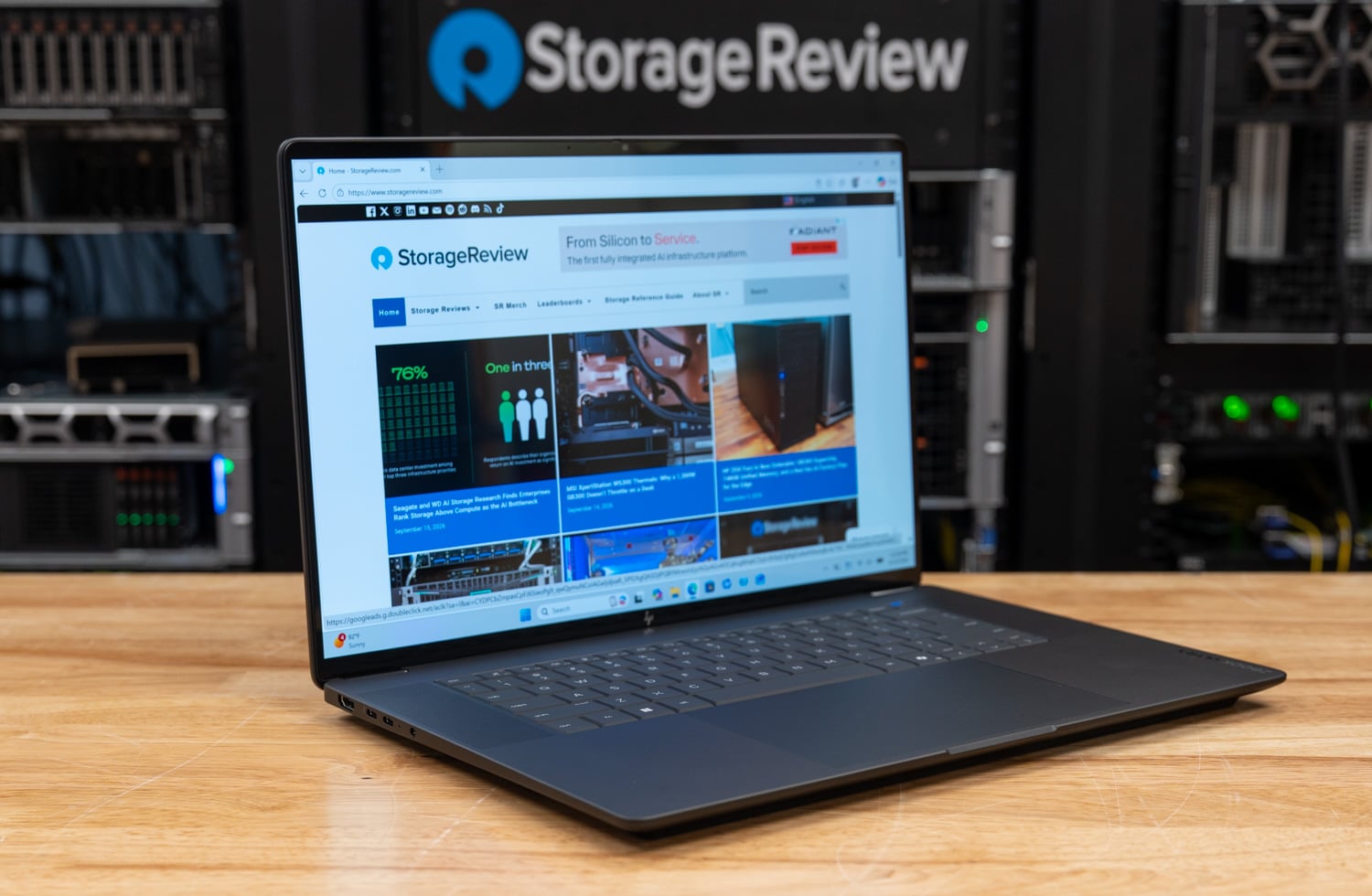
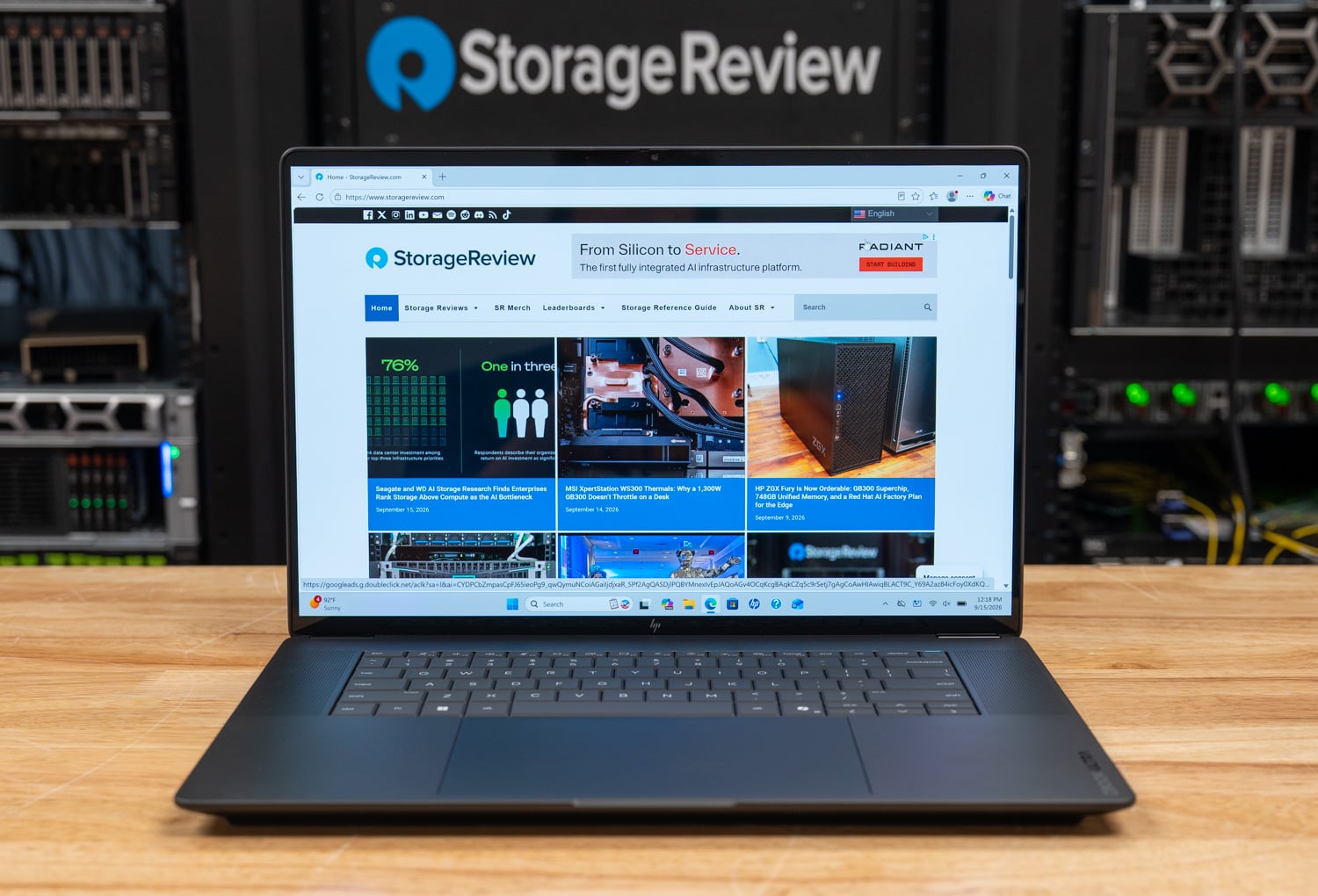
    HP ZBook Ultra G3a 16 open on the StorageReview lab bench with the StorageReview homepage on its 16-inch display and server racks behind it

    HP announced the ZBook Ultra G3a 16 today, with availability in October and pricing to follow closer to ship, and the unit on our bench carries a pre-production label and a clean Windows install. What we can do now is walk through the hardware, show what’s under the bottom cover, and lay out what we plan to measure once shipping systems arrive.

    192GB of Unified Memory, 160GB for the GPU

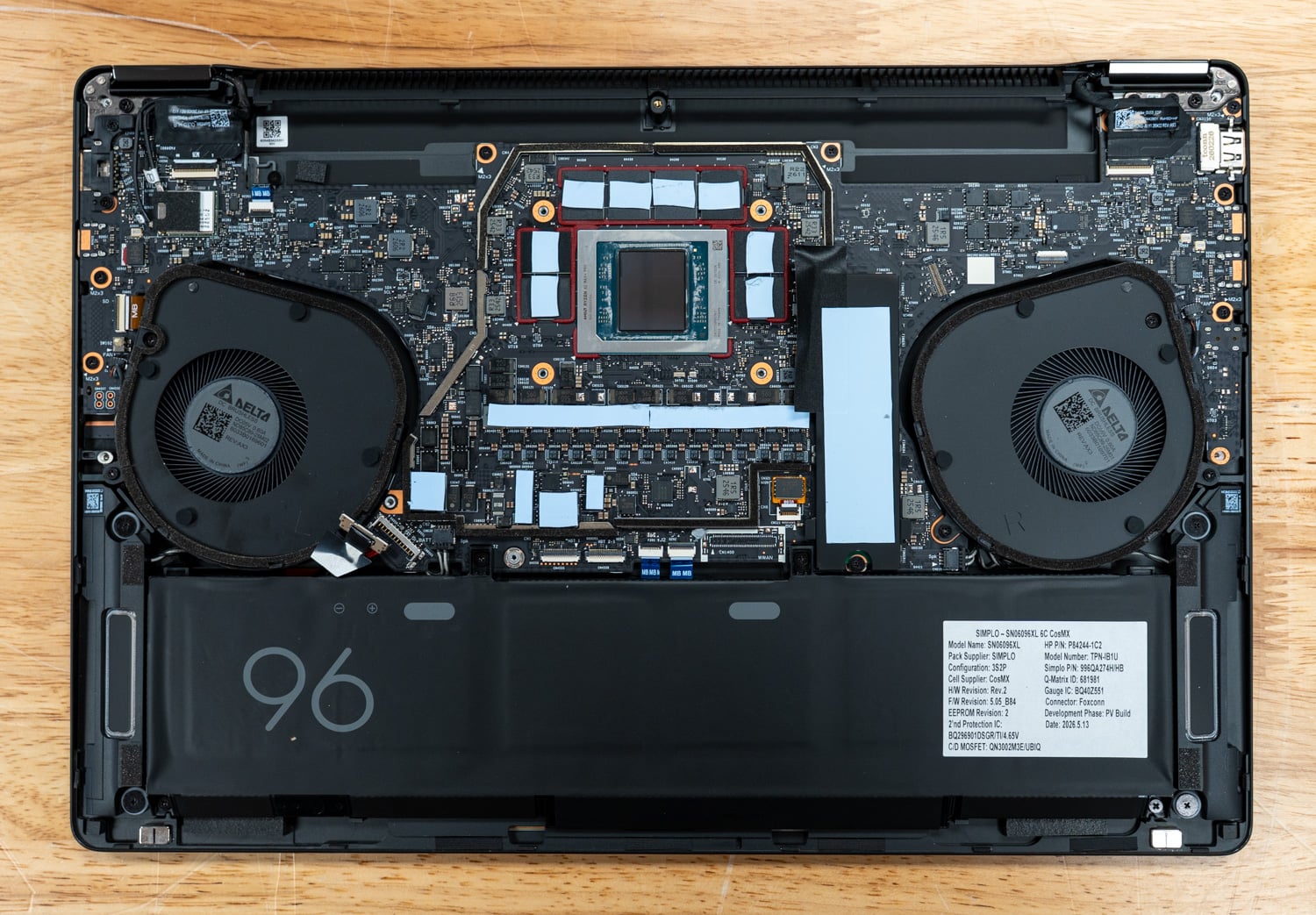
    One number defines this system: memory. Our unit pairs the AMD Ryzen AI Max+ PRO 495, the top of the Strix Halo PRO stack, with 16 cores, 32 threads, and a 5.2GHz boost clock, with 192GB of LPDDR5X-8533 soldered around the CPU. Up to 160GB of that pool can be dedicated to the integrated Radeon 8065S GPU, and the Ryzen AI NPU adds 55 TOPS on top. HP says it co-engineered the system with AMD, and its claim is that the configuration runs LLMs up to 300B parameters locally, with room for multiple agents alongside them; HP also calls it the most capable local agentic laptop, a ranking based on its own August comparison of GPU memory capacity across competing laptops.

    Close-up of the HP ZBook Ultra G3a 16 motherboard showing the AMD Ryzen AI Max+ PRO 495 die surrounded by LPDDR5X memory packages

    For context, the G1a 14 shipped with 128GB and let us assign up to 96GB to its Radeon 8060S. That was enough to load DeepSeek-R1 70B and QwQ 32B in LM Studio and Ollama, and to run Gemma 3 27B at 8.96 tokens per second, which is why it took the large-model category even though its Procyon numbers trailed the RTX PRO laptops we’ve tested. The G3a adds 64GB of GPU-addressable memory to that base design. It’s also the largest GPU memory allocation we’ve seen on any Ryzen AI Max system so far, laptop or desktop, and it lands in the same silicon family as the Ryzen AI Halo desktop we put up against the DGX Spark in July.

    Memory capacity decides which models load, but it doesn’t decide how fast they run. On the G1a, unified memory bought model size, and the 55W power budget set the pace, and the G3a’s GPU alone doesn’t change that equation.

    A Thermal Redesign From 55W to 100W

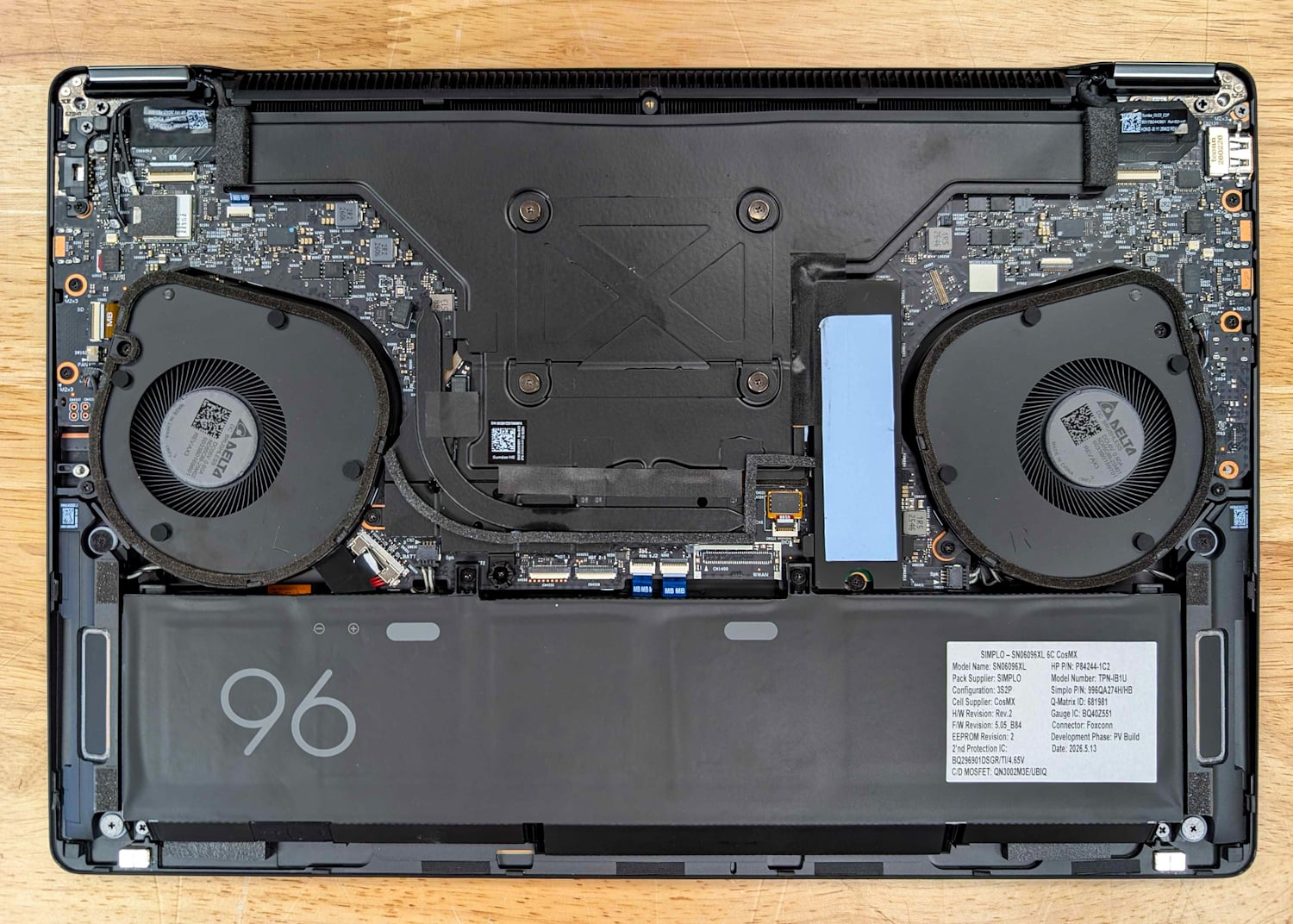
    HP’s new thermal design in the G3a 16 sustains up to 100W, a massive jump vs. prior Zbooks. A single heat spreader plate covers the SoC and memory packages, with two Delta fans on either side exhausting through a wide radiator fed by copper heat pipes along the rear edge.

    HP ZBook Ultra G3a 16 with the bottom cover removed and the heat spreader installed, showing the plate over the SoC, dual Delta fans, the rear radiator, and the 96Wh battery

    A 96Wh user-replaceable battery fills the lower third of the chassis, with an HP-rated runtime of up to 14 hours and a 50% charge in 30 minutes on the 180W GaN adapter. Storage is a single PCIe Gen5 x4 M.2 slot, populated in our unit with a 2TB SK hynix PCB01 and configurable up to 8TB. One slot in a 16-inch workstation is worth knowing about if you were counting on a second drive for datasets, though 8TB of Gen5 in one bay covers most of that ground. HP also notes the keyboard is designed to be swapped by IT without a full disassembly, part of a serviceability push across its portable line.

    HP ZBook Ultra G3a 16 with the heat spreader removed, exposing the SoC and LPDDR5X packages between the dual Delta fans, with the single M.2 SSD slot and 96Wh battery below

    Build and Design

    Design-wise, the G3a 16 is a Z through and through: an Eclipse Gray aluminum shell, 17.9mm thick, starting at 4.2 pounds, with the same understated finish as the Fury and Studio lines. The G1a 14 came in at 3.3 pounds with less than half the sustained power and a smaller screen; the G3a adds two inches of display, a larger cooling system, and a bigger battery for under a pound extra.

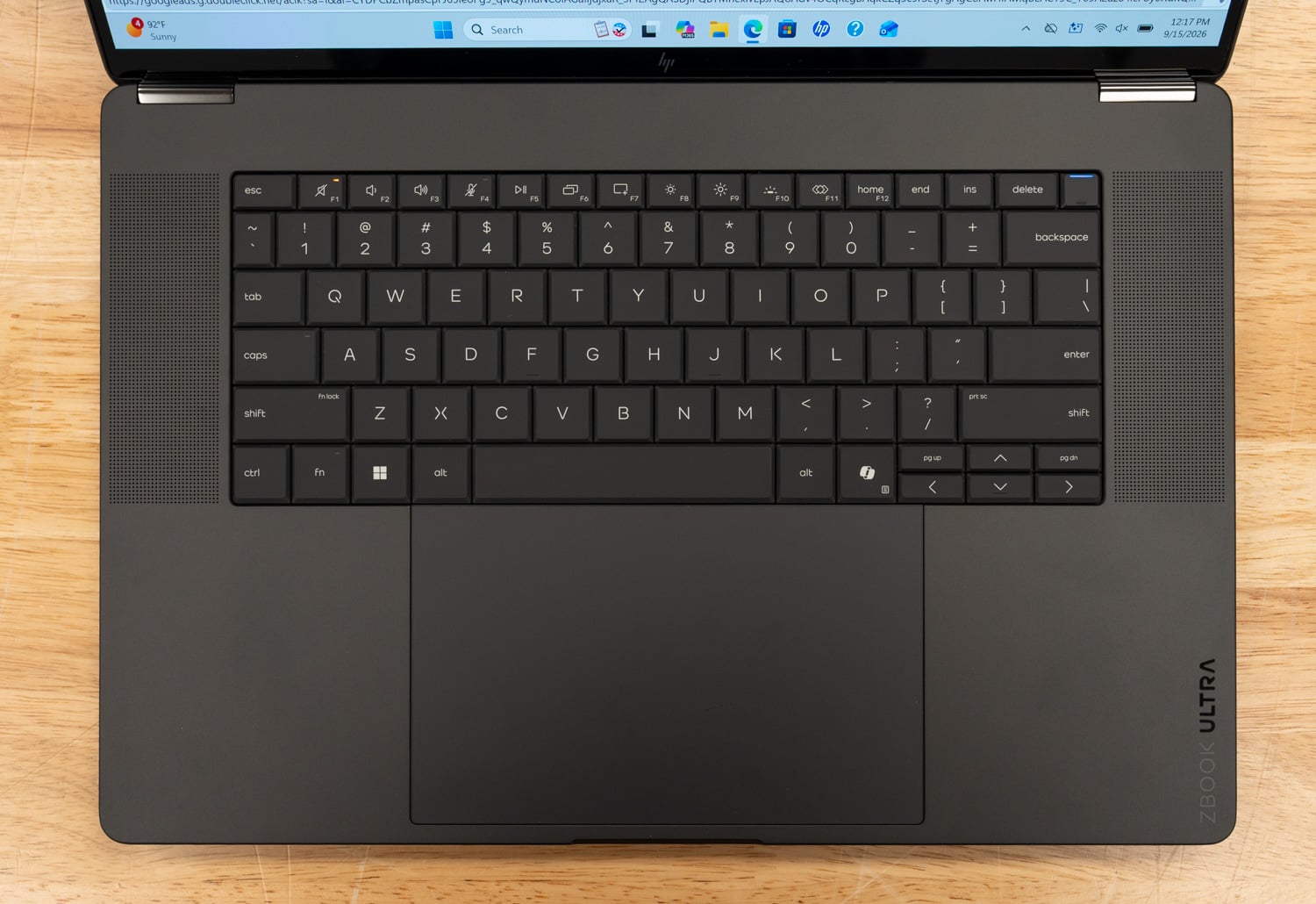
    Top-down view of the HP ZBook Ultra G3a 16 keyboard deck with backlit keys, a large glass trackpad, and ZBOOK ULTRA branding on the palm rest

    The deck carries a spill-resistant backlit keyboard with HP’s DuraKeys coating, a large Precision touchpad, and speaker grilles flanking the keys for the four-speaker Poly Studio audio system. Our unit has the 16-inch WQUXGA panel, a 3840×2400 IPS at 120Hz and 500 nits with HP DreamColor calibration and 100% DCI-P3 coverage. HP also lists a 2.8K OLED touch option at 500 nits, a 2.5K panel with 100% Adobe RGB, and a lower-power WUXGA panel for buyers who want battery life over pixels.

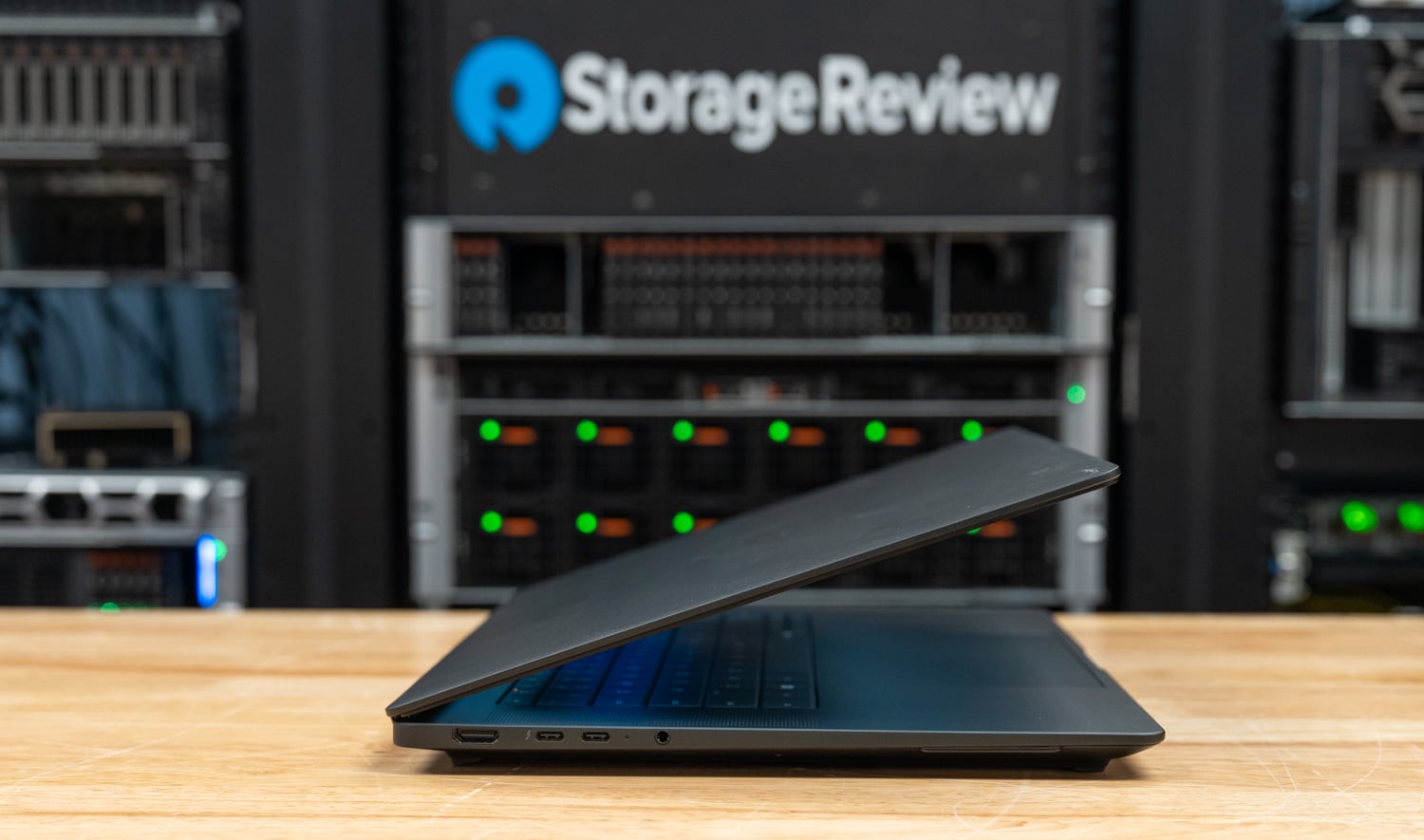
    Left side of the HP ZBook Ultra G3a 16 showing the HDMI 2.1 port, Thunderbolt 4 port, USB-C port, and headphone jack

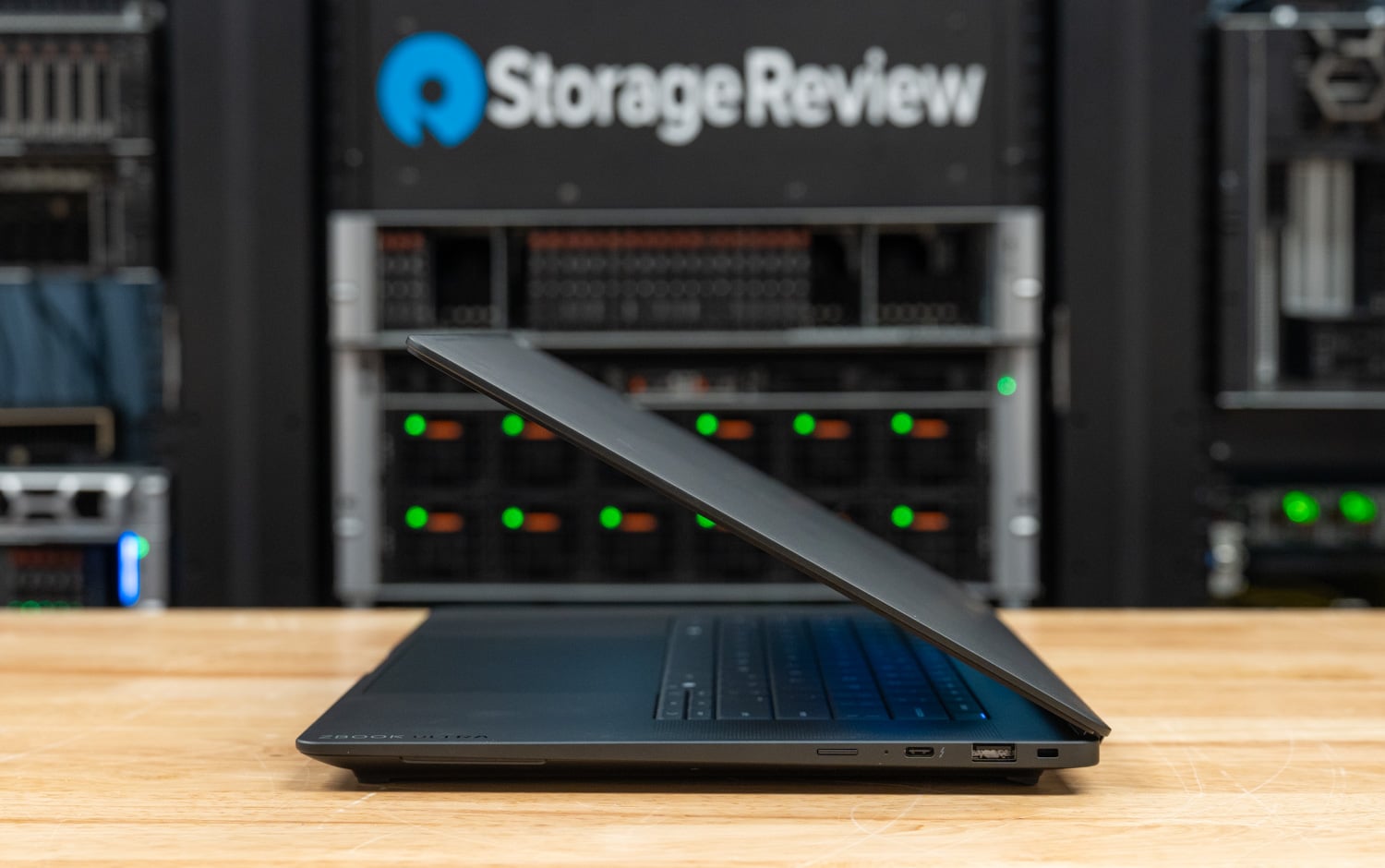
    The left edge carries HDMI 2.1, Thunderbolt 4 port at 40Gbps, 10Gbps USB-C port with Power Delivery and DisplayPort 1.4, and a headphone jack. The right edge adds a second Thunderbolt 4 port, 10Gbps USB-A port, and a nano security lock slot. Wireless is MediaTek Wi-Fi 7 with Bluetooth 6.0, and HP offers 5G WWAN, including its HP Go connectivity service, as an option. The webcam is a 5MP IR unit with Windows Hello, and the OS list includes Ubuntu 26.04 LTS alongside Windows 11 Pro.

    Right side of the HP ZBook Ultra G3a 16 showing the nano security lock slot, Thunderbolt 4 port, and USB-A port

    Perplexity, Revit, and HP’s Skills

    Perplexity Computer ships on the G3a 16 with an MCP connector into Autodesk Revit, so a local model can work against project data on the machine without pushing proprietary files to a cloud endpoint, and users can hand it off to a cloud model when they choose. HP and Perplexity also co-developed a set of task-based Skills exclusive to HP customers. Our pre-production unit arrived with a clean Windows image, which is normal at this stage, so we’ll look at the Perplexity stack and the Revit connector on a shipping build. On the application side, HP lists support for Autodesk Revit 2027, Autodesk 3ds Max, and Chaos Enscape visualization, the design and visualization workloads the AEC buyers this system targets already run.

    “Professionals need AI experiences that are powerful, reliable, and integrated into the way they work,” said Jim Nottingham, senior vice president and division president of Advanced Compute and Solutions at HP. HP positions the G3a 16 as one piece of a broader local AI portfolio that includes the ZGX Nano and the ZGX Fury, which is now orderable and is in our lab for review, along with HP Boost and HP Remote System Controller. HP is also publishing a Local AI Value Calculator on HP.com to model the cost of moving AI workloads from the cloud to Z workstations. For the desk-side end of that range, our Best Desktops for Local AI leaderboard ranks the ZGX Nano and its GB10 and Strix Halo peers on the same tests we’ll run here.

    HP ZBook Ultra G3a 16 Specifications

    Specification HP ZBook Ultra G3a 16
    Platform Overview
    Processor AMD Ryzen AI Max+ PRO 495 (16C/32T, up to 5.2GHz, 64MB L3) as tested
    Ryzen AI Max PRO 490, 485, and 480 configurations available
    Graphics AMD Radeon 8065S integrated (8050S and 8040S on lower SKUs)
    NPU AMD Ryzen AI, 55 TOPS (50 TOPS on lower SKUs)
    Memory Up to 192GB LPDDR5X-8533 unified
    Up to 160GB dedicated to the GPU
    Storage 1 x M.2 PCIe Gen5 x4 NVMe, up to 8TB
    2TB SK hynix PCB01 as tested
    Display 16-inch WQUXGA 3840×2400 IPS, 120Hz, 500 nits, 100% DCI-P3, HP DreamColor (as tested)
    16-inch 2.8K 2880×1800 OLED touch, up to 120Hz, 500 nits, 100% DCI-P3
    16-inch 2.5K 2560×1600, up to 120Hz, 400 nits, 100% Adobe RGB
    16-inch WUXGA 1920×1200, 400 nits, low power, 100% sRGB
    Connectivity
    Ports (left) 1 x HDMI 2.1
    1 x Thunderbolt 4 (USB-C, 40Gbps, PD, DisplayPort 2.1)
    1 x USB-C 10Gbps (PD, DisplayPort 1.4)
    1 x headphone/microphone combo
    Ports (right) 1 x Thunderbolt 4 (USB-C, 40Gbps, PD, DisplayPort 2.1)
    1 x USB-A 10Gbps
    1 x nano security lock slot
    Wireless MediaTek Wi-Fi 7 MT7925 (2×2) with Bluetooth 6.0
    Optional 5G WWAN (HP R18, HP Go) and LTE LPWAN
    Camera and Audio 5MP IR AI camera
    4 stereo speakers with discrete amplifiers, dual-array microphones (Poly Studio)
    Power and Physical
    Sustained Power Up to 100W (G1a: 55W)
    Battery 96Wh 6-cell, user replaceable
    Up to 14 hours (HP rating), 50% charge in 30 minutes
    Power Adapter 180W or 140W USB-C GaN
    Dimensions 14.02 x 9.45 x 0.70 inches (35.6 x 24.0 x 1.79cm)
    Weight Starting at 4.2 lb (1.9kg)
    Operating Systems Windows 11 Pro, Windows 11 Home, FreeDOS, Ubuntu 26.04 LTS
    Availability October 2026, pricing to be announced

    What We’ll Test Next

    The G1a 14 proved the unified-memory idea in a laptop: models that no discrete-GPU notebook could load ran locally on a 3.3-pound machine. Where it ran short was generation speed, with large models producing single-digit tokens per second inside a 55W envelope. The G3a 16 is aimed squarely at the power users who need more than that ceiling. The 160GB GPU allocation extends the capacity lead that earned the G1a its category, and the 100W thermal budget is the first chance for a Strix Halo laptop to close some of the throughput gap to the RTX PRO machines on the leaderboard. How much of that gap closes will be uncovered in the full review.

    When shipping systems arrive, likely in October, we’ll run the same UL Procyon AI Text Generation suite that ranks every laptop on the leaderboard, then push into LM Studio and Ollama with the 70B-class and larger models the memory pool invites, and measure sustained clocks, power, and battery. If the 100W budget holds up over a long generation run, this system has a case for the overall spot on top of the large-model category the G1a already holds.

    HP ZBook Ultra G3a 16 open and facing the camera on the StorageReview lab bench in front of a rack of servers

    HP ZBook Ultra G3a 16 Product Page

    The post HP ZBook Ultra G3a 16 Preview: 192GB of Unified Memory Aims for the Top of the Local AI Laptop Leaderboard appeared first on StorageReview.com.


    Micron Shows off 512GB DDR5 RDIMM: 12TB per Dual-Socket Server at 9,200 MT/s, Volume Production in 2H 2027 Sep 15, 2026
    Show notes Micron DDR5 RDIMM resting on server CPU heatsinks, photo courtesy of Micron Micron DDR5 RDIMM resting on server CPU heatsinks, photo courtesy of Micron

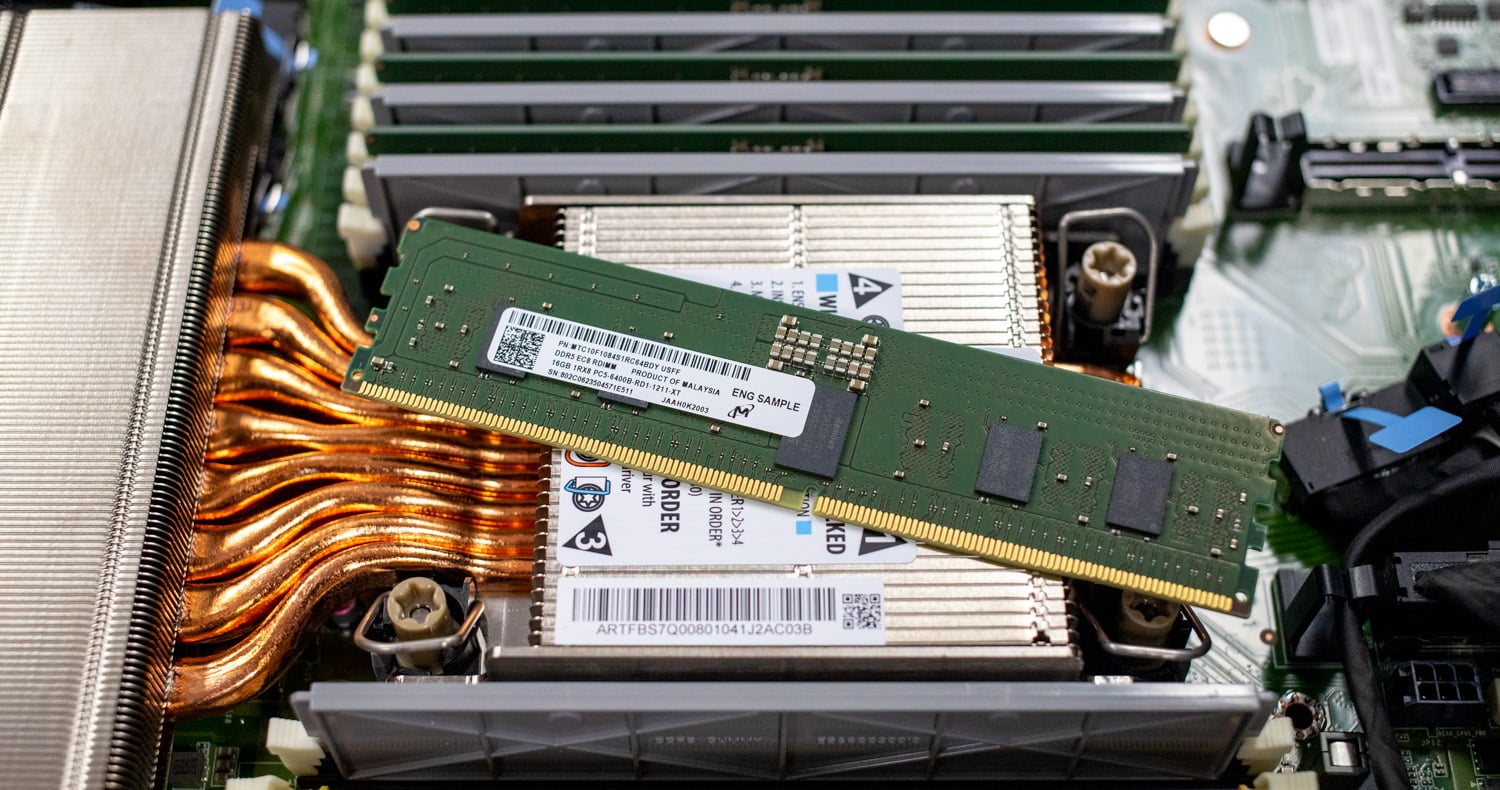
    Micron has demonstrated a 512GB DDR5 RDIMM running on multiple server platforms, which it calls the world’s first module at that capacity, and says AMD and Intel are both validating it for their next-generation server platforms. The module is rated for speeds up to 9,200 MT/s, and in a 24-slot dual-socket server it puts 12TB of DDR5 behind two CPUs. Volume production is scheduled for the second half of 2027.

    Micron DDR5 RDIMM resting on server CPU heatsinks, photo courtesy of Micron

    How Micron Gets to 512GB on One Module

    Micron vertically stacks DRAM dies inside each package and connects them with through-silicon vias (TSVs), the same die-stacking approach HBM uses. Stacking more dies per package doubles the capacity per slot without changing the module’s footprint or the server’s DIMM count, which is how a dual-socket, 24-slot system reaches 12TB.

    “Micron continues to set the pace for memory technology, delivering a new class of ultra-dense, high-performance server memory that helps customers keep larger datasets closer to the compute engines that need them,” said Raj Narasimhan, senior vice president and general manager of the Cloud Memory Business Unit at Micron. “A 512GB RDIMM enables multi-terabyte servers, supporting larger AI and database workloads, greater virtualization density and improved power efficiency, all within existing server footprints.”

    The 9,200 MT/s rating is the other notable figure, well past the DDR5-6400 ceiling for standard RDIMMs on current Xeon 6 platforms, and Micron’s release ties the module to next-generation platforms from both CPU vendors, so the speed and the capacity appear to arrive together with the 2027 server cycle. Micron RDIMMs have populated many of the Xeon 6 and EPYC systems through our lab, and its MRDIMMs were behind the HPE XD230’s STAC-A2 record earlier this year.

    One 512GB Module Against Four 128GB Modules

    Micron’s efficiency claim is that a single 512GB RDIMM cuts operating power by more than 60% compared with four 128GB RDIMMs of the same total capacity. 16W for the 512GB module against 44.2W for the four 128GB modules combined, a 63.8% reduction, or roughly 31mW per gigabyte against 86mW. The comparison assumes a server that has four free slots to spend on the alternative; the more common case is a server that has run out of slots, where the 512GB module is the only way to add capacity at all. The density argument is significant in many use cases, and it’s a similar one we made around their 245TB SSD recently.

    On performance, Micron cites up to 1.4x higher throughput for memory-bound workloads such as Spark SVM-based data analytics compared with 256GB DDR5 configurations, and says the module improves throughput and concurrency for memory-intensive databases and caching platforms including RocksDB and Redis.

    AMD, Intel, and an Early Customer Voice

    Both CPU vendors supplied validation statements. “Our close engineering collaboration with Micron brings compute and memory innovation together to help customers realize the full value of AMD-powered platforms,” said Amit Goel, corporate vice president, Compute and Enterprise AI Platform Solutions Engineering at AMD. Karin Eibschitz Segal, general manager of platform and system engineering in Intel’s Data Center Group, said Intel “is working closely with Micron to validate its 512GB DDR5 RDIMM and help enable future server platforms designed to meet the growing demands of next-generation data center workloads.”

    The release also carries a customer-side quote from Darrin Alves, chief information officer for Infrastructure Platforms at JPMorganChase, who said higher-capacity memory “will help enterprises support larger in-memory workloads, improve resource utilization and enhance the flexibility needed to scale modern computing environments.” In-memory databases, large-scale virtualization, and CPU-side inference for LLMs and agentic workloads are the use cases Micron names, all of which are gated by how much data a server can hold in main memory before spilling to storage.

    Timing

    The second-half 2027 production target puts the 512GB RDIMM a year or more out. In August, Micron and SK hynix committed billions to new DRAM fabs, with little of that capacity landing before 2028, so the module arrives in the same window as the wafer output it will draw on.

    Micron DDR5 RDIMM Product Page

    The post Micron Shows off 512GB DDR5 RDIMM: 12TB per Dual-Socket Server at 9,200 MT/s, Volume Production in 2H 2027 appeared first on StorageReview.com.


    Seagate and WD AI Storage Research Finds Enterprises Rank Storage Above Compute as the AI Bottleneck Sep 15, 2026
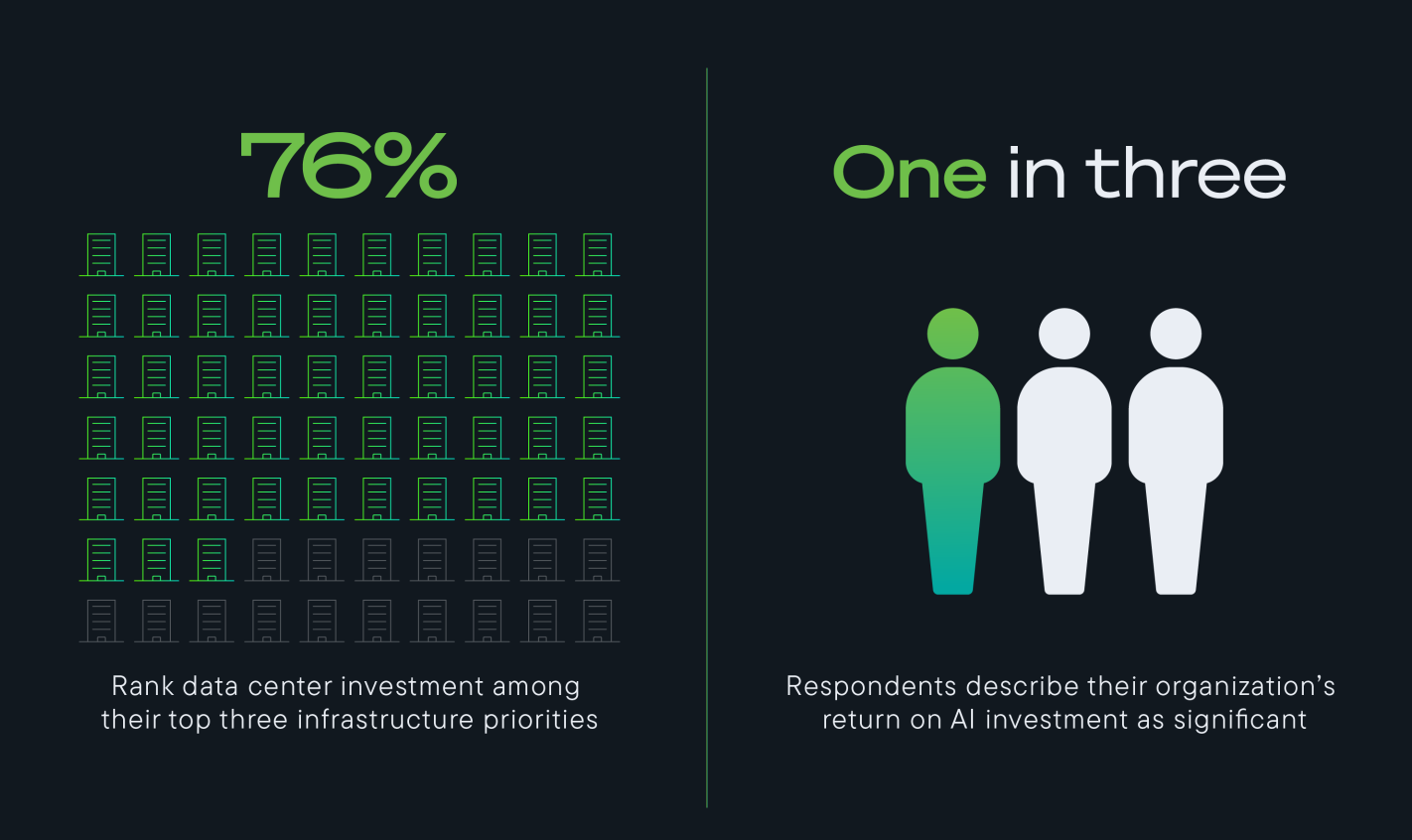
    Show notes Seagate Data Infrastructure Readiness Report graphic showing 76% of respondents rank data center investment among their top three infrastructure priorities and one in three describe their AI return as significant Seagate Data Infrastructure Readiness Report graphic showing 76% of respondents rank data center investment among their top three infrastructure priorities and one in three describe their AI return as significant

    Seagate and WD published separate AI storage studies within days of each other; the headline numbers: Seagate says 99% of enterprises expect AI to increase their storage requirements over the next three years, while WD’s IDC research puts the comparable figure at 74%. Read the fine print, and both reports land in the same directional place. AI is generating more data, enterprises intend to keep more of it for longer, and storage is taking a larger share of AI infrastructure planning than the GPU-centric conversation of the past two years suggested.

    Seagate Data Infrastructure Readiness Report graphic showing 76% of respondents rank data center investment among their top three infrastructure priorities and one in three describe their AI return as significant

    The two studies don’t measure the trend the same way. Seagate’s Data Infrastructure Readiness Report surveyed more than 2,700 enterprise technology decision-makers across seven markets, while WD commissioned IDC to survey 763 IT and business decision-makers responsible for AI architecture and storage across seven countries. Different questions, thresholds, and sample sizes make some of the main numbers look farther apart than they probably are.

    The Numbers Differ Because the Questions Do

    Seagate found that 99% of respondents expect AI to increase storage requirements over the next three years, with 70% anticipating an increase of at least 26% and 32% expecting requirements to rise by more than half. Only 38% consider their organizations fully prepared for AI’s long-term data demands, even though 83% describe themselves as fully or mostly prepared.

    WD’s study starts from what has already happened. IDC found that 94.7% of respondents are storing more data because of AI and generative AI adoption over the past 12 months, 61% saw data growth of 25% or more in the previous year, and 74% expect volumes to grow by at least 25% over the next three years.

    The gap between 99% and 74% looks substantial until you compare the questions. Seagate’s 99% covers respondents expecting any increase in storage requirements, while WD’s 74% counts only organizations expecting growth of at least 25%.

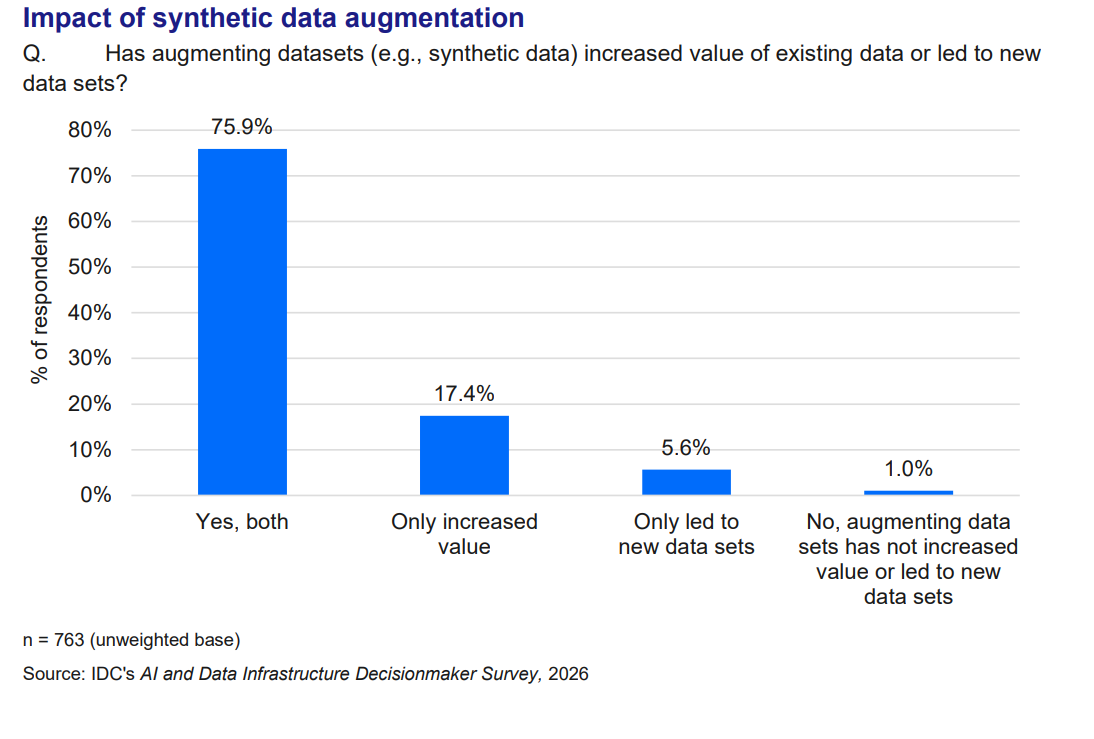
    Where the two reports line up more closely is on the changing value and lifespan of enterprise data. WD found that 74.3% of respondents are retaining data longer because of AI and GenAI, 75.9% are bringing increasing volumes of archived cold-tier data back online, and 96% expect faster archive retrieval to become necessary for AI inference and retrieval-augmented generation workloads. The same share, 75.9%, said augmenting datasets with synthetic data has both raised the value of existing data and produced new datasets, which is one more reason the pile keeps growing.

    IDC survey chart from the WD-sponsored white paper showing 75.9% of respondents say synthetic data augmentation both increased the value of existing data and led to new datasets

    WD also found that 74.6% of enterprise data resides in warm, cool, and cold tiers, and more than 60% of data lake capacity is cold or infrequently accessed. If AI workloads keep pulling historical information back into use, the line between active and archived data gets blurrier than tiering policies have assumed, a point that squares with the archive demand we saw in the Q1 LTO shipment numbers.

    Storage Is Part of a Larger AI Readiness Problem

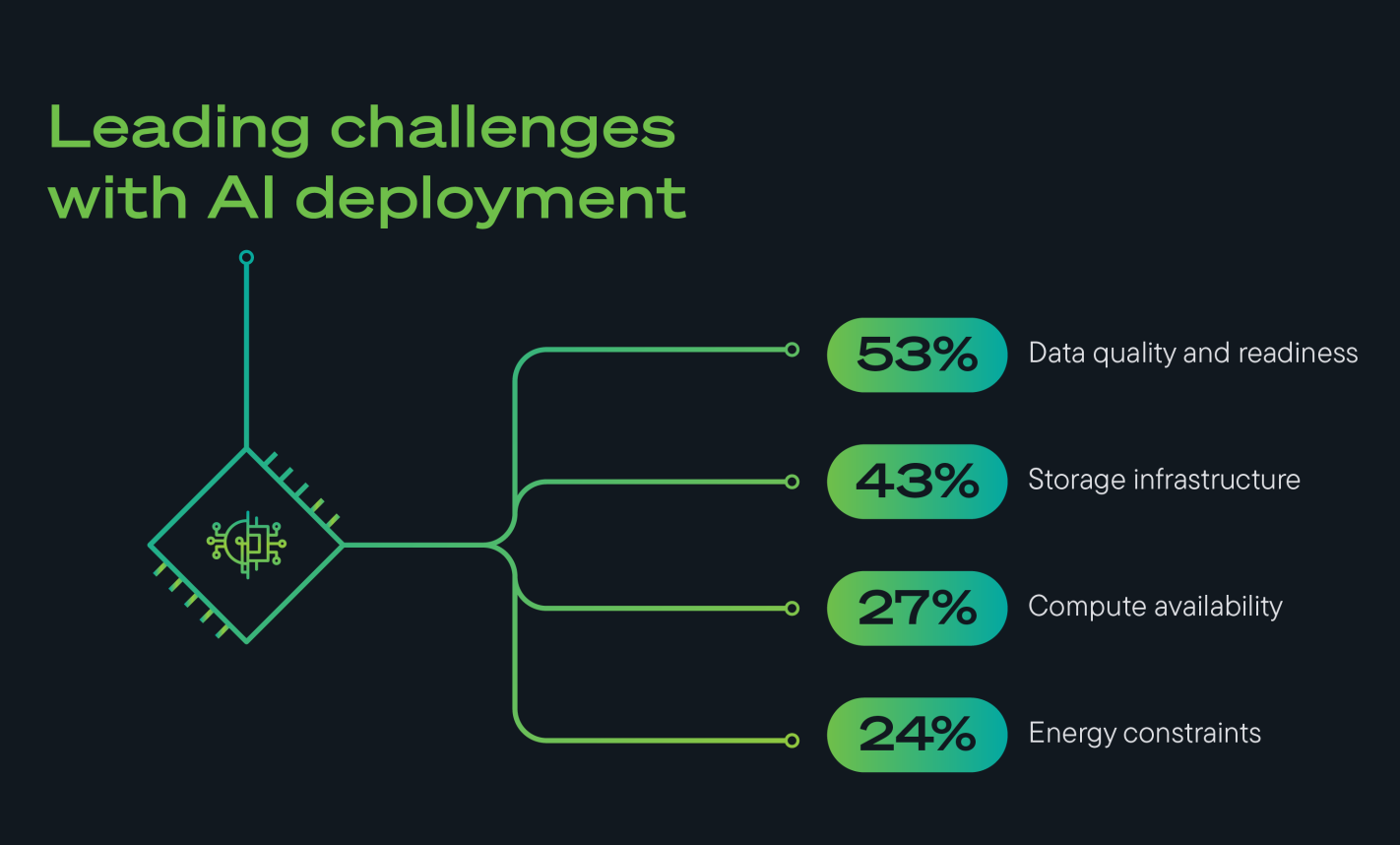
    Seagate’s study places storage inside a wider set of infrastructure challenges. Data quality and readiness was cited by 53% of respondents as a leading AI deployment challenge, followed by storage infrastructure at 43%, compute availability at 27%, and energy constraints at 24%.

    Seagate graphic listing the leading challenges with AI deployment: data quality and readiness 53%, storage infrastructure 43%, compute availability 27%, energy constraints 24%

    That ordering matters because compute has dominated the AI infrastructure discussion. Seagate’s respondents still put GPUs high on their spending lists, but security and compliance ranked first at 44%, data management and governance second at 43%, and AI and GPU infrastructure tied with storage hardware refreshes at 39%. Energy is already shaping those plans: 77% said their organization has delayed or restructured an expansion over power and sustainability concerns.

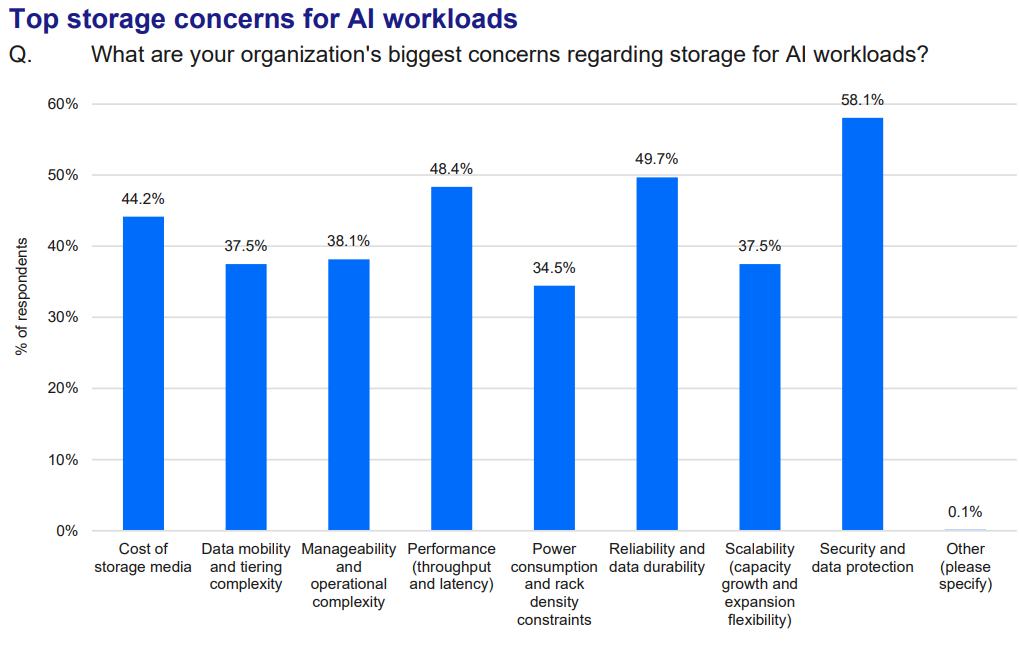
    WD reaches a similar conclusion through the data lifecycle. Historical information that once sat in colder storage may need to come back quickly for inference, RAG, or other AI workloads, which pushes organizations to balance capacity, accessibility, performance, and cost across tiers. WD’s respondents also put security ahead of cost when asked about their biggest storage concerns for AI workloads: security and data protection led at 58.1%, followed by reliability and data durability at 49.7% and performance at 48.4%, with cost of storage media fourth at 44.2%.

    IDC survey chart from the WD-sponsored white paper of top storage concerns for AI workloads, led by security and data protection at 58.1%, reliability at 49.7%, performance at 48.4%, and cost of storage media at 44.2%

    What Buyers Can Take From Both Studies

    Neither study makes a case for one storage technology over another. Both show AI increasing storage requirements, and WD’s adds that organizations are retaining data longer and pulling more archived information back into active use.

    Seagate frames the response as workload-aligned, multi-tiered architectures that balance performance, capacity, efficiency, and long-term value against the needs of each dataset. WD gets to the same place by showing that most enterprise data already sits outside the hottest tier while demand for fast access to archived data climbs.

    That leaves buyers with a planning problem that’s bigger than adding capacity. They have to decide how much data to retain, how quickly each class of data needs to be reachable, and what it will cost to store and manage those datasets as they grow. Both vendors would like the answer to include a lot of hard drives; the survey data suggests the buyers asking the question rank security, durability, and performance ahead of the price of the media.

    Flash vendors are working the other side of the same constraints. Seagate’s 77% who’ve delayed or restructured an expansion over power and sustainability is the opening for high-capacity QLC, and our Micron 6600 ION 245TB paper measured what that swap looks like: one 245TB SSD replaced eight 30TB nearline drives in the same Dell R5715, drew 170.2W under sequential writes against 173.5W for the HDD array at idle, and at exabyte scale fit in 6 racks against 22 for the densest HDD enclosures. Hard drives keep the acquisition cost advantage per terabyte, and both surveys show the cold and archive tiers where that still decides the purchase are growing. Where power and floor space are the binding constraints, flash is pricing itself against the GPUs it frees room for, a comparison neither HDD-funded study set out to make.

    Seagate Data Infrastructure Readiness Report 2026

    IDC White Paper for WD: Built for Scale, The Enduring Role of HDDs in the AI Era

    The post Seagate and WD AI Storage Research Finds Enterprises Rank Storage Above Compute as the AI Bottleneck appeared first on StorageReview.com.


    OWC Acquires OpenDrives, Adding Atlas, Astraeus, and Edge to the Jellyfish Shared Storage Line Sep 15, 2026
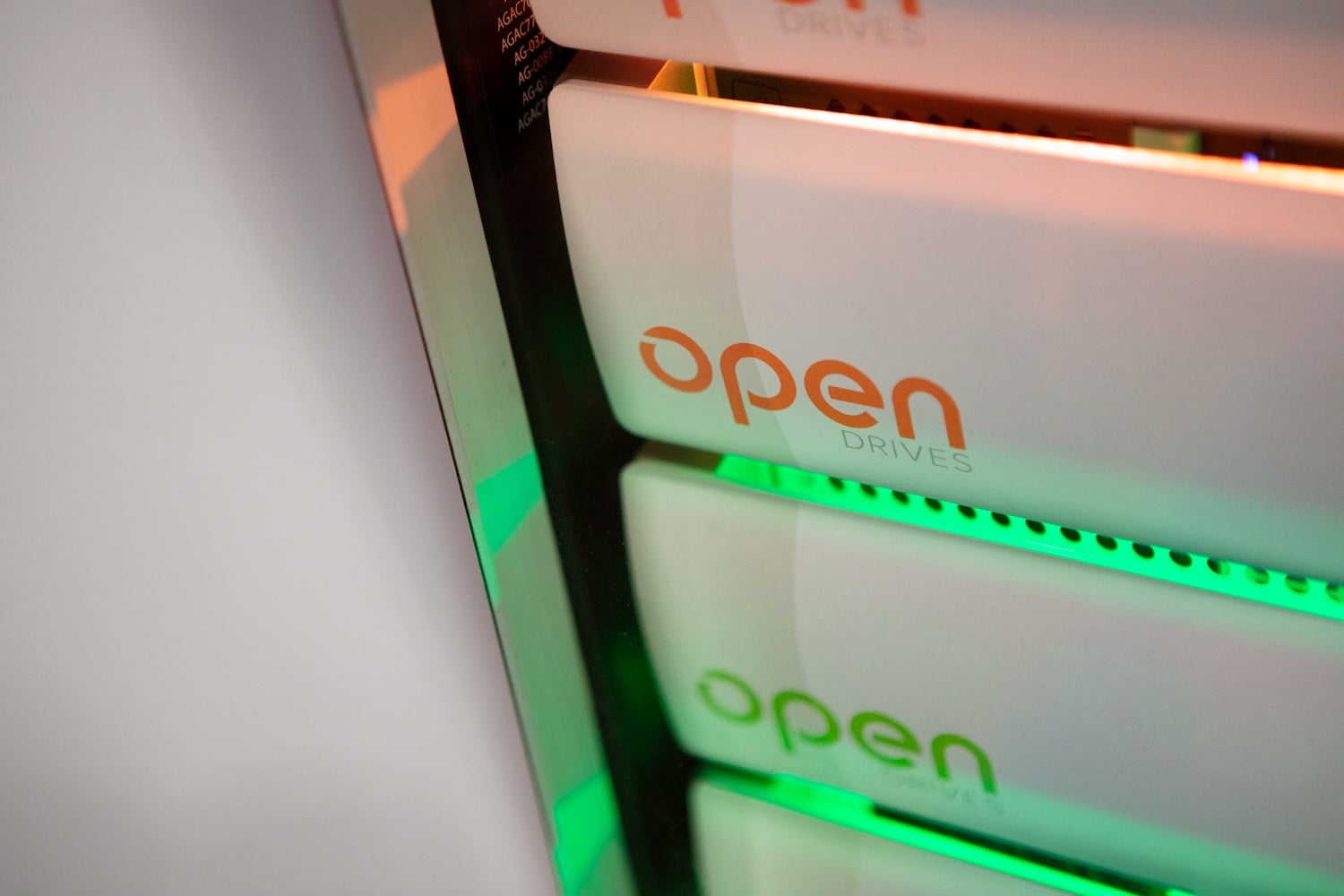
    Show notes Close-up of a stack of OpenDrives storage chassis with orange OpenDrives logos on the front panels and green status lighting between the units Close-up of a stack of OpenDrives storage chassis with orange OpenDrives logos on the front panels and green status lighting between the units

    Other World Computing (OWC) has acquired OpenDrives, the Los Angeles software-defined storage company whose Atlas platform has sat behind Hollywood studios, post houses, and live broadcast networks since 2011. The deal brings OpenDrives’ Atlas, Astraeus, and Edge platforms into OWC’s shared storage portfolio alongside the Jellyfish line, and OWC says it extends that line into enterprise-scale data management, hybrid cloud orchestration, and edge workflows. Terms weren’t disclosed.

    Close-up of a stack of OpenDrives storage chassis with orange OpenDrives logos on the front panels and green status lighting between the units

    What OpenDrives Brings

    OpenDrives’ Atlas data storage and management platform is the core of the deal. It’s built for the low-latency, high-throughput work that uncompressed video pipelines demand, and it’s been the company’s flagship since 2011, with hardware and software updates we covered through the Ultra hardware platform and Atlas 2.1. Two newer products round out the portfolio. OpenDrives Edge, announced in April 2026, is a hybrid cloud-edge performance accelerator that gives distributed teams at edge sites local-speed data access without the cost and complexity of a conventional hybrid cloud workflow. Astraeus is a cloud-native data services platform aimed at infrastructure modernization and at bridging data silos while cutting costs; it went into beta with early adopters in late 2025, and OWC says an updated release is planned for 2027.

    Building on Jellyfish

    OWC bought Jellyfish from LumaForge in 2021 and has expanded it since into a range that runs from mobile and desktop production through the enterprise-class rackmount and all-flash XT systems and on to petabyte-scale deployments. OpenDrives adds the software-defined management and cloud layers that line didn’t have.

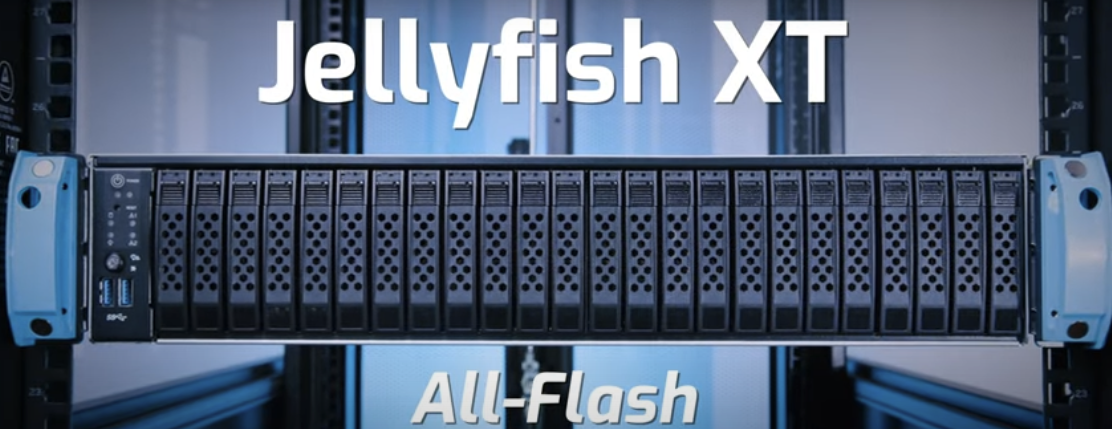
    OWC Jellyfish XT all-flash shared storage system, a 2U rackmount chassis with 24 front-loading drive bays

    “OWC and OpenDrives share so much synergy; we couldn’t be more excited about this partnership,” said Trevor Morgan, CEO of OpenDrives. He described the combined lineup as an end-to-end data ecosystem running from plug-and-play edit bays to global enterprise pipelines that handle uncompressed 8K and 12K workflows across on-premises, edge, and hybrid cloud, with OpenDrives customers picking up OWC’s direct-attached and shared storage products for archive and backup.

    OWC founder and CEO Larry O’Connor framed the acquisition as connecting the company’s storage and workflow hardware with software-defined data management services, so customers can capture, create, collaborate, and access content wherever they’re working. OpenDrives’ employees join OWC, which O’Connor said now numbers more than 250 people worldwide. Joel Whitley, partner at OpenDrives investor IAG Capital Partners, said OWC shares OpenDrives’ focus on creators and will carry on its product line for creative teams.

    For OWC, the move is a step up the stack, especially for M&E workloads. Jellyfish has been a hardware story, and OpenDrives’ Atlas, Edge, and Astraeus give the company a software and services layer it can sell into the same studios and broadcasters, with Edge and Astraeus aimed at the distributed production teams that Jellyfish alone couldn’t serve.

    The post OWC Acquires OpenDrives, Adding Atlas, Astraeus, and Edge to the Jellyfish Shared Storage Line appeared first on StorageReview.com.


    NVIDIA CUDA-Q Logical Debuts With a 7x Fermilab Speedup and a 10x Cut in Diraq’s Qubit Estimate Sep 15, 2026
    Show notes NVIDIA CUDA-Q Logical concept render showing four stacked layers from physical qubits and control hardware at the bottom up to applications such as molecular modeling and energy at the top NVIDIA CUDA-Q Logical concept render showing four stacked layers from physical qubits and control hardware at the bottom up to applications such as molecular modeling and energy at the top

    NVIDIA has added CUDA-Q Logical to its open-source CUDA-Q platform, an orchestration layer for building applications that run on fault-tolerant quantum computers, and it arrives with two numbers that are interesting. Fermilab says the tool cut a fault-tolerant algorithm design cycle from five months to three weeks, and Iceberg Quantum used it to show that Diraq’s spin-qubit hardware can reach 1,000 logical qubits with 150,000 physical qubits, roughly 10x fewer than Diraq’s previous estimate. Both results are early-access work reported by the labs and vendors involved, but they’re the first concrete figures for a tool aimed at the next stage of quantum computing, where error-corrected logical qubits replace raw physical ones.

    NVIDIA CUDA-Q Logical concept render showing four stacked layers from physical qubits and control hardware at the bottom up to applications such as molecular modeling and energy at the top

    Why Codesign Is the Bottleneck

    Fault-tolerant processors built on logical qubits are what make useful quantum computing possible, because they overcome the errors inherent in physical qubits and can execute the larger computations that drug discovery, financial modeling, and materials science need. Designing an application for one of those systems means juggling the algorithm, the error-correction code, the hardware architecture, and the rest of the QPU at the same time, and NVIDIA says that changing any one of them can swing the resources the application needs. CUDA-Q Logical lets researchers describe all of those components together and swap between options to find the configuration that performs best with logical qubits.

    “Quantum computing is maturing into an era of logical qubits, and researchers need an open, customizable platform capable of representing all aspects of a fault-tolerant system,” said Timothy Costa, vice president and general manager of quantum at NVIDIA. NVIDIA lists Fermi National Accelerator Laboratory, Infleqtion, IQM Quantum Computers, QCDesign, Quantum Motion, and Sandia National Laboratories among the QPU makers and labs already using it.

    Iceberg Maps Its qLDPC Architecture Onto Diraq’s Spin Qubits

    The headline result comes from Iceberg Quantum, which used CUDA-Q Logical to model its Pinnacle error-correction architecture on Diraq’s silicon spin-qubit hardware. Pinnacle is a quantum low-density parity-check (qLDPC) code, a family that promises far lower overhead than the surface code but is usually assumed to demand more complex hardware. Diraq’s write-up says the modeling showed Pinnacle can run on its hardware without asking much more of the platform than a surface-code approach would, with non-local connectivity confined to modular processing blocks and qubit shuttling schedules tuned so shuttling contributes no more to the error budget than physical gates. The hardware-aware physical qubit counts landed within 5% of the figures in the original Pinnacle paper, which is how the two companies arrive at 1,000 logical qubits from 150,000 physical ones, the figure Diraq now reports in its “The Case for Silicon” white paper and roughly 10x below its earlier estimate. Diraq CEO Andrew Dzurak called it an order-of-magnitude increase in the projected logical performance of each device.

    Fermilab Cuts Development Time From Five Months to Three Weeks

    Fermilab used CUDA-Q Logical in early work to validate prior results and evaluate physical qubit requirements, runtimes, and other resources across different error-correction approaches and hardware. The lab says that turned fault-tolerant system design into a repeatable, verifiable computational workflow and compressed algorithm development from five months to three weeks, a 7x speedup. “Using CUDA-Q Logical, our team explored combinations of these resources in just three weeks, compared with what would have typically taken about five months of building specialized infrastructure,” said Anna Grassellino, chief technology officer at Fermilab and director of the Superconducting Quantum Materials and Systems Center.

    Sandia’s QUOPS Benchmark Ships in CUDA-Q

    Alongside the orchestration layer, NVIDIA is shipping a reference implementation of QUOPS, a cross-platform, hardware-agnostic benchmark from Sandia National Laboratories that measures progress toward utility-scale, fault-tolerant quantum computing. The field has mostly tracked itself through physical-qubit metrics such as qubit count, gate fidelity, and coherence time; QUOPS is meant to score how close a system is to running useful workloads. Sandia posted a preprint ahead of IEEE Quantum Week with initial QUOPS results for QPUs from Google, IBM, and Quantinuum. “We created QUOPS to do exactly that, and we’re excited to see it used by quantum computing vendors and customers,” said Timothy Proctor, co-director of Sandia’s Quantum Performance Laboratory, referring to the need to track and forecast the growth of quantum computer capabilities.

    The Rest of the Quantum-GPU Stack

    The same announcement rounds up adoption across NVIDIA’s quantum lineup. Diraq used NVIDIA Ising, which NVIDIA calls the first family of open models for building and deploying AI for useful quantum computing, to calibrate its silicon qubit processor. Anyon Computing, Quandela, and Quantum Machines each built on NVQLink, NVIDIA’s open architecture for coupling QPUs to GPU supercomputers, with Quantum Machines running an integration demo at the Israeli Quantum Computing Center. IonQ reported progress on DQAOA-GPT, a quantum generative AI framework; MITRE published work on GPU-accelerated digital twins of quantum sensors; Phasecraft is using cuQuantum to build what it describes as the largest emulated molecular database generated by a variational quantum eigensolver, and UCLA and Caltech are working on the control sequences needed to run quantum applications.

    The timing puts NVIDIA’s software layer in the same conversation as the hardware roadmaps we’ve been tracking, including IBM’s path to a fault-tolerant machine in 2029 and the 120-qubit Nighthawk r2 headed to CSCS. CUDA-Q Logical is available now on GitHub, and the QUOPS reference implementation ships in CUDA-Q, with Sandia’s benchmark repository published separately.

    The post NVIDIA CUDA-Q Logical Debuts With a 7x Fermilab Speedup and a 10x Cut in Diraq’s Qubit Estimate appeared first on StorageReview.com.


    Previous 1 2 3

    Related Podcasts

    Reply All

    1

    Reply All Games & Hobbies
    Inside VR & AR

    2

    Inside VR & AR Gadgets
    Note to Self

    3

    Note to Self News
    BrainStuff

    4

    BrainStuff Natural Sciences
    This Week in Tech (Audio)

    5

    This Week in Tech (Audio) News
    Hands-On Tech (Audio)

    6

    Hands-On Tech (Audio) Technology
    footer-logo

    Contact Us

    Toll Free: 844-670-7747

    Links

    • Home
    • Top Charts
    • Networks
    • Apps
    • Independents Podcasts
    • Podcast Advertising
    • Podcast News
    • Contact Us
    • About Us
    • Analytics & Insights

    Stay Connected
      Privacy, Terms of Use & Our Code of Ethics Protecting Content Creators Copyrights