TopPodcast.com
Menu
  • Home
  • Top Charts
  • Top Networks
  • Top Apps
  • Top Independents
  • Top Podfluencers
  • Top Picks
    • Top Business Podcasts
    • Top True Crime Podcasts
    • Top Finance Podcasts
    • Top Comedy Podcasts
    • Top Music Podcasts
    • Top Womens Podcasts
    • Top Kids Podcasts
    • Top Sports Podcasts
    • Top News Podcasts
    • Top Tech Podcasts
    • Top Crypto Podcasts
    • Top Entrepreneurial Podcasts
    • Top Fantasy Sports Podcasts
    • Top Political Podcasts
    • Top Science Podcasts
    • Top Self Help Podcasts
    • Top Sports Betting Podcasts
    • Top Stocks Podcasts
  • Podcast News
  • About Us
  • Podcast Advertising
  • Contact
Not in our directory?
Add Show Here
Podcast Equipment
Center

toppodcastlogoOur TOPPODCAST Picks

  • Comedy
  • Crypto
  • Sports
  • News
  • Politics
  • True Crime
  • Business
  • Finance

Follow Us

toppodcastlogoStay Connected

    View Top 200 Chart
    Back to Rankings Page
    Government & Organizations

    STEM-Talk

    The most interesting people in the world of science and technology

    Advertise

    Copyright: © Florida Institute for Human and Machine Cognition

    • Apple Podcasts
    • Google Play
    • Spotify

    Latest Episodes:
    Episode 39: Suzana Herculano provides a new understanding of how our brains became remarkable Jun 06, 2017
    Show notes

    Prior to Dr. Suzana Herculano-Houzel’s research, scientists assumed that the brains of all mammals were built in the same way and that the overall brain mass as compared to body mass was the critical determinant of cognitive ability. It was to resolve these conundrums about brain mass, body mass, and intelligence that Herculano-Houzel turned to chainsaws, butchers’ knives, and kitchen blenders to concoct what she refers to as brain soup. As STEM-Talk co-hosts Ken Ford and Dawn Kernagis point out during their interview with Herculano-Houzel, epsisode 39 of the podcast turned out to be not only an enlightening conversation, but also one of the most fun STEM-Talk interviews to date. Herculano-Houzel is a Brazilian neuroscientist who devised a way to count the number of neurons in human and animal brains. She writes about this in her book, The Human Advantage: A New Understanding of How Our Brain Became Remarkable. Her method of counting the neurons of human and other animals' brains allowed her to study the relation between the cerebral cortex and the thickness and number of cortical folds in the brain. She is currently an associate professor of psychology and biological sciences in Vanderbilt University’s psychological sciences department and the Vanderbilt Brain Institute. She grew up in Brazil and received her undergraduate degree in biology at Federal University of Rio de Janeiro. She went to Case Western Reserve University in Cleveland, Ohio, to get her masters in neuroscience, and completed her Ph.D. in visual neurophysiology at the Max Planck Institute for Brain Research in Frankfurt, Germany. After completing her doctorate, Herculano-Houzel returned to Rio and went to work for the Museum of Life where she designed children’s activities. In 2002 she returned to her alma mater and began researching how human brains compared to other animals. In 2004, she devised a way of reducing brains to liquid as a means to count the number of neurons in them. It is technically known as the “isotropic fractionator.” In 2004 she won the Jose Reis Prize of Science, and in 2010 she received the James S. McDonell Foundation’s Scholar Award in Understanding Human Cognition. She is also the author of a biweekly newspaper column on the neuroscience of everyday life for Folha de São Paulo, the major newspaper in Brazil. Going into its 11th year, the column has appeared more than 270 times since 2006. In addition to “The Human Advantage,” Herculano-Houzel is also the author of six books in Portuguese that focus on the neuroscience of everyday life. She also has a popular blog called “The Neuroscientist on Call,” which she describes as not-so-random thoughts about brains, the universe and everything. She lives in Nashville, TN, with her husband, son and two dogs. Links you may be interested in: “The Human Advantage”: https://www.amazon.com/dp/B01DOSIN3U/ref=dp-kindle-redirect?_encoding=UTF8&btkr=1 The Neuroscientist on Call blog: http://www.suzanaherculanohouzel.com


    Episode 38: Dr. Mark Lupo discusses thyroid nodules and cancer May 23, 2017
    Show notes

    Thyroid cancer is one of the fastest growing cancers in the United States, especially among women. In Florida, thyroid cancer trails only melanoma skin cancer as the state’s fastest rising cancer. Today’s guest on episode 38 of STEM-Talk has made it his mission to not only treat thyroid cancer, but also raise awareness about the disease. Dr. Mark Lupo is founder and medical director of the Thyroid and Endocrine Center of Florida which is based in Sarasota. A graduate of Duke University, he went on to earn his medical degree at the University of Florida where he worked with the world-famous thyroid expert, Dr. Ernie Mazzaferri. Dr. Lupo also did his internship and residency in internal medicine at Florida and then won a fellowship in endocrinology, metabolism and nutrition at the University of California San Diego and the Scripps Clinic. Dr. Lupo’s research and practice are particularly focused on thyroid nodules, which are abnormal growths of thyroid cells that form a lump within the thyroid gland. Although the vast majority of thyroid nodules are benign, a small proportion do contain thyroid cancer. His practice is centered on diagnosing and treating thyroid cancer at the earliest stage and helping people avoid unnecessary surgeries. He also is very involved in teaching neck ultrasound, thyroid cancer and general thyroid disease to other physicians at the national level. He has published book chapters and several articles on thyroid disease and thyroid ultrasound. In addition to his work as the medical director of the Thyroid and Endocrine Center of Florida, he also is a clinical assistant professor on the faculty of the Florida State University College of Medicine. Dr. Lupo also was named the 2017 recipient of the Jack Baskin Endocrine Teaching Award, which is annually presented by the American Association of Clinical Endocrinologists. You can learn more about the Thyroid and Endocrine Center of Florida by visiting http://www.thyroidflorida.com.


    Episode 37: Gary Taubes discusses low-carb diets and sheds light on the hazards of sugar May 09, 2017
    Show notes

    The front pages of Gary Taubes’ new book on sugar feature a blurb excerpted from the magazine Scientific American: “Taubes is a science journalist’s science journalist who researches topics to the point of obsession – actually, well beyond that point – and never dumbs things down for readers.” Gary’s most recent obsession is documented in “The Case Against Sugar,” a book that argues that increased consumption of sugar over the past 30 to 40 years has led to a diabetes epidemic not only in the United States, but an epidemic that’s now spreading around the world. Episode 37 of STEM-Talk features a more than two-hour conversation with Gary about his latest research as well as a look back at other nutrition and science topics that have dominated Gary’s journalistic investigations since the 1980s. Gary first burst onto the national scene in 2002 with an article in the New York Times Magazine titled, “What If’s It’s All Been a Big Fat Lie?” Gary made the point that Robert Atkins and his high-fat, low-carb diet had a better history and scientific record of helping people lose weight than the low-fat diet that was and remains the centerpiece of the nation’s health policy and food pyramid. The article had an immediate impact. As Michael Pollan pointed out in the introduction of “The Omnivore’s Dilemma,” in the fall of 2002 bread “abruptly disappeared overnight from the American dinner table.” Virtually overnight, wrote Pollan, Americans changed the way they eat. Gary did not set out to become a science journalist. He graduated from Harvard College in 1977 with an S.B. degree in applied physics and went on to earn an M.S. degree in aeronautical engineering from Stanford University. But while at Stanford, he realized he wasn’t that passionate about becoming an aeronautical engineer and decided to enroll in the Columbia School of Journalism to become an investigative reporter. In the ‘80s, Gary became fascinated with flawed science and started writing a series of magazine articles about bad science. That eventually led to a pair of books: “Nobel Dreams” in 1987 and “Bad Science: The Short Life and Weird Times of Cold Fusion” in 1993. After “Bad Science,” Gary turned to nutrition reporting and that resulted in the 2002 article in the New York Times Magazine. He followed up on his research for the article with two books: “Good Calories, Bad Calories” in 2007; and “Why We Get Fat” in 2010. Both books detailed how refined carbohydrates are largely responsible for America’s rising obesity rate and a primary cause of heart disease, diabetes, cancer, and other chronic diseases of the Western diet. His new book, “The Case Against Sugar,” takes this argument a step further and shows how the explosion of sugar consumption and sugar-rich products in the United States has led to a global diabetes epidemic. Dan Barber, author of “The Third Plate,” wrote in a New York Times review of Gary’s book, “Comparing the dangers of inhaling cigarettes with chowing down on candy bars may sound like a false equivalence, but Gary Taubes’s “The Case Against Sugar” will persuade you otherwise. Here is a book on sugar that sugarcoats nothing. The stuff kills.” Below are links to Gary’s books: “The Case Against Sugar” http://amzn.to/2ps8Qbl “Good Calories, Bad Calories” http://amzn.to/2qTwJJ6 “Why We Get Fat” http://amzn.to/2qKuv2u “Bad Science” http://amzn.to/2qTjyrI “Nobel Dreams” http://amzn.to/2pXpRgK


    Episode 36: Jeff “Skunk” Baxter Discusses His Life in Rock ‘n’ Roll and the U.S. Intelligence Community Apr 25, 2017
    Show notes

    In a rare departure from interviews with scientists and engineers, STEM-Talk Host Dawn Kernagis and IHMC Director Ken Ford interview Jeffrey “Skunk” Baxter about his life as a musician and founding member of Steely Dan, and how he went on to become a defense consultant on the Senate Armed Services Committee. The two fields seem completely different, but Baxter explains the similarities between them and talks about how improvising in jazz is a skill that can carry over into defense analytics and tactics. Baxter’s bio includes playing with a number of well-known bands, such as Steely Dan and The Doobie Brothers. As a studio musician for 35 years, Baxter recorded with Donna Summer, Dolly Parton, Ringo Starr and Rod Stewart. He was a record producer for Carl Wilson, the Beach Boys and Stray Cats. He also composed music for movies and television.


    Episode 35: Stuart McGill explains the mechanics of back pain and the secrets to a healthy spine Apr 11, 2017
    Show notes

    Back pain has become the world’s leading cause of disability. Stuart McGill has been at the forefront of non-surgical approaches to addressing back pain for many years. His 2015 book "Back Mechanic: The Secrets to a Healthy Spine Your Doctor Isn't Telling You" amzn.to/2oV6eWR is a wonderfully accessible account of his methods and perspectives. Stuart McGill spent 30 years as a professor of spine biomechanics at the University of Waterloo in Canada. His laboratory has become a renowned destination for everyday people as well as Olympic and professional athletes from around the world who are struggling with back pain. He is the author of more than 300 scientific publications and 3 textbooks that address issues such as lumbar spine function and injury mechanisms, patient assessment, corrective exercise prescription, and performance training. McGill also consults for many medical management groups, governments, corporations, legal firms, and elite sports teams. He has won numerous awards, including the prestigious Volvo Bioengineering Award for Low Back Pain Research. He released his landmark text, “Low Back Disorders: Evidence-Based Prevention and Rehabilitation,” amzn.to/2omWe5I in 2002. It changed the way coaches, bodybuilders, athletes and non-athletes approached core training. His new book, “Back Mechanic,” is written for a lay audience and addresses common misperceptions about back pain. It also provides a step-by-step guide of the McGill Method to fix back pain. Backfitpro.com is a web site also geared for a lay audience and is dedicated to providing access to evidence-based information and products that assist in preventing and rehabilitating back pain. Products featured on the website have been tested in McGill's lab at the University of Waterloo. McGill and his staff have also produced a video, “The Ultimate Back: Enhancing Performance,” that synthesizes McGill's approaches for avoiding back injury and enhancing athletic and physical performance. It is available for purchase on Vimeo.


    Episode 34: Jim Stray-Gundersen explains how blood flow restriction training builds muscle and improves performance Mar 28, 2017
    Show notes

    Blood-flow-restriction training is a topic of growing interest. But as IHMC director and STEM-Talk co-host Dr. Ken Ford points out, there’s also a great deal of misinformation about the training. Episode 34 of STEM-Talk addresses some of that misinformation with our interview of Dr. Jim Stray-Gundersen, who helped pioneer blood flow restriction training and leads the Live Hi/Train Low program for the US Athletic Trust. Since receiving his board certification in general surgery in 1985, Jim has focused his work and research on maximizing human performance, health and resilience. He pioneered the Hi-Low training protocol and played a key role in the development of the anti-doping test, SAFE, which stands for Safe And Fair Events. It is considered the most aggressive blood-profiling test in the fight against doping. He has worked with numerous Olympians in various sports and has an ongoing relationship with world renowned long-distance runner Alberto Salazar, who also is a coach and director of the NIKE Oregon Project. Jeff has been an official physician and consultant of the United States, Norwegian and Canadian Olympic teams. He is an official member of 15 world championships. Jim completed post-doctoral fellowships in cardiovascular physiology and human nutrition at the University of Texas Southwestern Medical School. He received appointments as an associate professor of orthopedic surgery and physiology. He spent 20 years on the faculty of UTSW and helped build and direct two human-performance centers at St. Paul and Baylor University hospitals. He has served on international medical committees that include the International Olympic Committee, FIFA, International Biathlon Committee, International Ski Federation and the International Skating Union. Jim also is the sports science advisor for the US Ski and Snowboard Association (USSA), and continues to lead human performance and altitude camps for Olympic athletes, masters athletes, as well as Navy SEALs. He runs The SG Performance Medicine Center and Sport Technologies for Maximal Athletic Performance, overall fitness, weight loss, and recovery in Frisco, Texas, and now the new center in Park City, Utah, located inside The Center of Excellence USSA Building.


    Episode 33: Dr. Natalie Batalha talks about exoplanets and the possibility of life in our Milky Way and beyond Mar 14, 2017
    Show notes

    Dr. Natalie Batalha’s STEM-Talk interview was so contagious that Dawn Kernagis said it made her dream of returning to school to get a second graduate degree in astronomy. “Hearing Natalie talk about her research had all of us in the STEM-Talk studio buzzing,” said Dawn, the podcast’s co-host. Natalie is an astrophysicist and the project scientist for NASA’s Kepler Mission, a space observatory launched by NASA to discover Earth-sized planets orbiting other stars. She sat down with Dawn and veteran astronaut and IHMC senior research scientist Tom Jones for episode 33 of STEM-Talk. As one of the original co-investigators of the Kepler Mission, Natalie has been a leader in using the telescope to discover exoplanets, which are planets that orbit stars other than our own sun. Natalie has been involved in the Kepler Mission since the proposal stage and has helped identify more than 150,000 stars that are monitored by the telescope. She holds a bachelor’s degree in physics from The University of California Berkeley, and a doctoral degree in astrophysics from UC Santa Cruz. She taught physics and astronomy for 10 years at San Jose State University before joining the Space Sciences Division of the NASA Ames Research Center, which is located in California’s Silicon Valley. In 2011, Natalie received a NASA Public Service Medal for her vision in communicating Kepler’s science to the public, and also for her outstanding leadership in coordinating the Kepler science team. That same year Natalie also headed up the analysis that led to the discovery of Kepler 10b, the first confirmed rocky planet outside our solar system. She joined the leadership team of a new NASA initiative in 2015, which is dedicated to the search for evidence of life beyond our solar system. Called the Nexus for Exoplanet System Science, the program brings together teams from multiple disciplines to understand the diversity of worlds, and which of those exoplanets are most likely to harbor life.


    Episode 32: Dr. Claire Fraser explains how our gut microbes improve our health, prevent disease and even play a role in our mental health Feb 28, 2017
    Show notes

    Women who are pregnant often talk how careful they are about what they eat and drink. They’re careful, points out Dr. Claire Fraser, because they’re feeding their baby. “Well, we should all think about diet in the same way that pregnant women do,” says Fraser. “Everything we put into our mouths, we’re either feeding or not feeding our gut microbes … And it’s important we keep our gut microbes happy.” Fraser is a pioneer and global leader in genomic medicine, a branch of molecular biology that focuses on the genome. In episode 32 of STEM-Talk, Fraser sits down with host Dawn Kernagis and IHMC founder Ken Ford to explain why we should all pay more attention to our guts, which is the home of more than 100 trillion bacteria. An endowed professor at the University of Maryland School of Medicine, Fraser is a founder and director of Maryland’s Institute for Genome Sciences. From 1998 to 2007, she was the director of the Institute for Genomic Research in Rockville, Maryland, and led teams that sequenced the genomes of several microbial organisms, including important human and animal pathogens. In 1995, she became the first person to map the complete genetic code of a free-living organism, Haemophilus Influenza, the bacterium that causes lower respiratory tract infections and meningitis in infants and young children. This discovery forever changed microbiology and launched a new field of study, microbial genomics. During this time, she and her team also sequenced the bacteria behind syphilis and Lyme disease, and eventually the first plant genome and the first human-pathogenic parasite. She even helped identify the source of a deadly 2001 anthrax attack in one of the biggest investigations conducted by U.S. law enforcement. Research into the benefits of gut bacteria has exploded around the world in the past decade. In this STEM-Talk episode, Fraser explains the role these microbes play in improving health, preventing disease, and keeping us mentally sharp. She even shares how her diet has changed since she started studying the gut microbiome. Fraser also talks about working with the FBI during the 2001 antrhax attacks and her early work in microbiology that led to the first mapping of a free-living organism’s complete genetic code. Her recent lecture at IHMC, titled “The Human Gut Microbiome in Health and Disease,” can be viewed at ihmc.us/lectures. If you’re interested in learning more about the gut microbiome, Fraser in her lecture recommended “The Good Gut: Taking Control of Your Weight, Your Mood, and Your Long-term Health” by Stanford University scientists Justin and Erica Sonnenburg.


    Episode 31: Dr. Michael Turner, who coined the phrase ‘dark energy,’ talks about the deepest issues in cosmology Feb 14, 2017
    Show notes

    Dr. Michael Turner makes a “big bang” in the world of theoretical cosmology. Translation: He’s an expert on the universe—what it’s made of, what’s in its future, and how it came to be.

    Turner is the Rauner Distinguished Service Professor and Director of the Kavli Institute for Cosmological Physics at the University of Chicago. From 2003 until 2006, was Assistant Director for Mathematical and Physical Sciences for the National Science Foundation. He is the recipient of numerous awards and prizes, and he is a Fellow of the American Association for the Advancement of Science (AAAS).
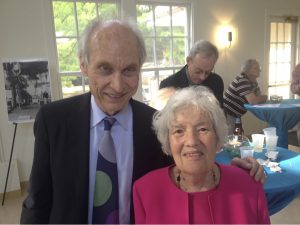
    Michael Turner and Vera Rubben, who recently passed away.

    Turner is most well-known for having coined the phrase “dark energy” in 1998, which he calls “very, very mysterious stuff.” Thought to comprise 70 percent of the universe, dark energy is responsible for both the expansion of the universe and the increasing speed at which that expansion is occurring.

    Another five percent of the universe is atoms, and the remaining twenty-five percent is “dark matter”—what Turner calls “the cosmic infrastructure of the universe.” The universe, he adds, has largely “been a battle between the two dark titans: dark energy and dark matter.”

    “He [Turner] is able to explain the deepest issues in cosmology with a rare clarity and elegance,” says IHMC Director Ken Ford. “His research focuses on the earliest moments of creation.”

    With Chicago cosmologist Rocky Kolb, Turner co-wrote the well-known book “The Early Universe.”

    More information on Turner can be found here: https://kicp.uchicago.edu/people/profile/michael_turner.html and here: https://en.wikipedia.org/wiki/Michael_Turner_(cosmologist).

    Turner’s 2011 IHMC lecture, “The Dark Side of the Universe,” can be viewed here: . Turner was also a guest on STEM-Talk for an earlier episode for his interview on the discovery of gravitational waves.

    Turner is interviewed by regular STEM-Talk host Dawn Kernagis and guest host Tom Jones, a veteran NASA astronaut and senior research scientist at IHMC.

    00:37: Ken calls Dr. Michael Turner “exactly the right guy to talk to about dark energy and dark matter. After all, he coined the phrase dark energy. He is able to explain deepest issues in cosmology with a rare clarity and elegance.”

    1:04: Ken pays tribute to Vera Rubin, who passed away on Christmas Day. She confirmed the existence of dark matter and transformed modern physics and astronomy.

    2:24: Ken asks for feedback on STEM-Talk and reads 5-star iTunes review from BobRXUF: “With all of the garbage we are bombarded with, listening to STEM-Talk reminds me that there is higher intelligence, the hope for mankind.”

    3:35: Dawn and Ken introduce Michael and talk about his background.

    4:17: Dawn and Tom welcome Michael to STEM-Talk.

    4:39: Tom asks Michael to give listeners the big picture about the structure of our universe and explain how we stumbled upon the phenomenon called dark matter and dark energy?

    5:14: Michael explains that a half of one percent of the universe is in the form of stars. The other 99.5 percent is dark.

    6:29: Michael talks about how dark matter matter provides the cosmic infrastructure of the universe.

    7:45: “Our universe,” says Michael, “has really been a battle between the two dark titans: dark energy and dark matter.”

    9:49: Michael explains that’s it’s the stars that give off energy and it’s the atoms we’re made of. “We’re the tip of the iceberg. We’re the special stuff.”

    10:52: “Michael talks about producing dark matter particles at the Large Hadron Collider (LHC) in Geneva, Switzerland, the world’s most powerful particle accelerator.

    11:25: Tom asks Michael what was the original evidence for dark matter and dark energy and who were the people who made that discovery?

    13:20: Michael describes how Vera Rubin, a scientist working at the Department of Terrestrial Magnetism at the Carnegie Institution of Washington, was able to confirm dark matter at work in our own galaxy.

    15:06: Tom asks if it’s dark matter that holds things together and makes the clock, the universe, tick?

    17:37: Michael explains how Fritz Zwicky and Vera Rubin went about building empirical evidence for dark matter.

    19:40: Michael talks about research into “neutralinos,” particles that scientists speculate are left over from the Big Bang. “We’re in the midst of this detective story.”

    21:24: Tom asks if the facilities and equipment exist to solve the mystery of the neutralinos and the dark-matter particle?

    24:31: Commercial break.

    24:55: Dawn wonders if our understanding of dark matter and dark energy continues to advance, what future applications might arise from this knowledge?

    25:21: Michael explains that if scientists are able to verify the existence of the neutralino, “it would be the first evidence of the super string theory, which unifies all the forces—a very, very bold theory that says there may be additional dimensions in space-time.”

    27:20: In continuing to answer Dawn’s question, Michael says, “If history is any guide, any time we understand nature a little better, there will be spin-offs and practical applications that change and improve the way we live.”

    27:43: Tom asks Michael to talk about dark energy and the continuous expansion of the universe.

    28:54: Michael shares how two teams discovered in 1998 that rather than slowing down, the expansion of the universe is speeding up, suggesting it’s back to the drawing board on the ultimate fate of the universe.

    30:18: Michael talks about what he describes as the most profound mystery in all of science: that gravity can be repulsive rather than attractive.

    32:48: Michael refers to a theory that could prove to be even grander than Einstein’s. This new theory says that “as the universe thins out, after expanding for 15 billion years, it starts to speed up.

    35:27: Tom asks about Congressional funding for the National Science Foundation research and Turner explains that almost every country on earth is grappling with funding allocations for science.

    42:22: Michael talks about the James Webb Space Telescope (JWST), which he describes as big and bold and the kind of project that only the U.S. can do.

    43:17: When Dawn asks Michael what led him to become a cosmologist, he talks about how great high school teachers led him into science.

    43:51: Michael encourages young people to pursue careers in science. “Just about every challenge that our country and our planet have involves science…trying to understand the secrets of nature and solve the mysteries of mankind are really, really exciting. The career opportunities are good.”

    44:41: Michael describes the rewarding nature of his career. “I get to think about the mysteries of the universe. I get to think about how the universe began and how it will end. That’s a pretty good job to have.”

    46:3: Tom talks about getting his first telescope when he was 12 years old and how that was a gateway into science.

    47:19: Dawn recaps the “mind-boggling statistics” Turner shared in the podcast, staring with 99.5 percent of our universe is dark.

    47:38: Ken talks about the great turn of phrases Michael used during the podcast, such as when Michael referred to the evolution of the universe as a “battle between two dark titans.”

    48:01 Dawn and Ken sign off.


    Episode 30: Art De Vany Talks About Hollywood Economics, the Paleo Way, and the Role of Fitness and Diet in Aging Jan 31, 2017
    Show notes

    Dr. Art De Vany is an American economist known for his work on the Hollywood film industry. He is perhaps best known, however, as the grandfather of the paleo diet, a high-protein, high-fiber way of eating similar to the way our hunter-gather ancestors ate during the Stone Age. Born in 1937, he has had a varied career that began right out of high school when he signed a baseball contract with the Hollywood Stars, a minor-league affiliate of the Pittsburg Pirates. Even though he could “run like a deer” and “hit the ball out of sight,” his poor eyesight ended his baseball career and led him the UCLA where earned a doctorate in economics. He spent most of his academic career studying Hollywood and the film industry. His research has ranged from “Hollywood Economics: How Extreme Uncertainty Shapes the Film Industry” to “Quality Revaluations and the Breakdown of Statistical Herding in the Dynamics of Box Office Revenues.” De Vany turns 80 in August and has spent the past 40 years living the paleo way. He outlined his diet and fitness philosophy in “The New Evolution Diet: What Our Paleolithic Ancestors Can Teach Us About Weight Loss, Fitness and Aging.” He is working on a new book that’s tentatively titled “Renewing Cycles: Healing the Wounds of Aging Through Improved Cellular Defense and Systemic Signaling.” De Vany gave a lecture at IHMC in Pensacola last December where he talked about the New Evolution Diet” as well as his upcoming book on aging. In Episode 30 of STEM-Talk, host Dawn Kernagis and IHMC Founder Ken Ford have a wide-ranging conversation with De Vany that covers his statistical study of home-run hitting to the dynamics of box-office revenues to the role that exercise and diet play in aging.


    Previous 1 15 16 17 18 19 20 Next

    Related Podcasts

    The Joe Rogan Experience

    1

    The Joe Rogan Experience Comedy
    More Perfect

    2

    More Perfect Government
    Casefile True Crime

    3

    Casefile True Crime Games & Hobbies
    Reply All

    4

    Reply All Games & Hobbies
    You Must Remember This

    5

    You Must Remember This Games & Hobbies
    Real Time with Bill Maher

    6

    Real Time with Bill Maher Games & Hobbies
    footer-logo

    Contact Us

    Toll Free: 844-670-7747

    Links

    • Home
    • Top Charts
    • Networks
    • Apps
    • Independents Podcasts
    • Podcast Advertising
    • Podcast News
    • Contact Us
    • About Us
    • Analytics & Insights

    Stay Connected

      Privacy, Terms of Use & Our Code of Ethics Protecting Content Creators Copyrights