TopPodcast.com
Menu
  • Home
  • Top Charts
  • Top Networks
  • Top Apps
  • Top Independents
  • Top Podfluencers
  • Top Picks
    • Top Business Podcasts
    • Top True Crime Podcasts
    • Top Finance Podcasts
    • Top Comedy Podcasts
    • Top Music Podcasts
    • Top Womens Podcasts
    • Top Kids Podcasts
    • Top Sports Podcasts
    • Top News Podcasts
    • Top Tech Podcasts
    • Top Crypto Podcasts
    • Top Entrepreneurial Podcasts
    • Top Fantasy Sports Podcasts
    • Top Political Podcasts
    • Top Science Podcasts
    • Top Self Help Podcasts
    • Top Sports Betting Podcasts
    • Top Stocks Podcasts
  • Podcast News
  • About Us
  • Podcast Advertising
  • Contact
Not in our directory?
Add Show Here
Podcast Equipment
Center

toppodcastlogoOur TOPPODCAST Picks

  • Comedy
  • Crypto
  • Sports
  • News
  • Politics
  • True Crime
  • Business
  • Finance

Follow Us

toppodcastlogoStay Connected

    View Top 200 Chart
    Back to Rankings Page
    Courses

    Speech and Language Kids Podcast

    The Speech and Language Kids Podcast is BACK and better than ever! Learn how to treat communication challenges in children without losing yourself in the process. Speech-language pathologist Carrie Clark shares her best tips, tricks, and strategies to help children improve their communication skills in all areas: speech, articulation, phonology, language, literacy, social communication, stuttering, voice, AAC, functional communication, and more! Plus, Carrie will walk you through the best ways to save time and streamline what you do so your clients make faster progress and you can be more effective in less time (and stop taking work home)! Listen to the live recordings inside The Hub at Hub.SpeechAndLanguageKids.com

    Advertise

    Copyright: © Copyright: Speech and Language Kids 2013

    • Apple Podcasts
    • Google Play
    • Spotify

    Latest Episodes:
    How to Teach the /r/ Sound with Christine Ristuccia Nov 09, 2014
    Show notes

    In episode 24 of the Speech and Language Kids Podcast, Carrie Clark interviews speech-language pathologist Christine Ristuccia, founder of “Say it Right” about how to teach that tricky /r/ sound. This is great information for parents or SLPs!

    Who Is Christine Ristuccia?

    Christine Ristuccia, M.S., C.C.C.-S.L.P. is an experienced school-based speech-language pathologist. Christine obtained her Master of Science degree in communicative disorders at the University of Redlands, Redlands, California. Christine has extensive experience working with students dealing with a wide range of communicative disorders of all ages, from preschool through adulthood. She is also a nationally known speaker, having made numerous presentations at state speech and hearing organization events.

    Christine founded a company called Say it Right™ which offers a comprehensive selection of products and solutions designed to help speech-language pathologists (SLPs), teachers, special educators, and English-as-a-Second-Language instructors overcome challenging speech and language-learning challenges with their students, while having fun! Our flagship product,The Entire World of R™, is an innovative product for teaching the eight variations of the /r/ phoneme.

    When To Start Working on /r/ With a Child?

    • As early as 5 years
    • You must follow your school district’s rules on when they can qualify
    • The earlier the better!
    • If they are stimulable, work on it as early as 5 years
    • Use the Entire World of /r/ Advanced Screening to see if they are ready

    What is the First Step in Working On /r/?

    • Screen all 32 variations of /r/ in all word positions in single words, phrases, and sentences
      • Variations include: /r/ at the beginning of the word, “air”, “ar”, “or”, “ear”, “er”, /r/ blends and “rl” in all word positions
      • Each variation requires a slightly different tongue position so they must be treated separately
    • Look for words that the child can already produce a good /r/ with
    • Determine the child’s natural tongue position in the words they can already do (if you can)
      • Two different ways to produce /r/, retroflexed tongue and mountain tongue
      • Try looking in their mouth when they say the good words or make them aware of how their mouth feels when they are saying that good sound

    How to Begin Therapy:

    • Write down all of the words they produced correctly on the screening and that becomes your warm-up list. Say these words at the beginning of each session and send home as homework.
      • Talk about how the child’s jaw, tongue, mouth feel during correct productions
      • Have them listen to their own productions and hear the difference between good and bad /r/ sounds
    • Choose one /r/ variation (in one word position-initial, medial, or final) that they were able to do in some words but not consistently to be your target.
    • Finish each session with the warm-up list again so they end with success

    How to Teach/Practice the /r/:

    • Practice word lists with that /r/ variation
    • Use picture cues, verbal prompts, etc.
    • If having trouble training that /r/(if not successful in first 5-10 minutes), choose another /r/ or use materials to help, such as those from Chrsitine’s company:

    Entire World of /r/ Book of Elicitation Techniques

    • Once the child can produce that variation in single words (in one position only), move onto phrases and then sentences

    What Next?

    • When the child has mastered words from your word list at 80% in the sentence level, you will do the following:
      • Add those words to the “correctly produced word list” that you use for warm-ups
      • Re-administer the screening to see which /r/ variation you should target next
    • At the beginning of each session, let the child talk for 1 minute and write down any /r/ words that you hear them produce correctly. Add those to your warm-up list.

    How to Work on Conversational Speech:

    • Talk about generalization in conversation throughout the entire course of therapy
    • Have the child talk about their weekend using the words on the correctly used word list
    • Structured conversation should be worked on every time, you can do this on the way to speech
    • Listen for the /r/ sounds that you have already been working on, you don’t have to work on all /r/ sounds all the time
    • Involve the teachers and parents in the process so they can help practice in other settings as well
    • Have other children in the group listen to the other children’s productions so they can listen for good and bad /r/ sounds to improve hearing and monitoring

    Links from Today’s Episode

    All of Say It Right’s /r/ Products:

    http://www.sayitright.org/articulation/entireworldofr.html

    Advanced Screening:

    http://www.sayitright.org/advancedscreening.html

    Elicitation Techniques:

    http://www.sayitright.org/ET.html

    Entire World of /r/ Program:

    http://www.sayitright.org/EWR-072.html

    Evaluation Support Program:

    http://www.sayitright.org/vocalic_R_Evaluation_Support.html

    Find more about Christine:

    www.SayItRight.org

    More Resources for Speech-Language Pathologists:

    Looking for more therapy ideas and resources to help you provide the BEST services to your clients? Join us in The SLP Solution, our membership program for speech-language professionals! Inside the membership, you’ll find:

    • Step-By-Step Guides for teaching a variety of speech/language/communication skills
    • Pre-Made Worksheets and Therapy Activities for hundreds of different topics
    • Training Videos for dealing with difficult disorders or problems
    • Answers to Your Questions in our exclusive SLP community
    • Tools and Resources to help you with your paperwork and admin tasks
    • Continuing Education through our monthly webinars and webinar recordings

    To join us in the full SLP Solution, or to snag a free membership, click on the button below!

    JOIN THE MEMBERSHIP TODAY!

    The post How to Teach the /r/ Sound with Christine Ristuccia appeared first on Speech And Language Kids.


    Phonological Processes: Definition, Examples, and Therapy Nov 06, 2014
    Show notes

    Phonological Processes: Speech Therapy and Activities:

    When children are learning to speak, they use specific patterns to simplify harder sounds.

    They may drop off certain sounds to make a word shorter.

    Or they may swap harder sounds out for easier ones.

    These error patterns are called phonological processes.

    They are a typical part of speech development but sometimes a child may need speech therapy to help learn those harder sounds.

    This page contains definitions and examples of phonological processes as well as speech therapy activities and ideas to help a child remediate them.

    Early Phonology Curriculum - final consonant deletion, initial consonant deletion, unstressed syllable deletion

    Early Phonology Curriculum Bundle

    Initial Consonant Deletion, Final Consonant Deletion, Unstressed Syllable Deletion

    $19 ~ Buy Now!

    What Are Phonological Processes?

    Phonological processes are patterns of sound replacements that children use to simplify their speech. When a child is young, he hears the speech sounds of the language used around him, but he can’t yet produce all of them. Children don’t sound like adults when they speak. Speaking with all of the sounds of an adult is too overwhelming to a young child’s brain. To overcome this, the child’s brain creates rules to simplify speech sounds and make words easier to say. These rules are called phonological processes.

    For example, sounds produced in the back of the mouth (like /k/ and /g/) are difficult for young children to say. Many children simply this by creating a rule (phonological process) that says “If a sound is produced in the back of the mouth, I will change it to be produced in the front of the mouth (where it’s easier).” Therefore, /k/ becomes /t/ and /g/ becomes /d/. This is why it’s common for young children to say “titty tat” instead of “kitty cat”.

    Keep in mind that these rules are out of the control of the child. He is not choosing to drop all consonants off the ends of words or change sounds around. His brain is doing it for him and he is probably not even aware that he’s doing it.

    If a child speaks with a lot of different phonological processes, or if they are very hard to understand, The Cycles Approach to Phonology is a great therapy method that will provide some structure to your sessions.

    Phonological Process Examples:

    All children use some phonological processes when they are younger. This a very normal part of learning to speak. Here are some example of typical phonological processes:

    • Cluster Reduction (pot for spot)
    • Reduplication (wawa for water)
    • Weak Syllable Deletion (nana for banana)
    • Final Consonant Deletion (ca for cat)
    • Velar Fronting (/t/ for /k/ and /d/ for /g/)
    • Stopping (replacing long sounds like /s/ with short sounds like /t/)
    • Assimilation (changing consonants in a word to be more like other consonants in the word, like gog for dog)

    Types of Phonological Processes by Age:

    We expect children to use certain phonological processes at certain ages. When children do not grow out of using phonological processes or are using them longer than is expected, they are considered to be a problem. Most children stop using these processes without any teaching or coaching. However, some children require speech therapy to learn not to use them. Here are some ages for when common phonological processes should stop being used:

    Phonological Process ~ Likely Age of Elimination

    Velar assimilation ~ 3 years

    Nasal assimilation ~ 3 years

    Final Consonant Deletion ~ 3 years

    Stopping of Fricatives

    /f/, /s/ ~ 3 years

    /z/, /v/ ~ 4 years

    “sh”, “ch”, “j”, “th” ~ 5 years

    Weak Syllable Deletion ~ 4 years

    Deaffrication (sh for ch) ~ 4 years

    Velar Fronting ~ 4 years

    Cluster Reduction

    without /s/ ~ 4 years

    with /s/ ~ 5 years

    Gliding of Liquids (/l/ and /r/) ~ 6-7 years

    Source: American Speech-Language Hearing Association: https://www.asha.org/practice-portal/clinical-topics/articulation-and-phonology/selected-phonological-processes/

    What are Atypical Phonological Processes?

    As I mentioned before, all children use some phonological processes in their speech. These are considered natural or normal phonological processes. However, in children with phonological disorders, we sometimes see other phonological processes being used that are atypical or abnormal. We call these atypical phonological processes or idiosyncratic phonological processes. These are different from the ones we see in typically-developing children. These can be red flags that there may be something wrong with the child’s phonological system. Children who use these processes should be checked out by a speech-language pathologist.

    Examples of Atypical Phonological Processes:

    • Initial Consonant Deletion (og for dog)
    • Backing (moving front sounds like /t/ and /d/ to the back of the mouth like /k/ and /g/)
    • Glottal Replacement (ha er for hammer)
    • Fricatives Replacing Stops (sop for top)
    • Stopping of glides (darn for yarn)
    • Vowel Error Patterns

    How to Treat Phonological Disorders:

    If a child is having trouble with phonological processes in that he is using normal ones beyond when he should or is using atypical processes, we consider that child to have a phonological disorder. To treat this problem, our job is to re-train the child’s brain to overwrite the rule that he/she has created. This is typically done in speech therapy sessions with a licensed speech-language pathologist. Here are the steps for fixing this:

    1. Listening: First, the child must hear the difference between his errors and the correct production.
    2. Speaking Words: Next, the child must say the words without using the phonological process.
    3. Speaking Sentences: Once the child can say the specific words, he must use those words in sentences.
    4. Structured Conversation: Now, the child must practice not using the process during longer speaking situations, such as answering a question or telling about a past event.
    5. Carry-Over: Only once you’ve done all of that can you work on helping the child remember to not use the process in every-day speech.

    If a child speaks with a lot of different phonological processes, or if they are very hard to understand, The Cycles Approach to Phonology is a great therapy method that will provide some structure to your sessions.

    Hide the Penny Game for Phonological Therapy:

    Check out this video with a great game you can play using minimal pairs. In this game, you will hide a penny under one of the pictures and help the child hear or speak the difference between the two words (targeting the phonological error that they are exhibiting). Click play below to watch!

    Reference:

    Paul, R. (2007). Language disorders from infancy through adolescence: Assessment & intervention. St. Louis: Mosby.

    A Complete Curriculum for Phonology Therapy:

    Are you constantly looking for “fresh therapy ideas”?

    Get off the endless search for new therapy materials and get a repeatable system that works.

    Early Phonology Curriculum - final consonant deletion, initial consonant deletion, unstressed syllable deletion

    Early Phonology Curriculum Bundle

    Initial Consonant Deletion, Final Consonant Deletion, Unstressed Syllable Deletion

    $19 ~ Buy Now!Carrie Clark, Speech-Language Pathologist

    About the Author: Carrie Clark, MA CCC-SLP

    Hi, I’m Carrie! I’m a speech-language pathologist from Columbia, Missouri, USA. I’ve worked with children and teenagers of all ages in schools, preschools, and even my own private practice. I love digging through the research on speech and language topics and breaking it down into step-by-step plans for my followers.

    Fun Fact: I’m a huge fan of Pat Flynn and the Smart Passive Income podcast. I’ve followed his business advice so much that I even got to be featured on his podcast. Recently, I was reading one of his books called “SuperFans” and I was surprised to find myself mentioned in the book! So cool!

    Connect with Me:

    The post Phonological Processes: Definition, Examples, and Therapy appeared first on Speech And Language Kids.


    Apraxia of Speech: Speech Therapy Approach by Nancy Kaufman Nov 03, 2014
    Show notes

    Teaching Adjectives to Children:
    Activities and Worksheets for Helping Kids Learn Adjectives

    Childhood Apraxia of Speech (CAS) is a rare, neurologically-based speech disorder where the child knows what he wants to say but the message gets mixed up in the motor-planning and execution phase so the sounds come out all wrong. Though the diagnosis of CAS is relatively new, experts have agreed that CAS usually includes these 3 generally-agreed upon components:

    • Inconsistent errors on consonants and vowels in repeated productions of syllables or words(meaning that if the child says the same word many times, it may sound differently each time)
    • Lengthened and disrupted coarticulatory transitions (meaning that the child’s speech sounds choppy or disconnected due to trouble transitioning between sounds or between words in older children)
    • Inappropriate prosody, especially in the realization of lexical or phrasal stress between sounds and syllables (meaning that the rhythm, intonation, and stress of speech may sound off, the child may sound robotic, have incorrect phrasing, or stress the wrong words or syllables)
    Free CV, VC, CVC, CVCV Flashcards and Worksheets

    Free Flashcards: CV, VC, CVC, CVCV Words

    Practice cards and worksheets for children with Apraxia and other motor speech disorders

    Download for Free!

    Or, Get the Full Motor Speech Curriculum

    Listen to the Podcast on Nancy Kaufman’s Speech Therapy Approach for Childhood Apaxia of Speech

    Links Mentioned:

    Carrie’s Apraxia Page:

    http://www.speechandlanguagekids.com/childhood-apraxia-speech-resource-page/

    Carrie’s Apraxia Book:

    http://www.speechandlanguagekids.com/products/ (Check the books at the top of the page)

    Nancy Kaufman’s Speech Praxis Materials:

    http://www.northernspeech.com/search/author/Nancy_Kaufman/

    Childhood Apraxia of Speech Association of North America:

    http://www.apraxia-kids.org

    Who is Nancy Kaufman?

    Nancy R. Kaufman, M.A. CCC-SLP is the owner and Director of the Kaufman Children’s Center for Speech, Language, Sensory-Motor and Social Connections located in West Bloomfield, Michigan. Nancy has been evaluating and treating children, specializing in CAS since 1979.

    Nancy is the author of the Kaufman Speech to Language Protocol (K-SLP) an evidence based method of helping children with CAS and other speech sound disorders become effective vocal communicators. She is the author of many materials to help children who struggle to speak, published by Northern Speech Services.

    Nancy serves on the Childhood Apraxia of Speech Association of North America (CASANA) advisory board. She was awarded the Michigan State University College of Communication Arts and Sciences Outstanding Alumni award and the Michigan Speech Language Hearing Association’s Distinguished Service Award.

    Nancy continues to work directly with children through intensive programs at the KCC consulting with SLPs and families through video consultations and conferences.

    What is the Successive Approximations Approach for Apraxia Treatment?

    In this approach, you take a word that a child cannot say and you find the closest approximation (or attempt at saying the word) that the child is able to produce. The therapist teaches the child to say the word in that “close but not quite there” manner.

    For example, if a child is able to say the “t” sound but not the “k” sound, the therapist would teach the child to say “tootie” instead of “cookie”. Once the child had mastered this approximation of the word, the therapist would work to gradually teach closer and closer approximations until the child is able to produce the word correctly.

    How Much Therapy do Children with CAS need?

    • More is always better
    • Is often based on school schedule and availability
    • At Nancy’s clinic, local children come twice per week and out of state children come for multi-day intensive therapy

    How Important is Home Practice for Chidhood Apraxia of Speech Treatment?

    • Every family has many demands on them, especially those with special needs so you don’t want to overwhelm
    • Important to teach parents how to treat their child during play so they can work it into daily routines
    • Teach parents scripts they can use during play that will improve speech skills
      • Anticipate what the child wants to say
      • Provide the child with a model for the single word (or a phrase with a consistent pivot word or pivot phrase) by asking a question with the target word embedded: “Do you want to go out?”
      • Help the child imitate the word

    How to Choose Words to Work On:

    • Choose highly preferred and motivating words
    • Choose words that will allow them to get what they really want through communication

    Do Traditional Speech Therapy Methods Work for Children with CAS?

    • The traditional articulation model doesn’t work well for these kids
    • Instead, work on complete words (not single sounds)
    • Work on creating phrases and short sentences as soon as possible (use pivot words and phrases)
    • Everyone working with the child uses the same cues to prompt the child to say particular sounds
    • Fade out the use of cues as soon as possible
    • Start at the child’s level. Start with short words (like vowel-consonant combinations) and work up to more complex structures
    • Error-less teaching: cue the child before failure (like if you can see him about to say the wrong sound)
    • Vary the practice and tasks so they don’t over-generalize
    • Get as many repetitions per session as possible

    Therapy Session for Child at Single Word Level:

    • Sit at the table
    • Mix structured work with play (work on speech throughout)
    • Give highly preferred object first (without working)
    • Ask for performance but choose an easy task that they can definitely do (not necessarily speech)
    • Ask for imitation (gross motor if not ready for speech)
    • Gradually move into more difficult speech imitation tasks
    • Work on words with simple sound structures (such as short words first), highly preferred words, words that can be used in many contexts, like “on”, “up”, “go”.
    • Work on 2-3 word phrases and sentences (functional) as soon as possible while perfecting clarity of speech in single words

    Therapy for Older Children with Apraxia:

    • Keep it fun
    • Work on words that are important to them (sports, activities, hobbies, school subjects, curriculum)
    • Target social language so they have scripts they can use in social interactions
    • Keep them motivated and wanting to work with you

    When to Work on Prosody with Children with Apraxia:

    • Hard to work on prosody when just working on sound combinations and two-syllable words (like when you emphasize one sound to aide in imitation)
    • Need to get speech sounds in a word correct before you can address prosody on that word
    • For older kids, important to talk about how emphasis on a certain word in a sentence can change the meaning
    • May be too much to make children focus on prosody when they need so much effort to focus on speech sounds

    How Does Augmentative/Alternative Communication Play into Therapy:

    • AAC often doesn’t happen due to parents/therapists hoping that they will talk without needing it
    • AAC will augment their ability to want to verbally communicate
    • Important to find an SLP who specializes in AAC for evaluation
    • AAC reduces frustration from not being able to communicate

    Nancy Kaufman’s Products

    • Kaufman Speech to Language Protocol
    • Kaufman Speech Praxis Materials
    • Nancy’s Products on Northern Speech Services

    How to Find out More about Nancy Kaufman

    Conferences and Workshops with Nancy:

    http://kidspeech.com/events–workshops.html?task=view

    Intensive therapy with Nancy Kaufman:

    http://kidspeech.com/services/intensive-programs-for-childhood-apraxia-of-speech.html?task=view

    Free CV, VC, CVC, CVCV Flashcards and Worksheets

    Free Flashcards: CV, VC, CVC, CVCV Words

    Practice cards and worksheets for children with Apraxia and other motor speech disorders

    Download for Free!

    Or, Get the Full Motor Speech Curriculum

    Carrie Clark, Speech-Language Pathologist

    About the Author: Carrie Clark, MA CCC-SLP

    Hi, I’m Carrie! I’m a speech-language pathologist from Columbia, Missouri, USA. I’ve worked with children and teenagers of all ages in schools, preschools, and even my own private practice. I love digging through the research on speech and language topics and breaking it down into step-by-step plans for my followers.

    Connect with Me:

    The post Apraxia of Speech: Speech Therapy Approach by Nancy Kaufman appeared first on Speech And Language Kids.


    Initial Consonant Deletion: Minimal Pairs and Therapy Activities Oct 30, 2014
    Show notes

    Initial Consonant Deletion: Minimal Pairs and Therapy Activities

    Some children leave off beginning consonants from words.

    Cat becomes “at”

    Dog becomes “og”

    This is called initial consonant deletion and we can help children that are doing this with speech therapy activities.

    This page will teach you about initial consonant deletion and how to help children who are leaving beginning consonants off of words. The page also includes minimal pair word lists and therapy activities.

    Early Phonology Curriculum - final consonant deletion, initial consonant deletion, unstressed syllable deletion

    Early Phonology Curriculum Bundle

    Initial Consonant Deletion, Final Consonant Deletion, Unstressed Syllable Deletion

    $19 ~ Buy Now!

    What is Initial Consonant Deletion?

    Initial consonant deletion is the phonological process when a child consistently leaves off consonants from the beginning of words. For example, “stick” becomes “ick” and “tree” becomes “ee”. While young children often leave consonants off of the ends of words, it is not common for children to delete beginning consonants. For this reason, initial consonant deletion is considered an atypical speech error. Children with this type of speech error would benefit greatly from being evaluated by a speech-language pathologist.

    Consonant Deletion Age of Elimination

    Initial consonant deletion is considered a phonological disorder. This means that the child has developed a rule in his/her head for how sounds will be used. For this particular phonological disorder, that rule is that all consonants at the beginning of words will be deleted. Keep in mind that the child is not doing this on purpose. That is just his brain’s way of making words easier for him to say. Another type of consonant deletion is final consonant deletion. In this process, children omit the final consonants off of words.

    Phonological processes are a normal part of speech development for young children and so we expect to see many of these until a child grows out of them. When should consonant deletion disappear? Well, we expect children to use final consonant deletion up until three years of age. At that point, it tends to resolve on its own. If a child doesn’t stop using final consonant deletion by that time, we may want to start therapy.

    When does initial consonant deletion disappear?

    This one is more complicated. Deleting initial consonants is not a common phonological process that most children use. So there isn’t a specific age that we consider it “typical” to use. For that reason, when we see this type of consonant deletion at any age, we want to go ahead and get that child evaluated for speech therapy. The presence of this type of speech error could indicate a problem with the child’s phonological system that may require therapy to overcome.

    Initial Consonant Deletion Speech Therapy Activities:

    The goal of therapy for initial consonant deletion is for the child to start producing those consonants at the beginning of words. Here’s the step-by-step process (with activities!) for treating this condition:

    1. Auditory Discrimination

    The first step is to help the child hear the difference between words that should have a beginning consonant and words that should not. Find minimal pairs of words that are exactly the same except that one has an initial consonant and one does not. Examples would be “up” and “cup” or “off” and “cough”. You can use my word list below or make up your own. You can also use the initial consonant deletion therapy materials inside the Phonology Curriculum, here.

    Initial Consonant Deletion Minimal Pairs

    up/cup
    up/pup
    at/cat
    at/mat
    at/bat
    at/sat
    at/rat
    at/fat
    at/hat
    out/spout
    out/shout
    in/pin
    in/tin
    in/fin
    in/grin
    in/shin

    in/thin
    in/spin
    over/clover
    on/lawn
    itch/witch
    ask/mask
    egg/leg
    egg/beg
    end/send
    end/bend
    el (L)/shell
    el (L)/bell
    ill/Bill
    off/cough

    awesome/possum
    under/thunder
    ouch/couch
    all/tall
    arm/farm
    art/cart
    ear/tear
    ear/fear
    eat/seat
    eat/sheet
    eel/seal
    ice/rice
    ice/nice
    oat/coat

    Get Pictures of Those Words: You will need to show the child pictures of those words. You can find pictures using Google Image Search, take your own pictures, or draw pictures. Or, grab the worksheets from our Phonology Curriculum that has them all done for you!

    Tell the child what each word is called (“this is cup, this is up”) and then ask the child to point to one of the words. See if the child can hear the difference between the two words. You may need to play games to get the child to do this. Here’s a video with a fun game called “hide the penny” that works great for this!

    2. Single Words

    Once the child can point to the correct picture about 80% of the time, you’re ready to have the child say those words. Show the child a minimal pair of two words again. Help the child say each word, one with a beginning consonant and one without. If the child is struggling to say the beginning consonant, have him say the consonant by itself first, then say the whole thing. You may have to allow the child to pause between the beginning sound and the word for now, then gradually work on eliminating the pause.

    3. Phrases and Sentences

    Now it’s time to help the child start using beginning consonants in short phrases and eventually sentences. Start by having the child say a repeating phrase like “my ____” or “no _____”. Cycle through the words he or she has already practiced in the previous step. Once the child is successful with that, you can start increasing the phrase length up through simple sentences.

    4. Conversational Speech

    Once the child is able to say the sound in sentences, you’ll want to work on the sound in conversation. For more information on practicing sounds in conversation, check out my post on increasing self-awareness and carry-over: Click Here to Learn About Teaching Sounds in Conversation

    Initial Consonant Deletion Curriculum:

    We have a complete Curriculum that will give you everything you need to treat initial consonant deletion along with final consonant deletion and unstressed syllable deletion:

    Early Phonology Curriculum - final consonant deletion, initial consonant deletion, unstressed syllable deletion

    Early Phonology Curriculum Bundle

    Initial Consonant Deletion, Final Consonant Deletion, Unstressed Syllable Deletion

    $19 ~ Buy Now!

    Listen to the Podcast Version Here:

    Carrie Clark, Speech-Language Pathologist

    About the Author: Carrie Clark, MA CCC-SLP

    Hi, I’m Carrie! I’m a speech-language pathologist from Columbia, Missouri, USA. I’ve worked with children and teenagers of all ages in schools, preschools, and even my own private practice. I love digging through the research on speech and language topics and breaking it down into step-by-step plans for my followers.

    Fun Fact: I ran my own private practice for several years. I rented an office out of the back of my childhood pediatrician’s office and only accepted cash pay patients. We had enough of a need in my area that I didn’t need to bill insurance. I closed the practice when my online business was taking off enough that I needed to dedicate my time to it full time. I referred all of my patients/clients to a friend of mine who was opening her practice. I have since worked for her practice when I wanted to get back into direct client contact for a bit.

    Connect with Me:

    The post Initial Consonant Deletion: Minimal Pairs and Therapy Activities appeared first on Speech And Language Kids.


    Signs, Symptoms, and Diagnosis of Childhood Apraxia of Speech Oct 28, 2014
    Show notes

    Signs, Symptoms and Diagnosis for Childhood Apraxia of Speech

    Speech-Language Pathologist Barbara Davis joins us today to discuss the signs and symptoms of Childhood Apraxia of Speech (CAS) as well as how it is diagnosed. Click the play button below to listen to the entire episode or scroll down to view the show notes.

    Free CV, VC, CVC, CVCV Flashcards and Worksheets

    Free Flashcards: CV, VC, CVC, CVCV Words

    Practice cards and worksheets for children with Apraxia and other motor speech disorders

    Download for Free!

    Or, Get the Full Motor Speech Curriculum

    Show Notes:

    What is Childhood Apraxia of Speech?

    • Disorder of speech, not a delay. Delay would be learning to speak later than typically-developing children but in the same order and way. A disorder is when the child learns in an atypical manner.
    • Common symptoms of CAS:
      • Variability in production (says it differently each time he tries)
      • Vowel errors (kids typically master vowels between 18-24 mos)
      • Trouble sequencing sounds (can say “oh” but has trouble putting it with a consonant to say “toe” or “go”).
      • Unusual prosody (the pitch, tone, and pausing of speech)
      • Severe sound errors
      • Symptoms persist to older ages than other speech problems

    Differential Diagnosis of Childhood Apraxia of Speech:

    Many other disorders can look like CAS. Differential diagnosis involves looking at all of these possibilities to make sure the child doesn’t need a different diagnosis instead. Here are some other disorders that should be ruled out for an appropriate diagnosis of CAS:

    • Dysarthria (trouble with the muscles and structures that produce speech)
    • Hearing Loss
    • Auditory Processing (being able to hear but not being able to process the sounds)
    • Cognitive Problems

    **It’s important to note that children with CAS could have these things as well, but a purely CAS diagnosis would come without these things.

    What Causes Childhood Apraxia of Speech?

    CAS is caused by motor planning difficulties. This means that the child knows what he wants to say, but the signal gets mixed up in his brain during the motor planning phase. This is what causes the inconsistencies in his errors. Sometimes, these types of problems are caused by injuries to the brain or nervous systems, but often they do not seem to have any cause at all.

    Who Can Diagnose Childhood Apraxia of Speech?

    Any speech-language pathologist (SLP) has the basic knowledge and certification to diagnose CAS but based on how tricky the diagnosis can be, it is advised that an SLP have additional training, workshops, and experience with CAS in order to make a confident diagnosis.

    How is a Childhood Apraxia of Speech Diagnosis Made?

    In short, cautiously! Many severe speech problems can look like CAS at first. It is important to only make the diagnosis of CAS after a course of therapy has been observed. Children with true CAS often make very slow progress with typical therapies. You also should not be diagnosing children with CAS before they are consistently using spoken language to communicate. That means, if the child isn’t talking, even if you observe them trying to make sounds, a diagnosis of CAS should NOT be made. At this point, CAS looks exactly the same to severe phonological disorders, severe articulation disorders, severe dysarthria, and many more.

    Are there Tests for Childhood Apraxia of Speech?

    Currently, there are very few instruments for differential diagnosis of CAS. Barbara Dodd and Nancy Kaufmann are two who have created CAS-specific diagnostic tools but you must not solely rely on a standard speech test, such as the Goldmann Fristoe Test of Articulation. These tests do not measure the variability, prosody, or vowel productions. If you are an SLP looking into CAS diagnosis, you should do plenty of research about the current diagnostic tools and how they are used. You should also make sure to do a thorough spontaneous speech sample to collect data on all features of CAS.

    What’s a Parent to Do?

    If you are the parent of a child with suspected or diagnosed CAS, you should talk openly with your speech-language pathologist (SLP) about CAS. Talk about the various other diagnoses that need to be ruled out and ask how it has been determined that your child does not have those conditions instead. Also, ask your SLP about their background, training, and experience with CAS. CAS is treated quite differently from typical speech errors so you want to make sure to find an SLP with experience.

    How to Find More Information:

    • Apraxia Kids Website: a fabulous resource for families and professionals working with children with CAS
    • Use continuing education courses: find workshops, conferences, webinars, or other trainings about the subject
    • Join email lists about CAS
    • ASHA Certified CEUs
    • Set up Google Alerts to let you know whenever new information on CAS is available

    More Information on Barbara Davis:

    Click the link below to visit Barbara’s page:

    http://csd.utexas.edu/faculty/barbara-davis

    Free CV, VC, CVC, CVCV Flashcards and Worksheets

    Free Flashcards: CV, VC, CVC, CVCV Words

    Practice cards and worksheets for children with Apraxia and other motor speech disorders

    Download for Free!

    Or, Get the Full Motor Speech Curriculum

    The post Signs, Symptoms, and Diagnosis of Childhood Apraxia of Speech appeared first on Speech And Language Kids.


    5-Minute Speech Therapy Sessions: How Long Should Therapy Sessions Be? Aug 13, 2014
    Show notes

    5-Minute Speech Therapy Sessions: How Long Should Speech Therapy Sessions Be?

    What if I told you there was a way for your clients to make faster progress with less time in therapy? I’m guessing you’d be all about it, right? Well, the 5-minute model has shown itself again and again to be exactly the solution we need. By seeing children 2-5 times per week for only five minutes each, we see faster gains on articulation, phonology, and other drill-and-practice skills. Read on to find out how this works!

    How Do 5-Minute Speech Therapy Sessions Work?

    Instead of seeing your clients in a group for 30 minutes, you see each child individually for 5 minutes. I like to pull the students right outside their classroom and do it in the hallway so we reduce the travel time (and I can get more clients seen in less time). I set a timer for 5 minutes and we drill, drill drill. No games, no fluff, nothing to prep. Just me, the child, and our artic cards. Once the timer goes off, I send them back to class. Then, repeat! 5-minute speech therapy sessions are usually conducted 2-5 times per week.

    5-Minute Speech Sessions Course

    5-Minute Speech Therapy Course

    Make Faster Progress in Less Time

    Join the Hub to Access (Free Trial)

    Are 5-Minute Sessions Research Based?

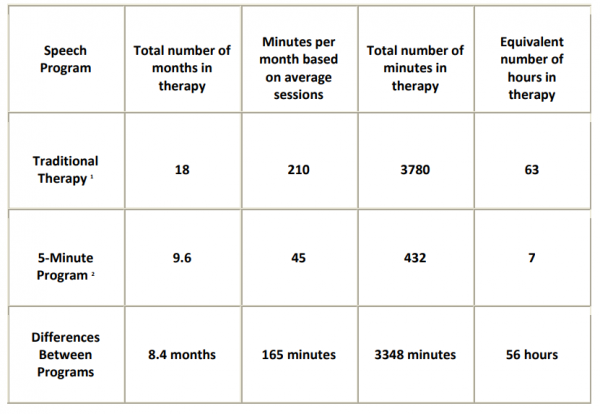
    Yes! This model has been studied multiple times with amazing results. Studies show that children learn faster with distributed practice vs. mass practice and results of a meta analysis showed that high intensity interventions (2-3 sessions per week of 70+ trials) were most effective for children with speech sound disorders.

    The 5-Minute Kids program conducted a study which showed that children receiving nine 5-minute sessions were dismissed in about half the time of children receiving seven 30-minute sessions per month.

    5 Minute Speech Therapy Results

    How Many Repetitions/Trials Can you Get in 5 Minute Speech Therapy Sessions?

    Learning a new skill is all about repetition. The more times a child practices the new skill, the faster he/she will learn it. But can we can get the same number of trials/repetitions (or more) in a 5-minute individual session as we can in a 30-minute group session? Check out this recording of a 5-minute /r/ session that I did while I counted my reps:

    @carrie_clark_slp Faster progress in less time with 5 minute speech therapy sessions! Watch to see how many repetitions (reps) of /r/ practice I can cram into 5 minutes. The shorter time means I don’t have to play games and do other activities to keep kids interested. We can hit the skill hard then get them back to class. #speechtherapy #speechlanguagepathologist #slpsoftiktok #slplife #speechdelay #articulationtherapy #schoolslp ♬ original sound - Carrie Clark SLP

    How to Run your 5-Minute Therapy Sessions

    1. Schedule in a block of time to see your 5-minute kids: You can probably see 4-5 kids during a 30-minute block, depending on how far apart their classrooms are.
    2. Pull each client to the back of the classroom or right outside their door. This eliminates the travel time and minimizes transition time
    3. Set a 5-Minute Timer
    4. Do Reps for 5 Minutes: Challenge the client to see how many reps he can get in 5 minutes (use a sports clicker if it motivates him). Provide prompts and cues to help establish the skill or get to the next level. Articulation Station Hive is a great app for prompting artic/phono. For language, I keep photo albums of stock photos on my tablet for prompts.
    5. When the Timer Goes Off, Send the Client Back: If you have another client in that classroom, you can have the first child tag in the second.
    6. Repeat! 5 Minutes per week isn’t going to cut it. Most of these programs and studies recommend between 2-5 weekly sessions, depending on the severity of each client.

    What if the Child Starts to Lose Interest?

    The nice thing about 5-minute sessions is that it’s not a long session so most of the time, you can keep a child working for that amount of time. But sometimes, they start to get squirrely or start to have trouble focusing by the end. Here are a few tips for helping with that:

    • Show them the timer and challenge them to see how many more reps they can get in before the timer goes off
    • Use a sports counter/clicker to count how many reps they get. Let them be the one to click it for every rep and see if they can get a “speech high score”
    • Strike a Pose! Have the child hold a pose while saying the next few words. Some of my favorites are standing on one foot (and then the other, gotta even it out), downward dog yoga pose, holding a plank/push-up position, and between your legs (bend over and say them backwards through your legs).
    • Walking Sessions: Take a walk around the school. Try to time it so you make it back to their door around the 5-minute mark. This is especially helpful for children at the carry-over or generalization phase where you can just practice their sounds in conversation.

    How to Handle Distractions During 5-Minute Sessions:

    I know the hallway isn’t the quietest place around. Here are some tips for doing 5-minute sessions in a noisy, busy school.

    5-Minute Therapy Course:

    Need some more help getting started with 5-minute sessions? Check out our full course here:

    5-Minute Speech Sessions Course

    5-Minute Speech Therapy Course

    Make Faster Progress in Less Time

    Join the Hub to Access (Free Trial)Carrie Clark, Speech-Language Pathologist

    About the Author: Carrie Clark, MA CCC-SLP

    Hi, I’m Carrie! I’m a speech-language pathologist from Columbia, Missouri, USA. I’ve worked with children and teenagers of all ages in schools, preschools, and even my own private practice. I love digging through the research on speech and language topics and breaking it down into step-by-step plans for my followers.

    Fun Fact: I didn’t realize that I had ADHD until I was an adult. It all clicked when I read that people with ADHD are motivated by things that are challenging, novel, or highly interesting. If a task doesn’t fall into one of those three categories, we have a hard time getting it done. I’ve subconsciously accommodated for this my whole life by setting challenges for myself or doing mundane tasks in novel ways, like doing my homework in a (dry) bathtub instead of at the kitchen table. Understanding how our brains work can be incredibly empowering and I love helping children understand these things as well!

    Connect with Me:

    Listen to the Podcast Version of this Info:

    The post 5-Minute Speech Therapy Sessions: How Long Should Therapy Sessions Be? appeared first on Speech And Language Kids.


    Social Skills for Autistic Adolescents and Teens Aug 05, 2014
    Show notes

    Social Skills for Autistic Adolescents and Teens

    Today we’re discussing how to teach conversation and social skills to older children who are struggling. This may include children with autism or other social impairments.

    Social Skill Therapy for Autistic Adolescent and Teens:

    Autism course

    Autism Course

    Learn more about supporting students with autism and other communication needs

    Join the Hub to Access (Free Trial)

    How to Decide Which Social Skills to Address:

    • Who are these kids
      • autism
      • social interaction problems
      • want to have friends
      • don’t understand rules
    • How to know which social skills to work on?
      • Observe in natural setting as much as possible
      • Ask teachers or other caregivers about what they’ve noticed
      • Observe other children that age
    • Research about how these kids learn social skills best
      • Review of research by White and Keonig
      • group-based social skills training
      • Direct teaching of social skills

    Social Communication Skills to Teach to Autistic Adolescents and Teens

    • Teaching Social Scripts
      • Specific rules that govern these activities
      • watch other kids
      • introductions, entering conversation, sitting in the lunch room, phone conversations,
    • Modeling and Role Play
      • watch someone else do it first
      • practice skill on their own
    • Differential reinforcement
      • change reinforcement based on their behavior
      • could be verbal praise or corrective feedback or the reaction of the listener
    • Peer Involvement
      • use other children with social needs
      • use typical peers
      • use siblings
    • Multiple Trainers
      • Don’t get too used to the same communication partners
    • Parent Involvement
      • Practice skills or talk about them at home
    • Practice in natural environments
      • Use peers to help with re-introducing the skill into a natural setting
      • Talk about before the child enters the situation
      • Review how it went afterwards
    • Foster Self-Awareness
      • Watch videos of self doing skill
      • Talk about how it went
      • Encourage child to judge if it went well
      • Encourage child to judge based on other person’s reaction

    How to Do Speech Therapy for Autistic Adolescents and Teens:

    1. Choose children who need social skills training, group together and add peers if possible

    or

    Tell child you’ll be working on social skills, bring in peers, friends, other children with autism, siblings if possible

    2. Observe natural social interactions to choose one target: entering a group conversation

    3. Observe typical kids in that situation

    • if body language is closed off, don’t enter
    • stand quietly by to see if they let you in
    • watch body language to see if they’re ok with you being there
    • listen for topic
    • make comment that is relevant and on-topic
    • don’t change topic away
    • don’t hog spotlight, ask others questions and let others take turns

    4. Write social script/social story

    5. Read the story with the group and discuss

    6. Act out the story with different people being the person approaching

    7. Provide reinforcement about how each child performed

    8. Ask peers to rate how other child performed

    9. Send home info to parents and have them practice/talk about it at home

    10. Take that skill to a natural setting with the same children

    11. Have the child rate his own performance

    12. Take child to a natural setting with whatever people are there.

    13. Talk about skill before he goes in

    14. Have him rate his performance after done and give feedback

    15. Maintenance:

    • discuss performance periodically to keep fresh
    • Provide feedback on what you observe
    Autism course

    Autism Course

    Learn more about supporting students with autism and other communication needs

    Join the Hub to Access (Free Trial)

    Free Therapy Materials for Teaching Conversation Skills:

    Check out the freebies that we have inside our Free Therapy Material Library!

    Initiating Interactions Social Story

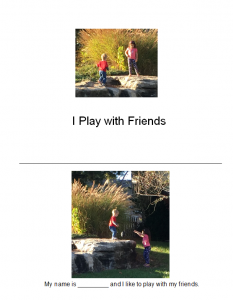
    How to Initiate Interactions – Social Story

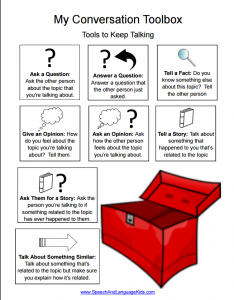
    Tools for Extending Conversations – Visual Aid

    Making Inferences Worksheets

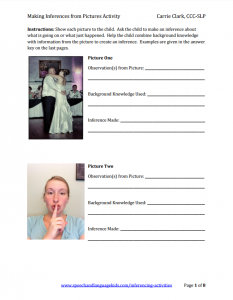
    Making Inferences from Pictures Worksheets

    Click Here to Access the Freebies!Carrie Clark, Speech-Language Pathologist

    About the Author: Carrie Clark, MA CCC-SLP

    Hi, I’m Carrie! I’m a speech-language pathologist from Columbia, Missouri, USA. I’ve worked with children and teenagers of all ages in schools, preschools, and even my own private practice. I love digging through the research on speech and language topics and breaking it down into step-by-step plans for my followers.

    Connect with Me:

    The post Social Skills for Autistic Adolescents and Teens appeared first on Speech And Language Kids.


    Stuttering Therapy for Children Jul 30, 2014
    Show notes

    How to conduct stuttering therapy with children

    On, this episode of the speech and language kids podcast, Carrie Clark reviews the current research on stuttering therapy for children. You will also learn how to conduct this therapy yourself. Note: This information is not intended to replace the guidance of a licensed speech-language pathologist (SLP). Every child is different and only a licensed SLP will know exactly what kind of therapy is best for your child. This information is intended to assist SLPs with knowing the best approach to therapy to take as well as to help parents understand the therapy process.

    News/Updates:

    Before getting into the content, I announced on the podcast that I will be writing a full-length e-book about Childhood Apraxia of Speech.

    Show Notes:

    Stuttering in Preschoolers

    • typical to go through phases of stuttering
    • warning signs that stuttering may be persistent and not resolve on own
      • A parent, sibling, or other family member who still stutters
      • Stuttering starts after age 3 ½
      • Stuttering has been occurring for at least 6 months
      • Preschooler is a male
      • The child has other speech sound errors or trouble being understood
      • The child’s language skills are advanced, delayed, or disordered
    • Source: http://www.stutteringhelp.org/risk-factors

    So What Therapy is Most Effective?

    • Younger children: systematic review in 2006 by Bothe, et. al. found that the response-contingency approach
    • Source: https://pubs.asha.org/doi/10.1044/1058-0360(2006/031)

    What is Response-Contingency Therapy for Stuttering?

    For a full article on this topic, visit the link below:

    http://www.speechandlanguagekids.com/stop-stuttering-preschoolers-current-research-based-methods/

    1. Reinforce fluent (non-stuttered) speech
      1. While playing with the child, comment on utterances that the child says that do not have any stutters. You can say “oh I like how smooth that was” or “you say that without any bumps!”.
      2. If the child stutters frequently, try an activity that requires the child to use shorter utterances. For example, you could play a game that requires the child to say a short sentence, like “Go Fish” (ex: “Do you have a ball?”). If the child still stutters on these, back up to even shorter sentences, like having the child use one word to name an object in a picture. Then, praise the fluent speech as above.
      3. If you need to shorten the utterance length down to have stutter-free speech, gradually build the utterance length back up by choosing slightly more demanding tasks.
    2. Give direct corrective feedback for stuttering
      1. As soon as the child begins to stutter, corrective feedback should be given. The research has shown that many different types of corrective feedback have worked so it doesn’t much matter what it is. One study found that turning off the lights over a puppet that the child was talking to was effective. Here are some ways that Bothe and Ingham suggest you can try:

    i. Say, “stop”

    ii. Say, “that was bumpy, try it again”

    iii. Say, “oops, hold on”

    iv. Say their name as a reminder

    v. Model the sentence without stutters

    vi. Hold up a hand and raise an eyebrow

    **If the child is stuttering so much that you would be doing this kind of correcting constantly, try choosing just the most severe stutters or just some of them. You can also try choosing activities that require a shorter utterance length as described above.

    Source: http://www.asha.org/Events/convention/handouts/2010/1528-Bothe-Anne/

    Great Example of Response-Contingency Therapy:

    Lidcombe program: http://www.amazon.com/Lidcombe-Program-Early-Stuttering-Intervention/dp/0890799040/ref=sr_1_1?s=books&ie=UTF8&qid=1406736420&sr=1-1&keywords=lidcombe+program

    Older Children:

    • Need to address psychological aspects
      • Reduce feelings of anxiety about stuttering
      • My activity for addressing emotional aspects. Ask these questions, listen, and discuss
        • What are your strengths?
        • What are your interests?
        • What are your weaknesses?
        • How do you feel about talking?
        • What are your emotions when you stutter?
        • Describe how your stutters feel or sound.
        • Why do you think you stutter?
        • What changes do you make because of your stutter?
        • What situations do you stutter more or less?
        • How does your stuttering impact interactions with other people?
        • What’s the worst thing that could happen because you stutter?
        • How likely is that to happen and what is more likely to happen instead?
        • What strategies have you used and how have they worked?
        • What are your goals for yourself and will your stuttering prevent you from doing those things?

    To Download the Emotional Aspects of Stuttering Worksheet (including what to say in response to the child’s answers), Click the Link Below

    Click here to download the free PDF of the Emotional Impacts of Stuttering Worksheet.

    Other Therapies for Older Children

    • Response Contingencies once again tops the list
    • Prolonged speech also has good outcomes (stretching out vowels and using extra pauses)
    • Self-management for older kids : know when they are stuttering and provide the response contingencies themselves, such as stopping themselves
    Reference Article: American Journal of Speech-Language Pathology, November 2006, Vol. 15, 321-341. doi:10.1044/1058-0360(2006/031). History: Received October 19, 2005; Revised March 28, 2006; AcceptedMay 25, 2006

    Thanks for Listening!

    I hope that helped to clarify how to do therapy with children who stutter. If you would like to download the free PDF of my emotional aspects worksheet, which includes what I recommend you say in response to the child’s answers, click on the link below.

    Click here to download the free PDF of the Emotional Impacts of Stuttering Worksheet.

    Thanks so much and don’t forget to leave a review on iTunes!

    More Resources for Speech-Language Pathologists:

    Looking for more therapy ideas and resources to help you provide the BEST services to your clients? Join us in The SLP Solution, our membership program for speech-language professionals! Inside the membership, you’ll find:

    • Step-By-Step Guides for teaching a variety of speech/language/communication skills
    • Pre-Made Worksheets and Therapy Activities for hundreds of different topics
    • Training Videos for dealing with difficult disorders or problems
    • Answers to Your Questions in our exclusive SLP community
    • Tools and Resources to help you with your paperwork and admin tasks
    • Continuing Education through our monthly webinars and webinar recordings

    To join us in the full SLP Solution, or to snag a free membership, click on the button below!

    JOIN THE MEMBERSHIP TODAY!

    The post Stuttering Therapy for Children appeared first on Speech And Language Kids.


    How this Chiropractor Helps Kids with Sensory Issues Jul 24, 2014
    Show notes

    In this episode of the Speech and Language Kids Podcast, Carrie interviews chiropractor Dr. Aaron Cunningham of Keystone Chiropractic and Sensory Development Center in Columbia, MO. Dr. Aaron discusses how his clinic is helping children with sensory issues and nuerodevelopmental disabilities, such as children with autism, ADHD, Asperger’s, etc. Dr. Aaron is one of about 60 chiropractors across the country (USA) trained in this special approach that combines nutrition, chiropractic adjustments, and movement exercises.

    This episode of the Speech and Language Kids Podcast is brought to you by: my YouTube Channel!

    Click Here to Visit Carrie’s YouTube Channel

    Notes from Chiropractor Aaron Cunningham about Sensory Issues

    • International Chiropractic Pediatric Association: Organization that certifies chiropractors for children
    • Intersect for Kids: Chiropractic program helping children with autism
    • Keystone Chiropractic and Sensory Development Center: Dr. Aaron’s clinic here in Columbia, MO

    What does this approach do for kids?

    Helps get the nervous system in proper working order so that they can take in information from their environment (including info given during speech therapy) and process it for optimal development.

    What can you look for to know if there are sensory or neurodevelopmental problems?

    • Not meeting all developmental milestones in the first year (or skipping steps!)
    • Being overactive or underactive
    • Trouble paying attention
    • Trouble following directions or listening
    • Playing by themselves
    • Lack of eye contact
    • Over-responding or under-responding to sensory input
    • Not integrating reflexes that are normally found in babies

    What three tools does Dr. Aaron use to improve nervous system function in these kiddos?

    1. Chiropractic adjustments
    2. Nutrition and diet changes
    3. Sensory exercises (Neuro-sensory therapy)

    How can I learn more about the nutrition side of this?

    • Speak with a chiropractor with this training
    • Speak with a nutritionist
    • Check out this book: The Second Brain by Michael Gershon

    Where can I find a chiropractor trained in this approach?

    Visit the website for the clinic that is pioneering this approach:

    Intersect for Kids

    Where can I find more about Dr. Aaron Cunningham?

    • Keystone Chiropractic and Sensory Development Center: Dr. Aaron’s clinic in Columbia, MO
    • Keystone’s Facebook Page

    Thanks to Dr. Aaron for being the very first guest on the Speech and Language Kids podcast. Leave a comment below to let me know who you would like me to interview or what topic you would like to hear an expert speak on! Also, don’t forget to leave a review on iTunes to help spread this podcast to others who would benefit from it!

    More Resources for Speech-Language Pathologists:

    Looking for more therapy ideas and resources to help you provide the BEST services to your clients? Join us in The SLP Solution, our membership program for speech-language professionals! Inside the membership, you’ll find:

    • Step-By-Step Guides for teaching a variety of speech/language/communication skills
    • Pre-Made Worksheets and Therapy Activities for hundreds of different topics
    • Training Videos for dealing with difficult disorders or problems
    • Answers to Your Questions in our exclusive SLP community
    • Tools and Resources to help you with your paperwork and admin tasks
    • Continuing Education through our monthly webinars and webinar recordings

    To join us in the full SLP Solution, or to snag a free membership, click on the button below!

    JOIN THE MEMBERSHIP TODAY!

    The post How this Chiropractor Helps Kids with Sensory Issues appeared first on Speech And Language Kids.


    7 Easy Things You Can Do Today to Help Your Child’s Speech and Language Skills Jul 14, 2014
    Show notes

    The podcast is back! After a much needed break to take care of my beautiful new baby boy, I am back and ready to get this podcast rolling again! This episode will give you 7 easy things you can do today to help your child’s speech and language skills. These are easy enough for you to do them today and effective enough for you to see some results. Try these seven easy steps today and maybe tomorrow you’ll have the confidence to take on something a little more complex!

    Show Notes: 7 Easy Things You Can Do Today

    News/Updates:

    Get excited for a new interview format to be used on this podcast! I’m working on getting some great guest speakers on the podcast. Is there anyone you would like to hear from? Let me know if there’s someone you’d like to hear from so I can leverage the power of having an established podcast to get you closer to the experts in the field. Tweet me on twitter @speechlangkids to let me know who you would like to hear from!

    Feature Content:

    And now, my 7 quick tips for improving speech and language skills. For elaboration on any of these points, listen to the podcast by clicking the player above or by listening on iTunes!

    1. Turn off Screens
    • American Academy of Pediatrics: no screen time for less than 2-year-olds, less than 2 hours per day after that
    • Average american child gets 7 hours of screen time per day
    • Studies linking more screen time with higher incidents of language delays
    • Time spent on screens takes away from time spent doing activities that children need to develop properly:
      • Playing-fine motor
      • Using their imaginations
      • Interacting with people
      • Having conversations
      • Reading
      • Playing outside -gross motor
      • Learning how to behave in public places
      • Learning how to be patient
    2. Read to your child
    • Best way to improve speech and language skills
    • Set aside 10 minutes per day that are just for reading, keep it sacred
    • Point out written words as you read
    • Ask child questions about the pictures and the text
    • Try holding the book upside down and see if your child can correct it
    • Find books about your child’s interests
    • For older kids, take turns reading paragraphs so the child has a chance to read too
    3. Review past events with your child
    • After doing something cool, ask your child questions about what happened (Ask Specific Questions)
    • Talk about your child’s favorite parts
    • What parts did your child not like?
    • What would your child improve if he could do it again
    • Try to put pieces of the event in order, sequencing
    4. Go on a walk and talk about what you see
    • Let your child take the lead and talk about whatever he’s interested in
    • For young children,
      • label what things are called and label actions you see people doing
    • For older children,
      • play I spy with adjectives
      • Ask your child questions about what he sees
    5. Research a topic that interests your child
    • Go to the library or use a computer to research info about something your child enjoys
    • For Younger Kids
      • Look at pictures, find nonfiction books on the topic, find general information
    • For Older Kids
      • Write down interesting facts about the topic
      • Find books with in-depth information
      • Find someone who knows about that topic and go meet them
      • Tell others about what he learned about the topic
    6. Have a distraction-free Family meal together
    • When you turn off the distractions, there’s more time to talk
    • Have everyone take a turn talking about a topic, if your child struggles, have him go last. examples:
      • Favorite part of the day
      • A challenge you overcame
      • Something you learned
      • Some place you want to travel to someday
      • A profession or hobby that you would like to learn more about
    • For younger kids, make the activity easier, for example, everyone could name one food when it’s their turn or say their favorite color
    7. Have a conversation with your child about whatever he wants to talk about
    • Sit down with your child, no distractions, and ask what’s on his mind, ask what he wants to talk about
    • Let your child talk and then expand on anything he says
    • Listen intently
    • Don’t correct your child, just add to what he says
    • Demonstrate good conversational skills like eye contact, body language, turn-taking, etc.

    Don’t Go Away Empty Handed!

    I am looking to gain some honest reviews on iTunes so that more people will discover the podcast. If you’re willing to leave me a review, I’m willing to give you a free e-book! Just head over to www.speechandlanguagekids.com/youtubeoffer. Thanks so much for reading/listening and have a fantastic day!

    More Resources for Speech-Language Pathologists:

    Looking for more therapy ideas and resources to help you provide the BEST services to your clients? Join us in The SLP Solution, our membership program for speech-language professionals! Inside the membership, you’ll find:

    • Step-By-Step Guides for teaching a variety of speech/language/communication skills
    • Pre-Made Worksheets and Therapy Activities for hundreds of different topics
    • Training Videos for dealing with difficult disorders or problems
    • Answers to Your Questions in our exclusive SLP community
    • Tools and Resources to help you with your paperwork and admin tasks
    • Continuing Education through our monthly webinars and webinar recordings

    To join us in the full SLP Solution, or to snag a free membership, click on the button below!

    JOIN THE MEMBERSHIP TODAY!

    The post 7 Easy Things You Can Do Today to Help Your Child’s Speech and Language Skills appeared first on Speech And Language Kids.


    Previous 1 6 7 8 9 10 Next

    Related Podcasts

    Coffee Break French

    1

    Coffee Break French Courses
    EconTalk

    2

    EconTalk Courses
    TED Talks Education

    3

    TED Talks Education Courses
    The Torch: The Great Courses Podcast

    4

    The Torch: The Great Courses Podcast Courses
    LSE: Public lectures and events

    5

    LSE: Public lectures and events Courses
    Homeschool Better Together

    6

    Homeschool Better Together Courses
    footer-logo

    Contact Us

    Toll Free: 844-670-7747

    Links

    • Home
    • Top Charts
    • Networks
    • Apps
    • Independents Podcasts
    • Podcast Advertising
    • Podcast News
    • Contact Us
    • About Us
    • Analytics & Insights

    Stay Connected

      Privacy, Terms of Use & Our Code of Ethics Protecting Content Creators Copyrights