MONDAY MATTERS Bonus Episode – Mastermind Lesson with Legacy Leaders
Jun 30, 2025
Show notes
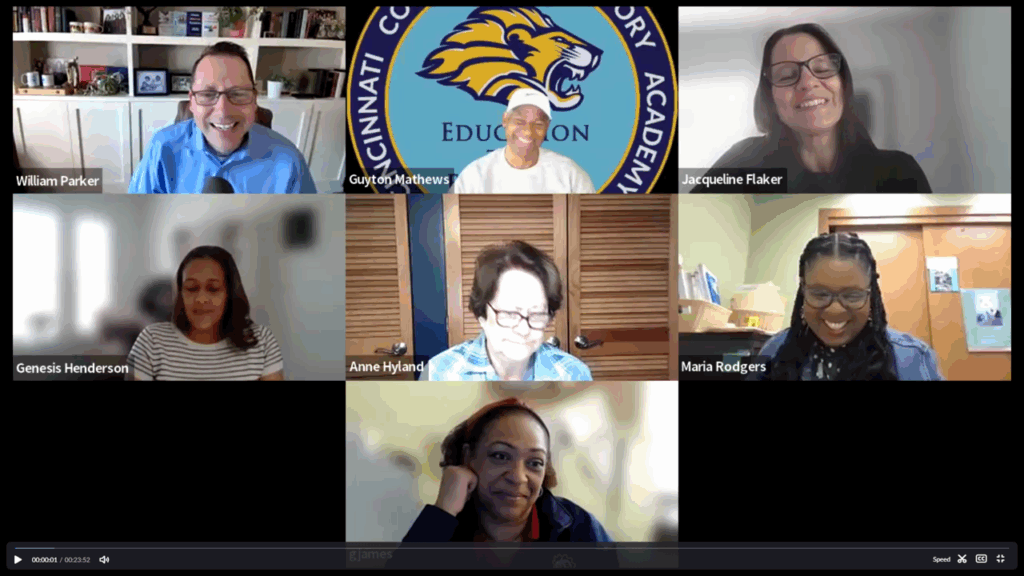
Welcome back to another Monday Matters! I can’t believe it is already summer. This week, our Monday Matters Podcast is going to be a little different than usual. As listeners may already know, the focus of recent Monday Matters episodes have been on the chapters of my new book Whose Permission Are You Waiting For? An Educator’s Guide to Doing What You Love. The chapter we are covering this week is one on masterminds. However, instead of talking about the chapter, I wanted to give listeners the chance to hear what it is like to be a part of one of the masterminds I offer. The following seven leaders took part in a mastermind I offered in the previous school year:
Gisele James, Superintendent, Par Excellence Stem Academy, Newark, OH
Genesis Henderson, Deputy Superintendent, Cincinnati College Preparatory Academy, Cincinnati, OH
Anne Hyland, Superintendent, Franklinton High School, Columbus, OH
Guyton Matthews, Superintendent, Cincinnati College Preparatory Academy, Cincinnati, OH
Maria Rodgers, Principal and Superintendent Designee, SCOPE Academy, Akron, OH
Bill Watson, Superintendent, Utica Shale Academy, Salineville, OH
Listen in to hear their answers to the following questions:
What motivated you to be a part of the Mastermind?
What are some common challenges you have shared along the way with Mastermind members?
In what ways have content discussions enhanced your own leadership development?
What reason(s) would you give someone else to consider joining a Mastermind?
What are you hoping to achieve in the future as a part of this kind of collaboration?
If you would like to learn more about the masterminds and other trainings I offer, visit my website to learn more! As always, thank you for doing what matters!
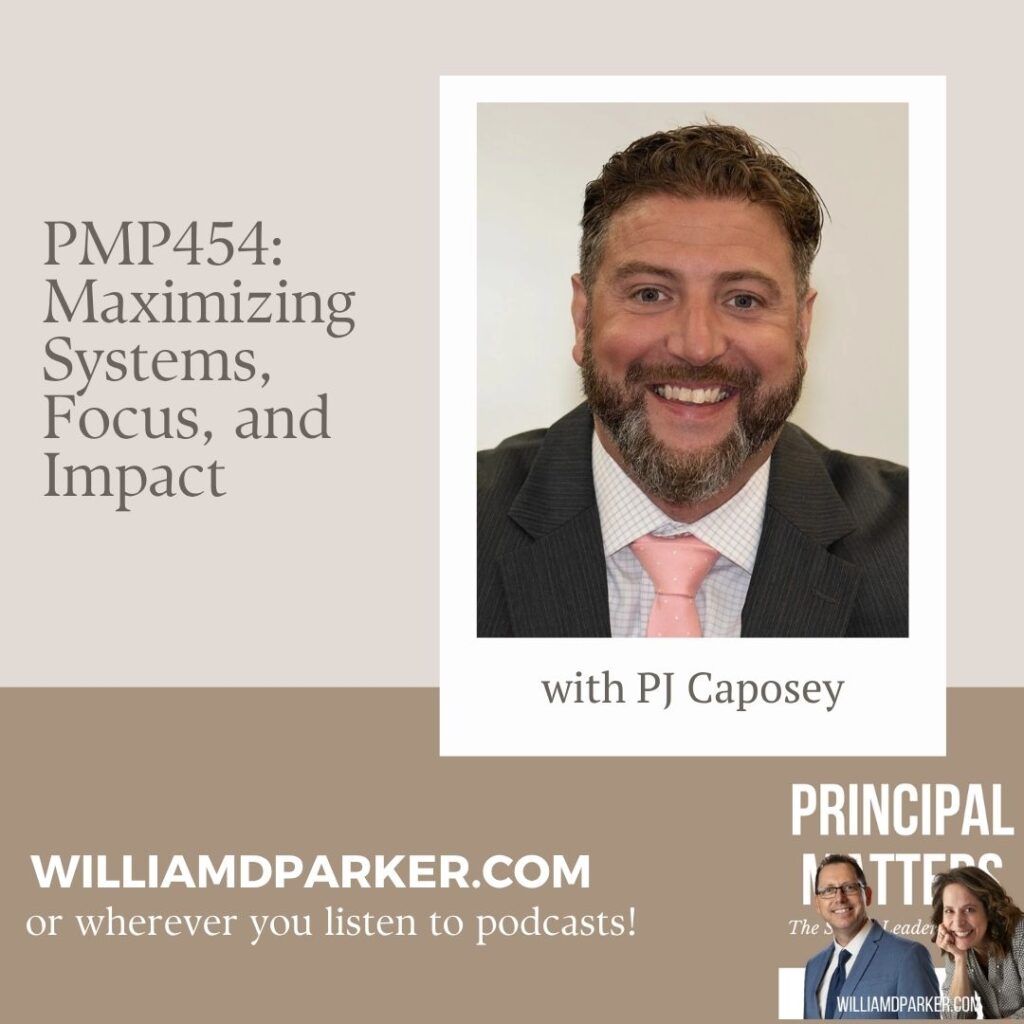
PMP454: Maximizing Systems, Focus, and Impact with PJ Caposey
Jun 25, 2025
Show notes
A Quick Note to Listeners:
Before this week’s interview, Will Parker answers a question from a student in Jen Schwanke’s graduate class at OSU.
The question is: From your experience as a podcaster, what are the most compelling or surprising insights you’ve gained from other educational leaders regarding human capital management? (This question is asked by Brenna Cropper, a first grade teacher in Worthington, Ohio)
Listen in to hear his response and thank you for doing what matters!
Meet PJ Caposey:
PJ Caposey is a dynamic speaker and a transformational leader and educator. PJ began his career as an award-winning teacher in the inner-city of Chicago and has subsequently led significant change in every administrative post he has held. PJ became a principal at the age of 28 and within three years was able to lead a small-town/rural school historically achieving near the bottom of its county to multiple national recognitions. After four years, PJ moved to his current district, Meridian CUSD 223, as superintendent and has led a similar turnaround leading to multiple national recognitions for multiple different efforts. He was the 2023 Illinois Superintendent of the Year, a finalist for 2023 National Superintendent of the Year, and a best-selling author. His latest book, coauthored with Bryan Wills, is Cracking the Coaching Code: Using Personality Archetypes to Maximize Performance (Rowman & Littlefield, 2023).
Show Summary:
In this episode of the Principal Matters podcast, Jen Schwanke interviews PJ Caposey, a superintendent overseeing two school districts and a prolific author and speaker. Caposey, a three-time cancer survivor, shares his unique perspective on time management and leadership, driven by a core belief in maximizing life’s finite resources. He emphasizes the importance of aligning personal ego demands, societal norms, and the inner drive for greatness to achieve focus and productivity.
Caposey advocates for a critical approach to time management, encouraging listeners to challenge accepted norms and prioritize tasks that yield the greatest impact. He questions the effectiveness of open-door policies, suggesting open calendar policies as a more efficient alternative. Part of his success relies on setting boundaries between work and personal life, sharing his personal strategy of achieving a “zero inbox” to fully engage with family. Caposey believes in giving his all to each aspect of his life, whether it’s work or family time, and encourages listeners to find what works best for them.
Jen and Caposey dive into a conversation, dear to Jen’s heart, about systems and people. Caposey draws from his experience with the Baldrige framework in solidifying his belief that simplifying and streamlining systems can empower teachers and leaders by reducing bureaucracy and increasing efficiency. He encourages principals to connect the dots between various initiatives and focus on a few core values to drive school improvement efforts, noting the power of language and consistent messaging in aligning actions with values, citing examples from his own district.
Caposey acknowledges that not all principals have the support of a systems-focused superintendent and offers strategies for simplifying systems at the building level. He suggests conducting an initiative purge to identify and group related efforts, reducing feelings of disjointedness. He also encourages principals to identify their strengths and build a team that complements those strengths, rather than striving to be a generalist. For all school leaders, an ongoing focus on continuous improvement and self-awareness will be an important component in success.
Staying Connected:
You can connect with PJ Caposey via the following:
MONDAY MATTERS with Jen Schwanke and Will Parker – The Value of Coaching
Jun 23, 2025
Show notes
Welcome back to another Monday Matters. As school leaders across the country are wrapping up their school years, Jen and I are wishing everyone a happy summer! This week’s episode is a discussion of a chapter on coaching from my book, Whose Permission Are You Waiting For? An Educator’s Guide to Doing What You Love. Coaching is a reflective activity that is extremely valuable to people across different walks of life, and it is particularly valuable to those working in education. Jen shares a story she read about coaching fifteen years ago that really opened her eyes to the benefit of coaching. She also shares her experience of some complementary coaching she received from me a few weeks ago. Furthermore, there are many different types of coaching available to leaders. Coaching is something that has benefitted both Jen and myself greatly. If you would like to learn more about coaching or want to set up some coaching with Jen or myself at jenschwanke@gmail.com or will@williamdparker.com. Thanks for listening to our conversation and thank you for doing what matters!
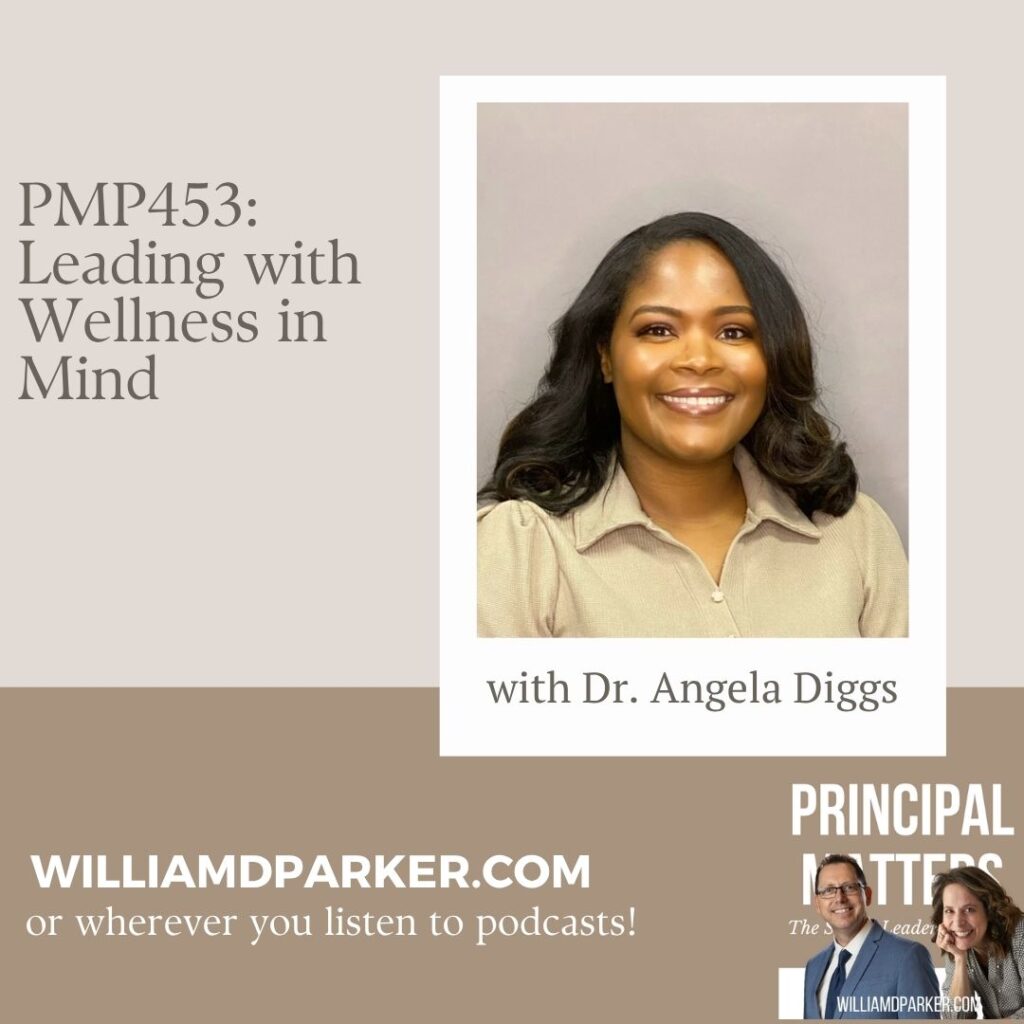
PMP453: Leading with Wellness in Mind with Dr. Angela Diggs
Jun 18, 2025
Show notes
A Quick Note to Listeners:
Before this week’s interview, Will Parker answers a question from a student in Jen Schwanke’s graduate class at OSU.
The question is: Through your consulting work, what common human capital challenges do you see schools facing and how can principals proactively address them? (Question from Madeline Platfoot, 6th grade math teacher from Columbus, Ohio)
Listen in to hear his response and thank you for doing what matters!
Meet Angela Diggs
Dr. Angela Diggs is an educational consultant with a background in special education, school administration, and school psychology. She earned her Bachelor of Arts degree in Psychology from Kentucky State University, a Masters Degree in School Psychology from Governors State University; and a Doctorate in Education in Counseling Psychology from Argosy University. Dr. Diggs is known for her strong work ethic as well as her personable and down-to-earth leadership style. In addition to her work as an educational consultant, Dr. Diggs is a real estate agent, a member of Delta Sigma Theta Sorority, Inc., and a mom to three children.
Interview:
In this week’s episode of Principal Matters, Dr. Jen Schwanke speaks with Dr. Angela Diggs, a leader who has a background in special education, school administration, and school psychology— and even real estate. She is currently a director of special services at an elementary school district.
The interview opens with Jen highlighting multiple hashtags that Dr. Diggs used on her LinkedIn profile. Each hashtag represents Dr. Diggs’s values and passions, including education as a gateway to success, the excellence and resilience fostered by Historically Black Colleges and Universities (HBCUs), and the importance of women in leadership, She also touches on leadership coaching and the significance of a growth mindset, as well as the need for mental health awareness and overcoming imposter syndrome.
As a Black woman in educational leadership, Dr. Diggs has faced unique challenges, including being seen and heard, dealing with microaggressions, and ensuring psychological safety . She learned to be more vocal and direct while remaining respectful . Dr. Diggs also stresses the importance of principals understanding special education law to advocate for students’ rights and navigate discipline issues effectively.
To maintain well-being, Dr. Diggs advises paying attention to the body’s signals and recognizing the importance of social and emotional intelligence in leadership. She shares her personal journey of recognizing and addressing stress, which led her to prioritize self-care and gamify the process of beating stress. She emphasizes the importance of balancing work with personal life, including family, exercise, and healthy eating. She encourages leaders to value diversity, prioritize relationships and trust, and see themselves as lifelong learners.
Thank you for listening to the entire conversation and for doing what matters!
MONDAY MATTERS with Jen Schwanke and Will Parker – Cycles of Reflection
Jun 16, 2025
Show notes
Hi, Principal Matters listeners! Thank you for tuning in for another episode of Monday Matters. This week, Jen Schanke and I are talking about chapter 10 from my book, Whose Permission Are You Waiting For? An Educator’s Guide to Doing What You Love. Before we jump into that discussion, Jen announces all of the places she will be at the ASCD/ITSE annual conference. Listen in to hear all of the details. If any listeners are planning to attend the ASCD/ITSE conference, Jen would love to connect with you!
Next, Jen and I discuss how summer is a great time for school leaders to take some time to reflect. We talk about scheduling reflection and engaging in both proactive reflection and reactive reflection. Additionally, we remind leaders of the benefit of reflecting with another person. Summer is often a good time for school leaders to do this as well, because there is more room on their schedules to connect with colleagues. At the end of the show, Jen and I share some reflection questions for listeners who may want to try reflecting, but are unsure where to start. The questions are:
What are some of the biggest milestones you experienced this past year?
What’s something you’re really happy to celebrate from this past year?
What were some of the most difficult challenges you faced?
What were the lessons you learned along the way?
Our challenge to listeners this week is to try to connect with a colleague and work through these questions together. If you would like to reflect with Jen or I, reach out to us via email at jenschwanke@gmail.com or will@williamdparker.com. We would love to hear from you!
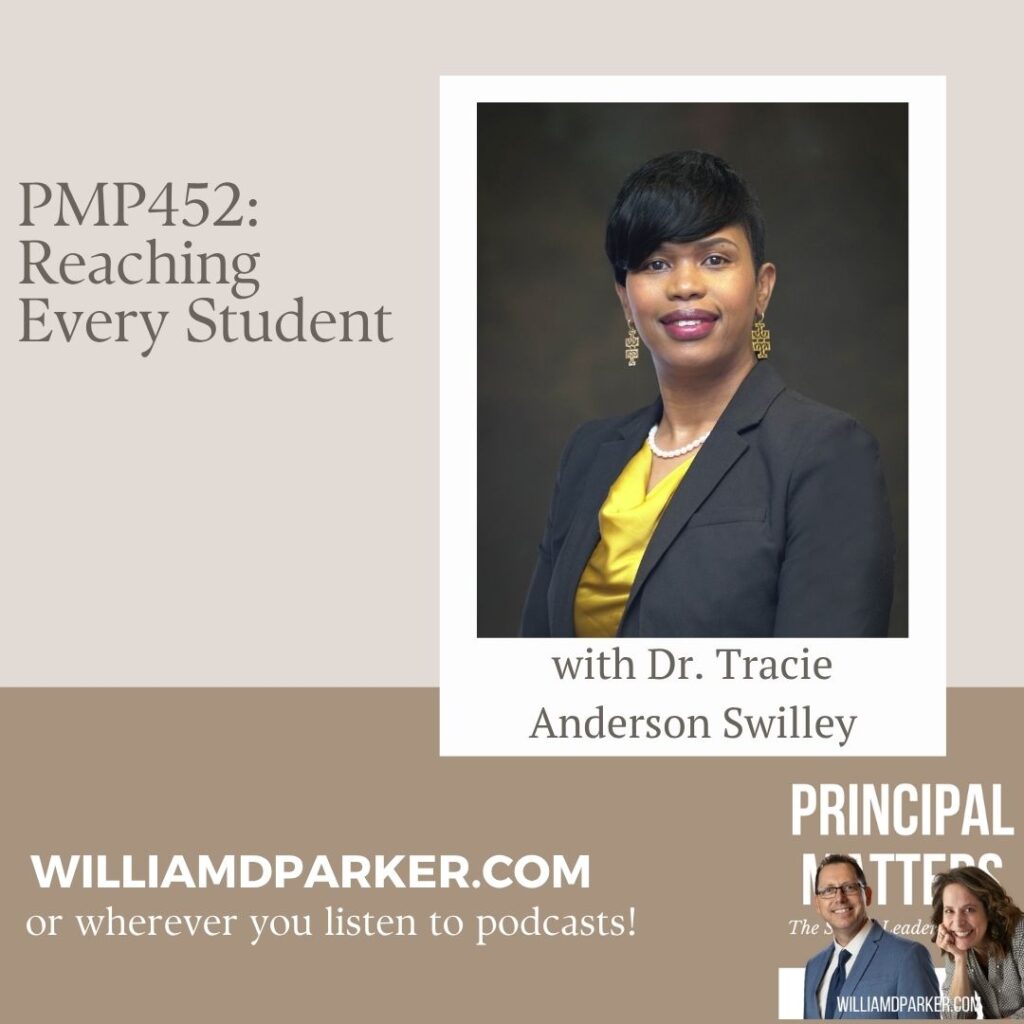
PMP452: Reaching Every Student with Dr. Tracie Anderson Swilley
Jun 11, 2025
Show notes
A Quick Note to Listeners:
Before this week’s interview, Will Parker answers a question from a student in Jen Schwanke’s graduate class at OSU.
The question is: How did you ensure equity and fairness in staff evaluations, promotions, and leadership opportunities? (Question from Diona Ross, High School Intervention Specialist from Columbus, Ohio)
Listen in to hear his response and thank you for doing what matters!
Meet Dr. Tracie Anderson Swilley:
Dr. Tracie Anderson Swilley, principal of Fairfield Central High School, in Winnsboro, South Carolina, was named the 2025 National Principal of the Year, a testament to her 12 years of inspiring leadership. Originally a biology major, she discovered her passion for education through mathematics and began her journey as a high school math teacher before becoming dean of students, assistant principal of curriculum and instruction, and a principal.
Under her leadership, Fairfield Central has achieved remarkable student success despite economic challenges. Dr. Swilley credits her team and students for their resilience, emphasizing that circumstances do not define potential. Known for her unwavering belief in her staff and students, she continues to shape a culture of growth, confidence, and achievement. Something the audience may be surprised to know about Dr. Swilley is that she has the opportunity to be the dean of students and assistant principal at the school she graduated from. She actually ended up being the supervisor to people who taught her!
The How and Why of Getting Into Education:
Tracie Swilley graciously shares her story with me and the rest of Principal Matters listeners. Growing up, Tracie says that she always knew she wanted to work with children and young people. The impetus that propelled her into a career in education was an interaction with a college professor who helped Tracie understand the “why” of mathematics. This interaction made Tracie realize that she wanted to teach other people what she had learned about math. Additionally, Dr. Swilley says that her passion comes from lived experience, having grown up in a community that is economically challenged.
Next, Tracie shares some of the outcomes she is most proud of at Fairfield Central High School. Her favorite day of every year is graduation. At Fairfield Central High School, the graduation rate is 91 and their school report card is exceeding state standards. Dr. Swilley and her staff are dedicated to making sure that students are able to graduate within 4 years, and that they are leaving high school with enough credentials to go into the workforce. Furthermore, Dr. Swilley discusses why she feels it is so important for her to stay in her position at Fairfield Central High School for so long. It’s about showing students that they are important enough for someone to stick around.
Lessons from Leadership Experience:
As Dr. Swilley considers what she wants to share with listeners regarding lessons in leadership that can be gained from her experience, she says she first wants to focus on what she did wrong. Tracie says that when she first stepped into a leadership role, she thought she had to be a superwoman and get everything done herself. This mindset led to her becoming a workaholic. Dr. Swilley also shares that something that helps leaders get out of the workaholic mindset is connecting with other leaders. Learning how to build the right team for your school is another skill that Tracie suggests new leaders acquire. Finally, Dr. Swilley reminds listeners to stay true to themselves. She spent a long time trying to be like other people, and has found the most success as herself.
Lessons for New Leaders:
Dr. Swilley tells me that if she could talk to a new or aspiring leader, she would offer the following advice:
There should be nothing you’re not willing to assist or do
You can’t prepare for the principalship before you’re in the principalship
Be at events so that you understand the hours that go in to the job
You do not have to be an expert but you should know who to go to to find out the information you need when you have questions
Advice for Veteran Leaders:
At the end of our conversation, Tracie reflects on what keeps her motivated in her work for the long haul. She does not deny that leadership can be an extremely difficult job, and it can be hard to stay motivated. By surrounding herself with younger leaders, Dr. Swilley is able to stay motivated. Kids also help her get her motivation back. She recommends befriending an elementary school principal to learn the innovative ways they are working with kids. Tricks that work for elementary school students work for high school students too, and seeing a student light up will help bring back motivation. To wrap up the conversation, Dr. Swilly tells Principal Matters listeners “Be the best version of you every day”.
Staying Connected:
You can find out more about Dr. Tracie Swilley via:
MONDAY MATTERS with Jen Schwanke and Will Parker – Building Systems That Produce Outcomes You Want
Jun 09, 2025
Show notes
Hi, Principal Matters listeners, and welcome back to another episode of Monday Matters! This week, Jen Schwanke and I are talking about building systems that produce the outcome you want (Chapter 8 in Whose Permission). I want to talk about systems on Monday Matters because Jen Schwanke has helped me understand systems better. Jen shares that systems is something she is really passionate about in her leadership and encourages listeners to experiment using systems in their work. We discuss considering the difference between a systems problem versus a peoplWe also talk about how good systems are often what will lead to someone finally achieving their goals. Systems are so important when it comes to achieving your goals and growing as an individual and a leader. Some questions Jen and I ask listeners to consider are: “What are the things you really want to achieve?” and “What are some systems that you have put in place to achieve those goals?”. If you keep having the same outcomes over and over again, and they’re not the ones you desire, then maybe you need to examine the systems that are creating those outcomes. Listen in to hear the whole conversation. Thank you for tuning in to Monday Matters and thank you for doing what matters!
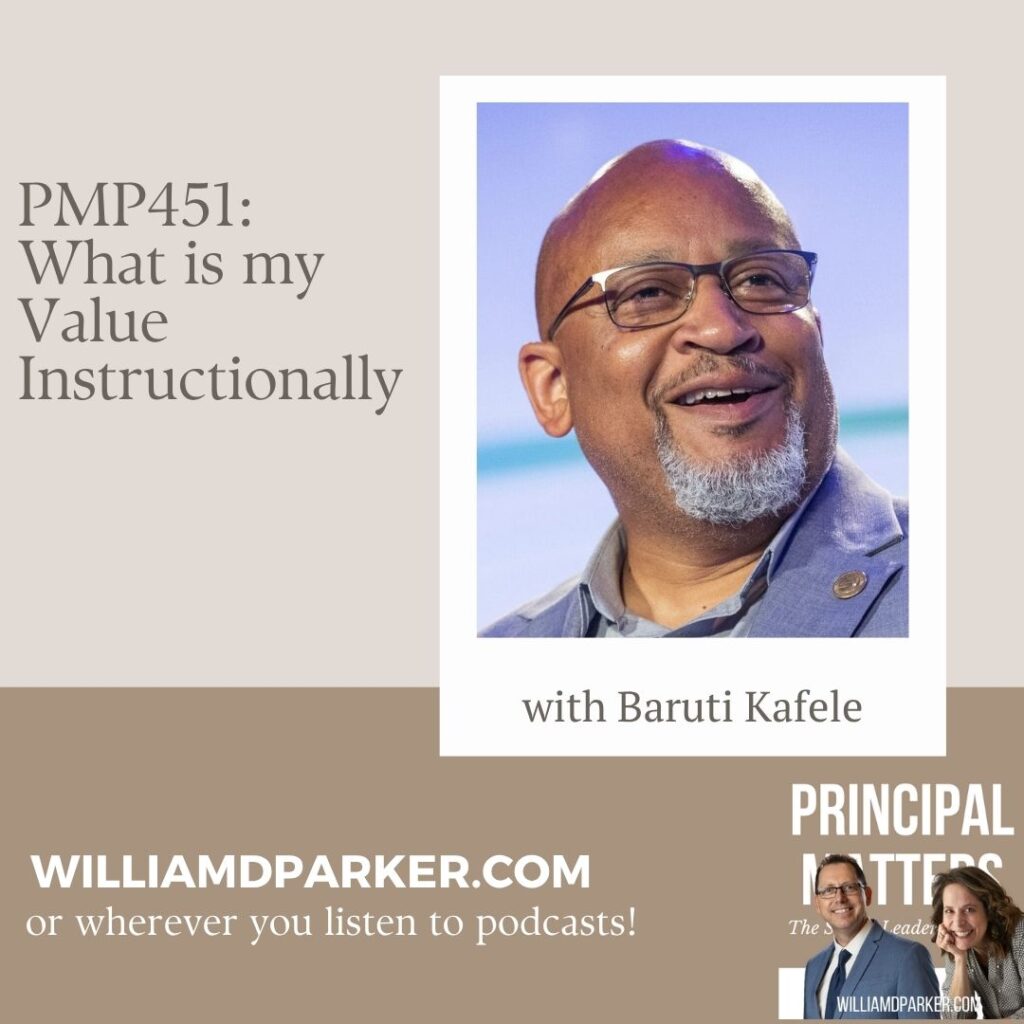
PMP451: What is My Value Instructionally with Baruti Kafele
Jun 04, 2025
Show notes
A Quick Note to Listeners:
Before this week’s interview, Will Parker answers a question from a student in Jen Schwanke’s graduate class at OSU.
The question is: What practical strategies did you use to boost staff morale and prevent burnout, especially during times of high stress or change? (Question from Cameron Carter, first grade teacher from Worthington, Ohio)
Listen in to hear his response and thank you for doing what matters!
Meet Baruti Kafele:
Hi, Friends! Jen Schwanke here, hosting Principal Matters Podcast this week. We are so excited to bring Principal Kafele back to this podcast episode, where we discuss the importance of a principal’s confidence, ability, and belief in themselves— and a whole lot more. Before we dive into the content of today’s episode, I’d like to share a short bio describing Principal Kafele and the work he has done as an educator and an author:
A highly-regarded urban educator in New Jersey for over twenty years, Principal Baruti Kafele served as an elementary teacher, assistant principal, and high school principal before becoming the author and renowned speaker he is today. His latest book, What is My Value Instructionally to the Teachers I Supervise? was recently released. Kafele’s website highlights this and the other of his thirteen books, including seven ASCD best sellers – Motivating Black Males to Achieve in School & in Life, Closing the Attitude Gap, Is My School a Better School BECAUSE I Lead It?, The Teacher 50, The Principal 50, The Assistant Principal 50 and The Equity & Social Justice Education 50. Principal Kafele is also the creator and host of the popular AP & New Principals Academy, streamed live every Saturday morning on his AP & New Principals Academy YouTube channel at 10:55 ET. He has been awarded the coveted Milken Educator Award as well as various other distinguished awards for his work.
My conversation with Principal Kafele starts with a discussion of his new book, “What is My Value Instructionally to the Teachers I Supervise?” We discuss the importance of instructional leadership and how it can impact students, particularly those who may be overlooked. Kafele is a living example of the importance of instructing all students, and he openly shares his personal story of struggling in high school before finding a passion for reading and education in college.
That passion transferred into a passion for instructional leadership. He emphasizes that principals should prioritize being instructional leaders and coaches rather than being bogged down by administrative tasks. He stresses that leaders should focus on pedagogy rather than trying to be experts in all content areas, and encourages leaders to utilize their central office supervisors and department heads for content-specific expertise. He also highlights the significance of starting each day with a positive message to students, creating a culture of belief and high expectations. A leader’s words matter to the students, and teachers should reinforce the messages of leadership throughout their day. Empowerment comes when we all focus on teaching and learning, school climate, and culture, rather than administrative minutiae.
At my prompting, Principal Kafele shares one of my favorite stories— the one that started his journey as an author—when he self-published his first book, “A Black Parent’s Handbook to Educating Your Children (Outside of the Classroom.” He sold it out of his car, contacted Black bookstores and radio stations to promote the book, and eventually found his hard work and hustle lead to his success with ASCD .
Above all, Principal Kafele emphasizes that instructional leadership is fueled by the power of belief and collective efficacy in schools, and encourages educators to believe in their ability to elevate their students.
Staying Connected:
You can stay connect with Principal Kafele and his work via:
MONDAY MATTERS with Jen Schwanke and Will Parker – Let’s Talk About Money
Jun 02, 2025
Show notes
It’s Monday, so that means it’s time for another Monday Matters episode! This week, Jen and I are continuing a series of conversations that revolve around the chapters from my new book, Whose Permission Are You Waiting For? An Educator’s Guide to Doing What You Love. The chapter we’re discussing this week is called “Let’s Talk About Money”. Even though many educators love what they do, they often make less money than their peers in other professions. So, when educators consider doing the work they love, they also need to consider what kind of income they need to pay their bills. Listeners are encouraged to think about their money goals and what is it that they need to do to meet them. We also talk about ways educators can supplement their income, through work in education or outside of it. There are a lot of factors that go into an educator’s income, so the advice offered in this episode and the book are not one size fits all, but they are important things to consider when thinking about money. This is a very complex topic and there is not a one-size fits all answer about how educators can supplement their income. With that said, if this topic interests you and you would like to talk about it with us in more detail, email Jen or I at jen@jenschwanke.com or will@williamdparker.com. We would love to know your thoughts on this topic!
On another note, Jen announces her 5th book, Trusted, will be coming out in August! Stay tuned to learn more about it and where you can purchase a copy!
ENCORE FRIDAY – PMP287: Chasing the Show with Pete Hall
May 30, 2025
Show notes
Happy Friday, Principal Matters listeners! This week’s encore episode is a conversation between myself and Pete Hall from 2022. Pete is a veteran school administrator and education consultant who has authored many books and articles on leadership. In this episode, we talk about his book Chasing the Show, a YA novel. Listen in to hear our full conversation, or read the original blog post to learn more about Pete Hall. As always, thank you for listening and thank you for doing what matters!

 Our TOPPODCAST Picks
  Stay Connected