TopPodcast.com
Menu
  • Home
  • Top Charts
  • Top Networks
  • Top Apps
  • Top Independents
  • Top Podfluencers
  • Top Picks
    • Top Business Podcasts
    • Top True Crime Podcasts
    • Top Finance Podcasts
    • Top Comedy Podcasts
    • Top Music Podcasts
    • Top Womens Podcasts
    • Top Kids Podcasts
    • Top Sports Podcasts
    • Top News Podcasts
    • Top Tech Podcasts
    • Top Crypto Podcasts
    • Top Entrepreneurial Podcasts
    • Top Fantasy Sports Podcasts
    • Top Political Podcasts
    • Top Science Podcasts
    • Top Self Help Podcasts
    • Top Sports Betting Podcasts
    • Top Stocks Podcasts
  • Podcast News
  • About Us
  • Podcast Advertising
  • Contact
Not in our directory?
Add Show Here
Podcast Equipment
Center

toppodcastlogoOur TOPPODCAST Picks

  • Comedy
  • Crypto
  • Sports
  • News
  • Politics
  • True Crime
  • Business
  • Finance

Follow Us

toppodcastlogoStay Connected

    View Top 200 Chart
    Back to Rankings Page
    Education

    Mastering Business Analysis

    Your key to advancing your career as a Business Analyst and beyond

    Advertise

    Copyright: © MasterClass 247 LLC

    • Apple Podcasts
    • Google Play
    • Spotify

    Latest Episodes:
    MBA076: Product Strategy Jun 14, 2016
    Show notes

    In this episode, Product Management expert Roman Pichler discusses the importance of a product strategy and how the vision, strategy, roadmap, and backlog all fit together.

    

    After listening to this episode, you'll understand:

    • The difference between a Product Manager and a Product Owner
    • How to develop a product strategy
    • How the strategy, roadmap, and backlog all fit together
    • Why a roadmap is so critical and how to overcome some challenges with roadmaps
    

    Show Notes

    Having a solid product strategy allows you to deliver the right product the right way. The strategy is the path or approach you choose to realize the vision.

    How the vision, strategy, roadmap, and backlog fit together

    The vision is the overarching aspirational goal; the positive change that the product should achieve in the world. It should be big, bold, ambitious, and inspirational. The vision provides grounding and a sense of purpose.

    The product strategy will speak to the problem the product should address or the expected benefit, identify the customer, and describes how the product stands out.

    A roadmap takes the high level strategy and provides more detail. It shows how product will likely evolve as well as the goals and benefits you’re likely to achieve.

    Backlogs add the necessary detail about design and capabilities. You should be able to tie backlog items to the roadmap, which delivers on the strategy, which is aligned to the vision.

    The vision is the big ‘Why’. Strategy also speaks to the ‘Why’ and also the ‘What’ and ‘Who’. The backlog provides more detail on the ‘What’. The product strategy bridges the gap between user stories and the vision.

    Don’t lose sight

    Often product owners and teams are so down in the details of user stories, they lose sight of the big picture. Having a clear product strategy gives you a reference point to tie back to and ensure you’re still aligning to the vision and product goals.

    Minimize the risk of creating the wrong product with techniques such as producing the minimum viable product (MVP), using prototypes, observing and interviewing customers, and other approaches for getting rapid feedback. What you learn from this validation will allow you to adjust your approach or pivot on your strategy.

    Roadmaps

    Roadmaps are planning artifacts and like many planning artifacts, they become of little value when they’re outdated. A roadmap must be revisited and updated as we learn more from customer feedback.

    At a minimum, a roadmap should be reviewed and updated at least quarterly. It’s a high level strategic plan, ideally showing rough timeframes and talk about the benefits that the releases or product versions provide and the goals those releases will help you meet.

    The roadmap lets you see the high level path ahead for 12 to 18 months to help people understand where the product is going and allows people to plan accordingly. However, everyone must realize that the plan will be updated; it’s simply a list of options. The near-term details are in the backlog.

    Listen to the full episode to hear all of Roman’s tips on developing a product strategy to make sure we build the right product to deliver value.

    http://traffic.libsyn.com/masteringbusinessanalysis/MBA076.mp3

    Z

    Your Homework

    The single most important action you can take to make sure your requirements, backlog, and roadmap are aligned to user needs is to talk with your customers. Talking with customers gives you insights into what your customer needs are, how they use your product, and features that they don’t use. Use these insights to adapt your roadmap and requirements.

    Links mentioned in this episode:

    • Roman’s website Pichler Consulting
    • Roman’s books
    Roman Pichler

    Roman Pichler

    Pichler Consulting

    Roman Pichler is a leading agile product management and Scrum expert. Roman is the author of several books including “Agile Product Management with Scrum“ and his latest book, “Strategize“.

    Roman is an active contributor to the London product management community and a regular speaker at international conferences. Roman was named one of the 20 most influential agile people in April 2012.

    • X
    • LinkedIn

    Thank you for listening to the program

    To get more valuable content to enhance your skills and advance your career, you can subscribe on iTunes.

    Also, reviews on iTunes are highly appreciated! I read each review and it helps keep me motivated to continue to bring you valuable content each week.

    The post MBA076: Product Strategy appeared first on Mastering Business Analysis.


    MBA075: Slices of Big Truths Jun 07, 2016
    Show notes

    In this episode, Bob Prentiss shares some hard truths about what we must be to achieve success in business analysis and other endeavors.

    

    After listening to this episode, you'll understand:

    • The hard truths we need to understand to achieve success
    • How to overcome discomfort and have crucial conversations
    • Why it’s important to be intelligently disobedient
    • Why knowing yourself is the first step in building a relationship with others
    

    Show Notes

    Bob’s teaching approach is about sharing little slices of bigger truths that allow us to think differently so we can learn and work differently. Those truths go beyond the theory you’ll find in many books and allows people to apply the meaning to their own situations.

    These big truths are life lessons; advanced competencies to allow you to expand your leadership and job specific skills.

    Crucial Conversations

    Most people shy away from difficult conversations, but it’s those crucial conversations that are key to changing behaviors that are impeding progress. You need to have the courage and openness to discuss difficult topics.

    The truth behind the myth is that not everything is solvable. Having the conversation will often help, but go into it with an understanding that not everything is repairable.

    Get Comfortable with Discomfort

    These crucial conversations often make us feel uncomfortable. We need to be able to feel that discomfort and do it anyway. Having a mentor, coach, or someone you can bounce ideas off of helps you overcome the discomfort. Having a strategy is also key to success.

    Having heroes or an imaginary mastermind group can give you insights and confidence to handle difficult situations.

    Intelligent Disobedience

    Sometimes we may need to disobey requests from managers or stakeholders if it’s not the right thing to do. If you’re not being intelligently disobedient at least once a week, you’re probably doing a disservice to your organization. The key word is “intelligently”. This requires you to think strategically, understand impacts, and have those difficult conversations.

    Don’t blindly follow orders; think through the consequences and do the right thing. Follow the value systems of your organization.

    Stretch

    Open your mind to create your own path and push your boundaries to know what you’re truly capable of. To grow, you need to be able to influence your organization to accept progress over perfection. Having strong relationships and a support system in place will allow you to stretch yourself safely. Create a safe to fail environment where you can experiment, learn, and grow.

    Listen to the full episode to hear all of Bob’s conversation about hard truths that you need to understand to take you career to the next level.

    http://traffic.libsyn.com/masteringbusinessanalysis/MBA075.mp3

    Homework

    Notice everything! Expand your awareness and start noticing everything around you. This includes people, how they are behaving, and anything new. Having a greater awareness gives you the data to build better relationships. Strong relationships is how work gets done.

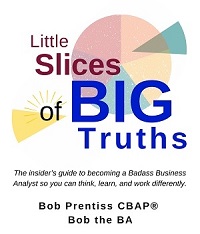
    Little Slices of Big TruthsLinks mentioned in this episode:

    • Bob the BA Website
    • Get Bob’s book
    • Bob’s previous episode
    Bob Prentiss

    Bob Prentiss

    Bob the BA

    Bob the BA provides badass business analysis training, consulting and mentoring services. Bob is passionate about helping you think, learn and work differently. Bob is CBAP® certified with 25+ years of experience in corporate America; with a background in managing BA centers of excellence, assessing and managing BA maturity, quality, and competency. Bob is an award winning curriculum developer and has presented numerous keynote, workshops, seminars, conferences, and training sessions across North America. He is also founding member and past President of the IIBA® MSP Chapter.

    • X
    • LinkedIn

    Thank you for listening to the program

    To get more valuable content to enhance your skills and advance your career, you can subscribe on iTunes.

    Also, reviews on iTunes are highly appreciated! I read each review and it helps keep me motivated to continue to bring you valuable content each week.

    The post MBA075: Slices of Big Truths appeared first on Mastering Business Analysis.


    MBA074: Lean Business Analysis May 31, 2016
    Show notes

    In this episode, Luke Johnstone helps us to eliminate waste in our BA practices using Lean Business Analysis.

    

    After listening to this episode, you'll understand:

    • Why the four values of the Lean Business Analysis Manifesto are so important
    • The 8 forms of waste in analysis
    • How to combat those forms of waste
    

    Show Notes

    Lean business analysis is about doing the right thing at the right time and removing things that don’t add value. Those non-value add activities are referred to as waste.

    To help business analysts better align to Lean principles, Luke and his organization created the Lean Business Analysis Manifesto with the following four values.

    1. Producing what is needed when it’s needed versus doing all of the analysis upfront
    2. Working with the right people at the right time versus working in silos
    3. Building quality in from the outset versus checking for quality at the end
    4. Avoiding unnecessary steps that don’t add value versus following a prescribed process

    Having a Lean mindset helps us to avoid some anti-patterns that lead to waste. These eight forms of waste are:

    • Unfinished work – Analysis or requirements completed but not implemented
    • Unnecessary features – Features customers don’t need or want
    • Silos and handoffs – Working without a shared understanding and transitioning work items
    • Unnecessary processes – Steps that don’t add value
    • Context switching – Moving from one task to another without focus
    • Waiting – Delays due to waiting for an answer or availability
    • Rework – Work that needs to be done over
    • Knowledge hording – Keeping knowledge to yourself

    In this interview, Luke discusses these forms of waste in detail and shows us some tools and techniques to eliminate the waste.

    Listen to the full episode to hear all of Luke’s advice for eliminating waste in your BA practice.

    http://traffic.libsyn.com/masteringbusinessanalysis/MBA074b.mp3

    Z

    Your Homework

    Reflect on your analysis practices and create a value stream map of your process. Doing so helps you to identify value add and non-value add activities. Then, try to eliminate of reduce the amount of non-value adding activities.

    Links mentioned in this episode:

    • Luke’s company website Assurity
    • Impact Mapping

    Luke’s Presentation from Agile NZ

    Luke Johnstone

    Luke Johnstone

    Lean Business Analysis at Assurity

    Luke has led Assurity’s Christchurch-based Lean Business Analysis Service for three years and has recently been appointed their National BA Service Owner. He is an outcome-focused, commercially astute Agile Business Analyst with significant experience in Business Analysis, Software Development projects, leading IT projects/teams and organization-wide Change Management.

    • X
    • LinkedIn

    Thank you for listening to the program

    To get more valuable content to enhance your skills and advance your career, you can subscribe on iTunes.

    Also, reviews on iTunes are highly appreciated! I read each review and it helps keep me motivated to continue to bring you valuable content each week.

    The post MBA074: Lean Business Analysis appeared first on Mastering Business Analysis.


    MBA073: Agile Requirements – What’s Different May 24, 2016
    Show notes

    In this episode, Barbara Carkenord helps us understand the difference between requirements in agile and waterfall and how to be successful with agile requirements.

    

    After listening to this episode, you'll understand:

    • How requirements in agile environments differ from waterfall requirements
    • The shift that you need to make to be successful with agile requirements
    • How to overcome perfectionism
    • What to do if the details aren’t needed right now
    

    Show Notes

    What’s the difference between requirements in an agile environment versus a waterfall environment? Not much . . . and a lot.

    On one hand, agile requirements approaches are very similar to traditional approaches. You still need to analyze, facilitate, use good listening skills, and manage the requirements.

    On the other hand, agile requirements differ in that the traditional, heavy documentation becomes a lot less important. We need to shift our thinking to focus on requirements as an analytical, thinking process. It’s more about discovery and collaboration than about documentation.

    You’ll still document requirements in agile, you’ll just likely do so in a lightweight way such as starting with Post-Its or using a flipchart. Think about documentation in more creative ways.

    Audit Considerations

    If you’re concerned that audit needs more comprehensive documentation, work to understand their true needs. Ask the ‘why’ questions to the audit department, leadership team, PMO, or whoever is asking for extensive documentation.

    This approach helps shift the thinking in your organization and helps everyone to understand what is truly needed and the value that an output provides.

    Asking questions about why documentation is needed and the value can help you to produce what is needed to the extent required to deliver the expected value. Instead of making assumptions, look at what’s actually required, why, and look for creative ways to meet that need.

    The Difference with Agile

    Most of the tools and analysis techniques you use in waterfall environments are still valuable and useful in agile.

    With agile, many of the business analysis techniques can be same, but the timing and approach may be different. You will likely still need to perform a current state analysis to understand your starting point. The difference will likely be in how much you need to document and in what format.

    The key to success with agile requirements is to know when to keep things at a high level and when to get into the details.

    Agile requirements and documentation should be barely sufficient; just enough to meet the needs of the team and the organization. Anything more is wasted effort.

    Remember that your outputs don’t always need to be perfect. Do just enough to meet the need and create a shared understanding. Force yourself to let go of perfectionism when it doesn’t add sufficient value.

    Requirements should also be completed at the last responsible moment. If we create requirements too far in advance, things will likely change and your effort would have been wasted. Often a scrum team will have 1-2 sprints of ready stories and the BA is working slightly ahead to refine the user stories.

    You’ll need to balance your time between working slightly ahead of the team and helping the team in the present moment with and questions or issues.

    Focus your effort on the most important thing you can do right now today. Know what can wait and know what can benefit from waiting because you’ll learn along the way and may have more information later. Keep in mind that things may change and doing too much upfront can be wasted time.

    When you come across ideas that are too soon to discuss, have an organization system for future ideas. It’s important to know when to be detailed and when to keep things at a high level.

    You’ll need strong analysis and facilitation skills to bring the team through cycles of discussing high level requirements, diving into the details when the team needs to, and then pulling everyone back up to the high level. Get comfortable with letting conversations take place until you cover the topic just sufficiently to create a shared understanding.

    A parking lot or other lightweight ways of capturing thoughts and ideas can help you rein the group back in. This gives the group a level of comfort that their comment or idea will not be lost. Of course, you’ll need to eventually go back to that topic when you need to.

    Listen to the full episode to hear all of Barbara’s tips and advice on succeeding with requirements in an agile environment.

    http://traffic.libsyn.com/masteringbusinessanalysis/MBA073.mp3

    Z

    Your Homework

    Keep asking yourself if what you’re working now needs to be done perfectly or if you can let go of some of that perfection. Work to understand what level of detail is needed to achieve the desired outcome and what value it provides.

    Links mentioned in this episode:

    • Barbara’s website, RMC Learning Solutions
    • Books written by Barbara Carkenord
    Barbara Carkenord

    Barbara Carkenord

    Director, RMC Learning Solutions

    Barbara is the Director of the Business Analysis Practice and Co-Director of the Agile Practice at RMC Learning Solutions and has over 30 years’ experience in business analysis, project management and software development. Barbara is one of the founders of the business analysis profession; authoring books, articles, presentations and creator of several business analysis training curriculums.

    Barbara earned an MBA from the University of Michigan and holds several industry certifications including CBAP®, PMI-PBA®, PMP®, and PMI-ACP®.

    • X
    • LinkedIn

    Thank you for listening to the program

    To get more valuable content to enhance your skills and advance your career, you can subscribe on iTunes.

    Also, reviews on iTunes are highly appreciated! I read each review and it helps keep me motivated to continue to bring you valuable content each week.

    The post MBA073: Agile Requirements – What’s Different appeared first on Mastering Business Analysis.


    MBA072: Improve Your Facilitation May 17, 2016
    Show notes

    In this episode, author and coach Leslie Stein helps us to discover the keys to successful facilitation.

    

    After listening to this episode, you'll understand:

    • The difference between leading a meeting and facilitating
    • Why it may be better if you don’t know the subject matter
    • How to deal with multi-taskers
    • How large group facilitation is different than small groups
    

    Show Notes

    Most people have misconceptions about facilitation. Good facilitation looks like nothing. Facilitation is a gentle guiding of people in the room and creating a container where they can do the work that needs to happen.

    Being a successful facilitator requires some upfront preparation work to get the best out of people when they come together. Understanding why you are coming together and allowing people to share information.

    It’s like being able to get everyone to put their pieces of the puzzle on the table and together create a picture.

    The Most Important Skills

    The two most important skills needed to be a successful facilitator are curiosity and the ability to find patterns.

    Being generously curious and asking great questions allows you to uncover information people don’t realize is important. It also sets the tone for the meeting and allows people to be more open in their communication.

    The ability to notice patterns may allow you to see things emerging before the rest of the group. This allows the facilitator to redirect the group or ask a pointed question to refocus everyone on the goal.

    To do this, the facilitator should not be a contributor to the conversation aside from helping the group communicate and discover information. Facilitation is about the process, not the topic. You don’t need to be an expert (or know anything) about the topic content.

    The Key

    One of the biggest keys to facilitation is helping the group understand the purpose of why they are coming together. Help attendees understand why they should attend the meeting and how they can contribute.

    A lack of clarity on the purpose may lead to other issues such as people multitasking or failing to attend the meeting.

    A Purpose Statement answers the question “Why are we here?” and the Goal is an expression on the expected outcome of the meeting. The purpose is the North Star that keeps everyone on track when they stray away from objectives.

    A good purpose statement should have three qualities.

    1. Be short: The length should be 1-2 sentences
    2. Be testable: you should be able to test whether or not you achieved the purpose and expected outcomes. This can be done with a simple thumbs up or thumbs down vote.
    3. Be resonant: The purpose must be something worth spending time on.

    If you have a strong purpose statement, attendees will know how they can contribute to the purpose of the meeting.

    How to Prepare

    To prepare for your next facilitation opportunity, give attendees the POW. Include in the invitation the purpose, outcomes, and what’s in it for my (WIFFM).

    The outcomes should express the expected result of the meeting and the what’s in it for my (them) helps attendees understand how they will benefit from engaging in the conversation.

    The POW helps keep everyone focused and on track to achieve the meeting objective.

    Near end of the meeting, leave enough time to test whether or not the purpose and outcomes were achieved and address any concerns from attendees who don’t think the group achieved the purpose. For shorter meetings (about one hour), this can be done in 5-10 minutes. The longer the meeting, the more time you’ll need for this test and wrap-up step.

    Without a good facilitator, dysfunctional behaviors will likely come up in the meeting. This may include dominating personalities, silence, multi-tasking, and more. People will leave without accomplishing goal and feel that their time was wasted.

    Large Group Facilitation

    The larger the group, the more you need to give up control. You can’t possibly be involved in every conversation and you’ll need to trust the group to have the appropriate discussions.

    One approach to large group facilitation is Changing Frames. To change frames, start with a whole group discussion to get some initial inputs and then shift to small groups to continue the conversation. Give those small groups specific instructions such as having them answer a specific question. This allows everyone to have a voice and provide input.

    If you need to collect a lot of data in a short time, you can use the Rotating Flipcharts approach. Start by parsing out the topics and have small teams go to one of the flipcharts. Allow the teams 5-10 minutes to work at a flipchart and then rotate to the next flipchart. When they see what the previous team at the flipchart wrote, they can add a check mark if they agree and an ‘X’ if they disagree before adding their own thoughts.

    Listen to the full episode to hear all of Leslie’s tips for better facilitation.

    http://traffic.libsyn.com/masteringbusinessanalysis/MBA072.mp3

    Z

    Your Homework

    Practice asking a question first. Even if you have a potential solution, ask the group a question. The group may come up with the same solution you were thinking or even something better. If not, you still can share your solution option.

    Links mentioned in this episode:

    • Leslie’s Website LeslieStein.com
    • Agile Coaching Institute
    • Leslie’s TEDx Talk
    Leslie Stein

    Leslie Stein

    Senior Trainer at Agile Coaching Institute

    Leslie attended West Point Military Academy and spent several years as an Aviation officer flying Chinook helicopters before finding what she believes to be her true purpose, facilitation & inspirational speaking. The subtitle of her first book, “Penny Perspectives: Let Go of Happily Ever After & Invest in Happily Ever NOW!” beautifully expresses the work she’s here to help people do. Leslie helps develop individuals into transformational leaders through building facilitation and coaching skills.

    • X
    • LinkedIn

    Thank you for listening to the program

    To get more valuable content to enhance your skills and advance your career, you can subscribe on iTunes.

    Also, reviews on iTunes are highly appreciated! I read each review and it helps keep me motivated to continue to bring you valuable content each week.

    The post MBA072: Improve Your Facilitation appeared first on Mastering Business Analysis.


    MBA071: The Essence of Business Analysis May 10, 2016
    Show notes

    In this episode, Jonathan Babcock helps us to understand the essence of business analysis and how though a better understanding the principles behind this essence, you can improve your performance.

    

    After listening to this episode, you'll understand:

    • Where the true value of business analysis lies
    • How understanding the essence of business analysis leads to more meaningful ways to measure performance
    

    Show Notes

    Why does business analysis exist? What is the underlying essence of the analysis activities? Many people confuse the role with the associated tasks such as stakeholder management and requirements elicitation.

    Business Analysts who confuse the essence of the role with the tasks they need to complete will fail to reach new levels of performance.

    The underlying essence of business analysis is finding out ways to get what’s in a stakeholder’s head out and onto a whiteboard where it can be modeled in such a way that other people can understand it and used to establish a shared understanding among stakeholders and confidently move forward with a solution.

    In short, the essence of business analysis is the value gained in creating a shared understanding and getting thoughts out of another person’s mind without a loss of fidelity is hard.

    Focusing on the essence of business analysis opens our eyes to new opportunities; new ways to create value and put the team in a position to be successful. It also allows us to use different techniques and tailor our approach to meet the needs of our stakeholders.

    Documentation has its place and its purpose, but creating documents in isolation and then sharing them is a poor way to communicate requirements and create a shared understanding. It’s much more effective to get the right people in a room and work through it together to the extent that the documentation we create becomes the sum of our conversation.

    How to Know if You’ve Done a Great Job

    You’ll know you’ve been successful in focusing on the essence of your role and in helping others to succeed if the stakeholders ask you to help on another project. If you’ve done your job well, it will be recognized and people will want to work with you again.

    Another way to find out if you’ve been successful is from 360-degree feedback or a net promoter score. 360 feedback allows team members at all levels provide feedback as to your performance. A net promoter score is a way to get quantitate feedback as to whether or not you’ve performed well and people would like to work with you again.

    The Impact of Focusing on the Essence

    Aside from the ability help others and your organization to be successful (and advance your own skills), seeing the essence of your role as communicator and facilitator helps you to understand where your skills can be used outside of your current role.

    The next leap forward for your role may be in moving out of the in-project work and helping executives with business cases. Here, you can make sure the delivery organization is working on the right things for the organization instead of just delivering the right way.

    In order for this to happen, people need to see us as communication experts and not just requirements experts. When we are viewed in this way, more career opportunities open up for us.

    Living the Essence

    To get to a point where we can focus on the essence of business analysis, we need to shift our focus away from written documentation. If we try to be more precise in our written communication, we tend to become more technical and use approaches (such as BPMN or UML) that are difficult for stakeholders to understand and consume.

    While the documentation has value, there’s more value in ensuring a shared understanding through the use of visuals. Visual models are easy to understand and can be as precise as formal written documentation.

    The highest bandwidth form of communication is talking together in the same room and using visuals to ensure a common understanding. The real value is doing the work together.

    Listen to the full episode to hear all of Jonathan’s advice including using the softer side of the essence to deliver more value for your organization and how to define success.

    http://traffic.libsyn.com/masteringbusinessanalysis/MBA071.mp3

    Z

    Your Homework

    When we create something, be it a document or a visual, think of who is going to use it as our customer. Focus on their needs and afterwards, get their feedback on how you could have done better or how you could have helped them to be more successful. This kind of mindset builds trust and allows you to reach higher levels of performance.

    Links mentioned in this episode:

    • Jonathan’s website Practical Analyst
    • Jabian Consulting
    Jonathan Babcock

    Jonathan Babcock

    Senior Manager, Jabian Consulting

    Jonathan has over 15 years’ experience delivering business solutions and has found his professional passion in helping organizations and individuals to define and realize their goals. He enjoys meeting and interacting with business analysis professionals and is an active participant in the broader business analysis community through speaking engagements and his Practical Analyst website. Jonathan is also the VP of Professional Development for the Greater Atlanta Chapter of the IIBA®.

    • X
    • LinkedIn

    Thank you for listening to the program

    To get more valuable content to enhance your skills and advance your career, you can subscribe on iTunes.

    Also, reviews on iTunes are highly appreciated! I read each review and it helps keep me motivated to continue to bring you valuable content each week.

    The post MBA071: The Essence of Business Analysis appeared first on Mastering Business Analysis.


    MBA070: Better BA and PM Collaboration May 03, 2016
    Show notes

    In this episode, Ori Schibi discussed how Business Analysts and Project Managers can collaborate better to achieve success on projects and deliver more value to their organization.

    

    After listening to this episode, you'll understand:

    • Why BAs and PMs often don’t collaborate well
    • Techniques for improving collaboration
    • Why a combined BA/PM role doesn’t help
    

    Show Notes

    When Project Managers and Business Analysts work together well, projects tend to run smoothly. This kind of partnership means that issues are identified and resolved quickly, knowledge is shared, and everyone gets the support they need to be successful.

    Often, good collaboration between PMs and BAs is absent and leads to confusion, loss of productivity, and poor quality.

    The role of the Business Analyst is on the rise and the role of the Project Manager continues to evolve. Unfortunately, many times people in these two roles don’t fully understand what the other does.

    This gap in understanding means that the two roles can’t fully collaborate and support each other.

    A Contentious Relationship

    The Project Manager and Business Analyst have different areas of focus and this at times leads to a contentious relationship. The PM focuses on time and budget while the BA focuses on scope and quality of the solution.

    Pressure from the PM to complete requirements elicitation faster can cause requirements to be missed. Pressure from the BA to slow down to take time to get the requirements late can result in missed milestones and deadlines.

    The key is to understand that we’re all working towards the same goal. Failure to understand the needs and goals of people in each of these roles can lead to a hostile environment.

    Better Alignment and Collaboration

    Part of the issue is that Project Managers and Business Analysts are measured and rewarded based on different metrics. If your organization can reward both roles based on the same goals and the overall outcome of the project, the result will be better alignment.

    Another approach is to work to understand the value and contribution that each brings to the project.

    A Project Manager can start by reaching out to the Business Analyst to understand each other’s areas of focus and preferences so you can apply your strengths in the appropriate area.

    A Business Analyst can help by preparing a brief package about the project and reviewing it with the Project Manager. Because the BA is often involved earlier in the project (for the business case and project selection), they may have additional information about the project that the PM would need to know to understand the context.

    From there, meet to discuss strengths and rules of engagement. Keeping communication open throughout the project will also lead to a better partnership.

    Collaboration Exercise

    A technique to better understand each other’s role involves meeting to understand the value each person brings to the team.

    1. To start, provide each person with two blank flip charts or pieces of paper.
    2. On the first page, each person writes down the value and contribution we bring to the team.
    3. Each person switches paper so you can see the value that the other person brings.
    4. On the second piece of paper, write down how you can help the other person achieve that value, what you need from that person, and what you should do together.
    5. When done, review each page together and ask questions to gain a better understanding.

    The Problem with a Combined Role

    In some organizations, we find a combined PM/BA role. While this solves the role understanding issue, this leads to other challenges.

    On larger projects, a person in a combined role may experience capacity issues. This could lead to delays, which is one of the issues we were trying to prevent with a combined role.

    The other issue with a combined role is focus. While the focus of the PM (time and budget) and that of the BA (scope and quality) can by opposing forces, they balance each other. With a combined role, it’s difficult to see both sides and achieve the balance needed to satisfy both areas of focus and bring value to the organization.

    Listen to the full episode to get all of Ori’s tips and recommendations on improving collaboration between Business Analysts and Project Managers.

    http://traffic.libsyn.com/masteringbusinessanalysis/MBA070.mp3

    Z

    Your Homework

    Talk to each other. Realize the value that each other brings and how we can help each other. Meet at the beginning of the project to identify collaboration opportunities right at the start.

    Links mentioned in this episode:

    • PM Konnctors Website
    • Ori’s books
    Ori Schibi

    Ori Schibi

    President, PM Konnectors

    Ori Schibi is President of PM Konnectors, a company that provides a wide range of innovative business solutions with a focus on strategy, change management, project management and business analysis. Ori has over 25 years experience in project and program management, training and facilitation, and business transformation. Ori is also the author of 2 books; Managing Stakeholder Expectations for Project Success and Effective PM and BA Role Collaboration.

    • LinkedIn

    Thank you for listening to the program

    To get more valuable content to enhance your skills and advance your career, you can subscribe on iTunes.

    Also, reviews on iTunes are highly appreciated! I read each review and it helps keep me motivated to continue to bring you valuable content each week.

    The post MBA070: Better BA and PM Collaboration appeared first on Mastering Business Analysis.


    MBA069: Business Rules – What You Need to Know Apr 26, 2016
    Show notes

    In this episode, Ron Ross shares his insights on Business Rules. Ron discusses what they are, how they differ from Business Requirements, and ways to harvest Business Rules.

    

    After listening to this episode, you'll understand:

    • What Business Rules are
    • How Business Rules differ from requirements
    • Why Business Rules are important
    • How to harvest Business Rules
    

    Show Notes

    There’s a lot of confusion around what a Business Rule is (and is not). A Business Rule is a guide or a statement that shapes behavior or decisions. In real live, a rule removed degrees of freedom. A rule is simply how we deal with a complex world.

    A Business Rule should not be thought of as technical. It’s not a specification or a specific requirement. It’s a statement to guide business behavior and business decisions.

    It’s a way of having a conversation in business language about constraints in the business.

    There’s an important distinction between Business Requirements and Rules. When you design a solution to a business problem, in some ways, it’s the end of life for your requirements. However, for Business Rules, the point of deployment is the start of life.

    Business have a continuing role over time and it’s important to provide the appropriate infrastructure to manage, review, reuse, and retire Rules over the life of the solution.

    Sources of Business Rules

    Business Rules can arise from contracts, regulations, warranties, and certifications. The important thing is that you need to interpret the rules in those documents as they apply to your organization.

    Other rules can come from the business strategy. These Business Rules protect the organization from a significant risk or align you to achieve a significant goal.

    Some rules stem from the specialized knowledge of individuals in your organization. Because of the complexity of this knowledge, it’s best to think of it as a set of rules.

    Rules can also come from workflow and process. The coordination of activities, limits, and alerts can be expressed through business rules.

    Keep in mind that a process model tells you the right things to do while Business Rules tell you how to do those things right.

    Harvesting Business Rules

    There are several ways to harvest Rules. The three approaches Ron mentioned are:

    • Pattern Questions: These are forms of questions you can ask that will lead you to the rules that coordinate the activities around a particular deliverable (e.g., models).
    • Decision Engineering (Decision Modeling): This is a method for modeling and decomposing operational decisions until you arrive at the rules needed in order to coactively make that decision.
    • Source Documents: Rules can be harvested from documents such as contracts, regulations, policies, and the like. You’ll need to make business sense out of the language used in those source documents.

    Well Defined Rules

    Ron helped define a set of guidelines for creating Business Rules called Rule Speak. There are three basic rules for writing rules.

    1. Every Business Rule must be a complete sentence: A rule is one complete thought that can stand alone. Example: A customer that purchases a product must have a valid credit account.
    2. Every Rule should start with a subject: Don’t start with ‘if’ or ‘when’. Start your sentence with the subject.
    3. Use one of two key words: Use either ‘must’ or ‘only’ in your rule.

    A Business Rule is about human communication. It’s not a technical specification. It’s about achieving clarity of meaning upfront with business people in clear English so that you take the guesswork out of things when developers work on implementing the solution.

    You can improve the quality of your requirements and ensure alignment with business needs by defining your Business Rules.

    Listen to the entire episode to hear all of Ron’s tips and advice for using Business Rules.

    http://traffic.libsyn.com/masteringbusinessanalysis/MBA069.mp3

    Z

    Your Homework

    Keep track of how long it takes to roll out a change that you perceive to be a business rule or set of rules. This may give you data you need to persuade your organization to implement a Business Rules approach.

    Links mentioned in this episode:

    • Ron’s Website BRSolutions.com
    • BRCommunity.com
    • Rules Speak website
    • Building Business Capability (BBC) website
    Ron Ross

    Ron Ross

    Co-Founder of Business Rule Solutions, LLC (BRS)

    Ron Ross is recognized internationally as the “father of business rules”. He is the author of ten professional books including the groundbreaking first book on business rules The Business Rule Book. Ron serves as Executive Editor of BRCommunity.com and its flagship publication, Business Rules Journal. He was also a contributor to the IIBA’s BABOK v3.

    • X
    • LinkedIn

    Thank you for listening to the program

    To get more valuable content to enhance your skills and advance your career, you can subscribe on iTunes.

    Also, reviews on iTunes are highly appreciated! I read each review and it helps keep me motivated to continue to bring you valuable content each week.

    The post MBA069: Business Rules – What You Need to Know appeared first on Mastering Business Analysis.


    MBA068: Realities of Being a Product Owner Apr 19, 2016
    Show notes

    In this episode, Kent McDonald discusses the realities of being a Product Owner including what it was like to transition to that role, the pitfalls he experienced, and how you can avoid them.

    

    After listening to this episode, you'll understand:

    • What a Product Owner does
    • Why a strong network is so important
    • How to create a shared understanding within your team
    • What Business Analysis skills you can apply in the PO role
    

    Show Notes

    The Product Owner (PO) is a critical role on a Scrum team. It’s an extremely complex role and even experienced practitioners stumble at times. While the tools and techniques vary across teams and organizations, the underlying skills and pitfalls are common to the role.

    A PO is an individual on a Scrum team who acts as the voice of the customer and is accountable for managing the Product Backlog so as to maximize value.

    Click Here to Get Your Free Guide to What a Product Owner Should Be, Do, and Know

    As a Product Owner, you’ll need to create a strong network inside your organization to get answers quickly for the team. Any delay in responding to team questions or addressing impediments that slow down or stop progress will mean delays in product delivery.

    You’ll also need to establish a clear and compelling vision of the product and create a shared understanding within the team. Use the highest bandwidth form of communication available; ideally, face to face communication with a whiteboard.

    Make sure you work towards minimizing outputs and maximizing positive business outcomes.

    Listen to the full episode to hear all of Kent’s tips and advice on success as a Product Owner.

    http://traffic.libsyn.com/masteringbusinessanalysis/MBA068.mp3

    Your Homework

    Change the way you’re creating a shared understanding. Talk through examples with different perspectives (business, developer, and tester). Be willing to have a conversation about the product, talk through examples of the features, and most importantly, explain why.

    Links mentioned in this episode:Beyond Requirements Book

    • Kent’s Blog kbp.media
    • About Kent’s book, Beyond Requirements
    • Live lessons on Analysis Techniques for Product Owners
    • Get 40% off Kent’s books and training – Use code MBAPODCAST
    Kent McDonald

    Kent McDonald

    Founder - Knowledge Bridge Partners

    Kent McDonald uncovers better ways of delivering value by doing it and helping others do it. His more than 20 years of experience include work in business analysis, strategic planning, project management, and product development in a variety of industries. As the founder of Knowledge Bridge Partners, he helps organizations figure out the right things to do in their IT and product development work. He currently practices those ideas as Product Owner for the Agile Alliance. Kent is also the author of the book, Beyond Requirements.

    • X
    • LinkedIn

    Get your free guide to What a Product Owner Should Be, Do, and Know.

    Related Episodes

    MBA222: Testing Your Business Ideas

    MBA222: Testing Your Business Ideas

    Jun 15, 2021

    David Bland discusses the importance of testing your business ideas and shares ways to dramatically reduce the risk and increase the likelihood of success for your product, initiative, or project.

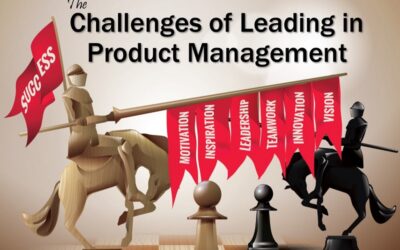
    read more MBA215: The Challenges with Leading in Product Management

    MBA215: The Challenges with Leading in Product Management

    Jan 5, 2021

    Roman Pichler discusses the challenges associated with leading in a Product Management role and what you can do to overcome those challenges.

    read more MBA201: Tips From an Accidental Product Owner

    MBA201: Tips From an Accidental Product Owner

    Nov 5, 2019

    Richard Larson shares his experiences as an accidental Product Owner and provides tips and advice for others moving toward a role in Product Ownership.

    read more « Older Entries

    Thank you for listening to the program

    To get more valuable content to enhance your skills and advance your career, you can subscribe on iTunes.

    Also, reviews on iTunes are highly appreciated! I read each review and it helps keep me motivated to continue to bring you valuable content each week.

    The post MBA068: Realities of Being a Product Owner appeared first on Mastering Business Analysis.


    MBA067: All About the PMI-PBA Certification Apr 12, 2016
    Show notes

    In this episode, Dayle Beyer gives us an overview of PMI’s Professional in Business Analysis (PMI-PBA®) certification. she’ll help us to understand the requirements and benefits of the certification, what the exam covers, and give us some advice on preparing for the exam.

    

    After listening to this episode, you'll understand:

    • What the PMI-PBA® certification is
    • The value of that credential to you and organizations
    • Focus areas that the exam covers
    • How to prepare for the exam
    

    Show Notes

    Many organizations are shifting toward a dual role for Project Managers in which they act as both Project Manager and Business Analyst. PMI’s Professional in Business Analysis (PMI-PBA®) certification is designed for project professionals who play both roles of PM and BA.

    The need for Business Analysis certifications is growing along with the role. The U.S. Bureau of Labor predicts that by 2022, business analysis will increase by 18.6%. Additionally, Business Analysts ranked the highest for wage growth on Glass Door with a 10% increase from 2014 to 2015 and we’re seeing more organizations include certifications in their hiring criteria.

    According to research from the Project Management Institute, in the next five years, more than half of organizations plan to integrate their PM and BA practices. Much of this change is driven by agile adoptions.

    In agile environments, the role of the Business Analyst doesn’t go away; the approach changes. Instead of performing analysis only at the beginning of a project, analysis in done throughout a project and different techniques may be used.

    The PMI-PBA® certification is really about the different kinds of analysis that are needed. This includes needs assessment, analysis planning, traceability, and other analysis tools and techniques. The questions on the exam are situational based and not simply memorization of information in a book.

    Where the International Institute of Business Analysis’s CBAP® certification is geared toward senior business analysts with 7-10 years of experience and includes a deep dive into the BA role, the PMI-PBA® looks at analysis activities at the business level and focuses on what you should consider along with requirements.

    Listen to the full episode to hear all of Dayle’s advice for preparing for and passing the PMI-PBA exam

    http://traffic.libsyn.com/masteringbusinessanalysis/MBA067.mp3

    Your Homework

    Pick a date for the exam and drive toward that date. The hardest part is getting started and picking a date is a great way to motivate yourself.

    Links mentioned in this episode:

    • Dayle’s website
    • Information from PMI about the PBA certification
    • Watermark Learning‘s website
    Dayle Beyer

    Dayle Beyer

    Senior Instructor, Watermark Learning

    Dayle Beyer is a Senior Instructor for Watermark Learning. For over 25 years, she has inspired excellence in thousands of people by providing best practices, tools, and techniques for project management and business analysis. Dayle is a member and active contributor of the Project Management Institute (PMI®) and International Institute of Business Analysis (IIBA®). She is also a frequent speaker at industry events.

    • X
    • LinkedIn

    Related Episode:
    BA Certification

    MBA020: The Value of Certifications

    In this episode, David Mantica, President of ASPE-SDLC, shares his views on the value of professional certifications – both to the individual and to the organization.

    Thank you for listening to the program

    To get more valuable content to enhance your skills and advance your career, you can subscribe on iTunes.

    Also, reviews on iTunes are highly appreciated! I read each review and it helps keep me motivated to continue to bring you valuable content each week.

    The post MBA067: All About the PMI-PBA Certification appeared first on Mastering Business Analysis.


    Previous 1 19 20 21 22 23 28 Next

    Related Podcasts

    Making Sense with Sam Harris

    1

    Making Sense with Sam Harris Education
    Grammar Girl

    2

    Grammar Girl Education
    Good Life Project

    3

    Good Life Project Education
    Explain It to Me

    4

    Explain It to Me Education
    Team Never Quit

    5

    Team Never Quit Comedy
    Optimal Living Daily – Personal Development and Self-Improvement

    6

    Optimal Living Daily – Personal Development and Self-Improvement Alternative Health
    footer-logo

    Contact Us

    Toll Free: 844-670-7747

    Links

    • Home
    • Top Charts
    • Networks
    • Apps
    • Independents Podcasts
    • Podcast Advertising
    • Podcast News
    • Contact Us
    • About Us
    • Analytics & Insights

    Stay Connected

      Privacy, Terms of Use & Our Code of Ethics Protecting Content Creators Copyrights