TopPodcast.com
Menu
  • Home
  • Top Charts
  • Top Networks
  • Top Apps
  • Top Independents
  • Top Podfluencers
  • Top Picks
    • Top Business Podcasts
    • Top True Crime Podcasts
    • Top Finance Podcasts
    • Top Comedy Podcasts
    • Top Music Podcasts
    • Top Womens Podcasts
    • Top Kids Podcasts
    • Top Sports Podcasts
    • Top News Podcasts
    • Top Tech Podcasts
    • Top Crypto Podcasts
    • Top Entrepreneurial Podcasts
    • Top Fantasy Sports Podcasts
    • Top Political Podcasts
    • Top Science Podcasts
    • Top Self Help Podcasts
    • Top Sports Betting Podcasts
    • Top Stocks Podcasts
  • Podcast News
  • About Us
  • Podcast Advertising
  • Contact
Not in our directory?
Add Show Here
Podcast Equipment
Center

toppodcastlogoOur TOPPODCAST Picks

  • Comedy
  • Crypto
  • Sports
  • News
  • Politics
  • True Crime
  • Business
  • Finance

Follow Us

toppodcastlogoStay Connected

    View Top 200 Chart
    Back to Rankings Page
    Education

    Mastering Business Analysis

    Your key to advancing your career as a Business Analyst and beyond

    Advertise

    Copyright: © MasterClass 247 LLC

    • Apple Podcasts
    • Google Play
    • Spotify

    Latest Episodes:
    MBA096: The Standard for Business Analysis Nov 01, 2016
    Show notes

    In this episode, David Bieg, PMI’s Business Analysis & Requirements Program Manager, tells us about PMI’s latest initiative; the development of a foundational standard in Business Analysis. PMI’s goal with this new standard is to provide a definitive body of knowledge for people performing business analysis on projects, programs, and portfolios.

    

    After listening to this episode, you'll understand:

    • Why the Project Management Institute is focused on Business Analysis
    • How the Standard for Business Analysis differs from the Practitioner’s Guide
    • How to apply the information in the Standard for Business Analysis to your work
    

    Show Notes

    The Project Management Institute (PMI) has developed a foundational standard in Business Analysis. With this new standard, PMI hopes to provide a definitive body of knowledge for people performing business analysis on projects, programs, and portfolios.

    The Standard vs. the Practice Guide

    The Standard for Business Analysis differs from the Business Analysis Practice Guide in that the foundational standard defines the “what is” of business analysis and its alignment to project, program, and portfolio management.

    It defines business analysis through identification of the process, tasks, inputs, and outputs of analysis activities.

    The Business Analysis Practice Guide briefly describes the “how to” and puts business analysis in the proper context. It primarily focuses on being a usable reference on how to perform business analysis on projects and programs.

    The Business Analysis Practice Guide will complement the Standard for Business Analysis by allowing practitioners to better understand how and when to use a technique or execute a specific process.

    Drivers Behind the Development of the Standard

    The first driver behind the creation of the Standard for Business Analysis was the success of the Business Analysis Practitioner’s Guide. The overwhelmingly positive response from the community led to further development of business analysis initiatives. The BA Practice Guide validated the appetite for business analysis related guides and standards.

    The second driver was that PMI’s business analysis community expressed an interest in the development of a standard to support the PMI-PBA certification.

    Focusing on Business Analysis

    While PMI has been addressing requirements since the beginning of the institute, there has been more emphasis on requirements and analysis activities in the last few years due to market research showing a growing need for quality requirements and the positive outcomes that can result from business analysis.

    Additionally, poor requirements and related factors have been a leading cause of project failures. As such, business analysis is a critical competency for project, program, and portfolio management.

    By focusing on business analysis, the PMI hopes to increase project success rates through increasing the skills of those performing business analysis activities.

    What to Expect from the Standard for Business Analysis

    The Standard for Business Analysis is for anyone who performs business analysis activities, regardless of their job title or a specific lifecycle (waterfall, Agile, Lean, etc.).

    The profession will be defined by six knowledge areas and 35 processes. It will also include tailoring tables to explain how perform each process an adaptive and predictive setting so that you can adjust your approach based on the lifecycle approach.

    Knowledge areas go from the initial needs assessment through the solution and solution evaluation process.

    The Standard for Business Analysis will also establish a common language for project, program, and portfolio professionals (including Business Analysts).

    Next Steps for the Standard

    The Standard for Business Analysis is going into the subject matter expert review phase in the fourth quarter of 2016 to get feedback from industry experts. It will then go through the public exposure draft review process in the first and second quarter, 2017. The public exposure review will provide the opportunity to for you to give feedback and comments to the development team for further consideration.

    The document will go through an adjudication process and rounds of edits at each phase before final publication in the fourth quarter of 2017.

    Listen to the full episode to hear more about PMI’s Standard for Business Analysis.

    http://traffic.libsyn.com/masteringbusinessanalysis/MBA096.mp3

    Z

    Your Homework

    Get a copy of the Business Analysis Practice Guide, find a new technique, and use that new technique in your work. The more you learn about and apply new techniques, the more tools you’ll have in support of your analysis activities.

    Links mentioned in this episode:

    • The Project Management Institute
    • PMI’s Business Analysis Practice Guide
    David Bieg

    David Bieg

    Bieg & Associates, Inc.

    Dave Bieg has over 30 years of experience in business and information systems and has served as a Program Manager, Business Analyst, and Systems Engineer. He’s currently the Business Analysis & Requirements Program Manager for the Project Management Institute where he leads the development and release of PMI’s Requirements Management initiatives.

    • X
    • LinkedIn

    Thank you for listening to the program

    To get more valuable content to enhance your skills and advance your career, you can subscribe on iTunes.

    Also, reviews on iTunes are highly appreciated! I read each review and it helps keep me motivated to continue to bring you valuable content each week.

    The post MBA096: The Standard for Business Analysis appeared first on Mastering Business Analysis.


    MBA095: Lean Change Management Oct 25, 2016
    Show notes

    In this episode, Jason Little helps us to understand how to use Lean Change Management to create change that sticks.

    

    After listening to this episode, you'll understand:

    • Why most change efforts fail
    • The elements of Lean Change Management that lead to successful organizational change
    • How to use experiments and adapt your change approach
    • Why canvases are a powerful tool in creating change
    

    Show Notes

    Lean Change Management was developed by Jason in an effort to help organizations get unstuck. It’s a mixture of ideas from lean startup, change management, and agile that all build on each other.

    The major difference between Lean Change Management and other change approaches is in the stance that’s taken. Many change approaches are linear whereas Lean Change Management is an iterative, contextualized approach.

    The problem with linear change approaches is that people don’t progress through the stages at the same rates or intensities. People’s reaction to change is unpredictable and rigid, linear change models often fail as a result.

    Jiggle the System

    As a change agent, you look for windows of opportunity to “jiggle” the system to get it unstuck. Part of the Lean Change Management approach is to become aware enough to identify those opportunities.

    One way to jiggle the system is to look at small pieces of the change and plot them against people’s motivation and ability to do it. If people aren’t motivated to make a change or aren’t able to make a change, it’s unlikely that the change effort will be successful.

    Determine how you can make the change easier for people.

    When designing experiments, always consider that there’s motivation, ability, system blockers, and other things going on that will lead to difficulties in making the change.

    Experiment Your Way to Change

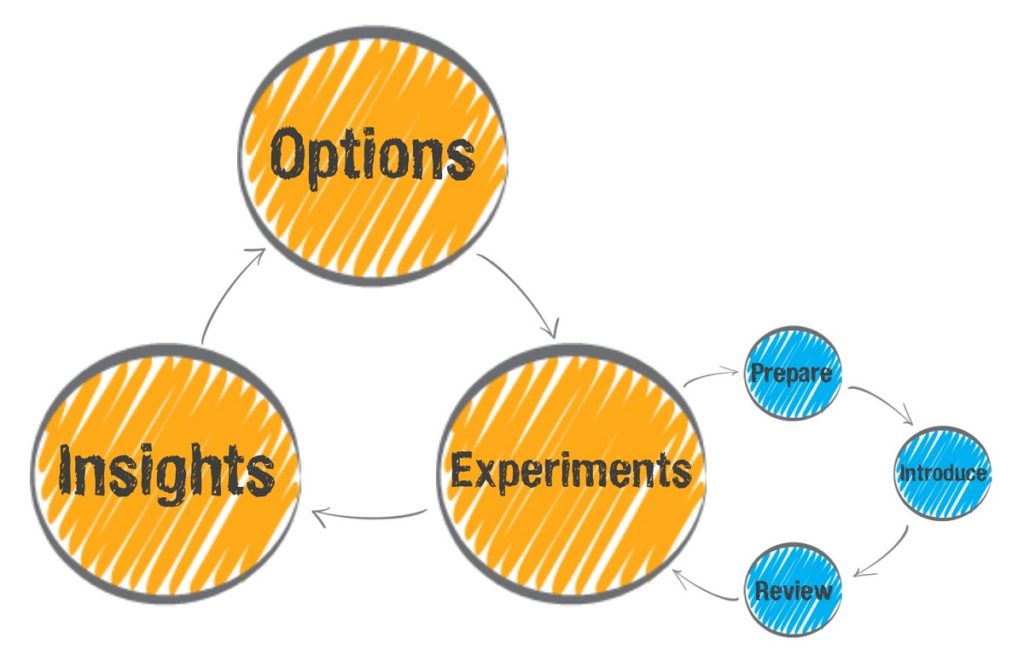
    Start with insights about the change. Insights can come from anywhere; watercooler conversations, change readiness surveys, observations, and more.

    Based on those insights, come up with options to get the organization closer to the future state. Of those options, plot them against cost and value to identify higher value, lower cost options to start.

    Create experiments based on the selected options. Remember that an experiment is a hypothesis and should identify the expected outcome and ways to measure the result. Experiments are really learning opportunities that allow you to adapt your approach.

    Wit experiments, you’ll need to prepare for them, run the experiment, and review the results. Those results may lead to additional insights and the cycle continues.

    While the process seems linear, the process is constant – even multiple times per day if needed.

    Lean Change Management

    Lean Change often succeeds because to the co-creation aspect. The people that have to live with the consequence of the change have a hand in creating the change approach.

    Listen to the full episode for all of Jason’s advice on using canvases and making change stick.

    http://traffic.libsyn.com/masteringbusinessanalysis/MBA095.mp3

    Z

    Your Homework

    Don’t get overwhelmed with a change initiative. Find ways to help people in the organization connect to other people who are having success with a change through small wins, sharing stories, and community building.

    Look at how social change happens and try to apply those same techniques in your organization by connecting people and having them share stories.

    Links mentioned in this episode:

    • Jason’s website LeanChange.org
    Jason Little

    Jason Little

    Jason Little is the author of Lean Change Management and an international speaker who has spoken all over the world from Canada, the US, Finland, Germany, Australia, Belgium and more. Jason has been helping organizations implement Agile practices since 2007 as a Scrum Master, Product Owner, Internal and External Coach.

    • X
    • LinkedIn

    Thank you for listening to the program

    To get more valuable content to enhance your skills and advance your career, you can subscribe on iTunes.

    Also, reviews on iTunes are highly appreciated! I read each review and it helps keep me motivated to continue to bring you valuable content each week.

    The post MBA095: Lean Change Management appeared first on Mastering Business Analysis.


    MBA094: Perspectives in Business Analysis Oct 18, 2016
    Show notes

    In this episode, Peter Leftrov helps us to understand the five Perspectives in the BABOK and how they can help you choose which tools, techniques, and tasks you should use given the specific context of your project.

    

    After listening to this episode, you'll understand:

    • Why the five perspectives were selected for version 3 of the BABOK® Guide
    • How the five perspectives help you understand the context of your specific project
    • How understanding the perspective will help you identify the tasks and techniques needed for your project
    

    Show Notes

    One of the new additions to version 3 of The Business Analysis Body of Knowledge® (BABOK® Guide) is the section on perspectives. These perspectives help us to focus on the techniques and tasks applicable to the context of a specific initiative.

    Perspectives are used within business analysis work to provide focus to tasks and techniques specific to the context of the initiative. Many initiatives will involve one or more perspectives. The five Perspectives in the BABOK® Guide are:

    1. The Agile Perspective
    2. The Business Intelligence Perspective
    3. The Information Technology Perspective
    4. The Business Architecture Perspective
    5. The Business Process Management Perspective

    Understanding the context of your project or initiative and which perspectives apply will help you narrow down the tasks and techniques to use, which allows you to focus more on better business outcomes.

    Listen to the full episode to hear all of Peter’s tips and advice about Business Analysis perspectives.

    http://traffic.libsyn.com/masteringbusinessanalysis/MBA094.mp3

    .

    Z

    Your Homework

    Don’t worry so much about templates and techniques. Instead, focus on your tasks and the value of what you’re doing. With your analysis work, you’re guiding the organization in a positive direction when you focus on value.

    Links mentioned in this episode:

    • Peter’s Website BAConsulting.eu
    Peter Leftrov

    Peter Leftrov

    CBAP, Senior Business Analyst

    Peter Leftrov, CBAP is a Business Analyst with extensive international expertise in stakeholder management, business process management and data integration, business intelligence and business process management. He’s also the co-founder of IIBA’s Bulgaria and Austria chapters.

    • LinkedIn
    IIBA®, BABOK® Guide, and Business Analysis Body of Knowledge® are registered trademarks owned by International Institute of Business Analysis. CBAP® and CCBA® are registered certification marks owned by International Institute of Business Analysis.

    Thank you for listening to the program

    To get more valuable content to enhance your skills and advance your career, you can subscribe on iTunes.

    Also, reviews on iTunes are highly appreciated! I read each review and it helps keep me motivated to continue to bring you valuable content each week.

    The post MBA094: Perspectives in Business Analysis appeared first on Mastering Business Analysis.


    MBA093: Beyond Project Risk Oct 11, 2016
    Show notes

    In this episode, Paula Bell talks to us about risk, and urges us to look beyond typical in-project risks such as time, scope, and budget and adopt a systems thinking approach to risk by identifying organizational risks that may come up as a result of your project.

    

    After listening to this episode, you'll understand:

    • Why it’s important to look beyond in-project risks
    • How your project solution can lead to increased risk across the organization
    • How to address different types of risk
    • Who you need to involve to help address organizational risk
    

    Show Notes

    Managing risk is everyone’s responsibility. Often we have a narrow focus of risk, thinking only about risk to our project and the scope, time, and budget.

    We need to see the bigger picture and take a systems thinking approach to risk by considering the organizational risk that our solution may create.

    If you don’t take organizational risk into consideration, you can create solutions that could potentially put your organization in a bad situation from a litigation, financial, and reputation standpoint.

    Types of Risk

    There are many different types of risk you should consider when thinking about potential solutions to addressing stakeholder needs. Some common types of risk are:

    Operational Risk: This is risk associated with the process and can include breakdowns in internal procedures as well as interactions between people and systems. Consider the impacts your project may have on the processes and procedures that govern operations.

    Financial Risk: This is an umbrella risk covering many related risks such as financing, financial transactions, and loans that put the company at risk of default. Credit risk is the risk that a consumer might default on a debt and may also be considered here. Financial risks may result is a disruption of cash flow or increased costs.

    Compliance Risk: This is the risk of legal sanctions. Failing to comply with regulations may result in financial losses and can have a great impact across your organization.

    Reputational Risk: This is essentially the risk of damage to your brand. Consider how your project’s solution and its upstream and downstream impacts will be perceived by customers and those outside your organization. An increase in other types of risk (operational, financial, compliance, etc.) can increase reputational risk.

    Getting Started

    If you’re new to risk management, start with a few of the most common types of risk and go deep. Think about the impacts your project and other organizational changes will have from a risk standpoint.

    Bring in experts from Legal, Compliance, Information Security, and other areas to provide input as to the risk associated with the change.

    It’s beneficial to bring in representatives from Legal, Compliance, and Risk at the beginning of a project to understand potential impacts and involve them throughout the project; especially at the solution development phase.

    Help representatives to better understand potential risk by providing an overview of the project at the beginning. This helps them to include the appropriate subject matter experts in the project.

    What to Do About Risks

    Once a risk is discovered, take action to address the risk. You can work to mitigate, avoid, or transfer the risk, or even accept the risk if the likelihood and impact is small enough.

    Your partners in Legal, Compliance, and Risk can help you establish appropriate controls to address the risk. This may include new procedures, exception reporting, or changes to requirements.

    If you choose to accept a risk, document it and why you accepted the risk as well as the names of those who approved the acceptance of the risk.

    Think outside the iron triangle of scope, time, and budget to identify and address risks resulting from your change effort.

    Listen to the full episode to hear all of Paula’s advice on having a holistic approach to risk.

    http://traffic.libsyn.com/masteringbusinessanalysis/MBA093.mp3

    Z

    Your Homework

    1) Look beyond the surface and go deeper. As you are working on your project, ask why. Ask “At this step, what could go wrong?” and if there is a risk, determine how you will address the risk.

    2) Identify who your stakeholders are in your Compliance area, your Legal area, and your Risk area. If your organization doesn’t have teams for these areas, find out who has knowledge in those areas so that you can involve them and not put your organization at risk.

    Links mentioned in this episode:

    • Paula’s website paulaabell.com
    • Paula’s episode on Systems Thinking
    • Paula’s episode on Collaboration
    Paula Bell

    Paula Bell

    Paula A. Bell Consulting, LLC

    Paula Bell is a Business Analyst, consultant, mentor, author, and speaker known for providing guidance to aspiring business analysts. She’s held just about every role in a RACI matrix including business analyst, technical writer, project manager, developer, test lead, and product owner.

    Paula is a frequent speaker at industry conferences and writes articles on BA and project related topics.

    • X
    • LinkedIn

    Thank you for listening to the program

    To get more valuable content to enhance your skills and advance your career, you can subscribe on iTunes.

    Also, reviews on iTunes are highly appreciated! I read each review and it helps keep me motivated to continue to bring you valuable content each week.

    The post MBA093: Beyond Project Risk appeared first on Mastering Business Analysis.


    MBA092: Reducing the Risk of Missing Non-Functional Requirements Oct 04, 2016
    Show notes

    In this episode, Roxanne Miller shares her approach to discovering non-functional requirements, which will help reduce the risk of missing requirements.

    

    After listening to this episode, you'll understand:

    • The six activities you can use to reduce the risk of missing non-functional requirements
    • Why missing non-functional requirements can cost an organization millions
    • How to start building a requirements repository to accelerate requirements discovery
    

    Show Notes

    The consequences of missing non-functional requirements can include the inability for users to access a system, allowing the wrong people to access confidential information, and can cost organizations millions of dollars.

    Non-functional requirements (NFRs) describe the attributes of the system such as scalability, maintainability, usability, and security. It’s a type of requirement that specifies the operation of a system rather than functionality.

    To ensure that you discover all of the needed non-functional requirements, Roxanne recommends six activities to reduce the risk of missed non-functional requirements.

    Use a defined classification
    A classification will help stakeholders and the development teams build a consistent language for discussing non-functional needs. Using a classification for your requirements types helps you identify high level types of non-functional requirements that may apply to your project.

    The classifications you and your organization uses will depend of the type of products and services you offer. Example categories include:

    • Security: How well the system is protected against attempts to access information from internal and external sources.
    • Availability: How dependable the system is (e.g., up time).
    • Reliability: How well the software can consistently perform its function without failure.
    • Survivability: How well the system continues to function and recovers after a system failure.
    • Usability: How easily a user is able to learn and operate the system.

    Use a pre-defined list of elicitation questions
    Having a list of pre-defined elicitation questions can increase the productivity of the team. It also helps reduce the time it takes to discover the system requirements and avoid missing requirements.

    You can tie your list of elicitation questions to one of the categories mentioned above for further clarity and organization.

    Use a structure to ask good questions
    Roxanne created the Requirements Framework, which is based on the Zachman Framework developed by John Zachman. It’s tailored for use in eliciting requirements from the perspective of two key roles: requirement suppliers and requirement receivers.

    For each of the two roles, ask questions based on what, who, why, when, where, and how. This helps you to identify:

    • What data or materials are needed?
    • Who needs the data?
    • Why is the data needed?
    • When will the data be used?
    • Where will the data and materials be used?
    • How will the data be used?

    Engage the right stakeholders
    Using a stakeholder profiling technique can help you identify not only who should be involved in requirements elicitation, but also when they should be engaged and expectations from that stakeholder.

    Use Invented Wheels
    Don’t reinvent the wheel. Leverage elicitation questions and non-functional requirements from previous projects so you don’t need to start from scratch.

    Reuse and modify non-functional requirements for previous projects or other systems to fit your project and your needs.
    Use State-of-the-Art Tools
    When possible, use an automated tool to identify software requirements to work faster and more efficiently. There are several software tools available that maintain a repository of questions and sample requirements you can use on your project. They often will help you identify where you may have missing requirements.

    Listen to the full episode to understand the consequences of missed non-functional requirements and how to develop a repository of elicitation questions and NFR examples.

    http://traffic.libsyn.com/masteringbusinessanalysis/MBA092.mp3

    Z

    Your Homework

    Find other Business Analysts or requirements producers and start comparing notes on eliciting requirements. You can then compile and share your predefined list of questions as well as examples of non-functional requirements. This will allow you to start building a repository of non-functional requirements and elicitation questions to accelerate requirements discovery.

    Links mentioned in this episode:

    • Requirements Quest Website
    • Roxanne’s on-demand training
    • Roxanne’s book, The Quest for Software Requirements
    • Roxanne’s Previous Interview (Episode 2)
    Roxanne Miller

    Roxanne Miller

    President, Requirements Quest

    Roxanne Miller is a self-proclaimed Requirements Super Freak and author of he book, The Quest for Software Requirements. She has been involved in the Information Technology industry since 1984 and founded Requirements Quest® in 2001. She has been consulting on requirements process improvement and business analysis practices for over 20 years.

    • X
    • LinkedIn

    Thank you for listening to the program

    To get more valuable content to enhance your skills and advance your career, you can subscribe on iTunes.

    Also, reviews on iTunes are highly appreciated! I read each review and it helps keep me motivated to continue to bring you valuable content each week.

    The post MBA092: Reducing the Risk of Missing Non-Functional Requirements appeared first on Mastering Business Analysis.


    MBA091: Going from Order Taker to Trusted Advisor Sep 27, 2016
    Show notes

    In this episode, Elizabeth Larson helps us along the path going from order taker to trusted advisor and helps us to avoid some of the common pitfalls.

    

    After listening to this episode, you'll understand:

    • Why new Business Analysts are often seen as order takers
    • How to build trust within your organization
    • The three components of the Influencing Formula
    • The right questions to ask to be seen as a trusted advisor
    • Common pitfalls to avoid on your way to becoming a trusted advisor
    

    Show Notes

    We don’t want to be seen as order takers. We want to be seen and sought out as trusted advisors.

    For beginning Business Analysts, it’s common to be viewed as an order taker. Without the skills and experience it’s difficult to do otherwise.

    We need to quickly build our capabilities and realize that our role is to help the organization and provide recommendations. Your role is not necessarily to make decisions but to advise the customer so that they can make the right decisions.

    Trusted advisors define the business need and recommend solutions that provide value to the organization. Order takers have a difficult time with this because they are often given a solution to implement, which they accept and implement.

    When given a solution, a trusted advisor will stop and ensure that we’ve defined the business problem we’re trying to solve or business opportunity we’re trying to seize. They can then explore the current state and determine if the proposed solution is the best option.

    The Influencing Formula

    To go from order taker to trusted advisor, we need to build trust. We can start by building credibility, doing our homework, and truly understanding the current state in the organization and business environment.

    You can also build trust by meeting your customers and end users where they work and actually performing some of the tasks that they do. This gives you a better understanding of how they use the current systems and what their pain points are.

    The most difficult part of going from order taker to trusted advisor is having the courage to speak up. And recommend the right thing to the organization. People may not like hearing what you have to say and we need to have the courage to state our case anyway.

    Another key to becoming a trusted advisor is influence. You need to be able to advise your organization and influence them to make the right decisions. Trust, courage, and influence are all interrelated.

    Questioning Like an Advisor

    Order takers usually ask questions related to the features and functionality of the solution. While those types of questions are important, we need to understand the big picture first.

    Ask ‘why’ in a way that builds trust. When provided with a solution to implement, ask questions to get a better understanding of the underlying problem or opportunity that the solution will address. Also ask questions to understand how your project fits into the overall business objectives.

    Asking the right questions helps you to identify the business need and pain points associated with the current process. All of this allows you to advise the organization on the right solution.

    Pitfalls Along the Path

    Along your journey from order taker to trusted advisors, there are some pitfall you need to avoid.

    Don’t mistake your role as advisor for a decision maker. Your role is to advise and influence, but it’s up to stakeholders and sponsors to make the final decision. Don’t be offended or take it personally if people don’t accept or follow our advice.

    Figure out a good time to reflect on why they didn’t go with your recommendation and determine if you should change your recommendation, try again, or drop it.

    Listen to the full episode for more of Elizabeth’s advice on the right questions to ask and pitfalls to avoid on your way to becoming a trusted advisor.

    http://traffic.libsyn.com/masteringbusinessanalysis/MBA091.mp3

    Z

    Your Homework

    When you’re provided with a solution to implement, practice asking the right kind of questions to better understand the intent of the solution and the current environment.

    Take the time to gather the facts and statistics about the current state so that you’ll be better prepared for conversations and make appropriate recommendations.

    Finally, don’t ask leading questions. Leading questions limit conversations and present a solution. Eliminate the phrase ‘have you thought about’. That phrase breaks trust.

    Links mentioned in this episode:

    • Watermark Learning
    • Elizabeth’s books and publications
    Elizabeth Larson

    Elizabeth Larson

    CEO of Watermark Learning

    Elizabeth is the CEO of Watermark Learning and has over 30 years of experience in business analysis, project management, and influencing skills. Elizabeth’s speaking history includes keynotes and presentations on five continents. Elizabeth has co-authored four books, including the acclaimed CBAP Certification Study Guide and has been cited in CIO Magazine and PM Network, PMI’s monthly publication.

    • X
    • LinkedIn

    Thank you for listening to the program

    To get more valuable content to enhance your skills and advance your career, you can subscribe on iTunes.

    Also, reviews on iTunes are highly appreciated! I read each review and it helps keep me motivated to continue to bring you valuable content each week.

    The post MBA091: Going from Order Taker to Trusted Advisor appeared first on Mastering Business Analysis.


    MBA090: BABOK 3.0 with Richard Larson Sep 20, 2016
    Show notes

    In this episode, Richard Larson helps us explore version 3 of the BABOK® Guide to understand how it can help you and your career.

    

    After listening to this episode, you'll understand:

    • What changes have been made to version 3 of the BABOK® Guide
    • How to use the BABOK® Guide depending on where you are in your career
    • How to get the most out of the BABOK®
    

    Show Notes

    The Business Analysis Body of Knowledge® (BABOK® Guide) represents the evolution of the Business Analyst profession. It creates better awareness in the industry and aligns the language and practice of business analysis.

    The BABOK® Guide has gone through several iterations over the years. The latest version, v3.0, is a huge leap forward.

    Version 3.0 is almost double the size of the previous version. It includes new guidelines added roughly 16 new for a total of 50 techniques. Version 3.0 also adds five different perspectives that give a focus on different specialties within business analysis.

    The BA Core Concept Model is also new to version 3.0 of the BABOK® Guide. An important component of the Core Concept Model is value. It reminds us of why we do our work . . . to add value to the organization. This acts as a beacon so we can ask ourselves “Is what I’m doing now (or is this deliverable) adding value?”

    Using the BABOK® Guide

    You can (and should) use the BABOK® Guide differently depending on where you are in your career.

    For practitioners new to business analysis, start by exploring the business analysis techniques. That will allow you to get perspective on what techniques you can use in different situations. From there, you can begin using some of the techniques and get some practice.

    Later in your career, it can help you not only in understanding some key concepts, but also if you’re looking to earn a certification, the information is essential.

    If you’re managing business analysts, you can use the generally accepted practices in the BABOK® Guide to mature your team.

    Regardless of where you are in your career, the introductory chapters of the BABOK® Guide can really help you focus on some essential ideas. The introductory chapters include key concepts and the Core Concept Model.

    From there, you can pick and choose the sections to explore. Read about tasks or technique as they come up in your work.

    Listen to the full episode to hear all of Richard’s tips and advice about using the BABOK® Guide and certifications.

    http://traffic.libsyn.com/masteringbusinessanalysis/MBA090.mp3

    Z

    Your Homework

    Get a copy of the BABOK® Guide and read it, focusing on value. Doing so will help you understand the value you provide in your role and shifts you toward becoming a value manager.

    Links mentioned in this episode:

    • Rich’s Website Watermark Learning
    • Watermark Learning’s Resources
    • IIBA’s Website for the BABOK
    Richard Larson

    Richard Larson

    Founder and President of Watermark Learning

    Richard Larson is Co-Principal, Founder, and President of Watermark Learning. He has over 30 years of experience in business, project management, business analysis, training,and mentoring. He has presented numerous workshops, seminars, and training classes since 1985 to over 10,000 participants on five continents.

    • X
    • LinkedIn
    IIBA®, BABOK® Guide, and Business Analysis Body of Knowledge® are registered trademarks owned by International Institute of Business Analysis. CBAP® and CCBA® are registered certification marks owned by International Institute of Business Analysis.

    Thank you for listening to the program

    To get more valuable content to enhance your skills and advance your career, you can subscribe on iTunes.

    Also, reviews on iTunes are highly appreciated! I read each review and it helps keep me motivated to continue to bring you valuable content each week.

    The post MBA090: BABOK 3.0 with Richard Larson appeared first on Mastering Business Analysis.


    MBA089: Agile Manifesto – What it Means to Business Analysts Sep 13, 2016
    Show notes

    In this episode, we’ll take a look at the 12 principles of the Agile Manifesto and see what they mean in the context of Business Analysis.

    

    After listening to this episode, you'll understand:

    • How to apply each of the 12 principles of the Agile Manifesto to Business Analysis
    • The mindset shift we need to make to be successful in agile environments
    • What you can do to adopt agile practices, even in waterfall environments
    

    Show Notes

    The principles behind the Agile Manifesto help align mindsets and behaviors to help people shift their thinking. Below are some thoughts on how these principles may be applied in Business Analysis. I encourage you to review the values and principles of the Agile Manifesto for yourself and consider how they can be applied in your context.

    1. Our highest priority is to satisfy the customer through early and continuous delivery of valuable software.

    BAs need to focus on customer priorities and their satisfaction. We can help the team to achieve fast and continuous delivery of software by breaking large requirements down into smaller, valuable chunks that can be delivered in small increments. If you’re working in a waterfall environment, perhaps you can break your project into small phases to deliver valuable pieces sooner.

    If you consider the time value of money, getting working software into the hands of your customer quickly allows them to start seeing some results while waiting for additional functionality and potentially start seeing income sooner.

    Prioritization also comes into play here. We need to understand what capabilities are most valuable to our customers and prioritize the highest value items first, or at least work to understand how to properly prioritize based on things like value, time criticality, risk, cost or effort required, and other factors.

    1. Welcome changing requirements, even late in development. Agile processes harness change for the customer’s competitive advantage.

    As Business Analysts, we need to be transparent about our work products and be open to feedback. Frequent, short feedback loops (ideally based on working software, prototypes, or some other representation of the product) help us to get the critical input from customers that we need to adjust and ensure we deliver exactly what the customer needs and expects.

    Get as close to the customer as you can and give them a way to interact with what you’re building. Use observation, interviews, and other techniques to get feedback and adjust your plans accordingly.

    1. Deliver working software frequently, from a couple of weeks to a couple of months, with a preference to the shorter timescale.

    Frequent delivery of working software helps with the rapid feedback loops I just mentioned and potentially allows your customers or your organization to begin realizing benefits sooner.

    Business Analysts can enable frequent software delivery by breaking requirements into small, valuable chunks as mentioned earlier. We can also use strong communication skills, lightweight prototypes, and visual modeling approaches to quickly create a shared understanding.

    1. Business people and developers must work together daily throughout the project.

    Here’s where our communication and facilitation skills really come in to play. Often, business people and software developers have difficulty communicating.

    Use your skills to bring these two groups together and facilitate a conversation, creating a shared understanding. Foster and promote a collaborative environment in which business people and developers can co-create a valuable solution.

    1. Build projects around motivated individuals. Give them the environment and support they need, and trust them to get the job done.

    This is similar to the last principle in that we need to create a collaborative, open environment. In addition, whenever possible, we need to find motivated people with the right skills for the project team.

    Through stakeholder analysis and sharing a compelling vision of the project, you can help motivate the right people and influence others to support you.

    You’ll also need to understand any roadblocks that the team is facing and work with others to remove the impediment.

    1. The most efficient and effective method of conveying information to and within a development team is face-to-face conversation.

    Most Business Analysts should know and practice this one already. Always use the highest bandwidth form of communication available.

    Email is great for moving files and calendar appointments, but it’s terrible for communicating. You lose all tone and nuances associated with other forms of communication. Not to mention that some people don’t check their email very often.

    Instant messaging is a little better, but you still lose 50-80% of communication through that channel. Using the telephone at least allows you to convey information through verbal cues such as tone, volume, and pace.

    Video allows you to use non-verbal cues and in some cases is almost as effective as face-to-face.

    The highest bandwidth form of communication is face-to-face using a whiteboard or some other visual diagraming format. This allows you to relay the message using verbal and non-verbal cues as well as share ideas with visuals to ensure you have a shared understanding.

    1. Working software is the primary measure of progress.

    As Business Analysts, we need to understand that the value isn’t in the documentation. Documentation is a means to an end. To get to that valuable outcome earlier, we need to keep our documentation as lightweight as possible.

    Do just enough just in time and focus on outcomes rather than outputs.

    Again, breaking requirements into small, valuable pieces helps get working software out the door and into the market.

    1. Agile processes promote sustainable development. The sponsors, developers, and users should be able to maintain a constant pace indefinitely.

    This principle is all about working at a sustainable pace. When you have a project with an impossible deadline, have the courage to speak up and have an open discussion about options.

    Can the scope be reduced? Can the timeline for some pieces of functionality be extended? Can we add more people or better tools?

    An understand of true stakeholder needs and their expected outcomes helps with this conversation, as does building trust before it comes to this point.

    For the team, make sure the vision and expectations are clear and you remove any non-value adding work.

    1. Continuous attention to technical excellence and good design enhances agility.

    The ability to understand the solution architecture and how to start with high quality is essential. Quality starts with a clear understanding of the vision and follows through to requirements before a developer ever touches anything.

    Understand what good requirements look like and create a shared understanding with your team. You can even use mockups, wireframes, lightweight prototypes, and other approaches to get clarity on the design.

    1. Simplicity–the art of maximizing the amount of work not done–is essential.

    This principle aligns to the earlier statement about the need for lightweight documentation and doing just enough. Review all of your tasks and outputs and determine which add value and which don’t.

    You can also look at this principle another way. Are there organizational processes that are overly complex or don’t add value? Use process models, value stream maps, and other tools to simplify processes. That’s a great way to add value to your organization.

    1. The best architectures, requirements, and designs emerge from self-organizing teams.

    Finally . . . a principle that mentions requirements. Good requirements and designs emerge from self-organizing teams.

    Notice the use of the word ‘emerge’. Requirements aren’t something to be gathered like ripe strawberries along a path.

    Not all requirements will be known upfront or be clear right away. Requirements need to be discovered and sometimes they emerge when a team works together to come up with something new.

    The self-organizing part is similar to the principal about building teams around motivated individuals. Use your facilitation skills to create an environment in which a diverse group of people can come together to come up with new and unique solutions.

    1. At regular intervals, the team reflects on how to become more effective, then tunes and adjusts its behavior accordingly.

    To continue to improve your analysis skills, you need to reflect frequently on what you did, how you did it, and outcomes achieved. You can do this on your own or within a team.

    Be open to feedback and accept it in the spirit it’s given; like a gift. And like when you receive a gift, the only response you should have is ‘Thank you’ or perhaps ‘Thank you. Tell me more’.

    Constantly question what could be better in order to continuously improve.

    Most importantly, do something with the feedback. Take action to improve. Continue to refine your skills. Learn, cultivate, and grow.

    Listen to the full episode now!

    http://traffic.libsyn.com/masteringbusinessanalysis/MBA089.mp3

    Z

    Your Homework

    Review the 12 principles of the Agile Manifesto and consider how they apply in the context of your role.

    Links mentioned in this episode:

    • Agile Manifesto
    • Enter to win a 2-day symposium pass to BA World Chicago
    • BA World information
    • Save 25% on training from ASPE

    Thank you for listening to the program

    To get more valuable content to enhance your skills and advance your career, you can subscribe on iTunes.

    Also, reviews on iTunes are highly appreciated! I read each review and it helps keep me motivated to continue to bring you valuable content each week.

    The post MBA089: Agile Manifesto – What it Means to Business Analysts appeared first on Mastering Business Analysis.


    MBA088: Effective Requirements Workshops Sep 06, 2016
    Show notes

    In this episode, Lora McCoy shows us how to run an effective and engaging requirements workshop; a great way to elicit a majority of the requirements for your project all at once.

    

    After listening to this episode, you'll understand:

    • How to keep workshop attendees engaged and focused on the business needs
    • The 5 parts of a requirements workshop
    • What you need to do before, during, and after your workshop to make it successful
    

    Show Notes

    Requirements elicitation workshops are a great way to discover requirements. They’re a key tool you can use to quickly elicit a majority of the requirements on your project. Unfortunately, many workshops don’t get the anticipated value.

    A well run requirements workshop is engaging, valuable, and maybe even fun. To run such a workshop, you’ll need to do a few key things before, during, and after the workshop.

    Effective requirements workshops are made up of five phases:

    • Planning
    • Opening
    • Execution
    • Closing
    • Follow up

    Planning

    The planning phase is where most of the work takes place and is critical for a successful workshop. During planning, you’ll manage not only the meeting logistics such as date and location, you’ll also need to make sure the right people are invited.

    Start by defining the purpose of the meeting. Understanding the scope and having a clear purpose will allow you to perform a stakeholder analysis to determine who should attend the workshop.

    You should also determine the vision and agenda. Given the purpose you identify, what is your vision for the workshop? The vision will lead to agenda items to drive the workshop toward the goal.

    You’ll want to include the purpose, vision, and expectations in the meeting invitation so people can prepare to work towards that vision.

    Opening

    At the start of the requirements workshop, clearly articulate the purpose, vision, and agenda. Of course, you’ll also want to have people introduce themselves, which can be done in a boring or fun way.

    The opening sets the tone for the workshop and helps start the requirements workshop off right.

    Execution

    During the execution phase, you will facilitate the workshop and keep attendees focused on the purpose and vision. You may want to have both a facilitator and scribe as doing both can be difficult.

    Having stakeholders in the room while eliciting and documenting requirements in real time allows for rapid feedback loops so you can make adjustments and ensure correct requirements.

    While executing the workshop, include a lot of activities to keep people moving around and engaged.

    Making use of visuals also helps with gaining clarity among all stakeholders. Think about what type of visuals might be appropriate for the situation. In most cases, you don’t need to create visuals beforehand. It’s powerful to create visuals with others in the workshop.

    Visuals may include mind maps, process flows, or other diagrams that create a shared understanding and allow you to discover requirements along the way. You may be able to get attendees to come to the whiteboard and create these visuals with you. Before long, you may have a room full of highly engaged stakeholders at the board all solving the problem together.

    Closing

    The closing phase is at the end of the workshop and allows you to discuss what was accomplished, what remains to be done, and what the next steps are.

    You’ll want to thank everyone for attending and clearly share what will happen next.

    Follow Up

    The follow up portion of the workshop may occur a day or two afterwards and includes tasks such as distributing action items, notes, or pictures or scheduling additional meetings.

    Listen to the full episode to hear how to get the most out of requirements elicitation workshops – even in Agile environments.

    http://traffic.libsyn.com/masteringbusinessanalysis/MBA088.mp3

    Z

    Your Homework

    Go to the Board

    In your next workshop or meeting, get up out of your seat and use the whiteboard or flip charts. Not only does this create a shared understanding, it also keeps attendees engaged. They can even pick up a marker and co-create the solution.

    Links mentioned in this episode:

    • Connect with Lora via email
    Lora McCoy

    Lora McCoy

    Founder and Principal Consultant at LMc3 Consulting

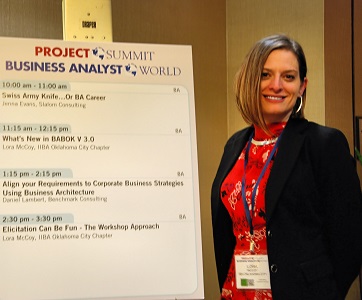
    Lora McCoy is a Certified Business Analysis Professional with over 18 years of experience performing Business Analysis skill set activities as well as Quality Assurance, Project Management, and more. She is dedicated to both the profession and those who perform the skill set for the profession. She currently serves as the President for the Oklahoma City Chapter of the IIBA where she applies that passion to the local membership in the form of mentorship and knowledge sharing. You can contact Lora at LMc3Consulting@gmail.com

    • Facebook
    • X
    • LinkedIn

    Thank you for listening to the program

    To get more valuable content to enhance your skills and advance your career, you can subscribe on iTunes.

    Also, reviews on iTunes are highly appreciated! I read each review and it helps keep me motivated to continue to bring you valuable content each week.

    The post MBA088: Effective Requirements Workshops appeared first on Mastering Business Analysis.


    MBA087: Replaced by a Robot – Interview with Kupe Kupersmith Aug 30, 2016
    Show notes

    In this episode, Kupe Kupersmith warns us that we may be replaced by robots, or if not by robots, how technology makes it possible to outsource your role and what you can do about it.

    

    After listening to this episode, you'll understand:

    • How technology is changing the way we work
    • Why some tasks or even your entire role can be automated or outsourced
    • How technology can expand your career opportunities
    • How to become a more valuable member of your organization
    

    Show Notes

    Can a Business Analyst be replaced by a robot? Machines are now able to solve problems and interact with humans.

    Technology may get to the point where computers can take what a stakeholder says, scan through an incredible amount of data, and come up with a solution far faster than humans. Until then, we need to have the ability to be that resource and have the knowledge to solve problems.

    There are tasks we do today that machines can do. IBM’s Watson was able to interact with people to the point that the users didn’t know they were interacting with a machine. Watson was able to assist and answer questions from graduate students.

    Robots are now able to read emotions and learn the way individuals react emotionally. Kiosks in banks and restaurants are quickly replacing people.

    It’s Not Just Robots

    Other advances in technology make it possible to communicate effectively even if you’re not co-located. This allows organizations to hire the best people regardless of location.

    In effect, this means that the Business Analyst can be outsourced.

    Candidates vying for the same position no longer need to be in the same location as the company. While this means greater competition, it also means greater opportunity. You can look outside your travel radius for careers with great organizations.

    Don’t Just Survive, Thrive

    For our own career survival, we need to get better at using remote communication tools and understand how to work with a geographically dispersed team. Technology is removing the barrier of the need for face-to-face communication and we need to be able to adapt.

    Work at being effective with remote technology, keeping people engaged, and connective at a personal level even when in another location. In the virtual level, we don’t have the same opportunities for accidental hallway conversations to build relationships. We need to be intentional about interacting with others and connect on a personal level.

    Make it a priority to connect and develop relationships. Often we are heads down and don’t focus on people. We even email and send instant messages to people in the same building instead of getting up and talking to them.

    Work is done through people and relationship power is the most effective means of getting things done. When you build strong relationships, you can use your network to influence and gain knowledge that you can’t get by yourself.

    Do What Machines Can’t Do

    Focus on developing skills that a machine can’t do. We need to think and work at a higher level.

    Technology removed the need for face-to-face communication. You now need to focus on how you can add value to your organization. If robots can solve problems, we need to get better at understanding what the right problems to solve are. Approaches such as Design Thinking allow you to understand the problem.

    Elevate your thinking and work to understand what’s happening in the environment and organization to understand the pain points and opportunities (think SWOT analysis).

    If you’re a note taker, a robot can take your job in a heartbeat. We need to think at a higher level and get beyond a solution to implement. Move in the direction of pulling back to understand the problem you’re intending to solve and whether or not it’s the right problem on which you need to focus.

    Listen to the full episode to get all of Kupe’s advice on becoming more valuable and understanding the benefits of technology.

    http://traffic.libsyn.com/masteringbusinessanalysis/MBA087.mp3

    Z

    Your Homework

    Facilitating Decision Making

    Think of your company’s initiatives as a set of decisions to be made and facilitate that decision making. Decisions are: What problem should we go after? What are some solution options? What features should we start with? What should we prioritize? Who needs to be involved?

    This helps you get to the point of just enough analysis. That’s because facilitating decision making helps is understand what work needs to be done (and what shouldn’t be done) and helps you get decisions quickly and move on.

    Links mentioned in this episode:

    • B2T Training
    • BA Times Article Your Next Business Analyst Will Be A Robot
    Kupe Kupersmith

    Kupe Kupersmith

    President, B2T Training

    Kupe is the President of B2T Training and has about 20 years of experience in the business analysis profession. He’s served as the lead Business Analyst and Project Manager on projects in the energy, television, sports management and marketing industries. Kupe is a trained improv actor, a mentor for business analysis professionals, and a frequent speaker at industry conferences.

    • X
    • LinkedIn

    Thank you for listening to the program

    To get more valuable content to enhance your skills and advance your career, you can subscribe on iTunes.

    Also, reviews on iTunes are highly appreciated! I read each review and it helps keep me motivated to continue to bring you valuable content each week.

    The post MBA087: Replaced by a Robot – Interview with Kupe Kupersmith appeared first on Mastering Business Analysis.


    Previous 1 17 18 19 20 21 28 Next

    Related Podcasts

    Making Sense with Sam Harris

    1

    Making Sense with Sam Harris Education
    Grammar Girl

    2

    Grammar Girl Education
    Good Life Project

    3

    Good Life Project Education
    Explain It to Me

    4

    Explain It to Me Education
    Team Never Quit

    5

    Team Never Quit Comedy
    Optimal Living Daily – Personal Development and Self-Improvement

    6

    Optimal Living Daily – Personal Development and Self-Improvement Alternative Health
    footer-logo

    Contact Us

    Toll Free: 844-670-7747

    Links

    • Home
    • Top Charts
    • Networks
    • Apps
    • Independents Podcasts
    • Podcast Advertising
    • Podcast News
    • Contact Us
    • About Us
    • Analytics & Insights

    Stay Connected

      Privacy, Terms of Use & Our Code of Ethics Protecting Content Creators Copyrights