TopPodcast.com
Menu
  • Home
  • Top Charts
  • Top Networks
  • Top Apps
  • Top Independents
  • Top Podfluencers
  • Top Picks
    • Top Business Podcasts
    • Top True Crime Podcasts
    • Top Finance Podcasts
    • Top Comedy Podcasts
    • Top Music Podcasts
    • Top Womens Podcasts
    • Top Kids Podcasts
    • Top Sports Podcasts
    • Top News Podcasts
    • Top Tech Podcasts
    • Top Crypto Podcasts
    • Top Entrepreneurial Podcasts
    • Top Fantasy Sports Podcasts
    • Top Political Podcasts
    • Top Science Podcasts
    • Top Self Help Podcasts
    • Top Sports Betting Podcasts
    • Top Stocks Podcasts
  • Podcast News
  • About Us
  • Podcast Advertising
  • Contact
Not in our directory?
Add Show Here
Podcast Equipment
Center

toppodcastlogoOur TOPPODCAST Picks

  • Comedy
  • Crypto
  • Sports
  • News
  • Politics
  • True Crime
  • Business
  • Finance

Follow Us

toppodcastlogoStay Connected

    View Top 200 Chart
    Back to Rankings Page
    Education

    Mastering Business Analysis

    Your key to advancing your career as a Business Analyst and beyond

    Advertise

    Copyright: © MasterClass 247 LLC

    • Apple Podcasts
    • Google Play
    • Spotify

    Latest Episodes:
    Lightning Cast: Symptoms of Success May 15, 2018
    Show notes

    Are you successful? In this Lightning Cast, we explore what it looks like to be successful as a Business Analyst or Project Manager.

    A Lightning Cast is a shorter form episode modeled after lightning talks. You’ll get valuable content in 8 minutes or less.

    What does success mean to you and are you successful at work?

    Success as a Business Analyst or Project Manager is more than a fancy title, fat paycheck, or a corner office. It has nothing to do with letters after your name for all of the certifications you hold.

    8 Symptoms of Success as a Business Analyst or Project Manager:

    1. There is clarity of role and the value you provide while having the autonomy to determine how to best deliver that value
    2. You have a strong sense of purpose and excited about what you do.
    3. You are constantly learning and challenging yourself.
    4. You see failure as a learning opportunity.
    5. You enjoy helping others to succeed.
    6. You are assertive and confident; you feel safe to speak up and challenge the status quo.
    7. You stay calm under pressure.
    8. Beyond your job duties, you have a clear vision of your career goals and are making progress toward those goals every day.

    Listen to the full episode to understand what success is (and is not) and learn more about the 8 symptoms of success.

    http://traffic.libsyn.com/masteringbusinessanalysis/MBALC020.mp3

    Thank you for listening to the program

    To get more valuable content to enhance your skills and advance your career, you can subscribe on iTunes and other podcatchers.

    Also, reviews on iTunes are highly appreciated! I read each review and it helps keep me motivated to continue to bring you valuable content each week.

    .Subscribe on iTunes Listen on Google Play Music Available on Stitcher Radio Subscribe on Android

    The post Lightning Cast: Symptoms of Success appeared first on Mastering Business Analysis.


    MBA156: The Power of Mentoring May 08, 2018
    Show notes

    Want to take your skills and your career to the next level? A mentoring relationship can do just that. Discover how to find the right mentor and create an effective mentoring relationship.

    

    After listening to this episode, you'll understand:

    • Why mentoring is such a powerful tool for career growth
    • How to find the right mentor for you
    • What to do to start a mentoring relationship
    • When a mentoring relationship should end

    SHOW NOTES

    An effective mentoring relationship can help you to rapidly develop your skills and send your career skyrocketing. The trick is to find a mentor that’s right for you and start that relationship correctly.

    A good mentor guides the mentee through overcoming obstacles and helps the mentee to enhance their skills.

    In the safe environment built by the mentor / mentee relationship, you can try out new things you’re struggling with without fear of failure. Learning and experimenting in this safe space helps the mentee to build confidence.

    The mentee learns and builds skills in an iterative fashion. The iterative learning helps the mentee to build a solid foundation upon which additional skills can be added.

    Finding a Mentor

    The first step in finding a mentor is to recognize that you have skills or areas in which you’d like to grow and having the courage to ask for assistance.

    Finding a mentor can be as easy as speaking with your manager or applying for a mentoring program you may have at work.

    If you feel that a mentor at work wouldn’t meet your needs or if you’re unable to find a mentor at your workplace, you can seek a mentor outside your organization. Having a network outside of work can be a big benefit in finding a mentor.

    Professional organizations such as the IIBA or PMI often have local chapter meetings and are a great source for growing your network and finding mentors.

    Listen to the full episode to find out more about how to find the right mentor and start a mentoring relationship.

    http://traffic.libsyn.com/masteringbusinessanalysis/MBA156.mp3

    YOUR HOMEWORK

    Start looking within your organization and in professional organizations for people with the skills and experience that can help you grow. Once you find someone in your network, ask for mentoring support from that person.

    To prepare for your personal development or mentoring and to focus your conversations, perform a personal SWOT analysis on yourself.

    Links mentioned in this episode:

    • Doug’s website DougGtheBA.com
    • Doug’s previous episode The Real Value of Business Analysis
    • Questions about the IIBA mentoring program: mentoring@gcc.iiba.org
    Doug Goldberg, CBAP

    Doug Goldberg, CBAP

    DougGtheBA.com

    Doug Goldberg is a Certified Business Analysis Professional (CBAP) with more than 23 years of experience. His background includes graphic design, printing, proofreading, typesetting, corporate communications, commercial kitchens, software support, online help development and training, J2EE/Java development, quality tester, and a few other sundry experiences. Doug mentors other business analysts and has a blog at DougGtheBA.com.

    • X
    • LinkedIn

    Thank you for listening to the program

    To get more valuable content to enhance your skills and advance your career, you can subscribe on iTunes and other podcatchers.

    Also, reviews on iTunes are highly appreciated! I read each review and it helps keep me motivated to continue to bring you valuable content each week.

    .Subscribe on iTunes Listen on Google Play Music Available on Stitcher Radio Subscribe on Android

    The post MBA156: The Power of Mentoring appeared first on Mastering Business Analysis.


    MBA155: Hiring BAs and PMs May 01, 2018
    Show notes

    Are you a hiring manager looking for great BA and PM candidates? Find out how to find the best candidates for your organization. Job seekers will discover how to best prepare for a job search.

    

    After listening to this episode, you'll understand:

    • What to do before you open a job requisition
    • The benefits behind the different types of interviews
    • Red flags to watch out for during interviews
    • How job seekers can best prepare for interviews

    SHOW NOTES

    Hiring the right people is the most important task for people managers. If you don’t hire great people, you’ll pay for recruiting mistakes with lower productivity and you’ll need to spend more time coaching and managing them.

    The task of finding and hiring the right people comes in two phases: attracting talent and interviewing.

    Attracting Talent: Current State and Future Needs

    Before you can attract the right candidates, you need to understand what type of people you need. To do that, first think about your company culture, the strengths of your current BAs and PMs, and future skills that you’ll need,

    This will lead you to identifying the skills and competencies you need. From there, you can build the job requirements. When you do this, set a high bar.

    Be a Talent Magnet

    In addition to understanding the strengths and opportunities within your team, set up a referral program. Referrals are your best source for finding talent because great BAs and PMs know other great BAs and PMs.

    As a hiring manager, you should also be on social media building a network and attend meetups and industry events. The connections you make could be a good source of candidates for a future opening.

    Job seekers should also attend local meetups, professional organization meetings (IIBA and PMI chapters), and industry events. Doing so not only allows you to grow your network, it will expand your knowledge and provides an opportunity to improve your personal brand through volunteering or speaking.

    Hiring managers should also be on the lookout for disruptive events such as layoffs and site closures in competing or related organizations. This may be an excellent opportunity to find new talent.

    All of this can be done before you have an opening to fill. If you invest time in attracting great talent to your organization, finding the right candidate will be much easier.

    Interviewing Candidates

    Listen to the full episode to tips and advice on interviewing and selecting the right candidates as well as how to best prepare for an interview.

    http://traffic.libsyn.com/masteringbusinessanalysis/MBA155.mp3

    YOUR HOMEWORK

    Hiring Managers: Start thinking about your organization, its culture, and the current strengths and capabilities of existing Business Analysts and Project Managers. This will help you to understand what you need from future candidates. Start joining local meetups and professional organizations to build your company’s brand (as well as your own).

    Job Seekers: Be active on social media (act professionally) and join local meetups and professional organizations. This will build your network and expand your knowledge.

    Links mentioned in this episode:

    • WIBADD: The Wisconsin Business Analysis Development Day

    Thank you for listening to the program

    To get more valuable content to enhance your skills and advance your career, you can subscribe on iTunes and other podcatchers.

    Also, reviews on iTunes are highly appreciated! I read each review and it helps keep me motivated to continue to bring you valuable content each week.

    .Subscribe on iTunes Listen on Google Play Music Available on Stitcher Radio Subscribe on Android

    The post MBA155: Hiring BAs and PMs appeared first on Mastering Business Analysis.


    MBA154: Change Leadership Apr 24, 2018
    Show notes

    In this episode, you’ll discover ways to help people in your organization adapt to the change associated with a new initiative; a key to successfully overcoming resistance.

    

    After listening to this episode, you'll understand:

    • Why people respond differently to change
    • How to discover where people are on the change curve
    • Ways to help people move from the status quo to a new beginning
    

    Show Notes

    To successfully implement large change initiatives in an organization, you need to go beyond requirements, training, and change management. You need Change Leadership to help people adjust to the change.

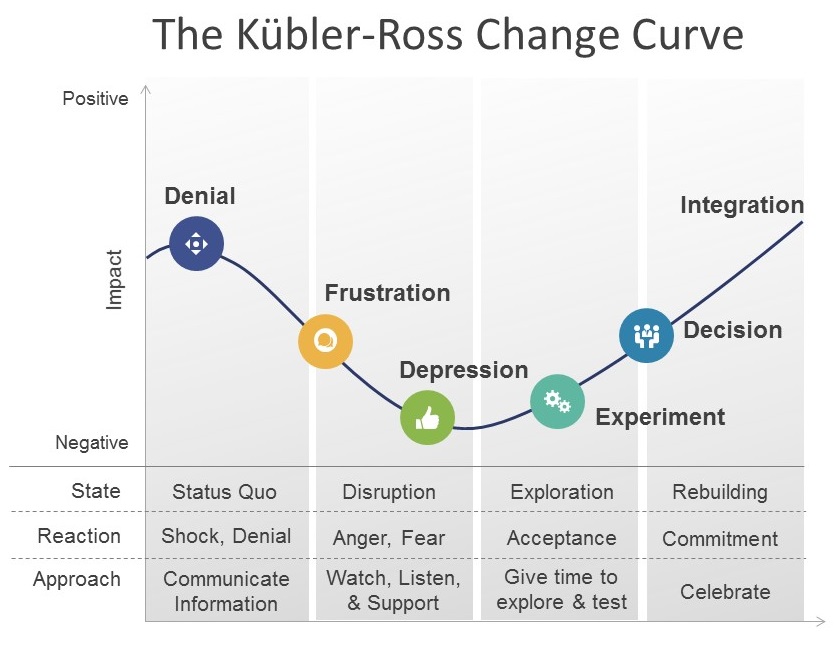
    People affected by a change often have an emotional response to the change. The response can be similar to the stages of grief as represented by the Kubler-Ross Change Curve.

    Kubler Ross Change Curve

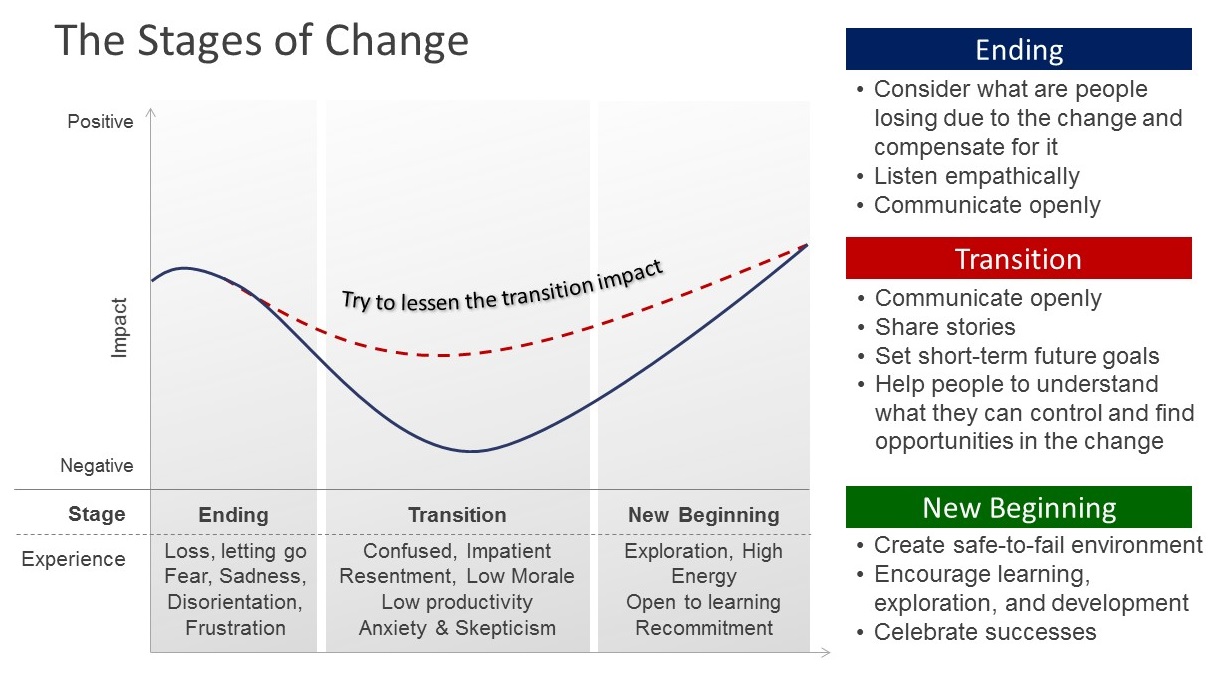
    At each stage of the change curve, you may observe different reactions and emotions. As change agents, it’s our responsibility to help people through the change and lessen the associated drop in productivity and other negative impacts.

    There are actions that we can take to overcome resistance to change if we are able to identify where an individual is on the change curve. Your response should be appropriate for the stage of the change in which an individual finds themselves.

    Are they at the Ending stage where they experience loss and need to let go of the status quo? Are they in the Transition stage battling strong emotions such as fear? Are they in the New Beginnings stage, exploring possibilities and starting to integrate the change into their life?

    Adapting to change

    Listen to the full episode to understand how to identify where people are along the change curve and help them adapt to the change.

    http://traffic.libsyn.com/masteringbusinessanalysis/MBA154.mp3

    Z

    Your Homework

    On your next change initiative, consider the human side. Examine what people are losing as part of the change and help individuals along the change curve.

    Links mentioned in this episode:

    • Save 25% on training from Watermark Learning
    • Get the book Managing Transitions by William Bridges on Audible (new Audible users can get this book free using this link)

    Thank you for listening to the program

    To get more valuable content to enhance your skills and advance your career, you can subscribe on iTunes.

    Also, reviews on iTunes are highly appreciated! I read each review and it helps keep me motivated to continue to bring you valuable content each week.

    The post MBA154: Change Leadership appeared first on Mastering Business Analysis.


    Lightning Cast: BA on a Scrum Team Apr 17, 2018
    Show notes

    In this Lightning Cast, we discuss what a Business Analyst does when on a Scrum team and how you can use your BA skills in a different way to help the team.

    A Lightning Cast is a shorter form episode modeled after lightning talks. You’ll get valuable content in 8 minutes or less.

    Listen to the full episode to understand how a Business Analyst can be a valuable member of a Scrum team.

    http://traffic.libsyn.com/masteringbusinessanalysis/MBALC019.mp3

    Thank you for listening to the program

    To get more valuable content to enhance your skills and advance your career, you can subscribe on iTunes and other podcatchers.

    Also, reviews on iTunes are highly appreciated! I read each review and it helps keep me motivated to continue to bring you valuable content each week.

    .Subscribe on iTunes Listen on Google Play Music Available on Stitcher Radio Subscribe on Android

    The post Lightning Cast: BA on a Scrum Team appeared first on Mastering Business Analysis.


    MBA153: Trends in Business Analysis Apr 10, 2018
    Show notes

    In this episode, Elizabeth Larson talks about current trends in the Business Analysis field and how they will affect you.

    

    After listening to this episode, you'll understand:

    • What key trends are affecting the business analysis field
    • The big news about the BA role in Agile
    • How to stay current and be seen as a Trusted Advisor
    

    Show Notes

    Change is the only constant. To keep up with today’s fast changing environment, we need to keep abreast of current trends and understand how we need to adapt.

    Our role has always been to be management consultants and trusted advisors. We define the real business problem and make recommendations to achieve the business goal.

    With some of the current trends in our industry, Business Analysts will need to use the skills and competencies that we’ve developed, but in a new way.

    Trend 1: The Digital BA

    What is the role of the Business Analyst in a digital transformation? Is a BA still needed?

    To adapt to the trend of digital transformations, our role becomes one of helping organizations introduce cognitive technologies. This includes machine learning and artificial intelligence.

    There are a lot of issues related to the adoption of these technologies and a BA can advise the organization and help them make the right decisions. Questions to ask about adopting cognitive technologies include:

    • Are we getting the right data?
    • What is the data source?
    • How do we interpret the data?
    • What are we doing with the data (from an ethics standpoint)?
    • Does the way we use data change for different cultures or across borders?

    Business Analysts can help organizational leaders understand the impacts, dependencies, and issues relating to data and cognitive technologies. We need to understand the problem the organization is trying to solve and the capabilities of the organization to adopt these technologies.

    This leads to advising on overall organizational strategy and future initiatives based on new capabilities.

    Trend 2: DevOps

    DevOps helps organizations adapt to faster delivery of small changes while mitigating risk to the production environment. It requires a different way of working and the adoption of new tool sets.

    Business Analysts can help with DevOps adoption by advising on the tool chain strategy. We can also help by breaking down organizational silos so that technology and operations teams can communicate more effectively.

    To do this, we need to step outside of the project box and see the entire value stream to make sure the organization is taking advantage of the new tools and DevOps approach.

    Trend 3: Certifications in the Gig Economy

    Many people are turning to short consulting stints instead of long term employment. This trend will continue to grow. With the emergence of the gig economy, are certifications still relevant and how do we need to shift our skills to be more marketable?

    If you’re going out on your own into the gig economy, certifications will give you a leg up. They help provide the assurance to hiring companies of a consistent approach.

    But not all certifications are equal. The trick is to choose relevant certifications.

    Additionally, expanding your skills and knowledge to become a Full-Stack Business Analyst makes you in high demand and opens more opportunities.

    Trend 4: Agile Business Cases

    Organizations often make the mistake of entirely stopping business cases when they transition to Agile. The decisions that come about from a business case are still needed, just in a different form.

    Regardless of the project approach, we still need to answer some basic questions such as “How bad is the problem and is it worth solving?” We can do that analysis formally or informally and it leads to advising the organization to make the right decisions.

    While we need the information in the business case to make the right decisions, we don’t want to take a long time to do it. Instead, build the business case incrementally on smaller pieces and at the right time.

    Trent 5: The Agile Business Analyst

    Many organizations have shifted away from having Business Analysts on Agile teams. However, a recent trend is to bring BAs back into Agile teams and use their skills in a new way.

    There has been a recognition of the value that a Business Analyst can bring to an organization adopting Agile practices. The practitioners might not be called Business Analysts, but the BA skills are critical to success.

    The type of work will shift depending on the time horizon of the work and a mindset shift is needed for BAs to adapt to an Agile way of working.

    Keeping up with these and other trends will allow you to understand how you can shift your skills and continue providing value as a Trusted Advisor.

    Listen to the full episode to understand trends in the business analysis field and what you can do to adapt and thrive.

    http://traffic.libsyn.com/masteringbusinessanalysis/MBA153.mp3

    Z

    Your Homework

    To be a Trusted Advisor, you need to be knowledgeable about industry trends. Invest some time reading and learning about these trends so that you stay informed and can use the information to advise your organization.

    Links mentioned in this episode:

    • Watermark Learning
    • Elizabeth’s books and publications
    • Save 25% on training from Watermark Learning
    Elizabeth Larson

    Elizabeth Larson

    CEO of Watermark Learning

    Elizabeth is the CEO of Watermark Learning and has over 30 years of experience in business analysis, project management, and influencing skills. Elizabeth’s speaking history includes keynotes and presentations on five continents. Elizabeth has co-authored four books, including the acclaimed CBAP Certification Study Guide and has been cited in CIO Magazine and PM Network, PMI’s monthly publication.

    • X
    • LinkedIn

    Thank you for listening to the program

    To get more valuable content to enhance your skills and advance your career, you can subscribe on iTunes.

    Also, reviews on iTunes are highly appreciated! I read each review and it helps keep me motivated to continue to bring you valuable content each week.

    The post MBA153: Trends in Business Analysis appeared first on Mastering Business Analysis.


    Lightning Cast: Powerful Questions Apr 03, 2018
    Show notes

    In this Lightning Cast, we explore Powerful Questions and how they can help you create a new level of discussion, explore new possibilities, and create a true partnership.

    A Lightning Cast is a shorter form episode modeled after lightning talks. You’ll get valuable content in 8 minutes or less.

    Powerful questions are a way to challenge our thinking, stimulating deeper conversations, and uncovering hidden truths. By asking powerful questions, we create a new level of discussion; a greater possibility for new learning. It also creates a sense of true partnership because the person with whom you’re speaking feels heard and understood.

    A powerful question differs from a regular question in a few key ways. Powerful questions:

    • Are open-ended
    • Are clear and concise
    • Evokes deeper thinking
    • Come from a place of curiosity and with a beginner’s mind

    This type of question is considered powerful because it requires a stakeholder (or whomever you’re speaking with) to reflect on their answer and explore new possibilities. They also helps overcome some of our biases that may hinder the ability to make good decisions.

    Weak Questions

    We often ask closed-ended, yes/no type questions that don’t explore the subject in any depth. Even when we ask some open-ended questions that start with who, where, and when, we limit exploration because you’re simply asking for a known answer or list.

    Questions that start with words like why, what, or how require more exploration and can lead to deeper discussions and reveal new learning.

    Make sure your questions don’t have any underlying assumptions which will limit exploration of the real issue.

    Examples of Powerful Questions

    The number one question you should ask is “Why?” This is the more powerful one-word question you can use. Beyond a simple “why”, here are a few powerful questions you can use in different situations.

    Scoping

    • What’s important about that? (or Why is that important?)
    • What if we did nothing at all, what would happen?
    • Why should we make this investment?
    • What would this initiative mean to you, your department, and to the rest of the organization?
    • How does this align to our corporate goals and vision?

    Initial Assessment

    • What would success look like to you and how would we measure it?
    • What would a proof of concept look like? How can we prove this idea?
    • How would this change affect the rest of the organization? What will the impacts be upstream and downstream for this process?

    Background

    • What led up to this problem?
    • What have you tried so far?
    • How do you deal with that problem today?

    Risks

    • What do you think is our biggest risk or roadblock on our way to success?
    • What’s are biggest risk and how do we mitigate it?
    • What are people thinking, but afraid to discuss?
    • What are our options and alternatives if we run into issues?

    Clarification

    • Can you tell me more about that?
    • That’s interesting, what process did you go through to reach that conclusion? (or Can you give me more detail on the logic used to arrive at that?)
    • What will be the key performance indicators for this? How will we measure them, and what hurdles do we need to overcome to be successful?

    Elaboration

    • What else?
    • What concerns do you have about this initiative?
    • What assumptions are we making? How can we challenge some of the assumptions we may be making?
    • Why is this important to you?
    • What haven’t I asked that would be important?
    • Are we missing anything here?

    The Key Trait

    The ability to ask powerful questions is dependent on your curiosity. Ask questions with a beginners mind; with a natural curiosity and an eagerness to learn more so that you can appropriate advise your organization.

    If you want to find powerful solutions and solve the right problems, ask more powerful questions.

    Listen to this episode to understand the power behind powerful questions and how to use them.

    http://traffic.libsyn.com/masteringbusinessanalysis/MBALC018.mp3

    Thank you for listening to the program

    To get more valuable content to enhance your skills and advance your career, you can subscribe on iTunes and other podcatchers.

    Also, reviews on iTunes are highly appreciated! I read each review and it helps keep me motivated to continue to bring you valuable content each week.

    .Subscribe on iTunes Listen on Google Play Music Available on Stitcher Radio Subscribe on Android

    The post Lightning Cast: Powerful Questions appeared first on Mastering Business Analysis.


    MBA152: Finding the Right Project Mar 27, 2018
    Show notes

    In this episode, Richard Larson shares five techniques you can use to discover the underlying problem or opportunity to solve create the right solution.

    

    After listening to this episode, you'll understand:

    • How to find the real problem to solve
    • What to do when you’re given a solution to implement
    • What questions to ask to discover value-creating opportunities
    • Techniques to visually map root causes and options
    

    Show Notes

    Are you always given a solution to implement or do you use your skills to discover the underlying problem to solve? Finding the right project is more than separating needs and wants. Being a Trusted Advisor means digging in and finding the root cause; the underlying problem to solve or opportunity on which we can capitalize.

    Quite often, we implement a project that only partially addresses a problem or create solutions that people never use.

    To become Trusted Advisors, we must focus on real business needs and not just what stakeholders tell you they need. Once you understand the need, a business case can help you recommend the right path for your stakeholders.

    There are several techniques that you can use to discover the underlying problem or opportunity related to the real business need.

    Consultative Interviewing

    Asking the right questions while interviewing stakeholders can help you uncover the underlying need. These types of questions are designed to get stakeholders talking about their true needs and not solutions.

    Your questions should be open ended and avoid leading questions that have a hidden solution in them. This type of question helps your stakeholder to explore the problem more deeply and perhaps find other problems beneath the surface.

    Five Whys

    Another approach for digging deeper and discovering the root cause is the five whys technique. This technique can be used in conjunction with consultative interviewing.

    People are frequently impatient and want to move to the solution. The five whys technique helps people to avoid prematurely talking about a solution and find the true root cause behind their initial request.

    Fishbone Diagrams and Mind Maps

    For a visual way of decomposing a problem to find the root cause or contributing factors, you can use a mind map or a fishbone diagram.

    Both of these techniques support brainstorming and allows you to engage with stakeholders to collaboratively discover causes and effects. These diagrams also provide a more holistic view than simply interviewing stakeholders.

    Mind maps are less hierarchical and more free-flowing than a fishbone diagram while the fishbone diagram provides more structure.

    Pareto Charts

    When you have problems or opportunities where you can use data to understand the situation better, you can use a Pareto Chart to help guide you to selecting the right problem to address.

    Using the Pareto principle, you get 80% of the benefit from solving 20% of the problems. A Pareto chart is a way of visualizing the data to understand where the biggest impact is.

    This gives you the means to prioritize your backlog to work on the most valuable things first and prevent some of our biases from influencing prioritization.

    Interrelationship Diagrams

    For more complex problems, Interrelationship Diagrams allow you to see the different parts of a problem and how they might interact with each other. It helps you better understand causes and effects when changing different factors related to a problem.

    This technique supports systems thinking by giving you a holistic view of the problem, the contributing factors, and the relationships between those factors.

    Similar to the Pareto Chart, you should address the most impactful contributing factor you discover with the Interrelationship diagram.

    The goal with all of these techniques is to discover the real problem or opportunity and address the underlying causes.

    Listen to the full episode to get all of Richard’s tips for discovering the real problem or opportunity behind your project.

    http://traffic.libsyn.com/masteringbusinessanalysis/MBA152.mp3

    Z

    Your Homework

    Choose one of the approaches that Richard mentioned and learn more about it. Once you have a basic understanding of the techniques, find a safe environment to practice using it.

    Links mentioned in this episode:

    • Rich’s Website Watermark Learning (Listen to this episode to get a 25% discount)
    • Watermark Learning’s Resources
    Richard Larson

    Richard Larson

    Founder and President, Watermark Learning

    Richard Larson is Co-Principal, Founder, and President of Watermark Learning. He has over 30 years of experience in business, project management, business analysis, training,and mentoring. He has presented numerous workshops, seminars, and training classes since 1985 to over 10,000 participants on five continents.

    • X
    • LinkedIn

    Thank you for listening to the program

    To get more valuable content to enhance your skills and advance your career, you can subscribe on iTunes and other podcatchers.

    Also, reviews on iTunes are highly appreciated! I read each review and it helps keep me motivated to continue to bring you valuable content each week.

    .Subscribe on iTunes Listen on Google Play Music Available on Stitcher Radio Subscribe on Android

    The post MBA152: Finding the Right Project appeared first on Mastering Business Analysis.


    Lightning Cast: Order your Backlog Mar 20, 2018
    Show notes

    A clear, well-ordered backlog leads to more focus, less time in refinement, and delivering the most important items first. In this Lightning Cast, you’ll find out how to order your backlog.

    A Lightning Cast is a shorter form episode modeled after lightning talks. You’ll get valuable content in 8 minutes or less.

    WHY ORDERING YOUR BACKLOG IS IMPORTANT

    There are many reasons why having a healthy, ordered product backlog is important to teams.

    1. An ordered backlog gives the team clarity as to what the next most important thing to do is. This brings focus to the team and helps them to limit work in progress (WIP), which in turn helps accelerate delivery.
    2. By focusing on the most important items, if the team is unable to finish everything that they forecast they’ll be able to complete, they’ll complete the most important work first and any incomplete work will be less important.
    3. Ordering the backlog is helpful in helping you identify which backlog items the team needs to refine to a ready state. Items at the top of the backlog should be in a ready start while items further down can have decreasing levels of clarity. Ordering the backlog helps keep refinement meetings short and focused.

    WHEN TO ORDER THE BACKLOG

    Ordering the backlog is not a one-time event. The team must review priorities regularly and update the backlog order. The backlog should be re-ordered whenever we learn new information. This includes:

    • For Scrum teams, after the Sprint Review / Demo when you receive stakeholder feedback
    • When the team identifies dependencies between backlog items
    • As items are added or removed from the backlog
    • As time changes; priorities may change based on urgency and cost of delay

    As organizational priorities change, the order of items in the backlog may change. This does not imply that one backlog item is more important than another item; it simply means that one item needs to be completed sooner than another item to meet program or organizational priorities.

    It’s important to note that the backlog is not a To Do list. The intention is not to complete all the backlog items in order. Teams must continually seek feedback, learn, and adapt their approach and priorities, which the backlog should change frequently.

    Once a team commits to an iteration (Sprint) plan, the priority of the committed backlog items should not change.

    APPROACHES TO ORDERING YOUR BACKLOG

    There are several ways to order the product backlog.

    MoSCoW Prioritization: Gain initial clarity by considering how each backlog item contributes to the Minimum Viable Product (MVP) and then separate backlog items into one of four categories:

    • Must Have
    • Should Have
    • Could Have
    • Won’t Have (at this time, but would like in the future)

    Value Based Prioritization: Consider the impact each backlog item will have on customers and the outcomes it will produce. Items that contribute more value or create better outcomes should be done first. When ordering by value, you should also consider:

    • dependencies between backlog items
    • size and cost of delay (prioritize smaller items with a higher cost of delay first)
    • risk (you may elect to attempt high risk items earlier so you can adapt if needed)
    • learning (if there is uncertainty, you may prioritize a few backlog items that allow for learning opportunities)

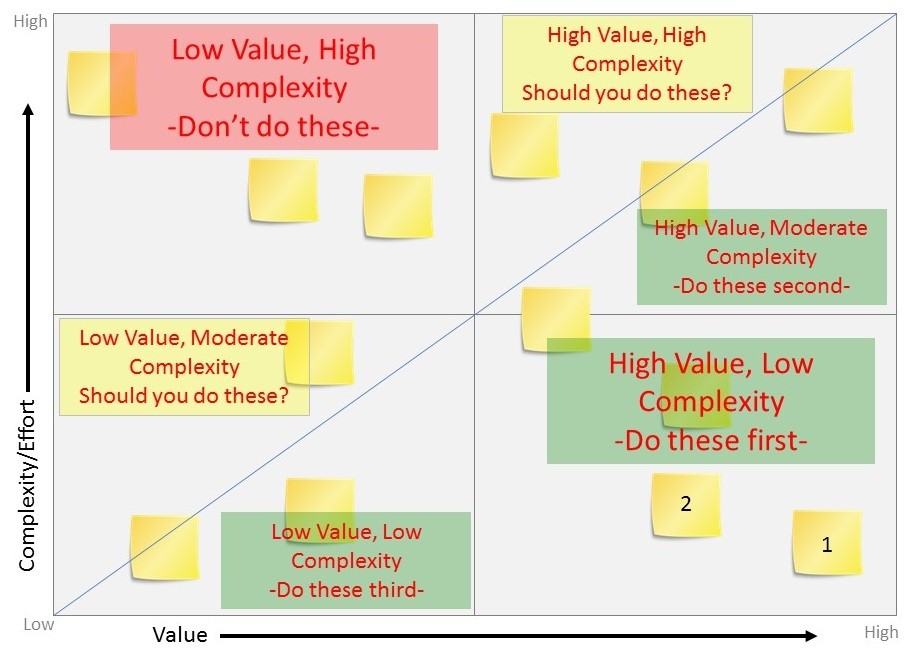
    Value-Complexity Matrix: When ordering your backlog, it’s helpful to consider both customer/business value as well as the effort and complexity needed to deliver that value. A rapid, visual way of ordering your stories, features, or initiatives is with a Value-Complexity Matrix.

    A Value-Complexity Matrix allows you to plot backlog items across two dimensions – business value and complexity/effort. You should add each backlog item to the matrix relative to others (e.g., items higher in value are farther right and items that are more complex or require more effort are plotted higher on the matrix).

    The example below shows a Value Complexity Matrix. You can use this tool with the entire team to gain a shared understanding or as an initial step by the Product Owner to understand high level priorities and what should/should not be considered.

    Backlog items that are high value and low complexity should be done first. These are quick wins that add a lot of value. Items high in value and moderate complexity should be done next. Low value, low complexity items can be considered next.

    For backlog items that are low in value and moderate complexity or high value and high complexity, you should carefully consider if they are worth doing or if there’s a simpler implementation that can bring value.

    Backlog items that are low value and high complexity should not be done unless absolutely required (e.g., regulatory). If that’s the case, explore how to simplify or reduce the effort needed.

    Value-Complexity Matrix

    Value Complexity Matrix

    ORDERING BUSINESS VS. TECHNICAL PRODUCT BACKLOG ITEMS

    As you continue implementing features, the system must scale and code needs to be refactored to ensure a stable platform. Additionally, architectural changes may be needed to enable future features and capabilities.

    Teams will need to balance delivery of business intent with the need to maintain code and build the architectural runway to enable future enhancements. To address the need for technical changes, there are a few approaches you can take.

    • Dedicate a certain percentage of team time to resolving technical debt
    • Look for ways to incorporate technical debt or advancement work into feature builds
    • Add enabler features and technical stories to your backlog which account for the development of architecture and prioritize those backlog items in addition to business intent.
    • Dedicate a percentage of time or stories to ensure both technical and business backlog items can be delivered (e.g., 70% business intent, 30% technical intent)
    • Plot technical backlog items along with business items on the Value-Complexity Matrix while considering the value of technical items as enabling future opportunities or reducing risk.

    When ordering your backlog, it’s important that the team has a shared understanding about the value (the ‘why’) of items so that there’s alignment and focus. Start by eliminating that which you shouldn’t do at all and then order remaining backlog items by considering value, effort, dependencies, risk, and cost of delay.

    A clear, well-ordered backlog leads to more focus, less time in refinement, and delivering the most important items first.

    Listen to this lightning cast for help ordering your backlog.

    http://traffic.libsyn.com/masteringbusinessanalysis/MBALC017.mp3

    Thank you for listening to the program

    To get more valuable content to enhance your skills and advance your career, you can subscribe on iTunes and other podcatchers.

    Also, reviews on iTunes are highly appreciated! I read each review and it helps keep me motivated to continue to bring you valuable content each week.

    .Subscribe on iTunes Listen on Google Play Music Available on Stitcher Radio Subscribe on Android

    The post Lightning Cast: Order your Backlog appeared first on Mastering Business Analysis.


    MBA151: Your Consulting Practice – with Karl Wiegers Mar 13, 2018
    Show notes

    In this episode, author, consultant, and thought leader Karl Wiegers shares his tips and advice on getting started with consulting.

    

    After listening to this episode, you'll understand:

    • The difference between consulting and contract work
    • How to build a personal brand
    • The pros and cons of going it alone
    • How to get up to speed quickly in a new environment
    

    Show Notes

    Have you ever thought about leaving your corporate job and starting your own consulting business? There’s a lot to consider; finances, travel, finding new clients, etc.

    The upside is that you can potentially make more money as an independent consultant and you’ll have more freedom. Striking out on your own also comes with challenges.

    Even if you don’t want to leave your corporate job go it alone, Karl shares his tips on building your personal brand, getting up to speed quickly on a new project, and more information that you can use.

    Listen to the full episodes to understand the benefits and challenges with striking out on your own as a consultant as well as tips you can use in your current role.

    http://traffic.libsyn.com/masteringbusinessanalysis/MBA151.mp3

    Z

    Your Homework

    Take an inventory of all of the intellectual property that you have available that may be valuable to your perspective clients. This includes templates, processes, checklists, spreadsheet tools, whitepapers, and presentations.

    After you have an inventory, think about how you can use that intellectual property in multiple ways.
    Be sure to respect ownership and copyrights associated with any materials.

    Links mentioned in this episode:

    • Karl’s personal website KarlWiegers.com
    • Process Impact website ProcessImpact.com
    • Karl’s books on Amazon
    Karl Wiegers

    Karl Wiegers

    Principal Consultant at Process Impact

    Karl Wiegers is an independent consultant, author, speaker, and thought leader in the project community. His books on software requirements are considered required reading for Business Analysts and Project Managers. As a consultant and trainer, Karl has worked with more than 100 companies and government organizations of all types, helping them improve the effectiveness and efficiency of their software development activities. Additionally, his publications have been recognized as helpful contributions to the domains of software requirements, process improvement, project management, and quality improvement.

    • X
    • LinkedIn

    Thank you for listening to the program

    To get more valuable content to enhance your skills and advance your career, you can subscribe on iTunes and other podcatchers.

    Also, reviews on iTunes are highly appreciated! I read each review and it helps keep me motivated to continue to bring you valuable content each week.

    .Subscribe on iTunes Listen on Google Play Music Available on Stitcher Radio Subscribe on Android

    The post MBA151: Your Consulting Practice – with Karl Wiegers appeared first on Mastering Business Analysis.


    Previous 1 9 10 11 12 13 28 Next

    Related Podcasts

    Making Sense with Sam Harris

    1

    Making Sense with Sam Harris Education
    Grammar Girl

    2

    Grammar Girl Education
    Good Life Project

    3

    Good Life Project Education
    Explain It to Me

    4

    Explain It to Me Education
    Team Never Quit

    5

    Team Never Quit Comedy
    Optimal Living Daily – Personal Development and Self-Improvement

    6

    Optimal Living Daily – Personal Development and Self-Improvement Alternative Health
    footer-logo

    Contact Us

    Toll Free: 844-670-7747

    Links

    • Home
    • Top Charts
    • Networks
    • Apps
    • Independents Podcasts
    • Podcast Advertising
    • Podcast News
    • Contact Us
    • About Us
    • Analytics & Insights

    Stay Connected

      Privacy, Terms of Use & Our Code of Ethics Protecting Content Creators Copyrights