TopPodcast.com
Menu
  • Home
  • Top Charts
  • Top Networks
  • Top Apps
  • Top Independents
  • Top Podfluencers
  • Top Picks
    • Top Business Podcasts
    • Top True Crime Podcasts
    • Top Finance Podcasts
    • Top Comedy Podcasts
    • Top Music Podcasts
    • Top Womens Podcasts
    • Top Kids Podcasts
    • Top Sports Podcasts
    • Top News Podcasts
    • Top Tech Podcasts
    • Top Crypto Podcasts
    • Top Entrepreneurial Podcasts
    • Top Fantasy Sports Podcasts
    • Top Political Podcasts
    • Top Science Podcasts
    • Top Self Help Podcasts
    • Top Sports Betting Podcasts
    • Top Stocks Podcasts
  • Podcast News
  • About Us
  • Podcast Advertising
  • Contact
Not in our directory?
Add Show Here
Podcast Equipment
Center

toppodcastlogoOur TOPPODCAST Picks

  • Comedy
  • Crypto
  • Sports
  • News
  • Politics
  • True Crime
  • Business
  • Finance

Follow Us

toppodcastlogoStay Connected

    View Top 200 Chart
    Back to Rankings Page
    Education

    Mastering Business Analysis

    Your key to advancing your career as a Business Analyst and beyond

    Advertise

    Copyright: © MasterClass 247 LLC

    • Apple Podcasts
    • Google Play
    • Spotify

    Latest Episodes:
    MBA163: Lean Six Sigma – What You Should Know Jul 24, 2018
    Show notes

    In this episode, you’ll discover how Lean Six Sigma can help you bring value to your organization and be a differentiator for your career.

    

    After listening to this episode, you'll understand:

    • What Lean Six Sigma is and how it’s different than Six Sigma
    • Why reducing variation is critical
    • How learning Lean Six Sigma can boost your career

    SHOW NOTES

    Lean Six Sigma is a methodology that you can use to improve performance by removing waste and reducing variation. It combines practices from lean and lean manufacturing with Six Sigma to eliminate waste and ensure quality.

    Listen to the full episode to understand how to get started with Lean Six Sigma and how it may help you in your career.

    http://traffic.libsyn.com/masteringbusinessanalysis/MBA163.mp3

    YOUR HOMEWORK

    Start getting familiar with the terminology and tools of Lean Six Sigma. The “Dummy” series of books is a good place to start.

    Links mentioned in this episode:

    • Vince’s website: http://www.vincentmirabelli.com/
    • Vince’s Lean Six Sigma training: http://www.vincentmirabelli.com/learn/training-workshops/

    The first 10 people to get Vince’s training and use code MBA150 will get $150 off his new training, Lean Six Sigma for BAs and PMs. Use code MBA50 for $50 off if you’re not one of the first 10 people to use the other code.

    Vincent Mirabelli

    Vincent Mirabelli

    Vince Mirabelli is a project and process improvement speaker, trainer and coach. In addition to his speaking and training, Vince is a PMP, CBAP, Lean Six Sigma Master Black Belt certified, and holds a Masters certification in Business Analysis. You can learn more about Vince on his website, vincentmirabelli.com

    • X
    • LinkedIn

    Thank you for listening to the program

    To get more valuable content to enhance your skills and advance your career, you can subscribe on iTunes and other podcatchers.

    Also, reviews on iTunes are highly appreciated! I read each review and it helps keep me motivated to continue to bring you valuable content each week.

    .Subscribe on iTunes Listen on Google Play Music Available on Stitcher Radio Subscribe on Android

    The post MBA163: Lean Six Sigma – What You Should Know appeared first on Mastering Business Analysis.


    Lightning Cast: Moving to a BA Role Jul 17, 2018
    Show notes

    In this Lightning Cast, you’ll find out how to transition to a Business Analyst role.

    A Lightning Cast is a shorter form episode modeled after lightning talks. You’ll get valuable content in 8 minutes or less.

    People often ask me how they can become a Business Analyst or how to transition from role X to a BA role. I have past episodes with Alex Papworth and Laura Brandenburg on this topic, but because this is such a frequently asked question, I’ve summarized some key ways you can get the skills to move to a Business Analyst role.

    Being successful as a BA takes knowledge and skills learned through practice and feedback. But this is a chicken or egg problem; it’s difficult to get a role as a business analyst without experience as a business analyst.

    Keep in mind that even if you don’t have the title of Business Analyst, you may still be doing business analysis work that’s applicable to the role.

    According to the BABOK® Guide version 3.0,

    “A business analyst is any person who performs business analysis tasks described in the BABOK® Guide, no matter their job title or organizational role. Business Analysts are responsible for discovering, synthesizing, and analyzing information from a variety of sources within an enterprise, including tools, processes, documentation, and stakeholders.”

    If your organization already has Business Analysts, start by looking at BA roles with your current employer and see if there are opportunities to shadow effective Business Analyst. Network with current BAs and offer help them. Ask if you can shadow or observe them as they work to learn more about the role. In fact, building and expanding your network is always a good idea; connecting with people in different departments, subject matter experts, and others who you may need support from in the future can help even if your career goals change.

    You can also review procedures and documentation from past projects within your organization. You may find outputs such as process flows, models, requirements documents, and other resources that will help you get a feel for how to perform the BA role.

    Look for opportunities with volunteer organizations and others that might benefit from your skills. Offering your time and services for free can allow you to build your experience and benefit organizations that need it most.

    If you’re in another role and want to transition to a BA role, think about the skills and experience you’ve in your current role or in your past that you can leverage. Do you have experience doing the kinds of things that a business analyst does? You may have experience in communicating with stakeholder groups, facilitating meetings, mapping business processes, or subject matter expertise developed in working with the software your organization uses.

    To find out what skills and experience will be relevant, it helps to look at job postings for the type of job you want. From there, you can reflect on your past experience and identify the skills and knowledge you’ve gained that aligns to business analysis.

    If you’re still missing some required skills, you can find ways to build your competencies and apply those skills. You can read books such as the BABOK® Guide, watch videos, listen to podcasts, and find other resources to help you fill in your skill gaps.

    Of course, joining local professional organizations such as the International Institute for Business Analysis (IIBA) or the Project Management Institute (PMI) gives you the opportunity to talk to other professionals to learn more about their role as well as what skills and techniques are needed to be successful.

    Thank you for listening to the program

    To get more valuable content to enhance your skills and advance your career, you can subscribe on iTunes and other podcatchers.

    Also, reviews on iTunes are highly appreciated! I read each review and it helps keep me motivated to continue to bring you valuable content each week.

    .Subscribe on iTunes Listen on Google Play Music Available on Stitcher Radio Subscribe on Android

    The post Lightning Cast: Moving to a BA Role appeared first on Mastering Business Analysis.


    MBA162: The Business Analyst Role and its Real Value Jul 10, 2018
    Show notes

    In this episode, Glenn Brule discusses the Business Analyst role, its real value proposition, and what you can do to increase the value you provide to your organization.

    

    After listening to this episode, you'll understand:

    • The real value proposition of the Business Analyst role
    • How to engage reluctant stakeholders
    • What you can do to deliver more value

    SHOW NOTES

    While great facilitation, communication, workshops, and stakeholder engagement are important, there’s a lot more to business analysis. We need to focus on the key fundamentals that drive value to our organizations.

    At the end of the day, all roads lead to money. A Business Analyst drives outcomes that have a financial impact. Whether it’s revenue growth or avoiding fines and lost revenue, a BA can ensure successful outcomes that have positive impact on an organization’s finances.

    The Business Analysis Value Spectrum

    The Guide to the Business Analysis Body of Knowledge (BABOK v3.0) includes the concept of the Business Analysis Value Spectrum. Interestingly, planning and monitoring, requirements lifecycle management, elicitation, and collaboration aren’t part of the value spectrum.

    While those skills and techniques are critically important in the world of business analysis, they’re not at the heart of it.

    The three knowledge areas that are at the heart of the Business Analysis Value Spectrum are Strategy Analysis, Requirements Analysis, and Design Definition and Solution Evaluation.

    Through those three knowledge areas, we’re looking at the current state, creating efficiencies, and developing valuable solutions. That translates to money for the organization.

    As Business Analysts, we need to pay attention to the quality of requirements and the quality of process models, business rules, and data models. Without quality, we can’t achieve the positive financial outcomes our organizations expect and need to survive.

    Don’t Take on Everything Alone

    You need to avoid taking the weight of the world on your shoulders when it comes to projects. If you try to do everything on your own, you’ll fail every time.

    We can’t be experts in everything. The expectation is that you’re an expert in business analysis.

    If you’re not working with your subject matter experts, the business units, designers, and the development team, you’re going to miss some of the critical requirements, business rules, or other necessary pieces of information to create the desired outcome.

    Don’t sit at your desk writing requirements on your own. Instead, use collaborative and iterative approaches to ensure the quality of what you produce.

    Don’t stand in front of a room of stakeholders and act as a scribe. Engage your stakeholders and get them to do some of the heavy lifting related to requirements. Engage them in a manner that empowers them to uncover some of the problems or opportunities that we can then craft into great models and requirements.

    Listen to the full episode to hear all of Glenn’s tips and advice on providing more value to your organization and find out what to do when stakeholders are disengaged or you’re given a solution to implement instead of a problem to solve.

    http://traffic.libsyn.com/masteringbusinessanalysis/MBA162.mp3

    YOUR HOMEWORK

    1. Look closely at your set of tools and techniques you use on a regular basis and ask yourself if you’re efficient in using those tools. Is there a better tool you can use to identify efficiencies in your organization? Do you understand what you are trying to accomplish and is there a tool for that?

    2. Muster up the courage and find ways to engage stakeholders to the extent that they’re doing the heavy lifting when it comes to requirements.

    3. Remember that the weight of the world doesn’t rest on your shoulders. Tap into other subject matter experts in your organization to help with gaining efficiencies and getting clarity around relevant data points.

    4. Don’t do everything at once; do things incrementally. Start with different levels of abstraction by starting at a high level and going deep where needed iteratively.

    Links mentioned in this episode:

    • Glenn’s website – Slide21.com
    Glenn Brûlé

    Glenn Brûlé

    Glenn Brûlé has more than two decades of focused business analysis experience and works directly with his clients to build and mature their business analysis capabilities. As a founding board member of the IIBA® and former Vice President, Chapters, Glenn drives the advancement of the BA profession globally. Glenn is also an author, speaker, and he’s a regular contributor to Modern Analyst and BA Times as well as other industry publications.

    • X
    • LinkedIn

    Thank you for listening to the program

    To get more valuable content to enhance your skills and advance your career, you can subscribe on iTunes and other podcatchers.

    Also, reviews on iTunes are highly appreciated! I read each review and it helps keep me motivated to continue to bring you valuable content each week.

    .Subscribe on iTunes Listen on Google Play Music Available on Stitcher Radio Subscribe on Android

    The post MBA162: The Business Analyst Role and its Real Value appeared first on Mastering Business Analysis.


    MBA161: Evolution of the BA Role Jul 03, 2018
    Show notes

    In this episode, you’ll discover the next step in the evolution of the role of the Business Analyst and if Agile spells the end of the BA role.

    

    After listening to this episode, you'll understand:

    • The origins of Business Analysis
    • Why context is important when considering your responsibilities
    • What to do to increase the value you provide in your current role
    • If Agile means the end of the BA role

    SHOW NOTES

    Origins of Business Analysis

    The role of the Business Analyst stemmed from gaps in understanding between different groups and a need for a holistic viewpoint.

    In the early 80s, the role of a Systems Analyst started to become prevalent. The Systems Analyst is responsible for analyzing the technology as a whole and ensuring that all of the pieces work will together.

    But that’s only part of the puzzle. While the technology works well, we aren’t necessarily creating solutions that meet the needs of our organizations or our customers. As a result, a new type of analyst emerged from the business side of organizations; a Business Analyst.

    The Business Analyst focuses on the needs and wants of the customers and the business . . . Not just the technical aspects, but how the two pieces fit together.

    The problem that these first BAs were trying to solve is that there’s a gap between the different parts of an organization; usually between business and technology. The different terms and language that each area uses leads to gaps in understanding.

    To fill this gap, the first Business Analysts became translators between business teams and technology teams. From this role, BAs started to become a bridge. A bridge between business and technology. Between the problem and the solution.

    As the role continues to evolve and Business Analysts add more value, the role is starting to be seen as more of a consultant or trusted advisor; someone with subject matter expertise who people can go to for advice and who can make recommendations.

    This shift requires BAs to move from the tactical to the strategic. We need to be more forward-looking and understand not only needs and wants, but also our organization’s capabilities, the environment in which we operate, and what our competitors are doing.

    Provide Move Value

    A big part of what BAs do is to find ways to bring more value to our organizations. How we do that depends on the context of our role.

    Are you working in a traditional environment or an Agile Environment? Are you imbedded in a project team/development team or do you operate outside the team?

    Listen to the full episode to understand how you can add more value to your organization in your current contect and understand what’s next for the Business Analyst role.

    http://traffic.libsyn.com/masteringbusinessanalysis/MBA161.mp3

    YOUR HOMEWORK

    Think about the immediate next step in the evolution of your current role and do one thing that will increase the value you provide to your organization and to its customers.

    Links mentioned in this episode:

    • Dude’s Law
    • The BA Career Path

    Thank you for listening to the program

    To get more valuable content to enhance your skills and advance your career, you can subscribe on iTunes and other podcatchers.

    Also, reviews on iTunes are highly appreciated! I read each review and it helps keep me motivated to continue to bring you valuable content each week.

    .Subscribe on iTunes Listen on Google Play Music Available on Stitcher Radio Subscribe on Android

    The post MBA161: Evolution of the BA Role appeared first on Mastering Business Analysis.


    Lightning Cast: Dude’s Law Jun 26, 2018
    Show notes

    In this Lightning Cast, you’ll find out what you can do to increase the value of products and solutions developed by your organization by using Dude’s Law.

    A Lightning Cast is a shorter form episode modeled after lightning talks. You’ll get valuable content in 8 minutes or less.

    How can you help increase the value of solutions that your team builds?

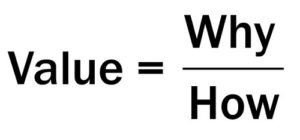
    First, let’s define value. We can represent value a simple formula created by David Hussman called Dude’s Law. Dude’s Law states that Value equals Why divided by How.

    Value = Why / How

    ‘Why’ refers to why we’re developing this solution. What’s the problem you’re trying to solve and how critical is it?

    ‘How’ refers to how you’ll achieve the intended outcome. This can mean things like the technical solution, lines of code, or documentation.

    As you can see by the formula, we can increase value if we increase the Why or reduce the How.

    Increasing Value

    We can increase the value of the solution by finding a bigger Why. By prioritizing what we work on, we can ensure that the most important (biggest Why) items are done first.

    Another way to increase the Why is to explore if the product can be applied to solve other pain points or enable opportunities to expand its use by other customers.

    We can reduce the How by thinking outside the box and exploring simple ways of achieving the intended outcome for the customer. Think about the simplest thing you can do to achieve the Why.

    Another way to reduce the How is to simplify or reduce the outputs needed to achieve the outcome. Can you reduce the amount of documentation and have a conversation instead? Does that process flow need to be in Visio or will a picture of a whiteboard drawing be sufficient?

    By using Dude’s Law, we can truly do less and achieve more. What will you do to increase the value of your organization’s products and services?

    Listen to the full episode to understand how to increase value in your organization.

    http://traffic.libsyn.com/masteringbusinessanalysis/MBALC022.mp3

    Thank you for listening to the program

    To get more valuable content to enhance your skills and advance your career, you can subscribe on iTunes and other podcatchers.

    Also, reviews on iTunes are highly appreciated! I read each review and it helps keep me motivated to continue to bring you valuable content each week.

    .Subscribe on iTunes Listen on Google Play Music Available on Stitcher Radio Subscribe on Android

    The post Lightning Cast: Dude’s Law appeared first on Mastering Business Analysis.


    MBA160: The Art of Better Business Requirements Jun 19, 2018
    Show notes

    In this episode, author and consultant Alyce Reopelle challenges some of the practices and assumptions about requirements elicitation.

    

    After listening to this episode, you'll understand:

    • Why a subject matter expert may not be the best person to elicit requirements
    • The impact of assumptions and how to avoid them
    • How to overcome the curse of knowledge

    SHOW NOTES

    A tactic that organizations often use is to assign a subject matter expert (SME) to elicit requirements for a project. This approach makes sense as a SME will understand the systems and processes impacted by the project and will likely discover and refine the requirements faster.

    But what is this conventional wisdom is wrong? What if the best person to elicit requirements is someone who knows nothing about the current state or the processes and products?

    The reality is that experts often make assumptions and fail to ask crucial questions. They enter a situation with an expert’s mind; a scenario in which there are few options for a solution. Instead, we need to have a beginner’s mind. With a beginner’s mind, the options are unbound by preconceived notions. We are free to ask insightful questions and imagine new possibilities.

    Listen to the full episode to find out how to approach situations with a beginner’s mind and fight some of the assumptions that lead to gaps in requirements.

    http://traffic.libsyn.com/masteringbusinessanalysis/MBA160.mp3

    YOUR HOMEWORK

    Watch our for and avoid words that describe requirements but can’t be tested. When you hear words such as fast, user friendly, or big, challenge stakeholders to quantify what they mean and get a clear understanding of the need.

    Links mentioned in this episode:

    • Alyce’s article, Perfecting the Art of Better Business Requirements
    • More articles by Alyce Reopelle
    Alyce Reopelle

    Alyce Reopelle

    Author and Consultant

    Alyce is a PMP certified consultant and contributing author for Project Management for Today. She has over 20 years of project management experience with a passion for helping organizations grow their PMO, their project managers, and their teams.

    • LinkedIn

    Thank you for listening to the program

    To get more valuable content to enhance your skills and advance your career, you can subscribe on iTunes and other podcatchers.

    Also, reviews on iTunes are highly appreciated! I read each review and it helps keep me motivated to continue to bring you valuable content each week.

    .Subscribe on iTunes Listen on Google Play Music Available on Stitcher Radio Subscribe on Android

    The post MBA160: The Art of Better Business Requirements appeared first on Mastering Business Analysis.


    Lightning Cast: Business Agility Jun 12, 2018
    Show notes

    In this Lightning Cast, you’ll discover what you can do to help your organization achieve business agility; the ability to quickly adapt to changes and rapidly deliver value.

    A Lightning Cast is a shorter form episode modeled after lightning talks. You’ll get valuable content in 8 minutes or less.

    Does your organization have Business Agility? Can they quickly adapt to changing conditions to meet their customer needs? Without Business Agility, your organization will struggle in today’s fast changing environment.

    What is Business Agility?

    The concept of Business Agility goes beyond Agile practices. I describe it as the ability to quickly adapt to meet customer needs and provide the right products to customers at the right time.

    The elements of Business Agility are:

    1. Time to market
    2. Customer Value
    3. Innovation

    With these three capabilities in place, you get an organization that can quickly deliver solutions that customers need and develop new products to meet future needs.

    Time to Market

    With a faster time to market, your organization will have a first mover advantage. You can also increase profits when you consider the time value of money (money or solutions now are more valuable than that same money/solution at a later date). This allows your organization to begin earning revenue sooner.

    You can help reduce time to market by accelerating requirements discovery. Actions such as breaking down organizational silos, talking directly to customers, and rapid prototyping helps to speed communication and create a shared understanding. The goal is to learn rapidly and move to delivery.

    Another way to reduce time to market is to accelerate delivery. We can do that by breaking things down into small, valuable, vertically-sliced chunks. We can also define the Minimum Viable Product (MVP) and Minimum Marketable Features (MFF) to help prioritize what the team should work on.

    DevOps practices also accelerate delivery by allowing teams to put solutions into production and into the hands of customers sooner.

    Customer Value

    The second element of Business Agility is customer value. This implies that we understand what customers want and what they would find valuable.

    To find out what’s valuable to our customers, we can work to better understand customers and use some of the approaches from the Lean Startup to test, learn, and adapt. We want to rapidly discover what’s valuable and get it to our customers.

    Value also implies that we’re delivering with quality. Small chunks of high-quality solutions are better than full-blown solutions with a lot of bugs.

    To ensure quality, we also need to ensure that our requirements are testable and we consider non-functional requirements.

    Innovation

    Even if your organization can quickly deliver solutions that customers currently find valuable, you won’t last long if you don’t experiment to discover products with may be valuable in the future. This is where innovation comes in.

    To innovate with purpose, we can take a scientific approach by formulating a hypothesis and running small experiments that we can test.

    Innovating with purpose requires a solid understanding of your customers, the current (and potential future) environment, your organizations capabilities, their competition, and industry trends. The ability see connections between these different dimensions and formulate a hypothesis about what may be valuable in the future leads to better innovation.

    Listen to the full episode to discover how you can help your organization achieve Business Agility.

    http://traffic.libsyn.com/masteringbusinessanalysis/MBALC021.mp3

    Thank you for listening to the program

    To get more valuable content to enhance your skills and advance your career, you can subscribe on iTunes and other podcatchers.

    Also, reviews on iTunes are highly appreciated! I read each review and it helps keep me motivated to continue to bring you valuable content each week.

    .Subscribe on iTunes Listen on Google Play Music Available on Stitcher Radio Subscribe on Android

    The post Lightning Cast: Business Agility appeared first on Mastering Business Analysis.


    MBA159: Experiment Driven Development Jun 05, 2018
    Show notes

    In this episode, you’ll discover how to use hypotheses and experiments to identify the right solutions that meet customer needs.

    

    After listening to this episode, you'll understand:

    • Why traditional approaches often lead to the wrong solution
    • How to use hypotheses and experiments to discover the right solution
    • How to craft experiments that are testable

    SHOW NOTES

    One of the biggest problems that we face today is that we’re often given a solution to implement. Unfortunately, that solution doesn’t always meet customer needs and results in shelfware; a product that customers won’t use.

    Instead of making assumptions and building an untested product, we can use the scientific method to discover the right solution for our customers.

    Experiment Driven Development is a more mature way of thinking about Agile methods. Traditionally in Agile, we use a backlog comprised mainly of User Stories. With Experiment Driven Development, you may still have User Stories, but that’s not where we start. Even with Agile methods, it’s entirely possible to build the wrong product.

    Using a scientific approach to discovering the right product for our customers allows us to ensure we’re delivering valuable solutions.

    Instead of starting with a User Story or epic, we start with a hypothesis. From there, the work items become experiments to prove or disprove the hypothesis. This frames solution development in the “plan, do, check, act” model and allows us to quickly validate solutions and avoid waste.

    To use Experiment Driven Development, follow these three steps:

    1. Start your development with a testable hypothesis
    2. For your highest priority hypothesis, identify the smallest experiment(s) that will prove or disprove it
    3. Run the experiments

    This approach allows you to get rapid feedback and decide whether to pivot in a new direction or persevere on your current path.

    Nordstrom Innovation Lab video:

    https://youtu.be/szr0ezLyQHY

    Listen to the full episode to understand why Experiement Driven Development is so powerful and how to start using this approach.

    http://traffic.libsyn.com/masteringbusinessanalysis/MBA159.mp3

    YOUR HOMEWORK

    For your next feature, instead of documenting that feature in a traditional way, define it as a hypothesis and perhaps a few small experiments that could validate the hypothesis.

    Links mentioned in this episode:

    • Agile Velocity website
    Mike Hall

    Mike Hall

    Senior Agile Coach/Trainer at Agile Velocity

    Mike Hall is an Enterprise Agile Coach/Trainer with 16 years of Agile transformation experience. In addition to holding 10 patents issued by the US Patent Office, he has practical experience in leading enterprise scaled Agile transformations for all types of organizations (including startups) and speaks at industry comferences.

    • X
    • LinkedIn

    Thank you for listening to the program

    To get more valuable content to enhance your skills and advance your career, you can subscribe on iTunes and other podcatchers.

    Also, reviews on iTunes are highly appreciated! I read each review and it helps keep me motivated to continue to bring you valuable content each week.

    .Subscribe on iTunes Listen on Google Play Music Available on Stitcher Radio Subscribe on Android

    The post MBA159: Experiment Driven Development appeared first on Mastering Business Analysis.


    MBA158: Agile Requirements May 29, 2018
    Show notes

    In this episode, we’ll explore Agile requirements and answer the question “Are User Stories requirements?”

    

    After listening to this episode, you'll understand:

    • How requirements in Agile differ from Traditional environments
    • Why User Stories are a popular approach
    • How to be effective with User Stories
    • Whether or not User Stories are requirements

    SHOW NOTES

    We’ve explored the differences in approaches to requirements elicitation and management in an Agile environment compared to a traditional approach before. While you can use many of the same tools and techniques, the focus is different.

    In an Agile context, we adopt a Lean mindset and value outcomes over outputs. We want to achieve positive business outcomes while minimizing the amount of outputs (e.g., documents) we create. This may mean a shift from large Business Requirements Documents (that no one reads) to whiteboard drawings, conversations, pictures, and minimal documentation.

    Making this change requires a mindset shift and a change in our approach. Instead of eliciting all of the requirements up front, we discover thinks in small increments. This allows us to create fast feedback loops and adjust as we deliver solutions.

    Through progressive elaboration, we increase the level of detail of the requirements incrementally. Near term items will be more detailed and better defined than items that are farther away or lower priority. This approach avoids the waste of detailing out information that will likely change as we learn more.

    Types of Agile Requirements

    There are many different approaches to articulating requirements in an Agile environment.

    Some teams use Jobs To Be Done or Job Stories, which create an understanding of your customer’s goals or purpose when using products. Other teams may use Use Case 2.0, which is a way of developing use cases to show system interactions that is well suited for an Agile environment.

    Hypothesis Driven Development is gaining in popularity as a way of discovering the true needs and desires of your customers. By starting with a hypothesis and crafting experiments, you are able to test assumptions about your products and customers.

    The most popular way to document and create a shared understanding about what you’re building and why is User Stories. However, you may also have technical stories and other enablers in your backlog as well.

    User Stories

    User Stories are powerful because they move us from writing requirements to discussing requirements. They allow us to have a customer-centric focus and maximize outcomes while minimizing outputs.

    When we think about applying User Stories, we keep the Three C’s in mind. Card, Conversation, and Confirmation.

    Card refers to the 3×5 index card upon which you would traditionally write your User Stories. This means that User Stories are intended to be small. They are placeholders to have a conversation in the future or a reminder of a conversation you’ve already had.

    The second C, Conversation, is critical. We can’t write something down, hand it off to someone, and expect them to develop the solution you intended. We need to have a conversation. That’s why User Stories are intentionally small and concise.

    The final C is Confirmation. This refers to the acceptance criteria. The acceptance criteria (conditions of satisfaction) helps us to clarify understanding, lets us know when the User Story is done, and makes sure it’s testable.

    Note that although User Stories are small and conversations are key, you can still include supporting artifacts with User Stories if needed. Artifacts can include pictures of whiteboard drawings, critical specifications or design decisions, and mock-ups.

    Listen to the full episode to find out more about requirements in an Agile context and whether or not User Stories are requirements.

    http://traffic.libsyn.com/masteringbusinessanalysis/MBA158.mp3

    Links mentioned in this episode:

    • International Institute of Business Analysis (IIBA)

    Thank you for listening to the program

    To get more valuable content to enhance your skills and advance your career, you can subscribe on iTunes and other podcatchers.

    Also, reviews on iTunes are highly appreciated! I read each review and it helps keep me motivated to continue to bring you valuable content each week.

    .Subscribe on iTunes Listen on Google Play Music Available on Stitcher Radio Subscribe on Android

    The post MBA158: Agile Requirements appeared first on Mastering Business Analysis.


    MBA157: The Importance of Good Data Analysis May 22, 2018
    Show notes

    In this episode, Ali Cox helps us to understand the importance of good data analysis and how to get started.

    

    After listening to this episode, you'll understand:

    • How to use data to your organization’s advantage
    • Why ignoring data can be detrimental to your organization
    • Simple tools to use in data analysis
    • How to find the right data to analyze

    SHOW NOTES

    Data analysis is not technical. While there are some technical aspects to it, it’s really about understanding your organization’s data so that you can help make good decisions and bring value by further refining those decisions based on good data.

    Your organization’s business processes, business rules, and use cases have associated data. If you don’t have a good understanding of that data or what data is needed bring value to that process, then the process can fail or you may make bad decisions about that process.

    Often as Business Analysts, sponsors hand us a product or a solution to implement. Unfortunately, we sometimes fail to ask why. How do we know that the product or solution is the right decision and the right thing to implement? Without data, our organization may be making bad decisions and wasting time and money.

    Within your organization, you have a lot of data and work with. You have data about your customers, data about your staff and their capabilities, data about your products, and data for metrics. Using this data can help your organization make good decisions.

    Starting Your Data Analysis

    When you first get into a project, the first thing you should do is look for the data. Creating a data dictionary or glossary when talking to stakeholders will help you to better understand the meaning of the data.

    When looking at a business process, you can identify the business rules associated with that process and the data that drives those rules. What data is used in the process? What reports are people looking at, what data is on the reports, and what does it mean?

    Start looking for metrics especially if you are trying to improve a process. Those metrics can be included in your current state analysis as well as part of the success criteria. You can use those metrics to identify the best improvement opportunities.

    If you fail to identify and establish baseline metrics, you’ll be limited in your ability to understand if your efforts were successful or if you sell the right problem.

    When you’re using an Agile approach, you can use the iterations to get feedback and analyzes data to determine if adjustments are needed.

    Applying the Data

    Once you have the data, Ali recommends building a data model. You can use the data and create a diagram to show the information that you elicit from the stakeholders and the relationships between the data.

    After you have the data and have identified the relationships, you can then determine what details you need to understand about the data. How much you need to know about the data or how much should you know?

    This allows you to better understand the business rules around the data and how the data impacts of business process.

    Consider what decisions your business needs to make. Once you understand what kind of decisions they need to make to be successful, then you can begin to determine the data you’ll need to help make better decisions.

    It’s Not Technical

    The data needed to make good decisions isn’t technical. It’s business data.

    You likely won’t need special tools to capture and analyze the data. You can use something as simple as pen and paper or a white board. Often, Excel or Visio are the most complex tools you may need.

    If your organization has big data systems and you don’t have the technical knowledge to use them, you can always pair with data scientists and other technical experts in your organization to draw meaning from the data and ask the right questions.

    The key to success in data analysis isn’t the tool. It’s about understanding what the data means to the business and what data you need to make better decisions.

    Listen to the full episode to understand why data analysis is critical to success and more examples of the type of data you should analyze on your next initiative.

    http://traffic.libsyn.com/masteringbusinessanalysis/MBA157.mp3

    YOUR HOMEWORK

    If you’re newer to business analysis or data analysis, start looking at your business data. On your next project, start looking at the data. Create a glossary or data dictionary and use that information to ensure that you understand the terms and acronyms that stakeholders use.

    If you’re a more experienced analyst, push for good analysis of the data. Make sure that the entire team understands the importance of data and try building a data model. Work to understand the relationships between the data and the underlying metadata.

    Links mentioned in this episode:

    • B2T Training website
    Ali Cox

    Ali Cox

    General Manager and Senior Instructor for B2T Training

    Alison Cox is senior instructor and general manager of B2T Training. She has over 30 years of experience in business analysis and project management. Ali has provided consulting and training in business analysis and project management for everything from small companies to Fortune 500 corporations worldwide.

    • LinkedIn

    Thank you for listening to the program

    To get more valuable content to enhance your skills and advance your career, you can subscribe on iTunes and other podcatchers.

    Also, reviews on iTunes are highly appreciated! I read each review and it helps keep me motivated to continue to bring you valuable content each week.

    .Subscribe on iTunes Listen on Google Play Music Available on Stitcher Radio Subscribe on Android

    The post MBA157: The Importance of Good Data Analysis appeared first on Mastering Business Analysis.


    Previous 1 8 9 10 11 12 28 Next

    Related Podcasts

    Making Sense with Sam Harris

    1

    Making Sense with Sam Harris Education
    Grammar Girl

    2

    Grammar Girl Education
    Good Life Project

    3

    Good Life Project Education
    Explain It to Me

    4

    Explain It to Me Education
    Team Never Quit

    5

    Team Never Quit Comedy
    Optimal Living Daily – Personal Development and Self-Improvement

    6

    Optimal Living Daily – Personal Development and Self-Improvement Alternative Health
    footer-logo

    Contact Us

    Toll Free: 844-670-7747

    Links

    • Home
    • Top Charts
    • Networks
    • Apps
    • Independents Podcasts
    • Podcast Advertising
    • Podcast News
    • Contact Us
    • About Us
    • Analytics & Insights

    Stay Connected

      Privacy, Terms of Use & Our Code of Ethics Protecting Content Creators Copyrights