Our TOPPODCAST Picks
 Audio narrations of LessWrong posts. Includes all curated posts and all posts with 125+ karma.
If you’d like more, subscribe to the “Lesswrong (30+ karma)” feed.

 Stay Connected
Audio narrations of LessWrong posts. Includes all curated posts and all posts with 125+ karma.
If you’d like more, subscribe to the “Lesswrong (30+ karma)” feed.
Copyright: © 2023 LessWrong Curated Podcast


Two new The Information articles with insider information on OpenAI's next models and moves.
They are paywalled, but here are the new bits of information:
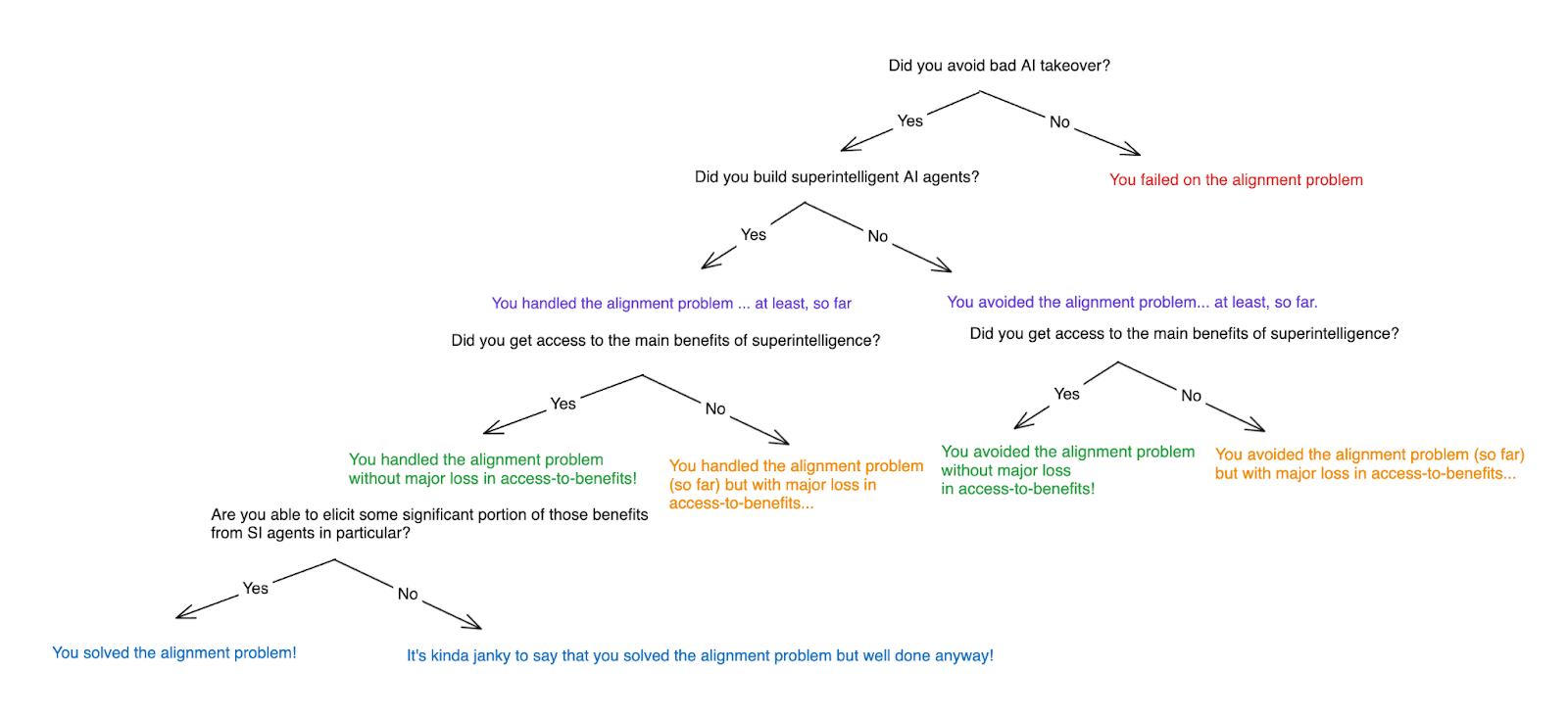
People often talk about “solving the alignment problem.” But what is it to do such a thing? I wanted to clarify my thinking about this topic, so I wrote up some notes.
In brief, I’ll say that you’ve solved the alignment problem if you’ve:
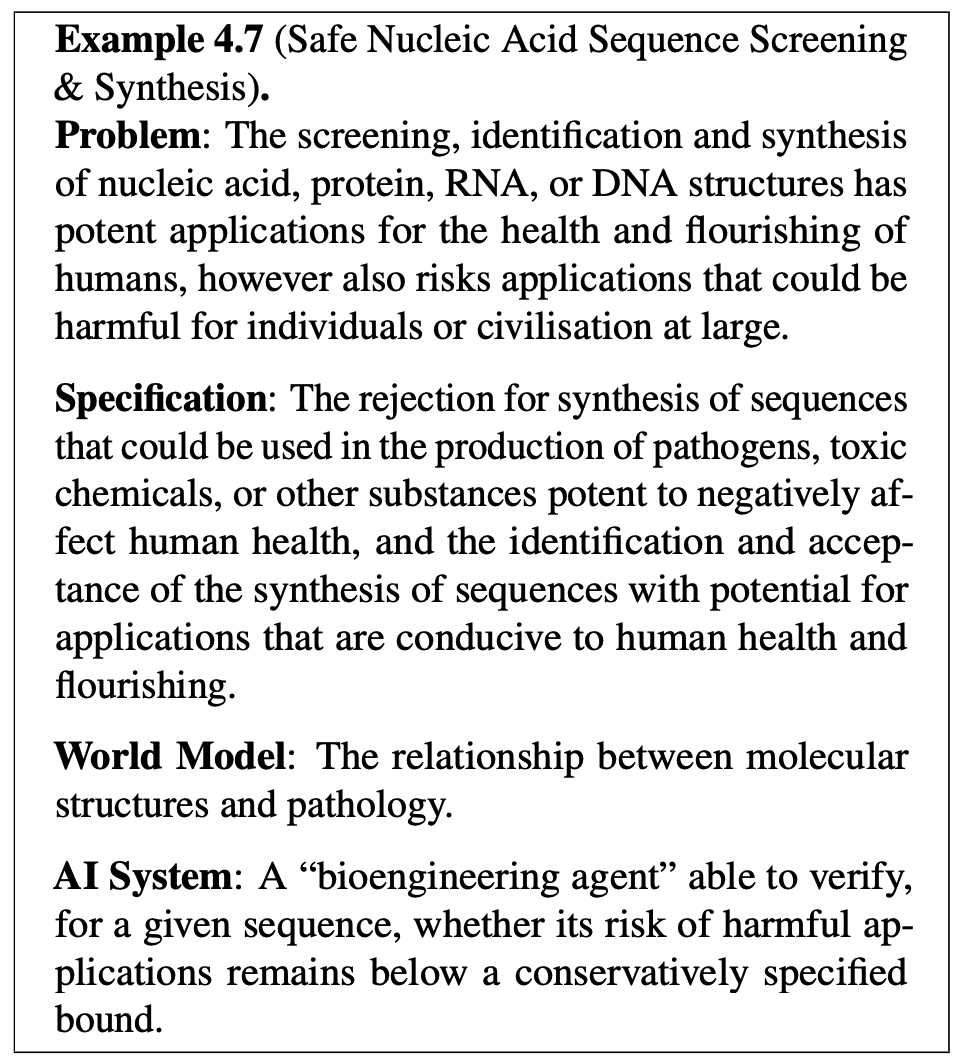
In the past two years there has been increased interest in formal verification-based approaches to AI safety. Formal verification is a sub-field of computer science that studies how guarantees may be derived by deduction on fully-specified rule-sets and symbol systems. By contrast, the real world is a messy place that can rarely be straightforwardly represented in a reductionist way. In particular, physics, chemistry and biology are all complex sciences which do not have anything like complete symbolic rule sets. Additionally, even if we had such rules for the natural sciences, it would be very difficult for any software system to obtain sufficiently accurate models and data about initial conditions for a prover to succeed in deriving strong guarantees for AI systems operating in the real world.
Practical limitations like these on formal verification have been well-understood for decades to engineers and applied mathematicians building real-world software systems, which makes [...]
---
Outline:
(01:23) What do we Mean by Formal Verification for AI Safety?
(12:13) Challenges and Limitations
(37:58) What Can Be Hoped-For?
---
First published:
August 19th, 2024
Source:
https://www.lesswrong.com/posts/B2bg677TaS4cmDPzL/limitations-on-formal-verification-for-ai-safety
---
Narrated by TYPE III AUDIO.
---
 Apple Podcasts and Spotify do not show images in the episode description. Try Pocket Casts, or another podcast app.
Crossposted from the AI Alignment Forum. May contain more technical jargon than usual.I often talk to people who think that if frontier models were egregiously misaligned and powerful enough to pose an existential threat, you could get AI developers to slow down or undeploy models by producing evidence of their misalignment. I'm not so sure. As an extreme thought experiment, I’ll argue this could be hard even if you caught your AI red-handed trying to escape.
Imagine you're running an AI lab at the point where your AIs are able to automate almost all intellectual labor; the AIs are now mostly being deployed internally to do AI R&D. (If you want a concrete picture here, I'm imagining that there are 10 million parallel instances, running at 10x human speed, working 24/7. See e.g. similar calculations here). And suppose (as I think is 35% likely) that these models are egregiously [...]
---
First published:
August 26th, 2024
Source:
https://www.lesswrong.com/posts/YTZAmJKydD5hdRSeG/would-catching-your-ais-trying-to-escape-convince-ai
---
Narrated by TYPE III AUDIO.
For many products, we face a choice of who to hold liable for harms that would not have occurred if not for the existence of the product. For instance, if a person uses a gun in a school shooting that kills a dozen people, there are many legal persons who in principle could be held liable for the harm:
Crossposted from the AI Alignment Forum. May contain more technical jargon than usual.We wanted to share a recap of our recent outputs with the AF community. Below, we fill in some details about what we have been working on, what motivated us to do it, and how we thought about its importance. We hope that this will help people build off things we have done and see how their work fits with ours.
Who are we?
We’re the main team at Google DeepMind working on technical approaches to existential risk from AI systems. Since our last post, we’ve evolved into the AGI Safety & Alignment team, which we think of as AGI Alignment (with subteams like mechanistic interpretability, scalable oversight, etc.), and Frontier Safety (working on the Frontier Safety Framework, including developing and running dangerous capability evaluations). We’ve also been growing since our last post: by 39% last year [...]
---
Outline:
(00:32) Who are we?
(01:32) What have we been up to?
(02:16) Frontier Safety
(02:38) FSF
(04:05) Dangerous Capability Evaluations
(05:12) Mechanistic Interpretability
(08:54) Amplified Oversight
(09:23) Theoretical Work on Debate
(10:32) Empirical Work on Debate
(11:37) Causal Alignment
(12:47) Emerging Topics
(14:57) Highlights from Our Collaborations
(17:07) What are we planning next?
---
First published:
August 20th, 2024
Source:
https://www.lesswrong.com/posts/79BPxvSsjzBkiSyTq/agi-safety-and-alignment-at-google-deepmind-a-summary-of
---
Narrated by TYPE III AUDIO.
Crossposted from the AI Alignment Forum. May contain more technical jargon than usual.This is a link post.Is AI takeover like a nuclear meltdown? A coup? A plane crash?
My day job is thinking about safety measures that aim to reduce catastrophic risks from AI (especially risks from egregious misalignment). The two main themes of this work are the design of such measures (what's the space of techniques we might expect to be affordable and effective) and their evaluation (how do we decide which safety measures to implement, and whether a set of measures is sufficiently robust). I focus especially on AI control, where we assume our models are trying to subvert our safety measures and aspire to find measures that are robust anyway.
Like other AI safety researchers, I often draw inspiration from other fields that contain potential analogies. Here are some of those fields, my opinions on their [...]
---
Outline:
(01:04) Robustness to insider threats
(07:16) Computer security
(09:58) Adversarial risk analysis
(11:58) Safety engineering
(13:34) Physical security
(18:06) How human power structures arise and are preserved
The original text contained 1 image which was described by AI.
---
First published:
August 13th, 2024
Source:
https://www.lesswrong.com/posts/xXXXkGGKorTNmcYdb/fields-that-i-reference-when-thinking-about-ai-takeover
---
Narrated by TYPE III AUDIO.
---
 Apple Podcasts and Spotify do not show images in the episode description. Try Pocket Casts, or another podcast app.
[This article was originally published on Dan Elton's blog, More is Different.]
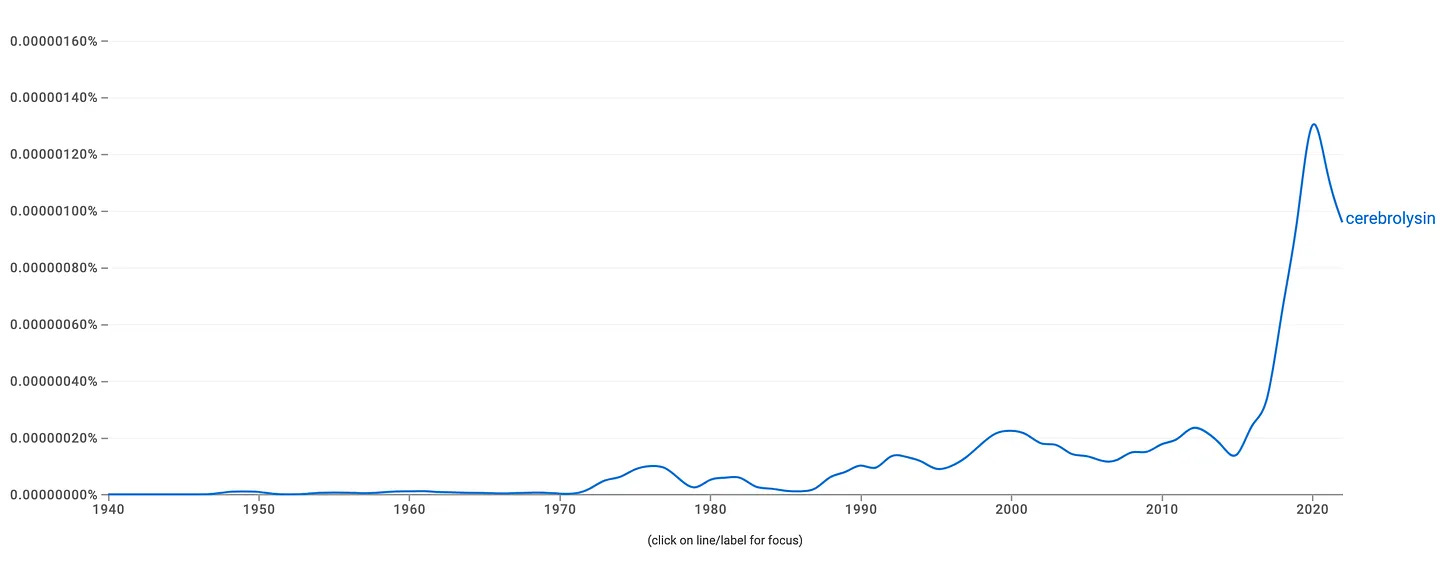
Cerebrolysin is an unregulated medical product made from enzymatically digested pig brain tissue. Hundreds of scientific papers claim that it boosts BDNF, stimulates neurogenesis, and can help treat numerous neural diseases. It is widely used by doctors around the world, especially in Russia and China.
A recent video of Bryan Johnson injecting Cerebrolysin has over a million views on X and 570,000 views on YouTube. The drug, which is advertised as a “peptide combination”, can be purchased easily online and appears to be growing in popularity among biohackers, rationalists, and transhumanists. The subreddit r/Cerebrolysin has 3,100 members.
TL;DR
Unfortunately, our investigation indicates that the benefits attributed to Cerebrolysin are biologically implausible and unlikely to be real. Here's what we found:

This work was produced at Apollo Research, based on initial research done at MATS.
LayerNorm is annoying for mechanstic interpretability research (“[...] reason #78 for why interpretability researchers hate LayerNorm” – Anthropic, 2023).
Here's a Hugging Face link to a GPT2-small model without any LayerNorm.
The final model is only slightly worse than a GPT2 with LayerNorm[1]:
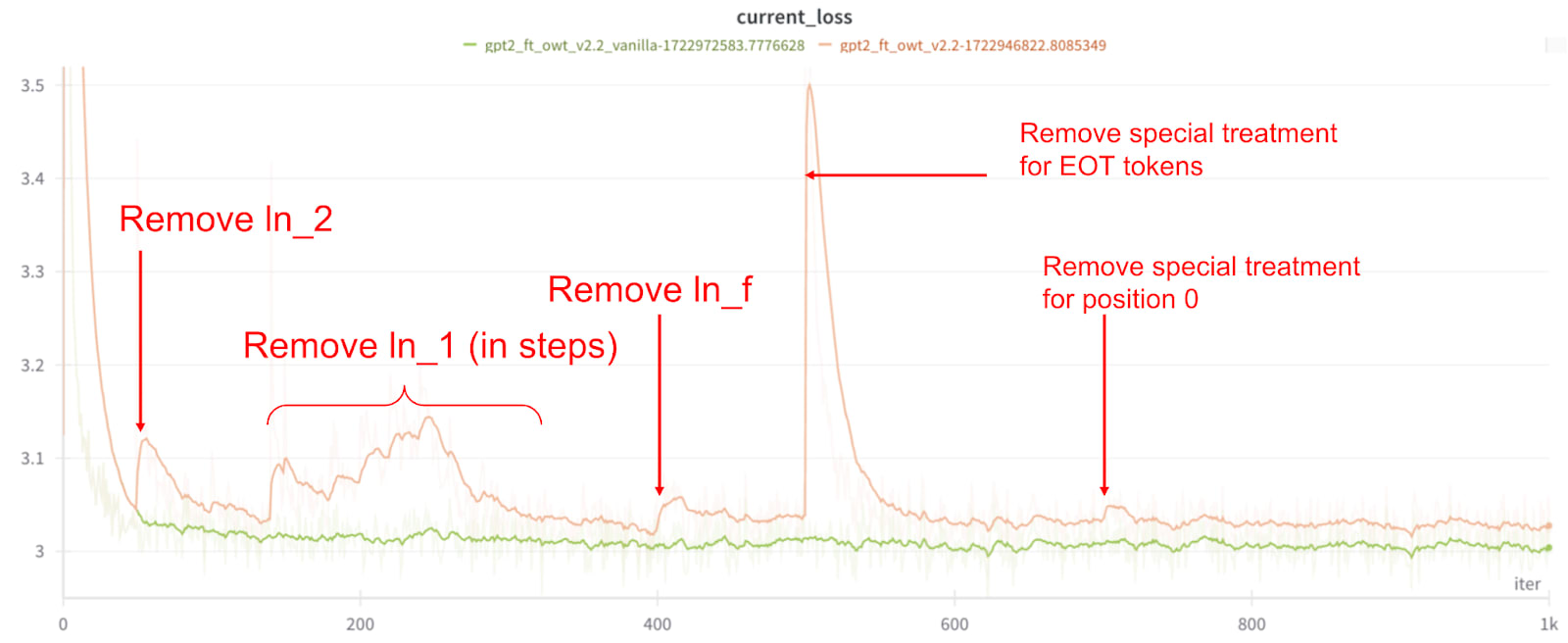
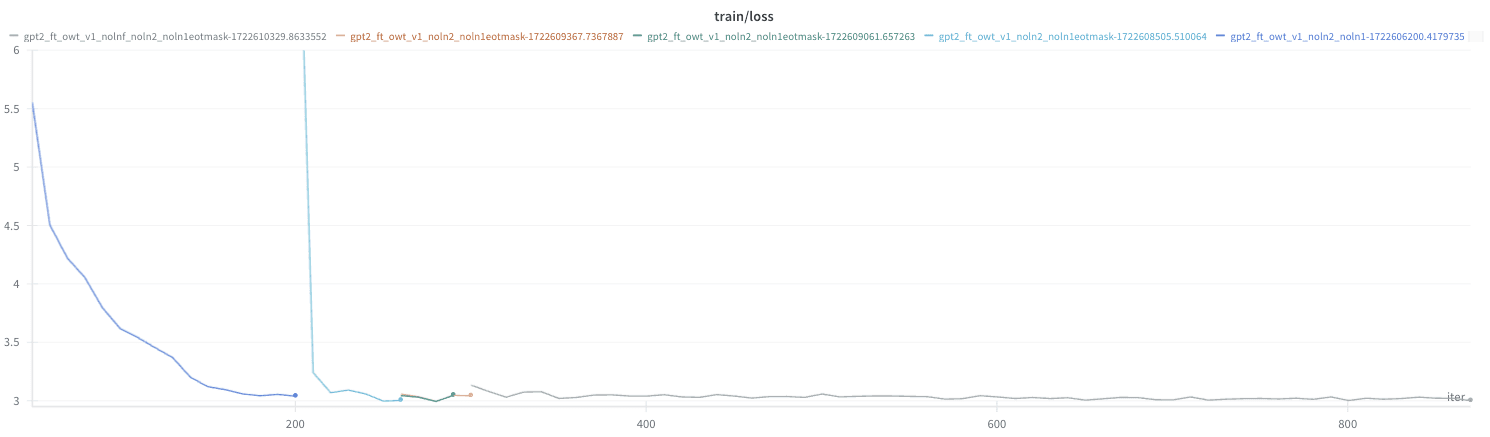
DatasetOriginal GPT2Fine-tuned GPT2 with LayerNormFine-tuned GPT without LayerNormOpenWebText (ce_loss)3.0952.9893.014 (+0.025)ThePile (ce_loss)2.8562.8802.926 (+0.046)HellaSwag (accuracy)29.56%29.82%29.54%I fine-tuned GPT2-small on OpenWebText while slowly removing its LayerNorm layers, waiting for the loss to go back down after reach removal:
Introduction
LayerNorm (LN) is a component in Transformer models that normalizes embedding vectors to have constant length; specifically it divides the embeddings by their standard deviation taken over the hidden dimension. It was originally introduced to stabilize and speed up training of models (as a replacement for batch normalization). It is active during training and inference.
<span>_mathrm{LN}(x) = frac{x - [...] ---
Outline:
(01:11) Introduction
(02:45) Motivation
(03:33) Method
(09:15) Implementation
(10:40) Results
(13:59) Residual stream norms
(14:32) Discussion
(14:35) Faithfulness to the original model
(15:45) Does the noLN model generalize worse?
(16:13) Appendix
(16:16) Representing the no-LayerNorm model in GPT2LMHeadModel
(18:08) Which order to remove LayerNorms in
(19:28) Which kinds of LayerNorms to remove first
(20:29) Which layer to remove LayerNorms in first
(21:13) Data-reuse and seeds
(21:35) Infohazards
(21:58) Acknowledgements
The original text contained 4 footnotes which were omitted from this narration.
The original text contained 5 images which were described by AI.
---
First published:
August 8th, 2024
Source:
https://www.lesswrong.com/posts/THzcKKQd4oWkg4dSP/you-can-remove-gpt2-s-layernorm-by-fine-tuning-for-an-hour
---
Narrated by TYPE III AUDIO.
---
This is slightly old news at this point, but: as part of MIRI's recent strategy pivot, they've eliminated the Agent Foundations research team. I've been out of a job for a little over a month now. Much of my research time in the first half of the year was eaten up by engaging with the decision process that resulted in this, and later, applying to grants and looking for jobs.
I haven't secured funding yet, but for my own sanity & happiness, I am (mostly) taking a break from worrying about that, and getting back to thinking about the most important things.
However, in an effort to try the obvious, I have set up a Patreon where you can fund my work directly. I don't expect it to become my main source of income, but if it does, that could be a pretty good scenario for me; it would [...]
---
Outline:
(01:00) What Im (probably) Doing Going Forward
(02:28) Thoughts on Public vs Private Research
The original text contained 1 footnote which was omitted from this narration.
---
First published:
August 8th, 2024
Source:
https://www.lesswrong.com/posts/SnaAYrqkb7fzpZn86/leaving-miri-seeking-funding
---
Narrated by TYPE III AUDIO.