Our TOPPODCAST Picks
 Audio narrations of LessWrong posts. Includes all curated posts and all posts with 125+ karma.
If you’d like more, subscribe to the “Lesswrong (30+ karma)” feed.

 Stay Connected
Audio narrations of LessWrong posts. Includes all curated posts and all posts with 125+ karma.
If you’d like more, subscribe to the “Lesswrong (30+ karma)” feed.
Copyright: © 2023 LessWrong Curated Podcast


Note: this is a static copy of this wiki page. We are also publishing it as a post to ensure visibility.
Circa 2015-2017, a lot of high quality content was written on Arbital by Eliezer Yudkowsky, Nate Soares, Paul Christiano, and others. Perhaps because the platform didn't take off, most of this content has not been as widely read as warranted by its quality. Fortunately, they have now been imported into LessWrong.
Most of the content written was either about AI alignment or math[1]. The Bayes Guide and Logarithm Guide are likely some of the best mathematical educational material online. Amongst the AI Alignment content are detailed and evocative explanations of alignment ideas: some well known, such as instrumental convergence and corrigibility, some lesser known like epistemic/instrumental efficiency, and some misunderstood like pivotal act.
The Sequence
The articles collected here were originally published as wiki pages with no set [...]
---
Outline:
(01:01) The Sequence
(01:23) Tier 1
(01:32) Tier 2
The original text contained 3 footnotes which were omitted from this narration.
---
First published:
February 20th, 2025
Source:
https://www.lesswrong.com/posts/mpMWWKzkzWqf57Yap/eliezer-s-lost-alignment-articles-the-arbital-sequence
---
Narrated by TYPE III AUDIO.
Arbital was envisioned as a successor to Wikipedia. The project was discontinued in 2017, but not before many new features had been built and a substantial amount of writing about AI alignment and mathematics had been published on the website.
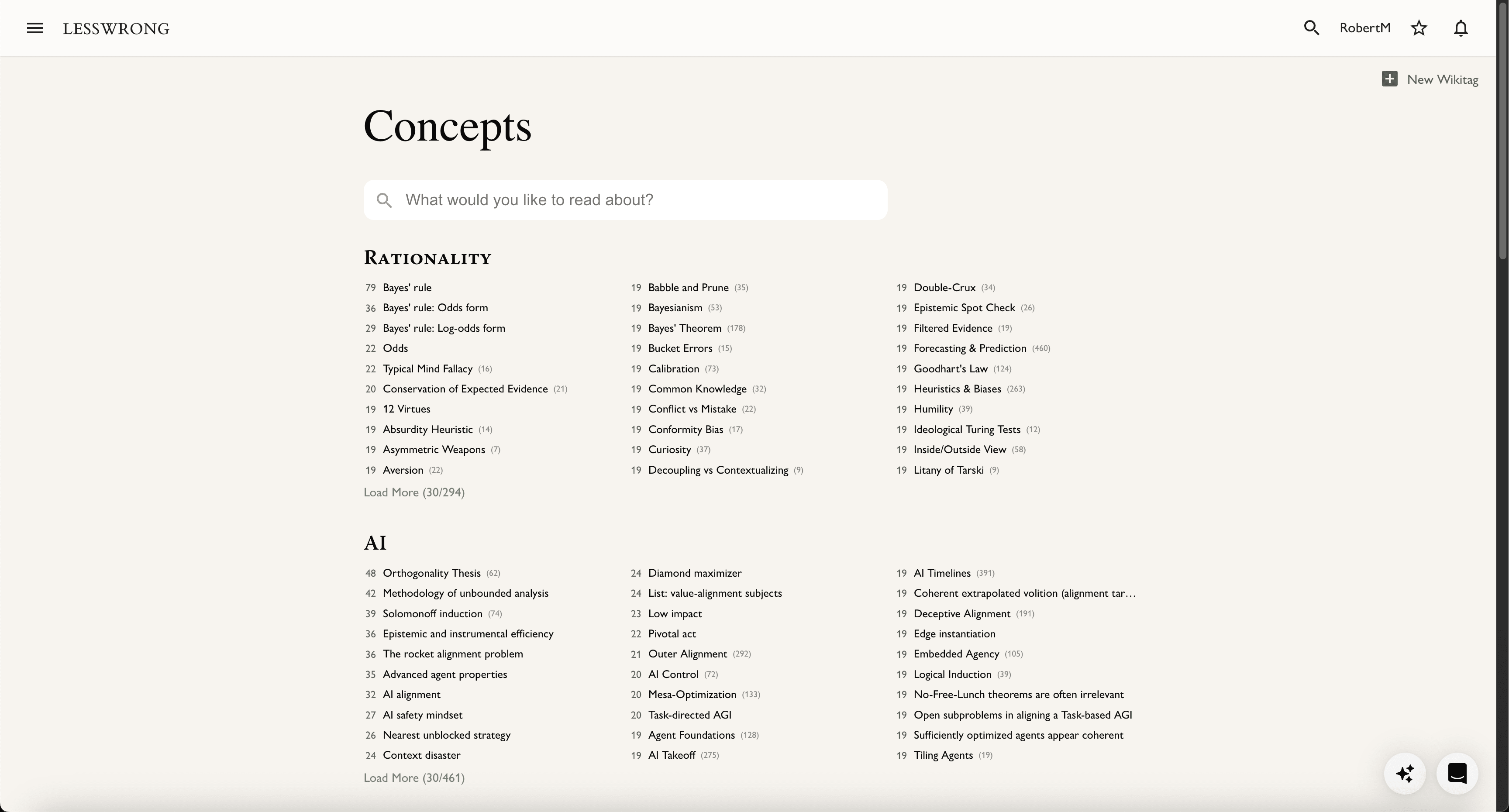
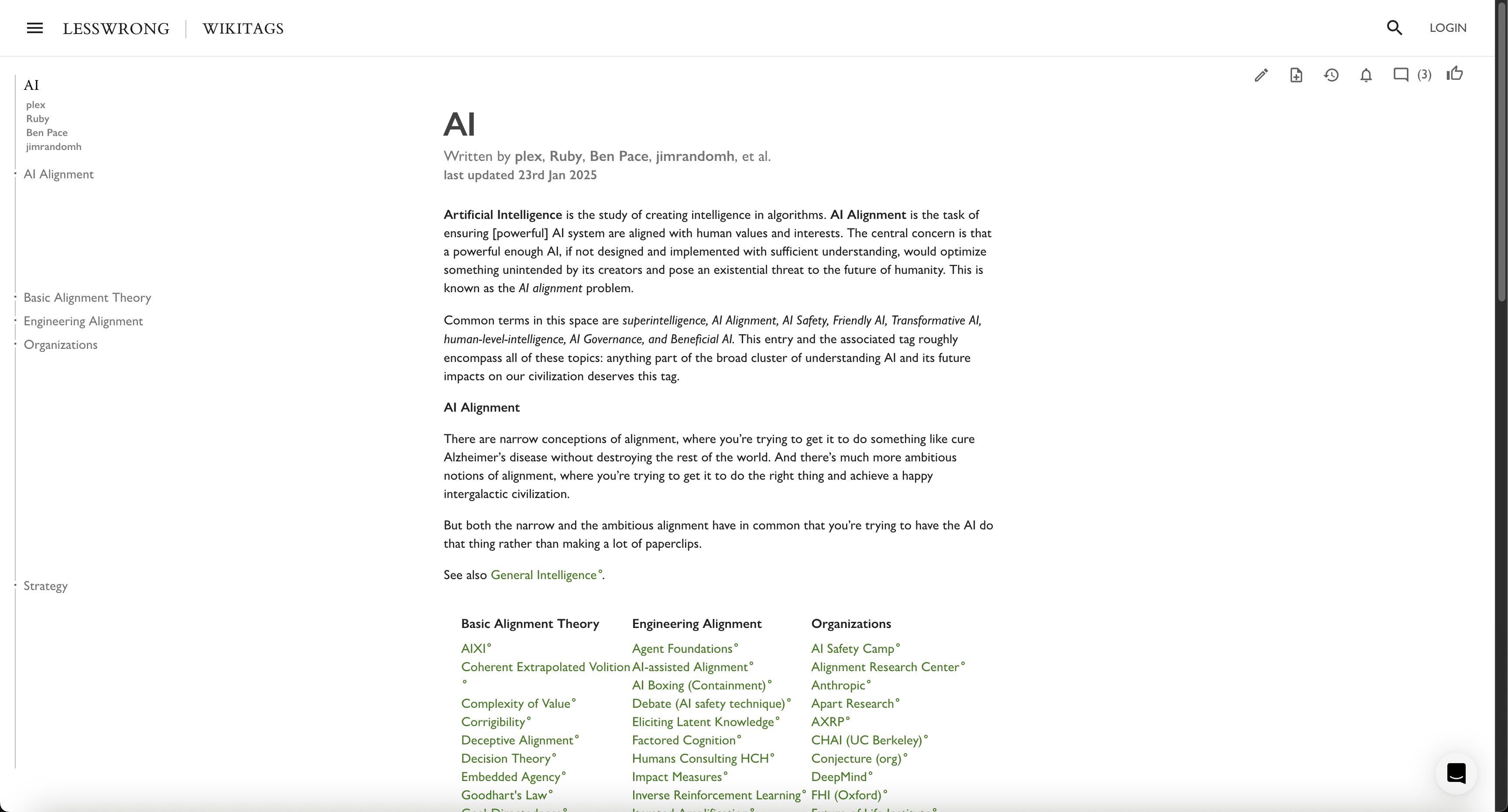
If you've tried using Arbital.com the last few years, you might have noticed that it was on its last legs - no ability to register new accounts or log in to existing ones, slow load times (when it loaded at all), etc. Rather than try to keep it afloat, the LessWrong team worked with MIRI to migrate the public Arbital content to LessWrong, as well as a decent chunk of its features. Part of this effort involved a substantial revamp of our wiki/tag pages, as well as the Concepts page. After sign-off[1] from Eliezer, we'll also redirect arbital.com links to the corresponding pages on LessWrong.
As always, you are [...]
---
Outline:
(01:13) New content
(01:43) New (and updated) features
(01:48) The new concepts page
(02:03) The new wiki/tag page design
(02:31) Non-tag wiki pages
(02:59) Lenses
(03:30) Voting
(04:45) Inline Reacts
(05:08) Summaries
(06:20) Redlinks
(06:59) Claims
(07:25) The edit history page
(07:40) Misc.
The original text contained 3 footnotes which were omitted from this narration.
The original text contained 10 images which were described by AI.
---
First published:
February 20th, 2025
Source:
https://www.lesswrong.com/posts/fwSnz5oNnq8HxQjTL/arbital-has-been-imported-to-lesswrong
---
Narrated by TYPE III AUDIO.
---
We’ve spent the better part of the last two decades unravelling exactly how the human genome works and which specific letter changes in our DNA affect things like diabetes risk or college graduation rates. Our knowledge has advanced to the point where, if we had a safe and reliable means of modifying genes in embryos, we could literally create superbabies. Children that would live multiple decades longer than their non-engineered peers, have the raw intellectual horsepower to do Nobel prize worthy scientific research, and very rarely suffer from depression or other mental health disorders.
The scientific establishment, however, seems to not have gotten the memo. If you suggest we engineer the genes of future generations to make their lives better, they will often make some frightened noises, mention “ethical issues” without ever clarifying what they mean, or abruptly change the subject. It's as if humanity invented electricity and decided [...]
---
Outline:
(02:17) How to make (slightly) superbabies
(05:08) How to do better than embryo selection
(08:52) Maximum human life expectancy
(12:01) Is everything a tradeoff?
(20:01) How to make an edited embryo
(23:23) Sergiy Velychko and the story of super-SOX
(24:51) Iterated CRISPR
(26:27) Sergiy Velychko and the story of Super-SOX
(28:48) What is going on?
(32:06) Super-SOX
(33:24) Mice from stem cells
(35:05) Why does super-SOX matter?
(36:37) How do we do this in humans?
(38:18) What if super-SOX doesn't work?
(38:51) Eggs from Stem Cells
(39:31) Fluorescence-guided sperm selection
(42:11) Embryo cloning
(42:39) What if none of that works?
(44:26) What about legal issues?
(46:26) How we make this happen
(50:18) Ahh yes, but what about AI?
(50:54) There is currently no backup plan if we can't solve alignment
(55:09) Team Human
(57:53) Appendix
(57:56) iPSCs were named after the iPod
(58:11) On autoimmune risk variants and plagues
(59:28) Two simples strategies for minimizing autoimmune risk and pandemic vulnerability
(01:00:29) I don't want someone else's genes in my child
(01:01:08) Could I use this technology to make a genetically enhanced clone of myself?
(01:01:36) Why does super-SOX work?
(01:06:14) How was the IQ grain graph generated?
The original text contained 19 images which were described by AI.
---
First published:
February 19th, 2025
Source:
https://www.lesswrong.com/posts/DfrSZaf3JC8vJdbZL/how-to-make-superbabies
---
Narrated by TYPE III AUDIO.
---

Audio note: this article contains 134 uses of latex notation, so the narration may be difficult to follow. There's a link to the original text in the episode description.
In a recent paper in Annals of Mathematics and Philosophy, Fields medalist Timothy Gowers asks why mathematicians sometimes believe that unproved statements are likely to be true. For example, it is unknown whether <span>_pi_</span> is a normal number (which, roughly speaking, means that every digit appears in <span>_pi_</span> with equal frequency), yet this is widely believed. Gowers proposes that there is no sign of any reason for <span>_pi_</span> to be non-normal -- especially not one that would fail to reveal itself in the first million digits -- and in the absence of any such reason, any deviation from normality would be an outrageous coincidence. Thus, the likely normality of <span>_pi_</span> is inferred from the following general principle:
No-coincidence [...]
---
Outline:
(02:32) Our no-coincidence conjecture
(05:37) How we came up with the statement
(08:31) Thoughts for theoretical computer scientists
(10:27) Why we care
The original text contained 12 footnotes which were omitted from this narration.
---
First published:
February 14th, 2025
Source:
https://www.lesswrong.com/posts/Xt9r4SNNuYxW83tmo/a-computational-no-coincidence-principle
---
Narrated by TYPE III AUDIO.
This is an all-in-one crosspost of a scenario I originally published in three parts on my blog (No Set Gauge). Links to the originals:


On March 14th, 2015, Harry Potter and the Methods of Rationality made its final post. Wrap parties were held all across the world to read the ending and talk about the story, in some cases sparking groups that would continue to meet for years. It's been ten years, and think that's a good reason for a round of parties.
If you were there a decade ago, maybe gather your friends and talk about how things have changed. If you found HPMOR recently and you're excited about it (surveys suggest it's still the biggest on-ramp to the community, so you're not alone!) this is an excellent chance to meet some other fans in person for the first time!
Want to run an HPMOR Anniversary Party, or get notified if one's happening near you? Fill out this form.
I’ll keep track of it and publish a collection of [...]
The original text contained 1 footnote which was omitted from this narration.
---
First published:
February 16th, 2025
Source:
https://www.lesswrong.com/posts/KGSidqLRXkpizsbcc/it-s-been-ten-years-i-propose-hpmor-anniversary-parties
---
Narrated by TYPE III AUDIO.
A friend of mine recently recommended that I read through articles from the journal International Security, in order to learn more about international relations, national security, and political science. I've really enjoyed it so far, and I think it's helped me have a clearer picture of how IR academics think about stuff, especially the core power dynamics that they think shape international relations.
Here are a few of the articles I most enjoyed.
"Not So Innocent" argues that ethnoreligious cleansing of Jews and Muslims from Western Europe in the 11th-16th century was mostly driven by the Catholic Church trying to consolidate its power at the expense of local kingdoms. Religious minorities usually sided with local monarchs against the Church (because they definitionally didn't respect the church's authority, e.g. they didn't care if the Church excommunicated the king). So when the Church was powerful, it was incentivized to pressure kings [...]
---
First published:
January 31st, 2025
Source:
https://www.lesswrong.com/posts/MEfhRvpKPadJLTuTk/some-articles-in-international-security-that-i-enjoyed
---
Narrated by TYPE III AUDIO.
This is the best sociological account of the AI x-risk reduction efforts of the last ~decade that I've seen. I encourage folks to engage with its critique and propose better strategies going forward.
Here's the opening ~20% of the post. I encourage reading it all.
In recent decades, a growing coalition has emerged to oppose the development of artificial intelligence technology, for fear that the imminent development of smarter-than-human machines could doom humanity to extinction. The now-influential form of these ideas began as debates among academics and internet denizens, which eventually took form—especially within the Rationalist and Effective Altruist movements—and grew in intellectual influence over time, along the way collecting legible endorsements from authoritative scientists like Stephen Hawking and Geoffrey Hinton.
Ironically, by spreading the belief that superintelligent AI is achievable and supremely powerful, these “AI Doomers,” as they came to be called, inspired the creation of OpenAI and [...]
---
First published:
January 31st, 2025
Source:
https://www.lesswrong.com/posts/YqrAoCzNytYWtnsAx/the-failed-strategy-of-artificial-intelligence-doomers
---
Narrated by TYPE III AUDIO.
Hi all
I've been hanging around the rationalist-sphere for many years now, mostly writing about transhumanism, until things started to change in 2016 after my Wikipedia writing habit shifted from writing up cybercrime topics, through to actively debunking the numerous dark web urban legends.
After breaking into what I believe to be the most successful ever fake murder for hire website ever created on the dark web, I was able to capture information about people trying to kill people all around the world, often paying tens of thousands of dollars in Bitcoin in the process.
My attempts during this period to take my information to the authorities were mostly unsuccessful, when in late 2016 on of the site a user took matters into his own hands, after paying $15,000 for a hit that never happened, killed his wife himself
Due to my overt battle with the site administrator [...]
---
First published:
February 13th, 2025
Source:
https://www.lesswrong.com/posts/isRho2wXB7Cwd8cQv/murder-plots-are-infohazards
---
Narrated by TYPE III AUDIO.
This is the full text of a post from "The Obsolete Newsletter," a Substack that I write about the intersection of capitalism, geopolitics, and artificial intelligence. I’m a freelance journalist and the author of a forthcoming book called Obsolete: Power, Profit, and the Race to build Machine Superintelligence. Consider subscribing to stay up to date with my work.
Wow. The Wall Street Journal just reported that, "a consortium of investors led by Elon Musk is offering $97.4 billion to buy the nonprofit that controls OpenAI."
Technically, they can't actually do that, so I'm going to assume that Musk is trying to buy all of the nonprofit's assets, which include governing control over OpenAI's for-profit, as well as all the profits above the company's profit caps.
OpenAI CEO Sam Altman already tweeted, "no thank you but we will buy twitter for $9.74 billion if you want." (Musk, for his part [...]
---
Outline:
(02:42) The control premium
(04:17) Conversion significance
(05:43) Musks suit
(09:24) The stakes
---
First published:
February 11th, 2025
Source:
https://www.lesswrong.com/posts/tdb76S4viiTHfFr2u/why-did-elon-musk-just-offer-to-buy-control-of-openai-for
---
Narrated by TYPE III AUDIO.