TopPodcast.com
Menu
  • Home
  • Top Charts
  • Top Networks
  • Top Apps
  • Top Independents
  • Top Podfluencers
  • Top Picks
    • Top Business Podcasts
    • Top True Crime Podcasts
    • Top Finance Podcasts
    • Top Comedy Podcasts
    • Top Music Podcasts
    • Top Womens Podcasts
    • Top Kids Podcasts
    • Top Sports Podcasts
    • Top News Podcasts
    • Top Tech Podcasts
    • Top Crypto Podcasts
    • Top Entrepreneurial Podcasts
    • Top Fantasy Sports Podcasts
    • Top Political Podcasts
    • Top Science Podcasts
    • Top Self Help Podcasts
    • Top Sports Betting Podcasts
    • Top Stocks Podcasts
  • Podcast News
  • About Us
  • Podcast Advertising
  • Contact
Not in our directory?
Add Show Here
Podcast Equipment
Center

toppodcastlogoOur TOPPODCAST Picks

  • Comedy
  • Crypto
  • Sports
  • News
  • Politics
  • True Crime
  • Business
  • Finance

Follow Us

toppodcastlogoStay Connected

    View Top 200 Chart
    Back to Rankings Page
    Natural Sciences

    KGNU – How On Earth

    The KGNU Science Show

    Advertise
    • Apple Podcasts
    • Google Play
    • Spotify

    Latest Episodes:
    China’s environmental impact // 100 Year Starship Jun 18, 2013
    Show notes

    Today, June 18, we offer two features interviews:
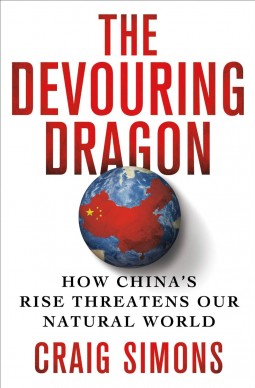
    Feature #1 – China’s Environmental Impact (start time 4:46): China’s meteoric economic rise is causing harmful side effects, ranging from choking air pollution domestically to threatened forests, wildlife and air quality around the globe. Of course China’s per capita greenhouse gas emissions still pale in comparison to those in the United States, and roughly one-third of China’s CO2 emissions are generated to manufacture goods that are exported to the U.S. and other nations. Craig Simons, a former journalist and author of a recently published book, The Devouring Dragon: How China’s Rise Threatens Our Natural World, discusses with co-host Susan Moran these critical issues, including coal mining in Colorado for export to China.

    Feature #2 – 100 Year Starship (start time 15:35): Science and exploration tend to be long-term commitments. That’s well-known by fans of the “Hitchhiker’s Guide to The Galaxy” series, where the computer Deep Thought did calculations for 7.5 million years to find the answer to The Ultimate Question of Life, the Universe, and everything. However, projects on our world tend to be limited by shorter-term political and funding cycles. So it is hard enough to consider projects that require thinking a decade into the future, beyond many political lifetimes. What about projects that require thinking a century or more into the future, many generations from now? Well, that is exactly what one group of space exploration advocates is working toward. The project is called the 100 Year Starship, which aims to create a long-duration mission sending humans to another star. Alires Almon, member of the project, talks with co-host Joel Parker about the challenges and the vision of 100 Year Starship.

    Hosts: Susan Moran, Joel Parker
    Producer: Susan Moran
    Engineer: Joel Parker
    Executive Producer: Joel Parker

    Listen to the show:


    Bird collisions and wind energy policy Jun 10, 2013
    Show notes

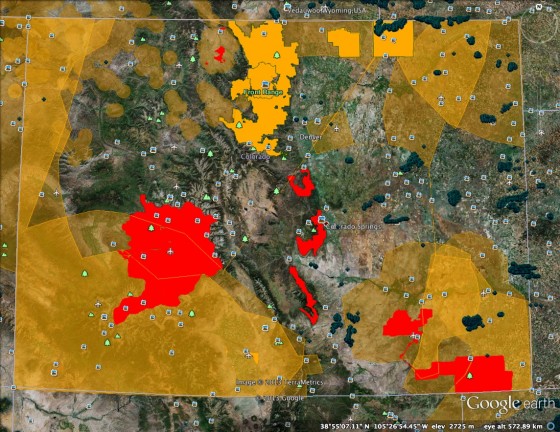
    High importance (yellow) and critical importance (red) risk areas to birds and wind tower proposals (2003-2011) (dark crosses). Source: American Bird Conservancy.

    One to two million additional bird deaths per year. Wind is the most rapidly growing energy source in the US, but are environmental protections keeping pace? Tuesday on How On Earth, Kelly Fuller, the American Bird Conservancy’s Wind Campaign Coordinator, talks with Jim Pullen about the impact of big wind on birds.

    Host: Jim Pullen
    Producer: Jim Pullen
    Executive Producer: Joel Parker

    Listen here:


    Cancer Drug Delivery // Mars’ Radiation Risks Jun 04, 2013
    Show notes

    Enjoy the two features we offer today, June 4:

    A “raft” artificially created in a liposome.
    Photo courtesy Tom Anchordoquy

    Feature #1 (start time 5:36): Cancer drugs are much more targeted than they were many years ago. But researchers are still trying to find a way to deliver drugs much more precisely to cancer cells, partly to avoid damaging, sometimes lethal, side effects. A huge obstacle has been getting nucleic acids to cross the membrane of cancer cells. A new study has brought researchers closer to crossing this big hurdle. Dr. Tom Anchordoquy, a lead author of the study, speaks with co-host Susan Moran about the study and what it means for cancer patients and researchers. Dr. Anchordoquy is an investigator at the University of Colorado Cancer Center in Denver and a professor at the Skaggs School of Pharmacy and Pharmaceutical Sciences.

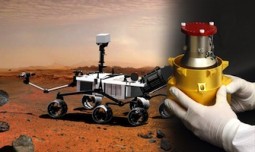
    The Radiation Assessment Detector, or RAD, instrument (right) is one of 10 science instruments on the Mars Curiosity rover (depicted in the artist’s concept on the left). Image credit: NASA/JPL-Caltech/SwRI

    Feature #2 (start time 15:02): Being an astronaut is a risky job, but perhaps one of the less-known risks is the high levels of radiation beyond the relatively protective cocoon of Earth’s magnetic field. This will be a particularly important problem to address for long-duration deep-space flight such as going to Mars. Until recently there have not been a lot of measurements available of the interplanetary radiation field for the types of radiation that could affect humans. But on the Curiosity rover of the Mars Science Laboratory, there is a radiation detector designed to make those important measurements. The instrument team recently published their initial results. Dr. Don Hassler, Science Program Director at Southwest Research Institute’s Boulder office and the Principal Investigator for the Radiation Assessment Detector on the Mars Curiosity rover, talks with co-host Joel Parker about the results.

    Hosts: Susan Moran, Joel Parker
    Producer: Susan Moran
    Engineer: Joel Parker
    Executive Producer: Joel Parker

    Listen to the audio here:


    Oh Thank You Canada: Lessons from the North on Growing Industrial Hemp May 27, 2013
    Show notes

    Canadian hemp being cut by combine-harvesters. (Canadian Hemp Trade Alliance)

    (starts at 08:19) At (high? no, not this plant) noon on Tuesday, Governor John Hickenlooper will sign a bill that will legalize growing industrial hemp in Colorado. But it’s been 70 years since hemp was legally grown in the US… Fortunately, because Canada lifted its ban in the 1990s, we can seek the experience of our northern neighbors. Join the How On Earth team and guest Dr. Jan Slaski, a Canadian plant science expert, to learn about the modern practice of growing industrial hemp.

    Hosts: Jim Pullen and Joel Parker
    Producer: Jim Pullen
    Engineer: Joel Parker
    Executive Producer: Joel Parker

    Listen to the show:


    Palm oil and rainforest devastation May 21, 2013
    Show notes

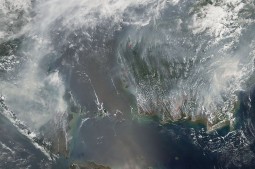
    NASA satellite image of slash and burn being used to clear rainforest in Sumatra.

    (start time: 07:23) We talk with Lindsey Allen, the Executive Director of the Rainforest Action Network, about the destruction of rainforest from the proliferation of palm oil plantations.

    Hosts: Jim Pullen, Joel Parker
    Producer: Jim Pullen
    Engineer: Joel Parker
    Executive Producer: Joel Parker

    Listen to the show:


    Larry Gold – Gold Lab Symposium May 15, 2013
    Show notes

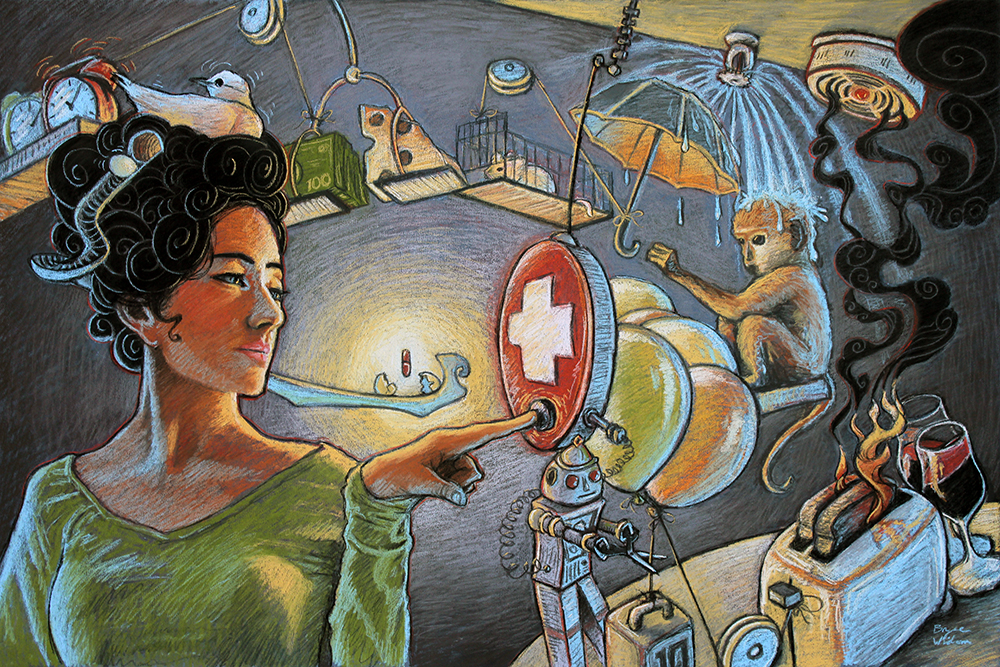
    We talk with Larry Gold about this year’s Gold Lab Symposium at CU-Boulder. It features, “The Biological and Social Evolution of Healthcare: Rube Goldberg and Time. Friday, May 17th – Saturday, May 18th, 2013, Muenzinger Auditorium, University of Colorado Boulder. NOTE: After the conference, speaker presentations will be posted at the Gold Lab Symposium site.

    Hosts: Joel Parker, Jim Pullen
    Producer: Shelley Schlender
    Engineer: Shelley Schlender
    Executive Producer: Joel Parker

    Listen to the show:


    Brain Trust // Drought May 07, 2013
    Show notes

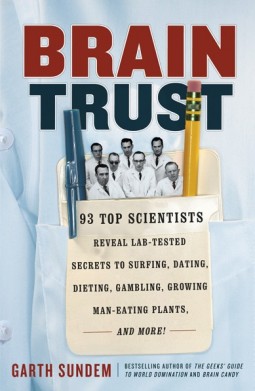
    Brain Trust (starts at 4:23) When you are trying to make a decision about something important or having a disagreement with someone, don’t you sometimes wish you had a scientist with you – a world expert on the topic at hand – to help you out? In fact, it would be great to have dozens of experts in many fields available, sort of your own personal Brain Trust. Well, luckily Garth Sundem can help you out with his book called: “Brain Trust,” where he has interviewed 93 of the top scientists in fields like physics, genetics, cognitive science, economics, nutrition, mathematics, and talked to them about very important topics in their fields. And not the easy topics like Higgs Bosons, Fermat’s Last Theorem, and inflationary cosmology, but rather the much more difficult – and immediately useful – topics like: the best design for a paper airplane, how to survive Armageddon, how to create giant man-eating plants, successful dating techniques (and we don’t mean carbon dating), and how to tell when someone is lying. Host Joel Parker talks with Garth about his book.

    Drought (starts at 15:10) Given all the rain and snow on the Front Range and beyond lately, you’d think that Colorado is emerging from the persistent drought, right? But last year was one of the hottest and driest on record in the state and some regions have yet to recover. Among those who have suffered the most from the persistent drought are farmers and ranchers. In fact, some have sold off cattle and even shuttered their businesses. That said, high prices have boosted profits for some wheat farmers, for instance. To find out just how badly many farmers and ranchers have been hit by the drought, researchers at Colorado State University have been surveying them annually for a while. Host Susan Moran talks with Christopher Goemans, a resource economist in the Department of Agricultural and Resource Economics at Colorado State University, and Ron Nelson, a graduate student also at CSU, about a recent survey of drought conditions and the broader environment.

    Hosts: Joel Parker, Susan Moran
    Producer: Joel Parker
    Engineer: Joel Parker
    Executive Producer: Joel Parker

    Listen to the show:


    Dr. David Wineland and the human side of winning the Nobel Prize May 01, 2013
    Show notes

    Dr. David Wineland (photo courtesy of NIST)

    Today on How On Earth, KGNU’s award-winning science show, we continue our discussion with Boulder’s Dr. David Wineland about the human side of winning the Nobel Prize. The National Institute of Standards and Technology scientist shared the 2012 physics award with France’s Serge Haroche. They’ve developed experimental methods for trapping and holding particles so that weird quantum behaviors can be studied. The research is critical to developing extreme quantum computers that may someday break today’s best encryption algorithms…and make truly unbreakable ones.

    Host: Jim Pullen
    Producer: Jim Pullen
    Executive Producer: Joel Parker

    Listen to the show:


    Mapping Pain in the Brain – CU Scientist Tor Wager Apr 23, 2013
    Show notes

    Brain Pain Signature

    Headlines:

    1. Climate Change Accelerates Changing Climate Zones – CU-Boulder and CIRES Scientist Irina Mahlstein (starts at 1:00)
    2. Family Dogs Harber Family Microbes – CU Boulder Scientist Rob Knight (and the American Gut Project) (starts at 2:26)
    3. Sound from the Big Bang – from John G. Cramer (starts at 4:45)

    Mapping Pain in the Brain (starts at 7:30 )

    If you hit your thumb with a hammer, you feel physical pain. Terrible sunburn? Pain. A muscle cramp? Pain. In each case, you know it’s pain. But how a body senses this pain has been elusive. Surgeons have tried to cut out what they think of as the brain’s pain center. This often doesn’t work, and it has side effects. Painkilling drugs? Sometimes they help, sometimes they cause addiction. Understanding the brain’s pain circuits might help scientists find better ways to deal with pain. Last week, CU-Boulder researchers took a step in that direction by publishing a magnetic resonance imaging map that they believe shows the signature of physical pain response within the brain. The lead researcher on this project is Tor Wager. Wager is the director of the Cognitive and Affective Neuroscience laboratory at the University of Colorado, Boulder.

    Hosts: Joel Parker, Chip Grandits
    Producer: Shelley Schlender
    Engineer: Shelley Schlender
    Executive Producer: Joel Parker

    Listen to the show:


    Conference on World Affairs Special with SETI’s Seth Shostak Apr 09, 2013
    Show notes

    One of the SETI Institute’s telescopes in the Allen array. (2007 photo courtesy of Colby Gutierrez-Kraybill and used under a Creative Commons license.)

    Welcome to a special episode of How On Earth with Dr. Seth Shostak, the Senior Astronomer at the Search for Extraterrestrial Intelligence Institute. We’ve been listening for their tell-tale signal for 50 years with no luck, but Seth says that he’ll bet a cup of coffee we’ll hear from them in the next few decades. We explore what might happen if we find these brainy aliens or if we don’t find them at all. It’s part of the Conference on World Affairs.

    Host: Jim Pullen
    Executive Producer: Joel Parker

    Listen to the show:


    Previous 1 63 64 65 66 67 79 Next

    Related Podcasts

    Science Friday

    1

    Science Friday Astronomy
    Radiolab

    2

    Radiolab Documentary
    BrainStuff

    3

    BrainStuff Natural Sciences
    StarTalk with Neil deGrasse Tyson

    4

    StarTalk with Neil deGrasse Tyson Games & Hobbies
    Radiolab

    5

    Radiolab Documentary
    Stuff To Blow Your Mind

    6

    Stuff To Blow Your Mind Life Sciences
    footer-logo

    Contact Us

    Toll Free: 844-670-7747

    Links

    • Home
    • Top Charts
    • Networks
    • Apps
    • Independents Podcasts
    • Podcast Advertising
    • Podcast News
    • Contact Us
    • About Us
    • Analytics & Insights

    Stay Connected

      Privacy, Terms of Use & Our Code of Ethics Protecting Content Creators Copyrights