Pledge Drive: Mind-Body Science
Mar 08, 2016
Show notes
Image credit: Target Health Global
In today’s spring pledge-drive show we play clips from an interview with Jo Marchant, author of the new book Cure: A Journey into the Science of Mind Over Body. (Stay tuned for the extended interview on next Tuesday’s show.) And we highlight another book, Sex in the Sea: Our Intimate Connection with Sex-Changing Fish, Romantic Lobsters, Kinky Squid, and Other Salty Erotica of the Deep, by Marah Hardt. Call KGNU (303-449-4885) or pledge online (www.kgnu.org) and you will have the chance to make either of these books yours.
Hosts: Susan Moran, Joel Parker Producer: Susan Moran Engineer: Joel Parker Additional contributions: Beth Bennett Executive Producer: Joel Parker
Listen to the show here:
STEM Research // Sex in the Sea
Feb 24, 2016
Show notes
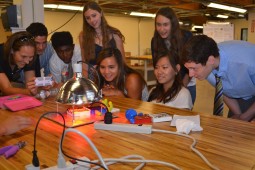
High school researchers in CU Boulder program observing photo-origami model. Photo credit: Stacey Forsyth
Today’s show offers two features: High School STEM Stars (start time: 5:00): Developing polymers to reduce waste from biodiesel production. Using 3D printing to design ocean textures, such as fish gills and waves, that blind students can use in textbooks to better understand nature. These are the kind of vexing challenges of seasoned scientists. Well, a select group of high school students here on the Front Range are also diving into this research, through the University of Colorado’s Photo-Origami Research Project. It’s part of the Research Experience and Mentoring (REM) program. Our guests–Lindsey Welch, a sophomore at Centaurus High; and Tyco Mera Evans, a senior at Northglenn High– will give poster presentations at the Emerging Researchers National Conference in STEM, in Washington, D.C. this week. Joining them in the studio is Kathryn Penzkover, who directs high school programs through CU Science Discovery.
Sex & Evolution Beneath the Waves (start time: 14:45) Ever wonder about the sex lives of gender-bending fish, desperately virgin elephant seals, and other creatures of the sea? Marine ecologist Marah Hardt has made a career out of it. She speaks with host Susan Moran about her newly published book, Sex in the Sea: Our Intimate Connections with Sex-changing Fish, Romantic Lobsters, Kinky Squid, and Other Salty Erotica of the Deep. Dr. Hardt, who works with the nonprofit Future of Fish, illuminates how sex in the sea is at the heart of healthy and sustainable oceans. The oceans, along with their inhabitants, are under many threats, including overfishing and climate change. She will speak tonight about her book at the Boulder Book Store. For more information on ocean conservation issues, and to get involved here in land-locked Colorado, check out the nonprofit Colorado Ocean Coalition. And listen to previous related interviews, in our series “The Ocean Is Us.”
Hosts: Susan Moran, Joel Parker Producer: Susan Moran Engineer: Joel Parker Additional contributors: Beth Bennett Executive Producer: Joel Parker
Listen to the audio here:
First Detection of Gravitational Waves
Feb 17, 2016
Show notes
Interview with LIGO Scientist Dr. Matt Evans (6:22): The recent big news in physics was the announcement of the first direct detection of gravitational waves. The detection was made by the LIGO project, which stands for “Laser Interferometer Gravitational-Wave Observatory”. Reports have said that this is a confirmation of general relativity and a new way to view the universe. To help us understand that, and why this is such a significant achievement, we have on the phone Dr. Matthew Evans, an Assistant Professor of Physics at MIT. Dr. Evans is a member of the LIGO Scientific Collaboration and the chair of the Advanced Interferometer Configurations working group. His research focus is on gravitational wave detector instrumentation, and the fundamental sensitivity of gravitational wave detectors.
Hosts: Kendra Krueger, Joel Parker Producer: Kendra Krueger Engineer: Kendra Krueger Additional Contributions: Beth Bennett Executive Producer: Joel Parker
Listen to the show:
How the Glucocorticoid Receptor can Treat Asthma, Cancer, and More
Feb 12, 2016
Show notes
What the mysterious acronym means
The Glucocorticoid Receptor (starts at 5:30): We interview Dr. Miles Pufall who studies the glucocorticoid receptor, a protein in cell membranes that is the target of drugs used to treat a variety of conditions from asthma to cancer. Binding cortisol causes the receptor to be moved to the nucleus where it turns on (or off) numerous genes. One of the big questions is how does each cell type ‘know’ which genes should be targeted?
Hosts: Beth Bennett, Joel Parker Producer: Beth Bennett Engineer: Beth Bennett Additional Contributions: Joel Parker, Susan Moran Executive Producer: Joel Parker
Listen to the show:
Winter Stars // Pollinators and Insecticides
Feb 02, 2016
Show notes
Winter Stars (starts at 5:30). We talk with Dave Sutherland, an interpretive naturalist with Boulder Open Space and Mountain Parks, about winter star-gazing. This program is tied to an upcoming concert performance by the Boulder Philharmonic Orchestra on February 12, 2016. More information about the Boulder night hikes and other programs can be found at: www.naturehikes.org and to find out more about for the starry concert and to purchase tickets, check out http://boulderphil.org/site/concerts/spheres-of-influence
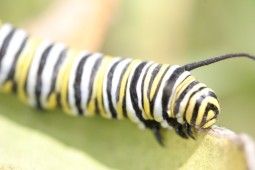
Monarch larvae Photo credit: Jonathan Lundgren
Pollinators and Insecticides (starts at 10:06). Although they may be hidden in the chill of winter, crickets, bees and thousands of other insects play a critical role year-round in how we grow the food we eat. Dr. Jonathan Lundgren, a South Dakota-based entomologist, talks with host Susan Moran about how predator insects serve as biological pest controls. Dr. Lundgren’s research on adverse effects of a controversial class of insecticides, called neonicotinoids, on pollinators such as honeybees and monarch butterflies, has made him the target of political pressure from his employer, the U.S. Department of Agriculture. A watchdog group has filed a whistleblower complaint on Lundgren’s behalf against the USDA. Dr. Lundgren recently started a research and education farm, called Blue Dasher Farm, which promotes regenerative agriculture.
Hosts: Susan Moran, Joel Parker Producer & Engineer: Joel Parker Executive Producer: Joel Parker
Listen to the show:
Electric Car Road Trips // Renewable Energy Nation . . . in 15 Years
Jan 26, 2016
Show notes
Tesla Superchargers – Rural Arizona
Electric Car Road Trips (starts 3:42): We go on a road trip with How on Earth’s Shelley Schlender to see how all-electric vehicles are exceeding “range anxiety” by driving coast to coast, all on electricity. Along the way we talk with Boulder Nissan’s Nigel Zeid about regional plans to help more drivers “plug in” and with Hunter Lovins, head of Natural Capitalism Solutions.
courtesy Solar Praxis
Renewable Energy Nation (starts 11:53): Joel Parker talks live with NOAA scientist Alexander MacDonald and Christopher Clack, a mathematician at the University of Colorado-Boulder. They have developed a model that demonstrates how the entire U.S. can run on solar and wind power–with existing technologies, with no batteries, and at lower cost than today’s prices–within 15 years. For more information, see this video and these animations of: U.S. Wind Power Potential U.S. Solar Power Potential U.S. Power Flow
Hosts: Joel Parker, Beth Bennett Producer: Shelley Schlender Executive Producer: Joel Parker Engineer: Shelley Schlender Additional Contributions: Susan Moran
Listen to the show:
Using the Microbiome to Determine Time of Death
Jan 20, 2016
Show notes
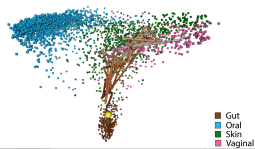
Using the Microbiome to Determine Time of Death (starts at 5:40): This week on How on Earth, we speak with Jessica Metcalf, an evolutionary biologist, who studies bacteria, specifically the microbiome. One of her research interests is using molecular biology to address basic hypotheses about the role of microbes in corpse decomposition. The time since death, or postmortem interval, also known as (PMI), is important for criminal investigations because it can lead to the identification of the deceased and validate alibis. PMI is critical to both forensic science and pop culture (e.g. TV shows Bones, CSI). Recently she co-authored a paper published in Science, describing how various species of the microbiome can be used to accurately and repeatedly determine the post-mortem interval.
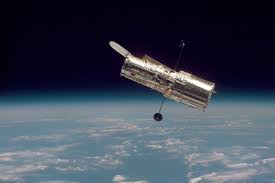
Today’s show of How on Earth starts with headlines about dark matter, genetic mysteries, jealous monkeys, and polar bears. We then present a short feature of BBC’s Science in Action about the Hubble Space Telescope.
This is shorter than our usual How on Earth show due to technical difficulties with the phone system for our feature interview with entomologist Jonathan Lundgren; that feature will appear in a future show.
Hosts: Susan Moran, Joel Parker Producer: Susan Moran Executive Producer and Engineer: Joel Parker Headline Contributions: Susan Moran, Beth Bennett, Joel Parker
Click below to listen to the show:
Hunter Lovins – Regenerative Economics Extended Version
Jan 05, 2016
Show notes
Hunter Lovins – Natural Capitalism Solutions
Hunter Lovins – Regenerative Economics EXTENDED VERSION. This is the extended version of the fall 2015 talk by Hunter Lovins, recorded by Shelley Schlender. Lovins heads up Natural Capitalism Solutions, and she’s a sought after speaker around the world, as well as here in Colorado. She gave this talk, including visuals, and called it Regenerative Economics. This talk was recorded in Boulder as part of the Colorado Chautauqua Events series, in conjunction with the Boulder City Club.
Our Microbes, Ourselves — Special Call-in Show
Dec 31, 2015
Show notes
human gut microbes
Our Microbes, Ourselves, Dec. 31, 2015: Roughly one hundred trillion bacteria are living, and gorging, in our gut–all the more so during the indulgent holidays. Microbes influence our health and well-being, by affecting our gut directly, as well as the crops we eat and the soils in which we grow crops. These microbial communities – called the gut microbiome — have been linked to many disorders, including obesity, inflammatory bowel disease, diabetes, cancer, immune disorders, and even mental illness. We are just at the dawn of a new era of microbial treatments for many illnesses. After a recent How On Earthshow generated so much interest, we decided to bring our guest, Amy Sheflin, back for an hour-long call-in show on A Public Affair on KGNU. Amy is a doctoral student at Colorado State University in food science and human nutrition. She studies how the food we eat alters the microbial communities in our gut, and how those microbes in our bodies influence our overall health. For more info on the gut microbiome, check out Amy’s favorite books on the topic: The Good Gut, by Justin and Erica Sonnenburg; and The Inside Tract, by Gerard Mullins. Also check out the American Gut Project.

 Our TOPPODCAST Picks
 Stay Connected


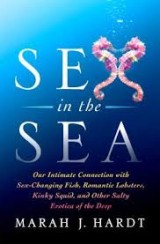 Sex & Evolution Beneath the Waves (start time: 14:45) Ever wonder about the sex lives of gender-bending fish, desperately virgin elephant seals, and other creatures of the sea? Marine ecologist
 Interview with LIGO Scientist Dr. Matt Evans (6:22): The recent big news in physics was the announcement of the first direct detection of gravitational waves. The detection was made by the

 Winter Stars (starts at 5:30). We talk with Dave Sutherland, an interpretive naturalist with Boulder Open Space and Mountain Parks, about winter star-gazing. This program is tied to an upcoming concert performance by the Boulder Philharmonic Orchestra on February 12, 2016. More information about the Boulder night hikes and other programs can be found at:


 Using the Microbiome to Determine Time of Death (starts at 5:40): This week on How on Earth, we speak with